IOne Mark question
1.The country follow constitutional monarchy
--Japan
2. Name the German philosopher who glorified war?
-- Friedrich Nietzche
3. How state is differ from communities?
No face to face relationship
No blood relationship
No common descend
4. The nationalism has two phases constructive and destructive
Constructive phase of nationalism
Create loyality
Unite people
Lead to freedom
Promote democracy
Example - cultural growth
Destructive phase of nationalism
Create bitterness
Divide people
Lead to disintegration
Promote isolation
Example- Instable govt
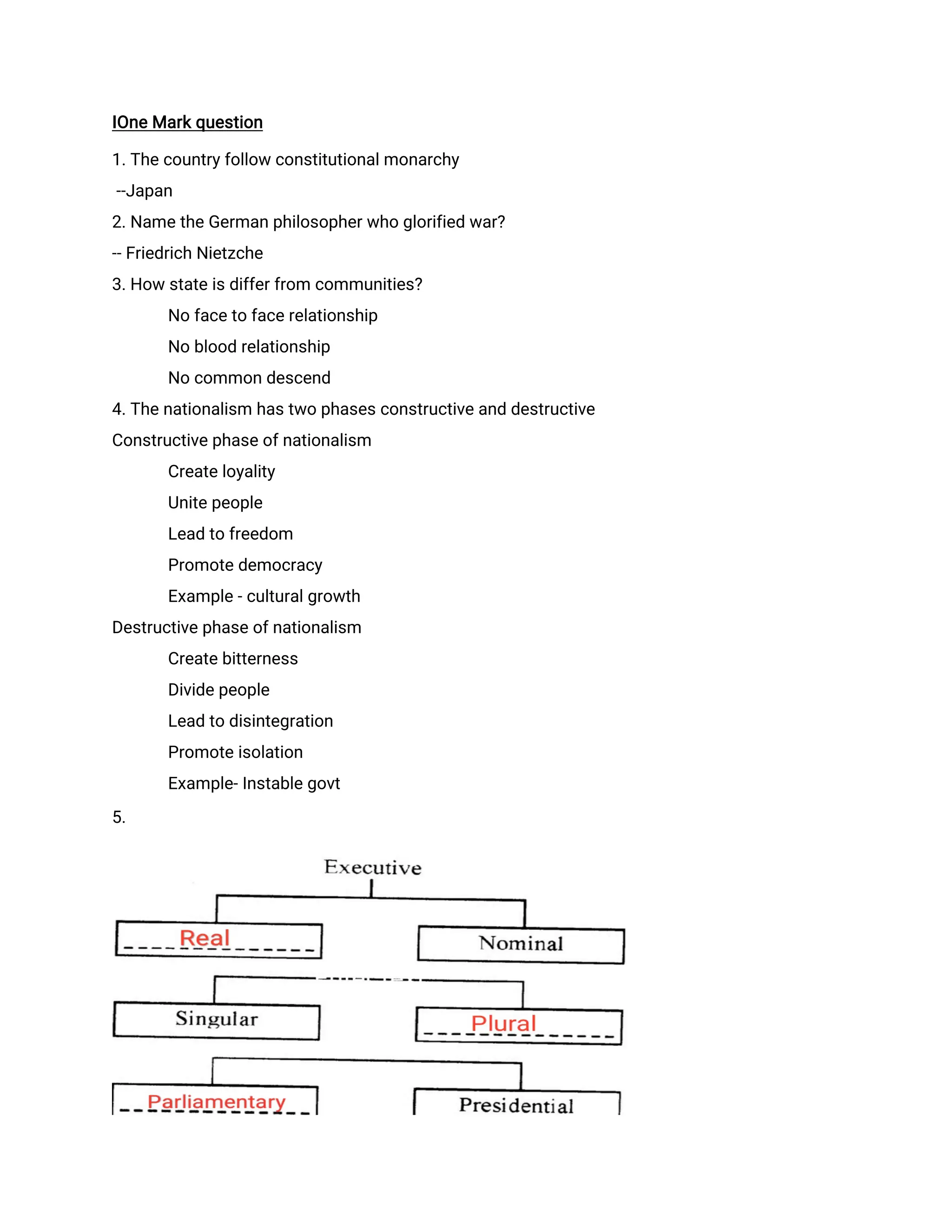
5.
2.
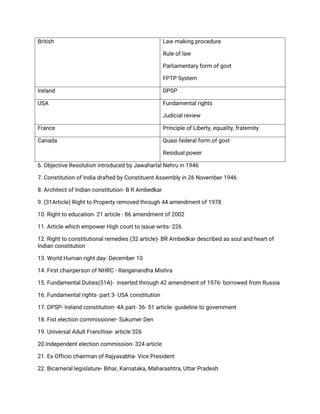
British Law makingprocedure
Rule of law
Parliamentary form of govt
FPTP System
Ireland DPSP
USA Fundamental rights
Judicial review
France Principle of Liberty, equality, fraternity
Canada Quasi federal form of govt
Residual power
6. Objective Resolution introduced by Jawaharlal Nehru in 1946
7. Constitution of India drafted by Constituent Assembly in 26 November 1946
8. Architect of Indian constitution- B R Ambedkar
9. (31Article) Right to Property removed through 44 amendment of 1978
10. Right to education- 21 article - 86 amendment of 2002
11. Article which empower High court to issue writs- 226
12. Right to constitutional remedies (32 article)- BR Ambedkar described as soul and heart of
Indian constitution
13. World Human right day- December 10
14. First chairperson of NHRC - Ranganandha Mishra
15. Fundamental Duties(51A)- inserted through 42 amendment of 1976- borrowed from Russia
16. Fundamental rights- part 3- USA constitution
17. DPSP- Ireland constitution- 4A part- 36- 51 article- guideline to government
18. Fist election commissioner- Sukumer Den
19. Universal Adult Franchise- article 326
20.Independent election commission- 324 article
21. Ex Officio chairman of Rajyasabha- Vice President
22. Bicameral legislature- Bihar, Karnataka, Maharashtra, Uttar Pradesh
3.
23. Lokasabha- lowerhouse, house of people
24. Rajyasabha- Upper house, house of state
25. Money bill introduce in Lokasabha
26. President nominate 2 Anglo Indian members in lokasabha and 12 member in Rajyasabha
27. Fist chief Justice of India- H J Kania
28. Article 370- Special provision to Jammu and Kashmir
29.Father of Local Self Government- Lord Rippon
30.Belvanth Ray Mehta committee recommend establish of 3 tier system-1957
31. First Panchayat raj system in Rajasthan
32. Constitutional status to Local Self Government- P K Thungan Committee- 1989
33. 73 amendment- Panchayat Raj Institution- 11 schedule
34. 74 amendmend- Municipality, Urban Local Self Government, 12 schedule
35. Article 368 deal with constitutional amendment
36.Kesavanandha Bharati case- Basic Structure of Indian constitution
37. Nelson Mandela- Long Walk to freedom
38. Aunt San Suu kyi- freedom from fear
39. J S Mill- Liberty- Harm Principles
40. Deep Mehta- Water
41. Aubery Menon- Ramayana Retold
42. Salman Rushdie- Sataric Verses
43. Plato- Republic
44. John Rawl- Theory of Justice- Veil of Ignorance
45.Voltaire statement- ''I disapprove of what you say but I will defend to death your right to say
it''
46. Karl Marx- equality was as crucial as freedom
47. Feminism- political doctrine for equal right for women and men
48. 61 amendment reduced voting age 21 to 18 years.
49. Sarkaria commission appointed to deal center and state issues.
4.
50. Impeachment -removal of President
51. Prime Minister - Ex officio chairman of NITI Aayog
52. Money bill only introduce in Loksabha
53.Article 368- Amendment of Indian constitution
54 Vice-President - exofficio chairman of Rajyasabha
55.Bill is a draft of proposed law
56.P k Thungan committee - Constitutional recognition to Indian constitution
57.Aristotle - Father of political science
58.Basic Structure of Indian constitution - Kesavananda Bharati case
59.Indian Citizenship Act- 1955
60.Election commission of India formed in 26 january 1950
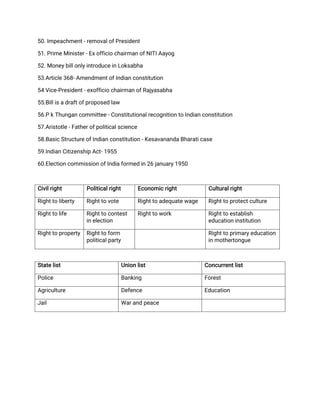
Civil right Political right Economic right Cultural right
Right to liberty Right to vote Right to adequate wage Right to protect culture
Right to life Right to contest
in election
Right to work Right to establish
education institution
Right to property Right to form
political party
Right to primary education
in mothertongue
State list Union list Concurrent list
Police Banking Forest
Agriculture Defence Education
Jail War and peace
5.
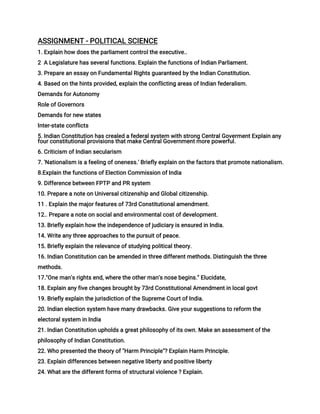
ASSIGNMENT - POLITICALSCIENCE
1. Explain how does the parliament control the executive..
2 A Legislature has several functions. Explain the functions of lndian Parliament.
3. Prepare an essay on Fundamental Rights guaranteed by the Indian Constitution.
4. Based on the hints provided, explain the conflicting areas of Indian federalism.
Demands for Autonomy
Role of Governors
Demands for new states
Inter-state conflicts
5. Indian Constitution has crealed a federal system with strong Central Goverment Explain any
four constitutional provisions that make Central Government more powerful.
6. Criticism of Indian secularism
7. 'Nationalism is a feeling of oneness.' Briefly explain on the factors that promote nationalism.
8.Explain the functions of Election Commission of India
9. Difference between FPTP and PR system
10. Prepare a note on Universal citizenship and Global citizenship.
11 . Explain the major features of 73rd Constitutional amendment.
12.. Prepare a note on social and environmental cost of development.
13. Briefly explain how the independence of judiciary is ensured in India.
14. Write any three approaches to the pursuit of peace.
15. Briefly explain the relevance of studying political theory.
16. Indian Constitution can be amended in three different methods. Distinguish the three
methods.
17."One man's rights end, where the other man's nose begins." Elucidate,
18. Explain any five changes brought by 73rd Constitutional Amendment in local govt
19. Briefly explain the jurisdiction of the Supreme Court of India.
20. Indian election system have many drawbacks. Give your suggestions to reform the
electoral system in India
21. Indian Constitution upholds a great philosophy of its own. Make an assessment of the
philosophy of Indian Constitution.
22. Who presented the theory of "Harm Principle"? Explain Harm Principle.
23. Explain differences between negative liberty and positive liberty
24. What are the different forms of structural violence ? Explain.
6.
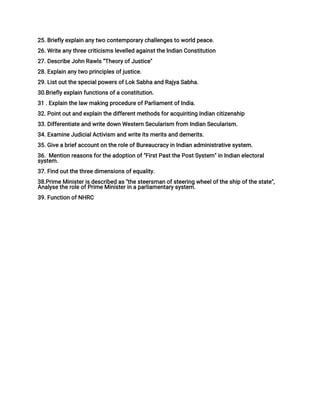
25. Briefly explainany two contemporary challenges to world peace.
26. Write any three criticisms levelled against the Indian Constitution
27. Describe John Rawls “Theory of Justice"
28. Explain any two principles of justice.
29. List out the special powers of Lok Sabha and Rajya Sabha.
30.Briefly explain functions of a constitution.
31 . Explain the law making procedure of Parliament of India.
32. Point out and explain the different methods for acquiriting Indian citizenship
33. Differentiate and write down Western Secularism from Indian Secularism.
34. Examine Judicial Activism and write its merits and demerits.
35. Give a brief account on the role of Bureaucracy in Indian administrative system.
36. Mention reasons for the adoption of "First Past the Post System" in Indian electoral
system.
37. Find out the three dimensions of equality.
38.Prime Minister is described as "the steersman of steering wheel of the ship of the state",
Analyse the role of Prime Minister in a parliamentary system.
39. Function of NHRC