BASIC FEATURES OF
INDIAN
CONSTITUTION
Introduction
❖ The Constitution of India was drafted by the Constituent
Assembly. The Constituent Assembly held its first sitting on the
9th December, 1946. It reassembled on the 14th August, 1947, as
the sovereign Constituent Assembly for the Dominion of India.
❖ Constitution of India is the supreme law of India. It lays down the
framework defining fundamental political principles, establishing
the structure, procedures, powers and duties, of the government
and spells out the fundamental rights, directive principles and
duties of citizens. Passed by the Constituent Assembly on 26
November 1949, it came into effect on 26 January 1950.
❖ The Constitution of every country has certain special features
because the historical background ,social, economic and political
conditions influence the making of the constitution. All these
factors have contributed in the making of the Constitution of
India.
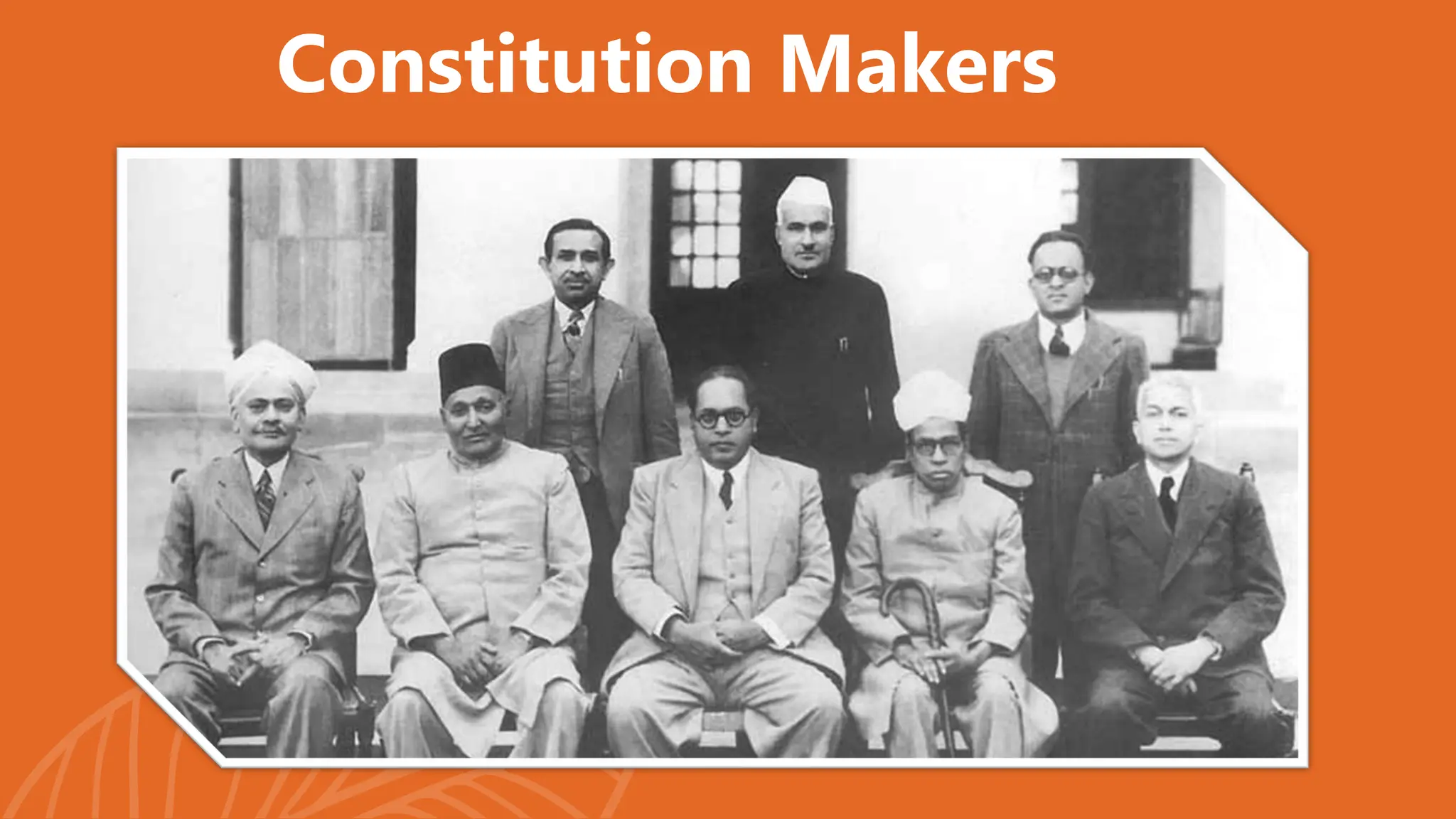
Constitution Makers
WRITTEN CONSTITUTION
The written constitution is the one which you can get
in the form of a book and can be read. There are 395
Articles, 12 schedules and it has been divided into 22
parts and till date more than 104 amendments have
been made into it. The Constitution, in its current form,
consists of a preamble, 22 parts containing 448
articles, 12 schedules, 5 appendices and 108
amendments to date.
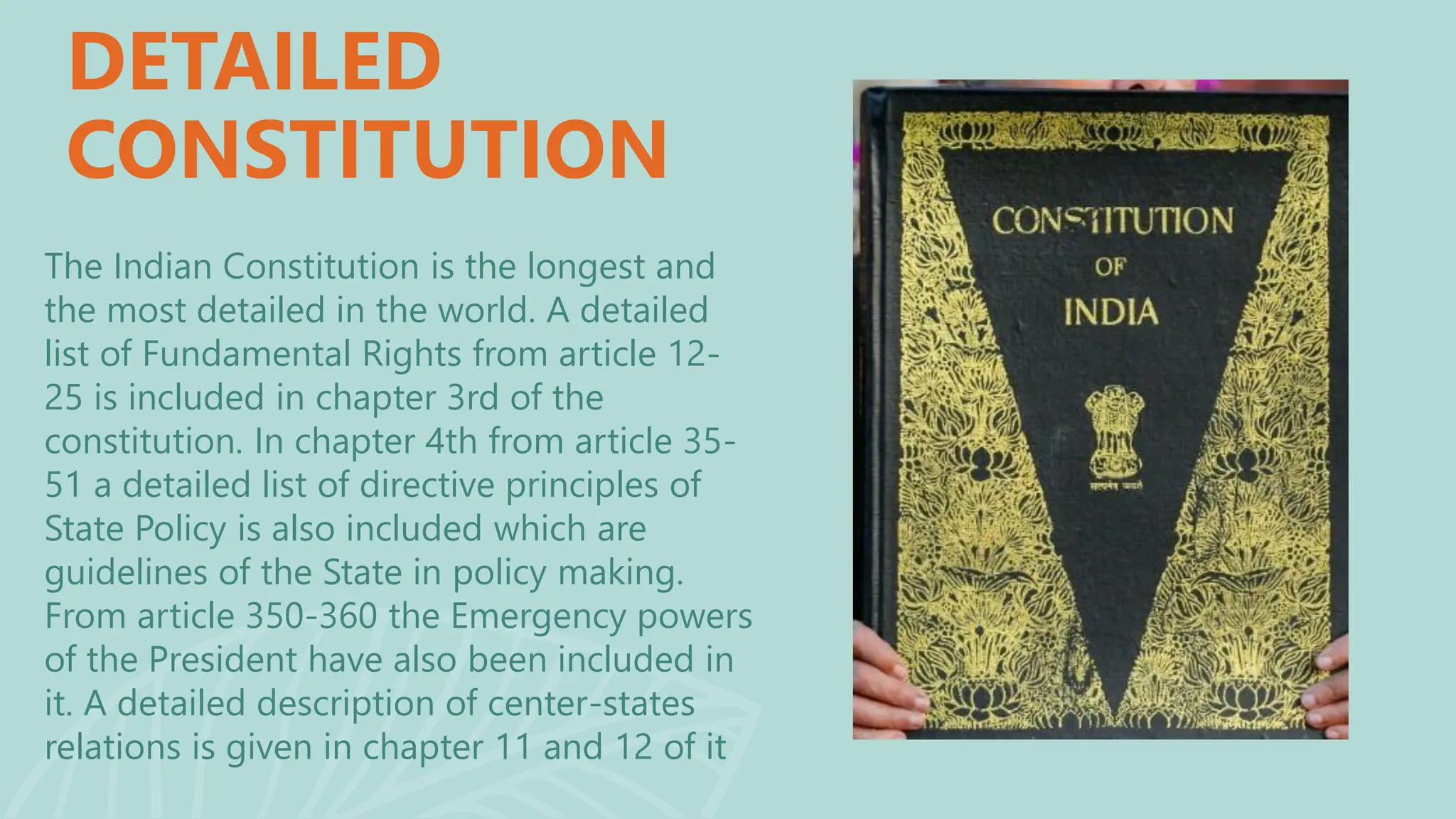
DETAILED
CONSTITUTION
The Indian Constitution is the longest and
the most detailed in the world. A detailed
list of Fundamental Rights from article 12-
25 is included in chapter 3rd of the
constitution. In chapter 4th from article 35-
51 a detailed list of directive principles of
State Policy is also included which are
guidelines of the State in policy making.
From article 350-360 the Emergency powers
of the President have also been included in
it. A detailed description of center-states
relations is given in chapter 11 and 12 of it
Sovereign , Socialist , Secular ,
Democratic & Republic
❑ India has been declared a sovereign, secular, Democratic, Republic through
the Preamble of the Constitution of India.
❑ Sovereign State –India is free to formulate its internal and foreign policy and
free to maintain relations with any foreign state.
❑ Socialist State- The aim of the state is to establish socialist society which is
free from exploitation of man by man and in which social economic and
political justice is provided to all.
❖ Secular State- The state has no religion of its
own, it does not discriminate against any
religion by imposing restrictions upon it
❖ Democratic State -The preamble also
declares India to be a democratic state in
which the supreme power rests in the hands of
the people.
❖ Republic- The President of India is elected for
a fixed term by the indirect vote of the people.
FUNDAMENTAL
RIGHTS
Fundamental rights have been included into the
chapter 3rd of the constitution from Article- 12 to
35
• Right to Equality (Article- 14 to 18)
• Right to Freedom (Article- 19 to 22)
• Right Against Exploitation (Article 23 to 24)
• Right to Religious Freedom (Article 25 to 28)
• Cultural and Educational rights (Article 29 /30)
• Right to Constitution Remedies (Article- 32)
RIGHT TO PROPERTY , AN ORDINARY
RIGHT
Till 1979 Right to Property was included in the list of Fundamental Rights. But
through 44nd amendment has been made an ordinary right and for this
purpose Articls-300 A has been included into the constitution.
FIXED SIZE OF COUNCIL OF
MINISTERS
Under this amendment the size of council of ministers of both Center and
States has been fixed and now it cannot be more than 15% of the total
strength of the lower house of Parliament in Center and States legislatures in
the states. In case the strength of the Legislative Assembly in a State is 60 or
less than that, then the maximum number of the ministers will be 12 which will
include the Chief Minister.
RIGID AS WELL AS FLEXIBLE
CONSTITUTION
Indian constitution is neither rigid as the constitution of U.S.A nor flexible as
the constitution of Great Britain.
Under Article-368 of the constitution,
1. Some of the articles of the constitution can be amended by the union
parliament by passing a resolution with 2/3rd majority of the members
present and voting and absolute majority of the total members.
2. Some of the articles of the constitution can be amended by the Union
Parliament by passing resolution with 2/3rd majority of the members present
and voting and absolute majority of the total members and approval of ½
State Legislatures.
FEDERAL IN FORM, UNITARY
IN SPIRIT
The Constitution of India provides for
<CENTRALISED FEDERALISM>. There is no
doubt that federal system has been adopted in India, but
keeping in mind certain special situations, the center is
made more powerful or strong. Federal features :
1. Written Constitution
2. Rigid constitution
3. Supremacy of the constitution
4. Division of subjects
5. Independent judiciary etc
FEDERAL IN FORM, UNITARY IN SPIRIT
The Constitution of India provides for <CENTRALISED
FEDERALISM>. There is no doubt that federal system has been
adopted in India, but keeping in mind certain special situations, the
center is made more powerful or strong. Federal features :
1. Written Constitution
2. Rigid constitution
3. Supremacy of the constitution
4. Division of subjects
5. Independent judiciary etc..
SECULAR STATE
Article-326 provides for universal adult franchise and every citizen including
both male and female who is 18 years of age is given the right to vote without
making any discrimination on the basis of sex, caste, color religion etc.
UNIVERSAL ADULT FRANCHISE
Every person has the right to practise, profess, propagate his/her religion
according to his/her goodwill. The religious dominations have the right to
establish and maintain institutions for religious and charitable purposes; to
manage its own affairs in matters of religion; to own and acquire movable and
immovable property and to administer such property in accordance with law.
But no individual is allowed to misuse his or her religious freedom. See in the
case of “KESHVANAND BHARTI Vs. STATE OF KERLA (A.I.R. 1973, S.C. 1461)
LIMITED POWERS OF THE
PARLIAMENT
Indian Parliament is non-sovereign. There are
limitations on the powers of the Parliament
1. It can pass laws on those subjects which have been
entrusted to it by the constitution.
2. The bills passed by the Parliament need the
approval of the President.
3. The supreme court can exercise the powers of
judicial review over the laws passed by the
parliament and can declare unconstitutional the
laws which it considers are against the constitution.
The entire judicial system of India is organized into an hierarchical order. Supreme
Court is at the top of judicial administration below that there are high courts at the
state level and there are district courts at the district level. All the courts of India are
bound to accept the decisions of the supreme court. See Article 137.
SINGLE-INTEGRATED JUDICIAL SYSTEM
INDEPENDENT JUDICIARY
The constitution of India makes provisions for the independence of judiciary
because only independent judiciary can safeguard the rights and liberties of the
people, can protect the supremacy of the constitution
1. An impartial method has been adopted for the appointment of the judges
2. High qualifications have been fixed for the judges
3. The judges of the Supreme Court stay in office till 65 years of age and of High
courts till 62 years of age
RULE OF LAW
1.Supremacy of Law
Rule of law according to Dicey means the absolute supremacy or predominance of regular law
as opposed to the influence of arbitrary power or wide discretionary power. It means the
exclusion of the existence of arbitrariness on part of the government. This in essence means
that no man can be arrested, punished or be lawfully made to suffer in body or in goods except
by the due process of law and for breach of a law established in the ordinary legal manner
before the ordinary courts of the land.
2.Equality before Law
While explaining this aspect of the doctrine, Dicey stated that there must be equality before the
law or equal subjection of all classes to the ordinary law of the land administered by the
ordinary law courts. Dicey believed that the exemption of civil servants from the jurisdiction of
the ordinary courts of law and providing them with the special tribunals was the negation of
equality. He stated that any encroachments on the jurisdiction of the courts and any restriction
on the subject’s unimpeded access to them are bound to jeopardise his rights.
SINGLE CITIZENSHIP
There is provision of single citizenship in India. A person may
be living in any state, but he is the citizen of India alone. The
principle of double citizenship promotes regionalism and
provincialism whereas the principle of single citizenship
promotes national unity, therefore the principle of single
citizenship is adopted in India.
The principle of Joint Electoral System was adopted
after independence. Under Article- 325 of the
constitution it is said that for every constituency there
will be one general electoral roll which will be one
general electoral roll which will include the names of
all the voters belonging to different classes , religions,
sex and races etc., and they will elect a common
representative
JOINT ELECTORAL
SYSTEM
1. The 68th Constitutional amendment made in 1990, it was provided for
the appointment of the National Commission for the scheduled castes
for the protection of their interests. In 2002, the government constituted
two separate commissions for scheduled castes and scheduled tribes.
2. The 68th Constitutional amendment made in 1990, it was provided for
the appointment of the National Commission for the scheduled castes for
the protection of their interests. In 2002, the government constituted two
separate commissions for scheduled castes and scheduled tribes.
SPECIAL PROVISIONS
1. Avasthi, A.P, Indian Government and Politics, Narain
Agarwal, Agra, 2001.
2. Pandey, Dr.J.N, Constitution of India, 2013.
3. Fadia, B.L, Indian Government and Politics, Sahitya
Bhawan Publication, Agra, 2002
4. Ghai, U.R, Indian Government and Politics, New
Academic Publishing, Jalandhar, 2002.
5. Gupta, D.C, Indian Government Publishing House,
New Delhi, 1978
6. Johari, J.C, Indian Government and Politics, Vishal
Publication, 1979.
References
THANK YOU!
Jiya Jand
BA – 2
MMMC , Patiala
3226

BASIC FEATURES OF INDIAN CONSTITUTION - print.pdf

  • 1.
  • 2.
    Introduction ❖ The Constitutionof India was drafted by the Constituent Assembly. The Constituent Assembly held its first sitting on the 9th December, 1946. It reassembled on the 14th August, 1947, as the sovereign Constituent Assembly for the Dominion of India. ❖ Constitution of India is the supreme law of India. It lays down the framework defining fundamental political principles, establishing the structure, procedures, powers and duties, of the government and spells out the fundamental rights, directive principles and duties of citizens. Passed by the Constituent Assembly on 26 November 1949, it came into effect on 26 January 1950. ❖ The Constitution of every country has certain special features because the historical background ,social, economic and political conditions influence the making of the constitution. All these factors have contributed in the making of the Constitution of India.
  • 3.
  • 4.
    WRITTEN CONSTITUTION The writtenconstitution is the one which you can get in the form of a book and can be read. There are 395 Articles, 12 schedules and it has been divided into 22 parts and till date more than 104 amendments have been made into it. The Constitution, in its current form, consists of a preamble, 22 parts containing 448 articles, 12 schedules, 5 appendices and 108 amendments to date.
  • 5.
    DETAILED CONSTITUTION The Indian Constitutionis the longest and the most detailed in the world. A detailed list of Fundamental Rights from article 12- 25 is included in chapter 3rd of the constitution. In chapter 4th from article 35- 51 a detailed list of directive principles of State Policy is also included which are guidelines of the State in policy making. From article 350-360 the Emergency powers of the President have also been included in it. A detailed description of center-states relations is given in chapter 11 and 12 of it
  • 6.
    Sovereign , Socialist, Secular , Democratic & Republic ❑ India has been declared a sovereign, secular, Democratic, Republic through the Preamble of the Constitution of India. ❑ Sovereign State –India is free to formulate its internal and foreign policy and free to maintain relations with any foreign state. ❑ Socialist State- The aim of the state is to establish socialist society which is free from exploitation of man by man and in which social economic and political justice is provided to all.
  • 7.
    ❖ Secular State-The state has no religion of its own, it does not discriminate against any religion by imposing restrictions upon it ❖ Democratic State -The preamble also declares India to be a democratic state in which the supreme power rests in the hands of the people. ❖ Republic- The President of India is elected for a fixed term by the indirect vote of the people.
  • 8.
    FUNDAMENTAL RIGHTS Fundamental rights havebeen included into the chapter 3rd of the constitution from Article- 12 to 35 • Right to Equality (Article- 14 to 18) • Right to Freedom (Article- 19 to 22) • Right Against Exploitation (Article 23 to 24) • Right to Religious Freedom (Article 25 to 28) • Cultural and Educational rights (Article 29 /30) • Right to Constitution Remedies (Article- 32)
  • 9.
    RIGHT TO PROPERTY, AN ORDINARY RIGHT Till 1979 Right to Property was included in the list of Fundamental Rights. But through 44nd amendment has been made an ordinary right and for this purpose Articls-300 A has been included into the constitution. FIXED SIZE OF COUNCIL OF MINISTERS Under this amendment the size of council of ministers of both Center and States has been fixed and now it cannot be more than 15% of the total strength of the lower house of Parliament in Center and States legislatures in the states. In case the strength of the Legislative Assembly in a State is 60 or less than that, then the maximum number of the ministers will be 12 which will include the Chief Minister.
  • 10.
    RIGID AS WELLAS FLEXIBLE CONSTITUTION Indian constitution is neither rigid as the constitution of U.S.A nor flexible as the constitution of Great Britain. Under Article-368 of the constitution, 1. Some of the articles of the constitution can be amended by the union parliament by passing a resolution with 2/3rd majority of the members present and voting and absolute majority of the total members. 2. Some of the articles of the constitution can be amended by the Union Parliament by passing resolution with 2/3rd majority of the members present and voting and absolute majority of the total members and approval of ½ State Legislatures.
  • 11.
    FEDERAL IN FORM,UNITARY IN SPIRIT The Constitution of India provides for <CENTRALISED FEDERALISM>. There is no doubt that federal system has been adopted in India, but keeping in mind certain special situations, the center is made more powerful or strong. Federal features : 1. Written Constitution 2. Rigid constitution 3. Supremacy of the constitution 4. Division of subjects 5. Independent judiciary etc
  • 12.
    FEDERAL IN FORM,UNITARY IN SPIRIT The Constitution of India provides for <CENTRALISED FEDERALISM>. There is no doubt that federal system has been adopted in India, but keeping in mind certain special situations, the center is made more powerful or strong. Federal features : 1. Written Constitution 2. Rigid constitution 3. Supremacy of the constitution 4. Division of subjects 5. Independent judiciary etc..
  • 13.
    SECULAR STATE Article-326 providesfor universal adult franchise and every citizen including both male and female who is 18 years of age is given the right to vote without making any discrimination on the basis of sex, caste, color religion etc. UNIVERSAL ADULT FRANCHISE Every person has the right to practise, profess, propagate his/her religion according to his/her goodwill. The religious dominations have the right to establish and maintain institutions for religious and charitable purposes; to manage its own affairs in matters of religion; to own and acquire movable and immovable property and to administer such property in accordance with law. But no individual is allowed to misuse his or her religious freedom. See in the case of “KESHVANAND BHARTI Vs. STATE OF KERLA (A.I.R. 1973, S.C. 1461)
  • 14.
    LIMITED POWERS OFTHE PARLIAMENT Indian Parliament is non-sovereign. There are limitations on the powers of the Parliament 1. It can pass laws on those subjects which have been entrusted to it by the constitution. 2. The bills passed by the Parliament need the approval of the President. 3. The supreme court can exercise the powers of judicial review over the laws passed by the parliament and can declare unconstitutional the laws which it considers are against the constitution.
  • 15.
    The entire judicialsystem of India is organized into an hierarchical order. Supreme Court is at the top of judicial administration below that there are high courts at the state level and there are district courts at the district level. All the courts of India are bound to accept the decisions of the supreme court. See Article 137. SINGLE-INTEGRATED JUDICIAL SYSTEM INDEPENDENT JUDICIARY The constitution of India makes provisions for the independence of judiciary because only independent judiciary can safeguard the rights and liberties of the people, can protect the supremacy of the constitution 1. An impartial method has been adopted for the appointment of the judges 2. High qualifications have been fixed for the judges 3. The judges of the Supreme Court stay in office till 65 years of age and of High courts till 62 years of age
  • 16.
    RULE OF LAW 1.Supremacyof Law Rule of law according to Dicey means the absolute supremacy or predominance of regular law as opposed to the influence of arbitrary power or wide discretionary power. It means the exclusion of the existence of arbitrariness on part of the government. This in essence means that no man can be arrested, punished or be lawfully made to suffer in body or in goods except by the due process of law and for breach of a law established in the ordinary legal manner before the ordinary courts of the land. 2.Equality before Law While explaining this aspect of the doctrine, Dicey stated that there must be equality before the law or equal subjection of all classes to the ordinary law of the land administered by the ordinary law courts. Dicey believed that the exemption of civil servants from the jurisdiction of the ordinary courts of law and providing them with the special tribunals was the negation of equality. He stated that any encroachments on the jurisdiction of the courts and any restriction on the subject’s unimpeded access to them are bound to jeopardise his rights.
  • 17.
    SINGLE CITIZENSHIP There isprovision of single citizenship in India. A person may be living in any state, but he is the citizen of India alone. The principle of double citizenship promotes regionalism and provincialism whereas the principle of single citizenship promotes national unity, therefore the principle of single citizenship is adopted in India.
  • 18.
    The principle ofJoint Electoral System was adopted after independence. Under Article- 325 of the constitution it is said that for every constituency there will be one general electoral roll which will be one general electoral roll which will include the names of all the voters belonging to different classes , religions, sex and races etc., and they will elect a common representative JOINT ELECTORAL SYSTEM
  • 19.
    1. The 68thConstitutional amendment made in 1990, it was provided for the appointment of the National Commission for the scheduled castes for the protection of their interests. In 2002, the government constituted two separate commissions for scheduled castes and scheduled tribes. 2. The 68th Constitutional amendment made in 1990, it was provided for the appointment of the National Commission for the scheduled castes for the protection of their interests. In 2002, the government constituted two separate commissions for scheduled castes and scheduled tribes. SPECIAL PROVISIONS
  • 20.
    1. Avasthi, A.P,Indian Government and Politics, Narain Agarwal, Agra, 2001. 2. Pandey, Dr.J.N, Constitution of India, 2013. 3. Fadia, B.L, Indian Government and Politics, Sahitya Bhawan Publication, Agra, 2002 4. Ghai, U.R, Indian Government and Politics, New Academic Publishing, Jalandhar, 2002. 5. Gupta, D.C, Indian Government Publishing House, New Delhi, 1978 6. Johari, J.C, Indian Government and Politics, Vishal Publication, 1979. References
  • 21.
    THANK YOU! Jiya Jand BA– 2 MMMC , Patiala 3226