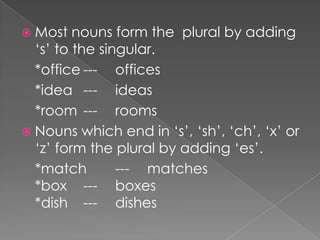

 Most

nouns form the plural by adding
‘s’ to the singular.
*office --- offices
*idea --- ideas
*room --- rooms
 Nouns which end in ‘s’, ‘sh’, ‘ch’, ‘x’ or
‘z’ form the plural by adding ‘es’.
*match
--- matches
*box --- boxes
*dish --- dishes
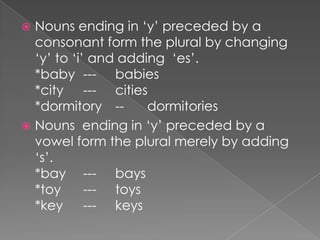
Nouns ending in ‘y’ preceded by a
consonant form the plural by changing
‘y’ to ‘i’ and adding ‘es’.
*baby --- babies
*city --- cities
*dormitory -dormitories
 Nouns ending in ‘y’ preceded by a
vowel form the plural merely by adding
‘s’.
*bay --- bays
*toy
--- toys
*key
--- keys

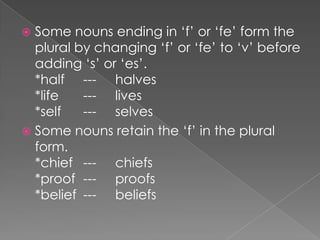
Some nouns ending in ‘f’ or ‘fe’ form the
plural by changing ‘f’ or ‘fe’ to ‘v’ before
adding ‘s’ or ‘es’.
*half --- halves
*life
--- lives
*self
--- selves
 Some nouns retain the ‘f’ in the plural
form.
*chief --- chiefs
*proof --- proofs
*belief --- beliefs

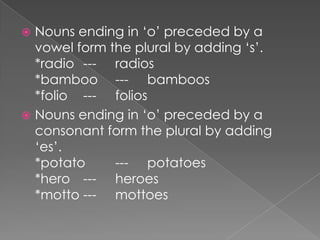
Nouns ending in ‘o’ preceded by a
vowel form the plural by adding ‘s’.
*radio --- radios
*bamboo --- bamboos
*folio --- folios
 Nouns ending in ‘o’ preceded by a
consonant form the plural by adding
‘es’.
*potato
--- potatoes
*hero --- heroes
*motto --- mottoes

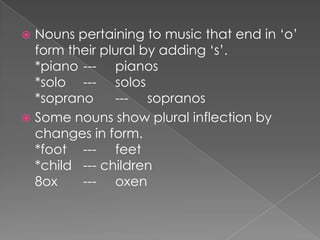
Nouns pertaining to music that end in ‘o’
form their plural by adding ‘s’.
*piano --- pianos
*solo --- solos
*soprano
--- sopranos
 Some nouns show plural inflection by
changes in form.
*foot --- feet
*child --- children
8ox
--- oxen

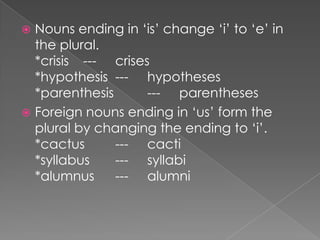
Nouns ending in ‘is’ change ‘i’ to ‘e’ in
the plural.
*crisis --- crises
*hypothesis --- hypotheses
*parenthesis
--- parentheses
 Foreign nouns ending in ‘us’ form the
plural by changing the ending to ‘i’.
*cactus
--- cacti
*syllabus
--- syllabi
*alumnus
--- alumni

Nouns ending in ‘um’ or ‘on’ form the
plural by changing the ending to ‘a’.
*datum
--- data
*phenomenon --- phenomena
*memorandum --- memoranda
 Compound nouns form the plural in
different ways. In general, ‘s’ or ‘es’ is
added to the more important word.
*sister-in-law
--- sisters-in-law
*editor-in-chief --- editors-in-chief
*spoonful --- spoonfuls

Some nouns have the same singular and
plural form.
*sheep --- sheep
*deer --- deer
*Chinese
--- Chinese
 Some nouns are always plural.
*scissors
*pants
*eyeglasses
*shorts
 Plurals of numerals and letters are
formed by adding ‘s’.
*t’s
*10’s
*5’s
*m’s

Bagel
 Basis
 Syllabus
 Datum
 Furniture

ANGELICA B. ENRIQUEZ
Bachelor of Secondary
Education II

plural of count nouns

  • 2.
     Most nouns formthe plural by adding ‘s’ to the singular. *office --- offices *idea --- ideas *room --- rooms  Nouns which end in ‘s’, ‘sh’, ‘ch’, ‘x’ or ‘z’ form the plural by adding ‘es’. *match --- matches *box --- boxes *dish --- dishes
  • 3.
    Nouns ending in‘y’ preceded by a consonant form the plural by changing ‘y’ to ‘i’ and adding ‘es’. *baby --- babies *city --- cities *dormitory -dormitories  Nouns ending in ‘y’ preceded by a vowel form the plural merely by adding ‘s’. *bay --- bays *toy --- toys *key --- keys 
  • 4.
    Some nouns endingin ‘f’ or ‘fe’ form the plural by changing ‘f’ or ‘fe’ to ‘v’ before adding ‘s’ or ‘es’. *half --- halves *life --- lives *self --- selves  Some nouns retain the ‘f’ in the plural form. *chief --- chiefs *proof --- proofs *belief --- beliefs 
  • 5.
    Nouns ending in‘o’ preceded by a vowel form the plural by adding ‘s’. *radio --- radios *bamboo --- bamboos *folio --- folios  Nouns ending in ‘o’ preceded by a consonant form the plural by adding ‘es’. *potato --- potatoes *hero --- heroes *motto --- mottoes 
  • 6.
    Nouns pertaining tomusic that end in ‘o’ form their plural by adding ‘s’. *piano --- pianos *solo --- solos *soprano --- sopranos  Some nouns show plural inflection by changes in form. *foot --- feet *child --- children 8ox --- oxen 
  • 7.
    Nouns ending in‘is’ change ‘i’ to ‘e’ in the plural. *crisis --- crises *hypothesis --- hypotheses *parenthesis --- parentheses  Foreign nouns ending in ‘us’ form the plural by changing the ending to ‘i’. *cactus --- cacti *syllabus --- syllabi *alumnus --- alumni 
  • 8.
    Nouns ending in‘um’ or ‘on’ form the plural by changing the ending to ‘a’. *datum --- data *phenomenon --- phenomena *memorandum --- memoranda  Compound nouns form the plural in different ways. In general, ‘s’ or ‘es’ is added to the more important word. *sister-in-law --- sisters-in-law *editor-in-chief --- editors-in-chief *spoonful --- spoonfuls 
  • 9.
    Some nouns havethe same singular and plural form. *sheep --- sheep *deer --- deer *Chinese --- Chinese  Some nouns are always plural. *scissors *pants *eyeglasses *shorts  Plurals of numerals and letters are formed by adding ‘s’. *t’s *10’s *5’s *m’s 
  • 10.
    Bagel  Basis  Syllabus Datum  Furniture 
  • 11.
    ANGELICA B. ENRIQUEZ Bachelorof Secondary Education II