STUDENT : NIKHIL JOSHI 
PROGRAMME : Post-Graduate Diploma Programme 
DIPLOMA PROJECT 
DESIGNING MATH BASED FUN EDUCATIONAL GAMES FOR WEB & TABLETS 
Sponsor : Playpower Labs, Gandhinagar 
GUIDE : DR. JIGNESH KHAKHAR 
COMMUNICATION DESIGN FACULTY ( NEW MEDIA DESIGN) 
National Institute of Design 
Gandhinagar 
2012
New Media Design | Diploma Project 
2
The Evaluation Jury recommends NIKHIL JOSHI for the 
Diploma of the National Institute of Design 
COMMUNICATION DESIGN (NEW MEDIA DESIGN) 
herewith, for the project titled "DESIGNING MATH BASED FUN EDUCATIONAL GAMES FOR WEB & TABLETS" 
on fulfilling the further requirements by * 
Chairman 
Members : 
*Subsequent remarks regarding fulfilling the requirements : 
Registrar(Academics)
Designing Math based fun educational games for web & tablets
ACKNOWLEDGEMENTS 
Dr. Khakhar Jignesh, 
Faculty & Project Guide, 
Coordinator - New Media Design 
National Institute of Design, India. 
Lomas Derek, 
CEO, Playpower Labs. 
Patel Kishan, 
COO, Playpower Labs. 
Special thanks to my team members at Playpower labs : Ankit Patel, Chandradip Rana, Darsh Shah, Diwas Bisht, Nikhil Poonawala, Nirmal Patel, Part Rao, Priyank Kapadia, Sharan Shodhan, Vivek Fitkariwala for helping and encoraging me. 
My parents, family and friends at NID for all the love and support.
New Media Design | Diploma Project 
8
9 
New Media Design | Diploma Project 
TABLE OF CONTENTS 
1. 
2. 
3. 
4. 
1.1 
2.1 
3.1 
4.1 
4.1.1 
4.1.2 
2.3 
3.3 
4.3 
4.4 
4.5 
1.2 
2.2 
3.2 
4.2 
2.4 
Synopsis 
The company 
Understanding Playpower Labs 
Design brief 
Secondary reserach 
Company motto 
Approach 
Goals 
Understanding Market 
Web 
Approaching devices 
Math fluency 
Target user group 
Games and play 
Casual games 
Curriculum Mapping 
Playpower Labs 
Why? 
Challenege and scope 
Why Tablets are different? 
How does it help? 
13 
15 
17 
21 
25 
25 
30 
17 
21 
33 
34 
34 
15 
17 
21 
33 
18
New Media Design | Diploma Project 
10 
5. 
6. 
7. 
8. 
5.1 
6.1 
7.1 
8.1 
5.4 
6.4 
7.4 
7.6 
5.2 
6.2 
7.2 
8.2 
5.5 
5.3 
6.3 
7.3 
7.5 
5.6 
Primary research 
Understanding technologies 
Developing Games 
First Game 
School visits 
Games designed for Tablets and 
Building framework vs individual 
Initial understanding 
Literature review reflection in game 
Product technical model 
Scoring Models 
The prototype product 
Literature review 
What was being Developed? 
Understanding MDA framework 
Educational Importance of Number line estimation. 
How can games accelerate learning? 
Research influences 
Technical requirements altering 
Understanding content development 
Different mechanics used 
Need of math games? 
39 
47 
53 
9 
44 
50 
58 
60 
39 
47 
53 
9 
44 
42 
49 
55 
59 
45
11 
New Media Design | Diploma Project 
9. 
10. 
11. 
9.1 
10.1 
11.1 
10.2 
11.2 
11.3 
11.4 
8.3 
9.4 
9.2 
8.4 
8.5 
8.6 
9.5 
9.3 
9.6 
9.7 
9.8 
9.9 
Games 
Conclusion and learning 
Appendix 
Refrences 
Bubble POP! 
Conclusion 
Interviews 
Learning 
Content structure(BSNL) 
Website 
Video 
The game redesign 
Jelly Beans 
Magnitude comparison 
Concept it covers 
Final game design 
Results & Learning 
Place Value 
Right Wrong 
Angle asteroid/Space coordinate 
Clock game 
Number jumble 
Games conceptualized (Design Documents) 
112 
71 
97 
97 
100 
99 
101 
107 
65 
79 
75 
67 
67 
69 
82 
77 
86 
88 
90 
92
New Media Design | Diploma Project 
12 
SYNOPSIS
13 
New Media Design | Diploma Project 
SYNOPSIS 
The project was aimed at designing and developing fun, engaging math based educational games that are backed 
by strong scientific research for students in K-7 grades in the US. The need of math games was to address a 
core problem in STEM (science, technology, engineering and math) education - Number Sense. Over 30% of 
8th graders lack basic proficiency in mathematics infact, over 50% of all 8th graders could not place 3 fractions 
in the right order, from smallest to largest, according to a recent NAEP(The National Assessment of Educational 
Progress) test. This is a clear reflection of the need for effective educational interventions that improves number 
sense. 
I started off by first understanding the current math based games/products in market, looking at research on 
learning science and difficulties children have in understanding mathematics. 
One of the challenges of the project was to ensure that the games designed for the web could easily translate 
to the tablets/smartphones with minimal design changes. This required a detailed study of different products 
available on the tablets and their interaction style. At the end, a total of 11 games were developed covering various 
math concepts. Most of the games were mapped to the US common core state standards for Mathematics. Based 
on these mini games two iPad applications were also developed for the Apple App store. 
Looking at my contribution to the entire product, I was the first designer in the company and paved the way for 
setting up a design team of four members. My responsibilities included understanding the research literature 
around specific mathematics concepts and then translating them to meaningful game design. Having a strong 
background in technology, I played an important role in bridging the design and development environment. 
During the period of six months that I spent developing games, I realized the importance of the subtle decisions 
that one takes and their impact on the entire game play. Lastly, I perceive games to be something much more 
than just being fun; they are more of a culture now.
New Media Design | Diploma Project 
14 
THE COMPANY 
1
15 
New Media Design | Diploma Project 
1.1 Company Motto 
1.2 Playpower Labs 
Playpowerlabs is an output of playpower.org , which 
is a high energy open-source community focused 
on creating high-quality educational games for 
underprivileged children around the world. 
The PlayPower Foundation supports the sustainable 
development, distribution and evaluation of effective 
educational games and other media, particularly for 
underserved children around the world. 
Playpower was founded at MIT’s International 
Development Design Summit in summer of 2008, with 
the goal of developing culturally appropriate learning 
games for the world’s most affordable home computer. 
Playpower labs aim at developing games to build core 
math skills that provide a foundation for success in 
Science, Technology, Engineering and Math (STEM). 
They are a small team of developer, designer and 
researcher that work together to make learning 
fun and engaging. 
β€œDesigning games 
that are fun, 
engaging, backed 
by research and 
justify the platform 
on which they are 
played”
New Media Design | Diploma Project 
16 
UNDERSTANDING 
PLAYPOWER 
LABS 
2
17 
New Media Design | Diploma Project 
2.1 Approach 
At Playpower labs they have systematic curriculum 
design approach which is based on β€œbackwards 
design”. Here, they start with a clear identification 
of their educational goals. So far, these goals have 
been to improve number sense. Then, they clearly 
identify which assessments they would use to 
measure number sense. This way, they get aware 
how to test whether their instruction is working. 
Finally, they develop games with the precise 
knowledge of what they are trying to accomplish. 
In order to test the efficacy of the games, they first 
play test the games with kids to eliminate usability 
issues. Then, they collect data from the games 
and document whether there is a learning curve. 
A learning curve shows how students improve 
at particular items within the game, over multiple 
opportunities. While the learning curve is not proof 
that the game improves number sense, it does 
provide powerful evidence of learning. At this point, 
the games can be tested online, with thousands of 
players. They then run experiments with the games 
to identify knowledge component models (i.e., 
identify the specific skills present in our games that 
students are learning) and to investigate a range of 
game design factors to optimize player engagement 
and learning. 
With the finished game, they then use a pre/post 
test randomized experimental design to evaluate 
whether students number sense improves as a result 
of playing the game. This experiment provides them 
concrete scientific evidence for the efficacy of the 
game, according to their original goals. 
2.2 Why? 
The games are designed to address core problem in 
STEM education, which is Number Sense. 
There are several evidences to it such as: over 
30% of 8th graders lack basic proficiency in math, 
in fact, over 50% of all 8th graders could not place 3 
fractions in the right order, from smallest to largest, 
according to a recent NAEP test. 
All these evidences points towards a clear need 
for effective educational interventions that improve 
number sense. 
Another important aspect to problem that supports a 
digital intervention is, it is hard for teachers to provide 
individualized number sense instruction to students in 
classroom setting or their personal space. 
That’s why Playpower created a set of games 
that provide highly effective practice activities for 
students, both in and out of school. 
The goal is to develop an intuitive understanding of 
math amongst kids, called β€œMATH FLUENCY”. 
2.3 Math Fluency 
What is math fluency? 
Math fluency is when students can perform basic 
math without effort quickly and accurately. 
Why is math fluency important? 
When students are fluent in basic math, they don’t 
need to think so hard about basic concepts. This 
frees up their mental resources to focus on higher-level 
problem solving. 
How is math fluency achieved? 
Practice! Practice allows tasks to be performed 
faster, easier and with fewer errors. Over time, 
practice produces automaticity, where tasks can be 
done quickly, accurately and without effort. 
From tying your shoes to using computer programs 
to spelling, all performance begins with a lot of 
conscious effort. But with practice, everything 
becomes easy. 
Why is math fluency so hard to achieve? 
1. The main reason is that math fluency, 
like language fluency, takes lots of practice. 
Unfortunately, many students view math tests, math 
worksheets and math homework as tedious, boring, 
disengaging and frustrating. 
2. The second reason why math fluency is so hard 
to achieve is that many students use slow and
New Media Design | Diploma Project 
18 
inefficient strategies when studying basic math. 
It’s like they don’t trust their gut sense! While 
students clearly need to understand the concepts 
behind math, thinking too hard about basic math 
functions can prevent students from succeeding in 
higher-level math. For instance, when solving an 
algebra problem involving 5+7, students shouldn’t be 
counting on their fingers, they should just β€œknow” the 
answer. 
2.4 How does it helps? 
The learning games make it fun and rewarding to 
practice math skills. Unlike math tests, worksheets 
and homework, games make it possible to play 
around, experiment and even fail. 
Games that are designed introduce an element of 
competition and cooperation that can be extremely 
motivating for students. 
While there is a high bar of challenge for the players, 
the emphasis is on rewarding success, rather than 
punishing failure.
19 
New Media Design | Diploma Project
New Media Design | Diploma Project 
20 
DESIGN BRIEF 
3
21 
New Media Design | Diploma Project 
Fig 1. Exloration and Age relationship 
3.1 Goals 
1. To identify a viable target user group. The decision 
would also include Playpower’s expertise at math 
based data analysis, their development skills and 
size of the market that was on stake. (Western (US) 
and Indian domain). 
2. Figuring out a revenue model for the product. This 
becomes crucial in terms of placing playpower in the 
best slot. 
3. What kind of revenue models will support a start-up 
like Playpower with a strong research backing but 
a new approach towards learning? 
4. How do products go about analysing and 
visualizing the data they store while there users 
interact with the product. There needs to be a 
consciousness about the way one would show the 
data analysis gathered while user interacts with the 
product. 
5. There was a need to study the in- game currency 
models for most of the sites and how were they being 
used in generation of revenues, if any? 
6. To study the products that are present both on web 
and tablets? Are there any games that are present 
simultaneously for web and tablets? What is the 
interaction style for these games? 
3.2 Challenges and Scope 
1. The idea was to make small games that do 
not teach but partially assess the user. By partial 
assessment, the primary goal is not only assessment 
but to develop a sense of fluency in users. This 
fluency builds up with rigorous practice and hours of 
game play and it is called β€œMATH FLUENCY”. 
2. Both India and the Western market were to be 
considered as the target population. It was still not 
clear if the product would be released in India or not. 
This makes the research work more challenging, 
as one needs to incorporate insights from both user 
groups while playing safe. 
3. Most of the games need to be based on research 
insights gained during research studies. The task 
would be to simplify these insights into meaningful 
game play. 
3.3 Target User group 
β€’ Understanding based on Papert, Sugata 
Mitra, Resnick and Piaget 
The target user group would include children’s from 
age 3 to 12. The rationale for such a target group 
would be their willingness to explore. Exploration 
ends with structures and structures are learned with 
age in our education system. So the target group is 
focussed between an age group where one is willing 
to explore and learn. 
β€’ Understanding based on CMU 
Being mentored by CMU, there was another 
understanding of the user group which was heavily 
following the US government’s emphasis on 
STEM (Science Engineering technology and Math) 
focussing on K to 12. 
*The expression is a shortening of Kindergarten (K) for 
4–6-year-olds through twelfth grade (12) for 16–19-year-olds. 
β€’ Target group based on the product, market 
and revenue model 
The final target group for the product was based on a 
strategic decision. The product was aimed at schools 
in US and India. Looking at the needs and building 
blocks of math at elementary level , 3rd to 7th grade
New Media Design | Diploma Project 
22 
suited the needs better. 
β€’ India or US? 
Initially the product was aimed at US with the idea 
and the mentorship coming from there. As Playpower 
started with their research and user testing, they 
realized India to be a powerful market. 
While researching, the curriculum studied was both 
from India and US, and insights came from both 
ends. Though, it was difficult to make a standard 
product for both parts of the worlds. The approach 
was to incorporate insights from both the United 
states and India, as it was difficult to narrow to one.
23 
New Media Design | Diploma Project
New Media Design | Diploma Project 
24 
SECONDARY 
RESEARCH 
(Precedent case studies) 
4
25 
New Media Design | Diploma Project 
4.1 Understanding Market 
The research started with understanding what exists 
in the market. 
There were several platforms for which the product 
could be developed. In the beginning, Playpower labs 
was not clear about the kind of product they were 
aiming at, but the core direction was still about β€œFun 
and engaging math games”. 
4.1.1 Web 
The target market was primarily distributed between 
two platforms, The β€œWEB” and the β€œTABLETS”. 
There were several products in the education 
learning domain, some aimed at providing 
teaching assistance to kids where others were just 
assessment systems. 
To name a few: 
1. Apangea Math 
2. Brain Pop 
3. Edu Comp 
4. Educational Initiatives 
5. Ten Marks 
6. Extra Marks 
7. Dream Box Learning 
8. Khan academy 
9. Manga hingh 
10. Code academy 
11. Cognitive tutor 
12. Alice 
13. Sum Dog 
14. Haiku Learning 
15. IXL learning 
16. Power my learning 
17. Mathplayground 
18. PBS kids 
19. Aventa Learning 
20. Ted-Ed 
21. Think Quest 
The research through these products revealed 
different models and tactics used by the producers. 
Tactics here refers to strategies employed by these 
products, while expanding their content and market. 
Generally most of these products follow a similar 
structure of licensing their products to schools.This 
allows them to keep track on students and their 
performance through different Interfaces. A general 
product model would look like one in fig 3. 
We were mainly focussed on products that were 
developing games and were using games as a 
medium for learning. Post the evaluation of many 
existing products, there were three web based 
products which had a huge impact on the research 
and understanding for the final product : 
1. Manga high 
2. Sumdog 
3. Dream Box 
There were some interesting strategies employed by 
each one of these products that sets them apart from 
the rest. 
A. Manga high 
Manga high consists of 16 math games and four 
exercise programs for students in middle high school. 
These online, flash-based games look and feel more 
like mainstream games than traditional β€œeducational” 
ones. The graphics on the site are in β€œManga” 
(Japanese comic book) style. 
Characteristics 
β€’ Assignable 
The product allows the instructor or teacher to assign 
a specific concept to a specific student. 
β€’ Blended Learning 
The product lets teacher partially supervise the 
Fig 2. Manga High free math based teaching resource 
[Image Source: Mangahigh.com]
New Media Design | Diploma Project 
26 
learning process and partially be the content that is 
being delivered. The product also provides teaching 
assistance. 
β€’ Informal Learning 
It allows learning outside formal learning environment 
β€’ Supplemental 
It provides additional instruction or learning 
opportunities outside the required curriculum. 
β€’ Interesting Points 
1. An outstanding characteristic of Manga high is a 
social component that allows schools to enter into 
β€œmath combat” with one another. 
2. Its free for use as no licensing is required. 
3. One can register as a school and generate as 
many accounts as one desires. 
4. Every game has two versions. A simpler version 
and the hard version. So there are only 8-9 unique 
games on the website. 
5. The site has an interesting β€œProdigy” product. 
The product is more of an assessment test UI which 
covers up most of the concepts from the US common 
core stae standard curricullum for math. 
A complete look at the website reveals, that the 
Prodigy actually covers 8-10 times the concepts 
covered by all the games on the games page. This is 
interesting in terms of strategy. The games provide 
the face value to the product where as the core 
is represented by a very simple UI in form of their 
Prodigy product. 
Game structure 
The inner game structuring of Mangahigh differs from 
one game to another, a close look at all the games 
reveal a uniform structure in some of the games. 
Fig 3. A generic structure for educational products 
Fig 4. MangaHigh’s Prodigy product 
[Image Source: Mangahigh.com] 
Product Student Teacher Parents 
School 
Per Student License Assessment / Games Data Analysis
27 
New Media Design | Diploma Project 
Each game in Manga high teaches various concepts 
based on the game mechanics. 
The level of structurization is such, that the user 
themselves can decide the difficulty as well as the 
concept to be taught. This selection can also be 
directed from the teacher dashboard. 
Revenue model 
Manga high have two revenue models: 
1. They give everything for free, their adaptive 
technology and the progress reports. 
2. They have a β€œM-Sensi” functionality, where they 
charge the parents for giving students challenges, 
next tasks etc. 
So the idea is to first addict students with games and 
allow schools to freely use their product, and then 
monetize from parents rather than schools. 
B. Sumdog 
Sum dog is an Avatar based free math games site. 
They offer free games which cover 120 numeracy 
skills, split in to 10 levels. The games are not 
religiously tied to any curriculum. 
Characteristics 
β€’ Flexible 
Sumdog has a very flexible platform, where the 
choice of selection of topic is independent of the 
game one desires to play. 
β€’ Assignable 
The product allows the instructor or teacher to assign 
specific concept to a specific student. 
β€’ Multiplayer 
Most Sumdog gmes are multiplayer, which means 
one can choose to play against other Sumdog users 
around the world. 
β€’ Games 
Most of the games are devoid of narratives as they 
use Physics based mechanics to raise user’s interest 
in games. 
For example, physics balancing game in fig 7, where 
user’s focus shifts from answering to balancing and 
subconsciously one ends up attempting a whole lot 
of question. 
Fig 5. Game structuring Mangahigh. 
Fig 6. Sumdog’s fun multiplayer games for grades K-8 
[Image Source: Sumdog.com]
New Media Design | Diploma Project 
28 
β€’ Adaptive Learning 
If one keeps getting the questions right, they’ll get 
harder automatically. If user have problems with a 
specific concept, Sumdog will help user practice by 
asking more questions related to the same concept. 
β€’ Interesting Points 
1. The product has an avatar system where user can 
earn virtual currency. One can play games to earn 
coins and go shopping in Sumdog’s online shop. 
2. Its free for use for students and parents. Teachers 
can generate up to 10 free licenses, but for schools 
they need to license the product. 
3. The product is adaptive in nature, so it lets the 
system analyze the concepts one finds difficult and 
then set questions accordingly. 
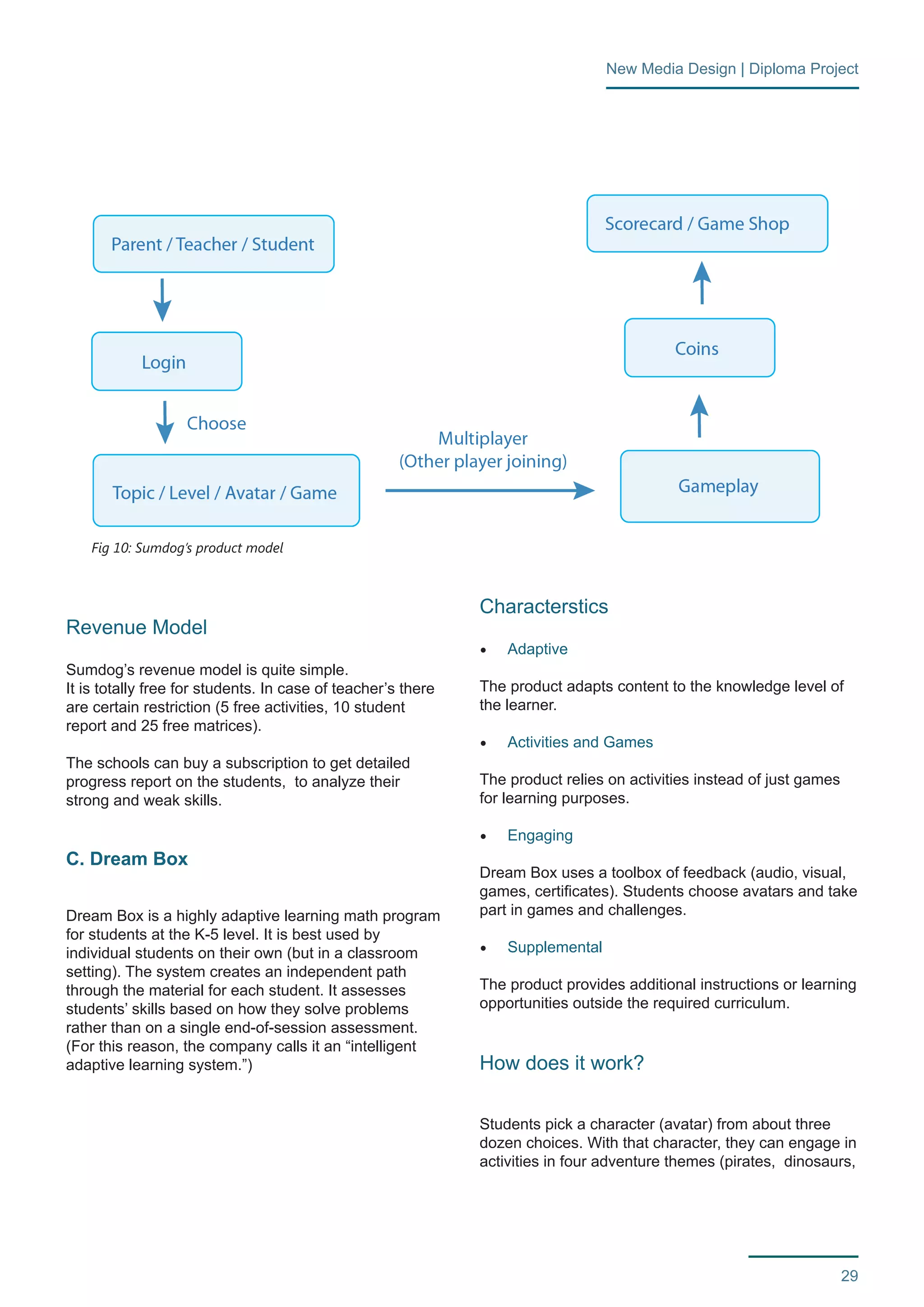
4. Single UI to assign topics, choose avatar and set 
games. This UI streamlines the process and is a boost 
to user experience. 
Game structuring 
The game structure in Sumdog is rather simple. The UI 
in the website lets the user select the topic (Concept 
to be taught) and the level, and then the user chooses 
the game that he wants to play. What is interesting 
here is that, the topics and the levels are independent 
of the game mechanics. 
For example Mangahigh’s ICE ICE MAYBE in fig9 
(A game teaching fractions)is entirely bound to the 
concepts of fraction and numbers on a number line, 
and cannot accommodate concepts like multiples etc. 
All the other products have games that support the 
game play and the concept to be taught, but here 
Sumdog makes their platform independent of the 
concepts that are being taught. The product structure 
allows them to expand their list of concepts without 
being pushed to make new games. 
Fig 7. Sumdog’s physics balancing game 
[Image Source: Sumdog.com] 
Fig 8. Sumdog’s single UI approach 
[Image Source: Sumdog.com] 
Fig 9. Mangahigh’s ICE ICE MAYBE 
[Image Source: Mangahigh.com]
29 
New Media Design | Diploma Project 
Revenue Model 
Sumdog’s revenue model is quite simple. 
It is totally free for students. In case of teacher’s there 
are certain restriction (5 free activities, 10 student 
report and 25 free matrices). 
The schools can buy a subscription to get detailed 
progress report on the students, to analyze their 
strong and weak skills. 
C. Dream Box 
Dream Box is a highly adaptive learning math program 
for students at the K-5 level. It is best used by 
individual students on their own (but in a classroom 
setting). The system creates an independent path 
through the material for each student. It assesses 
students’ skills based on how they solve problems 
rather than on a single end-of-session assessment. 
(For this reason, the company calls it an β€œintelligent 
adaptive learning system.”) 
Characterstics 
β€’ Adaptive 
The product adapts content to the knowledge level of 
the learner. 
β€’ Activities and Games 
The product relies on activities instead of just games 
for learning purposes. 
β€’ Engaging 
Dream Box uses a toolbox of feedback (audio, visual, 
games, certificates). Students choose avatars and take 
part in games and challenges. 
β€’ Supplemental 
The product provides additional instructions or learning 
opportunities outside the required curriculum. 
How does it work? 
Students pick a character (avatar) from about three 
dozen choices. With that character, they can engage in 
activities in four adventure themes (pirates, dinosaurs, 
Fig 10: Sumdog’s product model
New Media Design | Diploma Project 
30 
and pets), each with 8 stories. One can then visit the 
Adventure Park and the Carnival etc. 
The program uses β€œinteractive virtual manipulative” 
such as sliders or bars. It can continuously monitor 
not just a student’s answer to a problem but the 
strategy the student adopts to solve the problem. 
Dream Box’s software captures every mouse click 
students make and can adjust for 60 different 
parameters of student behaviour, such as how 
quickly they answer questions, how many β€œhints” they 
use to get an answer and so on. The program stores 
data based on thousands of students and derive user 
insight to help them learn. 
Revenue Model 
The product directly seeks money for different 
licences it provides: 
School use: 
β€’ License cost per student: $20 per year 
β€’ β€œUnlimited” school site license: $7,000 per year 
Home use: 
β€’ Individual licenses: $12.95 per month for one child 
or $59.95 for six months. 
4.1.2 Approaching devices 
The application market related to tablets and 
handheld devices is flooded with application on kid’s 
and education. There are several good products and 
companies that develop learning products. 
The main area of focus was β€œApple App Store” and 
the apps studied were mainly concentrated around 
math’s based educational ones. 
Some of the good educational apps studied were: 
1. Brain Pop 
2. Brain Tuner 
3. Dragon Box 
4. Telling Time 
5. Math Blaster 
6. Astro Math 
7. Monkey Math 
8. Pop Math 
9. Rocket Math 
10. Wings 
11. Hungry Fish 
12. Math Frogs 
13. MathBoard 
14. ChalkBoard 
15. A day with a difference 
16. Adding apples 
17. Bugs and Buttons 
18. Didackto 
19. Marble Math 
20. Motion Math(Wings, Zoom, Hungry fish) 
21. Number sense 
Entertainment Games 
22. Cut the rope 
23. Angry Birds 
24. Where is my Water 
25. Tap the frog 
26. Subway Surf 
27. Fruit Ninja 
28. Yellow Fins 
29. Temple Run 
Most of these apps cover very specific concepts. 
There are companies that have different apps for 
different concepts (Motion Math has different apps 
on fraction and addition). Some of the products were 
designed to leverage the touch and different gestures 
on Tablets, but the major bulk were designed to be 
easily ported to web. 
App store 
The App Store is a digital application distribution 
platform for different mobile applications developed 
and maintained by Development giants like Apple, 
Google and Nokia. The service allows users to 
browse and download applications from their devices 
and install them on the device itself. 
There are number of App Stores for different mobile 
platforms. The biggest of them is the iTunes store 
from Apple. Some famous App Stores are listed here: 
App Store (iOS), the official Apple online application 
distribution system for iPad, iPhone, and iPod touch 
β€’ Amazon Appstore, an online application 
distribution system for Android devices. 
β€’ Mac App Store, the official Apple online 
application distribution system for Mac OS X. 
β€’ Windows Phone Marketplace, the official 
application store for the Windows Phone. 
β€’ Windows Store, the upcoming application 
distribution platform for Windows 8.[41]
31 
New Media Design | Diploma Project 
How does it works? 
The only motive placing an application on these App 
Stores is to rank them higher when related keywords 
are searched. On web platform we call it SEO – 
Search engine optimization. 
Most of the big companies running these stores have 
their closely guarded algorithm for determining where 
an application lands. 
Some of the generic steps could be formulating a 
constant stream of updates, adjusting the price tag, 
and giving users a way to spread the word about 
the app.The pricing on the app is smartly adjusted, 
more than the purchasing power of your target group, 
the pricing from your competitors makes a huge 
difference. 
Many famous app developers mention β€œsocial 
networking, uploading features, and challenging 
friends” important for an app . Some functionality built 
into the game to include features like friends lists, 
challenges, and leader boards are beneficial. They 
make applications more discoverable. 
Another interesting point would be to set an 
actual date for app release instead of releasing it 
automatically after it gets approved. [40] 
If the average time to get reviewed is ~7 days, and 
then a couple hours for review, the app is set to go 
for sale 9 days from your submit day. [40] 
Key Learning 
1. Successful games on tablets are FAST. The game 
mechanics should allow one to be fast and there 
should be equally potential reaction from the game 
(in terms of positive/negative feedback). 
2. Most of the apps aimed at teaching simple but 
specific concepts. The crux of these apps lies in 
different mechanics that were used to enhance user 
experience and engagement. 
(Though web products include teaching concepts, 
games on tablets don’t really teach) 
3. One of the important learning’s, studying app 
interfaces was to make big buttons and clean 
user interface.Clean user interface here stands for 
minimalistic and readable. 
4. Another important task about designing an app 
interface is to make it intuitive. The user should 
exactly know what needs to be pressed and which 
action initiated what reaction. 
5. Animation is always minimal. Studying all the 
major games including educational ones revealed, 
how minimal animation is used with smart 
backgrounds to create a dynamic composition. 
Here are some apps that really inspired the product 
and laid down standards for Math based educational 
application development: 
1. Meteor Math 
2. Motion Math (Math Zoom) 
A. METEOR MATH 
Meteor Math encourages users to blast numbered 
meteors together to find the correct mathematical 
solution. 
As the player progresses the game becomes harder 
and the pace intensifies. 
Features 
β€’ Develops four principle mathematical functions; 
Addition, Subtraction, Division and Multiplication. 
β€’ Suitable for all ages, with carefully graded levels. 
. 
Fig 11. MindShapes Meteor math 
[Image Source: http://itunes.apple.com/in/app/mete-or- 
math]
New Media Design | Diploma Project 
32 
β€’ Drills that help your child develop super fast 
β€˜Mental Math’ . 
B. MOTION MATH (ZOOM) 
An animal adventure through the world of numbers. 
The game allows children to zoom in number lines 
exploring the concepts related to units and number 
lines. 
Features 
β€’ The game uses concrete objects to represent 
abstract numbers: from dinosaurs in the 
thousands down to amoebas in the thousandths. 
β€’ Fun animal animations and sound effects help 
elementary school children master the number 
line. 
Fig 12. Motion Math zoom 
[Image Source: http://itunes.apple.com/us/app/motion-math- 
zoom]
33 
New Media Design | Diploma Project 
4.2 Why Tablets are different? 
4.2.1 Understanding the context of usage 
When talking about tablets, we need to understand 
the need and the context in which they are used. 
With a huge boom in the tablet market, tablets are 
able to make their own place between laptops and 
mobile phones, which has considerably increased 
the amount of time people use to spend on a mobile 
device. 
When thinking about the context, try to answer the 
following questions:[33] 
β€’ How will the user interact with your app? Whether 
seated on their lap, held with both hands, or on a 
tablet stand? 
β€’ How long will the average interaction be? Seconds, 
minutes or hours? 
β€’ Is the ideal way of interacting with the app 
horizontal or vertical? Sometimes a specific 
orientation will be ideal for the user. How will you 
attract the user into using it the way you want them to 
without restricting the orientation and limiting the user 
experience? 
β€’ When will the user be interacting with your app? In 
the morning as they drink their coffee? At night, lying 
in bed? How will the time of day or the environment 
they are using the tablet in affect their interaction? 
β€’ Do you think your content best fits the tablet as a 
medium, does it justify itself on this medium. 
4.2.2 Considerations while designing for tablets 
1. Apple has a relative standard of when and how to 
use the tablet interface in their iOS Human Interface 
Guide. 
Based on the research, we stuck to the basic 
gestures in our games. Customized gesture will 
require custom programming, from user’s point 
of view, he will need a hint if the interaction isn’t 
intuitive, or give them another way to interact with the 
app and help them discover the less-intuitive gesture 
interaction. 
2. Fat Fingers 
As frequent users of tablets know, small buttons are 
frustrating. You constantly tap the screen, turn your 
finger to find the active area, and if it’s close to other 
buttons, you could hit another button altogether. 
Small buttons that have a narrow area of activation 
are just frustrating. It’s a widely accepted fact that 
larger buttons, regardless of the device or interface, 
are easier to find and interact with.[33] 
3. Helping Hands 
Even if your app doesn’t have writing or drawing 
interaction, it’s important to keep the user’s 
handedness in mind. Most users are right-handed, 
but providing the option to change the controls to 
accommodate left-handed people might be worth the 
time, especially if the app requires the user to access 
controls while directly interacting with the screen.[33] 
4.3 Games and play 
4.3.1 Why games? 
β€’ Games are a form of fun. That gives us 
enjoyment and pleasure. 
β€’ Games are form of play. That gives us intense 
and passionate involvement. 
β€’ Games have rules. That gives us structure. 
β€’ Games have goals. That gives us motivation. 
β€’ Games are interactive. That gives us doing. 
β€’ Games have outcomes and feedback. That gives 
us learning. 
β€’ Games are adaptive. That gives us flow. 
β€’ Games have win states. That gives us ego 
gratification. 
β€’ Games have conflict/competition/challenge/ 
opposition. That gives us adrenaline. 
β€’ Games have problem solving. That sparks our 
creativity. 
β€’ Games have interaction. That gives us social 
groups. 
β€’ Games have representation and story. That gives 
us emotion.[3] 
With all these opportunities and qualities, games 
give a chance to interact and create information. 
Information which is meaning full as well as engaging
New Media Design | Diploma Project 
34 
for us. 
Games as an act lets you think, strategize, 
understand, interact, involve, absorb and perform. 
This entire process is wrapped inside the envelop of 
games. 
To progress in a game is to learn; when we are 
actively engaged with a game, our minds are 
experiencing learning a new system. 
The very obvious difference between games and 
traditional schooling is that good games always 
involve play, and schooling rarely does[13].Games 
include PLAY! 
4.3.2 What is play? 
Play is a term employed in psychology to describe 
a range of voluntary, motivated activities normally 
associated with pleasure and enjoyment. Play is 
most commonly associated with children . 
Many prominent researchers in the field of 
psychology (including Jean Piaget, William James, 
and Sigmund Freud) have viewed play as endemic to 
the human species. 
Play is often interpreted as less serious; yet the 
player can be intently focused on his or her objective, 
particularly when play is structured and goal-oriented, 
as in a game [34]. Accordingly, play can range from 
relaxed, free-spirited and spontaneous through 
frivolous to planned or even compulsive. 
4.3.3 Play and games 
Games by contrast, tend to have defined goals. 
Games allow a sense of free play which the child 
pursues on his own terms. While in the game, the 
child accepts failure as a possibility. 
Games lay challenges which look worth attempting 
and channels player’s effort. 
Gaming is play across media, time and social 
spaces. It includes interaction with physical matter, 
digital artefact, humans (Parents and siblings) as 
well as games itself (hypothetical character and 
situations). 
Games need a player with an attitude to challenge, 
accept, learn, absorb, being creative and fail. Without 
a willing player a game is a formal system waiting to 
be inhabited.[27] 
A casual game is a video game targeted at or used 
by a mass audience of casual gamers. Casual 
games can have any type of game play, and fit in any 
genre. They are generally identified by their simple 
rules and shot game plays. 
Most casual games have similar basic features: 
β€’ Extremely simple game play, like a puzzle game 
that can be played entirely using a one-button 
mouse. 
β€’ Shot engaging game plays. 
β€’ The ability to quickly reach a final stage. 
4.4 Casual Games 
4.4.1 Casual gamer 
β€œCasual gamer” is a loosely defined term used to 
describe a type of video game player whose time or 
interest in playing games is limited compared with 
a hardcore gamer. For this reason, games which 
attempt to appeal to the casual player tend to strive 
for simple rules and ease of game play, the goal 
being to present fast game play experience that 
people from almost any age group or skill level could 
enjoy.[42] 
4.5 Curriculum Mapping 
4.5.1 CBSE/GSEB 
The team at Play power Labs had to understand 
how they would establish a relationship between 
their games and what is taught in the classroom. An 
important task was to develop games which were 
meaningful to the students within the age group of 
the desired grade. Therefore they tried to figure out 
the level of questions in mathematics to be asked, 
such that the student is able to co-relate it with what 
is being taught in the classroom. 
The need was to map, which age group learns what 
kind of concepts in each class, from Grade 1 to 
Grade 7 in the Indian curriculum. With access to all 
the textbooks of GBSE as well as CBSE, the topics 
learnt by each class in mathematics with the overall 
concepts were documented.
35 
New Media Design | Diploma Project 
The exercise was helpful in designing the content of 
the games for specific age groups. Moreover, while 
going through the textbooks of various standards, 
many visual images were used in textbooks to create 
clarity and make concepts explicit for the student. 
The student in a specific grade makes a transition 
from visual backed understanding (i.e. pictures of 
various objects are used more rather than textual 
content) to text-based understanding. For example 
in CBSE textbooks of Grade 5, It was found out that 
the images used, to make a student understand 
concepts in mathematics were considerably reduced. 
At the end of this task, the overview of what concepts 
were taught in each grade was documented (i.e. from 
Grade 1 to Grade 7). 
An overview of the documented data of the 
curriculum is as follows: 
β€’ Concepts like Addition, Subtraction, Multiplication 
and Division were defined for each grade. Like in 
grade 1, only single digit addition is introduced. 
The concept of carryover is not taught. 
β€’ There is an introduction to various kinds of 
measurement in each grade. 
β€’ Understanding of visual information in textbooks 
(which means gaining knowledge what kind of 
visual information is used in textbooks to make 
them understand concepts) 
An important understanding that was discovered 
while exploring the curriculum of the CBSE and 
GSEB textbooks was that, there could not be any 
element in the game which is outside the vocabulary 
of student, since he/she would not be able to relate to 
it while playing the game. For example a timer which 
counts up to a double figure would have no meaning 
to a student who has not learnt numbers up to double 
figures. 
The following table shows how the curriculum was 
mapped on the basis of study on the textbooks as 
well as some products. 
4.5.2 United states Common core standards 
After studying the Indian curriculum, the US common 
Core standards were studied. The US common core 
standards are religiously followed by major products 
in the US. 
The common core state standards are designed for 
consistent; clear understanding of what students are 
expected to learn, so teachers and parents know 
what they need to do to help them. 
The common core standards lay different knowledge 
components at different grades for students to 
achieve. 
Based on observations, the US common core 
state standards are closely aligned with different 
state board curriculums practiced in India (CBSE & 
GSEB). 
Having planned most of the games, we mapped 
games to different knowledge components that they 
relate to. 
Fig 13: CBSE & GSEB books, grade 1-7 
Fig 14: CBSE & GSEB based curricullum map
New Media Design | Diploma Project 
36 
The concept mapping (Fig 16) of different games 
allowed us to understand the scope of each game 
clearly. It also helped us support each of our game 
and gave us correct tangents for content creation 
practices. 
Fig 15: United states common core standards for math. 
[Image source: http://www.corestandards.org/]
37 
New Media Design | Diploma Project 
Fig 16: Games to Knowledge component mapping based on US common core standards
New Media Design | Diploma Project 
38 
PRIMARY 
RESEARCH 
5
39 
New Media Design | Diploma Project 
5.1 School visits 
For understanding the end user, there was a decision 
to visit some schools and ask questions that would 
prove essential in developing the games. After a 
few discussions within the team, few questions were 
prepared for the teacher/anyone related to education 
within schools. 
5.1.1 Observing and understanding classroom setting 
The initial visits to the schools revealed the nature 
and context in which the product was to be placed. 
Initially it was assumed as a wrong approach 
studying Indian classrooms, when the product 
primarily was for the US audience. 
In discussion with team members placed in US, the 
playpower team finally decided to go about observing 
and gathering insights from Indian classrooms . One 
of the key reasons behind the decision was to see 
the difficult terrain for the product (Internet speed, 
slow machines). 
Some of the primary observations and understanding 
from the class rooms were: 
1. Most of the computers do not have flash. Adobe 
does speak about their 99% penetration on desktops, 
but that is not true. 
Though flash isn’t the problem. It’s very difficult to 
make interactive products for school, independent of 
these platforms. It’s an obligation for school’s to have 
these platforms installed as a prerequisite. 
There was a need to clearly communicate this to 
clients when they buy the products. 
2. Generally a single section has around 50 students 
but none of the computer labs were equipped with 50 
computers, so there is a possibility of two students 
sharing a computer. 
This gives a new tangent to think about multiplayer 
games that could be played on a single screen. 
5.2 Literature review 
One of the most important parts of the research was 
the precedent studies that happened. This included 
reading through books, articles and research papers. 
Personally the most insightful information and 
understanding was developed while reading research 
papers. There were several areas which were to be 
researched. Some of those were: 
1. Educational games frameworks. 
2. Designing digital games. 
3. Understanding how learning happens through 
digital artefacts. 
4. Studying good user interface practices. 
5. Understanding interaction design for tablets 
and web. 
6. Understanding different game genres. 
9. Visual ergonomics (colours, animations and their 
impact). 
Most of the readings had a big impact on the 
understanding of user psychology and their 
understanding of the world around. 
The research domain was restricted between the age 
group 7-12yrs, though most of the research findings 
were aimed at much larger set of audiences. 
Some of the most interesting and important 
research readings that inspired and impacted the 
game designs are listed here: 
1. Piaget’s Constructivism, papert’s 
Constructionism: Whats the difference 
This paper talks about two of the most renowned 
educationist and child psychologist of their times. 
They both believed that knowledge is actively 
constructed by the child in interaction with their world. 
Teaching is always indirect. Kids don’t just take in 
what’s being said. According to them projection of the 
inner self and ideas is key to learning. 
Learning: The reading gives a clear idea, as to why 
teaching is not the only way for student to learn. It 
also supports the notion of games for math, which 
lets one build his own understanding of these 
concepts in terms of knowledge. 
2. Children’s Acquisition of Number 
Words and the counting system 
The paper talks about children and their 
understanding of the concept of Number words 
and related numerosity. The problem here is to
New Media Design | Diploma Project 
40 
understand that the number words do not refer to 
individual items, or to properties of individual items, 
but rather to properties of set of items. 
Learning: This paper gave an understanding as to 
how children look at numbers and related concepts. 
This gave a realization that we have already 
mastered and taken these concepts for granted. 
3.Moving Learning games forward 
An extensive paper that talks about history of 
educational games and how they have evolved. The 
paper talks about the entire platform (Mobile, Tablets, 
desktop, Gadgets) on which games are available and 
aims at answering many question related to design 
and development of educational learning games. 
The paper presents a good critique on categorizing 
what could be called as a game. It suggests looking 
at strength and challenges of both classrooms 
and games. there is a need to situate educational 
learning games at the intersection of both where they 
are most productive. 
The writer emphasizes that a good games always 
involve play, schooling rarely does. 
An interesting section from the paper discusses 
different kinds of freedom that a player might want to 
access: 
1. freedom to fail; 
2. freedom to experiment; 
3. freedom to fashion identities; 
4. freedom of effort; and 
5. freedom of interpretation 
Learning: The paper lays down some important 
learning game design principles. Some of them led 
to important design decision in the game design 
process. Following is a list of some principles based 
on the learning: 
β€’ Choose Wisely 
The hype around the education gaming market 
pushes whole lot of games. Games work well for 
many audiences, topics and contexts, but they 
may not be the best tools for all kinds of topics in 
every context. There were many attempts at games 
about topics Like Photosynthesis, but most of what 
results is not a game at all, but a more typical routine 
classroom activity (like flashcards) with a score and 
the name β€œgame” attached to it. One must consider 
what it is about this topic that may (or may not) be 
appropriate as the basis of a game.[27] 
β€’ Think small 
There could be two reasons in support of thinking 
small: 
1. Sometimes the right choice is to make a small 
casual game, because that style of play meets the 
learning goals of the activity. 
2. At times it might be useful to create a small 
prototype of a game to test the fundamental concept 
before going for major development effort. 
β€’ Put learning and game play first 
The principle raises a question over the famous 
discussion of β€œWho came first, the technology or the 
game play”. The paper suggests that both should be 
considered simultaneously. Good educational games 
will consider both the learning goals/content and the 
game play at the same time, with enough flexibility 
to iterate between the two to change one or both 
simultaneously. 
β€’ Play Everywhere and Anywhere 
Mobile games played on cell phones, PDAs, or iPods 
are becoming more common and more sophisticated. 
People can play these games for minutes at a time 
in their personal spaces – on the bus, waiting in line, 
and even while on the go. 
Educational games can use this style of play, and 
Fig 17. The photosynthesis Game 
[Image Source: Moving Learning games forward]
41 
New Media Design | Diploma Project 
can be designed to take advantage of the personal 
spaces in students’ lives – the time between classes, 
before school, after school, going to and from school, 
etc. 
β€’ Define the Learning Goals 
The success of learning games would depend on 
success of students and that could only be reflected 
through data gathered while playing. It is imperative 
that researchers and developers more clearly define 
their learning goals, and corresponding assessment 
tools should be developed. 
There is a need to simplify the process of data 
logging and data analysis. Another important aspect 
with data, is the meaningful visualization of data for 
all the stakeholders of this ecosystem to analyze and 
understand. 
The success of educational games depends on 
their ability to enhance learning and of these tools in 
quantifying learning. 
4. Howard Gardener, Multiple 
Intelligences and education 
In his book gardener goes against the old age belief 
of Intelligence being a single entity that was inherited; 
and that human beings initially a blank slate could be 
trained to learn anything. 
He divides intelligences in seven different 
categories however he maintains that none of these 
intelligences operate independently. 
Learning: The theory has helped us to reflect on our 
practices. It allows people not to look at intelligence 
as magical black box but as something that is very 
specific to an individual. 
As a game designer it allows them to design 
mechanics around a single intelligence 
simultaneously leveraging the other. 
5.Colour scheme preferences of 
elementary school children in their 
school environment 
The paper talks about colour preferences. There are 
different aspects of colour preferences like culture, 
Education Level, past experiences, Memories, 
History, perception of colour, age gender and the 
psychological and physiological conditions of the 
user. 
There were some interesting points raised when 
paper talks about different established colour 
preferences: 
1. A research suggested that women might prefer 
pink as a legacy of their fruit gathering days when the 
preference helped them identify the berries from the 
foliage. 
2. A neuroscientist argues that small differences 
between girls and boys are amplified in their 
socialisation and hard-wired into their brains with no 
biological preferences. 
Learning: There is no scientific evidence that boys 
prefer blue and girls prefer pink. Up until the early 
20th century, the trend was the opposite and baby 
boys were dressed in pink and girls in blue. There 
are also some small studies suggesting that adults 
of different cultures have different tastes in colours. 
It’s clear that colour preference is learnt rather than 
innate. 
6. Eight ways of thinking about problem 
Solving 
An interesting paper that summarizes that a problem 
solving process has three steps: 
1. The data 
2. The goal 
3. The method 
Each one of these can have different states: given, 
familiar, unfamiliar and incomplete 
Learning: From a game designers perspective it 
lets them define problems. The paper allows them 
evaluate the content of educational games and 
see if there are existing problems and what level of 
problem solving would be required from the user’s 
end, to attain the final goal. 
7. Game based learning : The learning 
revolution 
The writer suggests that digital games based learning
New Media Design | Diploma Project 
42 
enables the learners to actually experience a given 
subject rather than just reading about the subject. 
Learning: The idea of the paper is to understand 
games as a medium to stimulate motivation and 
stimulate engagement of learners in a positive way. 
8. Perception in Visualization 
An interesting article that talks about β€œPreattentive 
processing” in humans. There are some properties 
of human visual system that are called β€œpreattentive”, 
since their detection seemed to precede focused 
attention. 
A simple example of a preattentive task is the 
detection of a red circle in a group of blue circles 
A viewer can tell at a glance whether the target is 
present or absent. 
There are various features that have been identified 
as preattentive: 
1. Target detection 
2. Boundary detection 
3. Region detection 
4. Counting and estimation 
There are several theories proposed to explain how 
preattentive processing occurs within the visual 
system. 
Learning: The preattentive cognition theory gives 
an insight over how our brain channels the visual 
system, this includes object that would be more 
accessible visually in comparison to others. 
This understanding proved very helpful in designing 
intuitive interfaces for fast paced games. 
9. Blooms Taxonomy 
Bloom’s Taxonomy is a useful way to categorise 
knowledge and skills. This Taxonomy categorises 
learning into three domains: knowledge (Cognitive 
Domain), skills (Psychomotor Domain) and attitudes 
and values (Affective Domain). When developing 
learning objectives for a game, one may need to 
write objectives from each of these domains. 
A major focus is given to the β€œCognitive Domain”. The 
writer categorizes knowledge in six different levels, 
going toward the tip of the triangle. 
Learning: Blooms taxonomy presents a strong 
approach to evaluate learning. The six categories 
of cognitive domain allows people to understand 
learning process as a six step process which starts 
with remembering and ends at creating. 
In terms of game design at times this map is 
reversed where user create in the first act (Age of 
empires) and learn as the time passes on. Though 
while designing games one can always visualise the 
user, going through these steps in the process of 
achieving the goal. 
5.3 Research influences 
1. Jean Piaget 
Fig 18. Preattentive Processing: searching for a target red 
circle based on a difference in hue. 
[Image Source: http://www.csc.ncsu.edu/faculty/healey/ 
PP/] 
Fig 19. Bloom’s Taxonomy 
[Image Source: http://ww2.odu.edu/educ/roverbau/ 
Bloom/blooms_taxonomy.htm]
43 
New Media Design | Diploma Project 
- WHO? 
Jean Piaget (9 August 1896 – 16 September 1980) 
was a French-speaking Swiss developmental 
psychologist and philosopher known for his 
epistemological studies with children. 
Piaget placed great importance on the education 
of children. As the Director of the International 
Bureau of Education, he declared in 1934 that β€œonly 
education is capable of saving our societies from 
possible collapse, whether violent, or gradual.”[46] 
- AFFECT 
Piaget clearly says that β€œTeaching is always indirect” 
Kids don’t just take what is being said[13]. One need 
to create a system where, they are allowed to explore 
indirectly rather than pushing things on them (As in 
playpower’s case, where the games are not meant 
to teach but to allow practicing and enjoying math). 
He understands knowledge as experience that is 
acquired. 
2. Seymour Papert (MIT) 
- WHO? 
Seymour Papert (born February 29, 1928 in Pretoria, 
South Africa) is an MIT mathematician, computer 
scientist, and educator. He is one of the pioneers 
of artificial intelligence, as well as an inventor of the 
Logo programming language. 
Papert worked on learning theories, and is known 
for focusing on the impact of new technologies 
on learning in general and in schools as learning 
organizations in particular.[43] 
- AFFECT 
In paperts constructivist theory which is highly 
inspired form Piaget. He moved from universal to 
individual learner. He terms projecting our inner 
feelings and ideas as true learning. Expressing these 
ideas help us shape our world while we communicate 
with others. Papert gives huge importance to media 
and context in shaping ones ideas as building blocks 
of learning. 
3. Mitchel Resnick (Lifelong 
Kindergarten) 
- WHO? 
Mitchel Resnick is LEGO Papert Professor of 
Learning Research, Director of the Okawa Center, 
and Director of the Lifelong Kindergarten group at the 
MIT Media Lab. 
He explores how new technologies can engage 
people in creative learning experiences. Resnick’s 
research group developed the β€œprogrammable brick” 
technology that inspired the LEGO Mindstorms 
robotics kit. He co-founded the Computer Clubhouse 
project, a worldwide network of after-school centers 
where youth from low-income communities learn to 
express themselves creatively with new technologies. 
- AFFECT 
So where papert and Piaget laid down their 
understanding about kids and learning . Mitchel 
resnik clearly applies these theories in tangible 
products. Looking at SCRATCH as a programming 
environment for kids to lego Mind storm and further 
computer clubhouse initiatives. The idea is to 
empower kids with materials to explore. [44] 
4. Sugata Mitra(MIT) 
- WHO? 
Sugata Mitra is a leading proponent of Minimally 
Invasive Education. He has a PhD in Physics and is 
credited with more than 25 inventions in the area of 
cognitive science and education technology. 
- AFFECT 
The most interesting thing about Sugata Mitra is his 
belief in child being way more intelligent than we 
expect them to be. He believes in solutions that 
complement the framework of traditional schooling. A 
solution that uses the power of collaboration and the 
natural curiosity of children to catalyze learning. 
Sugata Mitra’s β€œHole in the Wall” experiments have 
shown that, in the absence of supervision or formal 
teaching, children can teach themselves and each 
other, if they’re motivated by curiosity and peer 
interest.
New Media Design | Diploma Project 
44 
5. Howard Gardener (Theory of multiple 
Intelligences) 
- WHO? 
Howard Earl Gardner, an American developmental 
psychologist who is a professor of Cognition and 
Education at Harvard Graduate School of Education 
at Harvard University. 
He is famous for his β€œTheory of multiple intelligences” 
which states, not only do human beings have several 
different ways of learning and processing information, 
but these methods are relatively independent of 
one another: leading to multiple β€œintelligences” as 
opposed to a general intelligence factor among 
correlated abilities 
- AFFECT: 
In his works gardener clearly distinguishes eight 
different types of intelligences. Describing all these 
intelligences he clearly explain the understanding 
and signs of each of these, he also points at ways 
through which one can develop these specific 
intelligences. 
6. Arvind Gupta (Toys from trash) 
- WHO? 
Arvind Gupta is an Indian toy inventor and 
populariser of science. 
- AFFECT 
For almost 30 years, Arvind Gupta has been taking 
his love for science and learning to the children 
of India. He’s the dream teacher we all yearned 
for. Gupta has travelled to over 3000 schools, 
demonstrating captivating science experiments to 
wide eyed children. What sparks their imagination 
further is that Gupta uses only everyday garbage as 
the building blocks of these experiments. 
He takes trash and creates unforgettable 
experiments and experiences for children. An encore 
purpose for everyday trash is a wonderful by-product 
of his work.[45] 
5.4 Literature review reflection in game 
design. 
There were some major design decisions taken 
based on the readings in the precedent studies, 
some of them are listed here: 
1. The human visual perception listed in β€œpreattentive 
processing” dictated the clean UI approach in most of 
the games. 
This dictated the big elements and playing around 
with high contrasting colours in games. The idea was 
to support easy visual access to different elements. 
2. The paper on problem solving helped to frame 
questions in form of real problems. 
This paved way for creation of good problems for 
users by either providing less data or making the 
user face an unknown method. 
3. With an understanding on visual numbers and their 
relationship with Numeracy as a concept, games like 
β€œJelly beans” were developed. 
4. Relating learning with engagement and immersion 
helped in developing games with interesting 
animations and small narratives. 
There was a reflection of engagement in form of 
objectives and different game design elements like 
different kind of bubbles in bubble pop. 
5. A paper suggested, that there is no born colour 
preference in kids[11]really helped the justification for 
bright colourful elements in game design. 
5.5 How can games accelerate learning? 
There are some major points to support games 
intervention in learning: 
1. One of the most important fact about games is 
β€œThere’s no instructor”. Children and adults of all 
ages learn how to play some of the most complex 
games, and pick up spectacular Skills, without any up 
front instruction.
45 
New Media Design | Diploma Project 
2. Massive amounts of feedback, failure and 
Rewards are possible within a single game.[19] 
3. Players learn how to learn through the dynamics 
and the strategies they aquire within the game play. 
[19] 
4. Learners are able to take risk, learn by failure and 
have to constantly push them for the next task. The 
idea is to try things out, test them and try again. 
5. Inside games your acts are aimed at more 
than learning. You play different roles including a 
participant, teacher, creator, of course learner.[27] 
5.6 Need for math games 
Math skills need quite a lot of practice before they 
become embedded in one. Practising math skills over 
and over again can be rather boring. That’s where 
playing math games can help. There are so many 
different games to help one master all the different 
mathematic skills, that learning math becomes fun. 
Most of the math games are designed to address a 
core problem in STEM education, Number Sense. 
Over 30% of 8th graders lack basic proficiency in 
math, in fact, over 50% of all 8th graders could not 
place 3 fractions in the right order, from smallest to 
largest, according to a recent NAEP test. This is a 
clear reflection of the need for effective educational 
interventions that improves number sense. 
After all, the lack of Number Sense is not just a 
problem for these students, but also for a countries 
growth and industry, indeed these skills aren’t just 
lacking in high school students but are also a major 
problem for college students. The lack of number 
sense is a critical barrier to the personal development 
of future citizens in an economy.
New Media Design | Diploma Project 
46 
UNDERSTANDING 
TECHNOLOGIES 
6
47 
New Media Design | Diploma Project 
6.1 Games designed for Tablets and Web 
There were several things taken care of while design-ing 
games on web as most of them were to be ported 
to Tablets: 
1. The buttons in most of the cases were purposely 
designed larger so that the game can directly be 
ported for touch interactions. 
2. The number of steps of interactions were aimed at 
reducing the input from users end, this allows user 
to take a shorter path to the desired screen on any 
platform. 
3. Use of Text fields was avoided in most of the cas-es. 
Games with text fields on the tablet will either re-quire 
a customized keypad or the default iOS keypad 
which will need huge changes in the game interface. 
4. Most of the interaction were designed in such a 
manner that they are meaningful on tablets. This 
required heavy visualization and fore planning, since 
most of these interactions were crucial parts of the 
game mechanics. 
The best example to this would be Bubble Pop game 
where the Bubble pop (the animation and the visuals) 
were planned in such a manner that they look as 
effective with touch as they do with mouse. 
6.2 What was being Developed? 
The idea was to make flash games on iPAD that 
were fun and engaging. The aim was not to teach 
Math and neither to make assessment test for 
children’s to categorize them, rather to develop an 
intuitive understanding of math with the help of short 
narrative games. 
The idea was to make small math games that talk 
about different concepts and are placed with intrigu-ing 
mechanics, interesting narratives and attractive 
aesthetics. 
With fun and engagement as primary goals, the 
Playpower team started looking at the games around 
and the only domain which looked to suffice their 
needs was of CASUAL GAMES. By very nature they 
are short in game play but highly addictive as well 
as have great replay values. The success to these 
games would lie in their replay ability. 
6.2.1 Why adobe Flash? 
Looking at different tools present in the market, one 
of the front runners was Adobe flash. Flash has a 
legacy of being the emperor in the casual games 
domain. 
There were other platforms that were looked upon: 
1. Adobe Flash 
2. Corona SDK 
3. Unity 3D 
4. IOS(Native code) 
One of the core issues to be handled was the cross 
platform ability of the tool, so that one can publish 
content sitting at the same platform for various 
Appstores and hardware devices. This would help 
developers broaden the user base and is one of the 
key strategic decision. 
The final decision was based on the power to 
reach Android and iOS devices by targeting the 
latest Adobe Flash Player and AIR runtimes. This 
paved way for a huge market to developers and 
simultaneously allowed them to publish content for 
the web. 
Fig 20. Adobe games on different 2D & 3D platforms 
[Image Source: www.gaming.adobe.com]
New Media Design | Diploma Project 
48 
6.2.2 Challenges ahead with Adobe Flash 
Flash is slow since it is a framework. One can under-stand 
a framework as something built upon a more 
native piece of code. So whatever flash call’s for, is 
sent first to some other more robust framework work-ing 
under the hood for flash and then flash is able to 
perform that function. 
One of the recent development in flash player was 
the release for the STARLING framework for mobile 
devices. This meant, there was now a more robust 
and native form of rendering technique quite different 
from flash’s own technique, which could be leveraged 
to perform rendering on mobile devices with less 
computational power. 
6.2.3 Starling Framework 
Starling is an Action Script 3 2D framework devel-oped 
on top of the Stage3D APIs, available for the 
desktop in Adobe Flash Player 11 and Adobe AIR 3. 
Starling was designed for game development, but 
one can use it for many other applications. Starling 
makes it possible to write fast GPU accelerated appli-cations 
without having to touch the low-level Stage3D 
APIs. 
Write your code once and deploy it on any platform. 
As Starling is built on top of Adobe’s Flash technol-ogy, 
it runs not only in the browser, but on all major 
mobile platforms out there, including iOS and An-droid. 
6.2.4 Understanding Spritesheets 
A sprite sheet is a collection of sprites arranged into 
a single image, where each sprite represents a frame 
of an animation, an asset, a part of an image. The 
idea of a sprite sheet has been utilized for a long 
time, namely in early gaming systems like Atari and 
Nintendo for faster rendering. 
Fig 21. Generic flash publishing cycle 
Adobe Flash 
Mouse Events 
Content 
Flash Player Publish Deploy AIR Format 
(swf) 
Audience 
Touch Screens 
Basic Rendering Sprite Sheets 
Web Mobile Devices
49 
New Media Design | Diploma Project 
The idea is that computer GPU’s are very efficient in 
drawing triangles. To draw a rectangular frame, stage 
3D API joins two triangles to form a quad that can 
represent a frame from a sprite sheet. 
This optimization lets flash render things faster than 
bitmap rendering approach. 
6.2.5 Need for starling? 
The need for all these frame works, sprite sheets, 
rendering engines and GPU boils down to processing 
power or in laymen’s terms: how fast you can render 
visual elements? 
What these frameworks and GPU allow one to do, 
is to access low level hardware inside the devices. 
These hardwares are generally not accessible 
though generic API/IDE’s (Flash, Java, and 
Processing). 
Another need for this framework arises because 
of, the platforms other then laptops and desktop 
computer on which the content is deployed. 
Having angry birds running on a IPAD is different 
from running it over a desktop. Generally, mobile 
devices are computationally weaker in comparison 
to desktop / laptops. In light of these issues 
programmers and content developers needed a way 
of exploiting the best of what these devices can offer. 
Though the goal is not to compromise on quality, yet 
there are restrictions and issues that are needed to 
be dealt with while using these tools. 
6.3 Technical requirements altering game 
design. 
The key to success on a mobile device with Starling 
is, less animations. 
The new way in which developers can leverage fast 
rendering in flash is through sprite sheets. Sprite 
sheets can be understood as big transparent (.png) 
sheets holding entire necessary frames for anima-tion. 
The same technique is used by most of the mobile 
platforms that have restricted amount of computation 
power to render graphics. 
The only restriction that sprite sheet imposes is 
the use of small animation. This small animation at 
each frame could only account to around 20% of the 
screen. What is meant by animation here is moving 
elements that change in shape, size and colour. 
Fig 22. A Spritesheet 
[Image Source : http://www.codeandweb.com/what-is- 
a-sprite-sheet/] 
Fig 23. Stage 3D drawing triangles 
[Image Source : byte array.org]
New Media Design | Diploma Project 
50 
6.4 Product technical model 
The technical model followed, revolves around 
the idea of randomized controlled experiments. 
Educational games provide an opportunity to use 
design experiments to optimize the educational 
outcomes of the software. 
A primary goal of the research conducted at CMU 
has been to understand how different game design 
factors affect player learning and engagement. A 
design factor can range from the number chosen 
as an endpoint (0 or 1, for instance), to the 
aesthetic of the choice of answer, to multitude of 
ways feedback can be represented. In order to 
systematically investigate these factors, developers 
implement these design factors as flexible xml-based 
parameters that can be determined at the game 
runtime. 
6.4.1 Software Design 
Level designers use a GUI xml editor to create 
specific instructional units by modifying xml game 
parameters, which include the game elements 
(For a game like BSNL, this would be endpoint’s 
where as in right wrong games this would become 
the deceptive probability of one of the components 
of equation), the items presented, the time limit, 
the error tolerance allowed, the item sequencing 
algorithm etc. We are then able to create online 
experiments that randomly assign new players to a 
set of different game sequences. 
The game sends a GET request to a PHP script on 
our server requesting a level XML file. On the server, 
we use algorithmic method to randomize the delivery 
of different xml level sequences to new players. 
An XML level editor will provide an easy interface for 
level creator to generate customized dynamic XML’s 
6.4.2 Data logging and analysis 
The various design factors presented above 
constitute the independent variables in online 
experiments. Game data logging needs to capture 
both these independent variables as well as 
dependent variables, such as a player’s accuracy 
on each item, their reaction time, and a binary field 
indicating whether they successfully completed the 
task in hand. 
The primary areas of our interest are player learning 
and engagement. Player engagement is defined by 
the number of trials played before choosing to quit (or 
the amount of time). 
Measuring player learning is slightly more 
complicated. We define learning as improvement 
over time (or more specifically, over opportunity). A 
learning curve can be defined, which plots the rate 
of error over the number of opportunities. However, 
because there are multiple skills that may comprise 
performance in the game, we need to define a 
Fig 25. Level XML editor 
Fig 24. Starling’s rendering pipeline under Flash IDE
51 
New Media Design | Diploma Project 
knowledge component model by labelling each item 
in the game according to the knowledge component 
it represents. For instance, estimating 1/2 requires 
a different set of knowledge components than 
estimating 2/3. 
6.4.3 Online Multivariate Testing 
Some of the games by Playpower Labs were hosted 
on a very popular website (www.brainpop.com) that 
was being used in 20% of schools in USA. As a 
result of this exposure, Playpower Labs logs ~ 1,000 
play sessions on a game each day. While all players 
are anonymous, the majority of play sessions occur 
during school hours, which suggests that players 
reach games during school. The demographics of 
Brain pop suggest that our players range in age from 
9-14. A session ID is generated when a player starts 
the game and that ID is unique to that particular 
session until the player leaves the website. 
When players begin games, they have the choice 
to different concepts. While one is not able to log 
individual students over multiple sessions, it is 
documented when players leave one version of 
the game and start another (e.g., they quit playing 
fractions and start playing decimals). When they 
begin playing in one of these number domains, 
they are randomly assigned to a different xml level 
sequence. 
With this basic experimental infrastructure Playpower 
Labs can run a large number of experiments where 
thousands of players are assigned to different 
conditions. 
With support from CMU based research on learning 
games, the effortwas to build an infrastructure to 
support games based design experiments. The data 
analysed from such experiments provide Playpower 
labs with a concrete ground for understanding and 
altering user engagement variables. 
Fig 26. Data analysis based on data loggging in
New Media Design | Diploma Project 
52 
DEVELOPING 
GAMES 
7
53 
New Media Design | Diploma Project 
7.1 Building framework vs Individual 
games 
With the start of ideation for games, there were two 
different models for designing the games. The first 
being more of a frame work where one can have 
different concepts taught under single mechanic and 
the other, a specific concept being taught in each 
game. 
The approach looked sceptical in the beginning 
but later it was better placed in terms of developing 
games for a product. 
The essential difference between the framework 
model and the individual model are the mechanics, 
that was meant to be similar for the entire product. 
There was an introduction of subtle changes in 
mechanics for both the game models: 
7.1.1 Framework (Bubble pop, Right wrong, 
Magnitude comparison, BSNL ) 
Screens: 
Splash >Macro>Micro>Game Screen 
The mechanics still include the difficulty level (Easy, 
Medium, and Hard). The framework can include 
various concepts and difficulty levels which were 
difficult to segregate based on user interaction. 
User clicking thrice to reach his desired set of 
questions was eliminated. For E.g. after two levels 
of interaction at β€œMicro” and β€œMacro” level we allow 
the user to set the difficulty of question based on his 
current performance. By β€œcurrent” we mean, if he 
plays well, the questions intelligently become harder 
and vice versa. 
7.1.2 Individual (Clock Game, angle asteroid, 
Coordinate) 
Screens: 
Splash >Macro>Game Screen 
In case of individual games, the objective was 
targeted at very specific concepts. Since the scope 
of the games was rather small we didn’t want the 
user to attain a sense of confidence very quickly. 
Removing the (Easy, Medium, and Hard) mechanic 
from this model ensures that the user continuously 
engages with the games and the concept without 
evaluating the difficulty of questions. This way user 
would be able to spend more time on a specific 
question. 
The bottom line is, not knowing that one has been 
continuously answering the harder questions 
correctly, which will keep one on his toes. 
7.2 Understanding MDA framework 
During literature review on games and game models, 
MDA framework was studied, it stands for Mechanics, 
Dynamics and Aesthetics. The framework looks at 
a game from two different perspectives, where the 
components of the framework sit in the centre. 
Fig 28. Bubble POP gameplay screen 
Fig 27. Angle asteroid gameplay screen
New Media Design | Diploma Project 
54 
The MDA framework formalizes the consumption 
of games by breaking them into their distinct 
components: 
Mechanics: The rules and concepts that formally 
specify the game-as-system. 
Dynamics: The run-time behavior of the game-as-system 
+ players. 
Aesthetics: The emotional responses evoked by the 
game dynamics. 
7.2.1 Dissecting a game based on MDA. (Bubble 
pop) 
Let’s see a dissection of bubble pop game based on 
this framework. This will help one understand how 
following the MDA approach allow game designers 
to control different elements of game design, which 
also includes programming and development assets. 
Bubble POP 
Mechanics 
The mechanics would account for all the rules and 
in game elements that define the game play. These 
elements were designed to support the aesthetics of 
the game. While designing the mechanics, the game 
designer also looks at emotional factors that make 
a game fun. There are several kinds of β€œfun” that the 
game designer would try to incorporate in his game 
based on the dynamics. 
In bubble pop the different mechanics would be: 
β€’ Popping the Bubbles 
β€’ Answering the maximum number of question in 
90 seconds 
β€’ Introducing special bubbles 
β€’ The β€œEasy, Medium, Hard” bar that increases the 
difficulty of question based on your performance 
β€’ Saving higher scores on leader boards and 
appearing on the β€œWall of fame” 
β€’ Achieving objectives to gain coins 
Based on these mechanics the games designer 
would try to evoke: 
β€’ Sensation, where the game is fun because the 
player is experiencing something new. 
β€’ Discovery, where the game is fun because the 
player needs to explore the game and discover 
its secrets. 
β€’ Expression, where the game is fun because the 
player is able to leave his/her mark on it and play 
it according to their preferences.[36] 
Dynamics 
The dynamics of a game is the runtime behaviour 
of the game that can be somewhat predicted when 
forming the game rules and objectives, however the 
dynamics cannot fully be understood until the game 
is played. 
Another understanding of dynamics is the user 
tactics and strategies that they employ and develop 
while playing the game. 
Taking both of these attributes of dynamics in 
consideration, here is a list of some observed 
dynamics in bubble pop: 
β€’ While deciding the levels to play, one would start 
with concepts that he is good at. 
β€’ When bubble appears, the pattern in which one 
would start popping would entirely depend on the 
runtime placement of bubbles or the appearance 
of random special bubbles. 
β€’ The time taken by the player to answer each 
question would also depend on the appearance 
of special bubbles or the type of special bubble 
that appeared. 
β€’ The appearance of a special bubble and the 
users choice of concept would finally reflect 
upon, how fast users are able to achieve the 
desired achievements and high scores. 
Fig 29. The two stakeholder in gamedesign process 
Fig 30. Three components of a game
55 
New Media Design | Diploma Project 
Aesthetics 
Looking at Bubble pop from an aesthetics point of 
view, everything that interfaces with the player comes 
under that. This will also include the interaction and 
experience designed for the user within the game 
play. 
The game aesthetic will include all these elements: 
β€’ Visual elements (Design language: the 
landscape theme and the use of bright colours) 
β€’ Animations (bubble popping animation) 
β€’ User Interface (The position of all the elements 
on screen based on usability practices and 
assumptions) 
β€’ Interaction (The mouse interaction with Buttons, 
No Button at splash screen, bubble pop) 
β€’ Narrative (The act of making the user understand 
the game, question popping in starting to 
highlight itself, Pig animation when coins are 
added) 
β€’ Sounds (Bubble pop Sound, coin sounds) 
7.2.2 How MDA helped? 
The MDA framework lets the games designer 
segregate a game design into three different 
components. He can now handle each one of them 
separately but not independent of each other. 
In one approach he can start looking from the user/ 
players perspective where the interface starts with 
aesthetics. While designing aesthetics one takes 
care of the dynamics that will be building upon the 
mechanics of the games. A similar approach would 
be reversed for designer where the mechanics 
generate dynamics which further generate 
aesthetics. 
The framework is a good tool to analyse a game and 
understand the dependency of one component of 
game design over another. 
7.3 Understanding content development 
Developing content for games is quite a task in order 
to meet standards of education set by different state 
governments and the US parliament (in India it would 
be different state boards). 
All games were mapped to different knowledge 
components they aling to.(following the US common 
core standards publishing’s). This provided a fair 
idea, as to what needed to be asked. 
This was followed by a research through academic 
curriculum in the form of different textbooks and 
questions types, that were used while teaching these 
concepts. 
Finally, the content development started: 
Content Development (Manual / Algorithms) 
There are different products that use different ways 
of content creation. Content creation here represents 
the set of question that are part of the game design. 
There are three ways of going about content 
creation: 
1. Manually created XML 
2. Programmatically generating XML 
3. Algorithms 
7.3.1 Manually created XML’s 
In case of a manually created XML, each game has 
two set of XML 
1. The progress XML that sets all the generic 
parameters for the games.fig33 
2. The level XML that has questions written for a 
specific level.fig34 
In fig33, the part one (1) describes all the node 
parameters that set the games state with name, 
number of stars and coins. 
In part two (2) the XML describes a particular level 
and details for the level. These details include 
number of variables that help make the question 
generation algorithm more random and effective. 
Now in case of a level XML, the basic level details 
are mentioned in the starting, stating the time limit 
and other parameters.(start count, coins, total pos 
etc) 
Fig 31. Coins collecting pig
New Media Design | Diploma Project 
56 
7.3.2 Programmatically generating XML’s 
Programmatically generated XML follow a similar 
structure explained above. These XML are dynami-cally 
generated using algorithms. 
Fig 33 Progress XML 
Fig 32. The content generation flow
57 
New Media Design | Diploma Project 
Algorithms 
An algorithm would dynamically generate questions 
when needed. The nature of these algorithms is 
interesting. 
The way these algorithms are designed is based on 
probability. The algorithm by default generates an 
ideal equation. 
For example the algorithm(Fig 35) is written for the 
Right Wrong game where the user needs to figure 
out if the given equation is right or wrong. An ideal 
equation here would be: 
Left + right = ans (2+5 =7) 
Now the system is programmed in such a manner 
that it generates random number , in case of above 
equation it is β€œrand1”, this random number dictates 
the probability of changing one of the components of 
this equation to make it incorrect. 
The three components here would be the left, right 
and the β€œans” parameter. Based on developers 
understanding, out of these, one of the parameter 
would be more deceptive in nature than other. 
The different validation then regulates the chance 
of a particular parameter to be changed in order to 
make the entire equation incorrect. 
Most of the product out there in market use 
specialized algorithms to generate question. Some of 
them are: 
1. Carnegie learning uses a complete AI based 
algorithm that is based on user performance. 
2. Mangahigh also uses algorithms to generate 
content 
3. Math Mystery Monster uses XML driven content to 
power their product. 
Fig 34. Level XML
New Media Design | Diploma Project 
58 
7.4 Scoring Models 
During the ideation of games, there was a constant 
focus on creating engaging and rewarding scoring 
models for the product. There were several iterations 
of possible models, some of them are listed here: 
7.4.1 Scoring system -1 
A set of mechanics where there are no Levels. 
The games have a pre-set time (60 or 90 sec) for the 
challenge (e.g. multiplication 1-100) 
The player starts to answer questions. So in case 
one consecutively answers correctly, then the system 
intelligently increases the complexity level of the 
questions and simultaneously the amount of scores 
that are being rewarded. 
Now again, if the user gets consecutive wrong 
answers, then the system decreases the level of 
difficulty and the scores in reward. 
At the end of the pre-set time one can land on the 
Medal screen (3000 score – bronze, 8000 – silver, 
20000 – gold). 
There will be a time limit to answer a question 
beyond which the user misses that question (5 sec) 
For instance an user got gold and the other student 
got a bronze. Both the medals get converted in to 
pointβ€˜s (1gold = 20 point, 1silver = 10 points, 1bronze 
= 5 points). 
These point are then displayed on the β€œWALL OF 
FAME”. 
Every time user takes a challenge and score a medal 
he can add points on the WALL and compete on the 
WALL OF FAME. 
7.4.2 Scoring system - 2 
Another model for scoring, inspired from the study of 
different games (Meteor Math, Angry Birds and Tap 
the frog) on the iPad. 
Each challenge (e.g. addition 1-100) is presented in 
form of a game with levels. So assume the β€œRIGHT 
WRONG” game to have different levels with this 
challenge. 
User starts the game on level one with 60 seconds in 
hand and minimum six questions to answer. He won’t 
proceed to next level before answering six questions 
correctly. If the time runs out then he has to replay 
the level. 
At the end of each level user converts his current 
scores in to stars (Like Angry birds on facebook). 
So after playing 5 levels, user can accumulate 10-12 
stars based on his performance. On the final screen 
once all the levels have been played, stars are added 
up. (If all the levels are not played then start counts 
are saved as in β€œTap the Frog”, which user can later 
Fig 35. Algorithm logic
59 
New Media Design | Diploma Project 
improve) 
Finally at the end say: 
30 stars = 1 bronze 
40 stars = 1 Silver 
50 stars = 1 Gold 
User gets the respective medal to fulfil his challenge 
goals. 
The teacher can assign the user a challenge goal. 
For example, a bronze or 12 stars based on the 
understanding of the class. 
Also in this case, stars earned are a representation of 
the scores on β€œWall of fame” 
So for the leader board, star x 10 = point. 
7.5 Different mechanics used 
Starting with the ideas about different mechanics, 
there was a high influence of games like: 
β€’ Meteor Math on iPad 
β€’ Fruit Ninja 
β€’ Angry Birds 
β€’ Ice Ice May be(Manga High) 
β€’ Temple run 
β€’ Slingo by zinga on Facebook 
Different games bring different kinds of mechanics, 
some has time as the driving force, others have 
number of coins one earns with which they can 
compete with friends on social platforms. 
Our games evolved from different approaches: 
6.5.1 Time based 
This is a generic approach where the user has fixed 
amount of time to play and earn coins/points. 
6.5.2 Unlimited time to play and complete the level 
Another approach tried, was to have unlimited 
amount of time for the users to answer, so it will be 
an infinite game play where the only way for the 
user to get out of the level would be to answer many 
questions incorrectly. 
The interesting part is, all the major incentives tied to 
the game play are associated with only fast players. 
This kind of mechanic creates a pressure over the 
player to play faster and commit mistakes. 
6.5.3 Why coins? (They could finally be part of virtual 
currency) 
The entire idea of having coins was thought on the 
basis of generic understanding of kids. There is no 
data to back such an assumption, but looking back at 
our own childhood, coins were figured out to be one 
universal incentive that one can have. 
There are some properties attached to notion of 
coins that make them a valid incentive for children’s: 
β€’ Coins are universal in nature. 
β€’ One can apply the gold, silver and bronze 
categorization easily to coins. 
β€’ Kids are fascinated with coins and the idea of 
earning them. 
In one of the games a piggy bank has been tried 
so that the idea of posessing and collecting coins 
becomes more established and evident.
New Media Design | Diploma Project 
60 
7.6 The prototype product 
Game development was still in process when the 
idea of creating a prototype of the final product came 
up. 
A single game based product was planned, which 
would have the entire UI for parent, teacher and 
student to register and store their progress. 
7.6.1 The prototype flow 
1. The teacher clicks on the β€œRegisterβ€œ button to 
register a class. 
2. The following form opens up: 
3. Teacher can enter β€œNumber of studentsβ€œ , she 
wants to enroll. 
Below is the screen shot of the teacher dashboard 
when teacher sign’s up for the first time. 
Fig 36. Mathfact product homepage 
Fig 38. Register button on homepage 
Fig 39. Teacher Signup form 
Fig 37. Mathfact product planning
61 
New Media Design | Diploma Project 
4. Usernames password are genrated against each 
student added by the teacher and mailed to the given 
ID. 
5. On clicking students name, the teacher can see 
complete statistics of the student. 
Game 
1. You can use a quick play or login to play on the 
website. 
2. First screen of the gameplay 
Fig 40. Teacher dashboard 
Fig 42. Student statistics 
Fig 43. Mathfact homepage 
Fig 41. Teacher generated user ID & passwords 
Fig 44. Mathfact splash screen 
Math fact : http://www.playpowerlabs.com/games_MathFact.html
New Media Design | Diploma Project 
62 
3. The menu screen, to select the concept to be 
practiced. 
4. The student has 90 seconds to finish a level, each 
correct answer will fetch him 100 points. 
Each level is divided in to three difficulty level’s: 
Easy, medium and hard. 
There is no score penalty on giving wrong answers. 
7.6.2 Testing 
The testing happened at St. Kabir school near SG 
highway, Ahmedabad. 
Students: 10 
Time: 1 Hour 
Fig 46. Different game screens 
Fig 45. Mathfact concept selection screen 
Fig 47. User testing mathfact (St. Kabir School)
63 
New Media Design | Diploma Project 
Insights 
Some major insights that helped in game design 
process were: 
1. Students of class 7th were finding it difficult to 
attempt content meant for class 5th. 
2. Students find it difficult to type on keyboard. It 
takes considerable amount of time for them to search 
keys. 
3. Not all computers in schools have flash installed. 
The testing was done on personal laptops. 
4. Teachers are not very comfortable with interactive 
products , where students are left to explore and 
interact with the digital content. 
5. In an hour of game play, only one student was able 
to achieve three stars (Maximum score).
New Media Design | Diploma Project 
64 
FIRST GAME 
8
65 
New Media Design | Diploma Project 
8.1 Initial understanding 
The initial task was to redesign a game called BSNL 
(Battleship Number line). This is a Number line 
estimation game. BSNL provides estimation practice 
with whole numbers, fractions, and decimals. 
BSNL was inspired from PAE(Percentage absolute 
error) number line estimation test. 
8.2 Educational Importance of Number 
line estimation. 
In 2008, the National Mathematics Advisory Panel 
stated: β€œThe most important foundational skill not 
presently developed appears to be proficiency 
with fractions.” In response to numerous studies 
describing the challenges faced by American 
students in fractions learning, in 2010 the Institute 
for Education Sciences released a practice guide 
for β€œDeveloping Effective Fractions Instruction for 
Kindergarten through 8th Grade.”This practice 
guide strongly advocates the use of number lines 
for improving the student understanding of fractions 
[22]. Teachers in America tend to use part-whole 
representations of fractions (e.g., pizza slices) as 
opposed to number lines, which are a more common 
instructional tool in Asian countries. Number lines 
are also used as assessment tools for investigating 
students’ conceptual understanding of fractions. 
Notably, recent work by Siegler [23] demonstrated 
that the accuracy of number line estimation with 
fractions correlates with standardized test scores in 
6-8th grade. 
8.3 The game redesign 
8.3.1 Original Game 
The initial design for BSNL was more of paper 
texture styled based on a battle ship theme. The 
game narrative loosely suggests that students need 
to defend their island from invading robot pirates by 
firing missiles at their ships and submarines. 
BSNL involves two basic modes: β€œTyping” and 
β€œClicking”. In the typing condition, players type a 
number that corresponds to the location of an enemy 
ship that is positioned on a number line between two 
marked endpoints. In the clicking mode, the player 
is given the numeric location of a hidden submarine 
(e.g., β€œSubmarine spotted at 1/3”) and needs to click 
on the location that they believe corresponds to 
the number. After the player has typed a number or 
clicked on the number line, a missile drops vertically 
from the top of the screen to the designated location 
on the number line. Animation and text-based 
feedback communicates the player’s accuracy after 
every round. 
Fig 49: PAE Numberline estimation test. 
Fig 48: BSNL on Brainpop.com 
BSNL : http://www.playpowerlabs.com/games_BSNL.html
New Media Design | Diploma Project 
66 
8.3.2 Abstract Style 
In the first redesign exercise, the current narrative 
aesthetics were replaced (robot pirates attacking) 
with an abstract game aesthetic. 
All the changes were done with minimal changes 
to the programming of the game. Aesthetics were 
changed that didn’t require significant changes to 
gameplay. 
8.3.3 Iterations 
Fig 50: BSNL Abstract redesign 
Fig 51: BSNL Raw sketches 
Fig 52: BSNL Raw sketches 
Fig 53: BSNL Raw sketches
67 
New Media Design | Diploma Project 
Within this period, the BSNL UI and visual language 
went through many changes. 
8.4 Concept it covers 
β€’ Numbers 
β€’ Negatives 
β€’ Decimals 
β€’ Fractions 
β€’ Percents 
β€’ Operations 
8.5 The final game design 
Fig 54: Different Visual iteration of BSNL 
Fig 55: Game screenshots BSNL 
7.5.1 Game screenshots
New Media Design | Diploma Project 
68 
8.5.2 Visual design elements 
There were four major design elements in the games. 
1. The theme of the game was chosen to support 
the title and the narrative. A water based background 
with two boats floating represents our Number line. 
The colour of the boats was taken care of inorder to 
provide easy visual access to the values attached to 
them. 
The RED colour over the flag (Fig 28) was one of the 
decisions where the designer tried to gain focus of 
the user as soon as he looks at the interface. 
2. Another intentionally designed element was the 
β€œPiggy Bank”. The idea was to give a sense to users, 
as if they are storing coins that they earn. 
It also provides some space to experiment with 
character based elements and would reveal data 
when the game is up with multivariate testing 
capabilities. 
Different pigs were tried, in order to judge which 
support the theme of the game better. 
3. Missiles were to fall from the top to hit the 
Submarines. With the completion of first game, the 
first feedback was pointing at the violent nature of the 
game. 
So there was a shift from deadly missiles to cute 
looking pumpkins. 
4. Finally, the target was small submarines pumping 
air bubbles in the water. Since the submarines came 
as a reaction to our click, they were not needed to 
visually dominate. 
Submarines were designed in such a fashion that 
they gains focus with their presence but doesn’t 
dominates. 
1. The other important element in the game was the 
question bar. One problem that was faced with the 
bar was β€œHow to highlight it, without making it big 
and bright”. The initial UI design suggested that the 
lower end of the screen would be the best position 
for the bar. This also raises an issue: weather the 
user would be able to easily read and get attracted 
towards the bar. 
Fig 60: Number Flags in BSNL 
Fig 59: The questions tab, BSNL 
Fig 56: Different pigs in BSNL 
Fig 57: Missiles turned in to Pumpkins 
Fig 58: The submarine , BSNL
69 
New Media Design | Diploma Project 
The bar was made to animate from a larger scale, 
entering the screen in centre and then settling down 
at the lower end of the screen. 
2. The target symbol gives an easy understanding for 
mouse click to be used to hit something. 
8.6 Result & Learning 
One of the most important learning’s from BSNL 
redesign was, to always visualize things from 
student’s perspective. The size, shape, colour of 
visual elements and the interactions cannot be 
independent of student’s context. 
Other thing that paved to become one of the 
important parts in the entire product development 
was the need to have a standard structure for games. 
This standard structure will dictate the different 
screens, objectives, scoring and in game transitions. 
Fig 61: The target sign, BSNL
New Media Design | Diploma Project 
70 
GAMES 
9
71 
New Media Design | Diploma Project 
Fig 62: Bubble POP game screens 
9.1 Bubble pop 
Bubble pop is a generic framework where users can 
pop bubbles to answer question, find equivalence 
and point the correct and incorrect answers. 
Screenshots 
Raw sketches 
Fig 63: Bubble POP UI ideation 
Bubble pop : http://www.playpowerlabs.com/games_BubblePop.html
New Media Design | Diploma Project 
72 
9.1.1 Iterations 
The design of Bubble pop evolved a lot at 
different stages. Many decisions were affected by 
simultaneous studies on user engagement and 
gaming interfaces. 
There were several iterations before the final 
interface for the game came up. 
9.1.2 Game Play 
Inside the game, the user is presented with different 
kinds of bubbles and one needs to find the correct 
set of answers popping these bubbles. User’s quest 
through the game play will be enhanced by different 
type of bubbles that adds interesting mechanics to 
the game play. 
The user gets a question in all the levels that maps 
it to different concepts, like greater than less than; 
equivalence, factorization, addition and then he is 
presented with a set of answers. User have to pop 
the correct bubbles; the interesting part is that one 
never knows the number of correct answers against 
a question. 
Fig 64: Bubble POP background ideation 
Fig 65: Different visual iterations for Bubble POP.
73 
New Media Design | Diploma Project 
9.1.3 Rationale 
Bubble pop is just basically a multiple choice test. 
That makes it hard and engaging to play. However, 
it can let one assess how strong a student is, in a 
number of areas, and give them some practice that 
could help them become more fluent. 
9.1.4 Concepts it covers 
Numbers, negatives, decimals, fractions, operations. 
Detailed structures for levels would be: 
MACRO LEVELS 
β€’ Whole Numbers 
β€’ Odds and Evens 
β€’ Skip Counting 
β€’ Ordering 
β€’ Greater or Less than? (Whole Comparison) 
β€’ Multiples 
β€’ Common Multiples 
β€’ Special Numbers (Primes, Squares, Cubes; free 
with any purchase?) 
Arithmetic 
β€’ Addition 
β€’ Subtraction 
β€’ Multiplication 
β€’ Division 
Fractions 
β€’ Fraction Sort (Fraction Ordering) 
β€’ Fraction to Fraction (Equivalent Fractions) 
β€’ Fraction to Whole (Whole Number to Fraction 
Equivalent) 
β€’ Greater or Less than? (Fraction Comparison) 
Decimals 
β€’ Decimal Sort (Decimal and Per cent ordering) 
β€’ Decimal to Fraction (Decimal to Fraction 
Equivalent) 
9.1.5 Game Design Elements 
1. Bubbles 
The bubbles were an important part of the entire 
game play and leads to different interesting 
dynamics. 
There were different bubbles planned at different 
stages of design process. Some initial bubble were: 
β€’ Smoke Bubble’s (Transparent) 
On bursting this adds 2 more answers (Bubbles) to 
screen as an incentive. 
β€’ Liquid Bubble’s (Acid) 
When this bursts, the liquid inside destroys any other 
bubble beneath. User needs to strategise his moves 
before he clicks this. 
β€’ Bubbles with thick material 
(Difficult to burst, so one needs to hold his mouse 
and pin harder to pop it. The harder user pins, the 
larger it grows. The trick here will be to estimate the 
threshold at which one can release the mouse to try 
and see if the bubble pops) 
β€’ Monster Bubbles 
They are interesting in the manner that they eat up 
your mouse pointer that obstructs the game play. 
These will be randomly placed in the games at the 
medium and hard levels. 
The mouse pointer reappears after 3 seconds. (User 
wastes 3 seconds!) 
How does it work? 
As the user approaches an answer, instantly he 
can see teeth emerging out of the bubble to form 
a monstrous face. If user is fast he can move his 
pointer in seconds else he is trapped and the 
monster eats up his mouse. 
Towards the completion, the bubble evolves in to: 
β€’ Generic Bubbles 
This would be the default bubble with the popping 
animation. The Bubble was designed as such, that it 
can dynamically be tinted through Programming and 
can be used with various colours. 
Fig 66,67,68: The proposed smoke, liquid and monster 
bubble
New Media Design | Diploma Project 
74 
β€’ Smoke Bubble 
This bubble would highlight all the correct and 
incorrect answers. The correct ones will turn green 
and the incorrect ones red. 
β€’ Lightning Bubble 
This bubble will let user pop all the wrong bubbles, so 
that he is just left with correct answers. 
β€’ Bad Bubble 
This interesting bubble comes up when user answers 
two incorrect questions consecutively. The black 
liquid from the bad bubble will cover all the other 
bubble and will prevent them from getting popped for 
a certain duration. 
β€’ Sand Bubble 
Sand Bubble lets user freeze time. The pressure 
factor in the game is time, so popping this bubble is 
more of a time incentive for the game. 
9.1.6 Interaction design Based Decisions 
The most important interaction based design decision 
in the game was adjusting the Bubble Pop animation. 
It was quite a difficult task in order to decide the 
Fig 69: The generic pink bubble 
Fig 72: The lightning bubble 
Fig 73: The bad bubble 
Fig 74: The bad bubble hiding bubble 
Fig 70: The smoke bubble 
Fig 71: Smoke bubble highlight correct incorrect 
answers 
Fig 75: The sand bubble
75 
New Media Design | Diploma Project 
exact amount of anticipation required for the bubble 
to pop. It took more than week and 4 animations from 
3 different artists to get it correct.
New Media Design | Diploma Project 
76 
9.2 Magnitude comparison 
Magnitude comparison represents a simple 
framework for comparing two values to each other. 
The framework is designed in such a manner 
that one can use text and images as part of the 
questions. 
Screenshots: Raw sketches: 
Fig 76: Magnitude comparison screenshots 
Fig 77: Magnitude comparison UI
77 
New Media Design | Diploma Project 
9.2.1 Iterations 
The design of Magnitude Comparison went through 
many changes through the period of time. Three 
different designs for magnitude comparison were 
ideated during this period. 
9.2.2 Gameplay 
This game makes players compare items on a 
chalkboard. Players are racing against the clock. 
They need to compare equation and images on both 
sides of the screen and select the desired option that 
satisfies the question asked. Each level had criteria 
for the number of coins required, for a number of 
star rankings on the level. Completing a micro level 
unlocks the next micro level. 
9.2.3 Rationale 
The rationale behind the games is to strengthen 
the visual comparison skill of students. Research 
has shown that students find it difficult to correlate 
numeric fraction to visual fractions[24] in form of a 
pizza. 
The games work with Numbers, Fraction Number 
sand visual fraction modes. 
9.2.4 Concepts it covers 
Fractions, decimals and whole numbers 
Detailed structures for levels would be: 
Macro Level Structure 
1. Whole Numbers 
2. Decimals and Percents 
3. Fractions 
4. Mixed 
8.2.5 Game Design Elements 
1. Coins Tab 
The coins tab in the games was carefully designed. 
The games interface is quite simple and hence 
gives us less of a chance to give effective negative 
feedback. 
Looking at other elements in the UI, we found coins 
to be important as an incentive, and hence can be 
used to give negative or positive feedback. 
Fig 78: Visual iterations, Magnitude comparison UI Positive Feedback: The coin scales up and shines, 
Fig 79: Coins in Magnitude comparison 
Magnitude Comparison : http://www.playpowerlabs.com/games_MagComp.html
New Media Design | Diploma Project 
78 
with numerical number rising up with a β€œ+” sign. 
Negative Feedback: The coin vibrates with a 
movement in horizontal direction. The action is 
accompanied by a negative sound and coins 
dropping down from the coins tab with a β€œ-” sign. 
2. Equivalence option 
Now as the gameplay suggests, there is a possibility 
of the two items on either side of the screen to 
be equivalent, this is important part of mechanics 
because it checks the actual conceptual knowledge 
of the student. 
The important part here was to place the equivalnce 
sign in such a fashion that it explains itself well,also it 
should’t hinder the gameplay . 
3. Duster 
As part of the game play the transition between two 
screens become fairly important. One of the aspects 
of this is to be logical while using any of these 
elements in the game. 
Having the chalkboard and the class room there, 
duster erasing animation was thought of to be 
appropriate for a transition between screens. In order 
to erase dynamically generated screens, the movie 
clips were to be dynamically placed one after another 
so that they can mask each other. 
8.2.6 Interaction design Based Decisions 
The most important part of the game play here was 
to dictate an easy way of interaction for player. 
The early design suggested having the mouse 
interactions, but while prototyping the games, it was 
realized that fast paced games need more that just 
mouse click as mode of interaction. 
In order to solve this problem, a solution was devised 
in form of having two arrow signs besides both the 
entities and mapping them to the right and the left 
arrow key. 
The designs were specifically made to resemble the 
arrow keys present on the keyboard so that user 
finds it easier to understand and map. 
Both the mouse and the keyboard interaction were 
left open for the user here. This particular game will 
let Playpower Labs experiment on the interaction 
style of the user and support the understanding with 
data that we will be logged through the games. 
Fig 81: Duster in Magnitude comparison 
Fig 80: Equivalence symbol in Magnitude comparison 
Fig 81: Questions tab, Magnitude comparison UI
79 
New Media Design | Diploma Project 
9.3 Right Wrong 
Screenshots: 
Raw sketches: 
8.3.1 Iterations 
The design of Right Wrong went through many 
changes through the period of time. One of such 
iterations is show below. 
Fig 82: Right wrong game screenshots 
Fig 83: Right wrong game UI planning 
Fig 84: Visual iterations, Right Wrong UI 
Right Wrong: http://www.playpowerlabs.com/games_RightWrong.html
New Media Design | Diploma Project 
80 
9.3.2 Gameplay 
The player has to mark a statement as correct or in-correct. 
The game has a duration of 60 seconds. The 
user needs to answer as many questions as they can 
in these sixty seconds. 
9.3.3 Rationale 
The game aims at developing an estimation skill in 
the students. To answer a question, not every time 
one needs to precisely know the answer, but just a 
hint of what it could be. This leads student to what 
we call as β€œMATH FLUENCY”, which is an intuitive 
understanding of math. 
9.3.4 Important features 
1. The answer Box 
The answer box is mapped with both clicking and key 
pressing functionality. The visual of keyboard keys 
provide an affordance for the user to switch between 
both input mediums as per his comfort. 
2. The question BOX 
The question box was designed in such a manner, 
that a sequence of question is visible on the screen. 
One of the primary reasons to have two faded and 
one highlighted text was to drive user focus on the 
central text, simultaneously absorbing what went off 
and what’s coming in. 
The mechanics are inspired from a famous iPad 
game β€œBRAIN TURNER”. 
Fig 85: The answer box, Right Wrong 
Fig 86: The question box, Right Wrong UI
81 
New Media Design | Diploma Project 
9.4 Jelly Beans 
Simple counting games loaded with different small 
mechanics that provide different ways for kids to 
count. 
Screenshots: 
Fig 87: Jelly beans game screenshots
New Media Design | Diploma Project 
82 
Raw sketches: 
8.4.1 Gameplay 
Jelly beans provide different mechanics one after 
another in form of different questions. Each mechanic 
presents itself with new interaction style. 
The player needs to answer each mechanic in 60 
seconds. There is a bonus bar for the players to earn 
bonus coins if they are fast. 
8.4.2 Rationale 
Counting in case of children is associated to the 
concept of numerosity. It is this concept of numerosity 
that kids find difficult to attach with word numbers[9]. 
The problem here is to understand that number of 
words do not refer to individual items, or to properties 
of individual items, but rather to properties of set of 
items. 
In order to cater to this problem we tried to come 
up with various small mechanics that help students 
associate these number concepts with set of items. 
8.4.3 Important features 
1. Feedback Character 
The entire theme of the game revolved around small 
colourful jelly beans in a household setting. 
A character was chosen, someone from the house-hold, 
who can give positive or negative feedbacks. 
Picking things from our child hood, a grandfather was 
visualized teaching and giving feedback to kids on 
counting related problems. 
2. Jelly Beans 
At the start of the game design, there was a need to 
find small entities that can serve as the basic unit of 
counting in our games. Looking at different options 
of cookies and candies, the design finally settled with 
jelly beans. 
There were two important rationales behind using 
jelly beans: 
1. They are small from game UI(user interface) point 
of view. 
2. They come in variety of colours and are popular 
amongst kids 
Fig 89: Feedback character, Jelly beans 
Make 4 Beans 
Which is More? 
GO! 
How Many? 12 GO! 
Number Sense 
Counting 
Counting to multiplying 
to estimating to combinations 
0-6 
6-12 
12-50 
50-100 
100-500 
500-? 
Fig 88: Jelly beans game UI planning 
Jelly beans: http://www.playpowerlabs.com/games_JellyBean.html
83 
New Media Design | Diploma Project
New Media Design | Diploma Project 
84 
9.5 Place Value 
Screenshots: 
Raw sketches: 
Fig 90: Place value game screenshots 
Place Value: http://www.playpowerlabs.com/games_PlaceValue.html
85 
New Media Design | Diploma Project 
9.5.1 Gameplay & design document 
GAME MECHANICS - 1 
In the first game mechanics, the user needs to 
know, which digit in a particular number stands for 
hundreds, thousands or tens place. 
In the gameplay a user have to click the required digit 
in minimum possible time. A stopwatch keeps track of 
users time and the lower it is the better he will score. 
The bonus will also decrease with time, as we 
wanted to emphasize time. This adds a bit of fun and 
competition. 
GAME MECHANICS - 2 
In the second mechanic, the player drags and drops 
the digits in its correct place values below. 
If user places say β€œ3” on ones place here, then it 
won’t settle but come back to its position. So there is 
no way for the user to make a mistake placing things 
at wrong positions but the user wastes time bonus. 
GAME MECHANICS – 3 
The faster user plays, the better it is. 
GAME MECHANICS – 4 
So there is a stack with number’s written in terms of 
their place value. In the starting, only the first written 
number is highlighted. The player needs to click 
on the correponding number from the grid. If he is 
Fig 91: Place value game mechanics planning 
Fig 92: Game mechanics 1, Place Value 
Fig 93: Game mechanics 2, Place Value 
Fig 94: Game mechanics 3, Place Value
New Media Design | Diploma Project 
86 
correct the focus in the stack shifts to the next written 
number or in case he is wrong, then the user gets a 
negative feedback(may be like in bubble pop) and he 
again attemps to get them correct. 
So if user is not correct he wastes time bonus. 
GAME MECHANICS – 5 
The idea here is to see a number in it’s pure place 
value form and add it up together to use it for further 
arithmetic. 
GAME MECHANICS – 6 
Here the user has a grid where he selects different 
elements of the place value system to create a 
desired number. 
The box below will update with each act and will 
show what a β€˜4’ in thousand column means and then 
a β€˜3’ in hundreds. 
Every time when a block is selected, one gets a 
feedback. If the answer is wrong one needs to again 
click and select some other block till the time he gets 
it correct. 
There was an effort, not get inncorrect answers from 
the users. The gameplay pushed the users to answer 
correctly each time he answers incorrectly. 
9.5.2 Rationale 
The idea of the game is to provide number of small 
mechanics to users in order to understand the depth 
of place value. 
More than a concept, place values are set of rules 
that need to be applied in various situations, in order 
to strengthen this aspect; the developers provided 
whole lot of practice in various forms and situation for 
the user to get accustomed to these rules. 
9.5.3 Important features 
1. The Question Bar 
There were three important aspects related to the 
question bar : 
β€’ Attracting user attention to the question 
The question pops out in the screen first scaling up 
and then settling down at a position. 
This lets the design element gain user focus in order 
for them to read the question easily. 
Fig 95: Game mechanics 4, Place Value 
Fig 96: Game mechanics 5, Place Value 
Fig 97: Game mechanics 6, Place Value 
Fig 98: The question bar, Place Value
87 
New Media Design | Diploma Project 
β€’ Highlighting important parts of a question 
Since there are different mechanics in the game with 
different set of questions , there was need to highlight 
certain parts of the question. 
This would make it easier for the user to absorb the 
questions instantly. 
β€’ Using the question bar as a feedback 
There was need to give some negative or positive 
feedback to the user when he answers a question. 
Looking at the interfaces, there were already 
many elements that needed attention and adding one 
more in form of feedback would have made things 
complex. 
Finally it was decided to have the question bar as 
feedback. On an incorrect question the bar would 
shake in the left right direction with an error sound. 
2. Timer and Bonus bar 
This particular game was a bit different from others 
in terms of the different game mechanics that were 
used as part of the same game play. Rather than 
having a new question after answering one, the user 
gets a new mechanic altogether. 
In order to support this new structure there was a 
need of a time pressure mechanic as the scoring sys-tem. 
So user have 40 seconds to answer a particular 
question with a time bonus bar. 
The faster user answers, the more coins get added 
to his score. 
To visually justify this new mechanic, a timer bonus 
bar for the game was created. 
For users to easily understand the association of 
bonus bar and coins, the coins were animated to fly 
from the bar towards the coins symbol at the top right 
of the screen. 
Fig 100: Timer bonus bar, Place Value 
Fig 99: Highlighted colored section in question bar.
New Media Design | Diploma Project 
88 
9.6 Angle asteroid / Space coordinate 
Screenshots: 
Raw sketches: 
Fig 101: Angle asteroid / Space coordinate game 
screenshots 
Fig 102: Angle asteroid / Space coordinate game 
planning 
Angle asteroid : http://www.playpowerlabs.com/games_AngleAsteroid.html 
Space coordinate: http://www.playpowerlabs.com/games_SpaceCoordinate.html
89 
New Media Design | Diploma Project 
9.6.1 Iterations 
9.6.2 Gameplay 
Both the games have fairly simple game play. The 
player tries to safeguard his ship at the centre of the 
screen. In order to do that he has to avoid various 
kind meteors approaching the ship. 
The player can fire lasers from his ship using angles 
in degrees or coordinates in the X and Y axes. 
The idea for these games was to make a fun and 
engaging quest for players in order to learn angles 
and coordinates. 
It’s fairly easy to map the idea of angles with shooting 
and coordinates to position lasers to blast asteroids 
and meteors. 
1. The input Box 
The input boxes in the space coordinate games were 
important as a design element. The input interaction 
was a difficult one to decide. 
The idea was to place sliders to minimise keyboard 
interaction, but one of the insights from research 
suggested that keyboard interaction let users 
emphasise on numbers. 
We studied Carnegie learning input boxes 
The X and Y input boxes were to be placed one after 
another, since they were right in the centre over 
lapping the grid. 
In the final iteration the design team settled on this 
design for the text field. 
2. The grid 
The endpoints of the grid were important as a design 
element. Simplistic shapes were needed to define 
and highlight these numbers. 
The contrasting colour used in the design help gain 
user attention. 
Fig 103: Visual iterations, Angle asteroid/Space coordi-nates 
UI 
Fig 104: Carniege learning input box 
Fig 105: Initial input box, Space coordinates 
Fig 106: Final input box, Space coordinates
New Media Design | Diploma Project 
90 
9.7 Clock game 
Screenshots: 
Raw sketches: 
9.7.1 Gameplay & design document 
So the game starts with easy question and the easy 
mechanics like the multiple choice question(MCQ). 
Here the player chooses a particular answer against 
a clock. 
The complexity of the mechanics increases with the 
kind of questions that are asked and check’s the 
textual understanding of time for the user. 
Another similar game mechanic could be choosing 
visually as to: what time it is? 
Fig 107: Clock game screenshots 
Fig 108: Clock game UI planning 
Clock game : http://www.playpowerlabs.com/games_Clock.html
91 
New Media Design | Diploma Project 
Fig 109: The grid, Space coordinates 
This will test how well user understands time on a 
clock. 
Again the questions asked at each level determine 
the complexity. 
Two clocks are compared against each other. 
Based on the level and detailing of the clock (Hints 
about minutes and seconds) one can ask a question 
from generic hour difference to complex seconds and 
other interesting things. 
E.g. stopping the two clocks one after another at a 
distance of 35 minutes. 
The user needs to stop the watch at his own will. But 
the complexity of the level defines how fine the clock 
jumps. So on the 3rd level it stops at only multiples of 
5 but at a greater level it ends up in 4 hours 39 mins. 
The last mechanic could be about dragging and 
placing the clock handles manually at a particular 
point. From an interaction point of view this 
mechanic gives user a good feedback and enriches 
understanding of how clock works effectively. 
Fig 109: Game mechanics 1, Clock game 
Fig 111: Game mechanics 4, Clock game 
Fig 110: Game mechanics 2, Clock game 
Fig 112: Game mechanics 5, Clock game
New Media Design | Diploma Project 
92 
9.7.2 Iterations 
9.7.3 Rationale 
The rationale behind the clock game was to place 
different scenarios related to clocks in front of the 
user. The idea was to place scenarios from day 
-to-day life of the user so that he understands the 
significance of context and concept. 
9.8 Number jumble 
Screenshots: 
Raw sketches: 
Fig 113: Visual iterations, Clock game UI 
Fig 114: Number jumble screenshots 
Fig 115: Number jumble game planning 
Number Jumble : http://www.playpowerlabs.com/games_NumberJumble.html
93 
New Media Design | Diploma Project 
9.8.1 Gameplay 
The game starts with a a set of numbers arranged 
in a matrix. The X and the Y grids are filled with 
certain numbers. The player needs to click and swap 
number on the grid to fit on to the intersection of the 
X and Y elements. The Intersections here are based 
on the operator that is represented on the upper left. 
9.8.2 Iteration 
9.8.3 Rationale 
The game helps students see patterns in numbers. 
For instance, if one looks at a multiplication table, 
one can see certain patterns. By having the table 
with only a few numbers at a time, this would help 
students notice those patterns as a strategy for 
quickly completing the game. This is one of the 
reasons it is important to have the numbers in the 
proper order along the sides of the table. 
9.8.4 Important features 
1. The Operator 
Since the game is about finding patterns in a two 
dimensional matrix. These patterns are dictated by 
the operator on the top left of the grid. 
While playing the game it was found that, the 
operator was over powered by other game design 
elements. In order to highlight the operator, the 
operator is animated to slowly enter the screen and 
then settle down at its position gaining enough focus 
for the player to understand its importance in the 
game mechanic. 
2. The tabs 
The tabs represent different numerical digits. User 
can click and swap different digits. 
Now the game mechanics suggested having three 
states of tab 
β€’ Default 
In this state the tabs can be clicked and swapped. 
β€’ Highlighted 
Inside the game, in order to earn bonus coins user 
can place these highlighted tabs. 
β€’ Settled 
Finally, once the tab reaches its correct position, it 
settles down in the background and catches less 
Fig 116: Number jumble game planning 
Fig 118: Highlighted operator, Number jumble 
Fig 117: Visual iterations, Clock game UI 
Fig 119: The default, highlighted and the settled tab, 
Number jumble.
New Media Design | Diploma Project 
94 
attention. 
A complete grid would look like this, inside the game 
play. 
9.9 Games conceptualized (Design Docu-ments) 
There were some games that were conceptualized 
but never developed. One of the main reasons for 
dropping these games was them not being the core 
concepts but concept built over others. 
After a point of time it was decided to first focus 
on strengthening the core concepts like Fractions, 
Angles etc. 
9.9.1 Money Game 
In the game play, user drags and drops the coins and 
the notes to sum up the desired target on the left. If in 
case he has dragged a wrong coin/note, then he can 
always click on it to go a step back. 
The white dots on the upper left represent the 
number of steps available for the user to reach the 
target. In initial levels user can use the total number 
of steps or may be less than those to achieve 
the target, but with complex levels user have to 
specifically fit in with the number of steps. 
E.g. If the target is 114.95 Rs. with 14 steps available 
then he cannot use anything less than 14 steps to 
achieve the target. 
The total tab reflects the current amount deposited. 
One can switch back and forth with coins and Notes. 
9.9.2 Volume surface area 
Mechanics: 1 
We would want the user to calculate the volume spe-cifically 
for each form and then compare. 
Mechanics: 2 
The MCQ type: User need to calculate and select the 
volume for a specific given FORM. 
Mechanics: 3 
User need to enter the amount of liquid to fill the 3d 
container. 
Fig 120: Complete grid, Number jumble 
Fig 121: Money game UI 
Fig 122: Mechanics 1, Volume surface area
95 
New Media Design | Diploma Project 
9.9.3 Area perimeter 
Mechanics: 1 
In this mechanic one can visually calculate area. In 
a more complex shape he can use the β€œ1cm2” aid to 
devise the needed components (length or breadth) 
and find out the area of the shape. 
User can play around with questions a lot like the 
β€œodd number” in this case. 
Mechanics: 2 
Here user is supposed to calculate area for two 
figures (For easier levels it could be similar concen-tric 
shapes but later developers can try with different 
shapes). 
The Idea here is to make player realize that area is 
not just related to a shape or formulae. It has prac-tical 
importance in calculating area for a desired 
space/shape. 
Mechanics: 3 
Here the user has a space allocated. He needs to 
guess the dimension and fill in the boxes below to 
visually see the shape filling up in the area. 
Fig 125: Mechanics 1, Area perimeter 
Fig 124: Mechanics 3, Volume surface area 
Fig 123: Mechanics 2, Volume surface area 
Fig 126: Mechanics 2, Area perimeter 
Fig 127: Mechanics 3, Area perimeter
New Media Design | Diploma Project 
96 
Mechanics: 4 
Mechanics: 5 
9.9.4 Laser multiplication 
The player turns on and off the lasers to make glow-ing 
β€œorbs” at the intersection. The intersection of the 
lines is the product of the number of lasers. 
One of the aims of the games was to target multipli-cation 
matrices. This game also highlights the con-straints 
one might have while working with matrices 
as an concept. 
For example it is impossible to make 5 orbs below 
using these lasers and their intersections. Situation 
like these situation reveal the concepts related quite 
effectively. 
Fig 129: Mechanics 5, Area perimeter 
Fig 131: Laser multiplication planning 
Fig 128: Mechanics 4, Area perimeter Fig 130: Laser multiplication UI
97 
New Media Design | Diploma Project
New Media Design | Diploma Project 
98 
CONCLUSION & 
LEARNING 
10
99 
New Media Design | Diploma Project 
10.1 Conclusion 
The Playpower Labs educational gaming product for 
3rd to 7th graders will be released early November, 
2012 in US for licensing. The product aims at suc-ceeding 
as an engaging platform for kids to study 
math and also act as an area of interest for learning 
science researchers. 
10.2 Learning 
This project made me realize that there can be an-other 
dimension to games – beyond something that 
is just fun and enjoyable. I realized that educational 
games can indeed play a crucial role in one’s learn-ing 
process. The use of statistics and rigorous data 
analysis in optimizing the game design was also a 
new paradigm for me. The exposure of working with 
leading educational researchers from Carnegie Mel-lon 
University is something that has broadened my 
vision. The ability to quantify learning, in particular, 
still sounds very intriguing to me. 
During my meetings with Dr. Jignesh khakhar, I was 
exposed to various research readings that surround 
the ecosystem around effective human computer 
interaction and games. The project was focussed on 
learning through games – but as my understanding 
grew, the question actually became - β€œHow learning 
takes place?” This question though simple, is actually 
a difficult one to answer. I tried to find an answer to 
this question by going through many books, papers 
and articles. A portion of my document talks about 
speakers that highly inspired and facilitated my 
understanding of how learning happens. All this time 
I was trying to continuously look back at my own 
childhood to draw inferences from my experiences to 
support my understanding. 
The startup environment had a lot to teach – in par-ticular 
the importance of initiatives that one can take 
as a team member and the impact it can make in 
the end product. I realized how important each team 
member is and how each of our work fit together to 
make a great product. The experience also taught 
me a lot about my own leadership skills. Working 
with excellent software engineers, I was also able to 
learn more about programming, importance of writing 
modular code, collaborating with several developers 
on the same codebase etc. Leading a team of 4 de-signers, 
having them collaborate with each other and 
coming up with the right end product has given me a 
great deal of confidence in myself. 
I realized the importance of clear communication with 
all the stakeholders in the project as something that 
is very crucial. As some members of the team were 
remotely based – writing clear effective emails is a 
skill on which I have improved over time. 
As an ending note, a point I would like to make is 
that Design process should not only include the user 
in the process but also keep in mind various Market 
factors. Because ultimately the design has to end in 
the market – and the product would truly be a good 
design only if it is a successful product in the market.
New Media Design | Diploma Project 
100 
APPENDIX 
11
101 
New Media Design | Diploma Project 
11.1 Interviews 
11.1.1 Interview guide 
1. On what concepts do students falter every time 
(class wise)(Teacher Question)? 
2. Do you have any ideas about any kind of games 
which would make greater impact to students? 
3. Would you allow us to attend the classes of 
students to have an understanding of how students 
are taught in class? 
4. Which grade students are properly able to handle 
computers? 
5. Which medium do you think would be more helpful 
for the students to learn in games? (Computer / 
Tablets / Something else) 
6. Do you think educational games would really 
benefit the students? 
7. Which product other than educational games 
do you think the school would benefit more than 
anything else? 
8. What kind of interaction with computers does a 
student have gradually in every class? (How much do 
you teach in every class about computers?) 
9. Are they allowed to play any kind of computer 
games? 
10. If yes, what specific games they are allowed to 
play and what are the goals meant to achieve within 
these games? 
11. Which are the specific classes (standard) which 
are allowed to play games? 
12. On a week, how much (depending on the 
standard) does a student has an interaction with 
computers (in hours)? 
13. How much fees do you charge to the students? 
14. What is the basic distribution of money invested 
for every student? 
15. Does the school buy any legal application or 
software for students? 
16. How much does your school invest in e-learning 
stuff? 
17. If yes, then what value does e-learning 
application add to the student learning? 
18. Would you like to experiment with new e-learning 
process through the medium of games? 
19. Do you think educational games can benefit the 
students? 
20. When do the students get introduced about 
drawing in colours? 
21. Do they frequently use primary colours? 
22. What are the analogies other than the textbook 
content which are given to make the students 
understand the operations(Addition, subtraction, 
multiplication and division) 
23. Total no. of students in the school 
24. Type of School i.e. (Completely private / 
Government aided) 
11.1.2 Excerpts from An interview 
Interview with Divine International School Principal 
Q.What are the educational softwares which you use 
in your school? 
A. The educational software which we use are Ikem 
library from Mexus Education as well as Standford 
backed language library. 
Q.From which standard, do the children start having 
interaction with computers? 
Ans. Its from the standard 1, they have frequent 
sessions with computer . Every student atleast has 
one hour session with the computer within a week. 
Q. Do they have any specific task to complete or are 
they allowed to explore? 
A. Well, they have some specific tasks to complete. 
After this they are allowed to explore in the specific 
software as there are games also included in the 
software provided. 
Q. What is the curriculum which you follow? 
A.We follow the CBSE curriculum. 
Q.So the Softwares are also in accordance with the 
curriculum? 
A. Yea they are in accordance with the curriculum 
and each every task in the labs are designed in 
accordance with what is going on parallel in the 
class. 
Q. What do you think about educational games ? 
A. See, the point is if there is something unique 
experience which the game has to offer then I think 
somebody would be interested to try this products 
out. But I have seen some of the educational 
products of companies like TCS, HCL etc and what 
I could find in the products was that there is nothing 
unique which we could not find on the Internet. So 
why school, invest 15000rs anually, if something is 
available on internet free of cost.
New Media Design | Diploma Project 
102 
11.2 Content structure(BSNL) 
Macro Level 1: Fraction Test 
Level 1: Random Order. No tick marks. 0-1: 1/10, 
9/10, 2/5, 3/4, 1/3, 1/2, 5/10, 2/8, 2/4, 1/4 
If less than 25%, opens only Fraction Chains. If 
less than 50%, opens Fraction Chains and Hello 
Fractions. If greater than 50%, opens Fraction 
Chains, Hello Fractions, and Skipper Fractions. If 
greater than 70%, opens Fraction Chains, Hello 
Fractions, Skipper Fractions, and Freak-Out 
Fractions. 
Macro Level 2: Hello Fractions 
To support 3.NF.2.a: partition the number line by b 
equal parts. Recognize that each part has size 1/b 
and that the first partition is the location of 1/b on 
the number line: Find 1/b on a number line with tick 
marks, then without. Find a chain of numbers a/b 
without labels. 
To support 3.NF.3.c: recognize fractions that are 
equivalent to whole numbers: estimate 4/4 and 1 
To support 3.NF.3.a: understand fractions as equal 
if they have the same point on the number line. 
Estimate equivalent fractions at the same location. 
Level 1: 0-1: 1/4, 2/4, 3/4, 4/4, 1/2, 1/4, 3/4, 1/3, 2/3, 
1/1, 0/2 
Level 2: 0-1: 1/5, 2/5, 0/5, 3/5, 5/5, 4/5, 1/10, 2/10, 
3/10, 4/10, 5/10 
Level 3: 0-1: 10/10, 5/10, 6/10, 3/5, 8/10, 4/5, 7/10, 
0/10, 9/10 
Level 4: 0-1: 5/100, 9/100, 100/100, 50/100, 40/100, 
4/10, 2/5, 60/100, 3/5 
Level 5: 0-1: 3/10, 1/3, 66/100, 2/3, 95/100, 20/100, 
1/5, 75/100, 6/8 
Challenge Level: Random selection of 10 fractions 
that were given before 
Macro Level 3: Skipper Fractions 
Requires Hello Fractions 
Level 1: 0-1/8: (the flags mark 0 and 1/8, where the 
1/8th flag is to the left, where 1/8 would be on a 0-1 
line. Tickmark mechanic or at 8ths): 1/8, 2/8, 3/8, 1/2, 
1/4, 2/4, 3/4, 6/8, 1/4, 8/8, 10/10 
Level 2: 0-1: 10 classic fractions in random order 
Level 3: 0-1: the other 10 classic fractions in random 
order 
Level 4: 0-1: 12ths, 4ths and 3rds 
Level 5: 0-1: (tick marks at 4ths) 16ths, 4ths and 8ths 
Challenge Level: Level 1 again, with no tick marks 
Macro Level 4: Fraction Chains: 
To support 3.NF.2.a: partition the number line by b 
equal parts. Recognize that each part has size 1/b 
and that the first partition is the location of 1/b on 
the number line: Find 1/b on a number line with tick 
marks, then without. Find a chain of numbers a/b 
without labels. 
To support 3.NF.3.c: recognize fractions that are 
equivalent to whole numbers: estimate 4/4 and 1 
Alt Mechanic: Players click at the divisions of the 
number line, causing a mine to float in the air/water, 
then the ships come in waves. 
Alt Mechanic: Click to place a mine. Drag to move a 
mine into place. When ready, hit fire. 
Core Mechanic: Entire denominator sequences are 
given as sequences, and if you get all of them, you 
get a bonus. 
1/2 < chain! 
1/3, 2/3 < chain! 
1/4, 2/4, 3/4 < chain! 
1/5, 2/5, 3/5, 4/5 < chain! 
1/6, 2/6, 3/6, 4/6, 5/6 <chain! 
1/8, 2/8, 3/8, 4/8, 5/8, 6/8, 7/8, <chain! 
1/10, 2/10, 3/10, 4/10, 5/10, 6/10, 7/10, 8/10, 9/10 
<chain! 
If a player succeeds in getting all the chains, a new 
level could emerge that randomizes the order of the 
items in the chains 
Macro Level 5: Captain Fractions: 
Requires Skipper Fractions 
Level 1: 0-2: Easiest 10 fractions from online 
Level 2: 0-2: Medium 10 fractions from online 
Level 3: 0-2: (random order) 1/4, 2/4, 3/4, 4/4, 5/4, 
6/4, 7/4, 8/4, 1/10, 9/10 
Level 4: Mix 0-1 and 0-2 Fractions (medium difficulty, 
set 1) 
Level 5: Mix 0-1 and 0-2 Fractions (medium difficulty, 
set 1) 
Level 6: Challenge, random fraction from mix 0-1 and 
0-2 
Macro Level 6: Freak out Fractions: 
Requires Captain Fractions or greater than 70% on 
test 
To support 4.NF.3: understand non-unit fractions as
103 
New Media Design | Diploma Project 
the sum of unit fractions: 1/8 + 1/8 
To support 4.NF.3.a: add unit fractions with non-unit 
fractions: 1/8 + 2/8 
To support 4.NF.5: add fractions with denominator 10 
and 100. 3/10 + 4/100 
Level 1: 0-1: (tick marks at 4ths) 1/2+1/2, 1/4 +1/4, 
1/100 + 99/100, 10/100 +10/100, 1/4 + 3/4, 1/8+1/8, 
4/10 +10/100, 90/100-9/10, 1/200 +1/2 
Level 2: 0-1: (tick marks at 4ths) 3/4-1/4, 3/4-1/2, 1/2- 
1/2, 4/4-1/2, 10/10-1/2, 3/8 +1/8, 7/10 + 30/100, 6/10 
+ 3/10, 4/100 + 1/10, 100/100 - 1/4, 200/100-2 
Level 3: 0-2: (tick marks at 8ths) 1/2 +1/2, 1+1/2, 5/4- 
1/4, 4/4-1/2, 2/4+1, 1+100/100 
Level 4: measurement --endpoints from 0-1/4: 
1/4+1/4, etc 
Level 5: mix: 
Level 6: challenge 
Macro Level 7:MEGA FRACTION 
To support 4.NF.4.a: multiply whole number by unit 
fraction: 3 x 1/4 
To support 4.NF.4.b: multiply whole number by non-unit 
fraction: 2 x 3/4 
11.3 Website 
11.3.1 Structure 
The website has in total five pages. 
All games are listed on the games page. Clicking on 
a specific Icon, opens up the specific game page with 
information about concepts attached to game and 
instruction. 
Clicking on the play button will open up a dialogue 
box for you to either register or play as a guest? 
Signing in will let you store your progress. 
11.3.2 Research 
In order to understand UI for such products and there 
structure, various sites were studied: 
http://adaptivecurriculum.com/us/ 
http://www.dreambox.com/ 
http://playfo.com/ 
http://www.mochimedia.com/ 
http://airylabs.com/ 
http://www.sumdog.com/ 
http://mindshapes.com/ 
http://zeptolabs.com/ 
http://www.clubpenguin.com/ 
http://buzzmath.com/ 
http://educomp.com/ 
http://brainpop.com/ 
Understanding Audiences 
Potential audiences for the site: 
1. funders (investors, grant givers, etc) 
2. customers (distributors, schools, brainpop) 
3. researchers 
4. press 
5. parents 
6. kids 
7. Other learning game companies
New Media Design | Diploma Project 
104 
Website 
Games 
11 Games Option 
Home 
Individual games page 
Play as a Guest 
Registration 
Parents Teachers Students 
Big Ideas About Us Contact Us 
Games 
Fig 132: Website structuring, playpowerlabs.com
105 
New Media Design | Diploma Project 
11.3.3 Web UI 
Initial mockups: 
After deciding upon basic UI elemets on the 
homepage, which will include a Video player and a 
image gallery to showcase developed games. The 
iterations on homepage design started. 
After deciding on a UI, there were several alterations 
to the placement of elements in order to reach the 
final designs. 
Fig 133: Initial UI for playpowerlabs.com homepage 
Fig 135: Initial UI for playpowerlabs.com homepage 
Fig 135: Homepage iterations, playpowerlabs.com
New Media Design | Diploma Project 
106 
11.3.4 Understanding Need of different pages 
HOME 
While designing the page there were two clear goals: 
1. Clean UI 
2. Minimal Text 
The page was aimed at establishing a feel of what 
Playpower Labs looks like. The task was to design 
something that looks fun to children. The landscapes 
used in the backgrounds were also inspired from 
different animated movies. 
Final design 
GAMES 
The games page needed to highlight games. The 
initial idea revolved around having just thumbnails of 
games. 
As the website and the product evolved we felt the 
need to have text with thumbnails for teacher to 
access information attached to each game faster. 
fig138 
BIG IDEA 
The need for this page was to highlight the β€œSpecial 
factor” about playpower labs. 
Fig 136: Usability alterations, playpowerlabs.com homepage 
Fig 137: Final homepage design, playpowerlabs.com
107 
New Media Design | Diploma Project 
As Playpower Labs β€œNumber sense” is one of the 
founding pillars of the company. 
The page details out why β€œNumber sense” is impor-tant 
for kids. 
It was planned to blog, update classroom trials, pub-lish 
online research and research methods here on 
this page. 
Fig 138: Games page designs, playpowerlabs.com 
Fig 139: Big Idea design, playpowerlabs.com
New Media Design | Diploma Project 
108 
10.3.5 Final designs 
Homepage: 
Games: 
Fig 140: Homepage, playpowerlabs.com 
Fig 141: Games page, playpowerlabs.com
109 
New Media Design | Diploma Project 
Contact us: 
About us: 
Team: 
Fig 142: Contact page, playpowerlabs.com 
Fig 143: About page, playpowerlabs.com 
Fig 144: Team page, playpowerlabs.com
New Media Design | Diploma Project 
110 
11.4 Video 
11.4.1 Need for video? 
The idea of having a video on the homepage was 
mainly influenced by other products in the market. 
Some reasons that make the video a must were: 
1. It helps explain the product fast. 
2. It allows the website to have simple UI on the 
homepage with minimal text. 
3. The visual quality of video establishes an essence 
of the product. 
4. The video needs least amount of effort from user’s 
side to understand what is being said. 
In case of the product, the innovation and research 
that the company follows while developing products 
is difficult to explain and communicate. The video 
as a medium effectively allows product developers 
to easily reach out to the audience and place the 
product within their context. 
11.4.2 Precedent studies 
1. DUOLINGO 
The duo lingo video aims at making user understand 
the structure of the product. It lets one measure the 
incentives attached with the product and the effort 
required. 
The vector motion graphics visual style that Duolingo 
uses, tries to portray the information in simple shapes 
and basic colours. 
2. AIRYLABS 
With the video on their homepage, Airylabs tries to 
place the rewarding experience of their product in 
front of their prospective users. 
The videos aims at establishing the sense of 
experience, those kids will have with the product. 
The live action footage, with a well written script 
clearly makes people jump in to the video and 
visualize themselves. 
10.4.3 Initial storyboard 
β€’ We start with learning having a close up shot with 
student’s face trying to understand something. 
β€’ A notebook or a black board showing some Math 
written so as to establish the context of math. 
β€’ We show a classroom with children may be 
studying or looking in a direction. (They are 
concentrating on something and finding things 
difficult). 
β€’ Another shot with a parent/teacher helping the 
kid (standing behind him). 
β€’ A notebook with math or some mathematical 
equation and cross sign to signify wrong 
.answers.Up till here we wanted to say β€œKids 
learn math in schools and they need help” 
β€’ Here we introduce play power with a 3 sec shot 
close up on our logo. 
β€’ Another shot that reads out introduction section 
or some text about us (All this stuff will be shot 
from camera with text either printed or on some 
digital device). 
β€’ student playing games (2-3 different shots). We 
need to capture their expressions . 
β€’ Some person (May be you) approaches and says 
a precise line about learning. 
β€’ A shot of our game and game play with 
expression from the students (The voice over will 
keep on explaining how we design games and 
how the thing works) 
β€’ Another shot that shows a graph, where voice 
Fig 146: Duolingo 
[Image source : Duolingo.com] 
Fig 145: Airy labs 
[Image source : Airylabs.com.com]
111 
New Media Design | Diploma Project 
over explains how data analysis happens and 
how our intelligent systems, maps knowledge 
components. 
β€’ Another game with its game play (Here the voice 
over can explain how teacher and parents looks 
at the progress and how the product is placed). 
β€’ In the next shot we show a dashboard where 
a developer changes some setting and we 
establish how multivariate testing works (need to 
think more on how we can establish it). 
β€’ Now a class room shot with students raising 
hands and a smiling teacher (showing how our 
product changes the school environments where 
no one is left out). 
β€’ We show a leader board 
β€’ Another shot with kids playing the game 
β€’ Again someone enters and says (2-3) lines about 
product and its impact and heavy research done 
in this field. 
β€’ Last shot, students standing in a group looking 
at a common PC or Tab smiling (we are trying to 
show that everyone in a class enjoys and gets 
benefitted from the product). 
10.4.4 Visual storyboard (Initial script) 
Fig 148: Script flow, video 
Fig 147: Visualizing script, video
New Media Design | Diploma Project 
112 
Fig 149: Script final visualization 
[Image credits : Chandradip rana]
113 
New Media Design | Diploma Project 
11.4.5 Final script 
<Rising through the clouds> 
If there’s one thing we know about the future, 
<visuals of floating orbs of light, cities, flying cars and 
robots> 
it’s that it will be filled with exciting advances in 
science and technology. 
If the foundation of the future is based on STEM: 
<zoom out to beanstalk/tree holding the clouds> 
science, technology, engineering and math. 
<leaves showing science, technology, engineering 
and math> 
Then to be successful in the future, we need to 
understand STEM! 
<zoom down> 
The root of STEM is math. 
<show big curvey above ground root system> 
But, math is also a barrier to the success of many 
students, who find math too hard, scary, and 
confusing. 
<lost in the roots, bumping into roots> 
Instead of hacking away at basic math problems, 
<hacking at the roots and counting fingers>, students 
need a way to leap ahead and master the rest of 
STEM. 
How can we transform math from something hard, 
scary and confusing into something fast, effortless 
and fun. 
Well, there is no question that math is challenging. 
<Climbing mountain of math> 
But challenges can be fun. <getting to the top, fist 
pumping> 
That’s why Playpower Labs has developed a top-secret 
method for making the challenge of math fun 
for all students. 
<top secret lab imagery, smug looking scientist> 
We do this by distilling math challenges into fast-paced 
games that students really love. 
<as scientist hears this, he tries to tell us to be quiet-- 
when it’s revealed, he smacks his head> 
Because hundreds of thousands of students have 
played our games around the world, we’ve learned 
how to measure the learning progress of each 
student and adapt the games to their individual 
needs. As students learn, our games increase their 
challenge. Over time, our games help students 
develop the math confidence and fluency that will 
help them master the rest of STEM and discover their 
success in the future. 
Playpower Labs is a worldwide collaboration of 
learning scientists and game designers that want to 
make the world a better place. And we’re doing this 
by making games that bring out the fun in math for 
everybody. 
SO GET AWESOME AT MATH. The Future depends 
on it.
New Media Design | Diploma Project 
114 
Fig 150: Animatics based on final script 
[Image credits : Diwas bisht]
115 
New Media Design | Diploma Project 
Kori M. Inkpen(2001). Drag-and-drop versus 
point-and-click mouse interaction styles for 
children 
Vincent Aleven, Eben Myers,Matthew 
Easterday, 
Amy Ogan(2010)Towards a framework for the 
analysis and design of educational games 
Marc prensky (2001).Digital Game-Based 
Learning 
A Liam Don, Shamus P. Smith (2010) applying 
bimanual interaction principle to text Input on 
multitouch surfaces and tabletops 
Bloom’s Taxonomy vs. Game-Based Learning: 
toward a preliminary theory on games and 
learning 
L. Buchanan, F. Wolanczyk, and F. Zinghini. 
Blending blooms taxonomy and Serious game 
design 
David Womack, Investigating children’s intuitive 
understanding of number operations by 
formalising their mental strategies. 
Using Handheld Gaming Device to Increase 
Multiple Intelligences with Digital Puzzle Game 
Karen Wynn(1992).Children’s acquisition of 
number words and counting system 
Juan Pablo Hourcade, Benjamin B. Bederson, 
Allison Druin (2004).Preschool children use of 
mouse button 
Zeynep basoglu, Color scheme prefernces 
of elementary school children in their school 
enviroments. 
Matthew Kam, Aishvarya Agarwal, Anuj Kumar, 
Siddhartha Lal, Akhil Mathur, Anuj Tewari 
and John Canny .Designing E-Learning Games 
for Rural Children in India 
Edith Ackermann. Piaget’s constructivism, 
Papert’s Constructionism: What’s the 
difference? 
Edutainment no thanks. I prefer playful 
learning. 
Game-Based Learning: The Learning 
Revolution 
Games and e-learning 
Using the technology of today, in the classroom 
of today. 
Camilla K. Gilmore and Elizabeth S. 
Spelke(2009).Children’s understanding of the 
relationship between addition and subtraction 
Shaun Bangay, Louise Preston(1998). 
Immersion in interactivity 
Donald Clark. Games and e-learning. 
Enhancing children’s educational television 
with design: rationales and justifications. 
Language abilities and math performance 
Developing effective fractions instruction for 
kindergarten through 8th grade: A practice 
guide (NCEE #2010-4039). 
B. Rittle-Johnson,R.S. Siegler&M.W. Alibali 
(2001). Developing conceptual understanding 
and procedural skill in mathematics 
Effective Fractions Instruction: Institute of 
education sciences 
Jeremy Roschelle and Stephanie D. Teasley. 
The construction of shared knowledge in 
collaborative learning environment. 
MIT media lab: Learning to play and playing to 
learn 
Eric Klopfer, Scot Osterweil, and Katie Salen 
(2010), Moving learning game forward 
Susanne Seitinge.A new playground 
experience: going digital 
Brian M. Winn .The design play and experience 
frame work 
REFRENCES 
[1] [14] 
[15] 
[16] 
[17] 
[18] 
[19] 
[20] 
[21] 
[22] 
[23] 
[24] 
[25] 
[26] 
[27] 
[28] 
[29] 
[2] 
[3] 
[4] 
[5] 
[6] 
[7] 
[8] 
[9] 
[10] 
[11] 
[12] 
[13]
New Media Design | Diploma Project 
116 
Online refrences: 
How do children learn to count? 
http://scienceblog.com/14759/how-do-children-learn- 
to-count-part-1/ 
Best online counting games 
http://www.kids-games-for-learning.com/online-counting- 
games.html 
MIT’s Education Arcade uses online gaming to 
teach science 
http://web.mit.edu/press/2012/mmog-stem-development. 
html 
http://blog.navigationarts.com/designing-interactions- 
for-tablet-apps/ 
http://e-niko.wrytestuff.com/swa2067.htm 
MATH AND LANGUAGE COGNITION 
http://www.mos.org/discoverycenter/livinglab/ 
mlc/list 
http://planetkodu.com/course/2010/03/15/mda-framework/ 
PERCEPTION IN VISUALIZATION 
http://www.csc.ncsu.edu/faculty/healey/PP/ 
Token based Media for Kids 
http://www.nearfield.org/2007/12/bowl-token-based- 
media-for-children 
Learning is Fundamentally Personal, Yet Social 
http://www.mcli.dist.maricopa.edu/learning/ 
pubs/oct97/li_pers.html 
www. techcrunch.com 
http://en.wikipedia.org/wiki/App_Store 
http://en.wikipedia.org/wiki/Casual_game 
http://en.wikipedia.org/wiki/Seymour_Papert 
http://web.media.mit.edu/~mres/ 
http://www.arvindguptatoys.com/toys.html 
http://en.wikipedia.org/wiki/Jean_Piaget 
[30] 
[31] 
[32] 
[33] 
[34] 
[35] 
[36] 
[37] 
[38] 
[39] 
[40] 
[41] 
[42] 
[43] 
[44] 
[45] 
[46]

Playpower Labs : Diploma Document

  • 1.
    STUDENT : NIKHILJOSHI PROGRAMME : Post-Graduate Diploma Programme DIPLOMA PROJECT DESIGNING MATH BASED FUN EDUCATIONAL GAMES FOR WEB & TABLETS Sponsor : Playpower Labs, Gandhinagar GUIDE : DR. JIGNESH KHAKHAR COMMUNICATION DESIGN FACULTY ( NEW MEDIA DESIGN) National Institute of Design Gandhinagar 2012
  • 2.
    New Media Design| Diploma Project 2
  • 3.
    The Evaluation Juryrecommends NIKHIL JOSHI for the Diploma of the National Institute of Design COMMUNICATION DESIGN (NEW MEDIA DESIGN) herewith, for the project titled "DESIGNING MATH BASED FUN EDUCATIONAL GAMES FOR WEB & TABLETS" on fulfilling the further requirements by * Chairman Members : *Subsequent remarks regarding fulfilling the requirements : Registrar(Academics)
  • 5.
    Designing Math basedfun educational games for web & tablets
  • 7.
    ACKNOWLEDGEMENTS Dr. KhakharJignesh, Faculty & Project Guide, Coordinator - New Media Design National Institute of Design, India. Lomas Derek, CEO, Playpower Labs. Patel Kishan, COO, Playpower Labs. Special thanks to my team members at Playpower labs : Ankit Patel, Chandradip Rana, Darsh Shah, Diwas Bisht, Nikhil Poonawala, Nirmal Patel, Part Rao, Priyank Kapadia, Sharan Shodhan, Vivek Fitkariwala for helping and encoraging me. My parents, family and friends at NID for all the love and support.
  • 8.
    New Media Design| Diploma Project 8
  • 9.
    9 New MediaDesign | Diploma Project TABLE OF CONTENTS 1. 2. 3. 4. 1.1 2.1 3.1 4.1 4.1.1 4.1.2 2.3 3.3 4.3 4.4 4.5 1.2 2.2 3.2 4.2 2.4 Synopsis The company Understanding Playpower Labs Design brief Secondary reserach Company motto Approach Goals Understanding Market Web Approaching devices Math fluency Target user group Games and play Casual games Curriculum Mapping Playpower Labs Why? Challenege and scope Why Tablets are different? How does it help? 13 15 17 21 25 25 30 17 21 33 34 34 15 17 21 33 18
  • 10.
    New Media Design| Diploma Project 10 5. 6. 7. 8. 5.1 6.1 7.1 8.1 5.4 6.4 7.4 7.6 5.2 6.2 7.2 8.2 5.5 5.3 6.3 7.3 7.5 5.6 Primary research Understanding technologies Developing Games First Game School visits Games designed for Tablets and Building framework vs individual Initial understanding Literature review reflection in game Product technical model Scoring Models The prototype product Literature review What was being Developed? Understanding MDA framework Educational Importance of Number line estimation. How can games accelerate learning? Research influences Technical requirements altering Understanding content development Different mechanics used Need of math games? 39 47 53 9 44 50 58 60 39 47 53 9 44 42 49 55 59 45
  • 11.
    11 New MediaDesign | Diploma Project 9. 10. 11. 9.1 10.1 11.1 10.2 11.2 11.3 11.4 8.3 9.4 9.2 8.4 8.5 8.6 9.5 9.3 9.6 9.7 9.8 9.9 Games Conclusion and learning Appendix Refrences Bubble POP! Conclusion Interviews Learning Content structure(BSNL) Website Video The game redesign Jelly Beans Magnitude comparison Concept it covers Final game design Results & Learning Place Value Right Wrong Angle asteroid/Space coordinate Clock game Number jumble Games conceptualized (Design Documents) 112 71 97 97 100 99 101 107 65 79 75 67 67 69 82 77 86 88 90 92
  • 12.
    New Media Design| Diploma Project 12 SYNOPSIS
  • 13.
    13 New MediaDesign | Diploma Project SYNOPSIS The project was aimed at designing and developing fun, engaging math based educational games that are backed by strong scientific research for students in K-7 grades in the US. The need of math games was to address a core problem in STEM (science, technology, engineering and math) education - Number Sense. Over 30% of 8th graders lack basic proficiency in mathematics infact, over 50% of all 8th graders could not place 3 fractions in the right order, from smallest to largest, according to a recent NAEP(The National Assessment of Educational Progress) test. This is a clear reflection of the need for effective educational interventions that improves number sense. I started off by first understanding the current math based games/products in market, looking at research on learning science and difficulties children have in understanding mathematics. One of the challenges of the project was to ensure that the games designed for the web could easily translate to the tablets/smartphones with minimal design changes. This required a detailed study of different products available on the tablets and their interaction style. At the end, a total of 11 games were developed covering various math concepts. Most of the games were mapped to the US common core state standards for Mathematics. Based on these mini games two iPad applications were also developed for the Apple App store. Looking at my contribution to the entire product, I was the first designer in the company and paved the way for setting up a design team of four members. My responsibilities included understanding the research literature around specific mathematics concepts and then translating them to meaningful game design. Having a strong background in technology, I played an important role in bridging the design and development environment. During the period of six months that I spent developing games, I realized the importance of the subtle decisions that one takes and their impact on the entire game play. Lastly, I perceive games to be something much more than just being fun; they are more of a culture now.
  • 14.
    New Media Design| Diploma Project 14 THE COMPANY 1
  • 15.
    15 New MediaDesign | Diploma Project 1.1 Company Motto 1.2 Playpower Labs Playpowerlabs is an output of playpower.org , which is a high energy open-source community focused on creating high-quality educational games for underprivileged children around the world. The PlayPower Foundation supports the sustainable development, distribution and evaluation of effective educational games and other media, particularly for underserved children around the world. Playpower was founded at MIT’s International Development Design Summit in summer of 2008, with the goal of developing culturally appropriate learning games for the world’s most affordable home computer. Playpower labs aim at developing games to build core math skills that provide a foundation for success in Science, Technology, Engineering and Math (STEM). They are a small team of developer, designer and researcher that work together to make learning fun and engaging. β€œDesigning games that are fun, engaging, backed by research and justify the platform on which they are played”
  • 16.
    New Media Design| Diploma Project 16 UNDERSTANDING PLAYPOWER LABS 2
  • 17.
    17 New MediaDesign | Diploma Project 2.1 Approach At Playpower labs they have systematic curriculum design approach which is based on β€œbackwards design”. Here, they start with a clear identification of their educational goals. So far, these goals have been to improve number sense. Then, they clearly identify which assessments they would use to measure number sense. This way, they get aware how to test whether their instruction is working. Finally, they develop games with the precise knowledge of what they are trying to accomplish. In order to test the efficacy of the games, they first play test the games with kids to eliminate usability issues. Then, they collect data from the games and document whether there is a learning curve. A learning curve shows how students improve at particular items within the game, over multiple opportunities. While the learning curve is not proof that the game improves number sense, it does provide powerful evidence of learning. At this point, the games can be tested online, with thousands of players. They then run experiments with the games to identify knowledge component models (i.e., identify the specific skills present in our games that students are learning) and to investigate a range of game design factors to optimize player engagement and learning. With the finished game, they then use a pre/post test randomized experimental design to evaluate whether students number sense improves as a result of playing the game. This experiment provides them concrete scientific evidence for the efficacy of the game, according to their original goals. 2.2 Why? The games are designed to address core problem in STEM education, which is Number Sense. There are several evidences to it such as: over 30% of 8th graders lack basic proficiency in math, in fact, over 50% of all 8th graders could not place 3 fractions in the right order, from smallest to largest, according to a recent NAEP test. All these evidences points towards a clear need for effective educational interventions that improve number sense. Another important aspect to problem that supports a digital intervention is, it is hard for teachers to provide individualized number sense instruction to students in classroom setting or their personal space. That’s why Playpower created a set of games that provide highly effective practice activities for students, both in and out of school. The goal is to develop an intuitive understanding of math amongst kids, called β€œMATH FLUENCY”. 2.3 Math Fluency What is math fluency? Math fluency is when students can perform basic math without effort quickly and accurately. Why is math fluency important? When students are fluent in basic math, they don’t need to think so hard about basic concepts. This frees up their mental resources to focus on higher-level problem solving. How is math fluency achieved? Practice! Practice allows tasks to be performed faster, easier and with fewer errors. Over time, practice produces automaticity, where tasks can be done quickly, accurately and without effort. From tying your shoes to using computer programs to spelling, all performance begins with a lot of conscious effort. But with practice, everything becomes easy. Why is math fluency so hard to achieve? 1. The main reason is that math fluency, like language fluency, takes lots of practice. Unfortunately, many students view math tests, math worksheets and math homework as tedious, boring, disengaging and frustrating. 2. The second reason why math fluency is so hard to achieve is that many students use slow and
  • 18.
    New Media Design| Diploma Project 18 inefficient strategies when studying basic math. It’s like they don’t trust their gut sense! While students clearly need to understand the concepts behind math, thinking too hard about basic math functions can prevent students from succeeding in higher-level math. For instance, when solving an algebra problem involving 5+7, students shouldn’t be counting on their fingers, they should just β€œknow” the answer. 2.4 How does it helps? The learning games make it fun and rewarding to practice math skills. Unlike math tests, worksheets and homework, games make it possible to play around, experiment and even fail. Games that are designed introduce an element of competition and cooperation that can be extremely motivating for students. While there is a high bar of challenge for the players, the emphasis is on rewarding success, rather than punishing failure.
  • 19.
    19 New MediaDesign | Diploma Project
  • 20.
    New Media Design| Diploma Project 20 DESIGN BRIEF 3
  • 21.
    21 New MediaDesign | Diploma Project Fig 1. Exloration and Age relationship 3.1 Goals 1. To identify a viable target user group. The decision would also include Playpower’s expertise at math based data analysis, their development skills and size of the market that was on stake. (Western (US) and Indian domain). 2. Figuring out a revenue model for the product. This becomes crucial in terms of placing playpower in the best slot. 3. What kind of revenue models will support a start-up like Playpower with a strong research backing but a new approach towards learning? 4. How do products go about analysing and visualizing the data they store while there users interact with the product. There needs to be a consciousness about the way one would show the data analysis gathered while user interacts with the product. 5. There was a need to study the in- game currency models for most of the sites and how were they being used in generation of revenues, if any? 6. To study the products that are present both on web and tablets? Are there any games that are present simultaneously for web and tablets? What is the interaction style for these games? 3.2 Challenges and Scope 1. The idea was to make small games that do not teach but partially assess the user. By partial assessment, the primary goal is not only assessment but to develop a sense of fluency in users. This fluency builds up with rigorous practice and hours of game play and it is called β€œMATH FLUENCY”. 2. Both India and the Western market were to be considered as the target population. It was still not clear if the product would be released in India or not. This makes the research work more challenging, as one needs to incorporate insights from both user groups while playing safe. 3. Most of the games need to be based on research insights gained during research studies. The task would be to simplify these insights into meaningful game play. 3.3 Target User group β€’ Understanding based on Papert, Sugata Mitra, Resnick and Piaget The target user group would include children’s from age 3 to 12. The rationale for such a target group would be their willingness to explore. Exploration ends with structures and structures are learned with age in our education system. So the target group is focussed between an age group where one is willing to explore and learn. β€’ Understanding based on CMU Being mentored by CMU, there was another understanding of the user group which was heavily following the US government’s emphasis on STEM (Science Engineering technology and Math) focussing on K to 12. *The expression is a shortening of Kindergarten (K) for 4–6-year-olds through twelfth grade (12) for 16–19-year-olds. β€’ Target group based on the product, market and revenue model The final target group for the product was based on a strategic decision. The product was aimed at schools in US and India. Looking at the needs and building blocks of math at elementary level , 3rd to 7th grade
  • 22.
    New Media Design| Diploma Project 22 suited the needs better. β€’ India or US? Initially the product was aimed at US with the idea and the mentorship coming from there. As Playpower started with their research and user testing, they realized India to be a powerful market. While researching, the curriculum studied was both from India and US, and insights came from both ends. Though, it was difficult to make a standard product for both parts of the worlds. The approach was to incorporate insights from both the United states and India, as it was difficult to narrow to one.
  • 23.
    23 New MediaDesign | Diploma Project
  • 24.
    New Media Design| Diploma Project 24 SECONDARY RESEARCH (Precedent case studies) 4
  • 25.
    25 New MediaDesign | Diploma Project 4.1 Understanding Market The research started with understanding what exists in the market. There were several platforms for which the product could be developed. In the beginning, Playpower labs was not clear about the kind of product they were aiming at, but the core direction was still about β€œFun and engaging math games”. 4.1.1 Web The target market was primarily distributed between two platforms, The β€œWEB” and the β€œTABLETS”. There were several products in the education learning domain, some aimed at providing teaching assistance to kids where others were just assessment systems. To name a few: 1. Apangea Math 2. Brain Pop 3. Edu Comp 4. Educational Initiatives 5. Ten Marks 6. Extra Marks 7. Dream Box Learning 8. Khan academy 9. Manga hingh 10. Code academy 11. Cognitive tutor 12. Alice 13. Sum Dog 14. Haiku Learning 15. IXL learning 16. Power my learning 17. Mathplayground 18. PBS kids 19. Aventa Learning 20. Ted-Ed 21. Think Quest The research through these products revealed different models and tactics used by the producers. Tactics here refers to strategies employed by these products, while expanding their content and market. Generally most of these products follow a similar structure of licensing their products to schools.This allows them to keep track on students and their performance through different Interfaces. A general product model would look like one in fig 3. We were mainly focussed on products that were developing games and were using games as a medium for learning. Post the evaluation of many existing products, there were three web based products which had a huge impact on the research and understanding for the final product : 1. Manga high 2. Sumdog 3. Dream Box There were some interesting strategies employed by each one of these products that sets them apart from the rest. A. Manga high Manga high consists of 16 math games and four exercise programs for students in middle high school. These online, flash-based games look and feel more like mainstream games than traditional β€œeducational” ones. The graphics on the site are in β€œManga” (Japanese comic book) style. Characteristics β€’ Assignable The product allows the instructor or teacher to assign a specific concept to a specific student. β€’ Blended Learning The product lets teacher partially supervise the Fig 2. Manga High free math based teaching resource [Image Source: Mangahigh.com]
  • 26.
    New Media Design| Diploma Project 26 learning process and partially be the content that is being delivered. The product also provides teaching assistance. β€’ Informal Learning It allows learning outside formal learning environment β€’ Supplemental It provides additional instruction or learning opportunities outside the required curriculum. β€’ Interesting Points 1. An outstanding characteristic of Manga high is a social component that allows schools to enter into β€œmath combat” with one another. 2. Its free for use as no licensing is required. 3. One can register as a school and generate as many accounts as one desires. 4. Every game has two versions. A simpler version and the hard version. So there are only 8-9 unique games on the website. 5. The site has an interesting β€œProdigy” product. The product is more of an assessment test UI which covers up most of the concepts from the US common core stae standard curricullum for math. A complete look at the website reveals, that the Prodigy actually covers 8-10 times the concepts covered by all the games on the games page. This is interesting in terms of strategy. The games provide the face value to the product where as the core is represented by a very simple UI in form of their Prodigy product. Game structure The inner game structuring of Mangahigh differs from one game to another, a close look at all the games reveal a uniform structure in some of the games. Fig 3. A generic structure for educational products Fig 4. MangaHigh’s Prodigy product [Image Source: Mangahigh.com] Product Student Teacher Parents School Per Student License Assessment / Games Data Analysis
  • 27.
    27 New MediaDesign | Diploma Project Each game in Manga high teaches various concepts based on the game mechanics. The level of structurization is such, that the user themselves can decide the difficulty as well as the concept to be taught. This selection can also be directed from the teacher dashboard. Revenue model Manga high have two revenue models: 1. They give everything for free, their adaptive technology and the progress reports. 2. They have a β€œM-Sensi” functionality, where they charge the parents for giving students challenges, next tasks etc. So the idea is to first addict students with games and allow schools to freely use their product, and then monetize from parents rather than schools. B. Sumdog Sum dog is an Avatar based free math games site. They offer free games which cover 120 numeracy skills, split in to 10 levels. The games are not religiously tied to any curriculum. Characteristics β€’ Flexible Sumdog has a very flexible platform, where the choice of selection of topic is independent of the game one desires to play. β€’ Assignable The product allows the instructor or teacher to assign specific concept to a specific student. β€’ Multiplayer Most Sumdog gmes are multiplayer, which means one can choose to play against other Sumdog users around the world. β€’ Games Most of the games are devoid of narratives as they use Physics based mechanics to raise user’s interest in games. For example, physics balancing game in fig 7, where user’s focus shifts from answering to balancing and subconsciously one ends up attempting a whole lot of question. Fig 5. Game structuring Mangahigh. Fig 6. Sumdog’s fun multiplayer games for grades K-8 [Image Source: Sumdog.com]
  • 28.
    New Media Design| Diploma Project 28 β€’ Adaptive Learning If one keeps getting the questions right, they’ll get harder automatically. If user have problems with a specific concept, Sumdog will help user practice by asking more questions related to the same concept. β€’ Interesting Points 1. The product has an avatar system where user can earn virtual currency. One can play games to earn coins and go shopping in Sumdog’s online shop. 2. Its free for use for students and parents. Teachers can generate up to 10 free licenses, but for schools they need to license the product. 3. The product is adaptive in nature, so it lets the system analyze the concepts one finds difficult and then set questions accordingly. 4. Single UI to assign topics, choose avatar and set games. This UI streamlines the process and is a boost to user experience. Game structuring The game structure in Sumdog is rather simple. The UI in the website lets the user select the topic (Concept to be taught) and the level, and then the user chooses the game that he wants to play. What is interesting here is that, the topics and the levels are independent of the game mechanics. For example Mangahigh’s ICE ICE MAYBE in fig9 (A game teaching fractions)is entirely bound to the concepts of fraction and numbers on a number line, and cannot accommodate concepts like multiples etc. All the other products have games that support the game play and the concept to be taught, but here Sumdog makes their platform independent of the concepts that are being taught. The product structure allows them to expand their list of concepts without being pushed to make new games. Fig 7. Sumdog’s physics balancing game [Image Source: Sumdog.com] Fig 8. Sumdog’s single UI approach [Image Source: Sumdog.com] Fig 9. Mangahigh’s ICE ICE MAYBE [Image Source: Mangahigh.com]
  • 29.
    29 New MediaDesign | Diploma Project Revenue Model Sumdog’s revenue model is quite simple. It is totally free for students. In case of teacher’s there are certain restriction (5 free activities, 10 student report and 25 free matrices). The schools can buy a subscription to get detailed progress report on the students, to analyze their strong and weak skills. C. Dream Box Dream Box is a highly adaptive learning math program for students at the K-5 level. It is best used by individual students on their own (but in a classroom setting). The system creates an independent path through the material for each student. It assesses students’ skills based on how they solve problems rather than on a single end-of-session assessment. (For this reason, the company calls it an β€œintelligent adaptive learning system.”) Characterstics β€’ Adaptive The product adapts content to the knowledge level of the learner. β€’ Activities and Games The product relies on activities instead of just games for learning purposes. β€’ Engaging Dream Box uses a toolbox of feedback (audio, visual, games, certificates). Students choose avatars and take part in games and challenges. β€’ Supplemental The product provides additional instructions or learning opportunities outside the required curriculum. How does it work? Students pick a character (avatar) from about three dozen choices. With that character, they can engage in activities in four adventure themes (pirates, dinosaurs, Fig 10: Sumdog’s product model
  • 30.
    New Media Design| Diploma Project 30 and pets), each with 8 stories. One can then visit the Adventure Park and the Carnival etc. The program uses β€œinteractive virtual manipulative” such as sliders or bars. It can continuously monitor not just a student’s answer to a problem but the strategy the student adopts to solve the problem. Dream Box’s software captures every mouse click students make and can adjust for 60 different parameters of student behaviour, such as how quickly they answer questions, how many β€œhints” they use to get an answer and so on. The program stores data based on thousands of students and derive user insight to help them learn. Revenue Model The product directly seeks money for different licences it provides: School use: β€’ License cost per student: $20 per year β€’ β€œUnlimited” school site license: $7,000 per year Home use: β€’ Individual licenses: $12.95 per month for one child or $59.95 for six months. 4.1.2 Approaching devices The application market related to tablets and handheld devices is flooded with application on kid’s and education. There are several good products and companies that develop learning products. The main area of focus was β€œApple App Store” and the apps studied were mainly concentrated around math’s based educational ones. Some of the good educational apps studied were: 1. Brain Pop 2. Brain Tuner 3. Dragon Box 4. Telling Time 5. Math Blaster 6. Astro Math 7. Monkey Math 8. Pop Math 9. Rocket Math 10. Wings 11. Hungry Fish 12. Math Frogs 13. MathBoard 14. ChalkBoard 15. A day with a difference 16. Adding apples 17. Bugs and Buttons 18. Didackto 19. Marble Math 20. Motion Math(Wings, Zoom, Hungry fish) 21. Number sense Entertainment Games 22. Cut the rope 23. Angry Birds 24. Where is my Water 25. Tap the frog 26. Subway Surf 27. Fruit Ninja 28. Yellow Fins 29. Temple Run Most of these apps cover very specific concepts. There are companies that have different apps for different concepts (Motion Math has different apps on fraction and addition). Some of the products were designed to leverage the touch and different gestures on Tablets, but the major bulk were designed to be easily ported to web. App store The App Store is a digital application distribution platform for different mobile applications developed and maintained by Development giants like Apple, Google and Nokia. The service allows users to browse and download applications from their devices and install them on the device itself. There are number of App Stores for different mobile platforms. The biggest of them is the iTunes store from Apple. Some famous App Stores are listed here: App Store (iOS), the official Apple online application distribution system for iPad, iPhone, and iPod touch β€’ Amazon Appstore, an online application distribution system for Android devices. β€’ Mac App Store, the official Apple online application distribution system for Mac OS X. β€’ Windows Phone Marketplace, the official application store for the Windows Phone. β€’ Windows Store, the upcoming application distribution platform for Windows 8.[41]
  • 31.
    31 New MediaDesign | Diploma Project How does it works? The only motive placing an application on these App Stores is to rank them higher when related keywords are searched. On web platform we call it SEO – Search engine optimization. Most of the big companies running these stores have their closely guarded algorithm for determining where an application lands. Some of the generic steps could be formulating a constant stream of updates, adjusting the price tag, and giving users a way to spread the word about the app.The pricing on the app is smartly adjusted, more than the purchasing power of your target group, the pricing from your competitors makes a huge difference. Many famous app developers mention β€œsocial networking, uploading features, and challenging friends” important for an app . Some functionality built into the game to include features like friends lists, challenges, and leader boards are beneficial. They make applications more discoverable. Another interesting point would be to set an actual date for app release instead of releasing it automatically after it gets approved. [40] If the average time to get reviewed is ~7 days, and then a couple hours for review, the app is set to go for sale 9 days from your submit day. [40] Key Learning 1. Successful games on tablets are FAST. The game mechanics should allow one to be fast and there should be equally potential reaction from the game (in terms of positive/negative feedback). 2. Most of the apps aimed at teaching simple but specific concepts. The crux of these apps lies in different mechanics that were used to enhance user experience and engagement. (Though web products include teaching concepts, games on tablets don’t really teach) 3. One of the important learning’s, studying app interfaces was to make big buttons and clean user interface.Clean user interface here stands for minimalistic and readable. 4. Another important task about designing an app interface is to make it intuitive. The user should exactly know what needs to be pressed and which action initiated what reaction. 5. Animation is always minimal. Studying all the major games including educational ones revealed, how minimal animation is used with smart backgrounds to create a dynamic composition. Here are some apps that really inspired the product and laid down standards for Math based educational application development: 1. Meteor Math 2. Motion Math (Math Zoom) A. METEOR MATH Meteor Math encourages users to blast numbered meteors together to find the correct mathematical solution. As the player progresses the game becomes harder and the pace intensifies. Features β€’ Develops four principle mathematical functions; Addition, Subtraction, Division and Multiplication. β€’ Suitable for all ages, with carefully graded levels. . Fig 11. MindShapes Meteor math [Image Source: http://itunes.apple.com/in/app/mete-or- math]
  • 32.
    New Media Design| Diploma Project 32 β€’ Drills that help your child develop super fast β€˜Mental Math’ . B. MOTION MATH (ZOOM) An animal adventure through the world of numbers. The game allows children to zoom in number lines exploring the concepts related to units and number lines. Features β€’ The game uses concrete objects to represent abstract numbers: from dinosaurs in the thousands down to amoebas in the thousandths. β€’ Fun animal animations and sound effects help elementary school children master the number line. Fig 12. Motion Math zoom [Image Source: http://itunes.apple.com/us/app/motion-math- zoom]
  • 33.
    33 New MediaDesign | Diploma Project 4.2 Why Tablets are different? 4.2.1 Understanding the context of usage When talking about tablets, we need to understand the need and the context in which they are used. With a huge boom in the tablet market, tablets are able to make their own place between laptops and mobile phones, which has considerably increased the amount of time people use to spend on a mobile device. When thinking about the context, try to answer the following questions:[33] β€’ How will the user interact with your app? Whether seated on their lap, held with both hands, or on a tablet stand? β€’ How long will the average interaction be? Seconds, minutes or hours? β€’ Is the ideal way of interacting with the app horizontal or vertical? Sometimes a specific orientation will be ideal for the user. How will you attract the user into using it the way you want them to without restricting the orientation and limiting the user experience? β€’ When will the user be interacting with your app? In the morning as they drink their coffee? At night, lying in bed? How will the time of day or the environment they are using the tablet in affect their interaction? β€’ Do you think your content best fits the tablet as a medium, does it justify itself on this medium. 4.2.2 Considerations while designing for tablets 1. Apple has a relative standard of when and how to use the tablet interface in their iOS Human Interface Guide. Based on the research, we stuck to the basic gestures in our games. Customized gesture will require custom programming, from user’s point of view, he will need a hint if the interaction isn’t intuitive, or give them another way to interact with the app and help them discover the less-intuitive gesture interaction. 2. Fat Fingers As frequent users of tablets know, small buttons are frustrating. You constantly tap the screen, turn your finger to find the active area, and if it’s close to other buttons, you could hit another button altogether. Small buttons that have a narrow area of activation are just frustrating. It’s a widely accepted fact that larger buttons, regardless of the device or interface, are easier to find and interact with.[33] 3. Helping Hands Even if your app doesn’t have writing or drawing interaction, it’s important to keep the user’s handedness in mind. Most users are right-handed, but providing the option to change the controls to accommodate left-handed people might be worth the time, especially if the app requires the user to access controls while directly interacting with the screen.[33] 4.3 Games and play 4.3.1 Why games? β€’ Games are a form of fun. That gives us enjoyment and pleasure. β€’ Games are form of play. That gives us intense and passionate involvement. β€’ Games have rules. That gives us structure. β€’ Games have goals. That gives us motivation. β€’ Games are interactive. That gives us doing. β€’ Games have outcomes and feedback. That gives us learning. β€’ Games are adaptive. That gives us flow. β€’ Games have win states. That gives us ego gratification. β€’ Games have conflict/competition/challenge/ opposition. That gives us adrenaline. β€’ Games have problem solving. That sparks our creativity. β€’ Games have interaction. That gives us social groups. β€’ Games have representation and story. That gives us emotion.[3] With all these opportunities and qualities, games give a chance to interact and create information. Information which is meaning full as well as engaging
  • 34.
    New Media Design| Diploma Project 34 for us. Games as an act lets you think, strategize, understand, interact, involve, absorb and perform. This entire process is wrapped inside the envelop of games. To progress in a game is to learn; when we are actively engaged with a game, our minds are experiencing learning a new system. The very obvious difference between games and traditional schooling is that good games always involve play, and schooling rarely does[13].Games include PLAY! 4.3.2 What is play? Play is a term employed in psychology to describe a range of voluntary, motivated activities normally associated with pleasure and enjoyment. Play is most commonly associated with children . Many prominent researchers in the field of psychology (including Jean Piaget, William James, and Sigmund Freud) have viewed play as endemic to the human species. Play is often interpreted as less serious; yet the player can be intently focused on his or her objective, particularly when play is structured and goal-oriented, as in a game [34]. Accordingly, play can range from relaxed, free-spirited and spontaneous through frivolous to planned or even compulsive. 4.3.3 Play and games Games by contrast, tend to have defined goals. Games allow a sense of free play which the child pursues on his own terms. While in the game, the child accepts failure as a possibility. Games lay challenges which look worth attempting and channels player’s effort. Gaming is play across media, time and social spaces. It includes interaction with physical matter, digital artefact, humans (Parents and siblings) as well as games itself (hypothetical character and situations). Games need a player with an attitude to challenge, accept, learn, absorb, being creative and fail. Without a willing player a game is a formal system waiting to be inhabited.[27] A casual game is a video game targeted at or used by a mass audience of casual gamers. Casual games can have any type of game play, and fit in any genre. They are generally identified by their simple rules and shot game plays. Most casual games have similar basic features: β€’ Extremely simple game play, like a puzzle game that can be played entirely using a one-button mouse. β€’ Shot engaging game plays. β€’ The ability to quickly reach a final stage. 4.4 Casual Games 4.4.1 Casual gamer β€œCasual gamer” is a loosely defined term used to describe a type of video game player whose time or interest in playing games is limited compared with a hardcore gamer. For this reason, games which attempt to appeal to the casual player tend to strive for simple rules and ease of game play, the goal being to present fast game play experience that people from almost any age group or skill level could enjoy.[42] 4.5 Curriculum Mapping 4.5.1 CBSE/GSEB The team at Play power Labs had to understand how they would establish a relationship between their games and what is taught in the classroom. An important task was to develop games which were meaningful to the students within the age group of the desired grade. Therefore they tried to figure out the level of questions in mathematics to be asked, such that the student is able to co-relate it with what is being taught in the classroom. The need was to map, which age group learns what kind of concepts in each class, from Grade 1 to Grade 7 in the Indian curriculum. With access to all the textbooks of GBSE as well as CBSE, the topics learnt by each class in mathematics with the overall concepts were documented.
  • 35.
    35 New MediaDesign | Diploma Project The exercise was helpful in designing the content of the games for specific age groups. Moreover, while going through the textbooks of various standards, many visual images were used in textbooks to create clarity and make concepts explicit for the student. The student in a specific grade makes a transition from visual backed understanding (i.e. pictures of various objects are used more rather than textual content) to text-based understanding. For example in CBSE textbooks of Grade 5, It was found out that the images used, to make a student understand concepts in mathematics were considerably reduced. At the end of this task, the overview of what concepts were taught in each grade was documented (i.e. from Grade 1 to Grade 7). An overview of the documented data of the curriculum is as follows: β€’ Concepts like Addition, Subtraction, Multiplication and Division were defined for each grade. Like in grade 1, only single digit addition is introduced. The concept of carryover is not taught. β€’ There is an introduction to various kinds of measurement in each grade. β€’ Understanding of visual information in textbooks (which means gaining knowledge what kind of visual information is used in textbooks to make them understand concepts) An important understanding that was discovered while exploring the curriculum of the CBSE and GSEB textbooks was that, there could not be any element in the game which is outside the vocabulary of student, since he/she would not be able to relate to it while playing the game. For example a timer which counts up to a double figure would have no meaning to a student who has not learnt numbers up to double figures. The following table shows how the curriculum was mapped on the basis of study on the textbooks as well as some products. 4.5.2 United states Common core standards After studying the Indian curriculum, the US common Core standards were studied. The US common core standards are religiously followed by major products in the US. The common core state standards are designed for consistent; clear understanding of what students are expected to learn, so teachers and parents know what they need to do to help them. The common core standards lay different knowledge components at different grades for students to achieve. Based on observations, the US common core state standards are closely aligned with different state board curriculums practiced in India (CBSE & GSEB). Having planned most of the games, we mapped games to different knowledge components that they relate to. Fig 13: CBSE & GSEB books, grade 1-7 Fig 14: CBSE & GSEB based curricullum map
  • 36.
    New Media Design| Diploma Project 36 The concept mapping (Fig 16) of different games allowed us to understand the scope of each game clearly. It also helped us support each of our game and gave us correct tangents for content creation practices. Fig 15: United states common core standards for math. [Image source: http://www.corestandards.org/]
  • 37.
    37 New MediaDesign | Diploma Project Fig 16: Games to Knowledge component mapping based on US common core standards
  • 38.
    New Media Design| Diploma Project 38 PRIMARY RESEARCH 5
  • 39.
    39 New MediaDesign | Diploma Project 5.1 School visits For understanding the end user, there was a decision to visit some schools and ask questions that would prove essential in developing the games. After a few discussions within the team, few questions were prepared for the teacher/anyone related to education within schools. 5.1.1 Observing and understanding classroom setting The initial visits to the schools revealed the nature and context in which the product was to be placed. Initially it was assumed as a wrong approach studying Indian classrooms, when the product primarily was for the US audience. In discussion with team members placed in US, the playpower team finally decided to go about observing and gathering insights from Indian classrooms . One of the key reasons behind the decision was to see the difficult terrain for the product (Internet speed, slow machines). Some of the primary observations and understanding from the class rooms were: 1. Most of the computers do not have flash. Adobe does speak about their 99% penetration on desktops, but that is not true. Though flash isn’t the problem. It’s very difficult to make interactive products for school, independent of these platforms. It’s an obligation for school’s to have these platforms installed as a prerequisite. There was a need to clearly communicate this to clients when they buy the products. 2. Generally a single section has around 50 students but none of the computer labs were equipped with 50 computers, so there is a possibility of two students sharing a computer. This gives a new tangent to think about multiplayer games that could be played on a single screen. 5.2 Literature review One of the most important parts of the research was the precedent studies that happened. This included reading through books, articles and research papers. Personally the most insightful information and understanding was developed while reading research papers. There were several areas which were to be researched. Some of those were: 1. Educational games frameworks. 2. Designing digital games. 3. Understanding how learning happens through digital artefacts. 4. Studying good user interface practices. 5. Understanding interaction design for tablets and web. 6. Understanding different game genres. 9. Visual ergonomics (colours, animations and their impact). Most of the readings had a big impact on the understanding of user psychology and their understanding of the world around. The research domain was restricted between the age group 7-12yrs, though most of the research findings were aimed at much larger set of audiences. Some of the most interesting and important research readings that inspired and impacted the game designs are listed here: 1. Piaget’s Constructivism, papert’s Constructionism: Whats the difference This paper talks about two of the most renowned educationist and child psychologist of their times. They both believed that knowledge is actively constructed by the child in interaction with their world. Teaching is always indirect. Kids don’t just take in what’s being said. According to them projection of the inner self and ideas is key to learning. Learning: The reading gives a clear idea, as to why teaching is not the only way for student to learn. It also supports the notion of games for math, which lets one build his own understanding of these concepts in terms of knowledge. 2. Children’s Acquisition of Number Words and the counting system The paper talks about children and their understanding of the concept of Number words and related numerosity. The problem here is to
  • 40.
    New Media Design| Diploma Project 40 understand that the number words do not refer to individual items, or to properties of individual items, but rather to properties of set of items. Learning: This paper gave an understanding as to how children look at numbers and related concepts. This gave a realization that we have already mastered and taken these concepts for granted. 3.Moving Learning games forward An extensive paper that talks about history of educational games and how they have evolved. The paper talks about the entire platform (Mobile, Tablets, desktop, Gadgets) on which games are available and aims at answering many question related to design and development of educational learning games. The paper presents a good critique on categorizing what could be called as a game. It suggests looking at strength and challenges of both classrooms and games. there is a need to situate educational learning games at the intersection of both where they are most productive. The writer emphasizes that a good games always involve play, schooling rarely does. An interesting section from the paper discusses different kinds of freedom that a player might want to access: 1. freedom to fail; 2. freedom to experiment; 3. freedom to fashion identities; 4. freedom of effort; and 5. freedom of interpretation Learning: The paper lays down some important learning game design principles. Some of them led to important design decision in the game design process. Following is a list of some principles based on the learning: β€’ Choose Wisely The hype around the education gaming market pushes whole lot of games. Games work well for many audiences, topics and contexts, but they may not be the best tools for all kinds of topics in every context. There were many attempts at games about topics Like Photosynthesis, but most of what results is not a game at all, but a more typical routine classroom activity (like flashcards) with a score and the name β€œgame” attached to it. One must consider what it is about this topic that may (or may not) be appropriate as the basis of a game.[27] β€’ Think small There could be two reasons in support of thinking small: 1. Sometimes the right choice is to make a small casual game, because that style of play meets the learning goals of the activity. 2. At times it might be useful to create a small prototype of a game to test the fundamental concept before going for major development effort. β€’ Put learning and game play first The principle raises a question over the famous discussion of β€œWho came first, the technology or the game play”. The paper suggests that both should be considered simultaneously. Good educational games will consider both the learning goals/content and the game play at the same time, with enough flexibility to iterate between the two to change one or both simultaneously. β€’ Play Everywhere and Anywhere Mobile games played on cell phones, PDAs, or iPods are becoming more common and more sophisticated. People can play these games for minutes at a time in their personal spaces – on the bus, waiting in line, and even while on the go. Educational games can use this style of play, and Fig 17. The photosynthesis Game [Image Source: Moving Learning games forward]
  • 41.
    41 New MediaDesign | Diploma Project can be designed to take advantage of the personal spaces in students’ lives – the time between classes, before school, after school, going to and from school, etc. β€’ Define the Learning Goals The success of learning games would depend on success of students and that could only be reflected through data gathered while playing. It is imperative that researchers and developers more clearly define their learning goals, and corresponding assessment tools should be developed. There is a need to simplify the process of data logging and data analysis. Another important aspect with data, is the meaningful visualization of data for all the stakeholders of this ecosystem to analyze and understand. The success of educational games depends on their ability to enhance learning and of these tools in quantifying learning. 4. Howard Gardener, Multiple Intelligences and education In his book gardener goes against the old age belief of Intelligence being a single entity that was inherited; and that human beings initially a blank slate could be trained to learn anything. He divides intelligences in seven different categories however he maintains that none of these intelligences operate independently. Learning: The theory has helped us to reflect on our practices. It allows people not to look at intelligence as magical black box but as something that is very specific to an individual. As a game designer it allows them to design mechanics around a single intelligence simultaneously leveraging the other. 5.Colour scheme preferences of elementary school children in their school environment The paper talks about colour preferences. There are different aspects of colour preferences like culture, Education Level, past experiences, Memories, History, perception of colour, age gender and the psychological and physiological conditions of the user. There were some interesting points raised when paper talks about different established colour preferences: 1. A research suggested that women might prefer pink as a legacy of their fruit gathering days when the preference helped them identify the berries from the foliage. 2. A neuroscientist argues that small differences between girls and boys are amplified in their socialisation and hard-wired into their brains with no biological preferences. Learning: There is no scientific evidence that boys prefer blue and girls prefer pink. Up until the early 20th century, the trend was the opposite and baby boys were dressed in pink and girls in blue. There are also some small studies suggesting that adults of different cultures have different tastes in colours. It’s clear that colour preference is learnt rather than innate. 6. Eight ways of thinking about problem Solving An interesting paper that summarizes that a problem solving process has three steps: 1. The data 2. The goal 3. The method Each one of these can have different states: given, familiar, unfamiliar and incomplete Learning: From a game designers perspective it lets them define problems. The paper allows them evaluate the content of educational games and see if there are existing problems and what level of problem solving would be required from the user’s end, to attain the final goal. 7. Game based learning : The learning revolution The writer suggests that digital games based learning
  • 42.
    New Media Design| Diploma Project 42 enables the learners to actually experience a given subject rather than just reading about the subject. Learning: The idea of the paper is to understand games as a medium to stimulate motivation and stimulate engagement of learners in a positive way. 8. Perception in Visualization An interesting article that talks about β€œPreattentive processing” in humans. There are some properties of human visual system that are called β€œpreattentive”, since their detection seemed to precede focused attention. A simple example of a preattentive task is the detection of a red circle in a group of blue circles A viewer can tell at a glance whether the target is present or absent. There are various features that have been identified as preattentive: 1. Target detection 2. Boundary detection 3. Region detection 4. Counting and estimation There are several theories proposed to explain how preattentive processing occurs within the visual system. Learning: The preattentive cognition theory gives an insight over how our brain channels the visual system, this includes object that would be more accessible visually in comparison to others. This understanding proved very helpful in designing intuitive interfaces for fast paced games. 9. Blooms Taxonomy Bloom’s Taxonomy is a useful way to categorise knowledge and skills. This Taxonomy categorises learning into three domains: knowledge (Cognitive Domain), skills (Psychomotor Domain) and attitudes and values (Affective Domain). When developing learning objectives for a game, one may need to write objectives from each of these domains. A major focus is given to the β€œCognitive Domain”. The writer categorizes knowledge in six different levels, going toward the tip of the triangle. Learning: Blooms taxonomy presents a strong approach to evaluate learning. The six categories of cognitive domain allows people to understand learning process as a six step process which starts with remembering and ends at creating. In terms of game design at times this map is reversed where user create in the first act (Age of empires) and learn as the time passes on. Though while designing games one can always visualise the user, going through these steps in the process of achieving the goal. 5.3 Research influences 1. Jean Piaget Fig 18. Preattentive Processing: searching for a target red circle based on a difference in hue. [Image Source: http://www.csc.ncsu.edu/faculty/healey/ PP/] Fig 19. Bloom’s Taxonomy [Image Source: http://ww2.odu.edu/educ/roverbau/ Bloom/blooms_taxonomy.htm]
  • 43.
    43 New MediaDesign | Diploma Project - WHO? Jean Piaget (9 August 1896 – 16 September 1980) was a French-speaking Swiss developmental psychologist and philosopher known for his epistemological studies with children. Piaget placed great importance on the education of children. As the Director of the International Bureau of Education, he declared in 1934 that β€œonly education is capable of saving our societies from possible collapse, whether violent, or gradual.”[46] - AFFECT Piaget clearly says that β€œTeaching is always indirect” Kids don’t just take what is being said[13]. One need to create a system where, they are allowed to explore indirectly rather than pushing things on them (As in playpower’s case, where the games are not meant to teach but to allow practicing and enjoying math). He understands knowledge as experience that is acquired. 2. Seymour Papert (MIT) - WHO? Seymour Papert (born February 29, 1928 in Pretoria, South Africa) is an MIT mathematician, computer scientist, and educator. He is one of the pioneers of artificial intelligence, as well as an inventor of the Logo programming language. Papert worked on learning theories, and is known for focusing on the impact of new technologies on learning in general and in schools as learning organizations in particular.[43] - AFFECT In paperts constructivist theory which is highly inspired form Piaget. He moved from universal to individual learner. He terms projecting our inner feelings and ideas as true learning. Expressing these ideas help us shape our world while we communicate with others. Papert gives huge importance to media and context in shaping ones ideas as building blocks of learning. 3. Mitchel Resnick (Lifelong Kindergarten) - WHO? Mitchel Resnick is LEGO Papert Professor of Learning Research, Director of the Okawa Center, and Director of the Lifelong Kindergarten group at the MIT Media Lab. He explores how new technologies can engage people in creative learning experiences. Resnick’s research group developed the β€œprogrammable brick” technology that inspired the LEGO Mindstorms robotics kit. He co-founded the Computer Clubhouse project, a worldwide network of after-school centers where youth from low-income communities learn to express themselves creatively with new technologies. - AFFECT So where papert and Piaget laid down their understanding about kids and learning . Mitchel resnik clearly applies these theories in tangible products. Looking at SCRATCH as a programming environment for kids to lego Mind storm and further computer clubhouse initiatives. The idea is to empower kids with materials to explore. [44] 4. Sugata Mitra(MIT) - WHO? Sugata Mitra is a leading proponent of Minimally Invasive Education. He has a PhD in Physics and is credited with more than 25 inventions in the area of cognitive science and education technology. - AFFECT The most interesting thing about Sugata Mitra is his belief in child being way more intelligent than we expect them to be. He believes in solutions that complement the framework of traditional schooling. A solution that uses the power of collaboration and the natural curiosity of children to catalyze learning. Sugata Mitra’s β€œHole in the Wall” experiments have shown that, in the absence of supervision or formal teaching, children can teach themselves and each other, if they’re motivated by curiosity and peer interest.
  • 44.
    New Media Design| Diploma Project 44 5. Howard Gardener (Theory of multiple Intelligences) - WHO? Howard Earl Gardner, an American developmental psychologist who is a professor of Cognition and Education at Harvard Graduate School of Education at Harvard University. He is famous for his β€œTheory of multiple intelligences” which states, not only do human beings have several different ways of learning and processing information, but these methods are relatively independent of one another: leading to multiple β€œintelligences” as opposed to a general intelligence factor among correlated abilities - AFFECT: In his works gardener clearly distinguishes eight different types of intelligences. Describing all these intelligences he clearly explain the understanding and signs of each of these, he also points at ways through which one can develop these specific intelligences. 6. Arvind Gupta (Toys from trash) - WHO? Arvind Gupta is an Indian toy inventor and populariser of science. - AFFECT For almost 30 years, Arvind Gupta has been taking his love for science and learning to the children of India. He’s the dream teacher we all yearned for. Gupta has travelled to over 3000 schools, demonstrating captivating science experiments to wide eyed children. What sparks their imagination further is that Gupta uses only everyday garbage as the building blocks of these experiments. He takes trash and creates unforgettable experiments and experiences for children. An encore purpose for everyday trash is a wonderful by-product of his work.[45] 5.4 Literature review reflection in game design. There were some major design decisions taken based on the readings in the precedent studies, some of them are listed here: 1. The human visual perception listed in β€œpreattentive processing” dictated the clean UI approach in most of the games. This dictated the big elements and playing around with high contrasting colours in games. The idea was to support easy visual access to different elements. 2. The paper on problem solving helped to frame questions in form of real problems. This paved way for creation of good problems for users by either providing less data or making the user face an unknown method. 3. With an understanding on visual numbers and their relationship with Numeracy as a concept, games like β€œJelly beans” were developed. 4. Relating learning with engagement and immersion helped in developing games with interesting animations and small narratives. There was a reflection of engagement in form of objectives and different game design elements like different kind of bubbles in bubble pop. 5. A paper suggested, that there is no born colour preference in kids[11]really helped the justification for bright colourful elements in game design. 5.5 How can games accelerate learning? There are some major points to support games intervention in learning: 1. One of the most important fact about games is β€œThere’s no instructor”. Children and adults of all ages learn how to play some of the most complex games, and pick up spectacular Skills, without any up front instruction.
  • 45.
    45 New MediaDesign | Diploma Project 2. Massive amounts of feedback, failure and Rewards are possible within a single game.[19] 3. Players learn how to learn through the dynamics and the strategies they aquire within the game play. [19] 4. Learners are able to take risk, learn by failure and have to constantly push them for the next task. The idea is to try things out, test them and try again. 5. Inside games your acts are aimed at more than learning. You play different roles including a participant, teacher, creator, of course learner.[27] 5.6 Need for math games Math skills need quite a lot of practice before they become embedded in one. Practising math skills over and over again can be rather boring. That’s where playing math games can help. There are so many different games to help one master all the different mathematic skills, that learning math becomes fun. Most of the math games are designed to address a core problem in STEM education, Number Sense. Over 30% of 8th graders lack basic proficiency in math, in fact, over 50% of all 8th graders could not place 3 fractions in the right order, from smallest to largest, according to a recent NAEP test. This is a clear reflection of the need for effective educational interventions that improves number sense. After all, the lack of Number Sense is not just a problem for these students, but also for a countries growth and industry, indeed these skills aren’t just lacking in high school students but are also a major problem for college students. The lack of number sense is a critical barrier to the personal development of future citizens in an economy.
  • 46.
    New Media Design| Diploma Project 46 UNDERSTANDING TECHNOLOGIES 6
  • 47.
    47 New MediaDesign | Diploma Project 6.1 Games designed for Tablets and Web There were several things taken care of while design-ing games on web as most of them were to be ported to Tablets: 1. The buttons in most of the cases were purposely designed larger so that the game can directly be ported for touch interactions. 2. The number of steps of interactions were aimed at reducing the input from users end, this allows user to take a shorter path to the desired screen on any platform. 3. Use of Text fields was avoided in most of the cas-es. Games with text fields on the tablet will either re-quire a customized keypad or the default iOS keypad which will need huge changes in the game interface. 4. Most of the interaction were designed in such a manner that they are meaningful on tablets. This required heavy visualization and fore planning, since most of these interactions were crucial parts of the game mechanics. The best example to this would be Bubble Pop game where the Bubble pop (the animation and the visuals) were planned in such a manner that they look as effective with touch as they do with mouse. 6.2 What was being Developed? The idea was to make flash games on iPAD that were fun and engaging. The aim was not to teach Math and neither to make assessment test for children’s to categorize them, rather to develop an intuitive understanding of math with the help of short narrative games. The idea was to make small math games that talk about different concepts and are placed with intrigu-ing mechanics, interesting narratives and attractive aesthetics. With fun and engagement as primary goals, the Playpower team started looking at the games around and the only domain which looked to suffice their needs was of CASUAL GAMES. By very nature they are short in game play but highly addictive as well as have great replay values. The success to these games would lie in their replay ability. 6.2.1 Why adobe Flash? Looking at different tools present in the market, one of the front runners was Adobe flash. Flash has a legacy of being the emperor in the casual games domain. There were other platforms that were looked upon: 1. Adobe Flash 2. Corona SDK 3. Unity 3D 4. IOS(Native code) One of the core issues to be handled was the cross platform ability of the tool, so that one can publish content sitting at the same platform for various Appstores and hardware devices. This would help developers broaden the user base and is one of the key strategic decision. The final decision was based on the power to reach Android and iOS devices by targeting the latest Adobe Flash Player and AIR runtimes. This paved way for a huge market to developers and simultaneously allowed them to publish content for the web. Fig 20. Adobe games on different 2D & 3D platforms [Image Source: www.gaming.adobe.com]
  • 48.
    New Media Design| Diploma Project 48 6.2.2 Challenges ahead with Adobe Flash Flash is slow since it is a framework. One can under-stand a framework as something built upon a more native piece of code. So whatever flash call’s for, is sent first to some other more robust framework work-ing under the hood for flash and then flash is able to perform that function. One of the recent development in flash player was the release for the STARLING framework for mobile devices. This meant, there was now a more robust and native form of rendering technique quite different from flash’s own technique, which could be leveraged to perform rendering on mobile devices with less computational power. 6.2.3 Starling Framework Starling is an Action Script 3 2D framework devel-oped on top of the Stage3D APIs, available for the desktop in Adobe Flash Player 11 and Adobe AIR 3. Starling was designed for game development, but one can use it for many other applications. Starling makes it possible to write fast GPU accelerated appli-cations without having to touch the low-level Stage3D APIs. Write your code once and deploy it on any platform. As Starling is built on top of Adobe’s Flash technol-ogy, it runs not only in the browser, but on all major mobile platforms out there, including iOS and An-droid. 6.2.4 Understanding Spritesheets A sprite sheet is a collection of sprites arranged into a single image, where each sprite represents a frame of an animation, an asset, a part of an image. The idea of a sprite sheet has been utilized for a long time, namely in early gaming systems like Atari and Nintendo for faster rendering. Fig 21. Generic flash publishing cycle Adobe Flash Mouse Events Content Flash Player Publish Deploy AIR Format (swf) Audience Touch Screens Basic Rendering Sprite Sheets Web Mobile Devices
  • 49.
    49 New MediaDesign | Diploma Project The idea is that computer GPU’s are very efficient in drawing triangles. To draw a rectangular frame, stage 3D API joins two triangles to form a quad that can represent a frame from a sprite sheet. This optimization lets flash render things faster than bitmap rendering approach. 6.2.5 Need for starling? The need for all these frame works, sprite sheets, rendering engines and GPU boils down to processing power or in laymen’s terms: how fast you can render visual elements? What these frameworks and GPU allow one to do, is to access low level hardware inside the devices. These hardwares are generally not accessible though generic API/IDE’s (Flash, Java, and Processing). Another need for this framework arises because of, the platforms other then laptops and desktop computer on which the content is deployed. Having angry birds running on a IPAD is different from running it over a desktop. Generally, mobile devices are computationally weaker in comparison to desktop / laptops. In light of these issues programmers and content developers needed a way of exploiting the best of what these devices can offer. Though the goal is not to compromise on quality, yet there are restrictions and issues that are needed to be dealt with while using these tools. 6.3 Technical requirements altering game design. The key to success on a mobile device with Starling is, less animations. The new way in which developers can leverage fast rendering in flash is through sprite sheets. Sprite sheets can be understood as big transparent (.png) sheets holding entire necessary frames for anima-tion. The same technique is used by most of the mobile platforms that have restricted amount of computation power to render graphics. The only restriction that sprite sheet imposes is the use of small animation. This small animation at each frame could only account to around 20% of the screen. What is meant by animation here is moving elements that change in shape, size and colour. Fig 22. A Spritesheet [Image Source : http://www.codeandweb.com/what-is- a-sprite-sheet/] Fig 23. Stage 3D drawing triangles [Image Source : byte array.org]
  • 50.
    New Media Design| Diploma Project 50 6.4 Product technical model The technical model followed, revolves around the idea of randomized controlled experiments. Educational games provide an opportunity to use design experiments to optimize the educational outcomes of the software. A primary goal of the research conducted at CMU has been to understand how different game design factors affect player learning and engagement. A design factor can range from the number chosen as an endpoint (0 or 1, for instance), to the aesthetic of the choice of answer, to multitude of ways feedback can be represented. In order to systematically investigate these factors, developers implement these design factors as flexible xml-based parameters that can be determined at the game runtime. 6.4.1 Software Design Level designers use a GUI xml editor to create specific instructional units by modifying xml game parameters, which include the game elements (For a game like BSNL, this would be endpoint’s where as in right wrong games this would become the deceptive probability of one of the components of equation), the items presented, the time limit, the error tolerance allowed, the item sequencing algorithm etc. We are then able to create online experiments that randomly assign new players to a set of different game sequences. The game sends a GET request to a PHP script on our server requesting a level XML file. On the server, we use algorithmic method to randomize the delivery of different xml level sequences to new players. An XML level editor will provide an easy interface for level creator to generate customized dynamic XML’s 6.4.2 Data logging and analysis The various design factors presented above constitute the independent variables in online experiments. Game data logging needs to capture both these independent variables as well as dependent variables, such as a player’s accuracy on each item, their reaction time, and a binary field indicating whether they successfully completed the task in hand. The primary areas of our interest are player learning and engagement. Player engagement is defined by the number of trials played before choosing to quit (or the amount of time). Measuring player learning is slightly more complicated. We define learning as improvement over time (or more specifically, over opportunity). A learning curve can be defined, which plots the rate of error over the number of opportunities. However, because there are multiple skills that may comprise performance in the game, we need to define a Fig 25. Level XML editor Fig 24. Starling’s rendering pipeline under Flash IDE
  • 51.
    51 New MediaDesign | Diploma Project knowledge component model by labelling each item in the game according to the knowledge component it represents. For instance, estimating 1/2 requires a different set of knowledge components than estimating 2/3. 6.4.3 Online Multivariate Testing Some of the games by Playpower Labs were hosted on a very popular website (www.brainpop.com) that was being used in 20% of schools in USA. As a result of this exposure, Playpower Labs logs ~ 1,000 play sessions on a game each day. While all players are anonymous, the majority of play sessions occur during school hours, which suggests that players reach games during school. The demographics of Brain pop suggest that our players range in age from 9-14. A session ID is generated when a player starts the game and that ID is unique to that particular session until the player leaves the website. When players begin games, they have the choice to different concepts. While one is not able to log individual students over multiple sessions, it is documented when players leave one version of the game and start another (e.g., they quit playing fractions and start playing decimals). When they begin playing in one of these number domains, they are randomly assigned to a different xml level sequence. With this basic experimental infrastructure Playpower Labs can run a large number of experiments where thousands of players are assigned to different conditions. With support from CMU based research on learning games, the effortwas to build an infrastructure to support games based design experiments. The data analysed from such experiments provide Playpower labs with a concrete ground for understanding and altering user engagement variables. Fig 26. Data analysis based on data loggging in
  • 52.
    New Media Design| Diploma Project 52 DEVELOPING GAMES 7
  • 53.
    53 New MediaDesign | Diploma Project 7.1 Building framework vs Individual games With the start of ideation for games, there were two different models for designing the games. The first being more of a frame work where one can have different concepts taught under single mechanic and the other, a specific concept being taught in each game. The approach looked sceptical in the beginning but later it was better placed in terms of developing games for a product. The essential difference between the framework model and the individual model are the mechanics, that was meant to be similar for the entire product. There was an introduction of subtle changes in mechanics for both the game models: 7.1.1 Framework (Bubble pop, Right wrong, Magnitude comparison, BSNL ) Screens: Splash >Macro>Micro>Game Screen The mechanics still include the difficulty level (Easy, Medium, and Hard). The framework can include various concepts and difficulty levels which were difficult to segregate based on user interaction. User clicking thrice to reach his desired set of questions was eliminated. For E.g. after two levels of interaction at β€œMicro” and β€œMacro” level we allow the user to set the difficulty of question based on his current performance. By β€œcurrent” we mean, if he plays well, the questions intelligently become harder and vice versa. 7.1.2 Individual (Clock Game, angle asteroid, Coordinate) Screens: Splash >Macro>Game Screen In case of individual games, the objective was targeted at very specific concepts. Since the scope of the games was rather small we didn’t want the user to attain a sense of confidence very quickly. Removing the (Easy, Medium, and Hard) mechanic from this model ensures that the user continuously engages with the games and the concept without evaluating the difficulty of questions. This way user would be able to spend more time on a specific question. The bottom line is, not knowing that one has been continuously answering the harder questions correctly, which will keep one on his toes. 7.2 Understanding MDA framework During literature review on games and game models, MDA framework was studied, it stands for Mechanics, Dynamics and Aesthetics. The framework looks at a game from two different perspectives, where the components of the framework sit in the centre. Fig 28. Bubble POP gameplay screen Fig 27. Angle asteroid gameplay screen
  • 54.
    New Media Design| Diploma Project 54 The MDA framework formalizes the consumption of games by breaking them into their distinct components: Mechanics: The rules and concepts that formally specify the game-as-system. Dynamics: The run-time behavior of the game-as-system + players. Aesthetics: The emotional responses evoked by the game dynamics. 7.2.1 Dissecting a game based on MDA. (Bubble pop) Let’s see a dissection of bubble pop game based on this framework. This will help one understand how following the MDA approach allow game designers to control different elements of game design, which also includes programming and development assets. Bubble POP Mechanics The mechanics would account for all the rules and in game elements that define the game play. These elements were designed to support the aesthetics of the game. While designing the mechanics, the game designer also looks at emotional factors that make a game fun. There are several kinds of β€œfun” that the game designer would try to incorporate in his game based on the dynamics. In bubble pop the different mechanics would be: β€’ Popping the Bubbles β€’ Answering the maximum number of question in 90 seconds β€’ Introducing special bubbles β€’ The β€œEasy, Medium, Hard” bar that increases the difficulty of question based on your performance β€’ Saving higher scores on leader boards and appearing on the β€œWall of fame” β€’ Achieving objectives to gain coins Based on these mechanics the games designer would try to evoke: β€’ Sensation, where the game is fun because the player is experiencing something new. β€’ Discovery, where the game is fun because the player needs to explore the game and discover its secrets. β€’ Expression, where the game is fun because the player is able to leave his/her mark on it and play it according to their preferences.[36] Dynamics The dynamics of a game is the runtime behaviour of the game that can be somewhat predicted when forming the game rules and objectives, however the dynamics cannot fully be understood until the game is played. Another understanding of dynamics is the user tactics and strategies that they employ and develop while playing the game. Taking both of these attributes of dynamics in consideration, here is a list of some observed dynamics in bubble pop: β€’ While deciding the levels to play, one would start with concepts that he is good at. β€’ When bubble appears, the pattern in which one would start popping would entirely depend on the runtime placement of bubbles or the appearance of random special bubbles. β€’ The time taken by the player to answer each question would also depend on the appearance of special bubbles or the type of special bubble that appeared. β€’ The appearance of a special bubble and the users choice of concept would finally reflect upon, how fast users are able to achieve the desired achievements and high scores. Fig 29. The two stakeholder in gamedesign process Fig 30. Three components of a game
  • 55.
    55 New MediaDesign | Diploma Project Aesthetics Looking at Bubble pop from an aesthetics point of view, everything that interfaces with the player comes under that. This will also include the interaction and experience designed for the user within the game play. The game aesthetic will include all these elements: β€’ Visual elements (Design language: the landscape theme and the use of bright colours) β€’ Animations (bubble popping animation) β€’ User Interface (The position of all the elements on screen based on usability practices and assumptions) β€’ Interaction (The mouse interaction with Buttons, No Button at splash screen, bubble pop) β€’ Narrative (The act of making the user understand the game, question popping in starting to highlight itself, Pig animation when coins are added) β€’ Sounds (Bubble pop Sound, coin sounds) 7.2.2 How MDA helped? The MDA framework lets the games designer segregate a game design into three different components. He can now handle each one of them separately but not independent of each other. In one approach he can start looking from the user/ players perspective where the interface starts with aesthetics. While designing aesthetics one takes care of the dynamics that will be building upon the mechanics of the games. A similar approach would be reversed for designer where the mechanics generate dynamics which further generate aesthetics. The framework is a good tool to analyse a game and understand the dependency of one component of game design over another. 7.3 Understanding content development Developing content for games is quite a task in order to meet standards of education set by different state governments and the US parliament (in India it would be different state boards). All games were mapped to different knowledge components they aling to.(following the US common core standards publishing’s). This provided a fair idea, as to what needed to be asked. This was followed by a research through academic curriculum in the form of different textbooks and questions types, that were used while teaching these concepts. Finally, the content development started: Content Development (Manual / Algorithms) There are different products that use different ways of content creation. Content creation here represents the set of question that are part of the game design. There are three ways of going about content creation: 1. Manually created XML 2. Programmatically generating XML 3. Algorithms 7.3.1 Manually created XML’s In case of a manually created XML, each game has two set of XML 1. The progress XML that sets all the generic parameters for the games.fig33 2. The level XML that has questions written for a specific level.fig34 In fig33, the part one (1) describes all the node parameters that set the games state with name, number of stars and coins. In part two (2) the XML describes a particular level and details for the level. These details include number of variables that help make the question generation algorithm more random and effective. Now in case of a level XML, the basic level details are mentioned in the starting, stating the time limit and other parameters.(start count, coins, total pos etc) Fig 31. Coins collecting pig
  • 56.
    New Media Design| Diploma Project 56 7.3.2 Programmatically generating XML’s Programmatically generated XML follow a similar structure explained above. These XML are dynami-cally generated using algorithms. Fig 33 Progress XML Fig 32. The content generation flow
  • 57.
    57 New MediaDesign | Diploma Project Algorithms An algorithm would dynamically generate questions when needed. The nature of these algorithms is interesting. The way these algorithms are designed is based on probability. The algorithm by default generates an ideal equation. For example the algorithm(Fig 35) is written for the Right Wrong game where the user needs to figure out if the given equation is right or wrong. An ideal equation here would be: Left + right = ans (2+5 =7) Now the system is programmed in such a manner that it generates random number , in case of above equation it is β€œrand1”, this random number dictates the probability of changing one of the components of this equation to make it incorrect. The three components here would be the left, right and the β€œans” parameter. Based on developers understanding, out of these, one of the parameter would be more deceptive in nature than other. The different validation then regulates the chance of a particular parameter to be changed in order to make the entire equation incorrect. Most of the product out there in market use specialized algorithms to generate question. Some of them are: 1. Carnegie learning uses a complete AI based algorithm that is based on user performance. 2. Mangahigh also uses algorithms to generate content 3. Math Mystery Monster uses XML driven content to power their product. Fig 34. Level XML
  • 58.
    New Media Design| Diploma Project 58 7.4 Scoring Models During the ideation of games, there was a constant focus on creating engaging and rewarding scoring models for the product. There were several iterations of possible models, some of them are listed here: 7.4.1 Scoring system -1 A set of mechanics where there are no Levels. The games have a pre-set time (60 or 90 sec) for the challenge (e.g. multiplication 1-100) The player starts to answer questions. So in case one consecutively answers correctly, then the system intelligently increases the complexity level of the questions and simultaneously the amount of scores that are being rewarded. Now again, if the user gets consecutive wrong answers, then the system decreases the level of difficulty and the scores in reward. At the end of the pre-set time one can land on the Medal screen (3000 score – bronze, 8000 – silver, 20000 – gold). There will be a time limit to answer a question beyond which the user misses that question (5 sec) For instance an user got gold and the other student got a bronze. Both the medals get converted in to pointβ€˜s (1gold = 20 point, 1silver = 10 points, 1bronze = 5 points). These point are then displayed on the β€œWALL OF FAME”. Every time user takes a challenge and score a medal he can add points on the WALL and compete on the WALL OF FAME. 7.4.2 Scoring system - 2 Another model for scoring, inspired from the study of different games (Meteor Math, Angry Birds and Tap the frog) on the iPad. Each challenge (e.g. addition 1-100) is presented in form of a game with levels. So assume the β€œRIGHT WRONG” game to have different levels with this challenge. User starts the game on level one with 60 seconds in hand and minimum six questions to answer. He won’t proceed to next level before answering six questions correctly. If the time runs out then he has to replay the level. At the end of each level user converts his current scores in to stars (Like Angry birds on facebook). So after playing 5 levels, user can accumulate 10-12 stars based on his performance. On the final screen once all the levels have been played, stars are added up. (If all the levels are not played then start counts are saved as in β€œTap the Frog”, which user can later Fig 35. Algorithm logic
  • 59.
    59 New MediaDesign | Diploma Project improve) Finally at the end say: 30 stars = 1 bronze 40 stars = 1 Silver 50 stars = 1 Gold User gets the respective medal to fulfil his challenge goals. The teacher can assign the user a challenge goal. For example, a bronze or 12 stars based on the understanding of the class. Also in this case, stars earned are a representation of the scores on β€œWall of fame” So for the leader board, star x 10 = point. 7.5 Different mechanics used Starting with the ideas about different mechanics, there was a high influence of games like: β€’ Meteor Math on iPad β€’ Fruit Ninja β€’ Angry Birds β€’ Ice Ice May be(Manga High) β€’ Temple run β€’ Slingo by zinga on Facebook Different games bring different kinds of mechanics, some has time as the driving force, others have number of coins one earns with which they can compete with friends on social platforms. Our games evolved from different approaches: 6.5.1 Time based This is a generic approach where the user has fixed amount of time to play and earn coins/points. 6.5.2 Unlimited time to play and complete the level Another approach tried, was to have unlimited amount of time for the users to answer, so it will be an infinite game play where the only way for the user to get out of the level would be to answer many questions incorrectly. The interesting part is, all the major incentives tied to the game play are associated with only fast players. This kind of mechanic creates a pressure over the player to play faster and commit mistakes. 6.5.3 Why coins? (They could finally be part of virtual currency) The entire idea of having coins was thought on the basis of generic understanding of kids. There is no data to back such an assumption, but looking back at our own childhood, coins were figured out to be one universal incentive that one can have. There are some properties attached to notion of coins that make them a valid incentive for children’s: β€’ Coins are universal in nature. β€’ One can apply the gold, silver and bronze categorization easily to coins. β€’ Kids are fascinated with coins and the idea of earning them. In one of the games a piggy bank has been tried so that the idea of posessing and collecting coins becomes more established and evident.
  • 60.
    New Media Design| Diploma Project 60 7.6 The prototype product Game development was still in process when the idea of creating a prototype of the final product came up. A single game based product was planned, which would have the entire UI for parent, teacher and student to register and store their progress. 7.6.1 The prototype flow 1. The teacher clicks on the β€œRegisterβ€œ button to register a class. 2. The following form opens up: 3. Teacher can enter β€œNumber of studentsβ€œ , she wants to enroll. Below is the screen shot of the teacher dashboard when teacher sign’s up for the first time. Fig 36. Mathfact product homepage Fig 38. Register button on homepage Fig 39. Teacher Signup form Fig 37. Mathfact product planning
  • 61.
    61 New MediaDesign | Diploma Project 4. Usernames password are genrated against each student added by the teacher and mailed to the given ID. 5. On clicking students name, the teacher can see complete statistics of the student. Game 1. You can use a quick play or login to play on the website. 2. First screen of the gameplay Fig 40. Teacher dashboard Fig 42. Student statistics Fig 43. Mathfact homepage Fig 41. Teacher generated user ID & passwords Fig 44. Mathfact splash screen Math fact : http://www.playpowerlabs.com/games_MathFact.html
  • 62.
    New Media Design| Diploma Project 62 3. The menu screen, to select the concept to be practiced. 4. The student has 90 seconds to finish a level, each correct answer will fetch him 100 points. Each level is divided in to three difficulty level’s: Easy, medium and hard. There is no score penalty on giving wrong answers. 7.6.2 Testing The testing happened at St. Kabir school near SG highway, Ahmedabad. Students: 10 Time: 1 Hour Fig 46. Different game screens Fig 45. Mathfact concept selection screen Fig 47. User testing mathfact (St. Kabir School)
  • 63.
    63 New MediaDesign | Diploma Project Insights Some major insights that helped in game design process were: 1. Students of class 7th were finding it difficult to attempt content meant for class 5th. 2. Students find it difficult to type on keyboard. It takes considerable amount of time for them to search keys. 3. Not all computers in schools have flash installed. The testing was done on personal laptops. 4. Teachers are not very comfortable with interactive products , where students are left to explore and interact with the digital content. 5. In an hour of game play, only one student was able to achieve three stars (Maximum score).
  • 64.
    New Media Design| Diploma Project 64 FIRST GAME 8
  • 65.
    65 New MediaDesign | Diploma Project 8.1 Initial understanding The initial task was to redesign a game called BSNL (Battleship Number line). This is a Number line estimation game. BSNL provides estimation practice with whole numbers, fractions, and decimals. BSNL was inspired from PAE(Percentage absolute error) number line estimation test. 8.2 Educational Importance of Number line estimation. In 2008, the National Mathematics Advisory Panel stated: β€œThe most important foundational skill not presently developed appears to be proficiency with fractions.” In response to numerous studies describing the challenges faced by American students in fractions learning, in 2010 the Institute for Education Sciences released a practice guide for β€œDeveloping Effective Fractions Instruction for Kindergarten through 8th Grade.”This practice guide strongly advocates the use of number lines for improving the student understanding of fractions [22]. Teachers in America tend to use part-whole representations of fractions (e.g., pizza slices) as opposed to number lines, which are a more common instructional tool in Asian countries. Number lines are also used as assessment tools for investigating students’ conceptual understanding of fractions. Notably, recent work by Siegler [23] demonstrated that the accuracy of number line estimation with fractions correlates with standardized test scores in 6-8th grade. 8.3 The game redesign 8.3.1 Original Game The initial design for BSNL was more of paper texture styled based on a battle ship theme. The game narrative loosely suggests that students need to defend their island from invading robot pirates by firing missiles at their ships and submarines. BSNL involves two basic modes: β€œTyping” and β€œClicking”. In the typing condition, players type a number that corresponds to the location of an enemy ship that is positioned on a number line between two marked endpoints. In the clicking mode, the player is given the numeric location of a hidden submarine (e.g., β€œSubmarine spotted at 1/3”) and needs to click on the location that they believe corresponds to the number. After the player has typed a number or clicked on the number line, a missile drops vertically from the top of the screen to the designated location on the number line. Animation and text-based feedback communicates the player’s accuracy after every round. Fig 49: PAE Numberline estimation test. Fig 48: BSNL on Brainpop.com BSNL : http://www.playpowerlabs.com/games_BSNL.html
  • 66.
    New Media Design| Diploma Project 66 8.3.2 Abstract Style In the first redesign exercise, the current narrative aesthetics were replaced (robot pirates attacking) with an abstract game aesthetic. All the changes were done with minimal changes to the programming of the game. Aesthetics were changed that didn’t require significant changes to gameplay. 8.3.3 Iterations Fig 50: BSNL Abstract redesign Fig 51: BSNL Raw sketches Fig 52: BSNL Raw sketches Fig 53: BSNL Raw sketches
  • 67.
    67 New MediaDesign | Diploma Project Within this period, the BSNL UI and visual language went through many changes. 8.4 Concept it covers β€’ Numbers β€’ Negatives β€’ Decimals β€’ Fractions β€’ Percents β€’ Operations 8.5 The final game design Fig 54: Different Visual iteration of BSNL Fig 55: Game screenshots BSNL 7.5.1 Game screenshots
  • 68.
    New Media Design| Diploma Project 68 8.5.2 Visual design elements There were four major design elements in the games. 1. The theme of the game was chosen to support the title and the narrative. A water based background with two boats floating represents our Number line. The colour of the boats was taken care of inorder to provide easy visual access to the values attached to them. The RED colour over the flag (Fig 28) was one of the decisions where the designer tried to gain focus of the user as soon as he looks at the interface. 2. Another intentionally designed element was the β€œPiggy Bank”. The idea was to give a sense to users, as if they are storing coins that they earn. It also provides some space to experiment with character based elements and would reveal data when the game is up with multivariate testing capabilities. Different pigs were tried, in order to judge which support the theme of the game better. 3. Missiles were to fall from the top to hit the Submarines. With the completion of first game, the first feedback was pointing at the violent nature of the game. So there was a shift from deadly missiles to cute looking pumpkins. 4. Finally, the target was small submarines pumping air bubbles in the water. Since the submarines came as a reaction to our click, they were not needed to visually dominate. Submarines were designed in such a fashion that they gains focus with their presence but doesn’t dominates. 1. The other important element in the game was the question bar. One problem that was faced with the bar was β€œHow to highlight it, without making it big and bright”. The initial UI design suggested that the lower end of the screen would be the best position for the bar. This also raises an issue: weather the user would be able to easily read and get attracted towards the bar. Fig 60: Number Flags in BSNL Fig 59: The questions tab, BSNL Fig 56: Different pigs in BSNL Fig 57: Missiles turned in to Pumpkins Fig 58: The submarine , BSNL
  • 69.
    69 New MediaDesign | Diploma Project The bar was made to animate from a larger scale, entering the screen in centre and then settling down at the lower end of the screen. 2. The target symbol gives an easy understanding for mouse click to be used to hit something. 8.6 Result & Learning One of the most important learning’s from BSNL redesign was, to always visualize things from student’s perspective. The size, shape, colour of visual elements and the interactions cannot be independent of student’s context. Other thing that paved to become one of the important parts in the entire product development was the need to have a standard structure for games. This standard structure will dictate the different screens, objectives, scoring and in game transitions. Fig 61: The target sign, BSNL
  • 70.
    New Media Design| Diploma Project 70 GAMES 9
  • 71.
    71 New MediaDesign | Diploma Project Fig 62: Bubble POP game screens 9.1 Bubble pop Bubble pop is a generic framework where users can pop bubbles to answer question, find equivalence and point the correct and incorrect answers. Screenshots Raw sketches Fig 63: Bubble POP UI ideation Bubble pop : http://www.playpowerlabs.com/games_BubblePop.html
  • 72.
    New Media Design| Diploma Project 72 9.1.1 Iterations The design of Bubble pop evolved a lot at different stages. Many decisions were affected by simultaneous studies on user engagement and gaming interfaces. There were several iterations before the final interface for the game came up. 9.1.2 Game Play Inside the game, the user is presented with different kinds of bubbles and one needs to find the correct set of answers popping these bubbles. User’s quest through the game play will be enhanced by different type of bubbles that adds interesting mechanics to the game play. The user gets a question in all the levels that maps it to different concepts, like greater than less than; equivalence, factorization, addition and then he is presented with a set of answers. User have to pop the correct bubbles; the interesting part is that one never knows the number of correct answers against a question. Fig 64: Bubble POP background ideation Fig 65: Different visual iterations for Bubble POP.
  • 73.
    73 New MediaDesign | Diploma Project 9.1.3 Rationale Bubble pop is just basically a multiple choice test. That makes it hard and engaging to play. However, it can let one assess how strong a student is, in a number of areas, and give them some practice that could help them become more fluent. 9.1.4 Concepts it covers Numbers, negatives, decimals, fractions, operations. Detailed structures for levels would be: MACRO LEVELS β€’ Whole Numbers β€’ Odds and Evens β€’ Skip Counting β€’ Ordering β€’ Greater or Less than? (Whole Comparison) β€’ Multiples β€’ Common Multiples β€’ Special Numbers (Primes, Squares, Cubes; free with any purchase?) Arithmetic β€’ Addition β€’ Subtraction β€’ Multiplication β€’ Division Fractions β€’ Fraction Sort (Fraction Ordering) β€’ Fraction to Fraction (Equivalent Fractions) β€’ Fraction to Whole (Whole Number to Fraction Equivalent) β€’ Greater or Less than? (Fraction Comparison) Decimals β€’ Decimal Sort (Decimal and Per cent ordering) β€’ Decimal to Fraction (Decimal to Fraction Equivalent) 9.1.5 Game Design Elements 1. Bubbles The bubbles were an important part of the entire game play and leads to different interesting dynamics. There were different bubbles planned at different stages of design process. Some initial bubble were: β€’ Smoke Bubble’s (Transparent) On bursting this adds 2 more answers (Bubbles) to screen as an incentive. β€’ Liquid Bubble’s (Acid) When this bursts, the liquid inside destroys any other bubble beneath. User needs to strategise his moves before he clicks this. β€’ Bubbles with thick material (Difficult to burst, so one needs to hold his mouse and pin harder to pop it. The harder user pins, the larger it grows. The trick here will be to estimate the threshold at which one can release the mouse to try and see if the bubble pops) β€’ Monster Bubbles They are interesting in the manner that they eat up your mouse pointer that obstructs the game play. These will be randomly placed in the games at the medium and hard levels. The mouse pointer reappears after 3 seconds. (User wastes 3 seconds!) How does it work? As the user approaches an answer, instantly he can see teeth emerging out of the bubble to form a monstrous face. If user is fast he can move his pointer in seconds else he is trapped and the monster eats up his mouse. Towards the completion, the bubble evolves in to: β€’ Generic Bubbles This would be the default bubble with the popping animation. The Bubble was designed as such, that it can dynamically be tinted through Programming and can be used with various colours. Fig 66,67,68: The proposed smoke, liquid and monster bubble
  • 74.
    New Media Design| Diploma Project 74 β€’ Smoke Bubble This bubble would highlight all the correct and incorrect answers. The correct ones will turn green and the incorrect ones red. β€’ Lightning Bubble This bubble will let user pop all the wrong bubbles, so that he is just left with correct answers. β€’ Bad Bubble This interesting bubble comes up when user answers two incorrect questions consecutively. The black liquid from the bad bubble will cover all the other bubble and will prevent them from getting popped for a certain duration. β€’ Sand Bubble Sand Bubble lets user freeze time. The pressure factor in the game is time, so popping this bubble is more of a time incentive for the game. 9.1.6 Interaction design Based Decisions The most important interaction based design decision in the game was adjusting the Bubble Pop animation. It was quite a difficult task in order to decide the Fig 69: The generic pink bubble Fig 72: The lightning bubble Fig 73: The bad bubble Fig 74: The bad bubble hiding bubble Fig 70: The smoke bubble Fig 71: Smoke bubble highlight correct incorrect answers Fig 75: The sand bubble
  • 75.
    75 New MediaDesign | Diploma Project exact amount of anticipation required for the bubble to pop. It took more than week and 4 animations from 3 different artists to get it correct.
  • 76.
    New Media Design| Diploma Project 76 9.2 Magnitude comparison Magnitude comparison represents a simple framework for comparing two values to each other. The framework is designed in such a manner that one can use text and images as part of the questions. Screenshots: Raw sketches: Fig 76: Magnitude comparison screenshots Fig 77: Magnitude comparison UI
  • 77.
    77 New MediaDesign | Diploma Project 9.2.1 Iterations The design of Magnitude Comparison went through many changes through the period of time. Three different designs for magnitude comparison were ideated during this period. 9.2.2 Gameplay This game makes players compare items on a chalkboard. Players are racing against the clock. They need to compare equation and images on both sides of the screen and select the desired option that satisfies the question asked. Each level had criteria for the number of coins required, for a number of star rankings on the level. Completing a micro level unlocks the next micro level. 9.2.3 Rationale The rationale behind the games is to strengthen the visual comparison skill of students. Research has shown that students find it difficult to correlate numeric fraction to visual fractions[24] in form of a pizza. The games work with Numbers, Fraction Number sand visual fraction modes. 9.2.4 Concepts it covers Fractions, decimals and whole numbers Detailed structures for levels would be: Macro Level Structure 1. Whole Numbers 2. Decimals and Percents 3. Fractions 4. Mixed 8.2.5 Game Design Elements 1. Coins Tab The coins tab in the games was carefully designed. The games interface is quite simple and hence gives us less of a chance to give effective negative feedback. Looking at other elements in the UI, we found coins to be important as an incentive, and hence can be used to give negative or positive feedback. Fig 78: Visual iterations, Magnitude comparison UI Positive Feedback: The coin scales up and shines, Fig 79: Coins in Magnitude comparison Magnitude Comparison : http://www.playpowerlabs.com/games_MagComp.html
  • 78.
    New Media Design| Diploma Project 78 with numerical number rising up with a β€œ+” sign. Negative Feedback: The coin vibrates with a movement in horizontal direction. The action is accompanied by a negative sound and coins dropping down from the coins tab with a β€œ-” sign. 2. Equivalence option Now as the gameplay suggests, there is a possibility of the two items on either side of the screen to be equivalent, this is important part of mechanics because it checks the actual conceptual knowledge of the student. The important part here was to place the equivalnce sign in such a fashion that it explains itself well,also it should’t hinder the gameplay . 3. Duster As part of the game play the transition between two screens become fairly important. One of the aspects of this is to be logical while using any of these elements in the game. Having the chalkboard and the class room there, duster erasing animation was thought of to be appropriate for a transition between screens. In order to erase dynamically generated screens, the movie clips were to be dynamically placed one after another so that they can mask each other. 8.2.6 Interaction design Based Decisions The most important part of the game play here was to dictate an easy way of interaction for player. The early design suggested having the mouse interactions, but while prototyping the games, it was realized that fast paced games need more that just mouse click as mode of interaction. In order to solve this problem, a solution was devised in form of having two arrow signs besides both the entities and mapping them to the right and the left arrow key. The designs were specifically made to resemble the arrow keys present on the keyboard so that user finds it easier to understand and map. Both the mouse and the keyboard interaction were left open for the user here. This particular game will let Playpower Labs experiment on the interaction style of the user and support the understanding with data that we will be logged through the games. Fig 81: Duster in Magnitude comparison Fig 80: Equivalence symbol in Magnitude comparison Fig 81: Questions tab, Magnitude comparison UI
  • 79.
    79 New MediaDesign | Diploma Project 9.3 Right Wrong Screenshots: Raw sketches: 8.3.1 Iterations The design of Right Wrong went through many changes through the period of time. One of such iterations is show below. Fig 82: Right wrong game screenshots Fig 83: Right wrong game UI planning Fig 84: Visual iterations, Right Wrong UI Right Wrong: http://www.playpowerlabs.com/games_RightWrong.html
  • 80.
    New Media Design| Diploma Project 80 9.3.2 Gameplay The player has to mark a statement as correct or in-correct. The game has a duration of 60 seconds. The user needs to answer as many questions as they can in these sixty seconds. 9.3.3 Rationale The game aims at developing an estimation skill in the students. To answer a question, not every time one needs to precisely know the answer, but just a hint of what it could be. This leads student to what we call as β€œMATH FLUENCY”, which is an intuitive understanding of math. 9.3.4 Important features 1. The answer Box The answer box is mapped with both clicking and key pressing functionality. The visual of keyboard keys provide an affordance for the user to switch between both input mediums as per his comfort. 2. The question BOX The question box was designed in such a manner, that a sequence of question is visible on the screen. One of the primary reasons to have two faded and one highlighted text was to drive user focus on the central text, simultaneously absorbing what went off and what’s coming in. The mechanics are inspired from a famous iPad game β€œBRAIN TURNER”. Fig 85: The answer box, Right Wrong Fig 86: The question box, Right Wrong UI
  • 81.
    81 New MediaDesign | Diploma Project 9.4 Jelly Beans Simple counting games loaded with different small mechanics that provide different ways for kids to count. Screenshots: Fig 87: Jelly beans game screenshots
  • 82.
    New Media Design| Diploma Project 82 Raw sketches: 8.4.1 Gameplay Jelly beans provide different mechanics one after another in form of different questions. Each mechanic presents itself with new interaction style. The player needs to answer each mechanic in 60 seconds. There is a bonus bar for the players to earn bonus coins if they are fast. 8.4.2 Rationale Counting in case of children is associated to the concept of numerosity. It is this concept of numerosity that kids find difficult to attach with word numbers[9]. The problem here is to understand that number of words do not refer to individual items, or to properties of individual items, but rather to properties of set of items. In order to cater to this problem we tried to come up with various small mechanics that help students associate these number concepts with set of items. 8.4.3 Important features 1. Feedback Character The entire theme of the game revolved around small colourful jelly beans in a household setting. A character was chosen, someone from the house-hold, who can give positive or negative feedbacks. Picking things from our child hood, a grandfather was visualized teaching and giving feedback to kids on counting related problems. 2. Jelly Beans At the start of the game design, there was a need to find small entities that can serve as the basic unit of counting in our games. Looking at different options of cookies and candies, the design finally settled with jelly beans. There were two important rationales behind using jelly beans: 1. They are small from game UI(user interface) point of view. 2. They come in variety of colours and are popular amongst kids Fig 89: Feedback character, Jelly beans Make 4 Beans Which is More? GO! How Many? 12 GO! Number Sense Counting Counting to multiplying to estimating to combinations 0-6 6-12 12-50 50-100 100-500 500-? Fig 88: Jelly beans game UI planning Jelly beans: http://www.playpowerlabs.com/games_JellyBean.html
  • 83.
    83 New MediaDesign | Diploma Project
  • 84.
    New Media Design| Diploma Project 84 9.5 Place Value Screenshots: Raw sketches: Fig 90: Place value game screenshots Place Value: http://www.playpowerlabs.com/games_PlaceValue.html
  • 85.
    85 New MediaDesign | Diploma Project 9.5.1 Gameplay & design document GAME MECHANICS - 1 In the first game mechanics, the user needs to know, which digit in a particular number stands for hundreds, thousands or tens place. In the gameplay a user have to click the required digit in minimum possible time. A stopwatch keeps track of users time and the lower it is the better he will score. The bonus will also decrease with time, as we wanted to emphasize time. This adds a bit of fun and competition. GAME MECHANICS - 2 In the second mechanic, the player drags and drops the digits in its correct place values below. If user places say β€œ3” on ones place here, then it won’t settle but come back to its position. So there is no way for the user to make a mistake placing things at wrong positions but the user wastes time bonus. GAME MECHANICS – 3 The faster user plays, the better it is. GAME MECHANICS – 4 So there is a stack with number’s written in terms of their place value. In the starting, only the first written number is highlighted. The player needs to click on the correponding number from the grid. If he is Fig 91: Place value game mechanics planning Fig 92: Game mechanics 1, Place Value Fig 93: Game mechanics 2, Place Value Fig 94: Game mechanics 3, Place Value
  • 86.
    New Media Design| Diploma Project 86 correct the focus in the stack shifts to the next written number or in case he is wrong, then the user gets a negative feedback(may be like in bubble pop) and he again attemps to get them correct. So if user is not correct he wastes time bonus. GAME MECHANICS – 5 The idea here is to see a number in it’s pure place value form and add it up together to use it for further arithmetic. GAME MECHANICS – 6 Here the user has a grid where he selects different elements of the place value system to create a desired number. The box below will update with each act and will show what a β€˜4’ in thousand column means and then a β€˜3’ in hundreds. Every time when a block is selected, one gets a feedback. If the answer is wrong one needs to again click and select some other block till the time he gets it correct. There was an effort, not get inncorrect answers from the users. The gameplay pushed the users to answer correctly each time he answers incorrectly. 9.5.2 Rationale The idea of the game is to provide number of small mechanics to users in order to understand the depth of place value. More than a concept, place values are set of rules that need to be applied in various situations, in order to strengthen this aspect; the developers provided whole lot of practice in various forms and situation for the user to get accustomed to these rules. 9.5.3 Important features 1. The Question Bar There were three important aspects related to the question bar : β€’ Attracting user attention to the question The question pops out in the screen first scaling up and then settling down at a position. This lets the design element gain user focus in order for them to read the question easily. Fig 95: Game mechanics 4, Place Value Fig 96: Game mechanics 5, Place Value Fig 97: Game mechanics 6, Place Value Fig 98: The question bar, Place Value
  • 87.
    87 New MediaDesign | Diploma Project β€’ Highlighting important parts of a question Since there are different mechanics in the game with different set of questions , there was need to highlight certain parts of the question. This would make it easier for the user to absorb the questions instantly. β€’ Using the question bar as a feedback There was need to give some negative or positive feedback to the user when he answers a question. Looking at the interfaces, there were already many elements that needed attention and adding one more in form of feedback would have made things complex. Finally it was decided to have the question bar as feedback. On an incorrect question the bar would shake in the left right direction with an error sound. 2. Timer and Bonus bar This particular game was a bit different from others in terms of the different game mechanics that were used as part of the same game play. Rather than having a new question after answering one, the user gets a new mechanic altogether. In order to support this new structure there was a need of a time pressure mechanic as the scoring sys-tem. So user have 40 seconds to answer a particular question with a time bonus bar. The faster user answers, the more coins get added to his score. To visually justify this new mechanic, a timer bonus bar for the game was created. For users to easily understand the association of bonus bar and coins, the coins were animated to fly from the bar towards the coins symbol at the top right of the screen. Fig 100: Timer bonus bar, Place Value Fig 99: Highlighted colored section in question bar.
  • 88.
    New Media Design| Diploma Project 88 9.6 Angle asteroid / Space coordinate Screenshots: Raw sketches: Fig 101: Angle asteroid / Space coordinate game screenshots Fig 102: Angle asteroid / Space coordinate game planning Angle asteroid : http://www.playpowerlabs.com/games_AngleAsteroid.html Space coordinate: http://www.playpowerlabs.com/games_SpaceCoordinate.html
  • 89.
    89 New MediaDesign | Diploma Project 9.6.1 Iterations 9.6.2 Gameplay Both the games have fairly simple game play. The player tries to safeguard his ship at the centre of the screen. In order to do that he has to avoid various kind meteors approaching the ship. The player can fire lasers from his ship using angles in degrees or coordinates in the X and Y axes. The idea for these games was to make a fun and engaging quest for players in order to learn angles and coordinates. It’s fairly easy to map the idea of angles with shooting and coordinates to position lasers to blast asteroids and meteors. 1. The input Box The input boxes in the space coordinate games were important as a design element. The input interaction was a difficult one to decide. The idea was to place sliders to minimise keyboard interaction, but one of the insights from research suggested that keyboard interaction let users emphasise on numbers. We studied Carnegie learning input boxes The X and Y input boxes were to be placed one after another, since they were right in the centre over lapping the grid. In the final iteration the design team settled on this design for the text field. 2. The grid The endpoints of the grid were important as a design element. Simplistic shapes were needed to define and highlight these numbers. The contrasting colour used in the design help gain user attention. Fig 103: Visual iterations, Angle asteroid/Space coordi-nates UI Fig 104: Carniege learning input box Fig 105: Initial input box, Space coordinates Fig 106: Final input box, Space coordinates
  • 90.
    New Media Design| Diploma Project 90 9.7 Clock game Screenshots: Raw sketches: 9.7.1 Gameplay & design document So the game starts with easy question and the easy mechanics like the multiple choice question(MCQ). Here the player chooses a particular answer against a clock. The complexity of the mechanics increases with the kind of questions that are asked and check’s the textual understanding of time for the user. Another similar game mechanic could be choosing visually as to: what time it is? Fig 107: Clock game screenshots Fig 108: Clock game UI planning Clock game : http://www.playpowerlabs.com/games_Clock.html
  • 91.
    91 New MediaDesign | Diploma Project Fig 109: The grid, Space coordinates This will test how well user understands time on a clock. Again the questions asked at each level determine the complexity. Two clocks are compared against each other. Based on the level and detailing of the clock (Hints about minutes and seconds) one can ask a question from generic hour difference to complex seconds and other interesting things. E.g. stopping the two clocks one after another at a distance of 35 minutes. The user needs to stop the watch at his own will. But the complexity of the level defines how fine the clock jumps. So on the 3rd level it stops at only multiples of 5 but at a greater level it ends up in 4 hours 39 mins. The last mechanic could be about dragging and placing the clock handles manually at a particular point. From an interaction point of view this mechanic gives user a good feedback and enriches understanding of how clock works effectively. Fig 109: Game mechanics 1, Clock game Fig 111: Game mechanics 4, Clock game Fig 110: Game mechanics 2, Clock game Fig 112: Game mechanics 5, Clock game
  • 92.
    New Media Design| Diploma Project 92 9.7.2 Iterations 9.7.3 Rationale The rationale behind the clock game was to place different scenarios related to clocks in front of the user. The idea was to place scenarios from day -to-day life of the user so that he understands the significance of context and concept. 9.8 Number jumble Screenshots: Raw sketches: Fig 113: Visual iterations, Clock game UI Fig 114: Number jumble screenshots Fig 115: Number jumble game planning Number Jumble : http://www.playpowerlabs.com/games_NumberJumble.html
  • 93.
    93 New MediaDesign | Diploma Project 9.8.1 Gameplay The game starts with a a set of numbers arranged in a matrix. The X and the Y grids are filled with certain numbers. The player needs to click and swap number on the grid to fit on to the intersection of the X and Y elements. The Intersections here are based on the operator that is represented on the upper left. 9.8.2 Iteration 9.8.3 Rationale The game helps students see patterns in numbers. For instance, if one looks at a multiplication table, one can see certain patterns. By having the table with only a few numbers at a time, this would help students notice those patterns as a strategy for quickly completing the game. This is one of the reasons it is important to have the numbers in the proper order along the sides of the table. 9.8.4 Important features 1. The Operator Since the game is about finding patterns in a two dimensional matrix. These patterns are dictated by the operator on the top left of the grid. While playing the game it was found that, the operator was over powered by other game design elements. In order to highlight the operator, the operator is animated to slowly enter the screen and then settle down at its position gaining enough focus for the player to understand its importance in the game mechanic. 2. The tabs The tabs represent different numerical digits. User can click and swap different digits. Now the game mechanics suggested having three states of tab β€’ Default In this state the tabs can be clicked and swapped. β€’ Highlighted Inside the game, in order to earn bonus coins user can place these highlighted tabs. β€’ Settled Finally, once the tab reaches its correct position, it settles down in the background and catches less Fig 116: Number jumble game planning Fig 118: Highlighted operator, Number jumble Fig 117: Visual iterations, Clock game UI Fig 119: The default, highlighted and the settled tab, Number jumble.
  • 94.
    New Media Design| Diploma Project 94 attention. A complete grid would look like this, inside the game play. 9.9 Games conceptualized (Design Docu-ments) There were some games that were conceptualized but never developed. One of the main reasons for dropping these games was them not being the core concepts but concept built over others. After a point of time it was decided to first focus on strengthening the core concepts like Fractions, Angles etc. 9.9.1 Money Game In the game play, user drags and drops the coins and the notes to sum up the desired target on the left. If in case he has dragged a wrong coin/note, then he can always click on it to go a step back. The white dots on the upper left represent the number of steps available for the user to reach the target. In initial levels user can use the total number of steps or may be less than those to achieve the target, but with complex levels user have to specifically fit in with the number of steps. E.g. If the target is 114.95 Rs. with 14 steps available then he cannot use anything less than 14 steps to achieve the target. The total tab reflects the current amount deposited. One can switch back and forth with coins and Notes. 9.9.2 Volume surface area Mechanics: 1 We would want the user to calculate the volume spe-cifically for each form and then compare. Mechanics: 2 The MCQ type: User need to calculate and select the volume for a specific given FORM. Mechanics: 3 User need to enter the amount of liquid to fill the 3d container. Fig 120: Complete grid, Number jumble Fig 121: Money game UI Fig 122: Mechanics 1, Volume surface area
  • 95.
    95 New MediaDesign | Diploma Project 9.9.3 Area perimeter Mechanics: 1 In this mechanic one can visually calculate area. In a more complex shape he can use the β€œ1cm2” aid to devise the needed components (length or breadth) and find out the area of the shape. User can play around with questions a lot like the β€œodd number” in this case. Mechanics: 2 Here user is supposed to calculate area for two figures (For easier levels it could be similar concen-tric shapes but later developers can try with different shapes). The Idea here is to make player realize that area is not just related to a shape or formulae. It has prac-tical importance in calculating area for a desired space/shape. Mechanics: 3 Here the user has a space allocated. He needs to guess the dimension and fill in the boxes below to visually see the shape filling up in the area. Fig 125: Mechanics 1, Area perimeter Fig 124: Mechanics 3, Volume surface area Fig 123: Mechanics 2, Volume surface area Fig 126: Mechanics 2, Area perimeter Fig 127: Mechanics 3, Area perimeter
  • 96.
    New Media Design| Diploma Project 96 Mechanics: 4 Mechanics: 5 9.9.4 Laser multiplication The player turns on and off the lasers to make glow-ing β€œorbs” at the intersection. The intersection of the lines is the product of the number of lasers. One of the aims of the games was to target multipli-cation matrices. This game also highlights the con-straints one might have while working with matrices as an concept. For example it is impossible to make 5 orbs below using these lasers and their intersections. Situation like these situation reveal the concepts related quite effectively. Fig 129: Mechanics 5, Area perimeter Fig 131: Laser multiplication planning Fig 128: Mechanics 4, Area perimeter Fig 130: Laser multiplication UI
  • 97.
    97 New MediaDesign | Diploma Project
  • 98.
    New Media Design| Diploma Project 98 CONCLUSION & LEARNING 10
  • 99.
    99 New MediaDesign | Diploma Project 10.1 Conclusion The Playpower Labs educational gaming product for 3rd to 7th graders will be released early November, 2012 in US for licensing. The product aims at suc-ceeding as an engaging platform for kids to study math and also act as an area of interest for learning science researchers. 10.2 Learning This project made me realize that there can be an-other dimension to games – beyond something that is just fun and enjoyable. I realized that educational games can indeed play a crucial role in one’s learn-ing process. The use of statistics and rigorous data analysis in optimizing the game design was also a new paradigm for me. The exposure of working with leading educational researchers from Carnegie Mel-lon University is something that has broadened my vision. The ability to quantify learning, in particular, still sounds very intriguing to me. During my meetings with Dr. Jignesh khakhar, I was exposed to various research readings that surround the ecosystem around effective human computer interaction and games. The project was focussed on learning through games – but as my understanding grew, the question actually became - β€œHow learning takes place?” This question though simple, is actually a difficult one to answer. I tried to find an answer to this question by going through many books, papers and articles. A portion of my document talks about speakers that highly inspired and facilitated my understanding of how learning happens. All this time I was trying to continuously look back at my own childhood to draw inferences from my experiences to support my understanding. The startup environment had a lot to teach – in par-ticular the importance of initiatives that one can take as a team member and the impact it can make in the end product. I realized how important each team member is and how each of our work fit together to make a great product. The experience also taught me a lot about my own leadership skills. Working with excellent software engineers, I was also able to learn more about programming, importance of writing modular code, collaborating with several developers on the same codebase etc. Leading a team of 4 de-signers, having them collaborate with each other and coming up with the right end product has given me a great deal of confidence in myself. I realized the importance of clear communication with all the stakeholders in the project as something that is very crucial. As some members of the team were remotely based – writing clear effective emails is a skill on which I have improved over time. As an ending note, a point I would like to make is that Design process should not only include the user in the process but also keep in mind various Market factors. Because ultimately the design has to end in the market – and the product would truly be a good design only if it is a successful product in the market.
  • 100.
    New Media Design| Diploma Project 100 APPENDIX 11
  • 101.
    101 New MediaDesign | Diploma Project 11.1 Interviews 11.1.1 Interview guide 1. On what concepts do students falter every time (class wise)(Teacher Question)? 2. Do you have any ideas about any kind of games which would make greater impact to students? 3. Would you allow us to attend the classes of students to have an understanding of how students are taught in class? 4. Which grade students are properly able to handle computers? 5. Which medium do you think would be more helpful for the students to learn in games? (Computer / Tablets / Something else) 6. Do you think educational games would really benefit the students? 7. Which product other than educational games do you think the school would benefit more than anything else? 8. What kind of interaction with computers does a student have gradually in every class? (How much do you teach in every class about computers?) 9. Are they allowed to play any kind of computer games? 10. If yes, what specific games they are allowed to play and what are the goals meant to achieve within these games? 11. Which are the specific classes (standard) which are allowed to play games? 12. On a week, how much (depending on the standard) does a student has an interaction with computers (in hours)? 13. How much fees do you charge to the students? 14. What is the basic distribution of money invested for every student? 15. Does the school buy any legal application or software for students? 16. How much does your school invest in e-learning stuff? 17. If yes, then what value does e-learning application add to the student learning? 18. Would you like to experiment with new e-learning process through the medium of games? 19. Do you think educational games can benefit the students? 20. When do the students get introduced about drawing in colours? 21. Do they frequently use primary colours? 22. What are the analogies other than the textbook content which are given to make the students understand the operations(Addition, subtraction, multiplication and division) 23. Total no. of students in the school 24. Type of School i.e. (Completely private / Government aided) 11.1.2 Excerpts from An interview Interview with Divine International School Principal Q.What are the educational softwares which you use in your school? A. The educational software which we use are Ikem library from Mexus Education as well as Standford backed language library. Q.From which standard, do the children start having interaction with computers? Ans. Its from the standard 1, they have frequent sessions with computer . Every student atleast has one hour session with the computer within a week. Q. Do they have any specific task to complete or are they allowed to explore? A. Well, they have some specific tasks to complete. After this they are allowed to explore in the specific software as there are games also included in the software provided. Q. What is the curriculum which you follow? A.We follow the CBSE curriculum. Q.So the Softwares are also in accordance with the curriculum? A. Yea they are in accordance with the curriculum and each every task in the labs are designed in accordance with what is going on parallel in the class. Q. What do you think about educational games ? A. See, the point is if there is something unique experience which the game has to offer then I think somebody would be interested to try this products out. But I have seen some of the educational products of companies like TCS, HCL etc and what I could find in the products was that there is nothing unique which we could not find on the Internet. So why school, invest 15000rs anually, if something is available on internet free of cost.
  • 102.
    New Media Design| Diploma Project 102 11.2 Content structure(BSNL) Macro Level 1: Fraction Test Level 1: Random Order. No tick marks. 0-1: 1/10, 9/10, 2/5, 3/4, 1/3, 1/2, 5/10, 2/8, 2/4, 1/4 If less than 25%, opens only Fraction Chains. If less than 50%, opens Fraction Chains and Hello Fractions. If greater than 50%, opens Fraction Chains, Hello Fractions, and Skipper Fractions. If greater than 70%, opens Fraction Chains, Hello Fractions, Skipper Fractions, and Freak-Out Fractions. Macro Level 2: Hello Fractions To support 3.NF.2.a: partition the number line by b equal parts. Recognize that each part has size 1/b and that the first partition is the location of 1/b on the number line: Find 1/b on a number line with tick marks, then without. Find a chain of numbers a/b without labels. To support 3.NF.3.c: recognize fractions that are equivalent to whole numbers: estimate 4/4 and 1 To support 3.NF.3.a: understand fractions as equal if they have the same point on the number line. Estimate equivalent fractions at the same location. Level 1: 0-1: 1/4, 2/4, 3/4, 4/4, 1/2, 1/4, 3/4, 1/3, 2/3, 1/1, 0/2 Level 2: 0-1: 1/5, 2/5, 0/5, 3/5, 5/5, 4/5, 1/10, 2/10, 3/10, 4/10, 5/10 Level 3: 0-1: 10/10, 5/10, 6/10, 3/5, 8/10, 4/5, 7/10, 0/10, 9/10 Level 4: 0-1: 5/100, 9/100, 100/100, 50/100, 40/100, 4/10, 2/5, 60/100, 3/5 Level 5: 0-1: 3/10, 1/3, 66/100, 2/3, 95/100, 20/100, 1/5, 75/100, 6/8 Challenge Level: Random selection of 10 fractions that were given before Macro Level 3: Skipper Fractions Requires Hello Fractions Level 1: 0-1/8: (the flags mark 0 and 1/8, where the 1/8th flag is to the left, where 1/8 would be on a 0-1 line. Tickmark mechanic or at 8ths): 1/8, 2/8, 3/8, 1/2, 1/4, 2/4, 3/4, 6/8, 1/4, 8/8, 10/10 Level 2: 0-1: 10 classic fractions in random order Level 3: 0-1: the other 10 classic fractions in random order Level 4: 0-1: 12ths, 4ths and 3rds Level 5: 0-1: (tick marks at 4ths) 16ths, 4ths and 8ths Challenge Level: Level 1 again, with no tick marks Macro Level 4: Fraction Chains: To support 3.NF.2.a: partition the number line by b equal parts. Recognize that each part has size 1/b and that the first partition is the location of 1/b on the number line: Find 1/b on a number line with tick marks, then without. Find a chain of numbers a/b without labels. To support 3.NF.3.c: recognize fractions that are equivalent to whole numbers: estimate 4/4 and 1 Alt Mechanic: Players click at the divisions of the number line, causing a mine to float in the air/water, then the ships come in waves. Alt Mechanic: Click to place a mine. Drag to move a mine into place. When ready, hit fire. Core Mechanic: Entire denominator sequences are given as sequences, and if you get all of them, you get a bonus. 1/2 < chain! 1/3, 2/3 < chain! 1/4, 2/4, 3/4 < chain! 1/5, 2/5, 3/5, 4/5 < chain! 1/6, 2/6, 3/6, 4/6, 5/6 <chain! 1/8, 2/8, 3/8, 4/8, 5/8, 6/8, 7/8, <chain! 1/10, 2/10, 3/10, 4/10, 5/10, 6/10, 7/10, 8/10, 9/10 <chain! If a player succeeds in getting all the chains, a new level could emerge that randomizes the order of the items in the chains Macro Level 5: Captain Fractions: Requires Skipper Fractions Level 1: 0-2: Easiest 10 fractions from online Level 2: 0-2: Medium 10 fractions from online Level 3: 0-2: (random order) 1/4, 2/4, 3/4, 4/4, 5/4, 6/4, 7/4, 8/4, 1/10, 9/10 Level 4: Mix 0-1 and 0-2 Fractions (medium difficulty, set 1) Level 5: Mix 0-1 and 0-2 Fractions (medium difficulty, set 1) Level 6: Challenge, random fraction from mix 0-1 and 0-2 Macro Level 6: Freak out Fractions: Requires Captain Fractions or greater than 70% on test To support 4.NF.3: understand non-unit fractions as
  • 103.
    103 New MediaDesign | Diploma Project the sum of unit fractions: 1/8 + 1/8 To support 4.NF.3.a: add unit fractions with non-unit fractions: 1/8 + 2/8 To support 4.NF.5: add fractions with denominator 10 and 100. 3/10 + 4/100 Level 1: 0-1: (tick marks at 4ths) 1/2+1/2, 1/4 +1/4, 1/100 + 99/100, 10/100 +10/100, 1/4 + 3/4, 1/8+1/8, 4/10 +10/100, 90/100-9/10, 1/200 +1/2 Level 2: 0-1: (tick marks at 4ths) 3/4-1/4, 3/4-1/2, 1/2- 1/2, 4/4-1/2, 10/10-1/2, 3/8 +1/8, 7/10 + 30/100, 6/10 + 3/10, 4/100 + 1/10, 100/100 - 1/4, 200/100-2 Level 3: 0-2: (tick marks at 8ths) 1/2 +1/2, 1+1/2, 5/4- 1/4, 4/4-1/2, 2/4+1, 1+100/100 Level 4: measurement --endpoints from 0-1/4: 1/4+1/4, etc Level 5: mix: Level 6: challenge Macro Level 7:MEGA FRACTION To support 4.NF.4.a: multiply whole number by unit fraction: 3 x 1/4 To support 4.NF.4.b: multiply whole number by non-unit fraction: 2 x 3/4 11.3 Website 11.3.1 Structure The website has in total five pages. All games are listed on the games page. Clicking on a specific Icon, opens up the specific game page with information about concepts attached to game and instruction. Clicking on the play button will open up a dialogue box for you to either register or play as a guest? Signing in will let you store your progress. 11.3.2 Research In order to understand UI for such products and there structure, various sites were studied: http://adaptivecurriculum.com/us/ http://www.dreambox.com/ http://playfo.com/ http://www.mochimedia.com/ http://airylabs.com/ http://www.sumdog.com/ http://mindshapes.com/ http://zeptolabs.com/ http://www.clubpenguin.com/ http://buzzmath.com/ http://educomp.com/ http://brainpop.com/ Understanding Audiences Potential audiences for the site: 1. funders (investors, grant givers, etc) 2. customers (distributors, schools, brainpop) 3. researchers 4. press 5. parents 6. kids 7. Other learning game companies
  • 104.
    New Media Design| Diploma Project 104 Website Games 11 Games Option Home Individual games page Play as a Guest Registration Parents Teachers Students Big Ideas About Us Contact Us Games Fig 132: Website structuring, playpowerlabs.com
  • 105.
    105 New MediaDesign | Diploma Project 11.3.3 Web UI Initial mockups: After deciding upon basic UI elemets on the homepage, which will include a Video player and a image gallery to showcase developed games. The iterations on homepage design started. After deciding on a UI, there were several alterations to the placement of elements in order to reach the final designs. Fig 133: Initial UI for playpowerlabs.com homepage Fig 135: Initial UI for playpowerlabs.com homepage Fig 135: Homepage iterations, playpowerlabs.com
  • 106.
    New Media Design| Diploma Project 106 11.3.4 Understanding Need of different pages HOME While designing the page there were two clear goals: 1. Clean UI 2. Minimal Text The page was aimed at establishing a feel of what Playpower Labs looks like. The task was to design something that looks fun to children. The landscapes used in the backgrounds were also inspired from different animated movies. Final design GAMES The games page needed to highlight games. The initial idea revolved around having just thumbnails of games. As the website and the product evolved we felt the need to have text with thumbnails for teacher to access information attached to each game faster. fig138 BIG IDEA The need for this page was to highlight the β€œSpecial factor” about playpower labs. Fig 136: Usability alterations, playpowerlabs.com homepage Fig 137: Final homepage design, playpowerlabs.com
  • 107.
    107 New MediaDesign | Diploma Project As Playpower Labs β€œNumber sense” is one of the founding pillars of the company. The page details out why β€œNumber sense” is impor-tant for kids. It was planned to blog, update classroom trials, pub-lish online research and research methods here on this page. Fig 138: Games page designs, playpowerlabs.com Fig 139: Big Idea design, playpowerlabs.com
  • 108.
    New Media Design| Diploma Project 108 10.3.5 Final designs Homepage: Games: Fig 140: Homepage, playpowerlabs.com Fig 141: Games page, playpowerlabs.com
  • 109.
    109 New MediaDesign | Diploma Project Contact us: About us: Team: Fig 142: Contact page, playpowerlabs.com Fig 143: About page, playpowerlabs.com Fig 144: Team page, playpowerlabs.com
  • 110.
    New Media Design| Diploma Project 110 11.4 Video 11.4.1 Need for video? The idea of having a video on the homepage was mainly influenced by other products in the market. Some reasons that make the video a must were: 1. It helps explain the product fast. 2. It allows the website to have simple UI on the homepage with minimal text. 3. The visual quality of video establishes an essence of the product. 4. The video needs least amount of effort from user’s side to understand what is being said. In case of the product, the innovation and research that the company follows while developing products is difficult to explain and communicate. The video as a medium effectively allows product developers to easily reach out to the audience and place the product within their context. 11.4.2 Precedent studies 1. DUOLINGO The duo lingo video aims at making user understand the structure of the product. It lets one measure the incentives attached with the product and the effort required. The vector motion graphics visual style that Duolingo uses, tries to portray the information in simple shapes and basic colours. 2. AIRYLABS With the video on their homepage, Airylabs tries to place the rewarding experience of their product in front of their prospective users. The videos aims at establishing the sense of experience, those kids will have with the product. The live action footage, with a well written script clearly makes people jump in to the video and visualize themselves. 10.4.3 Initial storyboard β€’ We start with learning having a close up shot with student’s face trying to understand something. β€’ A notebook or a black board showing some Math written so as to establish the context of math. β€’ We show a classroom with children may be studying or looking in a direction. (They are concentrating on something and finding things difficult). β€’ Another shot with a parent/teacher helping the kid (standing behind him). β€’ A notebook with math or some mathematical equation and cross sign to signify wrong .answers.Up till here we wanted to say β€œKids learn math in schools and they need help” β€’ Here we introduce play power with a 3 sec shot close up on our logo. β€’ Another shot that reads out introduction section or some text about us (All this stuff will be shot from camera with text either printed or on some digital device). β€’ student playing games (2-3 different shots). We need to capture their expressions . β€’ Some person (May be you) approaches and says a precise line about learning. β€’ A shot of our game and game play with expression from the students (The voice over will keep on explaining how we design games and how the thing works) β€’ Another shot that shows a graph, where voice Fig 146: Duolingo [Image source : Duolingo.com] Fig 145: Airy labs [Image source : Airylabs.com.com]
  • 111.
    111 New MediaDesign | Diploma Project over explains how data analysis happens and how our intelligent systems, maps knowledge components. β€’ Another game with its game play (Here the voice over can explain how teacher and parents looks at the progress and how the product is placed). β€’ In the next shot we show a dashboard where a developer changes some setting and we establish how multivariate testing works (need to think more on how we can establish it). β€’ Now a class room shot with students raising hands and a smiling teacher (showing how our product changes the school environments where no one is left out). β€’ We show a leader board β€’ Another shot with kids playing the game β€’ Again someone enters and says (2-3) lines about product and its impact and heavy research done in this field. β€’ Last shot, students standing in a group looking at a common PC or Tab smiling (we are trying to show that everyone in a class enjoys and gets benefitted from the product). 10.4.4 Visual storyboard (Initial script) Fig 148: Script flow, video Fig 147: Visualizing script, video
  • 112.
    New Media Design| Diploma Project 112 Fig 149: Script final visualization [Image credits : Chandradip rana]
  • 113.
    113 New MediaDesign | Diploma Project 11.4.5 Final script <Rising through the clouds> If there’s one thing we know about the future, <visuals of floating orbs of light, cities, flying cars and robots> it’s that it will be filled with exciting advances in science and technology. If the foundation of the future is based on STEM: <zoom out to beanstalk/tree holding the clouds> science, technology, engineering and math. <leaves showing science, technology, engineering and math> Then to be successful in the future, we need to understand STEM! <zoom down> The root of STEM is math. <show big curvey above ground root system> But, math is also a barrier to the success of many students, who find math too hard, scary, and confusing. <lost in the roots, bumping into roots> Instead of hacking away at basic math problems, <hacking at the roots and counting fingers>, students need a way to leap ahead and master the rest of STEM. How can we transform math from something hard, scary and confusing into something fast, effortless and fun. Well, there is no question that math is challenging. <Climbing mountain of math> But challenges can be fun. <getting to the top, fist pumping> That’s why Playpower Labs has developed a top-secret method for making the challenge of math fun for all students. <top secret lab imagery, smug looking scientist> We do this by distilling math challenges into fast-paced games that students really love. <as scientist hears this, he tries to tell us to be quiet-- when it’s revealed, he smacks his head> Because hundreds of thousands of students have played our games around the world, we’ve learned how to measure the learning progress of each student and adapt the games to their individual needs. As students learn, our games increase their challenge. Over time, our games help students develop the math confidence and fluency that will help them master the rest of STEM and discover their success in the future. Playpower Labs is a worldwide collaboration of learning scientists and game designers that want to make the world a better place. And we’re doing this by making games that bring out the fun in math for everybody. SO GET AWESOME AT MATH. The Future depends on it.
  • 114.
    New Media Design| Diploma Project 114 Fig 150: Animatics based on final script [Image credits : Diwas bisht]
  • 115.
    115 New MediaDesign | Diploma Project Kori M. Inkpen(2001). Drag-and-drop versus point-and-click mouse interaction styles for children Vincent Aleven, Eben Myers,Matthew Easterday, Amy Ogan(2010)Towards a framework for the analysis and design of educational games Marc prensky (2001).Digital Game-Based Learning A Liam Don, Shamus P. Smith (2010) applying bimanual interaction principle to text Input on multitouch surfaces and tabletops Bloom’s Taxonomy vs. Game-Based Learning: toward a preliminary theory on games and learning L. Buchanan, F. Wolanczyk, and F. Zinghini. Blending blooms taxonomy and Serious game design David Womack, Investigating children’s intuitive understanding of number operations by formalising their mental strategies. Using Handheld Gaming Device to Increase Multiple Intelligences with Digital Puzzle Game Karen Wynn(1992).Children’s acquisition of number words and counting system Juan Pablo Hourcade, Benjamin B. Bederson, Allison Druin (2004).Preschool children use of mouse button Zeynep basoglu, Color scheme prefernces of elementary school children in their school enviroments. Matthew Kam, Aishvarya Agarwal, Anuj Kumar, Siddhartha Lal, Akhil Mathur, Anuj Tewari and John Canny .Designing E-Learning Games for Rural Children in India Edith Ackermann. Piaget’s constructivism, Papert’s Constructionism: What’s the difference? Edutainment no thanks. I prefer playful learning. Game-Based Learning: The Learning Revolution Games and e-learning Using the technology of today, in the classroom of today. Camilla K. Gilmore and Elizabeth S. Spelke(2009).Children’s understanding of the relationship between addition and subtraction Shaun Bangay, Louise Preston(1998). Immersion in interactivity Donald Clark. Games and e-learning. Enhancing children’s educational television with design: rationales and justifications. Language abilities and math performance Developing effective fractions instruction for kindergarten through 8th grade: A practice guide (NCEE #2010-4039). B. Rittle-Johnson,R.S. Siegler&M.W. Alibali (2001). Developing conceptual understanding and procedural skill in mathematics Effective Fractions Instruction: Institute of education sciences Jeremy Roschelle and Stephanie D. Teasley. The construction of shared knowledge in collaborative learning environment. MIT media lab: Learning to play and playing to learn Eric Klopfer, Scot Osterweil, and Katie Salen (2010), Moving learning game forward Susanne Seitinge.A new playground experience: going digital Brian M. Winn .The design play and experience frame work REFRENCES [1] [14] [15] [16] [17] [18] [19] [20] [21] [22] [23] [24] [25] [26] [27] [28] [29] [2] [3] [4] [5] [6] [7] [8] [9] [10] [11] [12] [13]
  • 116.
    New Media Design| Diploma Project 116 Online refrences: How do children learn to count? http://scienceblog.com/14759/how-do-children-learn- to-count-part-1/ Best online counting games http://www.kids-games-for-learning.com/online-counting- games.html MIT’s Education Arcade uses online gaming to teach science http://web.mit.edu/press/2012/mmog-stem-development. html http://blog.navigationarts.com/designing-interactions- for-tablet-apps/ http://e-niko.wrytestuff.com/swa2067.htm MATH AND LANGUAGE COGNITION http://www.mos.org/discoverycenter/livinglab/ mlc/list http://planetkodu.com/course/2010/03/15/mda-framework/ PERCEPTION IN VISUALIZATION http://www.csc.ncsu.edu/faculty/healey/PP/ Token based Media for Kids http://www.nearfield.org/2007/12/bowl-token-based- media-for-children Learning is Fundamentally Personal, Yet Social http://www.mcli.dist.maricopa.edu/learning/ pubs/oct97/li_pers.html www. techcrunch.com http://en.wikipedia.org/wiki/App_Store http://en.wikipedia.org/wiki/Casual_game http://en.wikipedia.org/wiki/Seymour_Papert http://web.media.mit.edu/~mres/ http://www.arvindguptatoys.com/toys.html http://en.wikipedia.org/wiki/Jean_Piaget [30] [31] [32] [33] [34] [35] [36] [37] [38] [39] [40] [41] [42] [43] [44] [45] [46]