grgetherh


            Playing with Pricing in
            Social Mobile Games
                   Oscar Clark Evangelist
                     PapayaMobile Inc
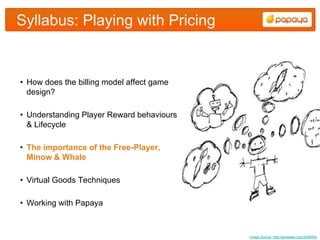
Syllabus: Playing with Pricing


• Some of the theory behind Freemium
  billing models?

• Understanding Player Reward behaviours
  & Lifecycle

• The importance of the Free-Player, Minow
  & Whale

• Virtual Goods Techniques

• Working with Papaya


                                             Image Source: http://jameslao.com/2008/04/
Billing and Game Design: Theories


Lets start with some
 economic principles
•   Consumer Purchase Process
•   Price Elasticity of Demand
•   Barriers to Purchase
•   Short Term and Long Term Risk

...and how they apply to Social Games


                                        Image Source: http://harmonyartmom.blogspot.co.uk/2009/04/sketch-tuesday-take-seat.html
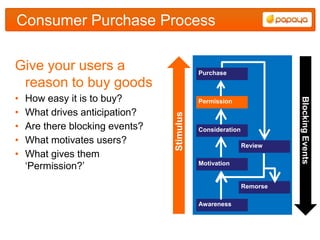
Consumer Purchase Process

Give your users a                           Purchase
 reason to buy goods
•   How easy it is to buy?


                                                                      Blocking Events
                                            Permission
•   What drives anticipation?


                                 Stimulus
•   Are there blocking events?              Consideration
•   What motivates users?                                   Review
•   What gives them
    „Permission?‟                           Motivation


                                                            Remorse

                                            Awareness
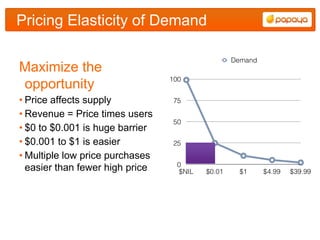
Pricing Elasticity of Demand


Maximize the
opportunity
• Price affects supply
• Revenue = Price times users
• $0 to $0.001 is huge barrier
• $0.001 to $1 is easier
• Multiple low price purchases
  easier than fewer high price
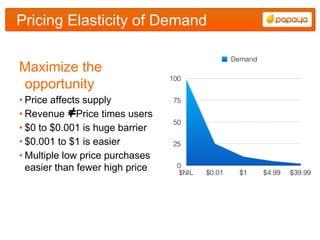
Pricing Elasticity of Demand


Maximize the
opportunity
• Price affects supply
             ≠
• Revenue = Price times users
• $0 to $0.001 is huge barrier
• $0.001 to $1 is easier
• Multiple low price purchases
  easier than fewer high price
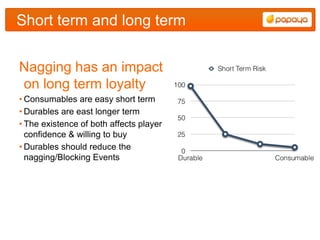
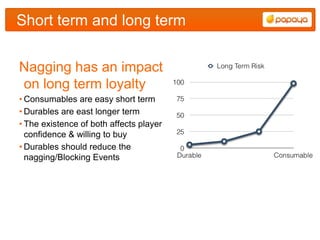
Short term and long term


Nagging has an impact
on long term loyalty
• Consumables are easy short term
• Durables are east longer term
• The existence of both affects player
  confidence & willing to buy
• Durables should reduce the
  nagging/Blocking Events
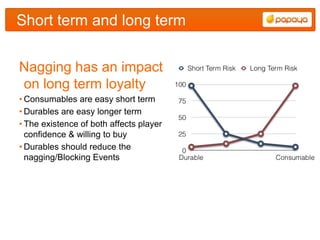
Short term and long term


Nagging has an impact
on long term loyalty
• Consumables are easy short term
• Durables are east longer term
• The existence of both affects player
  confidence & willing to buy
• Durables should reduce the
  nagging/Blocking Events
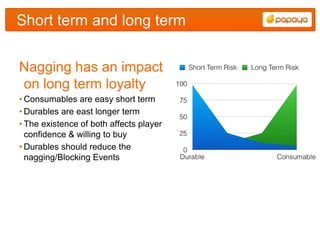
Short term and long term


Nagging has an impact
on long term loyalty
• Consumables are easy short term
• Durables are easy longer term
• The existence of both affects player
  confidence & willing to buy
• Durables should reduce the
  nagging/Blocking Events
Short term and long term


Nagging has an impact
on long term loyalty
• Consumables are easy short term
• Durables are east longer term
• The existence of both affects player
  confidence & willing to buy
• Durables should reduce the
  nagging/Blocking Events
Syllabus: Playing with Pricing


• Some of the theory behind Freemium
  billing models?

• Understanding Player Reward
  behaviours & Lifecycle

• The importance of the Free-Player, Minow
  & Whale

• Virtual Goods Techniques

• Using the Papaya Game Engine for rapid
  Social Game Development


                                             Image Source: http://jameslao.com/2008/04/
Where does Social come in?


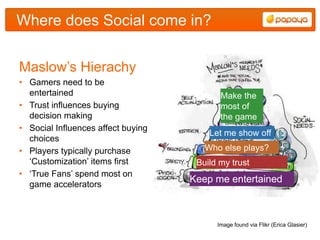
Maslow‟s Hierachy
• Gamers need to be
  entertained                              Make the
• Trust influences buying                  most of
  decision making                          the game
• Social Influences affect buying
                                        Let me show off
  choices
• Players typically purchase           Who else plays?
  „Customization‟ items first        Build my trust
• „True Fans‟ spend most on
  game accelerators
                                    Keep me entertained


                                          Image found via Flikr (Erica Glasier)
Who are your players?


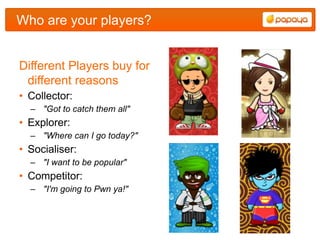
Different Players buy for
 different reasons
• Collector:
  – "Got to catch them all"
• Explorer:
  – "Where can I go today?"
• Socialiser:
  – "I want to be popular"
• Competitor:
  – "I'm going to Pwn ya!"
What do your players want now?


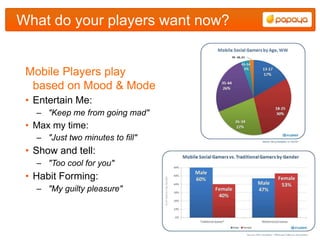
 Mobile Players play
  based on Mood & Mode
 • Entertain Me:
   – "Keep me from going mad"
 • Max my time:
   – "Just two minutes to fill"
 • Show and tell:
   – "Too cool for you"
 • Habit Forming:
   – "My guilty pleasure"
The life of the game


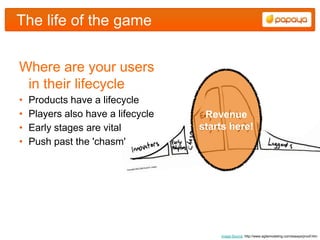
Where are your users
 in their lifecycle
•   Products have a lifecycle
•   Players also have a lifecycle    Revenue
•   Early stages are vital          starts here!
•   Push past the 'chasm'


                                        Image Source: http://www.agilemodeling.com/essays/proof.htm
Syllabus: Playing with Pricing


• How does the billing model affect game
  design?

• Understanding Player Reward behaviours
  & Lifecycle

• The importance of the Free-Player,
  Minow & Whale

• Virtual Goods Techniques

• Working with Papaya


                                           Image Source: http://jameslao.com/2008/04/
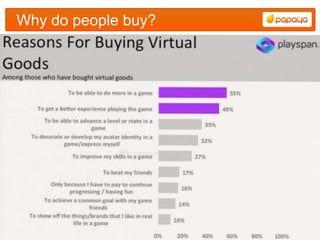
Why do people buy?
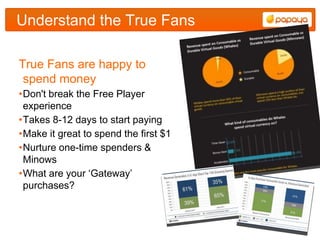
Understand the True Fans

True Fans are happy to
 spend money
•Don't break the Free Player
 experience
•Takes 8-12 days to start paying
•Make it great to spend the first $1
•Nurture one-time spenders &
 Minows
•What are your „Gateway‟
 purchases?
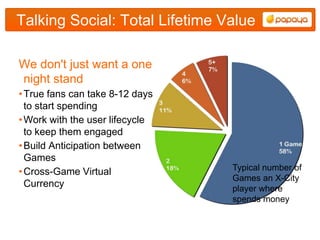
Talking Social: Total Lifetime Value

We don't just want a one
night stand
• True fans can take 8-12 days
  to start spending
• Work with the user lifecycle
  to keep them engaged
• Build Anticipation between
  Games
                                 Typical number of
• Cross-Game Virtual
                                 Games an X-City
  Currency                       player where
                                 spends money
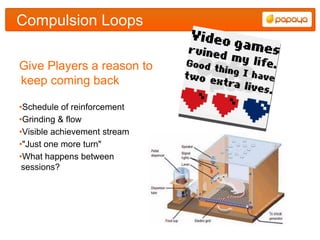
Compulsion Loops

Give Players a reason to
keep coming back

•Schedule of reinforcement
•Grinding & flow
•Visible achievement stream
•"Just one more turn"
•What happens between
 sessions?
Syllabus: Playing with Pricing


• How does the billing model affect game
  design?

• Understanding Player Reward behaviours
  & Lifecycle

• The importance of the Free-Player, Minow
  & Whale

• Virtual Goods techniques

• Working with Papaya


                                             Image Source: http://jameslao.com/2008/04/
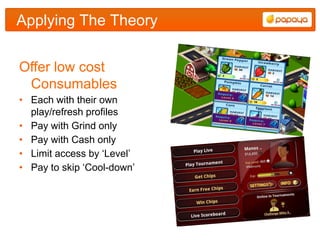
Applying The Theory


Offer low cost
 Consumables
• Each with their own
  play/refresh profiles
• Pay with Grind only
• Pay with Cash only
• Limit access by „Level‟
• Pay to skip „Cool-down‟
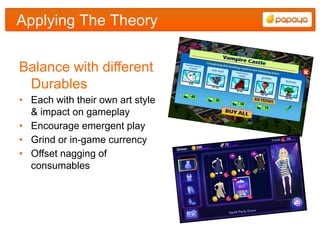
Applying The Theory


Balance with different
 Durables
• Each with their own art style
  & impact on gameplay
• Encourage emergent play
• Grind or in-game currency
• Offset nagging of
  consumables
Applying The Theory


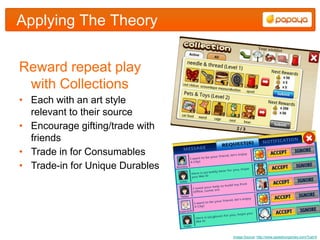
Reward repeat play
 with Collections
• Each with an art style
  relevant to their source
• Encourage gifting/trade with
  friends
• Trade in for Consumables
• Trade-in for Unique Durables


                                 Image Source: http://www.speedrungames.com/?cat=5
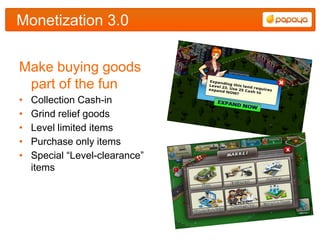
Monetization 3.0


Make buying goods
 part of the fun
•   Collection Cash-in
•   Grind relief goods
•   Level limited items
•   Purchase only items
•   Special “Level-clearance”
    items
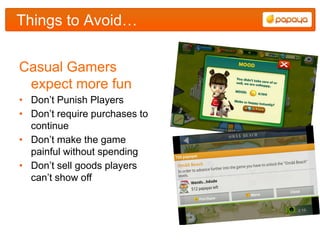
Things to Avoid…


Casual Gamers
 expect more fun
• Don‟t Punish Players
• Don‟t require purchases to
  continue
• Don‟t make the game
  painful without spending
• Don‟t sell goods players
  can‟t show off
Syllabus: Playing with Pricing


• How does the billing model affect game
  design?

• Understanding Player Reward behaviours
  & Lifecycle

• The importance of the Free-Player, Minow
  & Whale

• Virtual Goods Techniques

• Working with Papaya


                                             Image Source: http://jameslao.com/2008/04/
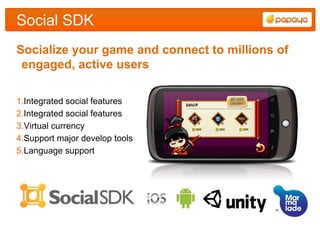
Social SDK
Socialize your game and connect to millions of
 engaged, active users

1.Integrated social features
2.Integrated social features
3.Virtual currency
4.Support major develop tools
5.Language support
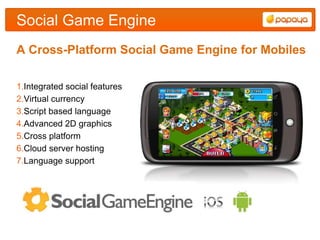
Social Game Engine
A Cross-Platform Social Game Engine for Mobiles

1.Integrated social features
2.Virtual currency
3.Script based language
4.Advanced 2D graphics
5.Cross platform
6.Cloud server hosting
7.Language support
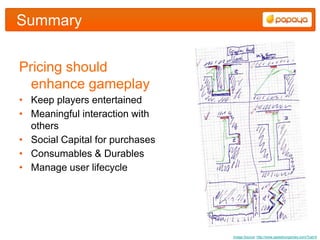
Summary


Pricing should
  enhance gameplay
• Keep players entertained
• Meaningful interaction with
  others
• Social Capital for purchases
• Consumables & Durables
• Manage user lifecycle


                                 Image Source: http://www.speedrungames.com/?cat=5
Any Questions?


                  oscarclark@papayamobile.com
Thank you :)                Twitter: @Athanateus

Playing with Pricing

  • 1.
    grgetherh Playing with Pricing in Social Mobile Games Oscar Clark Evangelist PapayaMobile Inc
  • 2.
    Syllabus: Playing withPricing • Some of the theory behind Freemium billing models? • Understanding Player Reward behaviours & Lifecycle • The importance of the Free-Player, Minow & Whale • Virtual Goods Techniques • Working with Papaya Image Source: http://jameslao.com/2008/04/
  • 3.
    Billing and GameDesign: Theories Lets start with some economic principles • Consumer Purchase Process • Price Elasticity of Demand • Barriers to Purchase • Short Term and Long Term Risk ...and how they apply to Social Games Image Source: http://harmonyartmom.blogspot.co.uk/2009/04/sketch-tuesday-take-seat.html
  • 4.
    Consumer Purchase Process Giveyour users a Purchase reason to buy goods • How easy it is to buy? Blocking Events Permission • What drives anticipation? Stimulus • Are there blocking events? Consideration • What motivates users? Review • What gives them „Permission?‟ Motivation Remorse Awareness
  • 5.
    Pricing Elasticity ofDemand Maximize the opportunity • Price affects supply • Revenue = Price times users • $0 to $0.001 is huge barrier • $0.001 to $1 is easier • Multiple low price purchases easier than fewer high price
  • 6.
    Pricing Elasticity ofDemand Maximize the opportunity • Price affects supply ≠ • Revenue = Price times users • $0 to $0.001 is huge barrier • $0.001 to $1 is easier • Multiple low price purchases easier than fewer high price
  • 7.
    Short term andlong term Nagging has an impact on long term loyalty • Consumables are easy short term • Durables are east longer term • The existence of both affects player confidence & willing to buy • Durables should reduce the nagging/Blocking Events
  • 8.
    Short term andlong term Nagging has an impact on long term loyalty • Consumables are easy short term • Durables are east longer term • The existence of both affects player confidence & willing to buy • Durables should reduce the nagging/Blocking Events
  • 9.
    Short term andlong term Nagging has an impact on long term loyalty • Consumables are easy short term • Durables are easy longer term • The existence of both affects player confidence & willing to buy • Durables should reduce the nagging/Blocking Events
  • 10.
    Short term andlong term Nagging has an impact on long term loyalty • Consumables are easy short term • Durables are east longer term • The existence of both affects player confidence & willing to buy • Durables should reduce the nagging/Blocking Events
  • 11.
    Syllabus: Playing withPricing • Some of the theory behind Freemium billing models? • Understanding Player Reward behaviours & Lifecycle • The importance of the Free-Player, Minow & Whale • Virtual Goods Techniques • Using the Papaya Game Engine for rapid Social Game Development Image Source: http://jameslao.com/2008/04/
  • 12.
    Where does Socialcome in? Maslow‟s Hierachy • Gamers need to be entertained Make the • Trust influences buying most of decision making the game • Social Influences affect buying Let me show off choices • Players typically purchase Who else plays? „Customization‟ items first Build my trust • „True Fans‟ spend most on game accelerators Keep me entertained Image found via Flikr (Erica Glasier)
  • 13.
    Who are yourplayers? Different Players buy for different reasons • Collector: – "Got to catch them all" • Explorer: – "Where can I go today?" • Socialiser: – "I want to be popular" • Competitor: – "I'm going to Pwn ya!"
  • 14.
    What do yourplayers want now? Mobile Players play based on Mood & Mode • Entertain Me: – "Keep me from going mad" • Max my time: – "Just two minutes to fill" • Show and tell: – "Too cool for you" • Habit Forming: – "My guilty pleasure"
  • 15.
    The life ofthe game Where are your users in their lifecycle • Products have a lifecycle • Players also have a lifecycle Revenue • Early stages are vital starts here! • Push past the 'chasm' Image Source: http://www.agilemodeling.com/essays/proof.htm
  • 16.
    Syllabus: Playing withPricing • How does the billing model affect game design? • Understanding Player Reward behaviours & Lifecycle • The importance of the Free-Player, Minow & Whale • Virtual Goods Techniques • Working with Papaya Image Source: http://jameslao.com/2008/04/
  • 17.
  • 18.
    Understand the TrueFans True Fans are happy to spend money •Don't break the Free Player experience •Takes 8-12 days to start paying •Make it great to spend the first $1 •Nurture one-time spenders & Minows •What are your „Gateway‟ purchases?
  • 19.
    Talking Social: TotalLifetime Value We don't just want a one night stand • True fans can take 8-12 days to start spending • Work with the user lifecycle to keep them engaged • Build Anticipation between Games Typical number of • Cross-Game Virtual Games an X-City Currency player where spends money
  • 20.
    Compulsion Loops Give Playersa reason to keep coming back •Schedule of reinforcement •Grinding & flow •Visible achievement stream •"Just one more turn" •What happens between sessions?
  • 21.
    Syllabus: Playing withPricing • How does the billing model affect game design? • Understanding Player Reward behaviours & Lifecycle • The importance of the Free-Player, Minow & Whale • Virtual Goods techniques • Working with Papaya Image Source: http://jameslao.com/2008/04/
  • 22.
    Applying The Theory Offerlow cost Consumables • Each with their own play/refresh profiles • Pay with Grind only • Pay with Cash only • Limit access by „Level‟ • Pay to skip „Cool-down‟
  • 23.
    Applying The Theory Balancewith different Durables • Each with their own art style & impact on gameplay • Encourage emergent play • Grind or in-game currency • Offset nagging of consumables
  • 24.
    Applying The Theory Rewardrepeat play with Collections • Each with an art style relevant to their source • Encourage gifting/trade with friends • Trade in for Consumables • Trade-in for Unique Durables Image Source: http://www.speedrungames.com/?cat=5
  • 25.
    Monetization 3.0 Make buyinggoods part of the fun • Collection Cash-in • Grind relief goods • Level limited items • Purchase only items • Special “Level-clearance” items
  • 26.
    Things to Avoid… CasualGamers expect more fun • Don‟t Punish Players • Don‟t require purchases to continue • Don‟t make the game painful without spending • Don‟t sell goods players can‟t show off
  • 27.
    Syllabus: Playing withPricing • How does the billing model affect game design? • Understanding Player Reward behaviours & Lifecycle • The importance of the Free-Player, Minow & Whale • Virtual Goods Techniques • Working with Papaya Image Source: http://jameslao.com/2008/04/
  • 28.
    Social SDK Socialize yourgame and connect to millions of engaged, active users 1.Integrated social features 2.Integrated social features 3.Virtual currency 4.Support major develop tools 5.Language support
  • 29.
    Social Game Engine ACross-Platform Social Game Engine for Mobiles 1.Integrated social features 2.Virtual currency 3.Script based language 4.Advanced 2D graphics 5.Cross platform 6.Cloud server hosting 7.Language support
  • 30.
    Summary Pricing should enhance gameplay • Keep players entertained • Meaningful interaction with others • Social Capital for purchases • Consumables & Durables • Manage user lifecycle Image Source: http://www.speedrungames.com/?cat=5
  • 31.
    Any Questions? oscarclark@papayamobile.com Thank you :) Twitter: @Athanateus