what chord is
N E X T ?
understand some theory
thy things out
think about key
understanding
M U S I C
you’ll probably use the major scale
think: do – re – mi – fa – sol – la – ti – do
anyone can understand harmony
t h e m a j o r
S C A L E
Every key has SEVEN notes
1 2 3 4 5 6 7 1
t h e m a j o r
S C A L E
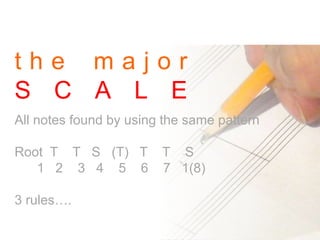
All notes found by using the same pattern
Root T T S (T) T T S
1 2 3 4 5 6 7 1(8)
3 rules….
t h e m a j o r
S C A L E
One of every alphabetical letter
Never miss out any letters
Never mix sharps and flats
t h e m a j o r
S C A L E
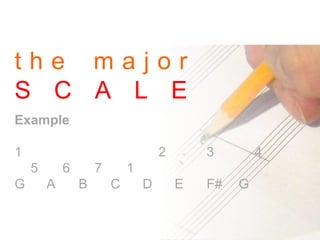
Example
1 2 3 4 5 6 7 1
t h e m a j o r
S C A L E
Example
1 2 3 4
5 6 7 1
G A B C D E F G
t h e m a j o r
S C A L E
Example
1 2 3 4
5 6 7 1
G A B C D E F# G
chords for a
S C A L E
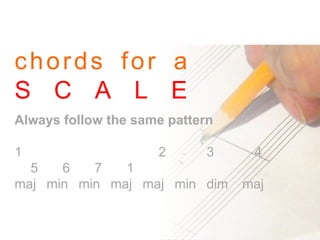
Always follow the same pattern
1 2 3 4
5 6 7 1
maj min min maj maj min dim maj
chords for a
S C A L E
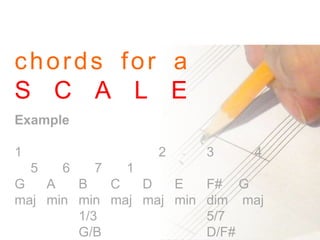
Example
1 2 3 4
5 6 7 1
G A B C D E F# G
maj min min maj maj min dim maj
1/3 5/7
G/B D/F#
chords for a
S C A L E
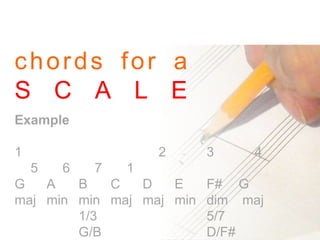
Example
1 2 3 4
5 6 7 1
G A B C D E F# G
maj min min maj maj min dim maj
1/3 5/7
G/B D/F#
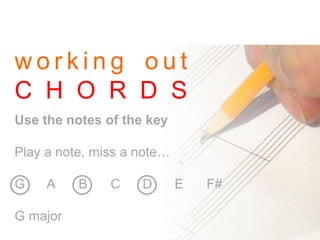
w o r k i n g o u t
C H O R D S
Use the notes of the key
Play a note, miss a note…
G A B C D E F#
G major
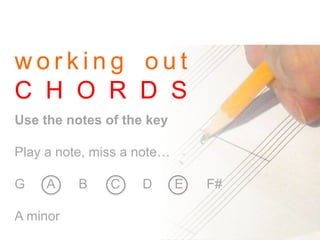
w o r k i n g o u t
C H O R D S
Use the notes of the key
Play a note, miss a note…
G A B C D E F#
A minor
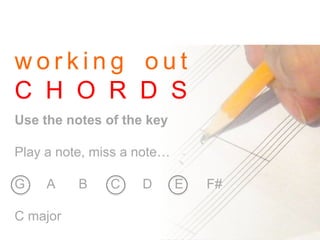
w o r k i n g o u t
C H O R D S
Use the notes of the key
Play a note, miss a note…
G A B C D E F#
C major
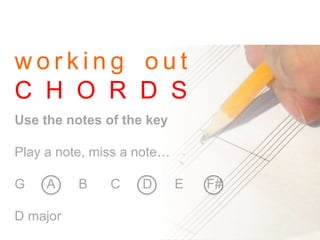
w o r k i n g o u t
C H O R D S
Use the notes of the key
Play a note, miss a note…
G A B C D E F#
D major
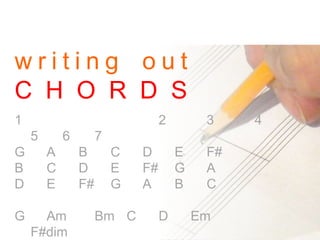
w r i t i n g o u t
C H O R D S
1 2 3 4
5 6 7
G A B C D E F#
B C D E F# G A
D E F# G A B C
G Am Bm C D Em
F#dim
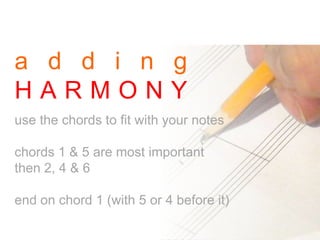
a d d i n g
H A R M O N Y
use the chords to fit with your notes
chords 1 & 5 are most important
then 2, 4 & 6
end on chord 1 (with 5 or 4 before it)
a d d i n g t h e
M U S I C
melody is the most important factor
don’t get caught up on nice chords
start by singing (in time)
a d d i n g t h e
M U S I C
pick the right time signature
try to stick within a good range
just over an octave is best
harmonise the melody you come up with
s i m p l i f y i n g
C H O R D S
you can use the same process
to simplify chords for an arrangement
find chords that fit – 1 or 2 per bar
experiment and see what sounds good
QUESTIONS
?

Play by ear and write music

  • 1.
    what chord is NE X T ? understand some theory thy things out think about key
  • 2.
    understanding M U SI C you’ll probably use the major scale think: do – re – mi – fa – sol – la – ti – do anyone can understand harmony
  • 3.
    t h em a j o r S C A L E Every key has SEVEN notes 1 2 3 4 5 6 7 1
  • 4.
    t h em a j o r S C A L E All notes found by using the same pattern Root T T S (T) T T S 1 2 3 4 5 6 7 1(8) 3 rules….
  • 5.
    t h em a j o r S C A L E One of every alphabetical letter Never miss out any letters Never mix sharps and flats
  • 6.
    t h em a j o r S C A L E Example 1 2 3 4 5 6 7 1
  • 7.
    t h em a j o r S C A L E Example 1 2 3 4 5 6 7 1 G A B C D E F G
  • 8.
    t h em a j o r S C A L E Example 1 2 3 4 5 6 7 1 G A B C D E F# G
  • 9.
    chords for a SC A L E Always follow the same pattern 1 2 3 4 5 6 7 1 maj min min maj maj min dim maj
  • 10.
    chords for a SC A L E Example 1 2 3 4 5 6 7 1 G A B C D E F# G maj min min maj maj min dim maj 1/3 5/7 G/B D/F#
  • 11.
    chords for a SC A L E Example 1 2 3 4 5 6 7 1 G A B C D E F# G maj min min maj maj min dim maj 1/3 5/7 G/B D/F#
  • 12.
    w o rk i n g o u t C H O R D S Use the notes of the key Play a note, miss a note… G A B C D E F# G major
  • 13.
    w o rk i n g o u t C H O R D S Use the notes of the key Play a note, miss a note… G A B C D E F# A minor
  • 14.
    w o rk i n g o u t C H O R D S Use the notes of the key Play a note, miss a note… G A B C D E F# C major
  • 15.
    w o rk i n g o u t C H O R D S Use the notes of the key Play a note, miss a note… G A B C D E F# D major
  • 16.
    w r it i n g o u t C H O R D S 1 2 3 4 5 6 7 G A B C D E F# B C D E F# G A D E F# G A B C G Am Bm C D Em F#dim
  • 17.
    a d di n g H A R M O N Y use the chords to fit with your notes chords 1 & 5 are most important then 2, 4 & 6 end on chord 1 (with 5 or 4 before it)
  • 18.
    a d di n g t h e M U S I C melody is the most important factor don’t get caught up on nice chords start by singing (in time)
  • 19.
    a d di n g t h e M U S I C pick the right time signature try to stick within a good range just over an octave is best harmonise the melody you come up with
  • 20.
    s i mp l i f y i n g C H O R D S you can use the same process to simplify chords for an arrangement find chords that fit – 1 or 2 per bar experiment and see what sounds good
  • 21.