How To Play The Major Scale
“Music is about communication, creativity, and cooperation, and by
studying music in school, students have the opportunity to build on these
skills, enrich their lives, and experience the world from a new
perspective.” — Bill Clinton, former President, United States of America
(http://artdrum.com/MUSIC_EDUCATORS_QUOTES.HTM)
When it comes to playing music getting started is easier than you might
have thought.
Just like learning a language, music begins with understanding how the
sounds fit together. For many in the world, especially in Europe and
America, learning how the sounds fit together begins with learning a
musical scale.
A musical scale is a set of notes, or sounds, that fit nicely together.
These sounds are able to communicate feelings. Just as the sounds of
the letters a,p,p,l,e create a word and placing a “t” sound would distort
the word, musical scales fit together in such a way that makes sense to
our ears.
Also like languages, musical scales vary around the
world. Some alphabets from other languages have
different sounds and some musical scales in other parts
of the world put their sounds together differently.
Today we are going to learn the most common scale in
American and European music, including classical and
modern music. The scale we will learn is called the Major
Scale.
We are going to learn this scale on a piano or any
keyboard instrument. A keyboard is an excellent way to
begin to learn how the sounds of music fit together. For
most keyboard instruments, a keyboard looks like this...
●
The Keyboard consists of five black keys
between seven white keys.
●
Can you see the pattern?
●
●
●
●
●
The seven white keys and five black keys
repeat their sequence throughout the entire
keyboard. Most consider the C key to be the
first key, the C key is this one....
Each white key that is left of the two
black keys is the C key. A keyboard has
many C keys.
●
They key of C
For now, learning the major scale does not require learning the
names of the keys, although it does help. The names of the keys
will have to be known in order to further one's musical knowledge,
but for self exploration and experimentation they are not essential.
●
Although many consider the key of C to be the
first note, a major scale does not need to begin
with that note. The major scale can begin
anywhere on a keyboard and today that is what
we are going to learn - how to play a major
scale beginning on any key on a keyboard.
●
When first learning a scale the two most
important things to playing a scale is playing the
right keys and not pressing the wrong keys.
●
Knowing what are the right and wrong keys is
what we will look at next.
“The piano keys are black and white but they sound like a million colors in your
mind.” – Maria Cristina Mena (http://takelessons.com/blog/quotes-about-piano)
Before we begin we need to visualize there being no black or
white keys, only keys of all the same color and size. Just like
people around us, we need to look beyond color and size to
see how we all fit together and can make harmony. Imagine
the keyboard with all the keys as one size and one color. Like
the picture below, every black key should be viewed as just
another white key, or vise-versa.
Every one is equal
●
The next part is easy. Pick any key you wish on
the keyboard. Again, it does not matter if it is a
black key or a white key. It is best to pick a note
somewhere away from the ends of the keyboard
so we can have room to create a musical scale.
●
Press down on the key you chose and then skip
the next key. It does not matter if the next key is
white or black, whatever key comes next is to
be skipped, remember all keys are to be seen in
an equal light. Now you have your first two
notes of the scale: the first one you chose and
the one after the one you chose.
●
Again, we press the first note chosen, skip the
next key and then press the next after the one
skipped. After the the second key is pressed we
now skip the next key and play the next one.
●
The fourth key is directly after the third. To play
the fourth key we do not have to skip one after
the third. Now we have four notes.
●
Now we have four notes to the major scale.
●
To get a good idea of where we are at we
should look at a diagram.
●
The diagram below shows the major scale
beginning with the key of C. Notice that the first
and last key of a scale is called the root.
●
To get from C to the next key of the major scale
we skipped one, which happens to be a black,
short key. Then to get to the next note we
skipped another key, again it happened to be a
short black note.
●
As was pointed out earlier, to get from the third
key to the fourth key of a major scale nothing
needs to be skipped. Notice on the diagram that
the third key, in this case the key of E, skips
nothing to get to the next and fourth key of the
major scale.
●
Now we have four keys to our major scale and
have four remaining.
●
To get from the fourth to the fifth, another key
must be skipped. Below we see that to get from
F to G we had to skip a black key.
●
To get from the fifth to the sixth we skip another
key again.
●
To get from the sixth to the seventh we skip
another key, and again it is a black key.
●
Now for the final note, from the seventh to the
eighth no key is to be skipped.
●
Again, if we look at the diagram, the major
scale is played in this order: the first note, or
the root; then we skip a note and play the
second; then we skip a note and play the third;
to get from the third to the fourth note, nothing
is skipped; then, from the fourth we skip a note
to get to the fifth; from the fifth we skip another
note to get to the sixth; after the sixth we skip
another note to get to the seventh; and from the
seventh to the eighth (the root) we do not skip a
key.
●
Press a note, skip one and play the next, skip
one and play the next, do not skip one and play
the next, skip one again then press a note, yet
again we skip and press, one more time we
skip and press a note, and then we do not skip
one and we press the final note. The C scale
happens to skip all black keys, however if we
start from a different note on the keyboard we
can get a better idea of how the pattern works
in a major scale. In the next slide we will begin
with a different key and play the same pattern
to produce a major scale.
●
On the diagram below, the dots indicate the
notes played for a major scale. Notice how we
started with a new key, a short black key. The
short black key, which is on the left of the pair of
black keys, as opposed to the three keys
grouped together, is called a C sharp. With that
black key as the root, or first note, played we
must skip a key to get to the second note of the
major scale. This time we had to skip a white
key. Once that white key is skipped and we
press the key after, we have our first two notes
of our new major scale.
●
To get from our second to our third note we
skipped another white key. Now, to get from our
third note to our fourth, notice how no key is
skipped. Now to finish we continue with our
pattern: from the fourth we skip a note and then
play the next, which is our fifth; then we skip
another note and play our sixth; one more time
we skip another note before playing our
seventh; and finally we do not skip a note to get
to our last and final note of the scale (our root).
●
Press-skip-press-skip-press-do not skip-press-
skip-press-skip-press-skip-press-do not skip-
press. This pattern is the major scale beginning
on any key chosen as the first key (or root).
Following this pattern all major scales are
formed.
●
Once the pattern is found it repeats itself
throughout the entire keyboard. In other words,
once we establish which notes are skipped and
which are pressed, we simply do not play the
notes skipped and stick to the notes pressed.
This is called playing in a major scale. Since the
C scale skips all the short black keys, to play in
the C scale on the entire keyboard one need
only stick to the white keys.
●
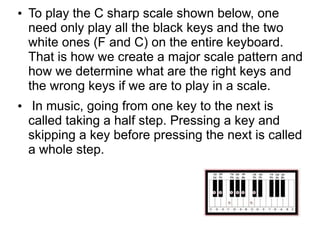
To play the C sharp scale shown below, one
need only play all the black keys and the two
white ones (F and C) on the entire keyboard.
That is how we create a major scale pattern and
how we determine what are the right keys and
the wrong keys if we are to play in a scale.
●
In music, going from one key to the next is
called taking a half step. Pressing a key and
skipping a key before pressing the next is called
a whole step.
●
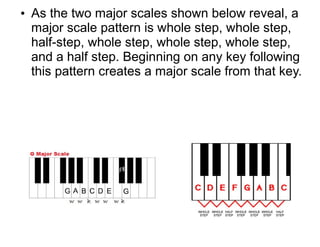
As the two major scales shown below reveal, a
major scale pattern is whole step, whole step,
half-step, whole step, whole step, whole step,
and a half step. Beginning on any key following
this pattern creates a major scale from that key.
●
The picture below shows the names of the keys
on a keyboard. Notice that the black keys have
two names (this will be significant later on in your
musical knowledge). Also pay attention to how
the pattern continues for the entire keyboard.
This makes it easy. The first note before the two
black keys is a C and the first note before the
three black keys is a F; no matter where the F or
C is on a keyboard it is an F or a C and the same
holds true for all the other notes.
●
Do you remember the pattern of a major scale?
Is it #1
●
●
Or is it #2
●
●
●
How about #3
●
The answer is #2.
●
Everything you needed to know to play a major
scale on a keyboard has been included in this
presentation. No matter what your age, 6 or 66,
your never to young or old to enjoy making your
own music. Thanks for your time.
References and Further Reading
●
Baxter, H., & Baxter, M. (1993). Learn to Read
Music. New York: MJF Books.
●
Piston, W. (1969). Harmony, 3rd
Edition. New
York: W. W. Norton & Company, INC.

Majorscale

  • 1.
    How To PlayThe Major Scale “Music is about communication, creativity, and cooperation, and by studying music in school, students have the opportunity to build on these skills, enrich their lives, and experience the world from a new perspective.” — Bill Clinton, former President, United States of America (http://artdrum.com/MUSIC_EDUCATORS_QUOTES.HTM) When it comes to playing music getting started is easier than you might have thought. Just like learning a language, music begins with understanding how the sounds fit together. For many in the world, especially in Europe and America, learning how the sounds fit together begins with learning a musical scale. A musical scale is a set of notes, or sounds, that fit nicely together. These sounds are able to communicate feelings. Just as the sounds of the letters a,p,p,l,e create a word and placing a “t” sound would distort the word, musical scales fit together in such a way that makes sense to our ears.
  • 2.
    Also like languages,musical scales vary around the world. Some alphabets from other languages have different sounds and some musical scales in other parts of the world put their sounds together differently. Today we are going to learn the most common scale in American and European music, including classical and modern music. The scale we will learn is called the Major Scale. We are going to learn this scale on a piano or any keyboard instrument. A keyboard is an excellent way to begin to learn how the sounds of music fit together. For most keyboard instruments, a keyboard looks like this...
  • 3.
    ● The Keyboard consistsof five black keys between seven white keys. ● Can you see the pattern? ● ● ● ● ● The seven white keys and five black keys repeat their sequence throughout the entire keyboard. Most consider the C key to be the first key, the C key is this one....
  • 4.
    Each white keythat is left of the two black keys is the C key. A keyboard has many C keys. ● They key of C
  • 5.
    For now, learningthe major scale does not require learning the names of the keys, although it does help. The names of the keys will have to be known in order to further one's musical knowledge, but for self exploration and experimentation they are not essential. ● Although many consider the key of C to be the first note, a major scale does not need to begin with that note. The major scale can begin anywhere on a keyboard and today that is what we are going to learn - how to play a major scale beginning on any key on a keyboard. ● When first learning a scale the two most important things to playing a scale is playing the right keys and not pressing the wrong keys. ● Knowing what are the right and wrong keys is what we will look at next.
  • 6.
    “The piano keysare black and white but they sound like a million colors in your mind.” – Maria Cristina Mena (http://takelessons.com/blog/quotes-about-piano) Before we begin we need to visualize there being no black or white keys, only keys of all the same color and size. Just like people around us, we need to look beyond color and size to see how we all fit together and can make harmony. Imagine the keyboard with all the keys as one size and one color. Like the picture below, every black key should be viewed as just another white key, or vise-versa. Every one is equal
  • 7.
    ● The next partis easy. Pick any key you wish on the keyboard. Again, it does not matter if it is a black key or a white key. It is best to pick a note somewhere away from the ends of the keyboard so we can have room to create a musical scale. ● Press down on the key you chose and then skip the next key. It does not matter if the next key is white or black, whatever key comes next is to be skipped, remember all keys are to be seen in an equal light. Now you have your first two notes of the scale: the first one you chose and the one after the one you chose.
  • 8.
    ● Again, we pressthe first note chosen, skip the next key and then press the next after the one skipped. After the the second key is pressed we now skip the next key and play the next one. ● The fourth key is directly after the third. To play the fourth key we do not have to skip one after the third. Now we have four notes. ● Now we have four notes to the major scale. ● To get a good idea of where we are at we should look at a diagram.
  • 9.
    ● The diagram belowshows the major scale beginning with the key of C. Notice that the first and last key of a scale is called the root. ● To get from C to the next key of the major scale we skipped one, which happens to be a black, short key. Then to get to the next note we skipped another key, again it happened to be a short black note.
  • 10.
    ● As was pointedout earlier, to get from the third key to the fourth key of a major scale nothing needs to be skipped. Notice on the diagram that the third key, in this case the key of E, skips nothing to get to the next and fourth key of the major scale. ● Now we have four keys to our major scale and have four remaining.
  • 11.
    ● To get fromthe fourth to the fifth, another key must be skipped. Below we see that to get from F to G we had to skip a black key. ● To get from the fifth to the sixth we skip another key again. ● To get from the sixth to the seventh we skip another key, and again it is a black key. ● Now for the final note, from the seventh to the eighth no key is to be skipped.
  • 12.
    ● Again, if welook at the diagram, the major scale is played in this order: the first note, or the root; then we skip a note and play the second; then we skip a note and play the third; to get from the third to the fourth note, nothing is skipped; then, from the fourth we skip a note to get to the fifth; from the fifth we skip another note to get to the sixth; after the sixth we skip another note to get to the seventh; and from the seventh to the eighth (the root) we do not skip a key.
  • 13.
    ● Press a note,skip one and play the next, skip one and play the next, do not skip one and play the next, skip one again then press a note, yet again we skip and press, one more time we skip and press a note, and then we do not skip one and we press the final note. The C scale happens to skip all black keys, however if we start from a different note on the keyboard we can get a better idea of how the pattern works in a major scale. In the next slide we will begin with a different key and play the same pattern to produce a major scale.
  • 14.
    ● On the diagrambelow, the dots indicate the notes played for a major scale. Notice how we started with a new key, a short black key. The short black key, which is on the left of the pair of black keys, as opposed to the three keys grouped together, is called a C sharp. With that black key as the root, or first note, played we must skip a key to get to the second note of the major scale. This time we had to skip a white key. Once that white key is skipped and we press the key after, we have our first two notes of our new major scale.
  • 15.
    ● To get fromour second to our third note we skipped another white key. Now, to get from our third note to our fourth, notice how no key is skipped. Now to finish we continue with our pattern: from the fourth we skip a note and then play the next, which is our fifth; then we skip another note and play our sixth; one more time we skip another note before playing our seventh; and finally we do not skip a note to get to our last and final note of the scale (our root).
  • 16.
    ● Press-skip-press-skip-press-do not skip-press- skip-press-skip-press-skip-press-donot skip- press. This pattern is the major scale beginning on any key chosen as the first key (or root). Following this pattern all major scales are formed. ● Once the pattern is found it repeats itself throughout the entire keyboard. In other words, once we establish which notes are skipped and which are pressed, we simply do not play the notes skipped and stick to the notes pressed. This is called playing in a major scale. Since the C scale skips all the short black keys, to play in the C scale on the entire keyboard one need only stick to the white keys.
  • 17.
    ● To play theC sharp scale shown below, one need only play all the black keys and the two white ones (F and C) on the entire keyboard. That is how we create a major scale pattern and how we determine what are the right keys and the wrong keys if we are to play in a scale. ● In music, going from one key to the next is called taking a half step. Pressing a key and skipping a key before pressing the next is called a whole step.
  • 18.
    ● As the twomajor scales shown below reveal, a major scale pattern is whole step, whole step, half-step, whole step, whole step, whole step, and a half step. Beginning on any key following this pattern creates a major scale from that key.
  • 19.
    ● The picture belowshows the names of the keys on a keyboard. Notice that the black keys have two names (this will be significant later on in your musical knowledge). Also pay attention to how the pattern continues for the entire keyboard. This makes it easy. The first note before the two black keys is a C and the first note before the three black keys is a F; no matter where the F or C is on a keyboard it is an F or a C and the same holds true for all the other notes.
  • 20.
    ● Do you rememberthe pattern of a major scale? Is it #1 ● ● Or is it #2 ● ● ● How about #3
  • 21.
    ● The answer is#2. ● Everything you needed to know to play a major scale on a keyboard has been included in this presentation. No matter what your age, 6 or 66, your never to young or old to enjoy making your own music. Thanks for your time.
  • 22.
    References and FurtherReading ● Baxter, H., & Baxter, M. (1993). Learn to Read Music. New York: MJF Books. ● Piston, W. (1969). Harmony, 3rd Edition. New York: W. W. Norton & Company, INC.