Human plasma fractionation Project
PPPS EMERGING COUNTRIES Page 2
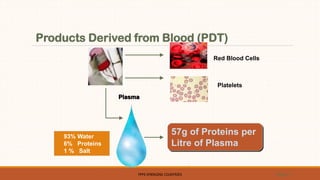
93% Water
6% Proteins
1 % Salt
57g of Proteins per
Litre of Plasma
Plasma
Red Blood Cells
Platelets
Products Derived from Blood (PDT)
Pakistan Case
Considering the currently weak overall infrastructure of health care
system and blood transfusion services, some important
recommendations include centralized blood transfusion and a pilot
contract fractionation resulting in self self-sufficiency in plasma derived
medicines.
The fractionation process fundamentally involves pooling, purification
and processing of donated plasma.
The manufacture and use of plasma products was originally developed
by Cohn et al.1 during World War II, to reduce war mortalities
In 1964, Judith Pool developed a simple way to make cryoprecipitate
that contained factor VIII, a revolutionary treatment for the haemophilia
patients.
About 23-28 million liters of human plasma are fractionated every year in 70
fractionation plants globally, out of which about 35% is processed from whole
blood donations and 65% by plasmaphaeresis.3 These fractionation plants have a
capacity to fractionate 50,0004 to 6million5 litres plasma. International market
for plasma derived medicines is very vibrant increasing by about 10% every year.
In 2008, the global market for plasma products reached $11.8billion, a 69%
increase from 2005, Intravenous Immunoglobulins (IVIG) being the most in
demand plasma product with 29% share. IVIG is the driver of plasma need in
western countries while coagulation factors are driver of plasma need in
developing countries. In Norway, the fractionation project generated large
revenues and the total profit from the products produced was 140€ per liter
plasma.6 The United States, with 70% of the total global plasma collections, is
completely independent to meetits requirements as well as being self-sufficient
in the full range of plasma products
Countries that do not have proper infrastructure for fractionation
projects enter into ‘Contract Fractionation’. This causes significant
savings on national health expenditure and also serves to improve
national blood safety. In this arrangement, plasma is collected locally,
processed in an independent facility located abroad and refined products
are returned to the country. A minimum of 30,000 to 50,000litres of
plasma is required for contract fractionation.5 Cost effectiveness is the
main advantage of contract fractionation as capital investment (at least
US $50-100million)5 on manufacturing plant is saved. The blood
transfusion services of the respective country collect plasma from
voluntary donors through strict selection criteria, serological screening
and quality assured processing and storage of plasma. On the other
hand, the fractionator has to guarantee the maximum yield of quality
products by following GMP (good manufacturing practices).
The World Health Assembly resolutions 28.72(1975) and 58.13(2005)
urge Member States to develop nationally coordinated blood transfusion
services.
Pakistan Case
Plasma, the liquid portion of blood, is rich in various types of proteins,
hormones and enzymes, each playing its vital and most of the time, irreplaceable
role in the healthy sustainment of life.
 Plasma Fractionation is the separation of the desired therapeutic plasma
proteins from the unnecessary ones.
 Various countries have established their own plasma fractionation projects that
reduce this cost and make the countries self-sufficient in their requirements of
the plasma derived medicines.
Pakistan has a high demand of plasma derived medicines and the establishment
of a national plasma fractionation project through contract mechanism is a good
model.
Considering the currently weak overall infrastructure of health care system and
blood transfusion services, some important recommendations include
centralized blood transfusion and a pilot contract fractionation resulting in self
self-sufficiency in plasma derived medicines.
Blood Products/ Plasma Derived Products
BLOOD PRODUCTS FOR
TRANSFUSION
 Whole Blood Products
Blood Components Products
 Red Blood Products
Platelet Products
Fresh Frozen Products
PLASMA DERIVED PRODUCTS
Immunoglobulins
Albumin
Coagulation Factors
Other Replacement Therapies
PPPS EMERGING COUNTRIES Page 9
Global Market for Plasma Proteins
Global market » US $7.3 Billion in 2001
Growing to » US $8.7 Billion in 2005
CAGR » 6%
» IVIG = 50% of US fractionator revenues
» US demand for IVIG is 50% of the market
» New indications alone could double market
rFVIIII
14%
IVIG
33%
HSA
21%
Others
21%
pdFVIII
11%
Adapted from data from Deutsche Bank 2002 (Plasma 101)
IVIG
33%
HSA
21%
Others
21%
rFVIIII
14%
pdFVIII
11%
PPPS EMERGING COUNTRIES Page 10
IgG
Albumin
Factor VIII
AAT
Fibrin
Others
$0
$1 000
$2 000
$3 000
$4 000
$5 000
$6 000
$7 000
$8 000
$9 000
1990 1992 1994 1996 1998 2000 2002 2004
US
$
Mil
Plasma Market by Proteins
PPPS EMERGING COUNTRIES Page 11
Technology Driven by
Multiple Applications
The ProMetic/ARC
process is a combi-
nation of ProMetic’s
technology with
ARC’s expertise
PPPS EMERGING COUNTRIES Page 12
Technology Driven by
Multiple Applications
PPPS EMERGING COUNTRIES Page 13
GAP Between Supply and Demand
Approximately one million people rely on plasma
protein therapies to live each year
Many more have not been diagnosed or do not have
access to therapies
Consumer Community % Treated % Untreated
Hemophilia
Immunodeficiency
Alpha-1 deficiency
20
6
3 97
94
80
PPPS EMERGING COUNTRIES Page 14
How to fix the GAP
Increased manufacturing capacity through
investments in (new) plants
Increased yields from new or improved
processes
New products and new applications
Dr. Ruedi Wager (June 2003)
CEO and President, Aventis Behring
PPPS EMERGING COUNTRIES Page 15
Solution
New Plants
Improved Yield
New Proteins
Mission of PLI/ARC
Joint Venture since
March 2003
PPPS EMERGING COUNTRIES Page 16
Purification Yields from Plasma
US$ 30-60 Million
IVIG
Equal
Albumin
US$ 16-35 Million
Factor VIII
US$ 80 Million
 20%
Alpha1 Protein.
Inhibitor
US$ 140 -280 Million
 10%
Fibrinogen
Revenue incr./
Million Liters
Est. Yield by
chromatography
Yield by Cohn
(Current)
Product
 18%
 75%
 35%
 70%
 80%
 60%
 80%
 70%
* based on US prices
*
PPPS EMERGING COUNTRIES Page 17
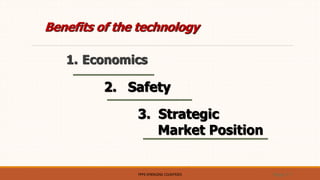
Benefits of the technology
1. Economics
2. Safety
3. Strategic
Market Position
PPPS EMERGING COUNTRIES Page 18
Benefits
1. Economics
 Smaller capital investments
Smaller plant for required product output
Smaller amount of plasma to collect
 Reverse “imports of” to “Exports of” High value lifesaving
therapeutics
PPPS EMERGING COUNTRIES Page 19
Creation of high tech / high profile jobs
Retention of Graduates from Universities
Collaboration and Networking with
various universities and institutions
Collateral Economic Benefits
PPPS EMERGING COUNTRIES Page 20
Self Sufficiency
Centre of excellence
Job/Export
Attract other complementary high value
industry and;
Synergize other complementary existing
infrastructure
Collateral Economic Benefits
PPPS EMERGING COUNTRIES Page 21
Improved Product Safety
New process improves pathogen reduction
Less plasma for same output means being more selective
in plasma collection
Chromatography process can be designed as a “Closed”
system while Cohn manufacturing involves dirty “Open”
process meaning less cGMP
Risk and % of donors with HIV, Hepatitis
Selectivity, costs because of expensive analytical testing
Consumption of albumin and intravenous
immunoglobulin by countries
(source:theMarketingResearchBureauwithpermission).
lasma fractionation process: unique technology.
Adapted from reference [2] and [16].
Plasma requirement (million liters) for albumin, factor and
intravenous immunoglobulin between 1974 and 2014 (source:the
MarketingResearchBureauwithpermission).Adaptedfromreference [22].
Factor VIII consumption and population in
different regions
Global plasma fractionation plant capacity
and throughput (thousand liter)
Create a profitable and sustainable business
First Phase : Target of 2 products as Albumin and IgG
Second phase : Coagulation factor products will be a
dded. (Factor IX and Factor VIII)
Third Phase: Stabilized serum and Fibrin Glue produc
ts will be added.
Mission
Overall Scenario: Objectives
 Proof of Concept - Process Plasma to finished product in commercial Plant
(2000 L batch size)
 Lab scale experiments to develop the process and to establish the data.
 Batch Size: 0.5 to 5 L Plasma
 In house process development, Process optimization and Yield Verification.
 Process Development at Lab scale require 9 moths to 12 months.
 If require Pilot scale up will be carried out. (Non-GMP)
 Commercial Plant Design Basis
 Capacity: 1.5 to 2.0 lakh / Annum
 Commercial Plant to operate require 24 to 26 months
 To Manufacture Albumin and IgG from Plasma to finished Product by Cohn-Hybrid proc
ess.
 This plant will meet the domestic marketing requirements to fractionate own Plasma and po
tential to serve contract manufacturing for Export Market
Overall Scenario : Supporting Resources
 Project Coordinator
 Technical team of expertise having hands on experience;
Product development
Analytical development
Manufacturing (DS and DP)
QA, QC and QMS
Regulatory
Project management
Manpower
For R & D -10 to 15 persons
For manufacturing – 100 to 120 persons
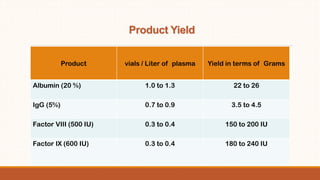
Product vials / Liter of plasma Yield in terms of Grams
Albumin (20 %) 1.0 to 1.3 22 to 26
IgG (5%) 0.7 to 0.9 3.5 to 4.5
Factor VIII (500 IU) 0.3 to 0.4 150 to 200 IU
Factor IX (600 IU) 0.3 to 0.4 180 to 240 IU
Product Yield
Plasma Fractionation Plant : Capacity
• Batch size: 2000 L
• Batches / Week = 2
• Batches / month= 8
• Total plasma Fractionation / month
= 16,000 L
• Total plasma Fractionation / year =
1,76,000 L
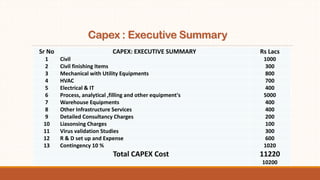
Capex : Executive Summary
Sr No CAPEX: EXECUTIVE SUMMARY Rs Lacs
1 Civil 1000
2 Civil finishing Items 300
3 Mechanical with Utility Equipments 800
4 HVAC 700
5 Electrical & IT 400
6 Process, analytical ,filling and other equipment's 5000
7 Warehouse Equipments 400
8 Other Infrastructure Services 400
9 Detailed Consultancy Charges 200
10 Liasonsing Charges 100
11 Virus validation Studies 300
12 R & D set up and Expense 600
13 Contingency 10 % 1020
Total CAPEX Cost 11220
10200
CAPEX : EXECUTIVE SUMMARY
Assumptions:
Land cost not considered.
Budget estimate as ±20 %. Single Plasma fractionation suit and 3 Downstream
processing suits.
Factor VIII and Factor IX equipment cost not considered.
GMP plant finishes & design to meet C-GMP / Schedule M Standards
The process Equipment automation considered at standalone equipment level,
however future retrofit has been considered

Plasma Fractionation Master.pptx

  • 1.
  • 2.
    PPPS EMERGING COUNTRIESPage 2 93% Water 6% Proteins 1 % Salt 57g of Proteins per Litre of Plasma Plasma Red Blood Cells Platelets Products Derived from Blood (PDT)
  • 3.
    Pakistan Case Considering thecurrently weak overall infrastructure of health care system and blood transfusion services, some important recommendations include centralized blood transfusion and a pilot contract fractionation resulting in self self-sufficiency in plasma derived medicines. The fractionation process fundamentally involves pooling, purification and processing of donated plasma. The manufacture and use of plasma products was originally developed by Cohn et al.1 during World War II, to reduce war mortalities In 1964, Judith Pool developed a simple way to make cryoprecipitate that contained factor VIII, a revolutionary treatment for the haemophilia patients.
  • 4.
    About 23-28 millionliters of human plasma are fractionated every year in 70 fractionation plants globally, out of which about 35% is processed from whole blood donations and 65% by plasmaphaeresis.3 These fractionation plants have a capacity to fractionate 50,0004 to 6million5 litres plasma. International market for plasma derived medicines is very vibrant increasing by about 10% every year. In 2008, the global market for plasma products reached $11.8billion, a 69% increase from 2005, Intravenous Immunoglobulins (IVIG) being the most in demand plasma product with 29% share. IVIG is the driver of plasma need in western countries while coagulation factors are driver of plasma need in developing countries. In Norway, the fractionation project generated large revenues and the total profit from the products produced was 140€ per liter plasma.6 The United States, with 70% of the total global plasma collections, is completely independent to meetits requirements as well as being self-sufficient in the full range of plasma products
  • 5.
    Countries that donot have proper infrastructure for fractionation projects enter into ‘Contract Fractionation’. This causes significant savings on national health expenditure and also serves to improve national blood safety. In this arrangement, plasma is collected locally, processed in an independent facility located abroad and refined products are returned to the country. A minimum of 30,000 to 50,000litres of plasma is required for contract fractionation.5 Cost effectiveness is the main advantage of contract fractionation as capital investment (at least US $50-100million)5 on manufacturing plant is saved. The blood transfusion services of the respective country collect plasma from voluntary donors through strict selection criteria, serological screening and quality assured processing and storage of plasma. On the other hand, the fractionator has to guarantee the maximum yield of quality products by following GMP (good manufacturing practices).
  • 6.
    The World HealthAssembly resolutions 28.72(1975) and 58.13(2005) urge Member States to develop nationally coordinated blood transfusion services.
  • 7.
    Pakistan Case Plasma, theliquid portion of blood, is rich in various types of proteins, hormones and enzymes, each playing its vital and most of the time, irreplaceable role in the healthy sustainment of life.  Plasma Fractionation is the separation of the desired therapeutic plasma proteins from the unnecessary ones.  Various countries have established their own plasma fractionation projects that reduce this cost and make the countries self-sufficient in their requirements of the plasma derived medicines. Pakistan has a high demand of plasma derived medicines and the establishment of a national plasma fractionation project through contract mechanism is a good model. Considering the currently weak overall infrastructure of health care system and blood transfusion services, some important recommendations include centralized blood transfusion and a pilot contract fractionation resulting in self self-sufficiency in plasma derived medicines.
  • 8.
    Blood Products/ PlasmaDerived Products BLOOD PRODUCTS FOR TRANSFUSION  Whole Blood Products Blood Components Products  Red Blood Products Platelet Products Fresh Frozen Products PLASMA DERIVED PRODUCTS Immunoglobulins Albumin Coagulation Factors Other Replacement Therapies
  • 9.
    PPPS EMERGING COUNTRIESPage 9 Global Market for Plasma Proteins Global market » US $7.3 Billion in 2001 Growing to » US $8.7 Billion in 2005 CAGR » 6% » IVIG = 50% of US fractionator revenues » US demand for IVIG is 50% of the market » New indications alone could double market rFVIIII 14% IVIG 33% HSA 21% Others 21% pdFVIII 11% Adapted from data from Deutsche Bank 2002 (Plasma 101) IVIG 33% HSA 21% Others 21% rFVIIII 14% pdFVIII 11%
  • 10.
    PPPS EMERGING COUNTRIESPage 10 IgG Albumin Factor VIII AAT Fibrin Others $0 $1 000 $2 000 $3 000 $4 000 $5 000 $6 000 $7 000 $8 000 $9 000 1990 1992 1994 1996 1998 2000 2002 2004 US $ Mil Plasma Market by Proteins
  • 11.
    PPPS EMERGING COUNTRIESPage 11 Technology Driven by Multiple Applications The ProMetic/ARC process is a combi- nation of ProMetic’s technology with ARC’s expertise
  • 12.
    PPPS EMERGING COUNTRIESPage 12 Technology Driven by Multiple Applications
  • 13.
    PPPS EMERGING COUNTRIESPage 13 GAP Between Supply and Demand Approximately one million people rely on plasma protein therapies to live each year Many more have not been diagnosed or do not have access to therapies Consumer Community % Treated % Untreated Hemophilia Immunodeficiency Alpha-1 deficiency 20 6 3 97 94 80
  • 14.
    PPPS EMERGING COUNTRIESPage 14 How to fix the GAP Increased manufacturing capacity through investments in (new) plants Increased yields from new or improved processes New products and new applications Dr. Ruedi Wager (June 2003) CEO and President, Aventis Behring
  • 15.
    PPPS EMERGING COUNTRIESPage 15 Solution New Plants Improved Yield New Proteins Mission of PLI/ARC Joint Venture since March 2003
  • 16.
    PPPS EMERGING COUNTRIESPage 16 Purification Yields from Plasma US$ 30-60 Million IVIG Equal Albumin US$ 16-35 Million Factor VIII US$ 80 Million  20% Alpha1 Protein. Inhibitor US$ 140 -280 Million  10% Fibrinogen Revenue incr./ Million Liters Est. Yield by chromatography Yield by Cohn (Current) Product  18%  75%  35%  70%  80%  60%  80%  70% * based on US prices *
  • 17.
    PPPS EMERGING COUNTRIESPage 17 Benefits of the technology 1. Economics 2. Safety 3. Strategic Market Position
  • 18.
    PPPS EMERGING COUNTRIESPage 18 Benefits 1. Economics  Smaller capital investments Smaller plant for required product output Smaller amount of plasma to collect  Reverse “imports of” to “Exports of” High value lifesaving therapeutics
  • 19.
    PPPS EMERGING COUNTRIESPage 19 Creation of high tech / high profile jobs Retention of Graduates from Universities Collaboration and Networking with various universities and institutions Collateral Economic Benefits
  • 20.
    PPPS EMERGING COUNTRIESPage 20 Self Sufficiency Centre of excellence Job/Export Attract other complementary high value industry and; Synergize other complementary existing infrastructure Collateral Economic Benefits
  • 21.
    PPPS EMERGING COUNTRIESPage 21 Improved Product Safety New process improves pathogen reduction Less plasma for same output means being more selective in plasma collection Chromatography process can be designed as a “Closed” system while Cohn manufacturing involves dirty “Open” process meaning less cGMP Risk and % of donors with HIV, Hepatitis Selectivity, costs because of expensive analytical testing
  • 22.
    Consumption of albuminand intravenous immunoglobulin by countries (source:theMarketingResearchBureauwithpermission).
  • 23.
    lasma fractionation process:unique technology. Adapted from reference [2] and [16].
  • 24.
    Plasma requirement (millionliters) for albumin, factor and intravenous immunoglobulin between 1974 and 2014 (source:the MarketingResearchBureauwithpermission).Adaptedfromreference [22].
  • 25.
    Factor VIII consumptionand population in different regions
  • 26.
    Global plasma fractionationplant capacity and throughput (thousand liter)
  • 27.
    Create a profitableand sustainable business First Phase : Target of 2 products as Albumin and IgG Second phase : Coagulation factor products will be a dded. (Factor IX and Factor VIII) Third Phase: Stabilized serum and Fibrin Glue produc ts will be added. Mission
  • 28.
    Overall Scenario: Objectives Proof of Concept - Process Plasma to finished product in commercial Plant (2000 L batch size)  Lab scale experiments to develop the process and to establish the data.  Batch Size: 0.5 to 5 L Plasma  In house process development, Process optimization and Yield Verification.  Process Development at Lab scale require 9 moths to 12 months.  If require Pilot scale up will be carried out. (Non-GMP)  Commercial Plant Design Basis  Capacity: 1.5 to 2.0 lakh / Annum  Commercial Plant to operate require 24 to 26 months  To Manufacture Albumin and IgG from Plasma to finished Product by Cohn-Hybrid proc ess.  This plant will meet the domestic marketing requirements to fractionate own Plasma and po tential to serve contract manufacturing for Export Market
  • 29.
    Overall Scenario :Supporting Resources  Project Coordinator  Technical team of expertise having hands on experience; Product development Analytical development Manufacturing (DS and DP) QA, QC and QMS Regulatory Project management Manpower For R & D -10 to 15 persons For manufacturing – 100 to 120 persons
  • 30.
    Product vials /Liter of plasma Yield in terms of Grams Albumin (20 %) 1.0 to 1.3 22 to 26 IgG (5%) 0.7 to 0.9 3.5 to 4.5 Factor VIII (500 IU) 0.3 to 0.4 150 to 200 IU Factor IX (600 IU) 0.3 to 0.4 180 to 240 IU Product Yield
  • 31.
    Plasma Fractionation Plant: Capacity • Batch size: 2000 L • Batches / Week = 2 • Batches / month= 8 • Total plasma Fractionation / month = 16,000 L • Total plasma Fractionation / year = 1,76,000 L
  • 32.
    Capex : ExecutiveSummary Sr No CAPEX: EXECUTIVE SUMMARY Rs Lacs 1 Civil 1000 2 Civil finishing Items 300 3 Mechanical with Utility Equipments 800 4 HVAC 700 5 Electrical & IT 400 6 Process, analytical ,filling and other equipment's 5000 7 Warehouse Equipments 400 8 Other Infrastructure Services 400 9 Detailed Consultancy Charges 200 10 Liasonsing Charges 100 11 Virus validation Studies 300 12 R & D set up and Expense 600 13 Contingency 10 % 1020 Total CAPEX Cost 11220 10200
  • 33.
    CAPEX : EXECUTIVESUMMARY Assumptions: Land cost not considered. Budget estimate as ±20 %. Single Plasma fractionation suit and 3 Downstream processing suits. Factor VIII and Factor IX equipment cost not considered. GMP plant finishes & design to meet C-GMP / Schedule M Standards The process Equipment automation considered at standalone equipment level, however future retrofit has been considered