MQ Technical Conference v2.0.1.7
Planning for MQ in the Cloud
Rob Parker, IBM
parrobe@uk.ibm.com
10/2/20171
MQ Technical Conference v2.0.1.72 10/2/2017
Please note
IBM’s statements regarding its plans, directions, and
intent
are subject to change or withdrawal without notice at
IBM’s
sole discretion.
Information regarding potential future products is
intended to outline our general product direction and
it should not be relied on in making a purchasing decision.
The information mentioned regarding potential future
products is not a commitment, promise, or legal obligation
to deliver
any material, code or functionality. Information about
potential future products may not be incorporated into any
contract.
The development, release, and timing of any future
features
or functionality described for our products remains at our
sole discretion.
Performance is based on measurements and projections
using standard IBM benchmarks in a
controlled environment. The actual throughput or
performance that any user will experience will vary
depending upon many factors, including considerations
such as the amount of multiprogramming in
the user’s job stream, the I/O configuration, the storage
configuration, and the workload processed. Therefore, no
assurance can be given that an individual user will achieve
results similar to those stated here.
MQ Technical Conference v2.0.1.73 10/2/2017
Agenda
• Introduction
• Generic Cloud considerations
• MQ Specific considerations
• Questions
MQ Technical Conference v2.0.1.7
GENERIC CLOUD CONSIDERATIONS
MQ Technical Conference v2.0.1.75
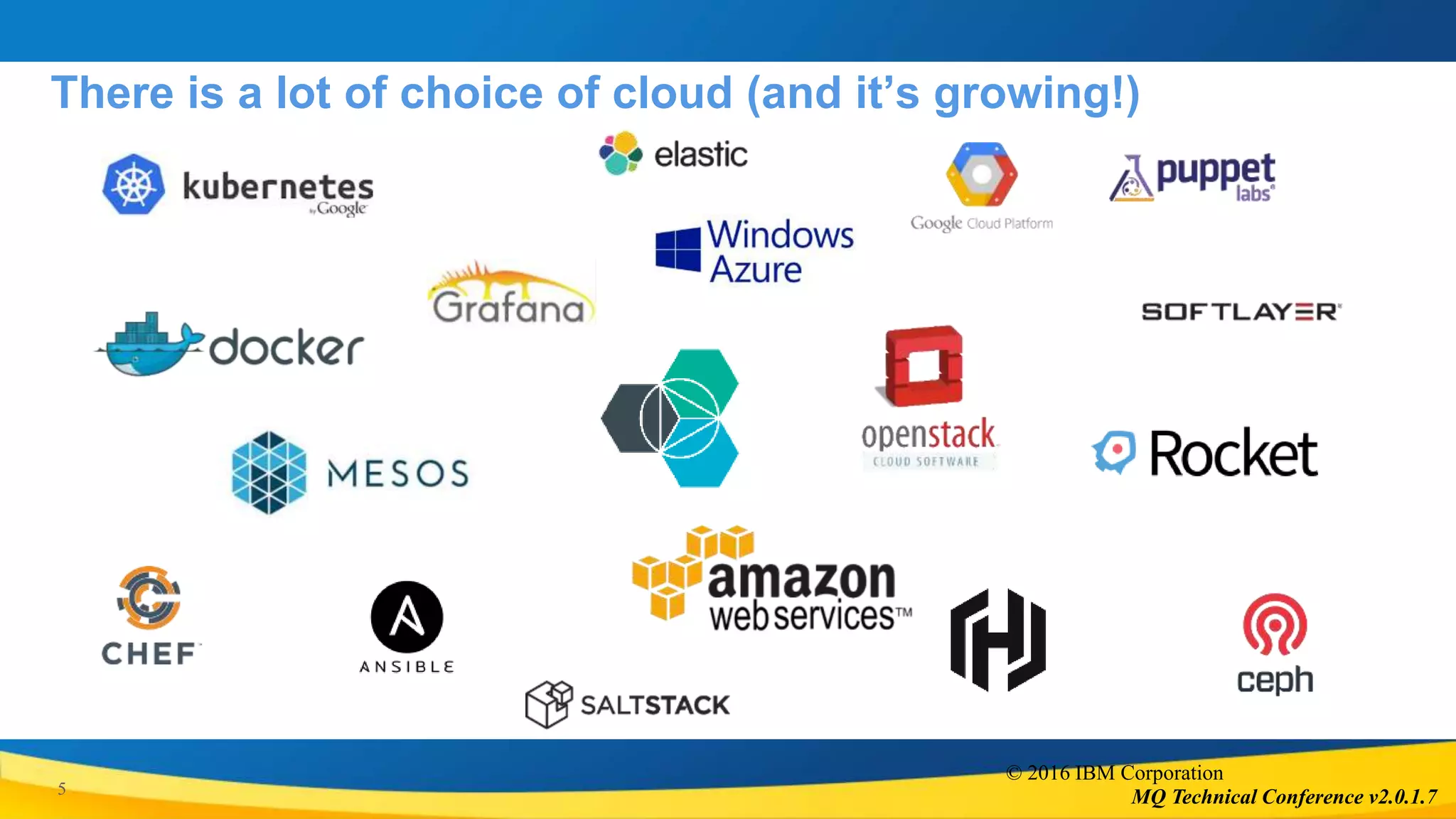
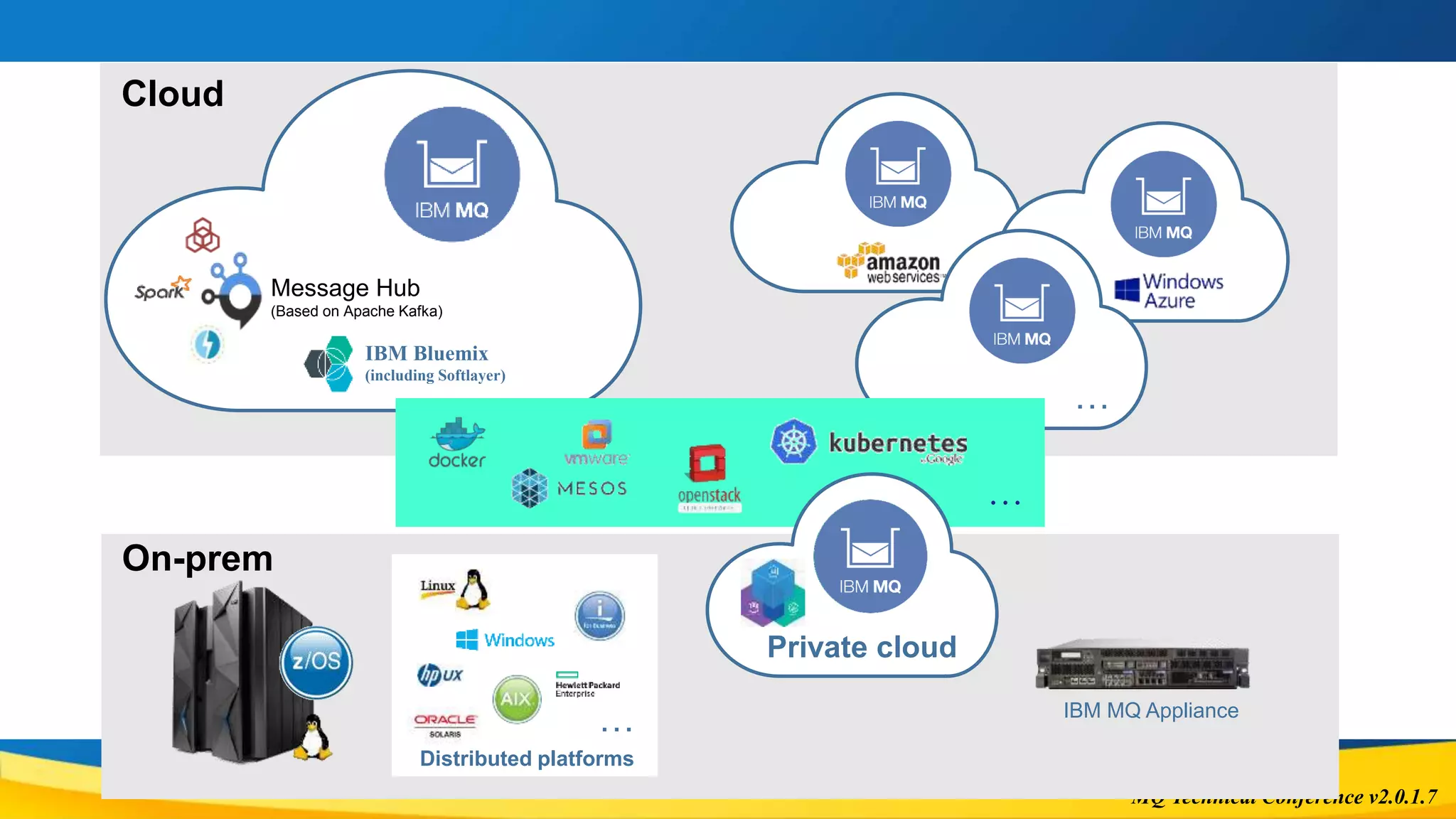
There is a lot of choice of cloud (and it’s growing!)
© 2016 IBM Corporation
MQ Technical Conference v2.0.1.7
On-prem
IBM MQ Appliance
AWS
AWS
AWS …
Cloud
Message Hub
(Based on Apache Kafka)
IBM Bluemix
(including Softlayer)
…
Distributed platforms
…
Private cloud
MQ Technical Conference v2.0.1.7
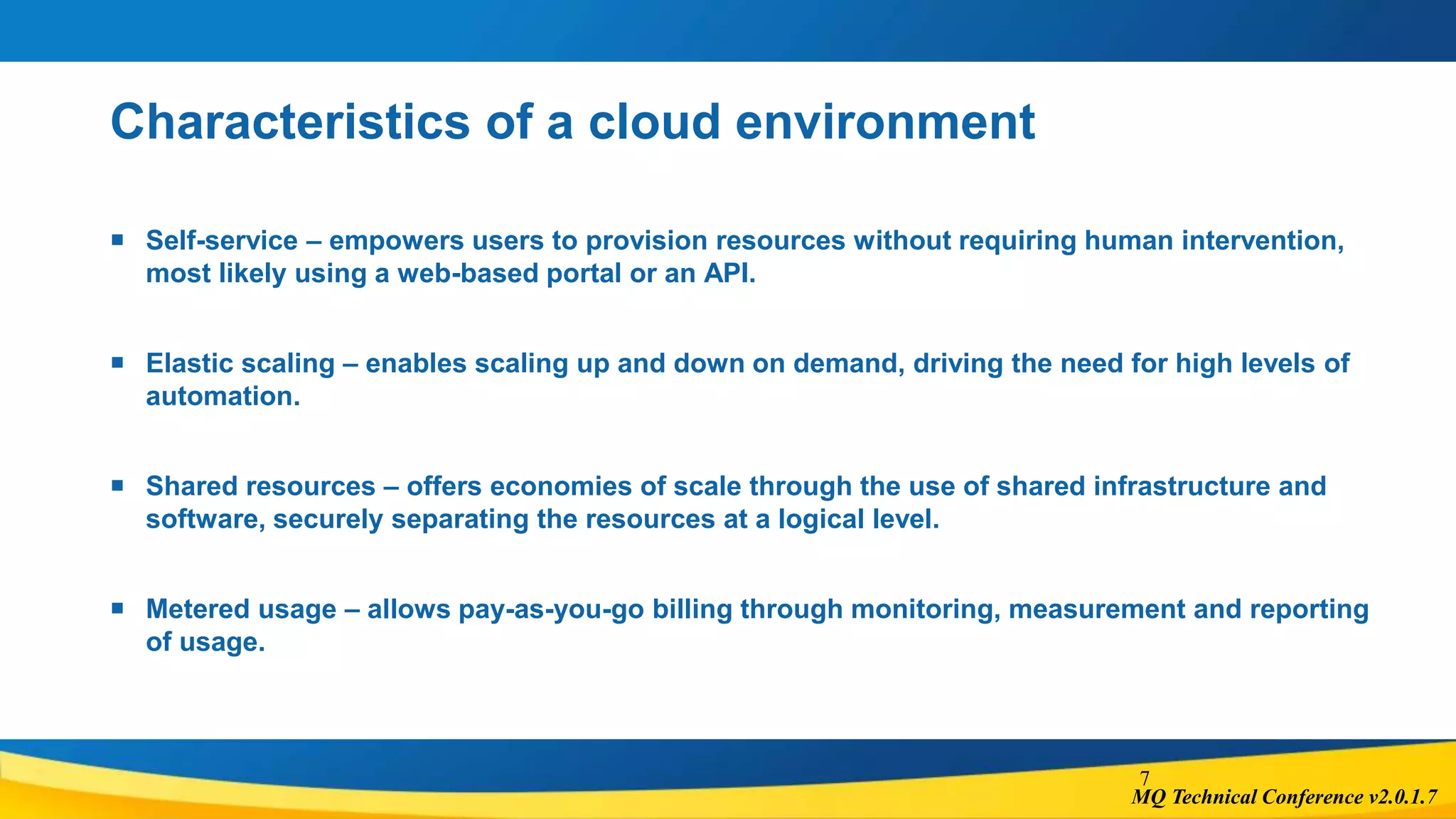
Characteristics of a cloud environment
 Self-service – empowers users to provision resources without requiring human intervention,
most likely using a web-based portal or an API.
 Elastic scaling – enables scaling up and down on demand, driving the need for high levels of
automation.
 Shared resources – offers economies of scale through the use of shared infrastructure and
software, securely separating the resources at a logical level.
 Metered usage – allows pay-as-you-go billing through monitoring, measurement and reporting
of usage.
7
MQ Technical Conference v2.0.1.7
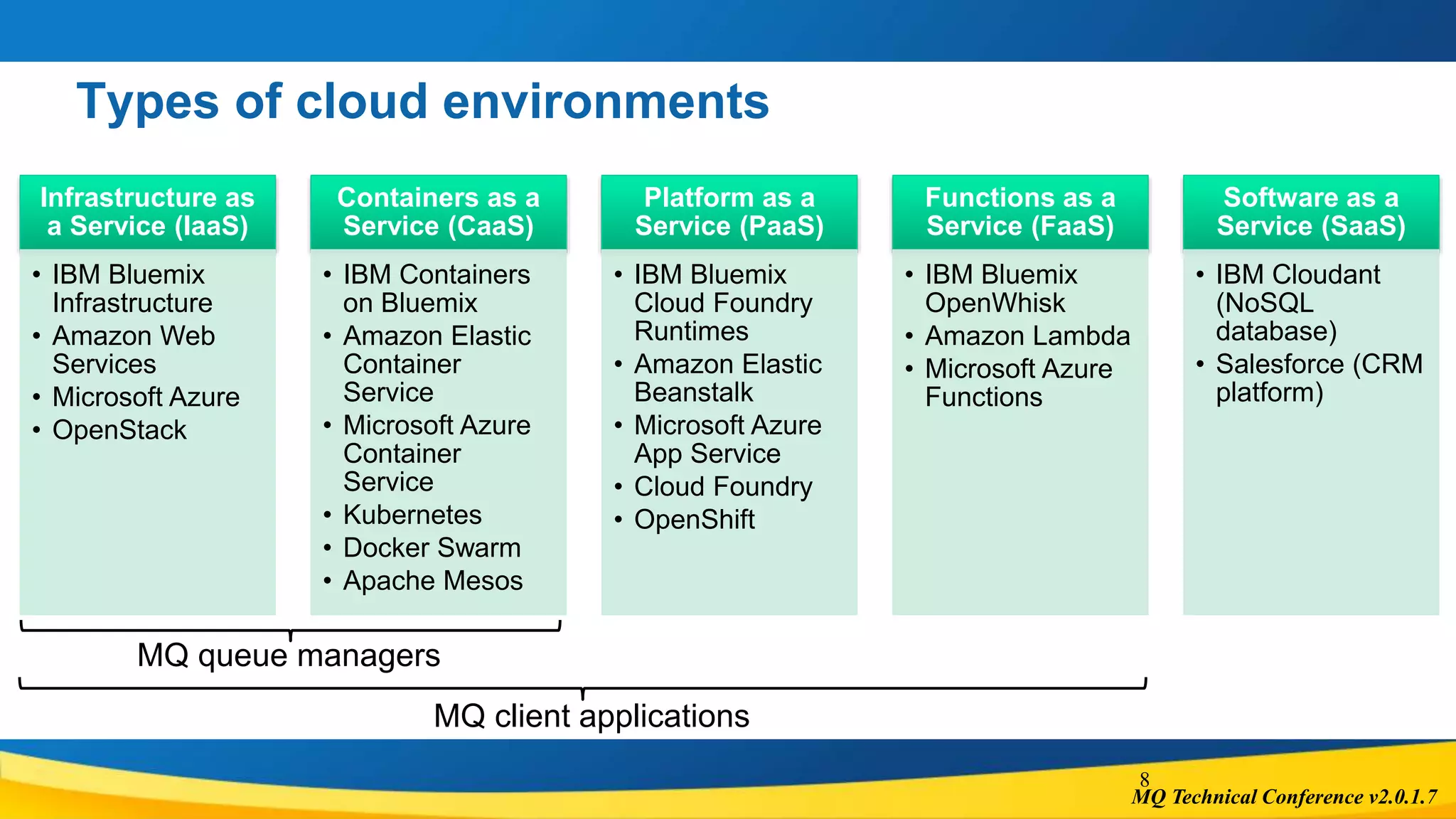
Types of cloud environments
Infrastructure as
a Service (IaaS)
• IBM Bluemix
Infrastructure
• Amazon Web
Services
• Microsoft Azure
• OpenStack
Containers as a
Service (CaaS)
• IBM Containers
on Bluemix
• Amazon Elastic
Container
Service
• Microsoft Azure
Container
Service
• Kubernetes
• Docker Swarm
• Apache Mesos
Platform as a
Service (PaaS)
• IBM Bluemix
Cloud Foundry
Runtimes
• Amazon Elastic
Beanstalk
• Microsoft Azure
App Service
• Cloud Foundry
• OpenShift
Functions as a
Service (FaaS)
• IBM Bluemix
OpenWhisk
• Amazon Lambda
• Microsoft Azure
Functions
Software as a
Service (SaaS)
• IBM Cloudant
(NoSQL
database)
• Salesforce (CRM
platform)
8
MQ queue managers
MQ client applications
MQ Technical Conference v2.0.1.7
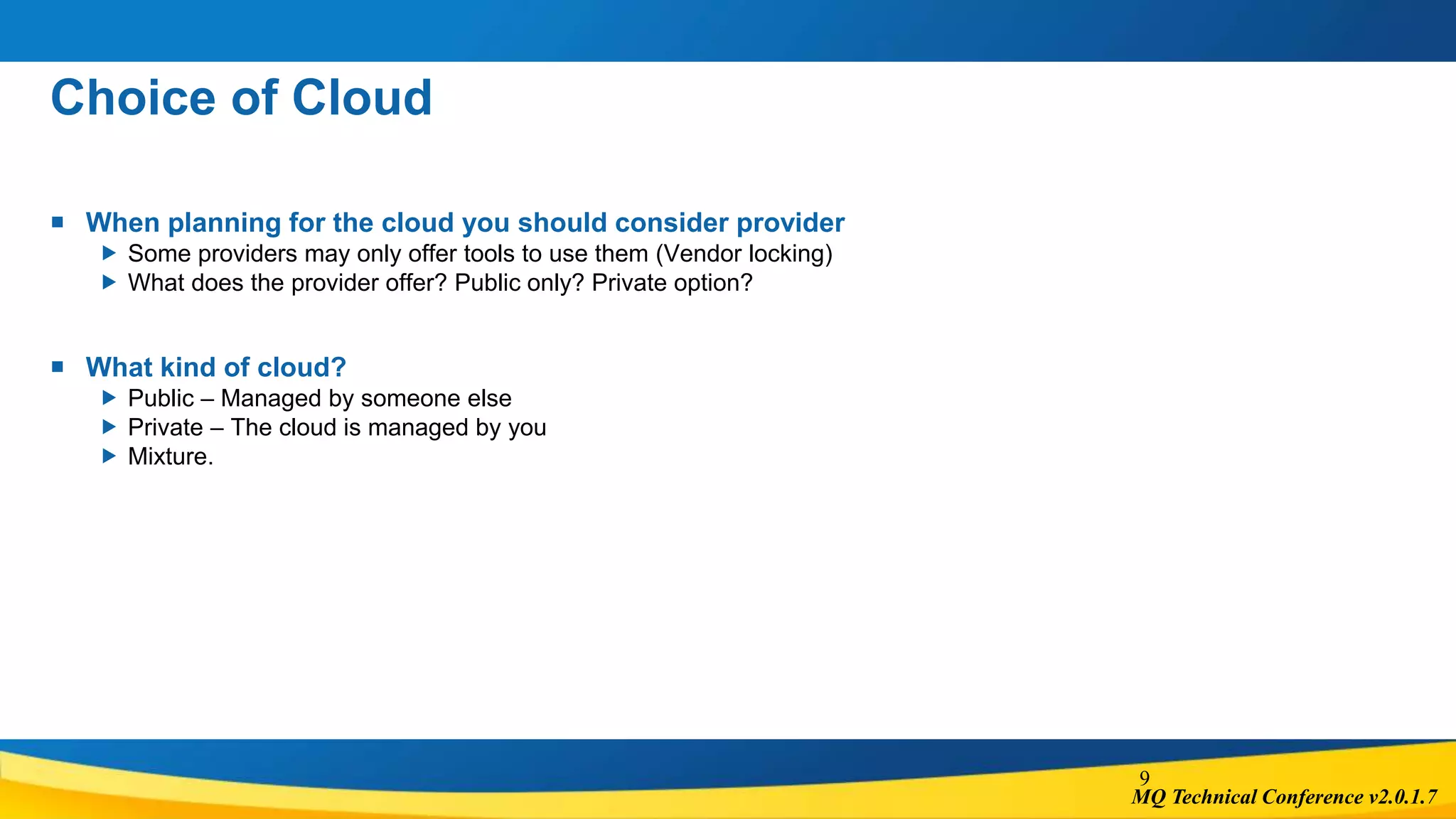
Choice of Cloud
 When planning for the cloud you should consider provider
 Some providers may only offer tools to use them (Vendor locking)
 What does the provider offer? Public only? Private option?
 What kind of cloud?
 Public – Managed by someone else
 Private – The cloud is managed by you
 Mixture.
9
MQ Technical Conference v2.0.1.7
Choice of Environment
 Infrastructure
 Virtual machines
 Containers
 Software as a service?
 Messagehub
 No “IBM MQ” SaaS, but being considered. (at least from IBM anyway)
10
MQ Technical Conference v2.0.1.7
Choice of tools & which tool for which job
 Orchestration
 How do you want to deploy your environments?
 Doing it by hand introduces error
 Management & monitoring
 Once you have your environment, how are you going to manage it?
 You probably already have this system in place so are you going to:
 A. Work out how to configure cloud Queue Managers to talk to it?
 B. Create a new system to manage these environments
 Vendor locking
 Some tools are provided by a cloud provider to use with their cloud
 But if you want to change providers in the future you will have to use another tool.
 More on this in Matthew Whiteheads talk. (Deploying MQ to the Cloud)
 Wednesday 15:50 - Sagewood
11
MQ Technical Conference v2.0.1.7
How will you slot it into your network?
 Hybrid cloud?
 Private cloud with On Prem
 Public cloud with on prem?
 Public cloud talking to Private?
 What about communication between clouds/on prem?
 Secure gateway
 VPN provided by cloud?
 TLS
 AMS
12
MQ Technical Conference v2.0.1.7
Future Proofing
 How will you apply updates/patches?
 You need to apply a patch, how will you apply it to all of your Queue Managers?
 You want to upgrade, how do you upgrade all of your Queue Managers?
 Do you have a way to stage the upgrade/patch?
 Not just limited to patches/updates of installation, what about configuration?
 How will you add new instances in?
 If you need to scale up how will you connect the new instance with your existing network
 How will you remove one when you don’t need it anymore.
13
MQ Technical Conference v2.0.1.7
MQ SPECIFIC CLOUD CONSIDERATIONS
MQ Technical Conference v2.0.1.7
Running in the cloud could be as simple as picking
up your current infrastructure and moving it to the
cloud
You then just manage a bunch of VMs exactly like
your datacentre don’t you?…
You could, but that would be missing the point
Clouds bring an opportunity for simplified
operations and management, better scalability and
better service and therefore application quality of
service
…
AWS
?
MQ Technical Conference v2.0.1.7
MQ’s capabilities were ready for the cloud
before the cloud was even a thing
 Dynamic client connectivity
 Dynamic scaling
 Workload balancing
 High security
 High scale and robustness
 Repeatable and remote administration and monitoring
for cattle, not pets deployments
 Perfect for integrating systems across any cloud
 …
But are you using it that way?
MQ, ready for the cloud
MQ Technical Conference v2.0.1.7
Rethink MQ
Don’t confuse old MQ practices for
MQ itself
“MQ is too hard to use”
“Our MQ system is too complicated to
change”
“MQ isn’t cloud, it’s too old!”
How many of these do you have?
 Hand crafted, shared queue managers
 Applications hard coding connection details
 Applications bound to a single IP address
 Edge security at most
 Internal architecture complexity exposed to
the applications
 A lengthy change control process
 Manual installation, deployment and
configuration
Rethink how you use MQ!
MQ Technical Conference v2.0.1.7
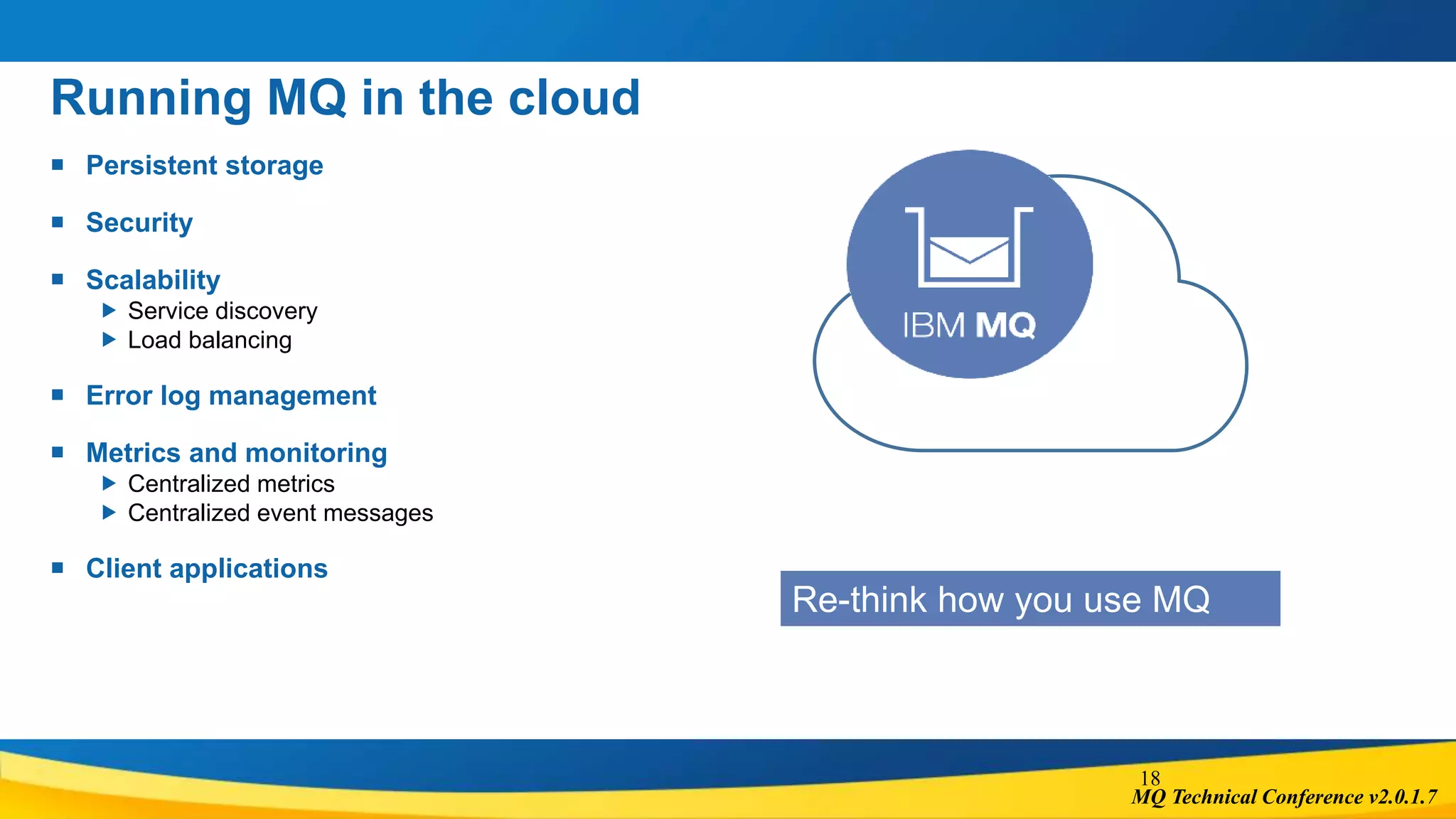
Running MQ in the cloud
 Persistent storage
 Security
 Scalability
 Service discovery
 Load balancing
 Error log management
 Metrics and monitoring
 Centralized metrics
 Centralized event messages
 Client applications
18
Re-think how you use MQ
MQ Technical Conference v2.0.1.7
Security
 No “armadillo” security
 All data in motion and at rest needs to be secured
 Configure MQ channels with TLS
 Use channel authentication for access control
 Configure disk encryption either at the OS or cloud provider level.
 IBM MQ Advanced Message Security is also available to provide additional security protections, such as per-
message encryption.
19
MQ Technical Conference v2.0.1.7
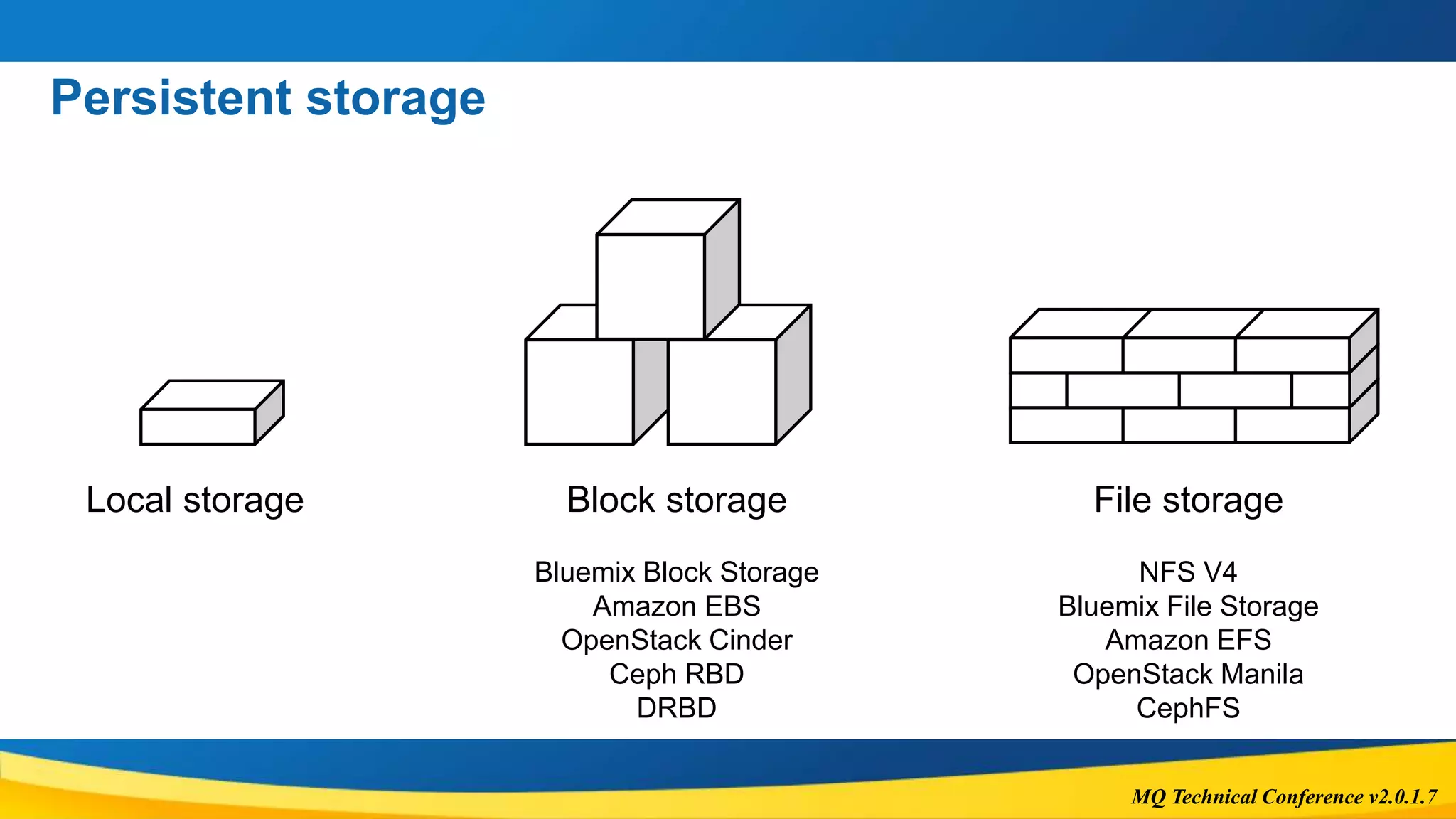
Persistent storage
Local storage Block storage
Bluemix Block Storage
Amazon EBS
OpenStack Cinder
Ceph RBD
DRBD
File storage
NFS V4
Bluemix File Storage
Amazon EFS
OpenStack Manila
CephFS
MQ Technical Conference v2.0.1.7
Persistent storage
 Reliability of storage
 Replicated across failure domains / availability zones?
 Are disk writes cached?
 What’s the failure rate of disks?
 Connecting to the right persistent storage
 When a queue manager’s is moved (e.g. run a container in a different VM), then something needs
to re-connect the queue manager to the correct storage.
 Some cloud orchestrators will run identical instances of your image. This could lead to lots of
copies of “qm1”. Other orchestrators, like Kubernetes, allow you to manage separate identities
(“qm1”, “qm2”, etc.).
MQ Technical Conference v2.0.1.7
Scalability
 In general, scale clients separately from servers
 Scaling up is easy
 MQ cluster
 Load-balanced set of identical queue managers
 Scaling down depends more on your applications
 Need to remove a queue manager in a controlled manner making sure that all of the messages are safely
processed.
 Message ordering
 Scaling out rather than scaling up, brings concurrent processing
 Messages could be received out of sequence.
 MQ provides features to allow groups of messages to be handled in small ordered batches, or you can manage
this yourself in your application.
22
MQ Technical Conference v2.0.1.7
Availability
 How do you want to handle Availability?
 Use existing MQ functionality (Active/Passive Queue Managers)
 Use systems built into Kubernetes (Demo in the Container talk)
 Operate across multiple Availability zones
 Availability zones,
 Pay attention to where you operate.
 Export regulations
 You are probably already spreading your MQ infrastructure across multiple regions/Data Centres
 Do you use existing MQ features or Cloud provider features?
23
MQ Technical Conference v2.0.1.7
Error log management
 To manage large numbers of servers, you don’t want to SSH into them very often (if ever).
 You will still need to diagnose problems
 Centralized logging is commonly used, where an agent sends MQ error logs and system logs to a
centralized location
 Store
 Index to make searchable
 Analyze
 For example:
 IBM Monitoring & Analytics
 AWS Cloudwatch
 ElasticSearch
24
MQ Technical Conference v2.0.1.7
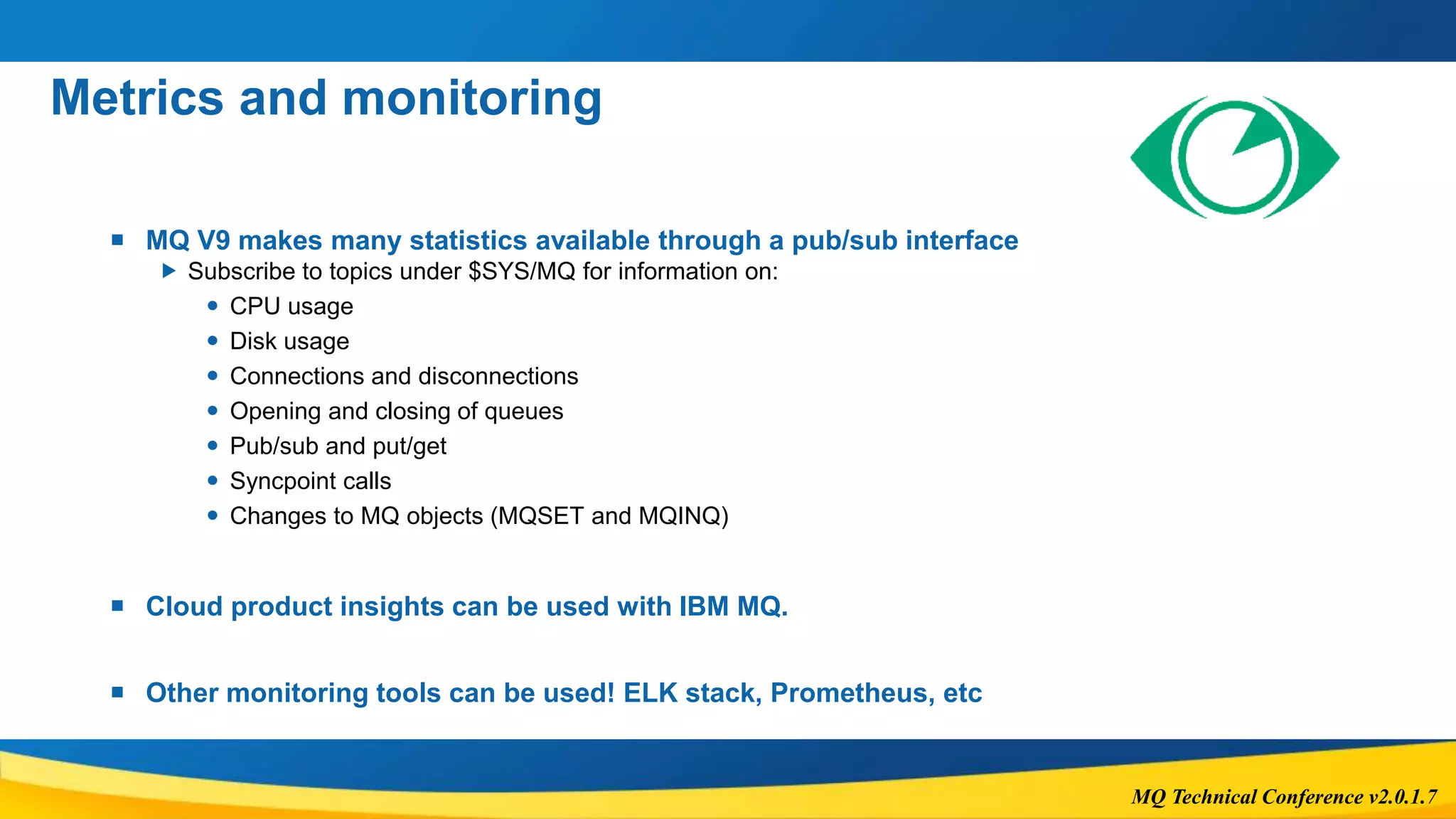
Metrics and monitoring
 MQ V9 makes many statistics available through a pub/sub interface
 Subscribe to topics under $SYS/MQ for information on:
 CPU usage
 Disk usage
 Connections and disconnections
 Opening and closing of queues
 Pub/sub and put/get
 Syncpoint calls
 Changes to MQ objects (MQSET and MQINQ)
 Cloud product insights can be used with IBM MQ.
 Other monitoring tools can be used! ELK stack, Prometheus, etc
MQ Technical Conference v2.0.1.7
Client applications
 Cloud typically emphasizes resilience over robustness
 Reminder: use your MQ client’s auto-reconnect feature
 Cloud servers are likely to get restarted or moved
factory.setClientReconnectOptions(WMQConstants.WMQ_CLIENT_RECONNECT);
 Service discovery will probably be affected
 Dynamic IP addresses
 Scalability may mean multiple equivalent queue managers are available
26
MQ Technical Conference v2.0.1.727 10/2/2017
General Principle
• Create image with IBM MQ.
• Docker image, EC2 Ami, etc
• Create method to customize the MQ Queue
Manager depending on variables
• Docker example image runs all MQSC
files loaded in /etc/mqm
• Use tools to create as many instances as
you need
• Scale up and down on requirement
• Developer works has (and will have)
examples of different uses of MQ in
different scenarios
• Including the automation scripts we used
to create and customize our instances
MQ Technical Conference v2.0.1.7
MQ as a Service Redbook
 http://ibm.biz/mqaas_red
 Information about how to build,
deploy, and use IBM MQ as a service.
 Explains how to apply as a service
methodologies to an IBM MQ
environment.
MQ Technical Conference v2.0.1.7
Where can I get more information?
10/2/201730
IBM Messaging developerWorks
developer.ibm.com/messaging
IBM Messaging Youtube
https://www.youtube.com/IBMmessagingMedia
LinkedIn
Ibm.biz/ibmmessaging
Twitter
@IBMMessaging
IBM MQ Facebook
Facebook.com/IBM-MQ-8304628654/
Blog posts
tagged with
“cloud”
MQ Technical Conference v2.0.1.7
Would you like to take part in IBM MQ Design Research?
 The IBM MQ team is currently conducting some long term research with our MQ customer base.
 With this survey we would like to understand:
 Who is interreacting with MQ and what are their responsibilities?
 Which customers are interested in moving IBM MQ into the cloud?
 Which customers would like to take part in future research?
 We estimate the survey should take 4 minutes to complete.
 Please note: This survey is for distributed users only.
 If you’re interested, go to ibm.biz/MQ-Customer-Survey
MQ Technical Conference v2.0.1.7
Other Cloud sessions from the IBM MQ team.
 MQ in Containers – Rob Parker
 Monday 9:50 – Leopardwood Room
 Wednesday 14:30 – Leopardwood Room
 MQ Automation: Config Managenment using Amazon S3 – T.Rob Wyatt
 Monday 15:50 – Aloeswoood Room
 Wednesday 8:30 – Aloeswood Room
 MQ Hybrid Cloud Architectures – Matt Whitehead
 Tuesday 8:30 – Sagewood Room
 Wednesday 9:50 – Sagewood Room
 MQ Automation: Config Management using Baselines, Patterns and Apps – T.Rob Wyatt
 Monday 9:50 – Aloeswood
 Tuesday 13:00 – Aloeswood Room
 What’s up DOCker – Rob Sordillo
 Monday 11:15 – Zebrawood Room
 Wednesday 11:15 – Sagewood Room
MQ Technical Conference v2.0.1.7
Other Cloud sessions from the IBM MQ team.
 Introduction to Kafka (and why you care) – Richard Nikula
 Monday 14:40 – Zebrawood Room
 Wednesday 14:30 – Aloeswood Room
 MQ Console & REST API – Matt Leming
 Wednesday 15:50 – Rosewood Room
 Deploying MQ to the Cloud – Matt Whitehead
 Monday 9:50 - Sagewood
 Wednesday 15:50 – Sagewood
 Meet the experts! – Various
 Tuesday 15:50 – Zebrawood Room
MQ Technical Conference v2.0.1.7
Questions & Answers
MQ Technical Conference v2.0.1.735 10/2/2017
Notices and disclaimers
Copyright © 2017 by International Business Machines Corporation
(IBM). No part of this document may be reproduced or transmitted
in any form without written permission from IBM.
U.S. Government Users Restricted Rights — use, duplication or
disclosure restricted by GSA ADP Schedule Contract with IBM.
Information in these presentations (including information relating to
products that have not yet been announced by IBM) has been
reviewed for accuracy as of the date of initial publication and could
include unintentional technical or typographical errors. IBM shall
have no responsibility to update this information. This document is
distributed “as is” without any warranty, either express or implied.
In no event shall IBM be liable for any damage arising from the use
of this information, including but not limited to, loss of data,
business interruption, loss of profit or loss of opportunity.
IBM products and services are warranted according to the terms
and conditions of the agreements under which they are provided.
IBM products are manufactured from new parts or new and used
parts.
In some cases, a product may not be new and may have been
previously installed. Regardless, our warranty terms apply.”
Any statements regarding IBM's future direction, intent or product
plans are subject to change or withdrawal without notice.
Performance data contained herein was generally obtained in a
controlled, isolated environments. Customer examples are
presented
as illustrations of how those customers have used
IBM products and
the results they may have achieved. Actual performance, cost,
savings or other results in other operating environments may vary.
References in this document to IBM products, programs, or services
does not imply that IBM intends to make such products, programs
or services available in all countries in which IBM operates or does
business.
Workshops, sessions and associated materials may have been
prepared by independent session speakers, and do not necessarily
reflect the
views of IBM. All materials and discussions are provided for
informational purposes only, and are neither intended to, nor shall
constitute legal or other guidance or advice to any individual
participant or their specific situation.
It is the customer’s responsibility to insure its own compliance
with legal requirements and to obtain advice of competent legal
counsel as to the identification and interpretation of any
relevant laws and regulatory requirements that may affect the
customer’s business and any actions
the customer may need to take to comply with such laws. IBM does
not provide legal advice or represent or warrant that its services or
products will ensure that the customer is in compliance with any
law.
MQ Technical Conference v2.0.1.736 10/2/2017
Notices and disclaimers
continued
Information concerning non-IBM products was obtained from the
suppliers of those products, their published announcements or
other publicly available sources. IBM has not tested those products
in connection with this publication and cannot confirm the accuracy
of performance, compatibility or any other claims related to non-IBM
products. Questions on the capabilities of non-IBM products should
be addressed to the suppliers of those products. IBM does not
warrant the quality of any third-party products, or the ability of
any such third-party products to interoperate with IBM’s products.
IBM expressly disclaims all warranties, expressed or implied,
including but not limited to, the implied warranties of
merchantability and fitness for a particular, purpose.
The provision of the information contained herein is not intended
to, and does not, grant any right or license under any IBM patents,
copyrights, trademarks or other intellectual property right.
IBM, the IBM logo, ibm.com, Aspera®, Bluemix, Blueworks Live,
CICS, Clearcase, Cognos®, DOORS®, Emptoris®, Enterprise
Document Management System™, FASP®, FileNet®,
Global Business Services®,
Global Technology Services®, IBM ExperienceOne™, IBM
SmartCloud®, IBM Social Business®, Information on Demand, ILOG,
Maximo®, MQIntegrator®, MQSeries®, Netcool®, OMEGAMON,
OpenPower, PureAnalytics™, PureApplication®, pureCluster™,
PureCoverage®, PureData®, PureExperience®, PureFlex®,
pureQuery®, pureScale®, PureSystems®, QRadar®, Rational®,
Rhapsody®, Smarter Commerce®, SoDA, SPSS, Sterling Commerce®,
StoredIQ, Tealeaf®, Tivoli® Trusteer®, Unica®, urban{code}®, Watson,
WebSphere®, Worklight®, X-Force® and System z® Z/OS, are
trademarks of International Business Machines Corporation,
registered in many jurisdictions worldwide. Other product and
service names might be trademarks of IBM or other companies. A
current list of IBM trademarks is available on the Web at "Copyright
and trademark information" at: www.ibm.com/legal/copytrade.shtml.

Planning for MQ in the cloud MQTC 2017

  • 1.
    MQ Technical Conferencev2.0.1.7 Planning for MQ in the Cloud Rob Parker, IBM parrobe@uk.ibm.com 10/2/20171
  • 2.
    MQ Technical Conferencev2.0.1.72 10/2/2017 Please note IBM’s statements regarding its plans, directions, and intent are subject to change or withdrawal without notice at IBM’s sole discretion. Information regarding potential future products is intended to outline our general product direction and it should not be relied on in making a purchasing decision. The information mentioned regarding potential future products is not a commitment, promise, or legal obligation to deliver any material, code or functionality. Information about potential future products may not be incorporated into any contract. The development, release, and timing of any future features or functionality described for our products remains at our sole discretion. Performance is based on measurements and projections using standard IBM benchmarks in a controlled environment. The actual throughput or performance that any user will experience will vary depending upon many factors, including considerations such as the amount of multiprogramming in the user’s job stream, the I/O configuration, the storage configuration, and the workload processed. Therefore, no assurance can be given that an individual user will achieve results similar to those stated here.
  • 3.
    MQ Technical Conferencev2.0.1.73 10/2/2017 Agenda • Introduction • Generic Cloud considerations • MQ Specific considerations • Questions
  • 4.
    MQ Technical Conferencev2.0.1.7 GENERIC CLOUD CONSIDERATIONS
  • 5.
    MQ Technical Conferencev2.0.1.75 There is a lot of choice of cloud (and it’s growing!) © 2016 IBM Corporation
  • 6.
    MQ Technical Conferencev2.0.1.7 On-prem IBM MQ Appliance AWS AWS AWS … Cloud Message Hub (Based on Apache Kafka) IBM Bluemix (including Softlayer) … Distributed platforms … Private cloud
  • 7.
    MQ Technical Conferencev2.0.1.7 Characteristics of a cloud environment  Self-service – empowers users to provision resources without requiring human intervention, most likely using a web-based portal or an API.  Elastic scaling – enables scaling up and down on demand, driving the need for high levels of automation.  Shared resources – offers economies of scale through the use of shared infrastructure and software, securely separating the resources at a logical level.  Metered usage – allows pay-as-you-go billing through monitoring, measurement and reporting of usage. 7
  • 8.
    MQ Technical Conferencev2.0.1.7 Types of cloud environments Infrastructure as a Service (IaaS) • IBM Bluemix Infrastructure • Amazon Web Services • Microsoft Azure • OpenStack Containers as a Service (CaaS) • IBM Containers on Bluemix • Amazon Elastic Container Service • Microsoft Azure Container Service • Kubernetes • Docker Swarm • Apache Mesos Platform as a Service (PaaS) • IBM Bluemix Cloud Foundry Runtimes • Amazon Elastic Beanstalk • Microsoft Azure App Service • Cloud Foundry • OpenShift Functions as a Service (FaaS) • IBM Bluemix OpenWhisk • Amazon Lambda • Microsoft Azure Functions Software as a Service (SaaS) • IBM Cloudant (NoSQL database) • Salesforce (CRM platform) 8 MQ queue managers MQ client applications
  • 9.
    MQ Technical Conferencev2.0.1.7 Choice of Cloud  When planning for the cloud you should consider provider  Some providers may only offer tools to use them (Vendor locking)  What does the provider offer? Public only? Private option?  What kind of cloud?  Public – Managed by someone else  Private – The cloud is managed by you  Mixture. 9
  • 10.
    MQ Technical Conferencev2.0.1.7 Choice of Environment  Infrastructure  Virtual machines  Containers  Software as a service?  Messagehub  No “IBM MQ” SaaS, but being considered. (at least from IBM anyway) 10
  • 11.
    MQ Technical Conferencev2.0.1.7 Choice of tools & which tool for which job  Orchestration  How do you want to deploy your environments?  Doing it by hand introduces error  Management & monitoring  Once you have your environment, how are you going to manage it?  You probably already have this system in place so are you going to:  A. Work out how to configure cloud Queue Managers to talk to it?  B. Create a new system to manage these environments  Vendor locking  Some tools are provided by a cloud provider to use with their cloud  But if you want to change providers in the future you will have to use another tool.  More on this in Matthew Whiteheads talk. (Deploying MQ to the Cloud)  Wednesday 15:50 - Sagewood 11
  • 12.
    MQ Technical Conferencev2.0.1.7 How will you slot it into your network?  Hybrid cloud?  Private cloud with On Prem  Public cloud with on prem?  Public cloud talking to Private?  What about communication between clouds/on prem?  Secure gateway  VPN provided by cloud?  TLS  AMS 12
  • 13.
    MQ Technical Conferencev2.0.1.7 Future Proofing  How will you apply updates/patches?  You need to apply a patch, how will you apply it to all of your Queue Managers?  You want to upgrade, how do you upgrade all of your Queue Managers?  Do you have a way to stage the upgrade/patch?  Not just limited to patches/updates of installation, what about configuration?  How will you add new instances in?  If you need to scale up how will you connect the new instance with your existing network  How will you remove one when you don’t need it anymore. 13
  • 14.
    MQ Technical Conferencev2.0.1.7 MQ SPECIFIC CLOUD CONSIDERATIONS
  • 15.
    MQ Technical Conferencev2.0.1.7 Running in the cloud could be as simple as picking up your current infrastructure and moving it to the cloud You then just manage a bunch of VMs exactly like your datacentre don’t you?… You could, but that would be missing the point Clouds bring an opportunity for simplified operations and management, better scalability and better service and therefore application quality of service … AWS ?
  • 16.
    MQ Technical Conferencev2.0.1.7 MQ’s capabilities were ready for the cloud before the cloud was even a thing  Dynamic client connectivity  Dynamic scaling  Workload balancing  High security  High scale and robustness  Repeatable and remote administration and monitoring for cattle, not pets deployments  Perfect for integrating systems across any cloud  … But are you using it that way? MQ, ready for the cloud
  • 17.
    MQ Technical Conferencev2.0.1.7 Rethink MQ Don’t confuse old MQ practices for MQ itself “MQ is too hard to use” “Our MQ system is too complicated to change” “MQ isn’t cloud, it’s too old!” How many of these do you have?  Hand crafted, shared queue managers  Applications hard coding connection details  Applications bound to a single IP address  Edge security at most  Internal architecture complexity exposed to the applications  A lengthy change control process  Manual installation, deployment and configuration Rethink how you use MQ!
  • 18.
    MQ Technical Conferencev2.0.1.7 Running MQ in the cloud  Persistent storage  Security  Scalability  Service discovery  Load balancing  Error log management  Metrics and monitoring  Centralized metrics  Centralized event messages  Client applications 18 Re-think how you use MQ
  • 19.
    MQ Technical Conferencev2.0.1.7 Security  No “armadillo” security  All data in motion and at rest needs to be secured  Configure MQ channels with TLS  Use channel authentication for access control  Configure disk encryption either at the OS or cloud provider level.  IBM MQ Advanced Message Security is also available to provide additional security protections, such as per- message encryption. 19
  • 20.
    MQ Technical Conferencev2.0.1.7 Persistent storage Local storage Block storage Bluemix Block Storage Amazon EBS OpenStack Cinder Ceph RBD DRBD File storage NFS V4 Bluemix File Storage Amazon EFS OpenStack Manila CephFS
  • 21.
    MQ Technical Conferencev2.0.1.7 Persistent storage  Reliability of storage  Replicated across failure domains / availability zones?  Are disk writes cached?  What’s the failure rate of disks?  Connecting to the right persistent storage  When a queue manager’s is moved (e.g. run a container in a different VM), then something needs to re-connect the queue manager to the correct storage.  Some cloud orchestrators will run identical instances of your image. This could lead to lots of copies of “qm1”. Other orchestrators, like Kubernetes, allow you to manage separate identities (“qm1”, “qm2”, etc.).
  • 22.
    MQ Technical Conferencev2.0.1.7 Scalability  In general, scale clients separately from servers  Scaling up is easy  MQ cluster  Load-balanced set of identical queue managers  Scaling down depends more on your applications  Need to remove a queue manager in a controlled manner making sure that all of the messages are safely processed.  Message ordering  Scaling out rather than scaling up, brings concurrent processing  Messages could be received out of sequence.  MQ provides features to allow groups of messages to be handled in small ordered batches, or you can manage this yourself in your application. 22
  • 23.
    MQ Technical Conferencev2.0.1.7 Availability  How do you want to handle Availability?  Use existing MQ functionality (Active/Passive Queue Managers)  Use systems built into Kubernetes (Demo in the Container talk)  Operate across multiple Availability zones  Availability zones,  Pay attention to where you operate.  Export regulations  You are probably already spreading your MQ infrastructure across multiple regions/Data Centres  Do you use existing MQ features or Cloud provider features? 23
  • 24.
    MQ Technical Conferencev2.0.1.7 Error log management  To manage large numbers of servers, you don’t want to SSH into them very often (if ever).  You will still need to diagnose problems  Centralized logging is commonly used, where an agent sends MQ error logs and system logs to a centralized location  Store  Index to make searchable  Analyze  For example:  IBM Monitoring & Analytics  AWS Cloudwatch  ElasticSearch 24
  • 25.
    MQ Technical Conferencev2.0.1.7 Metrics and monitoring  MQ V9 makes many statistics available through a pub/sub interface  Subscribe to topics under $SYS/MQ for information on:  CPU usage  Disk usage  Connections and disconnections  Opening and closing of queues  Pub/sub and put/get  Syncpoint calls  Changes to MQ objects (MQSET and MQINQ)  Cloud product insights can be used with IBM MQ.  Other monitoring tools can be used! ELK stack, Prometheus, etc
  • 26.
    MQ Technical Conferencev2.0.1.7 Client applications  Cloud typically emphasizes resilience over robustness  Reminder: use your MQ client’s auto-reconnect feature  Cloud servers are likely to get restarted or moved factory.setClientReconnectOptions(WMQConstants.WMQ_CLIENT_RECONNECT);  Service discovery will probably be affected  Dynamic IP addresses  Scalability may mean multiple equivalent queue managers are available 26
  • 27.
    MQ Technical Conferencev2.0.1.727 10/2/2017 General Principle • Create image with IBM MQ. • Docker image, EC2 Ami, etc • Create method to customize the MQ Queue Manager depending on variables • Docker example image runs all MQSC files loaded in /etc/mqm • Use tools to create as many instances as you need • Scale up and down on requirement • Developer works has (and will have) examples of different uses of MQ in different scenarios • Including the automation scripts we used to create and customize our instances
  • 28.
    MQ Technical Conferencev2.0.1.7 MQ as a Service Redbook  http://ibm.biz/mqaas_red  Information about how to build, deploy, and use IBM MQ as a service.  Explains how to apply as a service methodologies to an IBM MQ environment.
  • 29.
    MQ Technical Conferencev2.0.1.7 Where can I get more information? 10/2/201730 IBM Messaging developerWorks developer.ibm.com/messaging IBM Messaging Youtube https://www.youtube.com/IBMmessagingMedia LinkedIn Ibm.biz/ibmmessaging Twitter @IBMMessaging IBM MQ Facebook Facebook.com/IBM-MQ-8304628654/ Blog posts tagged with “cloud”
  • 30.
    MQ Technical Conferencev2.0.1.7 Would you like to take part in IBM MQ Design Research?  The IBM MQ team is currently conducting some long term research with our MQ customer base.  With this survey we would like to understand:  Who is interreacting with MQ and what are their responsibilities?  Which customers are interested in moving IBM MQ into the cloud?  Which customers would like to take part in future research?  We estimate the survey should take 4 minutes to complete.  Please note: This survey is for distributed users only.  If you’re interested, go to ibm.biz/MQ-Customer-Survey
  • 31.
    MQ Technical Conferencev2.0.1.7 Other Cloud sessions from the IBM MQ team.  MQ in Containers – Rob Parker  Monday 9:50 – Leopardwood Room  Wednesday 14:30 – Leopardwood Room  MQ Automation: Config Managenment using Amazon S3 – T.Rob Wyatt  Monday 15:50 – Aloeswoood Room  Wednesday 8:30 – Aloeswood Room  MQ Hybrid Cloud Architectures – Matt Whitehead  Tuesday 8:30 – Sagewood Room  Wednesday 9:50 – Sagewood Room  MQ Automation: Config Management using Baselines, Patterns and Apps – T.Rob Wyatt  Monday 9:50 – Aloeswood  Tuesday 13:00 – Aloeswood Room  What’s up DOCker – Rob Sordillo  Monday 11:15 – Zebrawood Room  Wednesday 11:15 – Sagewood Room
  • 32.
    MQ Technical Conferencev2.0.1.7 Other Cloud sessions from the IBM MQ team.  Introduction to Kafka (and why you care) – Richard Nikula  Monday 14:40 – Zebrawood Room  Wednesday 14:30 – Aloeswood Room  MQ Console & REST API – Matt Leming  Wednesday 15:50 – Rosewood Room  Deploying MQ to the Cloud – Matt Whitehead  Monday 9:50 - Sagewood  Wednesday 15:50 – Sagewood  Meet the experts! – Various  Tuesday 15:50 – Zebrawood Room
  • 33.
    MQ Technical Conferencev2.0.1.7 Questions & Answers
  • 34.
    MQ Technical Conferencev2.0.1.735 10/2/2017 Notices and disclaimers Copyright © 2017 by International Business Machines Corporation (IBM). No part of this document may be reproduced or transmitted in any form without written permission from IBM. U.S. Government Users Restricted Rights — use, duplication or disclosure restricted by GSA ADP Schedule Contract with IBM. Information in these presentations (including information relating to products that have not yet been announced by IBM) has been reviewed for accuracy as of the date of initial publication and could include unintentional technical or typographical errors. IBM shall have no responsibility to update this information. This document is distributed “as is” without any warranty, either express or implied. In no event shall IBM be liable for any damage arising from the use of this information, including but not limited to, loss of data, business interruption, loss of profit or loss of opportunity. IBM products and services are warranted according to the terms and conditions of the agreements under which they are provided. IBM products are manufactured from new parts or new and used parts. In some cases, a product may not be new and may have been previously installed. Regardless, our warranty terms apply.” Any statements regarding IBM's future direction, intent or product plans are subject to change or withdrawal without notice. Performance data contained herein was generally obtained in a controlled, isolated environments. Customer examples are presented as illustrations of how those customers have used IBM products and the results they may have achieved. Actual performance, cost, savings or other results in other operating environments may vary. References in this document to IBM products, programs, or services does not imply that IBM intends to make such products, programs or services available in all countries in which IBM operates or does business. Workshops, sessions and associated materials may have been prepared by independent session speakers, and do not necessarily reflect the views of IBM. All materials and discussions are provided for informational purposes only, and are neither intended to, nor shall constitute legal or other guidance or advice to any individual participant or their specific situation. It is the customer’s responsibility to insure its own compliance with legal requirements and to obtain advice of competent legal counsel as to the identification and interpretation of any relevant laws and regulatory requirements that may affect the customer’s business and any actions the customer may need to take to comply with such laws. IBM does not provide legal advice or represent or warrant that its services or products will ensure that the customer is in compliance with any law.
  • 35.
    MQ Technical Conferencev2.0.1.736 10/2/2017 Notices and disclaimers continued Information concerning non-IBM products was obtained from the suppliers of those products, their published announcements or other publicly available sources. IBM has not tested those products in connection with this publication and cannot confirm the accuracy of performance, compatibility or any other claims related to non-IBM products. Questions on the capabilities of non-IBM products should be addressed to the suppliers of those products. IBM does not warrant the quality of any third-party products, or the ability of any such third-party products to interoperate with IBM’s products. IBM expressly disclaims all warranties, expressed or implied, including but not limited to, the implied warranties of merchantability and fitness for a particular, purpose. The provision of the information contained herein is not intended to, and does not, grant any right or license under any IBM patents, copyrights, trademarks or other intellectual property right. IBM, the IBM logo, ibm.com, Aspera®, Bluemix, Blueworks Live, CICS, Clearcase, Cognos®, DOORS®, Emptoris®, Enterprise Document Management System™, FASP®, FileNet®, Global Business Services®, Global Technology Services®, IBM ExperienceOne™, IBM SmartCloud®, IBM Social Business®, Information on Demand, ILOG, Maximo®, MQIntegrator®, MQSeries®, Netcool®, OMEGAMON, OpenPower, PureAnalytics™, PureApplication®, pureCluster™, PureCoverage®, PureData®, PureExperience®, PureFlex®, pureQuery®, pureScale®, PureSystems®, QRadar®, Rational®, Rhapsody®, Smarter Commerce®, SoDA, SPSS, Sterling Commerce®, StoredIQ, Tealeaf®, Tivoli® Trusteer®, Unica®, urban{code}®, Watson, WebSphere®, Worklight®, X-Force® and System z® Z/OS, are trademarks of International Business Machines Corporation, registered in many jurisdictions worldwide. Other product and service names might be trademarks of IBM or other companies. A current list of IBM trademarks is available on the Web at "Copyright and trademark information" at: www.ibm.com/legal/copytrade.shtml.