Planning Documentation
Vegetarian Society Recipe Card Project
Names: Henry Buckham & Jonah Adshead
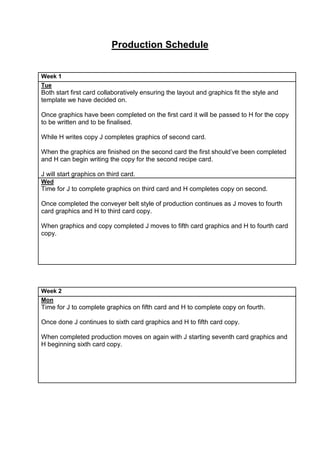
Production Schedule
Week 1
Tue
Both start first card collaboratively ensuring the layout and graphics fit the style and
template we have decided on.
Once graphics have been completed on the first card it will be passed to H for the copy
to be written and to be finalised.
While H writes copy J completes graphics of second card.
When the graphics are finished on the second card the first should’ve been completed
and H can begin writing the copy for the second recipe card.
J will start graphics on third card.
Wed
Time for J to complete graphics on third card and H completes copy on second.
Once completed the conveyer belt style of production continues as J moves to fourth
card graphics and H to third card copy.
When graphics and copy completed J moves to fifth card graphics and H to fourth card
copy.
Week 2
Mon
Time for J to complete graphics on fifth card and H to complete copy on fourth.
Once done J continues to sixth card graphics and H to fifth card copy.
When completed production moves on again with J starting seventh card graphics and
H beginning sixth card copy.
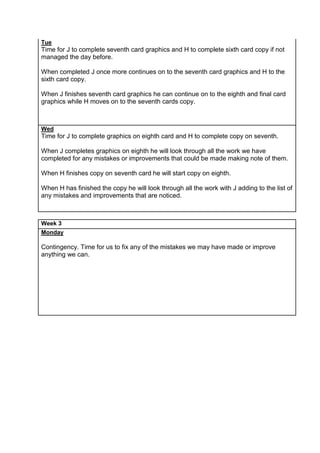
Tue
Time for J to complete seventh card graphics and H to complete sixth card copy if not
managed the day before.
When completed J once more continues on to the seventh card graphics and H to the
sixth card copy.
When J finishes seventh card graphics he can continue on to the eighth and final card
graphics while H moves on to the seventh cards copy.
Wed
Time for J to complete graphics on eighth card and H to complete copy on seventh.
When J completes graphics on eighth he will look through all the work we have
completed for any mistakes or improvements that could be made making note of them.
When H finishes copy on seventh card he will start copy on eighth.
When H has finished the copy he will look through all the work with J adding to the list of
any mistakes and improvements that are noticed.
Week 3
Monday
Contingency. Time for us to fix any of the mistakes we may have made or improve
anything we can.
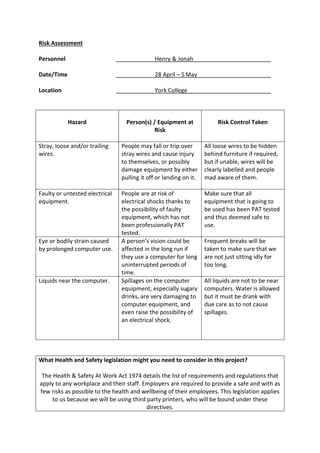
Risk Assessment
Personnel Henry & Jonah
Date/Time 28 April – 5May
Location York College
Hazard Person(s) / Equipment at
Risk
Risk Control Taken
Stray, loose and/or trailing
wires.
People may fall or trip over
stray wires and cause injury
to themselves, or possibly
damage equipment by either
pulling it off or landing on it.
All loose wires to be hidden
behind furniture if required,
but if unable, wires will be
clearly labelled and people
mad aware of them.
Faulty or untested electrical
equipment.
People are at risk of
electrical shocks thanks to
the possibility of faulty
equipment, which has not
been professionally PAT
tested.
Make sure that all
equipment that is going to
be used has been PAT tested
and thus deemed safe to
use.
Eye or bodily strain caused
by prolonged computer use.
A person’s vision could be
affected in the long run if
they use a computer for long
uninterrupted periods of
time.
Frequent breaks will be
taken to make sure that we
are not just sitting idly for
too long.
Liquids near the computer. Spillages on the computer
equipment, especially sugary
drinks, are very damaging to
computer equipment, and
even raise the possibility of
an electrical shock.
All liquids are not to be near
computers. Water is allowed
but it must be drank with
due care as to not cause
spillages.
What Health and Safety legislation might you need to consider in this project?
The Health & Safety At Work Act 1974 details the list of requirements and regulations that
apply to any workplace and their staff. Employers are required to provide a safe and with as
few risks as possible to the health and wellbeing of their employees. This legislation applies
to us because we will be using third party printers, who will be bound under these
directives.
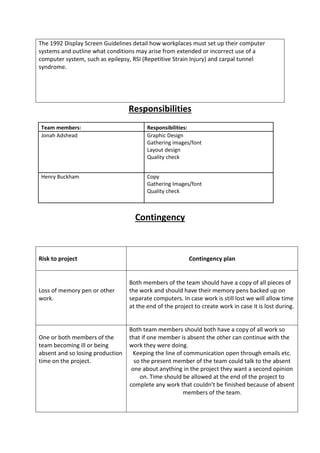
The 1992 Display Screen Guidelines detail how workplaces must set up their computer
systems and outline what conditions may arise from extended or incorrect use of a
computer system, such as epilepsy, RSI (Repetitive Strain Injury) and carpal tunnel
syndrome.
Responsibilities
Team members: Responsibilities:
Jonah Adshead Graphic Design
Gathering images/font
Layout design
Quality check
Henry Buckham Copy
Gathering Images/font
Quality check
Contingency
Risk to project Contingency plan
Loss of memory pen or other
work.
Both members of the team should have a copy of all pieces of
the work and should have their memory pens backed up on
separate computers. In case work is still lost we will allow time
at the end of the project to create work in case it is lost during.
One or both members of the
team becoming ill or being
absent and so losing production
time on the project.
Both team members should both have a copy of all work so
that if one member is absent the other can continue with the
work they were doing.
Keeping the line of communication open through emails etc.
so the present member of the team could talk to the absent
one about anything in the project they want a second opinion
on. Time should be allowed at the end of the project to
complete any work that couldn’t be finished because of absent
members of the team.
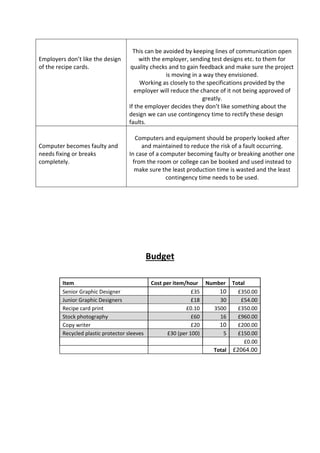
Employers don’t like the design
of the recipe cards.
This can be avoided by keeping lines of communication open
with the employer, sending test designs etc. to them for
quality checks and to gain feedback and make sure the project
is moving in a way they envisioned.
Working as closely to the specifications provided by the
employer will reduce the chance of it not being approved of
greatly.
If the employer decides they don’t like something about the
design we can use contingency time to rectify these design
faults.
Computer becomes faulty and
needs fixing or breaks
completely.
Computers and equipment should be properly looked after
and maintained to reduce the risk of a fault occurring.
In case of a computer becoming faulty or breaking another one
from the room or college can be booked and used instead to
make sure the least production time is wasted and the least
contingency time needs to be used.
Budget
Item Cost per item/hour Number Total
Senior Graphic Designer £35 10 £350.00
Junior Graphic Designers £18 30 £54.00
Recipe card print £0.10 3500 £350.00
Stock photography £60 16 £960.00
Copy writer £20 10 £200.00
Recycled plastic protector sleeves £30 (per 100) 5 £150.00
£0.00
Total £2064.00

Planning booklet

  • 1.
    Planning Documentation Vegetarian SocietyRecipe Card Project Names: Henry Buckham & Jonah Adshead
  • 2.
    Production Schedule Week 1 Tue Bothstart first card collaboratively ensuring the layout and graphics fit the style and template we have decided on. Once graphics have been completed on the first card it will be passed to H for the copy to be written and to be finalised. While H writes copy J completes graphics of second card. When the graphics are finished on the second card the first should’ve been completed and H can begin writing the copy for the second recipe card. J will start graphics on third card. Wed Time for J to complete graphics on third card and H completes copy on second. Once completed the conveyer belt style of production continues as J moves to fourth card graphics and H to third card copy. When graphics and copy completed J moves to fifth card graphics and H to fourth card copy. Week 2 Mon Time for J to complete graphics on fifth card and H to complete copy on fourth. Once done J continues to sixth card graphics and H to fifth card copy. When completed production moves on again with J starting seventh card graphics and H beginning sixth card copy.
  • 3.
    Tue Time for Jto complete seventh card graphics and H to complete sixth card copy if not managed the day before. When completed J once more continues on to the seventh card graphics and H to the sixth card copy. When J finishes seventh card graphics he can continue on to the eighth and final card graphics while H moves on to the seventh cards copy. Wed Time for J to complete graphics on eighth card and H to complete copy on seventh. When J completes graphics on eighth he will look through all the work we have completed for any mistakes or improvements that could be made making note of them. When H finishes copy on seventh card he will start copy on eighth. When H has finished the copy he will look through all the work with J adding to the list of any mistakes and improvements that are noticed. Week 3 Monday Contingency. Time for us to fix any of the mistakes we may have made or improve anything we can.
  • 4.
    Risk Assessment Personnel Henry& Jonah Date/Time 28 April – 5May Location York College Hazard Person(s) / Equipment at Risk Risk Control Taken Stray, loose and/or trailing wires. People may fall or trip over stray wires and cause injury to themselves, or possibly damage equipment by either pulling it off or landing on it. All loose wires to be hidden behind furniture if required, but if unable, wires will be clearly labelled and people mad aware of them. Faulty or untested electrical equipment. People are at risk of electrical shocks thanks to the possibility of faulty equipment, which has not been professionally PAT tested. Make sure that all equipment that is going to be used has been PAT tested and thus deemed safe to use. Eye or bodily strain caused by prolonged computer use. A person’s vision could be affected in the long run if they use a computer for long uninterrupted periods of time. Frequent breaks will be taken to make sure that we are not just sitting idly for too long. Liquids near the computer. Spillages on the computer equipment, especially sugary drinks, are very damaging to computer equipment, and even raise the possibility of an electrical shock. All liquids are not to be near computers. Water is allowed but it must be drank with due care as to not cause spillages. What Health and Safety legislation might you need to consider in this project? The Health & Safety At Work Act 1974 details the list of requirements and regulations that apply to any workplace and their staff. Employers are required to provide a safe and with as few risks as possible to the health and wellbeing of their employees. This legislation applies to us because we will be using third party printers, who will be bound under these directives.
  • 5.
    The 1992 DisplayScreen Guidelines detail how workplaces must set up their computer systems and outline what conditions may arise from extended or incorrect use of a computer system, such as epilepsy, RSI (Repetitive Strain Injury) and carpal tunnel syndrome. Responsibilities Team members: Responsibilities: Jonah Adshead Graphic Design Gathering images/font Layout design Quality check Henry Buckham Copy Gathering Images/font Quality check Contingency Risk to project Contingency plan Loss of memory pen or other work. Both members of the team should have a copy of all pieces of the work and should have their memory pens backed up on separate computers. In case work is still lost we will allow time at the end of the project to create work in case it is lost during. One or both members of the team becoming ill or being absent and so losing production time on the project. Both team members should both have a copy of all work so that if one member is absent the other can continue with the work they were doing. Keeping the line of communication open through emails etc. so the present member of the team could talk to the absent one about anything in the project they want a second opinion on. Time should be allowed at the end of the project to complete any work that couldn’t be finished because of absent members of the team.
  • 6.
    Employers don’t likethe design of the recipe cards. This can be avoided by keeping lines of communication open with the employer, sending test designs etc. to them for quality checks and to gain feedback and make sure the project is moving in a way they envisioned. Working as closely to the specifications provided by the employer will reduce the chance of it not being approved of greatly. If the employer decides they don’t like something about the design we can use contingency time to rectify these design faults. Computer becomes faulty and needs fixing or breaks completely. Computers and equipment should be properly looked after and maintained to reduce the risk of a fault occurring. In case of a computer becoming faulty or breaking another one from the room or college can be booked and used instead to make sure the least production time is wasted and the least contingency time needs to be used. Budget Item Cost per item/hour Number Total Senior Graphic Designer £35 10 £350.00 Junior Graphic Designers £18 30 £54.00 Recipe card print £0.10 3500 £350.00 Stock photography £60 16 £960.00 Copy writer £20 10 £200.00 Recycled plastic protector sleeves £30 (per 100) 5 £150.00 £0.00 Total £2064.00