


Presented by,
S.ARUN JOSEPH.
M.L.I.Sc 4th semester.
No : 1
D.L.I.S.
University of Kerala.
Seminar on
Library Planning &
implementation of Automation

 Library automation is the general term
for ICT that are used to replace manual
systems in the library
 Planning is a systematic process to
create or development of any specific
project
INTRODUCTION

 Library automation can be defined simply
as the use of computer and networking
technologies in the library
 The use of automatic machines or
processing devices in libraries. The
automation may be applied to library
administrative activities, office procedures,
and delivery of library services to users
DEFINITION

 Library authority
 Library committee
 Librarian or library staff
 Computer Specialist or Engineer
Who should be planned of
library automation?

 Automation of library functions
 Use of electronic resources within the library (e.g.
CD-ROMs)
 Accessing remote electronic resources (e.g. the
Internet)
 Office automation (e.g. word-processing,
spreadsheets, databases, etc.)
 Patron services (e.g. computer laboratory, multimedia
center)
Areas of Library Automation

 • To improve the level of service and
quality of output
 To fulfill needs that cannot be
achieved by manual system:
o Sharing of resources
o Information that appears only in electronic
format (e.g. CD-ROM, Internet resources, databases,
etc.)
Objectives of Library Automation
 Library automation refers to the Integrated
Library System (ILS)
 The ILS does other functions such as
tracking the books in the library and relating
to the OPAC
 It is need to speed up the process of
checking in and out materials and listing if it
is on the shelf or not
What is Library automation &
why need for library?

 Self Survival in the New Environment
 Speeding up the Operation
 Accuracy and Reliability
 Budget Saving
 Obtain increased operational efficiencies
 Relieve professional staff from clerical chores so
that they are available for user-oriented services
Need and Purpose of Library
Automation

 Improve the quality, speed and effectiveness of services
 Improve access to remote users and other stakeholders,
e.g: the general public
 Improve access to resources on other networks and
systems, including the Web
 Provide new services not hitherto possible,
 Improve the management of their physical and financial
resources
 Facilitate wider access to information for their clients
 Facilitate wider dissemination of their information
products and services
 Enable their participation in resource-sharing library
networks
 Enable rapid communication with other libraries
(including outreach libraries) and professional peers.

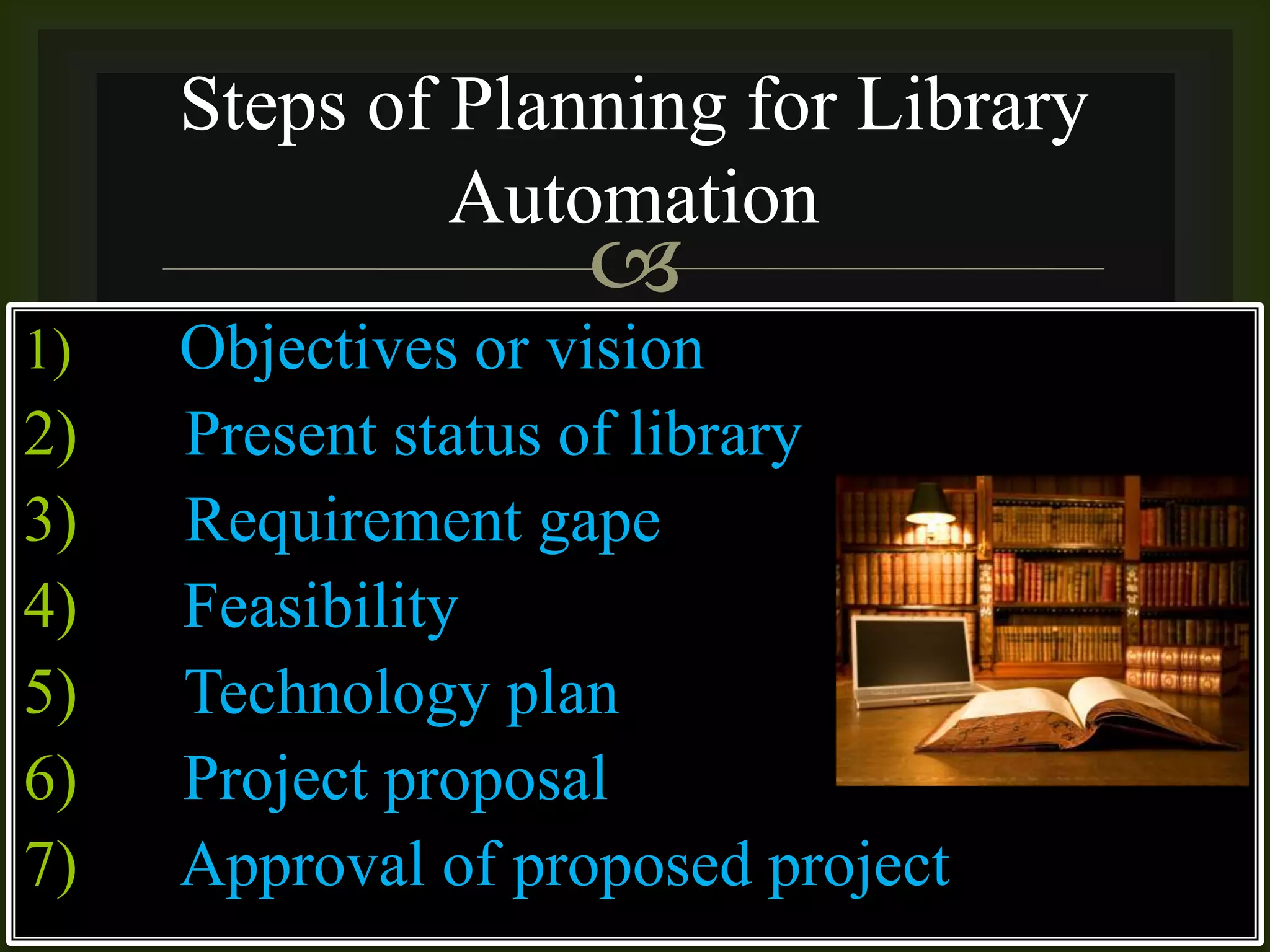
1) Objectives or vision
2) Present status of library
3) Requirement gape
4) Feasibility
5) Technology plan
6) Project proposal
7) Approval of proposed project
Steps of Planning for Library
Automation

 A vision is a dream
 It is a vivid picture of what you
would like your library to become in
the near future.
 A vision provides direction and a
philosophy for the library
1) Objectives or Vision

A systems study is conducted to assess the library’s status and
needs. It involves all the following issues;
 Nature of Library and its purpose
 Total collection of library
 Number of users
 Daily circulation
 Numbers of multi lingual documents
 Information service
 Available staff
 Working process of library
 Users need
2) Present status of Library

 Statistics
 Staff profile
 Patron profile
 Policies and procedures
 Functional
Sources of data

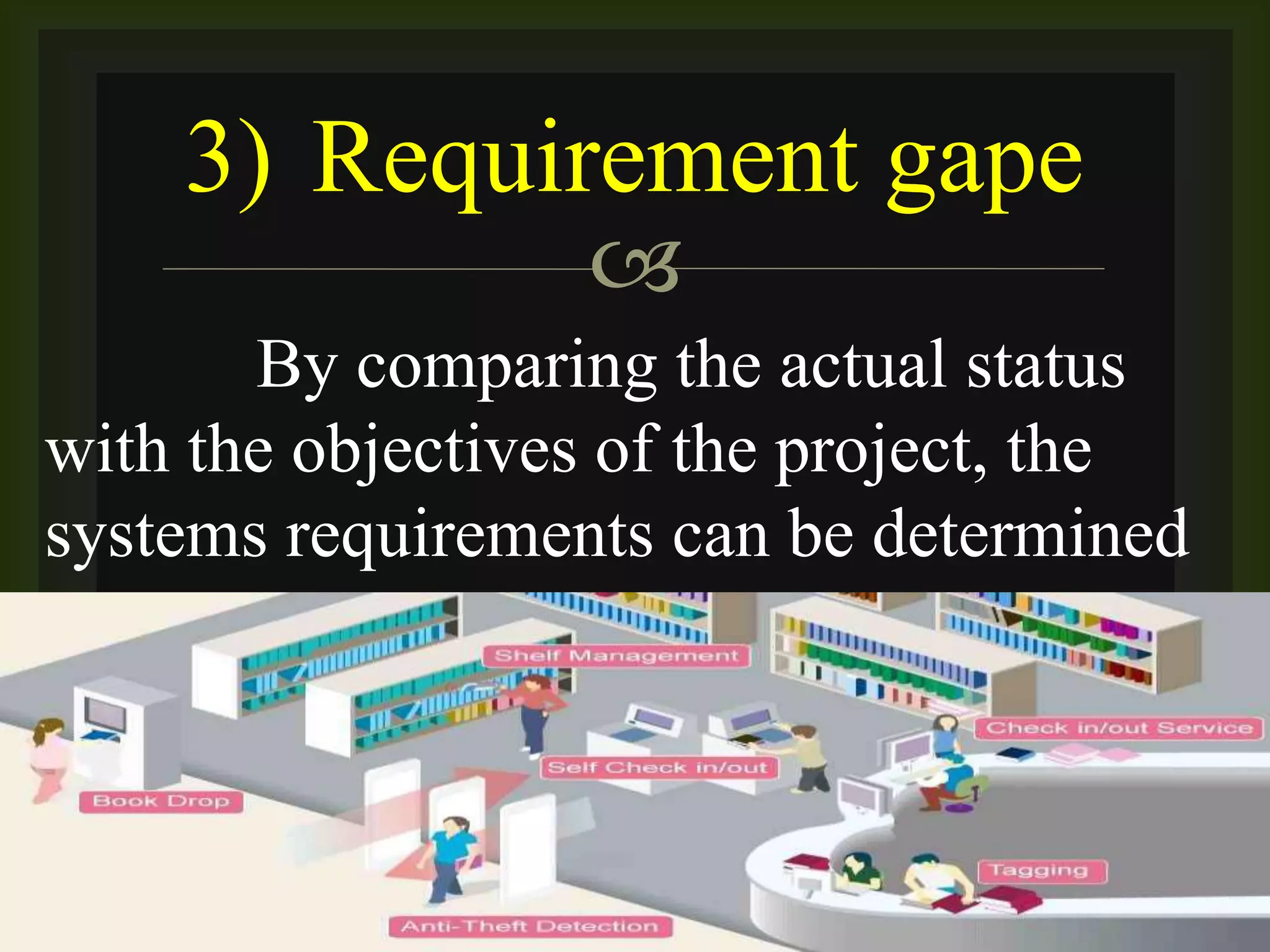
By comparing the actual status
with the objectives of the project, the
systems requirements can be determined
3) Requirement gape
 Immediately after the analysis and design for the system has been
completed, a feasibility study must be conducted. It is designed to
answer :
– Is the proposed system possible?
– Is it necessary?
– What other options are available?
– Is it affordable?
The end product of a feasibility study is a report to
management
4) Feasibility

 The technological plan should be a written document
Contains:
– Vision, Goals and Objectives
– Components of the project in terms of needs
to achieve the vision
– Specifications for your system requirements,
– Financial estimates,
– Action plan and
– Time table for the project.
5) Technological plan

 Project proposal should be based
on the technology plan.
 Project proposal should be
prepared for presentation to funding
agencies.
6) Project Proposal

 RFP is a formal request for a bid
from suppliers of library systems. The
RFP is a comprehensive document that
provides the vendor with the outline,
purpose, scope, description, minimum
requirements, etc. for the system.
7) Request For Proposal
(RFP)
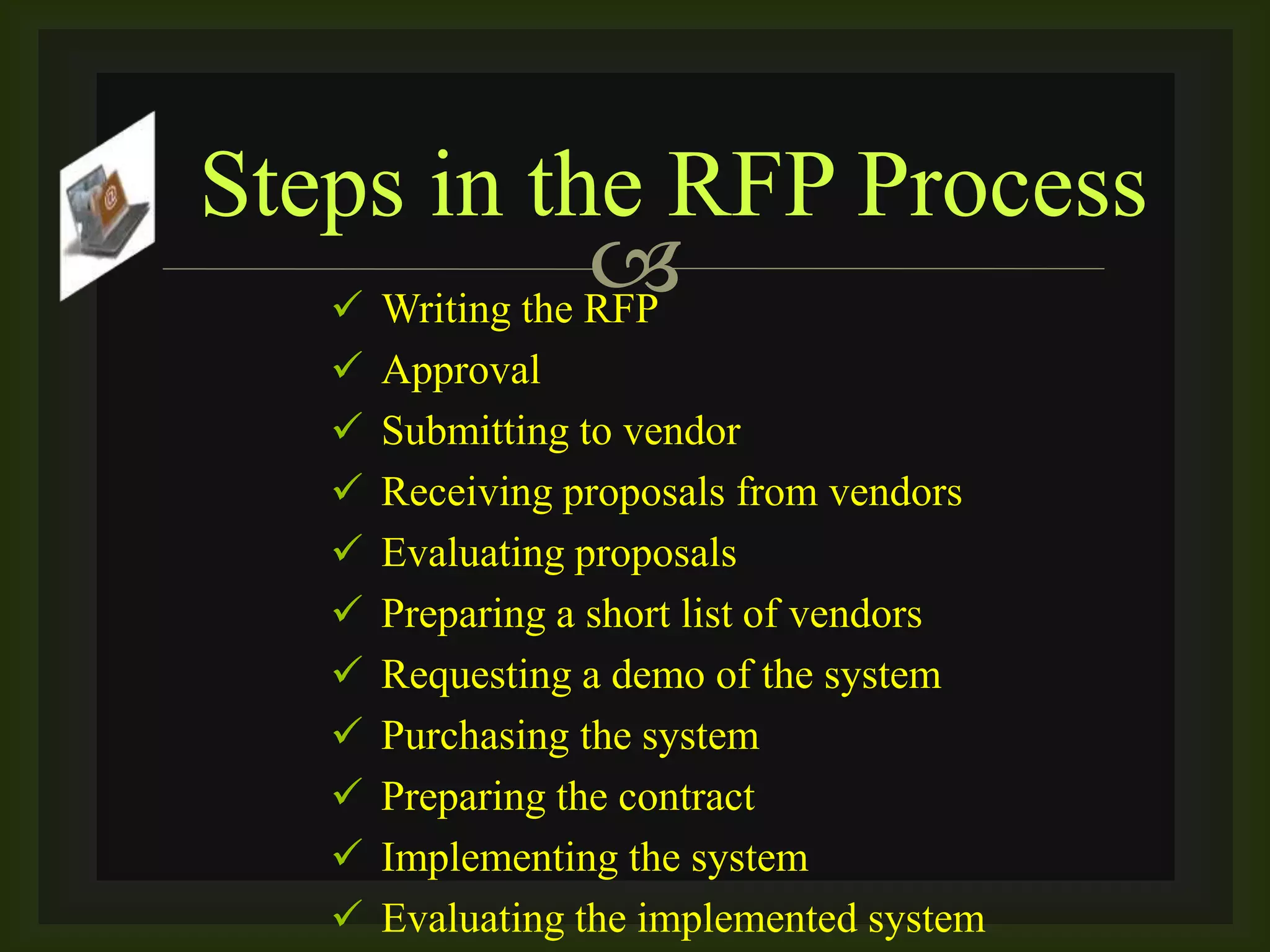
 Writing the RFP
 Approval
 Submitting to vendor
 Receiving proposals from vendors
 Evaluating proposals
 Preparing a short list of vendors
 Requesting a demo of the system
 Purchasing the system
 Preparing the contract
 Implementing the system
 Evaluating the implemented system
Steps in the RFP Process
Implementation includes all activities after management
has decided to automate the library and approved the plan. After purchasing
our system we must make it operational.
Thus even before we purchase our system, we must design
implementation strategies, which should include;
 Allocating resources
 Implementation for hardware
 Implementation for software
 Data conversion
 Implementation for System maintenance
 Training
 Making changes as necessary
Library Automation:
Implementation

 Lack of staff preparation for
automation project
 Data conversion
 Lack of resources and expertise
 Turns out to be more expensive
 Lack of administrative support
Difficulties in Implementing Library
Automation

 Support from administration
 Staff competence
 Consideration of user requirements
 Presence of infrastructure
 Available data
 Excellent managerial skill from coordinator
of the project
 User interface
Key Factors for Successful
implementation

 Library automation refers to the Integrated
Library System (ILS)
 Used to speed up administrative tasks
 Library automation can serve as a remedy to all
the existing ills of libraries
 Planning is time-consuming, but it is usually cost-
effective
Conclusion

Kumar, P.S.G.(2004). Information Technology: Applications. New Delhi: B.R
Publishing Corporation,3-18
Parthasarathy ,S.(1986). Computer applications to Libraries, IR and Networking.
Bangalore: Sarada Ranganathan Endowment for Library Science,1-8
Library automation .(n.d).retrieved On April 18, 2013,From
,dspace.thapar.edu:8080/ dspace / bitstream /.../Library+Automation.ppt
Library automation .(n.d).retrieved On April 18, 2013,From,
www.clib.dauniv.ac.in/E-Lecture/Library%20Automation1.ppt
Automation of library .(n.d).retrieved On April 18, 2013,From
http://ihome.ust.hk/~lblkt/diploma/libauto/libauto.html
REFERENCES


Planning & Automation Arun Joseph

  • 2.
     Presented by, S.ARUN JOSEPH. M.L.I.Sc4th semester. No : 1 D.L.I.S. University of Kerala. Seminar on Library Planning & implementation of Automation
  • 3.
      Library automationis the general term for ICT that are used to replace manual systems in the library  Planning is a systematic process to create or development of any specific project INTRODUCTION
  • 4.
      Library automationcan be defined simply as the use of computer and networking technologies in the library  The use of automatic machines or processing devices in libraries. The automation may be applied to library administrative activities, office procedures, and delivery of library services to users DEFINITION
  • 5.
      Library authority Library committee  Librarian or library staff  Computer Specialist or Engineer Who should be planned of library automation?
  • 6.
      Automation oflibrary functions  Use of electronic resources within the library (e.g. CD-ROMs)  Accessing remote electronic resources (e.g. the Internet)  Office automation (e.g. word-processing, spreadsheets, databases, etc.)  Patron services (e.g. computer laboratory, multimedia center) Areas of Library Automation
  • 7.
      • Toimprove the level of service and quality of output  To fulfill needs that cannot be achieved by manual system: o Sharing of resources o Information that appears only in electronic format (e.g. CD-ROM, Internet resources, databases, etc.) Objectives of Library Automation
  • 8.
     Library automationrefers to the Integrated Library System (ILS)  The ILS does other functions such as tracking the books in the library and relating to the OPAC  It is need to speed up the process of checking in and out materials and listing if it is on the shelf or not What is Library automation & why need for library?
  • 9.
      Self Survivalin the New Environment  Speeding up the Operation  Accuracy and Reliability  Budget Saving  Obtain increased operational efficiencies  Relieve professional staff from clerical chores so that they are available for user-oriented services Need and Purpose of Library Automation
  • 10.
      Improve thequality, speed and effectiveness of services  Improve access to remote users and other stakeholders, e.g: the general public  Improve access to resources on other networks and systems, including the Web  Provide new services not hitherto possible,  Improve the management of their physical and financial resources  Facilitate wider access to information for their clients  Facilitate wider dissemination of their information products and services  Enable their participation in resource-sharing library networks  Enable rapid communication with other libraries (including outreach libraries) and professional peers.
  • 11.
     1) Objectives orvision 2) Present status of library 3) Requirement gape 4) Feasibility 5) Technology plan 6) Project proposal 7) Approval of proposed project Steps of Planning for Library Automation
  • 12.
      A visionis a dream  It is a vivid picture of what you would like your library to become in the near future.  A vision provides direction and a philosophy for the library 1) Objectives or Vision
  • 13.
     A systems studyis conducted to assess the library’s status and needs. It involves all the following issues;  Nature of Library and its purpose  Total collection of library  Number of users  Daily circulation  Numbers of multi lingual documents  Information service  Available staff  Working process of library  Users need 2) Present status of Library
  • 14.
      Statistics  Staffprofile  Patron profile  Policies and procedures  Functional Sources of data
  • 15.
     By comparing theactual status with the objectives of the project, the systems requirements can be determined 3) Requirement gape
  • 16.
     Immediately afterthe analysis and design for the system has been completed, a feasibility study must be conducted. It is designed to answer : – Is the proposed system possible? – Is it necessary? – What other options are available? – Is it affordable? The end product of a feasibility study is a report to management 4) Feasibility
  • 17.
      The technologicalplan should be a written document Contains: – Vision, Goals and Objectives – Components of the project in terms of needs to achieve the vision – Specifications for your system requirements, – Financial estimates, – Action plan and – Time table for the project. 5) Technological plan
  • 18.
      Project proposalshould be based on the technology plan.  Project proposal should be prepared for presentation to funding agencies. 6) Project Proposal
  • 19.
      RFP isa formal request for a bid from suppliers of library systems. The RFP is a comprehensive document that provides the vendor with the outline, purpose, scope, description, minimum requirements, etc. for the system. 7) Request For Proposal (RFP)
  • 20.
     Writing theRFP  Approval  Submitting to vendor  Receiving proposals from vendors  Evaluating proposals  Preparing a short list of vendors  Requesting a demo of the system  Purchasing the system  Preparing the contract  Implementing the system  Evaluating the implemented system Steps in the RFP Process
  • 21.
    Implementation includes allactivities after management has decided to automate the library and approved the plan. After purchasing our system we must make it operational. Thus even before we purchase our system, we must design implementation strategies, which should include;  Allocating resources  Implementation for hardware  Implementation for software  Data conversion  Implementation for System maintenance  Training  Making changes as necessary Library Automation: Implementation
  • 22.
      Lack ofstaff preparation for automation project  Data conversion  Lack of resources and expertise  Turns out to be more expensive  Lack of administrative support Difficulties in Implementing Library Automation
  • 23.
      Support fromadministration  Staff competence  Consideration of user requirements  Presence of infrastructure  Available data  Excellent managerial skill from coordinator of the project  User interface Key Factors for Successful implementation
  • 24.
      Library automationrefers to the Integrated Library System (ILS)  Used to speed up administrative tasks  Library automation can serve as a remedy to all the existing ills of libraries  Planning is time-consuming, but it is usually cost- effective Conclusion
  • 25.
     Kumar, P.S.G.(2004). InformationTechnology: Applications. New Delhi: B.R Publishing Corporation,3-18 Parthasarathy ,S.(1986). Computer applications to Libraries, IR and Networking. Bangalore: Sarada Ranganathan Endowment for Library Science,1-8 Library automation .(n.d).retrieved On April 18, 2013,From ,dspace.thapar.edu:8080/ dspace / bitstream /.../Library+Automation.ppt Library automation .(n.d).retrieved On April 18, 2013,From, www.clib.dauniv.ac.in/E-Lecture/Library%20Automation1.ppt Automation of library .(n.d).retrieved On April 18, 2013,From http://ihome.ust.hk/~lblkt/diploma/libauto/libauto.html REFERENCES
  • 26.