Library
automation basics
1
Slide : 1 Meenakshi.k 1st M.LIb.I.Sc
Introduction
 Automation is a process of using machinery for easily working and saving human
power and time.
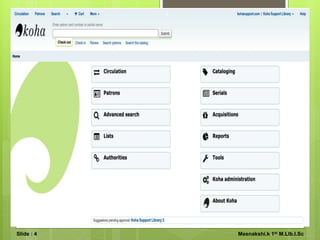
 Library automation refers to the use of the computer to automate the typical
procedures of libraries such as cataloging and circulation.
 In the process of library automation, a library makes the use of computers and other
technologies to support its systems and services.
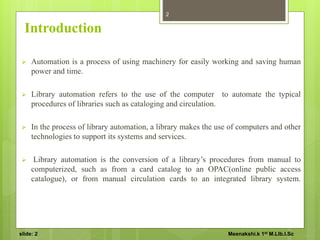
 Library automation is the conversion of a library’s procedures from manual to
computerized, such as from a card catalog to an OPAC(online public access
catalogue), or from manual circulation cards to an integrated library system.
2
slide: 2 Meenakshi.k 1st M.LIb.I.Sc
Slide : 3 Meenakshi.k 1st M.LIb.I.Sc
3
4
Slide : 4 Meenakshi.k 1st M.LIb.I.Sc
Definition
 ALA (American library Association) Glossary of Library and
Information Science defines automation as “the performance of an
operation, a series of operation or a process by self activating, self
controlling, or automatic means.
 Automation implies use of automatic data processing equipment
such as a computer or other labour saving devices”.
 Although, the term automation was first introduced by D. S. Harder
in 1936, the word library automation is being used in literature for
the last five decades.
5
Slide : 5 Meenakshi.k 1st M.LIb.I.Sc
Needs and purposes of library automation
 Much of the works involved in library are repetitive, tedious, and mechanical in nature
requiring accurate updating of records in files.
 The same bibliographic record in a library is used to perform multiple operations. Each
operation may concern with individual copies of a title.
 A bibliographic record created at the time of ordering a document is first used for its
acquisition, then for technical processing and subsequently for library OPAC(online
public access catalogue), circulation, binding, etc.
 Automation permits decentralized access to a bibliographic record by multiple users.
 A staff member in a branch library can verify the status of an order without maintaining
duplicate files or without making an enquiry.
 A user can check to see if a book is out on loan or available on the shelf of the library.
6
slide: 6 Meenakshi.k 1st M.LIb.I.Sc
Cont.….
 The application of information technology in libraries results in increased
operational efficiency.
 It ensures ease of functioning, accuracy and economy in human labor with
greater speed;
 The library staff, specially the younger ones, finds use of computers interesting
and exciting.
 Use of computers can be a motivating factor for several library staff members;
 The IT increases productivity of library staff. It relieves professional staff from
clerical chores so that they can be fruitfully used for user-oriented library
services; and
 It improves quality of services rendered by the library.
7
Slide : 7 Meenakshi.k 1st M.LIb.I.Sc
8
Slide : 8 Meenakshi.k 1st M.LIb.I.Sc
Advantages of library automation
Automation has the following advantages.
 1) Professional staff need not spend much time to do the routine library works
 2) Eliminates human errors while performing routine library works.
 3) Improved control covers library collection.
 4) Increased computer awareness among users.
 5) Cataloguing is faster, instant access to non records.
 6) Excellent control over circulation.
Some Library Software:
 SOUL
 LIBSYS
9
Slide : 9 Meenakshi.k 1stM.LIb.I.Sc
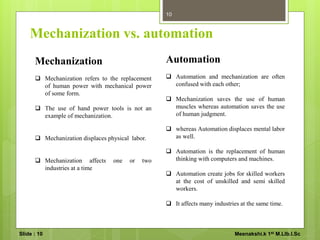
Mechanization vs. automation
Automation
 Automation and mechanization are often
confused with each other;
 Mechanization saves the use of human
muscles whereas automation saves the use
of human judgment.
 whereas Automation displaces mental labor
as well.
 Automation is the replacement of human
thinking with computers and machines.
 Automation create jobs for skilled workers
at the cost of unskilled and semi skilled
workers.
 It affects many industries at the same time.
Mechanization
 Mechanization refers to the replacement
of human power with mechanical power
of some form.
 The use of hand power tools is not an
example of mechanization.
 Mechanization displaces physical labor.
 Mechanization affects one or two
industries at a time
10
Slide : 10 Meenakshi.k 1st M.LIb.I.Sc
Areas of library automation
 Acquisition System: Automates the acquisition process, ordering, receiving, claiming
materials from suppliers and returns and cancellations of materials.
 Acquisition can be done online if system is linked to an external network.
 Cataloguing System: Creation, storage, retrieval and management of bibliographic records
and indexes.
 Circulation System: Handles circulation activities such as lending, return, renewal and place
on hold.
 Serial Publications Control System: Manages placing, canceling, claiming of orders; returning
defective, unwanted and unordered material and accounting and statistical information.
 Inter-library loan via OPAC(online public access catalogue): Provides staff with an
information management system for interlibrary loan transactions.
 This includes automatic monitoring of loans and accounts, making claims, putting holds on
materials being borrowed, etc.
11
Slide : 11 Meenaksh.ki 1stM.LIb.I.Sc
Circulation
 An automated library circulation control system includes a plurality
of remote book processing terminals and a computer controlling
the terminals and processing data between the terminals and the
computer to maintain a current inventory of the circulation status of
the library books.
12
Slide : 12 Meenakshi.k 1stM.LIb.I.Sc
Serial control
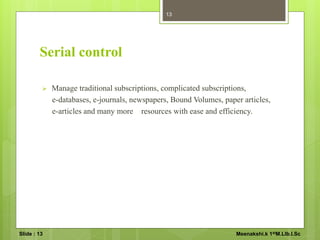
 Manage traditional subscriptions, complicated subscriptions,
e-databases, e-journals, newspapers, Bound Volumes, paper articles,
e-articles and many more resources with ease and efficiency.
13
Slide : 13 Meenakshi.k 1stM.LIb.I.Sc
Reference
 https://www.librarianshipstudies.com/2017/10/library-automation.html
 https://www.lisedunetwork.com/needs-and-purposes-of-library-automation/
 https://somemmec.wordpress.com/2013/03/09/differentiate-between-
automation-and-mechanization/
 http://eprints.rclis.org/22787/1/EPRINT%20Library%20Automation.pdf
14
Slide : 14 Meenakshi.k 1st M.LIb.I.Sc
Thank you
15
Slide : 15 Meenakshi.k 1stM.LIb.I.Sc

Library automation basics ppt.pptx

  • 1.
    Library automation basics 1 Slide :1 Meenakshi.k 1st M.LIb.I.Sc
  • 2.
    Introduction  Automation isa process of using machinery for easily working and saving human power and time.  Library automation refers to the use of the computer to automate the typical procedures of libraries such as cataloging and circulation.  In the process of library automation, a library makes the use of computers and other technologies to support its systems and services.  Library automation is the conversion of a library’s procedures from manual to computerized, such as from a card catalog to an OPAC(online public access catalogue), or from manual circulation cards to an integrated library system. 2 slide: 2 Meenakshi.k 1st M.LIb.I.Sc
  • 3.
    Slide : 3Meenakshi.k 1st M.LIb.I.Sc 3
  • 4.
    4 Slide : 4Meenakshi.k 1st M.LIb.I.Sc
  • 5.
    Definition  ALA (Americanlibrary Association) Glossary of Library and Information Science defines automation as “the performance of an operation, a series of operation or a process by self activating, self controlling, or automatic means.  Automation implies use of automatic data processing equipment such as a computer or other labour saving devices”.  Although, the term automation was first introduced by D. S. Harder in 1936, the word library automation is being used in literature for the last five decades. 5 Slide : 5 Meenakshi.k 1st M.LIb.I.Sc
  • 6.
    Needs and purposesof library automation  Much of the works involved in library are repetitive, tedious, and mechanical in nature requiring accurate updating of records in files.  The same bibliographic record in a library is used to perform multiple operations. Each operation may concern with individual copies of a title.  A bibliographic record created at the time of ordering a document is first used for its acquisition, then for technical processing and subsequently for library OPAC(online public access catalogue), circulation, binding, etc.  Automation permits decentralized access to a bibliographic record by multiple users.  A staff member in a branch library can verify the status of an order without maintaining duplicate files or without making an enquiry.  A user can check to see if a book is out on loan or available on the shelf of the library. 6 slide: 6 Meenakshi.k 1st M.LIb.I.Sc
  • 7.
    Cont.….  The applicationof information technology in libraries results in increased operational efficiency.  It ensures ease of functioning, accuracy and economy in human labor with greater speed;  The library staff, specially the younger ones, finds use of computers interesting and exciting.  Use of computers can be a motivating factor for several library staff members;  The IT increases productivity of library staff. It relieves professional staff from clerical chores so that they can be fruitfully used for user-oriented library services; and  It improves quality of services rendered by the library. 7 Slide : 7 Meenakshi.k 1st M.LIb.I.Sc
  • 8.
    8 Slide : 8Meenakshi.k 1st M.LIb.I.Sc
  • 9.
    Advantages of libraryautomation Automation has the following advantages.  1) Professional staff need not spend much time to do the routine library works  2) Eliminates human errors while performing routine library works.  3) Improved control covers library collection.  4) Increased computer awareness among users.  5) Cataloguing is faster, instant access to non records.  6) Excellent control over circulation. Some Library Software:  SOUL  LIBSYS 9 Slide : 9 Meenakshi.k 1stM.LIb.I.Sc
  • 10.
    Mechanization vs. automation Automation Automation and mechanization are often confused with each other;  Mechanization saves the use of human muscles whereas automation saves the use of human judgment.  whereas Automation displaces mental labor as well.  Automation is the replacement of human thinking with computers and machines.  Automation create jobs for skilled workers at the cost of unskilled and semi skilled workers.  It affects many industries at the same time. Mechanization  Mechanization refers to the replacement of human power with mechanical power of some form.  The use of hand power tools is not an example of mechanization.  Mechanization displaces physical labor.  Mechanization affects one or two industries at a time 10 Slide : 10 Meenakshi.k 1st M.LIb.I.Sc
  • 11.
    Areas of libraryautomation  Acquisition System: Automates the acquisition process, ordering, receiving, claiming materials from suppliers and returns and cancellations of materials.  Acquisition can be done online if system is linked to an external network.  Cataloguing System: Creation, storage, retrieval and management of bibliographic records and indexes.  Circulation System: Handles circulation activities such as lending, return, renewal and place on hold.  Serial Publications Control System: Manages placing, canceling, claiming of orders; returning defective, unwanted and unordered material and accounting and statistical information.  Inter-library loan via OPAC(online public access catalogue): Provides staff with an information management system for interlibrary loan transactions.  This includes automatic monitoring of loans and accounts, making claims, putting holds on materials being borrowed, etc. 11 Slide : 11 Meenaksh.ki 1stM.LIb.I.Sc
  • 12.
    Circulation  An automatedlibrary circulation control system includes a plurality of remote book processing terminals and a computer controlling the terminals and processing data between the terminals and the computer to maintain a current inventory of the circulation status of the library books. 12 Slide : 12 Meenakshi.k 1stM.LIb.I.Sc
  • 13.
    Serial control  Managetraditional subscriptions, complicated subscriptions, e-databases, e-journals, newspapers, Bound Volumes, paper articles, e-articles and many more resources with ease and efficiency. 13 Slide : 13 Meenakshi.k 1stM.LIb.I.Sc
  • 14.
    Reference  https://www.librarianshipstudies.com/2017/10/library-automation.html  https://www.lisedunetwork.com/needs-and-purposes-of-library-automation/ https://somemmec.wordpress.com/2013/03/09/differentiate-between- automation-and-mechanization/  http://eprints.rclis.org/22787/1/EPRINT%20Library%20Automation.pdf 14 Slide : 14 Meenakshi.k 1st M.LIb.I.Sc
  • 15.
    Thank you 15 Slide :15 Meenakshi.k 1stM.LIb.I.Sc