67%
2.5%
30.5%44.9%
25.4%
29.7%
The percentage of
hinese speakers in
speak
English?
speak
another
language?
What percentage
of people ...
speak
Chinese?
40.8% 50.8%
Census tracts
in MCD3 that
are closest to
the center of
Chinatown
20
40
60
80
100
27
2.5%
speak
another
language
67%
speak
Chinese
30.5%
speak
English
Chinatown
42
40
34
28
24
26.02
26.0122.02 20
10.02
32
38
36.02
30.02
30.01
36.01
22.01
12
10.01
14.02
14.01
18
25
27
29
8 6
2.01
2.02
16
A
mid 1700s
Chinese
traders and
sailors come
to the US
mid 1800s
Chinese flock to
“Gold Mountain”
California during
the gold rush
A brief history of
Chinese immigration to
Lower Manhattan
1840s
Construction of the
Central Pacific
Railroad begins,
providing jobs for
Chinese laborers
beginning in
the 1870s
Chinese
entrepreneurs
establish hand
laundries
throughout NYC
1860s - 1880s
Rising violence and
discrimination toward
Chinese immigrants
causes them to flee to
the big cities of the
eastern US for more
job opportunities
1882
The Chinese
Exclusion Act
imposed strict
limits on Chinese
immigration
7,000+
34,554
28,68
200-1,100
Population
of Chinese
immigrants in
Lower
Manhattan’s
Chinatown
1943
During WWII the
Chinese
Exclusion Act
was discontinued
1968
All other prohibitions
that prevented Chinese
immigration were lifted,
and Chinatown
experienced a massive
wave of new
immigrants
2000s
Getrification of
Chinatown
begins to
displace
residents
CALI
NYC
As a result of this, “Chinatowns” are growing in other areas of the City
such as Sunset Park in Brooklyn and Flushing in Queens.
Census tract 27 is in Manhattan Community District 3 (also known as the Lower
East Side and MCD3) but also finds itself situated very close to the heart of
Chinatown. Influence from both of these historical neighborhoods can be
observed in this census tract, making it a unique place to further investigate.
VISUAL STORYTELLING
AND KEY GRAPHIC PRINCIPLES
PLAN601E VERBAL AND VISUAL: INFORMATION GRAPHICS (SESSION 1)
HOW TO BUILD A STORY
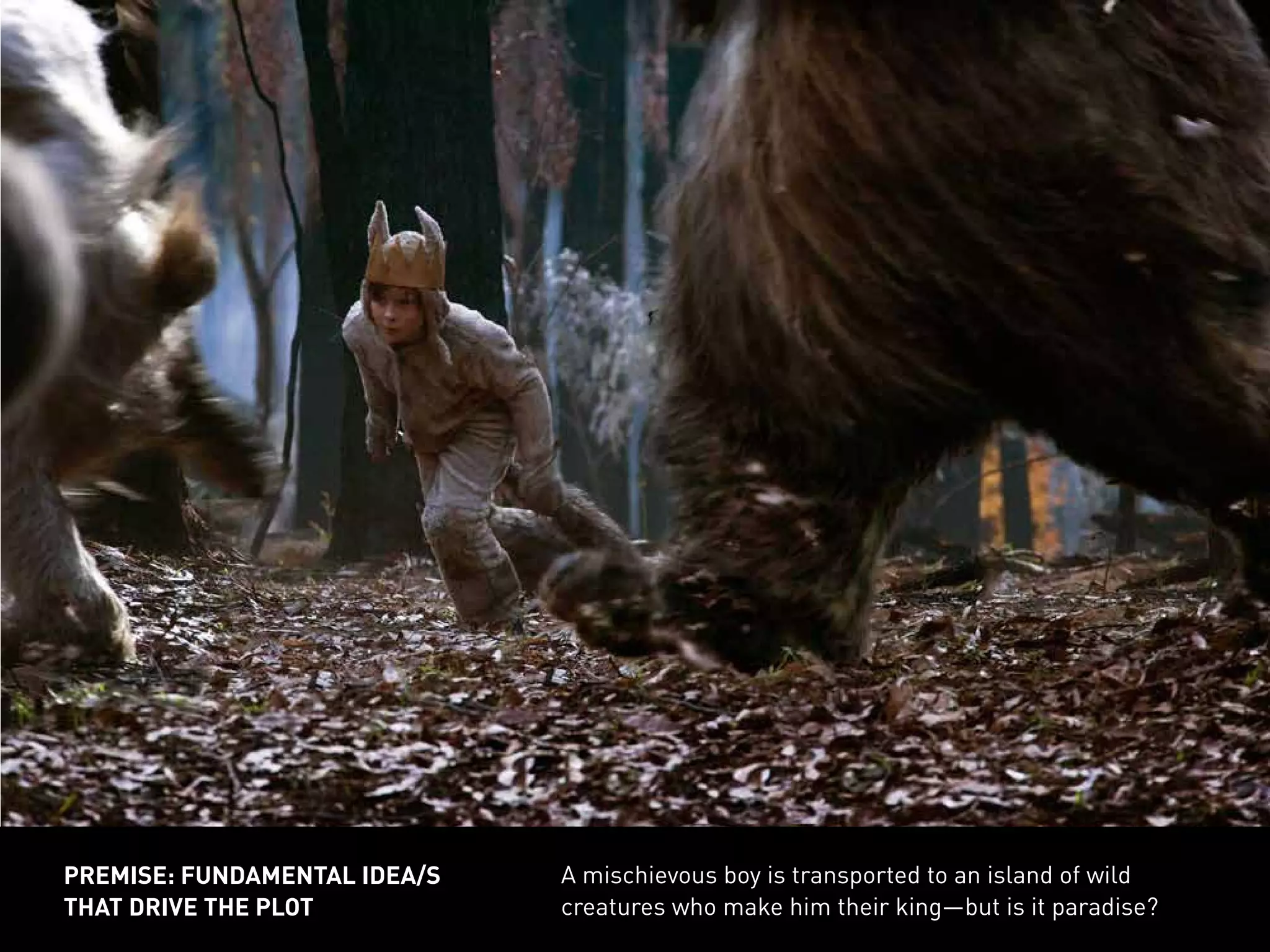
PREMISE
A mischievous boy is transported to an island of wild
creatures who make him their king—but is it paradise?
PREMISE: FUNDAMENTAL IDEA/S
THAT DRIVE THE PLOT
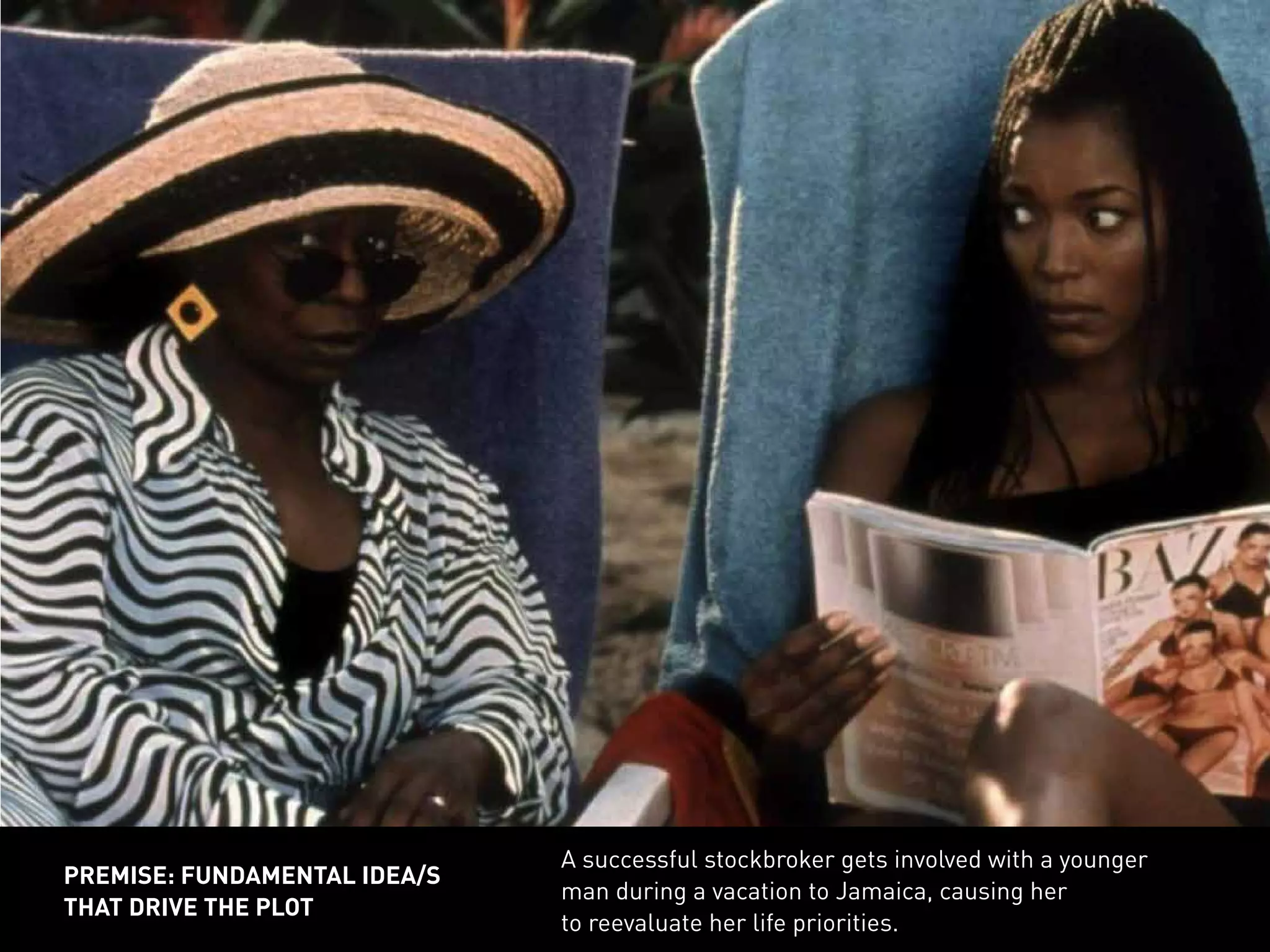
A successful stockbroker gets involved with a younger
man during a vacation to Jamaica, causing her
to reevaluate her life priorities.
PREMISE: FUNDAMENTAL IDEA/S
THAT DRIVE THE PLOT
HOW TO BUILD A STORY
ACT 1: BEGINNING
ACT 2: MIDDLE
ACT 3: END
SAMPLE PREMISES
Informal bike parking suggests a need for bike
racks in Census Tract 2.02, and the DOT can
address that need.
Where does curbside garbage from Community
District 3 ultimately go? Why, and at what costs?
What is at the root of challenges in registering
with the Department of Small Business Services,
and how can these challenges be addressed?
NONE OF THESE ARE PREMISES
The history of Tompkins Square Park
A look at graffiti in Soundview
Community Gardens in Clinton Hill
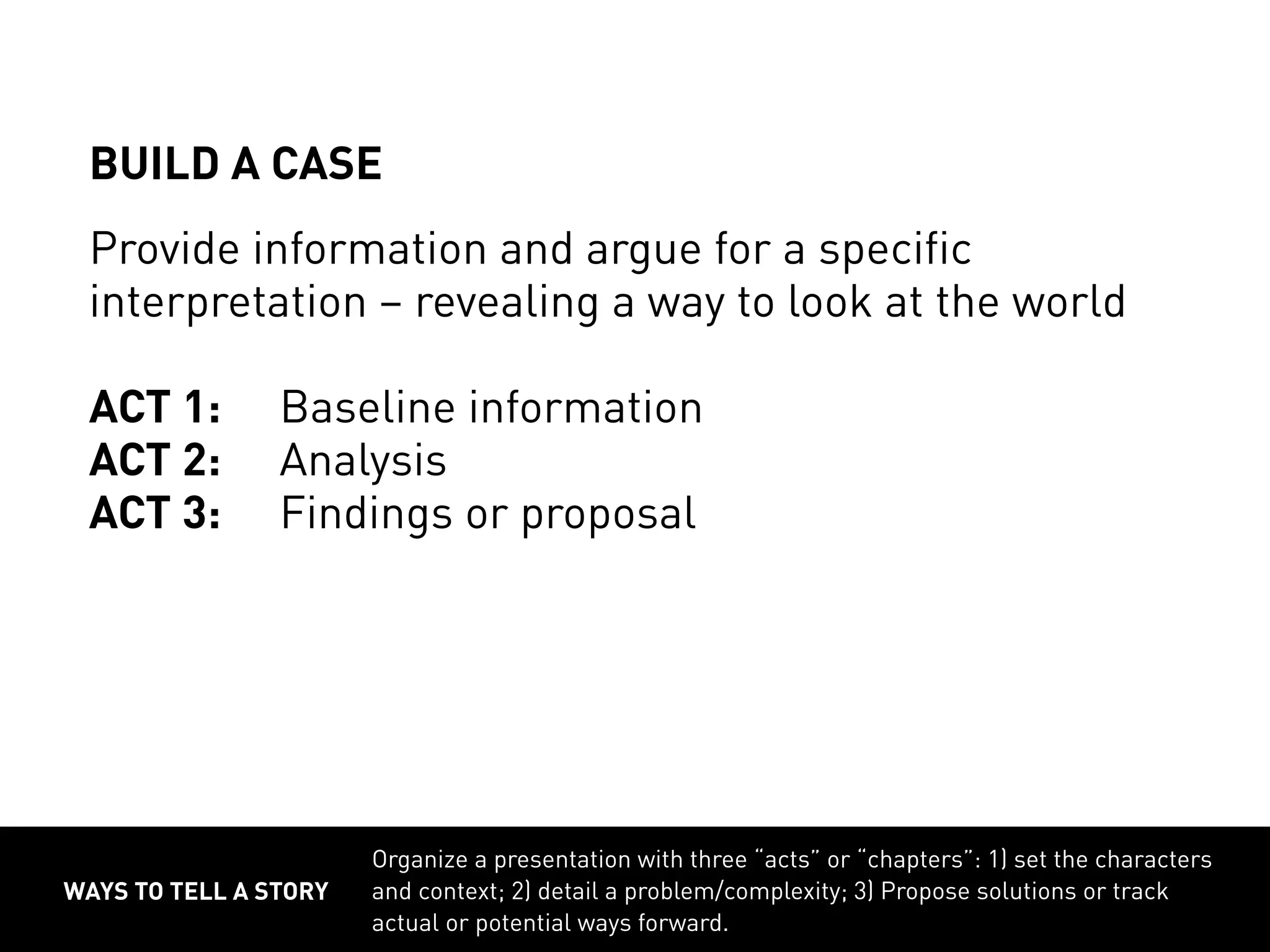
WAYS TO TELL A STORY
Organize a presentation with three “acts” or “chapters”: 1) set the characters
and context; 2) detail a problem/complexity; 3) Propose solutions or track
actual or potential ways forward.
BUILD A CASE
Provide information and argue for a specific
interpretation – revealing a way to look at the world
ACT 1:	 Baseline information
ACT 2:	 Analysis
ACT 3:	 Findings or proposal
WAYS TO TELL A STORY
Organize a presentation with three “acts” or “chapters”: 1) set the characters
and context; 2) detail a problem/complexity; 3) Propose solutions or track
actual or potential ways forward.
INDUCTIVE SURVEY
Describe existing conditions in depth and volume that
puts a single phenomenon in context
ACT 1:	 Explore individual instances
ACT 2:	 Explore potential causes and correlations
ACT 3:	 Draw phenomenon into larger context and
			 draw conclusions
WAYS TO TELL A STORY
Organize a presentation with three “acts” or “chapters”: 1) set the characters
and context; 2) detail a problem/complexity; 3) Propose solutions or track
actual or potential ways forward.
EXPLORE A SCENARIO
Explain a problem or condition through the experience
of stakeholders
ACT 1:	 Describe a character and their issues/concerns
ACT 2:	 Detail the mechanism that could serve them
ACT 3:	 Describe how the character is served
			 by the proposed program or service
WAYS TO TELL A STORY
Organize a presentation with three “acts” or “chapters”: 1) set the characters
and context; 2) detail a problem/complexity; 3) Propose solutions or track
actual or potential ways forward.
EVALUATION
Explore the strengths and weaknesses of a given
phenomenon, issue or dimension
ACT 1:	 Set a baseline: establish existing conditions
			 and explain them in context
ACT 2:	 Evaluate conditions or solutions via matrix
			 comparison, continuum, pros and cons, etc.
ACT 3:	 Make recommendations
INFORMATION GRAPHICS = TOOLS FOR VISUAL COMMUNICATION
Do you want to make a
COMPARISON?
ISOTYPE SECTION SUPERGRAPHIC
NETWORK MAP MATRIXCONTINUUM DIAGRAM
FLOW CHART CYCLE DIAGRAM
GRAPH CHART DOT DENSITY
Do you want to show a
PROCESS?
Do you want to show a
RELATIONSHIP?
Do you want to explain
a CONCEPT?
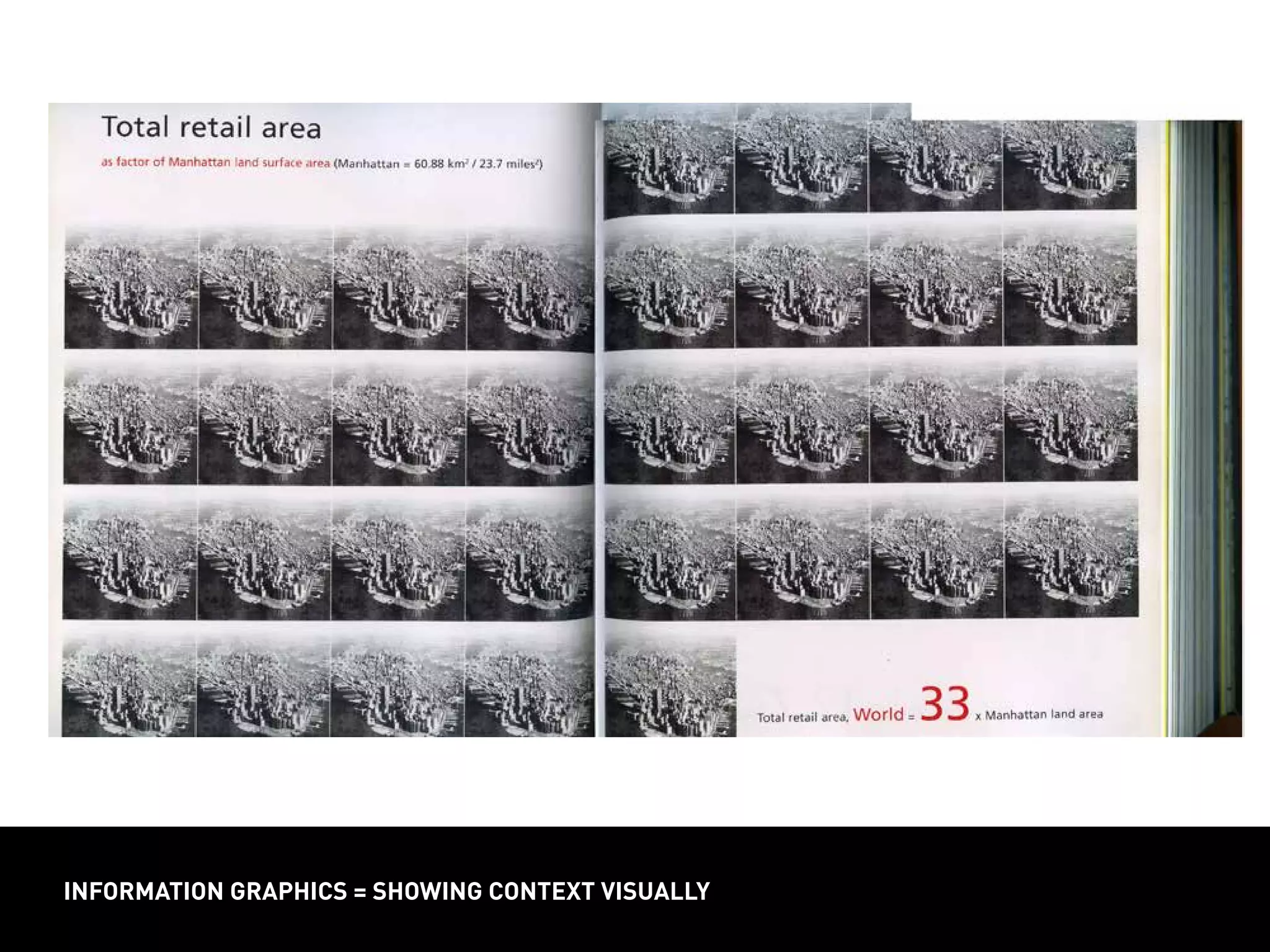
INFORMATION GRAPHICS = SHOWING CONTEXT VISUALLY
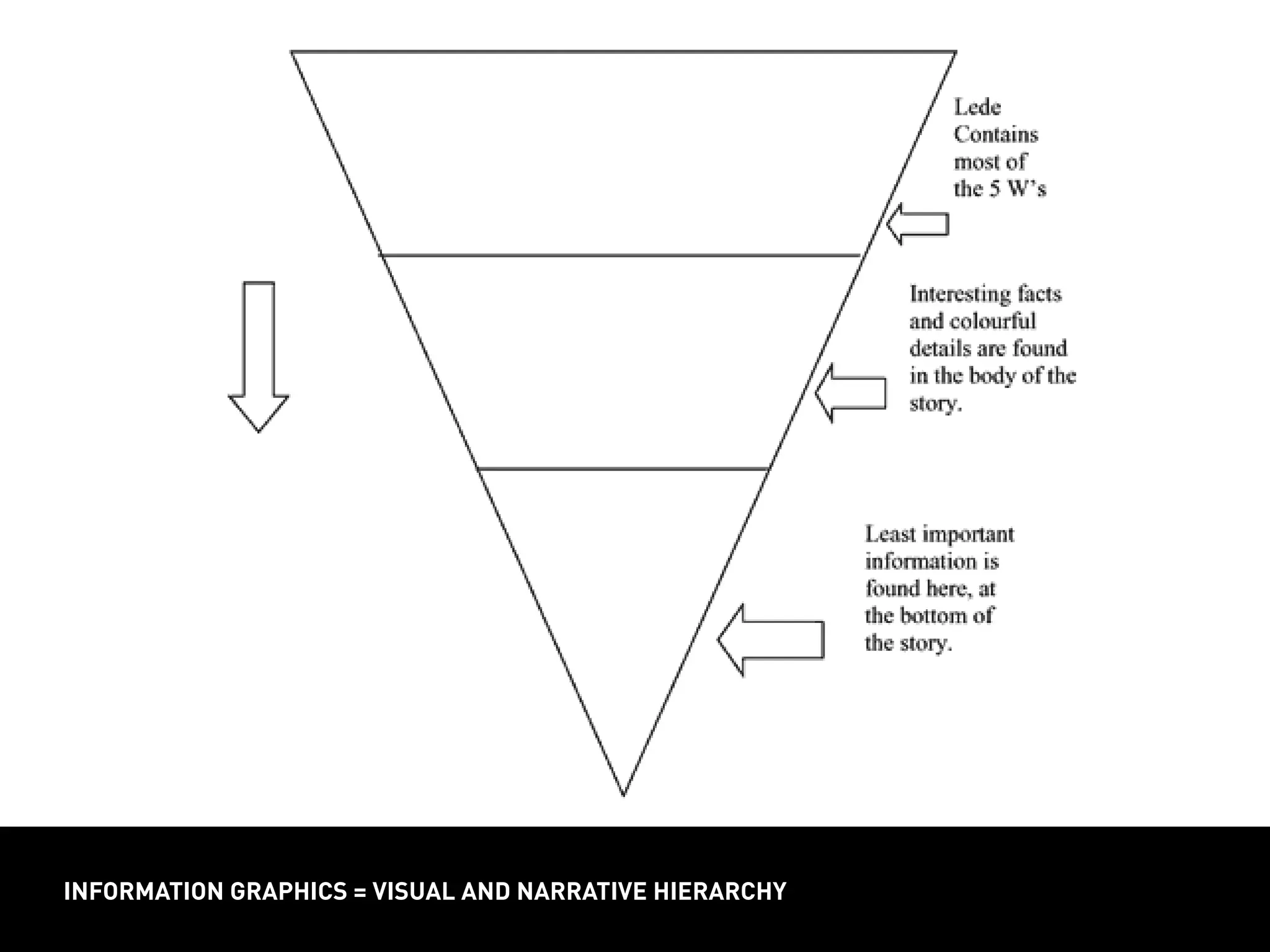
INFORMATION GRAPHICS = VISUAL AND NARRATIVE HIERARCHYINFORMATION GRAPHICS = VISUAL AND NARRATIVE HIERARCHY
Size / Scale Color Line Weight
INFORMATION GRAPHICS = EXPLAINING THROUGH VISUAL DIFFERENCE
s of social capital decreased nationwide with reported income.
in the absence of traditional civic structure, many Detroiters
r less official groups, I investigated the robustness of the trend
mple. Using GIS, I mapped respondents’ group memberships
rther disaggregated responses to reveal uneven correlations
I produced a series of illustrative diagrams to convey the
nses both quantatitively and qualitatively.
Size / Scale Color Line Weight
INFORMATION GRAPHICS = EXPLAINING THROUGH VISUAL DIFFERENCES
INFORMATION GRAPHICS = USING GRIDS
Leading the eye. Rule of thirds.
INFORMATION GRAPHICS = PROVIDING VISUAL STRUCTURE
INFORMATION GRAPHICS = MAKING VISUAL COMPARISONS
COURSE STRUCTURE
WK.
1
2
3
4
5
TOPICS
Visual Storytelling
and Key Graphic Principles
Principles of Graphic Design
Single Dimension Comparisons
Design Process
Sequence, Flow & Connection
Design Discretion
Evaluative & Synthetic Graphics
Constructing a Visual Narrative
Storyboarding
DEMO
FactFinder
Photo Highlights
Narrative Layout
Charts / Graphs
with Illustrator
Flowcharts / Small
Multiples with Illustrator
Continuum Diagram /
Matrix with Illustrator
and InDesign
Formatting and Layout
with InDesign
ASSIGNMENT
Data collection
Photo-documentation
Charts / Graphs
Icons
Flowcharts / Timelines
Continium Diagram /
Matrix
Slide Presentation
A1 Poster
COURSE STRUCTURE
COURSE COMPONENTS
Readings (x 2)
Case Studies
Lectures / Demonstrations
5-part Assignment
•	 Census Tract / Study Area
•	 Weekly slide deck + JPEG submission
•	 Final presentation
GRADING
Assignment 1: 			 	 10%
Assignment 2: 			 	 10%
Assignment 3: 				 10%
Assignment 4: 				 10%
Assignment 5: 				 20%
Case Study Presentation: 		 10%
Online Participation: 			 10%
In-Class Participation: 		 20%
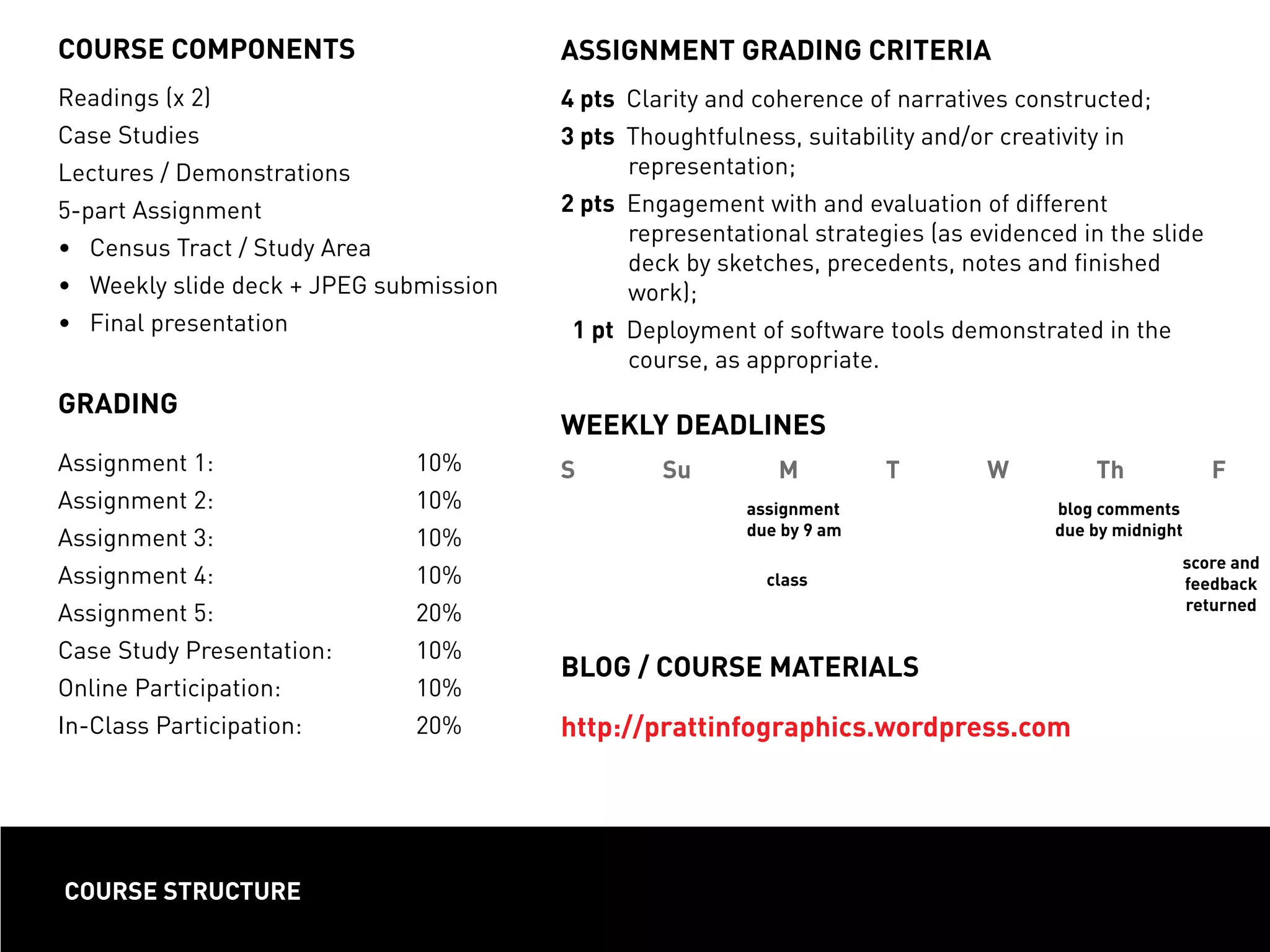
ASSIGNMENT GRADING CRITERIA
4 pts Clarity and coherence of narratives constructed;
3 pts Thoughtfulness, suitability and/or creativity in
representation;
2 pts Engagement with and evaluation of different
representational strategies (as evidenced in the slide
deck by sketches, precedents, notes and finished
work);
1 pt Deployment of software tools demonstrated in the
course, as appropriate.
WEEKLY DEADLINES
S Su M T W Th F
			 			
				 			 	
BLOG / COURSE MATERIALS
http://prattinfographics.wordpress.com
score and
feedback
returned
blog comments
due by midnight
assignment
due by 9 am
class
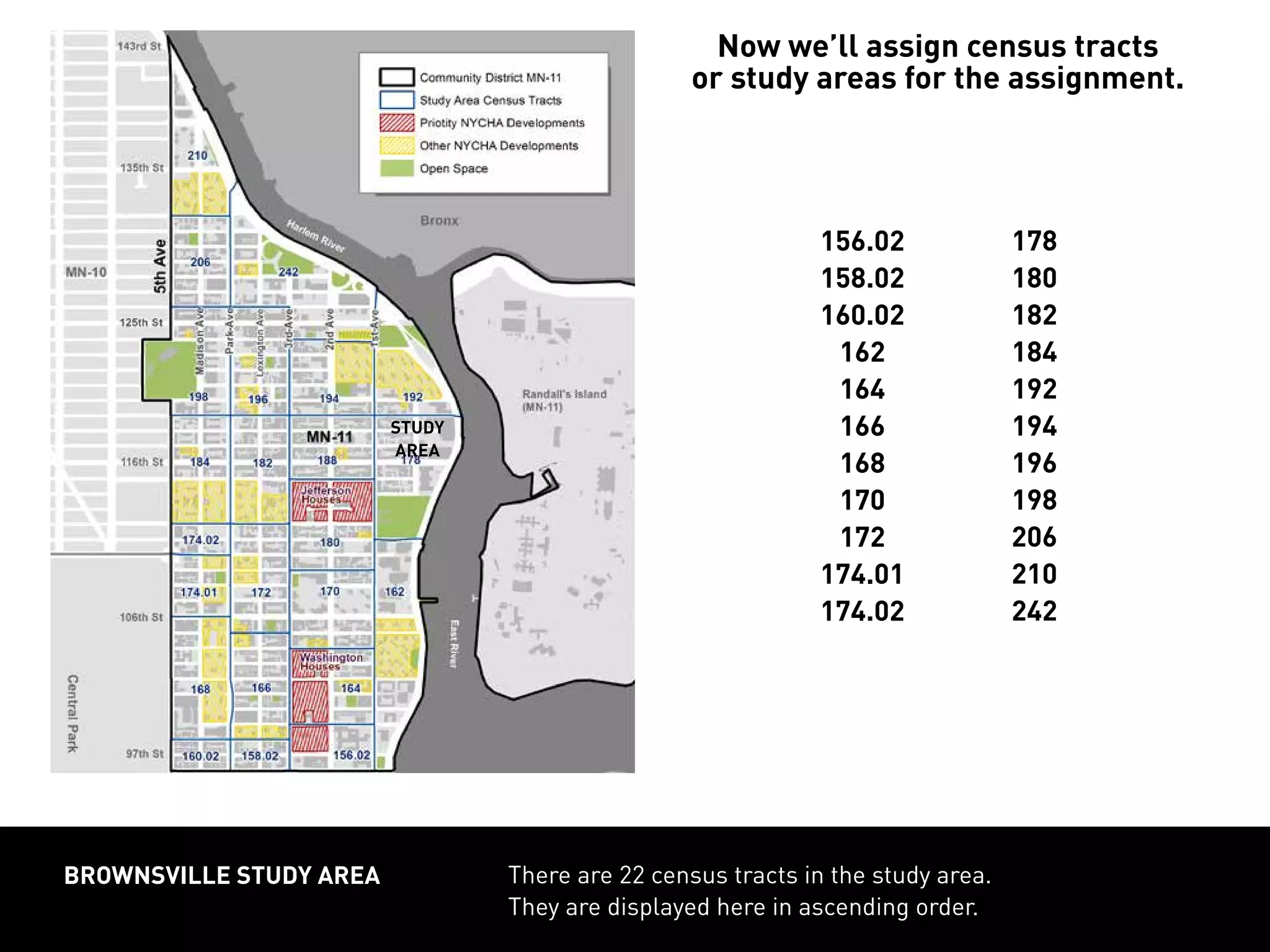
Now we’ll assign census tracts
or study areas for the assignment.
There are 22 census tracts in the study area.
They are displayed here in ascending order.
BROWNSVILLE STUDY AREA
156.02
158.02
160.02
162
164
166
168
170
172
174.01
174.02
178
180
182
184
192
194
196
198
206
210
242
STUDY
AREA
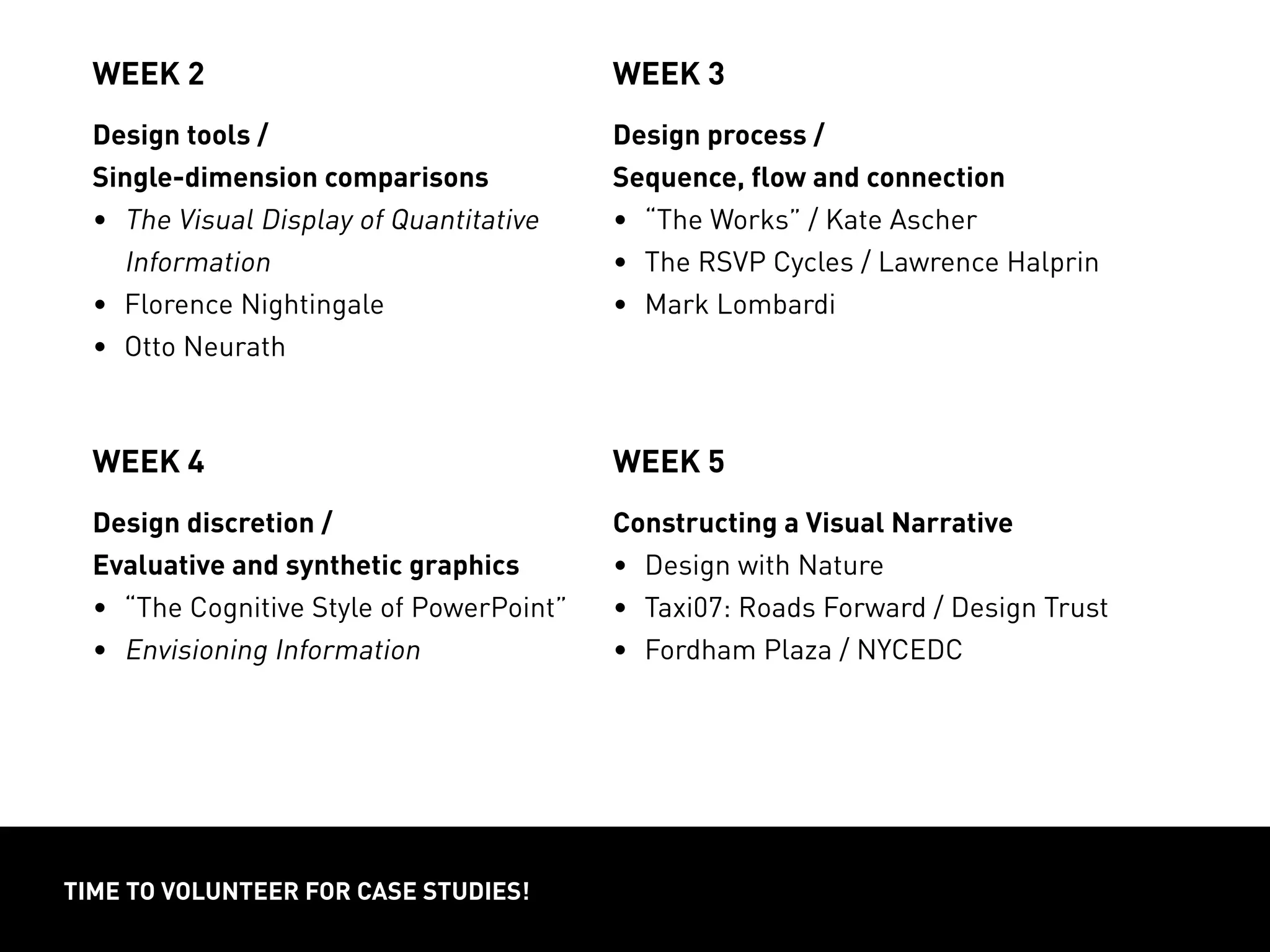
TIME TO VOLUNTEER FOR CASE STUDIES!
WEEK 2
Design tools /
Single-dimension comparisons
•	 The Visual Display of Quantitative
Information
•	 Florence Nightingale
•	 Otto Neurath
WEEK 4
Design discretion /
Evaluative and synthetic graphics
•	 “The Cognitive Style of PowerPoint”
•	 Envisioning Information
WEEK 3
Design process /
Sequence, flow and connection
•	 “The Works” / Kate Ascher
•	 The RSVP Cycles / Lawrence Halprin
•	 Mark Lombardi
WEEK 5
Constructing a Visual Narrative
•	 Design with Nature
•	 Taxi07: Roads Forward / Design Trust
•	 Fordham Plaza / NYCEDC

Plan601 e session 1 lesson 20151005

  • 1.
    67% 2.5% 30.5%44.9% 25.4% 29.7% The percentage of hinesespeakers in speak English? speak another language? What percentage of people ... speak Chinese? 40.8% 50.8% Census tracts in MCD3 that are closest to the center of Chinatown 20 40 60 80 100 27 2.5% speak another language 67% speak Chinese 30.5% speak English Chinatown 42 40 34 28 24 26.02 26.0122.02 20 10.02 32 38 36.02 30.02 30.01 36.01 22.01 12 10.01 14.02 14.01 18 25 27 29 8 6 2.01 2.02 16 A mid 1700s Chinese traders and sailors come to the US mid 1800s Chinese flock to “Gold Mountain” California during the gold rush A brief history of Chinese immigration to Lower Manhattan 1840s Construction of the Central Pacific Railroad begins, providing jobs for Chinese laborers beginning in the 1870s Chinese entrepreneurs establish hand laundries throughout NYC 1860s - 1880s Rising violence and discrimination toward Chinese immigrants causes them to flee to the big cities of the eastern US for more job opportunities 1882 The Chinese Exclusion Act imposed strict limits on Chinese immigration 7,000+ 34,554 28,68 200-1,100 Population of Chinese immigrants in Lower Manhattan’s Chinatown 1943 During WWII the Chinese Exclusion Act was discontinued 1968 All other prohibitions that prevented Chinese immigration were lifted, and Chinatown experienced a massive wave of new immigrants 2000s Getrification of Chinatown begins to displace residents CALI NYC As a result of this, “Chinatowns” are growing in other areas of the City such as Sunset Park in Brooklyn and Flushing in Queens. Census tract 27 is in Manhattan Community District 3 (also known as the Lower East Side and MCD3) but also finds itself situated very close to the heart of Chinatown. Influence from both of these historical neighborhoods can be observed in this census tract, making it a unique place to further investigate. VISUAL STORYTELLING AND KEY GRAPHIC PRINCIPLES PLAN601E VERBAL AND VISUAL: INFORMATION GRAPHICS (SESSION 1)
  • 2.
    HOW TO BUILDA STORY PREMISE
  • 3.
    A mischievous boyis transported to an island of wild creatures who make him their king—but is it paradise? PREMISE: FUNDAMENTAL IDEA/S THAT DRIVE THE PLOT
  • 4.
    A successful stockbrokergets involved with a younger man during a vacation to Jamaica, causing her to reevaluate her life priorities. PREMISE: FUNDAMENTAL IDEA/S THAT DRIVE THE PLOT
  • 5.
    HOW TO BUILDA STORY ACT 1: BEGINNING ACT 2: MIDDLE ACT 3: END
  • 6.
    SAMPLE PREMISES Informal bikeparking suggests a need for bike racks in Census Tract 2.02, and the DOT can address that need. Where does curbside garbage from Community District 3 ultimately go? Why, and at what costs? What is at the root of challenges in registering with the Department of Small Business Services, and how can these challenges be addressed?
  • 7.
    NONE OF THESEARE PREMISES The history of Tompkins Square Park A look at graffiti in Soundview Community Gardens in Clinton Hill
  • 8.
    WAYS TO TELLA STORY Organize a presentation with three “acts” or “chapters”: 1) set the characters and context; 2) detail a problem/complexity; 3) Propose solutions or track actual or potential ways forward. BUILD A CASE Provide information and argue for a specific interpretation – revealing a way to look at the world ACT 1: Baseline information ACT 2: Analysis ACT 3: Findings or proposal
  • 9.
    WAYS TO TELLA STORY Organize a presentation with three “acts” or “chapters”: 1) set the characters and context; 2) detail a problem/complexity; 3) Propose solutions or track actual or potential ways forward. INDUCTIVE SURVEY Describe existing conditions in depth and volume that puts a single phenomenon in context ACT 1: Explore individual instances ACT 2: Explore potential causes and correlations ACT 3: Draw phenomenon into larger context and draw conclusions
  • 10.
    WAYS TO TELLA STORY Organize a presentation with three “acts” or “chapters”: 1) set the characters and context; 2) detail a problem/complexity; 3) Propose solutions or track actual or potential ways forward. EXPLORE A SCENARIO Explain a problem or condition through the experience of stakeholders ACT 1: Describe a character and their issues/concerns ACT 2: Detail the mechanism that could serve them ACT 3: Describe how the character is served by the proposed program or service
  • 11.
    WAYS TO TELLA STORY Organize a presentation with three “acts” or “chapters”: 1) set the characters and context; 2) detail a problem/complexity; 3) Propose solutions or track actual or potential ways forward. EVALUATION Explore the strengths and weaknesses of a given phenomenon, issue or dimension ACT 1: Set a baseline: establish existing conditions and explain them in context ACT 2: Evaluate conditions or solutions via matrix comparison, continuum, pros and cons, etc. ACT 3: Make recommendations
  • 12.
    INFORMATION GRAPHICS =TOOLS FOR VISUAL COMMUNICATION Do you want to make a COMPARISON? ISOTYPE SECTION SUPERGRAPHIC NETWORK MAP MATRIXCONTINUUM DIAGRAM FLOW CHART CYCLE DIAGRAM GRAPH CHART DOT DENSITY Do you want to show a PROCESS? Do you want to show a RELATIONSHIP? Do you want to explain a CONCEPT?
  • 13.
    INFORMATION GRAPHICS =SHOWING CONTEXT VISUALLY INFORMATION GRAPHICS = SHOWING CONTEXT VISUALLY
  • 14.
    INFORMATION GRAPHICS =VISUAL AND NARRATIVE HIERARCHYINFORMATION GRAPHICS = VISUAL AND NARRATIVE HIERARCHY
  • 15.
    Size / ScaleColor Line Weight INFORMATION GRAPHICS = EXPLAINING THROUGH VISUAL DIFFERENCE s of social capital decreased nationwide with reported income. in the absence of traditional civic structure, many Detroiters r less official groups, I investigated the robustness of the trend mple. Using GIS, I mapped respondents’ group memberships rther disaggregated responses to reveal uneven correlations I produced a series of illustrative diagrams to convey the nses both quantatitively and qualitatively. Size / Scale Color Line Weight INFORMATION GRAPHICS = EXPLAINING THROUGH VISUAL DIFFERENCES
  • 16.
    INFORMATION GRAPHICS =USING GRIDS Leading the eye. Rule of thirds. INFORMATION GRAPHICS = PROVIDING VISUAL STRUCTURE
  • 17.
    INFORMATION GRAPHICS =MAKING VISUAL COMPARISONS INFORMATION GRAPHICS = MAKING VISUAL COMPARISONS
  • 18.
    COURSE STRUCTURE WK. 1 2 3 4 5 TOPICS Visual Storytelling andKey Graphic Principles Principles of Graphic Design Single Dimension Comparisons Design Process Sequence, Flow & Connection Design Discretion Evaluative & Synthetic Graphics Constructing a Visual Narrative Storyboarding DEMO FactFinder Photo Highlights Narrative Layout Charts / Graphs with Illustrator Flowcharts / Small Multiples with Illustrator Continuum Diagram / Matrix with Illustrator and InDesign Formatting and Layout with InDesign ASSIGNMENT Data collection Photo-documentation Charts / Graphs Icons Flowcharts / Timelines Continium Diagram / Matrix Slide Presentation A1 Poster
  • 19.
    COURSE STRUCTURE COURSE COMPONENTS Readings(x 2) Case Studies Lectures / Demonstrations 5-part Assignment • Census Tract / Study Area • Weekly slide deck + JPEG submission • Final presentation GRADING Assignment 1: 10% Assignment 2: 10% Assignment 3: 10% Assignment 4: 10% Assignment 5: 20% Case Study Presentation: 10% Online Participation: 10% In-Class Participation: 20% ASSIGNMENT GRADING CRITERIA 4 pts Clarity and coherence of narratives constructed; 3 pts Thoughtfulness, suitability and/or creativity in representation; 2 pts Engagement with and evaluation of different representational strategies (as evidenced in the slide deck by sketches, precedents, notes and finished work); 1 pt Deployment of software tools demonstrated in the course, as appropriate. WEEKLY DEADLINES S Su M T W Th F BLOG / COURSE MATERIALS http://prattinfographics.wordpress.com score and feedback returned blog comments due by midnight assignment due by 9 am class
  • 20.
    Now we’ll assigncensus tracts or study areas for the assignment. There are 22 census tracts in the study area. They are displayed here in ascending order. BROWNSVILLE STUDY AREA 156.02 158.02 160.02 162 164 166 168 170 172 174.01 174.02 178 180 182 184 192 194 196 198 206 210 242 STUDY AREA
  • 21.
    TIME TO VOLUNTEERFOR CASE STUDIES! WEEK 2 Design tools / Single-dimension comparisons • The Visual Display of Quantitative Information • Florence Nightingale • Otto Neurath WEEK 4 Design discretion / Evaluative and synthetic graphics • “The Cognitive Style of PowerPoint” • Envisioning Information WEEK 3 Design process / Sequence, flow and connection • “The Works” / Kate Ascher • The RSVP Cycles / Lawrence Halprin • Mark Lombardi WEEK 5 Constructing a Visual Narrative • Design with Nature • Taxi07: Roads Forward / Design Trust • Fordham Plaza / NYCEDC