
© 2011 Adobe Systems Incorporated. All Rights Reserved. Adobe Confidential.
Kevin Goldsmith | Senior Engineering Manager
Bob Archer | Senior Computer Scientist
Pixel Bender
© 2011 Adobe Systems Incorporated. All Rights Reserved. Adobe Confidential.
What is Pixel Bender?
A domain specific kernel and graph language for image and video processing
designed to efficiently target current and future heterogeneous hardware.
2
© 2011 Adobe Systems Incorporated. All Rights Reserved. Adobe Confidential.
Pixel Bender Kernels & Graphs
3
<languageVersion : 1.0;>
kernel pixelate_sample
<
namespace : "AIF Test";
vendor : "Adobe";
version : 1;>
{
parameter int dimension;
input image4 inputImage;
output pixel4 outputPixel;
void evaluatePixel()
{
float dimAsFloat = float(dimension);
float2 sc = floor(outCoord() /
float2(dimAsFloat, dimAsFloat));
sc *= dimAsFloat;
outputPixel = sampleNearest(inputImage, sc);
}
}
<?xml version="1.0" encoding="utf-8"?>
<graph name = "PixelateGraph"xmlns="http://ns.adobe.com/PixelBenderGraph/1.0">
<metadata name = "namespace" value = "AIF"/>
<metadata name = "vendor" value = "Adobe Systems" />
<metadata name = "version" type = "int" value = "1" />
<parameter type = "int" name = "dimension" >
<metadata name = "defaultValue" type = "int" value = "1" />
<metadata name = "minValue" type = "int" value = "1" />
<metadata name = "maxValue" type = "int" value = "100" />
</parameter>
<inputImage type = "image4" name = "inputImage" />
<outputImage type = "image4" name = "outputImage" />
<kernel>
<![CDATA[
<languageVersion : 1.0;>
kernel Pixelate
<
namespace:"AIF";
vendor:"Adobe Systems";
version:1;
>
{
…
}
]]>
</kernel>
<node id = "pixelateFilter" name ="Pixelate" namespace = "AIF" vendor = "Adobe Systems" version ="1"
clientID ="ADBE Pixelate" >
<evaluateParameters>
<![CDATA[
void evaluateParameters()
{
pixelateFilter::dimension = dimension;
}
]]>
</evaluateParameters>
</node>
<!-- Connect the graph -->
<connect fromImage = "inputImage" toNode = "pixelateFilter" toInput = "src" />
<connect fromNode = "pixelateFilter" fromOutput = "dst" toImage = "outputImage" />
</graph>
© 2011 Adobe Systems Incorporated. All Rights Reserved. Adobe Confidential.
Pixel Bender Kernels & Graphs
4
<languageVersion : 1.0;>
kernel pixelate_sample
<
namespace : "AIF Test";
vendor : "Adobe";
version : 1;>
{
parameter int dimension;
input image4 inputImage;
output pixel4 outputPixel;
void evaluatePixel()
{
float dimAsFloat = float(dimension);
float2 sc = floor(outCoord() /
float2(dimAsFloat, dimAsFloat));
sc *= dimAsFloat;
outputPixel = sampleNearest(inputImage, sc);
}
}
<?xml version="1.0" encoding="utf-8"?>
<graph name = "PixelateGraph"xmlns="http://ns.adobe.com/PixelBenderGraph/1.0">
<metadata name = "namespace" value = "AIF"/>
<metadata name = "vendor" value = "Adobe Systems" />
<metadata name = "version" type = "int" value = "1" />
<parameter type = "int" name = "dimension" >
<metadata name = "defaultValue" type = "int" value = "1" />
<metadata name = "minValue" type = "int" value = "1" />
<metadata name = "maxValue" type = "int" value = "100" />
</parameter>
<inputImage type = "image4" name = "inputImage" />
<outputImage type = "image4" name = "outputImage" />
<kernel>
<![CDATA[
<languageVersion : 1.0;>
kernel Pixelate
<
namespace:"AIF";
vendor:"Adobe Systems";
version:1;
>
{
…
}
]]>
</kernel>
<node id = "pixelateFilter" name ="Pixelate" namespace = "AIF" vendor = "Adobe Systems" version ="1"
clientID ="ADBE Pixelate" >
<evaluateParameters>
<![CDATA[
void evaluateParameters()
{
pixelateFilter::dimension = dimension;
}
]]>
</evaluateParameters>
</node>
<!-- Connect the graph -->
<connect fromImage = "inputImage" toNode = "pixelateFilter" toInput = "src" />
<connect fromNode = "pixelateFilter" fromOutput = "dst" toImage = "outputImage" />
</graph>
© 2011 Adobe Systems Incorporated. All Rights Reserved. Adobe Confidential.
Pixel Bender Kernels & Graphs
5
<languageVersion : 1.0;>
kernel pixelate_sample
<
namespace : "AIF Test";
vendor : "Adobe";
version : 1;>
{
parameter int dimension;
input image4 inputImage;
output pixel4 outputPixel;
void evaluatePixel()
{
float dimAsFloat = float(dimension);
float2 sc = floor(outCoord() /
float2(dimAsFloat, dimAsFloat));
sc *= dimAsFloat;
outputPixel = sampleNearest(inputImage, sc);
}
}
<?xml version="1.0" encoding="utf-8"?>
<graph name = "PixelateGraph"xmlns="http://ns.adobe.com/PixelBenderGraph/1.0">
<metadata name = "namespace" value = "AIF"/>
<metadata name = "vendor" value = "Adobe Systems" />
<metadata name = "version" type = "int" value = "1" />
<parameter type = "int" name = "dimension" >
<metadata name = "defaultValue" type = "int" value = "1" />
<metadata name = "minValue" type = "int" value = "1" />
<metadata name = "maxValue" type = "int" value = "100" />
</parameter>
<inputImage type = "image4" name = "inputImage" />
<outputImage type = "image4" name = "outputImage" />
<kernel>
<![CDATA[
<languageVersion : 1.0;>
kernel Pixelate
<
namespace:"AIF";
vendor:"Adobe Systems";
version:1;
>
{
…
}
]]>
</kernel>
<node id = "pixelateFilter" name ="Pixelate" namespace = "AIF" vendor = "Adobe Systems" version ="1"
clientID ="ADBE Pixelate" >
<evaluateParameters>
<![CDATA[
void evaluateParameters()
{
pixelateFilter::dimension = dimension;
}
]]>
</evaluateParameters>
</node>
<!-- Connect the graph -->
<connect fromImage = "inputImage" toNode = "pixelateFilter" toInput = "src" />
<connect fromNode = "pixelateFilter" fromOutput = "dst" toImage = "outputImage" />
</graph>
© 2011 Adobe Systems Incorporated. All Rights Reserved. Adobe Confidential.
Pixel Bender Kernels & Graphs
6
<languageVersion : 1.0;>
kernel pixelate_sample
<
namespace : "AIF Test";
vendor : "Adobe";
version : 1;>
{
parameter int dimension;
input image4 inputImage;
output pixel4 outputPixel;
void evaluatePixel()
{
float dimAsFloat = float(dimension);
float2 sc = floor(outCoord() /
float2(dimAsFloat, dimAsFloat));
sc *= dimAsFloat;
outputPixel = sampleNearest(inputImage, sc);
}
}
<?xml version="1.0" encoding="utf-8"?>
<graph name = "PixelateGraph"xmlns="http://ns.adobe.com/PixelBenderGraph/1.0">
<metadata name = "namespace" value = "AIF"/>
<metadata name = "vendor" value = "Adobe Systems" />
<metadata name = "version" type = "int" value = "1" />
<parameter type = "int" name = "dimension" >
<metadata name = "defaultValue" type = "int" value = "1" />
<metadata name = "minValue" type = "int" value = "1" />
<metadata name = "maxValue" type = "int" value = "100" />
</parameter>
<inputImage type = "image4" name = "inputImage" />
<outputImage type = "image4" name = "outputImage" />
<kernel>
<![CDATA[
<languageVersion : 1.0;>
kernel Pixelate
<
namespace:"AIF";
vendor:"Adobe Systems";
version:1;
>
{
…
}
]]>
</kernel>
<node id = "pixelateFilter" name ="Pixelate" namespace = "AIF" vendor = "Adobe Systems" version ="1"
clientID ="ADBE Pixelate" >
<evaluateParameters>
<![CDATA[
void evaluateParameters()
{
pixelateFilter::dimension = dimension;
}
]]>
</evaluateParameters>
</node>
<!-- Connect the graph -->
<connect fromImage = "inputImage" toNode = "pixelateFilter" toInput = "src" />
<connect fromNode = "pixelateFilter" fromOutput = "dst" toImage = "outputImage" />
</graph>
High Pass Texturize
Saturate
Blend
Vacation
© 2011 Adobe Systems Incorporated. All Rights Reserved. Adobe Confidential.
Pixel Bender Kernels & Graphs
7
<languageVersion : 1.0;>
kernel pixelate_sample
<
namespace : "AIF Test";
vendor : "Adobe";
version : 1;>
{
parameter int dimension;
input image4 inputImage;
output pixel4 outputPixel;
void evaluatePixel()
{
float dimAsFloat = float(dimension);
float2 sc = floor(outCoord() /
float2(dimAsFloat, dimAsFloat));
sc *= dimAsFloat;
outputPixel = sampleNearest(inputImage, sc);
}
}
<?xml version="1.0" encoding="utf-8"?>
<graph name = "PixelateGraph"xmlns="http://ns.adobe.com/PixelBenderGraph/1.0">
<metadata name = "namespace" value = "AIF"/>
<metadata name = "vendor" value = "Adobe Systems" />
<metadata name = "version" type = "int" value = "1" />
<parameter type = "int" name = "dimension" >
<metadata name = "defaultValue" type = "int" value = "1" />
<metadata name = "minValue" type = "int" value = "1" />
<metadata name = "maxValue" type = "int" value = "100" />
</parameter>
<inputImage type = "image4" name = "inputImage" />
<outputImage type = "image4" name = "outputImage" />
<kernel>
<![CDATA[
<languageVersion : 1.0;>
kernel Pixelate
<
namespace:"AIF";
vendor:"Adobe Systems";
version:1;
>
{
…
}
]]>
</kernel>
<node id = "pixelateFilter" name ="Pixelate" namespace = "AIF" vendor = "Adobe Systems" version ="1"
clientID ="ADBE Pixelate" >
<evaluateParameters>
<![CDATA[
void evaluateParameters()
{
pixelateFilter::dimension = dimension;
}
]]>
</evaluateParameters>
</node>
<!-- Connect the graph -->
<connect fromImage = "inputImage" toNode = "pixelateFilter" toInput = "src" />
<connect fromNode = "pixelateFilter" fromOutput = "dst" toImage = "outputImage" />
</graph>
•Explicitly Data Parallel
•Explicitly Lock Free
•Implicitly Vectorizable
•Contains Optimization Hints
•Region Reasoning
•Parameter Ranges
•Supports per-frame functions
•JIT
•x86 with SSE
•GLSL
•Implicitly Task Parallel
•Contains Optimization Hints
•Region Reasoning
•Parameter Ranges
•Parameter Use
•Supports per frame and internal
graph logic
•Language/Hardware Agnostic
•Enforces the programming Model
© 2011 Adobe Systems Incorporated. All Rights Reserved. Adobe Confidential.
Pixel Bender Runtime
§ Run-time scheduling
§ Decide if a Pixel Bender node runs on the GPU or CPU
§ Order the execution of each node
§ Drives Optimization
§ Runs region reasoning pass
§ Concatenate adjacent Pixel Bender nodes
§ Fix parameter values for constant folding and range propagation
§ Caches intra-graph frames when possible to reduce computation
§ Allows host application to aid optimization
§ Lock parameter values
§ Lock inputs
§ Interfaces with host application resource management
§ Application can force CPU or GPU execution
§ Application can provide memory or threading management
8
© 2011 Adobe Systems Incorporated. All Rights Reserved. Adobe Confidential.
Pixel Bender Runtime
§ Run-time scheduling
§ Decide if a Pixel Bender node runs on the GPU or CPU
§ Order the execution of each node
§ Drives Optimization
§ Runs region reasoning pass
§ Concatenate adjacent Pixel Bender nodes
§ Fix parameter values for constant folding and range propagation
§ Caches intra-graph frames when possible to reduce computation
§ Allows host application to aid optimization
§ Lock parameter values
§ Lock inputs
§ Interfaces with host application resource management
§ Application can force CPU or GPU execution
§ Application can provide memory or threading management
9
© 2011 Adobe Systems Incorporated. All Rights Reserved. Adobe Confidential.
Pixel Bender Runtime
§ Run-time scheduling
§ Decide if a Pixel Bender node runs on the GPU or CPU
§ Order the execution of each node
§ Drives Optimization
§ Runs region reasoning pass
§ Concatenate adjacent Pixel Bender nodes
§ Fix parameter values for constant folding and range propagation
§ Caches intra-graph frames when possible to reduce computation
§ Allows host application to aid optimization
§ Lock parameter values
§ Lock inputs
§ Interfaces with host application resource management
§ Application can force CPU or GPU execution
§ Application can provide memory or threading management
10
© 2011 Adobe Systems Incorporated. All Rights Reserved. Adobe Confidential.
Pixel Bender Runtime
§ Run-time scheduling
§ Decide if a Pixel Bender node runs on the GPU or CPU
§ Order the execution of each node
§ Drives Optimization
§ Runs region reasoning pass
§ Concatenate adjacent Pixel Bender nodes
§ Fix parameter values for constant folding and range propagation
§ Caches intra-graph frames when possible to reduce computation
§ Allows host application to aid optimization
§ Lock parameter values
§ Lock inputs
§ Interfaces with host application resource management
§ Application can force CPU or GPU execution
§ Application can provide memory or threading management
11
© 2011 Adobe Systems Incorporated. All Rights Reserved. Adobe Confidential.
Demo
12
© 2011 Adobe Systems Incorporated. All Rights Reserved. Adobe Confidential.
Lessons Learned (so far)
§ A DSL allows you to limit the language for optimization purposes while
preserving programmability
§ Just-in-time Compilation allows you not only to use runtime information for
optimization purposes, but also allows you to future-proof algorithms against
later hardware architectures
§ Developers will learn new programming languages if they give them an ability to
do something new, or make something significantly easier
§ A language with only a text representation creates some nice network and
community effects (for a time)
13
© 2011 Adobe Systems Incorporated. All Rights Reserved. Adobe Confidential.
Lessons Learned (so far)
§ A DSL allows you to limit the language for optimization purposes while
preserving programmability
§ Just-in-time Compilation allows you not only to use runtime information for
optimization purposes, but also allows you to future-proof algorithms against
later hardware architectures
§ Developers will learn new programming languages if they give them an ability to
do something new, or make something significantly easier
§ A language with only a text representation creates some nice network and
community effects (for a time)
14
© 2011 Adobe Systems Incorporated. All Rights Reserved. Adobe Confidential.
Lessons Learned (so far)
§ A DSL allows you to limit the language for optimization purposes while
preserving programmability
§ Just-in-time Compilation allows you not only to use runtime information for
optimization purposes, but also allows you to future-proof algorithms against
later hardware architectures
§ Developers will learn new programming languages if they give them an ability to
do something new, or make something significantly easier
§ A language with only a text representation creates some nice network and
community effects (for a time)
15
© 2011 Adobe Systems Incorporated. All Rights Reserved. Adobe Confidential.
Lessons Learned (so far)
§ A DSL allows you to limit the language for optimization purposes while
preserving programmability
§ Just-in-time Compilation allows you not only to use runtime information for
optimization purposes, but also allows you to future-proof algorithms against
later hardware architectures
§ Developers will learn new programming languages if they give them an ability to
do something new, or make something significantly easier
§ A language with only a text representation creates some nice network and
community effects (for a time)
16
© 2011 Adobe Systems Incorporated. All Rights Reserved. Adobe Confidential.
Warning.
Speculation ahead.
17
© 2011 Adobe Systems Incorporated. All Rights Reserved. Adobe Confidential.
How do we make the most of the hardware
we have available?
18
© 2011 Adobe Systems Incorporated. All Rights Reserved. Adobe Confidential.
Writing multi threaded code is like juggling
chainsaws; amazing when it works and truly
sucky when it doesn’t.
Andrew Wulf
19
© 2011 Adobe Systems Incorporated. All Rights Reserved. Adobe Confidential.
§ Gflop / $
20
© 2011 Adobe Systems Incorporated. All Rights Reserved. Adobe Confidential.
§ Gflop / $
§ Gflop / watt
21
© 2011 Adobe Systems Incorporated. All Rights Reserved. Adobe Confidential.
§ Gflop / $
§ Gflop / watt
Gflop / developer-hour
22
© 2011 Adobe Systems Incorporated. All Rights Reserved. Adobe Confidential.
What have we got?
23
© 2011 Adobe Systems Incorporated. All Rights Reserved. Adobe Confidential.
What have we got?
§ DSL for image processing (Pixel Bender)
24
© 2011 Adobe Systems Incorporated. All Rights Reserved. Adobe Confidential.
What have we got?
§ DSL for image processing (Pixel Bender)
§ JIT compiler / optimizer
25
© 2011 Adobe Systems Incorporated. All Rights Reserved. Adobe Confidential.
What have we got?
§ DSL for image processing (Pixel Bender)
§ JIT compiler / optimizer
§ Runtime – enforces programming model, allows graphs
26
© 2011 Adobe Systems Incorporated. All Rights Reserved. Adobe Confidential.
What have we got?
§ DSL for image processing (Pixel Bender)
§ JIT compiler / optimizer
§ Runtime – enforces programming model, allows graphs
§ High performance on parallel hardware (using OpenGL)
27
© 2011 Adobe Systems Incorporated. All Rights Reserved. Adobe Confidential.
What have we got?
§ DSL for image processing (Pixel Bender)
§ JIT compiler / optimizer
§ Runtime – enforces programming model, allows graphs
§ High performance on parallel hardware (using OpenGL)
§ Future proof against new hardware
28
© 2011 Adobe Systems Incorporated. All Rights Reserved. Adobe Confidential.
What have we got?
§ DSL for image processing (Pixel Bender)
§ JIT compiler / optimizer
§ Runtime – enforces programming model, allows graphs
§ High performance on parallel hardware (using OpenGL)
§ Future proof against new hardware
§ Cross platform
29
© 2011 Adobe Systems Incorporated. All Rights Reserved. Adobe Confidential.
What cross platform means to Adobe
§ Mac
§ Windows
§ AMD
§ Intel
§ nVidia
§ CPU
§ GPU
§ Mobile hardware
30
© 2011 Adobe Systems Incorporated. All Rights Reserved. Adobe Confidential.
What have we got?
§ DSL for image processing (Pixel Bender)
§ JIT compiler / optimizer
§ Runtime – enforces programming model, allows graphs
§ High performance on parallel hardware (using OpenGL)
§ Future proof against new hardware
§ Cross platform
31
© 2011 Adobe Systems Incorporated. All Rights Reserved. Adobe Confidential.
What have we got?
§ DSL for image processing (Pixel Bender)
§ JIT compiler / optimizer
§ Runtime – enforces programming model, allows graphs
§ High performance on parallel hardware (using OpenGL)
§ Future proof against new hardware
§ Cross platform
OpenCL
32
© 2011 Adobe Systems Incorporated. All Rights Reserved. Adobe Confidential.
Why not just switch entirely to OpenCL?
33
© 2011 Adobe Systems Incorporated. All Rights Reserved. Adobe Confidential.
Why not just switch entirely to OpenCL?
Pixel Bender has certain advantages:
§ Ease of writing
34
© 2011 Adobe Systems Incorporated. All Rights Reserved. Adobe Confidential.
Why not just switch entirely to OpenCL?
Pixel Bender has certain advantages:
§ Ease of writing
§ Optimization opportunities
35
© 2011 Adobe Systems Incorporated. All Rights Reserved. Adobe Confidential.
Why not just switch entirely to OpenCL?
Pixel Bender has certain advantages:
§ Ease of writing
§ Optimization opportunities
§ Race free by construction
36
© 2011 Adobe Systems Incorporated. All Rights Reserved. Adobe Confidential.
Why not just switch entirely to OpenCL?
Pixel Bender has certain advantages:
§ Ease of writing
§ Optimization opportunities
§ Race free by construction
§ Parallelism for the masses
37
© 2011 Adobe Systems Incorporated. All Rights Reserved. Adobe Confidential.
Warning.
Increased speculation
ahead.
38
© 2011 Adobe Systems Incorporated. All Rights Reserved. Adobe Confidential.
Pixel Bender has certain disadvantages:
§ One fixed programming model
§ Focuses on image processing
§ Not general enough
39
© 2011 Adobe Systems Incorporated. All Rights Reserved. Adobe Confidential.
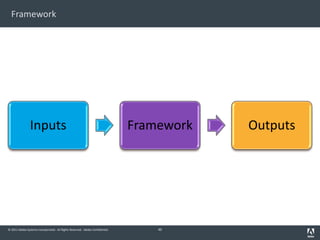
Framework
40
Inputs Framework Outputs
© 2011 Adobe Systems Incorporated. All Rights Reserved. Adobe Confidential.
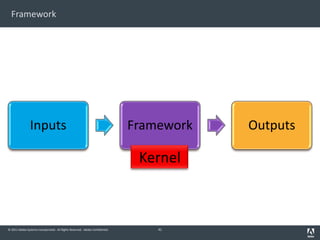
Framework
41
Inputs Framework Outputs
© 2011 Adobe Systems Incorporated. All Rights Reserved. Adobe Confidential.
Michael McCool’s parallel programming patterns
§ Gather
§ Map
§ Reduce
§ Superscalar sequences
§ Pipeline
§ Nesting
§ Scans
§ Recurrences
§ Search
§ Subdivision
§ Stencil
§ Scatter
§ Pack
§ Selection
§ Partition
§ Expand
42
© 2011 Adobe Systems Incorporated. All Rights Reserved. Adobe Confidential.
What are we going to do about it?
43
© 2011 Adobe Systems Incorporated. All Rights Reserved. Adobe Confidential.
Internal customers
44
© 2011 Adobe Systems Incorporated. All Rights Reserved. Adobe Confidential.
External customers
45
© 2011 Adobe Systems Incorporated. All Rights Reserved. Adobe Confidential.
References
Pixel Bender
http://www.adobe.com/devnet/pixelbender.html
http://blogs.adobe.com/pixel-bender/
http://blogs.adobe.com/kevin-goldsmith/tag/pixel-bender-2
Structured Parallel Programming with Deterministic Patterns
Michael D. McCool http://software.intel.com/file/27160
Patterns for Parallel Programming
Mattson, Sanders & Massingill
46
© 2011 Adobe Systems Incorporated. All Rights Reserved. Adobe Confidential.
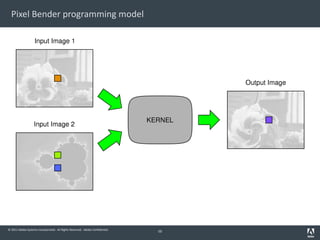
48
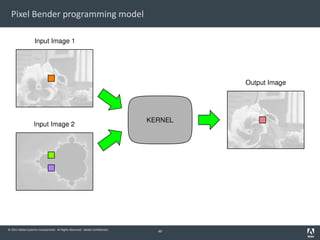
Pixel Bender programming model
Write a function that produces a single
output pixel
© 2011 Adobe Systems Incorporated. All Rights Reserved. Adobe Confidential.
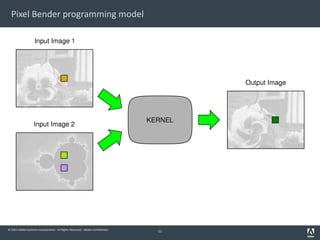
49
Pixel Bender programming model
© 2011 Adobe Systems Incorporated. All Rights Reserved. Adobe Confidential.
50
Pixel Bender programming model
© 2011 Adobe Systems Incorporated. All Rights Reserved. Adobe Confidential.
51
Pixel Bender programming model
© 2011 Adobe Systems Incorporated. All Rights Reserved. Adobe Confidential.
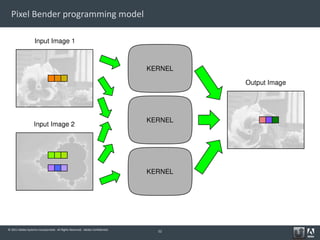
52
Pixel Bender programming model
© 2011 Adobe Systems Incorporated. All Rights Reserved. Adobe Confidential.
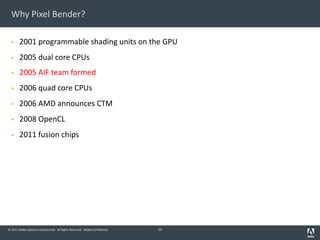
Why Pixel Bender?
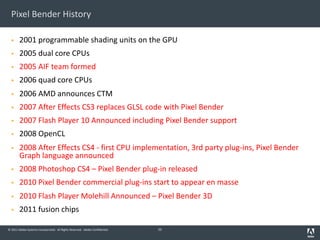
§ 2001 programmable shading units on the GPU
§ 2005 dual core CPUs
§ 2005 AIF team formed
§ 2006 quad core CPUs
§ 2006 AMD announces CTM
§ 2008 OpenCL
§ 2011 fusion chips
54
© 2011 Adobe Systems Incorporated. All Rights Reserved. Adobe Confidential.
Pixel Bender History
§ 2001 programmable shading units on the GPU
§ 2005 dual core CPUs
§ 2005 AIF team formed
§ 2006 quad core CPUs
§ 2006 AMD announces CTM
§ 2007 After Effects CS3 replaces GLSL code with Pixel Bender
§ 2007 Flash Player 10 Announced including Pixel Bender support
§ 2008 OpenCL
§ 2008 After Effects CS4 - first CPU implementation, 3rd party plug-ins, Pixel Bender
Graph language announced
§ 2008 Photoshop CS4 – Pixel Bender plug-in released
§ 2010 Pixel Bender commercial plug-ins start to appear en masse
§ 2010 Flash Player Molehill Announced – Pixel Bender 3D
§ 2011 fusion chips
55

Pixel Bender - 2011 AMD Fusion Conference

  • 1.
    © 2011 AdobeSystems Incorporated. All Rights Reserved. Adobe Confidential. Kevin Goldsmith | Senior Engineering Manager Bob Archer | Senior Computer Scientist Pixel Bender
  • 2.
    © 2011 AdobeSystems Incorporated. All Rights Reserved. Adobe Confidential. What is Pixel Bender? A domain specific kernel and graph language for image and video processing designed to efficiently target current and future heterogeneous hardware. 2
  • 3.
    © 2011 AdobeSystems Incorporated. All Rights Reserved. Adobe Confidential. Pixel Bender Kernels & Graphs 3 <languageVersion : 1.0;> kernel pixelate_sample < namespace : "AIF Test"; vendor : "Adobe"; version : 1;> { parameter int dimension; input image4 inputImage; output pixel4 outputPixel; void evaluatePixel() { float dimAsFloat = float(dimension); float2 sc = floor(outCoord() / float2(dimAsFloat, dimAsFloat)); sc *= dimAsFloat; outputPixel = sampleNearest(inputImage, sc); } } <?xml version="1.0" encoding="utf-8"?> <graph name = "PixelateGraph"xmlns="http://ns.adobe.com/PixelBenderGraph/1.0"> <metadata name = "namespace" value = "AIF"/> <metadata name = "vendor" value = "Adobe Systems" /> <metadata name = "version" type = "int" value = "1" /> <parameter type = "int" name = "dimension" > <metadata name = "defaultValue" type = "int" value = "1" /> <metadata name = "minValue" type = "int" value = "1" /> <metadata name = "maxValue" type = "int" value = "100" /> </parameter> <inputImage type = "image4" name = "inputImage" /> <outputImage type = "image4" name = "outputImage" /> <kernel> <![CDATA[ <languageVersion : 1.0;> kernel Pixelate < namespace:"AIF"; vendor:"Adobe Systems"; version:1; > { … } ]]> </kernel> <node id = "pixelateFilter" name ="Pixelate" namespace = "AIF" vendor = "Adobe Systems" version ="1" clientID ="ADBE Pixelate" > <evaluateParameters> <![CDATA[ void evaluateParameters() { pixelateFilter::dimension = dimension; } ]]> </evaluateParameters> </node> <!-- Connect the graph --> <connect fromImage = "inputImage" toNode = "pixelateFilter" toInput = "src" /> <connect fromNode = "pixelateFilter" fromOutput = "dst" toImage = "outputImage" /> </graph>
  • 4.
    © 2011 AdobeSystems Incorporated. All Rights Reserved. Adobe Confidential. Pixel Bender Kernels & Graphs 4 <languageVersion : 1.0;> kernel pixelate_sample < namespace : "AIF Test"; vendor : "Adobe"; version : 1;> { parameter int dimension; input image4 inputImage; output pixel4 outputPixel; void evaluatePixel() { float dimAsFloat = float(dimension); float2 sc = floor(outCoord() / float2(dimAsFloat, dimAsFloat)); sc *= dimAsFloat; outputPixel = sampleNearest(inputImage, sc); } } <?xml version="1.0" encoding="utf-8"?> <graph name = "PixelateGraph"xmlns="http://ns.adobe.com/PixelBenderGraph/1.0"> <metadata name = "namespace" value = "AIF"/> <metadata name = "vendor" value = "Adobe Systems" /> <metadata name = "version" type = "int" value = "1" /> <parameter type = "int" name = "dimension" > <metadata name = "defaultValue" type = "int" value = "1" /> <metadata name = "minValue" type = "int" value = "1" /> <metadata name = "maxValue" type = "int" value = "100" /> </parameter> <inputImage type = "image4" name = "inputImage" /> <outputImage type = "image4" name = "outputImage" /> <kernel> <![CDATA[ <languageVersion : 1.0;> kernel Pixelate < namespace:"AIF"; vendor:"Adobe Systems"; version:1; > { … } ]]> </kernel> <node id = "pixelateFilter" name ="Pixelate" namespace = "AIF" vendor = "Adobe Systems" version ="1" clientID ="ADBE Pixelate" > <evaluateParameters> <![CDATA[ void evaluateParameters() { pixelateFilter::dimension = dimension; } ]]> </evaluateParameters> </node> <!-- Connect the graph --> <connect fromImage = "inputImage" toNode = "pixelateFilter" toInput = "src" /> <connect fromNode = "pixelateFilter" fromOutput = "dst" toImage = "outputImage" /> </graph>
  • 5.
    © 2011 AdobeSystems Incorporated. All Rights Reserved. Adobe Confidential. Pixel Bender Kernels & Graphs 5 <languageVersion : 1.0;> kernel pixelate_sample < namespace : "AIF Test"; vendor : "Adobe"; version : 1;> { parameter int dimension; input image4 inputImage; output pixel4 outputPixel; void evaluatePixel() { float dimAsFloat = float(dimension); float2 sc = floor(outCoord() / float2(dimAsFloat, dimAsFloat)); sc *= dimAsFloat; outputPixel = sampleNearest(inputImage, sc); } } <?xml version="1.0" encoding="utf-8"?> <graph name = "PixelateGraph"xmlns="http://ns.adobe.com/PixelBenderGraph/1.0"> <metadata name = "namespace" value = "AIF"/> <metadata name = "vendor" value = "Adobe Systems" /> <metadata name = "version" type = "int" value = "1" /> <parameter type = "int" name = "dimension" > <metadata name = "defaultValue" type = "int" value = "1" /> <metadata name = "minValue" type = "int" value = "1" /> <metadata name = "maxValue" type = "int" value = "100" /> </parameter> <inputImage type = "image4" name = "inputImage" /> <outputImage type = "image4" name = "outputImage" /> <kernel> <![CDATA[ <languageVersion : 1.0;> kernel Pixelate < namespace:"AIF"; vendor:"Adobe Systems"; version:1; > { … } ]]> </kernel> <node id = "pixelateFilter" name ="Pixelate" namespace = "AIF" vendor = "Adobe Systems" version ="1" clientID ="ADBE Pixelate" > <evaluateParameters> <![CDATA[ void evaluateParameters() { pixelateFilter::dimension = dimension; } ]]> </evaluateParameters> </node> <!-- Connect the graph --> <connect fromImage = "inputImage" toNode = "pixelateFilter" toInput = "src" /> <connect fromNode = "pixelateFilter" fromOutput = "dst" toImage = "outputImage" /> </graph>
  • 6.
    © 2011 AdobeSystems Incorporated. All Rights Reserved. Adobe Confidential. Pixel Bender Kernels & Graphs 6 <languageVersion : 1.0;> kernel pixelate_sample < namespace : "AIF Test"; vendor : "Adobe"; version : 1;> { parameter int dimension; input image4 inputImage; output pixel4 outputPixel; void evaluatePixel() { float dimAsFloat = float(dimension); float2 sc = floor(outCoord() / float2(dimAsFloat, dimAsFloat)); sc *= dimAsFloat; outputPixel = sampleNearest(inputImage, sc); } } <?xml version="1.0" encoding="utf-8"?> <graph name = "PixelateGraph"xmlns="http://ns.adobe.com/PixelBenderGraph/1.0"> <metadata name = "namespace" value = "AIF"/> <metadata name = "vendor" value = "Adobe Systems" /> <metadata name = "version" type = "int" value = "1" /> <parameter type = "int" name = "dimension" > <metadata name = "defaultValue" type = "int" value = "1" /> <metadata name = "minValue" type = "int" value = "1" /> <metadata name = "maxValue" type = "int" value = "100" /> </parameter> <inputImage type = "image4" name = "inputImage" /> <outputImage type = "image4" name = "outputImage" /> <kernel> <![CDATA[ <languageVersion : 1.0;> kernel Pixelate < namespace:"AIF"; vendor:"Adobe Systems"; version:1; > { … } ]]> </kernel> <node id = "pixelateFilter" name ="Pixelate" namespace = "AIF" vendor = "Adobe Systems" version ="1" clientID ="ADBE Pixelate" > <evaluateParameters> <![CDATA[ void evaluateParameters() { pixelateFilter::dimension = dimension; } ]]> </evaluateParameters> </node> <!-- Connect the graph --> <connect fromImage = "inputImage" toNode = "pixelateFilter" toInput = "src" /> <connect fromNode = "pixelateFilter" fromOutput = "dst" toImage = "outputImage" /> </graph> High Pass Texturize Saturate Blend Vacation
  • 7.
    © 2011 AdobeSystems Incorporated. All Rights Reserved. Adobe Confidential. Pixel Bender Kernels & Graphs 7 <languageVersion : 1.0;> kernel pixelate_sample < namespace : "AIF Test"; vendor : "Adobe"; version : 1;> { parameter int dimension; input image4 inputImage; output pixel4 outputPixel; void evaluatePixel() { float dimAsFloat = float(dimension); float2 sc = floor(outCoord() / float2(dimAsFloat, dimAsFloat)); sc *= dimAsFloat; outputPixel = sampleNearest(inputImage, sc); } } <?xml version="1.0" encoding="utf-8"?> <graph name = "PixelateGraph"xmlns="http://ns.adobe.com/PixelBenderGraph/1.0"> <metadata name = "namespace" value = "AIF"/> <metadata name = "vendor" value = "Adobe Systems" /> <metadata name = "version" type = "int" value = "1" /> <parameter type = "int" name = "dimension" > <metadata name = "defaultValue" type = "int" value = "1" /> <metadata name = "minValue" type = "int" value = "1" /> <metadata name = "maxValue" type = "int" value = "100" /> </parameter> <inputImage type = "image4" name = "inputImage" /> <outputImage type = "image4" name = "outputImage" /> <kernel> <![CDATA[ <languageVersion : 1.0;> kernel Pixelate < namespace:"AIF"; vendor:"Adobe Systems"; version:1; > { … } ]]> </kernel> <node id = "pixelateFilter" name ="Pixelate" namespace = "AIF" vendor = "Adobe Systems" version ="1" clientID ="ADBE Pixelate" > <evaluateParameters> <![CDATA[ void evaluateParameters() { pixelateFilter::dimension = dimension; } ]]> </evaluateParameters> </node> <!-- Connect the graph --> <connect fromImage = "inputImage" toNode = "pixelateFilter" toInput = "src" /> <connect fromNode = "pixelateFilter" fromOutput = "dst" toImage = "outputImage" /> </graph> •Explicitly Data Parallel •Explicitly Lock Free •Implicitly Vectorizable •Contains Optimization Hints •Region Reasoning •Parameter Ranges •Supports per-frame functions •JIT •x86 with SSE •GLSL •Implicitly Task Parallel •Contains Optimization Hints •Region Reasoning •Parameter Ranges •Parameter Use •Supports per frame and internal graph logic •Language/Hardware Agnostic •Enforces the programming Model
  • 8.
    © 2011 AdobeSystems Incorporated. All Rights Reserved. Adobe Confidential. Pixel Bender Runtime § Run-time scheduling § Decide if a Pixel Bender node runs on the GPU or CPU § Order the execution of each node § Drives Optimization § Runs region reasoning pass § Concatenate adjacent Pixel Bender nodes § Fix parameter values for constant folding and range propagation § Caches intra-graph frames when possible to reduce computation § Allows host application to aid optimization § Lock parameter values § Lock inputs § Interfaces with host application resource management § Application can force CPU or GPU execution § Application can provide memory or threading management 8
  • 9.
    © 2011 AdobeSystems Incorporated. All Rights Reserved. Adobe Confidential. Pixel Bender Runtime § Run-time scheduling § Decide if a Pixel Bender node runs on the GPU or CPU § Order the execution of each node § Drives Optimization § Runs region reasoning pass § Concatenate adjacent Pixel Bender nodes § Fix parameter values for constant folding and range propagation § Caches intra-graph frames when possible to reduce computation § Allows host application to aid optimization § Lock parameter values § Lock inputs § Interfaces with host application resource management § Application can force CPU or GPU execution § Application can provide memory or threading management 9
  • 10.
    © 2011 AdobeSystems Incorporated. All Rights Reserved. Adobe Confidential. Pixel Bender Runtime § Run-time scheduling § Decide if a Pixel Bender node runs on the GPU or CPU § Order the execution of each node § Drives Optimization § Runs region reasoning pass § Concatenate adjacent Pixel Bender nodes § Fix parameter values for constant folding and range propagation § Caches intra-graph frames when possible to reduce computation § Allows host application to aid optimization § Lock parameter values § Lock inputs § Interfaces with host application resource management § Application can force CPU or GPU execution § Application can provide memory or threading management 10
  • 11.
    © 2011 AdobeSystems Incorporated. All Rights Reserved. Adobe Confidential. Pixel Bender Runtime § Run-time scheduling § Decide if a Pixel Bender node runs on the GPU or CPU § Order the execution of each node § Drives Optimization § Runs region reasoning pass § Concatenate adjacent Pixel Bender nodes § Fix parameter values for constant folding and range propagation § Caches intra-graph frames when possible to reduce computation § Allows host application to aid optimization § Lock parameter values § Lock inputs § Interfaces with host application resource management § Application can force CPU or GPU execution § Application can provide memory or threading management 11
  • 12.
    © 2011 AdobeSystems Incorporated. All Rights Reserved. Adobe Confidential. Demo 12
  • 13.
    © 2011 AdobeSystems Incorporated. All Rights Reserved. Adobe Confidential. Lessons Learned (so far) § A DSL allows you to limit the language for optimization purposes while preserving programmability § Just-in-time Compilation allows you not only to use runtime information for optimization purposes, but also allows you to future-proof algorithms against later hardware architectures § Developers will learn new programming languages if they give them an ability to do something new, or make something significantly easier § A language with only a text representation creates some nice network and community effects (for a time) 13
  • 14.
    © 2011 AdobeSystems Incorporated. All Rights Reserved. Adobe Confidential. Lessons Learned (so far) § A DSL allows you to limit the language for optimization purposes while preserving programmability § Just-in-time Compilation allows you not only to use runtime information for optimization purposes, but also allows you to future-proof algorithms against later hardware architectures § Developers will learn new programming languages if they give them an ability to do something new, or make something significantly easier § A language with only a text representation creates some nice network and community effects (for a time) 14
  • 15.
    © 2011 AdobeSystems Incorporated. All Rights Reserved. Adobe Confidential. Lessons Learned (so far) § A DSL allows you to limit the language for optimization purposes while preserving programmability § Just-in-time Compilation allows you not only to use runtime information for optimization purposes, but also allows you to future-proof algorithms against later hardware architectures § Developers will learn new programming languages if they give them an ability to do something new, or make something significantly easier § A language with only a text representation creates some nice network and community effects (for a time) 15
  • 16.
    © 2011 AdobeSystems Incorporated. All Rights Reserved. Adobe Confidential. Lessons Learned (so far) § A DSL allows you to limit the language for optimization purposes while preserving programmability § Just-in-time Compilation allows you not only to use runtime information for optimization purposes, but also allows you to future-proof algorithms against later hardware architectures § Developers will learn new programming languages if they give them an ability to do something new, or make something significantly easier § A language with only a text representation creates some nice network and community effects (for a time) 16
  • 17.
    © 2011 AdobeSystems Incorporated. All Rights Reserved. Adobe Confidential. Warning. Speculation ahead. 17
  • 18.
    © 2011 AdobeSystems Incorporated. All Rights Reserved. Adobe Confidential. How do we make the most of the hardware we have available? 18
  • 19.
    © 2011 AdobeSystems Incorporated. All Rights Reserved. Adobe Confidential. Writing multi threaded code is like juggling chainsaws; amazing when it works and truly sucky when it doesn’t. Andrew Wulf 19
  • 20.
    © 2011 AdobeSystems Incorporated. All Rights Reserved. Adobe Confidential. § Gflop / $ 20
  • 21.
    © 2011 AdobeSystems Incorporated. All Rights Reserved. Adobe Confidential. § Gflop / $ § Gflop / watt 21
  • 22.
    © 2011 AdobeSystems Incorporated. All Rights Reserved. Adobe Confidential. § Gflop / $ § Gflop / watt Gflop / developer-hour 22
  • 23.
    © 2011 AdobeSystems Incorporated. All Rights Reserved. Adobe Confidential. What have we got? 23
  • 24.
    © 2011 AdobeSystems Incorporated. All Rights Reserved. Adobe Confidential. What have we got? § DSL for image processing (Pixel Bender) 24
  • 25.
    © 2011 AdobeSystems Incorporated. All Rights Reserved. Adobe Confidential. What have we got? § DSL for image processing (Pixel Bender) § JIT compiler / optimizer 25
  • 26.
    © 2011 AdobeSystems Incorporated. All Rights Reserved. Adobe Confidential. What have we got? § DSL for image processing (Pixel Bender) § JIT compiler / optimizer § Runtime – enforces programming model, allows graphs 26
  • 27.
    © 2011 AdobeSystems Incorporated. All Rights Reserved. Adobe Confidential. What have we got? § DSL for image processing (Pixel Bender) § JIT compiler / optimizer § Runtime – enforces programming model, allows graphs § High performance on parallel hardware (using OpenGL) 27
  • 28.
    © 2011 AdobeSystems Incorporated. All Rights Reserved. Adobe Confidential. What have we got? § DSL for image processing (Pixel Bender) § JIT compiler / optimizer § Runtime – enforces programming model, allows graphs § High performance on parallel hardware (using OpenGL) § Future proof against new hardware 28
  • 29.
    © 2011 AdobeSystems Incorporated. All Rights Reserved. Adobe Confidential. What have we got? § DSL for image processing (Pixel Bender) § JIT compiler / optimizer § Runtime – enforces programming model, allows graphs § High performance on parallel hardware (using OpenGL) § Future proof against new hardware § Cross platform 29
  • 30.
    © 2011 AdobeSystems Incorporated. All Rights Reserved. Adobe Confidential. What cross platform means to Adobe § Mac § Windows § AMD § Intel § nVidia § CPU § GPU § Mobile hardware 30
  • 31.
    © 2011 AdobeSystems Incorporated. All Rights Reserved. Adobe Confidential. What have we got? § DSL for image processing (Pixel Bender) § JIT compiler / optimizer § Runtime – enforces programming model, allows graphs § High performance on parallel hardware (using OpenGL) § Future proof against new hardware § Cross platform 31
  • 32.
    © 2011 AdobeSystems Incorporated. All Rights Reserved. Adobe Confidential. What have we got? § DSL for image processing (Pixel Bender) § JIT compiler / optimizer § Runtime – enforces programming model, allows graphs § High performance on parallel hardware (using OpenGL) § Future proof against new hardware § Cross platform OpenCL 32
  • 33.
    © 2011 AdobeSystems Incorporated. All Rights Reserved. Adobe Confidential. Why not just switch entirely to OpenCL? 33
  • 34.
    © 2011 AdobeSystems Incorporated. All Rights Reserved. Adobe Confidential. Why not just switch entirely to OpenCL? Pixel Bender has certain advantages: § Ease of writing 34
  • 35.
    © 2011 AdobeSystems Incorporated. All Rights Reserved. Adobe Confidential. Why not just switch entirely to OpenCL? Pixel Bender has certain advantages: § Ease of writing § Optimization opportunities 35
  • 36.
    © 2011 AdobeSystems Incorporated. All Rights Reserved. Adobe Confidential. Why not just switch entirely to OpenCL? Pixel Bender has certain advantages: § Ease of writing § Optimization opportunities § Race free by construction 36
  • 37.
    © 2011 AdobeSystems Incorporated. All Rights Reserved. Adobe Confidential. Why not just switch entirely to OpenCL? Pixel Bender has certain advantages: § Ease of writing § Optimization opportunities § Race free by construction § Parallelism for the masses 37
  • 38.
    © 2011 AdobeSystems Incorporated. All Rights Reserved. Adobe Confidential. Warning. Increased speculation ahead. 38
  • 39.
    © 2011 AdobeSystems Incorporated. All Rights Reserved. Adobe Confidential. Pixel Bender has certain disadvantages: § One fixed programming model § Focuses on image processing § Not general enough 39
  • 40.
    © 2011 AdobeSystems Incorporated. All Rights Reserved. Adobe Confidential. Framework 40 Inputs Framework Outputs
  • 41.
    © 2011 AdobeSystems Incorporated. All Rights Reserved. Adobe Confidential. Framework 41 Inputs Framework Outputs
  • 42.
    © 2011 AdobeSystems Incorporated. All Rights Reserved. Adobe Confidential. Michael McCool’s parallel programming patterns § Gather § Map § Reduce § Superscalar sequences § Pipeline § Nesting § Scans § Recurrences § Search § Subdivision § Stencil § Scatter § Pack § Selection § Partition § Expand 42
  • 43.
    © 2011 AdobeSystems Incorporated. All Rights Reserved. Adobe Confidential. What are we going to do about it? 43
  • 44.
    © 2011 AdobeSystems Incorporated. All Rights Reserved. Adobe Confidential. Internal customers 44
  • 45.
    © 2011 AdobeSystems Incorporated. All Rights Reserved. Adobe Confidential. External customers 45
  • 46.
    © 2011 AdobeSystems Incorporated. All Rights Reserved. Adobe Confidential. References Pixel Bender http://www.adobe.com/devnet/pixelbender.html http://blogs.adobe.com/pixel-bender/ http://blogs.adobe.com/kevin-goldsmith/tag/pixel-bender-2 Structured Parallel Programming with Deterministic Patterns Michael D. McCool http://software.intel.com/file/27160 Patterns for Parallel Programming Mattson, Sanders & Massingill 46
  • 47.
    © 2011 AdobeSystems Incorporated. All Rights Reserved. Adobe Confidential.
  • 48.
    © 2011 AdobeSystems Incorporated. All Rights Reserved. Adobe Confidential. 48 Pixel Bender programming model Write a function that produces a single output pixel
  • 49.
    © 2011 AdobeSystems Incorporated. All Rights Reserved. Adobe Confidential. 49 Pixel Bender programming model
  • 50.
    © 2011 AdobeSystems Incorporated. All Rights Reserved. Adobe Confidential. 50 Pixel Bender programming model
  • 51.
    © 2011 AdobeSystems Incorporated. All Rights Reserved. Adobe Confidential. 51 Pixel Bender programming model
  • 52.
    © 2011 AdobeSystems Incorporated. All Rights Reserved. Adobe Confidential. 52 Pixel Bender programming model
  • 53.
    © 2011 AdobeSystems Incorporated. All Rights Reserved. Adobe Confidential.
  • 54.
    © 2011 AdobeSystems Incorporated. All Rights Reserved. Adobe Confidential. Why Pixel Bender? § 2001 programmable shading units on the GPU § 2005 dual core CPUs § 2005 AIF team formed § 2006 quad core CPUs § 2006 AMD announces CTM § 2008 OpenCL § 2011 fusion chips 54
  • 55.
    © 2011 AdobeSystems Incorporated. All Rights Reserved. Adobe Confidential. Pixel Bender History § 2001 programmable shading units on the GPU § 2005 dual core CPUs § 2005 AIF team formed § 2006 quad core CPUs § 2006 AMD announces CTM § 2007 After Effects CS3 replaces GLSL code with Pixel Bender § 2007 Flash Player 10 Announced including Pixel Bender support § 2008 OpenCL § 2008 After Effects CS4 - first CPU implementation, 3rd party plug-ins, Pixel Bender Graph language announced § 2008 Photoshop CS4 – Pixel Bender plug-in released § 2010 Pixel Bender commercial plug-ins start to appear en masse § 2010 Flash Player Molehill Announced – Pixel Bender 3D § 2011 fusion chips 55