SUPERIOR UNIVERSITY LAHORE
SHAH FAROOQ ATA
APPIED PHYSICS
DOPPLER’S EFFECT
what is Doppler's effect?
The Doppler Effect is the change in frequency or wavelength of a wave for an
observer moving relative to its source.
When wave energy like sound or radio waves travels from two objects, the
wavelength can seem to be changed if one or both of them are moving. This is
called the Doppler Effect
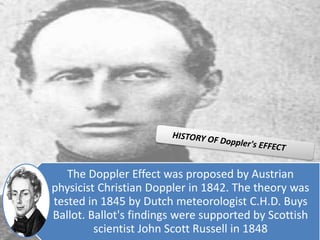
The Doppler Effect was proposed by Austrian
physicist Christian Doppler in 1842. The theory was
tested in 1845 by Dutch meteorologist C.H.D. Buys
Ballot. Ballot's findings were supported by Scottish
scientist John Scott Russell in 1848
Development
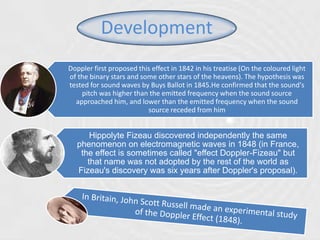
Doppler first proposed this effect in 1842 in his treatise (On the coloured light
of the binary stars and some other stars of the heavens). The hypothesis was
tested for sound waves by Buys Ballot in 1845.He confirmed that the sound's
pitch was higher than the emitted frequency when the sound source
approached him, and lower than the emitted frequency when the sound
source receded from him
Hippolyte Fizeau discovered independently the same
phenomenon on electromagnetic waves in 1848 (in France,
the effect is sometimes called "effect Doppler-Fizeau" but
that name was not adopted by the rest of the world as
Fizeau's discovery was six years after Doppler's proposal).
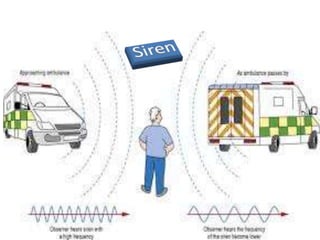
sound source and listener are static
sound source move toward a stationary listener
sounding source move away from a stationery listener
listener move toward a stationery source
listener moves away from the stationery source
sound source and listener both going away
STAGES
APPLICATIONS
O⨍
Doppler's EFFECT
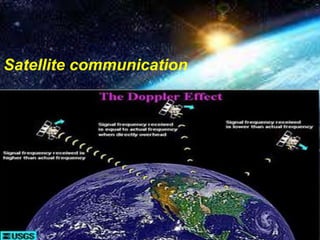
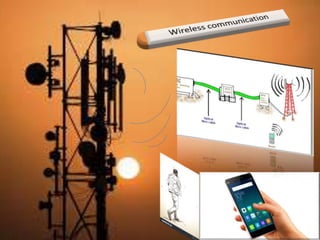
Satellite communication
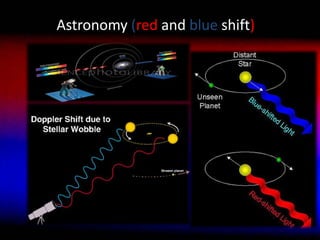
Astronomy (red and blue shift)
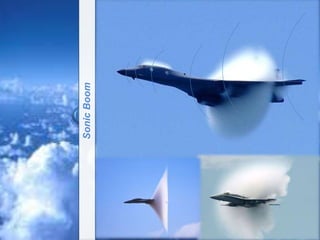
SonicBoom
Future
uses
of
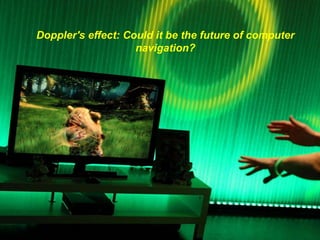
Doppler's effect: Could it be the future of computer
navigation?
Doppler effect

Doppler effect

  • 1.
  • 2.
  • 3.
    what is Doppler'seffect? The Doppler Effect is the change in frequency or wavelength of a wave for an observer moving relative to its source. When wave energy like sound or radio waves travels from two objects, the wavelength can seem to be changed if one or both of them are moving. This is called the Doppler Effect
  • 4.
    The Doppler Effectwas proposed by Austrian physicist Christian Doppler in 1842. The theory was tested in 1845 by Dutch meteorologist C.H.D. Buys Ballot. Ballot's findings were supported by Scottish scientist John Scott Russell in 1848
  • 5.
    Development Doppler first proposedthis effect in 1842 in his treatise (On the coloured light of the binary stars and some other stars of the heavens). The hypothesis was tested for sound waves by Buys Ballot in 1845.He confirmed that the sound's pitch was higher than the emitted frequency when the sound source approached him, and lower than the emitted frequency when the sound source receded from him Hippolyte Fizeau discovered independently the same phenomenon on electromagnetic waves in 1848 (in France, the effect is sometimes called "effect Doppler-Fizeau" but that name was not adopted by the rest of the world as Fizeau's discovery was six years after Doppler's proposal).
  • 6.
    sound source andlistener are static sound source move toward a stationary listener sounding source move away from a stationery listener listener move toward a stationery source listener moves away from the stationery source sound source and listener both going away STAGES
  • 7.
  • 10.
  • 12.
    Astronomy (red andblue shift)
  • 13.
  • 14.
  • 15.
    Doppler's effect: Couldit be the future of computer navigation?