Pitch like a pro
By Abdelkarim Benabdallah
Who am I?
• Senior IT support.
• Communications specialist.
• Blogger since 2003.
• Instagram, Foursquare, Eyeem, UN +Social Good, official
ambassador.
• UNDP member of the Mobiles4HD African wide program.
• BIL Conference Tunisia founder.
• BIL Conference MENA and Europe manager.
• Social media Club Tunisia co-founder.
• Live Blogging Workshops (50+ sessions so far) founder (since 2011).
• Ignite, EdCamp, PodCamp, FUN Tunis, Transparency Camp, Cafe
Carrefour, etc.. host for Tunisia.
• Photography/Videography and mobile photography expert.
• Founder and host of the Tunis Book Club (now a network of over 25
clubs around the country).
• Public speaking, pitching and presenter skills coach.
What is a pitch?
• A pitch is the description of a potential
story that a writer sends to an editor in
order to land an assignment.
• A pitch is basically delivering a
business plan verbally. A pitch typically
takes the form of an entrepreneur or
group of entrepreneurs presenting or
describing their ideas to prospective
investors.
What is an escalator pitch?
• A slang term used to describe the
quick delivery of a presentation
outlining an idea for a product, service
or project. The name comes from the
notion that the pitch should be
succinct enough to be delivered to
another party while riding an
escalator. An escalator pitch should
last no more than 60 seconds.
Means of pitching
• Face to face.
• In front of a group of people.
• Online (Skype, Google Hangout).
• By telephone.
• Email / Letter.
Who does to picth?
•Everybody.
•Everywhere.
•All the time.
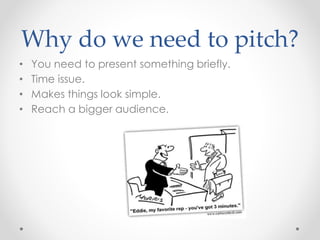
Why do we need to pitch?
• You need to present something briefly.
• Time issue.
• Makes things look simple.
• Reach a bigger audience.
What is the scope of the idea?
• Tiny tweak to something already in existence
• New feature or enhancement to existing product /
website / company
• A major new area of an existing product / website /
company
• An entirely new, but small and simple, project
• An entirely new, but large and possibly complex, project
• An organizational, directional, or philosophical, change
to an existing organization
• A new organization
• A new nation, planet or dimension of the universe (Sorry.
But for how to pitch to the omnipotent forces that run
the universe, you’ll have to look elsewhere).
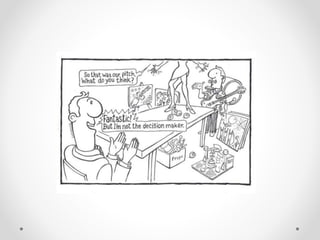
Who has the power to green
light the idea
• You have the power.
• A peer in your organization has the power.
• Your boss has the power.
• Someone above you in the organization.
• Someone you know in another organization.
• Someone you don’t know and don’t have easy access to.
• You have no idea.
• You are paralyzed on a cold wet basement floor, and your
annoying younger brother keeps poking you in the ribs with
the pointy end of pencil. (See, it can always be worse).
The structure of the pitch
• Always formulate 3 levels of depth to pitching your idea.
• 5 seconds, 30 seconds, 5 minutes (Credit to Ari Blenkhorn for
this simple breakdown).
• The 5 second version, also known as the elevator pitch, is the
most concise single sentence formulation of whatever your
idea is.
• Refine, refine, refine your thinking until you can say something
intelligent and interesting in a short sentence. “My idea? It’s a
way to make car engines twice as efficient, and 5 times as
powerful.” This can be done for any idea: never allow yourself
to believe your thing is so complicated and amazing that it’s
impossible to explain in a sentence. If you were to use this
excuse on me, I’d tell you it means you don’t have enough
perspective on how your idea fits into the world.
The structure of the pitch
• The elevator – you.
• The slow elevator – you, maybe something to show from your
pockets.
• The lunch – (you , maybe something to show, napkins to draw
on, alcohol)
• The conference room meeting – (laptop / slides / handout)
• The executive review – (laptop / slides / handout / yes-men /
splunge-men)
Test the pitch
• The longer you spend with an idea, the more vulnerable you
are to your own ego.
• Get out of your office / cubicle / apartment, and go find
smart people you know to give you feedback.
• Go through your pitch, responding to any questions
• Practice in front a mirror.
• Tape yourself (audio or video).
• Try to watch other people famous picths.
• Ask your mom ☺
Deliver
• Be calm, be direct, state your case, and then listen.
• The best delivery advice I can offer is to make sure you spend
some time preparing for a positive response.
• If there are other people involved who’s approval you’ll need,
ask them to set up a meeting for you. If there is a form that
needs to be filled out, make sure you have one with you.
• Be prepared for surprises: there more or few people, your
laptop is dead and you can’t use a slide, you have been
asked to do in les time, etc, ect…
Self evalution
• Did you respect the time quota?
• How good did you express your ideas?
• Did you leave a question mark or a smile into the people
face?
• How was your pitchs compared to the others?
• Were the questions about details or more about this awesome
stuff?
Mistakes to avoid when
Pitching
1. Lacks a structure.
2. Too heavy on details.
3. A lack of knowledge about your audience
4. Lack of adherence to a time frame
5. Inability to deliver an impromptu pitch
6. No anticipation of the tough questions
7. No determination to not let rejection stop you
Best practices
1. Review.
2. Write.
3. Rehearse.
4. Research.
5. Rapport.
6. Revelation.
7. Request.
8. Response.
Picthing in Tunisia
1. Ignite (5 minutesx20 slides).
2. Café Carrefour (1 minute x 1 slide/photo/Video).
3. FUN Tunis (7 minutes x 10 photos).
4. Pecha Kucha (20 x 20)
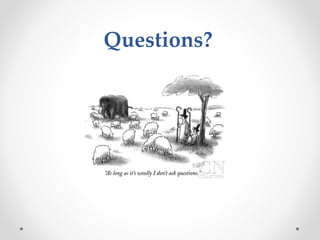
Questions?
Woskshop
1. Team up.
2. Look for innovative ideas to improve education in
Tunisia.
3. Make your research.
4. Coach you pitch man.
5. Get ready to pitch.
References
• Q&A from my pitching workshop
• Business plans that win, Pitching Hollywood – There are many
books on developing business plans and pitching screenplays.
I’ve yet to make any exceptional finds here, but these are
decent places to start.
• Changing Minds – Howard Gardner provides a science based
framework for how an individual changes the minds of others.
More about general science and psychology than a practical
guide.
• Influence: the psychology of persuasion – A classic book on
the basic psychology of persuasion. More about advertising
and environment than one on one pitch-work, this books
offers a framework for how individuals are influenced by the
context messages come in, and how the messages
themselves are designed.

Pitch like a pro

  • 1.
    Pitch like apro By Abdelkarim Benabdallah
  • 2.
    Who am I? •Senior IT support. • Communications specialist. • Blogger since 2003. • Instagram, Foursquare, Eyeem, UN +Social Good, official ambassador. • UNDP member of the Mobiles4HD African wide program. • BIL Conference Tunisia founder. • BIL Conference MENA and Europe manager. • Social media Club Tunisia co-founder. • Live Blogging Workshops (50+ sessions so far) founder (since 2011). • Ignite, EdCamp, PodCamp, FUN Tunis, Transparency Camp, Cafe Carrefour, etc.. host for Tunisia. • Photography/Videography and mobile photography expert. • Founder and host of the Tunis Book Club (now a network of over 25 clubs around the country). • Public speaking, pitching and presenter skills coach.
  • 4.
    What is apitch? • A pitch is the description of a potential story that a writer sends to an editor in order to land an assignment. • A pitch is basically delivering a business plan verbally. A pitch typically takes the form of an entrepreneur or group of entrepreneurs presenting or describing their ideas to prospective investors.
  • 5.
    What is anescalator pitch? • A slang term used to describe the quick delivery of a presentation outlining an idea for a product, service or project. The name comes from the notion that the pitch should be succinct enough to be delivered to another party while riding an escalator. An escalator pitch should last no more than 60 seconds.
  • 7.
    Means of pitching •Face to face. • In front of a group of people. • Online (Skype, Google Hangout). • By telephone. • Email / Letter.
  • 8.
    Who does topicth? •Everybody. •Everywhere. •All the time.
  • 10.
    Why do weneed to pitch? • You need to present something briefly. • Time issue. • Makes things look simple. • Reach a bigger audience.
  • 12.
    What is thescope of the idea? • Tiny tweak to something already in existence • New feature or enhancement to existing product / website / company • A major new area of an existing product / website / company • An entirely new, but small and simple, project • An entirely new, but large and possibly complex, project • An organizational, directional, or philosophical, change to an existing organization • A new organization • A new nation, planet or dimension of the universe (Sorry. But for how to pitch to the omnipotent forces that run the universe, you’ll have to look elsewhere).
  • 14.
    Who has thepower to green light the idea • You have the power. • A peer in your organization has the power. • Your boss has the power. • Someone above you in the organization. • Someone you know in another organization. • Someone you don’t know and don’t have easy access to. • You have no idea. • You are paralyzed on a cold wet basement floor, and your annoying younger brother keeps poking you in the ribs with the pointy end of pencil. (See, it can always be worse).
  • 15.
    The structure ofthe pitch • Always formulate 3 levels of depth to pitching your idea. • 5 seconds, 30 seconds, 5 minutes (Credit to Ari Blenkhorn for this simple breakdown). • The 5 second version, also known as the elevator pitch, is the most concise single sentence formulation of whatever your idea is. • Refine, refine, refine your thinking until you can say something intelligent and interesting in a short sentence. “My idea? It’s a way to make car engines twice as efficient, and 5 times as powerful.” This can be done for any idea: never allow yourself to believe your thing is so complicated and amazing that it’s impossible to explain in a sentence. If you were to use this excuse on me, I’d tell you it means you don’t have enough perspective on how your idea fits into the world.
  • 16.
    The structure ofthe pitch • The elevator – you. • The slow elevator – you, maybe something to show from your pockets. • The lunch – (you , maybe something to show, napkins to draw on, alcohol) • The conference room meeting – (laptop / slides / handout) • The executive review – (laptop / slides / handout / yes-men / splunge-men)
  • 17.
    Test the pitch •The longer you spend with an idea, the more vulnerable you are to your own ego. • Get out of your office / cubicle / apartment, and go find smart people you know to give you feedback. • Go through your pitch, responding to any questions • Practice in front a mirror. • Tape yourself (audio or video). • Try to watch other people famous picths. • Ask your mom ☺
  • 18.
    Deliver • Be calm,be direct, state your case, and then listen. • The best delivery advice I can offer is to make sure you spend some time preparing for a positive response. • If there are other people involved who’s approval you’ll need, ask them to set up a meeting for you. If there is a form that needs to be filled out, make sure you have one with you. • Be prepared for surprises: there more or few people, your laptop is dead and you can’t use a slide, you have been asked to do in les time, etc, ect…
  • 19.
    Self evalution • Didyou respect the time quota? • How good did you express your ideas? • Did you leave a question mark or a smile into the people face? • How was your pitchs compared to the others? • Were the questions about details or more about this awesome stuff?
  • 20.
    Mistakes to avoidwhen Pitching 1. Lacks a structure. 2. Too heavy on details. 3. A lack of knowledge about your audience 4. Lack of adherence to a time frame 5. Inability to deliver an impromptu pitch 6. No anticipation of the tough questions 7. No determination to not let rejection stop you
  • 21.
    Best practices 1. Review. 2.Write. 3. Rehearse. 4. Research. 5. Rapport. 6. Revelation. 7. Request. 8. Response.
  • 22.
    Picthing in Tunisia 1.Ignite (5 minutesx20 slides). 2. Café Carrefour (1 minute x 1 slide/photo/Video). 3. FUN Tunis (7 minutes x 10 photos). 4. Pecha Kucha (20 x 20)
  • 23.
  • 24.
    Woskshop 1. Team up. 2.Look for innovative ideas to improve education in Tunisia. 3. Make your research. 4. Coach you pitch man. 5. Get ready to pitch.
  • 25.
    References • Q&A frommy pitching workshop • Business plans that win, Pitching Hollywood – There are many books on developing business plans and pitching screenplays. I’ve yet to make any exceptional finds here, but these are decent places to start. • Changing Minds – Howard Gardner provides a science based framework for how an individual changes the minds of others. More about general science and psychology than a practical guide. • Influence: the psychology of persuasion – A classic book on the basic psychology of persuasion. More about advertising and environment than one on one pitch-work, this books offers a framework for how individuals are influenced by the context messages come in, and how the messages themselves are designed.