Smarter cities,
simpler cities
Accounting for the
city of the future
Spotlight
on India
This report reflects
on how professional
accountants can support
urbanisation in a way that
creates a positive impact.
In doing so, it addresses
two headline areas:
• the global case for
smart cities, to increase
awareness among the
accountancy community
about this concept
• a spotlight on India,
to examine a specific
scenario where
the accountancy
community can be
part of the solution in
simplifying the move
towards smart cities.
© The Association of Chartered Certified Accountants
December 2016
About ACCA
ACCA (the Association of Chartered Certified Accountants)
is the global body for professional accountants. It offers
business relevant, first-choice qualifications to people of
application, ability and ambition around the world who seek
a rewarding career in accountancy, finance and management.
ACCA supports its 188,000 members and 480,000 students
in 178 countries, helping them to develop successful careers
in accounting and business, with the skills required by
employers. ACCA works through a network of 100 offices
and centres and more than 7,110 Approved Employers
worldwide, who provide high standards of employee learning
and development. Through its public interest remit, ACCA
promotes appropriate regulation of accounting and conducts
relevant research to ensure accountancy continues to grow in
reputation and influence.
Founded in 1904, ACCA has consistently held unique core
values: opportunity, diversity, innovation, integrity and
accountability. It believes that accountants bring value to
economies in all stages of development and seek to develop
capacity in the profession and encourage the adoption of
global standards. ACCA’s core values are aligned to the
needs of employers in all sectors and it ensures that, through
its range of qualifications, it prepares accountants for
business. ACCA seeks to open up the profession to people
of all backgrounds and remove artificial barriers, innovating
its qualifications and delivery to meet the diverse needs of
trainee professionals and their employers.
In June 2016 ACCA formed a strategic alliance with
Chartered Accountants Australia and New Zealand (CA ANZ).
The alliance represents the voice of 788,000 members and
future professional accountants around the world, who share
the commitment to uphold the highest ethical, professional
and technical standards.
More information is available at: www.accaglobal.com
ABOUT THE AUTHOR
Narayanan Vaidyanathan develops ACCA’s
research and insights programme with a
focus on the future direction of business and
the accountancy profession. His experience
covers strategy, research and product
development in a range of sectors.
Contents
Foreword.....................................................................................................................4
Acknowledgments.....................................................................................................6
Executive summary....................................................................................................8
Introduction............................................................................................................. 15
Report structure...................................................................................................... 16
1.	 The global case for smart cities...................................................................... 17
	 Smart cities as an approach to urban planning................................................. 17
	 Key drivers for adoption...................................................................................... 18
	 Current adoption around the world................................................................... 21
	 Trends shaping smart cities................................................................................. 25
	 Relevance to the professional accountant......................................................... 27
2.	 Spotlight on India.............................................................................................. 28
	 Government of India Smart Cities Mission........................................................ 29
	 Municipal accounting in India – evolution of policy.......................................... 30
	 Key challenges – from policy to execution........................................................ 31
	 Smart Cities Mission – ‘view on the ground’...................................................... 35
	 Charting the path ahead..................................................................................... 44
Conclusion................................................................................................................ 49
References................................................................................................................ 50
Across the world, more of us now live in
cities than ever before. This is a long-term
global trend that is expected to shape the
way our societies will operate in the future.
Making communities work for the people
living in them is a complex task – one
which will become increasingly important
in the future as the number of urban
residents is set to increase by two billion
(a 50% increase) over the next thirty years.
Smart cities offer a promising alternative
that aims to combine the best of what
technology can offer with a best-practice
approach to structuring efficient and
effective processes that maximise the
limited resources available to a city.
Put differently, this involves
‘professionalising’ the approach to
managing a city. And key players in
delivering this approach are professional
accountants. At ACCA, we define this as an
individual who possesses the core technical
and numeric skills required of accountants,
but also much more. In particular, it refers
to those who can combine core skills with
effective stakeholder partnering based on
a strong understanding of how the
organisation operates (so accountants are
not just record keepers of past
performance, but influencers of future
performance), a strong ethical compass
and excellent communication skills.
ACCA is delighted to be partnering with
the Institute of Cost Accountants of India
(ICAI) in delivering this report on Smart
Cities, which has a particular focus on the
Smart Cities Mission in India. As referred to
in the report, skills building in the
accountancy profession is a key enabler for
the success of this mission, and ACCA looks
forward to deepening its engagement in
India to contribute to this important goal.
Helen Brand OBE
Chief executive
ACCA
Foreword 4
The Institute of Cost Accountants of India
(ICAI) has since its inception in 1959,
maintained an on-going focus on
contributing to the growth of the industrial
and economic climate of the country. As
the only recognised statutory professional
organisation and licensing body in India
specialising exclusively in Cost and
Management Accountancy, we continue
to play a key role in championing the
importance of cost accounting, and
related priorities such as effective
forecasting and budgeting.
These priorities have a special significance
in the context of the Smart Cities Mission
in India, where an ambitious multi-year
programme will see the allocation of funds
across several layers of government (from
central to state to municipal level) and
across all parts of country. Such a large-scale
endeavour will place new responsibilities on
municipalities to manage funds effectively
– which in turn will place important added
responsibilities on the accountants working
within these municipalities.
A lot of the Smart Cities related discussion
in India has referred extensively to the role
of government and of the technology
providers, who would be responsible for
installing ‘smart’ solutions. We believe that
there is an important third leg in this matrix
– the accounting community. This community
will ultimately be relied on heavily to ensure
promised funds are delivered for the stated
projects, and importantly will have the
responsibility to track funds usage and
impact over the coming 4-5 years that are
crucial for achieving Smart City objectives.
We would like to place on record the
contribution of CMA Sanjay Gupta, Former
Chairman, WTO and International Affairs
Committee of the Institute in this regard.
This report is one step towards building
capacity within the accountancy community
to support the Smart Cities Mission and we
are pleased to work with ACCA on this
important initiative.
CMA Manas Kumar Thakur
President
ICAI
5Smarter cities, simpler cities
Accounting for the city of the future
Foreword
The general served as governor of Arunachal Pradesh from 2008
to 2013. He was instrumental in the implementation of the Indian
prime minister’s development package of INR 200 billion for the
development of the state in major infrastructural projects related
to road, rail, air connectivity and power. By the end of his tenure
he was often described ‘a people’s governor’.
The general is a prolific writer and comments regularly in leading
newspapers and other channels. He has written on smart cities
from a range of perspectives, including the role of community
policing and environmental sustainability. His autobiography
A Soldier’s General, published in 2012 by Harper Collins, India.
A thinking general who has distinguished himself as a hands-on
professional leading from the front, General Singh believes in the
credo ‘Fight to Win’; a warrior and a winner, he is an achiever
against odds and in 2016 was honoured with the decoration of
Legion d‘Honneur by the government of France.
JAGAN SHAH
Jagan Shah has 20 years of professional work
experience in various aspects of urban development
in India. He studied architectural design at the
School of Planning  Architecture (SPA), New Delhi
and architectural history and theory at the University of Cincinnati
and Columbia University, US. He has served as the director of
Sushant School of Architecture, Gurgaon and taught at the SPA
from 1998 until 2006. From 2007 to 2010, he was the chief
executive of Urban Space Consultants, providing consultancy in
policy formulation, spatial planning, heritage conservation,
transportation and livelihoods development, for clients such as
Infrastructure Development Finance Company, Delhi Integrated
Multi-Modal Transport System, Jaipur Virasat Foundation, Sir
Ratan Tata Trust and India Foundation for the Arts.
KHYATI SANGHVI
Khyati Sanghvi has extensive experience in project
and corporate finance and infrastructure projects.
In the infrastructure field, specifically power,
telecoms, roads and port sectors, she has advised
and represented the entire spectrum of participants, including
lenders, project sponsors, equipment suppliers and private equity
investors. Before joining BTG Legal, Khyati was associated with
some major law firms, including India Law Services, SJ Law and
AZB  Partners. She has also worked as an in-house counsel for
Gammon Infrastructure Projects Limited. Some of the clients
advised by her include Essar Power, First Solar, Gammon
Infrastructure, Adani Power, HCC Infra, Madhucon Infra, Sadbhav
Group and LT Infra Finance. Khyati has a bachelor’s degree in
law from the University of Mumbai.
ALBERTO BERNAL GARCIA
Alberto Bernal Garcia is senior vice president,
Smart Cities Global Practice at Indra, a world leader
in the development of comprehensive technological
solutions in defence and security, transport and
traffic, energy and industry, telecommunications and media,
financial services, and public administrations and healthcare.
In October 2015, Indra and the Confederation of Indian Industry
(CII) signed a memorandum of understanding with a view to
collaborating to design a common offer of solutions and
technologies for smart cities in India. He is also Indra´s
representative in the Spanish Smart Cities Council, created to
lead and manage Spain’s new National Smart Cities Plan 2015–17.
He sits in several committees on smart cities in industrial and
public organisations in Europe and Spain.
CAROLINE TWIGG
Caroline Twigg is European Union (EU) and
international manager at Bristol City Council in the
United Kingdom (UK), overseeing the city’s
international strategy and a coordinated response to
Bristol’s global partnerships and projects, as well as co-leading a
city-wide response to the EU referendum result. Previously, she
was head of the Collaborative RD and International team at the
Future Cities Catapult (the UK government’s think-tank on city
development), and lived and worked in Delhi for three years,
establishing an office and work programmes for the World
Business Council for Sustainable Development (WBCSD). She has
a geography degree from Oxford University and a Certificate in
Cross-Sector Partnership from Cambridge University.
FARIS DEAN
Faris Dean is a solicitor with Richard Nelson and is a
chartered certified accountant, having trained with
two of the Big Four accountancy firms. He is also
chairman of the ACCA Global Forum for Business
Law. He has a particular interest in smart city projects in India and
the Middle East. Faris advises businesses on corporate,
commercial and regulatory legal matters. He has advised on legal
aspects of smart cities, including data protection and intellectual
property joint venture agreements between the public and private
sectors. Faris gained his law degree from the University of
Leicester and his postgraduate legal diploma from London.
GENERAL JJ SINGH, PVSM, AVSM, VSM (RETD.)
General J.J. Singh is a national leader with over 48
years’ contribution to nation building and having the
distinction of being the chief of army staff and later
governor of the state of Arunachal Pradesh. The
general rose to be chief of army staff and commanded the second
largest army in the world from 31 January 2005 to 30 September
2007. During 2007 he held the appointment of chairman chiefs of
staff of the armed forces. He has commanded an army of 1.2
million soldiers and managed defence assets of many billion
rupees as the army chief.
Acknowledgments 6
MUKUL G. ASHER
Mukul G. Asher is professorial fellow at the National
University of Singapore, and a director, Public Policy
Global Village Foundation (GVF), based in Delhi. He
is currently serving as chairman of the 5th State
Finance Commission of Haryana. He specialises in public financial
management and social security issues, primarily focusing on Asia.
He has written or edited 12 books, and has published extensively
in international journals. He has consulted with several multilateral
institutions, such as the IMF, World Bank, WHO and the Asian
Development Bank.
PAVAN SRINATH
Pavan Srinath is a fellow at the Centre for Smart City
Governance at Takshashila, India and head of
strategy and programmes at Takshashila. He started
his career in public policy by working on urban
policy, migration and climate change adaptation at Public Affairs
Centre, Bangalore. Pavan joined Takshashila after a brief stint at
Arghyam, Bangalore, where he worked on urban water and
sanitation, including groundwater. His research interests focus on
the intersection of science, cities and policy, and include urban
governance, climate, public health, public finance, space
exploration and defence economics. Following an academic
training in the biosciences from the Indian Institute of Technology
– Madras, Pavan trained in public policy at Takshashila. He is a
co-author of peer-reviewed articles in the Journal of Molecular
Biology and Journal of International Migration and Integration,
and of two books: The State of Our Cities: Evidence from
Karnataka (OUP 2012) and Changing the Urban Face of Karnataka
(PAC 2012), along with several research papers and articles.
PHILIPP RODE
Philipp Rode is executive director of LSE Cities and
associate professorial research fellow at the London
School of Economics and Political Science. He is
co-director of the LSE Executive MSc in Cities
programme. As a researcher, consultant and adviser he has been
directing interdisciplinary projects at the LSE, comprising urban
governance, transport, city planning and urban design, since 2003.
The focus of his current work is on institutional structures and
governance capacities of cities as part of an international
collaboration with UN Habitat and on city-level green economy
strategies, which recently included co-directing the cities research
programme of the Global Commission on the Economy and
Climate. Rode is executive director of the Urban Age Programme
and since 2005 has organised Urban Age conferences in
partnership with Deutsche Bank’s Alfred Herrhausen Society in
over a dozen world cities, bringing together political leaders,
city mayors, urban practitioners, private sector representatives
and academic experts.
PRASHANT MARA
Prashant Mara is the founding partner of BTG Legal.
Before establishing BTG Legal, he worked as the
co-head of India Desk at Osborne Clarke. Prashant
was co-chair of the firm’s India Group, in a similar
cross-border leadership role to his current work with BTG. He
divided his time between the Cologne and London offices of the
firm. Immediately before joining Osborne Clarke, Prashant ran the
India Desk of a French law firm in Paris. Part of his role at BTG
Legal involves leading cross-border teams of lawyers on various
investments and acquisitions projects, with a keen focus on
renewable power transactions involving Indian and European
companies. He also assists European companies in various sectors
(including in the defence, energy – nuclear and renewable,
infrastructure and automotive sectors) in structuring their
operations in India. Prashant is also a frequent speaker at
conferences in Europe and India on the smart cities and
infrastructure sectors.
PRATAP PADODE
Pratap Padode is founder and director, Smart Cities
Council India. Smart Cities Council, headquartered
in Washington DC, is a global consortium of experts,
practitioners, and academicians involved in over
7,500 smart cities case studies. Smart Cities Council India has
been working with state governments such as those of Rajasthan,
Maharashtra, and Telangana in educating their city populations. It
is also working with the US Trade and Development Agency
(USTDA) for three cities, namely Ajmer, Allahabad, and
Vishakhapatnam. It has planned a multi-city tour of 15 cities across
India where it will initiate conversations on the city development
plans among architects, urban planners, thinkers, conservationists
and academia, which will culminate in the fourth SM@RT CITIES
SUMMIT in February 2017.
TARUN SHARMA
Tarun Sharma is co-founder and director at Nagrika,
an indigenous organisation working in specific urban
local contexts to shape small towns. He led the
urban division at Ecorys, a research advisory firm,
and has previously also worked with Deloitte, Nielsen-Indicus and
McKinsey. He has managed and implemented various
government- and donor-funded projects on issues related to
urban renewal, housing, livelihoods, mobility and land titling. He
has also worked with the Ministry of Urban Development and the
Ministry of Housing on their flagship projects. He holds a masters
degree in public policy from the National University of Singapore
and a Bachelor in Economics degree from Delhi University.
7Smarter cities, simpler cities
Accounting for the city of the future
Acknowledgments
THE GLOBAL CASE FOR SMART CITIES
A smart city is not a destination –
rather it is a journey of continuous
improvement. This journey requires a
rounded approach that makes efficient use
of, inevitably limited, input resources,
produces effective outputs (often
technology-based solutions to improve city
life) and creates viable, long-term
outcomes that result in a better quality of
life for users of the city. Importantly,
therefore, a smart city is about more than
just using technology.
Across the world, urbanisation is a major
long-term trend with more people
projected to live in cities than ever before.
Also, many of these new urban dwellers will
be in Asian and African cities – indeed,
over the period 2015–45 India expects to
add the greatest number of urban dwellers
(over 300 million) of any country.
Smart cities come in many shapes and sizes.
They range from existing cities with added
smart features to cities built from scratch with
custom-made solutions to known problems;
and from cities with centralised top-down
management to those with localised,
citizen-led, bottom-up approaches.
Looking ahead, a variety of trends will be
central to the evolution of smart cities.
These include the greater use of open
standards, the internet of things (IoT) and
Big Data, as well as the newly emerging
areas of blockchain and distributed ledgers.
The professional accountant will play
a central role in providing a bridge
connecting vision with current reality on
the ground. Across the world, city
governments are grappling with issues
such as more decentralisation (placing
greater responsibility at city level for
managing budgets and planning future
needs) and reducing silos in public
service provision (for better use of
taxpayers’ funds) – and managing such
aspects is important both to what makes
a city ‘smart’ and to the accountancy
profession’s key role in its success.
Executive summary
A smart city is not a destination
– rather it is a journey of
continuous improvement.
8
‘SPOTLIGHT ON INDIA’
Municipal accounting in India has been
evolving over more than 30 years. From
isolated experiments in specific cities
(such as Mumbai and Chennai in the1980s)
that were led by external bodies such as
the World Bank, the initiative shifted to the
centre from the early 2000s – and resulted
in the creation of such frameworks as the
‘Guidelines for the Utilization of Local
Bodies’ Grants’ (Government of India 2001)
and ‘Model Municipal Law (MML)’
(Government of India 2003) that were
developed to form the basis of
administration for urban local bodies
(ULBs) across the country.
This evolution has certainly been one
of progress over time, but challenges
remain to be managed for cities to reach
their full potential.
At a legislative level, the national-level
frameworks and MML provide a common
denominator, but they are ultimately
guides for influencing at state and
municipal level; and the bodies that
produced them cannot directly enforce
compliance. Furthermore, risks from
retrospective changes to the law and lack
of speedy legal recourse for dispute
resolution are among the legal issues
perceived by private participants,
particularly in the context of public private
partnership (PPP) contracts. Not least,
specific challenges in areas such as land
acquisition and more generic concerns
about legal permits and clearances
required, are areas where perceived
challenges could dampen interest.
At an operational level, manual
procedures and a multiplicity of registers
for recording transactions, shortage of staff
and gaps in skills, incomplete adoption of
basic best practices such as double-entry
accruals systems, and insufficient effective
use of the internal audit function, are all
factors that are being recognised and
responded to – and how effectively these
challenges are managed will have a
considerable impact on policymakers’
ability to create smart cities. There is also a
key operational dependency on the
leadership of the state government, which
is the critical link between the vision at the
centre and the day-to-day reality at
municipal administration level.
9Smarter cities, simpler cities
Accounting for the city of the future
Executive summary
1	Smart Cities Challenge is a competition among the 100 selected smart cities which ranks them based on the quality of their proposal to meet set criteria. The top 20 cities
in the ranking have started receiving funds in the first round to implement their proposals, while the others will compete again for future funding rounds.
2	Smart cities are to be managed as projects via SPVs, with the aim of ensuring a professional, outcome-focused approach. An SPV is a legally constituted entity, such as a
corporation, set up only to fulfil a specific remit.
In order to obtain a first-hand view of the
status of municipal accounting in proposed
smart cities, interviews were conducted
with stakeholders working in municipal
governments in 40 cities across the country.
This research was conducted during June
and July 2016.
Research sample
Respondent cities ranged in population
from 0.1 million to a large metro with 7.1
million inhabitants; they were distributed
through all parts of the country and had
ranks in the Smart Cities Challenge ranging
from 1 to 94. This included all 20 cities in the
first phase of the roll-out of the Smart City
Plans (ie the top 20 ranks in the challenge)1
.
Two individuals were interviewed from each
city – one working in accounts and finance,
for example chief accounting officer or
similar, with respondents being permanent
employees having 10 to 32 years of
experience; and the other working in an
operational area relevant to that city’s
smart city plan, such as water, waste
management, and who interacts with
accountants (to give a more rounded view).
About 10% of cities had actually started
work on their smart city plan, though a
larger proportion, about two-thirds, had
formed their special purpose vehicle (SPV)
to formally begin the process2
.
Perceived level of readiness
Respondents within accounts department
were asked about their opinions of the
smart city plans for their city; these
opinions were classified as optimistic (35%),
cautious (38%) or pessimistic (28%). Cities
in the top 20 of the Smart Cities Challenge
were slightly more optimistic than the
sample as a whole, perhaps because they
had a higher level of preparation, and
therefore a greater belief that plans could
be achieved. It is worth noting, though,
that even those who were pessimistic
claimed that it was a good concept – the
pessimistic view was linked to doubts
about the realisation of the concept, rather
than the idea itself.
The operational staff members were of the
view that improvements would be needed,
when asked about their accountancy
teams’ current levels of preparation for
supporting delivery of smart city plans.
Cities in the top 20
of the Smart Cities
Challenge were slightly
more optimistic than
the sample as a whole,
perhaps because they
had a higher level of
preparation, and therefore
a greater belief that plans
could be achieved.
Slightly over one-quarter (28%) claimed
that a ‘lot of improvement’ was required,
with a further 60% taking the view that
‘some improvement’ was needed.
Key dependencies
When interviewees reflected on the main
dependencies over the next three years for
successful implementation of smart city
plans, areas mentioned included:
i.	fund raising and availability of talent
– concerns mentioned by almost half of
all respondents (across operations and
accounting staff combined)
ii.	the legal framework – the large number
of clearances, documentation for PPP
contracts, etc
iii.	project management concerns linked to
tight deadlines set by the Smart Cities
Mission; concerns of political
intervention; and coordination –across
the centre, state and municipal
government, and between departments
in the municipality.
Staffing considerations
There is an overall shortage of staff within
accounting teams. In half the cities
surveyed between 61% and 70% of
permanent posts within accounts and
finance lie vacant. Clearly, such a situation
is bound to place challenges even in a
business-as-usual scenario, let alone with
the additional pressures linked to
delivering smart city plans.
Furthermore, at the time of the survey, in
60% of cities surveyed, more than half of
accounting employees were in fact not
permanent employees of the ULB. While
there can be a legitimate case for bringing
in external specialists for specific, time-
bound contributions, such individuals are
generally best used as ‘top-ups’ to the
existing resources, rather than constituting
the majority of the team. When the
dependence on contract staff is so heavy,
there is a risk that if these contract staff
members leave (for example, if the specific
project for which they were engaged is
completed or there are better opportunities
elsewhere) they will carry their knowledge
and skills with them. This makes it difficult
to ensure long-term retention and
improvement of skills, and could be the
source of expensive costs for the ULB.
Priority requirements for the future
The operations respondents did not view
many core accounting skills (such as
preparing financial statements) as being
the main areas of concern. Looking ahead,
the areas they particularly focused on as
requiring support from the accounts team
were ‘Payments/Funding at required time
periods’ (cited by more than half the
respondents) followed by ‘Multi-year
budgets to support/track expenditure’
(cited by almost a quarter of respondents).
Accountancy respondents are very clear
about the need for skills enhancement and
the areas where this is required.
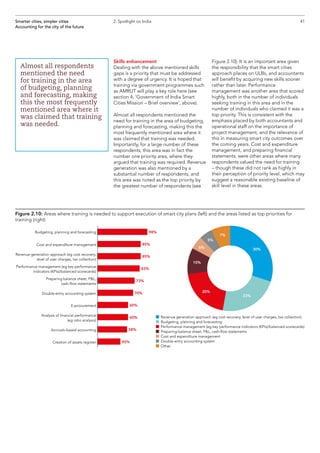
‘Budgeting, planning and forecasting’ were
mentioned as an area requiring training by
almost everyone (98%). ‘Cost and
expenditure management’ (85%) was the
second most commonly cited area. In
addition to asking respondents about the
number of staff needing training in a
specific area, the interviewers also asked
them to rank the level of priority for
training in each area. On this measure,
‘Revenue generation’ topped the list, with
the greatest number (30%) citing this area
as their number one priority for training
(this area was also cited as the top
challenge over the next three years), while
‘Budgeting, planning and forecasting’
(23%) came second.
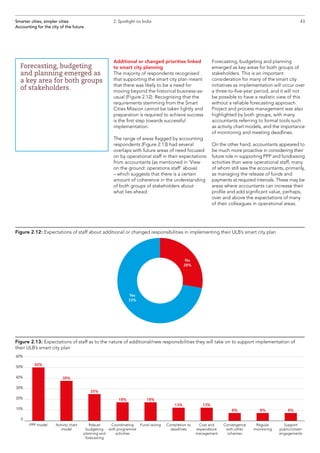
Accountancy staff members were asked
about additional or new responsibilities
they expected when looking ahead, in the
context of delivering smart city plans. Key
areas that emerged were: an
understanding of PPP (cited by 50%) and
project management approach (activity
chart models, cited by 38%). The next most
frequently mentioned area (cited by 23%)
was ‘Budgeting, planning and forecasting’.
10Smarter cities, simpler cities
Accounting for the city of the future
Executive summary
‘Budgeting, planning
and forecasting’ were
mentioned as an area
requiring training by
almost everyone (98%).
‘Budgeting, planning and forecasting’ has
therefore emerged as a key area requiring
a clear focus:
i.	operations staff, when looking ahead,
see these skills as a key area where they
need support from their accountants
ii.	almost all accountants seek training in
this area
iii.	many of them view it as their top priority
for training, and
iv.	accountants flag it as a key area
where they expect additional or new
responsibilities.
With respect to the final point above,
robust multi-year budgeting will in fact be
a new responsibility for many municipal
accountants. This is because the approach
is shifting from the historic procedure
(whereby funds are awarded annually from
higher levels of government) to a more
long-term process: Smart Cities Mission
has stated in advance its funding intentions
covering the next four to five years.
Budgeting and forecasting allocations must
therefore reflect a clear multi-year plan for
using these funds efficiently and effectively.
One of the key enablers for effective
budgeting and forecasting is an accruals-
based approach, so that activities can be
mapped to revenues and costs, rather than
a pure recording just of cash in and cash
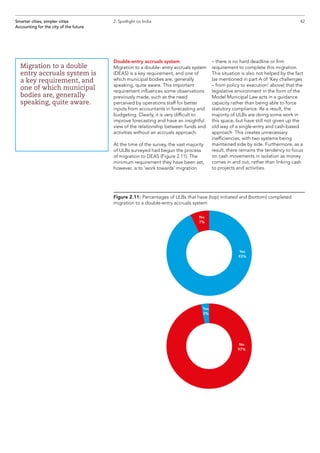
out. At present, the vast majority of ULBs
surveyed have begun the process of
migration to a double entry accruals
system (DEAS). The minimum requirement,
however, has been set as a commitment to
‘work towards’ migration – rather than the
setting of a hard deadline and firm
requirement to complete this migration. As
a result, while 93% have initiated the
migration, only 3% have actually
completed the process, with the rest
maintaining single-entry in parallel, which
is unnecessarily increasing the workload.
Completing this migration is integral to
meeting wider project requirements.
11Smarter cities, simpler cities
Accounting for the city of the future
Executive summary
One of the key enablers
for effective budgeting
and forecasting is an
accruals-based approach,
so that activities can be
mapped to revenues and
costs, rather than a pure
recording just of cash in
and cash out.
12Smarter cities, simpler cities
Accounting for the city of the future
Executive summary
Several factors are relevant to charting the
path ahead; and in doing so, it is important
to recognise best practice examples
already in place, and to learn from them.
•	Standardisation where possible:
this can help materially to reduce
complexity; while variations across
states may be inevitable given
administrative and political differences,
there is a case for greater homogeneity
at least within a state (for example, the
standardisation of accounting systems
achieved in Karnataka).
•	Strong support and backing from
state: the state government is a crucial
intermediary linking the smart cities
vision at the centre with the operational
reality at the municipal level (for example,
coordination has historically been
achieved in Tamil Nadu via a state-wide
urban development fund). A key
element here is the role of State Finance
Commissions in addressing issues linked
to accounting, procurement,
management information systems and
resource generation possibilities.
•	 Structured and phased
implementation by municipalities:
there can be difficulties in introducing
sweeping accounting and financial
reforms involving municipal
departments rapidly or in a single
release. One approach may be to focus
first on the central accounts department
or the central accounting system, before
tackling linked peripheral accounting
systems3
. Indore Municipal Corporation
(IMC) is an example of a successful
experiment in the implementation of
accounting systems reforms –
particularly as they have been
conceived, initiated and carried out
largely on the back of the IMC’s own
initiative, and it did not receive technical
or financial assistance from any
organisation nor was it directly required
to reform by a higher-level government.
•	Individual capacity building:
ultimately all reform is made by
individuals, and these individuals need
to have the necessary skills to achieve
the required outcomes.
	 i.	The Atal Mission for Rejuvenation
and Urban Transformation (AMRUT)
programme has recognised this, and
will be a key provider of nation-wide
training for skills development. This
report also highlights areas relevant
to skills development, in particular for
accountants working in ULBs, and it is
hoped this will further emphasise the
urgency of this extremely important
area. Maharashtra provides an
example here: for the training of
municipal staff in new accounting
principles and practices, a ‘training
for trainers’ course across 40 selected
cities was developed by Yashwantrao
Chavan Academy of Development
Administration, Pune which was a
step in the required direction.
	 ii.	Another approach to enabling access
to skills may involve graduates of
commerce, costing, accounting, etc.
(for example those with a Bachelor of
Commerce (B.Com) degree), who
could be called upon by the
municipality for certain tasks, as part
of a panel – similar to the way in
which architects are empanelled for
approving building plans for plot
sizes smaller than a certain level.
	 iii.	Educational entities, such as local
universities and professional
accountancy bodies, can play an
enabling role in creating a skills
partnership. This can be relevant on
various levels, including designing
and running training courses in
specific areas, supplying students to
work with the municipality through
structured internships, placements,
work shadowing, acting as a hub for
sourcing professionals to create
panels (with reference to point ii
above), and overall strategic
guidance for accountancy capacity
building for the ULB.
A key element here
is the role of State
Finance Commissions
in addressing issues
linked to accounting,
procurement,
management information
systems and resource
generation possibilities.
3	Generally, municipalities are divided into zones and the number of zones will depend upon the size of the municipality. Every zone has its own separate accounting and
budgeting system. In addition, there is a central office that consolidates all types of information related to accounting and budgeting. Each zone sends its income and
expenditure statement to the central office and all this zonal information is consolidated for final annual accounts and budgets. These zonal accounting departments are
also called peripheral accounting departments.
13Smarter cities, simpler cities
Accounting for the city of the future
Executive summary
•	Sharing of learning and expertise
across states: city development is a
state concern and as such has always
been seen within the confines of the
relevant state. Some of the greatest
efficiencies and value creation, however,
can happen when ULBs across the
country learn from one another (as a
case in point, the best practice
examples above are all in different
states). Despite differences across states
politically and administratively, there are
several common challenges and having
isolated pools of experience that are
not shared nationally is sub-optimal. The
Smart Cities Mission has taken a step to
address this by judging ULBs across all
states against certain common
standards as part of a nationwide
competition, and this could be used to
catalyse greater linkages between ULBs
across the country. Looking ahead, it
would be highly beneficial to run
periodic, say annual, sessions involving
cities from various states – as part of the
process of sharing lessons learned as
they deliver their smart city plans.
•	Governance and legal considerations:
these span both tactical and strategic
parameters.
	 i.	 Tactical factors are those directly
increasing speed of execution of the
smart cities agenda, including:
		 - single-window clearance which
could involve a separate new body
(or a similar existing body)
streamlining process for private
players in acquiring land and
clearances for the projects;
		 - best practice PPP governance
whereby a national mission director
(under the Apex Committee) could
lead the formulation of best
practice PPP templates that can be
tailored for specific scenarios;
		 - efficient dispute resolution whereby
a specialised body for redress or a
commercial court is formed in
each state, providing a forum for
speedy and commercially sound
dispute resolution;
		 - commercial incentives are provided,
eg regulatory benefits (like tax
breaks) that reduce transaction costs.
Looking ahead, it would
be highly beneficial to
run periodic, say annual,
sessions involving cities
from various states – as
part of the process of
sharing lessons learned
as they deliver their
smart city plans.
ii.	 Strategic factors are those improving
the overall ecosystem within which
smart cities are to be created and
sustained, and include areas such as:
		 - a data protection framework to
unify several pieces of legislation
such as the Information Technology
Act 2000, National Cyber Security
Policy 2013, the regulations
governing Internet Service Providers
(Unified Licence issued by the
Department of Telecommunication),
and the Indian Penal Code 1860,
among others;
		 - a regulatory framework for smart
cards and other payment systems
will be needed. Several smart city
plans envisage encouraging
financial inclusion through the use
of smart cards, and enabling
several types of payment and
transaction through one card. It
would be useful to consider
regulating the criteria that allow a
city to offer its inhabitants a range
of smart card services, and setting
up a framework for granting
payments system licences to
individual cities (or PPP entities) to
issue their own smart cards;
		 - a policy addressing net neutrality
and general internet access
(keeping in mind the benefits of
free public access to the internet).
The policy should be based on a
definition of net neutrality to guide
business models that rely on the
internet to reach mass consumers;
14Smarter cities, simpler cities
Accounting for the city of the future
Executive summary
		 - sector-specific policies and
regulations are needed. For
example, in waste management
such policies would include
regulations and pricing related to
segregation of organic and
inorganic waste, with a framework
to determine Viability Gap Funding
for large organisations (including
housing societies) dealing with
issues linked to decentralised solid
waste management.
In conclusion, creating smart cities is about
creating simple cities – ones where the
current day-to-day functioning and effective
future planning are embedded into the
operating model in a simple, workable way.
The municipal accounting function, in many
ways, is the glue that binds all the different
parts of the organisation together – and is
also the part of the organisation that will
have to bring a focus on day-to-day issues.
While many other teams will have
responsibility for initiating programmes,
such as the launch of a new infrastructure
solution, the accounting team must, in
addition, take primary responsibility for
monitoring how effectively this is working
post launch. For example, often costs for
initial set-up and development are
overshadowed by unexpectedly high
operating and maintenance costs (the
latter not being fully appreciated at the
start of project) and the accounting teams
will have a key role to play in keeping the
focus on simple but essential priorities.
Indeed, it is in achieving simplicity
that accountants may make their
smartest contribution.
In conclusion, creating
smart cities is about
creating simple cities –
ones where the current
day-to-day functioning
and effective future
planning are embedded
into the operating model
in a simple, workable way.
For the first time in human history, those
living in cities outnumber those that do not.
Behind this simple observation lies a deep
structural change that will have an
enormous impact on how the human
species will occupy this planet that is
‘home’. The fact that the Earth is the only
known inhabitable dwelling available means
that sensibly managing the finite space it
provides assumes an existential importance.
Smart cities are being conceptualised and
brought to life as part of the answer to the
problem of sensibly managing this finite
space. It is not a fancy futuristic concept,
belonging to the realm of science fiction.
On the contrary, it tackles a very basic
question that human beings have been
grappling with since the start of civilisation:
how should society and its resources be
organised so as to create the best
outcomes for the greatest number?
How human society is organised is relevant
to everyone, be they farmers, doctors,
artists, factory workers or indeed,
professional accountants! All have a stake
in society; and just as everyone will be
affected by the impact of urbanisation,
equally, everyone also has a role in
ensuring that this impact is a positive one.
This report reflects on how professional
accountants can support urbanisation in a
way that creates a positive impact. In doing
so, it addresses two headline areas:
1.	the global case for smart cities, to increase
awareness among the accountancy
community about this concept
2.	a spotlight on India, to examine a
specific scenario where the accountancy
community can be part of the solution in
simplifying the move towards smart cities.
Introduction
Smart cities are being
conceptualised and brought to
life as part of the answer to the
problem of sensibly managing
this finite space.
15
This report has been developed in
collaboration between the Association of
Chartered Certified Accountants (ACCA)
and the Institute of Cost Accountants of
India (ICAI). It combines ACCA’s work in the
area of Futures research (which examines
trends affecting business, society and the
accountancy profession in the future) with
ICAI’s deep understanding of the Indian
accountancy environment.
There are two headline sections in the
report. The first evaluates the ‘Global case
for smart cities’ and the second is a
‘Spotlight on India’, which focuses on the
Indian government’s Smart Cities Mission.
The ‘Global case for smart cities’ section
examines the definition and overall
argument for developing smart cities,
by setting out, in particular:
•	a definition for the meaning of a
smart city
•	the key drivers for the creation of
smart cities
•	a view of the global prevalence of
smart cities
•	the factors shaping the future of
smart cities
•	the relevance of smart cities to
professional accountants.
The second section – Spotlight on India –
delves more deeply into the Indian smart
cities initiative, with particular emphasis
on the relevance of accountants to
implementing this initiative. There is
already, quite naturally, a great deal of
attention on the front-end technology
applications that will form part of these
proposed smart cities. Given this, as well as
ACCA’s and ICAI’s roles in the accountancy
education sector, the India section of the
report specifically analyses the involvement
of professional accountants in making the
Smart Cities Mission a success.
The ‘Spotlight on India’ section addresses
the following:
•	It discusses the policy environment
for municipal accounting in India.
•	It outlines key challenges for municipal
accounting and governance in moving
from policy to execution.
•	It provides an ‘on the ground’ view
to support the above, with interviews
conducted across 40 cities that form
part of the Smart Cities Mission.
Interviewees included municipal
accountancy professionals, as well as
operational staff (for example, in waste
management or transport) who deal
with the municipal accountants on a
daily basis. This ensured a rounded view
of the role of accountants that is
informed not just by the accountants
themselves but also by their ‘internal
customers’ – the individuals in various
operations teams who depend on their
accountants to get their own jobs done.
•	It sets out recommendations for
charting the path ahead to ensure
that accountants can play their full role
in supporting the development of
smart cities.
The aim of the Spotlight on India section
is to support India’s ambitions by showing
the ways in which professional accountants
can play their full role in creating not just
smart cities, but simple cities where the
administration and service provision can
be simplified, thanks to an informed and
proactive accountancy function.
Report structure
This report has been developed
in collaboration between the
Association of Chartered
Certified Accountants (ACCA)
and the Institute of Cost
Accountants of India (ICAI).
16
SMART CITIES AS AN APPROACH TO
URBAN PLANNING
It can be tempting to adopt an extremely
prescriptive list of all the supposed
elements of a smart city, but this would
miss the point. While there is some value in
unpacking the various elements that might
constitute a smart city, it would be an
over-simplification to view these as a
check-list that guarantees ‘smartness’. As
has been recognised in various initiatives
across countries, every city is different, and
consequently the definition of ‘smartness’
is not a one-size-fits-all.
A smart city is not a destination –
rather it is a journey of continuous
improvement.
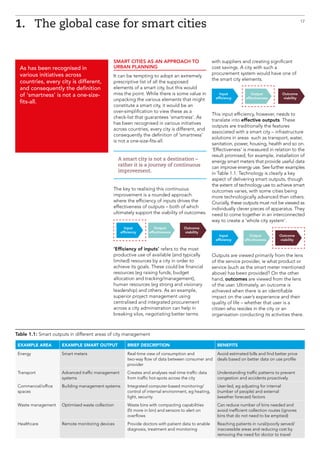
The key to realising this continuous
improvement is a rounded approach
where the efficiency of inputs drives the
effectiveness of outputs – both of which
ultimately support the viability of outcomes.
‘Efficiency of inputs’ refers to the most
productive use of available (and typically
limited) resources by a city in order to
achieve its goals. These could be financial
resources (eg raising funds, budget
allocation and tracking/management),
human resources (eg strong and visionary
leadership) and others. As an example,
superior project management using
centralised and integrated procurement
across a city administration can help in
breaking silos, negotiating better terms
1.	 The global case for smart cities
As has been recognised in
various initiatives across
countries, every city is different,
and consequently the definition
of ‘smartness’ is not a one-size-
fits-all.
17
with suppliers and creating significant
cost savings. A city with such a
procurement system would have one of
the smart city elements.
This input efficiency, however, needs to
translate into effective outputs. These
outputs are traditionally the features
associated with a smart city – infrastructure
solutions in areas such as transport, water,
sanitation, power, housing, health and so on.
‘Effectiveness’ is measured in relation to the
result promised; for example, installation of
energy smart meters that provide useful data
can improve energy use. See further examples
in Table 1.1. Technology is clearly a key
aspect of delivering smart outputs, though
the extent of technology use to achieve smart
outcomes varies, with some cities being
more technologically advanced than others.
Crucially, these outputs must not be viewed as
individually clever pieces of apparatus. They
need to come together in an interconnected
way to create a ‘whole city system’.
Outputs are viewed primarily from the lens
of the service provider, ie what product or
service (such as the smart meter mentioned
above) has been provided? On the other
hand, outcomes are viewed from the lens
of the user. Ultimately, an outcome is
achieved when there is an identifiable
impact on the user’s experience and their
quality of life – whether that user is a
citizen who resides in the city or an
organisation conducting its activities there.
Table 1.1: Smart outputs in different areas of city management
EXAMPLE AREA EXAMPLE SMART OUTPUT BRIEF DESCRIPTION BENEFITS
Energy Smart meters Real-time view of consumption and
two-way flow of data between consumer and
provider
Avoid estimated bills and find better price
deals based on better data on use profile
Transport Advanced traffic management
systems
Creates and analyses real-time traffic data
from traffic hot-spots across the city
Understanding traffic patterns to prevent
congestion and accidents proactively
Commercial/office
spaces
Building management systems Integrated computer-based monitoring/
control of internal environment, eg heating,
light, security
User-led, eg adjusting for internal
(number of people) and external
(weather forecast) factors
Waste management Optimised waste collection Waste bins with compacting capabilities
(fit more in bin) and sensors to alert on
overflows
Can reduce number of bins needed and
avoid inefficient collection routes (ignores
bins that do not need to be emptied)
Healthcare Remote monitoring devices Provide doctors with patient data to enable
diagnosis, treatment and monitoring
Reaching patients in rural/poorly served/
inaccessible areas and reducing cost by
removing the need for doctor to travel
Input
efficiency
Outcome
viability
Output
effectiveness
Input
efficiency
Outcome
viability
Output
effectiveness
Input
efficiency
Outcome
viability
Output
effectiveness
Viability of outcomes encompasses a range
of requirements. A commonly understood
aspect of viability is a system’s ability to
stand the test of time, either through the
continuing relevance of its outputs, or in its
ability to be adapted or upgraded without
significant reinvestment. Another key
element is the ability to minimise adverse
environmental impacts on the smart city
that will arise from a large concentration of
users in a dense urban area. Finally, the
smart city’s viability is also crucially linked
to the existence of an effective governance
infrastructure, in particular a governance
model that allows for the engagement and
empowerment of citizens within the
decision-making process.
In effect, the smart city is an
approach to urban planning
and service provision that
adopts a mindset of continuous
improvement while placing users
at the centre of the development
agenda for the city.
KEY DRIVERS FOR ADOPTION
The need for smart cities is being driven by
a range of factors, many of which are
interrelated. A few headline factors that
have influenced the development of this
concept are discussed below.
1. Urbanisation
Globally, more and more people are living
in cities. This is not just a function of the
world population increasing as a whole –
the percentage of individuals living in cities
as a proportion of total population is also
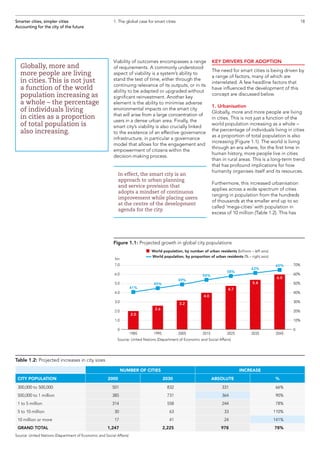
increasing (Figure 1.1). The world is living
through an era where, for the first time in
human history, more people live in cities
than in rural areas. This is a long-term trend
that has profound implications for how
humanity organises itself and its resources.
Furthermore, this increased urbanisation
applies across a wide spectrum of cities
ranging in population from the hundreds
of thousands at the smaller end up to so
called ‘mega-cities’ with population in
excess of 10 million (Table 1.2). This has
18Smarter cities, simpler cities
Accounting for the city of the future
1. The global case for smart cities
Globally, more and
more people are living
in cities. This is not just
a function of the world
population increasing as
a whole – the percentage
of individuals living
in cities as a proportion
of total population is
also increasing.
Figure 1.1: Projected growth in global city populations
Table 1.2: Projected increases in city sizes
NUMBER OF CITIES INCREASE
CITY POPULATION 2000 2030 ABSOLUTE %
300,000 to 500,000 501 832 331 66%
500,000 to 1 million 385 731 364 90%
1 to 5 million 314 558 244 78%
5 to 10 million 30 63 33 110%
10 million or more 17 41 24 141%
GRAND TOTAL 1,247 2,225 978 78%
Source: United Nations (Department of Economic and Social Affairs)
World population, by number of urban residents (billions – left axis)
World population, by proportion of urban residents (% – right axis)
1985 1995 2005 2015 2025 2035 2045
70%
60%
50%
40%
30%
20%
10%
0
2.0
2.6
3.2
4.0
4.7
6.0
5.4
41%
45%
49%
54%
58%
62%
65%7.0
6.0
5.0
4.0
3.0
2.0
1.0
0
bn
driven the need for a coherent approach to
city management that is relevant to all sizes
of city, and in designing such an approach
to provide a sensible road map for the
smaller cities as they grow into larger, and
potentially mega, cities. A planned (indeed
smart) approach to urban development at
this stage can produce exponential growth
in the return on investment (ROI) in the
future by ensuring managed growth –
and can avoid the calamitous opportunity
cost of a mushrooming urban sprawl that
is out of control.
2. The rise of cities in Asia and Africa
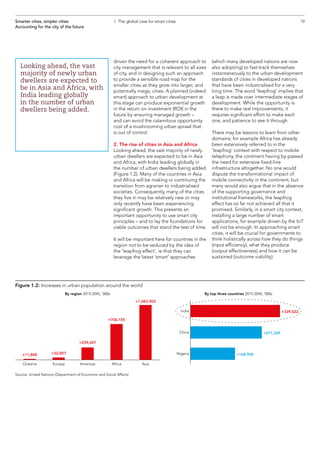
Looking ahead, the vast majority of newly
urban dwellers are expected to be in Asia
and Africa, with India leading globally in
the number of urban dwellers being added
(Figure 1.2). Many of the countries in Asia
and Africa will be making or continuing the
transition from agrarian to industrialised
societies. Consequently, many of the cities
they live in may be relatively new or may
only recently have been experiencing
significant growth. This presents an
important opportunity to use smart city
principles – and to lay the foundations for
viable outcomes that stand the test of time.
It will be important here for countries in the
region not to be seduced by the idea of
the ‘leapfrog effect’, ie that they can
leverage the latest ‘smart’ approaches
(which many developed nations are now
also adopting) to fast-track themselves
instantaneously to the urban development
standards of cities in developed nations
that have been industrialised for a very
long time. The word ‘leapfrog’ implies that
a leap is made over intermediate stages of
development. While the opportunity is
there to make real improvements, it
requires significant effort to make each
one, and patience to see it through.
There may be lessons to learn from other
domains; for example Africa has already
been extensively referred to in the
‘leapfrog’ context with respect to mobile
telephony, the continent having by-passed
the need for extensive fixed-line
infrastructure altogether. No one would
dispute the transformational impact of
mobile connectivity in the continent, but
many would also argue that in the absence
of the supporting governance and
institutional frameworks, the leapfrog
effect has so far not achieved all that it
promised. Similarly, in a smart city context,
installing a large number of smart
applications, for example driven by the IoT
will not be enough. In approaching smart
cities, it will be crucial for governments to
think holistically across how they do things
(input efficiency), what they produce
(output effectiveness) and how it can be
sustained (outcome viability).
19Smarter cities, simpler cities
Accounting for the city of the future
1. The global case for smart cities
Looking ahead, the vast
majority of newly urban
dwellers are expected to
be in Asia and Africa, with
India leading globally
in the number of urban
dwellers being added.
Figure 1.2: Increases in urban population around the world
Source: United Nations (Department of Economic and Social Affairs)
Oceania Europe Americas Africa Asia
By region 2015-2045, ‘000s
+11,888 +32,007
+239,657
+706,185
+1,083,902
By top three countries 2015-2045, ‘000s
India
China
Nigeria +168,904
+271,359
+339,022
3. Fuelling economic growth engines
Cities are recognised as economic growth
engines, with an estimated four-fifths of
global gross domestic product (GDP)
being generated in cities.4
Also, in the
majority of cases, they are pulling their
respective countries along, in the sense
that they out-perform their country in rate
of economic growth. These are important
considerations because if cities are the
economic engines driving countries
forward, then making cities more
productive will have a disproportionately
high positive impact on country GDP and,
by extension, global GDP. Smart cities are
all about deriving the maximum utility from
resources – which is just another way of
saying improving productivity and thereby
GDP. In addition to achieving this within
existing cities, there are also examples of
smart cities that are being custom built with
the express intention of their becoming
economic hubs. These hubs are typically
built to support jobs and a local economy,
while also offering transport connectivity
and environmental sustainability. So, in
order to provide jobs and generate
economic growth for a growing world
population, smart cities can emerge as a
key part of the matrix of solutions.
4. Environmental impact
Increased urbanisation, because of its link
to increased industrialisation, has created
catastrophic levels of pollution, particularly
in larger and mega-cities. Many urban
agglomerations around the world routinely
record air pollution at several multiples of
guideline levels. WHO’s guidance is an
annual mean of 10 micrograms per cubic
metre of particles less than 2.5 micrometres
in diameter – both Delhi and Shanghai are
over ten times this level5
.
This situation is untenable and smart city
developments offer a way of reconciling the
apparent clash of interests between the city
as an economic engine and as a place for
human life to flourish. Unless this is tackled
directly, the collateral damage in healthcare
costs will overwhelm cities, many of which
already have weak healthcare infrastructure.
At the centre of the smart cities promise
rests the superior use of data, and this is a
key tool that must be leveraged to better
understand the challenges posed to the
environment by industrialisation, and their
potential solutions. This engagement with
data must span the spectrum from greater
and more frequent data collection (such as
with IoT devices), better analysis (via Big
Data analytical tools) and improved
decision making (for example, using
visualisation techniques to enhance ability
to understand data insights).
5. Accessibility and assisted living
It used to be argued that Western
economies had an older demographic
profile than most emerging market
countries. That narrative has shifted, with
some countries such as China facing an
increasingly ageing population. In the early
1950s, populations in North America (both
the US and Canada) had an average life
expectancy that was 26 years longer than
those in Asia – that gap has now narrowed
to about seven years (79 years versus 72
years).6
The changing age demographic is
set to continue into the future and is a factor
that has made smart cities an increasingly
relevant concept, owing to their ability to
make a range of public services from
healthcare to mobility more user-friendly.
The use of a city and its facilities should be
open to all members of society, including
those who may have health challenges,
mobility constraints or other considerations.
This is critical to ensure the full participation
of all residents in a city, and to avoid
sub-optimal use of talent and skills.
20Smarter cities, simpler cities
Accounting for the city of the future
1. The global case for smart cities
Cities are recognised as
economic growth engines,
with an estimated four-
fifths of GDP being
generated in cities.
4	The World Bank, Urban Development - overview, www.worldbank.org/en/topic/urbandevelopment/overview, accessed 07/11/2016.
5	World Health Organization, Global Health Observatory (GHO) data - Exposure to ambient air pollution, www.who.int/gho/phe/outdoor_air_pollution/exposure/en,
accessed 07/11/2016.
6	 United Nations, Department of Economic and Social Affairs, Population Division (2015). World Population Prospects: The 2015 Revision, accessed 07/11/2016.
CURRENT ADOPTION AROUND
THE WORLD
Smart cities exist in various stages of
maturity across the world. Given the drivers
discussed previously, it is perhaps not
surprising that an increase in the number of
smart cities is forecast. One estimate
suggests a tripling from 28 smart cities in
2015 to 88 in 20257
. This is, if anything, a
conservative estimate because it defines
smart cities very specifically as those where
there is the use of information,
communications and technology
applications across three or more different
functional areas (out of mobile and
transport, energy and sustainability, physical
infrastructure, governance, and safety and
security). There are many cities where huge
improvements to urban life might result
from just one or two technology
applications, but combined with other
wide-ranging process improvements.
Also, there are a large number of early-
stage projects and proposals for smart
cities that are yet to come to fruition –
once these are added, the number of
smart city initiatives would potentially grow
even further. A key example of this is the
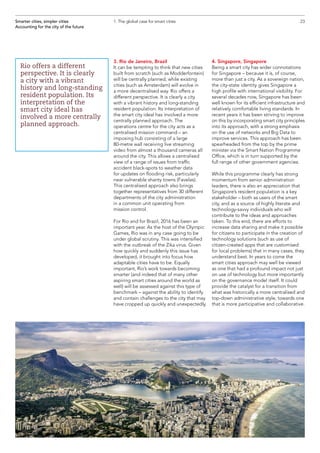
current smart cities initiative in India where
100 cities have been selected for
development using smart principles.
Just as important as the number of cities
adopting ‘smart’ principles is the approach
to such adoption, where qualitative
considerations and the need to reflect the
needs of the city come into play. Indeed,
some successful smart cities started as small
pilot projects that were gradually scaled up
to cover multiple parts of the city, and finally
the city as a whole. This organic growth
approach is significant because the greatest
increase in number of cities over 2000–30 is
expected to be in the mid-sized segment,
ie cities with between 500,000 and one
million inhabitants (Table 1.2, page 18).
For such cities, adoption will be linked to
the availability of bolt-on solutions that can
be gradually added on as the city grows,
rather than requiring monolithic, expensive
and complex technology (probably geared
to the needs of a mega-city) to be forced
on them at the outset.
There are a variety of examples around the
world of smart cities (and those cities
contemplating the first steps in this
direction) – and it is therefore illustrative to
review a few examples to understand this
variety (Table 1.3). These examples run the
gamut from developed countries to
emerging markets, from large cities to small
and medium-sized, established cities to
frontier ones, and from a more centralised
‘top-down’ city-wide approach to a
decentralised ‘bottom-up’ adoption starting
with small pockets in a city. A few examples
are discussed below to explore this diversity.
21Smarter cities, simpler cities
Accounting for the city of the future
1. The global case for smart cities
Smart cities exist all over
the world and come in
many shapes and sizes.
7	IHS Markit, Smart Cities to Rise Fourfold in Number from 2013 to 2025, July 2014, press.ihs.com/press-release/design-supply-chain-media/smart-cities-rise-fourfold-
number-2013-2025, accessed 07/11/2016.
Table 1.3: Different styles of smart city around the world
CITY
DEVELOPED
MARKET
EMERGING
MARKET
SMART FEATURES
TO EXISTING CITY
NEW CITY
CUSTOM BUILT
MAINLY CENTRALISED
PLANNING
CENTRALISED
AND LOCALISED
Amsterdam ü ü ü
Modderfontein ü ü ü
Rio de Janeiro ü ü ü
Singapore ü ü ü
Songdo ü ü ü
Barcelona ü ü ü
1. Amsterdam, the Netherlands
Amsterdam is an example of a city that is
developing a sophisticated approach to
becoming a smart city, but doing this in a
relatively organic way. In other words, it is
incrementally increasing its smart capabilities
over time, in close cooperation with its
stakeholders. These stakeholders include
a mix of citizens, businesses, academics,
experts and, of course, government.
Amsterdam is a strong proponent of the
use of open-source data and this forms a
key source of information that is used by
citizens and the government to build
applications and solutions to problems. All
across the city there are communities that
are trialling ideas, often within their own
local environment. For example, to reduce
congestion during the commute to work,
several solutions have arisen in parallel,
having been developed by different
interested parties. On the one hand, traffic
data is being used by local citizens to create
apps that provide much more localised,
and real-time, traffic information to enable
travellers to avoid problem routes. On the
other, co-working spaces have sprung up in
various parts of the city that reduce the
need for everyone to travel into the city
centre simultaneously and at the same time
encourage smaller companies and
entrepreneurs that value the flexibility of
this approach. These co-working spaces
also often offer free Wi-Fi (which itself is
linked to a wider push to develop free
Wi-Fi ‘hotspots’ across the city).
2. Modderfontein New City, South Africa
Modderfontein New City reveals a different
approach to developing a smart city. It is a
suburb of Johannesburg that is the site for
a proposed 1,600 hectare development to
be built from scratch. The Chinese firm
Zendai will be developing the city over the
period to 2060 with an estimated
investment of GBP 5bn needed to bring
the plans to fruition8
. Envisaged as a
mixed-use city that will act as a business
hub as well as a residential environment, it
is intended to be a glimpse into the future:
a future that is at once economically
productive and environmentally sustainable.
There will, of course, be questions about
the viability of such a grand and ambitious
project, particularly when the Chinese
economy might have economic challenges
of its own to focus on. A counter argument
would be that China is now Africa’s largest
trading partner (having overtaken the US9
)
and is in this for the long term – far beyond
short-term economic ups and downs. The
Modderfontein project is to be executed in
five phases completing in 2060. So the
aspiration is not an immediate output, but
more a long-term outcome for residents
and businesses. This will require the
creation of whole new communities housed
in eco-friendly settlements, provided with
schools, hospitals and social infrastructure
as well as retail outlets. All this will need to
be underpinned by effective public
transportation and commercial business
parks to support the livelihood of the
residents and their ability to reach their
workplaces in quick and sustainable ways.
22Smarter cities, simpler cities
Accounting for the city of the future
1. The global case for smart cities
Co-working spaces have
sprung up in various parts
of the city that reduce
the need for everyone to
travel into the city centre
simultaneously and at
the same time encourage
smaller companies and
entrepreneurs that
value the flexibility of
this approach.
8	The Zendai Group is a private conglomerate founded in 1992 and is listed on the Hong Kong Stock Exchange. It is involved in real estate development, tourism and
finance, alongside business interests in energy resources, information technology and creative industries. The Zendai Group holds assets worth c. £570bn and employs
more than 7,200 people globally.
9	The Economist, One among many – China has become big in Africa, now the backlash, January 2015, www.economist.com/news/middle-east-and-africa/21639554-china-
has-become-big-africa-now-backlash-one-among-many, accessed 07/11/2016.
3. Rio de Janeiro, Brazil
It can be tempting to think that new cities
built from scratch (such as Modderfontein)
will be centrally planned, while existing
cities (such as Amsterdam) will evolve in
a more decentralised way. Rio offers a
different perspective. It is clearly a city
with a vibrant history and long-standing
resident population. Its interpretation of
the smart city ideal has involved a more
centrally planned approach. The
operations centre for the city acts as a
centralised mission command – an
imposing hub consisting of a large
80-metre wall receiving live streaming
video from almost a thousand cameras all
around the city. This allows a centralised
view of a range of issues from traffic
accident black-spots to weather data
for updates on flooding risk, particularly
near vulnerable shanty towns (Favelas).
This centralised approach also brings
together representatives from 30 different
departments of the city administration
in a common unit operating from
mission control.
For Rio and for Brazil, 2016 has been an
important year. As the host of the Olympic
Games, Rio was in any case going to be
under global scrutiny. This was intensified
with the outbreak of the Zika virus. Given
how quickly and suddenly this issue has
developed, it brought into focus how
adaptable cities have to be. Equally
important, Rio’s work towards becoming
smarter (and indeed that of many other
aspiring smart cities around the world as
well) will be assessed against this type of
benchmark – against the ability to identify
and contain challenges to the city that may
have cropped up quickly and unexpectedly.
4. Singapore, Singapore
Being a smart city has wider connotations
for Singapore – because it is, of course,
more than just a city. As a sovereign nation,
the city-state identity gives Singapore a
high profile with international visibility. For
several decades now, Singapore has been
well known for its efficient infrastructure and
relatively comfortable living standards. In
recent years it has been striving to improve
on this by incorporating smart city principles
into its approach, with a strong emphasis
on the use of networks and Big Data to
improve services. This approach has been
spearheaded from the top by the prime
minister via the Smart Nation Programme
Office, which is in turn supported by the
full range of other government agencies.
While this programme clearly has strong
momentum from senior administration
leaders, there is also an appreciation that
Singapore’s resident population is a key
stakeholder – both as users of the smart
city, and as a source of highly literate and
technology-savvy individuals who will
contribute to the ideas and approaches
taken. To this end, there are efforts to
increase data sharing and make it possible
for citizens to participate in the creation of
technology solutions (such as use of
citizen-created apps that are customised
for local problems) that in many cases, they
understand best. In years to come the
smart cities approach may well be viewed
as one that had a profound impact not just
on use of technology but more importantly
on the governance model itself. It could
provide the catalyst for a transition from
what was historically a more centralised and
top-down administrative style, towards one
that is more participative and collaborative.
23Smarter cities, simpler cities
Accounting for the city of the future
1. The global case for smart cities
Rio offers a different
perspective. It is clearly
a city with a vibrant
history and long-standing
resident population. Its
interpretation of the
smart city ideal has
involved a more centrally
planned approach.
5. Songdo International Business
District, South Korea
Songdo is a custom-built city that is still
incomplete, but functional. It is being built
on 1,500 acres of reclaimed land about
65km from Seoul, the nation’s capital. It
incorporates an extensive use of
technology, particularly with environmental
sustainability in mind; for example, waste is
automatically transported from homes and
sorted at recycling centres. The city could
form a blueprint for how new settlements
that pursue economic and liveability goals
can be created and evolve – currently over
50,000 people are using its office spaces
with an almost equal number actually living
in Songdo. By the time it is fully complete,
which is expected around 2020, the city will
have 80,000 apartments, 50 million square
feet of office space and a further 10 million
square feet of retail space.
That is a lot of real estate to fill, and one
of the challenges Songdo will face in the
2020s will be avoiding the curse of half-
empty settlements that seem like ghost
towns. In addressing this, Songdo’s
administrators could have a real impact in
bringing together not just ‘facilities’ but
also the people who wish to use them.
This will require a flexible integrated value
proposition. To put that differently: plans
need a certain adaptability to inhabitants’
future living expectations, rather than
presenting individuals with a ‘finished’ city
that becomes out of sync with how
lifestyles (and indeed the country and the
world more generally) evolve over the
10-to-20-year period that it will take to
move from drawing board to fully
constructed reality.
6. Barcelona, Spain
Barcelona features regularly in any global
list of smart cities where attempts are
being made to improve lives for their users.
It has been giving attention to all relevant
aspects of this, in particular through the
creation of smart outputs and a willingness
to explore decentralised citizen-engaged
open-source methods. In addition to a
decentralised approach across the city,
there is also an identified core region,
named 22@ Barcelona which is emerging
as a technology-led innovation hub within
the city and is driving economic activity.
Barcelona is well regarded as a smart city,
for reasons beyond just its technological
prowess. In fact, its success is strongly
linked to its ability to develop a holistic
view across multiple domains. For example,
it has a ‘green’ bus transport system that
ensures that commuters can travel
between any two parts of the city with no
more than one change in most cases. It also
incorporates this smart travel approach into
waste collection, ensuring that waste bins
can indicate when they need emptying (to
a central data base via Wi-Fi) and collection
routes can be planned in an optimal way to
reduce unnecessary travel. In many ways,
Barcelona is a relatively mature smart city
that has moved beyond the glamour of
smart devices and is working on integrating
the ethos behind these innovations into
the day-to-day lives of its citizens.
The above illustrations intend to display
the heterogeneous nature of the smart city
phenomenon – one where different cities,
starting from diverse stages in their
development life cycles, are taking this
idea and making it their own.
Notwithstanding this diversity, there remain
certain key trends that are shaping the
smart city story as a whole. The speed of
adoption of these trends will vary from city
to city (for reasons discussed above), but
overall they share some common themes.
24Smarter cities, simpler cities
Accounting for the city of the future
1. The global case for smart cities
Barcelona features
regularly in any global
list of smart cities
where attempts are being
made to improve lives
for their users.
TRENDS SHAPING SMART CITIES
1. Smart cities are citizen led
Citizens are increasingly using technology
in their own ways to add value to their city
environment, rather than waiting for
anyone to tell them what to do. An
example is the citizen response during the
devastating floods in Chennai (India)
during November and December 2015.
Through an organic process of continual
addition and updating – effectively a
crowd-sourcing exercise – a comprehensive
database was developed in a relatively
short period of time that could inform
those whose houses were flooded about
the contact details of others in their area
who could provide a temporary shelter.
This database evolved from a sharable
spreadsheet to a website and could be
used by government agencies trying to
track and direct relief efforts where most
needed. Importantly, this concept can be
extended to all aspects of service
provision. Community-based policing,
for example, relies on participation of
citizens (which could be as simple as
taking video evidence on smart phones
and relaying it to the authorities via safe
web portals) in a collaborative way to
prevent and control crime. Being citizen-
led, such processes fundamentally alter
the relationship between the state and
citizen – the former changes from service
provider to partner. This democratisation
enabled by technology, with people
making decisions and acting upon them,
is an essential feature of smart citizens
operating in a smart city.
2. Open standards:
Concepts of smart cities have often relied
heavily on proprietary systems to offer
customised solutions. The problem with
this is the challenge of ensuring future-
proofing and ROI. Given the pace of
technological change, large upfront capital
expenditure in customised systems can be
wasted if they go out of date in a few years.
Also, if the customised element means that
the system cannot be rolled out in another
part of the city, or in another city, then
again it may result in a sub-optimal ROI.
Technological solutions built around open
standards (common and publicly available
rules that can be freely accessed or
updated) are an important area for
development. This ensures the
participation of a wider pool of application
developers who have the incentive of a
larger market if their solutions can be
scaled up for use by more people. Also, if
there is a large enough pool of users for a
system based on a given standard, the risk
that an application will quickly become
obsolete is lower. Notably, as the wider
community (or most of it) would also
require any updates at the same time, the
increased scale lowers the cost of the
upgrade for everyone.
3. Internet of Things (IoT):
Data can now be obtained from a range
of objects (‘things’) via sensors that post
it to a cloud on the internet, from where
it can be downloaded, analysed and used
to trigger further actions. This integrated
involvement of people, objects, data and
the processes that tie all this together is
expected to be a key theme in the
development of smart cities. As an
example, a temperature sensor in a
hospital may record a significantly higher
than expected room temperature, which
could be linked to an automatic fire safety
check, and heat sensors in lifts could
ensure that they automatically descend to
the ground floor to prevent anyone being
stuck in the lift in case of fire. The specific
uses of this concept are clearly endless,
but the underlying principle of an
integrated system of people and
technology is likely to remain important
for the foreseeable future.
25Smarter cities, simpler cities
Accounting for the city of the future
1. The global case for smart cities
Citizens are increasingly
using technology in their
own ways to add value to
their city environment,
rather than waiting for
anyone to tell them
what to do.
4. Big Data
One of the most fundamental
underpinnings of the concept of a smart
city is the use of data to improve the lives
of users of the city. The use of analytical
tools to understand data is not a new idea
in itself. Big Data takes things further by
vastly increasing the amount of data being
analysed, the range of different types of
data that can be collected and the speed
with which the data is processed. In the
context of smart cities, this can be very
useful, particularly with respect to the
above mentioned idea of the IoT. These
IoT devices often produce unstructured
data, in high volume that requires Big Data
tools for sensible analysis. The fact that the
data is unstructured is important.
Traditional databases have relational
properties, where data items have set
formats and can be arranged into rows and
columns for analysis. Unstructured data
tends to be much messier, for example, it
may be held in data sources such as emails
and videos, to name merely two. Big Data
will therefore play an increasingly powerful
role as the complexity and volume of
information expands with smart cites.
5. Blockchain and distributed ledgers
Distributed ledgers are databases that are
available, and are updated, simultaneously
for all participants in a network, and where
changes to the database are agreed by
consensus/permission of the entire network
using an encryption process. What makes
the database ‘distributed’ is the fact that
multiple copies of it exist in parallel (for
each network participant) and validation of
information does not require a central
authorising power. This is potentially an
enormously disruptive idea with far-
reaching consequences. For instance, land
registry and proving title of property can
be cumbersome, and corruption-riddled,
processes that many governments struggle
to manage effectively. Managing the
property ownership database via a
blockchain (a type of distributed ledger10
)
might make the process much quicker and
less susceptible to manual interference.
Blockchain is, of course, at a very early
stage of development, and it may be some
time before clear use cases are
implemented in smart cities – but it is
definitely an area to look out for as a
possible future trend.
26Smarter cities, simpler cities
Accounting for the city of the future
1. The global case for smart cities
One of the most
fundamental
underpinnings of the
concept of a smart city
is the use of data to
improve the lives of
users of the city.
10	http://www.blockchaintechnologies.com/blockchain-glossary
RELEVANCE OF SMART CITIES TO
PROFESSIONAL ACCOUNTANTS
There are several reasons because of which
smart cities will require the pro-active
involvement of professional accountants to
realise their full potential.
1. Financial management for an
increasing and varied pool of smart cities:
As mentioned in section on ‘Current
adoption around the world’, there is a
projected increase in the number of smart
cities. Furthermore, there are a range of
development models involved, which each
have different management, financial and
operational requirements. Professional
accountants will be essential for successful
day-to-day management of all the usual
delivery risks such as wastage of funds,
fraudulent reporting of financial
performance or lack of contractual
rigour (eg with PPPs).
2. Getting value for money from
technology:
Smart cities use technology (to a greater or
less extent) to optimise service delivery
and to add value to the lives of citizens.
Looking ahead there are several areas
where this dependence on technology is
likely to increase. Whether this is IOT, big
data or on-going innovations based on
open-source standards, they all exploit the
increased availability of data, and the
ability to analyse the data to better predict
user behaviour. Professional accountants
are needed to understand the impact of
technology on business decision making
(for example cost-benefit analyses), and to
ensure that the right digital tools are
adopted for the right reasons – ie in the
best interests of citizens. This is important
to provide objective fact-based reasons for
adoption, and reduce the risk of expensive
solutions being pushed by vested interests.
3. Greater fiscal responsibility for cities:
One of the models being explored around
the world to drive growth is to give cities
greater autonomy in managing their own
activities and budgets. Oversight from a
central governmental authority is reduced
in favour of greater decision-making control
for the city. The upside for the city might be
less dependency on the central government
to secure funds each year (which might in
some cases be quite a political process). On
the other hand, cities will need to be more
commercial and forward thinking, and
cannot wait passively for allocations from
higher levels of government.
In India the government has announced the
creation of 100 smart cities, many of which
are small and medium sized cities outside
of the traditional large city hubs. One of the
expectations within the programme is a
greater role for cities to raise and manage
their own funding (as only a portion of total
funding will be covered by centre and state
governments) – a task which will be new,
and daunting to many (particularly smaller)
cities. Finance and accounting professionals
will play a key role in ensuring that as
activities, responsibilities, and budgets
increase, cities have skills in place to
benefit from these changes.
4. Breaking down siloes in the
operating model:
Reducing silos is integral to creating a smart
city. The starting point for a smart city is to
achieve the most efficient use of limited
input resources. To do so, it is absolutely
vital that departments within a city
government and, indeed, different levels of
government (city, state and centre) are all
joined up to avoid expensive wastage of
time and resources. Traditional hierarchical
structures across government departments
have encouraged policy development in
individual silos. The impact of one policy
on another has not always been considered
which creates duplication and waste.
For example in the UK, funding for mental
health is not a ‘protected’ area of
government expenditure. Therefore, if
patients are released from care too early to
save costs, they might be at risk of
committing major or minor offences,
requiring police support and infrastructure.
This creates unintended consequences
with reductions in one area causing
increased expenditure in another, ironically
resulting in a higher overall spend.
Professional accountants are the link
between operating processes,
organisational performance and financial
value. They are therefore well placed to
provide a holistic project management
view and drive the breaking down of silos
to ensure best value for taxpayer funds.
This relevance to accountants of improving
budgeting and financial management
(necessitated by greater decentralisation)
and project management (linked to reducing
silos and lack of communication) are among
the themes explored in the following
section, which builds on reflections made so
far and examines India’s Smart Cities Mission
with a particular focus on observations
relevant to the professional accountant.
27Smarter cities, simpler cities
Accounting for the city of the future
1. The global case for smart cities
Finance and accounting
professionals will play
a key role in ensuring
that as activities,
responsibilities,
and budgets increase,
cities have skills in
place to benefit from
these changes.
This section focuses on the smart cities
initiative launched in India in 2015. In
particular, the aim is to discuss this initiative
from the viewpoint of the professional
accountant working within city
governments across the country.
The spotlight begins with a description of
the Indian government’s Smart Cities
Mission. The purpose is to provide a sense
of the overall project environment within
which municipal accountants will be
functioning. Accordingly, this description
does not seek to list every aspect of the
Smart Cities Mission in detail – rather it is
a brief, top-down assessment to outline
the strategy and philosophy driving the
approach taken by the Indian government.
Set against this background is an
assessment of the key features pertinent to
an understanding of municipal accounting.
This assessment begins with some key
policy milestones relevant to the evolution
of municipal accounting. This avoids
viewing the Smart Cities Mission in isolation
and enables current developments to be
seen as part of an historical progression
leading up to the present day.
These ‘big picture’ policy considerations
then set the scene for evaluating how
policies are executed. The approach is to
take a rounded view (which also includes
wider legal and governance issues) that not
only examines some of the key challenges
faced, but also considers their implications
for charting the path ahead, including a
few best practice examples across the
country, from which accountants can learn
so as to become an important part of
making the Smart Cities Mission a success.
Finally, the observations about the role of
accountants are tested against real
situations. The ‘Smart Cities Mission –
“view on the ground”’ section presents
results gathered from 40 cities that are part
of this initiative. This survey was conducted
during June and July 2016.
2.	 Spotlight on India
This section focuses on the
smart cities initiative launched in
India in 2015.
28
Figure 2.1: Municipal accounting and the Smart Cities Mission
Smart Cities Mission
Evolution of policy
From policy to execution
View on the ground
Charting the way forward
Municipalaccounting
GOVERNMENT OF INDIA SMART CITIES
MISSION
Brief overview
Smart Cities Mission is an ambitious
urbanisation programme launched by the
Indian government in 2015. The programme
aims for the creation of 100 smart cities and
has been allocated INR 480bn (c. £5.3bn)
over five years by the central government.
An equal amount, on a matching basis,
will have to be contributed by the state
government or urban local body (ULB –
city- or municipal-level administration).
A few headline factors influence the
philosophy of the mission.
1. The bottom-up model for development
Rather than prescribing inflexible top-
down requirements across all cities,
Smart Cities Mission provides for multiple
models of development in recognition of
the fact that needs differ between cities.
So, while some cities may be created afresh
(greenfield developments), many others
will involve replacement of a built-up area
(redevelopment) or upgrading to existing
structures (retrofit). There is also a provision
for providing an identified smart city
solution for city-wide infrastructure (pan-city)
so that all citizens across a city experience
some impact from the programme.
2. Professionalising the approach
City development is a state concern in
India, and city governments rarely think of
themselves outside the context of their
respective states. Also, the traditional view
of city development has tended towards a
somewhat reactive approach that satisfies
the minimum requirements as mandated
by the state administration. With Smart
Cities Mission, a concerted attempt has
been made for those running states and
cities to reflect on required improvements,
to compete nationally to be selected for
the programme on the basis of their
development indicators and potential, and
to build a business plan that sets out a
road map for achieving goals.
3. Implementation of vision
The approach will place greater emphasis
on financial discipline and skills at city level
– for creating and managing budgets, and
allocating and sourcing funds. A ‘project’
approach to smart city initiatives is being
tried out, rather than adding smart city
requirements to the day-to-day job of the
municipal administration (ie they are not
being made part of ‘business as usual’). This
in turn, will involve the creation of special
purpose vehicles (SPVs) that will be set up
specifically to lead project management
and, ultimately, implementation of each
city’s Smart City Plan.
4. Wider eco-system of development
The Smart Cities Mission is part of a mix
of programmes that collectively seek to
tackle India’s developmental challenges.
It is important, therefore, not to view the
smart cities initiative in a silo, but rather
as one that has links to a range of
programmes that collectively pursue
sustainable and long-term change. Of
direct relevance, for example, is the Atal
Mission for Rejuvenation and Urban
Transformation (AMRUT), which supports
the development of certain basic amenities
such as water, sewerage, transport and
green spaces (Government of India 2015),
and Digital India, which focuses on
e-delivery and digitally enabled services.11
Equally, the human dimension of smart
cities (ie ‘smart citizens’ who are
economically productive and socially
responsible) will get a boost from
programmes such as Skill India12
(training
programmes), and Make in India13
(creating
manufacturing hubs across the country).
Ultimately, to realise the above vision, the
accountants at the front line, ie at city level,
will have a key role to play. Therefore, it is
instructive to reflect first, briefly, on the
policy environment within which these
accountants function.
29Smarter cities, simpler cities
Accounting for the city of the future
2. Spotlight on India
A ‘project’ approach to
smart city initiatives is
being tried out, rather
than adding smart city
requirements to the
day-to-day job of the
municipal administration.
11	 Digital India, digitalindia.gov.in/, accessed 07/11/2016.
12	 Skill India Portal, www.skillindia.gov.in/, accessed 07/11/2016.
13	 Make in India, www.makeinindia.com/home, accessed 07/11/2016.
MUNICIPAL ACCOUNTING IN INDIA –
EVOLUTION OF POLICY
Developing smart cities requires a step-
change in the way cities are governed and
managed. A key part of this improvement
will involve capacity building at city level in
the field of accounting and finance. Before
considering current developments,
discussed below is a brief description of
the journey so far, so that the present can
be put into some context.
The reform of municipal accounting in
India is a journey spanning more than three
decades. The 1980s saw two experiments,
in Mumbai and Chennai, with the aim of
introducing double-entry accruals-based
accounting systems. At both these places
the experiment was initiated by the World
Bank, which then supported a second
phase in the early 1990s to introduce
accruals-based accounting in selected
municipalities in the state of Gujarat. From
the late 1990s onwards there was increased
momentum with the Tamil Nadu Urban
Development Fund (TNUDF) sponsoring a
state-wide municipal accounting reforms
programme in Tamil Nadu, the introduction
of an improved accounting system in
Anand (Gujarat), Jaipur (Rajasthan) and
Tumkur (Karnataka) by TATA Consultancy
Services under the Asian Development
Bank (ADB), and some individual
experiments such as the Bangalore
Agenda Task Force-initiated project of
improving the accounting system in
Bangalore Municipal Corporation.
In 2001, the Ministry of Finance issued
Guidelines for the Utilization of Local
Bodies’ Grants. In these guidelines, the
comptroller and auditor general (CAG) of
India prescribed formats for budgets and
accounts for ULBs’ accounting policies, and
costing of utilities and services. This was
followed by the Model Municipal Law
finalised by the Ministry of Urban
Development (MoUD) in 2003 (Government
of India 2003) – the basic objective of which
was to implement the provisions of the
74th Constitutional Amendment for
empowerment of ULBs, and to provide the
legislative framework for implementation of
the Ministry’s urban sector reform agenda.
In order to navigate the complex dynamics
of the country’s federal structure, the
MoUD prepared the National Municipal
Accounts Manual (NMAM) (Government of
India 2005). By using a generic framework
30Smarter cities, simpler cities
Accounting for the city of the future
2. Spotlight on India
Developing smart cities
requires a step-change
in the way cities are
governed and managed.
A key part of this
improvement will involve
capacity building at
city level in the field of
accounting and finance.
Photocredit:Noppasin/Shutterstock.com
of National Municipal Accounting,
national-level perspectives on reforms
could be aligned with those of the state
governments. The NMAM was formulated
with coverage of accounting policies,
procedures, and guidelines designed to
ensure correct, complete and timely
reporting of municipal transactions and
production of accurate and relevant
financial reports. Parallel to the NMAM, a
National Municipal Accounting Training
Manual was also prepared with the aim of
providing support to state governments in
implementing financial management
reforms in ULBs (Government of India 2007).
This was followed by the Jawaharlal Nehru
National Urban Renewal Mission (JnNURM)
(Government of India 2006), which tried to
link access to grant funds with the adoption
of reforms in a range of areas such as a
modern and transparent budgeting system,
a shift to the double entry accruals system
(DEAS), improved asset management, and
enhanced property tax collection efficiency.
This principle was further explored in the
Thirteenth Finance Commission
(Government of India 2009), which divided
grants allocated to local bodies into two
components: a general basic grant and a
performance grant, with 40% being the
performance grant.
Most recently the Atal Mission for
Rejuvenation and Urban Transformation
(AMRUT) has explicitly highlighted the
agenda of capacity building in ULBs,
with states requiring the inclusion of this
aspect in their action plans14
. Two
dimensions have been identified in this
respect – individual capacity building
(training and staff skills) and institutional
capacity building (with institutional
outcomes such as ensuring accountability
and transparency, specific service
standards, and citizen empowerment).
As outlined above, there have been several
initiatives over the years to influence and
improve the approach to municipal
accounting in India, and the following
section uses this background to shed light
on the current environment within which
cities must be made ‘smart’.
KEY CHALLENGES – FROM POLICY TO
EXECUTION
Municipal accounting, and more generally
city administration, in India is on a journey,
the goal of which is to engage
constructively with factors that prevent
cities from reaching their full potential.
Understandably, some issues are easier to
address than others; and more proactive
ULBs will have addressed some of these
factors better than other, particularly
smaller ones. Discussed below are some
key challenges pertinent to the successful
creation of smart cities.
A. Legislative aspects
1.	 Model Municipal Law (MML) can
suggest, but not enforce mandatory
compliance: MML (Government of India
2003) was developed to provide a
legislative framework for implementing
urban sector reform. So far, it serves
more as a guide for amendment to
existing state legislation rather than
requirements that must be followed.
	Therefore there is a high volume and
multiplicity of amendments, with variation
between states on level and style of
adoption. As states often add MML
requirements to existing state statutes,
a complex maze of legislation can result,
and this has to be carefully navigated.
2.	Ability of ULBs to influence the
approach to legislation: the power to
make rules and enact provisions for
municipalities usually lies with state
governments, which issue detailed
guidelines and rules, including
accounting rules for budget and account
formats, maintenance of accounts,
power to raise money, etc. Therefore
municipalities have a limited (if any) role
in issuing legislation – typically, they get
involved only with making bye-laws.
	As a result, further consideration may be
required in some areas; for example,
many ULBs lack a sufficiently robust
legal framework for procurement, even
though a substantial portion of
municipal budgetary expenditure is
Smarter cities, simpler cities
Accounting for the city of the future
2. Spotlight on India
Municipal accounting,
and more generally city
administration, in India
is on a journey, the goal
of which is to engage
constructively with
factors that prevent
cities from reaching
their full potential.
14	 Atal Mission for Rejuvenation and Urban Transformation, amrut.gov.in/, accessed 01/1/2016.
31
through external procurement. Many
states lack standard legally enforceable
documentation for procurement and an
absence of standardised procedures can
delay the tendering process and create
a lack of transparency.
3.	Retrospective changes in law: these can
affect private participants by adding
unanticipated costs to their project,
which is then made unviable. Generally,
PPP agreements do not provide for
consequences of changes in law, which
may also change the revenue or costs of
the project.
4.	Legal recourse for dispute resolution:
private parties will be wary of challenges
in seeking legal redress if there are
issues such as delay in payments by
government entities, unbalanced risk
sharing and overestimation of revenue,
resulting in financial unviability for
private participants who have invested
substantially in such projects. The
absence of dedicated or semi-
dedicated dispute resolution
mechanisms to deal with disputes in
government/PPP may be a deterrent.
5.	Land acquisition: every state in India has
different regulations for conversion of
agricultural land and forest land for
industrial use. Consequently, land
acquisition becomes a highly
cumbersome process, with the risk that
dependent projects might fail.
6.	Clearances and permits: permits and
clearances for project execution, such as
environmental, labour and municipal
clearances, need to be obtained from
various government departments.
Obtaining these clearances and permits
can be tedious and time-consuming.
7.	Robust documentation: in many
instances PPP agreements lack flexibility
in provisions, such as allowing
developers the right to renegotiate
tariffs, a mitigation mechanism for the
risk of non-payment and the ability to
seek relief in case of a force majeure
event. These factors vary from one
project to another, and the inflexibility of
current PPP agreements may not allow
for practical realities and consequent
changes in the contractual framework.
32Smarter cities, simpler cities
Accounting for the city of the future
2. Spotlight on India
Many states lack standard
legally enforceable
documentation for
procurement and an
absence of standardised
procedures can delay
the tendering process
and create a lack of
transparency.
B. Operational aspects
1.	 Active support from leadership in state
government: while the state
government could exert power and
authority over ULBs to make them
perform, there is a risk of a lack of
insistence or urgency to do so. Partly
this may be linked to legacy issues,
where in many states the introduction of
reforms was undertaken at the behest of
external consultants, such as the World
Bank or others, and state governments
at the time did not play a very active
role in initiating and driving these
reforms. For introducing any major
systemic/policy change in municipal
administration, an opinion-building
exercise would need to cover not only
the relevant municipal officers and
employees, but also officers of other
departments, top executives, elected
representatives and, importantly, officers
of related departments of the state
government. In the absence of
adequate opinion building, the whole
exercise can tend to be looked upon as
something unwanted that has been
imposed, and where ownership of
success and failure is missing.
	Active interest from the state
government is particularly important as
change cannot happen easily from
within the ULB. Traditionally the
accounts department and accounting
function have not been particularly high
in municipal organisational status, so
they are likely to lack the necessary
administrative strength to prioritise
these reforms on their own.
2.	 Skills availability within ULBs: the urban
bodies, especially the smaller ones, face
challenges in addressing gaps in the
availability of sufficient in-house
accounting and finance skills to support
day-to-day activities effectively as well
as ambitious programmes such as those
required to create smart cities.
	Resource mobilisation is one area that
can be a challenge. The financial
resources of ULBs are scarce, and fall
short of the expenditure requirements,
and therefore the dependence on the
two upper tiers of government (centre
and state) is substantial. The resource
base of ULBs typically consists of money
from their own sources (for example,
property taxes), state revenue,
government grant, loans from state
governments, and market borrowings.
ULBs generally lack the commercial
awareness and skills required to
maximise revenue collections, which
places immense strain on their ability to
provide desired outcomes.
	ULBs in India have traditionally followed
the single-entry cash basis of
accounting. This limits their ability to
prepare meaningful performance
reports and statements of their financial
position. Lack of skills and of full
familiarity with double-entry accruals
systems mean that it is difficult for ULBs
to match cash flows with corresponding
activities and to budget and plan
accurately for future expectations. While
there has been a recognised focus on
moving to double entry for some time
now, many ULBs still continue to
maintain single-entry systems, thus
increasing their workload unnecessarily.
	Generally, external consultants have
been hired for designing, developing
and implementing costly reforms. Most
cities are dependent on external
consultants for accounting and financial
reforms. Unless these important
activities are transferred to municipal
staff, the skills of external consultants in
using financial information for revenue
management and decision making are
lost when they leave – which creates an
expensive leakage of skills as these
individuals have acquired specific and
tailored information relevant to the ULB.
This, alongside other factors, such as
transfer of trained staff or presence of
staff without relevant educational
qualifications, can make it difficult to
embed accounting and finance best
practices fully into a ULB.
Smarter cities, simpler cities
Accounting for the city of the future
2. Spotlight on India
Traditionally the
accounts department
and accounting function
have not been particularly
high in municipal
organisational status, so
they are likely to lack the
necessary administrative
strength to prioritise these
reforms on their own.
33
3.	Records and processes followed by
ULBs: manual procedures and the
multiplicity of registers can result in
accounts remaining in arrears,
sometimes for years. Some important
information, such as assets records (in a
fixed assets register), is often not
maintained, making it difficult to
manage municipal assets, which in some
cases (particularly in larger or emerging
cities) can represent substantial amounts
of money. In many instances, only a
Receipts and Payments Statement is
available so that a complete cost-based
report with Income and Expenditure
statements cannot be prepared.
	Even where statements are prepared
the validity of these (as supported by
robust reconciliation processes) is not
always clear. As a result, financial
statements may not be legitimate owing
to the lack of an internal checking
mechanism, and weak coordination
between the revenue and accounts
department can result in mismatches
and differences.
	In a sense, these considerations are
linked to a need for improvement in
internal performance measurement.
Municipal budgets across the country
do not contain physical or performance
targets to be achieved through budget
allocation. This reduces budgetary
control to its money value only and results
in expenditure with limited reference to
the achievement of physical targets.
Related to this, is an ad hoc approach in
the preparation of budget with limited
prevalence of multi-year, flexible and
performance-based budgeting systems.
4.	Day-to-day monitoring of outcomes:
while legislative frameworks can set the
‘environment’ within which goals must
be achieved, in practice this can often
be challenging to enforce. As an
example, time schedules are prescribed
for preparation of budgets, finalisation
of accounts and submission of
administrative reports, but often there are
no penalty clauses for delays and because
of this finalisation of accounts can be
delayed (sometimes by years), which in
turn delays audit and other procedures.
5.	 Role of internal audit: related to the
above, a closer focus on internal audit
can play a key role in preventing issues,
rather than having to clean up after a
problem. Though referred to in JnNURM
(Government of India 2009), more work
needs to be carried out in strengthening
internal control and audit in ULBs. There
is a backlog of audits owing to the
limited capacity of Local Fund Accounts
Audit Directorates and increasing
transactions of ULBs. Some ULBs do
have a standing committee for audit and
accounts whose objective is scrutiny of
ULB accounts at each level, ensuring
compliance with audit comments, though
this is not a standard followed in all cases.
Smarter cities, simpler cities
Accounting for the city of the future
2. Spotlight on India
Generally, external
consultants have been
hired for designing,
developing and
implementing costly
reforms. Most cities are
dependent on external
consultants for accounting
and financial reforms.
34
SMART CITIES MISSION – ‘VIEW ON
THE GROUND’
In order to obtain a current and first-hand
view of what the macro-level aspirations
look like at ground level, a survey was
conducted with stakeholders working in
municipal governments across the country,
during June and July 2016. A diverse and
representative mix was chosen for the
research sample, both among cities and
among the individuals selected for
inclusion in the research.
Cities
In total, 40 cities were selected,
representing a diverse range – both in their
population and in their ranking in the
Smart Cities Challenge (Figure 2.2).
Individuals
In each city, two individuals were selected
for participation.
a.	Accounting staff member: this
individual worked in the accounting and
finance department. The 40 individuals in
this category had job titles such as chief
accounts officer, senior accounts officer,
assistant commissioner (accounts), chief
financial officer (CFO), accounts officer,
deputy accounts officer and finance
adviser. All 40 of them were permanent
employees holding at least a relevant
Bachelor’s degree in accounting/finance
(typically, Bachelor of Commerce), with
16 of them holding a relevant Master’s-
level degree in accounting and/or
finance (typically, Master of Commerce).
They ranged in experience from 10
years to 32 years, with an average of 15
years of experience.
b.	Operational staff member: this
individual worked in an operational area
relevant to executing the smart city plan
and works with, or had a dependency
on, the accounts department in order to
do this. The rationale for speaking to
these individuals was to avoid a one-
sided picture created by consulting only
accountants talking about themselves.
In order to create successful smart city
projects, accountants will need to work
closely with operational and executive
areas and these discussions give a view
of accountants from outside the accounts
and finance department. The 40
individuals in this category had job titles
such as executive engineer, planning
officer, deputy commissioner, civil
engineer, superintending engineer, junior
engineer and supervisor. They worked in a
diverse range of operational departments
such as water, waste management, road
infrastructure and development, land
acquisition, energy, town planning,
tourism and civil engineering.
35Smarter cities, simpler cities
Accounting for the city of the future
2. Spotlight on India
A diverse and
representative mix was
chosen for the research
sample, both among
cities and among the
individuals selected for
inclusion in the research.
20
8
7
6
5
4
3
2
1
0
Population
(millions)
Ahmedabad
Belgaum
Bhagalpur
Bhopal
Bhubaneshwar
Bilaspur
Chandigarh
Chennai
Coimbatore
Davangere
Diu
Durgapur
Faridabad
Ghaziabad
Greater Hyderabad
Guwahati
Indore
Jabalpur
Jaipur
Kakinada
Kanpur
Kochi
Lucknow
Ludhiana
Muzaffarpur
Nagpur
Navi Mumbai
New Delhi
New Kolkata
Pune
Raipur
Ranchi
Rourkela
Silvassa
Solapur
Surat
Tirupur
Udaipur
Visakhaptanam
Warangal
Figure 2.2: Ranking in Smart Cities Challenge by size of population
40 60 80 100
All cities in top 20 rank
of Smart Cities Challenge
(first phase of roll-out)
were surveyed A further 20 smart cities
were surveyed with Smart
Cities Challenge ranking
ranging from those that
just missed phase 1
to those nearer the
end of the list
Rank in Smart City Challenge
View on the ground: project status
The selected cities spanned the spectrum of
Smart Cities Mission development options.
As might be expected, the majority of cities
opted for retrofitting or redevelopment,
with a smaller number exploring greenfield
options (given their greater complexity
and cost outlay) (Figure 2.3). Given that
retrofitting and redevelopment can achieve
complementary, mutually supporting
outcomes, a third of cities had plans for
executing both these development
options together.
Work is underway to begin operationalising
the smart city plans. A key starting point is
the creation of the special purpose vehicle
(SPV) through which the plan must be
executed – almost two-thirds of surveyed
cities had taken this initial step.
Furthermore, given that in many cases the
skills required to implement smart city plans
are outside the core skills within the ULB,
the appointment of consultants is another
activity where almost half the cities had
made progress. The commencement of work
on the ground is still to happen for a majority
of cities, but this is expected in due course.
View on the ground: headline
dependencies
Given the onus placed by the Smart Cities
Mission on ULBs to be much more
proactive about raising funds in support of
their project outcomes, it is perhaps not
surprising that respondents view this as a
key challenge. This is a new area for them,
which is not particularly well understood
and so there could well be some significant
challenges in this area. Accountants could
be an important part of helping with this
situation. One of the prerequisites for ULBs
to be able to raise funds in the markets (eg
through municipal bonds, tax increment
financing) is for them to have a clear and
transparent understanding of the sources
of their revenue, where future revenues
will come from (and the basis for the
forecasts) and how much trust can be
placed in the financial numbers put to the
market by the ULB. All these areas map to
the role of the accountant in the ULB, and
the right talent within the accounting
function can materially help with
fundraising capabilities.
Smarter cities, simpler cities
Accounting for the city of the future
2. Spotlight on India
As might be expected,
the majority of cities
opted for retrofitting or
redevelopment, with a
smaller number exploring
greenfield options.
Figure 2.3: Types of approach to developing smart cities and progress in creating them
36
11%
Retrofit Redevelop Greenfield
72%
61%
80%
60%
40%
20%
0
10%
SPV formed Consultant appointed Work started
65%
43%
80%
60%
40%
20%
0
Figure 2.4: The key challenges over 2016–2019 for executing smart city plans
Fund raising 48%
Availability of talent
Legal framework
44%
30%
Managing deadlines and/or timeframes 30%
Political interventions 24%
Coordination with State, Centre and across departments 23%
Effective management of PPP model 23%
Lack of citizen civic duty and/or adoption 18%
Managing multiple external vendors and procurement processes 15%
Completion of utilisation certificates to secure funds 11%
When looking at respondents spanning
both accounting and operational areas, the
challenge of finding enough talent
emerged very clearly as an area of concern.
This includes a mix of staff shortage (there
were a number of unfilled vacancies in all
cities surveyed that needed to be filled as
soon as possible) as well as the lack of
required skills within existing staff. Clearly
these are, to some extent, medium-term
challenges that cannot be resolved
overnight, but ULBs in general have
definitely recognised that this is an issue,
and that is the first (and important) step
towards fixing the problem.
The legal framework within which all the
models such as retrofitting, redevelopment
and others must be executed was flagged
as another key area where issues could
arise. For the successful implementation of
the Smart Cities Mission, participation of
private players, for financing and executing
the projects, is crucial. Past history shows
that PPP models have not been as
successful as hoped owing to a number of
legal issues such as clearances and permits
(environmental, labour, municipal
clearances, etc, obtaining of which is
tedious and time-consuming), changes in
law affecting revenue (generally, PPP
agreements do not provide for the
consequences of changes in law, which
may also change the revenue or costs of
the project) and ‘one-size-fits-all’
documentation (as observed previously
under Key Challenges, page 31).
Equally, pressures linked to overall project
management were another significant
concern. These pressures could derive from
deadlines imposed by the Smart Cities
Mission, or from stakeholder management
issues across all layers of the government
machinery and the political establishment.
Interestingly, having the ability to embed
relevant technology solutions – which is
often thought of as the defining attribute of
smart cities – was not viewed as that much
of a concern. This may be a reflection of
the fact that, in the Indian context, strong
people and project management capabilities
are needed above all else. This is ultimately
a function of effective leadership. Once
this aspect is sorted, it is much more likely
and possible for technological solutions to
be evaluated, purchased and deployed.
View on the ground: operations staff
Operations staff members often cited the
importance of the accounts and finance
department: some respondents used terms
such as ‘high importance’ and ‘high
priority’ to describe their views of the
accounting staff. This is an encouraging
sign and provides the accounting team
with a good starting point for positioning
themselves at the heart of the smart city
teams. That said, operations teams do also
take the view that, barring some high-
performing examples, the vast majority of
accounting teams need to improve, with
approximately a quarter of respondents
taking the view that a ‘lot of improvement’
is required (Figure 2.5).
37Smarter cities, simpler cities
Accounting for the city of the future
2. Spotlight on India
The legal framework
within which all
the models such
as retrofitting,
redevelopment and
others must be executed
was flagged as another
key area where issues
could arise.
Figure 2.5: Current levels of preparation of accounting teams
13%
28%
59%
n	No improvement needed
n	Some improvement needed
n	Lots of improvement needed
This required improvement spans several
dimensions and, ultimately, reflects the
priorities of the operational teams. At the
top of their list is being able to get
clearance on (from the accountants)
payments and funding at the required time
intervals. While this might seem a basic
expectation, there are specific areas with
which they seek help, such as utilisation
certificates to explain how funds are to be
used (Figure 2.6).
The second area where they expect to
need a lot of help is forecasting and
budgeting. Currently there is no very well
established precedent of multi-year
rigorous methodology for this. Often such
methodologies either cannot be created in
any great detail, or are based on arbitrary
projections not linked to bottom-up analysis.
For example, understanding the future
potential of property tax income (often a
key source for municipalities) requires
having a good understanding of market
values, which in many second-tier cities have
shot up in recent years and are expected to
continue to do so. Also, a strong fund-
based accounting approach and effective
linking back of inflows and outflows to
specific areas (eg roads) is essential to be
able to create robust and credible forecasts
that can stand up to scrutiny.
In addition, operations staff members are
looking to their accounting teams for
project management support. Activity chart
models and programme evaluation and
review techniques (PERT) are mentioned as
useful tools that should be integrated into
the approach. This will assist with project-
based fund planning and provide collateral
benefits for the end-to-end process such as
efficient management of payments to
contractors/vendors and better
understanding of how PPP works.
Underlying specific tasks and areas is the
aspect of behaviours. Many respondents
specifically mentioned this point as being
a key dependency for meeting tight
deadlines and challenging targets that are
built into the smart city plans. There were
a few behaviours that were of particular
priority for operations staff in what they
expected from accountants in future, in the
context of smart city plans:
•	being flexible and team-oriented, so
that as challenges arise (which they
inevitably will), they can be resolved in
a collaborative way
•	working more closely with operational
teams and creating open channels of
communication
•	decisiveness – clarity about what
needs to happen and what the
dependencies are.
Standard accounting (eg bookkeeping and
financial reporting) and controls (eg cash
controls and vendor monitoring) were
other areas mentioned, though these are,
in a sense, covered as part of current core
activities and, therefore are not specifically
highlighted to the same extent when
looking ahead at expected needs.
Smarter cities, simpler cities
Accounting for the city of the future
2. Spotlight on India
Forecasting and
budgeting are the areas
where skills are expected
to be in demand.
Figure 2.6: The support that operational staff seek from their accounting team
38
Payments/funding
at required time
periods
Multi-year
budgets to
support or track
expenditure
Planning or
project
management
Core accounting Controls
63%
23%
15%
13% 10%
Behaviours
10%
View on the ground: accounting staff
Staff members responding on behalf of
accounts and finance departments within
ULBs display a certain amount of variation
in their overall perception of the smart city
plans put forward by their ULBs. Broadly,
their opinions could be classified as
optimistic, cautious or pessimistic (Figure
2.7). Those taking an optimistic view
believed that the plan could be executed in
the way it had been envisaged (for example,
‘we are positive on achieving the targets’). In
the middle category were respondents who
took a more cautious view, welcoming the
initiative but with some caveats (for example,
‘it is realistic if funds are raised in time and
[there are] minimum political interventions’).
Finally, there were those who were not
convinced that the plans developed for
smart cities could be executed (for
example, saying it was ‘difficult to achieve’).
It is worth noting, though, that even those
in this final category asserted that the smart
city was a good concept – their pessimistic
view was linked to the realisation of the
concept, rather than the idea itself.
Overall, about one-third of accountancy
respondents felt optimistic about the
smart cities initiative, with approximately a
further one-third being willing to support
the initiative cautiously. Cities that had
been selected to take part in the first
phase of the Smart Cities Challenge (those
ranking in the top 20) had a more
optimistic view than the sample as a whole.
This may be linked to their higher level of
preparedness in dealing with what lies
ahead – in any event, it could present an
opportunity for these cities to act as
mentors to other cities later, as they go
through the same journey in subsequent
phases of the smart cities roll-out.
39Smarter cities, simpler cities
Accounting for the city of the future
2. Spotlight on India
Cities that had been
selected to take part in
the first phase of the
Smart Cities Challenge
(those ranking in the top
20) had a more optimistic
view than the sample
as a whole.
Figure 2.7: Views of staff within the accounting function on their smart city plan
38%
28%
35%
n	Cautious
n	Optimistic
n	Pessimistic
% of cities
within range
Availability of talent
A key headline challenge highlighted
previously was the lack of talent. This is
certainly reflected within the accounting
teams across various smart cities. This has
an impact both on the availability of
sufficient staff to carry out required tasks
and on the availability and retention of skills.
There is also an overall shortage of staff
within accounting teams. Half the cities
surveyed (Figure 2.8) fall into the interval
from 61% to 70% – which represents a
situation where between 61% and 70% of
permanent posts within accounts and
finance departments lie vacant. Naturally,
this situation is likely to challenge the
implementation of plans, even in a business-
as-usual scenario, let alone a situation
where there are likely to be additional
pressures linked to the smart city plans.
Furthermore, at the time of the survey, in
60% of cities surveyed, the majority of
accounting employees were not
permanent employees of the ULB (Figure
2.9). This could introduce risks, as it means
that staff may easily choose to leave (for
example, if specific project for which they
were engaged is completed or better
opportunities arise elsewhere) and carry
their knowledge and skills away with them.
This makes it difficult to ensure long-term
retention and improvement of skills, and
could be the source of high costs for the
ULB. Certainly there are some situations
where it may be preferable to bring in
specialist skills from outside as contractors
or consultants – but these individuals are
usually intended to be add-ons to the
main team, rather than comprising the
majority of the team.
Smarter cities, simpler cities
Accounting for the city of the future
2. Spotlight on India
A key headline challenge
highlighted previously
was the lack of talent.
This is certainly reflected
within the accounting
teams across various
smart cities.
Figure 2.8: Vacancies within accounts and finance department
Figure 2.9: Percentage of contract/consultant staff working in ULBs
40
70%
60%
50%
40%
30%
20%
10%
0
Less than one-fifth* Between one-fifth and half More than half
10%
30%
60%
Accountancy department contractors as % of total staff
*Less than one-fifth means that in accounts departments, contractors were less than one-fifth of total staff, 10% of cities surveyed fell
into this range.
% of cities
within range
60%
50%
40%
30%
20%
10%
0
*0-10%
Accountancy permanent posts: vacant permanent posts as % of total permanent posts*
*0-10% means that in accounts departments, vacant permanent posts were between 0% and 10% of total permanent posts. 2.5% of
cities surveyed fell into this range.
11%-20% 21%-30% 31%-40% 41%-50% 51%-60% 61%-70% 71%-80% 81%-90% 91%-100%
50%
0%0%
7.5%
2.5%
12.5%
10%10%
5%
2.5%
Skills enhancement
Dealing with the above mentioned skills
gaps is a priority that must be addressed
with a degree of urgency. It is hoped that
training via government programmes such
as AMRUT will play a key role here (see
section 4, ‘Government of India Smart
Cities Mission – Brief overview’, above).
Almost all respondents mentioned the
need for training in the area of budgeting,
planning and forecasting, making this the
most frequently mentioned area where it
was claimed that training was needed.
Importantly, for a large number of these
respondents, this area was in fact the
number one priority area, where they
argued that training was required. Revenue
generation was also mentioned by a
substantial number of respondents, and
this area was noted as the top priority by
the greatest number of respondents (see
Figure 2.10). It is an important area given
the responsibility that the smart cities
approach places on ULBs, and accountants
will benefit by acquiring new skills sooner
rather than later. Performance
management was another area that scored
highly, both in the number of individuals
seeking training in this area and in the
number of individuals who claimed it was a
top priority. This is consistent with the
emphasis placed by both accountants and
operational staff on the importance of
project management, and the relevance of
this in measuring smart city outcomes over
the coming years. Cost and expenditure
management, and preparing financial
statements, were other areas where many
respondents valued the need for training
– though these did not rank as highly in
their perception of priority level, which may
suggest a reasonable existing baseline of
skill level in these areas.
41Smarter cities, simpler cities
Accounting for the city of the future
2. Spotlight on India
Almost all respondents
mentioned the need
for training in the area
of budgeting, planning
and forecasting, making
this the most frequently
mentioned area where it
was claimed that training
was needed.
Figure 2.10: Areas where training is needed to support execution of smart city plans (left) and the areas listed as top priorities for
training (right)
Budgeting, planning and forecasting 98%
Cost and expenditure management
Revenue generation approach (eg cost recovery,
level of user charges, tax collection)
85%
85%
Performance management (eg key performance
indicators (KPIs)/balanced scorecards)
83%
Preparing balance sheet, PL,
cash-flow statements
73%
Double-entry accounting system 70%
E-procurement 60%
Analysis of financial performance
(eg ratio analysis)
60%
Accruals-based accounting 58%
Creation of assets register 45%
n	Revenue generation approach (eg cost recovery, level of user charges, tax collection)
n	Budgeting, planning and forecasting
n	Performance management (eg key performance indicators (KPIs)/balanced scorecards)
n	Preparing balance sheet, PL, cash-flow statements
n	Cost and expenditure management
n	Double-entry accounting system
n	Other
23%
30%
7%
20%
10%
5%
5%
Double-entry accruals system
Migration to a double- entry accruals system
(DEAS) is a key requirement, and one of
which municipal bodies are, generally
speaking, quite aware. This important
requirement influences some observations
previously made, such as the need
perceived by operations staff for better
inputs from accountants in forecasting and
budgeting. Clearly, it is very difficult to
improve forecasting and have an insightful
view of the relationship between funds and
activities without an accruals approach.
At the time of the survey, the vast majority
of ULBs surveyed had begun the process
of migration to DEAS (Figure 2.11). The
minimum requirement they have been set,
however, is to ‘work towards’ migration
– there is no hard deadline or firm
requirement to complete this migration.
This situation is also not helped by the fact
(as mentioned in part A of ‘Key challenges
– from policy to execution’ above) that the
legislative environment in the form of the
Model Municipal Law acts in a guidance
capacity rather than being able to force
statutory compliance. As a result, the
majority of ULBs are doing some work in
this space, but have still not given up the
old way of a single-entry and cash-based
approach. This creates unnecessary
inefficiencies, with two systems being
maintained side by side. Furthermore, as a
result, there remains the tendency to focus
on cash movements in isolation as money
comes in and out, rather than linking cash
to projects and activities.
Smarter cities, simpler cities
Accounting for the city of the future
2. Spotlight on India
Migration to a double
entry accruals system is
a key requirement, and
one of which municipal
bodies are, generally
speaking, quite aware.
Figure 2.11: Percentages of ULBs that have (top) initiated and (bottom) completed
migration to a double-entry accruals system
42
Yes
93%
No
7%
No
97%
Yes
3%
Additional or changed priorities linked
to smart city planning
The majority of respondents recognised
that supporting the smart city plan meant
that there was likely to be a need for
moving beyond the historical business-as-
usual (Figure 2.12). Recognising that the
requirements stemming from the Smart
Cities Mission cannot be taken lightly and
preparation is required to achieve success
is the first step towards successful
implementation.
The range of areas flagged by accounting
respondents (Figure 2.13) had several
overlaps with future areas of need focused
on by operational staff in their expectations
from accountants (as mentioned in ‘View
on the ground: operations staff’ above)
– which suggests that there is a certain
amount of coherence in the understanding
of both groups of stakeholders about
what lies ahead.
Forecasting, budgeting and planning
emerged as key areas for both groups of
stakeholders. This is an important
consideration for many of the smart city
initiatives as implementation will occur over
a three-to-five-year period, and it will not
be possible to have a realistic view of this
without a reliable forecasting approach.
Project and process management was also
highlighted by both groups, with many
accountants referring to formal tools such
as activity chart models, and the importance
of monitoring and meeting deadlines.
On the other hand, accountants appeared to
be much more proactive in considering their
future role in supporting PPP and fundraising
activities than were operational staff, many
of whom still saw the accountants, primarily,
as managing the release of funds and
payments at required intervals. These may be
areas where accountants can increase their
profile and add significant value, perhaps,
over and above the expectations of many
of their colleagues in operational areas.
43Smarter cities, simpler cities
Accounting for the city of the future
2. Spotlight on India
Forecasting, budgeting
and planning emerged as
a key area for both groups
of stakeholders.
Figure 2.12: Expectations of staff about additional or changed responsibilities in implementing their ULB’s smart city plan
Figure 2.13: Expectations of staff as to the nature of additional/new responsibilities they will take on to support implementation of
their ULB’s smart city plan
No
28%
Yes
72%
PPP model
50%
13% 13%
8% 8% 8%
Activity chart
model
Robust
budgeting
planning and
forecasting
Coordinating
with programme
activities
Fund raising Completion to
deadlines
Cost and
expenditure
management
Convergence
with other
schemes
Regular
monitoring
Support
public/citizen
engagements
60%
50%
40%
30%
20%
10%
0
38%
18%18%
25%
CHARTING THE PATH AHEAD
This report has so far aimed at providing a
sense of how the policy environment is
developing, and the challenges in
executing that policy. This section examines
key priorities looking ahead and, where
appropriate, also highlights what can be
learned from previous successes in working
to resolve problems and meet challenges.
1. Standardisation where possible,
for scalable outcomes
The Smart Cities Mission is a clear signal of
intent from the Indian government to drive
changes in the way cities are administered
– this can only be good for reforms in
municipal accounting and management of
finances at city level. One factor driving
improvements is the standardisation of
approach within each state. At present,
different ULBs within a state might have
differences in processes, systems and ways
in which they account for and manage ULB
finances. This can create confusion with
lots of different, often incomparable,
pieces of information being collected in
different ULBs, which make it difficult to
aggregate and take a state-level view.
n Best practice example: one state that
has avoided this is Karnataka, where all 213
ULBs share the same software, and
accounting data is stored on a central
server maintained by the Municipal Reform
Cell of Karnataka. As a result of using a
common system, all 213 ULBs follow a
single set of accounting policies and
guidelines. They also have a similar set of
records, which facilitates consolidation of
information and data for policy reviews and
performance management.
2. Strong support and backing from
state government
The state government has a key role to
play as a crucial intermediary linking the
smart cities vision, at the centre, with the
operational reality at the municipal level. It
has a multi-dimensional responsibility across
provision of funding, monitoring and legal
support for programme implementation.
There is, therefore, a strong case for the
role of the state government in bringing
together in a coherent way the people,
processes and systems that are needed to
provide leadership that will sustain long-
term improvements in city administration.
A key element here is the role of State
Finance Commissions in addressing issues
linked to accounting, procurement,
management information systems and
resource generation possibilities.
n Best practice example: a relatively
successful initiative in this context is the
case of Tamil Nadu, where the presence of
a state-level professional nodal agency
(Tamil Nadu Urban Development Fund,
TNUDF), was helpful for streamlining
efforts and for implementing municipal
accounting reforms. TNUDF conceived
many of the municipal accounting reforms,
nurtured them, and made necessary
arrangements of funds, human resources,
and technical assistance for their
implementation. The involvement, support
and commitment from the state
government and senior bureaucrats played
an important role. In parallel, the senior
managers of each municipal body were
made responsible for the implementation
of accounting reforms, which provided
much-needed support from leadership
within the municipal body.
Smarter cities, simpler cities
Accounting for the city of the future
2. Spotlight on India
The Smart Cities Mission
is a clear signal of
intent from the Indian
government to drive
changes in the way
cities are administered –
this can only be
good for reforms in
municipal accounting
and management of
finances at city level.
44
3. Structured approach at city level for
implementation of reforms
It has been found to be very difficult to
introduce sweeping accounting and
financial reforms involving municipal
departments rapidly or in a single operation.
From past experiences of implementation
strategies, it is evident that if accounting
reforms are to be introduced in a municipal
environment, they have to be broken up
into smaller segments, which in turn should
be appropriately timed and phased.
In general, accounting reforms in a
municipal body are best directed first at the
central accounts department or the central
accounting system, then at the linked
peripheral15
accounting systems, ie the
feeder accounting system. Most of the
municipal bodies are characterised by a
highly centralised accounting system, which
results in a high volume of accounting data
or transactions. Also, the conversion of
single-entry cash-based accounting
systems into double-entry accruals-based
accounting systems has meant an increase
in accounting work – particularly because
in many ULBs the transition is not complete
so they maintain both single and double-
entry systems in parallel.
n Best practice example: an example of
the successful implementation of reforms
at city level is a standalone and successful
experiment at Indore Municipal Corporation
(IMC). The accounting system reforms efforts
of IMC are noteworthy as they have been
conceived, initiated and carried out largely
on the back of the IMC’s own initiative – it
did not receive technical or financial
assistance from any organisation, nor was it
directly required to reform by a higher-level
government. First initiated in the mid
2000s, the reforms covered the spectrum
from computerisation of accounting
systems and processes through to double-
entry adoption and separation of the
capital account from the revenue account.
45Smarter cities, simpler cities
Accounting for the city of the future
2. Spotlight on India
From past experiences
of implementation
strategies, it is evident
that if accounting reforms
are to be introduced in a
municipal environment,
they have to be broken
up into smaller segments,
which in turn should
be appropriately timed
and phased.
15	Generally, municipalities are divided into zones and the number of zones will depend upon the size of the municipality. Every zone has its separate accounting and
budgeting system. In addition, there is a central office which consolidates all types of information related to accounting and budgeting. Each zone sends its income and
expenditure statement to the central office and all this zonal information is consolidated for the final annual accounts and budgets. These zonal accounting departments
are also called peripheral accounting departments.
4. Individual capacity building
Ultimately all reform is made by individuals,
and these individuals need to have the
necessary skills to achieve the required
outcomes. This aspect has been specifically
recognised by the government within its
AMRUT programme (Government of India
2015), which provides for nine days of
training annually in the areas of financial
planning and management and revenue
mobilisation. Also, the approach
recognises the value of mentors (retired
officials from central, state and municipal
services who are settled in the ULBs),
who are matched with trainees – this
provides a valuable real-life perspective
to supplement learning from the training
courses. Importantly, the capacity
building will begin to address the
identified issues of skills gaps and use of
external consultants, with the consequent
problem of lack of transfer of knowledge
from them to the ULB.
Another avenue for enabling access to
skills may be via graduates of commerce,
costing, accountancy etc. (for example
those with the Bachelor of Commerce
(B.Com) degree), who could be called
upon by the municipality for certain tasks,
as part of a panel. This could be similar to
the way in which architects are empanelled
for approving building plans that are
subject to certain conditions (such as when
plot size is smaller than a certain level).
Education bodies such as local universities
and accountancy professional bodies could
play an important role in creating a skills
partnership. This can be relevant on a
variety of levels, such as designing and
presenting training courses in specific
areas; supplying students to work with the
municipality through structured internships,
placements and work shadowing; acting as
a hub for sourcing professionals to create
panels (with reference to point above); and
overall strategic guidance for capacity
building specific to the ULB.
n Best practice example: This transfer of
knowledge has been recognised in the
past by some states, notably Maharashtra,
which has made a strong commitment to
urban sector reforms. After recognising the
critical importance of training municipal
staff in new accounting principles and
practices, the training for trainers was
organised across 40 selected cities using a
training module developed by Yashwantrao
Chavan Academy of Development
Administration, Pune (YASHADA).
Smarter cities, simpler cities
Accounting for the city of the future
2. Spotlight on India
Education bodies such
as local universities and
accountancy professional
bodies could play an
important role in creating
a skills partnership.
46
5. Sharing of learning and expertise
across states
City development is a state concern and as
such has always been seen within the
confines of the state where it is situated.
While the first step in sharing learning and
expertise is for greater coordination
among ULBs within the same state, this
should not be viewed as the end of the
process. Indeed, some of the greatest
efficiencies and value creation can happen
when ULBs across the country learn from
one another. Certainly, there are
differences across states and differing
priorities – both politically and
administratively. Nonetheless, at a city level
there are several aspects with common
challenges, and it is sub-optimal for one
ULB to make painful mistakes, when
another ULB in another state offers a
relevant case study on how to tackle that
particular issue. Indeed, each of the best
practice examples discussed above was in
a different state, and it is important that
geographical separation does not become
a reason for isolating pools of experience
and failing to share them nationally.
n Best practice example: The Smart Cities
Mission has taken a step in this direction by
judging ULBs across all states against
certain common standards as part of a
nationwide competition, and this could be
used as a catalyst for greater linkages
between ULBs across the country. Looking
ahead, it would be highly beneficial to run
periodic, say annual, sessions involving
cities from various states, as part of the
process of sharing lessons learned.
6. Governance and legal considerations
There are a range of governance and
legal enablers that can materially help
with charting the way forward for the
realisation of smart cities. These enablers
span across both tactical and strategic
parameters. The tactical enablers could
include inter alia the following.
a.	Single-window clearance: a new
separate body (or a similar existing
body) under the relevant state
government should be constituted as a
single-window office to assist private
players in acquiring land and clearances
for the projects.
b.	Best practice PPP governance: the
National Mission director under the
Apex Committee is in charge of
developing and retaining a best practice
repository of several drafts (such as
model RFP documents), and could also
be tasked with formulating PPP
agreements specifically for various smart
cities infrastructure projects, thus
avoiding haphazard documentation and
addressing specific issues in each kind
of project. These PPP agreements could
be sophisticated ‘templates’ allowing
for a risk-sharing mechanism between
the parties, which can be tailored for
particular scenarios.
c.	Speedy dispute resolution: disputes
related to the projects should be
directed to a specialised body for
redress or to the commercial court
formed in each state, providing a forum
for speedy and commercially sound
dispute resolution.
d.	Commercial incentives: private
participation will be encouraged by
incentives, such as tax breaks and
regulatory benefits that reduce
transaction costs. Further, benefits such
as restructuring of capital adequacy
norms and categorising of non-
performing assets may be given to
private banks and non-banking financial
institutions (NBFIs) to provide capital for
projects, resulting in lower transaction
costs for debt financing. The accepted
standard requirement that developers
and promoters maintain over 50%
equity in the PPP project vehicle for
a long tenure, even after the project
achieves commercial operations,
could be reconsidered.
A number of projects that have been
identified as part of the Smart Cities
Mission are first-time projects (at such a
scale) in India; as an example they include
deployment of smart cards for city-wide
multi-vendor use or public Wi-Fi access.
While ad hoc rules are in place as reactive
measures for the deployment of these
technologies at a small scale, a strategic
response in the form of a proactive
regulatory ecosystem needs to be evolved
that will provide a stable and predictable
framework for private participation and
protection of citizens’ rights.
47Smarter cities, simpler cities
Accounting for the city of the future
2. Spotlight on India
City development is a
state concern and as such
has always been seen
within the confines of the
state where it is situated.
Such an ecosystem could include inter alia
the following.
a.	 A data protection framework: currently,
Indian laws on internet privacy are
scattered across several pieces of
legislation, including the Information
Technology Act 2000, National Cyber
Security Policy 2013, the regulations
governing internet service providers
(ISPs) (which are contained in the Unified
Licence issued by the Department of
Telecommunication), and the Indian Penal
Code 1860, among others. Since the
smart cities plans developed by various
cities encompass a variety of projects
involving different kinds of technology
(such as implementation of smart cards
for payments, public Wi-Fi facilities, health
projects and apps for public amenities),
a harmonised approach to data
protection regulation will be essential.
b.	A regulatory framework for smart cards
and other payment systems: several
smart city plans envisage financial
inclusion through smart cards, and
enabling several payments and
transactions through one card. This
means financial transactions on the
internet at a scale that far exceeds
current trends. It would be useful to
consider prescribing regulations that
will, inter alia (i) allow for integrated
smart cards, (ii) set out the criteria
according to which a city can have a
smart card offering, including providing
for accounting and financial controls
that must be put in place for such
systems, and (iii) allow the granting of
payments system licences to individual
cities (or PPP entities) so that they can
issue their own smart cards.
c.	Policy on net neutrality and general
internet access: a number of smart
cities’ projects envisage the use of the
internet to reach consumers and other
stakeholders at various levels of the
project. Whether such services can be
free or not is a moot question. At
present, no definition of net neutrality is
in place to guide business models that
depend on the internet to reach mass
consumers. A policy (keeping in mind
the benefits of free public access to the
internet) should be developed to
address this issue.
d.	Sector-specific policies and regulations:
smart city plans have provided for
solutions in particular sectors, for example
waste management or smart transport, to
name two that are high on the agenda.
A regulatory framework is needed to
encourage these initiatives and provide
private participants with a clear
understanding of the rules of operation.
Smarter cities, simpler cities
Accounting for the city of the future
2. Spotlight on India
Since the smart cities
plans developed by
various cities encompass
a variety of projects
involving different
kinds of technology, a
harmonised approach to
data protection regulation
will be essential.
48
Increasing urbanisation is a reality, both
now and for the foreseeable future. The
question therefore is: should it be allowed
to happen in an unchecked and haphazard
manner? Or is it better to tackle the issue
head-on and prepare to benefit from it,
rather than to just accept it.
Smart cities are a key part of providing that
proactive response that could convert an
inevitable fact into a welcome opportunity.
This proactive response cannot be brought
to life in a vacuum. All members of the
ecosystem will need to play their part for
this to work. As part of this, the
accountancy profession must pull its weight
in this endeavour. For without the active
involvement of professional accountants,
this initiative is bound to fail. Just as the
most technologically advanced car cannot
function without the fuel to propel it
forward, similarly the most advanced smart
city solutions will fail unless the professional
accountants who manage the financial
‘fuel’ show leadership and vision to support
the aspiration to its fruitful completion.
This report makes reference to the relevance
of the accountant across dimensions such
as effective budgeting, planning and
forecasting, as well project management –
reducing the amount of work done in silos
and supporting greater coordination across
city departments and between different
levels of government (city, state and central).
Many of these observations have been
made within the specific context of the
India Smart Cities Mission. This is so that
the generic observations can be brought
to life against the backdrop of a real and
live initiative that aims to achieve results
in the short-term.
The Indian Smart Cities Mission is a
complex, multi-year and multi-dimensional
initiative (operating across sectors from
water to transport, and across cities with
widely differing profiles). It will require all
arms of government to work efficiently
within and between themselves, and
externally with private players.
This involvement relates to how
accountants are required to get things
right on a continuous basis, so that the
ambitious goals of the Smart Cities Mission
are not just achieved in the short term,
but also sustained in the long term.
The accounting function is a key part of
managing day-to-day affairs. While this is
sometimes less directly visible or high
profile than other activities, it plays an
important role in keeping things simple –
and will play a key part in ensuring that
smart cities are also simple cities that get
the basics right.
The overarching purpose of this report is to
reflect on the role and relevance of
accountants in being part of the process,
with many specifics drawn from the vision
of creating smart cities in India. The
accounting function can often be a
neglected aspect that gets forgotten in the
more high-profile conversations about
technological applications for smart cities.
Yet, in fact, day-to-day implementation of a
smart city plan depends crucially on the
accounting function and in particular on
the effectiveness with which accountants
can partner with staff across the
organisation in order to make that
implementation as simple and cost-
effective as possible.
Conclusion
Increasing urbanisation is a
reality, both now and for the
foreseeable future.
49
50
Government of India (2003), Model Municipal Law (New Delhi: Ministry
of Urban Development).
Government of India (2005), National Municipal Accounts Manual
(New Delhi: Ministry of Urban Development/Comptroller  Auditor
General of India).
Government of India (2007), National Municipal Accounting Training
Manual (New Delhi: Ministry of Urban Development and the Office of
the Comptroller and Auditor General of India).
Government of India (2009), Thirteenth Finance Commission (2010–2015)
Finance Commission, India
Government of India (2009) Municipal Accounting Primer (New Delhi:
Jawaharlal Nehru National Urban Renewal Mission (JNNURM). Ministry of
Urban Development).
Government of India (2009), Model National Municipal Assets Valuation
Methodology Manual (New Delhi: Ministry of Urban Development and the
Office of the Comptroller and Auditor General of India).
Government of India (2010), Report of the Committee on Slum Statistics/
Census (India: Ministry of Housing and Urban Poverty Alleviation, National
Buildings Organisation).
Government of India (2011), Report on Indian Urban Infrastructure and
Services (The High Powered Expert Committee (HPEC) for Estimating the
Investment Requirements for Urban Infrastructure Services).
Government of India (2012), Report of the Sub-Committee on Financing
Urban Infrastructure in the 12th Plan, (High Level Committee on Financing
Infrastructure, Ministry of Urban Development).
Government of India (2013), Twelfth Five Year Plan (2012–2017), Economic
Sectors, Volume II (Planning Commission).
Government of India (2014), Fourteenth Finance Commission (2015–20)
(India: Finance Commission).
Government of India (2015), Mission Statement and Guidelines (New
Delhi: Atal Mission for Rejuvenation and Urban Transformation. Ministry of
Urban Development).
Indo-US Financial Institutions Reform and Expansion Program—Debt 
Infrastructure, United States Agency for International Development
(USAID) (2010), Developing Sustainable and Inclusive Urban Infrastructure
Services – A Guidebook for Project Implementers and Policy Makers in
India. (New Delhi: USAID)
Reserve Bank of India (RBI) (2007), Municipal Finance in India: An
Assessment (Mumbai: Development Research Group, Department of
Economic Analysis and Policy).
Securities and Exchange Board of India (2014), Concept Paper on
Proposed Regulatory Framework for Issuance of Debt Securities by
Municipalities and the Draft SEBI (Issue and Listing of Debt Securities by
Municipality) Regulations, 2015.
World Bank Studies (2011), Developing a Regulatory Framework for
Municipal Borrowing in India, Volumes 1 and 2.
References 50
PI-SMARTER-CITIES
ACCA The Adelphi 1/11 John Adam Street London WC2N 6AU United Kingdom / +44 (0)20 7059 5000 / www.accaglobal.com

pi-smarter-cities-simpler-cities

  • 1.
    Smarter cities, simpler cities Accountingfor the city of the future Spotlight on India
  • 2.
    This report reflects onhow professional accountants can support urbanisation in a way that creates a positive impact. In doing so, it addresses two headline areas: • the global case for smart cities, to increase awareness among the accountancy community about this concept • a spotlight on India, to examine a specific scenario where the accountancy community can be part of the solution in simplifying the move towards smart cities. © The Association of Chartered Certified Accountants December 2016 About ACCA ACCA (the Association of Chartered Certified Accountants) is the global body for professional accountants. It offers business relevant, first-choice qualifications to people of application, ability and ambition around the world who seek a rewarding career in accountancy, finance and management. ACCA supports its 188,000 members and 480,000 students in 178 countries, helping them to develop successful careers in accounting and business, with the skills required by employers. ACCA works through a network of 100 offices and centres and more than 7,110 Approved Employers worldwide, who provide high standards of employee learning and development. Through its public interest remit, ACCA promotes appropriate regulation of accounting and conducts relevant research to ensure accountancy continues to grow in reputation and influence. Founded in 1904, ACCA has consistently held unique core values: opportunity, diversity, innovation, integrity and accountability. It believes that accountants bring value to economies in all stages of development and seek to develop capacity in the profession and encourage the adoption of global standards. ACCA’s core values are aligned to the needs of employers in all sectors and it ensures that, through its range of qualifications, it prepares accountants for business. ACCA seeks to open up the profession to people of all backgrounds and remove artificial barriers, innovating its qualifications and delivery to meet the diverse needs of trainee professionals and their employers. In June 2016 ACCA formed a strategic alliance with Chartered Accountants Australia and New Zealand (CA ANZ). The alliance represents the voice of 788,000 members and future professional accountants around the world, who share the commitment to uphold the highest ethical, professional and technical standards. More information is available at: www.accaglobal.com ABOUT THE AUTHOR Narayanan Vaidyanathan develops ACCA’s research and insights programme with a focus on the future direction of business and the accountancy profession. His experience covers strategy, research and product development in a range of sectors.
  • 3.
    Contents Foreword.....................................................................................................................4 Acknowledgments.....................................................................................................6 Executive summary....................................................................................................8 Introduction............................................................................................................. 15 Reportstructure...................................................................................................... 16 1. The global case for smart cities...................................................................... 17 Smart cities as an approach to urban planning................................................. 17 Key drivers for adoption...................................................................................... 18 Current adoption around the world................................................................... 21 Trends shaping smart cities................................................................................. 25 Relevance to the professional accountant......................................................... 27 2. Spotlight on India.............................................................................................. 28 Government of India Smart Cities Mission........................................................ 29 Municipal accounting in India – evolution of policy.......................................... 30 Key challenges – from policy to execution........................................................ 31 Smart Cities Mission – ‘view on the ground’...................................................... 35 Charting the path ahead..................................................................................... 44 Conclusion................................................................................................................ 49 References................................................................................................................ 50
  • 4.
    Across the world,more of us now live in cities than ever before. This is a long-term global trend that is expected to shape the way our societies will operate in the future. Making communities work for the people living in them is a complex task – one which will become increasingly important in the future as the number of urban residents is set to increase by two billion (a 50% increase) over the next thirty years. Smart cities offer a promising alternative that aims to combine the best of what technology can offer with a best-practice approach to structuring efficient and effective processes that maximise the limited resources available to a city. Put differently, this involves ‘professionalising’ the approach to managing a city. And key players in delivering this approach are professional accountants. At ACCA, we define this as an individual who possesses the core technical and numeric skills required of accountants, but also much more. In particular, it refers to those who can combine core skills with effective stakeholder partnering based on a strong understanding of how the organisation operates (so accountants are not just record keepers of past performance, but influencers of future performance), a strong ethical compass and excellent communication skills. ACCA is delighted to be partnering with the Institute of Cost Accountants of India (ICAI) in delivering this report on Smart Cities, which has a particular focus on the Smart Cities Mission in India. As referred to in the report, skills building in the accountancy profession is a key enabler for the success of this mission, and ACCA looks forward to deepening its engagement in India to contribute to this important goal. Helen Brand OBE Chief executive ACCA Foreword 4
  • 5.
    The Institute ofCost Accountants of India (ICAI) has since its inception in 1959, maintained an on-going focus on contributing to the growth of the industrial and economic climate of the country. As the only recognised statutory professional organisation and licensing body in India specialising exclusively in Cost and Management Accountancy, we continue to play a key role in championing the importance of cost accounting, and related priorities such as effective forecasting and budgeting. These priorities have a special significance in the context of the Smart Cities Mission in India, where an ambitious multi-year programme will see the allocation of funds across several layers of government (from central to state to municipal level) and across all parts of country. Such a large-scale endeavour will place new responsibilities on municipalities to manage funds effectively – which in turn will place important added responsibilities on the accountants working within these municipalities. A lot of the Smart Cities related discussion in India has referred extensively to the role of government and of the technology providers, who would be responsible for installing ‘smart’ solutions. We believe that there is an important third leg in this matrix – the accounting community. This community will ultimately be relied on heavily to ensure promised funds are delivered for the stated projects, and importantly will have the responsibility to track funds usage and impact over the coming 4-5 years that are crucial for achieving Smart City objectives. We would like to place on record the contribution of CMA Sanjay Gupta, Former Chairman, WTO and International Affairs Committee of the Institute in this regard. This report is one step towards building capacity within the accountancy community to support the Smart Cities Mission and we are pleased to work with ACCA on this important initiative. CMA Manas Kumar Thakur President ICAI 5Smarter cities, simpler cities Accounting for the city of the future Foreword
  • 6.
    The general servedas governor of Arunachal Pradesh from 2008 to 2013. He was instrumental in the implementation of the Indian prime minister’s development package of INR 200 billion for the development of the state in major infrastructural projects related to road, rail, air connectivity and power. By the end of his tenure he was often described ‘a people’s governor’. The general is a prolific writer and comments regularly in leading newspapers and other channels. He has written on smart cities from a range of perspectives, including the role of community policing and environmental sustainability. His autobiography A Soldier’s General, published in 2012 by Harper Collins, India. A thinking general who has distinguished himself as a hands-on professional leading from the front, General Singh believes in the credo ‘Fight to Win’; a warrior and a winner, he is an achiever against odds and in 2016 was honoured with the decoration of Legion d‘Honneur by the government of France. JAGAN SHAH Jagan Shah has 20 years of professional work experience in various aspects of urban development in India. He studied architectural design at the School of Planning Architecture (SPA), New Delhi and architectural history and theory at the University of Cincinnati and Columbia University, US. He has served as the director of Sushant School of Architecture, Gurgaon and taught at the SPA from 1998 until 2006. From 2007 to 2010, he was the chief executive of Urban Space Consultants, providing consultancy in policy formulation, spatial planning, heritage conservation, transportation and livelihoods development, for clients such as Infrastructure Development Finance Company, Delhi Integrated Multi-Modal Transport System, Jaipur Virasat Foundation, Sir Ratan Tata Trust and India Foundation for the Arts. KHYATI SANGHVI Khyati Sanghvi has extensive experience in project and corporate finance and infrastructure projects. In the infrastructure field, specifically power, telecoms, roads and port sectors, she has advised and represented the entire spectrum of participants, including lenders, project sponsors, equipment suppliers and private equity investors. Before joining BTG Legal, Khyati was associated with some major law firms, including India Law Services, SJ Law and AZB Partners. She has also worked as an in-house counsel for Gammon Infrastructure Projects Limited. Some of the clients advised by her include Essar Power, First Solar, Gammon Infrastructure, Adani Power, HCC Infra, Madhucon Infra, Sadbhav Group and LT Infra Finance. Khyati has a bachelor’s degree in law from the University of Mumbai. ALBERTO BERNAL GARCIA Alberto Bernal Garcia is senior vice president, Smart Cities Global Practice at Indra, a world leader in the development of comprehensive technological solutions in defence and security, transport and traffic, energy and industry, telecommunications and media, financial services, and public administrations and healthcare. In October 2015, Indra and the Confederation of Indian Industry (CII) signed a memorandum of understanding with a view to collaborating to design a common offer of solutions and technologies for smart cities in India. He is also Indra´s representative in the Spanish Smart Cities Council, created to lead and manage Spain’s new National Smart Cities Plan 2015–17. He sits in several committees on smart cities in industrial and public organisations in Europe and Spain. CAROLINE TWIGG Caroline Twigg is European Union (EU) and international manager at Bristol City Council in the United Kingdom (UK), overseeing the city’s international strategy and a coordinated response to Bristol’s global partnerships and projects, as well as co-leading a city-wide response to the EU referendum result. Previously, she was head of the Collaborative RD and International team at the Future Cities Catapult (the UK government’s think-tank on city development), and lived and worked in Delhi for three years, establishing an office and work programmes for the World Business Council for Sustainable Development (WBCSD). She has a geography degree from Oxford University and a Certificate in Cross-Sector Partnership from Cambridge University. FARIS DEAN Faris Dean is a solicitor with Richard Nelson and is a chartered certified accountant, having trained with two of the Big Four accountancy firms. He is also chairman of the ACCA Global Forum for Business Law. He has a particular interest in smart city projects in India and the Middle East. Faris advises businesses on corporate, commercial and regulatory legal matters. He has advised on legal aspects of smart cities, including data protection and intellectual property joint venture agreements between the public and private sectors. Faris gained his law degree from the University of Leicester and his postgraduate legal diploma from London. GENERAL JJ SINGH, PVSM, AVSM, VSM (RETD.) General J.J. Singh is a national leader with over 48 years’ contribution to nation building and having the distinction of being the chief of army staff and later governor of the state of Arunachal Pradesh. The general rose to be chief of army staff and commanded the second largest army in the world from 31 January 2005 to 30 September 2007. During 2007 he held the appointment of chairman chiefs of staff of the armed forces. He has commanded an army of 1.2 million soldiers and managed defence assets of many billion rupees as the army chief. Acknowledgments 6
  • 7.
    MUKUL G. ASHER MukulG. Asher is professorial fellow at the National University of Singapore, and a director, Public Policy Global Village Foundation (GVF), based in Delhi. He is currently serving as chairman of the 5th State Finance Commission of Haryana. He specialises in public financial management and social security issues, primarily focusing on Asia. He has written or edited 12 books, and has published extensively in international journals. He has consulted with several multilateral institutions, such as the IMF, World Bank, WHO and the Asian Development Bank. PAVAN SRINATH Pavan Srinath is a fellow at the Centre for Smart City Governance at Takshashila, India and head of strategy and programmes at Takshashila. He started his career in public policy by working on urban policy, migration and climate change adaptation at Public Affairs Centre, Bangalore. Pavan joined Takshashila after a brief stint at Arghyam, Bangalore, where he worked on urban water and sanitation, including groundwater. His research interests focus on the intersection of science, cities and policy, and include urban governance, climate, public health, public finance, space exploration and defence economics. Following an academic training in the biosciences from the Indian Institute of Technology – Madras, Pavan trained in public policy at Takshashila. He is a co-author of peer-reviewed articles in the Journal of Molecular Biology and Journal of International Migration and Integration, and of two books: The State of Our Cities: Evidence from Karnataka (OUP 2012) and Changing the Urban Face of Karnataka (PAC 2012), along with several research papers and articles. PHILIPP RODE Philipp Rode is executive director of LSE Cities and associate professorial research fellow at the London School of Economics and Political Science. He is co-director of the LSE Executive MSc in Cities programme. As a researcher, consultant and adviser he has been directing interdisciplinary projects at the LSE, comprising urban governance, transport, city planning and urban design, since 2003. The focus of his current work is on institutional structures and governance capacities of cities as part of an international collaboration with UN Habitat and on city-level green economy strategies, which recently included co-directing the cities research programme of the Global Commission on the Economy and Climate. Rode is executive director of the Urban Age Programme and since 2005 has organised Urban Age conferences in partnership with Deutsche Bank’s Alfred Herrhausen Society in over a dozen world cities, bringing together political leaders, city mayors, urban practitioners, private sector representatives and academic experts. PRASHANT MARA Prashant Mara is the founding partner of BTG Legal. Before establishing BTG Legal, he worked as the co-head of India Desk at Osborne Clarke. Prashant was co-chair of the firm’s India Group, in a similar cross-border leadership role to his current work with BTG. He divided his time between the Cologne and London offices of the firm. Immediately before joining Osborne Clarke, Prashant ran the India Desk of a French law firm in Paris. Part of his role at BTG Legal involves leading cross-border teams of lawyers on various investments and acquisitions projects, with a keen focus on renewable power transactions involving Indian and European companies. He also assists European companies in various sectors (including in the defence, energy – nuclear and renewable, infrastructure and automotive sectors) in structuring their operations in India. Prashant is also a frequent speaker at conferences in Europe and India on the smart cities and infrastructure sectors. PRATAP PADODE Pratap Padode is founder and director, Smart Cities Council India. Smart Cities Council, headquartered in Washington DC, is a global consortium of experts, practitioners, and academicians involved in over 7,500 smart cities case studies. Smart Cities Council India has been working with state governments such as those of Rajasthan, Maharashtra, and Telangana in educating their city populations. It is also working with the US Trade and Development Agency (USTDA) for three cities, namely Ajmer, Allahabad, and Vishakhapatnam. It has planned a multi-city tour of 15 cities across India where it will initiate conversations on the city development plans among architects, urban planners, thinkers, conservationists and academia, which will culminate in the fourth SM@RT CITIES SUMMIT in February 2017. TARUN SHARMA Tarun Sharma is co-founder and director at Nagrika, an indigenous organisation working in specific urban local contexts to shape small towns. He led the urban division at Ecorys, a research advisory firm, and has previously also worked with Deloitte, Nielsen-Indicus and McKinsey. He has managed and implemented various government- and donor-funded projects on issues related to urban renewal, housing, livelihoods, mobility and land titling. He has also worked with the Ministry of Urban Development and the Ministry of Housing on their flagship projects. He holds a masters degree in public policy from the National University of Singapore and a Bachelor in Economics degree from Delhi University. 7Smarter cities, simpler cities Accounting for the city of the future Acknowledgments
  • 8.
    THE GLOBAL CASEFOR SMART CITIES A smart city is not a destination – rather it is a journey of continuous improvement. This journey requires a rounded approach that makes efficient use of, inevitably limited, input resources, produces effective outputs (often technology-based solutions to improve city life) and creates viable, long-term outcomes that result in a better quality of life for users of the city. Importantly, therefore, a smart city is about more than just using technology. Across the world, urbanisation is a major long-term trend with more people projected to live in cities than ever before. Also, many of these new urban dwellers will be in Asian and African cities – indeed, over the period 2015–45 India expects to add the greatest number of urban dwellers (over 300 million) of any country. Smart cities come in many shapes and sizes. They range from existing cities with added smart features to cities built from scratch with custom-made solutions to known problems; and from cities with centralised top-down management to those with localised, citizen-led, bottom-up approaches. Looking ahead, a variety of trends will be central to the evolution of smart cities. These include the greater use of open standards, the internet of things (IoT) and Big Data, as well as the newly emerging areas of blockchain and distributed ledgers. The professional accountant will play a central role in providing a bridge connecting vision with current reality on the ground. Across the world, city governments are grappling with issues such as more decentralisation (placing greater responsibility at city level for managing budgets and planning future needs) and reducing silos in public service provision (for better use of taxpayers’ funds) – and managing such aspects is important both to what makes a city ‘smart’ and to the accountancy profession’s key role in its success. Executive summary A smart city is not a destination – rather it is a journey of continuous improvement. 8
  • 9.
    ‘SPOTLIGHT ON INDIA’ Municipalaccounting in India has been evolving over more than 30 years. From isolated experiments in specific cities (such as Mumbai and Chennai in the1980s) that were led by external bodies such as the World Bank, the initiative shifted to the centre from the early 2000s – and resulted in the creation of such frameworks as the ‘Guidelines for the Utilization of Local Bodies’ Grants’ (Government of India 2001) and ‘Model Municipal Law (MML)’ (Government of India 2003) that were developed to form the basis of administration for urban local bodies (ULBs) across the country. This evolution has certainly been one of progress over time, but challenges remain to be managed for cities to reach their full potential. At a legislative level, the national-level frameworks and MML provide a common denominator, but they are ultimately guides for influencing at state and municipal level; and the bodies that produced them cannot directly enforce compliance. Furthermore, risks from retrospective changes to the law and lack of speedy legal recourse for dispute resolution are among the legal issues perceived by private participants, particularly in the context of public private partnership (PPP) contracts. Not least, specific challenges in areas such as land acquisition and more generic concerns about legal permits and clearances required, are areas where perceived challenges could dampen interest. At an operational level, manual procedures and a multiplicity of registers for recording transactions, shortage of staff and gaps in skills, incomplete adoption of basic best practices such as double-entry accruals systems, and insufficient effective use of the internal audit function, are all factors that are being recognised and responded to – and how effectively these challenges are managed will have a considerable impact on policymakers’ ability to create smart cities. There is also a key operational dependency on the leadership of the state government, which is the critical link between the vision at the centre and the day-to-day reality at municipal administration level. 9Smarter cities, simpler cities Accounting for the city of the future Executive summary 1 Smart Cities Challenge is a competition among the 100 selected smart cities which ranks them based on the quality of their proposal to meet set criteria. The top 20 cities in the ranking have started receiving funds in the first round to implement their proposals, while the others will compete again for future funding rounds. 2 Smart cities are to be managed as projects via SPVs, with the aim of ensuring a professional, outcome-focused approach. An SPV is a legally constituted entity, such as a corporation, set up only to fulfil a specific remit. In order to obtain a first-hand view of the status of municipal accounting in proposed smart cities, interviews were conducted with stakeholders working in municipal governments in 40 cities across the country. This research was conducted during June and July 2016. Research sample Respondent cities ranged in population from 0.1 million to a large metro with 7.1 million inhabitants; they were distributed through all parts of the country and had ranks in the Smart Cities Challenge ranging from 1 to 94. This included all 20 cities in the first phase of the roll-out of the Smart City Plans (ie the top 20 ranks in the challenge)1 . Two individuals were interviewed from each city – one working in accounts and finance, for example chief accounting officer or similar, with respondents being permanent employees having 10 to 32 years of experience; and the other working in an operational area relevant to that city’s smart city plan, such as water, waste management, and who interacts with accountants (to give a more rounded view). About 10% of cities had actually started work on their smart city plan, though a larger proportion, about two-thirds, had formed their special purpose vehicle (SPV) to formally begin the process2 . Perceived level of readiness Respondents within accounts department were asked about their opinions of the smart city plans for their city; these opinions were classified as optimistic (35%), cautious (38%) or pessimistic (28%). Cities in the top 20 of the Smart Cities Challenge were slightly more optimistic than the sample as a whole, perhaps because they had a higher level of preparation, and therefore a greater belief that plans could be achieved. It is worth noting, though, that even those who were pessimistic claimed that it was a good concept – the pessimistic view was linked to doubts about the realisation of the concept, rather than the idea itself. The operational staff members were of the view that improvements would be needed, when asked about their accountancy teams’ current levels of preparation for supporting delivery of smart city plans. Cities in the top 20 of the Smart Cities Challenge were slightly more optimistic than the sample as a whole, perhaps because they had a higher level of preparation, and therefore a greater belief that plans could be achieved.
  • 10.
    Slightly over one-quarter(28%) claimed that a ‘lot of improvement’ was required, with a further 60% taking the view that ‘some improvement’ was needed. Key dependencies When interviewees reflected on the main dependencies over the next three years for successful implementation of smart city plans, areas mentioned included: i. fund raising and availability of talent – concerns mentioned by almost half of all respondents (across operations and accounting staff combined) ii. the legal framework – the large number of clearances, documentation for PPP contracts, etc iii. project management concerns linked to tight deadlines set by the Smart Cities Mission; concerns of political intervention; and coordination –across the centre, state and municipal government, and between departments in the municipality. Staffing considerations There is an overall shortage of staff within accounting teams. In half the cities surveyed between 61% and 70% of permanent posts within accounts and finance lie vacant. Clearly, such a situation is bound to place challenges even in a business-as-usual scenario, let alone with the additional pressures linked to delivering smart city plans. Furthermore, at the time of the survey, in 60% of cities surveyed, more than half of accounting employees were in fact not permanent employees of the ULB. While there can be a legitimate case for bringing in external specialists for specific, time- bound contributions, such individuals are generally best used as ‘top-ups’ to the existing resources, rather than constituting the majority of the team. When the dependence on contract staff is so heavy, there is a risk that if these contract staff members leave (for example, if the specific project for which they were engaged is completed or there are better opportunities elsewhere) they will carry their knowledge and skills with them. This makes it difficult to ensure long-term retention and improvement of skills, and could be the source of expensive costs for the ULB. Priority requirements for the future The operations respondents did not view many core accounting skills (such as preparing financial statements) as being the main areas of concern. Looking ahead, the areas they particularly focused on as requiring support from the accounts team were ‘Payments/Funding at required time periods’ (cited by more than half the respondents) followed by ‘Multi-year budgets to support/track expenditure’ (cited by almost a quarter of respondents). Accountancy respondents are very clear about the need for skills enhancement and the areas where this is required. ‘Budgeting, planning and forecasting’ were mentioned as an area requiring training by almost everyone (98%). ‘Cost and expenditure management’ (85%) was the second most commonly cited area. In addition to asking respondents about the number of staff needing training in a specific area, the interviewers also asked them to rank the level of priority for training in each area. On this measure, ‘Revenue generation’ topped the list, with the greatest number (30%) citing this area as their number one priority for training (this area was also cited as the top challenge over the next three years), while ‘Budgeting, planning and forecasting’ (23%) came second. Accountancy staff members were asked about additional or new responsibilities they expected when looking ahead, in the context of delivering smart city plans. Key areas that emerged were: an understanding of PPP (cited by 50%) and project management approach (activity chart models, cited by 38%). The next most frequently mentioned area (cited by 23%) was ‘Budgeting, planning and forecasting’. 10Smarter cities, simpler cities Accounting for the city of the future Executive summary ‘Budgeting, planning and forecasting’ were mentioned as an area requiring training by almost everyone (98%).
  • 11.
    ‘Budgeting, planning andforecasting’ has therefore emerged as a key area requiring a clear focus: i. operations staff, when looking ahead, see these skills as a key area where they need support from their accountants ii. almost all accountants seek training in this area iii. many of them view it as their top priority for training, and iv. accountants flag it as a key area where they expect additional or new responsibilities. With respect to the final point above, robust multi-year budgeting will in fact be a new responsibility for many municipal accountants. This is because the approach is shifting from the historic procedure (whereby funds are awarded annually from higher levels of government) to a more long-term process: Smart Cities Mission has stated in advance its funding intentions covering the next four to five years. Budgeting and forecasting allocations must therefore reflect a clear multi-year plan for using these funds efficiently and effectively. One of the key enablers for effective budgeting and forecasting is an accruals- based approach, so that activities can be mapped to revenues and costs, rather than a pure recording just of cash in and cash out. At present, the vast majority of ULBs surveyed have begun the process of migration to a double entry accruals system (DEAS). The minimum requirement, however, has been set as a commitment to ‘work towards’ migration – rather than the setting of a hard deadline and firm requirement to complete this migration. As a result, while 93% have initiated the migration, only 3% have actually completed the process, with the rest maintaining single-entry in parallel, which is unnecessarily increasing the workload. Completing this migration is integral to meeting wider project requirements. 11Smarter cities, simpler cities Accounting for the city of the future Executive summary One of the key enablers for effective budgeting and forecasting is an accruals-based approach, so that activities can be mapped to revenues and costs, rather than a pure recording just of cash in and cash out.
  • 12.
    12Smarter cities, simplercities Accounting for the city of the future Executive summary Several factors are relevant to charting the path ahead; and in doing so, it is important to recognise best practice examples already in place, and to learn from them. • Standardisation where possible: this can help materially to reduce complexity; while variations across states may be inevitable given administrative and political differences, there is a case for greater homogeneity at least within a state (for example, the standardisation of accounting systems achieved in Karnataka). • Strong support and backing from state: the state government is a crucial intermediary linking the smart cities vision at the centre with the operational reality at the municipal level (for example, coordination has historically been achieved in Tamil Nadu via a state-wide urban development fund). A key element here is the role of State Finance Commissions in addressing issues linked to accounting, procurement, management information systems and resource generation possibilities. • Structured and phased implementation by municipalities: there can be difficulties in introducing sweeping accounting and financial reforms involving municipal departments rapidly or in a single release. One approach may be to focus first on the central accounts department or the central accounting system, before tackling linked peripheral accounting systems3 . Indore Municipal Corporation (IMC) is an example of a successful experiment in the implementation of accounting systems reforms – particularly as they have been conceived, initiated and carried out largely on the back of the IMC’s own initiative, and it did not receive technical or financial assistance from any organisation nor was it directly required to reform by a higher-level government. • Individual capacity building: ultimately all reform is made by individuals, and these individuals need to have the necessary skills to achieve the required outcomes. i. The Atal Mission for Rejuvenation and Urban Transformation (AMRUT) programme has recognised this, and will be a key provider of nation-wide training for skills development. This report also highlights areas relevant to skills development, in particular for accountants working in ULBs, and it is hoped this will further emphasise the urgency of this extremely important area. Maharashtra provides an example here: for the training of municipal staff in new accounting principles and practices, a ‘training for trainers’ course across 40 selected cities was developed by Yashwantrao Chavan Academy of Development Administration, Pune which was a step in the required direction. ii. Another approach to enabling access to skills may involve graduates of commerce, costing, accounting, etc. (for example those with a Bachelor of Commerce (B.Com) degree), who could be called upon by the municipality for certain tasks, as part of a panel – similar to the way in which architects are empanelled for approving building plans for plot sizes smaller than a certain level. iii. Educational entities, such as local universities and professional accountancy bodies, can play an enabling role in creating a skills partnership. This can be relevant on various levels, including designing and running training courses in specific areas, supplying students to work with the municipality through structured internships, placements, work shadowing, acting as a hub for sourcing professionals to create panels (with reference to point ii above), and overall strategic guidance for accountancy capacity building for the ULB. A key element here is the role of State Finance Commissions in addressing issues linked to accounting, procurement, management information systems and resource generation possibilities. 3 Generally, municipalities are divided into zones and the number of zones will depend upon the size of the municipality. Every zone has its own separate accounting and budgeting system. In addition, there is a central office that consolidates all types of information related to accounting and budgeting. Each zone sends its income and expenditure statement to the central office and all this zonal information is consolidated for final annual accounts and budgets. These zonal accounting departments are also called peripheral accounting departments.
  • 13.
    13Smarter cities, simplercities Accounting for the city of the future Executive summary • Sharing of learning and expertise across states: city development is a state concern and as such has always been seen within the confines of the relevant state. Some of the greatest efficiencies and value creation, however, can happen when ULBs across the country learn from one another (as a case in point, the best practice examples above are all in different states). Despite differences across states politically and administratively, there are several common challenges and having isolated pools of experience that are not shared nationally is sub-optimal. The Smart Cities Mission has taken a step to address this by judging ULBs across all states against certain common standards as part of a nationwide competition, and this could be used to catalyse greater linkages between ULBs across the country. Looking ahead, it would be highly beneficial to run periodic, say annual, sessions involving cities from various states – as part of the process of sharing lessons learned as they deliver their smart city plans. • Governance and legal considerations: these span both tactical and strategic parameters. i. Tactical factors are those directly increasing speed of execution of the smart cities agenda, including: - single-window clearance which could involve a separate new body (or a similar existing body) streamlining process for private players in acquiring land and clearances for the projects; - best practice PPP governance whereby a national mission director (under the Apex Committee) could lead the formulation of best practice PPP templates that can be tailored for specific scenarios; - efficient dispute resolution whereby a specialised body for redress or a commercial court is formed in each state, providing a forum for speedy and commercially sound dispute resolution; - commercial incentives are provided, eg regulatory benefits (like tax breaks) that reduce transaction costs. Looking ahead, it would be highly beneficial to run periodic, say annual, sessions involving cities from various states – as part of the process of sharing lessons learned as they deliver their smart city plans.
  • 14.
    ii. Strategic factorsare those improving the overall ecosystem within which smart cities are to be created and sustained, and include areas such as: - a data protection framework to unify several pieces of legislation such as the Information Technology Act 2000, National Cyber Security Policy 2013, the regulations governing Internet Service Providers (Unified Licence issued by the Department of Telecommunication), and the Indian Penal Code 1860, among others; - a regulatory framework for smart cards and other payment systems will be needed. Several smart city plans envisage encouraging financial inclusion through the use of smart cards, and enabling several types of payment and transaction through one card. It would be useful to consider regulating the criteria that allow a city to offer its inhabitants a range of smart card services, and setting up a framework for granting payments system licences to individual cities (or PPP entities) to issue their own smart cards; - a policy addressing net neutrality and general internet access (keeping in mind the benefits of free public access to the internet). The policy should be based on a definition of net neutrality to guide business models that rely on the internet to reach mass consumers; 14Smarter cities, simpler cities Accounting for the city of the future Executive summary - sector-specific policies and regulations are needed. For example, in waste management such policies would include regulations and pricing related to segregation of organic and inorganic waste, with a framework to determine Viability Gap Funding for large organisations (including housing societies) dealing with issues linked to decentralised solid waste management. In conclusion, creating smart cities is about creating simple cities – ones where the current day-to-day functioning and effective future planning are embedded into the operating model in a simple, workable way. The municipal accounting function, in many ways, is the glue that binds all the different parts of the organisation together – and is also the part of the organisation that will have to bring a focus on day-to-day issues. While many other teams will have responsibility for initiating programmes, such as the launch of a new infrastructure solution, the accounting team must, in addition, take primary responsibility for monitoring how effectively this is working post launch. For example, often costs for initial set-up and development are overshadowed by unexpectedly high operating and maintenance costs (the latter not being fully appreciated at the start of project) and the accounting teams will have a key role to play in keeping the focus on simple but essential priorities. Indeed, it is in achieving simplicity that accountants may make their smartest contribution. In conclusion, creating smart cities is about creating simple cities – ones where the current day-to-day functioning and effective future planning are embedded into the operating model in a simple, workable way.
  • 15.
    For the firsttime in human history, those living in cities outnumber those that do not. Behind this simple observation lies a deep structural change that will have an enormous impact on how the human species will occupy this planet that is ‘home’. The fact that the Earth is the only known inhabitable dwelling available means that sensibly managing the finite space it provides assumes an existential importance. Smart cities are being conceptualised and brought to life as part of the answer to the problem of sensibly managing this finite space. It is not a fancy futuristic concept, belonging to the realm of science fiction. On the contrary, it tackles a very basic question that human beings have been grappling with since the start of civilisation: how should society and its resources be organised so as to create the best outcomes for the greatest number? How human society is organised is relevant to everyone, be they farmers, doctors, artists, factory workers or indeed, professional accountants! All have a stake in society; and just as everyone will be affected by the impact of urbanisation, equally, everyone also has a role in ensuring that this impact is a positive one. This report reflects on how professional accountants can support urbanisation in a way that creates a positive impact. In doing so, it addresses two headline areas: 1. the global case for smart cities, to increase awareness among the accountancy community about this concept 2. a spotlight on India, to examine a specific scenario where the accountancy community can be part of the solution in simplifying the move towards smart cities. Introduction Smart cities are being conceptualised and brought to life as part of the answer to the problem of sensibly managing this finite space. 15
  • 16.
    This report hasbeen developed in collaboration between the Association of Chartered Certified Accountants (ACCA) and the Institute of Cost Accountants of India (ICAI). It combines ACCA’s work in the area of Futures research (which examines trends affecting business, society and the accountancy profession in the future) with ICAI’s deep understanding of the Indian accountancy environment. There are two headline sections in the report. The first evaluates the ‘Global case for smart cities’ and the second is a ‘Spotlight on India’, which focuses on the Indian government’s Smart Cities Mission. The ‘Global case for smart cities’ section examines the definition and overall argument for developing smart cities, by setting out, in particular: • a definition for the meaning of a smart city • the key drivers for the creation of smart cities • a view of the global prevalence of smart cities • the factors shaping the future of smart cities • the relevance of smart cities to professional accountants. The second section – Spotlight on India – delves more deeply into the Indian smart cities initiative, with particular emphasis on the relevance of accountants to implementing this initiative. There is already, quite naturally, a great deal of attention on the front-end technology applications that will form part of these proposed smart cities. Given this, as well as ACCA’s and ICAI’s roles in the accountancy education sector, the India section of the report specifically analyses the involvement of professional accountants in making the Smart Cities Mission a success. The ‘Spotlight on India’ section addresses the following: • It discusses the policy environment for municipal accounting in India. • It outlines key challenges for municipal accounting and governance in moving from policy to execution. • It provides an ‘on the ground’ view to support the above, with interviews conducted across 40 cities that form part of the Smart Cities Mission. Interviewees included municipal accountancy professionals, as well as operational staff (for example, in waste management or transport) who deal with the municipal accountants on a daily basis. This ensured a rounded view of the role of accountants that is informed not just by the accountants themselves but also by their ‘internal customers’ – the individuals in various operations teams who depend on their accountants to get their own jobs done. • It sets out recommendations for charting the path ahead to ensure that accountants can play their full role in supporting the development of smart cities. The aim of the Spotlight on India section is to support India’s ambitions by showing the ways in which professional accountants can play their full role in creating not just smart cities, but simple cities where the administration and service provision can be simplified, thanks to an informed and proactive accountancy function. Report structure This report has been developed in collaboration between the Association of Chartered Certified Accountants (ACCA) and the Institute of Cost Accountants of India (ICAI). 16
  • 17.
    SMART CITIES ASAN APPROACH TO URBAN PLANNING It can be tempting to adopt an extremely prescriptive list of all the supposed elements of a smart city, but this would miss the point. While there is some value in unpacking the various elements that might constitute a smart city, it would be an over-simplification to view these as a check-list that guarantees ‘smartness’. As has been recognised in various initiatives across countries, every city is different, and consequently the definition of ‘smartness’ is not a one-size-fits-all. A smart city is not a destination – rather it is a journey of continuous improvement. The key to realising this continuous improvement is a rounded approach where the efficiency of inputs drives the effectiveness of outputs – both of which ultimately support the viability of outcomes. ‘Efficiency of inputs’ refers to the most productive use of available (and typically limited) resources by a city in order to achieve its goals. These could be financial resources (eg raising funds, budget allocation and tracking/management), human resources (eg strong and visionary leadership) and others. As an example, superior project management using centralised and integrated procurement across a city administration can help in breaking silos, negotiating better terms 1. The global case for smart cities As has been recognised in various initiatives across countries, every city is different, and consequently the definition of ‘smartness’ is not a one-size- fits-all. 17 with suppliers and creating significant cost savings. A city with such a procurement system would have one of the smart city elements. This input efficiency, however, needs to translate into effective outputs. These outputs are traditionally the features associated with a smart city – infrastructure solutions in areas such as transport, water, sanitation, power, housing, health and so on. ‘Effectiveness’ is measured in relation to the result promised; for example, installation of energy smart meters that provide useful data can improve energy use. See further examples in Table 1.1. Technology is clearly a key aspect of delivering smart outputs, though the extent of technology use to achieve smart outcomes varies, with some cities being more technologically advanced than others. Crucially, these outputs must not be viewed as individually clever pieces of apparatus. They need to come together in an interconnected way to create a ‘whole city system’. Outputs are viewed primarily from the lens of the service provider, ie what product or service (such as the smart meter mentioned above) has been provided? On the other hand, outcomes are viewed from the lens of the user. Ultimately, an outcome is achieved when there is an identifiable impact on the user’s experience and their quality of life – whether that user is a citizen who resides in the city or an organisation conducting its activities there. Table 1.1: Smart outputs in different areas of city management EXAMPLE AREA EXAMPLE SMART OUTPUT BRIEF DESCRIPTION BENEFITS Energy Smart meters Real-time view of consumption and two-way flow of data between consumer and provider Avoid estimated bills and find better price deals based on better data on use profile Transport Advanced traffic management systems Creates and analyses real-time traffic data from traffic hot-spots across the city Understanding traffic patterns to prevent congestion and accidents proactively Commercial/office spaces Building management systems Integrated computer-based monitoring/ control of internal environment, eg heating, light, security User-led, eg adjusting for internal (number of people) and external (weather forecast) factors Waste management Optimised waste collection Waste bins with compacting capabilities (fit more in bin) and sensors to alert on overflows Can reduce number of bins needed and avoid inefficient collection routes (ignores bins that do not need to be emptied) Healthcare Remote monitoring devices Provide doctors with patient data to enable diagnosis, treatment and monitoring Reaching patients in rural/poorly served/ inaccessible areas and reducing cost by removing the need for doctor to travel Input efficiency Outcome viability Output effectiveness Input efficiency Outcome viability Output effectiveness Input efficiency Outcome viability Output effectiveness
  • 18.
    Viability of outcomesencompasses a range of requirements. A commonly understood aspect of viability is a system’s ability to stand the test of time, either through the continuing relevance of its outputs, or in its ability to be adapted or upgraded without significant reinvestment. Another key element is the ability to minimise adverse environmental impacts on the smart city that will arise from a large concentration of users in a dense urban area. Finally, the smart city’s viability is also crucially linked to the existence of an effective governance infrastructure, in particular a governance model that allows for the engagement and empowerment of citizens within the decision-making process. In effect, the smart city is an approach to urban planning and service provision that adopts a mindset of continuous improvement while placing users at the centre of the development agenda for the city. KEY DRIVERS FOR ADOPTION The need for smart cities is being driven by a range of factors, many of which are interrelated. A few headline factors that have influenced the development of this concept are discussed below. 1. Urbanisation Globally, more and more people are living in cities. This is not just a function of the world population increasing as a whole – the percentage of individuals living in cities as a proportion of total population is also increasing (Figure 1.1). The world is living through an era where, for the first time in human history, more people live in cities than in rural areas. This is a long-term trend that has profound implications for how humanity organises itself and its resources. Furthermore, this increased urbanisation applies across a wide spectrum of cities ranging in population from the hundreds of thousands at the smaller end up to so called ‘mega-cities’ with population in excess of 10 million (Table 1.2). This has 18Smarter cities, simpler cities Accounting for the city of the future 1. The global case for smart cities Globally, more and more people are living in cities. This is not just a function of the world population increasing as a whole – the percentage of individuals living in cities as a proportion of total population is also increasing. Figure 1.1: Projected growth in global city populations Table 1.2: Projected increases in city sizes NUMBER OF CITIES INCREASE CITY POPULATION 2000 2030 ABSOLUTE % 300,000 to 500,000 501 832 331 66% 500,000 to 1 million 385 731 364 90% 1 to 5 million 314 558 244 78% 5 to 10 million 30 63 33 110% 10 million or more 17 41 24 141% GRAND TOTAL 1,247 2,225 978 78% Source: United Nations (Department of Economic and Social Affairs) Source: United Nations (Department of Economic and Social Affairs) World population, by number of urban residents (billions – left axis) World population, by proportion of urban residents (% – right axis) 1985 1995 2005 2015 2025 2035 2045 70% 60% 50% 40% 30% 20% 10% 0 2.0 2.6 3.2 4.0 4.7 6.0 5.4 41% 45% 49% 54% 58% 62% 65%7.0 6.0 5.0 4.0 3.0 2.0 1.0 0 bn
  • 19.
    driven the needfor a coherent approach to city management that is relevant to all sizes of city, and in designing such an approach to provide a sensible road map for the smaller cities as they grow into larger, and potentially mega, cities. A planned (indeed smart) approach to urban development at this stage can produce exponential growth in the return on investment (ROI) in the future by ensuring managed growth – and can avoid the calamitous opportunity cost of a mushrooming urban sprawl that is out of control. 2. The rise of cities in Asia and Africa Looking ahead, the vast majority of newly urban dwellers are expected to be in Asia and Africa, with India leading globally in the number of urban dwellers being added (Figure 1.2). Many of the countries in Asia and Africa will be making or continuing the transition from agrarian to industrialised societies. Consequently, many of the cities they live in may be relatively new or may only recently have been experiencing significant growth. This presents an important opportunity to use smart city principles – and to lay the foundations for viable outcomes that stand the test of time. It will be important here for countries in the region not to be seduced by the idea of the ‘leapfrog effect’, ie that they can leverage the latest ‘smart’ approaches (which many developed nations are now also adopting) to fast-track themselves instantaneously to the urban development standards of cities in developed nations that have been industrialised for a very long time. The word ‘leapfrog’ implies that a leap is made over intermediate stages of development. While the opportunity is there to make real improvements, it requires significant effort to make each one, and patience to see it through. There may be lessons to learn from other domains; for example Africa has already been extensively referred to in the ‘leapfrog’ context with respect to mobile telephony, the continent having by-passed the need for extensive fixed-line infrastructure altogether. No one would dispute the transformational impact of mobile connectivity in the continent, but many would also argue that in the absence of the supporting governance and institutional frameworks, the leapfrog effect has so far not achieved all that it promised. Similarly, in a smart city context, installing a large number of smart applications, for example driven by the IoT will not be enough. In approaching smart cities, it will be crucial for governments to think holistically across how they do things (input efficiency), what they produce (output effectiveness) and how it can be sustained (outcome viability). 19Smarter cities, simpler cities Accounting for the city of the future 1. The global case for smart cities Looking ahead, the vast majority of newly urban dwellers are expected to be in Asia and Africa, with India leading globally in the number of urban dwellers being added. Figure 1.2: Increases in urban population around the world Source: United Nations (Department of Economic and Social Affairs) Oceania Europe Americas Africa Asia By region 2015-2045, ‘000s +11,888 +32,007 +239,657 +706,185 +1,083,902 By top three countries 2015-2045, ‘000s India China Nigeria +168,904 +271,359 +339,022
  • 20.
    3. Fuelling economicgrowth engines Cities are recognised as economic growth engines, with an estimated four-fifths of global gross domestic product (GDP) being generated in cities.4 Also, in the majority of cases, they are pulling their respective countries along, in the sense that they out-perform their country in rate of economic growth. These are important considerations because if cities are the economic engines driving countries forward, then making cities more productive will have a disproportionately high positive impact on country GDP and, by extension, global GDP. Smart cities are all about deriving the maximum utility from resources – which is just another way of saying improving productivity and thereby GDP. In addition to achieving this within existing cities, there are also examples of smart cities that are being custom built with the express intention of their becoming economic hubs. These hubs are typically built to support jobs and a local economy, while also offering transport connectivity and environmental sustainability. So, in order to provide jobs and generate economic growth for a growing world population, smart cities can emerge as a key part of the matrix of solutions. 4. Environmental impact Increased urbanisation, because of its link to increased industrialisation, has created catastrophic levels of pollution, particularly in larger and mega-cities. Many urban agglomerations around the world routinely record air pollution at several multiples of guideline levels. WHO’s guidance is an annual mean of 10 micrograms per cubic metre of particles less than 2.5 micrometres in diameter – both Delhi and Shanghai are over ten times this level5 . This situation is untenable and smart city developments offer a way of reconciling the apparent clash of interests between the city as an economic engine and as a place for human life to flourish. Unless this is tackled directly, the collateral damage in healthcare costs will overwhelm cities, many of which already have weak healthcare infrastructure. At the centre of the smart cities promise rests the superior use of data, and this is a key tool that must be leveraged to better understand the challenges posed to the environment by industrialisation, and their potential solutions. This engagement with data must span the spectrum from greater and more frequent data collection (such as with IoT devices), better analysis (via Big Data analytical tools) and improved decision making (for example, using visualisation techniques to enhance ability to understand data insights). 5. Accessibility and assisted living It used to be argued that Western economies had an older demographic profile than most emerging market countries. That narrative has shifted, with some countries such as China facing an increasingly ageing population. In the early 1950s, populations in North America (both the US and Canada) had an average life expectancy that was 26 years longer than those in Asia – that gap has now narrowed to about seven years (79 years versus 72 years).6 The changing age demographic is set to continue into the future and is a factor that has made smart cities an increasingly relevant concept, owing to their ability to make a range of public services from healthcare to mobility more user-friendly. The use of a city and its facilities should be open to all members of society, including those who may have health challenges, mobility constraints or other considerations. This is critical to ensure the full participation of all residents in a city, and to avoid sub-optimal use of talent and skills. 20Smarter cities, simpler cities Accounting for the city of the future 1. The global case for smart cities Cities are recognised as economic growth engines, with an estimated four- fifths of GDP being generated in cities. 4 The World Bank, Urban Development - overview, www.worldbank.org/en/topic/urbandevelopment/overview, accessed 07/11/2016. 5 World Health Organization, Global Health Observatory (GHO) data - Exposure to ambient air pollution, www.who.int/gho/phe/outdoor_air_pollution/exposure/en, accessed 07/11/2016. 6 United Nations, Department of Economic and Social Affairs, Population Division (2015). World Population Prospects: The 2015 Revision, accessed 07/11/2016.
  • 21.
    CURRENT ADOPTION AROUND THEWORLD Smart cities exist in various stages of maturity across the world. Given the drivers discussed previously, it is perhaps not surprising that an increase in the number of smart cities is forecast. One estimate suggests a tripling from 28 smart cities in 2015 to 88 in 20257 . This is, if anything, a conservative estimate because it defines smart cities very specifically as those where there is the use of information, communications and technology applications across three or more different functional areas (out of mobile and transport, energy and sustainability, physical infrastructure, governance, and safety and security). There are many cities where huge improvements to urban life might result from just one or two technology applications, but combined with other wide-ranging process improvements. Also, there are a large number of early- stage projects and proposals for smart cities that are yet to come to fruition – once these are added, the number of smart city initiatives would potentially grow even further. A key example of this is the current smart cities initiative in India where 100 cities have been selected for development using smart principles. Just as important as the number of cities adopting ‘smart’ principles is the approach to such adoption, where qualitative considerations and the need to reflect the needs of the city come into play. Indeed, some successful smart cities started as small pilot projects that were gradually scaled up to cover multiple parts of the city, and finally the city as a whole. This organic growth approach is significant because the greatest increase in number of cities over 2000–30 is expected to be in the mid-sized segment, ie cities with between 500,000 and one million inhabitants (Table 1.2, page 18). For such cities, adoption will be linked to the availability of bolt-on solutions that can be gradually added on as the city grows, rather than requiring monolithic, expensive and complex technology (probably geared to the needs of a mega-city) to be forced on them at the outset. There are a variety of examples around the world of smart cities (and those cities contemplating the first steps in this direction) – and it is therefore illustrative to review a few examples to understand this variety (Table 1.3). These examples run the gamut from developed countries to emerging markets, from large cities to small and medium-sized, established cities to frontier ones, and from a more centralised ‘top-down’ city-wide approach to a decentralised ‘bottom-up’ adoption starting with small pockets in a city. A few examples are discussed below to explore this diversity. 21Smarter cities, simpler cities Accounting for the city of the future 1. The global case for smart cities Smart cities exist all over the world and come in many shapes and sizes. 7 IHS Markit, Smart Cities to Rise Fourfold in Number from 2013 to 2025, July 2014, press.ihs.com/press-release/design-supply-chain-media/smart-cities-rise-fourfold- number-2013-2025, accessed 07/11/2016. Table 1.3: Different styles of smart city around the world CITY DEVELOPED MARKET EMERGING MARKET SMART FEATURES TO EXISTING CITY NEW CITY CUSTOM BUILT MAINLY CENTRALISED PLANNING CENTRALISED AND LOCALISED Amsterdam ü ü ü Modderfontein ü ü ü Rio de Janeiro ü ü ü Singapore ü ü ü Songdo ü ü ü Barcelona ü ü ü
  • 22.
    1. Amsterdam, theNetherlands Amsterdam is an example of a city that is developing a sophisticated approach to becoming a smart city, but doing this in a relatively organic way. In other words, it is incrementally increasing its smart capabilities over time, in close cooperation with its stakeholders. These stakeholders include a mix of citizens, businesses, academics, experts and, of course, government. Amsterdam is a strong proponent of the use of open-source data and this forms a key source of information that is used by citizens and the government to build applications and solutions to problems. All across the city there are communities that are trialling ideas, often within their own local environment. For example, to reduce congestion during the commute to work, several solutions have arisen in parallel, having been developed by different interested parties. On the one hand, traffic data is being used by local citizens to create apps that provide much more localised, and real-time, traffic information to enable travellers to avoid problem routes. On the other, co-working spaces have sprung up in various parts of the city that reduce the need for everyone to travel into the city centre simultaneously and at the same time encourage smaller companies and entrepreneurs that value the flexibility of this approach. These co-working spaces also often offer free Wi-Fi (which itself is linked to a wider push to develop free Wi-Fi ‘hotspots’ across the city). 2. Modderfontein New City, South Africa Modderfontein New City reveals a different approach to developing a smart city. It is a suburb of Johannesburg that is the site for a proposed 1,600 hectare development to be built from scratch. The Chinese firm Zendai will be developing the city over the period to 2060 with an estimated investment of GBP 5bn needed to bring the plans to fruition8 . Envisaged as a mixed-use city that will act as a business hub as well as a residential environment, it is intended to be a glimpse into the future: a future that is at once economically productive and environmentally sustainable. There will, of course, be questions about the viability of such a grand and ambitious project, particularly when the Chinese economy might have economic challenges of its own to focus on. A counter argument would be that China is now Africa’s largest trading partner (having overtaken the US9 ) and is in this for the long term – far beyond short-term economic ups and downs. The Modderfontein project is to be executed in five phases completing in 2060. So the aspiration is not an immediate output, but more a long-term outcome for residents and businesses. This will require the creation of whole new communities housed in eco-friendly settlements, provided with schools, hospitals and social infrastructure as well as retail outlets. All this will need to be underpinned by effective public transportation and commercial business parks to support the livelihood of the residents and their ability to reach their workplaces in quick and sustainable ways. 22Smarter cities, simpler cities Accounting for the city of the future 1. The global case for smart cities Co-working spaces have sprung up in various parts of the city that reduce the need for everyone to travel into the city centre simultaneously and at the same time encourage smaller companies and entrepreneurs that value the flexibility of this approach. 8 The Zendai Group is a private conglomerate founded in 1992 and is listed on the Hong Kong Stock Exchange. It is involved in real estate development, tourism and finance, alongside business interests in energy resources, information technology and creative industries. The Zendai Group holds assets worth c. £570bn and employs more than 7,200 people globally. 9 The Economist, One among many – China has become big in Africa, now the backlash, January 2015, www.economist.com/news/middle-east-and-africa/21639554-china- has-become-big-africa-now-backlash-one-among-many, accessed 07/11/2016.
  • 23.
    3. Rio deJaneiro, Brazil It can be tempting to think that new cities built from scratch (such as Modderfontein) will be centrally planned, while existing cities (such as Amsterdam) will evolve in a more decentralised way. Rio offers a different perspective. It is clearly a city with a vibrant history and long-standing resident population. Its interpretation of the smart city ideal has involved a more centrally planned approach. The operations centre for the city acts as a centralised mission command – an imposing hub consisting of a large 80-metre wall receiving live streaming video from almost a thousand cameras all around the city. This allows a centralised view of a range of issues from traffic accident black-spots to weather data for updates on flooding risk, particularly near vulnerable shanty towns (Favelas). This centralised approach also brings together representatives from 30 different departments of the city administration in a common unit operating from mission control. For Rio and for Brazil, 2016 has been an important year. As the host of the Olympic Games, Rio was in any case going to be under global scrutiny. This was intensified with the outbreak of the Zika virus. Given how quickly and suddenly this issue has developed, it brought into focus how adaptable cities have to be. Equally important, Rio’s work towards becoming smarter (and indeed that of many other aspiring smart cities around the world as well) will be assessed against this type of benchmark – against the ability to identify and contain challenges to the city that may have cropped up quickly and unexpectedly. 4. Singapore, Singapore Being a smart city has wider connotations for Singapore – because it is, of course, more than just a city. As a sovereign nation, the city-state identity gives Singapore a high profile with international visibility. For several decades now, Singapore has been well known for its efficient infrastructure and relatively comfortable living standards. In recent years it has been striving to improve on this by incorporating smart city principles into its approach, with a strong emphasis on the use of networks and Big Data to improve services. This approach has been spearheaded from the top by the prime minister via the Smart Nation Programme Office, which is in turn supported by the full range of other government agencies. While this programme clearly has strong momentum from senior administration leaders, there is also an appreciation that Singapore’s resident population is a key stakeholder – both as users of the smart city, and as a source of highly literate and technology-savvy individuals who will contribute to the ideas and approaches taken. To this end, there are efforts to increase data sharing and make it possible for citizens to participate in the creation of technology solutions (such as use of citizen-created apps that are customised for local problems) that in many cases, they understand best. In years to come the smart cities approach may well be viewed as one that had a profound impact not just on use of technology but more importantly on the governance model itself. It could provide the catalyst for a transition from what was historically a more centralised and top-down administrative style, towards one that is more participative and collaborative. 23Smarter cities, simpler cities Accounting for the city of the future 1. The global case for smart cities Rio offers a different perspective. It is clearly a city with a vibrant history and long-standing resident population. Its interpretation of the smart city ideal has involved a more centrally planned approach.
  • 24.
    5. Songdo InternationalBusiness District, South Korea Songdo is a custom-built city that is still incomplete, but functional. It is being built on 1,500 acres of reclaimed land about 65km from Seoul, the nation’s capital. It incorporates an extensive use of technology, particularly with environmental sustainability in mind; for example, waste is automatically transported from homes and sorted at recycling centres. The city could form a blueprint for how new settlements that pursue economic and liveability goals can be created and evolve – currently over 50,000 people are using its office spaces with an almost equal number actually living in Songdo. By the time it is fully complete, which is expected around 2020, the city will have 80,000 apartments, 50 million square feet of office space and a further 10 million square feet of retail space. That is a lot of real estate to fill, and one of the challenges Songdo will face in the 2020s will be avoiding the curse of half- empty settlements that seem like ghost towns. In addressing this, Songdo’s administrators could have a real impact in bringing together not just ‘facilities’ but also the people who wish to use them. This will require a flexible integrated value proposition. To put that differently: plans need a certain adaptability to inhabitants’ future living expectations, rather than presenting individuals with a ‘finished’ city that becomes out of sync with how lifestyles (and indeed the country and the world more generally) evolve over the 10-to-20-year period that it will take to move from drawing board to fully constructed reality. 6. Barcelona, Spain Barcelona features regularly in any global list of smart cities where attempts are being made to improve lives for their users. It has been giving attention to all relevant aspects of this, in particular through the creation of smart outputs and a willingness to explore decentralised citizen-engaged open-source methods. In addition to a decentralised approach across the city, there is also an identified core region, named 22@ Barcelona which is emerging as a technology-led innovation hub within the city and is driving economic activity. Barcelona is well regarded as a smart city, for reasons beyond just its technological prowess. In fact, its success is strongly linked to its ability to develop a holistic view across multiple domains. For example, it has a ‘green’ bus transport system that ensures that commuters can travel between any two parts of the city with no more than one change in most cases. It also incorporates this smart travel approach into waste collection, ensuring that waste bins can indicate when they need emptying (to a central data base via Wi-Fi) and collection routes can be planned in an optimal way to reduce unnecessary travel. In many ways, Barcelona is a relatively mature smart city that has moved beyond the glamour of smart devices and is working on integrating the ethos behind these innovations into the day-to-day lives of its citizens. The above illustrations intend to display the heterogeneous nature of the smart city phenomenon – one where different cities, starting from diverse stages in their development life cycles, are taking this idea and making it their own. Notwithstanding this diversity, there remain certain key trends that are shaping the smart city story as a whole. The speed of adoption of these trends will vary from city to city (for reasons discussed above), but overall they share some common themes. 24Smarter cities, simpler cities Accounting for the city of the future 1. The global case for smart cities Barcelona features regularly in any global list of smart cities where attempts are being made to improve lives for their users.
  • 25.
    TRENDS SHAPING SMARTCITIES 1. Smart cities are citizen led Citizens are increasingly using technology in their own ways to add value to their city environment, rather than waiting for anyone to tell them what to do. An example is the citizen response during the devastating floods in Chennai (India) during November and December 2015. Through an organic process of continual addition and updating – effectively a crowd-sourcing exercise – a comprehensive database was developed in a relatively short period of time that could inform those whose houses were flooded about the contact details of others in their area who could provide a temporary shelter. This database evolved from a sharable spreadsheet to a website and could be used by government agencies trying to track and direct relief efforts where most needed. Importantly, this concept can be extended to all aspects of service provision. Community-based policing, for example, relies on participation of citizens (which could be as simple as taking video evidence on smart phones and relaying it to the authorities via safe web portals) in a collaborative way to prevent and control crime. Being citizen- led, such processes fundamentally alter the relationship between the state and citizen – the former changes from service provider to partner. This democratisation enabled by technology, with people making decisions and acting upon them, is an essential feature of smart citizens operating in a smart city. 2. Open standards: Concepts of smart cities have often relied heavily on proprietary systems to offer customised solutions. The problem with this is the challenge of ensuring future- proofing and ROI. Given the pace of technological change, large upfront capital expenditure in customised systems can be wasted if they go out of date in a few years. Also, if the customised element means that the system cannot be rolled out in another part of the city, or in another city, then again it may result in a sub-optimal ROI. Technological solutions built around open standards (common and publicly available rules that can be freely accessed or updated) are an important area for development. This ensures the participation of a wider pool of application developers who have the incentive of a larger market if their solutions can be scaled up for use by more people. Also, if there is a large enough pool of users for a system based on a given standard, the risk that an application will quickly become obsolete is lower. Notably, as the wider community (or most of it) would also require any updates at the same time, the increased scale lowers the cost of the upgrade for everyone. 3. Internet of Things (IoT): Data can now be obtained from a range of objects (‘things’) via sensors that post it to a cloud on the internet, from where it can be downloaded, analysed and used to trigger further actions. This integrated involvement of people, objects, data and the processes that tie all this together is expected to be a key theme in the development of smart cities. As an example, a temperature sensor in a hospital may record a significantly higher than expected room temperature, which could be linked to an automatic fire safety check, and heat sensors in lifts could ensure that they automatically descend to the ground floor to prevent anyone being stuck in the lift in case of fire. The specific uses of this concept are clearly endless, but the underlying principle of an integrated system of people and technology is likely to remain important for the foreseeable future. 25Smarter cities, simpler cities Accounting for the city of the future 1. The global case for smart cities Citizens are increasingly using technology in their own ways to add value to their city environment, rather than waiting for anyone to tell them what to do.
  • 26.
    4. Big Data Oneof the most fundamental underpinnings of the concept of a smart city is the use of data to improve the lives of users of the city. The use of analytical tools to understand data is not a new idea in itself. Big Data takes things further by vastly increasing the amount of data being analysed, the range of different types of data that can be collected and the speed with which the data is processed. In the context of smart cities, this can be very useful, particularly with respect to the above mentioned idea of the IoT. These IoT devices often produce unstructured data, in high volume that requires Big Data tools for sensible analysis. The fact that the data is unstructured is important. Traditional databases have relational properties, where data items have set formats and can be arranged into rows and columns for analysis. Unstructured data tends to be much messier, for example, it may be held in data sources such as emails and videos, to name merely two. Big Data will therefore play an increasingly powerful role as the complexity and volume of information expands with smart cites. 5. Blockchain and distributed ledgers Distributed ledgers are databases that are available, and are updated, simultaneously for all participants in a network, and where changes to the database are agreed by consensus/permission of the entire network using an encryption process. What makes the database ‘distributed’ is the fact that multiple copies of it exist in parallel (for each network participant) and validation of information does not require a central authorising power. This is potentially an enormously disruptive idea with far- reaching consequences. For instance, land registry and proving title of property can be cumbersome, and corruption-riddled, processes that many governments struggle to manage effectively. Managing the property ownership database via a blockchain (a type of distributed ledger10 ) might make the process much quicker and less susceptible to manual interference. Blockchain is, of course, at a very early stage of development, and it may be some time before clear use cases are implemented in smart cities – but it is definitely an area to look out for as a possible future trend. 26Smarter cities, simpler cities Accounting for the city of the future 1. The global case for smart cities One of the most fundamental underpinnings of the concept of a smart city is the use of data to improve the lives of users of the city. 10 http://www.blockchaintechnologies.com/blockchain-glossary
  • 27.
    RELEVANCE OF SMARTCITIES TO PROFESSIONAL ACCOUNTANTS There are several reasons because of which smart cities will require the pro-active involvement of professional accountants to realise their full potential. 1. Financial management for an increasing and varied pool of smart cities: As mentioned in section on ‘Current adoption around the world’, there is a projected increase in the number of smart cities. Furthermore, there are a range of development models involved, which each have different management, financial and operational requirements. Professional accountants will be essential for successful day-to-day management of all the usual delivery risks such as wastage of funds, fraudulent reporting of financial performance or lack of contractual rigour (eg with PPPs). 2. Getting value for money from technology: Smart cities use technology (to a greater or less extent) to optimise service delivery and to add value to the lives of citizens. Looking ahead there are several areas where this dependence on technology is likely to increase. Whether this is IOT, big data or on-going innovations based on open-source standards, they all exploit the increased availability of data, and the ability to analyse the data to better predict user behaviour. Professional accountants are needed to understand the impact of technology on business decision making (for example cost-benefit analyses), and to ensure that the right digital tools are adopted for the right reasons – ie in the best interests of citizens. This is important to provide objective fact-based reasons for adoption, and reduce the risk of expensive solutions being pushed by vested interests. 3. Greater fiscal responsibility for cities: One of the models being explored around the world to drive growth is to give cities greater autonomy in managing their own activities and budgets. Oversight from a central governmental authority is reduced in favour of greater decision-making control for the city. The upside for the city might be less dependency on the central government to secure funds each year (which might in some cases be quite a political process). On the other hand, cities will need to be more commercial and forward thinking, and cannot wait passively for allocations from higher levels of government. In India the government has announced the creation of 100 smart cities, many of which are small and medium sized cities outside of the traditional large city hubs. One of the expectations within the programme is a greater role for cities to raise and manage their own funding (as only a portion of total funding will be covered by centre and state governments) – a task which will be new, and daunting to many (particularly smaller) cities. Finance and accounting professionals will play a key role in ensuring that as activities, responsibilities, and budgets increase, cities have skills in place to benefit from these changes. 4. Breaking down siloes in the operating model: Reducing silos is integral to creating a smart city. The starting point for a smart city is to achieve the most efficient use of limited input resources. To do so, it is absolutely vital that departments within a city government and, indeed, different levels of government (city, state and centre) are all joined up to avoid expensive wastage of time and resources. Traditional hierarchical structures across government departments have encouraged policy development in individual silos. The impact of one policy on another has not always been considered which creates duplication and waste. For example in the UK, funding for mental health is not a ‘protected’ area of government expenditure. Therefore, if patients are released from care too early to save costs, they might be at risk of committing major or minor offences, requiring police support and infrastructure. This creates unintended consequences with reductions in one area causing increased expenditure in another, ironically resulting in a higher overall spend. Professional accountants are the link between operating processes, organisational performance and financial value. They are therefore well placed to provide a holistic project management view and drive the breaking down of silos to ensure best value for taxpayer funds. This relevance to accountants of improving budgeting and financial management (necessitated by greater decentralisation) and project management (linked to reducing silos and lack of communication) are among the themes explored in the following section, which builds on reflections made so far and examines India’s Smart Cities Mission with a particular focus on observations relevant to the professional accountant. 27Smarter cities, simpler cities Accounting for the city of the future 1. The global case for smart cities Finance and accounting professionals will play a key role in ensuring that as activities, responsibilities, and budgets increase, cities have skills in place to benefit from these changes.
  • 28.
    This section focuseson the smart cities initiative launched in India in 2015. In particular, the aim is to discuss this initiative from the viewpoint of the professional accountant working within city governments across the country. The spotlight begins with a description of the Indian government’s Smart Cities Mission. The purpose is to provide a sense of the overall project environment within which municipal accountants will be functioning. Accordingly, this description does not seek to list every aspect of the Smart Cities Mission in detail – rather it is a brief, top-down assessment to outline the strategy and philosophy driving the approach taken by the Indian government. Set against this background is an assessment of the key features pertinent to an understanding of municipal accounting. This assessment begins with some key policy milestones relevant to the evolution of municipal accounting. This avoids viewing the Smart Cities Mission in isolation and enables current developments to be seen as part of an historical progression leading up to the present day. These ‘big picture’ policy considerations then set the scene for evaluating how policies are executed. The approach is to take a rounded view (which also includes wider legal and governance issues) that not only examines some of the key challenges faced, but also considers their implications for charting the path ahead, including a few best practice examples across the country, from which accountants can learn so as to become an important part of making the Smart Cities Mission a success. Finally, the observations about the role of accountants are tested against real situations. The ‘Smart Cities Mission – “view on the ground”’ section presents results gathered from 40 cities that are part of this initiative. This survey was conducted during June and July 2016. 2. Spotlight on India This section focuses on the smart cities initiative launched in India in 2015. 28 Figure 2.1: Municipal accounting and the Smart Cities Mission Smart Cities Mission Evolution of policy From policy to execution View on the ground Charting the way forward Municipalaccounting
  • 29.
    GOVERNMENT OF INDIASMART CITIES MISSION Brief overview Smart Cities Mission is an ambitious urbanisation programme launched by the Indian government in 2015. The programme aims for the creation of 100 smart cities and has been allocated INR 480bn (c. £5.3bn) over five years by the central government. An equal amount, on a matching basis, will have to be contributed by the state government or urban local body (ULB – city- or municipal-level administration). A few headline factors influence the philosophy of the mission. 1. The bottom-up model for development Rather than prescribing inflexible top- down requirements across all cities, Smart Cities Mission provides for multiple models of development in recognition of the fact that needs differ between cities. So, while some cities may be created afresh (greenfield developments), many others will involve replacement of a built-up area (redevelopment) or upgrading to existing structures (retrofit). There is also a provision for providing an identified smart city solution for city-wide infrastructure (pan-city) so that all citizens across a city experience some impact from the programme. 2. Professionalising the approach City development is a state concern in India, and city governments rarely think of themselves outside the context of their respective states. Also, the traditional view of city development has tended towards a somewhat reactive approach that satisfies the minimum requirements as mandated by the state administration. With Smart Cities Mission, a concerted attempt has been made for those running states and cities to reflect on required improvements, to compete nationally to be selected for the programme on the basis of their development indicators and potential, and to build a business plan that sets out a road map for achieving goals. 3. Implementation of vision The approach will place greater emphasis on financial discipline and skills at city level – for creating and managing budgets, and allocating and sourcing funds. A ‘project’ approach to smart city initiatives is being tried out, rather than adding smart city requirements to the day-to-day job of the municipal administration (ie they are not being made part of ‘business as usual’). This in turn, will involve the creation of special purpose vehicles (SPVs) that will be set up specifically to lead project management and, ultimately, implementation of each city’s Smart City Plan. 4. Wider eco-system of development The Smart Cities Mission is part of a mix of programmes that collectively seek to tackle India’s developmental challenges. It is important, therefore, not to view the smart cities initiative in a silo, but rather as one that has links to a range of programmes that collectively pursue sustainable and long-term change. Of direct relevance, for example, is the Atal Mission for Rejuvenation and Urban Transformation (AMRUT), which supports the development of certain basic amenities such as water, sewerage, transport and green spaces (Government of India 2015), and Digital India, which focuses on e-delivery and digitally enabled services.11 Equally, the human dimension of smart cities (ie ‘smart citizens’ who are economically productive and socially responsible) will get a boost from programmes such as Skill India12 (training programmes), and Make in India13 (creating manufacturing hubs across the country). Ultimately, to realise the above vision, the accountants at the front line, ie at city level, will have a key role to play. Therefore, it is instructive to reflect first, briefly, on the policy environment within which these accountants function. 29Smarter cities, simpler cities Accounting for the city of the future 2. Spotlight on India A ‘project’ approach to smart city initiatives is being tried out, rather than adding smart city requirements to the day-to-day job of the municipal administration. 11 Digital India, digitalindia.gov.in/, accessed 07/11/2016. 12 Skill India Portal, www.skillindia.gov.in/, accessed 07/11/2016. 13 Make in India, www.makeinindia.com/home, accessed 07/11/2016.
  • 30.
    MUNICIPAL ACCOUNTING ININDIA – EVOLUTION OF POLICY Developing smart cities requires a step- change in the way cities are governed and managed. A key part of this improvement will involve capacity building at city level in the field of accounting and finance. Before considering current developments, discussed below is a brief description of the journey so far, so that the present can be put into some context. The reform of municipal accounting in India is a journey spanning more than three decades. The 1980s saw two experiments, in Mumbai and Chennai, with the aim of introducing double-entry accruals-based accounting systems. At both these places the experiment was initiated by the World Bank, which then supported a second phase in the early 1990s to introduce accruals-based accounting in selected municipalities in the state of Gujarat. From the late 1990s onwards there was increased momentum with the Tamil Nadu Urban Development Fund (TNUDF) sponsoring a state-wide municipal accounting reforms programme in Tamil Nadu, the introduction of an improved accounting system in Anand (Gujarat), Jaipur (Rajasthan) and Tumkur (Karnataka) by TATA Consultancy Services under the Asian Development Bank (ADB), and some individual experiments such as the Bangalore Agenda Task Force-initiated project of improving the accounting system in Bangalore Municipal Corporation. In 2001, the Ministry of Finance issued Guidelines for the Utilization of Local Bodies’ Grants. In these guidelines, the comptroller and auditor general (CAG) of India prescribed formats for budgets and accounts for ULBs’ accounting policies, and costing of utilities and services. This was followed by the Model Municipal Law finalised by the Ministry of Urban Development (MoUD) in 2003 (Government of India 2003) – the basic objective of which was to implement the provisions of the 74th Constitutional Amendment for empowerment of ULBs, and to provide the legislative framework for implementation of the Ministry’s urban sector reform agenda. In order to navigate the complex dynamics of the country’s federal structure, the MoUD prepared the National Municipal Accounts Manual (NMAM) (Government of India 2005). By using a generic framework 30Smarter cities, simpler cities Accounting for the city of the future 2. Spotlight on India Developing smart cities requires a step-change in the way cities are governed and managed. A key part of this improvement will involve capacity building at city level in the field of accounting and finance. Photocredit:Noppasin/Shutterstock.com
  • 31.
    of National MunicipalAccounting, national-level perspectives on reforms could be aligned with those of the state governments. The NMAM was formulated with coverage of accounting policies, procedures, and guidelines designed to ensure correct, complete and timely reporting of municipal transactions and production of accurate and relevant financial reports. Parallel to the NMAM, a National Municipal Accounting Training Manual was also prepared with the aim of providing support to state governments in implementing financial management reforms in ULBs (Government of India 2007). This was followed by the Jawaharlal Nehru National Urban Renewal Mission (JnNURM) (Government of India 2006), which tried to link access to grant funds with the adoption of reforms in a range of areas such as a modern and transparent budgeting system, a shift to the double entry accruals system (DEAS), improved asset management, and enhanced property tax collection efficiency. This principle was further explored in the Thirteenth Finance Commission (Government of India 2009), which divided grants allocated to local bodies into two components: a general basic grant and a performance grant, with 40% being the performance grant. Most recently the Atal Mission for Rejuvenation and Urban Transformation (AMRUT) has explicitly highlighted the agenda of capacity building in ULBs, with states requiring the inclusion of this aspect in their action plans14 . Two dimensions have been identified in this respect – individual capacity building (training and staff skills) and institutional capacity building (with institutional outcomes such as ensuring accountability and transparency, specific service standards, and citizen empowerment). As outlined above, there have been several initiatives over the years to influence and improve the approach to municipal accounting in India, and the following section uses this background to shed light on the current environment within which cities must be made ‘smart’. KEY CHALLENGES – FROM POLICY TO EXECUTION Municipal accounting, and more generally city administration, in India is on a journey, the goal of which is to engage constructively with factors that prevent cities from reaching their full potential. Understandably, some issues are easier to address than others; and more proactive ULBs will have addressed some of these factors better than other, particularly smaller ones. Discussed below are some key challenges pertinent to the successful creation of smart cities. A. Legislative aspects 1. Model Municipal Law (MML) can suggest, but not enforce mandatory compliance: MML (Government of India 2003) was developed to provide a legislative framework for implementing urban sector reform. So far, it serves more as a guide for amendment to existing state legislation rather than requirements that must be followed. Therefore there is a high volume and multiplicity of amendments, with variation between states on level and style of adoption. As states often add MML requirements to existing state statutes, a complex maze of legislation can result, and this has to be carefully navigated. 2. Ability of ULBs to influence the approach to legislation: the power to make rules and enact provisions for municipalities usually lies with state governments, which issue detailed guidelines and rules, including accounting rules for budget and account formats, maintenance of accounts, power to raise money, etc. Therefore municipalities have a limited (if any) role in issuing legislation – typically, they get involved only with making bye-laws. As a result, further consideration may be required in some areas; for example, many ULBs lack a sufficiently robust legal framework for procurement, even though a substantial portion of municipal budgetary expenditure is Smarter cities, simpler cities Accounting for the city of the future 2. Spotlight on India Municipal accounting, and more generally city administration, in India is on a journey, the goal of which is to engage constructively with factors that prevent cities from reaching their full potential. 14 Atal Mission for Rejuvenation and Urban Transformation, amrut.gov.in/, accessed 01/1/2016. 31
  • 32.
    through external procurement.Many states lack standard legally enforceable documentation for procurement and an absence of standardised procedures can delay the tendering process and create a lack of transparency. 3. Retrospective changes in law: these can affect private participants by adding unanticipated costs to their project, which is then made unviable. Generally, PPP agreements do not provide for consequences of changes in law, which may also change the revenue or costs of the project. 4. Legal recourse for dispute resolution: private parties will be wary of challenges in seeking legal redress if there are issues such as delay in payments by government entities, unbalanced risk sharing and overestimation of revenue, resulting in financial unviability for private participants who have invested substantially in such projects. The absence of dedicated or semi- dedicated dispute resolution mechanisms to deal with disputes in government/PPP may be a deterrent. 5. Land acquisition: every state in India has different regulations for conversion of agricultural land and forest land for industrial use. Consequently, land acquisition becomes a highly cumbersome process, with the risk that dependent projects might fail. 6. Clearances and permits: permits and clearances for project execution, such as environmental, labour and municipal clearances, need to be obtained from various government departments. Obtaining these clearances and permits can be tedious and time-consuming. 7. Robust documentation: in many instances PPP agreements lack flexibility in provisions, such as allowing developers the right to renegotiate tariffs, a mitigation mechanism for the risk of non-payment and the ability to seek relief in case of a force majeure event. These factors vary from one project to another, and the inflexibility of current PPP agreements may not allow for practical realities and consequent changes in the contractual framework. 32Smarter cities, simpler cities Accounting for the city of the future 2. Spotlight on India Many states lack standard legally enforceable documentation for procurement and an absence of standardised procedures can delay the tendering process and create a lack of transparency.
  • 33.
    B. Operational aspects 1. Active support from leadership in state government: while the state government could exert power and authority over ULBs to make them perform, there is a risk of a lack of insistence or urgency to do so. Partly this may be linked to legacy issues, where in many states the introduction of reforms was undertaken at the behest of external consultants, such as the World Bank or others, and state governments at the time did not play a very active role in initiating and driving these reforms. For introducing any major systemic/policy change in municipal administration, an opinion-building exercise would need to cover not only the relevant municipal officers and employees, but also officers of other departments, top executives, elected representatives and, importantly, officers of related departments of the state government. In the absence of adequate opinion building, the whole exercise can tend to be looked upon as something unwanted that has been imposed, and where ownership of success and failure is missing. Active interest from the state government is particularly important as change cannot happen easily from within the ULB. Traditionally the accounts department and accounting function have not been particularly high in municipal organisational status, so they are likely to lack the necessary administrative strength to prioritise these reforms on their own. 2. Skills availability within ULBs: the urban bodies, especially the smaller ones, face challenges in addressing gaps in the availability of sufficient in-house accounting and finance skills to support day-to-day activities effectively as well as ambitious programmes such as those required to create smart cities. Resource mobilisation is one area that can be a challenge. The financial resources of ULBs are scarce, and fall short of the expenditure requirements, and therefore the dependence on the two upper tiers of government (centre and state) is substantial. The resource base of ULBs typically consists of money from their own sources (for example, property taxes), state revenue, government grant, loans from state governments, and market borrowings. ULBs generally lack the commercial awareness and skills required to maximise revenue collections, which places immense strain on their ability to provide desired outcomes. ULBs in India have traditionally followed the single-entry cash basis of accounting. This limits their ability to prepare meaningful performance reports and statements of their financial position. Lack of skills and of full familiarity with double-entry accruals systems mean that it is difficult for ULBs to match cash flows with corresponding activities and to budget and plan accurately for future expectations. While there has been a recognised focus on moving to double entry for some time now, many ULBs still continue to maintain single-entry systems, thus increasing their workload unnecessarily. Generally, external consultants have been hired for designing, developing and implementing costly reforms. Most cities are dependent on external consultants for accounting and financial reforms. Unless these important activities are transferred to municipal staff, the skills of external consultants in using financial information for revenue management and decision making are lost when they leave – which creates an expensive leakage of skills as these individuals have acquired specific and tailored information relevant to the ULB. This, alongside other factors, such as transfer of trained staff or presence of staff without relevant educational qualifications, can make it difficult to embed accounting and finance best practices fully into a ULB. Smarter cities, simpler cities Accounting for the city of the future 2. Spotlight on India Traditionally the accounts department and accounting function have not been particularly high in municipal organisational status, so they are likely to lack the necessary administrative strength to prioritise these reforms on their own. 33
  • 34.
    3. Records and processesfollowed by ULBs: manual procedures and the multiplicity of registers can result in accounts remaining in arrears, sometimes for years. Some important information, such as assets records (in a fixed assets register), is often not maintained, making it difficult to manage municipal assets, which in some cases (particularly in larger or emerging cities) can represent substantial amounts of money. In many instances, only a Receipts and Payments Statement is available so that a complete cost-based report with Income and Expenditure statements cannot be prepared. Even where statements are prepared the validity of these (as supported by robust reconciliation processes) is not always clear. As a result, financial statements may not be legitimate owing to the lack of an internal checking mechanism, and weak coordination between the revenue and accounts department can result in mismatches and differences. In a sense, these considerations are linked to a need for improvement in internal performance measurement. Municipal budgets across the country do not contain physical or performance targets to be achieved through budget allocation. This reduces budgetary control to its money value only and results in expenditure with limited reference to the achievement of physical targets. Related to this, is an ad hoc approach in the preparation of budget with limited prevalence of multi-year, flexible and performance-based budgeting systems. 4. Day-to-day monitoring of outcomes: while legislative frameworks can set the ‘environment’ within which goals must be achieved, in practice this can often be challenging to enforce. As an example, time schedules are prescribed for preparation of budgets, finalisation of accounts and submission of administrative reports, but often there are no penalty clauses for delays and because of this finalisation of accounts can be delayed (sometimes by years), which in turn delays audit and other procedures. 5. Role of internal audit: related to the above, a closer focus on internal audit can play a key role in preventing issues, rather than having to clean up after a problem. Though referred to in JnNURM (Government of India 2009), more work needs to be carried out in strengthening internal control and audit in ULBs. There is a backlog of audits owing to the limited capacity of Local Fund Accounts Audit Directorates and increasing transactions of ULBs. Some ULBs do have a standing committee for audit and accounts whose objective is scrutiny of ULB accounts at each level, ensuring compliance with audit comments, though this is not a standard followed in all cases. Smarter cities, simpler cities Accounting for the city of the future 2. Spotlight on India Generally, external consultants have been hired for designing, developing and implementing costly reforms. Most cities are dependent on external consultants for accounting and financial reforms. 34
  • 35.
    SMART CITIES MISSION– ‘VIEW ON THE GROUND’ In order to obtain a current and first-hand view of what the macro-level aspirations look like at ground level, a survey was conducted with stakeholders working in municipal governments across the country, during June and July 2016. A diverse and representative mix was chosen for the research sample, both among cities and among the individuals selected for inclusion in the research. Cities In total, 40 cities were selected, representing a diverse range – both in their population and in their ranking in the Smart Cities Challenge (Figure 2.2). Individuals In each city, two individuals were selected for participation. a. Accounting staff member: this individual worked in the accounting and finance department. The 40 individuals in this category had job titles such as chief accounts officer, senior accounts officer, assistant commissioner (accounts), chief financial officer (CFO), accounts officer, deputy accounts officer and finance adviser. All 40 of them were permanent employees holding at least a relevant Bachelor’s degree in accounting/finance (typically, Bachelor of Commerce), with 16 of them holding a relevant Master’s- level degree in accounting and/or finance (typically, Master of Commerce). They ranged in experience from 10 years to 32 years, with an average of 15 years of experience. b. Operational staff member: this individual worked in an operational area relevant to executing the smart city plan and works with, or had a dependency on, the accounts department in order to do this. The rationale for speaking to these individuals was to avoid a one- sided picture created by consulting only accountants talking about themselves. In order to create successful smart city projects, accountants will need to work closely with operational and executive areas and these discussions give a view of accountants from outside the accounts and finance department. The 40 individuals in this category had job titles such as executive engineer, planning officer, deputy commissioner, civil engineer, superintending engineer, junior engineer and supervisor. They worked in a diverse range of operational departments such as water, waste management, road infrastructure and development, land acquisition, energy, town planning, tourism and civil engineering. 35Smarter cities, simpler cities Accounting for the city of the future 2. Spotlight on India A diverse and representative mix was chosen for the research sample, both among cities and among the individuals selected for inclusion in the research. 20 8 7 6 5 4 3 2 1 0 Population (millions) Ahmedabad Belgaum Bhagalpur Bhopal Bhubaneshwar Bilaspur Chandigarh Chennai Coimbatore Davangere Diu Durgapur Faridabad Ghaziabad Greater Hyderabad Guwahati Indore Jabalpur Jaipur Kakinada Kanpur Kochi Lucknow Ludhiana Muzaffarpur Nagpur Navi Mumbai New Delhi New Kolkata Pune Raipur Ranchi Rourkela Silvassa Solapur Surat Tirupur Udaipur Visakhaptanam Warangal Figure 2.2: Ranking in Smart Cities Challenge by size of population 40 60 80 100 All cities in top 20 rank of Smart Cities Challenge (first phase of roll-out) were surveyed A further 20 smart cities were surveyed with Smart Cities Challenge ranking ranging from those that just missed phase 1 to those nearer the end of the list Rank in Smart City Challenge
  • 36.
    View on theground: project status The selected cities spanned the spectrum of Smart Cities Mission development options. As might be expected, the majority of cities opted for retrofitting or redevelopment, with a smaller number exploring greenfield options (given their greater complexity and cost outlay) (Figure 2.3). Given that retrofitting and redevelopment can achieve complementary, mutually supporting outcomes, a third of cities had plans for executing both these development options together. Work is underway to begin operationalising the smart city plans. A key starting point is the creation of the special purpose vehicle (SPV) through which the plan must be executed – almost two-thirds of surveyed cities had taken this initial step. Furthermore, given that in many cases the skills required to implement smart city plans are outside the core skills within the ULB, the appointment of consultants is another activity where almost half the cities had made progress. The commencement of work on the ground is still to happen for a majority of cities, but this is expected in due course. View on the ground: headline dependencies Given the onus placed by the Smart Cities Mission on ULBs to be much more proactive about raising funds in support of their project outcomes, it is perhaps not surprising that respondents view this as a key challenge. This is a new area for them, which is not particularly well understood and so there could well be some significant challenges in this area. Accountants could be an important part of helping with this situation. One of the prerequisites for ULBs to be able to raise funds in the markets (eg through municipal bonds, tax increment financing) is for them to have a clear and transparent understanding of the sources of their revenue, where future revenues will come from (and the basis for the forecasts) and how much trust can be placed in the financial numbers put to the market by the ULB. All these areas map to the role of the accountant in the ULB, and the right talent within the accounting function can materially help with fundraising capabilities. Smarter cities, simpler cities Accounting for the city of the future 2. Spotlight on India As might be expected, the majority of cities opted for retrofitting or redevelopment, with a smaller number exploring greenfield options. Figure 2.3: Types of approach to developing smart cities and progress in creating them 36 11% Retrofit Redevelop Greenfield 72% 61% 80% 60% 40% 20% 0 10% SPV formed Consultant appointed Work started 65% 43% 80% 60% 40% 20% 0 Figure 2.4: The key challenges over 2016–2019 for executing smart city plans Fund raising 48% Availability of talent Legal framework 44% 30% Managing deadlines and/or timeframes 30% Political interventions 24% Coordination with State, Centre and across departments 23% Effective management of PPP model 23% Lack of citizen civic duty and/or adoption 18% Managing multiple external vendors and procurement processes 15% Completion of utilisation certificates to secure funds 11%
  • 37.
    When looking atrespondents spanning both accounting and operational areas, the challenge of finding enough talent emerged very clearly as an area of concern. This includes a mix of staff shortage (there were a number of unfilled vacancies in all cities surveyed that needed to be filled as soon as possible) as well as the lack of required skills within existing staff. Clearly these are, to some extent, medium-term challenges that cannot be resolved overnight, but ULBs in general have definitely recognised that this is an issue, and that is the first (and important) step towards fixing the problem. The legal framework within which all the models such as retrofitting, redevelopment and others must be executed was flagged as another key area where issues could arise. For the successful implementation of the Smart Cities Mission, participation of private players, for financing and executing the projects, is crucial. Past history shows that PPP models have not been as successful as hoped owing to a number of legal issues such as clearances and permits (environmental, labour, municipal clearances, etc, obtaining of which is tedious and time-consuming), changes in law affecting revenue (generally, PPP agreements do not provide for the consequences of changes in law, which may also change the revenue or costs of the project) and ‘one-size-fits-all’ documentation (as observed previously under Key Challenges, page 31). Equally, pressures linked to overall project management were another significant concern. These pressures could derive from deadlines imposed by the Smart Cities Mission, or from stakeholder management issues across all layers of the government machinery and the political establishment. Interestingly, having the ability to embed relevant technology solutions – which is often thought of as the defining attribute of smart cities – was not viewed as that much of a concern. This may be a reflection of the fact that, in the Indian context, strong people and project management capabilities are needed above all else. This is ultimately a function of effective leadership. Once this aspect is sorted, it is much more likely and possible for technological solutions to be evaluated, purchased and deployed. View on the ground: operations staff Operations staff members often cited the importance of the accounts and finance department: some respondents used terms such as ‘high importance’ and ‘high priority’ to describe their views of the accounting staff. This is an encouraging sign and provides the accounting team with a good starting point for positioning themselves at the heart of the smart city teams. That said, operations teams do also take the view that, barring some high- performing examples, the vast majority of accounting teams need to improve, with approximately a quarter of respondents taking the view that a ‘lot of improvement’ is required (Figure 2.5). 37Smarter cities, simpler cities Accounting for the city of the future 2. Spotlight on India The legal framework within which all the models such as retrofitting, redevelopment and others must be executed was flagged as another key area where issues could arise. Figure 2.5: Current levels of preparation of accounting teams 13% 28% 59% n No improvement needed n Some improvement needed n Lots of improvement needed
  • 38.
    This required improvementspans several dimensions and, ultimately, reflects the priorities of the operational teams. At the top of their list is being able to get clearance on (from the accountants) payments and funding at the required time intervals. While this might seem a basic expectation, there are specific areas with which they seek help, such as utilisation certificates to explain how funds are to be used (Figure 2.6). The second area where they expect to need a lot of help is forecasting and budgeting. Currently there is no very well established precedent of multi-year rigorous methodology for this. Often such methodologies either cannot be created in any great detail, or are based on arbitrary projections not linked to bottom-up analysis. For example, understanding the future potential of property tax income (often a key source for municipalities) requires having a good understanding of market values, which in many second-tier cities have shot up in recent years and are expected to continue to do so. Also, a strong fund- based accounting approach and effective linking back of inflows and outflows to specific areas (eg roads) is essential to be able to create robust and credible forecasts that can stand up to scrutiny. In addition, operations staff members are looking to their accounting teams for project management support. Activity chart models and programme evaluation and review techniques (PERT) are mentioned as useful tools that should be integrated into the approach. This will assist with project- based fund planning and provide collateral benefits for the end-to-end process such as efficient management of payments to contractors/vendors and better understanding of how PPP works. Underlying specific tasks and areas is the aspect of behaviours. Many respondents specifically mentioned this point as being a key dependency for meeting tight deadlines and challenging targets that are built into the smart city plans. There were a few behaviours that were of particular priority for operations staff in what they expected from accountants in future, in the context of smart city plans: • being flexible and team-oriented, so that as challenges arise (which they inevitably will), they can be resolved in a collaborative way • working more closely with operational teams and creating open channels of communication • decisiveness – clarity about what needs to happen and what the dependencies are. Standard accounting (eg bookkeeping and financial reporting) and controls (eg cash controls and vendor monitoring) were other areas mentioned, though these are, in a sense, covered as part of current core activities and, therefore are not specifically highlighted to the same extent when looking ahead at expected needs. Smarter cities, simpler cities Accounting for the city of the future 2. Spotlight on India Forecasting and budgeting are the areas where skills are expected to be in demand. Figure 2.6: The support that operational staff seek from their accounting team 38 Payments/funding at required time periods Multi-year budgets to support or track expenditure Planning or project management Core accounting Controls 63% 23% 15% 13% 10% Behaviours 10%
  • 39.
    View on theground: accounting staff Staff members responding on behalf of accounts and finance departments within ULBs display a certain amount of variation in their overall perception of the smart city plans put forward by their ULBs. Broadly, their opinions could be classified as optimistic, cautious or pessimistic (Figure 2.7). Those taking an optimistic view believed that the plan could be executed in the way it had been envisaged (for example, ‘we are positive on achieving the targets’). In the middle category were respondents who took a more cautious view, welcoming the initiative but with some caveats (for example, ‘it is realistic if funds are raised in time and [there are] minimum political interventions’). Finally, there were those who were not convinced that the plans developed for smart cities could be executed (for example, saying it was ‘difficult to achieve’). It is worth noting, though, that even those in this final category asserted that the smart city was a good concept – their pessimistic view was linked to the realisation of the concept, rather than the idea itself. Overall, about one-third of accountancy respondents felt optimistic about the smart cities initiative, with approximately a further one-third being willing to support the initiative cautiously. Cities that had been selected to take part in the first phase of the Smart Cities Challenge (those ranking in the top 20) had a more optimistic view than the sample as a whole. This may be linked to their higher level of preparedness in dealing with what lies ahead – in any event, it could present an opportunity for these cities to act as mentors to other cities later, as they go through the same journey in subsequent phases of the smart cities roll-out. 39Smarter cities, simpler cities Accounting for the city of the future 2. Spotlight on India Cities that had been selected to take part in the first phase of the Smart Cities Challenge (those ranking in the top 20) had a more optimistic view than the sample as a whole. Figure 2.7: Views of staff within the accounting function on their smart city plan 38% 28% 35% n Cautious n Optimistic n Pessimistic
  • 40.
    % of cities withinrange Availability of talent A key headline challenge highlighted previously was the lack of talent. This is certainly reflected within the accounting teams across various smart cities. This has an impact both on the availability of sufficient staff to carry out required tasks and on the availability and retention of skills. There is also an overall shortage of staff within accounting teams. Half the cities surveyed (Figure 2.8) fall into the interval from 61% to 70% – which represents a situation where between 61% and 70% of permanent posts within accounts and finance departments lie vacant. Naturally, this situation is likely to challenge the implementation of plans, even in a business- as-usual scenario, let alone a situation where there are likely to be additional pressures linked to the smart city plans. Furthermore, at the time of the survey, in 60% of cities surveyed, the majority of accounting employees were not permanent employees of the ULB (Figure 2.9). This could introduce risks, as it means that staff may easily choose to leave (for example, if specific project for which they were engaged is completed or better opportunities arise elsewhere) and carry their knowledge and skills away with them. This makes it difficult to ensure long-term retention and improvement of skills, and could be the source of high costs for the ULB. Certainly there are some situations where it may be preferable to bring in specialist skills from outside as contractors or consultants – but these individuals are usually intended to be add-ons to the main team, rather than comprising the majority of the team. Smarter cities, simpler cities Accounting for the city of the future 2. Spotlight on India A key headline challenge highlighted previously was the lack of talent. This is certainly reflected within the accounting teams across various smart cities. Figure 2.8: Vacancies within accounts and finance department Figure 2.9: Percentage of contract/consultant staff working in ULBs 40 70% 60% 50% 40% 30% 20% 10% 0 Less than one-fifth* Between one-fifth and half More than half 10% 30% 60% Accountancy department contractors as % of total staff *Less than one-fifth means that in accounts departments, contractors were less than one-fifth of total staff, 10% of cities surveyed fell into this range. % of cities within range 60% 50% 40% 30% 20% 10% 0 *0-10% Accountancy permanent posts: vacant permanent posts as % of total permanent posts* *0-10% means that in accounts departments, vacant permanent posts were between 0% and 10% of total permanent posts. 2.5% of cities surveyed fell into this range. 11%-20% 21%-30% 31%-40% 41%-50% 51%-60% 61%-70% 71%-80% 81%-90% 91%-100% 50% 0%0% 7.5% 2.5% 12.5% 10%10% 5% 2.5%
  • 41.
    Skills enhancement Dealing withthe above mentioned skills gaps is a priority that must be addressed with a degree of urgency. It is hoped that training via government programmes such as AMRUT will play a key role here (see section 4, ‘Government of India Smart Cities Mission – Brief overview’, above). Almost all respondents mentioned the need for training in the area of budgeting, planning and forecasting, making this the most frequently mentioned area where it was claimed that training was needed. Importantly, for a large number of these respondents, this area was in fact the number one priority area, where they argued that training was required. Revenue generation was also mentioned by a substantial number of respondents, and this area was noted as the top priority by the greatest number of respondents (see Figure 2.10). It is an important area given the responsibility that the smart cities approach places on ULBs, and accountants will benefit by acquiring new skills sooner rather than later. Performance management was another area that scored highly, both in the number of individuals seeking training in this area and in the number of individuals who claimed it was a top priority. This is consistent with the emphasis placed by both accountants and operational staff on the importance of project management, and the relevance of this in measuring smart city outcomes over the coming years. Cost and expenditure management, and preparing financial statements, were other areas where many respondents valued the need for training – though these did not rank as highly in their perception of priority level, which may suggest a reasonable existing baseline of skill level in these areas. 41Smarter cities, simpler cities Accounting for the city of the future 2. Spotlight on India Almost all respondents mentioned the need for training in the area of budgeting, planning and forecasting, making this the most frequently mentioned area where it was claimed that training was needed. Figure 2.10: Areas where training is needed to support execution of smart city plans (left) and the areas listed as top priorities for training (right) Budgeting, planning and forecasting 98% Cost and expenditure management Revenue generation approach (eg cost recovery, level of user charges, tax collection) 85% 85% Performance management (eg key performance indicators (KPIs)/balanced scorecards) 83% Preparing balance sheet, PL, cash-flow statements 73% Double-entry accounting system 70% E-procurement 60% Analysis of financial performance (eg ratio analysis) 60% Accruals-based accounting 58% Creation of assets register 45% n Revenue generation approach (eg cost recovery, level of user charges, tax collection) n Budgeting, planning and forecasting n Performance management (eg key performance indicators (KPIs)/balanced scorecards) n Preparing balance sheet, PL, cash-flow statements n Cost and expenditure management n Double-entry accounting system n Other 23% 30% 7% 20% 10% 5% 5%
  • 42.
    Double-entry accruals system Migrationto a double- entry accruals system (DEAS) is a key requirement, and one of which municipal bodies are, generally speaking, quite aware. This important requirement influences some observations previously made, such as the need perceived by operations staff for better inputs from accountants in forecasting and budgeting. Clearly, it is very difficult to improve forecasting and have an insightful view of the relationship between funds and activities without an accruals approach. At the time of the survey, the vast majority of ULBs surveyed had begun the process of migration to DEAS (Figure 2.11). The minimum requirement they have been set, however, is to ‘work towards’ migration – there is no hard deadline or firm requirement to complete this migration. This situation is also not helped by the fact (as mentioned in part A of ‘Key challenges – from policy to execution’ above) that the legislative environment in the form of the Model Municipal Law acts in a guidance capacity rather than being able to force statutory compliance. As a result, the majority of ULBs are doing some work in this space, but have still not given up the old way of a single-entry and cash-based approach. This creates unnecessary inefficiencies, with two systems being maintained side by side. Furthermore, as a result, there remains the tendency to focus on cash movements in isolation as money comes in and out, rather than linking cash to projects and activities. Smarter cities, simpler cities Accounting for the city of the future 2. Spotlight on India Migration to a double entry accruals system is a key requirement, and one of which municipal bodies are, generally speaking, quite aware. Figure 2.11: Percentages of ULBs that have (top) initiated and (bottom) completed migration to a double-entry accruals system 42 Yes 93% No 7% No 97% Yes 3%
  • 43.
    Additional or changedpriorities linked to smart city planning The majority of respondents recognised that supporting the smart city plan meant that there was likely to be a need for moving beyond the historical business-as- usual (Figure 2.12). Recognising that the requirements stemming from the Smart Cities Mission cannot be taken lightly and preparation is required to achieve success is the first step towards successful implementation. The range of areas flagged by accounting respondents (Figure 2.13) had several overlaps with future areas of need focused on by operational staff in their expectations from accountants (as mentioned in ‘View on the ground: operations staff’ above) – which suggests that there is a certain amount of coherence in the understanding of both groups of stakeholders about what lies ahead. Forecasting, budgeting and planning emerged as key areas for both groups of stakeholders. This is an important consideration for many of the smart city initiatives as implementation will occur over a three-to-five-year period, and it will not be possible to have a realistic view of this without a reliable forecasting approach. Project and process management was also highlighted by both groups, with many accountants referring to formal tools such as activity chart models, and the importance of monitoring and meeting deadlines. On the other hand, accountants appeared to be much more proactive in considering their future role in supporting PPP and fundraising activities than were operational staff, many of whom still saw the accountants, primarily, as managing the release of funds and payments at required intervals. These may be areas where accountants can increase their profile and add significant value, perhaps, over and above the expectations of many of their colleagues in operational areas. 43Smarter cities, simpler cities Accounting for the city of the future 2. Spotlight on India Forecasting, budgeting and planning emerged as a key area for both groups of stakeholders. Figure 2.12: Expectations of staff about additional or changed responsibilities in implementing their ULB’s smart city plan Figure 2.13: Expectations of staff as to the nature of additional/new responsibilities they will take on to support implementation of their ULB’s smart city plan No 28% Yes 72% PPP model 50% 13% 13% 8% 8% 8% Activity chart model Robust budgeting planning and forecasting Coordinating with programme activities Fund raising Completion to deadlines Cost and expenditure management Convergence with other schemes Regular monitoring Support public/citizen engagements 60% 50% 40% 30% 20% 10% 0 38% 18%18% 25%
  • 44.
    CHARTING THE PATHAHEAD This report has so far aimed at providing a sense of how the policy environment is developing, and the challenges in executing that policy. This section examines key priorities looking ahead and, where appropriate, also highlights what can be learned from previous successes in working to resolve problems and meet challenges. 1. Standardisation where possible, for scalable outcomes The Smart Cities Mission is a clear signal of intent from the Indian government to drive changes in the way cities are administered – this can only be good for reforms in municipal accounting and management of finances at city level. One factor driving improvements is the standardisation of approach within each state. At present, different ULBs within a state might have differences in processes, systems and ways in which they account for and manage ULB finances. This can create confusion with lots of different, often incomparable, pieces of information being collected in different ULBs, which make it difficult to aggregate and take a state-level view. n Best practice example: one state that has avoided this is Karnataka, where all 213 ULBs share the same software, and accounting data is stored on a central server maintained by the Municipal Reform Cell of Karnataka. As a result of using a common system, all 213 ULBs follow a single set of accounting policies and guidelines. They also have a similar set of records, which facilitates consolidation of information and data for policy reviews and performance management. 2. Strong support and backing from state government The state government has a key role to play as a crucial intermediary linking the smart cities vision, at the centre, with the operational reality at the municipal level. It has a multi-dimensional responsibility across provision of funding, monitoring and legal support for programme implementation. There is, therefore, a strong case for the role of the state government in bringing together in a coherent way the people, processes and systems that are needed to provide leadership that will sustain long- term improvements in city administration. A key element here is the role of State Finance Commissions in addressing issues linked to accounting, procurement, management information systems and resource generation possibilities. n Best practice example: a relatively successful initiative in this context is the case of Tamil Nadu, where the presence of a state-level professional nodal agency (Tamil Nadu Urban Development Fund, TNUDF), was helpful for streamlining efforts and for implementing municipal accounting reforms. TNUDF conceived many of the municipal accounting reforms, nurtured them, and made necessary arrangements of funds, human resources, and technical assistance for their implementation. The involvement, support and commitment from the state government and senior bureaucrats played an important role. In parallel, the senior managers of each municipal body were made responsible for the implementation of accounting reforms, which provided much-needed support from leadership within the municipal body. Smarter cities, simpler cities Accounting for the city of the future 2. Spotlight on India The Smart Cities Mission is a clear signal of intent from the Indian government to drive changes in the way cities are administered – this can only be good for reforms in municipal accounting and management of finances at city level. 44
  • 45.
    3. Structured approachat city level for implementation of reforms It has been found to be very difficult to introduce sweeping accounting and financial reforms involving municipal departments rapidly or in a single operation. From past experiences of implementation strategies, it is evident that if accounting reforms are to be introduced in a municipal environment, they have to be broken up into smaller segments, which in turn should be appropriately timed and phased. In general, accounting reforms in a municipal body are best directed first at the central accounts department or the central accounting system, then at the linked peripheral15 accounting systems, ie the feeder accounting system. Most of the municipal bodies are characterised by a highly centralised accounting system, which results in a high volume of accounting data or transactions. Also, the conversion of single-entry cash-based accounting systems into double-entry accruals-based accounting systems has meant an increase in accounting work – particularly because in many ULBs the transition is not complete so they maintain both single and double- entry systems in parallel. n Best practice example: an example of the successful implementation of reforms at city level is a standalone and successful experiment at Indore Municipal Corporation (IMC). The accounting system reforms efforts of IMC are noteworthy as they have been conceived, initiated and carried out largely on the back of the IMC’s own initiative – it did not receive technical or financial assistance from any organisation, nor was it directly required to reform by a higher-level government. First initiated in the mid 2000s, the reforms covered the spectrum from computerisation of accounting systems and processes through to double- entry adoption and separation of the capital account from the revenue account. 45Smarter cities, simpler cities Accounting for the city of the future 2. Spotlight on India From past experiences of implementation strategies, it is evident that if accounting reforms are to be introduced in a municipal environment, they have to be broken up into smaller segments, which in turn should be appropriately timed and phased. 15 Generally, municipalities are divided into zones and the number of zones will depend upon the size of the municipality. Every zone has its separate accounting and budgeting system. In addition, there is a central office which consolidates all types of information related to accounting and budgeting. Each zone sends its income and expenditure statement to the central office and all this zonal information is consolidated for the final annual accounts and budgets. These zonal accounting departments are also called peripheral accounting departments.
  • 46.
    4. Individual capacitybuilding Ultimately all reform is made by individuals, and these individuals need to have the necessary skills to achieve the required outcomes. This aspect has been specifically recognised by the government within its AMRUT programme (Government of India 2015), which provides for nine days of training annually in the areas of financial planning and management and revenue mobilisation. Also, the approach recognises the value of mentors (retired officials from central, state and municipal services who are settled in the ULBs), who are matched with trainees – this provides a valuable real-life perspective to supplement learning from the training courses. Importantly, the capacity building will begin to address the identified issues of skills gaps and use of external consultants, with the consequent problem of lack of transfer of knowledge from them to the ULB. Another avenue for enabling access to skills may be via graduates of commerce, costing, accountancy etc. (for example those with the Bachelor of Commerce (B.Com) degree), who could be called upon by the municipality for certain tasks, as part of a panel. This could be similar to the way in which architects are empanelled for approving building plans that are subject to certain conditions (such as when plot size is smaller than a certain level). Education bodies such as local universities and accountancy professional bodies could play an important role in creating a skills partnership. This can be relevant on a variety of levels, such as designing and presenting training courses in specific areas; supplying students to work with the municipality through structured internships, placements and work shadowing; acting as a hub for sourcing professionals to create panels (with reference to point above); and overall strategic guidance for capacity building specific to the ULB. n Best practice example: This transfer of knowledge has been recognised in the past by some states, notably Maharashtra, which has made a strong commitment to urban sector reforms. After recognising the critical importance of training municipal staff in new accounting principles and practices, the training for trainers was organised across 40 selected cities using a training module developed by Yashwantrao Chavan Academy of Development Administration, Pune (YASHADA). Smarter cities, simpler cities Accounting for the city of the future 2. Spotlight on India Education bodies such as local universities and accountancy professional bodies could play an important role in creating a skills partnership. 46
  • 47.
    5. Sharing oflearning and expertise across states City development is a state concern and as such has always been seen within the confines of the state where it is situated. While the first step in sharing learning and expertise is for greater coordination among ULBs within the same state, this should not be viewed as the end of the process. Indeed, some of the greatest efficiencies and value creation can happen when ULBs across the country learn from one another. Certainly, there are differences across states and differing priorities – both politically and administratively. Nonetheless, at a city level there are several aspects with common challenges, and it is sub-optimal for one ULB to make painful mistakes, when another ULB in another state offers a relevant case study on how to tackle that particular issue. Indeed, each of the best practice examples discussed above was in a different state, and it is important that geographical separation does not become a reason for isolating pools of experience and failing to share them nationally. n Best practice example: The Smart Cities Mission has taken a step in this direction by judging ULBs across all states against certain common standards as part of a nationwide competition, and this could be used as a catalyst for greater linkages between ULBs across the country. Looking ahead, it would be highly beneficial to run periodic, say annual, sessions involving cities from various states, as part of the process of sharing lessons learned. 6. Governance and legal considerations There are a range of governance and legal enablers that can materially help with charting the way forward for the realisation of smart cities. These enablers span across both tactical and strategic parameters. The tactical enablers could include inter alia the following. a. Single-window clearance: a new separate body (or a similar existing body) under the relevant state government should be constituted as a single-window office to assist private players in acquiring land and clearances for the projects. b. Best practice PPP governance: the National Mission director under the Apex Committee is in charge of developing and retaining a best practice repository of several drafts (such as model RFP documents), and could also be tasked with formulating PPP agreements specifically for various smart cities infrastructure projects, thus avoiding haphazard documentation and addressing specific issues in each kind of project. These PPP agreements could be sophisticated ‘templates’ allowing for a risk-sharing mechanism between the parties, which can be tailored for particular scenarios. c. Speedy dispute resolution: disputes related to the projects should be directed to a specialised body for redress or to the commercial court formed in each state, providing a forum for speedy and commercially sound dispute resolution. d. Commercial incentives: private participation will be encouraged by incentives, such as tax breaks and regulatory benefits that reduce transaction costs. Further, benefits such as restructuring of capital adequacy norms and categorising of non- performing assets may be given to private banks and non-banking financial institutions (NBFIs) to provide capital for projects, resulting in lower transaction costs for debt financing. The accepted standard requirement that developers and promoters maintain over 50% equity in the PPP project vehicle for a long tenure, even after the project achieves commercial operations, could be reconsidered. A number of projects that have been identified as part of the Smart Cities Mission are first-time projects (at such a scale) in India; as an example they include deployment of smart cards for city-wide multi-vendor use or public Wi-Fi access. While ad hoc rules are in place as reactive measures for the deployment of these technologies at a small scale, a strategic response in the form of a proactive regulatory ecosystem needs to be evolved that will provide a stable and predictable framework for private participation and protection of citizens’ rights. 47Smarter cities, simpler cities Accounting for the city of the future 2. Spotlight on India City development is a state concern and as such has always been seen within the confines of the state where it is situated.
  • 48.
    Such an ecosystemcould include inter alia the following. a. A data protection framework: currently, Indian laws on internet privacy are scattered across several pieces of legislation, including the Information Technology Act 2000, National Cyber Security Policy 2013, the regulations governing internet service providers (ISPs) (which are contained in the Unified Licence issued by the Department of Telecommunication), and the Indian Penal Code 1860, among others. Since the smart cities plans developed by various cities encompass a variety of projects involving different kinds of technology (such as implementation of smart cards for payments, public Wi-Fi facilities, health projects and apps for public amenities), a harmonised approach to data protection regulation will be essential. b. A regulatory framework for smart cards and other payment systems: several smart city plans envisage financial inclusion through smart cards, and enabling several payments and transactions through one card. This means financial transactions on the internet at a scale that far exceeds current trends. It would be useful to consider prescribing regulations that will, inter alia (i) allow for integrated smart cards, (ii) set out the criteria according to which a city can have a smart card offering, including providing for accounting and financial controls that must be put in place for such systems, and (iii) allow the granting of payments system licences to individual cities (or PPP entities) so that they can issue their own smart cards. c. Policy on net neutrality and general internet access: a number of smart cities’ projects envisage the use of the internet to reach consumers and other stakeholders at various levels of the project. Whether such services can be free or not is a moot question. At present, no definition of net neutrality is in place to guide business models that depend on the internet to reach mass consumers. A policy (keeping in mind the benefits of free public access to the internet) should be developed to address this issue. d. Sector-specific policies and regulations: smart city plans have provided for solutions in particular sectors, for example waste management or smart transport, to name two that are high on the agenda. A regulatory framework is needed to encourage these initiatives and provide private participants with a clear understanding of the rules of operation. Smarter cities, simpler cities Accounting for the city of the future 2. Spotlight on India Since the smart cities plans developed by various cities encompass a variety of projects involving different kinds of technology, a harmonised approach to data protection regulation will be essential. 48
  • 49.
    Increasing urbanisation isa reality, both now and for the foreseeable future. The question therefore is: should it be allowed to happen in an unchecked and haphazard manner? Or is it better to tackle the issue head-on and prepare to benefit from it, rather than to just accept it. Smart cities are a key part of providing that proactive response that could convert an inevitable fact into a welcome opportunity. This proactive response cannot be brought to life in a vacuum. All members of the ecosystem will need to play their part for this to work. As part of this, the accountancy profession must pull its weight in this endeavour. For without the active involvement of professional accountants, this initiative is bound to fail. Just as the most technologically advanced car cannot function without the fuel to propel it forward, similarly the most advanced smart city solutions will fail unless the professional accountants who manage the financial ‘fuel’ show leadership and vision to support the aspiration to its fruitful completion. This report makes reference to the relevance of the accountant across dimensions such as effective budgeting, planning and forecasting, as well project management – reducing the amount of work done in silos and supporting greater coordination across city departments and between different levels of government (city, state and central). Many of these observations have been made within the specific context of the India Smart Cities Mission. This is so that the generic observations can be brought to life against the backdrop of a real and live initiative that aims to achieve results in the short-term. The Indian Smart Cities Mission is a complex, multi-year and multi-dimensional initiative (operating across sectors from water to transport, and across cities with widely differing profiles). It will require all arms of government to work efficiently within and between themselves, and externally with private players. This involvement relates to how accountants are required to get things right on a continuous basis, so that the ambitious goals of the Smart Cities Mission are not just achieved in the short term, but also sustained in the long term. The accounting function is a key part of managing day-to-day affairs. While this is sometimes less directly visible or high profile than other activities, it plays an important role in keeping things simple – and will play a key part in ensuring that smart cities are also simple cities that get the basics right. The overarching purpose of this report is to reflect on the role and relevance of accountants in being part of the process, with many specifics drawn from the vision of creating smart cities in India. The accounting function can often be a neglected aspect that gets forgotten in the more high-profile conversations about technological applications for smart cities. Yet, in fact, day-to-day implementation of a smart city plan depends crucially on the accounting function and in particular on the effectiveness with which accountants can partner with staff across the organisation in order to make that implementation as simple and cost- effective as possible. Conclusion Increasing urbanisation is a reality, both now and for the foreseeable future. 49
  • 50.
    50 Government of India(2003), Model Municipal Law (New Delhi: Ministry of Urban Development). Government of India (2005), National Municipal Accounts Manual (New Delhi: Ministry of Urban Development/Comptroller Auditor General of India). Government of India (2007), National Municipal Accounting Training Manual (New Delhi: Ministry of Urban Development and the Office of the Comptroller and Auditor General of India). Government of India (2009), Thirteenth Finance Commission (2010–2015) Finance Commission, India Government of India (2009) Municipal Accounting Primer (New Delhi: Jawaharlal Nehru National Urban Renewal Mission (JNNURM). Ministry of Urban Development). Government of India (2009), Model National Municipal Assets Valuation Methodology Manual (New Delhi: Ministry of Urban Development and the Office of the Comptroller and Auditor General of India). Government of India (2010), Report of the Committee on Slum Statistics/ Census (India: Ministry of Housing and Urban Poverty Alleviation, National Buildings Organisation). Government of India (2011), Report on Indian Urban Infrastructure and Services (The High Powered Expert Committee (HPEC) for Estimating the Investment Requirements for Urban Infrastructure Services). Government of India (2012), Report of the Sub-Committee on Financing Urban Infrastructure in the 12th Plan, (High Level Committee on Financing Infrastructure, Ministry of Urban Development). Government of India (2013), Twelfth Five Year Plan (2012–2017), Economic Sectors, Volume II (Planning Commission). Government of India (2014), Fourteenth Finance Commission (2015–20) (India: Finance Commission). Government of India (2015), Mission Statement and Guidelines (New Delhi: Atal Mission for Rejuvenation and Urban Transformation. Ministry of Urban Development). Indo-US Financial Institutions Reform and Expansion Program—Debt Infrastructure, United States Agency for International Development (USAID) (2010), Developing Sustainable and Inclusive Urban Infrastructure Services – A Guidebook for Project Implementers and Policy Makers in India. (New Delhi: USAID) Reserve Bank of India (RBI) (2007), Municipal Finance in India: An Assessment (Mumbai: Development Research Group, Department of Economic Analysis and Policy). Securities and Exchange Board of India (2014), Concept Paper on Proposed Regulatory Framework for Issuance of Debt Securities by Municipalities and the Draft SEBI (Issue and Listing of Debt Securities by Municipality) Regulations, 2015. World Bank Studies (2011), Developing a Regulatory Framework for Municipal Borrowing in India, Volumes 1 and 2. References 50
  • 52.
    PI-SMARTER-CITIES ACCA The Adelphi1/11 John Adam Street London WC2N 6AU United Kingdom / +44 (0)20 7059 5000 / www.accaglobal.com