John Pisa-Relli Legal Director, Trade Compliance  Thales USA, Inc. The Butterfly Effect Making Sense of OFAC Facilitation Prohibitions
Merriam-Webster : to make easier : help bring about facilitate  fษ™-si-lษ™-tฤt  (transitive verb) OFAC : to do  anything  [pretty much] that can be associated, however remotely, with a sanctions target
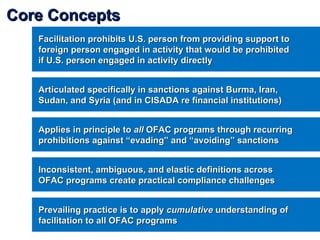
Core Concepts Facilitation prohibits U.S. person from providing support to foreign person engaged in activity that would be prohibited if U.S. person engaged in activity directly Articulated specifically in sanctions against Burma, Iran, Sudan, and Syria (and in CISADA re financial institutions) Applies in principle to  all  OFAC programs through recurring prohibitions against โ€œevadingโ€ and โ€œavoidingโ€ sanctions Inconsistent, ambiguous, and elastic definitions across OFAC programs create practical compliance challenges Prevailing practice is to apply  cumulative  understanding of facilitation to all OFAC programs
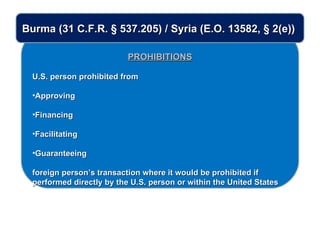
PROHIBITIONS U.S. person prohibited from Approving Financing Facilitating Guaranteeing foreign personโ€™s transaction where it would be prohibited if performed directly by the U.S. person or within the United States Burma (31 C.F.R. ยง 537.205) / Syria (E.O. 13582, ยง 2(e))
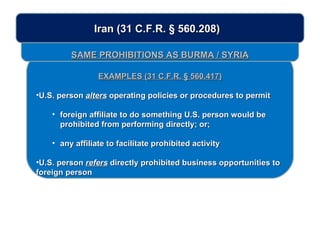
EXAMPLES (31 C.F.R. ยง 560.417) U.S. person  alters  operating policies or procedures to permit foreign affiliate to do something U.S. person would be prohibited from performing directly; or; any affiliate to facilitate prohibited activity U.S. person  refers  directly prohibited business opportunities to foreign person SAME PROHIBITIONS AS BURMA / SYRIA Iran (31 C.F.R. ยง 560.208)
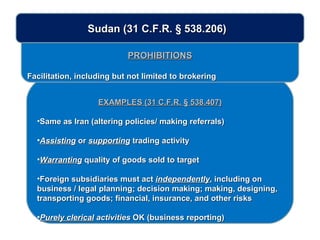
EXAMPLES (31 C.F.R. ยง 538.407) Same as Iran (altering policies/ making referrals) Assisting  or  supporting  trading activity Warranting  quality of goods sold to target Foreign subsidiaries must act  independently , including on business / legal planning; decision making; making, designing, transporting goods; financial, insurance, and other risks Purely clerical  activities  OK (business reporting) PROHIBITIONS Facilitation, including but not limited to brokering Sudan (31 C.F.R. ยง 538.206)
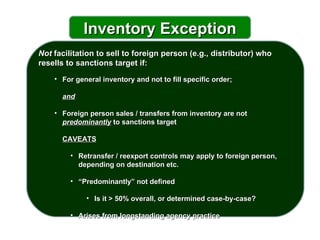
Not  facilitation to sell to foreign person (e.g., distributor) who resells to sanctions target if: For general inventory and not to fill specific order;    and Foreign person sales / transfers from inventory are not  predominantly  to sanctions target CAVEATS Retransfer / reexport controls may apply to foreign person, depending on destination etc. โ€œ Predominantlyโ€ not defined Is it > 50% overall, or determined case-by-case?  Arises from longstanding agency practice  Inventory Exception
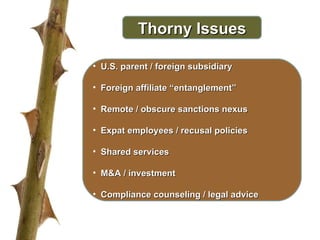
Thorny Issues U.S. parent / foreign subsidiary Foreign affiliate โ€œentanglementโ€ Remote / obscure sanctions nexus Expat employees / recusal policies Shared services M&A / investment Compliance counseling / legal advice
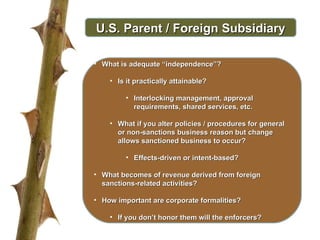
U.S. Parent / Foreign Subsidiary What is adequate โ€œindependenceโ€? Is it practically attainable? Interlocking management, approval requirements, shared services, etc.  What if you alter policies / procedures for general or non-sanctions business reason but change allows sanctioned business to occur? Effects-driven or intent-based? What becomes of revenue derived from foreign sanctions-related activities? How important are corporate formalities? If you donโ€™t honor them will the enforcers?
Foreign Affiliate โ€œEntanglementโ€ Foreign affiliates donโ€™t always recognize that what they can do lawfully is illegal for you to support under U.S. law What if affiliate does not disclose sanctions connection when requesting support?  Compare to โ€œstripping,โ€ where a bank will be deemed in violation of OFAC sanctions when it removes information from payment instructions to avoid detection of sanctions activity Remember: potential strict liability for civil violations (no need to prove intent) Can trigger liability for foreign person as well
Remote / Obscure Sanctions Nexus How deeply into a transaction must you delve to confirm no sanctions connection? How many steps removed are sufficient to eliminate liability for violations? Is strict liability actually enforced absent some indication of knowledge or reason to know? Reason to know may be inferred from documentary trail Bank blocking / reject reports may reveal sanctions nexus not adequately considered by U.S. person and give OFAC notice of potential facilitation Whither the โ€œbutterfly effectโ€?
Expat Employees / Recusal Policies How do U.S. expats act appropriately when presented with sanctions activities? Especially managers and board members Remember: Green Card holders are U.S. persons for OFAC purposes Is recusal a potential Catch-22?  Does it matter who creates the policy (U.S. versus foreign person) and why (general versus sanctions-specific)? Does the very act of recusal potentially facilitate by allowing a transaction to otherwise proceed?
Shared Services How do you manage IT, ERP, finance, compliance, HR, and other potential shared services in global company with foreign business in OFAC-sanctioned countries? Where is line drawn for clerical services? What if โ€œroutineโ€ financial report provides basis for making sanctions-related business decision? Distinction between general and dedicated services?  Does โ€œpredominanceโ€ matter? Some practitioners say that analysis is similar to โ€œinventoryโ€ exception, which itself is not fully clear
When U.S. company acquires interest in foreign company, no โ€œgrace periodโ€ to wind down sanctions-related activities that could impute liability Due diligence therefore essential to anticipate and address potential risks Risks vary depending on nature and extent of investment and subsequent authority What about passive investment / international securities offerings? No โ€œper seโ€ rule but practitioners often identify a conservative range of 5-15% of sanctioned business as potentially tolerable for U.S. investment What becomes of revenue derived from foreign sanctions-related activities? M&A / Investment
How do you distinguish permissible compliance counseling from impermissible business / strategic / legal advice? Can you advise on a hypothetical business deal involving sanctions targets? What about general business strategy without reference to a specific sanctions-related transaction? Again, is the โ€œpredominanceโ€ concept vital, let alone subject to practical interpretation? Compliance Counseling / Legal Advice
OFAC has settled a number of reported civil cases alleging facilitation violations against full range of parties, including banks, U.S. corporate affiliates, and shippers But OFAC public enforcement data yield little helpful information about precise facts / elements that constitute alleged facilitation in any particular case Anecdotal information suggests that OFAC tends to advance an expansive view of facilitation (โ€œif the dots connect...โ€) Lack of transparency / consistency, established deference courts grant OFAC to interpret its rules, and potentially steep penalties, create uncertain compliance landscape Arguably calculated to give OFAC visibility / control and compel conservative behavior BOTTOM LINE: any U.S. nexus to a sanctioned transaction, however seemingly attenuated, triggers facilitation risk Enforcement Trends
Anticipate as part of due diligence potential sanctions risks associated with proposed international activities and operations  Easier and less disruptive to prevent than correct Donโ€™t discount possibility of OFAC issues in global environment โ€“ most U.S. sanctions are unilateral Think big picture - envision all possibilities, however remote Use policies, procedures, and contractual limitations / exclusions to prevent becoming embroiled in sanctions activities But timing is key, and be careful that your effort to comply does not itself become unwitting facilitation Educate foreign counterparts about U.S. sanctions risks Compliance Strategies Remember: if you canโ€™t do it yourself directly, you probably canโ€™t help someone else do it
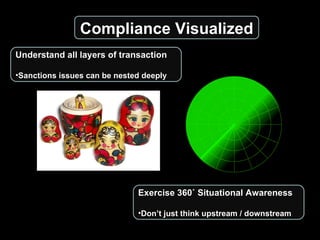
Compliance Visualized Understand all layers of transaction Sanctions issues can be nested deeply Exercise 360หš Situational Awareness Donโ€™t just think upstream / downstream
My presentation was informed by invaluable and generous insights from members of the American Bar Association, Section of International Law & Practice, Export Control & Economic Sanctions Committee Special thanks to Professor Terence Lau, whose 2004 paper on facilitation remains a vital guidepost: Terence Lau. "Triggering Parent Company Liability Under United States Sanctions Regimes: The Troubling Implications of Prohibiting Approval and Facilitation" American Business Law Journal 41.4 (2004): 413-457. Available at: http://works.bepress.com/terence_lau/4. Hat tip to Clif Burns, Esq. at Bryan Cave who previously invoked the โ€œbutterfly effectโ€ metaphor in one of his excellent essays in his indispensable Export Law Blog (http://www.exportlawblog.com) The information in this presentation should not be construed as legal advice or the furnishing of professional services, nor does it represent the views of any third party Acknowledgements

Pisa-Relli OFAC Facilitation (October 2011)

  • 1.
    John Pisa-Relli LegalDirector, Trade Compliance Thales USA, Inc. The Butterfly Effect Making Sense of OFAC Facilitation Prohibitions
  • 2.
    Merriam-Webster : tomake easier : help bring about facilitate fษ™-si-lษ™-tฤt (transitive verb) OFAC : to do anything [pretty much] that can be associated, however remotely, with a sanctions target
  • 3.
    Core Concepts Facilitationprohibits U.S. person from providing support to foreign person engaged in activity that would be prohibited if U.S. person engaged in activity directly Articulated specifically in sanctions against Burma, Iran, Sudan, and Syria (and in CISADA re financial institutions) Applies in principle to all OFAC programs through recurring prohibitions against โ€œevadingโ€ and โ€œavoidingโ€ sanctions Inconsistent, ambiguous, and elastic definitions across OFAC programs create practical compliance challenges Prevailing practice is to apply cumulative understanding of facilitation to all OFAC programs
  • 4.
    PROHIBITIONS U.S. personprohibited from Approving Financing Facilitating Guaranteeing foreign personโ€™s transaction where it would be prohibited if performed directly by the U.S. person or within the United States Burma (31 C.F.R. ยง 537.205) / Syria (E.O. 13582, ยง 2(e))
  • 5.
    EXAMPLES (31 C.F.R.ยง 560.417) U.S. person alters operating policies or procedures to permit foreign affiliate to do something U.S. person would be prohibited from performing directly; or; any affiliate to facilitate prohibited activity U.S. person refers directly prohibited business opportunities to foreign person SAME PROHIBITIONS AS BURMA / SYRIA Iran (31 C.F.R. ยง 560.208)
  • 6.
    EXAMPLES (31 C.F.R.ยง 538.407) Same as Iran (altering policies/ making referrals) Assisting or supporting trading activity Warranting quality of goods sold to target Foreign subsidiaries must act independently , including on business / legal planning; decision making; making, designing, transporting goods; financial, insurance, and other risks Purely clerical activities OK (business reporting) PROHIBITIONS Facilitation, including but not limited to brokering Sudan (31 C.F.R. ยง 538.206)
  • 7.
    Not facilitationto sell to foreign person (e.g., distributor) who resells to sanctions target if: For general inventory and not to fill specific order; and Foreign person sales / transfers from inventory are not predominantly to sanctions target CAVEATS Retransfer / reexport controls may apply to foreign person, depending on destination etc. โ€œ Predominantlyโ€ not defined Is it > 50% overall, or determined case-by-case? Arises from longstanding agency practice Inventory Exception
  • 8.
    Thorny Issues U.S.parent / foreign subsidiary Foreign affiliate โ€œentanglementโ€ Remote / obscure sanctions nexus Expat employees / recusal policies Shared services M&A / investment Compliance counseling / legal advice
  • 9.
    U.S. Parent /Foreign Subsidiary What is adequate โ€œindependenceโ€? Is it practically attainable? Interlocking management, approval requirements, shared services, etc. What if you alter policies / procedures for general or non-sanctions business reason but change allows sanctioned business to occur? Effects-driven or intent-based? What becomes of revenue derived from foreign sanctions-related activities? How important are corporate formalities? If you donโ€™t honor them will the enforcers?
  • 10.
    Foreign Affiliate โ€œEntanglementโ€Foreign affiliates donโ€™t always recognize that what they can do lawfully is illegal for you to support under U.S. law What if affiliate does not disclose sanctions connection when requesting support? Compare to โ€œstripping,โ€ where a bank will be deemed in violation of OFAC sanctions when it removes information from payment instructions to avoid detection of sanctions activity Remember: potential strict liability for civil violations (no need to prove intent) Can trigger liability for foreign person as well
  • 11.
    Remote / ObscureSanctions Nexus How deeply into a transaction must you delve to confirm no sanctions connection? How many steps removed are sufficient to eliminate liability for violations? Is strict liability actually enforced absent some indication of knowledge or reason to know? Reason to know may be inferred from documentary trail Bank blocking / reject reports may reveal sanctions nexus not adequately considered by U.S. person and give OFAC notice of potential facilitation Whither the โ€œbutterfly effectโ€?
  • 12.
    Expat Employees /Recusal Policies How do U.S. expats act appropriately when presented with sanctions activities? Especially managers and board members Remember: Green Card holders are U.S. persons for OFAC purposes Is recusal a potential Catch-22? Does it matter who creates the policy (U.S. versus foreign person) and why (general versus sanctions-specific)? Does the very act of recusal potentially facilitate by allowing a transaction to otherwise proceed?
  • 13.
    Shared Services Howdo you manage IT, ERP, finance, compliance, HR, and other potential shared services in global company with foreign business in OFAC-sanctioned countries? Where is line drawn for clerical services? What if โ€œroutineโ€ financial report provides basis for making sanctions-related business decision? Distinction between general and dedicated services? Does โ€œpredominanceโ€ matter? Some practitioners say that analysis is similar to โ€œinventoryโ€ exception, which itself is not fully clear
  • 14.
    When U.S. companyacquires interest in foreign company, no โ€œgrace periodโ€ to wind down sanctions-related activities that could impute liability Due diligence therefore essential to anticipate and address potential risks Risks vary depending on nature and extent of investment and subsequent authority What about passive investment / international securities offerings? No โ€œper seโ€ rule but practitioners often identify a conservative range of 5-15% of sanctioned business as potentially tolerable for U.S. investment What becomes of revenue derived from foreign sanctions-related activities? M&A / Investment
  • 15.
    How do youdistinguish permissible compliance counseling from impermissible business / strategic / legal advice? Can you advise on a hypothetical business deal involving sanctions targets? What about general business strategy without reference to a specific sanctions-related transaction? Again, is the โ€œpredominanceโ€ concept vital, let alone subject to practical interpretation? Compliance Counseling / Legal Advice
  • 16.
    OFAC has settleda number of reported civil cases alleging facilitation violations against full range of parties, including banks, U.S. corporate affiliates, and shippers But OFAC public enforcement data yield little helpful information about precise facts / elements that constitute alleged facilitation in any particular case Anecdotal information suggests that OFAC tends to advance an expansive view of facilitation (โ€œif the dots connect...โ€) Lack of transparency / consistency, established deference courts grant OFAC to interpret its rules, and potentially steep penalties, create uncertain compliance landscape Arguably calculated to give OFAC visibility / control and compel conservative behavior BOTTOM LINE: any U.S. nexus to a sanctioned transaction, however seemingly attenuated, triggers facilitation risk Enforcement Trends
  • 17.
    Anticipate as partof due diligence potential sanctions risks associated with proposed international activities and operations Easier and less disruptive to prevent than correct Donโ€™t discount possibility of OFAC issues in global environment โ€“ most U.S. sanctions are unilateral Think big picture - envision all possibilities, however remote Use policies, procedures, and contractual limitations / exclusions to prevent becoming embroiled in sanctions activities But timing is key, and be careful that your effort to comply does not itself become unwitting facilitation Educate foreign counterparts about U.S. sanctions risks Compliance Strategies Remember: if you canโ€™t do it yourself directly, you probably canโ€™t help someone else do it
  • 18.
    Compliance Visualized Understandall layers of transaction Sanctions issues can be nested deeply Exercise 360หš Situational Awareness Donโ€™t just think upstream / downstream
  • 19.
    My presentation wasinformed by invaluable and generous insights from members of the American Bar Association, Section of International Law & Practice, Export Control & Economic Sanctions Committee Special thanks to Professor Terence Lau, whose 2004 paper on facilitation remains a vital guidepost: Terence Lau. "Triggering Parent Company Liability Under United States Sanctions Regimes: The Troubling Implications of Prohibiting Approval and Facilitation" American Business Law Journal 41.4 (2004): 413-457. Available at: http://works.bepress.com/terence_lau/4. Hat tip to Clif Burns, Esq. at Bryan Cave who previously invoked the โ€œbutterfly effectโ€ metaphor in one of his excellent essays in his indispensable Export Law Blog (http://www.exportlawblog.com) The information in this presentation should not be construed as legal advice or the furnishing of professional services, nor does it represent the views of any third party Acknowledgements