© 2022, AJCSE. All Rights Reserved 40
RESEARCH ARTICLE
Pipeline Inspection Robot Monitoring System
Muhammad Ahmad Baballe1
*, Mukhtar Ibrahim Bello2
, Adamu Hussaini3
,
Usman Shuaibu Musa3
1
Department of Computer Engineering Technology, School of Technology, Kano State Polytechnic,
Kano, Nigeria, 2
Department of Computer Science, School of Technology, Kano State Polytechnic, Kano,
Nigeria, 3
Department of Computer Science and Information Sciences, Towson University, Towson,
Maryland, USA
Received on: 10/02/2022; Revised on: 25/02/2022; Accepted on: 13/03/2022
ABSTRACT
The most popular method for transporting fluids and gases is through pipelines nowadays. Regular
inspection is necessary for the pipelines to work correctly. Humans must not enter potentially dangerous
environments to inspect these pipelines. As a result of this, pipeline robots came into existence. These
pipe inspection robots help in pipeline inspection, protecting numerous people from harm since human
beings cannot enter the pipes and inspect them in case there is any such or kind of damage that requires
repair. Despite numerous improvements, pipeline robots still have several limitations. The introduction
of this in pipe inspection robots helps to solve many problems, such as leakage of the gas or fluid
pipelines, rustiness, and also if the pipe is broken from any part.
Key words: Broken, Inspection robot, Leakage, Pipeline
INTRODUCTION
Pipelines are now the most widely used method of
transport for gases and liquids (63-65). Therefore,
ongoing pipeline monitoring is necessary to
assure its safety and health.[1]
The most widely
utilized non-destructive testing inspection
techniques are optical testing, radiographic
testing, ultrasonic testing, and hydrostatic testing,
among others.[2]
However, because of recent
advancements in robotic technology,[66,67]
they are
now the preferable choice. Robots are a superior
choice because it is challenging for people to
access a small pipeline.[3]
In-Pipe Inspection
Robots (IPIR) have undergone a great deal of
improvement recently, and these advancements
are categorized according to their various
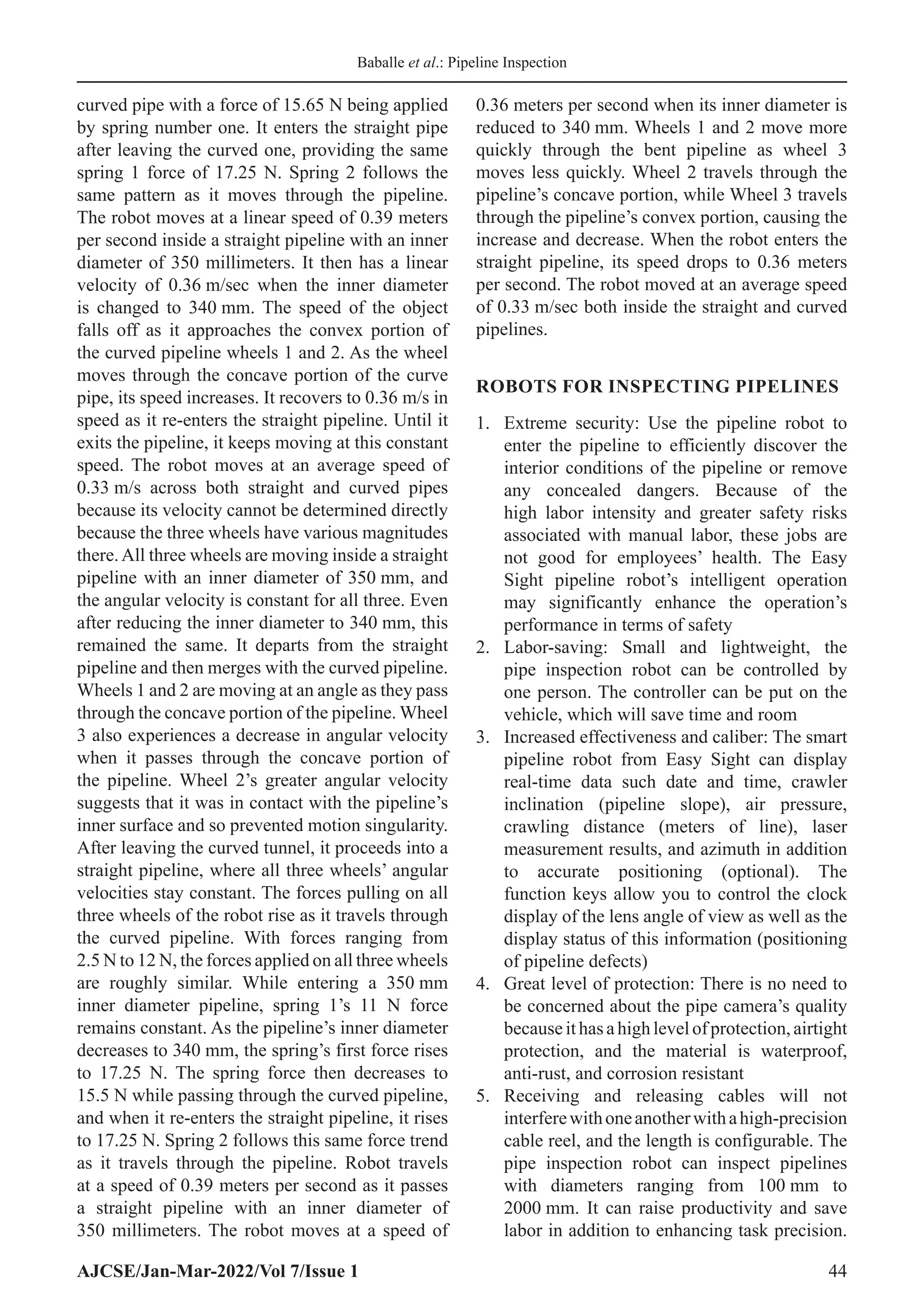
locomotion patterns. Figure 1 shows examples of
thepipelineinspectiongauge(PIG),[9,10]
screw,[16,17]
inchworm,[18-24]
wall press,[25-29]
walking,[30-34]
caterpillar,[35-39]
and wheel type.[40-52]
These
popular forms of movement have drawbacks in
addition to their benefits.[53]
Address for correspondence:
Muhammad Ahmad Baballe
E-mail: mbaballe@kanopoly.edu.ng
Robotic IPIR
The PIG type can be utilized for large distances[4,8]
and moves inside pipelines using water pressure.
The inside surface of the pipelines are not
harmed by the screw-helical type’s motion when
it moves.[11-15]
The inchworm may pass through
pipelines because of its strong grasp despite its
poor traction.[18-22]
The wall press type steadily
passes through the pipelines using contact
force.[25-29]
The walking kind employs legs to
move and has a complex mechanism, which
causes reduced surface wear and slippage.[30,34]
Caterpillars move inside pipelines using tracked
wheels, and its system enables them to adjust to
the circumstances there.[35-39]
The wheel type is
more mobile than the other varieties and can travel
inside pipelines by simply rotating its wheels.[40-44]
Due to the pipeline’s curved and branching pipes,
these robots must overcome numerous obstacles.
It encounters motion singularity and erratic motion
while doing this.[5-7]
Motion singularity
The “Motion Singularity” is the loss of contact
between a robot and pipeline intersections such
Available Online at www.ajcse.info
Asian Journal of Computer Science Engineering 2022;7(1):40-47
ISSN 2581 – 3781
Baballe et al.: Pipeline Inspection
AJCSE/Jan-Mar-2022/Vol 7/Issue 1 41
curved pipes, L-branch pipes, and T-branch
pipes.[54,55]
Due to its powerful traction force
and substantial contact area, the caterpillar robot
offers more stability and is the most widely used
IPIR. The pipeline is kept in contact with the inner
surface no matter how the pipeline is turning
using tracked wheels.[35,39,54,55]
If one of the wheels
loses contact with the inner surface of the pipe,
it is unable to pass through it, leading to motion
singularity.[54]
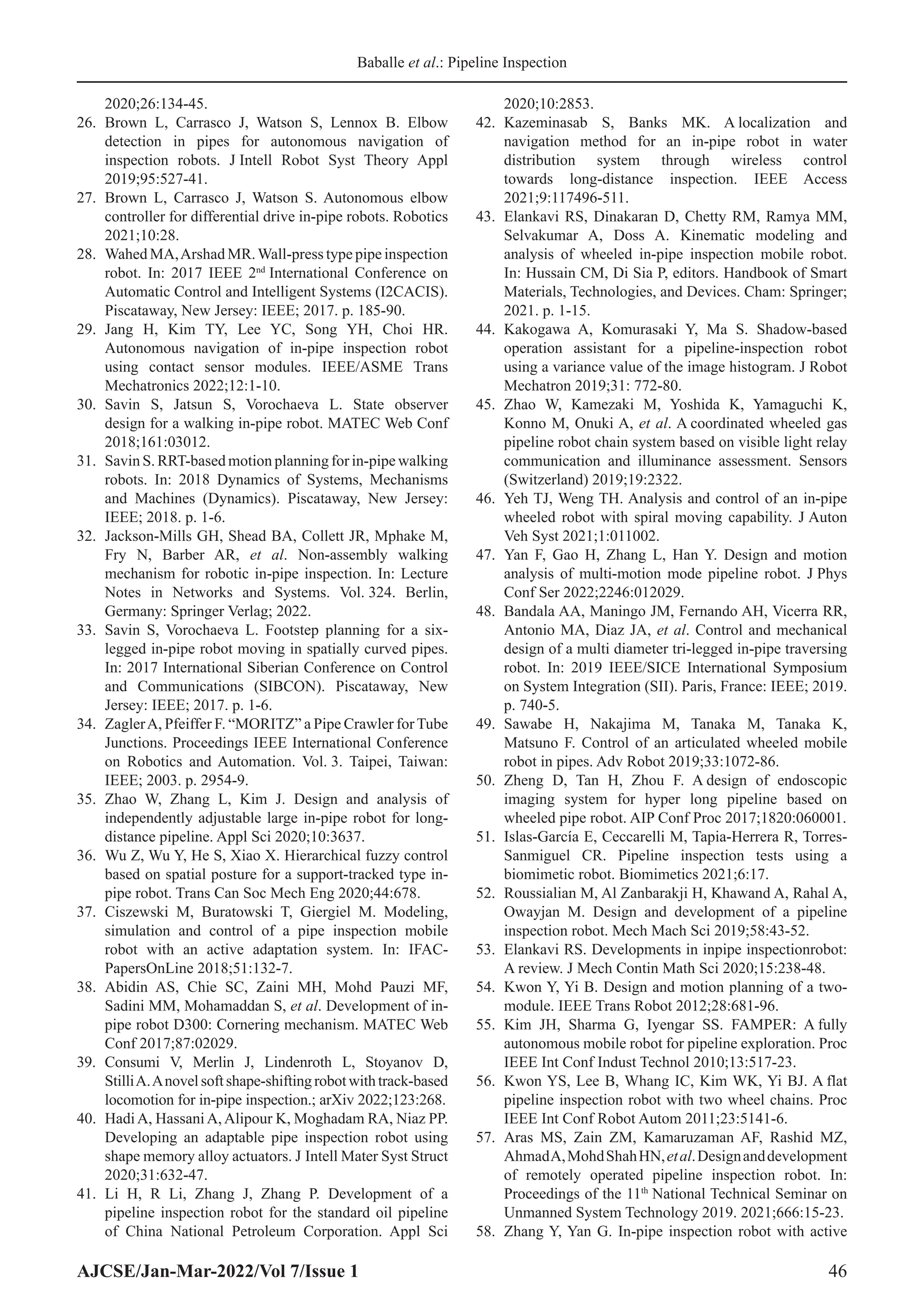
In Figure 2, a caterpillar robot
that is travelling through T-branch pipes uses
two modules in place of one to prevent motion
singularity. Three caterpillar wheels are mounted
on the first module at a 120° angle to one another,
and the second module is infix at a 60° angle
to the front module.[54]
A pipeline exploration
robot named “FAMPER” loses contact with the
inner surface of the pipeline while turning at
Y and T-branch pipes, which results in motion
singularity. The caterpillar wheels were positioned
at a 5° inclination with regard to the robot body
rather than set straight to compensate for the
loss of contact. “Motion singularity” is thereby
avoided.[55]
A two-wheel chain robot that avoids
the motion singularity is shown in.[56]
Irregular motion
According to published research, many
conventional wheeled robots use wheels that
are symmetrically positioned at a 120° angle
to ensure even loading and improved stability
while moving through pipelines. The wall
press characteristic is how the wheeled robots
acquire this stability.[35,54,57,59]
According to,[41,42]
the inclusion of six wheels corrects the uneven
motion that occurs along the circumferential axis
of the pipeline in forward motion caused by the
three-wheel arrangement in wheeled IPIR. The
wheeled robot has a three-wheel layout and moves
inside the pipelines using two different types of
wheels.[24,58,63-65]
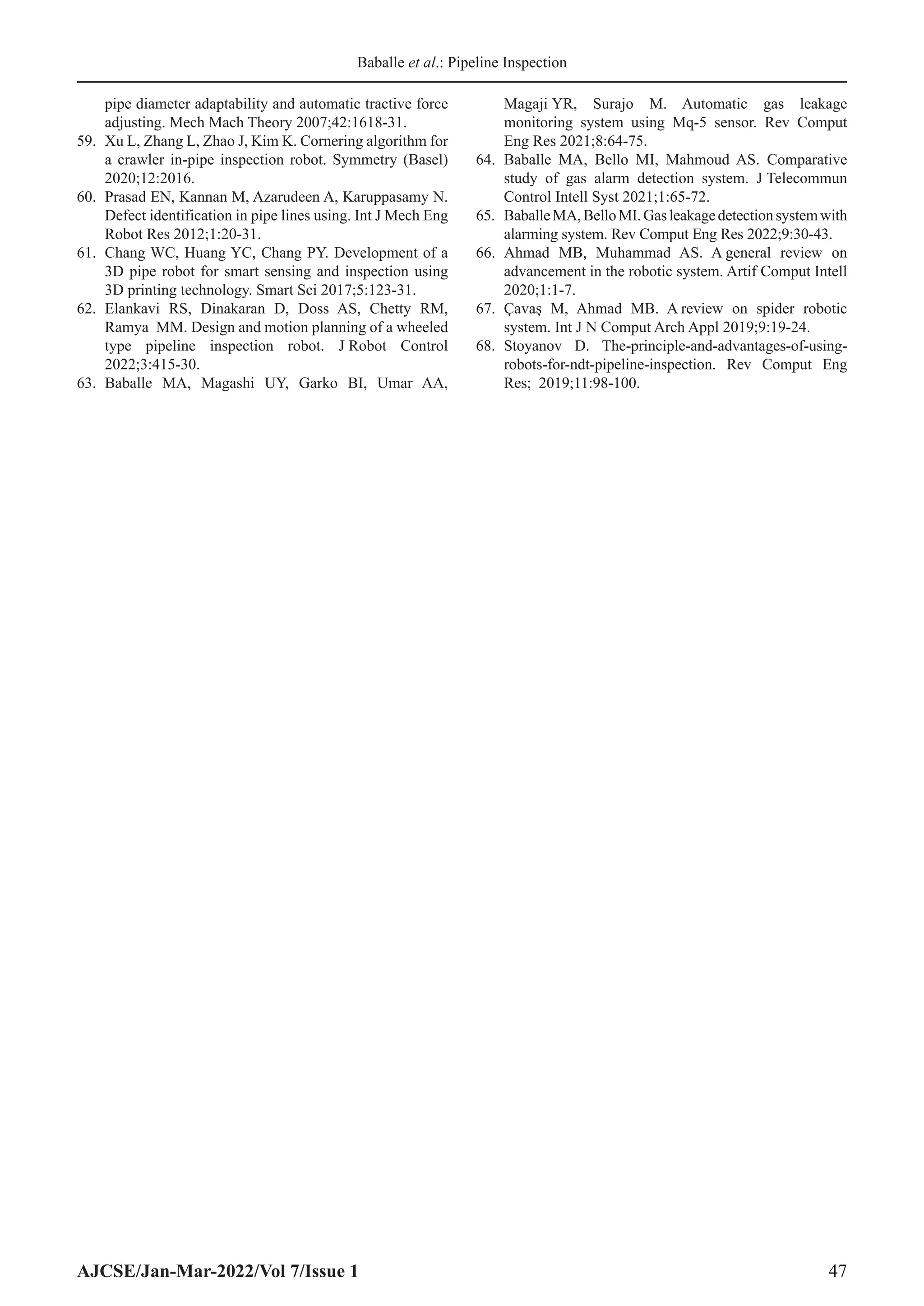
One has single wheels, whereas
the other has double wheels, as seen in Figure 3.
When moving forward, the robot’s single three-
wheel design tries to rotate in the pipeline’s
circumferential direction.[60]
Only straight
pipelines have been the subject of investigations
about their motion. The orientation of the robot at
the completing end is different from the starting
end in circumstances[61]
where it tries to roll
over to maneuver through the curved pipeline.
In addition, steering inside branching pipes is
challenging due to how the wheels are positioned.
To avoid motion singularity and irregular motion
while retaining the same orientation before and
Figure 1: Different types of in-pipe inspection robots
Figure 2: Two-module collaborative indoor pipeline
inspection robot
Baballe et al.: Pipeline Inspection
AJCSE/Jan-Mar-2022/Vol 7/Issue 1 42
after entering the curved pipeline, this research
focuses on constructing a wheeled IPIR with a
single three-wheel arrangement.[62]
Contribution
To address the issue of irregular motion and
motion singularity occurring in pipelines, a
wheeled type IPIR is proposed and developed in
this research. The wheels on this robot are different
from those on conventional robots in that they are
not fixed at a 120° angle from one another. The
location of the wheels guarantees that the robot’s
wheels are always in contact with the pipe surface
and prevents the robot from rolling over when
moving along a curved pipeline. It also aids the
robot’s navigation through branched pipes.[62]
RESOURCES AND TECHNIQUES
Initially, we used the Solidworks program to
design the robot. To ADAMS, the created model
is exported. Using the limitations listed in the
flowchart, motion analysis is performed for the
robot. The findings are then discussed. Links,
wheels, clamps, a central shaft, legs, a spring, a
fixed joint, and a prismatic joint are all features
of the proposed robot. Inside pipelines, the legs
provide improved stability. The legs are supported
bythesmalllinkages.Allofthepartsarekeptwhere
they belong thanks to the clamps. The wheels are
designed to increase mobility within pipelines. All
of the modular parts are linked to the central shaft,
which serves as the primary body. The prismatic
joint, which is the moveable joint and the one
that generates the force required for the wheels to
make contact with the inner surface of the pipeline,
moves while the fixed joint remains stationary.
Spring-based devices that compress and expand
in accordance with the inner circumference of
the pipeline supply the necessary force for the
prismatic junction. The internal pipeline diameter
of the robot can range from 250 mm to 350 mm.
It has three revolute joints and one prismatic joint.
By compressing and stretching the legs, these
joints provide the robot extra stability as it travels
through the pipelines. It helps the robot deal
with various pipeline scenarios, such curved or
T-branch pipes. The actuator scale is ascertained
using static analysis.
DISCUSSION/ANALYSIS
The ADAMS software does the motion analysis.
The robot design is imported from Solidworks
and the boundary conditions for the simulation are
provided by the ADAMS software. Body-to-body
contact, motor rpm, and spring stiffness are
taken into account. Simulations are done for the
proposed robot as well as the conditions when
the wheels are offset by 120°. In the scenario,
the robot first travels inside a 350 mm-diameter
pipeline. After traveling 600 mm, the pipeline’s
inner diameter changes; it decreases by 10 mm,
or 340 mm overall. The robot’s capacity to adjust
to pipelines of various diameters is tested by this
shift in diameter. The robot then passes through
a straight pipe once more before coming to a 90°
curved elbow. It enters the straight pipe once more
after leaving the curved pipe to exit the pipeline.
This simulation scenario tests the robot’s ability
to move through pipes that are straight, curved,
and of different diameters. The only difference
between the simulations’ parameters is the angle
at which the wheels are mounted. Gravity, motor
speed, solid body contact, and spring stiffness are
the criteria the robot must meet in order to travel
through the pipelines. The third wheel serves as
a support wheel, making the three wheels at the
bottom of the robot’s front side functional. The
robot has three inactive wheels at the back. The
motor spins at 100 rpm, and the spring stiffness is
2.826 N/mm.
Robot with wheels for pipe inspection
Traditional wheeled IPIRs have wheels that are
120°apartfromoneanother.Theangleiscalculated
Figure 3: Three-wheel configuration robot
Baballe et al.: Pipeline Inspection
AJCSE/Jan-Mar-2022/Vol 7/Issue 1 43
between the centers of each wheel and the central
axis of the robot body. The homogeneous wheel
mounting angle results in the motion singularity.
The prismatic junction between the three legs
allows them to compress uniformly as they
pass through the pipeline. Motion singularity
consequently develops inside curved pipelines.
Wheel 1 rotates with a greater angular velocity
than wheels 2 and 3, which remain stationary. The
three wheels’ angular velocity is constant as the
inner diameter of the pipe shrinks. The robot then
attempts to enter the curved pipeline, but wheel
3 loses contact, preventing the robot from doing
so. It demonstrates that wheel 3’s angular velocity,
which should have been high when it traversed the
concave region of the pipe, has remained constant
in magnitude. The fact that it lost contact with the
pipe wall is thus demonstrated. A maximum force
of approximately 11.25 N is applied to wheels
1, 2, and 3 as the robot goes through a 350 mm
pipeline. Wheels 1 and 2 encounter the most
force when the pipeline diameter is increased to
340 mm, whilst wheel 3 experiences a decrease in
forces. The forces pulling on the wheels then cease
to exist. Wheel 3 experiences an increase in force
when the robot enters the curved pipeline because
the wheel loses touch with the concave portion of
the inner pipeline surface. When the robot tries to
travel through a curved pipe, it loses contact with
one of the wheels and is unable to do so; however,
the two wheels that are still in contact exert a
force on the spring, which is why wheel 3 has a
high spike after losing contact. The spring force
causes the wheels to push the robot backward,
which causes wheel 3 to hit the inside of the pipe
and generate a huge force spike. Here, springs 1
and 2 refer to the springs in the front and back
of the robot, respectively. When the robot passes
through a pipeline with a 350 mm inner diameter,
the force supplied by springs 1 and 2 ranges from
1.25 to 12.5 N. When the inner pipeline diameter
reaches 340 mm, the force generated by springs 1
and 2 approaches 17.5 N. The robot cannot move
through the curved pipeline because of motion
singularity, which causes the force in spring 1
to decrease. Motion singularity causes the back
half to exert a slight push at that precise moment
because of the inertia of motion. As a result, the
legs on the robot’s back compress, producing
a strong force of roughly 25 N at first before
progressively reducing. It moves at an average
linear velocity of 0.35 m/s while inside the
350 mm straight pipeline. The linear speed of the
robot varies between 0.30 and 0.35 m/s when the
inner diameter of the pipeline drops to 340 mm.
The robot then tries to enter the curved pipeline
but is unable to do so due to motion singularity,
causing a sharp fall in linear velocity.
Wheeled IPIR design modification
The suggested wheeled design Inspection of the
Pipe, the wheels are asymmetrically and at various
angles mounted by the robot. The arrangement of
the wheels results in angles that are 120°, 104.88°,
and 135.12° apart from one another. Calculations
are made to determine the angle between the
central axes of each wheel and the body of the
robot.
In the curved pipeline, a robot With the exception
of the wheel mounting angle, it uses the same
mechanism as a conventional robot with wheels.
The motion singularity in the curved pipeline
is therefore avoided by the suggested design.
The angular velocity of all three wheels remains
constant as the robot moves through a straight
pipeline with an inner diameter of 350 mm.
When the inner pipeline diameter was reduced
to 340 mm, small spikes in angular velocity
were observed. After then, it moves via a straight
pipeline with a constant angular velocity for the
three wheels. The angular velocity of wheel 3
increases while that of wheels 1 and 2 decreases
as the robot moves along the curved pipeline.
Wheel 3 has a higher magnitude than the other
two wheels because it travels through the concave
portion, which causes its angular velocity to
increase. This demonstrates that the robot’s
wheels are in contact with the ground as it travels
through the bent conduit. After leaving the curved
pipe, it enters a straight pipeline where the three
wheels’ angular velocities are held constant.
As they go along the curved pipeline, there are
increased forces on all three wheels. The forces
ranging from 2.5 to 10 N are equally distributed
among the three wheels. The springs utilized in
the front and back of the robot are numbered 1
and 2, respectively. When going through a straight
pipe with an inner diameter of 350 mm, spring 1
exerts a force of 11 N. When the inner diameter
of the pipe is reduced to 340 mm, spring 1’s force
increases to 17.25 N. The robot travels through the
Baballe et al.: Pipeline Inspection
AJCSE/Jan-Mar-2022/Vol 7/Issue 1 44
curved pipe with a force of 15.65 N being applied
by spring number one. It enters the straight pipe
after leaving the curved one, providing the same
spring 1 force of 17.25 N. Spring 2 follows the
same pattern as it moves through the pipeline.
The robot moves at a linear speed of 0.39 meters
per second inside a straight pipeline with an inner
diameter of 350 millimeters. It then has a linear
velocity of 0.36 m/sec when the inner diameter
is changed to 340 mm. The speed of the object
falls off as it approaches the convex portion of
the curved pipeline wheels 1 and 2. As the wheel
moves through the concave portion of the curve
pipe, its speed increases. It recovers to 0.36 m/s in
speed as it re-enters the straight pipeline. Until it
exits the pipeline, it keeps moving at this constant
speed. The robot moves at an average speed of
0.33 m/s across both straight and curved pipes
because its velocity cannot be determined directly
because the three wheels have various magnitudes
there.All three wheels are moving inside a straight
pipeline with an inner diameter of 350 mm, and
the angular velocity is constant for all three. Even
after reducing the inner diameter to 340 mm, this
remained the same. It departs from the straight
pipeline and then merges with the curved pipeline.
Wheels 1 and 2 are moving at an angle as they pass
through the concave portion of the pipeline. Wheel
3 also experiences a decrease in angular velocity
when it passes through the concave portion of
the pipeline. Wheel 2’s greater angular velocity
suggests that it was in contact with the pipeline’s
inner surface and so prevented motion singularity.
After leaving the curved tunnel, it proceeds into a
straight pipeline, where all three wheels’ angular
velocities stay constant. The forces pulling on all
three wheels of the robot rise as it travels through
the curved pipeline. With forces ranging from
2.5 N to 12 N, the forces applied on all three wheels
are roughly similar. While entering a 350 mm
inner diameter pipeline, spring 1’s 11 N force
remains constant. As the pipeline’s inner diameter
decreases to 340 mm, the spring’s first force rises
to 17.25 N. The spring force then decreases to
15.5 N while passing through the curved pipeline,
and when it re-enters the straight pipeline, it rises
to 17.25 N. Spring 2 follows this same force trend
as it travels through the pipeline. Robot travels
at a speed of 0.39 meters per second as it passes
a straight pipeline with an inner diameter of
350 millimeters. The robot moves at a speed of
0.36 meters per second when its inner diameter is
reduced to 340 mm. Wheels 1 and 2 move more
quickly through the bent pipeline as wheel 3
moves less quickly. Wheel 2 travels through the
pipeline’s concave portion, while Wheel 3 travels
through the pipeline’s convex portion, causing the
increase and decrease. When the robot enters the
straight pipeline, its speed drops to 0.36 meters
per second. The robot moved at an average speed
of 0.33 m/sec both inside the straight and curved
pipelines.
ROBOTS FOR INSPECTING PIPELINES
1. Extreme security: Use the pipeline robot to
enter the pipeline to efficiently discover the
interior conditions of the pipeline or remove
any concealed dangers. Because of the
high labor intensity and greater safety risks
associated with manual labor, these jobs are
not good for employees’ health. The Easy
Sight pipeline robot’s intelligent operation
may significantly enhance the operation’s
performance in terms of safety
2. Labor-saving: Small and lightweight, the
pipe inspection robot can be controlled by
one person. The controller can be put on the
vehicle, which will save time and room
3. Increased effectiveness and caliber: The smart
pipeline robot from Easy Sight can display
real-time data such date and time, crawler
inclination (pipeline slope), air pressure,
crawling distance (meters of line), laser
measurement results, and azimuth in addition
to accurate positioning (optional). The
function keys allow you to control the clock
display of the lens angle of view as well as the
display status of this information (positioning
of pipeline defects)
4. Great level of protection: There is no need to
be concerned about the pipe camera’s quality
becauseithasahighlevelofprotection,airtight
protection, and the material is waterproof,
anti-rust, and corrosion resistant
5. Receiving and releasing cables will not
interferewithoneanotherwithahigh-precision
cable reel, and the length is configurable. The
pipe inspection robot can inspect pipelines
with diameters ranging from 100 mm to
2000 mm. It can raise productivity and save
labor in addition to enhancing task precision.
Baballe et al.: Pipeline Inspection
AJCSE/Jan-Mar-2022/Vol 7/Issue 1 45
In addition, it can maintain the pipeline in
some locations where manual labor is not
appropriate and quickly identify the internal
sources of pipeline degradation.[68]
CONCLUSION
In this work, we contrast the suggested wheeled
type IPIR with the wheeled type IPIR that is
currently in use. The three wheels are mounted on
the current design at a 120° angle from one another.
Both the suggested and conventional wheeled
forms of IPIR are simulated. The ideal angles are
104.88°, 135.12°, and 120°. Results of velocity
and force analyses for each wheel demonstrate
how this design brings the wheels into contact with
the pipelines. The created robot did not experience
the unequal force experienced by the robot with a
wheel mounting angle of 120° when traversing the
curved pipeline. Also discussed are the effects of
the in-pipe wheel robots.
REFERENCES
1. Adegboye MA, Fung WK, Karnik A. Recent advances
in pipeline monitoring and oil leakage detection
technologies: Principles and approaches. Sensors
(Switzerland) 2019;19:2548.
2. Carvalho AA, Rebello JM, Souza MP, Sagrilo LV,
Soares SD. Reliability of non-destructive test techniques
in the inspection of pipelines used in the oil industry. Int
J Pressure Vessels Piping 2008;85:745-51.
3. Kakogawa A, Ma S. Robotic search and rescue through
in-pipe movement. In: Unmanned Robotic Systems and
Applications. London, UK: Intechopen; 2020.
4. Zhou J, Deng T, Peng J, Liang G, Zhou X, Gong J.
Experimental study on pressure pulses in long-distance
gas pipeline during the pigging process. Sci Prog
2020;103:368.
5. Zhang H, Dong J, Cui C, Liu S. Stress and strain
analysis of spherical sealing cups of fluid-driven
pipeline robot in dented oil and gas pipeline. Eng Fail
Anal 2020;108:104294.
6. Liu C, Wei Y, Cao Y, Zhang S, Sun Y. Traveling ability
of pipeline inspection gauge (PIG) in elbow under
different friction coefficients by 3D FEM. J Nat Gas Sci
Eng 2020;75:103134.
7. Jiang J, Zhang H, Ji B, Yi F, Yan F, Liu X. Numerical
investigation on sealing performance of drainage
pipeline inspection gauge crossing pipeline elbows.
Energy Sci Eng 2021;9:1858-71.
8. Dong J, Liu S, Zhang H, Xiao H. Experiment and
simulation of a controllable multi-airbag sealing disc of
pipeline inspection gauges (PIGs). Int J Press Vessel Pip
2021;192:104422.
9. Chen Z. Deformation and stress analysis of cup
on pipeline inspection gauge based on reverse
measurement. Energy Sci Eng 2022;10:2509-26.
10. Zhang H, Gao MQ, Tang B, Cui C, Xu XF. Dynamic
characteristics of the pipeline inspection gauge under
girth weld excitation in submarine pipeline. Pet Sci
2022;19:774-88.
11. Ren T, Zhang Y, Li Y, Chen Y, Liu Q. Driving
mechanisms, motion, and mechanics of screw drive in-
pipe robots: A review. Appl Sci 2019;9:2514.
12. Tourajizadeh H, Boomeri V, Rezaei M, Sedigh A.
Dynamic optimization of a steerable screw in-pipe
inspection robot using HJB and turbine installation.
Robotica 2020;38:2001-22.
13. Li T, Liu K, Liu H, Cui X, Li B, Wang Y. Rapid design
of a screw drive in-pipe robot based on parameterized
simulation technology. Simulation 2019;95:45.
14. Tourajizadeh H, Rezaei M, Sedigh AH. Optimal control
of screw in-pipe inspection robot with controllable
pitch rate. J Intell Robot Syst 2018;90:269-86.
15. Li P, Tang M, Lyu C, Fang M, Duan X, Liu Y. Design
and analysis of a novel active screw-drive pipe robot.
Adv Mech Eng 2018;10:168.
16. Tu Q, Liu Q, Ren T, Li Y. Obstacle crossing and traction
performance of active and passive screw pipeline
robots. J Mech Sci Technol 2019;33:2417-27.
17. Tourajizadeh H, Rezaei M. Design and control
of a steerable screw in-pipe inspection robot. In:
2016 4th
International Conference on Robotics and
Mechatronics (ICROM). Piscataway, New Jersey:
IEEE; 2016. p. 98-104.
18. Yamamoto T, Sakama S, Kamimura A. Pneumatic
duplex-chambered inchworm mechanism for narrow
pipes driven by only two air supply lines. IEEE Robot
Autom Lett 2020;5:5034-42.
19. Kusunose K, Akagi T, Dohta S, Kobayashi W,
Shinohara T, Hane Y, et al. Development of inchworm
type pipe inspection robot using extension type
flexible pneumatic actuators. Int J Automot Mech Eng
2020;17:8019-28.
20. Hayashi K, Akagi T, Dohta S, Kobayashi W,
Shinohara T, Kusunose K, et al. Improvement of pipe
holding mechanism and inchworm type flexible pipe
inspection robot. Int J Mech Eng Robot Res 2020;9:6.
21. Fang D, Shang J, Luo Z, Lv P, Wu G. Development
of a novel self-locking mechanism for continuous
propulsion inchworm in-pipe robot. Adv Mech Eng
2018;10:345.
22. Khan MB, Chuthong T, Do CD, Thor M, Billeschou P,
LarsenJC,etal.ICrawl:Aninchworm-inspiredcrawling
robot. IEEE Access 2020;8:1.
23. Aliff M, Imran M, Izwan S, Ismail M, Samsiah N,
Shimooka S, et al. Development of pipe inspection
robot using soft actuators, microcontroller and labview.
Int J Adv Comput Sci Appl 2022;13:349-54.
24. Yang J, Xue Y, Shang J, Luo Z. Research on a new
bilateral self-locking mechanism for an inchworm
micro in-pipe robot with large traction. Int J Adv Robot
Syst 2014;11:174.
25. Feng G, Li W, Li Z, He Z. Development of a wheeled
and wall-pressing type in-pipe robot for water pipelines
cleaning and its traveling capability. Mechanika
Baballe et al.: Pipeline Inspection
AJCSE/Jan-Mar-2022/Vol 7/Issue 1 46
2020;26:134-45.
26. Brown L, Carrasco J, Watson S, Lennox B. Elbow
detection in pipes for autonomous navigation of
inspection robots. J Intell Robot Syst Theory Appl
2019;95:527-41.
27. Brown L, Carrasco J, Watson S. Autonomous elbow
controller for differential drive in-pipe robots. Robotics
2021;10:28.
28. Wahed MA,Arshad MR.Wall-press type pipe inspection
robot. In: 2017 IEEE 2nd
International Conference on
Automatic Control and Intelligent Systems (I2CACIS).
Piscataway, New Jersey: IEEE; 2017. p. 185-90.
29. Jang H, Kim TY, Lee YC, Song YH, Choi HR.
Autonomous navigation of in-pipe inspection robot
using contact sensor modules. IEEE/ASME Trans
Mechatronics 2022;12:1-10.
30. Savin S, Jatsun S, Vorochaeva L. State observer
design for a walking in-pipe robot. MATEC Web Conf
2018;161:03012.
31. Savin S. RRT-based motion planning for in-pipe walking
robots. In: 2018 Dynamics of Systems, Mechanisms
and Machines (Dynamics). Piscataway, New Jersey:
IEEE; 2018. p. 1-6.
32. Jackson-Mills GH, Shead BA, Collett JR, Mphake M,
Fry N, Barber AR, et al. Non-assembly walking
mechanism for robotic in-pipe inspection. In: Lecture
Notes in Networks and Systems. Vol. 324. Berlin,
Germany: Springer Verlag; 2022.
33. Savin S, Vorochaeva L. Footstep planning for a six-
legged in-pipe robot moving in spatially curved pipes.
In: 2017 International Siberian Conference on Control
and Communications (SIBCON). Piscataway, New
Jersey: IEEE; 2017. p. 1-6.
34. ZaglerA, Pfeiffer F. “MORITZ” a Pipe Crawler forTube
Junctions. Proceedings IEEE International Conference
on Robotics and Automation. Vol. 3. Taipei, Taiwan:
IEEE; 2003. p. 2954-9.
35. Zhao W, Zhang L, Kim J. Design and analysis of
independently adjustable large in-pipe robot for long-
distance pipeline. Appl Sci 2020;10:3637.
36. Wu Z, Wu Y, He S, Xiao X. Hierarchical fuzzy control
based on spatial posture for a support-tracked type in-
pipe robot. Trans Can Soc Mech Eng 2020;44:678.
37. Ciszewski M, Buratowski T, Giergiel M. Modeling,
simulation and control of a pipe inspection mobile
robot with an active adaptation system. In: IFAC-
PapersOnLine 2018;51:132-7.
38. Abidin AS, Chie SC, Zaini MH, Mohd Pauzi MF,
Sadini MM, Mohamaddan S, et al. Development of in-
pipe robot D300: Cornering mechanism. MATEC Web
Conf 2017;87:02029.
39. Consumi V, Merlin J, Lindenroth L, Stoyanov D,
StilliA.Anovelsoftshape-shiftingrobotwithtrack-based
locomotion for in-pipe inspection.; arXiv 2022;123:268.
40. HadiA, HassaniA,Alipour K, Moghadam RA, Niaz PP.
Developing an adaptable pipe inspection robot using
shape memory alloy actuators. J Intell Mater Syst Struct
2020;31:632-47.
41. Li H, R Li, Zhang J, Zhang P. Development of a
pipeline inspection robot for the standard oil pipeline
of China National Petroleum Corporation. Appl Sci
2020;10:2853.
42. Kazeminasab S, Banks MK. A localization and
navigation method for an in-pipe robot in water
distribution system through wireless control
towards long-distance inspection. IEEE Access
2021;9:117496-511.
43. Elankavi RS, Dinakaran D, Chetty RM, Ramya MM,
Selvakumar A, Doss A. Kinematic modeling and
analysis of wheeled in-pipe inspection mobile robot.
In: Hussain CM, Di Sia P, editors. Handbook of Smart
Materials, Technologies, and Devices. Cham: Springer;
2021. p. 1-15.
44. Kakogawa A, Komurasaki Y, Ma S. Shadow-based
operation assistant for a pipeline-inspection robot
using a variance value of the image histogram. J Robot
Mechatron 2019;31: 772-80.
45. Zhao W, Kamezaki M, Yoshida K, Yamaguchi K,
Konno M, Onuki A, et al. A coordinated wheeled gas
pipeline robot chain system based on visible light relay
communication and illuminance assessment. Sensors
(Switzerland) 2019;19:2322.
46. Yeh TJ, Weng TH. Analysis and control of an in-pipe
wheeled robot with spiral moving capability. J Auton
Veh Syst 2021;1:011002.
47. Yan F, Gao H, Zhang L, Han Y. Design and motion
analysis of multi-motion mode pipeline robot. J Phys
Conf Ser 2022;2246:012029.
48. Bandala AA, Maningo JM, Fernando AH, Vicerra RR,
Antonio MA, Diaz JA, et al. Control and mechanical
design of a multi diameter tri-legged in-pipe traversing
robot. In: 2019 IEEE/SICE International Symposium
on System Integration (SII). Paris, France: IEEE; 2019.
p. 740-5.
49. Sawabe H, Nakajima M, Tanaka M, Tanaka K,
Matsuno F. Control of an articulated wheeled mobile
robot in pipes. Adv Robot 2019;33:1072-86.
50. Zheng D, Tan H, Zhou F. A design of endoscopic
imaging system for hyper long pipeline based on
wheeled pipe robot. AIP Conf Proc 2017;1820:060001.
51. Islas‐García E, Ceccarelli M, Tapia‐Herrera R, Torres‐
Sanmiguel CR. Pipeline inspection tests using a
biomimetic robot. Biomimetics 2021;6:17.
52. Roussialian M, Al Zanbarakji H, Khawand A, Rahal A,
Owayjan M. Design and development of a pipeline
inspection robot. Mech Mach Sci 2019;58:43-52.
53. Elankavi RS. Developments in inpipe inspectionrobot:
A review. J Mech Contin Math Sci 2020;15:238-48.
54. Kwon Y, Yi B. Design and motion planning of a two-
module. IEEE Trans Robot 2012;28:681-96.
55. Kim JH, Sharma G, Iyengar SS. FAMPER: A fully
autonomous mobile robot for pipeline exploration. Proc
IEEE Int Conf Indust Technol 2010;13:517-23.
56. Kwon YS, Lee B, Whang IC, Kim WK, Yi BJ. A flat
pipeline inspection robot with two wheel chains. Proc
IEEE Int Conf Robot Autom 2011;23:5141-6.
57. Aras MS, Zain ZM, Kamaruzaman AF, Rashid MZ,
AhmadA,MohdShahHN,etal.Designanddevelopment
of remotely operated pipeline inspection robot. In:
Proceedings of the 11th
National Technical Seminar on
Unmanned System Technology 2019. 2021;666:15-23.
58. Zhang Y, Yan G. In-pipe inspection robot with active
Baballe et al.: Pipeline Inspection
AJCSE/Jan-Mar-2022/Vol 7/Issue 1 47
pipe diameter adaptability and automatic tractive force
adjusting. Mech Mach Theory 2007;42:1618-31.
59. Xu L, Zhang L, Zhao J, Kim K. Cornering algorithm for
a crawler in-pipe inspection robot. Symmetry (Basel)
2020;12:2016.
60. Prasad EN, Kannan M, Azarudeen A, Karuppasamy N.
Defect identification in pipe lines using. Int J Mech Eng
Robot Res 2012;1:20-31.
61. Chang WC, Huang YC, Chang PY. Development of a
3D pipe robot for smart sensing and inspection using
3D printing technology. Smart Sci 2017;5:123-31.
62. Elankavi RS, Dinakaran D, Doss AS, Chetty RM,
Ramya MM. Design and motion planning of a wheeled
type pipeline inspection robot. J Robot Control
2022;3:415-30.
63. Baballe MA, Magashi UY, Garko BI, Umar AA,
Magaji YR, Surajo M. Automatic gas leakage
monitoring system using Mq-5 sensor. Rev Comput
Eng Res 2021;8:64-75.
64. Baballe MA, Bello MI, Mahmoud AS. Comparative
study of gas alarm detection system. J Telecommun
Control Intell Syst 2021;1:65-72.
65. BaballeMA,BelloMI.Gasleakagedetectionsystemwith
alarming system. Rev Comput Eng Res 2022;9:30-43.
66. Ahmad MB, Muhammad AS. A general review on
advancement in the robotic system. Artif Comput Intell
2020;1:1-7.
67. Çavaş M, Ahmad MB. A review on spider robotic
system. Int J N Comput Arch Appl 2019;9:19-24.
68. Stoyanov D. The-principle-and-advantages-of-using-
robots-for-ndt-pipeline-inspection. Rev Comput Eng
Res; 2019;11:98-100.

Pipeline Inspection Robot Monitoring System

  • 1.
    © 2022, AJCSE.All Rights Reserved 40 RESEARCH ARTICLE Pipeline Inspection Robot Monitoring System Muhammad Ahmad Baballe1 *, Mukhtar Ibrahim Bello2 , Adamu Hussaini3 , Usman Shuaibu Musa3 1 Department of Computer Engineering Technology, School of Technology, Kano State Polytechnic, Kano, Nigeria, 2 Department of Computer Science, School of Technology, Kano State Polytechnic, Kano, Nigeria, 3 Department of Computer Science and Information Sciences, Towson University, Towson, Maryland, USA Received on: 10/02/2022; Revised on: 25/02/2022; Accepted on: 13/03/2022 ABSTRACT The most popular method for transporting fluids and gases is through pipelines nowadays. Regular inspection is necessary for the pipelines to work correctly. Humans must not enter potentially dangerous environments to inspect these pipelines. As a result of this, pipeline robots came into existence. These pipe inspection robots help in pipeline inspection, protecting numerous people from harm since human beings cannot enter the pipes and inspect them in case there is any such or kind of damage that requires repair. Despite numerous improvements, pipeline robots still have several limitations. The introduction of this in pipe inspection robots helps to solve many problems, such as leakage of the gas or fluid pipelines, rustiness, and also if the pipe is broken from any part. Key words: Broken, Inspection robot, Leakage, Pipeline INTRODUCTION Pipelines are now the most widely used method of transport for gases and liquids (63-65). Therefore, ongoing pipeline monitoring is necessary to assure its safety and health.[1] The most widely utilized non-destructive testing inspection techniques are optical testing, radiographic testing, ultrasonic testing, and hydrostatic testing, among others.[2] However, because of recent advancements in robotic technology,[66,67] they are now the preferable choice. Robots are a superior choice because it is challenging for people to access a small pipeline.[3] In-Pipe Inspection Robots (IPIR) have undergone a great deal of improvement recently, and these advancements are categorized according to their various locomotion patterns. Figure 1 shows examples of thepipelineinspectiongauge(PIG),[9,10] screw,[16,17] inchworm,[18-24] wall press,[25-29] walking,[30-34] caterpillar,[35-39] and wheel type.[40-52] These popular forms of movement have drawbacks in addition to their benefits.[53] Address for correspondence: Muhammad Ahmad Baballe E-mail: mbaballe@kanopoly.edu.ng Robotic IPIR The PIG type can be utilized for large distances[4,8] and moves inside pipelines using water pressure. The inside surface of the pipelines are not harmed by the screw-helical type’s motion when it moves.[11-15] The inchworm may pass through pipelines because of its strong grasp despite its poor traction.[18-22] The wall press type steadily passes through the pipelines using contact force.[25-29] The walking kind employs legs to move and has a complex mechanism, which causes reduced surface wear and slippage.[30,34] Caterpillars move inside pipelines using tracked wheels, and its system enables them to adjust to the circumstances there.[35-39] The wheel type is more mobile than the other varieties and can travel inside pipelines by simply rotating its wheels.[40-44] Due to the pipeline’s curved and branching pipes, these robots must overcome numerous obstacles. It encounters motion singularity and erratic motion while doing this.[5-7] Motion singularity The “Motion Singularity” is the loss of contact between a robot and pipeline intersections such Available Online at www.ajcse.info Asian Journal of Computer Science Engineering 2022;7(1):40-47 ISSN 2581 – 3781
  • 2.
    Baballe et al.:Pipeline Inspection AJCSE/Jan-Mar-2022/Vol 7/Issue 1 41 curved pipes, L-branch pipes, and T-branch pipes.[54,55] Due to its powerful traction force and substantial contact area, the caterpillar robot offers more stability and is the most widely used IPIR. The pipeline is kept in contact with the inner surface no matter how the pipeline is turning using tracked wheels.[35,39,54,55] If one of the wheels loses contact with the inner surface of the pipe, it is unable to pass through it, leading to motion singularity.[54] In Figure 2, a caterpillar robot that is travelling through T-branch pipes uses two modules in place of one to prevent motion singularity. Three caterpillar wheels are mounted on the first module at a 120° angle to one another, and the second module is infix at a 60° angle to the front module.[54] A pipeline exploration robot named “FAMPER” loses contact with the inner surface of the pipeline while turning at Y and T-branch pipes, which results in motion singularity. The caterpillar wheels were positioned at a 5° inclination with regard to the robot body rather than set straight to compensate for the loss of contact. “Motion singularity” is thereby avoided.[55] A two-wheel chain robot that avoids the motion singularity is shown in.[56] Irregular motion According to published research, many conventional wheeled robots use wheels that are symmetrically positioned at a 120° angle to ensure even loading and improved stability while moving through pipelines. The wall press characteristic is how the wheeled robots acquire this stability.[35,54,57,59] According to,[41,42] the inclusion of six wheels corrects the uneven motion that occurs along the circumferential axis of the pipeline in forward motion caused by the three-wheel arrangement in wheeled IPIR. The wheeled robot has a three-wheel layout and moves inside the pipelines using two different types of wheels.[24,58,63-65] One has single wheels, whereas the other has double wheels, as seen in Figure 3. When moving forward, the robot’s single three- wheel design tries to rotate in the pipeline’s circumferential direction.[60] Only straight pipelines have been the subject of investigations about their motion. The orientation of the robot at the completing end is different from the starting end in circumstances[61] where it tries to roll over to maneuver through the curved pipeline. In addition, steering inside branching pipes is challenging due to how the wheels are positioned. To avoid motion singularity and irregular motion while retaining the same orientation before and Figure 1: Different types of in-pipe inspection robots Figure 2: Two-module collaborative indoor pipeline inspection robot
  • 3.
    Baballe et al.:Pipeline Inspection AJCSE/Jan-Mar-2022/Vol 7/Issue 1 42 after entering the curved pipeline, this research focuses on constructing a wheeled IPIR with a single three-wheel arrangement.[62] Contribution To address the issue of irregular motion and motion singularity occurring in pipelines, a wheeled type IPIR is proposed and developed in this research. The wheels on this robot are different from those on conventional robots in that they are not fixed at a 120° angle from one another. The location of the wheels guarantees that the robot’s wheels are always in contact with the pipe surface and prevents the robot from rolling over when moving along a curved pipeline. It also aids the robot’s navigation through branched pipes.[62] RESOURCES AND TECHNIQUES Initially, we used the Solidworks program to design the robot. To ADAMS, the created model is exported. Using the limitations listed in the flowchart, motion analysis is performed for the robot. The findings are then discussed. Links, wheels, clamps, a central shaft, legs, a spring, a fixed joint, and a prismatic joint are all features of the proposed robot. Inside pipelines, the legs provide improved stability. The legs are supported bythesmalllinkages.Allofthepartsarekeptwhere they belong thanks to the clamps. The wheels are designed to increase mobility within pipelines. All of the modular parts are linked to the central shaft, which serves as the primary body. The prismatic joint, which is the moveable joint and the one that generates the force required for the wheels to make contact with the inner surface of the pipeline, moves while the fixed joint remains stationary. Spring-based devices that compress and expand in accordance with the inner circumference of the pipeline supply the necessary force for the prismatic junction. The internal pipeline diameter of the robot can range from 250 mm to 350 mm. It has three revolute joints and one prismatic joint. By compressing and stretching the legs, these joints provide the robot extra stability as it travels through the pipelines. It helps the robot deal with various pipeline scenarios, such curved or T-branch pipes. The actuator scale is ascertained using static analysis. DISCUSSION/ANALYSIS The ADAMS software does the motion analysis. The robot design is imported from Solidworks and the boundary conditions for the simulation are provided by the ADAMS software. Body-to-body contact, motor rpm, and spring stiffness are taken into account. Simulations are done for the proposed robot as well as the conditions when the wheels are offset by 120°. In the scenario, the robot first travels inside a 350 mm-diameter pipeline. After traveling 600 mm, the pipeline’s inner diameter changes; it decreases by 10 mm, or 340 mm overall. The robot’s capacity to adjust to pipelines of various diameters is tested by this shift in diameter. The robot then passes through a straight pipe once more before coming to a 90° curved elbow. It enters the straight pipe once more after leaving the curved pipe to exit the pipeline. This simulation scenario tests the robot’s ability to move through pipes that are straight, curved, and of different diameters. The only difference between the simulations’ parameters is the angle at which the wheels are mounted. Gravity, motor speed, solid body contact, and spring stiffness are the criteria the robot must meet in order to travel through the pipelines. The third wheel serves as a support wheel, making the three wheels at the bottom of the robot’s front side functional. The robot has three inactive wheels at the back. The motor spins at 100 rpm, and the spring stiffness is 2.826 N/mm. Robot with wheels for pipe inspection Traditional wheeled IPIRs have wheels that are 120°apartfromoneanother.Theangleiscalculated Figure 3: Three-wheel configuration robot
  • 4.
    Baballe et al.:Pipeline Inspection AJCSE/Jan-Mar-2022/Vol 7/Issue 1 43 between the centers of each wheel and the central axis of the robot body. The homogeneous wheel mounting angle results in the motion singularity. The prismatic junction between the three legs allows them to compress uniformly as they pass through the pipeline. Motion singularity consequently develops inside curved pipelines. Wheel 1 rotates with a greater angular velocity than wheels 2 and 3, which remain stationary. The three wheels’ angular velocity is constant as the inner diameter of the pipe shrinks. The robot then attempts to enter the curved pipeline, but wheel 3 loses contact, preventing the robot from doing so. It demonstrates that wheel 3’s angular velocity, which should have been high when it traversed the concave region of the pipe, has remained constant in magnitude. The fact that it lost contact with the pipe wall is thus demonstrated. A maximum force of approximately 11.25 N is applied to wheels 1, 2, and 3 as the robot goes through a 350 mm pipeline. Wheels 1 and 2 encounter the most force when the pipeline diameter is increased to 340 mm, whilst wheel 3 experiences a decrease in forces. The forces pulling on the wheels then cease to exist. Wheel 3 experiences an increase in force when the robot enters the curved pipeline because the wheel loses touch with the concave portion of the inner pipeline surface. When the robot tries to travel through a curved pipe, it loses contact with one of the wheels and is unable to do so; however, the two wheels that are still in contact exert a force on the spring, which is why wheel 3 has a high spike after losing contact. The spring force causes the wheels to push the robot backward, which causes wheel 3 to hit the inside of the pipe and generate a huge force spike. Here, springs 1 and 2 refer to the springs in the front and back of the robot, respectively. When the robot passes through a pipeline with a 350 mm inner diameter, the force supplied by springs 1 and 2 ranges from 1.25 to 12.5 N. When the inner pipeline diameter reaches 340 mm, the force generated by springs 1 and 2 approaches 17.5 N. The robot cannot move through the curved pipeline because of motion singularity, which causes the force in spring 1 to decrease. Motion singularity causes the back half to exert a slight push at that precise moment because of the inertia of motion. As a result, the legs on the robot’s back compress, producing a strong force of roughly 25 N at first before progressively reducing. It moves at an average linear velocity of 0.35 m/s while inside the 350 mm straight pipeline. The linear speed of the robot varies between 0.30 and 0.35 m/s when the inner diameter of the pipeline drops to 340 mm. The robot then tries to enter the curved pipeline but is unable to do so due to motion singularity, causing a sharp fall in linear velocity. Wheeled IPIR design modification The suggested wheeled design Inspection of the Pipe, the wheels are asymmetrically and at various angles mounted by the robot. The arrangement of the wheels results in angles that are 120°, 104.88°, and 135.12° apart from one another. Calculations are made to determine the angle between the central axes of each wheel and the body of the robot. In the curved pipeline, a robot With the exception of the wheel mounting angle, it uses the same mechanism as a conventional robot with wheels. The motion singularity in the curved pipeline is therefore avoided by the suggested design. The angular velocity of all three wheels remains constant as the robot moves through a straight pipeline with an inner diameter of 350 mm. When the inner pipeline diameter was reduced to 340 mm, small spikes in angular velocity were observed. After then, it moves via a straight pipeline with a constant angular velocity for the three wheels. The angular velocity of wheel 3 increases while that of wheels 1 and 2 decreases as the robot moves along the curved pipeline. Wheel 3 has a higher magnitude than the other two wheels because it travels through the concave portion, which causes its angular velocity to increase. This demonstrates that the robot’s wheels are in contact with the ground as it travels through the bent conduit. After leaving the curved pipe, it enters a straight pipeline where the three wheels’ angular velocities are held constant. As they go along the curved pipeline, there are increased forces on all three wheels. The forces ranging from 2.5 to 10 N are equally distributed among the three wheels. The springs utilized in the front and back of the robot are numbered 1 and 2, respectively. When going through a straight pipe with an inner diameter of 350 mm, spring 1 exerts a force of 11 N. When the inner diameter of the pipe is reduced to 340 mm, spring 1’s force increases to 17.25 N. The robot travels through the
  • 5.
    Baballe et al.:Pipeline Inspection AJCSE/Jan-Mar-2022/Vol 7/Issue 1 44 curved pipe with a force of 15.65 N being applied by spring number one. It enters the straight pipe after leaving the curved one, providing the same spring 1 force of 17.25 N. Spring 2 follows the same pattern as it moves through the pipeline. The robot moves at a linear speed of 0.39 meters per second inside a straight pipeline with an inner diameter of 350 millimeters. It then has a linear velocity of 0.36 m/sec when the inner diameter is changed to 340 mm. The speed of the object falls off as it approaches the convex portion of the curved pipeline wheels 1 and 2. As the wheel moves through the concave portion of the curve pipe, its speed increases. It recovers to 0.36 m/s in speed as it re-enters the straight pipeline. Until it exits the pipeline, it keeps moving at this constant speed. The robot moves at an average speed of 0.33 m/s across both straight and curved pipes because its velocity cannot be determined directly because the three wheels have various magnitudes there.All three wheels are moving inside a straight pipeline with an inner diameter of 350 mm, and the angular velocity is constant for all three. Even after reducing the inner diameter to 340 mm, this remained the same. It departs from the straight pipeline and then merges with the curved pipeline. Wheels 1 and 2 are moving at an angle as they pass through the concave portion of the pipeline. Wheel 3 also experiences a decrease in angular velocity when it passes through the concave portion of the pipeline. Wheel 2’s greater angular velocity suggests that it was in contact with the pipeline’s inner surface and so prevented motion singularity. After leaving the curved tunnel, it proceeds into a straight pipeline, where all three wheels’ angular velocities stay constant. The forces pulling on all three wheels of the robot rise as it travels through the curved pipeline. With forces ranging from 2.5 N to 12 N, the forces applied on all three wheels are roughly similar. While entering a 350 mm inner diameter pipeline, spring 1’s 11 N force remains constant. As the pipeline’s inner diameter decreases to 340 mm, the spring’s first force rises to 17.25 N. The spring force then decreases to 15.5 N while passing through the curved pipeline, and when it re-enters the straight pipeline, it rises to 17.25 N. Spring 2 follows this same force trend as it travels through the pipeline. Robot travels at a speed of 0.39 meters per second as it passes a straight pipeline with an inner diameter of 350 millimeters. The robot moves at a speed of 0.36 meters per second when its inner diameter is reduced to 340 mm. Wheels 1 and 2 move more quickly through the bent pipeline as wheel 3 moves less quickly. Wheel 2 travels through the pipeline’s concave portion, while Wheel 3 travels through the pipeline’s convex portion, causing the increase and decrease. When the robot enters the straight pipeline, its speed drops to 0.36 meters per second. The robot moved at an average speed of 0.33 m/sec both inside the straight and curved pipelines. ROBOTS FOR INSPECTING PIPELINES 1. Extreme security: Use the pipeline robot to enter the pipeline to efficiently discover the interior conditions of the pipeline or remove any concealed dangers. Because of the high labor intensity and greater safety risks associated with manual labor, these jobs are not good for employees’ health. The Easy Sight pipeline robot’s intelligent operation may significantly enhance the operation’s performance in terms of safety 2. Labor-saving: Small and lightweight, the pipe inspection robot can be controlled by one person. The controller can be put on the vehicle, which will save time and room 3. Increased effectiveness and caliber: The smart pipeline robot from Easy Sight can display real-time data such date and time, crawler inclination (pipeline slope), air pressure, crawling distance (meters of line), laser measurement results, and azimuth in addition to accurate positioning (optional). The function keys allow you to control the clock display of the lens angle of view as well as the display status of this information (positioning of pipeline defects) 4. Great level of protection: There is no need to be concerned about the pipe camera’s quality becauseithasahighlevelofprotection,airtight protection, and the material is waterproof, anti-rust, and corrosion resistant 5. Receiving and releasing cables will not interferewithoneanotherwithahigh-precision cable reel, and the length is configurable. The pipe inspection robot can inspect pipelines with diameters ranging from 100 mm to 2000 mm. It can raise productivity and save labor in addition to enhancing task precision.
  • 6.
    Baballe et al.:Pipeline Inspection AJCSE/Jan-Mar-2022/Vol 7/Issue 1 45 In addition, it can maintain the pipeline in some locations where manual labor is not appropriate and quickly identify the internal sources of pipeline degradation.[68] CONCLUSION In this work, we contrast the suggested wheeled type IPIR with the wheeled type IPIR that is currently in use. The three wheels are mounted on the current design at a 120° angle from one another. Both the suggested and conventional wheeled forms of IPIR are simulated. The ideal angles are 104.88°, 135.12°, and 120°. Results of velocity and force analyses for each wheel demonstrate how this design brings the wheels into contact with the pipelines. The created robot did not experience the unequal force experienced by the robot with a wheel mounting angle of 120° when traversing the curved pipeline. Also discussed are the effects of the in-pipe wheel robots. REFERENCES 1. Adegboye MA, Fung WK, Karnik A. Recent advances in pipeline monitoring and oil leakage detection technologies: Principles and approaches. Sensors (Switzerland) 2019;19:2548. 2. Carvalho AA, Rebello JM, Souza MP, Sagrilo LV, Soares SD. Reliability of non-destructive test techniques in the inspection of pipelines used in the oil industry. Int J Pressure Vessels Piping 2008;85:745-51. 3. Kakogawa A, Ma S. Robotic search and rescue through in-pipe movement. In: Unmanned Robotic Systems and Applications. London, UK: Intechopen; 2020. 4. Zhou J, Deng T, Peng J, Liang G, Zhou X, Gong J. Experimental study on pressure pulses in long-distance gas pipeline during the pigging process. Sci Prog 2020;103:368. 5. Zhang H, Dong J, Cui C, Liu S. Stress and strain analysis of spherical sealing cups of fluid-driven pipeline robot in dented oil and gas pipeline. Eng Fail Anal 2020;108:104294. 6. Liu C, Wei Y, Cao Y, Zhang S, Sun Y. Traveling ability of pipeline inspection gauge (PIG) in elbow under different friction coefficients by 3D FEM. J Nat Gas Sci Eng 2020;75:103134. 7. Jiang J, Zhang H, Ji B, Yi F, Yan F, Liu X. Numerical investigation on sealing performance of drainage pipeline inspection gauge crossing pipeline elbows. Energy Sci Eng 2021;9:1858-71. 8. Dong J, Liu S, Zhang H, Xiao H. Experiment and simulation of a controllable multi-airbag sealing disc of pipeline inspection gauges (PIGs). Int J Press Vessel Pip 2021;192:104422. 9. Chen Z. Deformation and stress analysis of cup on pipeline inspection gauge based on reverse measurement. Energy Sci Eng 2022;10:2509-26. 10. Zhang H, Gao MQ, Tang B, Cui C, Xu XF. Dynamic characteristics of the pipeline inspection gauge under girth weld excitation in submarine pipeline. Pet Sci 2022;19:774-88. 11. Ren T, Zhang Y, Li Y, Chen Y, Liu Q. Driving mechanisms, motion, and mechanics of screw drive in- pipe robots: A review. Appl Sci 2019;9:2514. 12. Tourajizadeh H, Boomeri V, Rezaei M, Sedigh A. Dynamic optimization of a steerable screw in-pipe inspection robot using HJB and turbine installation. Robotica 2020;38:2001-22. 13. Li T, Liu K, Liu H, Cui X, Li B, Wang Y. Rapid design of a screw drive in-pipe robot based on parameterized simulation technology. Simulation 2019;95:45. 14. Tourajizadeh H, Rezaei M, Sedigh AH. Optimal control of screw in-pipe inspection robot with controllable pitch rate. J Intell Robot Syst 2018;90:269-86. 15. Li P, Tang M, Lyu C, Fang M, Duan X, Liu Y. Design and analysis of a novel active screw-drive pipe robot. Adv Mech Eng 2018;10:168. 16. Tu Q, Liu Q, Ren T, Li Y. Obstacle crossing and traction performance of active and passive screw pipeline robots. J Mech Sci Technol 2019;33:2417-27. 17. Tourajizadeh H, Rezaei M. Design and control of a steerable screw in-pipe inspection robot. In: 2016 4th International Conference on Robotics and Mechatronics (ICROM). Piscataway, New Jersey: IEEE; 2016. p. 98-104. 18. Yamamoto T, Sakama S, Kamimura A. Pneumatic duplex-chambered inchworm mechanism for narrow pipes driven by only two air supply lines. IEEE Robot Autom Lett 2020;5:5034-42. 19. Kusunose K, Akagi T, Dohta S, Kobayashi W, Shinohara T, Hane Y, et al. Development of inchworm type pipe inspection robot using extension type flexible pneumatic actuators. Int J Automot Mech Eng 2020;17:8019-28. 20. Hayashi K, Akagi T, Dohta S, Kobayashi W, Shinohara T, Kusunose K, et al. Improvement of pipe holding mechanism and inchworm type flexible pipe inspection robot. Int J Mech Eng Robot Res 2020;9:6. 21. Fang D, Shang J, Luo Z, Lv P, Wu G. Development of a novel self-locking mechanism for continuous propulsion inchworm in-pipe robot. Adv Mech Eng 2018;10:345. 22. Khan MB, Chuthong T, Do CD, Thor M, Billeschou P, LarsenJC,etal.ICrawl:Aninchworm-inspiredcrawling robot. IEEE Access 2020;8:1. 23. Aliff M, Imran M, Izwan S, Ismail M, Samsiah N, Shimooka S, et al. Development of pipe inspection robot using soft actuators, microcontroller and labview. Int J Adv Comput Sci Appl 2022;13:349-54. 24. Yang J, Xue Y, Shang J, Luo Z. Research on a new bilateral self-locking mechanism for an inchworm micro in-pipe robot with large traction. Int J Adv Robot Syst 2014;11:174. 25. Feng G, Li W, Li Z, He Z. Development of a wheeled and wall-pressing type in-pipe robot for water pipelines cleaning and its traveling capability. Mechanika
  • 7.
    Baballe et al.:Pipeline Inspection AJCSE/Jan-Mar-2022/Vol 7/Issue 1 46 2020;26:134-45. 26. Brown L, Carrasco J, Watson S, Lennox B. Elbow detection in pipes for autonomous navigation of inspection robots. J Intell Robot Syst Theory Appl 2019;95:527-41. 27. Brown L, Carrasco J, Watson S. Autonomous elbow controller for differential drive in-pipe robots. Robotics 2021;10:28. 28. Wahed MA,Arshad MR.Wall-press type pipe inspection robot. In: 2017 IEEE 2nd International Conference on Automatic Control and Intelligent Systems (I2CACIS). Piscataway, New Jersey: IEEE; 2017. p. 185-90. 29. Jang H, Kim TY, Lee YC, Song YH, Choi HR. Autonomous navigation of in-pipe inspection robot using contact sensor modules. IEEE/ASME Trans Mechatronics 2022;12:1-10. 30. Savin S, Jatsun S, Vorochaeva L. State observer design for a walking in-pipe robot. MATEC Web Conf 2018;161:03012. 31. Savin S. RRT-based motion planning for in-pipe walking robots. In: 2018 Dynamics of Systems, Mechanisms and Machines (Dynamics). Piscataway, New Jersey: IEEE; 2018. p. 1-6. 32. Jackson-Mills GH, Shead BA, Collett JR, Mphake M, Fry N, Barber AR, et al. Non-assembly walking mechanism for robotic in-pipe inspection. In: Lecture Notes in Networks and Systems. Vol. 324. Berlin, Germany: Springer Verlag; 2022. 33. Savin S, Vorochaeva L. Footstep planning for a six- legged in-pipe robot moving in spatially curved pipes. In: 2017 International Siberian Conference on Control and Communications (SIBCON). Piscataway, New Jersey: IEEE; 2017. p. 1-6. 34. ZaglerA, Pfeiffer F. “MORITZ” a Pipe Crawler forTube Junctions. Proceedings IEEE International Conference on Robotics and Automation. Vol. 3. Taipei, Taiwan: IEEE; 2003. p. 2954-9. 35. Zhao W, Zhang L, Kim J. Design and analysis of independently adjustable large in-pipe robot for long- distance pipeline. Appl Sci 2020;10:3637. 36. Wu Z, Wu Y, He S, Xiao X. Hierarchical fuzzy control based on spatial posture for a support-tracked type in- pipe robot. Trans Can Soc Mech Eng 2020;44:678. 37. Ciszewski M, Buratowski T, Giergiel M. Modeling, simulation and control of a pipe inspection mobile robot with an active adaptation system. In: IFAC- PapersOnLine 2018;51:132-7. 38. Abidin AS, Chie SC, Zaini MH, Mohd Pauzi MF, Sadini MM, Mohamaddan S, et al. Development of in- pipe robot D300: Cornering mechanism. MATEC Web Conf 2017;87:02029. 39. Consumi V, Merlin J, Lindenroth L, Stoyanov D, StilliA.Anovelsoftshape-shiftingrobotwithtrack-based locomotion for in-pipe inspection.; arXiv 2022;123:268. 40. HadiA, HassaniA,Alipour K, Moghadam RA, Niaz PP. Developing an adaptable pipe inspection robot using shape memory alloy actuators. J Intell Mater Syst Struct 2020;31:632-47. 41. Li H, R Li, Zhang J, Zhang P. Development of a pipeline inspection robot for the standard oil pipeline of China National Petroleum Corporation. Appl Sci 2020;10:2853. 42. Kazeminasab S, Banks MK. A localization and navigation method for an in-pipe robot in water distribution system through wireless control towards long-distance inspection. IEEE Access 2021;9:117496-511. 43. Elankavi RS, Dinakaran D, Chetty RM, Ramya MM, Selvakumar A, Doss A. Kinematic modeling and analysis of wheeled in-pipe inspection mobile robot. In: Hussain CM, Di Sia P, editors. Handbook of Smart Materials, Technologies, and Devices. Cham: Springer; 2021. p. 1-15. 44. Kakogawa A, Komurasaki Y, Ma S. Shadow-based operation assistant for a pipeline-inspection robot using a variance value of the image histogram. J Robot Mechatron 2019;31: 772-80. 45. Zhao W, Kamezaki M, Yoshida K, Yamaguchi K, Konno M, Onuki A, et al. A coordinated wheeled gas pipeline robot chain system based on visible light relay communication and illuminance assessment. Sensors (Switzerland) 2019;19:2322. 46. Yeh TJ, Weng TH. Analysis and control of an in-pipe wheeled robot with spiral moving capability. J Auton Veh Syst 2021;1:011002. 47. Yan F, Gao H, Zhang L, Han Y. Design and motion analysis of multi-motion mode pipeline robot. J Phys Conf Ser 2022;2246:012029. 48. Bandala AA, Maningo JM, Fernando AH, Vicerra RR, Antonio MA, Diaz JA, et al. Control and mechanical design of a multi diameter tri-legged in-pipe traversing robot. In: 2019 IEEE/SICE International Symposium on System Integration (SII). Paris, France: IEEE; 2019. p. 740-5. 49. Sawabe H, Nakajima M, Tanaka M, Tanaka K, Matsuno F. Control of an articulated wheeled mobile robot in pipes. Adv Robot 2019;33:1072-86. 50. Zheng D, Tan H, Zhou F. A design of endoscopic imaging system for hyper long pipeline based on wheeled pipe robot. AIP Conf Proc 2017;1820:060001. 51. Islas‐García E, Ceccarelli M, Tapia‐Herrera R, Torres‐ Sanmiguel CR. Pipeline inspection tests using a biomimetic robot. Biomimetics 2021;6:17. 52. Roussialian M, Al Zanbarakji H, Khawand A, Rahal A, Owayjan M. Design and development of a pipeline inspection robot. Mech Mach Sci 2019;58:43-52. 53. Elankavi RS. Developments in inpipe inspectionrobot: A review. J Mech Contin Math Sci 2020;15:238-48. 54. Kwon Y, Yi B. Design and motion planning of a two- module. IEEE Trans Robot 2012;28:681-96. 55. Kim JH, Sharma G, Iyengar SS. FAMPER: A fully autonomous mobile robot for pipeline exploration. Proc IEEE Int Conf Indust Technol 2010;13:517-23. 56. Kwon YS, Lee B, Whang IC, Kim WK, Yi BJ. A flat pipeline inspection robot with two wheel chains. Proc IEEE Int Conf Robot Autom 2011;23:5141-6. 57. Aras MS, Zain ZM, Kamaruzaman AF, Rashid MZ, AhmadA,MohdShahHN,etal.Designanddevelopment of remotely operated pipeline inspection robot. In: Proceedings of the 11th National Technical Seminar on Unmanned System Technology 2019. 2021;666:15-23. 58. Zhang Y, Yan G. In-pipe inspection robot with active
  • 8.
    Baballe et al.:Pipeline Inspection AJCSE/Jan-Mar-2022/Vol 7/Issue 1 47 pipe diameter adaptability and automatic tractive force adjusting. Mech Mach Theory 2007;42:1618-31. 59. Xu L, Zhang L, Zhao J, Kim K. Cornering algorithm for a crawler in-pipe inspection robot. Symmetry (Basel) 2020;12:2016. 60. Prasad EN, Kannan M, Azarudeen A, Karuppasamy N. Defect identification in pipe lines using. Int J Mech Eng Robot Res 2012;1:20-31. 61. Chang WC, Huang YC, Chang PY. Development of a 3D pipe robot for smart sensing and inspection using 3D printing technology. Smart Sci 2017;5:123-31. 62. Elankavi RS, Dinakaran D, Doss AS, Chetty RM, Ramya MM. Design and motion planning of a wheeled type pipeline inspection robot. J Robot Control 2022;3:415-30. 63. Baballe MA, Magashi UY, Garko BI, Umar AA, Magaji YR, Surajo M. Automatic gas leakage monitoring system using Mq-5 sensor. Rev Comput Eng Res 2021;8:64-75. 64. Baballe MA, Bello MI, Mahmoud AS. Comparative study of gas alarm detection system. J Telecommun Control Intell Syst 2021;1:65-72. 65. BaballeMA,BelloMI.Gasleakagedetectionsystemwith alarming system. Rev Comput Eng Res 2022;9:30-43. 66. Ahmad MB, Muhammad AS. A general review on advancement in the robotic system. Artif Comput Intell 2020;1:1-7. 67. Çavaş M, Ahmad MB. A review on spider robotic system. Int J N Comput Arch Appl 2019;9:19-24. 68. Stoyanov D. The-principle-and-advantages-of-using- robots-for-ndt-pipeline-inspection. Rev Comput Eng Res; 2019;11:98-100.