GeoPulse Pipeliner offers a solution to the problem of detecting buried pipelines. Based upon the successful
GeoPulse Sub-Bottom Profiler it has a specific transducer array design to maximize the footprint size and
detection capabilities together with an additional high frequency transducer for higher resolution imaging and
burial depth determination.
PINGER SUB-BOTTOM PROFILER FOR PIPELINE DETECTION
GEOPULSE PIPELINER
Feb 14
Technology
The towfish transducer layout is configured to give the perfect
acoustic footprint for pipe detection.The Transmitter (Model
5430P) allows control of the output power, frequency and the
number of cycles included in the outgoing pulse. At the flick
of a switch a 14 kHz transducer can be activated allowing
higher resolution data to be collected and pipeline burial to be
accurately determined. Seabed returns can be conditioned by
analogue means using the GeoPulse Receiver (Model 5210A).
Features
System components
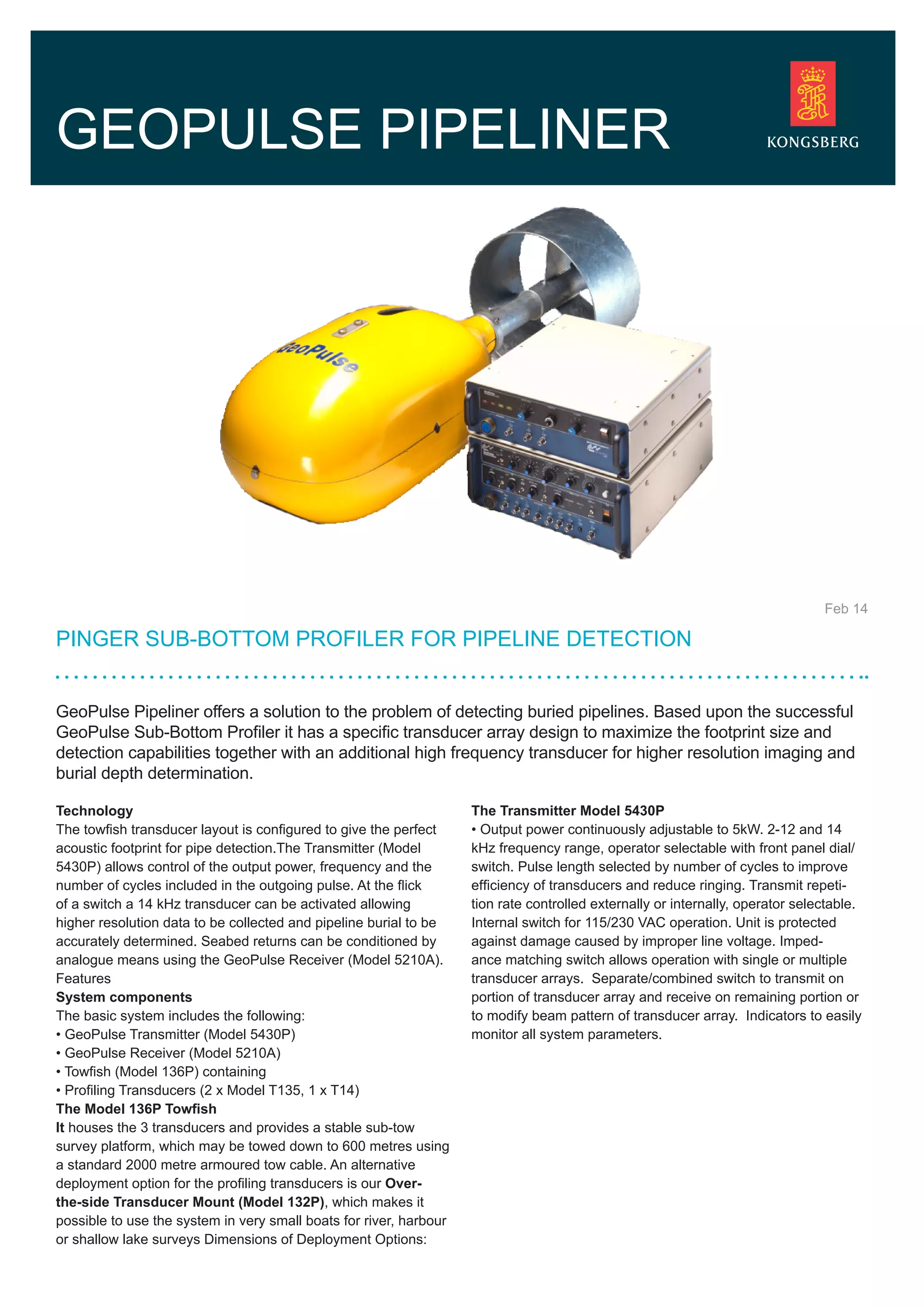
The basic system includes the following:
• GeoPulse Transmitter (Model 5430P)
• GeoPulse Receiver (Model 5210A)
• Towfish (Model 136P) containing
• Profiling Transducers (2 x Model T135, 1 x T14)
The Model 136P Towfish
It houses the 3 transducers and provides a stable sub-tow
survey platform, which may be towed down to 600 metres using
a standard 2000 metre armoured tow cable. An alternative
deployment option for the profiling transducers is our Over-
the-side Transducer Mount (Model 132P), which makes it
possible to use the system in very small boats for river, harbour
or shallow lake surveys Dimensions of Deployment Options:
The Transmitter Model 5430P
• Output power continuously adjustable to 5kW. 2-12 and 14
kHz frequency range, operator selectable with front panel dial/
switch. Pulse length selected by number of cycles to improve
efficiency of transducers and reduce ringing. Transmit repeti-
tion rate controlled externally or internally, operator selectable.
Internal switch for 115/230 VAC operation. Unit is protected
against damage caused by improper line voltage. Imped-
ance matching switch allows operation with single or multiple
transducer arrays. Separate/combined switch to transmit on
portion of transducer array and receive on remaining portion or
to modify beam pattern of transducer array. Indicators to easily
monitor all system parameters.
Receiver Model 5210A
Combined TVG and operator controllable gain provide up to
100dB of active gain for low amplitude signal processing. Auto-
matic bottom tracking provides constant TVG adjustment re-
gardless of bottom variation or degree of slope. (Manual TVG is
standard) • AGC provides operator with the ability to manipulate
receiver sensitivity for a given reflector intensity. Key program:
Multiply and divide-by functions for source triggering flexibility
in deep water or extremely shallow water. The tape interface
allows for recording of either raw or processed data. Elimin-
ates costly interface devices and provides calibration signal for
proper recorder adjustment. Optic isolation between receiver
and source power supply prevents ground loop interference on
acoustic record. TVG record annotation: Upon switch closure by
operator or by Nav interface, places a mark on record at every
6dB point throughout TVG ramp. Compensates for spreading
and attenuation losses through the water column in deep water.
All gain controls, manual or TVG, are in fixed increments en-
abling relative reflectivity of different areas to be compared.
Signal output to tape recorder is displayed by LED’s signifying
maximum possible dynamic range or presence of clipping.
Data can be displayed directly onto a wide rangeof industry
standard graphic recorders.
Dimensions of Deployment Options:
•	132P: 70cm (L) x 52cm (W) x 46cm (H), 120kg
•	Mounting Staff:
•	One section 183cm, two sections 360cm
•	136P: 156cm (L) x 46cm (W) x 46cm (H), 125kg.
Transmitter Model 5430P
•	Output: 5 kW with 0.75% duty cycle, continuously adjustable.
2 to 12kHz, and switchable to 14kHz.
•	Pulse Cycles: 1, 2, 4, 8, 16 or 32.
•	Output to Receiver Transformer isolated response flat
between approximately 1 kHz and 20 kHz.
•	Two modes of operation:
•	A: Flat gain –0dB gain
•	B: Short range TVG -20dB (10:1) of attenuation during trans-
mit pulse and a –20dB to 0dB ramp within 15 ms after end
of transmit signal.
•	Key: External: 2 to 12V pulse or internal:
•	Power: 115/230 VAC ± 10%, 47 to 63Hz, 220W maximum.
•	Auxiliary Power: IEC connector, unfused, 6A maximum.
•	Environmental: Operational: -5 to 50°C, storage: -15 to 85°C
•	Dimensions: 45.7cm (L) x 43cm (W) x 13cm (H), 18kg
Receiver Model 5210A
•	Amplifier: Differential common mode rejection: 100dB at
60Hz. Sensitivity 30μV RMS input produces 1V RMS output
at 90dB total gain with TVG.
•	Signal to noise: 20dB at 100dB gain 1 kHz centre frequency
and 1 kHz bandwidth.
•	Coarse gain: 40dB maximum.
•	 Fine gain: 0 – 30dB in 3dB increments.
•	Filter: Low pass and high pass, active type, maximally flat,
24dB/octave minimum roll-off, 0 gain, 0.02 kHz to 15 kHz
adjustable in ½ octave increments.
•	TVG: Dynamic range: 30dB
•	Rate: approximately flat to 30dB in 14ms. Manual delay: ver-
nier adjust from 1 to 14 ms with multiplier of x 1, x 10, x 100
and internal select of x 1000.
•	AGC: Attack adjustable from 330μs to 330ms. Decay: ad-
justable from 330μs to 330ms. Range: 20dB
•	Power: 115/230VAC ± 10% (internal switch selectable), 47 to
63Hz, 45W maximum.
•	Environmental: Operational: -5 to 50°C Storage: -15 to 85°C
•	•imensions: 45.7cm (L) x 43cm (W) x 17.8cm (H), 12kg.
Specifications subject to change without any further notice.
TECHNICAL SPECIFICATIONS
FEATURES
•	 Selectable transmit frequency 2 to 12 kHz
•	 Selectable 14 kHz transducer
•	 Pipeline detection
•	 Over-the-side, towed or hull mounted deployment
•	 Reliable, proven, easy to use
•	 Good penetration and resolution
•	 Combined with side scan sonar
•	 Third party acquisition system integration
•	 Range of tow cables and winches
KONGSBERG GEOACOUSTICS LTD
Great Yarmouth, UK
km.geoacoustics.sales@kongsberg.com
+44 1493 600666 www.km.kongsberg.com/geoacoustics
OPTIONS

Pipeline detection-sub-bottom-profiler

  • 1.
    GeoPulse Pipeliner offersa solution to the problem of detecting buried pipelines. Based upon the successful GeoPulse Sub-Bottom Profiler it has a specific transducer array design to maximize the footprint size and detection capabilities together with an additional high frequency transducer for higher resolution imaging and burial depth determination. PINGER SUB-BOTTOM PROFILER FOR PIPELINE DETECTION GEOPULSE PIPELINER Feb 14 Technology The towfish transducer layout is configured to give the perfect acoustic footprint for pipe detection.The Transmitter (Model 5430P) allows control of the output power, frequency and the number of cycles included in the outgoing pulse. At the flick of a switch a 14 kHz transducer can be activated allowing higher resolution data to be collected and pipeline burial to be accurately determined. Seabed returns can be conditioned by analogue means using the GeoPulse Receiver (Model 5210A). Features System components The basic system includes the following: • GeoPulse Transmitter (Model 5430P) • GeoPulse Receiver (Model 5210A) • Towfish (Model 136P) containing • Profiling Transducers (2 x Model T135, 1 x T14) The Model 136P Towfish It houses the 3 transducers and provides a stable sub-tow survey platform, which may be towed down to 600 metres using a standard 2000 metre armoured tow cable. An alternative deployment option for the profiling transducers is our Over- the-side Transducer Mount (Model 132P), which makes it possible to use the system in very small boats for river, harbour or shallow lake surveys Dimensions of Deployment Options: The Transmitter Model 5430P • Output power continuously adjustable to 5kW. 2-12 and 14 kHz frequency range, operator selectable with front panel dial/ switch. Pulse length selected by number of cycles to improve efficiency of transducers and reduce ringing. Transmit repeti- tion rate controlled externally or internally, operator selectable. Internal switch for 115/230 VAC operation. Unit is protected against damage caused by improper line voltage. Imped- ance matching switch allows operation with single or multiple transducer arrays. Separate/combined switch to transmit on portion of transducer array and receive on remaining portion or to modify beam pattern of transducer array. Indicators to easily monitor all system parameters.
  • 2.
    Receiver Model 5210A CombinedTVG and operator controllable gain provide up to 100dB of active gain for low amplitude signal processing. Auto- matic bottom tracking provides constant TVG adjustment re- gardless of bottom variation or degree of slope. (Manual TVG is standard) • AGC provides operator with the ability to manipulate receiver sensitivity for a given reflector intensity. Key program: Multiply and divide-by functions for source triggering flexibility in deep water or extremely shallow water. The tape interface allows for recording of either raw or processed data. Elimin- ates costly interface devices and provides calibration signal for proper recorder adjustment. Optic isolation between receiver and source power supply prevents ground loop interference on acoustic record. TVG record annotation: Upon switch closure by operator or by Nav interface, places a mark on record at every 6dB point throughout TVG ramp. Compensates for spreading and attenuation losses through the water column in deep water. All gain controls, manual or TVG, are in fixed increments en- abling relative reflectivity of different areas to be compared. Signal output to tape recorder is displayed by LED’s signifying maximum possible dynamic range or presence of clipping. Data can be displayed directly onto a wide rangeof industry standard graphic recorders. Dimensions of Deployment Options: • 132P: 70cm (L) x 52cm (W) x 46cm (H), 120kg • Mounting Staff: • One section 183cm, two sections 360cm • 136P: 156cm (L) x 46cm (W) x 46cm (H), 125kg. Transmitter Model 5430P • Output: 5 kW with 0.75% duty cycle, continuously adjustable. 2 to 12kHz, and switchable to 14kHz. • Pulse Cycles: 1, 2, 4, 8, 16 or 32. • Output to Receiver Transformer isolated response flat between approximately 1 kHz and 20 kHz. • Two modes of operation: • A: Flat gain –0dB gain • B: Short range TVG -20dB (10:1) of attenuation during trans- mit pulse and a –20dB to 0dB ramp within 15 ms after end of transmit signal. • Key: External: 2 to 12V pulse or internal: • Power: 115/230 VAC ± 10%, 47 to 63Hz, 220W maximum. • Auxiliary Power: IEC connector, unfused, 6A maximum. • Environmental: Operational: -5 to 50°C, storage: -15 to 85°C • Dimensions: 45.7cm (L) x 43cm (W) x 13cm (H), 18kg Receiver Model 5210A • Amplifier: Differential common mode rejection: 100dB at 60Hz. Sensitivity 30μV RMS input produces 1V RMS output at 90dB total gain with TVG. • Signal to noise: 20dB at 100dB gain 1 kHz centre frequency and 1 kHz bandwidth. • Coarse gain: 40dB maximum. • Fine gain: 0 – 30dB in 3dB increments. • Filter: Low pass and high pass, active type, maximally flat, 24dB/octave minimum roll-off, 0 gain, 0.02 kHz to 15 kHz adjustable in ½ octave increments. • TVG: Dynamic range: 30dB • Rate: approximately flat to 30dB in 14ms. Manual delay: ver- nier adjust from 1 to 14 ms with multiplier of x 1, x 10, x 100 and internal select of x 1000. • AGC: Attack adjustable from 330μs to 330ms. Decay: ad- justable from 330μs to 330ms. Range: 20dB • Power: 115/230VAC ± 10% (internal switch selectable), 47 to 63Hz, 45W maximum. • Environmental: Operational: -5 to 50°C Storage: -15 to 85°C • •imensions: 45.7cm (L) x 43cm (W) x 17.8cm (H), 12kg. Specifications subject to change without any further notice. TECHNICAL SPECIFICATIONS FEATURES • Selectable transmit frequency 2 to 12 kHz • Selectable 14 kHz transducer • Pipeline detection • Over-the-side, towed or hull mounted deployment • Reliable, proven, easy to use • Good penetration and resolution • Combined with side scan sonar • Third party acquisition system integration • Range of tow cables and winches KONGSBERG GEOACOUSTICS LTD Great Yarmouth, UK km.geoacoustics.sales@kongsberg.com +44 1493 600666 www.km.kongsberg.com/geoacoustics OPTIONS