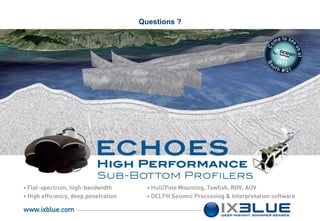
ECHOES
General Presentation
 iXBlue Day, Hamburg, 29/03/2011
2
ECHOES product Line

Sub-Bottom Profiling is a mean to acoustically form vertical images of the sub-soil.

It traditionally differs from reflection seismic in the way that:
     Higher frequencies are used to obtain thinner vertical resolution
     Pulse modulation – chirp – is used to bring an additional gain to data


While using chirp pulse modulation to obtain optimal data quality, IXSEA employs
 particular transducer types to reach lower frequencies and thus deeper
 penetration.

IXSEA has an extensive experience in developing high-quality sub-bottom profilers,
  they are now available in a complete product family: ECHOES.
3
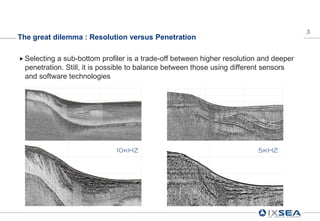
The great dilemma : Resolution versus Penetration

 Selectinga sub-bottom profiler is a trade-off between higher resolution and deeper
 penetration. Still, it is possible to balance between those using different sensors
 and software technologies


                             10kHZ                                       5kHZ
4
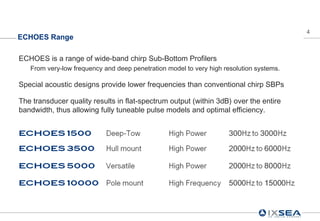
ECHOES Range

ECHOES is a range of wide-band chirp Sub-Bottom Profilers
   From very-low frequency and deep penetration model to very high resolution systems.

Special acoustic designs provide lower frequencies than conventional chirp SBPs

The transducer quality results in flat-spectrum output (within 3dB) over the entire
bandwidth, thus allowing fully tuneable pulse models and optimal efficiency.
5
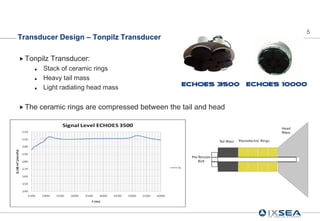
Transducer Design – Tonpilz Transducer

 Tonpilz   Transducer:
        Stack of ceramic rings
        Heavy tail mass
                                                 ECHOES 3500     ECHOES 10000
        Light radiating head mass


 The   ceramic rings are compressed between the tail and head
6
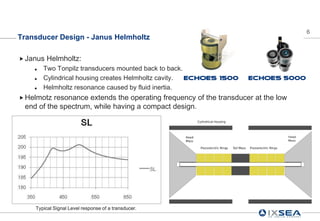
Transducer Design - Janus Helmholtz

 Janus   Helmholtz:
       Two Tonpilz transducers mounted back to back.
       Cylindrical housing creates Helmholtz cavity. ECHOES 1500   ECHOES 5000
       Helmholtz resonance caused by fluid inertia.
 Helmotz resonance extends the operating frequency of the transducer at the low
 end of the spectrum, while having a compact design.


    Typical Signal Level response of a transducer.
7
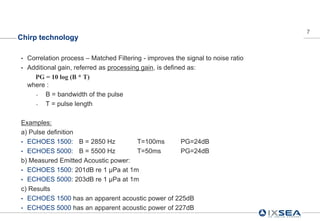
Chirp technology

• Correlation process – Matched Filtering - improves the signal to noise ratio
• Additional gain, referred as processing gain, is defined as:
    PG = 10 log (B * T)
  where :
    •    B = bandwidth of the pulse
    •    T = pulse length

Examples:
a) Pulse definition
• ECHOES 1500: B = 2850 Hz          T=100ms       PG=24dB
• ECHOES 5000: B = 5500 Hz          T=50ms        PG=24dB
b) Measured Emitted Acoustic power:
• ECHOES 1500: 201dB re 1 μPa at 1m
• ECHOES 5000: 203dB re 1 μPa at 1m
c) Results
• ECHOES 1500 has an apparent acoustic power of 225dB
• ECHOES 5000 has an apparent acoustic power of 227dB
8
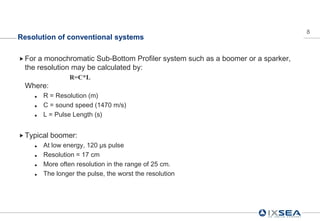
Resolution of conventional systems

 Fora monochromatic Sub-Bottom Profiler system such as a boomer or a sparker,
 the resolution may be calculated by:
                 R=C*L
 Where:
       R = Resolution (m)
       C = sound speed (1470 m/s)
       L = Pulse Length (s)


 Typical   boomer:
       At low energy, 120 µs pulse
       Resolution = 17 cm
       More often resolution in the range of 25 cm.
       The longer the pulse, the worst the resolution
9
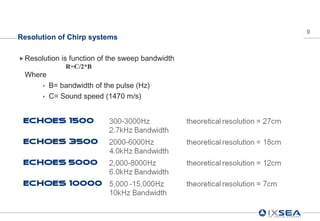
Resolution of Chirp systems

 Resolution   is function of the sweep bandwidth
                R=C/2*B
 Where
       • B= bandwidth of the pulse (Hz)
       • C= Sound speed (1470 m/s)
10
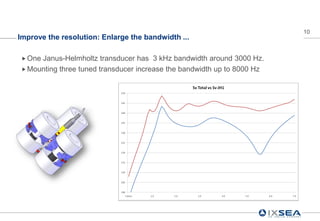
Improve the resolution: Enlarge the bandwidth ...

 OneJanus-Helmholtz transducer has 3 kHz bandwidth around 3000 Hz.
 Mounting three tuned transducer increase the bandwidth up to 8000 Hz
11
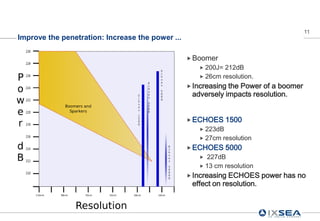
Improve the penetration: Increase the power ...

                                                   Boomer
                                                      200J= 212dB
                                                      26cm resolution.
                                                   Increasingthe Power of a boomer
                                                   adversely impacts resolution.


                                                   ECHOES     1500
                                                      223dB
                                                      27cm   resolution
                                                   ECHOES     5000
                                                      227dB
                                                      13 cm resolution
                                                   Increasing ECHOES power has no
                                                   effect on resolution.
12
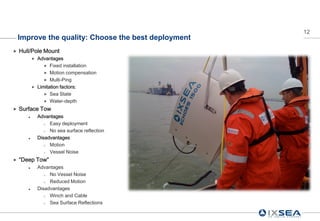
    Improve the quality: Choose the best deployment
   Hull/Pole Mount
              Advantages
                   Fixed installation
                   Motion compensation
                   Multi-Ping
              Limitation factors:
                   Sea State
                   Water-depth

   Surface Tow
              Advantages
                   Easy deployment
                   No sea surface reflection
              Disadvantages
                   Motion
                   Vessel Noise
   “Deep Tow”
              Advantages
                   No Vessel Noise
                   Reduced Motion
              Disadvantages
                   Winch and Cable
                   Sea Surface Reflections
13
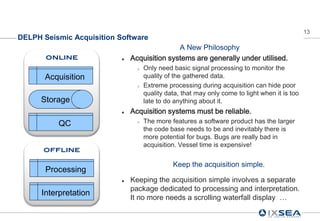
DELPH Seismic Acquisition Software
                                             A New Philosophy
       ONLINE                Acquisition systems are generally under utilised.
                                   Only need basic signal processing to monitor the
       Acquisition                  quality of the gathered data.
                                   Extreme processing during acquisition can hide poor
                                    quality data, that may only come to light when it is too
      Storage                       late to do anything about it.
                             Acquisition systems must be reliable.
          QC                       The more features a software product has the larger
                                    the code base needs to be and inevitably there is
                                    more potential for bugs. Bugs are really bad in
                                    acquisition. Vessel time is expensive!
      OFFLINE

                                              Keep the acquisition simple.
       Processing
                             Keeping the acquisition simple involves a separate
                              package dedicated to processing and interpretation.
      Interpretation
                              It no more needs a scrolling waterfall display …
14
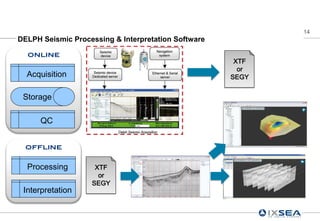
DELPH Seismic Processing & Interpretation Software

  ONLINE
                                                      XTF
                                                       or
  Acquisition                                        SEGY


 Storage

      QC


  OFFLINE


  Processing        XTF
                     or
                   SEGY
 Interpretation
15
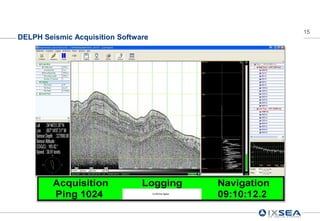
DELPH Seismic Acquisition Software
16
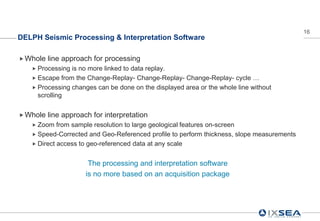
DELPH Seismic Processing & Interpretation Software

 Whole   line approach for processing
    Processing is no more linked to data replay.
    Escape from the Change-Replay- Change-Replay- Change-Replay- cycle …
    Processing changes can be done on the displayed area or the whole line without
     scrolling


 Whole   line approach for interpretation
    Zoom   from sample resolution to large geological features on-screen
    Speed-Corrected and Geo-Referenced profile to perform thickness, slope measurements
    Direct access to geo-referenced data at any scale


                       The processing and interpretation software
                      is no more based on an acquisition package
17
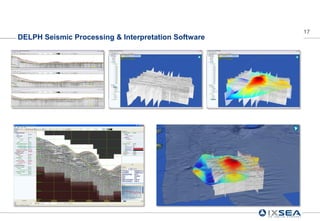
DELPH Seismic Processing & Interpretation Software
18
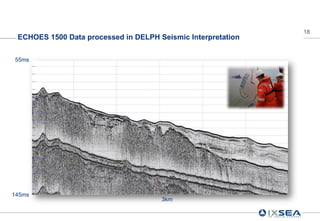
 ECHOES 1500 Data processed in DELPH Seismic Interpretation


55ms


145ms
                                      3km
19
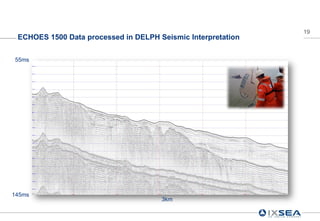
 ECHOES 1500 Data processed in DELPH Seismic Interpretation


55ms


145ms
                                      3km
20
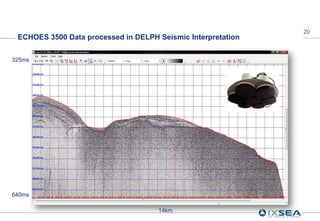
 ECHOES 3500 Data processed in DELPH Seismic Interpretation


325ms


640ms

                                     14km
21
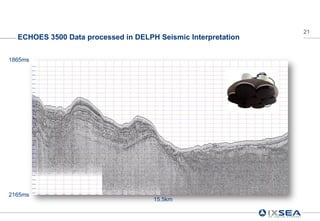
  ECHOES 3500 Data processed in DELPH Seismic Interpretation


1865ms


2165ms
                                     15.5km
22
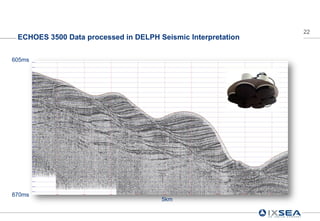
 ECHOES 3500 Data processed in DELPH Seismic Interpretation


605ms


870ms
                                      5km
23
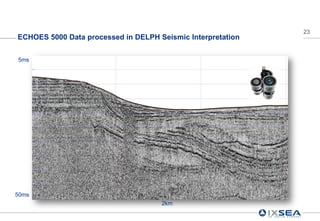
ECHOES 5000 Data processed in DELPH Seismic Interpretation


5ms


50ms
                                     2km
24
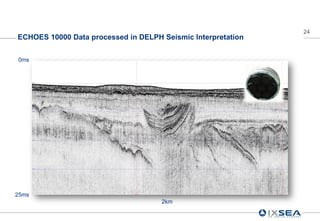
ECHOES 10000 Data processed in DELPH Seismic Interpretation


0ms


25ms
                                     2km
25
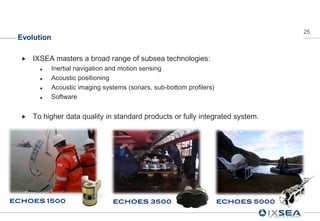
 Evolution

     IXSEA masters a broad range of subsea technologies:
            Inertial navigation and motion sensing
            Acoustic positioning
            Acoustic imaging systems (sonars, sub-bottom profilers)
            Software


     To higher data quality in standard products or fully integrated system.


ECHOES 1500                      ECHOES 3500                           ECHOES 5000
Questions ?
              26

4 ECHOES - General Presentation

  • 1.
    ECHOES General Presentation iXBlueDay, Hamburg, 29/03/2011
  • 2.
    2 ECHOES product Line Sub-BottomProfiling is a mean to acoustically form vertical images of the sub-soil. It traditionally differs from reflection seismic in the way that: Higher frequencies are used to obtain thinner vertical resolution Pulse modulation – chirp – is used to bring an additional gain to data While using chirp pulse modulation to obtain optimal data quality, IXSEA employs particular transducer types to reach lower frequencies and thus deeper penetration. IXSEA has an extensive experience in developing high-quality sub-bottom profilers, they are now available in a complete product family: ECHOES.
  • 3.
    3 The great dilemma: Resolution versus Penetration  Selectinga sub-bottom profiler is a trade-off between higher resolution and deeper penetration. Still, it is possible to balance between those using different sensors and software technologies 10kHZ 5kHZ
  • 4.
    4 ECHOES Range ECHOES isa range of wide-band chirp Sub-Bottom Profilers From very-low frequency and deep penetration model to very high resolution systems. Special acoustic designs provide lower frequencies than conventional chirp SBPs The transducer quality results in flat-spectrum output (within 3dB) over the entire bandwidth, thus allowing fully tuneable pulse models and optimal efficiency.
  • 5.
    5 Transducer Design –Tonpilz Transducer  Tonpilz Transducer:  Stack of ceramic rings  Heavy tail mass ECHOES 3500 ECHOES 10000  Light radiating head mass  The ceramic rings are compressed between the tail and head
  • 6.
    6 Transducer Design -Janus Helmholtz  Janus Helmholtz:  Two Tonpilz transducers mounted back to back.  Cylindrical housing creates Helmholtz cavity. ECHOES 1500 ECHOES 5000  Helmholtz resonance caused by fluid inertia.  Helmotz resonance extends the operating frequency of the transducer at the low end of the spectrum, while having a compact design. Typical Signal Level response of a transducer.
  • 7.
    7 Chirp technology • Correlationprocess – Matched Filtering - improves the signal to noise ratio • Additional gain, referred as processing gain, is defined as: PG = 10 log (B * T) where : • B = bandwidth of the pulse • T = pulse length Examples: a) Pulse definition • ECHOES 1500: B = 2850 Hz T=100ms PG=24dB • ECHOES 5000: B = 5500 Hz T=50ms PG=24dB b) Measured Emitted Acoustic power: • ECHOES 1500: 201dB re 1 μPa at 1m • ECHOES 5000: 203dB re 1 μPa at 1m c) Results • ECHOES 1500 has an apparent acoustic power of 225dB • ECHOES 5000 has an apparent acoustic power of 227dB
  • 8.
    8 Resolution of conventionalsystems  Fora monochromatic Sub-Bottom Profiler system such as a boomer or a sparker, the resolution may be calculated by: R=C*L Where:  R = Resolution (m)  C = sound speed (1470 m/s)  L = Pulse Length (s)  Typical boomer:  At low energy, 120 µs pulse  Resolution = 17 cm  More often resolution in the range of 25 cm.  The longer the pulse, the worst the resolution
  • 9.
    9 Resolution of Chirpsystems  Resolution is function of the sweep bandwidth R=C/2*B Where • B= bandwidth of the pulse (Hz) • C= Sound speed (1470 m/s)
  • 10.
    10 Improve the resolution:Enlarge the bandwidth ...  OneJanus-Helmholtz transducer has 3 kHz bandwidth around 3000 Hz.  Mounting three tuned transducer increase the bandwidth up to 8000 Hz
  • 11.
    11 Improve the penetration:Increase the power ...  Boomer  200J= 212dB  26cm resolution.  Increasingthe Power of a boomer adversely impacts resolution.  ECHOES 1500  223dB  27cm resolution  ECHOES 5000  227dB  13 cm resolution  Increasing ECHOES power has no effect on resolution.
  • 12.
    12 Improve the quality: Choose the best deployment  Hull/Pole Mount  Advantages  Fixed installation  Motion compensation  Multi-Ping  Limitation factors:  Sea State  Water-depth  Surface Tow  Advantages  Easy deployment  No sea surface reflection  Disadvantages  Motion  Vessel Noise  “Deep Tow”  Advantages  No Vessel Noise  Reduced Motion  Disadvantages  Winch and Cable  Sea Surface Reflections
  • 13.
    13 DELPH Seismic AcquisitionSoftware A New Philosophy ONLINE  Acquisition systems are generally under utilised.  Only need basic signal processing to monitor the Acquisition quality of the gathered data.  Extreme processing during acquisition can hide poor quality data, that may only come to light when it is too Storage late to do anything about it.  Acquisition systems must be reliable. QC  The more features a software product has the larger the code base needs to be and inevitably there is more potential for bugs. Bugs are really bad in acquisition. Vessel time is expensive! OFFLINE Keep the acquisition simple. Processing  Keeping the acquisition simple involves a separate package dedicated to processing and interpretation. Interpretation It no more needs a scrolling waterfall display …
  • 14.
    14 DELPH Seismic Processing& Interpretation Software ONLINE XTF or Acquisition SEGY Storage QC OFFLINE Processing XTF or SEGY Interpretation
  • 15.
  • 16.
    16 DELPH Seismic Processing& Interpretation Software  Whole line approach for processing  Processing is no more linked to data replay.  Escape from the Change-Replay- Change-Replay- Change-Replay- cycle …  Processing changes can be done on the displayed area or the whole line without scrolling  Whole line approach for interpretation  Zoom from sample resolution to large geological features on-screen  Speed-Corrected and Geo-Referenced profile to perform thickness, slope measurements  Direct access to geo-referenced data at any scale The processing and interpretation software is no more based on an acquisition package
  • 17.
    17 DELPH Seismic Processing& Interpretation Software
  • 18.
    18 ECHOES 1500Data processed in DELPH Seismic Interpretation 55ms 145ms 3km
  • 19.
    19 ECHOES 1500Data processed in DELPH Seismic Interpretation 55ms 145ms 3km
  • 20.
    20 ECHOES 3500Data processed in DELPH Seismic Interpretation 325ms 640ms 14km
  • 21.
    21 ECHOES3500 Data processed in DELPH Seismic Interpretation 1865ms 2165ms 15.5km
  • 22.
    22 ECHOES 3500Data processed in DELPH Seismic Interpretation 605ms 870ms 5km
  • 23.
    23 ECHOES 5000 Dataprocessed in DELPH Seismic Interpretation 5ms 50ms 2km
  • 24.
    24 ECHOES 10000 Dataprocessed in DELPH Seismic Interpretation 0ms 25ms 2km
  • 25.
    25 Evolution  IXSEA masters a broad range of subsea technologies:  Inertial navigation and motion sensing  Acoustic positioning  Acoustic imaging systems (sonars, sub-bottom profilers)  Software  To higher data quality in standard products or fully integrated system. ECHOES 1500 ECHOES 3500 ECHOES 5000
  • 26.