OBJECTIVES
OBJECTIVES
After completing thischapter, the reader will be able to:
1. Describe the impact of new and emerging technologies on
education. outcomes for patients with various learning needs.
2. Discuss appropriate educational strategies using technology to
promote effective learning
3. Identity ways in which telehealth could be incorporated into
healthcare education.
4.Describe the role of the nurse educator in using technology in
patient, staff, and student education.
5.Recognize the issues related to the use of learners in distant
locales.
6.Discuss technological advances available for professional
education and higher education
9.
INTRODUCTION
INTRODUCTION
Life as todayis greatly influenced by technological
advances of the last. half century, a period in time
known as the Third Industrial Revolution or the
Information Age. These Information Age advances
include the birth of the internet and the World
Wide Web, the development of information
technology, the widescale production of com-puters,
and the development of user-friendly software, all
of which have had an impact on every aspect of
people's lives.
10.
INTRODUCTION
INTRODUCTION
Fourth Industrial Revolution
"ischaracterized by a fusion of technologies that are blurring the
lines between the physical, digital and biological spheres"
A result, children of today are often referred to as "digital
natives," as their lifelong exposure to digital technology has
shaped the way they think and process information
This is a very different beginning from that experienced by most
adults who grew up in the 20th century with no or limited
computer technology and who are referred to as "digital
immigrants"
11.
THE WORLD WIDEWEB
THE WORLD WIDE WEB
Is a virtual space for information. These webpages
cover a wide range of topics and display a variety
of formats, including text, audio, graphic, and
video.
The World Wide Web was first conceived in 1989
by Tim Berners-Lee and Robert Cailliau, two
scientists working at a laboratory in Switzerland
12.
THE INTERNET
THE INTERNET
isa huge global network of computers established
to allow the transfer of information from one
computer to another.
World Wide Web, which was created to display
information, the internet was created to exchange
information.
example of WWW: www.facebook.com
. www.youtube.com
13.
HEALTH EDUCATION IN
HEALTHEDUCATION IN
TECHNOLOGY BASED WORLD
TECHNOLOGY BASED WORLD
The Information Age, also known as the Computer Age or Digital
Age, was characterized by a change in focus from industry to
information.
Patient education, professional development, and higher education
have capitalized on the power of computer technology to provide
learning solutions referred to as e-learning, an abbreviation for
electronic learning.
E-learning can be defined as "the various technological tools that
are either web-based, web-distributed or web-capable"
14.
HEALTH EDUCA IN
HEALTHEDUCA IN
TECHNOLOGY BASED WORLD
TECHNOLOGY BASED WORLD
Healthcare education and informatics professionals are working together to
develop codes to guide practice and safeguard healthcare consumers who use
educational information and services delivered via the World Wide Web and
the internet. The not-for-profit group Internet Healthcare Coalition was
founded in 1997 to identify and promote high-quality educational resources on
the internet.
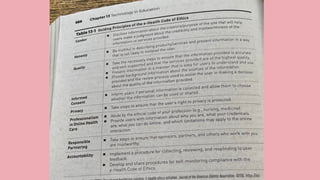
One of this organization's most significant accomplishments was the
establishment of the e-Health Code of Ethics, displayed in six languages on
its web-site.
16.
THE IMPACT OFTECHNOLOGY ON THE TEACHER
THE IMPACT OF TECHNOLOGY ON THE TEACHER
AND THE LEARNER
AND THE LEARNER
Access to health information online has
been shown to encourage consumers to en-
gise in greater dialogue with their
healthcare providers as they seek
clarification and greater understanding of
their health, illness, and diagnosis and
treatment.
17.
STRATEGIES FOR USINGTECHNOLOGY IN
STRATEGIES FOR USING TECHNOLOGY IN
HEALTHCARE EDUCATION
HEALTHCARE EDUCATION
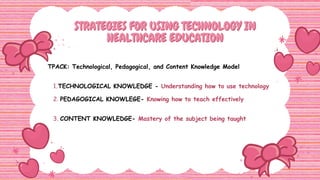
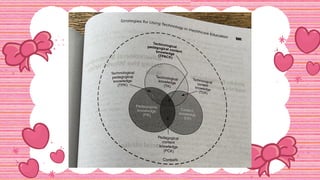
TPACK: Technological, Pedagogical, and Content Knowledge Model
The TPACK model is useful for nurse educators because it addresses
responsibilities for, pedagogical knowledge, content knowl-edge, and
technological knowledge
Lee and Kim (2017) discuss steps involved in using the TPACK model. The
three seps are: understanding TPACK, experiencing TPACK, and practicing
TPACK. These authors also include examples of lessons using TPACK, such
as using webcam sessions with experts and creating a family tree activity
using digital storytelling.
18.
STRATEGIES FOR USINGTECHNOLOGY IN
STRATEGIES FOR USING TECHNOLOGY IN
HEALTHCARE EDUCATION
HEALTHCARE EDUCATION
TPACK: Technological, Pedagogical, and Content Knowledge Model
TECHNOLOGICAL KNOWLEDGE - Understanding how to use technology
1.
2. PEDAGOGICAL KNOWLEGE- Knowing how to teach effectively
3. CONTENT KNOWLEDGE- Mastery of the subject being taught
20.
STRATEGIES FOR USINGTECHNOLOGY IN
STRATEGIES FOR USING TECHNOLOGY IN
HEALTHCARE EDUCATION
HEALTHCARE EDUCATION
Mobile Technologies and M-Learning
Mobile technology refers to the use of portable electronic devices and
wireless communication systems that enable users to access information,
communicate, and perform tasks on the go. It includes mobile phones,
tablets, laptops, and wearable devices connected through cellular networks,
Wi-Fi, or Bluetooth.
M-learning is the process of accessing learning content on a mobile device,
such as a smartphone or tablet.
21.
EDUCATIONAL STRATEGIES
EDUCATIONAL STRATEGIES
USINGTHE WORLD WIDE WEB
USING THE WORLD WIDE WEB
also knowm as social networking ,
has made available a wide array of
communication formats for people
with similar interest to come
together to exchange ideas and
share information .
22.
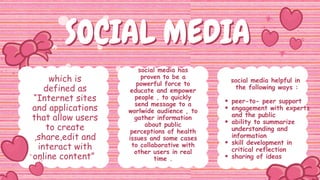
SOCIAL MEDIA
SOCIAL MEDIA
whichis
defined as
“Internet sites
and applications
that allow users
to create
,share,edit and
interact with
online content”
social media has
proven to be a
powerful force to
educate and empower
people , to quickly
send message to a
worlwide audience , to
gather information
about public
perceptions of health
issues and some cases
to collaborative with
other users in real
time .
social media helpful in
the following ways :
peer-to- peer support
engagement with experts
and the public
ability to summarize
understanding and
information
skill development in
critical reflection
sharing of ideas
23.
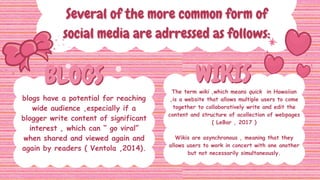
BLOGS
BLOGS WIKIS
WIKIS
Several ofthe more common form of
Several of the more common form of
social media are adrressed as follows:
social media are adrressed as follows:
blogs have a potential for reaching
wide audience ,especially if a
blogger write content of significant
interest , which can “ go viral”
when shared and viewed again and
again by readers ( Ventola ,2014).
The term wiki ,which means quick in Hawaiian
,is a website that allows multiple users to come
together to collaboratively write and edit the
content and structure of acollection of webpages
( LeBar , 2017 )
Wikis are asynchronous , meaning that they
allows users to work in concert with one another
but not necessarily simultaneously.
24.
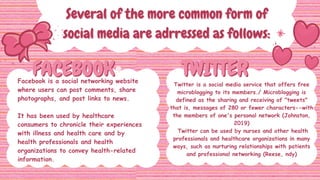
FACEBOOK
FACEBOOK TWITTER
TWITTER
Several ofthe more common form of
Several of the more common form of
social media are adrressed as follows:
social media are adrressed as follows:
Facebook is a social networking website
where users can post comments, share
photographs, and post links to news.
It has been used by healthcare
consumers to chronicle their experiences
with illness and health care and by
health professionals and health
organizations to convey health-related
information.
Twitter is a social media service that offers free
microblogging to its members./ Microblogging is
defined as the sharing and receiving of "tweets"
that is, messages of 280 or fewer characters--with
the members of one's personal network (Johnston,
2019)
Twitter can be used by nurses and other health
professionals and healthcare organizations in many
ways, such as nurturing relationships with patients
and professional networking (Reese, ndy)
25.
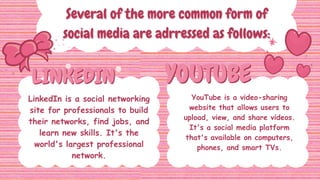
LINKEDIN
LINKEDIN YOUTUBE
YOUTUBE
Several ofthe more common form of
Several of the more common form of
social media are adrressed as follows:
social media are adrressed as follows:
LinkedIn is a social networking
site for professionals to build
their networks, find jobs, and
learn new skills. It's the
world's largest professional
network.
YouTube is a video-sharing
website that allows users to
upload, view, and share videos.
It's a social media platform
that's available on computers,
phones, and smart TVs.
26.
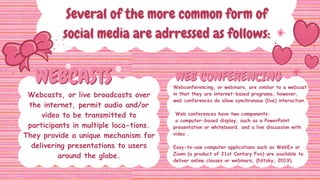
WEBCASTS
WEBCASTS WEB CONFERENCING
WEBCONFERENCING
Several of the more common form of
Several of the more common form of
social media are adrressed as follows:
social media are adrressed as follows:
Webcasts, or live broadcasts over
the internet, permit audio and/or
video to be transmitted to
participants in multiple loca-tions.
They provide a unique mechanism for
delivering presentations to users
around the globe.
Webconferencing, or webinars, are similar to a webcast
in that they are internet-based programs; however,
web conferences do allow synchronous (live) interaction.
Web conferences have two components:
a computer-based display, such as a PowerPoint
presentation or whiteboard, and a live discussion with
video .
Easy-to-use computer applications such as WebEx or
Zoom (a product of 21st Century Fox) are available to
deliver online classes or webinars, (Nitzky, 2019).
27.
EDUCATIONAL STRATEGIES
EDUCATIONAL STRATEGIES
USINGTHE INTERNET
USING THE INTERNET
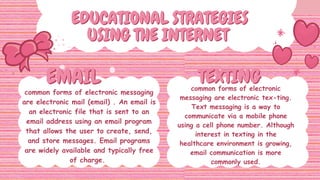
EMAIL
EMAIL TEXTING
TEXTING
common forms of electronic messaging
are electronic mail (email) . An email is
an electronic file that is sent to an
email address using an email program
that allows the user to create, send,
and store messages. Email programs
are widely available and typically free
of charge.
common forms of electronic
messaging are electronic tex-ting.
Text messaging is a way to
communicate via a mobile phone
using a cell phone number. Although
interest in texting in the
healthcare environment is growing,
email communication is more
commonly used.
28.
HEALTH CONSUMER EDUCATIONIN A
HEALTH CONSUMER EDUCATION IN A
TECHNOLOGY - BASED WORLD
TECHNOLOGY - BASED WORLD
Telehealth sometimes referred to as
telemedicine, telecare, or e-care, can be
described as healthcare delivery through
audio or audio/video telecommunication
over a distance (Finley & Shea, 2019).
29.
HEALTH CONSUMER EDUCATIONIN A
HEALTH CONSUMER EDUCATION IN A
TECHNOLOGY - BASED WORLD
TECHNOLOGY - BASED WORLD
is a telehealth service that allows
patients to use digital devices to share
health data with their healthcare
providers. RPM can help patients
manage chronic and acute conditions.
30.
TECHNOLOGY PROFESSIONAL DEVELOPEMENT
TECHNOLOGYPROFESSIONAL DEVELOPEMENT
AND HIGHER EDUCATION
AND HIGHER EDUCATION
electronic learning is the delivery of educational
content through digital devices like computers,
tablets, and smartphones. Unlike traditional
learning methods, eLearning enables individuals
to access courses anytime, anywhere, making it
a flexible and efficient approach to learning.
31.
TECHNOLOGY PROFESSIONAL DEVELOPEMENT
TECHNOLOGYPROFESSIONAL DEVELOPEMENT
AND HIGHER EDUCATION
AND HIGHER EDUCATION
distance learning means different things to
different people. Online courses, correspondence
courses, independent study, and
videoconferencing are just a few of the
techniques that can be used to deliver
educational programs to students studying at a
distance.
32.
TECHNOLOGY PROFESSIONAL DEVELOPEMENT
TECHNOLOGYPROFESSIONAL DEVELOPEMENT
AND HIGHER EDUCATION
AND HIGHER EDUCATION
Learning management systems (LMS) are web-
based technologies that provide data
management, assessment, reporting, and a
platform for instructional materials to assist
online learners and faculty to engage in teaching
learning activities (Sanga, 2016; Watson &
Watson, 2007).
33.
TECHNOLOGY PROFESSIONAL DEVELOPEMENT
TECHNOLOGYPROFESSIONAL DEVELOPEMENT
AND HIGHER EDUCATION
AND HIGHER EDUCATION
Hybrid (blended) learning is defined as combining
face-to-face experiences with online learning
experiences to maximize the strengths of each
for optimal learning (Picciano, 2014).
34.
is the practiceof protecting systems,
networks, and programs from digital
attacks. These cyberattacks are usually
aimed at accessing, changing, or destroying
sensitive information; extorting money from
users via ransomware; or interrupting normal
business processes.
ISSUES RELATED TO THE USE OF
ISSUES RELATED TO THE USE OF
TECHNOLOGY
TECHNOLOGY
35.
ISSUES RELATED TOTHE USE OF
ISSUES RELATED TO THE USE OF
TECHNOLOGY
TECHNOLOGY
refers to the system of regulations, policies,
and practices implemented to ensure the
proper handling, protection, and privacy of
sensitive patient health data.
36.
ISSUES RELATED TOTHE USE OF
ISSUES RELATED TO THE USE OF
TECHNOLOGY
TECHNOLOGY
Accessibility in healthcare technology is vital to
ensure that all patients, including those with
disabilities, can benefit from digital health services.
Digital Divide - Many individuals, particularly
those in underserved communities, lack access to
necessary technology, which can exacerbate health
disparities.
37.
ISSUES RELATED TOTHE USE OF
ISSUES RELATED TO THE USE OF
TECHNOLOGY
TECHNOLOGY
The state of evidence regarding technology in education
suggests that it can improve learning outcomes when
used effectively.It helps the students to improve the
students engagement , access to information, have a
good communication and collaboration .Technology in
education has great potential, but its effectiveness
depends on proper implementation, access, and teacher
support.
AT