MINISTRY OF LABOUR & SOCIAL
SECURITY
DIRECTORATE GENERAL OF OHS
Dr. Buhara Önal
OHS INSTITUTE (ISGUM)
May 2010
Ankara - TURKEY
CONTENT
• Definition of occupational health
• ILO/WHO Joint Committee
• Definition of Occupational Disases
• List of Occupational Diseases
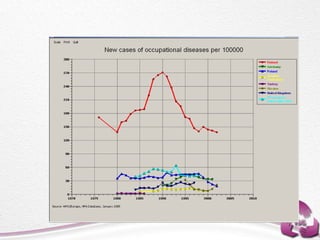
• OH situation in Turkey
DEFINITION OF OCCUPATIONAL HEALTH
JOINT ILO/WHO COMMITTEE,1950
• the promotion and maintenance of the highest degree
of physical, mental and social wellbeing of workers in
all occupations;
• the prevention amongst workers of departures from
health caused by their working conditions;
• the protection of workers in their employment from
risks resulting from factors adverse to health;
• the placing and maintenance of the worker in an
occupational environment adapted to his physiological
and psychological capabilities, and to summarize:
the adaptation of work to man and of each man to
his job.
OCCUPATIONAL HEALTH OBJECTIVES
JOINT ILO/WHO COMITTEE, 1995
• the maintenance and promotion of workers’ health
and working capacity;
• the improvement of the working environment and
work to become conducive to safety and health;
• development of work organization and working
culture in a direction which supports health and
safety at work and in doing so also promotes a
positive social climate and smooth operation which
may enhance productivity of an undertaking.
THE EUROPEAN COMMISSION STRATEGY
FOR SAFETY AND HEALTH
• It adopts a global approach of well-being at work taking into
account the changes in the world of work and the emergence of
new risks, especially of psycho-social nature.
• This strategy aims at promoting “well-being at work” – physical,
moral and social well-being, and not just something which can be
measured by absence of accidents and occupational illness.
• This strategy clearly suggests that health at work should not be
measured only based on the number of rate of occupational
diseases and accidents.
EUROPEAN AGENCY FOR SAFETY AND
HEALTH AT WORK (OSHA)
OHS concept includes any measures aimed at adapting
work to the individual worker in order to:
• reduce the harmful effect of work on the individual’s
health;
• ensure that people that have health problems are not
unnecessarily excluded from the workplace or labour
market as a result of work requirements and work
capacities; and
• promote working conditions and work organization in a
way that improves general health.
OCCUPATIONAL DISEASES
OHS DATA IN THE WORLD AND EU
ILO
Total Workforce 2.8 billion
Work related deaths 2.2 million
Occupational accidents 270 million
Occupational diseases 160 million
Total Cost 30 000 billion $
OSHA
• Work related deaths 5.500
Lost working day 149 million
• Total ost 20 billion €
•
DEFINITION OF OCCUPATIONAL DISEASE
• The term “occupational disease” covers any disease
contracted as a result of an exposure to risk factors
arising from work activity (the Protocol of 2002 to
the OSH Convention, 1981).
• The ILO Employment Injury Benefits Recommendation,
defines occupational diseases as following terms:
“Each Member should, under prescribed conditions,
regard diseases known to arise out of the exposure to
substances and dangerous conditions in processes,
trades or occupations as occupational diseases.”
DEFINITION OF OCCUPATIONAL DİSEASE
• Two main elements are present in the definition of an
occupational disease:
- the causal relationship between exposure in a
specific working environment or work activity and a
specific disease; and
- the fact that the disease occurs among a group of
exposed persons with a frequency above the average
morbidity of the rest of the population.
GENERAL CRITERIA FOR IDENTIFICATION
AND RECOGNITION OF OD
• The causal relationship is established on the basis of clinical and
pathological data, occupational background and job analysis,
identification and evaluation of occupational risk factors and of
the role of other risk factors.
• Epidemiological and toxicological data are useful for determining
the causal relationship between a specific occupational disease
and its corresponding exposure in a specific working environment
or work activity.
• As a general rule, the symptoms are not sufficiently
characteristic to enable an occupational disease to be diagnosed
as such without the knowledge of the pathological changes
engendered by the physical, chemical, biological or other factors
encountered in the exercise of an occupation.
GENERAL CRITERIA FOR IDENTIFICATION
AND RECOGNITION OF OD
• It is therefore normal that, as a result of
improvements in knowledge regarding the mechanisms
of action of the factors in question, the steady
increase in the number of substances employed, and
the quality and variety of suspected agents, it
becomes more and more feasible to make an accurate
diagnosis, while the range of diseases recognized as
occupational in origin is broadening.
GENERAL CRITERIA FOR IDENTIFICATION
AND RECOGNITION OF OD
- Strength of association. The greater the impact of an exposure on the
occurrence or development of a disease, the stronger the likelihood of a causal
relationship.
- Consistency. Different research reports have generally similar conclusions.
- Specificity. Exposure to a specific risk factor results in a clearly defined
pattern of disease or diseases.
- Temporality or time sequence. The exposure of interest preceded the disease
by a period of time consistent with any proposed biological mechanism.
- Biological gradient. The greater the level and duration of exposure, the
greater the severity of diseases or their incidence.
- Biological plausibility. From what is known of toxicology, chemistry, physical
properties or other attributes of the studied risk or hazard, it makes biological
sense to suggest that exposure leads to the disease.
- Coherence. A general synthesis of all the evidence leads to the conclusion that
there is a cause–effect relationship in a broad sense and in terms of general
common sense.
- Interventional studies. Sometimes, a primary preventative trial may verify
whether removing a specific hazard or reducing a specific risk from the working
environment or work activity eliminates the development of a specific disease or
reduces its incidence.
CRITERIA FOR IDENTIFICATION AND
RECOGNITION OF AN INDIVIDUAL
DISEASE
• Important elements for the determination of a causal
relationship:
- the exposure–effect relationship (relation between exposure
and the severity of the impairment in the subject)
- the exposure–response relationship (connection between
exposure and the relative number of subjects affected)
• Research and epidemiological studies have greatly contributed in
this respect. Better knowledge of the causal relationship has
allowed us to achieve a better medical definition of occupational
diseases.
• As a consequence, the legal definition of occupational diseases,
which was rather a complex problem, is becoming more and more
linked to the medical definition and criteria.
CRITERIA FOR IDENTIFICATION AND
RECOGNITION OF AN INDIVIDUAL
DISEASE
• Legal provisions on compensation for victims vary from country to
country.
• The Employment Injury Benefits Convention which indicates the various
possibilities regarding the form of the identification and recognition of
OD entitling workers to compensation benefits, states that:
• Each Member shall:
(a) prescribe a list of diseases, comprising at least the diseases
enumerated in the Convention, which shall be regarded as OD under
prescribed conditions; or
(b) include in its legislation a general definition of OD broad enough to
cover at least the diseases enumerated in the Convention; or
(c) prescribe a list of diseases in conformity with clause (a),
complemented by a general definition of OD or by other provisions
for establishing the occupational origin of diseases not so listed or
manifesting themselves under conditions different from those
prescribed.
CRITERIA FOR IDENTIFICATION AND
RECOGNITION OF AN INDIVIDUAL
DISEASE
• The “list system” covers only a certain number of occupational diseases,
and has the advantage of listing diseases for which there is a
presumption that they are of occupational origin. This simplifies the
matter for all parties since it is frequently very difficult, if not
impossible, to prove or disprove that a disease is directly attributable
to the victim's occupation. It also has the important advantage of
indicating clearly where prevention should focus.
• The “general definition system” theoretically covers all occupational
diseases; it affords the widest and most flexible protection, but leaves
it to the victim to prove the occupational origin of the disease. In
practice, it also often implies that arbitration on individual cases is
necessary. Furthermore, no emphasis is placed on specific prevention.
• The “mixed system” has been favoured by many ILO member States,
because it combines the advantages of the other two without their
disadvantages.
CRITERIA FOR INCORPORATING A
DISEASE INTO THE ILO LIST OF
OCCUPATIONAL DISEASES
• The List of Occupational Diseases Recommendation, 2002 (No.
194) was adopted at the 90th Session of the International
Labour Conference, 2002.
• The Committee on Occupational Accidents and Diseases
established in 2002 to work on the List of Occupational
Diseases Recommendation requested the Governing Body of the
International Labour Office to convene the first of the
tripartite meetings of experts referred to the Recommendation
as a matter of priority.
• The Committee expected that, in addition to examining the
Annex to the Recommendation, the existing national and other
lists of occupational diseases, and the comments received from
member States, the Meeting should consider all the amendments
submitted on the Annex to the Conference Committee.
UPDATING THE LIST OF OD
Decisions to incorporate specific diseases in the updated List of
OD need to take into account the following general criteria:
- there is a causal relationship with a specific agent, exposure or
work process;
- they occur in connection with the work environment and/or in
specific occupations;
- they occur among the groups of persons concerned with a
frequency which exceeds the average incidence within the rest
of the population; and
- there is scientific evidence of a clearly defined pattern of
disease following exposure and plausibility of cause.
LIST OF OCCUPATIONAL DISEASES
(ILO)
1. Diseases caused by agents
1.1. Diseases caused by chemical agents
1.2. Diseases caused by physical agents
1.3. Diseases caused by biological agents
2. Diseases by target organ systems
2.1. Occupational respiratory diseases
2.2. Occupational skin diseases
2.3. Occupational musculo-skeletal disorders
3. Occupational cancer
3.1. Cancer caused by the following agents
4. Other diseases
4.1. Miners' nystagmus
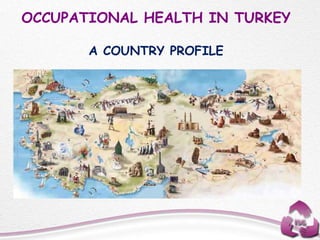
OCCUPATIONAL HEALTH IN TURKEY
A COUNTRY PROFILE
DEMOGRAPHIC CHARACTERISTICS,
TURKEY
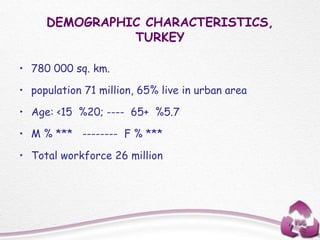
• 780 000 sq. km.
• population 71 million, 65% live in urban area
• Age: <15 %20; ---- 65+ %5.7
• M % *** -------- F % ***
• Total workforce 26 million
SGK STATISTICS (2008)
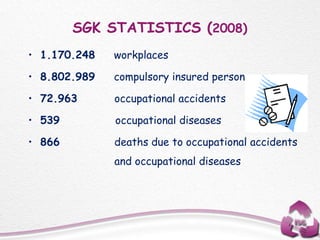
• 1.170.248 workplaces
• 8.802.989 compulsory insured person
• 72.963 occupational accidents
• 539 occupational diseases
• 866 deaths due to occupational accidents
and occupational diseases
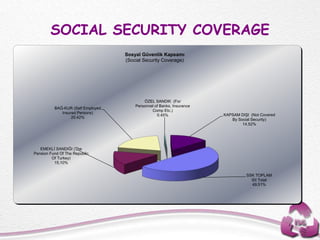
SOCIAL SECURITY COVERAGE
SSK TOPLAM
SII Total
49.51%
EMEKLİ SANDIĞI (The
Pension Fund Of The Republic
Of Turkey)
15,10%
BAĞ-KUR (Self Employed
Insured Persons)
20.42%
ÖZEL SANDIK (For
Personnel of Banks, Insurance
Comp Etc.)
0.45% KAPSAM DIŞI (Not Covered
By Social Security)
14.52%
Sosyal Güvenlik Kapsamı
(Social Security Coverage)
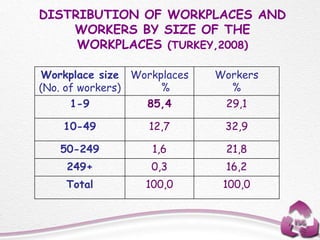
DISTRIBUTION OF WORKPLACES AND
WORKERS BY SIZE OF THE
WORKPLACES (TURKEY,2008)
Workplace size
(No. of workers)
Workplaces
%
Workers
%
1-9 85,4 29,1
10-49 12,7 32,9
50-249 1,6 21,8
249+ 0,3 16,2
Total 100,0 100,0
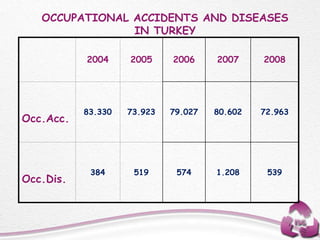
OCCUPATIONAL ACCIDENTS AND DISEASES
IN TURKEY
2004 2005 2006 2007 2008
Occ.Acc.
83.330 73.923 79.027 80.602 72.963
Occ.Dis.
384 519 574 1.208 539
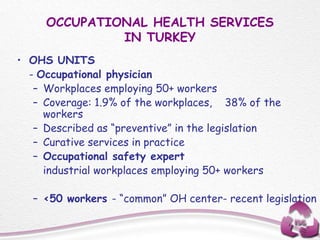
OCCUPATIONAL HEALTH SERVICES
IN TURKEY
• OHS UNITS
- Occupational physician
– Workplaces employing 50+ workers
– Coverage: 1.9% of the workplaces, 38% of the
workers
– Described as “preventive” in the legislation
– Curative services in practice
– Occupational safety expert
industrial workplaces employing 50+ workers
– <50 workers - “common” OH center- recent legislation
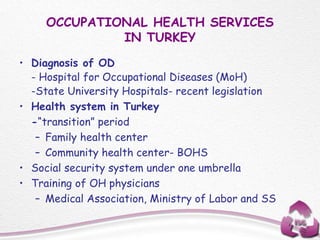
OCCUPATIONAL HEALTH SERVICES
IN TURKEY
• Diagnosis of OD
- Hospital for Occupational Diseases (MoH)
-State University Hospitals- recent legislation
• Health system in Turkey
-“transition” period
– Family health center
– Community health center- BOHS
• Social security system under one umbrella
• Training of OH physicians
– Medical Association, Ministry of Labor and SS
THANK YOU…
Dr. Buhara ÖNAL
bonal@csgb.gov.tr
00 90 312 2571690/200

pilot-Occupational_Health_and_Diseases.ppt

  • 1.
    MINISTRY OF LABOUR& SOCIAL SECURITY DIRECTORATE GENERAL OF OHS Dr. Buhara Önal OHS INSTITUTE (ISGUM) May 2010 Ankara - TURKEY
  • 2.
    CONTENT • Definition ofoccupational health • ILO/WHO Joint Committee • Definition of Occupational Disases • List of Occupational Diseases • OH situation in Turkey
  • 3.
    DEFINITION OF OCCUPATIONALHEALTH JOINT ILO/WHO COMMITTEE,1950 • the promotion and maintenance of the highest degree of physical, mental and social wellbeing of workers in all occupations; • the prevention amongst workers of departures from health caused by their working conditions; • the protection of workers in their employment from risks resulting from factors adverse to health; • the placing and maintenance of the worker in an occupational environment adapted to his physiological and psychological capabilities, and to summarize: the adaptation of work to man and of each man to his job.
  • 4.
    OCCUPATIONAL HEALTH OBJECTIVES JOINTILO/WHO COMITTEE, 1995 • the maintenance and promotion of workers’ health and working capacity; • the improvement of the working environment and work to become conducive to safety and health; • development of work organization and working culture in a direction which supports health and safety at work and in doing so also promotes a positive social climate and smooth operation which may enhance productivity of an undertaking.
  • 5.
    THE EUROPEAN COMMISSIONSTRATEGY FOR SAFETY AND HEALTH • It adopts a global approach of well-being at work taking into account the changes in the world of work and the emergence of new risks, especially of psycho-social nature. • This strategy aims at promoting “well-being at work” – physical, moral and social well-being, and not just something which can be measured by absence of accidents and occupational illness. • This strategy clearly suggests that health at work should not be measured only based on the number of rate of occupational diseases and accidents.
  • 6.
    EUROPEAN AGENCY FORSAFETY AND HEALTH AT WORK (OSHA) OHS concept includes any measures aimed at adapting work to the individual worker in order to: • reduce the harmful effect of work on the individual’s health; • ensure that people that have health problems are not unnecessarily excluded from the workplace or labour market as a result of work requirements and work capacities; and • promote working conditions and work organization in a way that improves general health.
  • 7.
  • 8.
    OHS DATA INTHE WORLD AND EU ILO Total Workforce 2.8 billion Work related deaths 2.2 million Occupational accidents 270 million Occupational diseases 160 million Total Cost 30 000 billion $ OSHA • Work related deaths 5.500 Lost working day 149 million • Total ost 20 billion € •
  • 10.
    DEFINITION OF OCCUPATIONALDISEASE • The term “occupational disease” covers any disease contracted as a result of an exposure to risk factors arising from work activity (the Protocol of 2002 to the OSH Convention, 1981). • The ILO Employment Injury Benefits Recommendation, defines occupational diseases as following terms: “Each Member should, under prescribed conditions, regard diseases known to arise out of the exposure to substances and dangerous conditions in processes, trades or occupations as occupational diseases.”
  • 11.
    DEFINITION OF OCCUPATIONALDİSEASE • Two main elements are present in the definition of an occupational disease: - the causal relationship between exposure in a specific working environment or work activity and a specific disease; and - the fact that the disease occurs among a group of exposed persons with a frequency above the average morbidity of the rest of the population.
  • 12.
    GENERAL CRITERIA FORIDENTIFICATION AND RECOGNITION OF OD • The causal relationship is established on the basis of clinical and pathological data, occupational background and job analysis, identification and evaluation of occupational risk factors and of the role of other risk factors. • Epidemiological and toxicological data are useful for determining the causal relationship between a specific occupational disease and its corresponding exposure in a specific working environment or work activity. • As a general rule, the symptoms are not sufficiently characteristic to enable an occupational disease to be diagnosed as such without the knowledge of the pathological changes engendered by the physical, chemical, biological or other factors encountered in the exercise of an occupation.
  • 13.
    GENERAL CRITERIA FORIDENTIFICATION AND RECOGNITION OF OD • It is therefore normal that, as a result of improvements in knowledge regarding the mechanisms of action of the factors in question, the steady increase in the number of substances employed, and the quality and variety of suspected agents, it becomes more and more feasible to make an accurate diagnosis, while the range of diseases recognized as occupational in origin is broadening.
  • 14.
    GENERAL CRITERIA FORIDENTIFICATION AND RECOGNITION OF OD - Strength of association. The greater the impact of an exposure on the occurrence or development of a disease, the stronger the likelihood of a causal relationship. - Consistency. Different research reports have generally similar conclusions. - Specificity. Exposure to a specific risk factor results in a clearly defined pattern of disease or diseases. - Temporality or time sequence. The exposure of interest preceded the disease by a period of time consistent with any proposed biological mechanism. - Biological gradient. The greater the level and duration of exposure, the greater the severity of diseases or their incidence. - Biological plausibility. From what is known of toxicology, chemistry, physical properties or other attributes of the studied risk or hazard, it makes biological sense to suggest that exposure leads to the disease. - Coherence. A general synthesis of all the evidence leads to the conclusion that there is a cause–effect relationship in a broad sense and in terms of general common sense. - Interventional studies. Sometimes, a primary preventative trial may verify whether removing a specific hazard or reducing a specific risk from the working environment or work activity eliminates the development of a specific disease or reduces its incidence.
  • 15.
    CRITERIA FOR IDENTIFICATIONAND RECOGNITION OF AN INDIVIDUAL DISEASE • Important elements for the determination of a causal relationship: - the exposure–effect relationship (relation between exposure and the severity of the impairment in the subject) - the exposure–response relationship (connection between exposure and the relative number of subjects affected) • Research and epidemiological studies have greatly contributed in this respect. Better knowledge of the causal relationship has allowed us to achieve a better medical definition of occupational diseases. • As a consequence, the legal definition of occupational diseases, which was rather a complex problem, is becoming more and more linked to the medical definition and criteria.
  • 16.
    CRITERIA FOR IDENTIFICATIONAND RECOGNITION OF AN INDIVIDUAL DISEASE • Legal provisions on compensation for victims vary from country to country. • The Employment Injury Benefits Convention which indicates the various possibilities regarding the form of the identification and recognition of OD entitling workers to compensation benefits, states that: • Each Member shall: (a) prescribe a list of diseases, comprising at least the diseases enumerated in the Convention, which shall be regarded as OD under prescribed conditions; or (b) include in its legislation a general definition of OD broad enough to cover at least the diseases enumerated in the Convention; or (c) prescribe a list of diseases in conformity with clause (a), complemented by a general definition of OD or by other provisions for establishing the occupational origin of diseases not so listed or manifesting themselves under conditions different from those prescribed.
  • 17.
    CRITERIA FOR IDENTIFICATIONAND RECOGNITION OF AN INDIVIDUAL DISEASE • The “list system” covers only a certain number of occupational diseases, and has the advantage of listing diseases for which there is a presumption that they are of occupational origin. This simplifies the matter for all parties since it is frequently very difficult, if not impossible, to prove or disprove that a disease is directly attributable to the victim's occupation. It also has the important advantage of indicating clearly where prevention should focus. • The “general definition system” theoretically covers all occupational diseases; it affords the widest and most flexible protection, but leaves it to the victim to prove the occupational origin of the disease. In practice, it also often implies that arbitration on individual cases is necessary. Furthermore, no emphasis is placed on specific prevention. • The “mixed system” has been favoured by many ILO member States, because it combines the advantages of the other two without their disadvantages.
  • 18.
    CRITERIA FOR INCORPORATINGA DISEASE INTO THE ILO LIST OF OCCUPATIONAL DISEASES • The List of Occupational Diseases Recommendation, 2002 (No. 194) was adopted at the 90th Session of the International Labour Conference, 2002. • The Committee on Occupational Accidents and Diseases established in 2002 to work on the List of Occupational Diseases Recommendation requested the Governing Body of the International Labour Office to convene the first of the tripartite meetings of experts referred to the Recommendation as a matter of priority. • The Committee expected that, in addition to examining the Annex to the Recommendation, the existing national and other lists of occupational diseases, and the comments received from member States, the Meeting should consider all the amendments submitted on the Annex to the Conference Committee.
  • 19.
    UPDATING THE LISTOF OD Decisions to incorporate specific diseases in the updated List of OD need to take into account the following general criteria: - there is a causal relationship with a specific agent, exposure or work process; - they occur in connection with the work environment and/or in specific occupations; - they occur among the groups of persons concerned with a frequency which exceeds the average incidence within the rest of the population; and - there is scientific evidence of a clearly defined pattern of disease following exposure and plausibility of cause.
  • 20.
    LIST OF OCCUPATIONALDISEASES (ILO) 1. Diseases caused by agents 1.1. Diseases caused by chemical agents 1.2. Diseases caused by physical agents 1.3. Diseases caused by biological agents 2. Diseases by target organ systems 2.1. Occupational respiratory diseases 2.2. Occupational skin diseases 2.3. Occupational musculo-skeletal disorders 3. Occupational cancer 3.1. Cancer caused by the following agents 4. Other diseases 4.1. Miners' nystagmus
  • 21.
    OCCUPATIONAL HEALTH INTURKEY A COUNTRY PROFILE
  • 22.
    DEMOGRAPHIC CHARACTERISTICS, TURKEY • 780000 sq. km. • population 71 million, 65% live in urban area • Age: <15 %20; ---- 65+ %5.7 • M % *** -------- F % *** • Total workforce 26 million
  • 23.
    SGK STATISTICS (2008) •1.170.248 workplaces • 8.802.989 compulsory insured person • 72.963 occupational accidents • 539 occupational diseases • 866 deaths due to occupational accidents and occupational diseases
  • 24.
    SOCIAL SECURITY COVERAGE SSKTOPLAM SII Total 49.51% EMEKLİ SANDIĞI (The Pension Fund Of The Republic Of Turkey) 15,10% BAĞ-KUR (Self Employed Insured Persons) 20.42% ÖZEL SANDIK (For Personnel of Banks, Insurance Comp Etc.) 0.45% KAPSAM DIŞI (Not Covered By Social Security) 14.52% Sosyal Güvenlik Kapsamı (Social Security Coverage)
  • 25.
    DISTRIBUTION OF WORKPLACESAND WORKERS BY SIZE OF THE WORKPLACES (TURKEY,2008) Workplace size (No. of workers) Workplaces % Workers % 1-9 85,4 29,1 10-49 12,7 32,9 50-249 1,6 21,8 249+ 0,3 16,2 Total 100,0 100,0
  • 26.
    OCCUPATIONAL ACCIDENTS ANDDISEASES IN TURKEY 2004 2005 2006 2007 2008 Occ.Acc. 83.330 73.923 79.027 80.602 72.963 Occ.Dis. 384 519 574 1.208 539
  • 27.
    OCCUPATIONAL HEALTH SERVICES INTURKEY • OHS UNITS - Occupational physician – Workplaces employing 50+ workers – Coverage: 1.9% of the workplaces, 38% of the workers – Described as “preventive” in the legislation – Curative services in practice – Occupational safety expert industrial workplaces employing 50+ workers – <50 workers - “common” OH center- recent legislation
  • 28.
    OCCUPATIONAL HEALTH SERVICES INTURKEY • Diagnosis of OD - Hospital for Occupational Diseases (MoH) -State University Hospitals- recent legislation • Health system in Turkey -“transition” period – Family health center – Community health center- BOHS • Social security system under one umbrella • Training of OH physicians – Medical Association, Ministry of Labor and SS
  • 29.
    THANK YOU… Dr. BuharaÖNAL bonal@csgb.gov.tr 00 90 312 2571690/200

Editor's Notes

  • #15 The recognition of a disease as being occupational is a specific example of clinical decision-making or applied clinical epidemiology. Deciding on the cause of a disease is not an “exact science” but rather a question of judgement based on a critical review of all the available evidence, which should include a consideration of the following: