Downloaded 50 times
![DETERMINATION OF THE LOAD CARRYING CAPACITY OF THE PILE
FOUNDATIONS
The load carrying capacity of piles comprises of two parts: skin friction and
end bearing. A wide range of method of analyses for determining skin friction
and end bearing is currently available for cast in-situ piles. Each of these
methods provides different outcome load capacities for driven piles and situ
piles. However, following equations may be used for all practical purposes:
Ultimate Skin Friction
A. Cohesive soil:
sus AcQ ××=α
where,
Qs = ultimate skin friction of pile (kN)
α = empirical adhesion factor [0.45 for cast in-situ piles and 0.50 to 1.0
for driven piles]
Cu = undrained cohesion (kN/m2
)
As = circumferential area of pile (m2
)
B. Cohesionless soil:
scorrs ANAQ ××= ; [A = 1.0 for situ pile and 2.0 for driven pile]
where,
Qs = ultimate skin friction of pile (kN)
Ncorr = corrected SPT for overburden pressure
As = circumferential area of pile (m2
)
Ultimate End Bearing Capacity
A. Cohesive soil:
pup AcQ ××=9
where,
Qp = ultimate end bearing capacity of pile (kN)
cu = undrained cohesion (kN/m2
)
Ap = tip area of pile (m2
)
B. Cohesionless soil:
pcorrp ANBQ ××= ; [B =120 for situ piles and 400 for driven piles]
where,
- 1 -](https://image.slidesharecdn.com/pilecapacityequations-150313023314-conversion-gate01/85/Pile-capacity-equations-1-320.jpg)
![DETERMINATION OF THE LOAD CARRYING CAPACITY OF THE PILE
FOUNDATIONS
The load carrying capacity of piles comprises of two parts: skin friction and
end bearing. A wide range of method of analyses for determining skin friction
and end bearing is currently available for cast in-situ piles. Each of these
methods provides different outcome load capacities for driven piles and situ
piles. However, following equations may be used for all practical purposes:
Ultimate Skin Friction
A. Cohesive soil:
sus AcQ ××=α
where,
Qs = ultimate skin friction of pile (kN)
α = empirical adhesion factor [0.45 for cast in-situ piles and 0.50 to 1.0
for driven piles]
Cu = undrained cohesion (kN/m2
)
As = circumferential area of pile (m2
)
B. Cohesionless soil:
scorrs ANAQ ××= ; [A = 1.0 for situ pile and 2.0 for driven pile]
where,
Qs = ultimate skin friction of pile (kN)
Ncorr = corrected SPT for overburden pressure
As = circumferential area of pile (m2
)
Ultimate End Bearing Capacity
A. Cohesive soil:
pup AcQ ××=9
where,
Qp = ultimate end bearing capacity of pile (kN)
cu = undrained cohesion (kN/m2
)
Ap = tip area of pile (m2
)
B. Cohesionless soil:
pcorrp ANBQ ××= ; [B =120 for situ piles and 400 for driven piles]
where,
- 1 -](https://image.slidesharecdn.com/pilecapacityequations-150313023314-conversion-gate01/75/Pile-capacity-equations-1-2048.jpg)
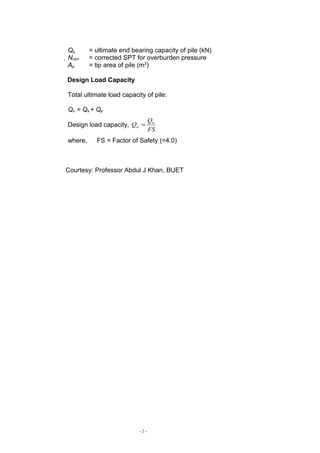

The document discusses methods for determining the load carrying capacity of pile foundations. The load carrying capacity has two components: skin friction and end bearing. Several methods are available to calculate skin friction and end bearing for cast-in-situ and driven piles. The document provides equations that can be used to calculate the ultimate skin friction and end bearing capacity for cohesive and cohesionless soils. The total ultimate load capacity is the sum of the skin friction and end bearing capacities. The design load capacity is calculated by dividing the total ultimate load capacity by a factor of safety of 4.0.


