Pietroasele Village
Nume : Horhocea Oana-Diana• Profesor Coordonator
• Frumuselu Mihai
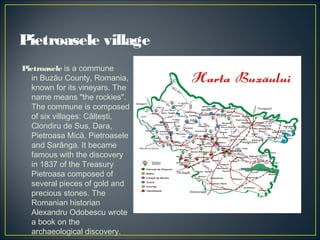
Pietroasele village
Pietroasele is a commune
in Buzău County, Romania,
known for its vineyars. The
name means "the rockies".
The commune is composed
of six villages: Câlţeşti,
Clondiru de Sus, Dara,
Pietroasa Mică, Pietroasele
and Şarânga. It became
famous with the discovery
in 1837 of the Treasury
Pietroasa composed of
several pieces of gold and
precious stones. The
Romanian historian
Alexandru Odobescu wrote
a book on the
archaeological discovery.
• A Dacian fortress is located at 1,5 km
north of Pietroasa Mică village. 
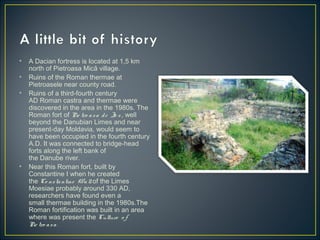
• Ruins of the Roman thermae at
Pietroasele near county road.
• Ruins of a third-fourth century
AD Roman castra and thermae were
discovered in the area in the 1980s. The
Roman fort of Pie tro asa de Jo s , well
beyond the Danubian Limes and near
present-day Moldavia, would seem to
have been occupied in the fourth century
A.D. It was connected to bridge-head
forts along the left bank of
the Danube river.
• Near this Roman fort, built by
Constantine I when he created
the Co nstantine Wall of the Limes
Moesiae probably around 330 AD,
researchers have found even a
small thermae building in the 1980s.The
Roman fortification was built in an area
where was present the Culture o f
Pie tro asa.
• The Pietroasele treasure, an Ostrogothic  hoard uncovered in
1837 by local villagers, is on display at the National Museum
of Romania history, in Bucharest. The original gold hoard,
discovered within a large ring barrow known as "Istriţa hill"
near Pietroasele, is a late fourth-century Gothic treasure that
included some twenty-two objects of gold, among the most
famous examples of the polychrome style of Migration Period
art. The total weight of the find was approximately 20
kilograms.
• Two of the targets are classified as monuments of
architecture, both in the village of Pietroasele: a stone fountain
dating from 1892 and a viticulture research station built in
1893. Three objects are considered tombstones or
memorials: Cruce a Frum o as ă (Beautiful Cross), dating from
the 19th century, Stan Avram  andIo n Le m naru (1841) from
Pietroasa Minor.
• Through it`s soil and climate conditions, the Pietroasa
viticultural domain distinguishes fromthe one in Urla iţ
through its osseous soil, with high limestone content,
established on calciferous soil, the terrain exposure, its rich
heliothermal resources and a regime low enough on
precipitation. Consisting of high temperatures and low
precipitations, this region is excellent forsweet and flavoured
grape varieties.
• Basilescu Winery owns over40 ha cultivated with: Busuioacă
de Bohotin, Romanian Muscatel, White Maiden and Italian
Riesling, fromthe wine category with Controlled Origin
Naming (D.O.C.) – Pietroasa. This is the region fromwhich
grapes fromin the Ingeri din Micul Paris, Eclipse and Dessert-
wines – Busuioac de Bohotin gamut, withdraw theirsap.ă
Pietroasele Village
Pietroasele Village

Pietroasele Village

  • 1.
    Pietroasele Village Nume :Horhocea Oana-Diana• Profesor Coordonator • Frumuselu Mihai
  • 2.
    Pietroasele village Pietroasele is acommune in Buzău County, Romania, known for its vineyars. The name means "the rockies". The commune is composed of six villages: Câlţeşti, Clondiru de Sus, Dara, Pietroasa Mică, Pietroasele and Şarânga. It became famous with the discovery in 1837 of the Treasury Pietroasa composed of several pieces of gold and precious stones. The Romanian historian Alexandru Odobescu wrote a book on the archaeological discovery.
  • 3.
    • A Dacian fortress islocated at 1,5 km north of Pietroasa Mică village.  • Ruins of the Roman thermae at Pietroasele near county road. • Ruins of a third-fourth century AD Roman castra and thermae were discovered in the area in the 1980s. The Roman fort of Pie tro asa de Jo s , well beyond the Danubian Limes and near present-day Moldavia, would seem to have been occupied in the fourth century A.D. It was connected to bridge-head forts along the left bank of the Danube river. • Near this Roman fort, built by Constantine I when he created the Co nstantine Wall of the Limes Moesiae probably around 330 AD, researchers have found even a small thermae building in the 1980s.The Roman fortification was built in an area where was present the Culture o f Pie tro asa.
  • 4.
    • The Pietroasele treasure,an Ostrogothic  hoard uncovered in 1837 by local villagers, is on display at the National Museum of Romania history, in Bucharest. The original gold hoard, discovered within a large ring barrow known as "Istriţa hill" near Pietroasele, is a late fourth-century Gothic treasure that included some twenty-two objects of gold, among the most famous examples of the polychrome style of Migration Period art. The total weight of the find was approximately 20 kilograms. • Two of the targets are classified as monuments of architecture, both in the village of Pietroasele: a stone fountain dating from 1892 and a viticulture research station built in 1893. Three objects are considered tombstones or memorials: Cruce a Frum o as ă (Beautiful Cross), dating from the 19th century, Stan Avram  andIo n Le m naru (1841) from Pietroasa Minor.
  • 5.
    • Through it`ssoil and climate conditions, the Pietroasa viticultural domain distinguishes fromthe one in Urla iţ through its osseous soil, with high limestone content, established on calciferous soil, the terrain exposure, its rich heliothermal resources and a regime low enough on precipitation. Consisting of high temperatures and low precipitations, this region is excellent forsweet and flavoured grape varieties. • Basilescu Winery owns over40 ha cultivated with: Busuioacă de Bohotin, Romanian Muscatel, White Maiden and Italian Riesling, fromthe wine category with Controlled Origin Naming (D.O.C.) – Pietroasa. This is the region fromwhich grapes fromin the Ingeri din Micul Paris, Eclipse and Dessert- wines – Busuioac de Bohotin gamut, withdraw theirsap.ă