PIE CRUST
● Crust is evenly browned and golden brown around the edge,
somewhat lighter brown on bottom.
● Crust is flaky and tender.
● Filling is firm, smooth, and adequately cooked.
● Flavor is well-blended, with the filling characteristic for that kind of
pie.
● It holds its shape when served.
Note:
Two of the most important steps when making pie crust are: use
chilled ingredients, and do not overblend.
Characteristics of a Good Pie
Handle dough lightly. This will
incorporate air and keep the
gluten from being developed.
Never substitute self-rising or cake flour for
all-purpose flour in pastry-making. If it is
necessary to use self-rising flour, omit the
salt. Pastry made with self-rising four will be
mealy rather than flaky.
Add a teaspoon of vinegar or lemon
juice in the liquid ingredients for each
cup of flour in the recipe; the acid
tempers the gluten and tenderizes the
dough.
Never skimp on quality for the sake of price when
it comes to pie ingredients. Bargain brands in
shortening are often made from reprocessed oils;
there is a real sacrifice of quality and flavor. Read
the label. Be sure it indicates the shortening is
pure, all-vegetable, and is recommended for
baking.
Cut half the shortening in at a
time; make sure it is chilled.
Use ice water to keep the
shortening solid and to minimize
the development of gluten. Use
just enough water so the dough
will just stick together. Too little
will make the crust crumbly; too
much will make it tough.
The kind of fat used effects the
tenderness, flavor, and nutrition
of a dough:
Preparing Dough
01 02 03 04
05 06 07
Do not place the pie pan on a
baking sheet before placing it in
the oven, unless the recipe
indicates to do so. This tends to
disperse too much heat away
from the bottom crust; it can
result in a soggy, unevenly
baked pie.
01 03
It is not necessary to grease
pie plates or pans because
of the amount of fat in pastry
and crusts. Never use a
shiny pie pan; the pie will
have a soggy bottom crust.
Nonstick pie pans can cause
pastry to shrnik excessively
when baking one crust pie
shells. To remedy this
problem, be sure pastry is
securely hooked ov er the
edge of a nonstick pan.
To prevent shrinkage of the
sides of an unfilled pie shell,
chill unbaked crust for 20 to 30
minutes and bake in a
preheated oven set at 425° to
475°F.
04
BAKING PIES
02
05 06
If the filling will be juicy, first
brush the crust lightly with
egg white or melted butter or
shortening. This keeps the
juices from soaking into the
crust and making it soggy.
Then sprinkle the lower crust
with a mixture of sugar and
flour before adding the fruit.
Bake the filled pie on the
lower oven shelf.
To protect a baked crust
when heating a filling in it, put
the pie (still in the original
pan) into an extra pan. This
prevents overbrowning.
BAKING PIES
PIE TOPPINGS
Pastry cutouts
Roll scraps of leftover dough. Cut out
shapes with cookie cutters or a knife.
Moisten the back of the cut-out with water,
and place the moistened side down on top of
the crust. An extra coating of an egg wash
will make cut-outs darker and more visible.
A shiny, glossy top
Brush with slightly beaten eggs;
sprinkle with sugar, if desired. An
egg white wash will be clear; the
whole egg or egg yolk wash will be
bronze.
Cut-out design
Use a knife or canape cutter
before placing top crust over
filling.
A golden-brown, shiny top
Brush with milk, cream, or a mixture
of 1 egg yolk and 1 tablespoon
water; sprinkle with sugar, if desired.
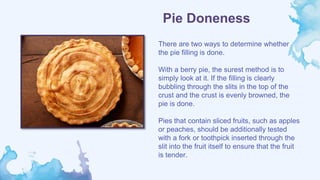
Pie Doneness
There are two ways to determine whether
the pie filling is done.
With a berry pie, the surest method is to
simply look at it. If the filling is clearly
bubbling through the slits in the top of the
crust and the crust is evenly browned, the
pie is done.
Pies that contain sliced fruits, such as apples
or peaches, should be additionally tested
with a fork or toothpick inserted through the
slit into the fruit itself to ensure that the fruit
is tender.
Storing Pies
Pies containing eggs and dairy products
(such as milk, sour cream, whipped cream or
topping, ice creams, yogurt, and cream
cheese) must be refrigerated or frozen as
appropriate.
If the room temperature is excessively warm,
refrigerate a baked fruit pie.
References:
Everything you need to know about pie dough. (2019,
December 11). Co+op, welcome to the
table. https://www.welcometothetable.coop/food-
lifestyle/cooking/everything-you-need-to-know-about-pie-
dough
Pies. (n.d.). Youth Development & Agricultural
Education. https://www.four-h.purdue.edu/foods/Pies.htm
Martina Maria Angela P. Gaza John David R. Roadilla Eishah Kaye O. Limbo

About Pie Crusts

  • 1.
  • 2.
    ● Crust isevenly browned and golden brown around the edge, somewhat lighter brown on bottom. ● Crust is flaky and tender. ● Filling is firm, smooth, and adequately cooked. ● Flavor is well-blended, with the filling characteristic for that kind of pie. ● It holds its shape when served. Note: Two of the most important steps when making pie crust are: use chilled ingredients, and do not overblend. Characteristics of a Good Pie
  • 3.
    Handle dough lightly.This will incorporate air and keep the gluten from being developed. Never substitute self-rising or cake flour for all-purpose flour in pastry-making. If it is necessary to use self-rising flour, omit the salt. Pastry made with self-rising four will be mealy rather than flaky. Add a teaspoon of vinegar or lemon juice in the liquid ingredients for each cup of flour in the recipe; the acid tempers the gluten and tenderizes the dough. Never skimp on quality for the sake of price when it comes to pie ingredients. Bargain brands in shortening are often made from reprocessed oils; there is a real sacrifice of quality and flavor. Read the label. Be sure it indicates the shortening is pure, all-vegetable, and is recommended for baking. Cut half the shortening in at a time; make sure it is chilled. Use ice water to keep the shortening solid and to minimize the development of gluten. Use just enough water so the dough will just stick together. Too little will make the crust crumbly; too much will make it tough. The kind of fat used effects the tenderness, flavor, and nutrition of a dough: Preparing Dough 01 02 03 04 05 06 07
  • 4.
    Do not placethe pie pan on a baking sheet before placing it in the oven, unless the recipe indicates to do so. This tends to disperse too much heat away from the bottom crust; it can result in a soggy, unevenly baked pie. 01 03 It is not necessary to grease pie plates or pans because of the amount of fat in pastry and crusts. Never use a shiny pie pan; the pie will have a soggy bottom crust. Nonstick pie pans can cause pastry to shrnik excessively when baking one crust pie shells. To remedy this problem, be sure pastry is securely hooked ov er the edge of a nonstick pan. To prevent shrinkage of the sides of an unfilled pie shell, chill unbaked crust for 20 to 30 minutes and bake in a preheated oven set at 425° to 475°F. 04 BAKING PIES 02
  • 5.
    05 06 If thefilling will be juicy, first brush the crust lightly with egg white or melted butter or shortening. This keeps the juices from soaking into the crust and making it soggy. Then sprinkle the lower crust with a mixture of sugar and flour before adding the fruit. Bake the filled pie on the lower oven shelf. To protect a baked crust when heating a filling in it, put the pie (still in the original pan) into an extra pan. This prevents overbrowning. BAKING PIES
  • 6.
    PIE TOPPINGS Pastry cutouts Rollscraps of leftover dough. Cut out shapes with cookie cutters or a knife. Moisten the back of the cut-out with water, and place the moistened side down on top of the crust. An extra coating of an egg wash will make cut-outs darker and more visible. A shiny, glossy top Brush with slightly beaten eggs; sprinkle with sugar, if desired. An egg white wash will be clear; the whole egg or egg yolk wash will be bronze. Cut-out design Use a knife or canape cutter before placing top crust over filling. A golden-brown, shiny top Brush with milk, cream, or a mixture of 1 egg yolk and 1 tablespoon water; sprinkle with sugar, if desired.
  • 7.
    Pie Doneness There aretwo ways to determine whether the pie filling is done. With a berry pie, the surest method is to simply look at it. If the filling is clearly bubbling through the slits in the top of the crust and the crust is evenly browned, the pie is done. Pies that contain sliced fruits, such as apples or peaches, should be additionally tested with a fork or toothpick inserted through the slit into the fruit itself to ensure that the fruit is tender.
  • 8.
    Storing Pies Pies containingeggs and dairy products (such as milk, sour cream, whipped cream or topping, ice creams, yogurt, and cream cheese) must be refrigerated or frozen as appropriate. If the room temperature is excessively warm, refrigerate a baked fruit pie.
  • 9.
    References: Everything you needto know about pie dough. (2019, December 11). Co+op, welcome to the table. https://www.welcometothetable.coop/food- lifestyle/cooking/everything-you-need-to-know-about-pie- dough Pies. (n.d.). Youth Development & Agricultural Education. https://www.four-h.purdue.edu/foods/Pies.htm Martina Maria Angela P. Gaza John David R. Roadilla Eishah Kaye O. Limbo