INTRODUCTION:
A PICmicrocontroller is a family of microcontrollers made by
Microchip Technology. The term PIC originally stood for
“Peripheral Interface Controller”, though it is now simply
known as PIC.
🔹 Definition:
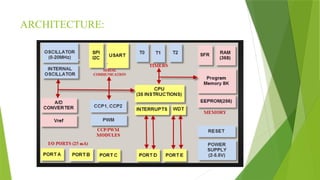
A PIC microcontroller is a small computer on a single integrated
circuit (IC) that contains a processor (CPU), memory (program and
data), and input/output peripherals, designed for use in embedded
systems and control applications.
cont…
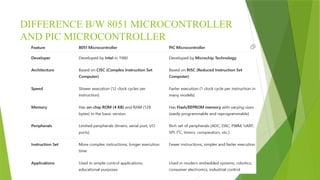
Peripheral InterfaceControllers (PIC) is a family of
microcontrollers from microchip Technologies.
Pic microcontrollers have attractive features and they are suitable
for a wide range of applications.
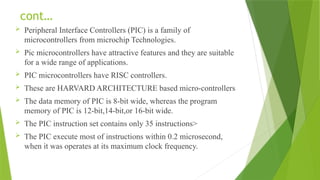
PIC microcontrollers have RISC controllers.
These are HARVARD ARCHITECTURE based micro-controllers
The data memory of PIC is 8-bit wide, whereas the program
memory of PIC is 12-bit,14-bit,or 16-bit wide.
The PIC instruction set contains only 35 instructions>
The PIC execute most of instructions within 0.2 microsecond,
when it was operates at its maximum clock frequency.
5.
cont..
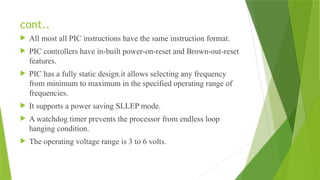
All mostall PIC instructions have the same instruction format.
PIC controllers have in-built power-on-reset and Brown-out-reset
features.
PIC has a fully static design.it allows selecting any frequency
from minimum to maximum in the specified operating range of
frequencies.
It supports a power saving SLLEP mode.
A watchdog timer prevents the processor from endless loop
hanging condition.
The operating voltage range is 3 to 6 volts.
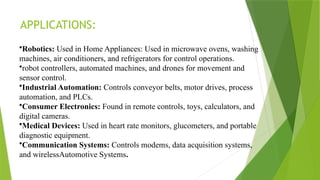
APPLICATIONS:
•Robotics: Used inHome Appliances: Used in microwave ovens, washing
machines, air conditioners, and refrigerators for control operations.
•robot controllers, automated machines, and drones for movement and
sensor control.
•Industrial Automation: Controls conveyor belts, motor drives, process
automation, and PLCs.
•Consumer Electronics: Found in remote controls, toys, calculators, and
digital cameras.
•Medical Devices: Used in heart rate monitors, glucometers, and portable
diagnostic equipment.
•Communication Systems: Controls modems, data acquisition systems,
and wirelessAutomotive Systems.
8.
ADVANTAGES&LIMITATIONS:
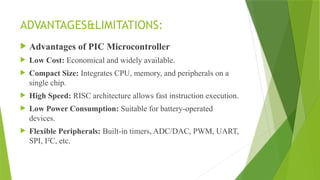
Advantages ofPIC Microcontroller
Low Cost: Economical and widely available.
Compact Size: Integrates CPU, memory, and peripherals on a
single chip.
High Speed: RISC architecture allows fast instruction execution.
Low Power Consumption: Suitable for battery-operated
devices.
Flexible Peripherals: Built-in timers, ADC/DAC, PWM, UART,
SPI, I²C, etc.
9.
CONT..
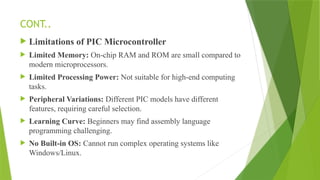
Limitations ofPIC Microcontroller
Limited Memory: On-chip RAM and ROM are small compared to
modern microprocessors.
Limited Processing Power: Not suitable for high-end computing
tasks.
Peripheral Variations: Different PIC models have different
features, requiring careful selection.
Learning Curve: Beginners may find assembly language
programming challenging.
No Built-in OS: Cannot run complex operating systems like
Windows/Linux.





![Polymer [ बहुलक ] Chemistry Notes PDF - Irfanullah Mehar - JJ Sir Chemistry.pdf](https://cdn.slidesharecdn.com/ss_thumbnails/polymerchemistrynotespdf-irfanullahmehar-jjsirchemistry-260210172118-3f9b37f7-thumbnail.jpg?width=640&height=640&fit=bounds)