Muscle MCQs
1. The regulatory (relaxing) proteins are
a. Tropomyosin
b. Troponin
c. Dystrophin – glycoprotein complex
d. Both tropomyosin & troponin
1. Which of the statements regarding the T tubules is correct
a. They are better developed in thin muscle fibres
b. They are invaginations of sarcoplasmic reticulum
c. They conduct depolarization to muscle cell interior
d. They contain ICF
1. Based on sliding- filament theory which of the following changes
would you expect in the sarcomere during contraction?
a. The length of A and H zones should increase
b. The length of A zone should increase
c. The length of H and I should decrease
d. The length of H zone should increase
e. The length of I zone should decrease
1. Dihydropyridine receptor is
a. Present in the T-tubule membrane and it is essentially a
voltage gated Ca++ channel
b. Present in the L-tubule and it is essentially a voltage- gated
Ca++ channel
c. Present in the L-tubule and it is essentially a ligand gated Ca++
channel
d. Present in the T-tubule membrane and it is essentially a ligand
gated Ca++ channel
Following is the electron micrograph of skeletal muscle
Junction of A and I band is represented at
A
B
C
D
1. Spatial summation means
a. Increasing the frequency of neural stimulation, therapy
increasing the number of motor units that will contract
b. Increasing the frequency of neural stimulation, thereby
increasing the tension developed by individual contracting
motor units
c. Increasing the intensity of electrical stimulation, thereby
increasing the tension developed by each individual
contracting motor unit
d. Increasing the intensity of electrical stimulation, thereby
increasing the number of motor units that will contract
1. All the following are true of type II muscle except
a. They are also called as white muscles
b. They are of short- twitch durations
c. They are meant for long, slow posture- maintaining
contractions
d. Extraocular muscle are an example
1. All are associated with smooth muscle except
a. Smooth muscle develops less force per unit cross-section
than skeletal muscle
b. Latch- state
c. Dense bodies
d. Ca++ (for contraction) comes mainly from ECF
e. Plasticity
f. One of the steps in contraction is activation of calmodulin-
dependent myosin light chain kinase and phosphorylation of
myosin
1. Which of the following muscle proteins physically covers the active
sites on actin filament to prevent interaction with myosin
a. Troponin C
b. Troponin I
c. Tropomyosin
d. Troponin T
1. Recruitment of motor units is also known as
a. Spatial summation
b. Temporal summation
c. Treppe
d. Clonus
Respiratory System MCQs
1. The Respiratory zone consists of all the following
except
a.Alveoli
b.Alveolar ducts
c.Respiratory bronchiole
d.Terminal bronchiole
1. With reference to atmospheric pressure, the
intrapleural pressure at the base of the lungs at
the start of inspiration is (in mmHg) about
a.–2.5
b.–6.0
c. 0
d.+2.5
1. With reference to atmospheric pressure, the
intrapulmonary pressure at the peak of normal
inspiration is (In mmHg).
a.–1.0
b.+1.0
c.–2.5
d.-60
1. The transpulmonary pressure is the pressure
difference between
a.Intrapleural and atmospheric pressure
b.Intra pulmonary and atmospheric pressure
c.Intrapleural and intrapulmonary
d.None of the above
1. The main muscle of inspiration is
a.Diaphragm
b.External intercostals
c.Internal intercostals
d.Scalene
1. Surfactant is secreted by
a.Type I alveolar epithelial cells
b.Granular pneumocytes
c.‘Dust’ Cells
d. APUD Cells
1. Surfactant is composed mainly of
a.Lecithin
b.Cephalin
c.Phosphatidylglycerol
d . Protein
1. Work of breathing is mostly due to
a.Surface tension elasticity
b.Tissue elasticity
c.Viscous resistance
d.Airway resistance
1. Whose value is normally the maximum
a.IRV
b.TV
c.ERV
d.RV
1. From base to apex of the lung during standing all
the following decrease except
a.Pulmonary blood flow
b.Ventilation per unit volume
c.VA/Q ratio
d.Intrapleural pressure
1. Consider the following graph
Shift of the solid curve to dashed curve can be
described as
a. Bohr’s effect
b.Heldane’s effect
c. CO poisoning
d. Chloride shift
1. Lung diffusion capacity is measured with
a.CO
b.CO2
c.N2O
d.O2
1. DLO2 at rest is (in mL/min/mmHg)
a.25
b.50
c.12.5
d.100
1. The ratio of the pulmonary ventilation to
pulmonary blood flow for the whole lung at rest
is approximately.
a.5.5
b.1.3
c.0.8
d.4.2
1. The partial pressure of CO2 in the atmospheric
air is (in mm Hg)
a.0.003
b.0.04
c.0.3
d.3
1. The partial pressure of H2O at body temperature
(37oC) is (in mm Hg)
a.21
b.40
c.47
d.100
1. The alveolar air composition is (in mm Hg)
a.PAO2=100; PACO2=40
b.PAO2=100; PACO2=46
c.PAO2 = 95; PACO2=46
d.PAO2 = 95; PACO2=40
Oxygen saturation in venous blood during severe
exercise lies at which point
A
B
C
D
1. When the O2 –Hb dissociation curve (OHDC) shifts
to the right it is associated with
a.Increased P50
b.Increased affinity Hb for O2
c.Impaired ability to unload O2 in the Tissues
d.Increased O2 – carrying capacity of Hb
1. 4 moles of myoglobin will bind how many moles
of Oxygen
a.4
b.16
c.1
d.8
1. Haldane effect is
a.Binding of O2 to Hb favours release of CO2
b.Binding of CO2 to Hb favour release of O2
c.HCO3 leaving RBC in exchange for C1
d.None of the above
1. CO2 is carried in the blood as
a.Carbamino compound
b.Dissolved gas
c.Bicarbonate
d. All of the above
1. The solubility of CO2 in blood is how many times
that of O2
a.210
b.20
c.10
d.1.4
1. Inherent rhythmicity of respiration is controlled by
neurons located in
a.Carotid
b.Lungs
c.Reticular formation of medulla
d.Pneumotaxic center
1. The ‘brakes’ on inspiration are applied by
a.Pneumotaxic centre
b.Afferent in vagi from the receptors in the
lungs and airways
c.Both A and B
d.Apneustic centre
1. The central chemoreceptors in the medulla
respond to
a.CO2
b.H+
c.O2
d.All of the above
1. The peripheral chemoreceptors respond to
a.CO2
b.H+
c.O2
d.All of the above
1. Carotic body chemoreceptors are stimulated by all
the following types of hypoxia except
a.Histotoxic
b.Stagnant
c.Hypoxic
d.Anemic
1. The ventilatory response to O2 lack becomes
marked only when the PAO2 is les than (in mm Hg)
a.100
b.95
c.60
d.30
1. Hering – Breuer reflexes are mediated by
a.Slowly adapting myelinated vagal fibres
b.Rapidly adapting myelinated vagal fibres
c.Unmyelinated pulmonary C fibers
d.Unmyelinated bronchial C fibers
1. J receptors are situated in
a.Heart
b.Joint
c.Alveolar interstitium
d.Carotid body
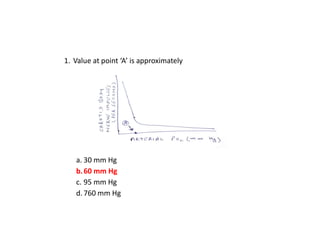
1. Value at point ‘A’ is approximately
a. 30 mm Hg
b.60 mm Hg
c. 95 mm Hg
d.760 mm Hg
1. Transection of brainstem below the medulla
a.Results in apneustic breathing
b.Stops respiration
c.Does not affect automatic respiration
d.Causes irregular respiration
1. Calculate the alveolar ventilation if respiratory
rate =20/ min, dead space = 180 ml and tidal
volume = 400 ml
a.5.5L/min
b.6.0L/min
c.4.4L/min
d.2.4L/min
1. In moderate exercise, the respiratory rate is
increased due to response of
a.Joint propriceptor stimulation
b.Increase in PCO2 in arterial blood
c.Decreased pH
d.Decreased O2
1. During exercise oxygen consumption of the
body can become
a.6 times
b.20 times
c.50 times
d.100 times
GIT MCQs
1. Digestion of protein occurs at
a. Intestinal lumen
b. Brush border
c. Cytoplasm of mucosal calls
d. All
1. Ebner's glands secrete
a.Ptyalin
b.Lingual lipase
c.Mucus
d. Colipase
1. Protein digestion begins in
a. Saliva
b.Stomach
c. Duodenal cap
d. Jejunum
1. Trypsinogen can be converted to trypsin by
a. Carboxypepdidase
b. Aminopepdidase
c. Enterokinase
d. gastrin
1. Carbohydrate digestion begins in
a. Saliva
b. Stomach
c. Duodenum
d. Ileum
1. Bile salts are maximally absorbed in
a. Duodenum
b. Jejunum
c. Ileum
d. Colon
1. Contents are essentially isotonic in all except
a. Duodenum
b. Jejunum
c. Ileum
d. Colon
1. Auerbach plexus is concerned mainly with
a. Motor control
b. Secreting activity
c. Sensory function
d. Blood flow
1. BER is seen in all except
a. Esophagus
b. Stomach
c. Ileum
d. Colon
1. Rate of BER is minimum in
a. Stomach
b. Duodenum
c. Caecum
d. Sigmoid
1. All are true about migratory motor complexes (MMC)
except
a. They migrate at the speed of 5 cm/min
b. They occur at an interval of 90 min
c. They are present during fasting
d.Gastrin may have a role in its generation
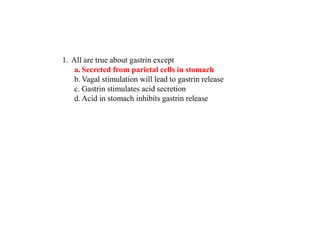
1. All are true about gastrin except
a. Secreted from parietal cells in stomach
b. Vagal stimulation will lead to gastrin release
c. Gastrin stimulates acid secretion
d. Acid in stomach inhibits gastrin release
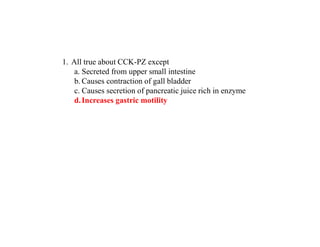
1. All true about CCK-PZ except
a. Secreted from upper small intestine
b. Causes contraction of gall bladder
c. Causes secretion of pancreatic juice rich in enzyme
d.Increases gastric motility
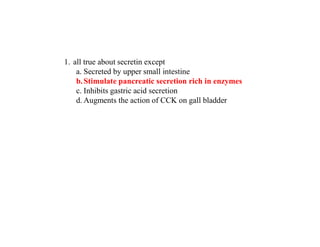
1. all true about secretin except
a. Secreted by upper small intestine
b.Stimulate pancreatic secretion rich in enzymes
c. Inhibits gastric acid secretion
d. Augments the action of CCK on gall bladder
1. All true about gastric emptying except
a. Gastrin promotes gastric emptying
b. Gastric distension favours gastric emptying
c. CCK inhibits gastric emptying
d.Duodenal hyperosmolarity increases gastric
emptying
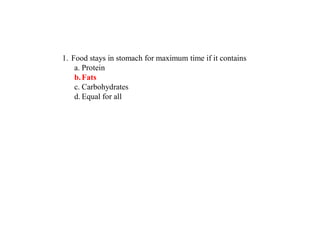
1. Food stays in stomach for maximum time if it contains
a. Protein
b.Fats
c. Carbohydrates
d. Equal for all
1. Primary bile acids are
a. Cholic acid and chenodeoxycholic acid
b. Cholic acid and lithocholic acid
c. Cholic acid and deoxycholic acid
d. Deoxycholic acid and chenodeoxycholic acid
1. Secondary bile acids are produced in
a. Small intestine
b.Large intestine
c. Liver
d. Gall bladder
1. Maximum water absorption occurs in
a. Stomach
b.Jejunum
c. Ileum
d. Colon
1. Glucose absorption at apical border in enterocytes
a. Primary active transport
b.Secondary active transport
c. Passive
d. Fascilitated diffusion
Kidney MCQs
1. All are true of juxtamedullary nephrons except [wrt cortical
nephrons]
a. Form 15% of total nephrons
b. Have vas recta
c. Have long loops of Henle
d.Have high blood flow
e. Have large O2 extraction
f. Have larger glomeruli and narrower efferent arterioles
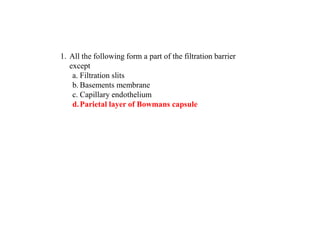
1. All the following form a part of the filtration barrier
except
a. Filtration slits
b. Basements membrane
c. Capillary endothelium
d.Parietal layer of Bowmans capsule
1. Calculate the direction of the net filtration force given the
following data:
PGC = 40mmHg
PT = 6mmHg
GC = 23mmHg
T = 3 mmHg
a. 14mmHg, from GC to T
b. 20 mmHg, fro GC to T
c. 54 mmHg, from GC to T
d. 20 mmHg, from T to CG
GC= Glomerular capillary
T=Tubule
P= Hydrostatic pressure
= Oncotic pressure
1. Clearance of which of the following substances is normally
the maximum
a. Glucose
b. Sodium
c. Urea
d. Creatinine
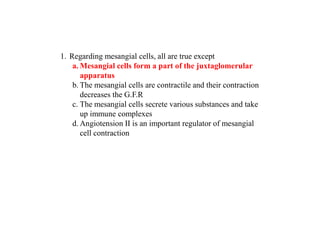
1. Regarding mesangial cells, all are true except
a. Mesangial cells form a part of the juxtaglomerular
apparatus
b. The mesangial cells are contractile and their contraction
decreases the G.F.R
c. The mesangial cells secrete various substances and take
up immune complexes
d. Angiotension II is an important regulator of mesangial
cell contraction
1. Sodium is maximally absorbed in
a. PCT
b. DCT
c. Loop of Henle
d. Collecting ducts
1. The correct sequence regarding the tonicity of tubular fluid
from PCT Descending limb of Henle’s loop  Ascending
limb of Henle’s loop is
a) Isotonic  HypotonicHypertonic.
b) Isotonic  Hypertonic  Isotonic / Hypotonic.
c) Isotonic  isotonic  Hypertonic.
d) Isotonic Isotonic  Hypotonic.
1. The part of the nephron least permeable to water is
a. PCT
b. Descending thin segment
c. Collecting duct
d. Ascending limb of Loop Of Henle
11.In the presence of vasopressin, the greatest fraction of filtered
water is reabsorbed in
a. PCT
b. Loop of Henle
c. DCT
d. CCD
e. OMCD
f. IMCD
To increase water reabsorption, / vasopressin acts on
a) Aquaporin 1
b) Aquaporin 2
c) Aquaporin 3
d) Aquaporin 4
Regarding the counter current mechanism all the following are
true EXCEPT
a. The CC multiplier in the loop of henle is an active process.
b. The CC exchanger in the Vasa Recta is a passive process.
c. Urea contributes to the medullary interstitial osmotic
gradient.
d.The high medullary blood flow helps in the counter
current mechanism.
e. The differential permeability characteristics of the
descending and ascending limbs of Henle to Na+ / H2O
helps in the counter current mechanism.
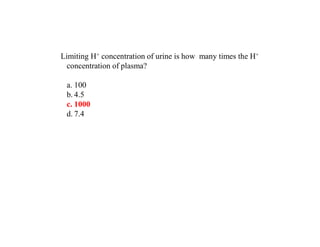
Limiting H+ concentration of urine is how many times the H+
concentration of plasma?
a. 100
b. 4.5
c. 1000
d. 7.4
18.Transport maxima of glucose in adult human kidney in male
i. 375 mg/min
ii.375 mg/100 ml
iii.180 mg/min
iv.180 mg/100 ml
18.Which of the following statements about renin is true?
i. Cells of PCT secrete it.
ii.Its secretion leads to loss of Na+ and H2O from plasma
iii.Its secretion is stimulated by increased mean renal
arterial pressure.
iv.Increase in ECF potassium decreases it.
18.The following test results were obtained on specimens from a
person over a 24-hour period:
Urine flow rate = 2.0 ml/min
Urine inulin = 1.0 mg /ml
Plasma inulin = 0.01 mg /ml
Urine urea = 220 m mol/L
Plasma urea = 5 m mol /L
What is the GFR?
a. 200 ml/ min
b. 125 ml/min
c. 150 ml/min
d. 175 ml /min
18.Urea concentration is maximum in
i. End of PCT
ii.Tip of Loop of Henle
iii.Medullary Collecting duct
iv.Medullary interstitium
18.In normal conditions total osmolarity maximum at
i. End of PCT
ii.End of DCT
iii.End of medullary collecting ducts
iv.Medullary interstitium near pyramids
18.Glucose concentration is maximum at
a)proximal PCT
b)distal PCT
c)DCT
d) collecting duct
Endocrine System MCQs
1. With respect to inactive follicles, active thyroid follicles
a. Have abundant colloid
b. Are large
c. Have columnar cells
d. Both a and b
1. Reabsorption lacunae in thyroid are seen in
a. Colloid in active follicle
b. Colloid in inactive follicle
c. Cells in active follicle
d. Cells in active follicle
1. Iodide uptake in thyroid cells is an example of
a. Primary active transport
b.Secondary active transport
c. Facilitated diffusion
d. Passive transport
1. All of the following are thyroid binding proteins in plasma
except
a. Albumin
b. Transthyretin
c. Thyroid binding globulin
d. Thyroglobulin
1. In thyroid 'coupling reaction' forms all of the following
except
a. T3
b. T4
c. RT3
d.DIT
1. Most of the total mass of adrenal gland is made up of
a. Zona glomerulosa
b.Zona fasciculata
c. Zona reticularis
d. Adrenal medulla
1. In adrenal medulla
a. 90 % cells are epinephrine secreting type
b. 90 % cells are nor-epinephrine secreting type
c. 90 % cells are dopamine secreting type
d. All three are almost equal
1. Cardiovascular effects of nor-epinephrine would include a
significant increase in all of the following except
a. Systolic BP
b. Diastolic BP
c. Mean BP
d.Pulse Pressure
1. The effects of aldosterone on kidney include
a. Increased Na+ reabsorption
b. Increased K+ excretion
c. Increased H+ excretion
d.All
1. All are true about primary hyper-aldosteronism except
a. Decrease in K+ in Plasma
b.Increase in plasma Na+
c. Increase in plasma HCO3
d. Hypertension
1. Aldosterone secretion is controlled by
a. ACTH
b. Angiotensin II
c. Electrolytes Na+ and K+
d.All
1. All of the following can give stimulatory afferent input to
hypothalamus for CRH release except
a. Limbic system
b. Suprachiasmatic nucleus
c. Baroreceptor
d. Nociceptive pathways
1. Cortisol
a. Secretion increases following injury
b. Favors protein synthesis
c. Enhances effects of antigen- antibody reaction
d. Tends to low blood pressure
1. Which of the following regarding action on plasma Ca++
and PO4 is true
a. 1, 25 DHCC : ↑Ca++ , ↓PO4
b. Calcitonin : ↓Ca++ , ↑PO4
c. PTH : ↑Ca++ , ↑PO4
d.None
1. Main effect of vit-D
a. Increases intestinal absorption of Ca++
b. Increases bone resorption
c. Increases Ca++ reabsorption in kidney
d. Increases bone formation
1. Major storage form of Vit-D is
a. 25 hydroxy cholecalciferol
b. 1, 25 dihydroxy cholecalciferol
c. 24,25 dihydroxy cholecalciferol
d. Cholecalciferol
1. 24 -25 dihydroxy cholecalciferol is produced in
a. Liver
b.Kidney
c. Skin
d. bones
1. Transaction of pituitary stalk leads to increase in
a. GH
b. TSH
c. ACTH
d.Prolactin
1. Anterior pituitary secretes
a. Somatotropin
b. Somatostatin
c. Somatomedin
d. all
1. Pan hypopituitarism causes all except
a. Pigmentation
b. Infertility
c. Loss of secondary sexual characteristics
d. Cold intolerance
1. Which of the following hormones is not secreted by
adenohypophysis
a. ADH
b. ACTH
c. TSH
d. FSH
1. Melatonin is secreted by
a. Hypothalamus
b. Intermediate lobe of pituitary
c. Pineal gland
d. Malanocytes
CNS MCQs
1. For arousal response, the important ascending pathway is
a. Reticulocortical
b. corticogeniculate
c. Spinoreticular
d. Limbal
1. Thalamus is a major sensory relay station for all except
a. Taste
b. Hearing
c. Vision
d.Smell
1. The term ‘desynchronisation’ indicates
a. S waves
b. Replacement of rhythmic wave with ‘a’ waves
c. Replacement of rhythmic EEG pattern with low
voltage, irregular waves
d. All of the above
1. All of the following statements about alpha rhythm of the
EEG is true except
a. It has an amplitude of about 50 microvolts
b. It has a frequency of 8-12 Hz
c. It disappears when the subject closes his eyes
d. It is most prominent over the parieto occipital region in
the adult
1. Sleep spindles appear in
a. Stage 1 of NREM
b.Stage 2 of NREM
c. Stage 3 of NREM
d. REM sleep
1. The percentage of REM out of the total sleeping time in
adults between 20-65 years is
a. 80
b. 50
c. 25
d. 15
1. Positive supporting (magnet) reaction is integrated at the
level of
a. Midbrain
b.Spinal cord
c. Medulla
d. Motor cortex
1. All are true of transection at the superior border of the pons
except
a. It causes decerebrate rigidity
b. Tonic labyrinthine and tonic neck reflexes are present
c. Righting reflexes are present
d. No stage of spinal shock; rigidity appears immediately
1. Most righting reflexes are integrated in the
a. Motor cortex
b. Spinal cord
c. Mid brain
d. Medulla
1. The optical righting reflex is integrated in
a. Motor cortex
b. Spinal card
c. Midbrain
d. Medulla
1. Most of the corticospinal and corticobulbar tracts arise from
a. Primary motor cortex
b. Premotor cortex
c. Supplementary motor area
d.Parietal lobe
1. Principle motor area is
a. 1
b. 2
c. 3
d.4
1. One of the following tracts s concerned with distal limb
muscles for skilled voluntary movement
a. Tectospinal
b. Reticulospinal
c. Vestibulospinal
d.Rubrospinal
e. Ventral corticospinal
1. In cerebellum all are inhibitory cells except
a. Purkinje cell
b. Golgi cells
c. Basket cells
d.Granule cells
1. Climbing fibers originate from
a. Spinal cord
b. Cerebral cortex
c. Cerebellar cortex
d.Inferior olive
1. Floculonodular lobe of cerebellum is concerned with
a. Equilibrium
b. Hearing
c. Fine movement
d. Planning and programming
1. The striatum includes
a. Caudate nucleus and putamen
b. Putamen and globus pallidus
c. Caudate nucleus and globus pallidus
d. Subthalamic nucleus and putamen
1. Afferents to basal ganglia end mainly in
a. Striatum
b. Subthalamic nucleus
c. Globus pallidus
d Substantia nigra
1. Efferents from basal ganglia arise mainly from
a. Striatum
b. Subthalamic nucleus
c. Globus pallidus
d. Substantia nigra
1. The neurotransmitter in the tract from the striatum to
substantia nigra is
a. Acetylcholine
b. Dopamine
c. GABA
d. Norepinephrine
1. All are true about endolymph except
a. Its potassium concentration is closer to that of
intracellular fluid
b.It is electrically negative as compared with perilymph
c. Membranous labyrinth contains endolymph
d. Steriocillia of the hair cells project into endolymph
1. Hair cells are the receptors of hearing. All are true except
a. They are present on reissner’s membrane
b. 3 layer of external and 1 layer of internal hair cell is
usually present
c. Internal hair cells are mainly responsible for carrying
information to brain
d. They have kino-cillium
1. Following is true about mango-cellular pathway
a. It can differentiate colors
b.It is a fast conducting pathway
c. It does not reach up-to the level of cortex
d. Meant for acuity of vision
1. If optic radiations present in meyer’s loop (temporal lobe)
of right side are cut, it will produce
a. Upper left quadrantanopsia
b. Lower left quadrantanopsia
c. Upper right quadrantanopsia
d. Upper right quadrantanopsia
1. In the retina, sensory signal usually passes in the
following order
a. From photoreceptor to amacrine cell to horizontal cell
to bipolar cell to ganglion cell
b.From photoreceptor to bipolar cell to amacrine cell
to ganglion cell
c. From photoreceptor to bipolar cell to horizontal call to
ganglion cell
d. From photoreceptor to horizontal cell to amacrine cell
to ganglion cell
1. Vomero-nasal organ on the nasal septum is particularly
meant for sensing
a. Odorants
b.Pheromones
c. Taste
d. Pungent smell
Nerve MCQs
1. The site of generation of action potential in a spinal motor
neuron is
a. The initial segment
b. The initial node of Ranvier
c. Dendritiic spines
d. Axon telondendria
e. Axon hillock
1. Myelin is a
a. Protein- lipid complex
b. Protein- carbohydrate- lipid complex
c. Carbohydrate- protein complex
d. Carbohydrate- lipid complex
1. Regarding myelin formation, one of the following is true
a. In peripheral nerves, Schwann cells form myelin;
Schwann cell forms myelin on one axon
b. In peripheral nerves, oligodendrogliocyte forms myelin
and forms myelin on many axons
c. In CNS, oligodendrogliocytes form myelin and forms
myelin on one axon
d. In CNS Schwann Cell forms myelin and Schwann cell
forms myelin on one axon
1. Out of the various phases of the action potential (recorded
with one electrode inside the cell), which one has the
longest duration?
a. Firing level
b. Overshoot
c. After depolarization
d. After hyper polarization
1. Rheobase is
a. Minimum time required to stimulate an excitable cell
b.Minimum current strength required to stimulate an
excitable cell
c. Minimum current strength required to stimulate an
excitable cell, when applied for a definite time period only
d. Maximum strength of current that an excitable cell can
withstand, without permanent damage.
1. Proprioceptive impulses are carried by which type of nerve
fibre
a. A 
b. A 
c. A 
d. C
1. Which will obey all or none law
a. Twitch
b.Action potential
c. EPSP
d. IPSP
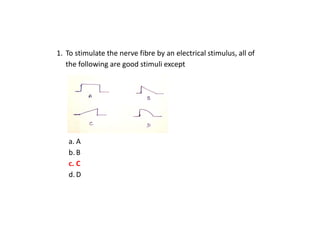
1. To stimulate the nerve fibre by an electrical stimulus, all of
the following are good stimuli except
a. A
b.B
c. C
d.D
Consider the following figure
Chronaxie is represented by
A
B
C
D
1. Chronaxie is minimum in
a. Skeletal muscle
b. Cardiac muscle
c. Smooth muscle
d. Equal in all
CVS MCQs
1. All are true of ventricular depolarization except
a. Left endocardial surface of interventricular septum is
the structure first to depolarize
b. Right endocardial surface of interventricular septum is
the structure second to depolarize
c. The top of the interventricular septum, posterobasal
portions of left ventricle, and pulmonary conus are the
last structures to depolarize
d.Depolarisation always proceeds from the
epicardium to endocardium
1. Repolarisation in the ventricle first occurs in
a. Apical epicardial surface
b. Basal epicardial surface
c. Basal endocardial surface
d.Apical endocardial surface
1. All are true of bipolar leads except
a. They are also called the standard limb leads
b.Leads II shows maximum deflection since the
direction of the mean QRS vector is perpendicular
to its lead axis
c. Lead III is between left arm and left leg, with the left
leg being positive and the left arm being negative
d. Potentials in lead I+ Lead III = Lead II (Einthoven’s
law)
1. ECG is predominantly negative in
a. aVL
b. aVF
c. aVR
d.VL
1. R wave in a healthy subject denotes a dipole with an
electrical axis of (in degrees)
a. 0
b. +120
c. –120
d.+60
1. Action potential of the ventricle is given in the following
figure. Point ‘A’ lies during
a. PR interval
b.QRS
c. ST segment
d.TP segment
1. The correct sequence of the given electromechanical events
as they occur during the cardiac cycle is
a. First heart sound (HIS), QRS complex of the ECG (QRS)
c wave of the JVP (c)
b. QRS, c, HIS
c. ‘c’ HSE, QRS
d.QRS, HIS, c
1. First heart sound occurs during
a. Isovolumic contraction
b. Isotonic contraction
c. Isovolumic relaxation
d. Isotonic relaxation
1. Action potential of the atrium corresponds to which part of
ECG
a. A
b.B
c. C
d.D
1. Cardiac output can be measured by
a. Fick principle
b. Thermodilution /dye dilution method
c. Doppler combined with echocardiography
d.All
1. Left ventricular work / beat is
a. SV x MAP in aorta
b. CO x MAP in aorta
c. EF x MAP in aorta
d. SV x systolic pressure in aorta
1. If flow is 5400 ml/ minute and pressure is 90 mm Hg, the resistance in R units
will be
a. 1/60
b. 60
c. 1
d. 6/100
1. The probability of turbulence is more in all the following
except when
a. Velocity is more
b.Viscosity is more
c. Diameter of the tube is more
d. Density of fluid is more
1. If length is half and the radius is doubled, the flow increase
by
a. 32 times
b. 16 times
c. 1/16 times
d. 8 times
1. With respect to cardiovascular system, autoregulation means
maintenance of
a. Perfusion pressure
b. Mean arterial pressure (MAP)
c. Peripheral resistance
d.Blood flow
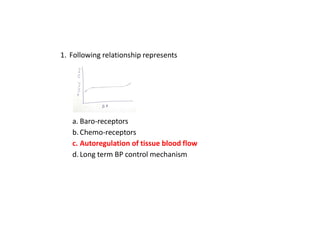
1. Following relationship represents
a. Baro-receptors
b.Chemo-receptors
c. Autoregulation of tissue blood flow
d.Long term BP control mechanism
1. Vasomotor center (VMC) is located in
a. Spinal cord (C 2, 3, 4)
b. Spinal cord (T1 to L2)
c. Medulla
d. Cerebral cortex
1. All the following excite the VMC except
a. Increase in baroreceptor discharge
b. Increase in chemoreceptor discharge
c. Increase in carbon dioxide (direct effect)
d. Decrease in oxygen (direct effect)
1. Increase in heart rate will be seen in
a. Cushing’s reflex or the CNS ischaemic response
b. Besold- Jarisch reflex
c. Bainbridge reflex
d. Norepinephrine infusion
1. Mayer and Traube – Hering waves are
a. BP waves
b. Respiratory pressure curves
c. Ventricular pressure curves
d. Respiratory volumes curves
1. Receptor for Bainbridge reflex lies in
a. Right atrium
b. Left atrium
c. Right ventricle
d. Left ventricle
1. Receptor for Bezold Zerisch reflex lies in
a. Right atrium
b. Left atrium
c. Right ventricle
d.Left ventricle
1. All are BP regulating mechanisms except
a. Chemoreflex
b. CNS ischemic response
c. Pressure natriuresis
d. Frank starling law
1. All are long term BP regulating mechanisms except
a. Salt intake
b. Pressure natriuresis
c. Aldosterone
d.Baroreflex
1. All will increase heart rate except
a. Right atrial stretch
b. Stretching of SA node
c. Increased temperature of SA node
d. Carotid sinus stretch
1. While standing from reclining position, all will decrease
except
a. Venous return
b. Central venous pressure
c. BP
d.TPR
Reproduction MCQs
1. Synthesis of testosterone is controlled by
a. FSH
b.LH
c. TSH
d. LHRH
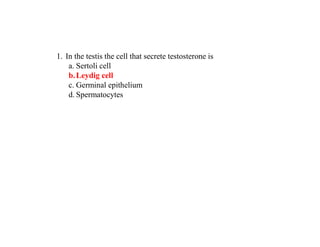
1. In the testis the cell that secrete testosterone is
a. Sertoli cell
b.Leydig cell
c. Germinal epithelium
d. Spermatocytes
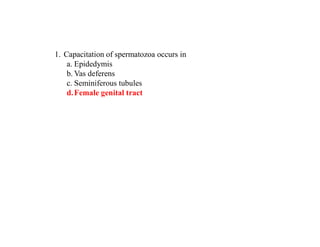
1. Capacitation of spermatozoa occurs in
a. Epidedymis
b. Vas deferens
c. Seminiferous tubules
d.Female genital tract
1. Which of the following statements about androgen is false
a. They are formed by seminiferous tubules of the testis
b. They are formed in greater quantity in fetal life than in
childhood
c. They are secreted in small amount in adult females
d. Their concentration decreases after 30 yrs in men
1. Inhibin in male is secreted from
a. Sertoli cells
b. Leydig cells
c. Anterior pituitary
d. Hypothalamus
1. Sertoli cells secrete all except
a. Androgen binding prorein
b. Inhibin
c. Mullerian inhibiting substance
d.Testosterone
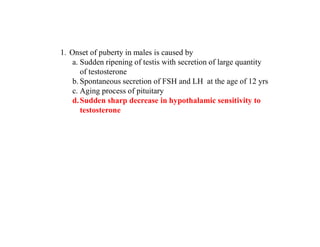
1. Onset of puberty in males is caused by
a. Sudden ripening of testis with secretion of large quantity
of testosterone
b. Spontaneous secretion of FSH and LH at the age of 12 yrs
c. Aging process of pituitary
d.Sudden sharp decrease in hypothalamic sensitivity to
testosterone
1. Erection is mediated by release of which neurotransmitter
a. Acetylcholine
b. Epinephrine
c. Norepinephrine
d.Nitric oxide
1. Uterine contractility is increased by
a. Estrogen
b. Progesterone
c. FSH
d. LH
1. Hormone responsible for increased body temperature after
ovulation
a. LH
b. Estrogen
c. Progesterone
d. Testosterone
1. All true about luteal phase except
a. Increased temperature
b. Breast tenderness
c. Cervical mucous can not be stretched into a thread
d.Fern pattern of cervical mucous
1. Ovulation is caused by
a. Surge of LH just prior to mid cycle
b. Failure of corpus luteum to involute
c. Reduction of estrogen and progesterone
d. Excessive secretion of estrogen and progesterone
1. Luteal phase of menstruation is characterized by
a. A variable length
b. Secretion of estrogen
c. Low body temperature
d.Secretion of progesterone
1. Menopausal hot flushes are due to
a. FSH surge
b.LH surge
c. Decreased estrogen
d. Decreased progesterone
1. Menopause is caused due to
a. Endometrium becoming insensitive to estrogen and
progesterone
b.Ovary not producing estrogen and progesterone
c. Pituitary
d. Hypothalamus
1. Level of which hormone is increased after menopause
a. Estrogen
b. Progesterone
c. FSH
d. Cortisone
1. Hormones secreted by plecenta
a. Human chorionic gonadotropin
b. Estrogen
c. Progesterone
d. Human chorionic somatomammatropin
e. All
1. Maximum production of HCG occurs during
a. First trimester
b. Second trimester
c. Third trimester
d. Implantation
1. Milk let down is produced by
a. Estrogen
b. Progesterone
c. Prolactin
d.Oxitocin
Clotting MCQs
1. the first important event in haemostasis after tissue injury
a. Vascular spasm
b. Formation of platelet plug
c. Formation of prothrombin activator
d. Formation of thromboplastin
1. In vitro coagulation is initiated by factor
a. XII
b. XI
c. X
d. VII
1. Conversion of fibrinogen into fibrin is caused by
a. Thrombin
b. Calcium ion
c. Factor XII
d. Thromboplastin
1. Factors common to both intrinsic and extrinsic clotting
pathway include
a. X
b. V
c. IV
d. XIII
e. All
1. Factors used in extrinsic pathway of blood clotting are all
except
a. V
b.VIII
c. Tissue factor
d. X
1. Life span of platelet is
a. 4 days
b.9-12 days
c. 20-31 days
d. 90 days
1. Thrombosthenin is
a. Coagulation factor
b.Contractile protein
c. A protein regulating platelet function
d. A protein meant for fibrin stabilization
1. Appropriate treatment for increased tendency of clot includes
a. Intravenous heparin
b. Vitamin K
c. IV sodium citrate
d. Oxalate
1. Anticoagulant that prevent coagulation when placed in
blood sample outside the body include all except
a. Citrate
b. Oxalate
c. Heparin
d.Coumarins
1. What facilitates conversion of profibrinolysin to
fibrinolysin
a. tPA
b. Streptokinase
c. Urokinase
d.All
1. Anticoagulant action of citrate is due to its ability to
a. Bind factor XII
b. Bind vit K
c. Chelate calcium
d. Inhibit prothrombin
1. In haemophilia
a. Factor VIII is decreased
b. Factor VII is decreased
c. Bleeding time is increased
d. Prothrombin time is increased
General Physiology MCQs
1. Calculate the interstitial fluid volume in a 60 kg man
a. 3 L
b.9 L
c. 12 L
d. 24 L
1. If plasma volume = 4L, and haematocrit = 60%, what is the
blood volume
a. 10 L
b. 6.67 L
c. 6 L
d. 8 L
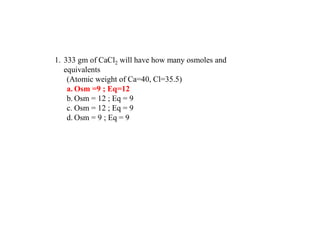
1. 333 gm of CaCl2 will have how many osmoles and
equivalents
(Atomic weight of Ca=40, Cl=35.5)
a. Osm =9 ; Eq=12
b. Osm = 12 ; Eq = 9
c. Osm = 12 ; Eq = 9
d. Osm = 9 ; Eq = 9
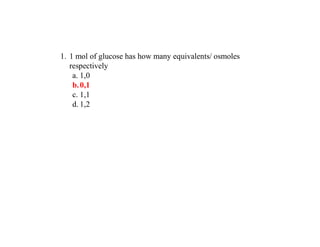
1. 1 mol of glucose has how many equivalents/ osmoles
respectively
a. 1,0
b.0,1
c. 1,1
d. 1,2
1. Osmolality is
a. No.of osmoles/ litre of solutions
b.No. of Osmoles/ kg of solvent
c. No. of moles/ litre of solution
d. No. of moles / kg of solvent
1. A cell is place into a solution, swells and bursts.Normal
cellular osmolarity is approximately 280 m OSM. Into
which solution could the cell have been placed?
a. A 140 mm NaCl solution
b. A 280 mm NaCl solution
c. A 280 mm glucose solution
d. A 580-mm glucose solution
e. None of the above
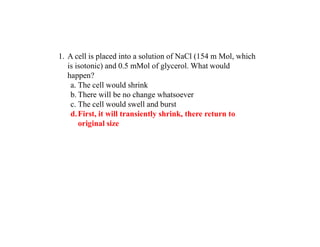
1. A cell is placed into a solution of NaCl (154 m Mol, which
is isotonic) and 0.5 mMol of glycerol. What would
happen?
a. The cell would shrink
b. There will be no change whatsoever
c. The cell would swell and burst
d.First, it will transiently shrink, there return to
original size
1. Calculate the Osmotic pressure of a 0.01 M of CaCl2 with
an osmotic coefficient of 0.8 (1osm 22.4 atmosphere
a. 0.1792 atm.
b.0.5376 atm
c. 0.3584 atm
d. 0.7368 atm
1. Uncorrected total osmolarity of plasma is
a. 154 mosm/l
b. 285 mosm/l
c. 308 mosm/l
d. 348 mosm/l
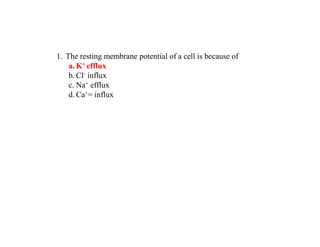
1. The resting membrane potential of a cell is because of
a. K+ efflux
b. Cl- influx
c. Na+ efflux
d. Ca+= influx
1. The equilibrium potential for Na+ is about
a. –70 mv
b.+ 60 mv
c. –60 mv
d. –100 mv
1. Duration of action potential in a nerve fiber
a. 3-4 ms
b. 30-40 ms
c. 300- 400 ms
d. 3000- 4000 ms
1. Action potential duration is maximum in
a. Nerve fiber
b. Skeletal muscle
c. Atrial muscle
d.Ventricular muscle

Physiology MCQS.pdf

  • 1.
  • 2.
    1. The regulatory(relaxing) proteins are a. Tropomyosin b. Troponin c. Dystrophin – glycoprotein complex d. Both tropomyosin & troponin
  • 3.
    1. Which ofthe statements regarding the T tubules is correct a. They are better developed in thin muscle fibres b. They are invaginations of sarcoplasmic reticulum c. They conduct depolarization to muscle cell interior d. They contain ICF
  • 4.
    1. Based onsliding- filament theory which of the following changes would you expect in the sarcomere during contraction? a. The length of A and H zones should increase b. The length of A zone should increase c. The length of H and I should decrease d. The length of H zone should increase e. The length of I zone should decrease
  • 5.
    1. Dihydropyridine receptoris a. Present in the T-tubule membrane and it is essentially a voltage gated Ca++ channel b. Present in the L-tubule and it is essentially a voltage- gated Ca++ channel c. Present in the L-tubule and it is essentially a ligand gated Ca++ channel d. Present in the T-tubule membrane and it is essentially a ligand gated Ca++ channel
  • 6.
    Following is theelectron micrograph of skeletal muscle Junction of A and I band is represented at A B C D
  • 7.
    1. Spatial summationmeans a. Increasing the frequency of neural stimulation, therapy increasing the number of motor units that will contract b. Increasing the frequency of neural stimulation, thereby increasing the tension developed by individual contracting motor units c. Increasing the intensity of electrical stimulation, thereby increasing the tension developed by each individual contracting motor unit d. Increasing the intensity of electrical stimulation, thereby increasing the number of motor units that will contract
  • 9.
    1. All thefollowing are true of type II muscle except a. They are also called as white muscles b. They are of short- twitch durations c. They are meant for long, slow posture- maintaining contractions d. Extraocular muscle are an example
  • 10.
    1. All areassociated with smooth muscle except a. Smooth muscle develops less force per unit cross-section than skeletal muscle b. Latch- state c. Dense bodies d. Ca++ (for contraction) comes mainly from ECF e. Plasticity f. One of the steps in contraction is activation of calmodulin- dependent myosin light chain kinase and phosphorylation of myosin

  • 11.
    1. Which ofthe following muscle proteins physically covers the active sites on actin filament to prevent interaction with myosin a. Troponin C b. Troponin I c. Tropomyosin d. Troponin T
  • 12.
    1. Recruitment ofmotor units is also known as a. Spatial summation b. Temporal summation c. Treppe d. Clonus
  • 13.
  • 14.
    1. The Respiratoryzone consists of all the following except a.Alveoli b.Alveolar ducts c.Respiratory bronchiole d.Terminal bronchiole
  • 16.
    1. With referenceto atmospheric pressure, the intrapleural pressure at the base of the lungs at the start of inspiration is (in mmHg) about a.–2.5 b.–6.0 c. 0 d.+2.5
  • 18.
    1. With referenceto atmospheric pressure, the intrapulmonary pressure at the peak of normal inspiration is (In mmHg). a.–1.0 b.+1.0 c.–2.5 d.-60
  • 19.
    1. The transpulmonarypressure is the pressure difference between a.Intrapleural and atmospheric pressure b.Intra pulmonary and atmospheric pressure c.Intrapleural and intrapulmonary d.None of the above
  • 20.
    1. The mainmuscle of inspiration is a.Diaphragm b.External intercostals c.Internal intercostals d.Scalene
  • 21.
    1. Surfactant issecreted by a.Type I alveolar epithelial cells b.Granular pneumocytes c.‘Dust’ Cells d. APUD Cells
  • 22.
    1. Surfactant iscomposed mainly of a.Lecithin b.Cephalin c.Phosphatidylglycerol d . Protein
  • 23.
    1. Work ofbreathing is mostly due to a.Surface tension elasticity b.Tissue elasticity c.Viscous resistance d.Airway resistance
  • 24.
    1. Whose valueis normally the maximum a.IRV b.TV c.ERV d.RV
  • 25.
    1. From baseto apex of the lung during standing all the following decrease except a.Pulmonary blood flow b.Ventilation per unit volume c.VA/Q ratio d.Intrapleural pressure
  • 26.
    1. Consider thefollowing graph Shift of the solid curve to dashed curve can be described as a. Bohr’s effect b.Heldane’s effect c. CO poisoning d. Chloride shift
  • 27.
    1. Lung diffusioncapacity is measured with a.CO b.CO2 c.N2O d.O2
  • 28.
    1. DLO2 atrest is (in mL/min/mmHg) a.25 b.50 c.12.5 d.100
  • 29.
    1. The ratioof the pulmonary ventilation to pulmonary blood flow for the whole lung at rest is approximately. a.5.5 b.1.3 c.0.8 d.4.2
  • 30.
    1. The partialpressure of CO2 in the atmospheric air is (in mm Hg) a.0.003 b.0.04 c.0.3 d.3
  • 31.
    1. The partialpressure of H2O at body temperature (37oC) is (in mm Hg) a.21 b.40 c.47 d.100
  • 32.
    1. The alveolarair composition is (in mm Hg) a.PAO2=100; PACO2=40 b.PAO2=100; PACO2=46 c.PAO2 = 95; PACO2=46 d.PAO2 = 95; PACO2=40
  • 33.
    Oxygen saturation invenous blood during severe exercise lies at which point A B C D
  • 34.
    1. When theO2 –Hb dissociation curve (OHDC) shifts to the right it is associated with a.Increased P50 b.Increased affinity Hb for O2 c.Impaired ability to unload O2 in the Tissues d.Increased O2 – carrying capacity of Hb
  • 35.
    1. 4 molesof myoglobin will bind how many moles of Oxygen a.4 b.16 c.1 d.8
  • 36.
    1. Haldane effectis a.Binding of O2 to Hb favours release of CO2 b.Binding of CO2 to Hb favour release of O2 c.HCO3 leaving RBC in exchange for C1 d.None of the above
  • 37.
    1. CO2 iscarried in the blood as a.Carbamino compound b.Dissolved gas c.Bicarbonate d. All of the above
  • 38.
    1. The solubilityof CO2 in blood is how many times that of O2 a.210 b.20 c.10 d.1.4
  • 39.
    1. Inherent rhythmicityof respiration is controlled by neurons located in a.Carotid b.Lungs c.Reticular formation of medulla d.Pneumotaxic center
  • 40.
    1. The ‘brakes’on inspiration are applied by a.Pneumotaxic centre b.Afferent in vagi from the receptors in the lungs and airways c.Both A and B d.Apneustic centre
  • 41.
    1. The centralchemoreceptors in the medulla respond to a.CO2 b.H+ c.O2 d.All of the above
  • 42.
    1. The peripheralchemoreceptors respond to a.CO2 b.H+ c.O2 d.All of the above
  • 43.
    1. Carotic bodychemoreceptors are stimulated by all the following types of hypoxia except a.Histotoxic b.Stagnant c.Hypoxic d.Anemic
  • 44.
    1. The ventilatoryresponse to O2 lack becomes marked only when the PAO2 is les than (in mm Hg) a.100 b.95 c.60 d.30
  • 45.
    1. Hering –Breuer reflexes are mediated by a.Slowly adapting myelinated vagal fibres b.Rapidly adapting myelinated vagal fibres c.Unmyelinated pulmonary C fibers d.Unmyelinated bronchial C fibers
  • 47.
    1. J receptorsare situated in a.Heart b.Joint c.Alveolar interstitium d.Carotid body
  • 48.
    1. Value atpoint ‘A’ is approximately a. 30 mm Hg b.60 mm Hg c. 95 mm Hg d.760 mm Hg
  • 49.
    1. Transection ofbrainstem below the medulla a.Results in apneustic breathing b.Stops respiration c.Does not affect automatic respiration d.Causes irregular respiration
  • 50.
    1. Calculate thealveolar ventilation if respiratory rate =20/ min, dead space = 180 ml and tidal volume = 400 ml a.5.5L/min b.6.0L/min c.4.4L/min d.2.4L/min
  • 51.
    1. In moderateexercise, the respiratory rate is increased due to response of a.Joint propriceptor stimulation b.Increase in PCO2 in arterial blood c.Decreased pH d.Decreased O2
  • 52.
    1. During exerciseoxygen consumption of the body can become a.6 times b.20 times c.50 times d.100 times
  • 53.
  • 54.
    1. Digestion ofprotein occurs at a. Intestinal lumen b. Brush border c. Cytoplasm of mucosal calls d. All
  • 55.
    1. Ebner's glandssecrete a.Ptyalin b.Lingual lipase c.Mucus d. Colipase
  • 56.
    1. Protein digestionbegins in a. Saliva b.Stomach c. Duodenal cap d. Jejunum
  • 57.
    1. Trypsinogen canbe converted to trypsin by a. Carboxypepdidase b. Aminopepdidase c. Enterokinase d. gastrin
  • 58.
    1. Carbohydrate digestionbegins in a. Saliva b. Stomach c. Duodenum d. Ileum
  • 59.
    1. Bile saltsare maximally absorbed in a. Duodenum b. Jejunum c. Ileum d. Colon
  • 60.
    1. Contents areessentially isotonic in all except a. Duodenum b. Jejunum c. Ileum d. Colon
  • 61.
    1. Auerbach plexusis concerned mainly with a. Motor control b. Secreting activity c. Sensory function d. Blood flow
  • 63.
    1. BER isseen in all except a. Esophagus b. Stomach c. Ileum d. Colon
  • 65.
    1. Rate ofBER is minimum in a. Stomach b. Duodenum c. Caecum d. Sigmoid
  • 66.
    1. All aretrue about migratory motor complexes (MMC) except a. They migrate at the speed of 5 cm/min b. They occur at an interval of 90 min c. They are present during fasting d.Gastrin may have a role in its generation
  • 67.
    1. All aretrue about gastrin except a. Secreted from parietal cells in stomach b. Vagal stimulation will lead to gastrin release c. Gastrin stimulates acid secretion d. Acid in stomach inhibits gastrin release
  • 68.
    1. All trueabout CCK-PZ except a. Secreted from upper small intestine b. Causes contraction of gall bladder c. Causes secretion of pancreatic juice rich in enzyme d.Increases gastric motility
  • 69.
    1. all trueabout secretin except a. Secreted by upper small intestine b.Stimulate pancreatic secretion rich in enzymes c. Inhibits gastric acid secretion d. Augments the action of CCK on gall bladder
  • 70.
    1. All trueabout gastric emptying except a. Gastrin promotes gastric emptying b. Gastric distension favours gastric emptying c. CCK inhibits gastric emptying d.Duodenal hyperosmolarity increases gastric emptying
  • 72.
    1. Food staysin stomach for maximum time if it contains a. Protein b.Fats c. Carbohydrates d. Equal for all
  • 73.
    1. Primary bileacids are a. Cholic acid and chenodeoxycholic acid b. Cholic acid and lithocholic acid c. Cholic acid and deoxycholic acid d. Deoxycholic acid and chenodeoxycholic acid
  • 74.
    1. Secondary bileacids are produced in a. Small intestine b.Large intestine c. Liver d. Gall bladder
  • 75.
    1. Maximum waterabsorption occurs in a. Stomach b.Jejunum c. Ileum d. Colon
  • 76.
    1. Glucose absorptionat apical border in enterocytes a. Primary active transport b.Secondary active transport c. Passive d. Fascilitated diffusion
  • 77.
  • 78.
    1. All aretrue of juxtamedullary nephrons except [wrt cortical nephrons] a. Form 15% of total nephrons b. Have vas recta c. Have long loops of Henle d.Have high blood flow e. Have large O2 extraction f. Have larger glomeruli and narrower efferent arterioles
  • 79.
    1. All thefollowing form a part of the filtration barrier except a. Filtration slits b. Basements membrane c. Capillary endothelium d.Parietal layer of Bowmans capsule
  • 81.
    1. Calculate thedirection of the net filtration force given the following data: PGC = 40mmHg PT = 6mmHg GC = 23mmHg T = 3 mmHg a. 14mmHg, from GC to T b. 20 mmHg, fro GC to T c. 54 mmHg, from GC to T d. 20 mmHg, from T to CG GC= Glomerular capillary T=Tubule P= Hydrostatic pressure = Oncotic pressure
  • 83.
    1. Clearance ofwhich of the following substances is normally the maximum a. Glucose b. Sodium c. Urea d. Creatinine
  • 84.
    1. Regarding mesangialcells, all are true except a. Mesangial cells form a part of the juxtaglomerular apparatus b. The mesangial cells are contractile and their contraction decreases the G.F.R c. The mesangial cells secrete various substances and take up immune complexes d. Angiotension II is an important regulator of mesangial cell contraction
  • 85.
    1. Sodium ismaximally absorbed in a. PCT b. DCT c. Loop of Henle d. Collecting ducts
  • 86.
    1. The correctsequence regarding the tonicity of tubular fluid from PCT Descending limb of Henle’s loop  Ascending limb of Henle’s loop is a) Isotonic  HypotonicHypertonic. b) Isotonic  Hypertonic  Isotonic / Hypotonic. c) Isotonic  isotonic  Hypertonic. d) Isotonic Isotonic  Hypotonic.
  • 87.
    1. The partof the nephron least permeable to water is a. PCT b. Descending thin segment c. Collecting duct d. Ascending limb of Loop Of Henle
  • 88.
    11.In the presenceof vasopressin, the greatest fraction of filtered water is reabsorbed in a. PCT b. Loop of Henle c. DCT d. CCD e. OMCD f. IMCD
  • 90.
    To increase waterreabsorption, / vasopressin acts on a) Aquaporin 1 b) Aquaporin 2 c) Aquaporin 3 d) Aquaporin 4
  • 91.
    Regarding the countercurrent mechanism all the following are true EXCEPT a. The CC multiplier in the loop of henle is an active process. b. The CC exchanger in the Vasa Recta is a passive process. c. Urea contributes to the medullary interstitial osmotic gradient. d.The high medullary blood flow helps in the counter current mechanism. e. The differential permeability characteristics of the descending and ascending limbs of Henle to Na+ / H2O helps in the counter current mechanism.
  • 92.
    Limiting H+ concentrationof urine is how many times the H+ concentration of plasma? a. 100 b. 4.5 c. 1000 d. 7.4
  • 93.
    18.Transport maxima ofglucose in adult human kidney in male i. 375 mg/min ii.375 mg/100 ml iii.180 mg/min iv.180 mg/100 ml
  • 94.
    18.Which of thefollowing statements about renin is true? i. Cells of PCT secrete it. ii.Its secretion leads to loss of Na+ and H2O from plasma iii.Its secretion is stimulated by increased mean renal arterial pressure. iv.Increase in ECF potassium decreases it.
  • 95.
    18.The following testresults were obtained on specimens from a person over a 24-hour period: Urine flow rate = 2.0 ml/min Urine inulin = 1.0 mg /ml Plasma inulin = 0.01 mg /ml Urine urea = 220 m mol/L Plasma urea = 5 m mol /L What is the GFR? a. 200 ml/ min b. 125 ml/min c. 150 ml/min d. 175 ml /min
  • 97.
    18.Urea concentration ismaximum in i. End of PCT ii.Tip of Loop of Henle iii.Medullary Collecting duct iv.Medullary interstitium
  • 99.
    18.In normal conditionstotal osmolarity maximum at i. End of PCT ii.End of DCT iii.End of medullary collecting ducts iv.Medullary interstitium near pyramids
  • 101.
    18.Glucose concentration ismaximum at a)proximal PCT b)distal PCT c)DCT d) collecting duct
  • 102.
  • 103.
    1. With respectto inactive follicles, active thyroid follicles a. Have abundant colloid b. Are large c. Have columnar cells d. Both a and b
  • 104.
    1. Reabsorption lacunaein thyroid are seen in a. Colloid in active follicle b. Colloid in inactive follicle c. Cells in active follicle d. Cells in active follicle
  • 105.
    1. Iodide uptakein thyroid cells is an example of a. Primary active transport b.Secondary active transport c. Facilitated diffusion d. Passive transport
  • 106.
    1. All ofthe following are thyroid binding proteins in plasma except a. Albumin b. Transthyretin c. Thyroid binding globulin d. Thyroglobulin
  • 107.
    1. In thyroid'coupling reaction' forms all of the following except a. T3 b. T4 c. RT3 d.DIT
  • 108.
    1. Most ofthe total mass of adrenal gland is made up of a. Zona glomerulosa b.Zona fasciculata c. Zona reticularis d. Adrenal medulla
  • 109.
    1. In adrenalmedulla a. 90 % cells are epinephrine secreting type b. 90 % cells are nor-epinephrine secreting type c. 90 % cells are dopamine secreting type d. All three are almost equal
  • 110.
    1. Cardiovascular effectsof nor-epinephrine would include a significant increase in all of the following except a. Systolic BP b. Diastolic BP c. Mean BP d.Pulse Pressure
  • 112.
    1. The effectsof aldosterone on kidney include a. Increased Na+ reabsorption b. Increased K+ excretion c. Increased H+ excretion d.All
  • 113.
    1. All aretrue about primary hyper-aldosteronism except a. Decrease in K+ in Plasma b.Increase in plasma Na+ c. Increase in plasma HCO3 d. Hypertension
  • 114.
    1. Aldosterone secretionis controlled by a. ACTH b. Angiotensin II c. Electrolytes Na+ and K+ d.All
  • 116.
    1. All ofthe following can give stimulatory afferent input to hypothalamus for CRH release except a. Limbic system b. Suprachiasmatic nucleus c. Baroreceptor d. Nociceptive pathways
  • 118.
    1. Cortisol a. Secretionincreases following injury b. Favors protein synthesis c. Enhances effects of antigen- antibody reaction d. Tends to low blood pressure
  • 119.
    1. Which ofthe following regarding action on plasma Ca++ and PO4 is true a. 1, 25 DHCC : ↑Ca++ , ↓PO4 b. Calcitonin : ↓Ca++ , ↑PO4 c. PTH : ↑Ca++ , ↑PO4 d.None
  • 120.
    1. Main effectof vit-D a. Increases intestinal absorption of Ca++ b. Increases bone resorption c. Increases Ca++ reabsorption in kidney d. Increases bone formation
  • 121.
    1. Major storageform of Vit-D is a. 25 hydroxy cholecalciferol b. 1, 25 dihydroxy cholecalciferol c. 24,25 dihydroxy cholecalciferol d. Cholecalciferol
  • 122.
    1. 24 -25dihydroxy cholecalciferol is produced in a. Liver b.Kidney c. Skin d. bones
  • 123.
    1. Transaction ofpituitary stalk leads to increase in a. GH b. TSH c. ACTH d.Prolactin
  • 124.
    1. Anterior pituitarysecretes a. Somatotropin b. Somatostatin c. Somatomedin d. all
  • 125.
    1. Pan hypopituitarismcauses all except a. Pigmentation b. Infertility c. Loss of secondary sexual characteristics d. Cold intolerance
  • 126.
    1. Which ofthe following hormones is not secreted by adenohypophysis a. ADH b. ACTH c. TSH d. FSH
  • 127.
    1. Melatonin issecreted by a. Hypothalamus b. Intermediate lobe of pituitary c. Pineal gland d. Malanocytes
  • 128.
  • 129.
    1. For arousalresponse, the important ascending pathway is a. Reticulocortical b. corticogeniculate c. Spinoreticular d. Limbal
  • 130.
    1. Thalamus isa major sensory relay station for all except a. Taste b. Hearing c. Vision d.Smell
  • 131.
    1. The term‘desynchronisation’ indicates a. S waves b. Replacement of rhythmic wave with ‘a’ waves c. Replacement of rhythmic EEG pattern with low voltage, irregular waves d. All of the above
  • 132.
    1. All ofthe following statements about alpha rhythm of the EEG is true except a. It has an amplitude of about 50 microvolts b. It has a frequency of 8-12 Hz c. It disappears when the subject closes his eyes d. It is most prominent over the parieto occipital region in the adult
  • 133.
    1. Sleep spindlesappear in a. Stage 1 of NREM b.Stage 2 of NREM c. Stage 3 of NREM d. REM sleep
  • 134.
    1. The percentageof REM out of the total sleeping time in adults between 20-65 years is a. 80 b. 50 c. 25 d. 15
  • 135.
    1. Positive supporting(magnet) reaction is integrated at the level of a. Midbrain b.Spinal cord c. Medulla d. Motor cortex
  • 136.
    1. All aretrue of transection at the superior border of the pons except a. It causes decerebrate rigidity b. Tonic labyrinthine and tonic neck reflexes are present c. Righting reflexes are present d. No stage of spinal shock; rigidity appears immediately
  • 137.
    1. Most rightingreflexes are integrated in the a. Motor cortex b. Spinal cord c. Mid brain d. Medulla
  • 138.
    1. The opticalrighting reflex is integrated in a. Motor cortex b. Spinal card c. Midbrain d. Medulla
  • 139.
    1. Most ofthe corticospinal and corticobulbar tracts arise from a. Primary motor cortex b. Premotor cortex c. Supplementary motor area d.Parietal lobe
  • 140.
    1. Principle motorarea is a. 1 b. 2 c. 3 d.4
  • 141.
    1. One ofthe following tracts s concerned with distal limb muscles for skilled voluntary movement a. Tectospinal b. Reticulospinal c. Vestibulospinal d.Rubrospinal e. Ventral corticospinal
  • 142.
    1. In cerebellumall are inhibitory cells except a. Purkinje cell b. Golgi cells c. Basket cells d.Granule cells
  • 143.
    1. Climbing fibersoriginate from a. Spinal cord b. Cerebral cortex c. Cerebellar cortex d.Inferior olive
  • 144.
    1. Floculonodular lobeof cerebellum is concerned with a. Equilibrium b. Hearing c. Fine movement d. Planning and programming
  • 145.
    1. The striatumincludes a. Caudate nucleus and putamen b. Putamen and globus pallidus c. Caudate nucleus and globus pallidus d. Subthalamic nucleus and putamen
  • 146.
    1. Afferents tobasal ganglia end mainly in a. Striatum b. Subthalamic nucleus c. Globus pallidus d Substantia nigra
  • 147.
    1. Efferents frombasal ganglia arise mainly from a. Striatum b. Subthalamic nucleus c. Globus pallidus d. Substantia nigra
  • 148.
    1. The neurotransmitterin the tract from the striatum to substantia nigra is a. Acetylcholine b. Dopamine c. GABA d. Norepinephrine
  • 150.
    1. All aretrue about endolymph except a. Its potassium concentration is closer to that of intracellular fluid b.It is electrically negative as compared with perilymph c. Membranous labyrinth contains endolymph d. Steriocillia of the hair cells project into endolymph
  • 151.
    1. Hair cellsare the receptors of hearing. All are true except a. They are present on reissner’s membrane b. 3 layer of external and 1 layer of internal hair cell is usually present c. Internal hair cells are mainly responsible for carrying information to brain d. They have kino-cillium
  • 152.
    1. Following istrue about mango-cellular pathway a. It can differentiate colors b.It is a fast conducting pathway c. It does not reach up-to the level of cortex d. Meant for acuity of vision
  • 153.
    1. If opticradiations present in meyer’s loop (temporal lobe) of right side are cut, it will produce a. Upper left quadrantanopsia b. Lower left quadrantanopsia c. Upper right quadrantanopsia d. Upper right quadrantanopsia
  • 154.
    1. In theretina, sensory signal usually passes in the following order a. From photoreceptor to amacrine cell to horizontal cell to bipolar cell to ganglion cell b.From photoreceptor to bipolar cell to amacrine cell to ganglion cell c. From photoreceptor to bipolar cell to horizontal call to ganglion cell d. From photoreceptor to horizontal cell to amacrine cell to ganglion cell
  • 155.
    1. Vomero-nasal organon the nasal septum is particularly meant for sensing a. Odorants b.Pheromones c. Taste d. Pungent smell
  • 156.
  • 157.
    1. The siteof generation of action potential in a spinal motor neuron is a. The initial segment b. The initial node of Ranvier c. Dendritiic spines d. Axon telondendria e. Axon hillock
  • 158.
    1. Myelin isa a. Protein- lipid complex b. Protein- carbohydrate- lipid complex c. Carbohydrate- protein complex d. Carbohydrate- lipid complex
  • 159.
    1. Regarding myelinformation, one of the following is true a. In peripheral nerves, Schwann cells form myelin; Schwann cell forms myelin on one axon b. In peripheral nerves, oligodendrogliocyte forms myelin and forms myelin on many axons c. In CNS, oligodendrogliocytes form myelin and forms myelin on one axon d. In CNS Schwann Cell forms myelin and Schwann cell forms myelin on one axon
  • 160.
    1. Out ofthe various phases of the action potential (recorded with one electrode inside the cell), which one has the longest duration? a. Firing level b. Overshoot c. After depolarization d. After hyper polarization
  • 161.
    1. Rheobase is a.Minimum time required to stimulate an excitable cell b.Minimum current strength required to stimulate an excitable cell c. Minimum current strength required to stimulate an excitable cell, when applied for a definite time period only d. Maximum strength of current that an excitable cell can withstand, without permanent damage.
  • 162.
    1. Proprioceptive impulsesare carried by which type of nerve fibre a. A  b. A  c. A  d. C
  • 163.
    1. Which willobey all or none law a. Twitch b.Action potential c. EPSP d. IPSP
  • 164.
    1. To stimulatethe nerve fibre by an electrical stimulus, all of the following are good stimuli except a. A b.B c. C d.D
  • 165.
    Consider the followingfigure Chronaxie is represented by A B C D
  • 166.
    1. Chronaxie isminimum in a. Skeletal muscle b. Cardiac muscle c. Smooth muscle d. Equal in all
  • 167.
  • 168.
    1. All aretrue of ventricular depolarization except a. Left endocardial surface of interventricular septum is the structure first to depolarize b. Right endocardial surface of interventricular septum is the structure second to depolarize c. The top of the interventricular septum, posterobasal portions of left ventricle, and pulmonary conus are the last structures to depolarize d.Depolarisation always proceeds from the epicardium to endocardium
  • 169.
    1. Repolarisation inthe ventricle first occurs in a. Apical epicardial surface b. Basal epicardial surface c. Basal endocardial surface d.Apical endocardial surface
  • 170.
    1. All aretrue of bipolar leads except a. They are also called the standard limb leads b.Leads II shows maximum deflection since the direction of the mean QRS vector is perpendicular to its lead axis c. Lead III is between left arm and left leg, with the left leg being positive and the left arm being negative d. Potentials in lead I+ Lead III = Lead II (Einthoven’s law)
  • 171.
    1. ECG ispredominantly negative in a. aVL b. aVF c. aVR d.VL
  • 172.
    1. R wavein a healthy subject denotes a dipole with an electrical axis of (in degrees) a. 0 b. +120 c. –120 d.+60
  • 173.
    1. Action potentialof the ventricle is given in the following figure. Point ‘A’ lies during a. PR interval b.QRS c. ST segment d.TP segment
  • 174.
    1. The correctsequence of the given electromechanical events as they occur during the cardiac cycle is a. First heart sound (HIS), QRS complex of the ECG (QRS) c wave of the JVP (c) b. QRS, c, HIS c. ‘c’ HSE, QRS d.QRS, HIS, c
  • 175.
    1. First heartsound occurs during a. Isovolumic contraction b. Isotonic contraction c. Isovolumic relaxation d. Isotonic relaxation
  • 176.
    1. Action potentialof the atrium corresponds to which part of ECG a. A b.B c. C d.D
  • 177.
    1. Cardiac outputcan be measured by a. Fick principle b. Thermodilution /dye dilution method c. Doppler combined with echocardiography d.All
  • 178.
    1. Left ventricularwork / beat is a. SV x MAP in aorta b. CO x MAP in aorta c. EF x MAP in aorta d. SV x systolic pressure in aorta
  • 179.
    1. If flowis 5400 ml/ minute and pressure is 90 mm Hg, the resistance in R units will be a. 1/60 b. 60 c. 1 d. 6/100
  • 180.
    1. The probabilityof turbulence is more in all the following except when a. Velocity is more b.Viscosity is more c. Diameter of the tube is more d. Density of fluid is more
  • 181.
    1. If lengthis half and the radius is doubled, the flow increase by a. 32 times b. 16 times c. 1/16 times d. 8 times
  • 182.
    1. With respectto cardiovascular system, autoregulation means maintenance of a. Perfusion pressure b. Mean arterial pressure (MAP) c. Peripheral resistance d.Blood flow
  • 183.
    1. Following relationshiprepresents a. Baro-receptors b.Chemo-receptors c. Autoregulation of tissue blood flow d.Long term BP control mechanism
  • 184.
    1. Vasomotor center(VMC) is located in a. Spinal cord (C 2, 3, 4) b. Spinal cord (T1 to L2) c. Medulla d. Cerebral cortex
  • 185.
    1. All thefollowing excite the VMC except a. Increase in baroreceptor discharge b. Increase in chemoreceptor discharge c. Increase in carbon dioxide (direct effect) d. Decrease in oxygen (direct effect)
  • 186.
    1. Increase inheart rate will be seen in a. Cushing’s reflex or the CNS ischaemic response b. Besold- Jarisch reflex c. Bainbridge reflex d. Norepinephrine infusion
  • 187.
    1. Mayer andTraube – Hering waves are a. BP waves b. Respiratory pressure curves c. Ventricular pressure curves d. Respiratory volumes curves
  • 188.
    1. Receptor forBainbridge reflex lies in a. Right atrium b. Left atrium c. Right ventricle d. Left ventricle
  • 189.
    1. Receptor forBezold Zerisch reflex lies in a. Right atrium b. Left atrium c. Right ventricle d.Left ventricle
  • 190.
    1. All areBP regulating mechanisms except a. Chemoreflex b. CNS ischemic response c. Pressure natriuresis d. Frank starling law
  • 191.
    1. All arelong term BP regulating mechanisms except a. Salt intake b. Pressure natriuresis c. Aldosterone d.Baroreflex
  • 192.
    1. All willincrease heart rate except a. Right atrial stretch b. Stretching of SA node c. Increased temperature of SA node d. Carotid sinus stretch
  • 193.
    1. While standingfrom reclining position, all will decrease except a. Venous return b. Central venous pressure c. BP d.TPR
  • 194.
  • 195.
    1. Synthesis oftestosterone is controlled by a. FSH b.LH c. TSH d. LHRH
  • 197.
    1. In thetestis the cell that secrete testosterone is a. Sertoli cell b.Leydig cell c. Germinal epithelium d. Spermatocytes
  • 199.
    1. Capacitation ofspermatozoa occurs in a. Epidedymis b. Vas deferens c. Seminiferous tubules d.Female genital tract
  • 201.
    1. Which ofthe following statements about androgen is false a. They are formed by seminiferous tubules of the testis b. They are formed in greater quantity in fetal life than in childhood c. They are secreted in small amount in adult females d. Their concentration decreases after 30 yrs in men
  • 203.
    1. Inhibin inmale is secreted from a. Sertoli cells b. Leydig cells c. Anterior pituitary d. Hypothalamus
  • 205.
    1. Sertoli cellssecrete all except a. Androgen binding prorein b. Inhibin c. Mullerian inhibiting substance d.Testosterone
  • 206.
    1. Onset ofpuberty in males is caused by a. Sudden ripening of testis with secretion of large quantity of testosterone b. Spontaneous secretion of FSH and LH at the age of 12 yrs c. Aging process of pituitary d.Sudden sharp decrease in hypothalamic sensitivity to testosterone
  • 207.
    1. Erection ismediated by release of which neurotransmitter a. Acetylcholine b. Epinephrine c. Norepinephrine d.Nitric oxide
  • 209.
    1. Uterine contractilityis increased by a. Estrogen b. Progesterone c. FSH d. LH
  • 210.
    1. Hormone responsiblefor increased body temperature after ovulation a. LH b. Estrogen c. Progesterone d. Testosterone
  • 212.
    1. All trueabout luteal phase except a. Increased temperature b. Breast tenderness c. Cervical mucous can not be stretched into a thread d.Fern pattern of cervical mucous
  • 213.
    1. Ovulation iscaused by a. Surge of LH just prior to mid cycle b. Failure of corpus luteum to involute c. Reduction of estrogen and progesterone d. Excessive secretion of estrogen and progesterone
  • 214.
    1. Luteal phaseof menstruation is characterized by a. A variable length b. Secretion of estrogen c. Low body temperature d.Secretion of progesterone
  • 215.
    1. Menopausal hotflushes are due to a. FSH surge b.LH surge c. Decreased estrogen d. Decreased progesterone
  • 216.
    1. Menopause iscaused due to a. Endometrium becoming insensitive to estrogen and progesterone b.Ovary not producing estrogen and progesterone c. Pituitary d. Hypothalamus
  • 217.
    1. Level ofwhich hormone is increased after menopause a. Estrogen b. Progesterone c. FSH d. Cortisone
  • 218.
    1. Hormones secretedby plecenta a. Human chorionic gonadotropin b. Estrogen c. Progesterone d. Human chorionic somatomammatropin e. All
  • 219.
    1. Maximum productionof HCG occurs during a. First trimester b. Second trimester c. Third trimester d. Implantation
  • 220.
    1. Milk letdown is produced by a. Estrogen b. Progesterone c. Prolactin d.Oxitocin
  • 221.
  • 222.
    1. the firstimportant event in haemostasis after tissue injury a. Vascular spasm b. Formation of platelet plug c. Formation of prothrombin activator d. Formation of thromboplastin
  • 225.
    1. In vitrocoagulation is initiated by factor a. XII b. XI c. X d. VII
  • 226.
    1. Conversion offibrinogen into fibrin is caused by a. Thrombin b. Calcium ion c. Factor XII d. Thromboplastin
  • 227.
    1. Factors commonto both intrinsic and extrinsic clotting pathway include a. X b. V c. IV d. XIII e. All
  • 228.
    1. Factors usedin extrinsic pathway of blood clotting are all except a. V b.VIII c. Tissue factor d. X
  • 229.
    1. Life spanof platelet is a. 4 days b.9-12 days c. 20-31 days d. 90 days
  • 230.
    1. Thrombosthenin is a.Coagulation factor b.Contractile protein c. A protein regulating platelet function d. A protein meant for fibrin stabilization
  • 231.
    1. Appropriate treatmentfor increased tendency of clot includes a. Intravenous heparin b. Vitamin K c. IV sodium citrate d. Oxalate
  • 232.
    1. Anticoagulant thatprevent coagulation when placed in blood sample outside the body include all except a. Citrate b. Oxalate c. Heparin d.Coumarins
  • 233.
    1. What facilitatesconversion of profibrinolysin to fibrinolysin a. tPA b. Streptokinase c. Urokinase d.All
  • 234.
    1. Anticoagulant actionof citrate is due to its ability to a. Bind factor XII b. Bind vit K c. Chelate calcium d. Inhibit prothrombin
  • 235.
    1. In haemophilia a.Factor VIII is decreased b. Factor VII is decreased c. Bleeding time is increased d. Prothrombin time is increased
  • 236.
  • 237.
    1. Calculate theinterstitial fluid volume in a 60 kg man a. 3 L b.9 L c. 12 L d. 24 L
  • 238.
    1. If plasmavolume = 4L, and haematocrit = 60%, what is the blood volume a. 10 L b. 6.67 L c. 6 L d. 8 L
  • 239.
    1. 333 gmof CaCl2 will have how many osmoles and equivalents (Atomic weight of Ca=40, Cl=35.5) a. Osm =9 ; Eq=12 b. Osm = 12 ; Eq = 9 c. Osm = 12 ; Eq = 9 d. Osm = 9 ; Eq = 9
  • 240.
    1. 1 molof glucose has how many equivalents/ osmoles respectively a. 1,0 b.0,1 c. 1,1 d. 1,2
  • 241.
    1. Osmolality is a.No.of osmoles/ litre of solutions b.No. of Osmoles/ kg of solvent c. No. of moles/ litre of solution d. No. of moles / kg of solvent
  • 242.
    1. A cellis place into a solution, swells and bursts.Normal cellular osmolarity is approximately 280 m OSM. Into which solution could the cell have been placed? a. A 140 mm NaCl solution b. A 280 mm NaCl solution c. A 280 mm glucose solution d. A 580-mm glucose solution e. None of the above
  • 243.
    1. A cellis placed into a solution of NaCl (154 m Mol, which is isotonic) and 0.5 mMol of glycerol. What would happen? a. The cell would shrink b. There will be no change whatsoever c. The cell would swell and burst d.First, it will transiently shrink, there return to original size
  • 244.
    1. Calculate theOsmotic pressure of a 0.01 M of CaCl2 with an osmotic coefficient of 0.8 (1osm 22.4 atmosphere a. 0.1792 atm. b.0.5376 atm c. 0.3584 atm d. 0.7368 atm
  • 245.
    1. Uncorrected totalosmolarity of plasma is a. 154 mosm/l b. 285 mosm/l c. 308 mosm/l d. 348 mosm/l
  • 246.
    1. The restingmembrane potential of a cell is because of a. K+ efflux b. Cl- influx c. Na+ efflux d. Ca+= influx
  • 247.
    1. The equilibriumpotential for Na+ is about a. –70 mv b.+ 60 mv c. –60 mv d. –100 mv
  • 248.
    1. Duration ofaction potential in a nerve fiber a. 3-4 ms b. 30-40 ms c. 300- 400 ms d. 3000- 4000 ms
  • 249.
    1. Action potentialduration is maximum in a. Nerve fiber b. Skeletal muscle c. Atrial muscle d.Ventricular muscle