Physics
Chapter No 1
Topics will cover.
• What is physics?
• History of Physics.
• Branches of Physics.
• Units and Measurement.
• Units conversions
What is Physics?
• Physics is the knowledge, observations based on experiments
(Science) and study of properties of matter, energy and their mutual
interactions.
Matter and Energy
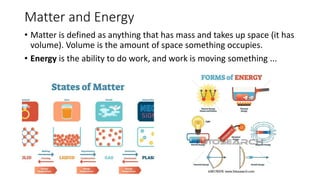
• Matter is defined as anything that has mass and takes up space (it has
volume). Volume is the amount of space something occupies.
• Energy is the ability to do work, and work is moving something ...
History of Physics
History of Physics
History of Physics
Catheter Intravenous Injection
History of Physics
Some definitions
• Meteorology: the branch of science concerned with the processes
and phenomena of the atmosphere, especially as a means of
forecasting the weather.
• Tides are the rise and fall of sea levels caused by the combined effects
of the gravitational forces exerted by the Moon and the Sun, and the
rotation of the Earth.
Branches of Physics
• Thermodynamics (Heat)
• It is the study of nature of heat, modes of transfer and effects of heat.
• Sound
• It is the study of physical aspects of sound waves, their production, properties, and
applications.
• Light(optic)
• It is the study of physical aspects of light, its properties and use of optical instruments.
• Electricity and Magnetism
• It is the study of the charges at rest and in motion, their effects and their relationship
with magnetism.
• Atomic physics
• It is the study of the structure and properties of atoms.
Branches of Physics
• Nuclear physics
• It is the study of properties and behavior of nuclei and the particles.
• Plasma physics
• It is the study of production, properties of the ionic state of matter.
• Geophysics
• It is the study of the internal structure of the earth.
• Modern physics
• It is the branch of physics which deals with the theory of relativity and quantum
mechanics. Max plank and Einstein are considered the father of modern physics.
• Astrophysics
• The branch of physics which deals with the study of universes such as stars,
planets and galaxies, etc
Measurements and Units
What is the difference between Qualitative
and Quantitative?
• Qualitative identifies abstract concepts
• Quantitative collects numerical data
Measurements and Units
Supplementary units are the dimensionless units that are used along with the base units to form
derived units in the International system. The class of supplementary contains only two purely
geometrical units, that is the radian and the steradian.
Dimension
• Dimension express the physical quantity
• Dimensional formula is an expression which tells the involvement of
the fundamental units in a physical quantity.
• The dimension of a physical quantity is defined as the powers to
which the fundamental quantities are raised in order to represent
that quantity. The seven fundamental quantities are enclosed in
square brackets [ ] to represent its dimensions.
Dimension
Dimension of Length is described as [L], the dimension of time is described as [T],
the dimension of mass is described as [M],
the dimension of electric current is described as [A] and dimension of the amount
of quantity can be described as [mol].Adding further dimension of temperature is
[K] and that dimension of luminous intensity is [Cd]
It is mandatory for us to use [ ] in order to write dimension of a physical quantity. In
real life, everything is written in terms of dimensions of mass, length and time.
Dimension
• 1. The volume of a solid is given is the product of length, width and its
height. Its dimension is given as:
• Volume = Length × width × Height
• Volume = [L] × [L] × [L] (as length, width and height are lengths)
• Volume = [L]3
• As volume is dependent on length , the powers of time and mass will
be zero while expressing its dimensions i.e. [M]0 and [T]0
• The final dimension of volume will be [M]0[L]3[T]0 = [M0L3T]
• 2. In a similar manner, dimensions of area will be [M]0[L]2[T]0
Fundamental Quantity Dimension
Length L
Mass M
Time T
Temperature K
Electric Current A
Luminous Intensity Cd
Amount of substance mol
Round off
• If number after decimal point is greater then 5 than value round off by the
next value.
• Example:
• 24.27 round off 24.3
• If number after decimal point is smaller then 5 than the smaller number
will remove without any change.
• Example
• 24.23 round off 24.2
• If number after decimal point is equal to 5 than there are two cases.
1. If number is even than remove the 5 without any change
• Example: 23.45 round off 23.4
2. If number is odd than remove the 5 and round off by next value.
• Example: 23.35 round off 23.4
Significant Figures
SI Prefixes
Unit conversion of length
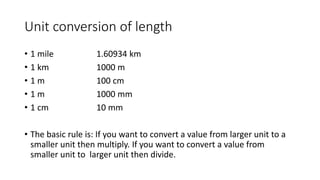
• 1 mile 1.60934 km
• 1 km 1000 m
• 1 m 100 cm
• 1 m 1000 mm
• 1 cm 10 mm
• The basic rule is: If you want to convert a value from larger unit to a
smaller unit then multiply. If you want to convert a value from
smaller unit to larger unit then divide.
Example
1. Convert 32 cm into m.
Data
1 m = 100 cm
32/100=0.32 m ans
2. Convert 0.23 m into cm
Data
1 m = 100 cm
0.23 x 100 =23 cm
Problems
Question 1
Convert the following measurements into m.
a. 280 cm
b. 56100 mm
c. 3.7 km
Question 2
Which is greater: 45 miles or 63 km?
Question 3:
Which values has prefix?
1. 12 m
2. 30 km
3. 2 cm
4. 9 mm
5. 10 m
MCQS
1. By evaluating (83 x 2.06)⁄5.48, the answer correct to three significant figures is
A. 5.12
B. 31.2
C. 312
D. 3.12
2. The number of significant figures in 9.00823 are
A. six
B. four
C. five
D. seven
3. The number of significant figures in value 0.0891 are
A. four
B. five
C. two
D. Three
4. By evaluating 28 x 3.54⁄6.8549, the round off value correct up to two decimal places is
A. 10.46
B. 15.46
C. 14.46
D. 0.46
5. Aqib bought a tank whose dimensions are 5.6cm, 8.2cm and 12.8 cm. The volume of water (in cm³) that can be
stored in tank (correct up to four significant figures) is
A. 585.8
B. 600.8
C. 590.8
D. 587.8

Physics Chapter No 1

  • 1.
  • 2.
    Topics will cover. •What is physics? • History of Physics. • Branches of Physics. • Units and Measurement. • Units conversions
  • 3.
    What is Physics? •Physics is the knowledge, observations based on experiments (Science) and study of properties of matter, energy and their mutual interactions.
  • 4.
    Matter and Energy •Matter is defined as anything that has mass and takes up space (it has volume). Volume is the amount of space something occupies. • Energy is the ability to do work, and work is moving something ...
  • 5.
  • 7.
  • 8.
  • 9.
  • 10.
  • 13.
    Some definitions • Meteorology:the branch of science concerned with the processes and phenomena of the atmosphere, especially as a means of forecasting the weather. • Tides are the rise and fall of sea levels caused by the combined effects of the gravitational forces exerted by the Moon and the Sun, and the rotation of the Earth.
  • 14.
    Branches of Physics •Thermodynamics (Heat) • It is the study of nature of heat, modes of transfer and effects of heat. • Sound • It is the study of physical aspects of sound waves, their production, properties, and applications. • Light(optic) • It is the study of physical aspects of light, its properties and use of optical instruments. • Electricity and Magnetism • It is the study of the charges at rest and in motion, their effects and their relationship with magnetism. • Atomic physics • It is the study of the structure and properties of atoms.
  • 15.
    Branches of Physics •Nuclear physics • It is the study of properties and behavior of nuclei and the particles. • Plasma physics • It is the study of production, properties of the ionic state of matter. • Geophysics • It is the study of the internal structure of the earth. • Modern physics • It is the branch of physics which deals with the theory of relativity and quantum mechanics. Max plank and Einstein are considered the father of modern physics. • Astrophysics • The branch of physics which deals with the study of universes such as stars, planets and galaxies, etc
  • 16.
  • 17.
    What is thedifference between Qualitative and Quantitative? • Qualitative identifies abstract concepts • Quantitative collects numerical data
  • 18.
  • 19.
  • 20.
  • 21.
    Measurements and Units Supplementaryunits are the dimensionless units that are used along with the base units to form derived units in the International system. The class of supplementary contains only two purely geometrical units, that is the radian and the steradian.
  • 22.
    Dimension • Dimension expressthe physical quantity • Dimensional formula is an expression which tells the involvement of the fundamental units in a physical quantity. • The dimension of a physical quantity is defined as the powers to which the fundamental quantities are raised in order to represent that quantity. The seven fundamental quantities are enclosed in square brackets [ ] to represent its dimensions.
  • 24.
    Dimension Dimension of Lengthis described as [L], the dimension of time is described as [T], the dimension of mass is described as [M], the dimension of electric current is described as [A] and dimension of the amount of quantity can be described as [mol].Adding further dimension of temperature is [K] and that dimension of luminous intensity is [Cd] It is mandatory for us to use [ ] in order to write dimension of a physical quantity. In real life, everything is written in terms of dimensions of mass, length and time.
  • 25.
    Dimension • 1. Thevolume of a solid is given is the product of length, width and its height. Its dimension is given as: • Volume = Length × width × Height • Volume = [L] × [L] × [L] (as length, width and height are lengths) • Volume = [L]3 • As volume is dependent on length , the powers of time and mass will be zero while expressing its dimensions i.e. [M]0 and [T]0 • The final dimension of volume will be [M]0[L]3[T]0 = [M0L3T] • 2. In a similar manner, dimensions of area will be [M]0[L]2[T]0
  • 26.
    Fundamental Quantity Dimension LengthL Mass M Time T Temperature K Electric Current A Luminous Intensity Cd Amount of substance mol
  • 27.
    Round off • Ifnumber after decimal point is greater then 5 than value round off by the next value. • Example: • 24.27 round off 24.3 • If number after decimal point is smaller then 5 than the smaller number will remove without any change. • Example • 24.23 round off 24.2 • If number after decimal point is equal to 5 than there are two cases. 1. If number is even than remove the 5 without any change • Example: 23.45 round off 23.4 2. If number is odd than remove the 5 and round off by next value. • Example: 23.35 round off 23.4
  • 28.
  • 29.
  • 30.
    Unit conversion oflength • 1 mile 1.60934 km • 1 km 1000 m • 1 m 100 cm • 1 m 1000 mm • 1 cm 10 mm • The basic rule is: If you want to convert a value from larger unit to a smaller unit then multiply. If you want to convert a value from smaller unit to larger unit then divide.
  • 31.
    Example 1. Convert 32cm into m. Data 1 m = 100 cm 32/100=0.32 m ans 2. Convert 0.23 m into cm Data 1 m = 100 cm 0.23 x 100 =23 cm
  • 32.
    Problems Question 1 Convert thefollowing measurements into m. a. 280 cm b. 56100 mm c. 3.7 km Question 2 Which is greater: 45 miles or 63 km? Question 3: Which values has prefix? 1. 12 m 2. 30 km 3. 2 cm 4. 9 mm 5. 10 m
  • 33.
    MCQS 1. By evaluating(83 x 2.06)⁄5.48, the answer correct to three significant figures is A. 5.12 B. 31.2 C. 312 D. 3.12 2. The number of significant figures in 9.00823 are A. six B. four C. five D. seven 3. The number of significant figures in value 0.0891 are A. four B. five C. two D. Three 4. By evaluating 28 x 3.54⁄6.8549, the round off value correct up to two decimal places is A. 10.46 B. 15.46 C. 14.46 D. 0.46 5. Aqib bought a tank whose dimensions are 5.6cm, 8.2cm and 12.8 cm. The volume of water (in cm³) that can be stored in tank (correct up to four significant figures) is A. 585.8 B. 600.8 C. 590.8 D. 587.8

Editor's Notes

  • #4 Property means (Khasiyat)
  • #9 Prominent (Mashur) , physician (mualej), monographs (Aik He Mazmoon Ka Byaan). Pertained (mutaliq)
  • #17 Standard (Mayar) concern (Taluq), measurement (paymaish) Quantity (Mikdar) Quality (Khubi)
  • #21 Derived (Akhaz karna)
  • #22 Supplementary or additional (Mazeed)
  • #29 Significant (Aayhum) , reliable (Qabil e aytamaad), certainty (Yaqini), refers (hawala dena), precision (durust), accuracy (durust) Accuracy refers to the closeness of a measured value to a standard or known value. Precision refers to the closeness of two or more measurements to each other. 
  • #30 Prefix (phelay) a word, letter, or number placed before another.