PHYSICAL METHOD OF
STERILIZATION
SWETHA. S
BP231507
I M.SC., MICROBIOLOGY
STERILIZATION
• Sterilization is the process of killing of microorganisms.
• It refers to the process that removes, kills or deactivates all forms of life and other biological agents
present in or on a specific surface, object or fluid.
• It was carried out by two methods.
1) Physical method
2) Chemical method
1) PHYSICAL METHOD OF STERILIZATION
(a) DRYING
* Moisture is essential for the growth of bacteria. Four – fifth of the weight of the bacterial cell is
due to bacteria.
* Drying in has a deleterious effect on many bacteria.
* Spores are unaffected by drying.
(b) DRY HEAT
i) Flaming
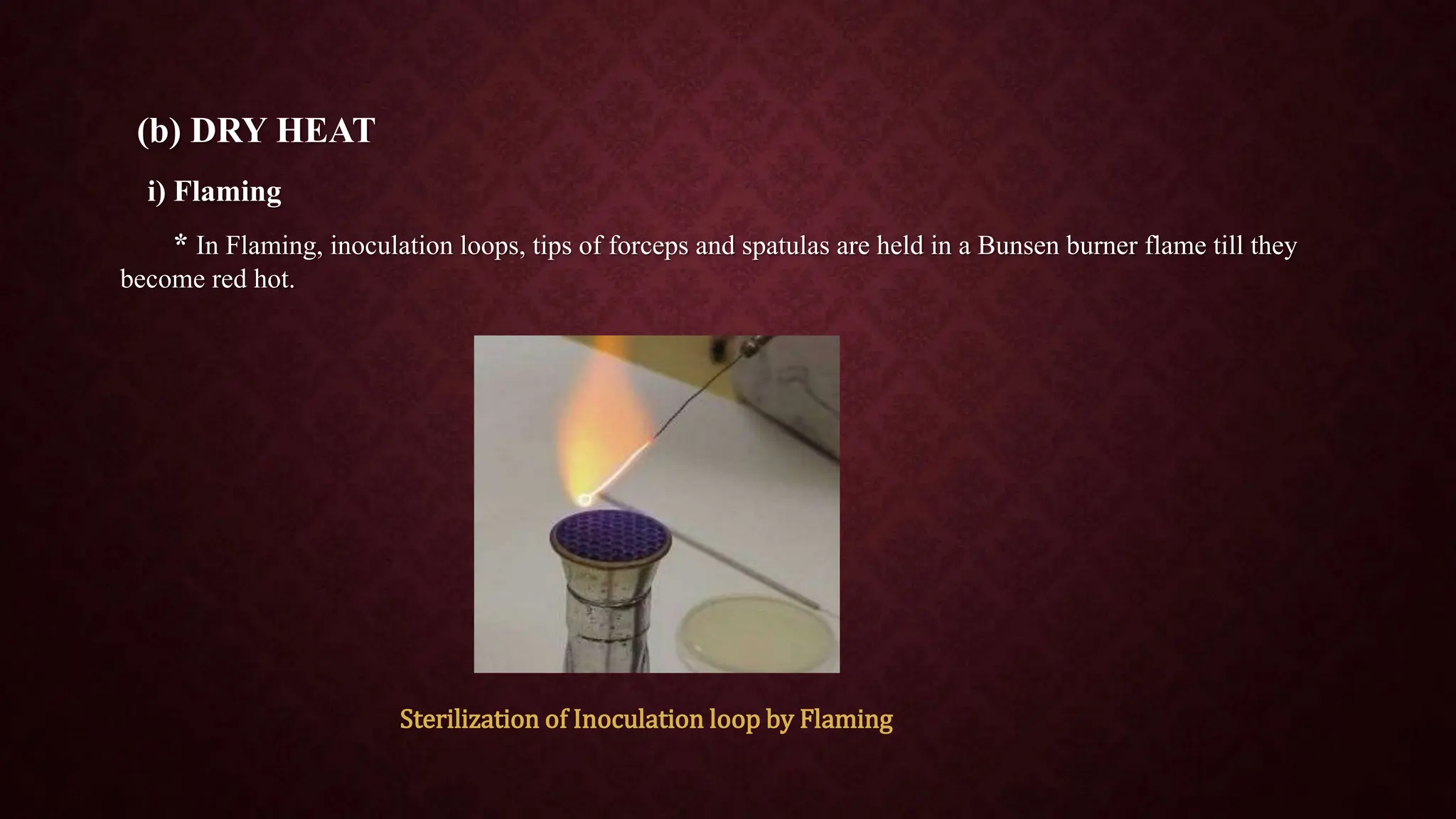
* In Flaming, inoculation loops, tips of forceps and spatulas are held in a Bunsen burner flame till they
become red hot.
Sterilization of Inoculation loop by Flaming
ii) Incineration
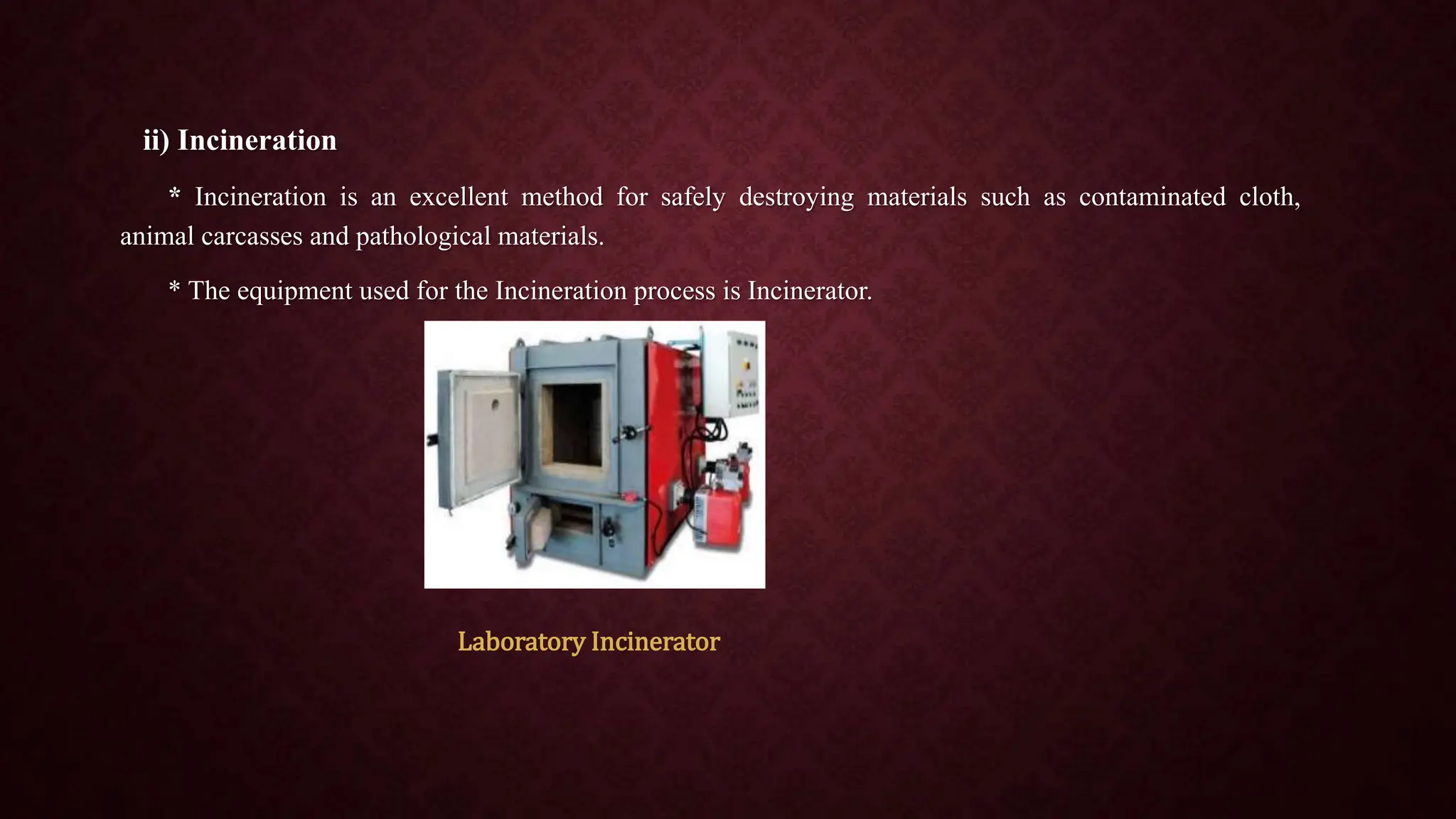
* Incineration is an excellent method for safely destroying materials such as contaminated cloth,
animal carcasses and pathological materials.
* The equipment used for the Incineration process is Incinerator.
Laboratory Incinerator
iii) Hot air oven
* Sterilization by Hot air oven is the most widely used method for sterilization by Dry heat.
* Hot air oven is used to sterilize glasswares, forceps, scissors, scalpels, glass syringes and swabs.
* “Temperature required for sterilization is inversely proportional to Time” is the principle of Hot air
oven.
* During the sterilization of materials in Hot air oven, the sterilization time was reduced when the
sterilization temperature was increased.
* Temperature and duration for Hot air oven sterilization is
▪ 140 °C for 11/2 hours
▪ 160 °C for 1 hours
▪ 180 °C for 1/2 hours
* Sterilization by Hot air oven kills the microorganisms by denaturation of proteins.
(c) MOIST HEAT
i) Pasteurization
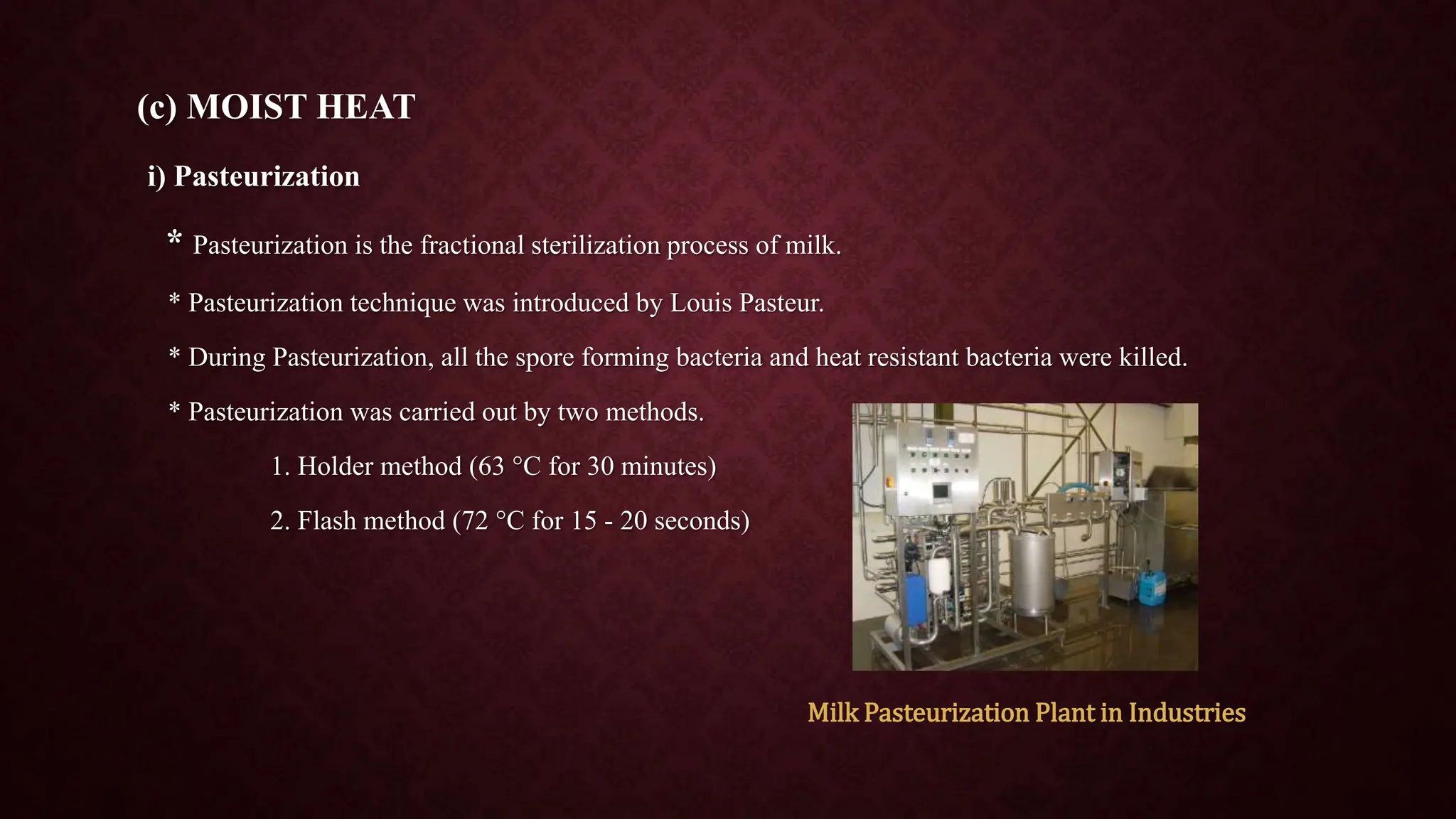
* Pasteurization is the fractional sterilization process of milk.
* Pasteurization technique was introduced by Louis Pasteur.
* During Pasteurization, all the spore forming bacteria and heat resistant bacteria were killed.
* Pasteurization was carried out by two methods.
1. Holder method (63 °C for 30 minutes)
2. Flash method (72 °C for 15 - 20 seconds)
Milk Pasteurization Plant in Industries
ii) Boiling
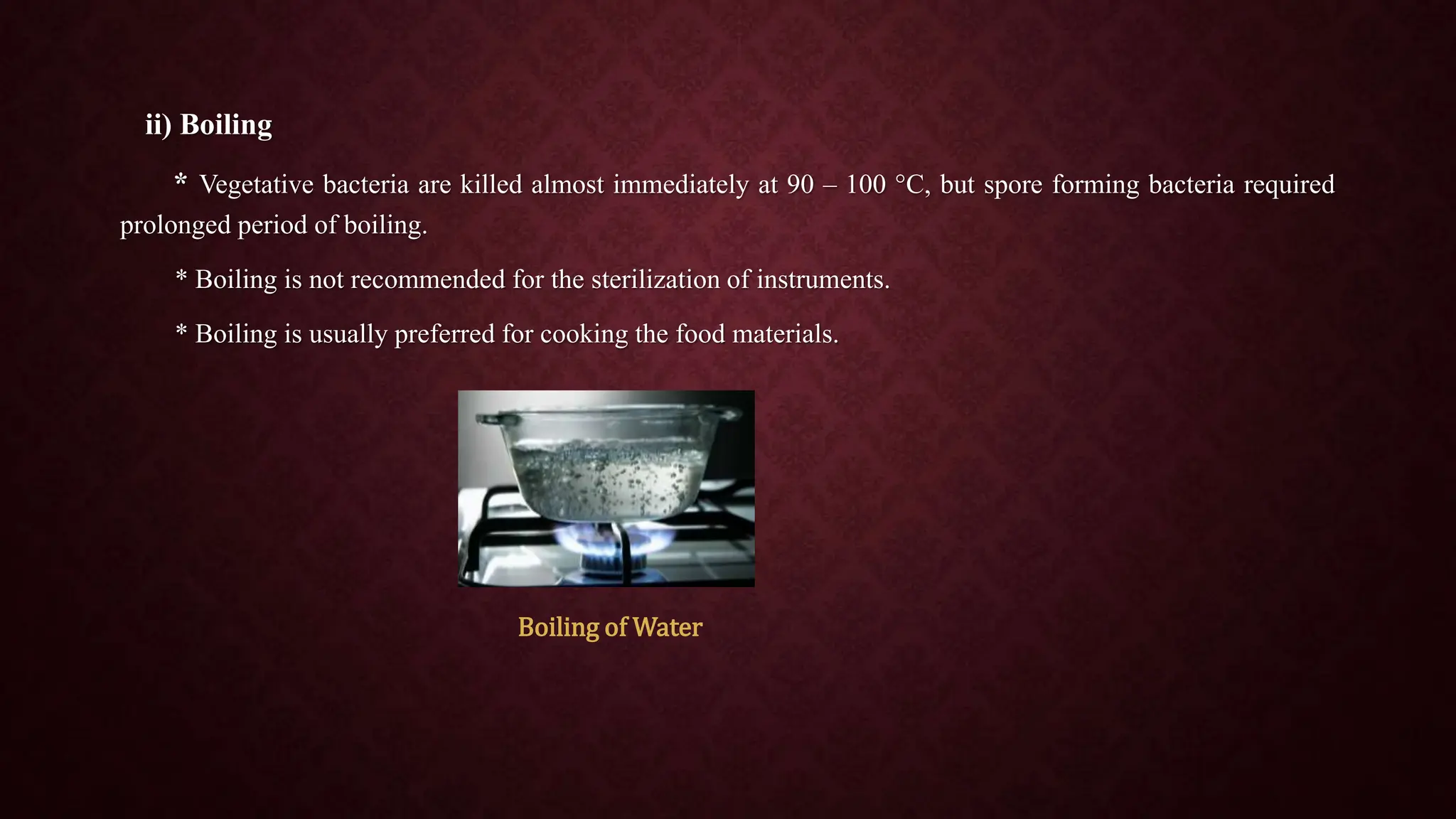
* Vegetative bacteria are killed almost immediately at 90 – 100 °C, but spore forming bacteria required
prolonged period of boiling.
* Boiling is not recommended for the sterilization of instruments.
* Boiling is usually preferred for cooking the food materials.
Boiling of Water
iii) Tyndallization
* Tyndallization is a process dating from the nineteenth century for sterilizing substances, usually
food, named after its inventor, scientist John Tyndall.
* It is still occasionally used.
* Tyndallization can be used to destroy the spores.
* Tyndallization essentially consists of heating the substance to boiling point (or just a little below
boiling point) and holding it there for 15 minutes, three days in succession.
iv) Autoclave
* An autoclave is a pressure chamber used to carry out the sterilization under pressure (Moist heat).
* The mechanism of the autoclave is similar to the pressure cooker.
* Autoclave works under the principal of Boyl’s Law – “When volume is constant, temperature is
directly proportional to time”.
* Temperature and duration for Autoclave sterilization is 121 °C or 15 lbs for 20 minutes.
* Sterilization by autoclaving kills the microorganisms by coagulation of proteins.
Autoclave
(d) FILTRATION
* Filtration helps to remove the bacteria from heat liable substances such as serum, sugar solutions or
antibiotics used for the preparation of culture medium.
* Four types of filtrations are commonly used for the sterilization process. They are
i. Candle filters
ii. Asbestos filters
iii. Sintered glass filters
iv. Membrane filters
i) Candle filters
* Candle filters are manufactured in different grades of porosity.
* They have been widely used widely for the purification of water for drinking and industrial process.
* They are of two types:
1. Unglazed ceramic filters (e.g) Chamberland filter and Doulton filter
2. Diatomaceous earth filters (e.g.) Berkefeld filter and Mandler filter
ii) Asbestos filter
* Asbestos filters are disposable, single – use discs.
* They have high absorbing capacity and tend to alkalinize filtered liquids.
* Examples of Asbestos filter include Seitz filters and Sterimat filters.
iii) Sintered glass filter
* Sintered filters are prepared by heat fusing finely powdered glass particles of graded size.
* They have low absorptive property and can be cleaned easily but are brittle and expensive.
iv) Membrane filters
* Membrane filters are made up of cellulose esters or other polymers have largely replaced other types
of filters.
* Membrane filters are routinely used in water purification and analysis, sterilization and sterility
testing and for preparation of solutions for parental use.
(e) RADIATION
* Two types of radiations are used for sterilization. They are
a) Non – ionizing radiation
b) Ionizing radiation
i) Non – ionizing radiation
* Infra red and Ultraviolet rays are the non – ionizing low energy type.
* Infra red radiation is used for rapid mass sterilization of prepacked items such as syringes and
catheters.
* Ultraviolet radiation is used for disinfecting enclosed areas such as entry ways, operation theaters and
laboratories.
ii) Ionizing radiation
* X – rays, Gamma rays and Cosmic rays are high energy ionizing type.
* Ionizing radiations are lethal to DNA and other vital constituents.
* They have high penetrative power.
* Ionizing radiations are used to sterilize plastics, swabs, catheters, animal feeds, cardboards, oils,
greases, fabrics and metal foils.
THANK YOU

PHYSICAL METHOD OF STERILIZATION(PHYSICAL METHODS).pptx

  • 1.
    PHYSICAL METHOD OF STERILIZATION SWETHA.S BP231507 I M.SC., MICROBIOLOGY
  • 2.
    STERILIZATION • Sterilization isthe process of killing of microorganisms. • It refers to the process that removes, kills or deactivates all forms of life and other biological agents present in or on a specific surface, object or fluid. • It was carried out by two methods. 1) Physical method 2) Chemical method
  • 3.
    1) PHYSICAL METHODOF STERILIZATION (a) DRYING * Moisture is essential for the growth of bacteria. Four – fifth of the weight of the bacterial cell is due to bacteria. * Drying in has a deleterious effect on many bacteria. * Spores are unaffected by drying.
  • 4.
    (b) DRY HEAT i)Flaming * In Flaming, inoculation loops, tips of forceps and spatulas are held in a Bunsen burner flame till they become red hot. Sterilization of Inoculation loop by Flaming
  • 5.
    ii) Incineration * Incinerationis an excellent method for safely destroying materials such as contaminated cloth, animal carcasses and pathological materials. * The equipment used for the Incineration process is Incinerator. Laboratory Incinerator
  • 6.
    iii) Hot airoven * Sterilization by Hot air oven is the most widely used method for sterilization by Dry heat. * Hot air oven is used to sterilize glasswares, forceps, scissors, scalpels, glass syringes and swabs. * “Temperature required for sterilization is inversely proportional to Time” is the principle of Hot air oven. * During the sterilization of materials in Hot air oven, the sterilization time was reduced when the sterilization temperature was increased. * Temperature and duration for Hot air oven sterilization is ▪ 140 °C for 11/2 hours ▪ 160 °C for 1 hours ▪ 180 °C for 1/2 hours * Sterilization by Hot air oven kills the microorganisms by denaturation of proteins.
  • 7.
    (c) MOIST HEAT i)Pasteurization * Pasteurization is the fractional sterilization process of milk. * Pasteurization technique was introduced by Louis Pasteur. * During Pasteurization, all the spore forming bacteria and heat resistant bacteria were killed. * Pasteurization was carried out by two methods. 1. Holder method (63 °C for 30 minutes) 2. Flash method (72 °C for 15 - 20 seconds) Milk Pasteurization Plant in Industries
  • 8.
    ii) Boiling * Vegetativebacteria are killed almost immediately at 90 – 100 °C, but spore forming bacteria required prolonged period of boiling. * Boiling is not recommended for the sterilization of instruments. * Boiling is usually preferred for cooking the food materials. Boiling of Water
  • 9.
    iii) Tyndallization * Tyndallizationis a process dating from the nineteenth century for sterilizing substances, usually food, named after its inventor, scientist John Tyndall. * It is still occasionally used. * Tyndallization can be used to destroy the spores. * Tyndallization essentially consists of heating the substance to boiling point (or just a little below boiling point) and holding it there for 15 minutes, three days in succession.
  • 10.
    iv) Autoclave * Anautoclave is a pressure chamber used to carry out the sterilization under pressure (Moist heat). * The mechanism of the autoclave is similar to the pressure cooker. * Autoclave works under the principal of Boyl’s Law – “When volume is constant, temperature is directly proportional to time”. * Temperature and duration for Autoclave sterilization is 121 °C or 15 lbs for 20 minutes. * Sterilization by autoclaving kills the microorganisms by coagulation of proteins. Autoclave
  • 11.
    (d) FILTRATION * Filtrationhelps to remove the bacteria from heat liable substances such as serum, sugar solutions or antibiotics used for the preparation of culture medium. * Four types of filtrations are commonly used for the sterilization process. They are i. Candle filters ii. Asbestos filters iii. Sintered glass filters iv. Membrane filters
  • 12.
    i) Candle filters *Candle filters are manufactured in different grades of porosity. * They have been widely used widely for the purification of water for drinking and industrial process. * They are of two types: 1. Unglazed ceramic filters (e.g) Chamberland filter and Doulton filter 2. Diatomaceous earth filters (e.g.) Berkefeld filter and Mandler filter ii) Asbestos filter * Asbestos filters are disposable, single – use discs. * They have high absorbing capacity and tend to alkalinize filtered liquids. * Examples of Asbestos filter include Seitz filters and Sterimat filters.
  • 13.
    iii) Sintered glassfilter * Sintered filters are prepared by heat fusing finely powdered glass particles of graded size. * They have low absorptive property and can be cleaned easily but are brittle and expensive. iv) Membrane filters * Membrane filters are made up of cellulose esters or other polymers have largely replaced other types of filters. * Membrane filters are routinely used in water purification and analysis, sterilization and sterility testing and for preparation of solutions for parental use.
  • 14.
    (e) RADIATION * Twotypes of radiations are used for sterilization. They are a) Non – ionizing radiation b) Ionizing radiation i) Non – ionizing radiation * Infra red and Ultraviolet rays are the non – ionizing low energy type. * Infra red radiation is used for rapid mass sterilization of prepacked items such as syringes and catheters. * Ultraviolet radiation is used for disinfecting enclosed areas such as entry ways, operation theaters and laboratories.
  • 15.
    ii) Ionizing radiation *X – rays, Gamma rays and Cosmic rays are high energy ionizing type. * Ionizing radiations are lethal to DNA and other vital constituents. * They have high penetrative power. * Ionizing radiations are used to sterilize plastics, swabs, catheters, animal feeds, cardboards, oils, greases, fabrics and metal foils.
  • 16.