SESSION 8
Assessment Tools in
Profiling Pupil’s Reading
Ability and in Tracking the
Improvement of their
Reading Performance
Department of Education Reading Assessment Tool
DIVISION TRAINING ON CONDUCTING A READING RECOVERY PROGRAM
At the end of this session, you are expected to:
1. Identify the different assessment tools in profiling
pupil’s reading ability;
2. Understand the relevance of the assessment tools in
tracking the improvement of their pupils’ reading ability;
3. Simulate how to assess pupil’s reading ability using Phil-
IRI, Modified Beginning Reading Assessment, and
Teacher-made Tests
4. Present data gathered from the assessment; and
5. Explain the advantages of utilizing reading assessment
tools.
Department of Education Reading Assessment Tool
OBJECTIVES
ASSESSMENT is an essential element of education
used to inform instruction (Wren, 2004). The first
step in implementing good reading instruction is to
determine student baseline performance. Students
enter the classroom with diverse backgrounds and
skills in literacy. Some students may enter the
classroom with special needs that require review
of basic skills in reading, while other students may
have mastered the content a teacher intends to
cover.
Department of Education Reading Assessment Tool
INTRODUCTION
Due to these various student levels, it is necessary
to design literacy instruction to meet the individual
needs of each student. Individual needs can be
determined by initial and ongoing reading
assessments. These assessments provide teachers
with the information needed to develop
appropriate lessons and improve instruction for all
students, including students with disabilities
(Rhodes & Shanklin, 1993).
Department of Education Reading Assessment Tool
The information gained from appropriate
assessment enables teachers to provide
exceptional students with improved access to the
general education curriculum. The following
information is an overview of the purpose and
benefits of early reading assessment, examples of
data collection methods, and considerations for
selecting a measure for students.
Department of Education Reading Assessment Tool
PURPOSE AND BENEFITS
The Purpose and Benefits
of Assessment
Department of Education Reading Assessment Tool
PURPOSE AND BENEFITS
Research provides evidence that specific
early literacy concepts can predict young
students' later reading achievement
(DeBruinParecki, 2004). These reading
concepts include letter knowledge, phonemic
awareness, decoding, fluency, and
comprehension. An effective reading program
includes assessments of all of these concepts
for several purposes.
Department of Education Reading Assessment Tool
PURPOSE AND BENEFITS
One purpose is to identify skills that need
review. Assessment provides teachers with
information on what skills students have and
have not mastered. It is needed to help
teachers know the skill levels of their
students, since students have varying
experiences and knowledge.
Department of Education Reading Assessment Tool
PURPOSE AND BENEFITS
A second purpose is to monitor student
progress. A teacher can learn which students
need review before covering additional
content and which students are ready to move
forward.
A third purpose is to guide teacher
instruction. Through consistent assessment, a
teacher can make informed decisions about
what instruction is appropriate for each
student.
Department of Education Reading Assessment Tool
PURPOSE AND BENEFITS
A fourth purpose is to demonstrate the
effectiveness of instruction. The information
gained from assessment allows teachers to know
if all students are mastering the content covered.
It is important for teachers to use instructional
time effectively, and this can be done when
teachers are knowledgeable about what their
students are ready to learn and what they
already know.
Department of Education Reading Assessment Tool
PURPOSE AND BENEFITS
Therefore, the information gained from
assessment allows a teacher to create
appropriate instruction for their students.
Additionally, a fifth purpose of
assessment is to provide teachers with
information on how instruction can be
improved.
Department of Education Reading Assessment Tool
Phil-IRI
Phil-IRI
(Philippine Informal Reading
Inventory)
Department of Education Reading Assessment Tool
What is the Phil-IRI?
> The development of the Phil-IRIis oneof the
initiatives put in place insupport of the Every Child
A ReaderProgram (ECARP).
> The PhilippineInformal Reading Inventory(Phil-IRI)
wascreated to provide classroom teachers a tool for
measuring anddescribing reading performance.
It is an assessment tool composed of graded
passagesdesigned to determinea student’s
reading level.
(Flippo, R.,2014).
Department of Education Reading Assessment Tool
What is the Phil-IRI for?
 This diagnostic approach to describing how children
read embraces inclusionary principles that
emphasize the need for education that is learner-
oriented, responsive and culturally sensitive.
 The Phil-IRI is one of the diagnostic tools that
teachers can use to determine a student’s abilities
and needs in reading.
 It is important to note that the Phil-IRI only provides
an approximation of the learner’s abilities and may
be used in combination with other reliable tools of
assessment.
Department of Education Reading Assessment Tool
What can the Phil-IRI tell us?
 The Phil-IRI Group Screening Test (GST) can tell
teachers whether students are reading at, or
below, their grade levels.
 The individually administered Phil-IRI Graded
Passages, can be used to assess students’ Oral
Reading, Silent Reading Comprehension and
Listening Comprehension levels.
Department of Education Reading Assessment Tool
Assessment of Oral Reading
When used to assess oral reading skills, the Phil-
IRI may be used to describe decoding and word
recognition, fluency and comprehension. The
student’s performance in decoding (the ability to
read isolated words using phonics knowledge) and
word recognition (the ability to automatically
identify words on sight) is measured through a
Reading Miscue Inventory.
Department of Education Reading Assessment Tool
Assessment of Silent Reading
When used to assess Silent Reading
Comprehension, Phil-IRI may be used to describe
reading speed and comprehension. The student’s
reading speed is measured by recording the time it
takes the child to read each passage completely.
Silent reading comprehension is measured by asking
the student to answer five to eight questions of
varying difficulty after a passage has been read.
Department of Education Reading Assessment Tool
How do we administer the Phil-IRI?
Assessment and Instruction
Department of Education Reading Assessment Tool
STEPS IN
ADMINISTERING
PHIL-IRI
Department of Education Reading Assessment Tool
Stage 1
 Administration of the Initial Screening:
Group Screening Test
Department of Education Reading Assessment Tool
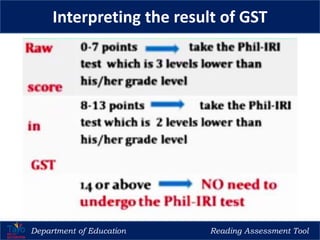
Interpreting the result of GST
Department of Education Reading Assessment Tool
Stage 1
o This initial screening allows the
teacher to focus more on the students
with reading difficulties.
Department of Education Reading Assessment Tool
Stage 2
A. Oral Reading Test
Objectives:
1. Identify the student’s miscues in oral
reading;
2. Record the number of words that a student
reads per minute; and
3. Find out how well a student understands
the passage read
Department of Education Reading Assessment Tool
What is miscue?
a derivation or difference between
what a reader says and the word in the
page (Goodman, 1973)
Department of Education Reading Assessment Tool
Common Miscues
of Readers
Department of Education Reading Assessment Tool
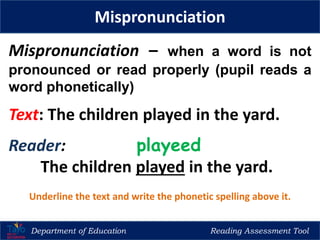
Mispronunciation
Mispronunciation – when a word is not
pronounced or read properly (pupil reads a
word phonetically)
Text: The children played in the yard.
Reader: playeed
The children played in the yard.
Underline the text and write the phonetic spelling above it.
Department of Education Reading Assessment Tool
Omission
Omission– when a word or words are
omitted
Text: Tony saw an enormous elephant in
the zoo.
Reader:
Tony saw an elephant in the zoo.
Circle the omitted word.
Department of Education Reading Assessment Tool
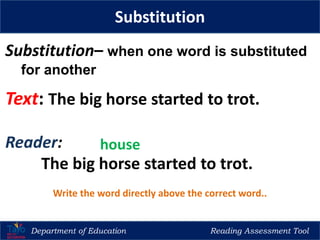
Substitution
Substitution– when one word is substituted
for another
Text: The big horse started to trot.
Reader:
The big horse started to trot.
Write the word directly above the correct word..
house
Department of Education Reading Assessment Tool
Insertion
Insertion– when one word or words are
inserted.
Text: His big sister is in school.
Reader:
His big sister is in the school.
Indicate it with a caret at the point of intersection and the word is
written above the caret.
the
Department of Education Reading Assessment Tool
Repetition
Repetition– when a word or phrase is
repeated
Text: The red roses are in the lovely vase.
Reader:
The red roses are in the in the lovely
vase.
Draw a line from the point at which the readers decides to retrace his
steps to the point the repetition begins.
Department of Education Reading Assessment Tool
Transposition
Transposition– when two words are
reversed
Text: The dog is barking at me.
Reader:
The dog is barking at me.
Use a proofreader’s symbol for transposition.
Department of Education Reading Assessment Tool
Reversal
Reversal– when two letters are reversed
Text: d a b
Reader: b a d
Use a proofreader’s symbol for transposition.
dab
Department of Education Reading Assessment Tool
Omission of Punctuation
Omission of punctuation– punctuations
are not given attention.
Text: The teacher greeted the pupils ,
then she told them to sit down.
Reader:
The teacher greeted the pupils
then she told them to sit down.
Circle the omitted punctuation mark.
Department of Education Reading Assessment Tool
Omission of Punctuation
Omission of punctuation– punctuations
are not given attention.
Text: The teacher greeted the pupils ,
then she told them to sit down.
Reader:
The teacher greeted the pupils
then she told them to sit down.
The punctuation is circled.
Department of Education Reading Assessment Tool
Recording Oral Reading Miscues
Department of Education Reading Assessment Tool
Recording Oral Reading Miscues
Department of Education Reading Assessment Tool
Sample of Teachers Running Record
Department of Education Reading Assessment Tool
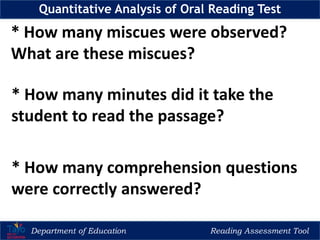
Quantitative Analysis of Oral Reading Test
* How many miscues were observed?
What are these miscues?
* How many minutes did it take the
student to read the passage?
* How many comprehension questions
were correctly answered?
Department of Education Reading Assessment Tool
Computing the Percentage of the
Number of Words Correctly Read
No of words in the passage – number of miscues
No. of words
X 100
Department of Education Reading Assessment Tool
Example:
Karlo’s performance in Oral Reading
No. of words in the passage: 65
No. of miscues: 15
65 – 15 = 50
65
X 100 = 76.9 %
% of words correctly read: 76.9 %
Department of Education Reading Assessment Tool
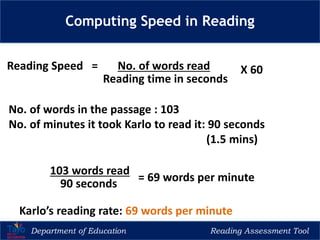
Computing Speed in Reading
Reading Speed = No. of words read
No. of words in the passage : 103
No. of minutes it took Karlo to read it: 90 seconds
(1.5 mins)
X 60
Reading time in seconds
103 words read
90 seconds
= 69 words per minute
Karlo’s reading rate: 69 words per minute
Department of Education Reading Assessment Tool
Computing of Comprehension
Comprehension = No. of correct answers
No. of correct answers: 4
Total number of questions: 7
X 100
No. of questions
4
7 = .57 X 100 = 57 %
Karlo’s comprehension skill: 57 %
Department of Education Reading Assessment Tool
Determining the Reading Level
Reading Level – the level at which the
learner can read and comprehend a
leveled text or graded passage.
Different Reading Levels:
> Independent
> Instructional
> Frustration
Department of Education Reading Assessment Tool
Independent Level
“I can read this on my own.”
> The level at which a learner can read and
comprehend a leveled text on his/her own.
> The reader is familiar with most, if not all,
of the words in the text. The pupils reads
smoothly, fluently and with expression.
> The level of comprehension is high.
Department of Education Reading Assessment Tool
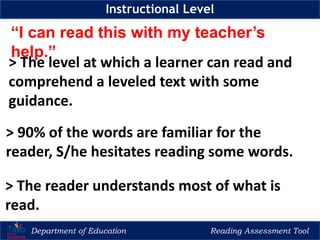
Instructional Level
“I can read this with my teacher’s
help.”
> The level at which a learner can read and
comprehend a leveled text with some
guidance.
> 90% of the words are familiar for the
reader, S/he hesitates reading some words.
> The reader understands most of what is
read.
Department of Education Reading Assessment Tool
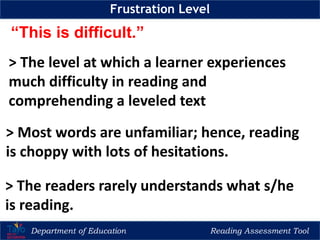
Frustration Level
“This is difficult.”
> The level at which a learner experiences
much difficulty in reading and
comprehending a leveled text
> Most words are unfamiliar; hence, reading
is choppy with lots of hesitations.
> The readers rarely understands what s/he
is reading.
Department of Education Reading Assessment Tool
Oral Reading Profile
Department of Education Reading Assessment Tool
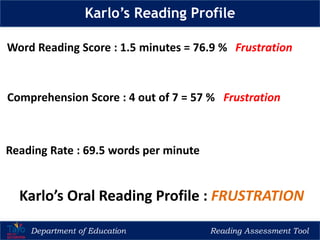
Karlo’s Reading Profile
Word Reading Score : 1.5 minutes = 76.9 % Frustration
Karlo’s Oral Reading Profile : FRUSTRATION
Comprehension Score : 4 out of 7 = 57 % Frustration
Reading Rate : 69.5 words per minute
Department of Education Reading Assessment Tool
Qualitative Analysis
Observations on Oral Reading
Department of Education Reading Assessment Tool
Regional Training of Trainers (TOT) for Reading Teachers in Madrasah, CNR & Kindergarten
Magpalipad Tayo ng Saranggola
Maganda ang panahon. Gustong maglaro ni Niko. Niyaya ni Niko na
maglaro ang kakambal na si Noli. Pumunta ang kambal sa labas. May
dala silang mga saranggola. Makukulay ang mga saranggola ng
kambal.
Pinalipad agad nila ang mga saranggola. Mataas ang lipad ng
saranggola ni Niko.
Napansin ni Niko si Noli. Nakasimangot si Noli habang nakatingin kay
Niko.
“Halika, tuturuan kita ng tamang pagpapalipad.” sabi ni Niko.
Ngumiti si Noli. Ipinakita ni Niko kay Noli kung paano magpalipad.
Ilang saglit pa, nakatawa na itong nagpapalipad ng saranggola.
“Salamat, Niko,” wika niya.
Department of Education Reading Assessment Tool
Regional Training of Trainers (TOT) for Reading Teachers in Madrasah, CNR & Kindergarten
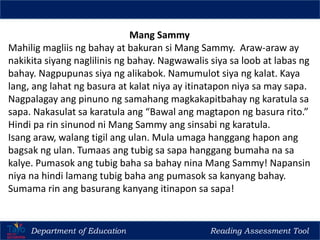
Mang Sammy
Mahilig magliis ng bahay at bakuran si Mang Sammy. Araw-araw ay
nakikita siyang naglilinis ng bahay. Nagwawalis siya sa loob at labas ng
bahay. Nagpupunas siya ng alikabok. Namumulot siya ng kalat. Kaya
lang, ang lahat ng basura at kalat niya ay itinatapon niya sa may sapa.
Nagpalagay ang pinuno ng samahang magkakapitbahay ng karatula sa
sapa. Nakasulat sa karatula ang “Bawal ang magtapon ng basura rito.”
Hindi pa rin sinunod ni Mang Sammy ang sinsabi ng karatula.
Isang araw, walang tigil ang ulan. Mula umaga hanggang hapon ang
bagsak ng ulan. Tumaas ang tubig sa sapa hanggang bumaha na sa
kalye. Pumasok ang tubig baha sa bahay nina Mang Sammy! Napansin
niya na hindi lamang tubig baha ang pumasok sa kanyang bahay.
Sumama rin ang basurang kanyang itinapon sa sapa!
Department of Education Reading Assessment Tool
Regional Training of Trainers (TOT) for Reading Teachers in Madrasah, CNR & Kindergarten
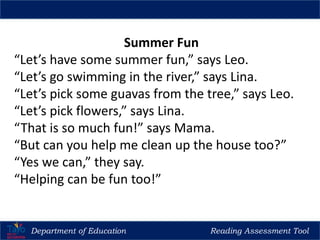
Summer Fun
“Let’s have some summer fun,” says Leo.
“Let’s go swimming in the river,” says Lina.
“Let’s pick some guavas from the tree,” says Leo.
“Let’s pick flowers,” says Lina.
“That is so much fun!” says Mama.
“But can you help me clean up the house too?”
“Yes we can,” they say.
“Helping can be fun too!”
(Modified Beginning Reading Assessment)
PHONICS AND WORD
RECOGNITION
INVENTORY TOOL
“Tara na Tayo’y Magbasa”
Department of Education Reading Assessment Tool
Regional Training of Trainers (TOT) for Reading Teachers in Madrasah, CNR & Kindergarten
After looking at the different data on the
reading and academic performance of the
different schools in the entire City Division of
Koronadal, it shows that our present
academic performance is greatly affected by
the pupils’ poor reading ability as shown in
SREYA, NAT & LAPG (c/o Division Early
Reading Program Presentation Paper)
Department of Education Reading Assessment Tool
Background of the development of the
reading assessment tool
Grade One pupils’ reading ability in the
Mother Tongue should be monitored and
given priority to arrest non- readers in the
future thus an assessment shall be conducted
to keep a reading profile in class, school,
district and division. Pupils’ Reading Profile is
a suitable basis for sound classroom
instruction and reading intervention
program.
Department of Education Reading Assessment Tool
This assessment Tool is contextualized in four
languages to serve the needs of the adopted
Mother Tongues of Koronadal City Division
which are as follows:
1. Hiligaynon-mostly of the elementary
schools
2. Binisaya- Mambucal ES
3. Tagalog- Magsaysay ES, Caloocan ES and
Namnama ES
4. B’laan- Nelmida ES and Ulo-Mlao ES
Department of Education Reading Assessment Tool
Part One:
Simple Listening Comprehension:
5 points
In this part we are assessing the ability of the
pupil to understand information involve in
the text. Since we are evaluating the listening
comprehension of the child, the teacher
reads the short story to the pupil; allow
him/her to answer the questions orally.
Department of Education Reading Assessment Tool
How to use the Assessment Tool?
Part Two:
Phonological Awareness:
5 points
Phonological Awareness is a skill which
shows the child’s ability to distinguish sound
in a spoken language like initial, middle and
final sound. The teacher must ask the pupil
to name each picture and to give the initial
sound of each object.
Department of Education Reading Assessment Tool
Part Three:
Phonics or Sound Identification:
26 points
Phonemic awareness is the ability to notice,
think about and work with the
individual sounds in spoken words. The
teacher encircles every letter that a
child can sound.
Department of Education Reading Assessment Tool
Part Four:
Alphabet Knowledge:
26 points
This part is divided into two parts: Upper
Case and Lower Case with 26 items
respectively. The teacher encircles every
letter that a child can name.
Department of Education Reading Assessment Tool
Part Five:
Word Recognition:
10 points
This part assesses the ability of the pupil to
recognize words in the target language.
Words should be read by the pupils
independently. The teacher encircles every
word that a child can read.
Department of Education Reading Assessment Tool
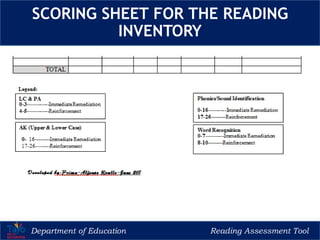
Scores for each domain specified in this
tool must be recorded using the scoring
sheet or can be directly encoded to your
laptop using the available E-Tool. The
Electronic Copy of the data should be
submitted to the division on the date
stipulated in the Division Office.
Department of Education Reading Assessment Tool
About the Data Gathering
READING ASSESSMENT TOOL
(HILIGAYNON)
Department of Education Reading Assessment Tool
READING ASSESSMENT TOOL
(FILIPINO)
READING ASSESSMENT TOOL
(BINISAYA)
READING ASSESSMENT TOOL
(BLAAN)
Department of Education Reading Assessment Tool
SCORING SHEET FOR THE READING
INVENTORY
Department of Education Reading Assessment Tool
SCORING SHEET FOR THE READING
INVENTORY
(Modified Beginning Reading Assessment)
FINAL ORAL READING
INVENTORY TEST IN
FILIPINO FOR GRADES 1,2
and 3
Department of Education Reading Assessment Tool
FINAL ORAL READING INVENTORY TEST - FILIPINO
Panuntunan at gabay sa
pagbibigay ng pangwakas na
pagsusulit sa pasalitang pagbasa
(oral reading test) sa mga mag-
aaral ng baitang 1, 2 at 3:
Department of Education Reading Assessment Tool
FINAL ORAL READING INVENTORY TEST - FILIPINO
1. Ang pagsusulit na ito ay naglalayong
maitala ang wastong antas ng kasanayan sa
pagbasa ng mga mag-aaral na nasa una,
pangalawa at ikatlong baitang. Ang datos na
makakalap ay magsisilbing batayan at gabay
sa pagpaplano ng Individualized Reading
Tutorial na isasama sa Reading Instruction
Program sa darating na Summer o Tag-araw
gayundin sa pagbubukas ng klase sa darating
na Hunyo 2017.
Department of Education Reading Assessment Tool
FINAL ORAL READING INVENTORY TEST - FILIPINO
2. Nahahati sa limang (5) bahagi ang test
mula sa pinakamahirap hanggang sa
pinakamadali. Nakabatay rin sa Learning
Competencies ng Filipino Curriculum ang
mga babasahing nakatala kaya
inaasahang ang lahat ng mga salita,
pangngusap maging ang maikling
kuwento ay natutunan na ng mga mag-
aaral.
Department of Education Reading Assessment Tool
FINAL ORAL READING INVENTORY TEST - FILIPINO
3. Ang mga sumusunod ay gabay sa pag-alam
o pagkilala ng antas ng kasanayan sa pagbasa
ng bawat mag-aaral:
Level 5-------nabasa ang buong kuwento at
nasagot nang wasto ang 4
hanggang 5 mga katanungan
Level 4------nabasa nang wasto ang 8
hanggang 10 mga parirala at
pangungusap
Department of Education Reading Assessment Tool
FINAL ORAL READING INVENTORY TEST - FILIPINO
Level 3-------nabasa nang wasto ang 8
hanggang 10 mga salita
Level 2-------nabasa nang wasto ang 8
hanggang 10 mga pantig
Level 1-------nasabi o nakilala nang wasto ang
20 hanggang 25 tunog ng mga
nakatalang letra
Department of Education Reading Assessment Tool
FINAL ORAL READING INVENTORY TEST - FILIPINO
4. Simulan sa Level 5 ang pagpapabasa sa mga
mag-aaral na nasa Ikatlong baitang. Gamitin
ang gabay sa pag-alam ng antas sa pagbasa
upang maitala ang wastong reading profile ng
bawat mag-aaral.
Department of Education Reading Assessment Tool
FINAL ORAL READING INVENTORY TEST - FILIPINO
5. Para sa mga mag-aaral na nasa Una at
Ikalawang Baitang, simulan sa Level 4 ang
pagpapabasa at sundin ang hakbang na
nakasaad sa bilang 4.
Department of Education Reading Assessment Tool
TARA NA, TAYO’Y MAGBASA
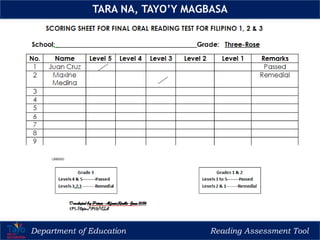
6. Nakalakip sa kagamitang pagsusulit na ito
ang Scoring Sheet na maaaring gamitin sa
pagkuha ng datos hinggil sa antas ng
kakayahan ng mga mag-aaral sa pagbasa at
pag-unawa sa wikang Filipino.
Department of Education Reading Assessment Tool
TARA NA, TAYO’Y MAGBASA
7. Ang pagsusulit na ito ay maaring gamitin sa
mga mag-aaral na nasa mataas na baitang
(Grades 4 to 10) na may suliranin sa pagbasa.
Department of Education Reading Assessment Tool
TARA NA, TAYO’Y MAGBASA
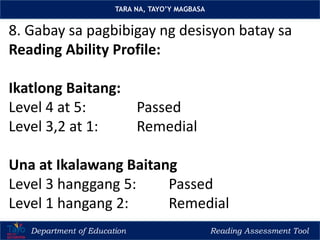
8. Gabay sa pagbibigay ng desisyon batay sa
Reading Ability Profile:
Ikatlong Baitang:
Level 4 at 5: Passed
Level 3,2 at 1: Remedial
Una at Ikalawang Baitang
Level 3 hanggang 5: Passed
Level 1 hangang 2: Remedial
Department of Education Reading Assessment Tool
TARA NA, TAYO’Y MAGBASA
Department of Education Reading Assessment Tool
FINAL ORAL READING INVENTORY TEST - FILIPINO
FINAL ORAL READING
INVENTORY TEST IN FILIPINO
FOR GRADES 1,2 and 3
Department of Education Reading Assessment Tool
DIVISION TRAINING ON CONDUCTING A READING RECOVERY PROGRAM
FINAL ORAL READING
INVENTORY TEST IN FILIPINO
FOR GRADES 1,2 and 3
Department of Education Reading Assessment Tool
DIVISION TRAINING ON CONDUCTING A READING RECOVERY PROGRAM

Modified_reading_assessment_tool.pptx

  • 1.
    SESSION 8 Assessment Toolsin Profiling Pupil’s Reading Ability and in Tracking the Improvement of their Reading Performance Department of Education Reading Assessment Tool DIVISION TRAINING ON CONDUCTING A READING RECOVERY PROGRAM
  • 2.
    At the endof this session, you are expected to: 1. Identify the different assessment tools in profiling pupil’s reading ability; 2. Understand the relevance of the assessment tools in tracking the improvement of their pupils’ reading ability; 3. Simulate how to assess pupil’s reading ability using Phil- IRI, Modified Beginning Reading Assessment, and Teacher-made Tests 4. Present data gathered from the assessment; and 5. Explain the advantages of utilizing reading assessment tools. Department of Education Reading Assessment Tool OBJECTIVES
  • 3.
    ASSESSMENT is anessential element of education used to inform instruction (Wren, 2004). The first step in implementing good reading instruction is to determine student baseline performance. Students enter the classroom with diverse backgrounds and skills in literacy. Some students may enter the classroom with special needs that require review of basic skills in reading, while other students may have mastered the content a teacher intends to cover. Department of Education Reading Assessment Tool INTRODUCTION
  • 4.
    Due to thesevarious student levels, it is necessary to design literacy instruction to meet the individual needs of each student. Individual needs can be determined by initial and ongoing reading assessments. These assessments provide teachers with the information needed to develop appropriate lessons and improve instruction for all students, including students with disabilities (Rhodes & Shanklin, 1993). Department of Education Reading Assessment Tool
  • 5.
    The information gainedfrom appropriate assessment enables teachers to provide exceptional students with improved access to the general education curriculum. The following information is an overview of the purpose and benefits of early reading assessment, examples of data collection methods, and considerations for selecting a measure for students. Department of Education Reading Assessment Tool
  • 6.
    Department of EducationReading Assessment Tool PURPOSE AND BENEFITS The Purpose and Benefits of Assessment
  • 7.
    Department of EducationReading Assessment Tool PURPOSE AND BENEFITS Research provides evidence that specific early literacy concepts can predict young students' later reading achievement (DeBruinParecki, 2004). These reading concepts include letter knowledge, phonemic awareness, decoding, fluency, and comprehension. An effective reading program includes assessments of all of these concepts for several purposes.
  • 8.
    Department of EducationReading Assessment Tool PURPOSE AND BENEFITS One purpose is to identify skills that need review. Assessment provides teachers with information on what skills students have and have not mastered. It is needed to help teachers know the skill levels of their students, since students have varying experiences and knowledge.
  • 9.
    Department of EducationReading Assessment Tool PURPOSE AND BENEFITS A second purpose is to monitor student progress. A teacher can learn which students need review before covering additional content and which students are ready to move forward. A third purpose is to guide teacher instruction. Through consistent assessment, a teacher can make informed decisions about what instruction is appropriate for each student.
  • 10.
    Department of EducationReading Assessment Tool PURPOSE AND BENEFITS A fourth purpose is to demonstrate the effectiveness of instruction. The information gained from assessment allows teachers to know if all students are mastering the content covered. It is important for teachers to use instructional time effectively, and this can be done when teachers are knowledgeable about what their students are ready to learn and what they already know.
  • 11.
    Department of EducationReading Assessment Tool PURPOSE AND BENEFITS Therefore, the information gained from assessment allows a teacher to create appropriate instruction for their students. Additionally, a fifth purpose of assessment is to provide teachers with information on how instruction can be improved.
  • 12.
    Department of EducationReading Assessment Tool Phil-IRI Phil-IRI (Philippine Informal Reading Inventory)
  • 13.
    Department of EducationReading Assessment Tool What is the Phil-IRI? > The development of the Phil-IRIis oneof the initiatives put in place insupport of the Every Child A ReaderProgram (ECARP). > The PhilippineInformal Reading Inventory(Phil-IRI) wascreated to provide classroom teachers a tool for measuring anddescribing reading performance. It is an assessment tool composed of graded passagesdesigned to determinea student’s reading level. (Flippo, R.,2014).
  • 14.
    Department of EducationReading Assessment Tool What is the Phil-IRI for?  This diagnostic approach to describing how children read embraces inclusionary principles that emphasize the need for education that is learner- oriented, responsive and culturally sensitive.  The Phil-IRI is one of the diagnostic tools that teachers can use to determine a student’s abilities and needs in reading.  It is important to note that the Phil-IRI only provides an approximation of the learner’s abilities and may be used in combination with other reliable tools of assessment.
  • 15.
    Department of EducationReading Assessment Tool What can the Phil-IRI tell us?  The Phil-IRI Group Screening Test (GST) can tell teachers whether students are reading at, or below, their grade levels.  The individually administered Phil-IRI Graded Passages, can be used to assess students’ Oral Reading, Silent Reading Comprehension and Listening Comprehension levels.
  • 16.
    Department of EducationReading Assessment Tool Assessment of Oral Reading When used to assess oral reading skills, the Phil- IRI may be used to describe decoding and word recognition, fluency and comprehension. The student’s performance in decoding (the ability to read isolated words using phonics knowledge) and word recognition (the ability to automatically identify words on sight) is measured through a Reading Miscue Inventory.
  • 17.
    Department of EducationReading Assessment Tool Assessment of Silent Reading When used to assess Silent Reading Comprehension, Phil-IRI may be used to describe reading speed and comprehension. The student’s reading speed is measured by recording the time it takes the child to read each passage completely. Silent reading comprehension is measured by asking the student to answer five to eight questions of varying difficulty after a passage has been read.
  • 18.
    Department of EducationReading Assessment Tool How do we administer the Phil-IRI? Assessment and Instruction
  • 19.
    Department of EducationReading Assessment Tool STEPS IN ADMINISTERING PHIL-IRI
  • 20.
    Department of EducationReading Assessment Tool Stage 1  Administration of the Initial Screening: Group Screening Test
  • 21.
    Department of EducationReading Assessment Tool Interpreting the result of GST
  • 22.
    Department of EducationReading Assessment Tool Stage 1 o This initial screening allows the teacher to focus more on the students with reading difficulties.
  • 23.
    Department of EducationReading Assessment Tool Stage 2 A. Oral Reading Test Objectives: 1. Identify the student’s miscues in oral reading; 2. Record the number of words that a student reads per minute; and 3. Find out how well a student understands the passage read
  • 24.
    Department of EducationReading Assessment Tool What is miscue? a derivation or difference between what a reader says and the word in the page (Goodman, 1973)
  • 25.
    Department of EducationReading Assessment Tool Common Miscues of Readers
  • 26.
    Department of EducationReading Assessment Tool Mispronunciation Mispronunciation – when a word is not pronounced or read properly (pupil reads a word phonetically) Text: The children played in the yard. Reader: playeed The children played in the yard. Underline the text and write the phonetic spelling above it.
  • 27.
    Department of EducationReading Assessment Tool Omission Omission– when a word or words are omitted Text: Tony saw an enormous elephant in the zoo. Reader: Tony saw an elephant in the zoo. Circle the omitted word.
  • 28.
    Department of EducationReading Assessment Tool Substitution Substitution– when one word is substituted for another Text: The big horse started to trot. Reader: The big horse started to trot. Write the word directly above the correct word.. house
  • 29.
    Department of EducationReading Assessment Tool Insertion Insertion– when one word or words are inserted. Text: His big sister is in school. Reader: His big sister is in the school. Indicate it with a caret at the point of intersection and the word is written above the caret. the
  • 30.
    Department of EducationReading Assessment Tool Repetition Repetition– when a word or phrase is repeated Text: The red roses are in the lovely vase. Reader: The red roses are in the in the lovely vase. Draw a line from the point at which the readers decides to retrace his steps to the point the repetition begins.
  • 31.
    Department of EducationReading Assessment Tool Transposition Transposition– when two words are reversed Text: The dog is barking at me. Reader: The dog is barking at me. Use a proofreader’s symbol for transposition.
  • 32.
    Department of EducationReading Assessment Tool Reversal Reversal– when two letters are reversed Text: d a b Reader: b a d Use a proofreader’s symbol for transposition. dab
  • 33.
    Department of EducationReading Assessment Tool Omission of Punctuation Omission of punctuation– punctuations are not given attention. Text: The teacher greeted the pupils , then she told them to sit down. Reader: The teacher greeted the pupils then she told them to sit down. Circle the omitted punctuation mark.
  • 34.
    Department of EducationReading Assessment Tool Omission of Punctuation Omission of punctuation– punctuations are not given attention. Text: The teacher greeted the pupils , then she told them to sit down. Reader: The teacher greeted the pupils then she told them to sit down. The punctuation is circled.
  • 35.
    Department of EducationReading Assessment Tool Recording Oral Reading Miscues
  • 36.
    Department of EducationReading Assessment Tool Recording Oral Reading Miscues
  • 37.
    Department of EducationReading Assessment Tool Sample of Teachers Running Record
  • 38.
    Department of EducationReading Assessment Tool Quantitative Analysis of Oral Reading Test * How many miscues were observed? What are these miscues? * How many minutes did it take the student to read the passage? * How many comprehension questions were correctly answered?
  • 39.
    Department of EducationReading Assessment Tool Computing the Percentage of the Number of Words Correctly Read No of words in the passage – number of miscues No. of words X 100
  • 40.
    Department of EducationReading Assessment Tool Example: Karlo’s performance in Oral Reading No. of words in the passage: 65 No. of miscues: 15 65 – 15 = 50 65 X 100 = 76.9 % % of words correctly read: 76.9 %
  • 41.
    Department of EducationReading Assessment Tool Computing Speed in Reading Reading Speed = No. of words read No. of words in the passage : 103 No. of minutes it took Karlo to read it: 90 seconds (1.5 mins) X 60 Reading time in seconds 103 words read 90 seconds = 69 words per minute Karlo’s reading rate: 69 words per minute
  • 42.
    Department of EducationReading Assessment Tool Computing of Comprehension Comprehension = No. of correct answers No. of correct answers: 4 Total number of questions: 7 X 100 No. of questions 4 7 = .57 X 100 = 57 % Karlo’s comprehension skill: 57 %
  • 43.
    Department of EducationReading Assessment Tool Determining the Reading Level Reading Level – the level at which the learner can read and comprehend a leveled text or graded passage. Different Reading Levels: > Independent > Instructional > Frustration
  • 44.
    Department of EducationReading Assessment Tool Independent Level “I can read this on my own.” > The level at which a learner can read and comprehend a leveled text on his/her own. > The reader is familiar with most, if not all, of the words in the text. The pupils reads smoothly, fluently and with expression. > The level of comprehension is high.
  • 45.
    Department of EducationReading Assessment Tool Instructional Level “I can read this with my teacher’s help.” > The level at which a learner can read and comprehend a leveled text with some guidance. > 90% of the words are familiar for the reader, S/he hesitates reading some words. > The reader understands most of what is read.
  • 46.
    Department of EducationReading Assessment Tool Frustration Level “This is difficult.” > The level at which a learner experiences much difficulty in reading and comprehending a leveled text > Most words are unfamiliar; hence, reading is choppy with lots of hesitations. > The readers rarely understands what s/he is reading.
  • 47.
    Department of EducationReading Assessment Tool Oral Reading Profile
  • 48.
    Department of EducationReading Assessment Tool Karlo’s Reading Profile Word Reading Score : 1.5 minutes = 76.9 % Frustration Karlo’s Oral Reading Profile : FRUSTRATION Comprehension Score : 4 out of 7 = 57 % Frustration Reading Rate : 69.5 words per minute
  • 49.
    Department of EducationReading Assessment Tool Qualitative Analysis Observations on Oral Reading
  • 50.
    Department of EducationReading Assessment Tool Regional Training of Trainers (TOT) for Reading Teachers in Madrasah, CNR & Kindergarten Magpalipad Tayo ng Saranggola Maganda ang panahon. Gustong maglaro ni Niko. Niyaya ni Niko na maglaro ang kakambal na si Noli. Pumunta ang kambal sa labas. May dala silang mga saranggola. Makukulay ang mga saranggola ng kambal. Pinalipad agad nila ang mga saranggola. Mataas ang lipad ng saranggola ni Niko. Napansin ni Niko si Noli. Nakasimangot si Noli habang nakatingin kay Niko. “Halika, tuturuan kita ng tamang pagpapalipad.” sabi ni Niko. Ngumiti si Noli. Ipinakita ni Niko kay Noli kung paano magpalipad. Ilang saglit pa, nakatawa na itong nagpapalipad ng saranggola. “Salamat, Niko,” wika niya.
  • 51.
    Department of EducationReading Assessment Tool Regional Training of Trainers (TOT) for Reading Teachers in Madrasah, CNR & Kindergarten Mang Sammy Mahilig magliis ng bahay at bakuran si Mang Sammy. Araw-araw ay nakikita siyang naglilinis ng bahay. Nagwawalis siya sa loob at labas ng bahay. Nagpupunas siya ng alikabok. Namumulot siya ng kalat. Kaya lang, ang lahat ng basura at kalat niya ay itinatapon niya sa may sapa. Nagpalagay ang pinuno ng samahang magkakapitbahay ng karatula sa sapa. Nakasulat sa karatula ang “Bawal ang magtapon ng basura rito.” Hindi pa rin sinunod ni Mang Sammy ang sinsabi ng karatula. Isang araw, walang tigil ang ulan. Mula umaga hanggang hapon ang bagsak ng ulan. Tumaas ang tubig sa sapa hanggang bumaha na sa kalye. Pumasok ang tubig baha sa bahay nina Mang Sammy! Napansin niya na hindi lamang tubig baha ang pumasok sa kanyang bahay. Sumama rin ang basurang kanyang itinapon sa sapa!
  • 52.
    Department of EducationReading Assessment Tool Regional Training of Trainers (TOT) for Reading Teachers in Madrasah, CNR & Kindergarten Summer Fun “Let’s have some summer fun,” says Leo. “Let’s go swimming in the river,” says Lina. “Let’s pick some guavas from the tree,” says Leo. “Let’s pick flowers,” says Lina. “That is so much fun!” says Mama. “But can you help me clean up the house too?” “Yes we can,” they say. “Helping can be fun too!”
  • 53.
    (Modified Beginning ReadingAssessment) PHONICS AND WORD RECOGNITION INVENTORY TOOL “Tara na Tayo’y Magbasa” Department of Education Reading Assessment Tool Regional Training of Trainers (TOT) for Reading Teachers in Madrasah, CNR & Kindergarten
  • 54.
    After looking atthe different data on the reading and academic performance of the different schools in the entire City Division of Koronadal, it shows that our present academic performance is greatly affected by the pupils’ poor reading ability as shown in SREYA, NAT & LAPG (c/o Division Early Reading Program Presentation Paper) Department of Education Reading Assessment Tool Background of the development of the reading assessment tool
  • 55.
    Grade One pupils’reading ability in the Mother Tongue should be monitored and given priority to arrest non- readers in the future thus an assessment shall be conducted to keep a reading profile in class, school, district and division. Pupils’ Reading Profile is a suitable basis for sound classroom instruction and reading intervention program. Department of Education Reading Assessment Tool
  • 56.
    This assessment Toolis contextualized in four languages to serve the needs of the adopted Mother Tongues of Koronadal City Division which are as follows: 1. Hiligaynon-mostly of the elementary schools 2. Binisaya- Mambucal ES 3. Tagalog- Magsaysay ES, Caloocan ES and Namnama ES 4. B’laan- Nelmida ES and Ulo-Mlao ES Department of Education Reading Assessment Tool
  • 57.
    Part One: Simple ListeningComprehension: 5 points In this part we are assessing the ability of the pupil to understand information involve in the text. Since we are evaluating the listening comprehension of the child, the teacher reads the short story to the pupil; allow him/her to answer the questions orally. Department of Education Reading Assessment Tool How to use the Assessment Tool?
  • 58.
    Part Two: Phonological Awareness: 5points Phonological Awareness is a skill which shows the child’s ability to distinguish sound in a spoken language like initial, middle and final sound. The teacher must ask the pupil to name each picture and to give the initial sound of each object. Department of Education Reading Assessment Tool
  • 59.
    Part Three: Phonics orSound Identification: 26 points Phonemic awareness is the ability to notice, think about and work with the individual sounds in spoken words. The teacher encircles every letter that a child can sound. Department of Education Reading Assessment Tool
  • 60.
    Part Four: Alphabet Knowledge: 26points This part is divided into two parts: Upper Case and Lower Case with 26 items respectively. The teacher encircles every letter that a child can name. Department of Education Reading Assessment Tool
  • 61.
    Part Five: Word Recognition: 10points This part assesses the ability of the pupil to recognize words in the target language. Words should be read by the pupils independently. The teacher encircles every word that a child can read. Department of Education Reading Assessment Tool
  • 62.
    Scores for eachdomain specified in this tool must be recorded using the scoring sheet or can be directly encoded to your laptop using the available E-Tool. The Electronic Copy of the data should be submitted to the division on the date stipulated in the Division Office. Department of Education Reading Assessment Tool About the Data Gathering
  • 63.
    READING ASSESSMENT TOOL (HILIGAYNON) Departmentof Education Reading Assessment Tool READING ASSESSMENT TOOL (FILIPINO) READING ASSESSMENT TOOL (BINISAYA) READING ASSESSMENT TOOL (BLAAN)
  • 64.
    Department of EducationReading Assessment Tool SCORING SHEET FOR THE READING INVENTORY
  • 65.
    Department of EducationReading Assessment Tool SCORING SHEET FOR THE READING INVENTORY
  • 66.
    (Modified Beginning ReadingAssessment) FINAL ORAL READING INVENTORY TEST IN FILIPINO FOR GRADES 1,2 and 3 Department of Education Reading Assessment Tool
  • 67.
    Department of EducationReading Assessment Tool FINAL ORAL READING INVENTORY TEST - FILIPINO Panuntunan at gabay sa pagbibigay ng pangwakas na pagsusulit sa pasalitang pagbasa (oral reading test) sa mga mag- aaral ng baitang 1, 2 at 3:
  • 68.
    Department of EducationReading Assessment Tool FINAL ORAL READING INVENTORY TEST - FILIPINO 1. Ang pagsusulit na ito ay naglalayong maitala ang wastong antas ng kasanayan sa pagbasa ng mga mag-aaral na nasa una, pangalawa at ikatlong baitang. Ang datos na makakalap ay magsisilbing batayan at gabay sa pagpaplano ng Individualized Reading Tutorial na isasama sa Reading Instruction Program sa darating na Summer o Tag-araw gayundin sa pagbubukas ng klase sa darating na Hunyo 2017.
  • 69.
    Department of EducationReading Assessment Tool FINAL ORAL READING INVENTORY TEST - FILIPINO 2. Nahahati sa limang (5) bahagi ang test mula sa pinakamahirap hanggang sa pinakamadali. Nakabatay rin sa Learning Competencies ng Filipino Curriculum ang mga babasahing nakatala kaya inaasahang ang lahat ng mga salita, pangngusap maging ang maikling kuwento ay natutunan na ng mga mag- aaral.
  • 70.
    Department of EducationReading Assessment Tool FINAL ORAL READING INVENTORY TEST - FILIPINO 3. Ang mga sumusunod ay gabay sa pag-alam o pagkilala ng antas ng kasanayan sa pagbasa ng bawat mag-aaral: Level 5-------nabasa ang buong kuwento at nasagot nang wasto ang 4 hanggang 5 mga katanungan Level 4------nabasa nang wasto ang 8 hanggang 10 mga parirala at pangungusap
  • 71.
    Department of EducationReading Assessment Tool FINAL ORAL READING INVENTORY TEST - FILIPINO Level 3-------nabasa nang wasto ang 8 hanggang 10 mga salita Level 2-------nabasa nang wasto ang 8 hanggang 10 mga pantig Level 1-------nasabi o nakilala nang wasto ang 20 hanggang 25 tunog ng mga nakatalang letra
  • 72.
    Department of EducationReading Assessment Tool FINAL ORAL READING INVENTORY TEST - FILIPINO 4. Simulan sa Level 5 ang pagpapabasa sa mga mag-aaral na nasa Ikatlong baitang. Gamitin ang gabay sa pag-alam ng antas sa pagbasa upang maitala ang wastong reading profile ng bawat mag-aaral.
  • 73.
    Department of EducationReading Assessment Tool FINAL ORAL READING INVENTORY TEST - FILIPINO 5. Para sa mga mag-aaral na nasa Una at Ikalawang Baitang, simulan sa Level 4 ang pagpapabasa at sundin ang hakbang na nakasaad sa bilang 4.
  • 74.
    Department of EducationReading Assessment Tool TARA NA, TAYO’Y MAGBASA 6. Nakalakip sa kagamitang pagsusulit na ito ang Scoring Sheet na maaaring gamitin sa pagkuha ng datos hinggil sa antas ng kakayahan ng mga mag-aaral sa pagbasa at pag-unawa sa wikang Filipino.
  • 75.
    Department of EducationReading Assessment Tool TARA NA, TAYO’Y MAGBASA 7. Ang pagsusulit na ito ay maaring gamitin sa mga mag-aaral na nasa mataas na baitang (Grades 4 to 10) na may suliranin sa pagbasa.
  • 76.
    Department of EducationReading Assessment Tool TARA NA, TAYO’Y MAGBASA 8. Gabay sa pagbibigay ng desisyon batay sa Reading Ability Profile: Ikatlong Baitang: Level 4 at 5: Passed Level 3,2 at 1: Remedial Una at Ikalawang Baitang Level 3 hanggang 5: Passed Level 1 hangang 2: Remedial
  • 77.
    Department of EducationReading Assessment Tool TARA NA, TAYO’Y MAGBASA
  • 78.
    Department of EducationReading Assessment Tool FINAL ORAL READING INVENTORY TEST - FILIPINO FINAL ORAL READING INVENTORY TEST IN FILIPINO FOR GRADES 1,2 and 3
  • 79.
    Department of EducationReading Assessment Tool DIVISION TRAINING ON CONDUCTING A READING RECOVERY PROGRAM FINAL ORAL READING INVENTORY TEST IN FILIPINO FOR GRADES 1,2 and 3
  • 80.
    Department of EducationReading Assessment Tool DIVISION TRAINING ON CONDUCTING A READING RECOVERY PROGRAM

Editor's Notes