THE PHILIPPINES
ITS LAND and PEOPLE
About
The Philippines officially the Republic of the Philippines is an archipelagic country
in Southeast Asia. It is situated in the western Pacific Ocean and consists of around
7,641 islands that are broadly categorized under three main geographical divisions
from north to south: Luzon, Visayas, and Mindanao.
The Philippines is bounded by the South China Sea to the west, the Philippine Sea
to the east, and the Celebes Sea to the southwest. It shares maritime borders with
Taiwan to the north, Japan to the northeast, Palau to the east and southeast,
Indonesia to the south, Malaysia to the southwest, Vietnam to the west, and China
to the northwest.
The Philippines covers an area of 300,000 km2 (120,000 sq mi) and, as of 2021, it
had a population of around 109 million people, making it the world's thirteenth-
most populous country
About
• The country has two main seasons: (wet
and dry)
• The country consist of 79 provinces to
facilitate governance and decision making.
• The country was divided into NCR, 13
Administrative regions, and autonomous
regions. (Cordillera and Muslim Mindanao)
About
• The country has two main seasons: (wet
and dry)
• The country consist of 79 provinces to
facilitate governance and decision making.
• The country was divided into NCR, 13
Administrative regions, and autonomous
regions. (Cordillera and Muslim Mindanao)
The national flag of the Philippines is a horizontal
bicolor flag with equal bands of royal blue and crimson
red, with a white, equilateral triangle at the hoist. In
the center of the triangle is a golden-yellow sun with
eight primary rays, each representing a province
The coat of arms of the Philippines features the eight-rayed sun of
the Philippines with each ray representing the eight provinces which
were placed under martial law during the Philippine Revolution,
and the 3 five-pointed stars representing the 3 major island groups
Flag
History
The Philippines takes its name from Philip II, who was king of Spain during the Spanish colonization of the islands in the 16th century.
Because it was under Spanish rule for 333 years and under U.S. tutelage for a further 48 years, the Philippines has many cultural
affinities with the West.
Government
The Philippines has a democratic government in the form of a constitutional republic with a presidential system. The president
functions as both head of state and head of government and is the commander-in-chief of the armed forces.
President Vice - President House Speaker Chief Justice
Bongbong Marcos Sara Duterte Martin Romualdez Alexander Gesmundo
Ethnicity
There is substantial ethnic diversity with the Philippines, a product of the seas and mountain ranges dividing the archipelago along
with significant foreign influences.
Visayan – 33.7% Tagalog – 24.4% Ilocano – 8.4% Bicolano – 6.8%
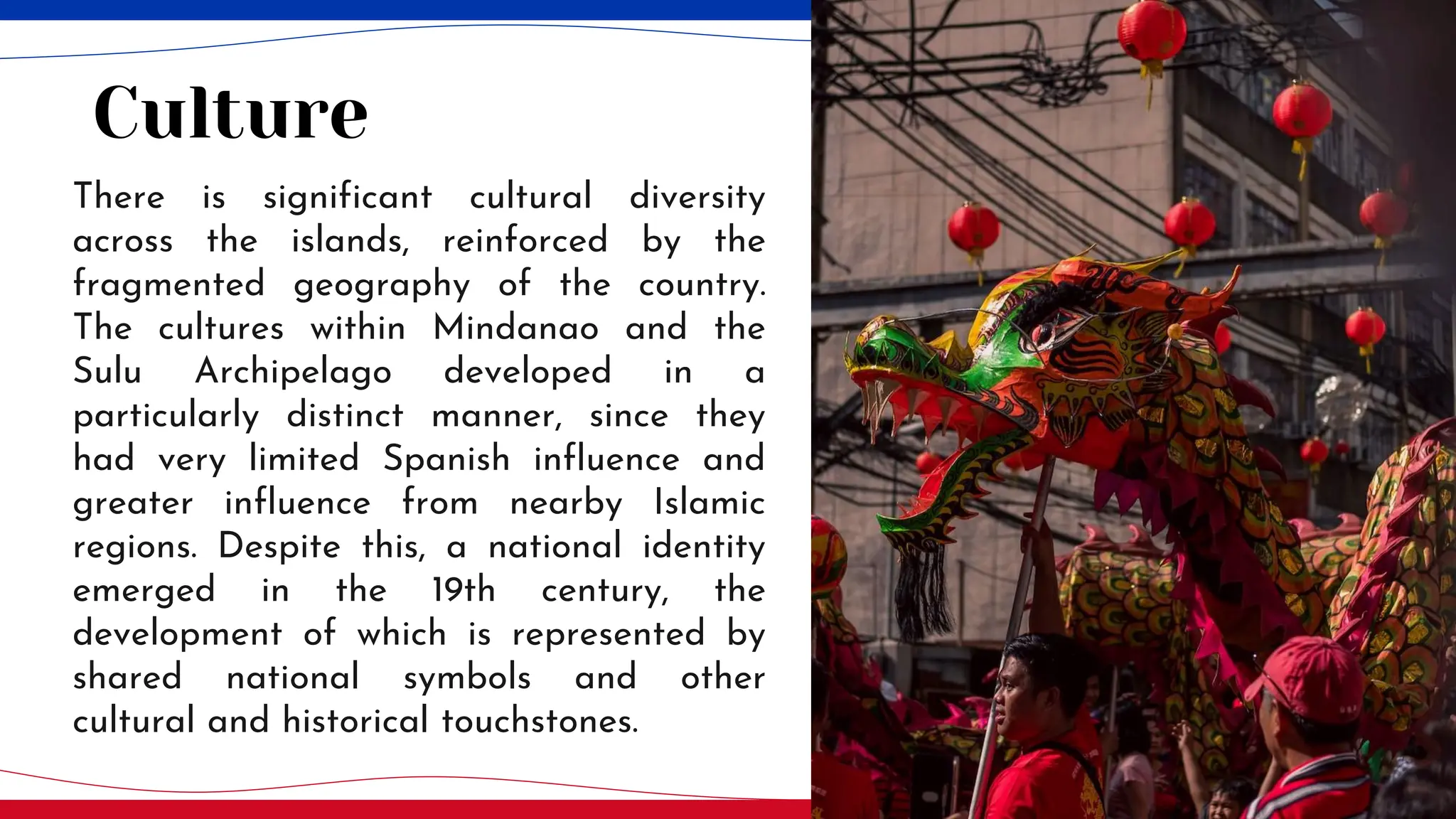
Culture
There is significant cultural diversity
across the islands, reinforced by the
fragmented geography of the country.
The cultures within Mindanao and the
Sulu Archipelago developed in a
particularly distinct manner, since they
had very limited Spanish influence and
greater influence from nearby Islamic
regions. Despite this, a national identity
emerged in the 19th century, the
development of which is represented by
shared national symbols and other
cultural and historical touchstones.
Religion
The Philippines is a secular state which
protects freedom of religion. Christianity is
the dominant faith, shared by about 89% of
the population
88.7% - Christianity
6.0% - Islam
5.3% - Other / None
Economy
In 2020, the Philippine economy produced an estimated gross domestic product of $367.4 billion. Primary exports in 2019 included
integrated circuits, office machinery/parts, insulated wiring, semiconductors, transformers; major trading partners included China
(16%), United States (15%), Japan (13%), Hong Kong (12%), Singapore (7%), Germany (5%). Its unit of currency is the Philippine peso
Philippine Peso
The Philippine peso, also referred to by its Filipino name piso is
the official currency of the Philippines. It is subdivided into 100
sentimo, also called centavos.
Language
Ethnologue lists 186 individual languages in the Philippines, 182 of which are living languages, while 4
no longer have any known speakers. Most native languages are part of the Philippine branch of the
Malayo-Polynesian languages, which is a branch of the Austronesian language family
26.09
3.97
8.44
8.77
21.35
24.44
0 5 10 15 20 25 30
Other dialects
Waray
Hiligaynon
Ilokano
Cebuano
Tagalog
Architecture
Tourism
The travel and tourism sector contributed 10.6% of the country's GDP in 2015 and providing
1,226,500 jobs in 2013. The Philippines is a popular retirement destination for foreigners
because of its climate and low cost of living.
8,260,913 international visitors arrived from January to December 2019, up by 15.24% for the
same period in 2018. 58.62% (4,842,774) of these came from East Asia, 15.84% (1,308,444)
came from North America, and 6.38% (526,832) came from other ASEAN countries
Manila
Zamboanga
Davao
Cebu
Map
The Philippines is an
emerging market and a
newly industrialized
country whose economy is
transitioning from being
agriculture centered to
services and
manufacturing centered. It
is a founding member of
the United Nations, WTO,
ASEAN, the APEC forum,
and the EAS
THANK - YOU
Instructions for use
What you are allowed to do :
Modify this template
Use it for personal or commercial projects
You must credit Slidechef in order to used this template
What you are not allowed to do :
Offer Slidechef templates for download
Sublicense, sell or rent any Slidechef content
Distribute Slidechef content unless it has been authorized
Include Slidechef content in an online or offline file
Acquire the copyright of Slidechef content
Slide Chef

Philippines Land and People.pptx..........

  • 1.
  • 2.
    About The Philippines officiallythe Republic of the Philippines is an archipelagic country in Southeast Asia. It is situated in the western Pacific Ocean and consists of around 7,641 islands that are broadly categorized under three main geographical divisions from north to south: Luzon, Visayas, and Mindanao. The Philippines is bounded by the South China Sea to the west, the Philippine Sea to the east, and the Celebes Sea to the southwest. It shares maritime borders with Taiwan to the north, Japan to the northeast, Palau to the east and southeast, Indonesia to the south, Malaysia to the southwest, Vietnam to the west, and China to the northwest. The Philippines covers an area of 300,000 km2 (120,000 sq mi) and, as of 2021, it had a population of around 109 million people, making it the world's thirteenth- most populous country
  • 3.
    About • The countryhas two main seasons: (wet and dry) • The country consist of 79 provinces to facilitate governance and decision making. • The country was divided into NCR, 13 Administrative regions, and autonomous regions. (Cordillera and Muslim Mindanao)
  • 4.
    About • The countryhas two main seasons: (wet and dry) • The country consist of 79 provinces to facilitate governance and decision making. • The country was divided into NCR, 13 Administrative regions, and autonomous regions. (Cordillera and Muslim Mindanao)
  • 5.
    The national flagof the Philippines is a horizontal bicolor flag with equal bands of royal blue and crimson red, with a white, equilateral triangle at the hoist. In the center of the triangle is a golden-yellow sun with eight primary rays, each representing a province The coat of arms of the Philippines features the eight-rayed sun of the Philippines with each ray representing the eight provinces which were placed under martial law during the Philippine Revolution, and the 3 five-pointed stars representing the 3 major island groups Flag
  • 6.
    History The Philippines takesits name from Philip II, who was king of Spain during the Spanish colonization of the islands in the 16th century. Because it was under Spanish rule for 333 years and under U.S. tutelage for a further 48 years, the Philippines has many cultural affinities with the West.
  • 7.
    Government The Philippines hasa democratic government in the form of a constitutional republic with a presidential system. The president functions as both head of state and head of government and is the commander-in-chief of the armed forces. President Vice - President House Speaker Chief Justice Bongbong Marcos Sara Duterte Martin Romualdez Alexander Gesmundo
  • 8.
    Ethnicity There is substantialethnic diversity with the Philippines, a product of the seas and mountain ranges dividing the archipelago along with significant foreign influences. Visayan – 33.7% Tagalog – 24.4% Ilocano – 8.4% Bicolano – 6.8%
  • 9.
    Culture There is significantcultural diversity across the islands, reinforced by the fragmented geography of the country. The cultures within Mindanao and the Sulu Archipelago developed in a particularly distinct manner, since they had very limited Spanish influence and greater influence from nearby Islamic regions. Despite this, a national identity emerged in the 19th century, the development of which is represented by shared national symbols and other cultural and historical touchstones.
  • 10.
    Religion The Philippines isa secular state which protects freedom of religion. Christianity is the dominant faith, shared by about 89% of the population 88.7% - Christianity 6.0% - Islam 5.3% - Other / None
  • 11.
    Economy In 2020, thePhilippine economy produced an estimated gross domestic product of $367.4 billion. Primary exports in 2019 included integrated circuits, office machinery/parts, insulated wiring, semiconductors, transformers; major trading partners included China (16%), United States (15%), Japan (13%), Hong Kong (12%), Singapore (7%), Germany (5%). Its unit of currency is the Philippine peso Philippine Peso The Philippine peso, also referred to by its Filipino name piso is the official currency of the Philippines. It is subdivided into 100 sentimo, also called centavos.
  • 12.
    Language Ethnologue lists 186individual languages in the Philippines, 182 of which are living languages, while 4 no longer have any known speakers. Most native languages are part of the Philippine branch of the Malayo-Polynesian languages, which is a branch of the Austronesian language family 26.09 3.97 8.44 8.77 21.35 24.44 0 5 10 15 20 25 30 Other dialects Waray Hiligaynon Ilokano Cebuano Tagalog
  • 13.
  • 14.
    Tourism The travel andtourism sector contributed 10.6% of the country's GDP in 2015 and providing 1,226,500 jobs in 2013. The Philippines is a popular retirement destination for foreigners because of its climate and low cost of living. 8,260,913 international visitors arrived from January to December 2019, up by 15.24% for the same period in 2018. 58.62% (4,842,774) of these came from East Asia, 15.84% (1,308,444) came from North America, and 6.38% (526,832) came from other ASEAN countries
  • 15.
    Manila Zamboanga Davao Cebu Map The Philippines isan emerging market and a newly industrialized country whose economy is transitioning from being agriculture centered to services and manufacturing centered. It is a founding member of the United Nations, WTO, ASEAN, the APEC forum, and the EAS
  • 16.
  • 17.
    Instructions for use Whatyou are allowed to do : Modify this template Use it for personal or commercial projects You must credit Slidechef in order to used this template What you are not allowed to do : Offer Slidechef templates for download Sublicense, sell or rent any Slidechef content Distribute Slidechef content unless it has been authorized Include Slidechef content in an online or offline file Acquire the copyright of Slidechef content
  • 18.