Levels in thePhilippine Qualification Framework.
Domains in the Philippine Qualification Framework.
Importance of the Philippine Qualification Framework to the
Curriculum Evaluation.
TOPIC COVERAGE
3.
Define the meaningof the Philippine
Qualification Framework;
Explain the Levels of Qualifications and
its Domains in the Philippine
Qualification Framework;
Analyze the importance of Philippine
Qualification Framework to Curriculum
Evaluation.
OBJECTIVES
03
4.
04
INTRODUCTION
It specifies whatan individual
has learned in or out of formal
schooling (lifelong learning)
based on qualifications, levels,
and degree of competencies on
knowledge, skills, applications,
values, and degree of
independence.
5.
05
INTRODUCTION
It establish nationalstandards and
levels of qualifications to assist and
support academic and worker
mobility and to address job skills
mismatch.
It is outlined after in the ASEAN
framework and which the other ASEAN
member countries are referencing so
that there will be ease in the mobility
of professionals, students among
others.
6.
06
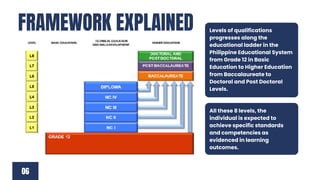
FRAMEWORK EXPLAINED Levelsof qualifications
progresses along the
educational ladder in the
Philippine Educational System
from Grade 12 in Basic
Education to Higher Education
from Baccalaureate to
Doctoral and Post Doctoral
Levels.
All these 8 levels, the
individual is expected to
achieve specific standards
and competencies as
evidenced in learning
outcomes.
7.
07
DOMAINS EXPLAINED
evaluates thelevel of autonomy and
responsibility that an individual can
exercise in their work or tasks,
ranging from following instructions
to making independent decisions.
assesses how
individuals apply their
knowledge, skills, and
values in various
contexts, including both
routine and non-routine
situations.
APLICATION
DEGREE OF INDEPENDENCE
on the theoretical
understanding,
practical abilities, and
personal attributes that
individuals acquire
through education and
training.
KNOWLEDGE, SKILL,
VALUES
10
IMPORTANCE OF PHILIPPINE
QUALIFICATIONFRAMEWORK TO
CURRICULUM EVALUATION
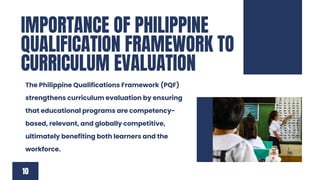
The Philippine Qualifications Framework (PQF)
strengthens curriculum evaluation by ensuring
that educational programs are competency-
based, relevant, and globally competitive,
ultimately benefiting both learners and the
workforce.
11.
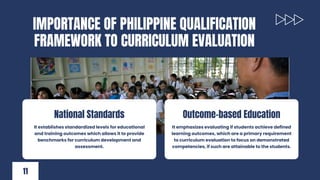
National Standards
It establishesstandardized levels for educational
and training outcomes which allows it to provide
benchmarks for curriculum development and
assessment.
IMPORTANCE OF PHILIPPINE QUALIFICATION
FRAMEWORK TO CURRICULUM EVALUATION
11
Outcome-based Education
It emphasizes evaluating if students achieve defined
learning outcomes, which are a primary requirement
to curriculum evaluation to focus on demonstrated
competencies, if such are attainable to the students.
12.
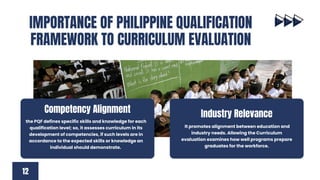
Industry Relevance
It promotesalignment between education and
industry needs. Allowing the Curriculum
evaluation examines how well programs prepare
graduates for the workforce.
12
IMPORTANCE OF PHILIPPINE QUALIFICATION
FRAMEWORK TO CURRICULUM EVALUATION
Competency Alignment
the PQF defines specific skills and knowledge for each
qualification level; so, it assesses curriculum in its
development of competencies, if such levels are in
accordance to the expected skills or knowledge an
individual should demonstrate.
13.
Quality Assurance
It functionsas a quality-assured national system
or policy on standards of training and learning
competencies, which curriculum evaluation is a
core component of ensuring program quality.
IMPORTANCE OF PHILIPPINE QUALIFICATION
FRAMEWORK TO CURRICULUM EVALUATION
11
International Comparability
It aligns curriculums to global standards.
Producing global competitive individuals through
assessing the Curricula that must consider
international benchmarks for recognition.
14.
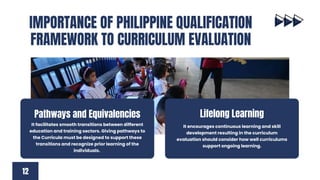
Lifelong Learning
It encouragescontinuous learning and skill
development resulting in the curriculum
evaluation should consider how well curriculums
support ongoing learning.
12
IMPORTANCE OF PHILIPPINE QUALIFICATION
FRAMEWORK TO CURRICULUM EVALUATION
Pathways and Equivalencies
It facilitates smooth transitions between different
education and training sectors. Giving pathways to
the Curricula must be designed to support these
transitions and recognize prior learning of the
individuals.








![The teaching profession.pptx[1]](https://cdn.slidesharecdn.com/ss_thumbnails/theteachingprofession-pptx1-130111052019-phpapp01-thumbnail.jpg?width=640&height=640&fit=bounds)


