POETRY:
BASIC
ENGLISH 7
(WEEK 2)
MELC’S
EN7LIT-I-1 Analyze
literarytexts as
expressions of
individual or
communal
valueswithin.
OBJECTIV
ES
1. Sharespecific thoughts or insights on Filipino
values discussed in class.
2. Write a short prayer showing the elements of
poetry.
3. Analyzethe given poem according to the
assignedconcept.
Share their ideas and thoughts about significant
conceptsfrom the poem and relateit to your specific
SHORT
REVIEW
think of words or phrases that start
with each initial letter and are
relevant to the topic of poetry. The
learners will work in pairs and each
pair will present their work in front of
the class.
P-
O-
E-
T-
R-
Y-
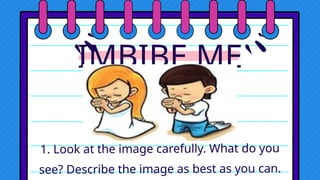
IMBIBE ME
1. Look at the image carefully. What do you
see? Describe the image as best as you can.
2.What Filipinovalue do you think is shown in
the image?Why do you think so?
3.When you pray, what do you usually pray
for? Share some lines from your prayers and
explain why they are important to you.
4. How does prayer play a role in your life?
What does it mean to you?
THI
NK,
PAIR
,
m pairs and collaborate to write a
yer usingthe elements of poetry.
dents can choose to write a free-
poem or a rhyming poem as their
prayer.
ce the pairs have completed their
s, they will take turns reading their
work aloud to the class.
ncourage the rest of the class to
n attentively and provide positive
ments or constructive suggestions
after each reading.
GUIDE
QUESTIONS
a. How did you feel about writing a poem
usingthe elements of poetry? Describe your
experience.
b. Do you think there is a connection between
writing poetry and writing a prayer? Explain
your thoughts.
GUIDE
QUESTIONS
a. Did you face any challenges while writing
your prayer poem? If so, how did you address
them?
UNLOCKING
CONTENTVOC
ABULARY
GUESS THE
WORD
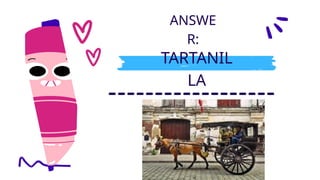
A TYPE OF HORSE-DRAWN CARRIAGE OR A
TRADITIONAL FILIPINO HORSE-DRAWN VEHICLE.
IT IS COMMONLY USED AS A MODE OF
TRANSPORTATION IN RURAL AREAS AND SMALL
TOWNS IN THE PHILIPPINES. 10 LETTERS.
ANSWE
R:
TARTANIL
LA
GUIDE
QUESTIO
NS
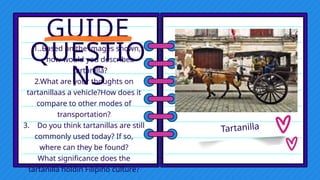
1..Based on the images shown,
how would you describea
tartanilla?
2.What are your thoughts on
tartanillaas a vehicle?How does it
compare to other modes of
transportation?
3. Do you think tartanillas are still
commonly used today? If so,
where can they be found?
What significance does the
tartanilla holdin Filipino culture?
Tartanilla
BRAIN BLOSSOMS:
CULTIVATING IDEAS AND
THOUGHTS
PROCESSING QUESTIONS
1. HOW DID CREATING THE FLOWER CONCEPT
MAP HELP YOU BETTER UNDERSTAND THE
CONCEPT OF POETRY?
2. WHAT DID YOU LEARN ABOUT YOUR OWN
EXPERIENCES WITH READING, WRITING, AND
UNDERSTANDING POETRY WHILE MAKING THE
CONCEPT MAP?
3. IF YOU WERE TO ANALYZE A POEM RIGHT NOW,
WHAT WOULD BE THE FIRST STEP YOU TAKE?
BASIC
ELEMENTS
OF
DAY 2 - 3
BASIC
ELEMENTS
OF POETRY
01
● Form - Refers to how the poem is put together,
like its structure and design. This includes things like
how it rhymes, the rhythm of the words, how the lines
are grouped into stanzas, and how it looks on the
BASIC
ELEMENTS
OF POETRY
02
● Line – Thebasic unit of poetry, often
characterized by its length,rhythm, and
arrangement on the page.
BASIC
ELEMENTS
OF POETRY
03
● Imagery – Descriptive language that appeals to the
senses, creating vivid mental pictures and sensory
experiences for the reader.This means the writer chooses
words that help you imagine how things look, sound,
BASIC
ELEMENTS
OF POETRY
04
● Sound Devices – Techniques such as rhyme, rhythm,
alliteration, assonance, consonance, and onomatopoeia
that create auditory effects and enhance the musicality of
a poem.
BASIC
ELEMENTS
OF POETRY
05
Figurative Language-Figurative language adds depth, nuance,and
emotion to poetryby going beyond literal meaningsand inviting
readersto interpret and experience the text in different ways through
the use of metaphors, similes, personification, hyperbole, etc. It
allows poets to convey complex ideas, emotions,and experiences
BASIC
ELEMENTS
OF POETRY
06
●Theme- The central idea, message, or
underlying meaning of a poem, often expressed
through recurring images,symbols, or motifs.
HOW DO YOU
LOOK AT THE
CONTEXT OF A
POEM?
Poems often have biographical, historical, and
socio-cultural contexts because these contexts
greatly influence the themes, styles, and
messages of the poems. Here are the things you
need to remember when identifying them:
1.BIOGRAPHIC
AL CONTEXT
●Includes the life experiences, background,
beliefs, and personal history of the writer.
● Understanding the writer's biography can
provide insights into the motivations, emotions,
and perspectives behind their poems.
1.BIOGRAPHIC
AL CONTEXT
●This context may influence the theme,
subject,and style of the writer.
●Personal experiences often shape the themes
and emotions explored in poetry, making
biographical context crucial for understanding
the writer's perspective and creative process.
2.HISTORICAL
CONTEXT
●Refers to the time period, events, social
conditions, and cultural movements in which the
poem was written.
●Examining historical context helps readers
understand how societal changes, political
events, or cultural shifts may have influenced the
poet's perspective and message.
3. SOCIO-
CULTURAL
CONTEXT
●Refers to the social, cultural,and ideological environment
in which the poem is produced and received.
●Socio-cultural context includes factors such as societal
norms, values, beliefs, traditions, and cultural identities.
●This context may influence the themes,
symbols,language choices, and interpretations of the
poem, as well as how the poem is received and
PRACTICE
TASK
Filipino Heritage By Francisco
Balagtas
Our heritage, a tapestry rich and
grand, Woven with stories of our
native land.
From Luzon's mountains to
GUIDE
QUESTIONS
1.How would you describe the
form and structure of the
poem? What do you notice
about the length and
arrangement of the lines?
GUIDE
QUESTIONS
2. Did the author use any
imagery, sound devices (like
rhyme or alliteration), or
figurative language (like
metaphors or similes)? Provide
examples from the poem.
GUIDE
QUESTIONS
4. What can you tell about the
background of the poem?
Consider the author's life, the
historical period, or the cultural
setting when the poem was
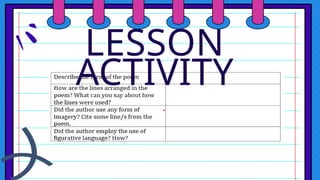
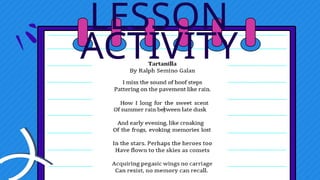
LESSON
ACTIVITY
LESSON
ACTIVITY
LESSON
ACTIVITY
LEARNERS’
TAKEAWAY
S
DAY 4
EXITSLIP: 3,
2 1
On a piece of paper, the studentsanswer
the following:
●Write three things you learned from this
lesson.
●List down two thingsyou want to learn
EXITSLIP: 3,
2 1
The teacher will divide the class into small
groups and prompt them to discuss their most
effective learning experiences as well as areas
they believe they can enhance. Afterwards, each
group will combine their insights, and two
representatives from each group will present
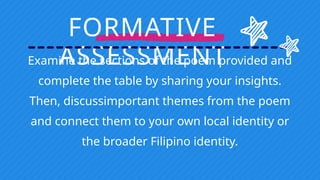
FORMATIVE
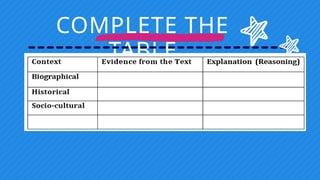
ASSESSMENT
Examine the sections of the poem provided and
complete the table by sharing your insights.
Then, discussimportant themes from the poem
and connect them to your own local identity or
the broader Filipino identity.
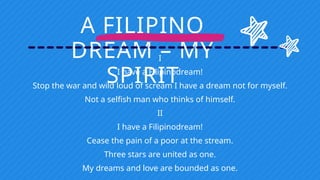
A FILIPINO
DREAM – MY
SPIRIT
I
I have a Filipinodream!
Stop the war and wild loud of scream I have a dream not for myself.
Not a selfish man who thinks of himself.
II
I have a Filipinodream!
Cease the pain of a poor at the stream.
Three stars are united as one.
My dreams and love are bounded as one.
COMPLETE THE
TABLE
THANK
YOU!
A&R DIGITALS
RESOURCES PAGE

Basic Elements of Poetry English Grade 7

  • 1.
  • 2.
    MELC’S EN7LIT-I-1 Analyze literarytexts as expressionsof individual or communal valueswithin.
  • 3.
    OBJECTIV ES 1. Sharespecific thoughtsor insights on Filipino values discussed in class. 2. Write a short prayer showing the elements of poetry. 3. Analyzethe given poem according to the assignedconcept. Share their ideas and thoughts about significant conceptsfrom the poem and relateit to your specific
  • 4.
    SHORT REVIEW think of wordsor phrases that start with each initial letter and are relevant to the topic of poetry. The learners will work in pairs and each pair will present their work in front of the class. P- O- E- T- R- Y-
  • 5.
    IMBIBE ME 1. Lookat the image carefully. What do you see? Describe the image as best as you can.
  • 6.
    2.What Filipinovalue doyou think is shown in the image?Why do you think so? 3.When you pray, what do you usually pray for? Share some lines from your prayers and explain why they are important to you. 4. How does prayer play a role in your life? What does it mean to you?
  • 7.
    THI NK, PAIR , m pairs andcollaborate to write a yer usingthe elements of poetry. dents can choose to write a free- poem or a rhyming poem as their prayer. ce the pairs have completed their s, they will take turns reading their work aloud to the class. ncourage the rest of the class to n attentively and provide positive ments or constructive suggestions after each reading.
  • 8.
    GUIDE QUESTIONS a. How didyou feel about writing a poem usingthe elements of poetry? Describe your experience. b. Do you think there is a connection between writing poetry and writing a prayer? Explain your thoughts.
  • 9.
    GUIDE QUESTIONS a. Did youface any challenges while writing your prayer poem? If so, how did you address them?
  • 10.
    UNLOCKING CONTENTVOC ABULARY GUESS THE WORD A TYPEOF HORSE-DRAWN CARRIAGE OR A TRADITIONAL FILIPINO HORSE-DRAWN VEHICLE. IT IS COMMONLY USED AS A MODE OF TRANSPORTATION IN RURAL AREAS AND SMALL TOWNS IN THE PHILIPPINES. 10 LETTERS.
  • 11.
  • 12.
    GUIDE QUESTIO NS 1..Based on theimages shown, how would you describea tartanilla? 2.What are your thoughts on tartanillaas a vehicle?How does it compare to other modes of transportation? 3. Do you think tartanillas are still commonly used today? If so, where can they be found? What significance does the tartanilla holdin Filipino culture? Tartanilla
  • 13.
  • 14.
    PROCESSING QUESTIONS 1. HOWDID CREATING THE FLOWER CONCEPT MAP HELP YOU BETTER UNDERSTAND THE CONCEPT OF POETRY? 2. WHAT DID YOU LEARN ABOUT YOUR OWN EXPERIENCES WITH READING, WRITING, AND UNDERSTANDING POETRY WHILE MAKING THE CONCEPT MAP? 3. IF YOU WERE TO ANALYZE A POEM RIGHT NOW, WHAT WOULD BE THE FIRST STEP YOU TAKE?
  • 15.
  • 16.
    BASIC ELEMENTS OF POETRY 01 ● Form- Refers to how the poem is put together, like its structure and design. This includes things like how it rhymes, the rhythm of the words, how the lines are grouped into stanzas, and how it looks on the
  • 17.
    BASIC ELEMENTS OF POETRY 02 ● Line– Thebasic unit of poetry, often characterized by its length,rhythm, and arrangement on the page.
  • 18.
    BASIC ELEMENTS OF POETRY 03 ● Imagery– Descriptive language that appeals to the senses, creating vivid mental pictures and sensory experiences for the reader.This means the writer chooses words that help you imagine how things look, sound,
  • 19.
    BASIC ELEMENTS OF POETRY 04 ● SoundDevices – Techniques such as rhyme, rhythm, alliteration, assonance, consonance, and onomatopoeia that create auditory effects and enhance the musicality of a poem.
  • 20.
    BASIC ELEMENTS OF POETRY 05 Figurative Language-Figurativelanguage adds depth, nuance,and emotion to poetryby going beyond literal meaningsand inviting readersto interpret and experience the text in different ways through the use of metaphors, similes, personification, hyperbole, etc. It allows poets to convey complex ideas, emotions,and experiences
  • 21.
    BASIC ELEMENTS OF POETRY 06 ●Theme- Thecentral idea, message, or underlying meaning of a poem, often expressed through recurring images,symbols, or motifs.
  • 22.
    HOW DO YOU LOOKAT THE CONTEXT OF A POEM? Poems often have biographical, historical, and socio-cultural contexts because these contexts greatly influence the themes, styles, and messages of the poems. Here are the things you need to remember when identifying them:
  • 23.
    1.BIOGRAPHIC AL CONTEXT ●Includes thelife experiences, background, beliefs, and personal history of the writer. ● Understanding the writer's biography can provide insights into the motivations, emotions, and perspectives behind their poems.
  • 24.
    1.BIOGRAPHIC AL CONTEXT ●This contextmay influence the theme, subject,and style of the writer. ●Personal experiences often shape the themes and emotions explored in poetry, making biographical context crucial for understanding the writer's perspective and creative process.
  • 25.
    2.HISTORICAL CONTEXT ●Refers to thetime period, events, social conditions, and cultural movements in which the poem was written. ●Examining historical context helps readers understand how societal changes, political events, or cultural shifts may have influenced the poet's perspective and message.
  • 26.
    3. SOCIO- CULTURAL CONTEXT ●Refers tothe social, cultural,and ideological environment in which the poem is produced and received. ●Socio-cultural context includes factors such as societal norms, values, beliefs, traditions, and cultural identities. ●This context may influence the themes, symbols,language choices, and interpretations of the poem, as well as how the poem is received and
  • 27.
    PRACTICE TASK Filipino Heritage ByFrancisco Balagtas Our heritage, a tapestry rich and grand, Woven with stories of our native land. From Luzon's mountains to
  • 28.
    GUIDE QUESTIONS 1.How would youdescribe the form and structure of the poem? What do you notice about the length and arrangement of the lines?
  • 29.
    GUIDE QUESTIONS 2. Did theauthor use any imagery, sound devices (like rhyme or alliteration), or figurative language (like metaphors or similes)? Provide examples from the poem.
  • 30.
    GUIDE QUESTIONS 4. What canyou tell about the background of the poem? Consider the author's life, the historical period, or the cultural setting when the poem was
  • 31.
  • 32.
  • 33.
  • 34.
  • 35.
    EXITSLIP: 3, 2 1 Ona piece of paper, the studentsanswer the following: ●Write three things you learned from this lesson. ●List down two thingsyou want to learn
  • 36.
    EXITSLIP: 3, 2 1 Theteacher will divide the class into small groups and prompt them to discuss their most effective learning experiences as well as areas they believe they can enhance. Afterwards, each group will combine their insights, and two representatives from each group will present
  • 37.
    FORMATIVE ASSESSMENT Examine the sectionsof the poem provided and complete the table by sharing your insights. Then, discussimportant themes from the poem and connect them to your own local identity or the broader Filipino identity.
  • 38.
    A FILIPINO DREAM –MY SPIRIT I I have a Filipinodream! Stop the war and wild loud of scream I have a dream not for myself. Not a selfish man who thinks of himself. II I have a Filipinodream! Cease the pain of a poor at the stream. Three stars are united as one. My dreams and love are bounded as one.
  • 39.
  • 40.
  • 41.