What is Poetry?
Poetryis a form of literature that uses aesthetic and
rhythmic qualities of language—such as phonaesthetics,
sound symbolism, and metre—to evoke meanings in
addition to, or in place of, prosaic ostensible meaning.
What sets poetry apart from other genres is its
concentrated use of language, often employing figurative
speech, imagery, and heightened emotion to create a
unique experience for the reader. Unlike prose, which
focuses on narrative or factual description, poetry
prioritizes expression and the musicality of words.
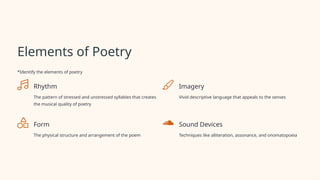
Elements of Poetry
*Identifythe elements of poetry
Rhythm
The pattern of stressed and unstressed syllables that creates
the musical quality of poetry
Imagery
Vivid descriptive language that appeals to the senses
Form
The physical structure and arrangement of the poem
Sound Devices
Techniques like alliteration, assonance, and onomatopoeia
5.
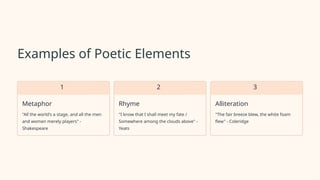
Examples of PoeticElements
1
Metaphor
"All the world's a stage, and all the men
and women merely players" -
Shakespeare
2
Rhyme
"I know that I shall meet my fate /
Somewhere among the clouds above" -
Yeats
3
Alliteration
"The fair breeze blew, the white foam
flew" - Coleridge
6.
Development of PhilippinePoetry
Philippine poetry has a rich and vibrant history, evolving significantly through three distinct periods that reflect the nation's cultural and political
transformations. This timeline highlights the key characteristics and influences that shaped poetic expression in the Philippines.
1
Pre-Colonial Period
Rooted in oral traditions, this era featured a rich tapestry of folk
songs, riddles, epics, and chants. These forms deeply reflected
indigenous beliefs, community life, and customs, serving as vital
vehicles for cultural transmission.
2
Spanish Colonial Period
With Spanish colonization came the introduction of Western literary
forms and religious themes. This period saw the rise of devotional
poetry like the "pasyon," a narrative of Christ's life, and "corrido,"
narrative poems often focused on chivalric or religious subjects.
3
American/Modern Period
The American period brought English as a new medium for poetic
expression, fostering themes of nationalism, identity, and social
commentary. This era eventually blossomed into contemporary
experimental forms, reflecting diverse influences and artistic freedom.
7.
Examples from PhilippinePoetry
To illustrate the evolution of Philippine poetry, let's explore significant examples from each major period, showcasing their unique styles and themes.
Pre-Colonial: Ambahan
The Ambahan is a traditional poetic form of the Mangyan people of Mindoro, consisting of
seven-syllable lines that rhyme. It conveys practical wisdom, riddles, or narrates daily life
and societal values.
Spanish Period: "Florante at Laura"
Francisco Balagtas's epic poem "Florante at Laura" is a masterpiece written in Tagalog. It
uses allegory to subtly critique Spanish colonial rule while exploring themes of love,
injustice, and betrayal within a fictional setting.
Modern Period: "Have Come, Am Here"
José García Villa's collection "Have Come, Am Here" showcases his innovative use of
punctuation, particularly his "comma poems," and his exploration of individual
consciousness, spirituality, and artistic freedom, often challenging conventional poetic
forms.




![FINAL PPT Elements_of_Poetry_Presentation.pptx_20241017_055037_0000[1].pptx](https://cdn.slidesharecdn.com/ss_thumbnails/finalpptelementsofpoetrypresentation-250405114945-c237f921-thumbnail.jpg?width=640&height=640&fit=bounds)


