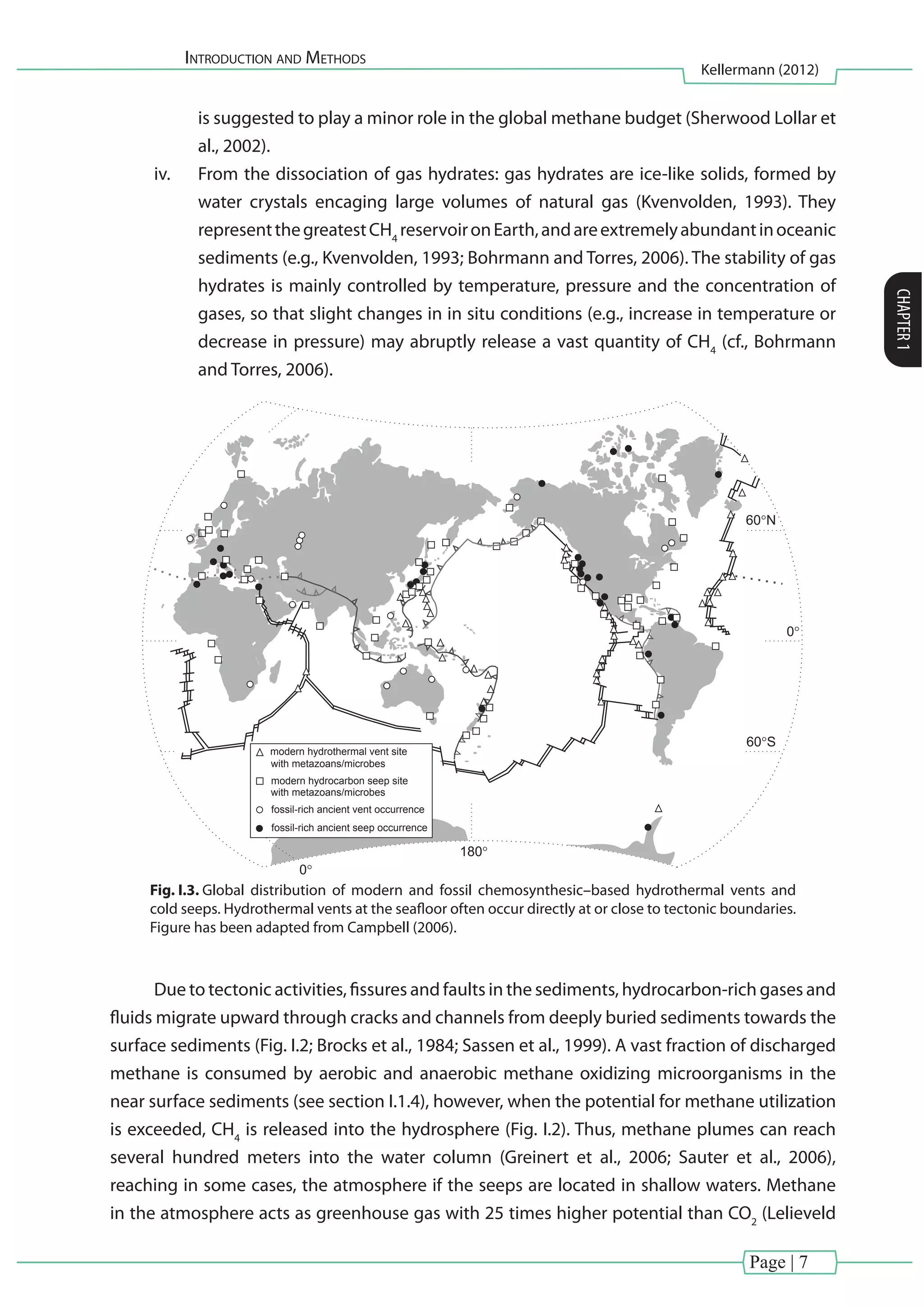
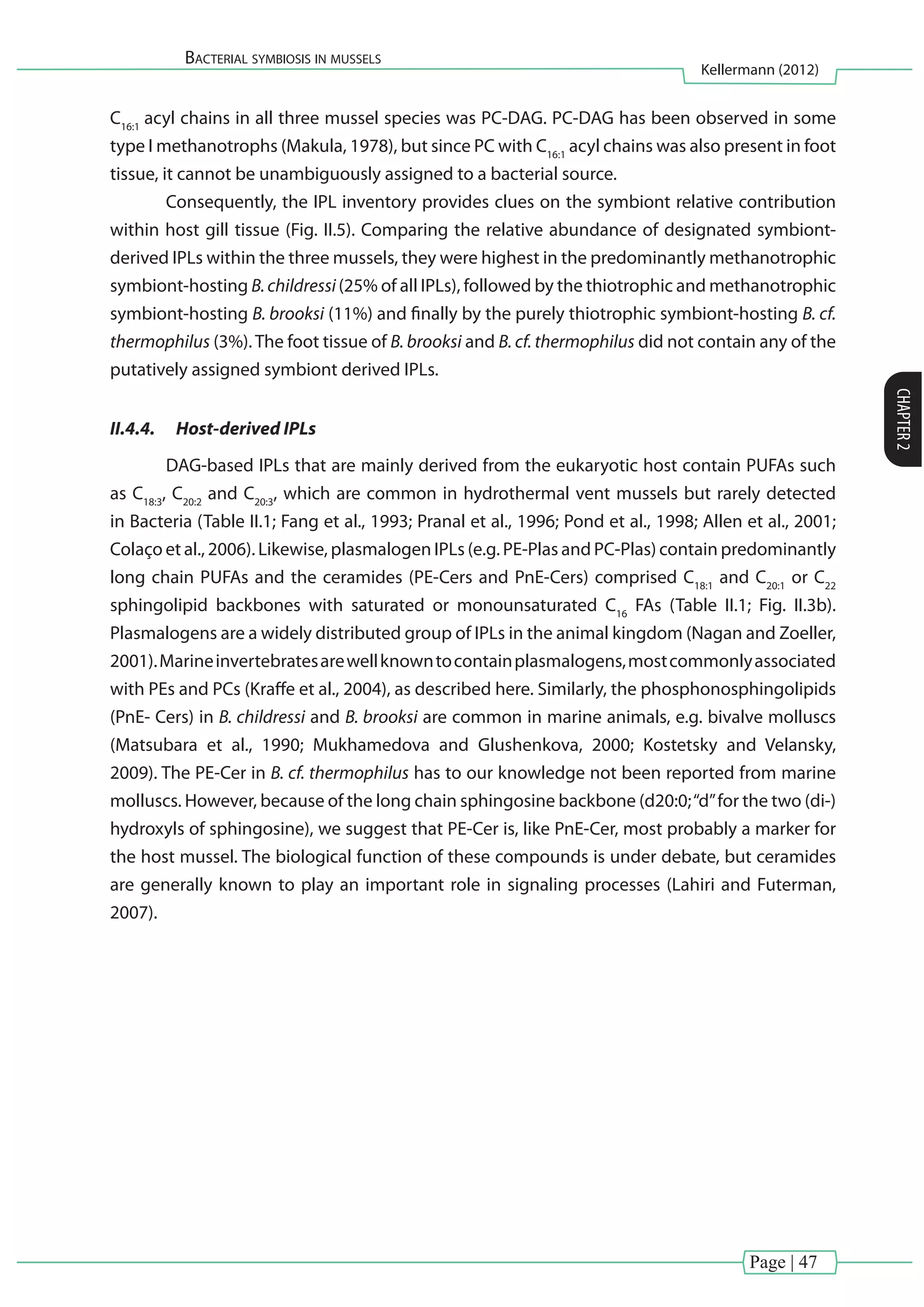
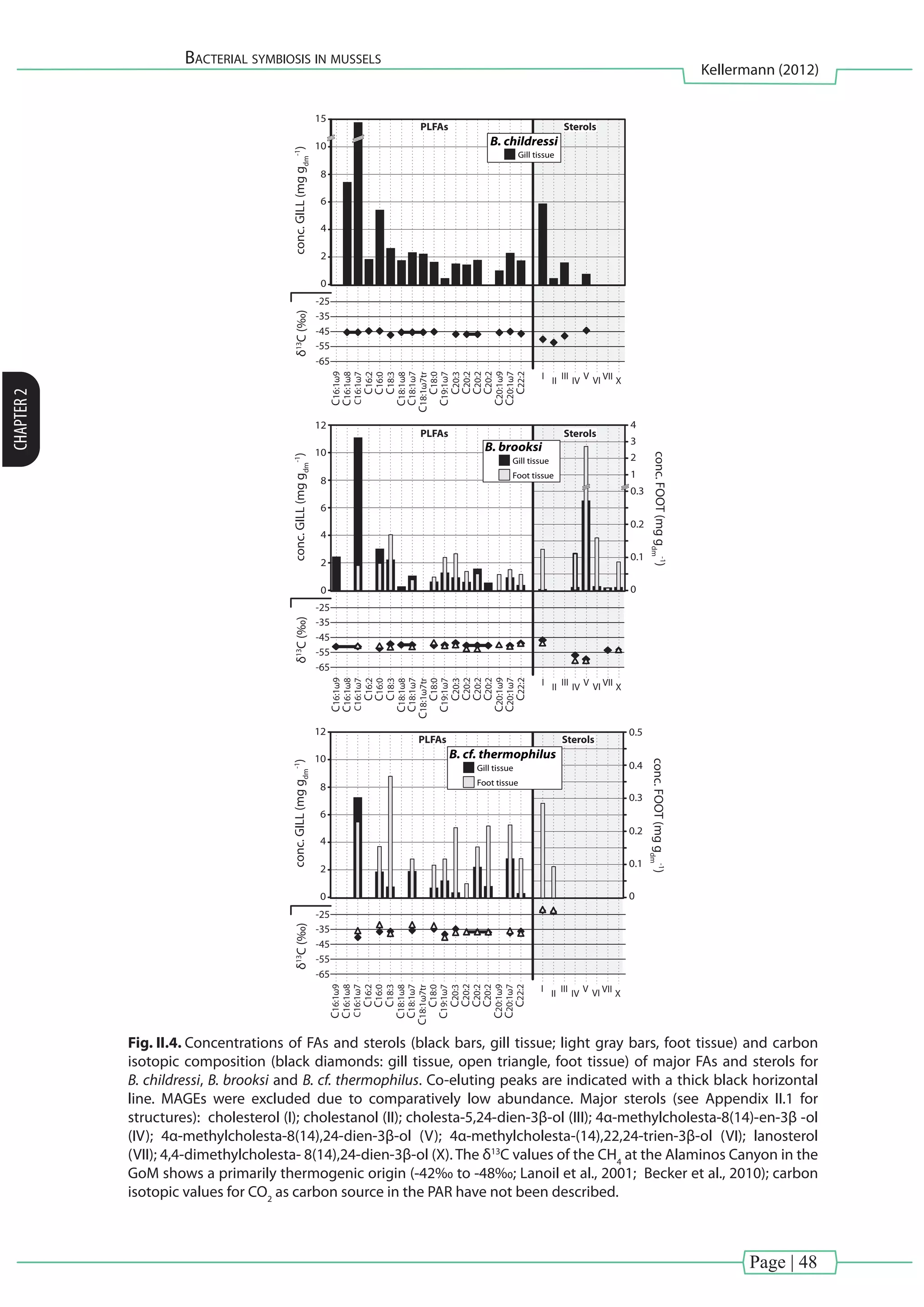
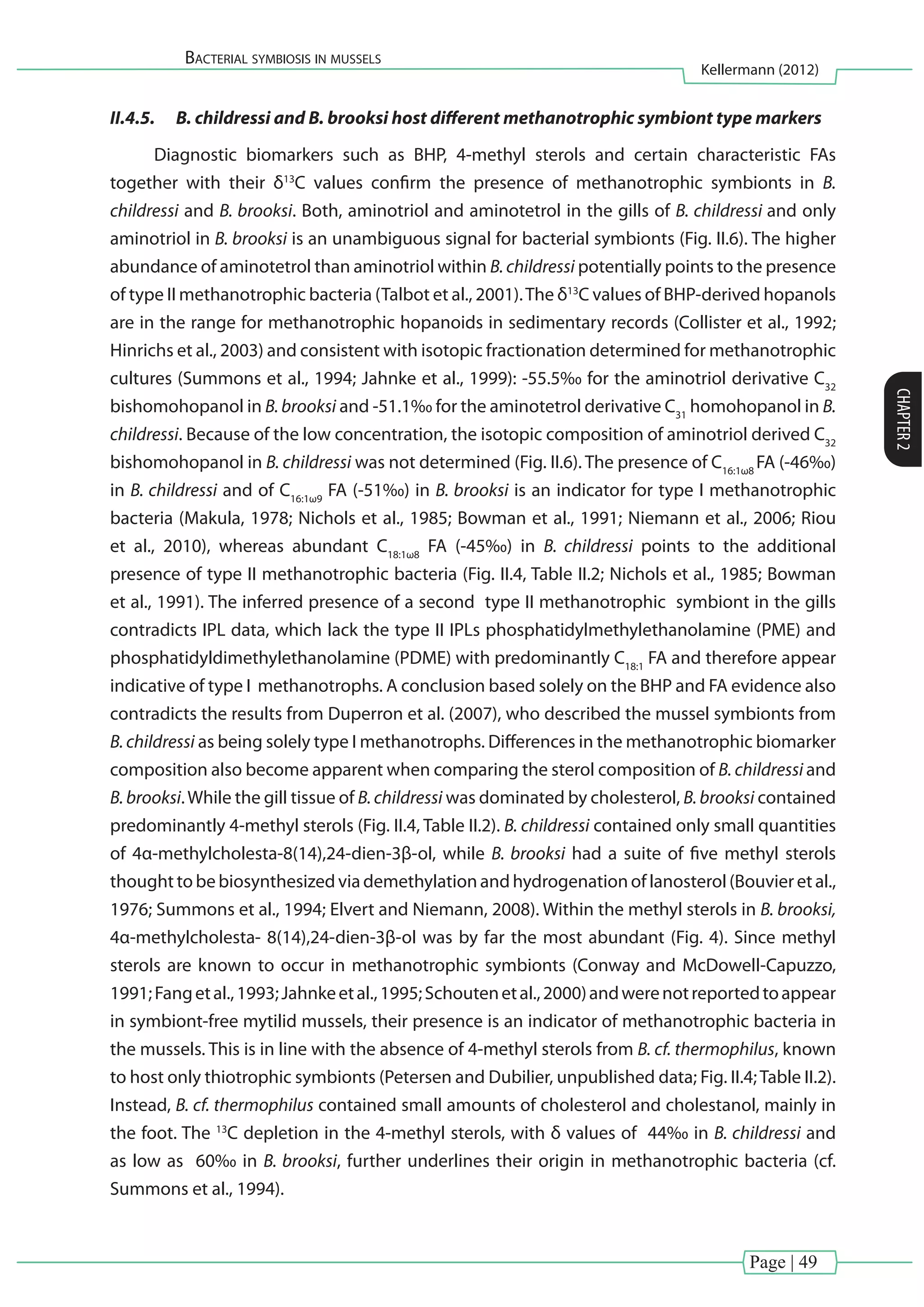
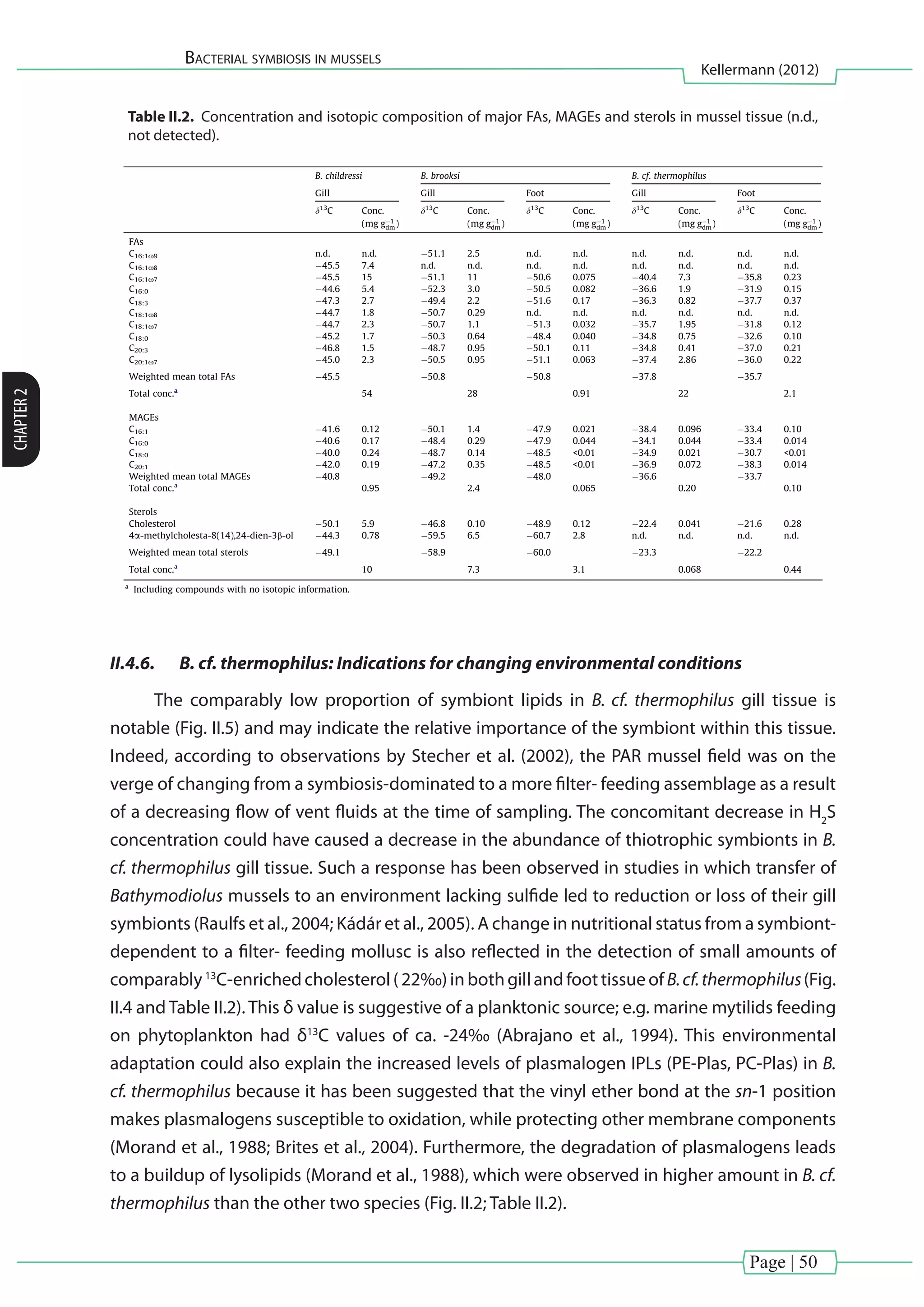
Lipid biomolecules reveal patterns of microbial
metabolism in extreme environments
Dissertation
zur Erlangung des Doktorgrades
der Naturwissenschaften
- Dr. rer. nat. -
dem Fachbereich Geowissenschaften
der Universität Bremen
vorgelegt von
Matthias Kellermann
Bremen
February 2012
Die vorliegende Arbeit wurde in der Zeit von Mai 2008 bis Februar 2012 in der Arbeitsgruppe
Organische Geochemie am MARUM – Zentrum für Marine Umweltwissenschaften und dem
Fachbereich Geowissenschaften der Universität Bremen angefertigt.
1. Gutachter: Prof. Dr. Kai-Uwe Hinrichs
2. Gutachter: Prof. Dr. Stuart G. Wakeham
Tag des Promotionskolloquiums: 23. März 2012
DARCLIFE
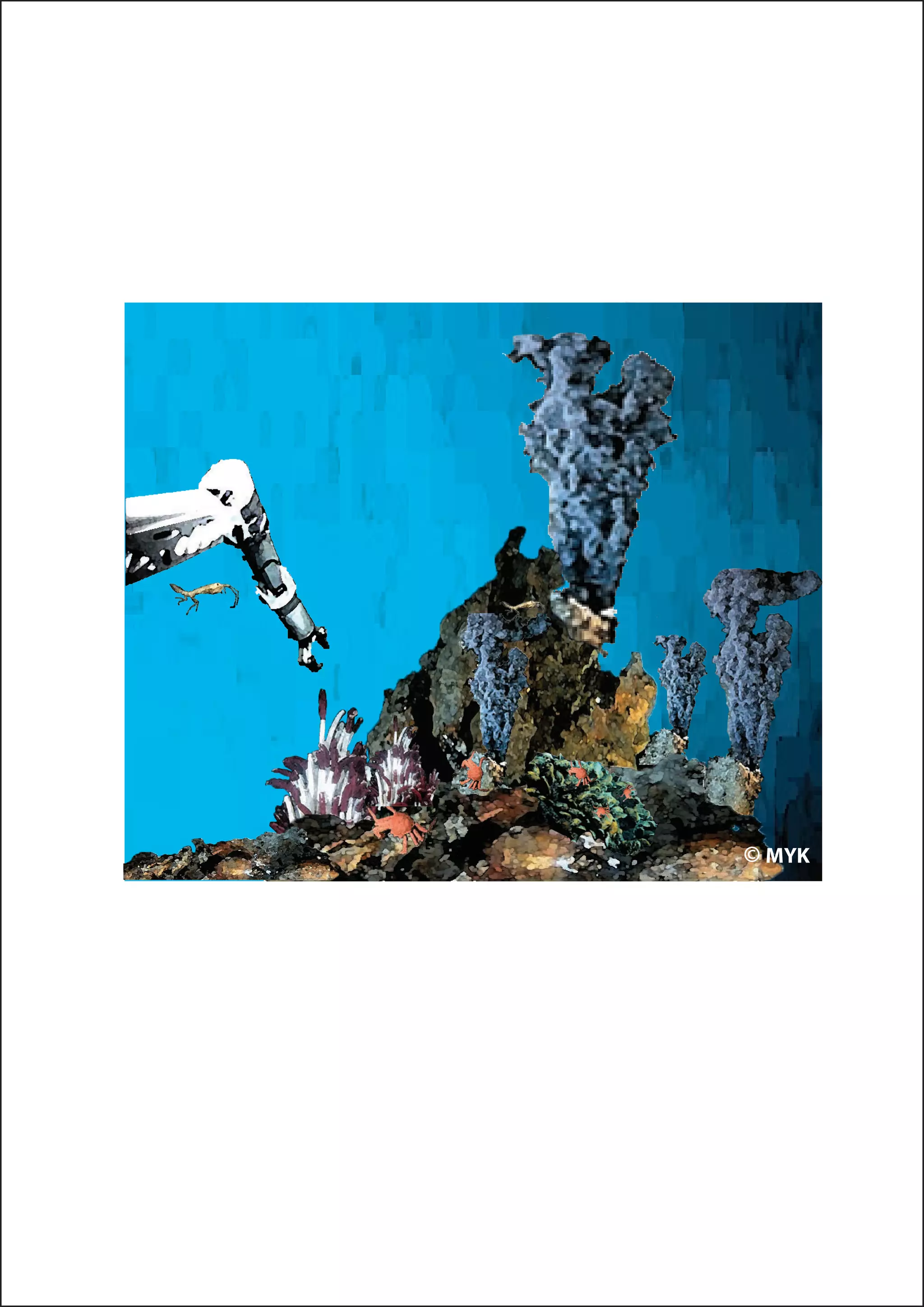
© MYK
“It’s a magical world, Hobbes, ol’ buddy...Let’s go exploring!”
Bill Watterson, cartoonist, ”Calvin and Hobbes”
Table of Contents
Abstract	 I
Kurzbeschreibung	 III
Acknowledgements	 V
List of Abbreviations	 VIII
Chapter I	 1
Introduction and Methods
Chapter II	 35
Symbiont–host relationships in chemosynthetic mussels:
A comprehensive lipid biomarker study
Chapter III	 57
Dominance of autotrophic carbon fixation in hydrothermal
sediments inhabited by methanotrophic communities
Chapter IV	 77
Systematic fragmentation patterns of archaeal intact polar lipids
by high-performance liquid chromatography/electrospray
ionization ion-trap mass spectrometry
Chapter V	 105
Stable isotope probing of an anaerobic methane–oxidizing
enrichment provides clues on archaeal tetraether lipid biosynthesis
Chapter VI	 125
Concluding remarks & future perspectives
References 	 133
Appendix 	 155
Page | I
Kellermann (2012)
Abstract
Thisdissertationusedstate-of-the-artorganicgeochemicaltechniquestoexplorethelipid
biosignatures of microorganisms inhabiting at cold and hot vents.The association of organisms
and their carbon metabolisms were assessed and the current knowledge on the microbially-
mediated oxidation of reduced compounds under aerobic and anaerobic conditions, especially
at methane-rich environments, was expanded. By using the taxonomic information encoded
in intact polar lipid (IPL) molecules, this work confirmed the presence of aerobic chemotrophic
bacteria living symbiotically with mussels recovered from seep and vent environments.This was
the first application of IPLs in symbiont ecology, providing a semi-quantitative estimation of
the importance of methanotrophic and thiotrophic symbionts within the gills of Bathymodiolus
mussels. In addition, the stable carbon isotopic composition of a suite of lipid biomarkers (e.g.,
fatty acids, sterols, bacteriohopanepolyols) derived from symbionts and hosts highlighted the
importance of a chemosynthetic lifestyle in these extreme settings. The anaerobic oxidation
of methane (AOM) performed by naturally enriched anaerobic methanotrophic (ANME)
archaea belonging to the ANME–1 subgroup and sulfate-reducing bacteria (SRB) belonging
to the HotSeep–1 cluster from the Guaymas Basin (Gulf of California) sediments was studied
using a novel dual stable isotope probing (SIP) method. Dual-SIP was applied to bulk microbial
lipids (total lipid extract, TLE) and involves the assimilation of deuterated water (D2
O) and
13
CDIC
(DIC = dissolved inorganic carbon), which allows the simultaneous assessment of auto–
and heterotrophic carbon fixation. This work was the first to demonstrate autotrophic lipid
production for both ANME and SRB, in contrast to previous AOM studies which suggested a
significant contribution of direct methane assimilation during microbial growth. These results
haveadirectimplicationintheinterpretationofnaturallipidstablecarbonisotopiccompositions
in AOM systems.To further access the 13
C assimilation into individual archaeal IPLs an extensive
preparative HPLC separation of lipids was performed. This work demonstrated an increase of
up to 35 times in sensitivity on IPLs (IPL-SIP) rather than bulk lipids (TLE-SIP). Moreover, the
label assimilation of individual di– and tetraether IPLs uncovered a possible role of a diether
phospholipid as precursor in archaeal tetraether biosynthesis. Finally, it was hypothesized that
the tetraether membrane, especially the formation of glycosidic (Gly) glycerol dibiphytanyl
glycerol tetraether (GDGT), is used to reduce proton-permeability, thereby protecting the
integrity of cells at extreme conditions from the Guaymas Basin. Along with this hypothesis,
the ubiquity of 2Gly-GDGTs in marine sediments worldwide may likely represent an expression
of cell-wall adaptation to cope with energy stress.
Keywords: anaerobic oxidation of methane | intact polar lipids | stable isotope probing |
hot and cold vents | chemotrophic microorganisms | Guaymas Basin | Archaea | Bacteria | auto–
and heterotrophy | archaeal lipid biosynthesis
Page | II
Kellermann (2012)
Page | III
Kellermann (2012)
Kurzbeschreibung
In der vorliegenden Dissertation wurden mithilfe neuester organisch-geochemischer
Methoden Lipid-Biosignaturen von Mikroorganismen in heißen und kalten Quellen analysiert.
Die Untersuchung des Kohlenstoffmetabolismus im Zusammenwirken von Organismen
insbesondere an methanreichen Standorten hat neue Erkenntnisse im Bereich der mikrobiell
initiierten aeroben und anaeroben Oxidation reduzierter Komponenten gebracht. Durch die
Entschlüsselung taxonomischer Information von intakten polaren Membranlipiden (IPLs),
konnte die Existenz aerober chemotropher Bakterien in einer Symbiose mit Muscheln an
kalten und heißen Quellen nachgewiesen werden. Der erstmalige Einsatz von IPLs im Bereich
der Symbiontenforschung ermöglichte eine semiquantitative Bestimmung der Bedeutung
methanotropher und thiotropher Symbionten in den Kiemen der Bathymodiolus Muscheln.
Die isotopische Zusammensetzung des Kohlenstoffs verschiedener Lipidbiomarker (z.B.
Fettsäuren, Sterole oder BHPs) verdeutlichte die Relevanz chemosynthetischer Prozesse
für Muscheln und Symbionten unter extremen Umweltbedingungen. Mithilfe einer neu
entwickelten Dual-SIP Methode (duale Isotopenmarkierung von zwei Substraten) wurde
die anaerobe Oxidation von Methan (AOM) in Proben aus dem Guaymas Becken (Golf von
Kalifornien) untersucht, welche von einem Konsortium von anaeroben methanotrophen
Archaeen (ANME) aus der ANME-1 Untergruppe und sulfatreduzierenden Bakterien (SRB) aus
dem HotSeep-1 Cluster durchgeführt wird. Um eine Aussage über autotrophen und/oder
heterotrophen Einbau des Kohlenstoffs in mikrobielle Biomasse treffen zu können, wurde der
gesamte mikrobielle Lipidpool hinsichtlich einer Aufnahme von deuteriertem Wasser (D2
O)
und 13
C-markiertem anorganischem Kohlenstoff (DIC) geprüft. Die Untersuchungen belegen
eindeutig, dass die Lipidproduktion der ANME and SRB ein ausschließlich autotropher Prozess
ist. Diese Ergebnisse stehen somit im Gegensatz zu früheren Studien, die einen signifikanten
Anteil des mikrobiellen Wachstums der direkten Aufnahme von Methan zuschreiben. Die
neu gewonnenen Erkenntnisse haben eine unmittelbare Auswirkung auf die Interpretation
der natürlichen Kohlenstoffisotopenzusammensetzung von Lipiden in AOM-beeinflussten
Systemen. Zur genaueren Bestimmung der 13
C-Aufnahme in einzelne Archaeen-IPLs wurde
eine aufwendige präparative Auftrennung von Lipiden durchgeführt. Diese Aufarbeitung
hatte zur Folge, dass die Empfindlichkeit der Bestimmung der Aufnahme des 13
C markierten
Substrats deutlich gesteigert wurde. So zeigten die IPLs verglichen mit dem gesamten
Lipidpool (TLE-SIP) eine bis zu 35-fache Signalverstärkung. Darüber hinaus deutet die
unterschiedliche Aufname von 13
C-markiertem Substrat in einzelne Di- und Tetraether-IPLs
auf ein Diether-Phospholipid als möglichen Vorläufer in der Tetraether Biosynthese hin. Die
Erkenntnisse dieser Arbeit legen die Vermutung nahe, dass eine Lipidmembran bestehend
aus Tetraethern, insbesondere Glyceroldibiphytanylglyceroltetraether mit glycosidischen
Kopfgruppen, die Protonendurchlässigkeit verringert und dadurch die Integrität der Zellen an
extremen Standorten sichert. Es ist daher anzunehmen, dass die Präsenz von diglykosidischen
Tetraetherlipiden in weltweit verteilten marinen Sedimenten, eine Art Anpassung der Zellwand
darstellt, die ein Überleben auch an Standorten mit geringen Energiequellen ermöglicht.
Page | IV
Kellermann (2012)
Page | V
Kellermann (2012)
Acknowledgements
The foremost thanks go to my advisor, Prof. Dr. Kai-Uwe Hinrichs. Kai’s support and
assistance are the foundation on which my work is built. Thank you for the opportunity to
work and progress as part of your group. Thanks for creating an inspiring and positive working
atmosphere which allowed me day-to-day to explore and enjoy science.
Prof. Dr. StuartWakeham, thank you for being a member of my thesis committee, thanks
for the discussions, your ideas, your input and your time, coming a long way for my defense. I
am really honored that you will be part of my defense party and I am looking forward to future
projects involving you as an appreciated and valued mentor and colleague.
Thanks to Prof. Dr. Wolfgang Bach, PD Dr. Matthias Zabel, Dr. Julius Lipp and Nadine
Broda for their help with the thesis defense process.
None of this would have been possible without the commitment and generous support
of Dr. Florence Schubotz, Dr. Gunter Wegener and Dr. Marcos Y. Yoshinaga. I hope that
someday I can return all the time that you guys spent discussing, commentating and criticizing
my work.
I’ve been fortunate to have a number of outstanding colleagues among the organic
geochemistry group who have provided everything from the help of instruments, advice on
writing to practical advice in the lab. Especially Marcus Elvert, Julius Lipp, Xavier Prieto and
Birgit Schmincke who helped me on a daily basis should be mentioned here. Thanks to the
organic geochemistry members, all my office and lab buddies – Arne, Julio, Tobi, Pame, Tobias,
Florence, Benni, Florian, Lars, Jan, Jan–Lars, Yu–Shih, Travis, Sitan, Gerard, Frauke, Verena, Rong,
Jenny, Thomas, Daniel, Jessica, Raika, Guangchao, Evert, Charlie, Xiaolei, Gina, Solveig, Jörn,
Bernhard, Eoghan, Marshall, Kevin, Marlene, Felix, Nadine, Nadine, Nadine, Tim und Susanne –
for the incredibly positive atmosphere at work. You’ve all helped me in so many ways and I’ve
gained learned so much by doing science with you.
Thanks also to Prof. Dr. Andreas Teske for inviting me to the cruises to the Guaymas
Basin hydrothermal vent system and allowing me to explore the mysteries of the dark–ocean
in the manned deep–ocean research submersible Alvin.
Page | VI
Kellermann (2012)
Acknowledgements (continued)
Meinen Freunden und meiner Familie ist der letzte Teil meiner Danksagung gewidmet.
Freund und Kollege waren in den letzten Jahren größtenteils eins: Tagsüber eine
Privatvorlesung über Fragmentationsmuster von Archeenlipiden und abends von der selbigen
Person mit Korn und Bier beim Kickern abgefüllt und vorgeführt zu werden... Marcos, du hast es
wirklich geschafft, mir täglich meine Grenzen aufzuzeigen und mich gleichzeitig immer dazu
bewegt, mir höhere Ziele zu stecken. Ich danke dir für Alles und hoffe, wir werden es schaffen,
uns ein Leben lang gegenseitig herauszufordern. Gunti, mir tut‘s Leid für die vielen grauen
Haare, die ich dir bereitet habe, aber sei gewiss, mir hat‘s großen Spaß gemacht! Ich hoffe,
wir werden uns noch an vielen gemeinsamen Projekten die Haare raufen. Floflo, was würde
ich ohne Dich nur machen. Egal wie voll dein Terminplan auch ist, du nimmst Dir Zeit und,
viel wichtiger, hast immer positive und aufmunternde Worte parat, die jedes noch so große
Problem winzig klein erscheinen lassen.
Während meiner Doktorarbeit habe ich viele meiner Liebsten vernachlässigt. Ich möchte
mich hiermit bei denjenigen entschuldigen, denen ich in den letzten Jahren nicht gerecht
geworden bin. Janine, danke dafür, dass du stets an mich gedacht und von Zeit zu Zeit deine
Gedanken mit mir geteilt hast. Mensch Peter, wie wär‘s mit einer ausgedehnten Wanderung in
Deutschlands Mittelgebirge? Wie ich finde wäre es wieder an der Zeit für einen weiteren Road
Trip! Malde, Sonnti, Stinka - schnürt Euch die Schuhe, wir gehen tanzen!
Vielen Dank meinen Mitbewohnern in der Mainstraße (ausschließlich Hochparterre und
1. Obergeschoss) für Unterkunft, Speis,Trank und liebeWorte - wir haben zusammen viel erlebt
und ich bin wirklich dankbar, dass wir zur selben Zeit am gleichen Ort waren. Schade Klausens,
dass du schon weiter gezogen bist, ich werde dich nicht vergessen.
Finally, the family, Mama und Papa. Euch sei gedankt, dass ihr diese Familie gegründet
und all die Jahre zusammengehalten habt. Ihr seid der Grund, warum ich mit positiven
Gedanken unbeschwert durchs Leben gehen kann. Es ist ein schönes Gefühl zu wissen, dass
ihr stets für mich da seid und immer auf mich Acht gebt. Vielen Dank für einen großartigen Ali,
meinen Bruder, der mir schon von Klein auf gezeigt hat wie die Dinge wirklich laufen. Ohne
dich wär’ ich bestimmt nicht ich. Und natürlich Susanne – mit dir bin ich groß geworden, du
hast mir die Welt gezeigt und jeden Tag eröffnest du mir neue Wunder, die ansonsten einfach
so an mir vorbeikrabbeln würden. Deine verdrehte und unsortierte, kunterbunte Ansicht auf
die Welt erhellt mein Leben und lässt so manche Dinge auch im Dunkeln strahlen.
...
Page | VII
Kellermann (2012)
Page | VIII
Kellermann (2012)
List of Abbreviations
ΔG0
		 standard free Gibbs energy
µmol d–1
gdm
–1
	 micromol per day per gram dry mass sediment
16S rRNA	 small subunit of ribosomal ribonucleic acid with a sedimentary unit of 16
AEG 		 acylether glycerol
ANA		 aldononitrile acetate
ANME 		 anaerobic methanotrophic archaea
AOM 		 anaerobic oxidation of methane
AR		 archaeol (C20
-C20
isoprenoidal chains)
assimIC
		 assimilation rate of inorganic carbon
ATP 		 adenosine triphosphate
BBr3
		 boron tribromide
BPG 		 bisphosphatidylglycerol
BHPs		 bacteriohopanepolyols
BP 		 biphytane
BSTFA 		 bis‑(trimethylsilyl) trifluoroacetamide
C16
-PAF 		 1‑O-hexadecyl-2-acetoyl-sn-glycero-3-phosphocholine
Cer 		 ceramide
CH4
		 methane
CO2
		 carbon dioxide
CoA 		 coenzyme A
CSIA 		 compound-specific isotope analysis
D		 deuterium
D2
O		 deuterated water
Da 		 dalton
DAG		 diacylglycerol
DAGE 		 dialkylgycerolether
DCM 		 dichloromethane
DEG 		 dietherglycerol
DFG 		 Deutsche Forschungsgemeinschaft
DGD 		 dialkylglyceroldiether
dGly		 deoxy-glycosyl
DIC 		 dissolved inorganic carbon
diOH-AR		 dihydroxylated archaeol
DNA 		 desoxyribonucleic acid
DPG 		 diphosphatidylglycerol (cardiolipin)
DSS 		 desulfosarcina/desulfoccocus group
ELSD 		 evaporative light scattering detector
ESI 		 electrospray ionization
Page | IX
Kellermann (2012)
eV 		 electron volts
Ext-AR		 extended archaeol (C20
-C25
isoprenoidal chains)
FA 		 fatty acids
FAME 		 fatty acid methyl esters
FID 		 flame ionization detector
FISH 		 fluorescent in-situ hybridization
G-1P 		 glycerol-1-phosphate
G-3P 		 glycerol-3 phosphate
Gal		 galactose
GC 		 gas chromatography
GC-FID 		 gas chromatography coupled to flame ionization detector
GC-irMS 		 gas chromatography coupled to isotope ratio mass spectrometer
GC-MS 		 gas chromatography coupled to mass spectrometer
GDGT		 glycerol dibiphytanyl glycerol tetraether (C40
-C40
isoprenoidal chains)
gdm
		 gram dry mass
Glc		 glucose
GLOMAR 	 Global Changes in the Marine Realm
Gly		 glycosyl (hexose)
GoM 		 Gulf of Mexico
H2
		 hydrogen gas
H2
S		 hydrogen sulfide
H3
PO4
		 phosphoric acid
HPLC 		 high performance liquid chromatography
ID		 inner diameter
IPL 		 intact polar lipid
IS 		 internal standard
IT-MS 		 ion-trap mass spectrometer
KOH 		 potassium hydroxide
Li(C2
H5
)3
BH	 lithium triethylborohydride solution (super-hydride)
LLE		 liquid–liquid extraction
m/z 		 mass to charge ratio
MAGE 		 monoalkylglycerolether
MAR		 macrocyclic archaeol
MARUM 		 Center for Marine Environmental Sciences
mbsf 		 meters below seafloor
mbsl 		 meters below sea level
MeOH 		 methanol
mL 		 milliliter
mM 		 millimolar
MPL 		 main polar lipid
Page | X
Kellermann (2012)
MS1
		 primary order mass spectrometry stage
MS2
		 secondary order daughter ion mass spectra
MSD 		 mass selective detector
MSn
		 higher order daughter ion (multistage) mass spectra
n.a. 		 not analyzed
n.d. 		 not detected
n.i. 		 not identified
NH3
		 ammonia
NMR 		 nuclear magnetic resonance
NO2
-
		 nitrogen dioxide
NO3
-
		 nitrate
NSF 		 National Science Foundation
O2
		 dioxygen
OH-AR		 monohydroxylated archaeol
OMZ 		 oxygen minimum zone
PA 		 phosphatidic acid
PC 		 phosphatidylcholine
PCR 		 polymerase chain reaction
PDME 		 phosphatidyl-(N,N)-dimethylethanolamine
PE 		 phosphatidylethanolamine
PG 		 phosphatidylglycerol
PGP		 phosphatidylglycerolphosphate
PI 		 phosphatidylinositol
PLFA 		 polar lipid-derived fatty acid
PME 		 phosphatidyl-(N)-methylethanolamine
PnE 		 phosphonoethanolamine
PO4
		 phosphate
prodLipid
		 total lipid production rate
PS 		 phosphatidylserine
PUFA 		 polyunsaturated fatty acid
Q-PCR 		 quantitative polymerase chain reaction
Ra/p
		 assimIC
/prodlipid
ratio
RNA 		 ribonucleic acid
ROV 		 remotely operated vehicle
SIMS 		 secondary ion mass spectrometry
SIP 		 stable isotope probing
SMTZ 		 sulfate-methane transition zone
SO4
2-
		 sulfate
SR 		 sulfate-reduction
SRB 		 sulfate-reducing bacteria
Page | XI
Kellermann (2012)
TCA 		 trichloroacetic acid
TFA		 trifluoroacetic acid
TIC 		 total ion chromatogram
TLE 		 total lipid extract
TMS 		 trimethylsilyl
TOC 		 total organic carbon
UK 		 unknown
Uns-AR		 unsaturated archaeol
VFA 		 volatile fatty acid
VPDB 		 Vienna Pee Dee Belemnite standard
ZnCl2
		 zinc chloride
Page | XII
Kellermann (2012)
Introduction and Methods
Kellermann (2012)
CHAPTER1
Page | 1
[Chapter I] - Introduction and Methods
Page | 2
Introduction and Methods
Kellermann (2012)
CHAPTER1
I.1.	 General Introduction
This introduction section provides an overview on the importance and function of
hydrothermal vents and cold seeps in the oceanic system. As opposed to other ecosystems,
which rely directly or indirectly on photosynthetic activity, complex communities depend on
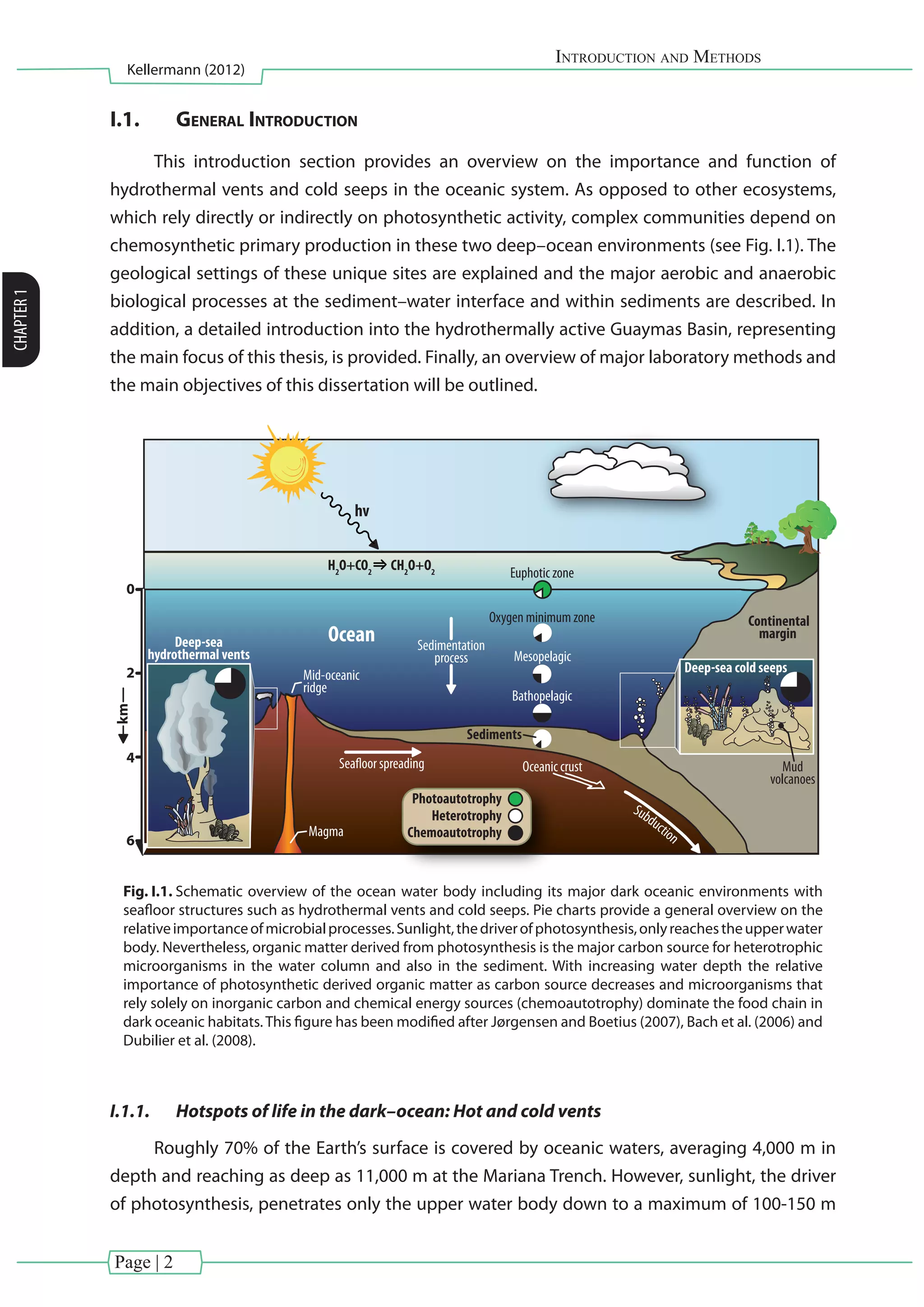
chemosynthetic primary production in these two deep–ocean environments (see Fig. I.1). The
geological settings of these unique sites are explained and the major aerobic and anaerobic
biological processes at the sediment–water interface and within sediments are described. In
addition, a detailed introduction into the hydrothermally active Guaymas Basin, representing
the main focus of this thesis, is provided. Finally, an overview of major laboratory methods and
the main objectives of this dissertation will be outlined.
Ocean
Sediments
Continental
margin
Seafloor spreading Oceanic crust
Magma
Mid-oceanic
ridge
Subduction
Sedimentation
process
Euphotic zone
hv
Oxygen minimum zone
Mesopelagic
Bathopelagic
Heterotrophy
Chemoautotrophy
Photoautotrophy
0
2
4
6
km
H2
O+CO2
CH2
O+O2
Mud
volcanoes
Deep-sea cold seeps
Deep-sea
hydrothermal vents
Fig. I.1. Schematic overview of the ocean water body including its major dark oceanic environments with
seafloor structures such as hydrothermal vents and cold seeps. Pie charts provide a general overview on the
relativeimportanceofmicrobialprocesses.Sunlight,thedriverofphotosynthesis,onlyreachestheupperwater
body. Nevertheless, organic matter derived from photosynthesis is the major carbon source for heterotrophic
microorganisms in the water column and also in the sediment. With increasing water depth the relative
importance of photosynthetic derived organic matter as carbon source decreases and microorganisms that
rely solely on inorganic carbon and chemical energy sources (chemoautotrophy) dominate the food chain in
dark oceanic habitats.This figure has been modified after Jørgensen and Boetius (2007), Bach et al. (2006) and
Dubilier et al. (2008).
I.1.1.	 Hotspots of life in the dark–ocean: Hot and cold vents
Roughly 70% of the Earth’s surface is covered by oceanic waters, averaging 4,000 m in
depth and reaching as deep as 11,000 m at the Mariana Trench. However, sunlight, the driver
of photosynthesis, penetrates only the upper water body down to a maximum of 100-150 m
Introduction and Methods
Kellermann (2012)
CHAPTER1
Page | 3
depth, leaving the remaining part of the ocean in the dark. Consequently, the dark–ocean
represents the largest aqueous habitat for microbial life on Earth (Bach et al., 2006; Jørgensen
and Boetius, 2007; Orcutt et al., 2011). In order to inhabit the remote deep sea, microorganisms
need alternative energy sources, and have to adapt to the high hydrostatic pressure (up to
1,100 bar at the MarianaTrench) and the low temperatures (–1 to 4°C). Not long ago, the seabed
was thought to be like a desert under water: uniform and biologically inert. However, the
development and operation of marine technical tools for observing, mapping and sampling
the seabed, e.g., remotely operated vehicles (ROVs), autonomous underwater vehicles (AUVs),
and manned submersibles, enabled scientists to discover the highly dynamic and populated
ecosystems in the dark–ocean, caused by interaction of the geo– and biosphere (e.g. Kelley et
al., 2001; 2005; Teske et al., 2002; Haase et al., 2007; Inagaki et al., 2006; Reeves et al., 2011). For
example, discoveries such as the rich microbial communities at hydrothermal vents (Corliss et
al., 1979) and cold seeps (Paull et al., 1984; Kennicutt et al., 1985) changed the recognition of
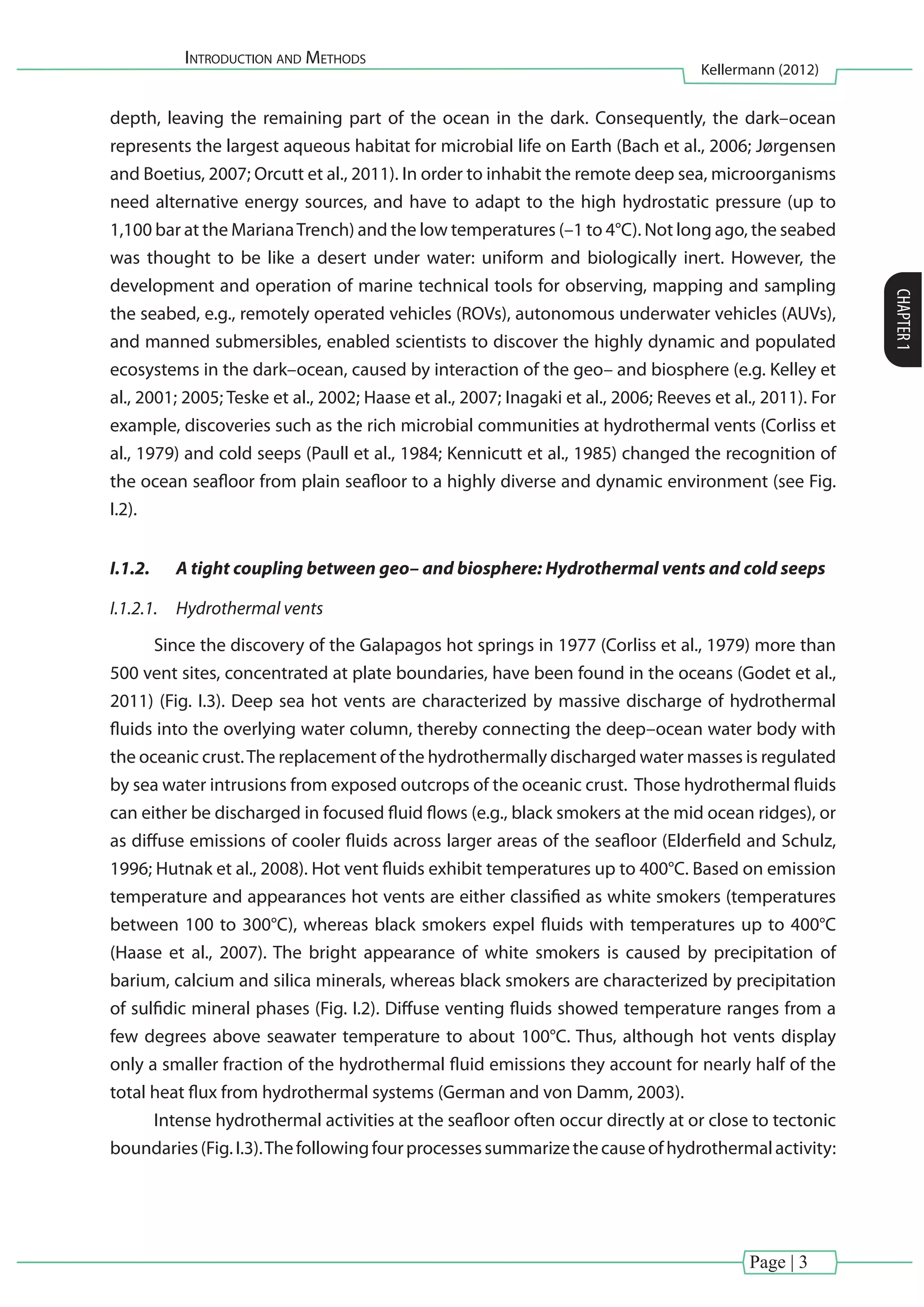
the ocean seafloor from plain seafloor to a highly diverse and dynamic environment (see Fig.
I.2).
I.1.2.	 A tight coupling between geo– and biosphere: Hydrothermal vents and cold seeps
I.1.2.1.	 Hydrothermal vents
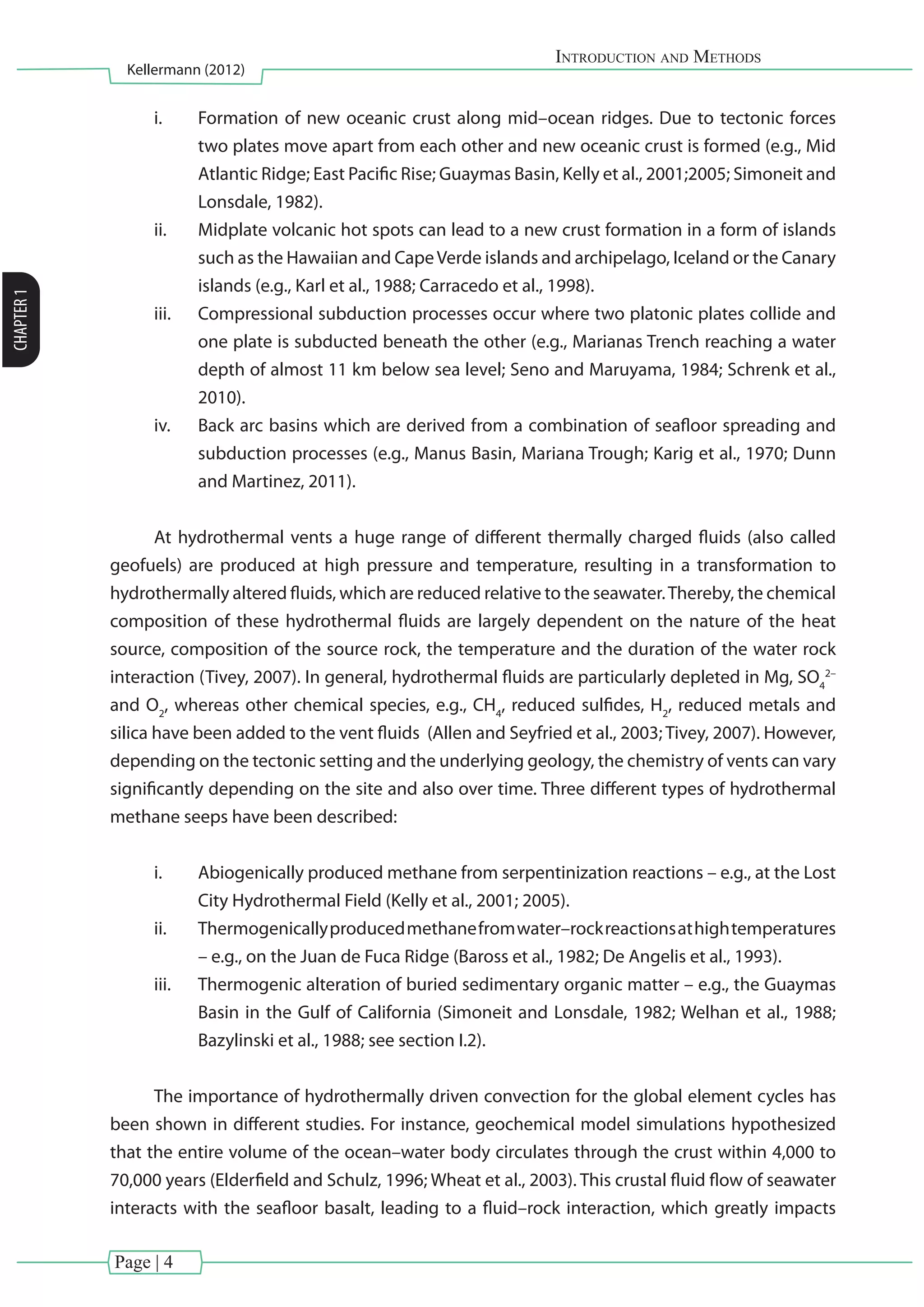
Since the discovery of the Galapagos hot springs in 1977 (Corliss et al., 1979) more than
500 vent sites, concentrated at plate boundaries, have been found in the oceans (Godet et al.,
2011) (Fig. I.3). Deep sea hot vents are characterized by massive discharge of hydrothermal
fluids into the overlying water column, thereby connecting the deep–ocean water body with
the oceanic crust.The replacement of the hydrothermally discharged water masses is regulated
by sea water intrusions from exposed outcrops of the oceanic crust. Those hydrothermal fluids
can either be discharged in focused fluid flows (e.g., black smokers at the mid ocean ridges), or
as diffuse emissions of cooler fluids across larger areas of the seafloor (Elderfield and Schulz,
1996; Hutnak et al., 2008). Hot vent fluids exhibit temperatures up to 400°C. Based on emission
temperature and appearances hot vents are either classified as white smokers (temperatures
between 100 to 300°C), whereas black smokers expel fluids with temperatures up to 400°C
(Haase et al., 2007). The bright appearance of white smokers is caused by precipitation of
barium, calcium and silica minerals, whereas black smokers are characterized by precipitation
of sulfidic mineral phases (Fig. I.2). Diffuse venting fluids showed temperature ranges from a
few degrees above seawater temperature to about 100°C. Thus, although hot vents display
only a smaller fraction of the hydrothermal fluid emissions they account for nearly half of the
total heat flux from hydrothermal systems (German and von Damm, 2003).
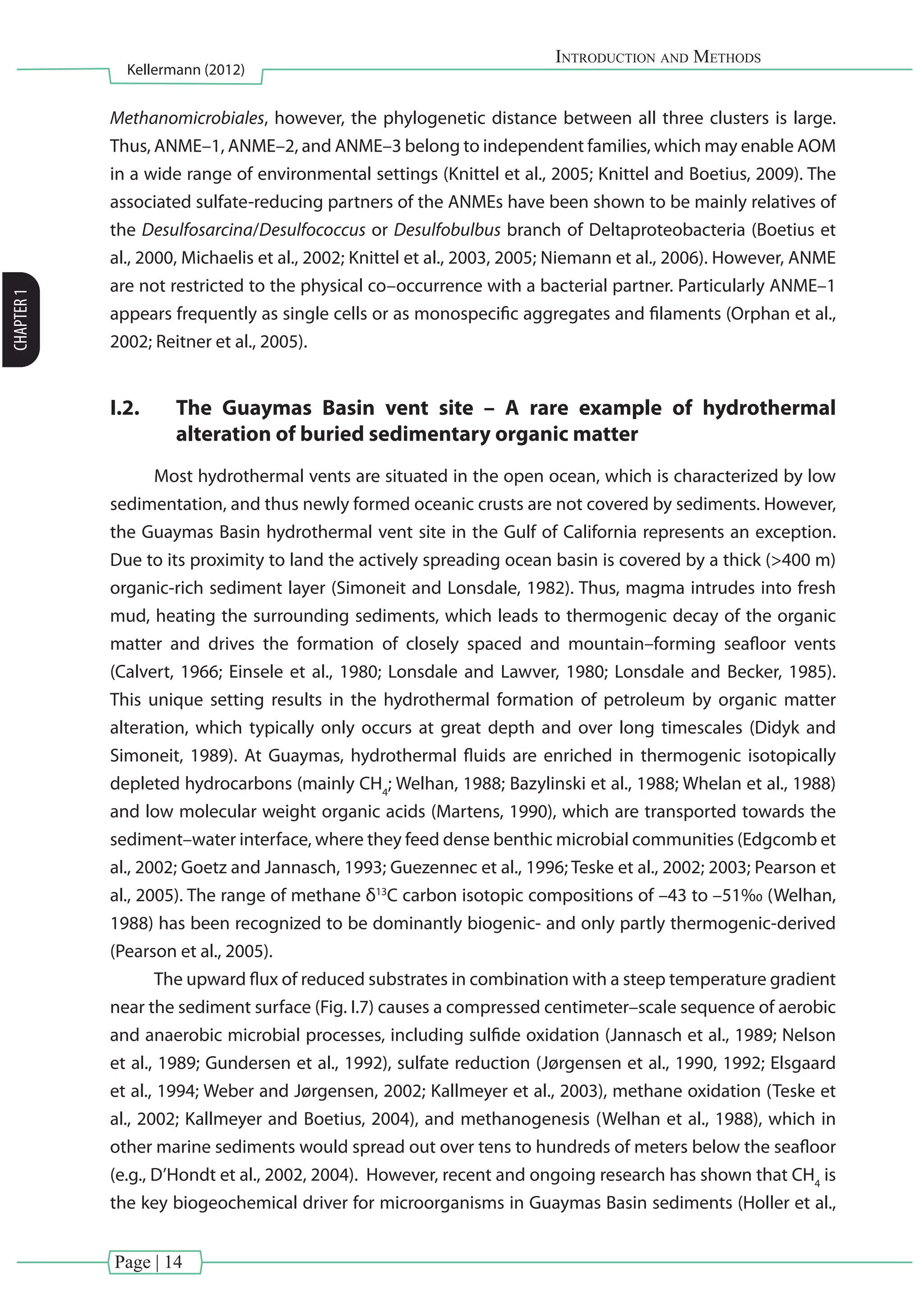
Intense hydrothermal activities at the seafloor often occur directly at or close to tectonic
boundaries(Fig.I.3).Thefollowingfourprocessessummarizethecauseofhydrothermalactivity:
Page | 4
Introduction and Methods
Kellermann (2012)
CHAPTER1
i.	 Formation of new oceanic crust along mid–ocean ridges. Due to tectonic forces
two plates move apart from each other and new oceanic crust is formed (e.g., Mid
Atlantic Ridge; East Pacific Rise; Guaymas Basin, Kelly et al., 2001;2005; Simoneit and
Lonsdale, 1982).
ii.	 Midplate volcanic hot spots can lead to a new crust formation in a form of islands
such as the Hawaiian and CapeVerde islands and archipelago, Iceland or the Canary
islands (e.g., Karl et al., 1988; Carracedo et al., 1998).
iii.	 Compressional subduction processes occur where two platonic plates collide and
one plate is subducted beneath the other (e.g., Marianas Trench reaching a water
depth of almost 11 km below sea level; Seno and Maruyama, 1984; Schrenk et al.,
2010).
iv.	 Back arc basins which are derived from a combination of seafloor spreading and
subduction processes (e.g., Manus Basin, Mariana Trough; Karig et al., 1970; Dunn
and Martinez, 2011).
At hydrothermal vents a huge range of different thermally charged fluids (also called
geofuels) are produced at high pressure and temperature, resulting in a transformation to
hydrothermally altered fluids, which are reduced relative to the seawater.Thereby, the chemical
composition of these hydrothermal fluids are largely dependent on the nature of the heat
source, composition of the source rock, the temperature and the duration of the water rock
interaction (Tivey, 2007). In general, hydrothermal fluids are particularly depleted in Mg, SO4
2–
and O2
, whereas other chemical species, e.g., CH4
, reduced sulfides, H2
, reduced metals and
silica have been added to the vent fluids (Allen and Seyfried et al., 2003; Tivey, 2007). However,
depending on the tectonic setting and the underlying geology, the chemistry of vents can vary
significantly depending on the site and also over time. Three different types of hydrothermal
methane seeps have been described:
i.	 Abiogenically produced methane from serpentinization reactions – e.g., at the Lost
City Hydrothermal Field (Kelly et al., 2001; 2005).
ii.	 Thermogenicallyproducedmethanefromwater–rockreactionsathightemperatures
– e.g., on the Juan de Fuca Ridge (Baross et al., 1982; De Angelis et al., 1993).
iii.	 Thermogenic alteration of buried sedimentary organic matter – e.g., the Guaymas
Basin in the Gulf of California (Simoneit and Lonsdale, 1982; Welhan et al., 1988;
Bazylinski et al., 1988; see section I.2).
The importance of hydrothermally driven convection for the global element cycles has
been shown in different studies. For instance, geochemical model simulations hypothesized
that the entire volume of the ocean–water body circulates through the crust within 4,000 to
70,000 years (Elderfield and Schulz, 1996; Wheat et al., 2003). This crustal fluid flow of seawater
interacts with the seafloor basalt, leading to a fluid–rock interaction, which greatly impacts
Introduction and Methods
Kellermann (2012)
CHAPTER1
Page | 5
the global ocean chemistry. For example, Sander and Koschinsky (2011) estimated that the
hydrothermal fluids could account 9 and 14% of the total deep–ocean dissolved iron and
copper budgets, respectively.
(a)
(b)
(c)
(d)
(e) (f)
(c) (g)
Fig. I.2. Typical pictures presenting biological oases in the dark-ocean: (a–c) Cold seep habitats from the
continental margin off Pakistan (Meteor Expedition M74/3). (d–g) Typical hydrothermal vent features found
in the Manus Basin, Papua New Guinea (Sonne Expedition SO216). All images were taken by the remotely
operated vehicle Quest (courtesy of MARUM, University of Bremen).
Page | 6
Introduction and Methods
Kellermann (2012)
CHAPTER1
I.1.2.2.	 Cold seeps
Shortly after the discovery of hydrothermal vents, a second type of chemosynthetic
seafloor environment was detected: cold seeps. Unlike hydrothermal vents, cold seeps
are characterized by the advection of fluids with temperatures only slightly above ambient
seawater (~4°C). The first cold seep system has been identified in the northern Gulf of Mexico
continental slope (Florida Escarpment; Paull et al., 1984). Nowadays, cold seeps are recognized
as a globally widespread feature, which can be found in either active continental margins such
as the Peruvian Margin (close proximity to plate boundaries; Kulm et al., 1986; Lallemand et
al., 1992) or passive continental margins such as the Gulf of Mexico (Paull et al., 1984; Hovland,
1992; Fig. I.3). Cold seeps have been found in shallow waters such as the costal zones of the
Eckernförde Bay (Anderson et al., 1998) or at Cape Lookout Bay (Martens and Val Klump, 1980)
but also in deep sea trenches in several thousand meters depth (Japan Trench; Kobayashi et al.,
1992).Their surface expression can range from centimeter to kilometers scale in diameter (Kopf
et al., 2002) and the type of cold seep surface feature (e.g., gas seeps, mud volcano, pockmarks
and brine/oil pools) may depend on the geological settings, the intensity of the fluid flow and
nature of the discharge (e.g., gas, fluid, mud).
Depending on the fluid source, the seep discharge can be loaded with hydrocarbons,
CO2
and H2
S. However, the most important fluid constituent is CH4
, exceeding 90% of the
total dissolved gases (Dimitrov, 2002; Kopf, 2002). In the following potential CH4
sources are
described:
i.	 Microbial methane production: biological methane production is performed
by microorganisms known as methanogens. Methanogenesis is the last step in
the anaerobic degradation of organic matter (cf. [BOX I]), where single-celled
methanogenic archaea utilize fermentative end products such as acetate and CO2
/
H2
to produce methane (e.g., Whiticar et al., 1986).
ii.	 Thermogenic methane production (deep thermogenic reservoirs): organic material
which escaped microbial degradation is subsequently converted by heat–induced
processes to heavy gaseous and liquid hydrocarbons at temperatures between 80-
120°C (early thermogenic gas formation) which ultimately are converted to CH4
at
temperatures between 150-200°C (late thermogenic gas formation; Claypool and
Kvenvolden, 1983).
iii.	 Abiogenic methane production: abiogenic methane formation is independent of
organic matter and also from microbial activity. Abiotic methane is predominantly
produced by diagenesis of fresh oceanic rocks, such as found in the Lost City
Hydrothermal vent fields from the Mid Atlantic Ridge (Rona et al., 1992; Kelley et
al., 2001; 2005). In these places, the heating of rock material to temperatures above
300°C releases, by serpentinization, hydrogen which can react with CO2
resulting in
abiogenic methane (Foustoukos and Seyfried, 2004). Production of abiogenic CH4
Introduction and Methods
Kellermann (2012)
CHAPTER1
Page | 7
is suggested to play a minor role in the global methane budget (Sherwood Lollar et
al., 2002).
iv.	 From the dissociation of gas hydrates: gas hydrates are ice-like solids, formed by
water crystals encaging large volumes of natural gas (Kvenvolden, 1993). They
representthegreatestCH4
reservoironEarth,andareextremelyabundantinoceanic
sediments (e.g., Kvenvolden, 1993; Bohrmann and Torres, 2006). The stability of gas
hydrates is mainly controlled by temperature, pressure and the concentration of
gases, so that slight changes in in situ conditions (e.g., increase in temperature or
decrease in pressure) may abruptly release a vast quantity of CH4
(cf., Bohrmann
and Torres, 2006).
(e.g., Gold, 1992; Nisbet and Fowler, 1996; Komatsu
and Ori, 2000; Van Dover, 2000; Fujioka et al., 2002;
Kelley et al., 2002; Reyensbach and Shock, 2002;
Marion et al., 2003; Shapiro, 2004). Moreover, perio-
dic, catastrophic release of stored methane in gas
hydrates has been implicated in past, abrupt climate
change scenarios (Dickens et al., 1995; Kennett et al.,
2000). In addition, hydrothermal vents and hydrocar-
bon seeps are necessary components of climate mo-
dels, because cycling of methane-derived carbon from
the lithosphere to the hydrosphere and atmosphere
includes emissions from the 75,000 km-long oceanic
ridge system, and from seepages or gas hydrates
released around the world’s continental margins
(e.g., Hovland and Judd, 1988; Judd et al., 2002a).
In addition to the advances made from studies of
modern vent–seep settings, a multitude of ancient
occurrences with metazoan fossils and/or microbial
fabrics also have been recognized in the geologic
record. They are now known from at least 59 regional
groupings of Early Archean to Pleistocene age ore
deposits and marine sedimentary sequences world-
with metazoans/microbes
modern hydrocarbon seep site
with metazoans/microbes
fossil-rich ancient vent occurrence
fossil-rich ancient seep occurrence
modern hydrothermal vent site
60°N
60°S
180°
0°
0°
Fig. 1. Distribution map of chemosynthesis-based settings, illustrating those Archean to Recent hydrothermal vents and hydrocarbon seeps with
associated metazoan and/or microbial signatures. Modern vent distributions are from Fricke et al. (1989), Kamenev et al. (1993), Van Dover
(2000), Kelley et al., 2002, Kojima (2002), von Cosel and Marshall (2003), and Kojima et al. (2004). Modern seep locations were compiled
from Hovland and Judd (1988), Hovland et al. (1987), Dando et al. (1991), Corselli and Basso (1996), Sibuet and Olu (1998), Greinert et al.
(2000), Coleman and Ballard (2001), Bohrmann et al. (2002, 2003), Judd et al. (2002c), Kojima (2002), Kojima et al. (2002, 2004), Sahling et
al. (2002), Salas and Woodside (2002), Stakes et al. (1999), Wiedicke et al. (2002), Hovland and Risk (2003), Han et al. (2004), MacDonald et
al. (2004), Sassen et al. (2004), and Sellanes et al. (2004), Levin (in press). Ancient hydrothermal vent deposit locations are from Noll et al.
(1984), Banks (1985), Moore et al. (1986), Duhig et al. (1992a), Little et al. (1998, 1999b), Rasmussen (2000), and Playford and Wallace
(2001). Ancient hydrocarbon seep occurrences are from Druckman et al. (1994), Taviani (2001), Burhan et al. (2002), Campbell et al. (2002),
Amano (2003), Goedert et al. (2003a, b), Go´mez-Pe´rez (2003), Hikida et al. (2003), Kitazaki and Majima (2003), Majima et al. (2003, in press),
Nobuhara (2003), Torres et al. (2003), and Barbieri et al. (2004).
K.A. Campbell / Palaeogeography, Palaeoclimatology, Palaeoecology 232 (2006) 362–407364
Fig. I.3. Global distribution of modern and fossil chemosynthesic–based hydrothermal vents and
cold seeps. Hydrothermal vents at the seafloor often occur directly at or close to tectonic boundaries.
Figure has been adapted from Campbell (2006).
Due to tectonic activities, fissures and faults in the sediments, hydrocarbon-rich gases and
fluids migrate upward through cracks and channels from deeply buried sediments towards the
surface sediments (Fig. I.2; Brocks et al., 1984; Sassen et al., 1999). A vast fraction of discharged
methane is consumed by aerobic and anaerobic methane oxidizing microorganisms in the
near surface sediments (see section I.1.4), however, when the potential for methane utilization
is exceeded, CH4
is released into the hydrosphere (Fig. I.2). Thus, methane plumes can reach
several hundred meters into the water column (Greinert et al., 2006; Sauter et al., 2006),
reaching in some cases, the atmosphere if the seeps are located in shallow waters. Methane
in the atmosphere acts as greenhouse gas with 25 times higher potential than CO2
(Lelieveld
Page | 8
Introduction and Methods
Kellermann (2012)
CHAPTER1
et al., 1993) and has a major impact on Earth’s climate. However, the quantification of upward-
migrating methane from cold seeps into the atmosphere is difficult and thus up to date poorly
constrained (Solomon et al., 2009).
I.1.3.	 Chemosynthetic biomass production as driver of dark–ocean benthic habitats
In1977,thediscoveryofthehydrothermalventecosystems(GalapagosRift,PacificOcean)
based entirely on chemosynthesis communities changed the understanding of the limits of life
on Earth (Corliss et al., 1979; Jannasch and Mottl, 1985; Deming and Baross, 1993; Van Dover
et al., 2002; Bach et al., 2006). The first cold seep faunal assemblages were described in the
northern Gulf of Mexico (Kennicutt et al., 1985) and at subduction zones in the northwestern
Pacific (Suess et al., 1985). The metabolic strategies of microorganisms in the dark ocean differ
from the sunlight–dependent photosynthetic world (0 – 300 m depth), where metabolic energy
is gained from the coupling of redox reactions (see [BOX I]).
BOX I Electron donors and acceptors in the marine & dark oceanic environments
Incontrasttophotoautotrophiccarbonfixationwheretheenergycomesfromsunlight,chemosynthesis
is the process by which microorganisms harness the energy in chemical bonds to convert one-carbon
molecules (e.g., CO2
and or CH4
) into biomass. Chemosynthesis is carried out exclusively by Bacteria and
Archaea.
The activity of microorganisms in the sunlight-independent dark ocean depends on the availability of
electron donors (oxidizable compounds) and acceptors (reducible compounds). Within typical marine
sediments, a well–known cascade of preferred electron donors and acceptors is observed (Froehlich
et al., 1979). The major electron donors in the dark oceans are organic matter, hydrogen (H2
), methane
(CH4
), reduced sulfur, iron and manganese compounds.
These electron sources differ in significance for
microbial metabolism, since they have differences in
abundance and energy potential. On the other hand,
the major electron acceptors can be characterized
by the order of highest electron accepting potential,
starting with O2
, NO2
–
, NO3
–
, Mn and Fe oxides, oxidized
sulfur compounds (e.g., SO4
2–
), and finally CO2
(Fig. I.4;
Froehlich et al., 1979).
In marine sediments the majority of the organic
matter degradation is coupled to sulfate reduction.
Since SO4
2-
exists in almost unlimited quantities in
seawater and oxygen is quickly consumed by aerobic
respiration, SO4
2-
is consequently the most important
electron acceptor in marine sediments (Jørgensen,
1982).
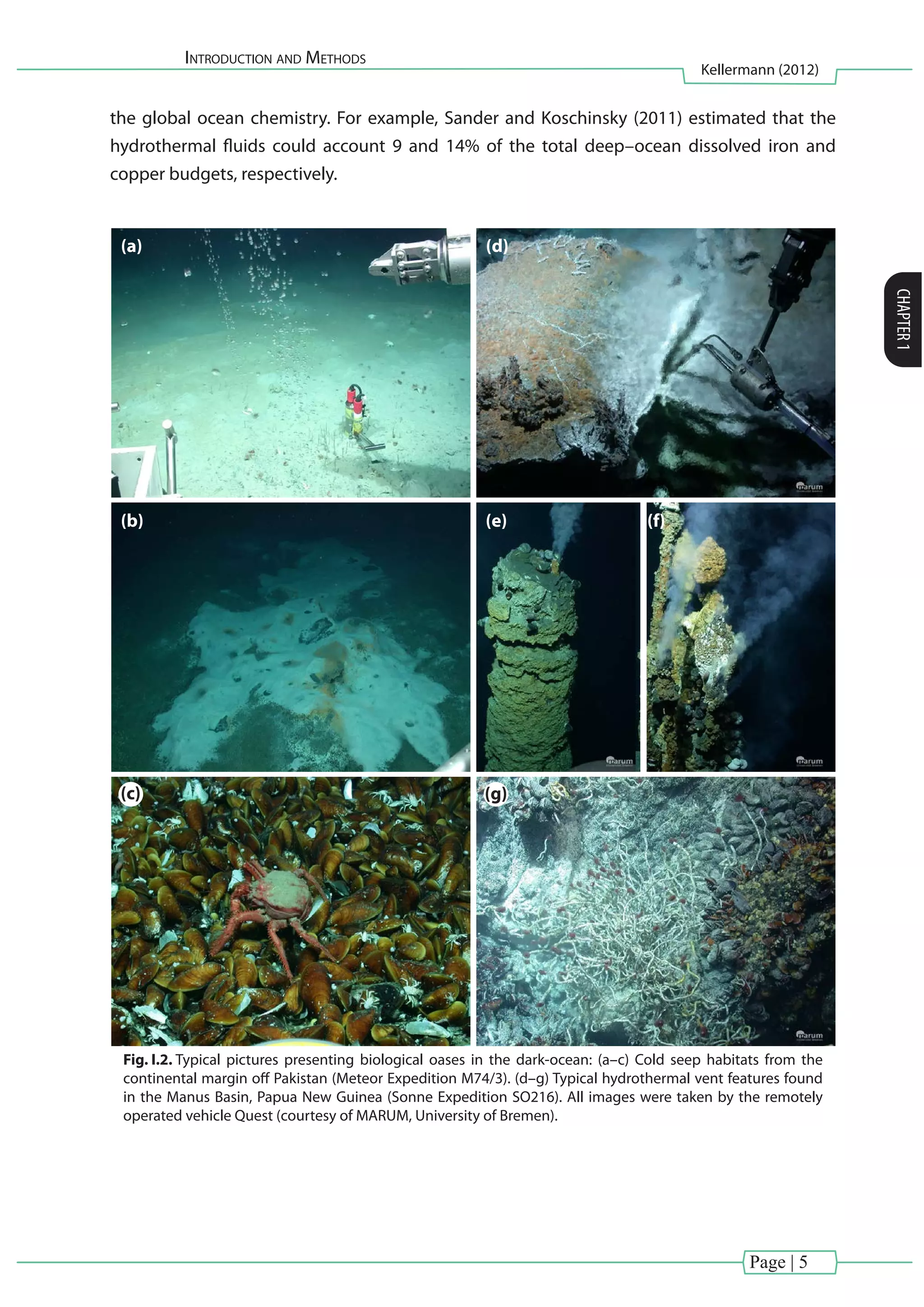
Fig. I.4. Schematic representation of the broad range
of redox–active compounds in marine environments
and the names describing the respiration process.
The order of electron acceptors utilization is based on
the thermodynamic potential of the process and the
energy available to the organisms. The most important
electron acceptors/respiration processes dealt with in
this dissertation are highlighted in red. Figure has been
modified from Canfield and Thamdrup (2009).
O2
Electron
acceptor
Respiration
process
Oxic/aerobic
respiration
Nitrate
reduction
Manganese
reduction
Iron
reduction
Sulfate
reduction
Methano-
genesis
NO2
-
NO3
-
MnO2
FeOOH
SO4
2-
CO2
Sedimentdepth
Introduction and Methods
Kellermann (2012)
CHAPTER1
Page | 9
The primary producers living in these extreme environments are microorganisms that
live either as chemolithoautotrophs using inorganic chemicals as electron donor and CO2
as
carbon source, or chemoorganoheterotrophs consuming CH4
as both electron donor and
carbon source. However, microorganisms can only gain the chemical energy if the reaction is
thermodynamically favorable. This is the case when the electron–donor rich fluids encounter
cold seawater, rich in electron–acceptors. Hereby, chemotrophic organisms gain their energy
by oxidizing reduced elements of the vent/seep fluids such as H2
, CH4
, H2
S, NH3
, Fe(II), Mn2+
,
with available oxidants supplied by the seawater such as CO2
, SO4
2–
, S, Fe(III), NO3
–
or O2
(see
[BOX I]). The presence of chemosynthetic communities at the seafloor is thus indicative of
near-surface methane and/or sulfide discharge (Fig. I.2). However, the redox processes at these
extreme environments depend indirectly also on sunlight. For example, the vast fraction of CH4
discharged at cold and hot seeps is most often derived from the decay of organic matter, which
was originally derived from photosynthesis. In addition, the electron–acceptors for primary
production (e.g., O2
, SO4
2-
and NO3
-
) derived from seawater have been ultimately oxidized by
photosynthesis.
The simultaneous appearance of electron–donor and electron–acceptor rich fluids at the
seafloor of both hot and cold seeps is the cause of a massive accumulation of symbiotic and free
livingmicrofauna(Fig.I.2).Infact,CH4
-fuelledmicrobialcommunitieshavebeenshowntoharbor
the largest amounts of biomass of all marine ecosystems (up to 1012
cells per cm3
; Michaelis et
al., 2002; Treude et al., 2007). A symbiotic association of chemotrophic microorganisms with
invertebrates is probably one of the most characteristic features occurring at cold seeps and
hydrothermal vents. For example, bivalves and clams are known to host symbionts in their gills
(see [BOX II]; e.g., Fisher et al., 1993; Distel et al., 1995) and tubeworms rely on endosymbionts
in their trophosome (Cordes et al., 2005; Lösekann et al., 2008). However, methanotrophic
and thiotrophic symbionts have also been observed as free living microorganisms, without a
symbiotic partner such as the widespread and giant sulfur–oxidizing Gammaproteobacteria
Beggiatoa, Thiomargarita, and Thioploca (e.g., Jannasch et al., 1989; Sassen et al., 1993).
Due to elevated temperatures at hydrothermal vents, many record-holding extreme
microorganisms have been isolated from such environments. Those extremophiles are able to
tolerate extreme conditions such as high temperatures, hydrostatic pressure, toxic chemistry,
extreme pH, and permanent fluctuations of environmental conditions (Takai et al., 2006). For
example, a newly isolated, hyperthermophilic methanogen Methanopyrus kandleri strain has
been shown, to survive under laboratory conditions at high hydrostatic pressure (20 MPa)
and temperatures of up to 122°C (Takai et al., 2008). This temperature is the current upper
temperature limit of life under laboratory conditions; but further evidence suggests that this
limit of life might actually be closer to 150°C (Schrenk et al., 2003; Hoehler et al., 2007).
Page | 10
Introduction and Methods
Kellermann (2012)
CHAPTER1
BOX II Symbiotic chemosynthesis at cold seeps and hot vents
The term “symbiosis” has Greek roots; “sym” means with and “bio” means living. Symbiosis can be
defined as a close association between two different organisms. Up to now, at least seven animal phyla
(e.g., mussels, snails, worms, sponges and single–celled ciliates) are known to host chemosynthetic
symbiotic microorganisms. Chemosynthetic symbioses have been found at different habitats including
hydrothermal vents and cold seeps. Hereby, the symbionts provide the eukaryotic host nutrition, while
the host supplies the symbiotic bacteria with fluids, enriched in electron donors such as CH4
or H2
S and
electron acceptors such as O2
, by positioning themselves at the interface between reduced and oxidized
fluids (Petersen and Dubilier, 2010).
In general, Bathymodiolus spp. are known to dominate the biomass production at hydrothermal vents
and cold seeps (Fig. I.5a; Van Dover, 2000). These mussels have been found in association with sulfur–
oxidizing (Cavanaugh, 1983, Distel et al., 1988) and methane–oxidizing bacteria (Childress et al., 1986) and
specimens hosting both groups of these Gammaprotobacteria (Fisher et al., 1993; Distel et al., 1995). Just
recently, Petersen et al. (2011) found that the symbionts of the hydrothermal vent mussel Bathymodiolus
puteoserpentis recovered from the Mid–Atlantic Ridge can also use H2
as electron donor, extending the
number of substrates for chemosynthetic bacteria (Fig. I.5b). The symbionts can either be housed as
endosymbionts within specialized gill bacteriocytes (intra– or extracellularly) or ectosymbionts, which are
found to be attached to the outside surface of the host (Dubilier et al., 2008; Duperron et al., 2009). Many
host organisms known to harbor endosymbionts have shown reduced digestive systems and/or none
functional guts, highlighting the evolutionary adaption of a food web solely based on their symbionts
(Page et al., 1990; Colaço et al., 2006; Cavanaugh et al., 2006).
Siphon i - H2
+ O2
ii - H2
S + O2
iii - CH4
+ O2
Foot
Gills
Sulfide-
oxidizing
bacteria
I - H2
O
II - SO4
2-
III - CO2
Methane-
oxidizing
bacteria
(a) (b)
Fig. I.5. Symbiotic chemosynthesis in extreme environments. (a) Picture shows a mussel vent field from
a cold seep located off Pakistan taken by the remotely operated vehicle Quest (MARUM, University of
Bremen). (b) Schematic drawing of the function of symbionts within a Bathymodiolus spp. mussel. The
gray arrow indicates the three possible metabolic reactions performed by bacteria to harness energy (i)
oxidation of H2
to H2
O and (ii) oxidation of H2
S to SO4
2-
both performed by sulfide oxidizing bacteria; (iii)
oxidizing CH4
to CO2
performed by methane oxidizing bacteria. Figure has been modified after Orphan
and Hoehler (2011).
Cross Reference: [Chapter II] examined symbiont–host interactions within Bathymodiolus mussels using a
comprehensive lipid biomarker approach.This study targets IPLs (see section I.3.1.2) as a lipid class capable of
distinguish bacterial from host derived biomass.
Introduction and Methods
Kellermann (2012)
CHAPTER1
Page | 11
I.1.4.	 Methane oxidation: A globally important biogeochemical process
Methane, the simplest and most abundant hydrocarbon in the atmosphere, plays
an important role in Earth’s greenhouse problem. Its ability to trap heat via absorption and
re–emission of infrared radiation has been shown to be roughly 25 times stronger than CO2
(Lelieveldetal.,1993).Therefore,itsconcentrationintheatmospheresignificantlyinfluencesthe
energy budget of the Earth. However, marine environments, considering the high production
rates and large reservoirs of CH4
in marine sediments, contribute only little to the atmospheric
budget (Judd et al., 2002; Reeburgh, 2007), due to aerobic and anaerobic microbial methane
oxidization.
I.1.4.1.	 Aerobic oxidation of CH4
At the sediment–water interface at cold seep and hot vent environments high fluxes
of upward-advecting CH4
gas can be oxidized aerobically. Aerobic methanotrophy can be
described by the reaction equation [Eq. I]:


[Eq. I]
Compared to the anaerobic oxidation (see section I.1.4.2), the efficiency of the aerobic
methane oxidation is more than one order of magnitude higher (Nauhaus et al., 2007), therefore
the aerobic oxidation of the seep and vent community represents an efficient sink for CH4
(Sommeretal.,2009).However,atcoldandhotvents,theaerobicoxidationofmethaneislimited
by the rapid consumption of oxygen (Suess et al., 1999). Sulfate, on the other hand, exists in
exhaustless concentration in seawater (29mM; Jørgensen, 1982; Reeburgh, 2007), enabling the
sulfate–dependent anoxic methane oxidation (Reeburgh et al., 1969).Thus, the main biological
sink for CH4
consumption in marine sediments, including seep and vent environments, is the
anaerobic oxidation of methane (AOM; [Eq. II]) with sulfate as oxidant.

 [Eq. II]
I.1.4.2.	 The history of AOM: A globally important process regulating ocean’s CH4
emission
The oceans contribute about 7–25% to the total global methane production (Hinrichs
and Boetius, 2002; Reeburgh, 2007). However, more than 90% of the total oceanic methane
production is consumed by the anaerobic oxidation of methane (AOM), thereby reducing
the oceans contribution to the atmosphere methane budget to less than 2% (Valentine and
Reeburgh, 2000; Reeburgh, 2007). The main niches for AOM-performing microorganisms in
the marine realm are sulfate methane transition zones (SMTZ; [BOX III]), where both methane
(transported from below) and sulfate (transported from above) are simultaneously consumed.
In marine sediments, first evidence for AOM came from in situ pore water gradients, showing
the mutual depletion of methane and sulfate in methane-rich anoxic sediments (e.g., Reeburgh,
Page | 12
Introduction and Methods
Kellermann (2012)
CHAPTER1
1969; Martens and Berner, 1974; Barnes and Goldberg, 1976; Reeburgh, 1976, 1980; Iversen and
Blackburn, 1981; see [BOX III]).The stoichiometric relationship of methane oxidation and sulfate
reduction was first published by Reeburgh (1976; [Eq. II]). Later, Iversen and Jørgensen (1985)
showed that rates of maximal methane oxidation coincide with a maximum in sulfate reduction
at the SMTZ [BOX III], indicating that CH4
consumption is directly linked to sulfate reduction.
The consumption of methane and the formation of sulfide from sulfate are coupled at a molar
ratio of approximately 1:1 (e.g., Nauhaus et al., 2002, Holler et al., 2009; 2011b), confirming the
stoichiometric equation of AOM (cf. [Eq. II]).
BOX III Sulfate methane transition zones and the appearance of AOM
The sulfate methane transition zone (SMTZ) is present in all anoxic marine systems where CH4
is
transported upwards from the zone of production (methanogenic zone) and SO4
2–
derived from the
overlying water column diffuses downwards (Reeburgh et al., 2007). In this centimeter–scale sediment
horizon microbial activity is enhanced by the anaerobic oxidation of methane (AOM; see section I.1.4.2)
coupled to autotrophic sulfate reduction (e.g., Hinrichs and Boetius 2002; Parkes et al., 2005).
For example, in typical marine sediments the relatively slow upward movement of CH4
allows AOM-
mediating organisms to remove CH4
at the SMTZ efficiently (Iversen and Blackburn, 1981; Iversen and
Jørgensen, 1985; Fossing et al., 2000). Considering the enormous aerial extent of marine sediments
(Whitman et al., 1998), the SMTZ plays a key role in the global CH4
cycle (Hinrichs and Boetius, 2002;
Reeburgh, 2007). Carbon cycling within the SMTZ, in general under cm scale, shapes geochemical
gradients (e.g., CH4
, SO4
2–
, DIC/alkalinity) and also stable carbon isotopic profiles of CH4
and DIC at the
scale of meters both above and below this biogeochemically active horizon. The intersection of both CH4
and SO4
2–
concentration (see Fig. I.6a), as well as depleted stable carbon isotopic compositions of both
CH4
and DIC (see Fig. I.6b) enables to identify the hotspot of active AOM (e.g., Valentine and Reeburgh,
2000). Further evidence for AOM is provided by radiolabeling experiments, where methane oxidation
rates (14
CH4
) and sulfate reduction rates (35
SO4
2–
) peak within the SMTZ (see Fig. I.6c).
CH4
oxidation rate
Rates (nmol cm-3
day-1
)
0 10 15 25 30205
SO4
2-
reduction rate
SMTZ
(c)
Sedimentdepth
SMTZ
sulfate
reduction
zone
methanogenic
zone
SMTZ
[CH4
] CH4
CH4
(mM)
0
0 10 20 30
0 10 20 30 40
4 8 12
[SO4
2-
]
SO4
2-
(mM)
SMTZ
DIC
δ13
C
[DIC]
DIC (mM)
-20 0-40-60-80-100-120
(a) (b)
Fig. I.6. General geochemical profiles in marine sediment where the anaerobic oxidation of methane
(AOM) takes place. (a) Concentration profiles of SO4
2–
, DIC, CH4
(modified after Reeburgh, 2007); (b) stable
isotope data (δ13
C) for DIC and CH4
(redrawn from Pohlman et al., 2008); (c) rates of SO4
2–
reduction and
CH4
oxidation (redrawn from Iversen and Jørgensen, 1985).
Introduction and Methods
Kellermann (2012)
CHAPTER1
Page | 13
In 1994, Hoehler and colleagues postulated that AOM is performed most likely in a
syntrophic reaction by methanogenic archaea and sulfate-reducing bacteria: a reversely acting
methanogenconsumesmethaneandproduceshydrogen(viaareversalofCO2
reduction)which
in turn is metabolized by a sulfate–reducing partner. Although thermodynamic calculations
for this reaction [Eq. II] resulted in extremely low energy yields (ΔG°’= –20 to –40 kJ mol–1
;
Hoehler et al., 1994; Knab et al., 2008; Alperin and Hoehler, 2009a), their hypothesis for the
functioning of AOM is still accepted. Nevertheless, the poor energy yield of this redox reaction,
which furthermore needs to be split between both partners, contradicts the traditional view
of the minimum free energy threshold of –20 kJ mol–1
determined for bacteria (i.e., the amount
of energy needed to generate ATP/mole H+
; Schink, 1997). Therefore the understanding of the
physiology and biochemistry of AOM remains incomplete.
TheinvolvementofArchaeainAOMwasindicatedbystrong13
Cdepletionofcharacteristic
archaeal biomarkers (δ13
C of archaeol = –100‰; δ13
C of hydroxyarchaeol = –110‰) identified in
seep sediments, leading to the conclusion that AOM microbial communities directly assimilate
13
C-depleted methane (Hinrichs et al., 1999). Later, numerous other studies presented δ13
C
biomarker data showing additional isotopically depleted lipids for the methane oxidizing
archaea, such as isoprenoidal hydrocarbons like tetramethylhexadecane (crocetane) and
pentamethyleicosane (PMI), as well as diagnostic fatty acids (FAs) and non-isoprenoidal glycerol
ethersforthesulfate-reducingbacterialpartner(SRBs).Thosearchaealandbacterialbiomarkers
showed δ13
C values ranging from –70‰ to –130‰ and –60‰ to –100‰, respectively (e.g.,
Elvert et al., 1999, 2003, 2005; Hinrichs et al., 1999, 2000; Pancost et al., 2000; Blumenberg et al.,
2004; Niemann and Elvert, 2008).
Cross Reference: Previous studies interpreted extremely 13
C-depleted archaeal and bacterial lipid biomarkers
as clear indicator for methane-driven lipid biosynthesis. However, just recently, Alperin and Hoehler (2009b)
questioned the exclusive methanotrophic carbon fixation by the Archaea and hypothesized a possible
autotrophic CO2
fixation pathway for both Bacteria and Archaea. Their hypothesis has been fueled by
observations of Wegener and colleagues (2008) amending cold seep AOM communities with either 13
CH4
or
H13
CO3
–
and detecting a mixed carbon assimilation of CH4
and CO2
within the Archaea and a pure autotrophic
lipid production within the Bacteria. [Chapter III] has used a similar approach as Wegener et al. (2008) in
which the dominant carbon source of both the Archaea and the Bacteria has been investigated by applying
an improved SIP approach (Dual-SIP; see section I.3.2.4).
Boetius and colleagues (2000) were the first to visualize the consortium of ANME and the
SRBs via microscopy of cells hybridized with fluorochrome–labeled specific oligonucleotide
probes. These aggregates of ANME and SRB have been shown to be the dominant microbial
population in various cold seep environments, representing more than 90% of the total
microbial community in this habitat (Boetius et al., 2000; Michaelis et al., 2002; Orphan et al.,
2002). Gene-based studies (16S rRNA, mcrA) revealed that AOM in marine environments is
mediated by three distinct clusters of Euryarchaeota (ANME–1, ANME–2, and ANME–3). These
three phylogenetic clusters of archaea are related to the orders of Methanosarcinales and
Page | 14
Introduction and Methods
Kellermann (2012)
CHAPTER1
Methanomicrobiales, however, the phylogenetic distance between all three clusters is large.
Thus, ANME–1, ANME–2, and ANME–3 belong to independent families, which may enable AOM
in a wide range of environmental settings (Knittel et al., 2005; Knittel and Boetius, 2009). The
associated sulfate-reducing partners of the ANMEs have been shown to be mainly relatives of
the Desulfosarcina/Desulfococcus or Desulfobulbus branch of Deltaproteobacteria (Boetius et
al., 2000, Michaelis et al., 2002; Knittel et al., 2003, 2005; Niemann et al., 2006). However, ANME
are not restricted to the physical co–occurrence with a bacterial partner. Particularly ANME–1
appears frequently as single cells or as monospecific aggregates and filaments (Orphan et al.,
2002; Reitner et al., 2005).
I.2.	 The Guaymas Basin vent site – A rare example of hydrothermal
alteration of buried sedimentary organic matter
Most hydrothermal vents are situated in the open ocean, which is characterized by low
sedimentation, and thus newly formed oceanic crusts are not covered by sediments. However,
the Guaymas Basin hydrothermal vent site in the Gulf of California represents an exception.
Due to its proximity to land the actively spreading ocean basin is covered by a thick (>400 m)
organic-rich sediment layer (Simoneit and Lonsdale, 1982). Thus, magma intrudes into fresh
mud, heating the surrounding sediments, which leads to thermogenic decay of the organic
matter and drives the formation of closely spaced and mountain–forming seafloor vents
(Calvert, 1966; Einsele et al., 1980; Lonsdale and Lawver, 1980; Lonsdale and Becker, 1985).
This unique setting results in the hydrothermal formation of petroleum by organic matter
alteration, which typically only occurs at great depth and over long timescales (Didyk and
Simoneit, 1989). At Guaymas, hydrothermal fluids are enriched in thermogenic isotopically
depleted hydrocarbons (mainly CH4
; Welhan, 1988; Bazylinski et al., 1988; Whelan et al., 1988)
and low molecular weight organic acids (Martens, 1990), which are transported towards the
sediment–water interface, where they feed dense benthic microbial communities (Edgcomb et
al., 2002; Goetz and Jannasch, 1993; Guezennec et al., 1996; Teske et al., 2002; 2003; Pearson et
al., 2005). The range of methane δ13
C carbon isotopic compositions of –43 to –51‰ (Welhan,
1988) has been recognized to be dominantly biogenic- and only partly thermogenic-derived
(Pearson et al., 2005).
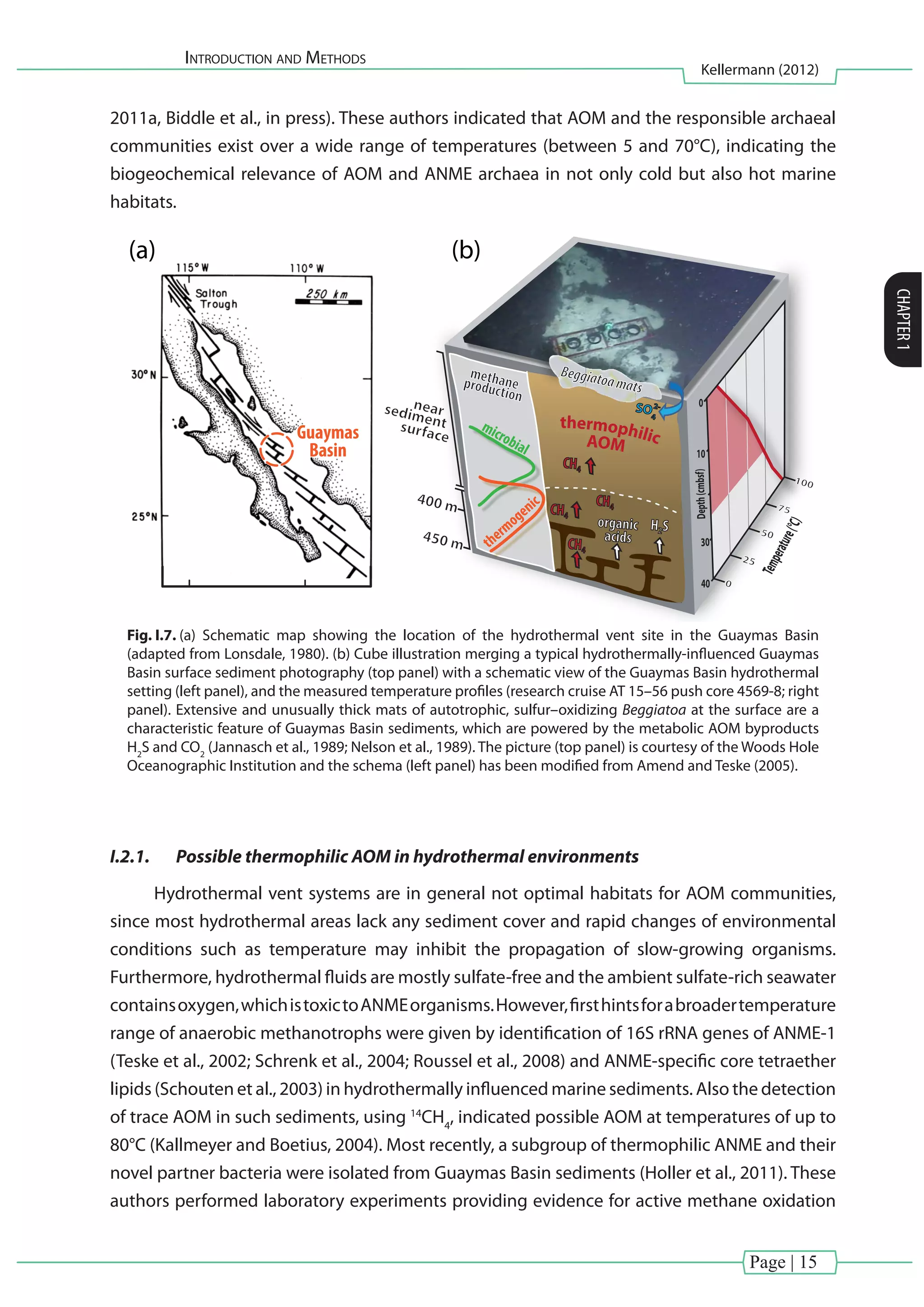
The upward flux of reduced substrates in combination with a steep temperature gradient
near the sediment surface (Fig. I.7) causes a compressed centimeter–scale sequence of aerobic
and anaerobic microbial processes, including sulfide oxidation (Jannasch et al., 1989; Nelson
et al., 1989; Gundersen et al., 1992), sulfate reduction (Jørgensen et al., 1990, 1992; Elsgaard
et al., 1994; Weber and Jørgensen, 2002; Kallmeyer et al., 2003), methane oxidation (Teske et
al., 2002; Kallmeyer and Boetius, 2004), and methanogenesis (Welhan et al., 1988), which in
other marine sediments would spread out over tens to hundreds of meters below the seafloor
(e.g., D’Hondt et al., 2002, 2004). However, recent and ongoing research has shown that CH4
is
the key biogeochemical driver for microorganisms in Guaymas Basin sediments (Holler et al.,
Introduction and Methods
Kellermann (2012)
CHAPTER1
Page | 15
2011a, Biddle et al., in press). These authors indicated that AOM and the responsible archaeal
communities exist over a wide range of temperatures (between 5 and 70°C), indicating the
biogeochemical relevance of AOM and ANME archaea in not only cold but also hot marine
habitats.
Guaymas
Basin
0
Temperature(°C)
25
50
75
100
400 m
sediment
450 m
0
10
Depth(cmbsf)
30
40
near
surface
CH4
CH4
CH4
H2Sorganic
acids
Beggiatoamats
thermophilicAOM
CH4
methaneproduction
microbial
thermogenic
SO4
2-
(a) (b)
Fig. I.7. (a) Schematic map showing the location of the hydrothermal vent site in the Guaymas Basin
(adapted from Lonsdale, 1980). (b) Cube illustration merging a typical hydrothermally-influenced Guaymas
Basin surface sediment photography (top panel) with a schematic view of the Guaymas Basin hydrothermal
setting (left panel), and the measured temperature profiles (research cruise AT 15–56 push core 4569-8; right
panel). Extensive and unusually thick mats of autotrophic, sulfur–oxidizing Beggiatoa at the surface are a
characteristic feature of Guaymas Basin sediments, which are powered by the metabolic AOM byproducts
H2
S and CO2
(Jannasch et al., 1989; Nelson et al., 1989). The picture (top panel) is courtesy of the Woods Hole
Oceanographic Institution and the schema (left panel) has been modified from Amend and Teske (2005).
I.2.1.	 Possible thermophilic AOM in hydrothermal environments
Hydrothermal vent systems are in general not optimal habitats for AOM communities,
since most hydrothermal areas lack any sediment cover and rapid changes of environmental
conditions such as temperature may inhibit the propagation of slow-growing organisms.
Furthermore, hydrothermal fluids are mostly sulfate-free and the ambient sulfate-rich seawater
containsoxygen,whichistoxictoANMEorganisms.However,firsthintsforabroadertemperature
range of anaerobic methanotrophs were given by identification of 16S rRNA genes of ANME-1
(Teske et al., 2002; Schrenk et al., 2004; Roussel et al., 2008) and ANME-specific core tetraether
lipids (Schouten et al., 2003) in hydrothermally influenced marine sediments. Also the detection
of trace AOM in such sediments, using 14
CH4
, indicated possible AOM at temperatures of up to
80°C (Kallmeyer and Boetius, 2004). Most recently, a subgroup of thermophilic ANME and their
novel partner bacteria were isolated from Guaymas Basin sediments (Holler et al., 2011). These
authors performed laboratory experiments providing evidence for active methane oxidation
Page | 16
Introduction and Methods
Kellermann (2012)
CHAPTER1
withathermophilictemperatureoptimumbetween45°Cand60°C(cf.Fig.I.8)andanupperlimit
of AOM up to 70°C. These results finally extend the known growth range of ANME organisms,
which was before defined as a moderately psychrophilic or mesophilic process widespread in
marine sediments and cold seep environments (e.g., Orphan et al., 2002; Knittel et al., 2005;
Nauhaus et al., 2007; Holler et al., 2009; Knittel and Boetius, 2009).
-45 -35500 100 -25
δ13
CCH4
(‰)
CH4
(mM)
(supersaturated)
CH4
(mM)
(supersaturated)
CH4
(mM)
(supersaturated)
CH4
(µM)
-45 -40500 100 -35 -30
δ13
CCH4
(‰)
0
10
20
30
40
50
-50 -40 -30 -20
8006004002000
10
(15 °C)
20
cont. ?
0 30
depth[cmbsf]
Sorrounding mat-free sediment
„cold-mat“ > [4569 (03)]
Under white Beggiatoa mat
„warm-mat“ > [4569 (01)]
Under orange Beggiatoa mat
„hot-mat“ > [4569 (08)]
δ13
CCH4
(‰) Temp. (°C)
-45 -40500 100 -35
δ13
CCH4
(‰)
INSINC - mat
[4568 (02)]
Temp. (°C)
Temp. (°C)Temp. (°C)
(23 °C)
(39 °C)
(62 °C)
(65 °C)
(45 °C)
(13 °C)
(4 °C)
possibleAOM
possibleA
OM
possi
bleAOM
possible AOM
CH4
(mM)
(supersaturated)
10
20
30
40
50
depth[cmbsf]
0
-42 -40 -38500 100 -36
δ13
CCH4
(‰)
Megamat (Marker 1)
[4486 (29)]
Temp. (°C)
(60 °C)
(16 °C)
possibleAO
M
Fig. I.8. Geochemistry of CH4
for different push core stations analyzed during two Guaymas Basin research
cruises(AT15–40;AT15–56). Selectedprofilesoftemperature,concentrationandcarbonisotopiccomposition
of CH4
from different locations are shown. Here, δ13
C–isotopic signatures of CH4
provided consistent evidence
of ongoing AOM at elevated temperatures (Kellermann et al., unpublished results; cf. Biddle et al., in press).
Zones of possible AOM (here indicated in red), coincides with a thermophilic temperature optimum between
45°C and 60°C observed by Holler and coworkers (2011a).
Since AOM operates close to the thermodynamic equilibrium (Hoehler et al., 1994; Knab
et al., 2008; Alperin and Hoehler, 2009a), the growth yield of the organisms is extremely low
(around 1% relative to CH4
oxidation; Nauhaus et al., 2007; Treude et al., 2007; Wegener et al.,
2008; Holler et al., 2011a). For example, AOM consortia from cold methane-rich environments
with a temperature optimum between 5 to 20°C have been shown to grow with doubling times
of three to seven months (Nauhaus et al., 2005; 2007; Holler et al., 2009). However, the recently
obtainedthermophilicAOMenrichmentshowedashorteneddoublingtimeof68days(Holleret
al., 2011a). The feasibility of sulfate-dependent thermophilic AOM up to temperatures of 100°C
has been demonstrated by La Rowe et al. (2008) who conducted thermodynamic calculations
of the Gibbs free energy yield.
Introduction and Methods
Kellermann (2012)
CHAPTER1
Page | 17
I.3.	 Methods
I.3.1.	 The lipid biomarker approach
Molecular biosignatures or biomarkers are metabolites or biochemicals that encode for
particular kinds of living organisms (Eglinton et al., 1964; Eglington and Calvin 1967). Potential
biomolecules such as amino acids, nucleic acids, proteins, carbohydrates and lipids are all
essential components of living cells. However, in contrast to the aforementioned biomolecules,
lipid biomarkers can be used for both: as proxy for modern organisms (White et al., 1979;
Harvey et al., 1986; Moodley et al., 2000) as well as molecular fossils originated from formerly
living organisms (Brocks and Summons, 2003). This method section will emphasize on the
application of intact polar membrane lipids (IPLs) as tool to examine microbial communities
thriving at marine hydrothermal and cold seep settings.
I.3.1.1.	 The function and structure of membrane lipids
In microorganisms lipids can represent up to 7% of the cell dry weight and are essential
components of cellular membranes (Langworthy et al., 1983). The hydrophilic (greek: water-
loving) polar headgroup and hydrophobic (greek: water-fearing) tail of membrane lipids build
up the physical basis for the lipid bilayer that segregates the internal part of the cell from the
external environment (Fig. I.9a). In addition to that barrier function, lipids execute indispensable
functions. For example, lipids enable membranes to divide, reproduce and allow intercellular
membrane trafficking. They are used for energy storage (e.g., caloric reserve in the form of
triacylglycerols and steryl esters), transport of nutrients into the cell, provide a stabilizing
matrix for proteins, and are responsible for the maintenance of the proton–motive force
(Dowhan and Bogdanov, 2002; Eyster, 2007; Haucke and Di Paolo, 2007; van der Meer et al.,
2008). Furthermore, lipids are also able to regulate membrane fluidity by modifying their polar
headgroup or hydrophilic tail in response to external conditions such as pressure, temperature
and pH (see section I.3.1.4; Hazel and Williams, 1990; Hazel, 1995; Russel et al., 1995).
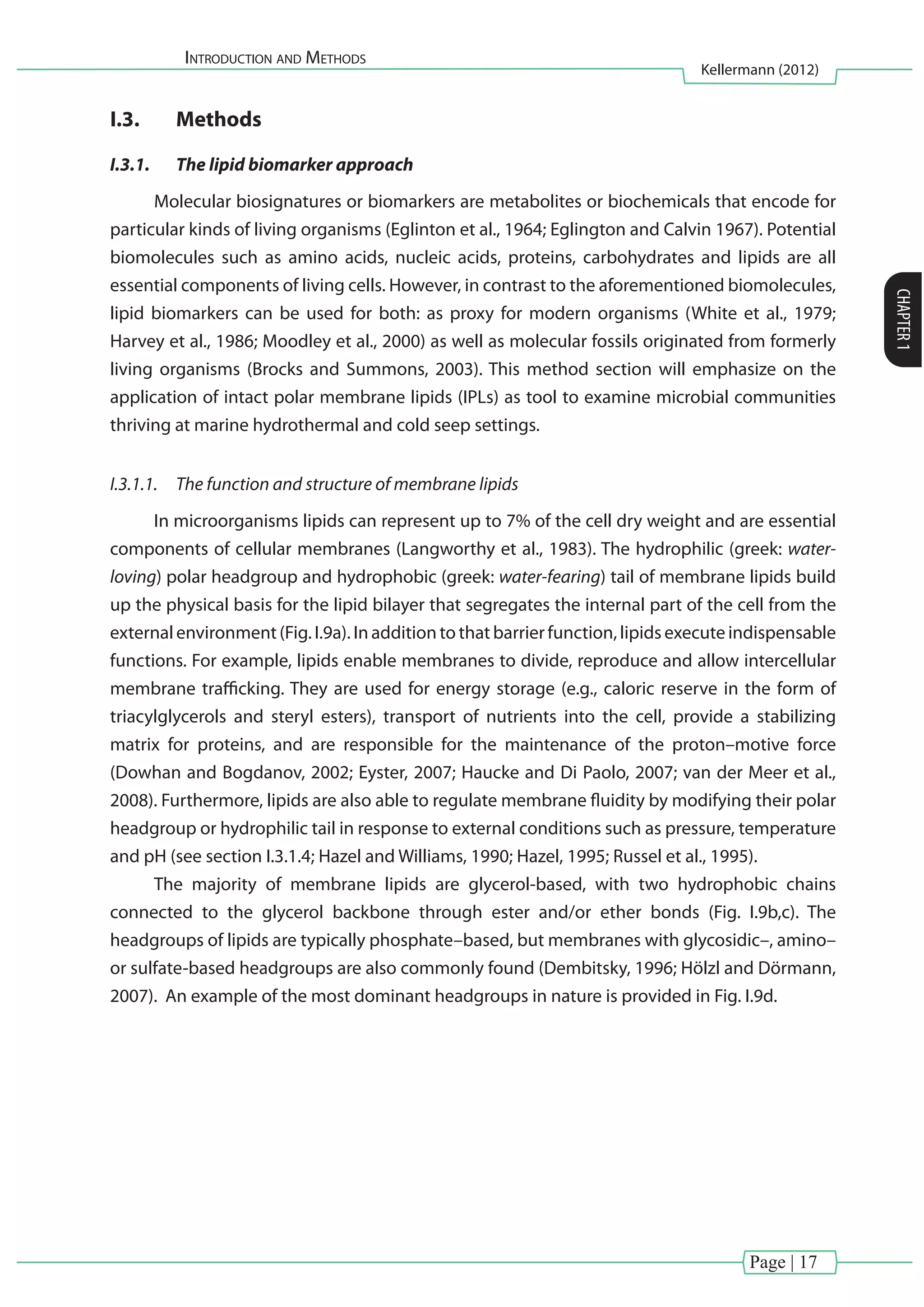
The majority of membrane lipids are glycerol-based, with two hydrophobic chains
connected to the glycerol backbone through ester and/or ether bonds (Fig. I.9b,c). The
headgroups of lipids are typically phosphate–based, but membranes with glycosidic–, amino–
or sulfate-based headgroups are also commonly found (Dembitsky, 1996; Hölzl and Dörmann,
2007). An example of the most dominant headgroups in nature is provided in Fig. I.9d.
Page | 18
Introduction and Methods
Kellermann (2012)
CHAPTER1
hydrophobic
region
I II III IV V
VI
VII
VIII
IX
X
XI
XII
O
O
O
O
O
O
Sphingosine
(Ceramide - Cer)
Acyletherglycerol (AEG)
Dietherglycerol (DEG)
Monoacylglycerol (Lyso)
Plasmalogen
(Plas)
XIII:
other core
lipid types
P
OH
O
H2
N
P
O
OH
O
NH3
O
O
P
O
OH
O
H2
N P
O
OH
O
N
P
O
OH
O
HO
OH
P
O
O
O
N
P
O
OH
O
OHHO
HO
HO OH
P
OH
O
O
OH
O
O
HO
HO OH
HO
P
OH
O
O
Phosphatidyl-
ethanolamine
(PE)
Phosphatidyl-(N,N)-
dimethylethanolamine
(PDME)
P
O
OH
O
N
H
Phosphatidyl-(N)-
methylethanolamine
(PME)
Phosphono-
ethanolamine
(PnE)
Phosphatidyl-
choline
(PC)
Phosphatidylglycerol
(PG)
Phosphatidylserine
(PS)
Diphosphatidylglycerol
(DPG)
Monoglycosyl (Gly) n = 1
Diglycosyl (Gly) n = 2
Triglycosyl (Gly) n = 3
... Phosphatidylinositol
(PI)
n
Phosphate-containing headgroups
Headgroups
Glyco-based
headgroups
O
O
O
O
O
O
O
O
O
O
O
O
O
O
O
O
O
O
O
O
O
O
O
O
O
O
O
O
O
R'
R''
O
O
O
O O
O
R'
R''
O
R''
HN
O
R'
OH
O
O
R'O
OH
O
O
O
O
O
O
O
O
O
O
O
Monolayers Bilayers
1,2-sn-glycerol
ester
linkage
head-
group
C
CCR
CR C
n-alkyl chains with
- methylation
- unsaturation
- cycloprenylation
O
O
O
O
O
headgroup
di- and tetra
ethers
hydrophilic
region
O C
C C
CC O
O Ri
Ri Ri
-isoprenoidal
n
2,3-sn-glycerol
ether
linkage
head-
group
O
O
O
O
O
O
O
O
O
O
OH
O
O
O
O
O
O
(a)
(b)
(d)
(c)
fatty
acids
integral
membrane
protein
Archaea
Bacteria &
Eukarya
Archaea
Bacteria &
Eukarya
outer
membrane
inner
membrane
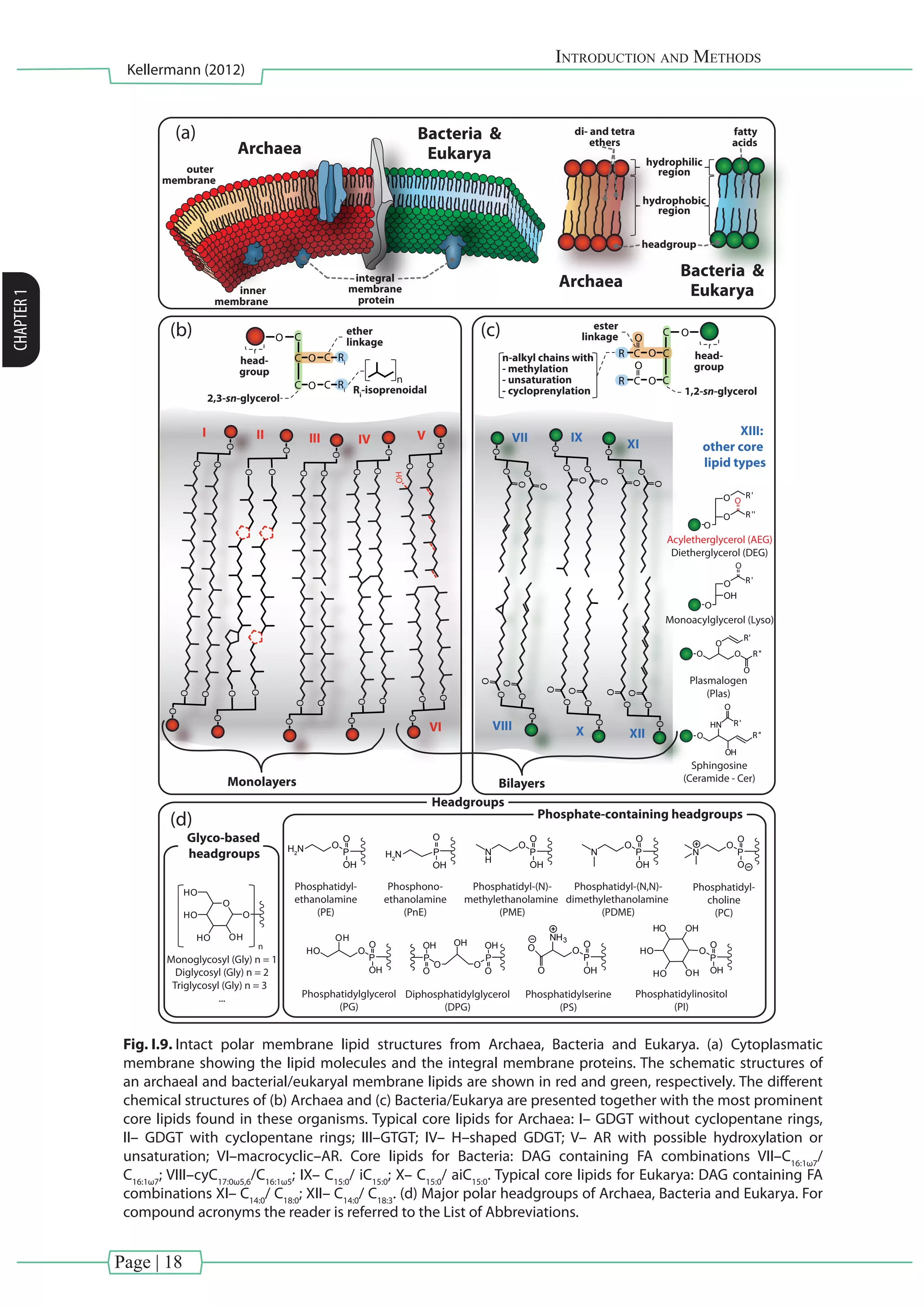
Fig. I.9. Intact polar membrane lipid structures from Archaea, Bacteria and Eukarya. (a) Cytoplasmatic
membrane showing the lipid molecules and the integral membrane proteins. The schematic structures of
an archaeal and bacterial/eukaryal membrane lipids are shown in red and green, respectively. The different
chemical structures of (b) Archaea and (c) Bacteria/Eukarya are presented together with the most prominent
core lipids found in these organisms. Typical core lipids for Archaea: I– GDGT without cyclopentane rings,
II– GDGT with cyclopentane rings; III–GTGT; IV– H–shaped GDGT; V– AR with possible hydroxylation or
unsaturation; VI–macrocyclic–AR. Core lipids for Bacteria: DAG containing FA combinations VII–C16:1ω7
/
C16:1ω7
; VIII–cyC17:0ω5,6
/C16:1ω5
; IX– C15:0
/ iC15:0
; X– C15:0
/ aiC15:0
. Typical core lipids for Eukarya: DAG containing FA
combinations XI– C14:0
/ C18:0
; XII– C14:0
/ C18:3
. (d) Major polar headgroups of Archaea, Bacteria and Eukarya. For
compound acronyms the reader is referred to the List of Abbreviations.
Introduction and Methods
Kellermann (2012)
CHAPTER1
Page | 19
I.3.1.2.	 IPLs representing all three domains of life
The membrane constituents of the three domains of life (Archaea, Bacteria and Eukarya)
have fundamental differences (Kates et al., 1978; Langworthy, 1982; Koga et al., 1993). Archaeal
IPLs are comprised of isoprenoidal side chains (C15
, C20
, C25
, C40
: farnesyl, phytanyl, sesterterpanyl
and biphytanyl, respectively) bound at the sn–2 and sn–3 position via di– or tetraether linkage
to the glycerol backbone, while the headgroup is attached at the sn–1 position (Fig. I.9b; e.g.,
Koga et al., 1993; Koga and Morii, 2007). Thus, archaeal membranes can occur both as bilayer
(dietherlipids)ormonolayer(tetraetherlipids).Bycontrast,bacterialandeukaryoticmembranes,
build up membrane lipids containing headgroups attached to the glycerol backbone at the
sn–3 position. In general, two fatty acid chains are linked to the glycerol backbone via ester
bonds in the sn–1 and sn–2 position (Fig. I.9c). Bacterial and eukaryal IPLs differ in the length
of carbon chains and the degree of unsaturation of the core lipids. Typically, eukaryotic FAs
have predominantly even-numbered carbon atoms (Lechevelier and Lechevalier, 1988), and
are often polyunsaturated (Brett and Müller–Navarra, 1997). Bacteria produce FAs with chain
lengths of 14 to 24 carbon atoms, monounsaturated fatty acids and/or penultimate (iso) or
ante-penultimate (anteiso) methyl-branched compounds (Zhang and Rock, 2008). In addition,
Bacteria and Eukarya differ in the production of cyclic isoprenoids: Whereas Bacteria produce
preferentially hopanoids, eukaryotes synthesize sterols in their membranes (see [BOX IV];
Ourisson et al., 1987).
BOX IV Hopanoids and steroids as membrane rigidifiers
Bacteriohopanepolyols (BHP) are a class of lipid which is known more generally as hopanoid. Hopanoids
are pentacyclic isoprenoids, which are found in many Bacteria, and particularly in cyanobacteria (Rohmer
et al., 1984; Rohmer et al., 1993; Summons et al., 1999). Sterols, on the other hand, are generally absent
in Archaea and Bacteria (Bouvier, 1976), but represent a conspicuous feature in lipid membranes of
eukaryotes (Fig. I.10; Ourisson et al., 1987). As an exception, 4–methyl sterols have been detected in
some aerobic methanotrophic bacteria, making them an ideal marker for this group of bacteria (Fig. I.10;
Bouvier et al., 1976; Ourisson et al., 1987; Elvert and Niemann, 2008). Due to structural similarity (e.g.,
molecular dimensions, semi–planar polycyclic ring structure and amphiphilic character) both hopanoids
and sterols are believed to serve as membrane stabilizers within the bacterial and eukaryotic membrane,
respectively (Ourisson et al., 1987).
hopanoid:
aminobacteriohopane-31,32,33,34-triol
(aminotriol)
4-methyl steroid:
4α-methylcholesta-8(14),24-dien-3β-ol
steroid:
cholest-5-en-3β-ol
(also known as cholesterol)
OH
BACTERIA EUCARYA
OH
OH NH2
HOHO
Fig. I.10. Chemical structure of characteristic triterpenoids.
Page | 20
Introduction and Methods
Kellermann (2012)
CHAPTER1
Cross Reference: In [Chapter II] the taxonomic information encoded in the intact polar lipid (IPL) molecules
enabled us, in a quantitative manner, to distinguish endosymbiotic bacteria from their eukaryotic host, which
were recovered from cold–and hot seep environments.
I.3.1.3.	 IPLs as taxonomic marker for the active microbial biomass
Thespecializationofmicroorganismstoawiderangeofbiologicalprocesseshasledtothe
formation of a variety of membrane lipids with differential functional roles.The vast abundance
of IPL membrane compositions can be assigned to: (1) responses with respect to environmental
parameters (see section I.3.1.4), or (2) from different membrane characteristics of organism
groups that are either phylogenetically related or have similar metabolisms (Langworthy, 1982;
Goldfine, 1984; Langworthy and Pond, 1986; Kaneda et al., 1991; Itoh et al., 2001).
Basedonrecentdevelopmentsinanalyticalchemistry,membranelipidsarenowaccessible
to be analyzed in their intact form using liquid chromatography coupled to mass spectrometry
(LC-MS; see section I.3.1.5). Before this direct measurement of IPLs using the LC–MS technique,
indirect measurements of IPLs have been performed using mostly silicagel column in order to
separate lipid extracts into fossil, glyco– and phospholipid fractions (Guckert et al., 1985; Oba
et al., 2006; Pitcher et al., 2009), which subsequently were hydrolyzed and/or ether-cleaved in
order to release their core lipids. Such conventional biomarker analyses focused mainly on the
polar lipid–derived fatty acids (PLFAs) or other IPL derivatives such as isoprenoidal hydrocarbon
chains (e.g., Parkes and Calder, 1985; Boschker et al., 1998; Orcutt et al., 2005; Wakeham et al.,
2007). The advantage of direct IPL analysis compared to traditional membrane lipid analysis
is a better taxonomic differentiation in environmental samples, since additional structural
information, such as headgroup and core lipid composition can be determined simultaneously
(Fang et al., 2000b; Rütters et al., 2002b Sturt et al., 2004; Biddle et al., 2006; Zink et al., 2008;
Schubotz et al., 2011b; Yoshinaga et al., 2011). However, most importantly, IPLs are thought to
be labile compounds which tend to (bio) degrade (hydrolysis of the polar headgroup) soon after
cell death (White et al., 1979; Harvey et al., 1986; Moodley et al., 2000). Hence, in comparison
to their more stable and recalcitrant core lipids, the presence of IPLs in sediments is thought to
reflect viable microbial cells (e.g., Sturt et al., 2004; Biddle et al., 2006; Schubotz et al., 2011b).
However, the stability of IPLs, especially for glycosidic archaeal IPLs, is an intensively discussed
topic in the field of organic geochemistry (e.g., Lipp and Hinrichs et al., 2009; Schouten et al.,
2010).
The increasing numbers of publications related to IPL research reflect their reputation.
For example, a vast number of recent publications applied IPLs as chemosynthetic markers
extracted either from cultures (e.g., Koga et al., 1998; Koga and Morii, 2005; Koga and Nakano,
2008) or various natural environments in the marine and terrestrial sediments (e.g. Rütters et al.,
2001, 2002a, 2002b; Zink et al., 2003; Biddle et al., 2006; Lipp et al., 2008; Schubotz et al., 2009;
Liu et al., 2010; 2011), surface waters of the oceans (e.g. Van Mooy et al., 2006; Schubotz et al.,
2009; Van Mooy and Fredericks, 2010; Popendorf et al., 2011) and cold seeps and hydrothermal
Introduction and Methods
Kellermann (2012)
CHAPTER1
Page | 21
vents (e.g., Rossel et al., 2008, 2011; Schubotz et al., 2011b; Yoshinaga et al., 2011).
CrossReference:[ChapterIIIandV]investigatedthelipidcompositionofanaturalenrichmentofthermophilic
AOM consortia, originally retrieved from the hydrothermally-influenced sediments of the Guaymas Basin. In
[Chapter III] we analyzed the ether-cleaved and hydrolyzed core lipids from the AOM community, which were
dominated by thermophilic ANME–1 and partner bacteria from the HotSeep–1 cluster (Holler et al., 2011).
[ChapterV], on the other hand, focused on individual archaeal IPLs (IPL–SIP) extracted from the same ANME-1
community analyzed in [Chapter III].
I.3.1.4.	 Membrane adaptation strategies of Archaea and Bacteria to cope with extreme
environmental conditions
In general, archaeal ether lipids are considered to be more resistant to stress factors such
as high temperature, pH, salinity, and pressure than lipids from Bacteria, containing mostly
ester bonds (Valentine, 2007). Therefore, Archaea were assumed to be the dominant group of
microorganisms that are able to thrive at extreme environments (e.g., van de Vossenberg et
al., 1998; Rothschild and Mancinelli, 2001; Cavicchioli, 2011). In this context, it is interesting to
mention that Archaea root very deeply in the phylogenetic tree, pointing to a close relationship
with a thermophilic ancestor (Woese et al., 1990; Stetter, 1996). Nevertheless, both Archaea
and Bacteria have developed different strategies to protect themselves from changing external
environmental conditions by modifying their membrane lipids.
Bacteria have the ability to react to changing external conditions (e.g., increase
in temperature, pH, pressure or salinity) by modifying both their apolar fatty acid chain
composition (e.g., variations in chain length, unsaturation, cyclopropanisation, and methyl
branches; Cronan and Gelmann,1975; Langworthy, 1982; DeLong and Yayanos, 1986, Nichols
et al., 1997; Männistö and Puhakka, 2001; Valentine and Valentine, 2004; Zhang et al., 2008) as
well as their polar headgroup composition (e.g., increase in temperature caused thermophilic
bacteria to shift from the synthesis of PE to PG, Hasegawa et al., 1980). Compared to the
bacterial membranes, the archaeal membranes are much less permeable towards passive
diffusion of ions. This enables Archaea to survive under extreme conditions (e.g., Elferink et
al., 1994; van de Vossenberg et al., 1995; 1998; Valentine, 2007). For example, compared to
diether–based membranes, the presence of membrane–spanning GDGTs and/or macrocyclic
archaeol in Archaea has been observed as strategy to tighten their membranes (Mathai et al.,
2001). Furthermore, by increasing cyclization of the tetraether isoprenoidal chains (e.g., Gliozzi
et al., 1983; Langworthy and Pond, 1986; De Rosa and Gambacorta 1988; Schouten et al.,
2003; Macalady et al., 2004) and substituting phospho–based by glycosidic headgroups (e.g.,
Shimadaetal.,2008)archaeareduceprotonpermeability,withstandingextremeenvironmental
conditions.
Page | 22
Introduction and Methods
Kellermann (2012)
CHAPTER1
Cross Reference: In [Chapter V] we hypothesize that the tetraether membrane, especially the formation
of 2Gly–GDGT, is used to reduce proton-permeability, thereby protecting the integrity of cells at extreme
conditions.
I.3.1.5.	 Sample handling: From extraction to IPL analysis to inter–and intramolecular isotope
analysis
In this dissertation IPLs have been extracted from sediments, microbial enrichments and
pure biomass using a modified Bligh and Dyer method (White and Ringelberg, 1998; Sturt et al.,
2004). Hereby samples were extracted using a mixture of methanol (MeOH), dichloromethane
(DCM) and an aqueous buffer in order to prepare the total lipid extract (TLE). In brief, target
sedimentswereextractedusingMeOH:DCM:aq.phosphatebuffer(50mM,pH7.4)(2:1:0.8,v:v:v)
and MeOH:DCM:trichloroacetic acid (50 mM, pH 2) (2:1:0.8, v:v:v). The combined supernatants
were washed with water, evaporated to dryness and stored at –20°C. Subsequently, an aliquot
of the TLE was analyzed by high performance liquid chromatography coupled to electrospray
ionization ion trap multistage mass spectrometry (HPLC/ESI–ITMSn
).This analytical technique is
particularly appropriate for the analysis of polar molecules such as IPLs. HPLC/ESI–ITMSn
allows
detailed structural characterization of IPLs by combining information gained in positive and
negative ionization modes not only in MS2
but also in MS3
(Fig. I.11; e.g., Rütters et al., 2002a;
Sturt et al., 2004; Zink and Mangelsdorf, 2004; Yoshinaga et al., 2011).
Intermolecular analysis
Preparative–HPLC is a new methodological advancement to the aforementioned
conventional lipid separation enabling to separate for example IPLs from the free/core lipids.
Recently, new purification protocols emerged, targeting the isotopic analysis of the apolar
side chains of individual IPLs extracted from environmental samples (e.g., Biddle et al., 2006;
Schubotz et al., 2011b). However, these protocols used only one dimensional normal–phase
preparative HPLC, thus IPLs with similar structural components were not completely separated.
In [Chapter V], further purification schemes are presented, involving the combination of
normal– and reverse–phase preparative HPLC in order to separate co–eluting archaeal di–and
tetraethers into individual fractions.
Intramolecular analysis
After lipid purification of individual IPLs, several cleavage reactions are necessary to
obtain GC–amenable compounds for intramolecular isotopic analysis. Recently, protocols have
been developed which allow analyzing polar lipid moieties, such as glycosidic headgroups (Lin
et al., 2010) and the glycerol backbone (Lin et al., in preparation) together with their apolar
side chains (e.g., biphytanes from GDGTs, PLFAs from phospholipids) . A schematic diagram
illustrating the analytical routes starting from sample extraction until separation of individual
lipid moieties is provided in Fig. I.12
Introduction and Methods
Kellermann (2012)
CHAPTER1
Page | 23
2000
1900
1800
1700
1600
1500
1400
1300
1200
1100
1000
900
800
700
600
15 20 25 30 35 40
Retention time [min]
m/z
2Gly-
GDGT BPGs
2Gly-AR
PG-AR
PGPG-OH-AR
PG-OH-AR
PE-AR
PS-AR
PAF
PS-OH-AR
PS-diOH-AR
PI-OH-AR
PG-GDGT-PG
Gly-BPG
Ser-BPG
PI-Ext-
OH-AR
PI-AR
PI-Ext-Uns(5)-
OH-AR
BL
PE-DEG PE
PE&PME
PC
PG
dimers
PS-diOH-AR
[M H] = 852
PE-DAG
[M H] = 688
538
547
253
450
556260
242
RelativeAbundance
O
O
O
P
O
O
OHNH2
HO
O OH
OH
556 (538)
260 (242)
+H
200 300 400 500 600 700
m/z
800 900
(a)
(c)
(b)
RelativeAbundance
200 300 400 500 600 700 800
m/z
PE-DAG
[M H] = 686
RelativeAbundance
200 300 400 500 600 700 800
m/z
450
253
253
547
+H -H
O O
O
O
O
P
O
OH
O
H2
N
O O
O
O
O
P
O
OH
O
H2
N
Fig. I.11. (a) Density map showing archaeal (red) and bacterial (blue) lipids analyzed in positive ionization
mode by HPLC/ESI–ITMSn
. The high diversity of microbial IPLs became apparent after visualization of the
chromatogram by way of 3D density maps (x – time, y – m/z, z – intensity). The intensity of the color black
is correlated to the concentration of the IPLs. Density maps provide a “fingerprint” of the IPL composition
in environmental samples. This sample was originally extracted from a cold seep environment from the
continental margin off Pakistan (M74/3, GeoB 12315, water depth 1000 m). Exemplarily, two fragmentation
pattern of (b) the archaeal IPL PS–diOH–AR in positive ionization mode and (c) the bacterial IPL PE–DAG in
both positive (left) and negative (right) ionization modes. In general, bacterial lipids typically lose its polar
headgroup upon fragmentation in positive ion mode in the mass spectrometer from which a headgroup-
diagnostic neutral mass loss can be calculated (e.g., PE–>loss of 141 Da). In negative ion mode, the bacterial
IPL parent ion tends to lose primarily their fatty acid chains (e.g., C16:1
–> m/z 253 Da). The fragmentation
patterns of a wide variety of archaeal IPLs are summarized in more detail in [Chapter IV]. For compound
acronyms the reader is referred to the List of Abbreviations.
Cross Reference: [Chapter IV] focused exclusively on the diversity of archaeal IPLs extracted from
environmental samples. This chapter revealed a systematic fragmentation pattern during high performance
liquid chromatography electrospray ionization mass spectrometry, providing a guide for organic geochemists
analyzing archaeal IPLs in natural samples.
Page | 24
Introduction and Methods
Kellermann (2012)
CHAPTER1
HPLC/ESI-MSn
HPLC/ESI-MSn
individual IPLs
e.g. 2Gly-AR
groups of IPLs
e.g., 2Gly-AR & 2Gly-GDGT
fossil / apolar
lipids
e.g., core GDGT,
core AR
purified
fractions
of IPLs
reduction using
super-hydride
Si
Si
O
Bligh & Dyer
extraction
SAMPLES
(e.g. sediments)
total lipid extract (TLE)
acid hydrolysis with TFA
-liquid-liquid extraction (LLE)-
ether cleavage
with BBr3
-LLE-
Lin et al., 2010
Lin et al.
(in prep.)
Summons
et al. (1998)
normal phase
Preparative HPLC
reverse phase
(organic phase)
core GDGTs
(aqueous phase)
monosaccharides
(organic phase)
brominated
biphytanes
gas chromatography - amenable compounds
(aqueous phase)
glycerol
phytanes
(derived from AR)
glycosydic headgroups
(as ANA derivative)
glycerol
backbone
(as TMS derivative)
O
Si O
C
CH2
OAc
OAc
AcO
AcO
OAc
H
H
H
H
N
(Gal)
C
CH2
OAc
OAc
AcO
OAc
OAc
H
H
H
H
N
(Glc)
HPLC/ESI-MSn
Fig. I.12. Flow chart showing all major steps starting from sample extraction to purification (normal– and
reverse– phase prep) towards intramolecular stable carbon isotopic analysis of individual IPLs. Hydrolysis of
glycosidic headgroups, glycerol backbone, and isoprenoidal chains (intramolecular analysis) are shown for
2Gly–AR. For compound acronyms the reader is referred to the List of Abbreviations.
Introduction and Methods
Kellermann (2012)
CHAPTER1
Page | 25
I.3.2.	 Stable carbon and hydrogen isotope analysis as tool in biogeochemistry
Carbon and hydrogen atoms contain variable numbers of neutrons in their nucleus,
leading to different isotopes of the same element. The term “isotope” is originated from the
greek language, where“iso”means equal and“topos”means location.
Carbon has two stable isotopes: 12
C and 13
C.The ratio of 13
C to 12
C can be expressed as δ13
C
as deviation in permill from a reference material [Eq. III] (typically, Vienna Pee dee Belemnite;
VPDB). The VPDB standard had a 13
C:12
C ratio (0.0112372), which by definition has a δ13
CVPDB
value of zero.
(
( )
( )
)
(
( )
( )
)
[Eq. III]
Like carbon, hydrogen has two stable isotopes: 1
H and 2
H. 1
H, consisting only of one
proton, is the most common hydrogen isotope. The 2
H isotope is also called deuterium (D)
and water enriched in D is called heavy water. The degree of hydrogen deviation (δ2
H) has
been quantified versus an established reference material (Vienna Standard Mean Ocean Water
(VSMOW); [Eq. IV]). The isotopic ratios of 1
H:2
H of the VSMOW standard is defined as 155.76±0.1
ppm (0.00015576). Both, the δ13
C and the δ2
H values are reported in the permill (‰) notation.
(
( )
( )
)
(
( )
( )
)
[Eq. IV]
Typically, biological reactions discriminate against the heavier stable isotope (2
H and 13
C)
and select for 1
H and 12
C, resulting in products which are depleted in 1
H and 12
C relative to 2
H
and 13
C, respectively. Naturally-derived microbial lipids depleted in 13
C and 2
H relative to their
standard show in general negative δ2
H and δ13
C values, respectively.
I.3.2.1.	 Analysis of natural abundance stable carbon isotope
In the past, most isotopic analysis on organic matter focused primarily on the ratio of 13
C
to 12
C. The distribution of these naturally occurring isotopes in lipid biomarkers can provide
information on the carbon substrate, and/or the carbon fixation pathway of the source
organisms. For example, in settings such as marine hydrothermal or cold seep environments,
where life is largely supported by chemosynthesis [BOX I], the isotopic composition of carbon is
a powerful tool. For instance, the isotopic analysis of cell wall membrane lipids and whole cells
of microbes involved in AOM (see section I.1.4.2) and their potential organic carbon substrates
have been used as a tool to reveal metabolic pathways of carbon assimilation (e.g., Elvert et
Page | 26
Introduction and Methods
Kellermann (2012)
CHAPTER1
al., 1999; Hinrichs et al., 1999; Hinrichs and Boetius, 2002; Orphan et al., 2002; Blumenberg et
al., 2004). These authors hypothesized that the carbon assimilation during AOM yields carbon
isotopic values of the methane oxidizing ANMEs (e.g., archaeol and hydroxyarchaeol) which are
15–50‰ depleted relative to methane as the proposed carbon substrate (Fig. I.13).
Cross Reference: During the process of AOM, the formation of biomass from anaerobic methanotrophic
archaea is generally thought to be related to methane as their dominant carbon source. This assumption will
be discussed and also questioned in [Chapter III].
The distribution of 13
C in natural systems is affected by thermodynamic reactions and
kinetic fractionation processes.Thermodynamic fractionation, on the one hand, is an important
process between reservoirs where the carbon exchange is slow enough to approach isotopic
equilibrium. Typically the associated isotope effects of these pure physical reactions are small.
For example, the exchange between CO2
in the air and the dissolved inorganic carbon (DIC =
CO3
2–
+ HCO3
–
+ H2
CO3
+ CO2aq
) in seawater causes an unequal isotope distribution between
the dissolved species (Pearson, 2010). On the other hand, the kinetic fractionation, during
biologically-mediated carbon transfers, has a stronger control on the 13
C distribution. Thus,
biochemical reactions that convert one carbon molecule (e.g., CO2
and or CH4
) into organic
matter show large fractionation effects, whereas heterotrophic reactions, using complex
organic matter as substrates, have small fractionation effects. This biological turnover leads to
12
C enrichment in the products and a 13
C enrichment in the residue of the substrates.The extent
of the preferential incorporation of the isotopically light 12
C into the biomass within Bacteria
and Archaea (biological fractionation) has been associated with different carbon–fixation
pathways (metabolic mode of the organism; cf. Hayes et al., 2001; House et al., 2003; Holler et
al., 2009; Pearson, 2010).
To effectively track the carbon fixation pathway of microorganisms the isotopic
composition of the potential substrate has to be known (You are what you eat!; De Niro
and Epstein, 1976). Therefore, to characterize the food web of microorganisms, the isotopic
composition of total organic carbon (TOC), dissolved inorganic carbon (DIC) and hydrocarbon
gases such as methane are important parameters in geochemical studies. Fig. I.13 provides an
overview of common δ13
C ranges of various carbon reservoirs and organisms found in nature.
Introduction and Methods
Kellermann (2012)
CHAPTER1
Page | 27
-130 -120-140 -110 -100 -80 -70 -60 -50 -40 -30 -20 -10 0 10-90
-130-140 -120 -110 -100 -80 -70 -60 -50 -40 -30 -20 -10 0 10-90
δ13
C
marine carbonates
marine bicarbonate
atmospheric CO2
higher plants (C3, C4, CAM)
marine plants
methanogenic Archaea
CH4
(abiogenic?, mantle?)
CH4
(biogenic)
CH4
(thermogenic)
AOM-carbonates (recent)
methanotrophic Archaea (AOM)
Fig. I.13. Summary of δ13
C ranges of mostly marine carbon reservoirs and organisms. The most important
carbon reservoirs dealt with in this dissertation are highlighted in red. Figure has been modified after
Blumenberg et al. (2010).
I.3.2.2.	 Natural abundance and stable hydrogen isotope analysis
Besides carbon, stable hydrogen isotope compositions of lipid compounds can also
be analyzed by GC–IRMS. As already shown for carbon, variability in lipid δ2
H values can also
be a useful tracer for biogeochemical processes (Hoering, 1974). The hydrogen content of
the organic matter is originally derived from the ambient water (Estep and Hoering, 1980).
In contrast to terrestrial waters, marine waters only show little variations in δ2
H on a spatial
and temporal scale (Schmidt et al., 1999), making hydrogen in the marine realm a potential
marker to track biogeochemical processes. Up to now, only little is known about the usefulness
of measurements of microbial lipids from marine systems. However, a few studies have
investigated the D/H ratios of lipids derived from marine organisms, resulting for example in
large, systematic differences within one compound class (e.g., fatty acids; Jones et al., 2008),
among different compound classes (e.g., n–alkyl and isoprenoid species, Sessions et al., 1999)
but also showed alterations in δ2
H within alkenones associated to changes in temperature,
salinity or growth rate (Schouten et al., 2006; van der Meer et al., 2007, 2008). Just recently, an
extensive survey of lipid δ2
H values, ranging from –32 to –348‰, from marine sources including
short– and long–chain n–alkanes, n–alcohols, and n–acids, steroids and hopanoids and also
archaeal isoprenoids emphasized strong fractionations associated with particular metabolic
capabilities of its producing organism (Li et al., 2009).
Cross Reference: The large and systematic differences among isoprenoidal chains (–150 to –290‰) and
different FAs (–86 to –230‰) have also been observed in [Chapter III]. This chapter extracted a natural
enrichment dominated by thermophilic ANME–1 and their partner bacteria from the HotSeep–1 cluster
(Holler et al., 2011).
Page | 28
Introduction and Methods
Kellermann (2012)
CHAPTER1
I.3.2.3.	 Stable isotope probing experiments of lipid biomarkers
Stable isotope probing (SIP) is a cultivation–independent approach which attempts to
identify microorganisms responsible for specific metabolic processes. SIP experiments rely on
the incorporation of a substrate, usually enriched in its heavier stable isotope (e.g., 13
C or 2
H),
which in turn will result in biomolecules (e.g., lipids, carbohydrates, DNA, RNA, protein) with
positiveisotopicvalueswhenthesubstrateisusedassourceduringbiosynthesis.FirstSIPstudies
combined 13
C labeling (13
C–acetate and 13
CH4
) with isotopic analysis of lipid biomarkers such as
phospholipid derived fatty acids (PLFAs) by isotope–ratio mass spectrometry (IRMS) (Boschker
et al., 1998). Up to date, lipid biomarker SIP is a popular approach since this biomolecule class
is extremely sensitive to GC–IRMS analysis and requires only low amounts of label assimilation
(Hayes et al., 1990; Brenna et al., 1997).
Until now, lipid-based SIP experiments focused mainly on the apolar, hydrophobic
moieties such as bacterial PLFAs (Boschker et al., 1998; Webster et al., 2006; Bühring et al., 2006)
or archaeal di–and tetraether lipids (Blumenberg et al., 2005; Wegener et al., 2008; [Chapter
III]). However, some of these SIP studies combined free and intact lipid pools, thereby mixing
signals from dead and living microbial biomass. Particularly the pool size of archaeal lipids such
as fossil/core GDGTs in marine sediments, have been shown to greatly outnumber membrane
lipids derived from living biomass (intact GDGTs), by up to one order of magnitude (Lipp and
Hinrichs, 2009; Liu et al., 2010, 2011), thus leading to a substantial isotope dilution, minimizing
the sensitivity of lipid–SIP.
Cross Reference: [Chapter III andV] are two SIP studies tracking the assimilation of 13
C labeled into bulk and
intact derived microbial lipids, respectively.
I.3.2.4.	 Dual SIP experiments
Justrecently,Wegenerandcoworkers(inrevision)introducedtheconceptofduallabeling,
using 13
C–labeled bicarbonate (13
CDIC
) and deuterated water (D2
O) as tracers.They reported that
the sulfate–reducer Desulfosarcina variabilis incorporates H2
from water protons to build up the
majority of its lipids, independent of the carbon fixation pathway. Hence assimilation of D2
O
can be used as sensitive tool to measure total lipid production (via assimilation of deuterated
protons from water), whereas the assimilation of inorganic carbon (determined via 13
CDIC
uptake
in lipids) indicates autotrophy. In addition, the ratio of inorganic carbon assimilation to total
lipid production yields an estimation of auto– and heterotrophic carbon fixation, without
addition of further labeled carbon sources.
Cross Reference: In [Chapter III] we performed a dual labeling study using 13
C–labeled bicarbonate (13
CDIC
)
and deuterated water (D2
O) and identify the AOM performing archaea and their sulfate-reducing bacterial
partner as mainly autotrophs.
Introduction and Methods
Kellermann (2012)
CHAPTER1
Page | 29
I.3.2.5.	 IPL–SIP: Intramolecular isotopic analysis on individual IPLs
To overcome the problems of a mixed signal derived from fossil and intact lipids normal
phase liquid chromatography has been shown to be sufficient for excluding the apolar sample
matrix from different groups of IPLs (e.g., Biddle et al., 2006; Schubotz et al., 2011b). However, in
order to purify individual IPLs, new purification protocols using a set of orthogonal columns of
normal– and reversed–phases have been applied (Lin et al., in preparation). The advantage of
IPL-SIP has been shown, for the first time, by Popendorf and coworkers (2011), who combined
SIP (using 13
C–bicarbonate and 13
C–glucose) and preparative HPLC (to separate individual IPLs),
in order to reveal bacteria–specific photoautotrophic and heterotrophic lipid production in
surface ocean waters.
Furthermore, recent and ongoing developments in sample purification together with
improved protocols for the chemical hydrolysis of individual IPLs (Lin et al., 2010; Lin et al., in
preparation) established the possibility to study the carbon assimilation not only within the
hydrophobic moieties (e.g., FAs and isoprenoidal chains) but also the polar components of
individual IPLs (i.e. glycerol and their headgroup; Fig. I.12).
Cross Reference: [Chapter V] unambiguously presents the advantage of IPL-SIP over TLE-SIP.
Page | 30
Introduction and Methods
Kellermann (2012)
CHAPTER1
I.4.	 Structure and main objectives of this thesis
In this thesis, lipid biomolecules and carbon metabolism of aerobic and anaerobic
chemosynthetic microorganisms at cold seeps and hot vents were examined by using and
improving state-of-the-art geochemical techniques.
[Chapter II] focused on the aerobic oxidation of reduced compounds (e.g., CH4
and
H2
S) by chemosynthetic microorganisms living in symbiosis inside mussels from the genus
Bathymodiolus. We analyzed a suite of lipids in muscle and gill tissues from Bathymodiolus,
collected from methane seeps and sulfide-rich hydrothermal vents. This chapter examined
symbiont–host interactions using a holistic lipid biomarker approach by investigating IPLs,
BHPs, FAs and sterols.
Research question:
•	 What are the advantages of IPL analysis over the traditional biomarker approach
regarding the characterization of bacterial and eukaryotic biomass?
•	 Can methane– and sulfur–oxidizing symbionts be differentiated by their biomarker
signatures and their stable carbon isotopic composition?
•	 Does the semi-quantitative IPL analysis allow an estimation of the abundance of
symbionts living in the gills of the host?
[Chapter III] of this thesis investigated carbon fixation during thermophilic anaerobic
oxidation of methane (AOM). Natural enrichments from the Guaymas Basin, which were
dominated by ANME-1 and sulfate-reducing bacteria from the HotSeep–1 cluster (Holler et al.,
2011)wereexaminedusingacombinedmultiple(13
CH4
and13
CDIC
)anddual(D2
Oand13
CDIC
)stable
isotope probing approach. Microbial biomass production was assessed as 13
C and D labeled
lipid biomarkers recovered at different time points (0, 10, 17 and 24 days) and treatments (with
and without methane at 37 or 50°C).
Research question:
•	 Which lipids are produced by the organisms performing AOM at elevated
temperatures?
•	 What are the roles of methane and inorganic carbon as carbon sources for
microorganisms involved in the thermophilic AOM?
•	 What are the patterns of microbial lipid production in presence and absence of
methane?
•	 What is the relative importance of heterotrophic and autotrophic carbon fixation at
different temperatures?
Introduction and Methods
Kellermann (2012)
CHAPTER1
Page | 31
[Chapter IV] reveals a systematic fragmentation pattern from archaeal IPLs during high
performance liquid chromatography electrospray ionization mass spectrometry. Analyzed IPLs
were exclusively retrieved from environmental samples; thereby this work is particularly useful
for a rapid and straightforward characterization of intact archaeal membrane lipids.
In [Chapter V] we studied the assimilation of inorganic carbon during thermophilic AOM
into individual archaeal IPLs. This chapter merges the recent advances in preparative HPLC
together with newly developed protocols for chemical hydrolysis of IPLs. The assimilation of
13
C–labeled bicarbonate was evaluated as follows: (1) archaeal IPLs vs. bulk lipids (TLE); (2)
among individual IPLs (di- and tetraethers); (3) intramolecular analysis (isoprenoids, sugar
moieties and glycerol backbone).
Research question:
•	 How strong does the large pool of fossil archaeal lipids influence the actual 13
C
uptake of the living archaeal community?
•	 Can adaptations of archaea to thermophilic environments be identified by the IPL
distribution?
•	 What are the patterns of label assimilation into isoprenoidal side chains, sugar
headgroups and glycerol moieties of individual lipids?
•	 What can be told from IPL-SIP: Towards de novo synthesis of biomass in Archaea.
Page | 32
Introduction and Methods
Kellermann (2012)
CHAPTER1
I.5.	 Contribution to publications
This PhD thesis enfolds three first–author and one second–author manuscripts
prepared for publication in international journals [Chapters II–V]. [Chapter II] and [Chapter
IV] are published and [Chapter III] and [Chapter V] are ready for submission. All other co–
author contributions are summarized in the [Appendix] containing manuscript abstracts in
combination with their most significant figure.
[Chapter II]
Symbiont–host relationships in chemosynthetic mussels: A comprehensive lipid
biomarker study.
Matthias Y. Kellermann, Florence Schubotz, Marcus Elvert, Julius S. Lipp, Daniel Birgel,
Xavier Prieto Mollar, Nicole Dubilier, Kai–Uwe Hinrichs
N.D. and K.–U.H. designed the project; N.D. provided the samples; M.Y.K. extracted,
analyzed and evaluated lipid data with help from F.S., M.E., J.S.L., D.B., X.P.M.; M.Y.K. and
F.S. wrote the paper with input of all co–authors.
Published in Organic Geochemistry 43, 112–124.
doi:10.1016/j.orggeochem.2011.10.005
[Chapter III]
Dual isotopic probing reveals dominant autotrophic carbon fixation in methane–rich
sediments from the Guaymas Basin.
Matthias Y. Kellermann, Gunter Wegener, Marcus Elvert, Marcos Y. Yoshinaga, Yu–Shih Lin,
Thomas Holler, Xavier Prieto Mollar, Kai–Uwe Hinrichs
M.Y.K., G.W. and Y.S.L. designed the project; G.W. and T.H. provided the samples; M.Y.K.
extracted, analyzed and evaluated lipid data with help from M.E., M.Y.Y., X.P.M.; M.Y.K.,
G.W. and M.Y.Y. wrote the manuscript with input of all co–authors.
In preparation for Geochimica et Cosmochimica Acta.
Introduction and Methods
Kellermann (2012)
CHAPTER1
Page | 33
[Chapter IV]
Systematic fragmentation patterns of archaeal intact polar lipids by HPLC/ESI/ITMS.
Marcos Y. Yoshinaga, Matthias Y. Kellermann, Pamela E. Rossel, Florence Schubotz, Julius
S. Lipp, and Kai–Uwe Hinrichs.
M.Y.Y. and M.Y.K. designed the project; M.Y.Y., M.Y.K. and P.E.R. provided the samples;
M.Y.Y., M.Y.K. and P.E.R. extracted, analyzed and evaluated lipid data and M.Y.Y. wrote the
manuscript with input of all co–authors.
Published in Rapid Communication in Mass Spectrometry 25, 3563–3574.
doi: 10.1002/rcm.5251
[Chapter V]
Stable isotope probing of an anaerobic methane–oxidizing enrichment provides clues on
archaeal tetraether lipid biosynthesis.
MatthiasY. Kellermann, MarcosY.Yoshinaga, GunterWegener,Yu–Shih Lin,Thomas Holler,
and Kai–Uwe Hinrichs
M.Y.K., M.Y.Y. and G.W. designed the project; G.W. and T.H. provided the samples; M.Y.K.
extracted, analyzed and evaluated lipid data with help from M.Y.Y., G.W. and Y.S.L.; M.Y.K.,
M.Y.Y. and G.W. wrote the manuscript with input of all co–authors.
In preparation for Geochimica et Cosmochimica Acta.
Page | 34
Introduction and Methods
Kellermann (2012)
CHAPTER1
Page | 35
Bacterial symbiosis in mussels
Kellermann (2012)
CHAPTER2
[Chapter II] - Bacterial symbiosis in mussels
Symbiont–host relationships in chemosynthetic mussels: A comprehensive
lipid biomarker study
Matthias Y. Kellermann a
*, Florence Schubotz a1
, Marcus Elvert a
, Julius S. Lipp a
,
Daniel Birgel a,c
, Xavier Prieto-Mollar a
, Nicole Dubilier b
, Kai-Uwe Hinrichs a
Published in Organic Geochemistry
Vol: 43 (2012), page: 112–124, doi:10.1016/j.orggeochem.2011.10.005
© 2011 Elsevier Ltd. All rights reserved.
a
	 Organic Geochemistry Group, MARUM Center for Marine Environmental Sciences & Department of
Geosciences, University of Bremen, Leobener Strasse, D-28359 Bremen, Germany
b
	 Max Planck Institute for Marine Microbiology, Celsiusstr. 1, D-28359 Bremen, Germany
c
	 Department of Geodynamics and Sedimentology, University of Vienna, Althanstrasse 14, A-1090
Vienna, Austria
1
	 Present address: Department of Earth, Atmospheric and Planetary Sciences, Massachusetts Institute
of Technology, Cambridge, MA 02139, USA.
*	 Corresponding author.
	 Tel.: +49 421 218 65742; Fax: + 49 421 218 65715
	 E–mail address: kellermann.matthias@gmail.com
Keywords:
symbionts | Bathymodiolus mussels| methane oxidizers | sulfur oxidizers | lipid biomarker | intact
polar lipids | bacteriohopanepolyols | fatty acids | sterols | stable carbon isotopes
Page | 36
Bacterial symbiosis in mussels
Kellermann (2012)
CHAPTER2
II.1.	 Abstract
Symbiosis with chemosynthetic microorganisms allows invertebrates from hydrothermal
vents and cold seeps, such as mussels, snails and tubeworms, to gain nutrition independently of
organic input from photosynthetic communities. Lipid biomarkers and their compound specific
stable carbon isotopes (δ13
C) have greatly aided the elucidation of chemosynthetic symbiosis.
Due to recent methodological advances in liquid chromatography it is now possible to obtain
a more holistic view of lipid biomarkers, including the analysis of intact polar membrane lipids
(IPLs) and bacteriohopanepolyols (BHPs).This study provides an extensive examination of polar
and apolar lipids in combination with stable carbon isotope analysis of three Bathymodiolus
mussels (Bathymodiolus childressi, Bathymodiolus cf. thermophilus, Bathymodiolus brooksi)
hosting different types of bacterial symbiont (methane-oxidizing, sulfur-oxidizing and a dual
symbiosis with methane- and sulfur-oxidizing symbionts, respectively). We propose that IPLs
with C16:1
acyl side chains, and phosphatidylglycerol (PG), diphosphatidylglycerol (DPG) and
phosphatidylethanolamine (PE) head groups, which were only detected in the gill tissue, can
be used as symbiont-characteristic biomarkers. These putative symbiont-specific IPLs provide
the opportunity to detect and quantify the methanotrophic and thiotrophic symbionts
within the gill tissue. Additional characteristic markers for methanotrophic symbionts were
found in B. childressi and B. brooksi, including the BHP derivatives aminotriol and aminotetrol,
4-methyl sterols and diagnostic fatty acids (FAs), such as C16:1ω9
, C16:1ω8
, and C18:1ω8
. In general,
the δ13
C values of FAs, alcohols and BHP-derived hopanols were in accordance with carbon
assimilation pathways of the respective methanotrophic or thiotrophic symbionts in all three
Bathymodiolusmussels. Differences in BHP distribution as well as δ13
C values in the two mussels
hosting a methanotrophic symbiont may indicate the presence of different methanotrophic
symbionts and/or changes in the nutritional status. In all three mussel species the δ13
C values
of lipid biomarkers assigned to the symbionts were similar to those of the hosts, indicating the
importance of the bacterial symbionts as the main carbon source for the mussel tissue.
II.2.	 Introduction
Cold seeps and hydrothermal vents are highly productive, chemosynthetic ecosystems in
the deep ocean, fueled by microbial oxidation of compounds supplied by fluids such as H2
, H2
S,
CH4
and reduced metals (Lonsdale, 1977). Chemosynthetic bacteria, representing the smallest
members of the food chain, can either be free living or hosted by invertebrates such as mussels,
snails, tubeworms or sponges (Petersen and Dubilier, 2010). The first discovery of invertebrates
gaining most of their energy through the oxidation of H2
S was reported in the late 1970s (Rau
and Hedges, 1979). The presence and function of these endosymbiotic bacteria has been the
subject of many studies (references detailed below). The symbiont provides the eukaryotic
host with nutrition, while the host supplies the symbiotic bacteria with fluids, enriched in
electron donors such as CH4
or H2
S and electron acceptors such as O2
, by positioning itself at
Page | 37
Bacterial symbiosis in mussels
Kellermann (2012)
CHAPTER2
the interface between reduced fluid and oxidized fluid (Petersen and Dubilier, 2010).
Bathymodiolus mussels have been found in association with sulfur-oxidizing (Cavanaugh,
1983;Disteletal.,1988)ormethane-oxidizingbacteria(Childressetal.,1986);specimenshosting
both groups of these Gammaprotobacteria have also been described (Fisher et al., 1993).
Bacterial symbiosis in Bathymodiolus mussels has been identified via transmission electron
microscopy (Childress et al., 1986; Fisher et al., 1987), molecular methods such as comparative
16S rRNA sequence analysis (Eisen et al., 1992), fluorescence in situ hybridization (Duperron
et al., 2005, 2007; Riou et al., 2008) and carbon incorporation experiments using isotopically
labelled CH4
or HCO3
-
for identification of methanotrophic or thiotrophic symbiont uptake
pathways (Fisher et al., 1987; Scott and Cavanaugh, 2007; Riou et al., 2010). A distinct lipid
fingerprint of an endosymbiotic microorganism was first described by Gillan and coworkers
(1988) and was further specified with regard to the function of the symbiont by way of analysis
of compound specific stable carbon isotopic compositions (e.g. Fang et al., 1993; Abrajano et
al., 1994; Jahnke et al., 1995; Pond et al., 1998).
Thebiomassandlipidbiomarkersofseepandventcommunitiesbecomestronglydepleted
in 13
C when the chemosynthetic bacteria incorporate 13
C depleted methane (Summons et al.,
1994) or metabolites derived from autotrophic carbon fixation (Ruby et al., 1987). Specifically,
diagnostic biomarkers of aerobic methanotrophic bacteria in cultures (Makula, 1978; Nichols
et al., 1985; Bowman et al., 1991) and the environment (e.g. Pond et al., 1998; Niemann et al.,
2006) are monounsaturated C16
fatty acids (FAs) with double bonds at positions ω7, ω8 and ω9,
methylsteroids(e.g.Bouvieretal.,1976;ConwayandMcDowell-Capuzzo,1991;Fangetal.,1992;
Elvert and Niemann, 2008; Birgel and Peckmann, 2008) and hopanoids (e.g. Rohmer et al., 1984;
Summons et al., 1994; Elvert and Niemann, 2008; Birgel et al., 2011). Many groups of bacteria
also contain bacteriohopanepolyols (BHPs) which have been suggested to act as membrane
stabilizers (Ourisson and Rohmer, 1982; Ourisson et al., 1987). BHPs are useful microbial markers
because of organism-specific functionalization of the hopanoid side chain, e.g. BHPs with a
terminal NH2
group (aminopentol and aminotetrol) are indicative of methanotrophic bacteria
(Talbot et al., 2001).
Intact polar membrane lipids (IPLs) are thought to reflect the presence of intact cells and
thus viable biomass (White et al., 1979; Rütters et al., 2002; Sturt et al., 2004). In combination
with conventional biomarkers [e.g. polar lipid-derived FAs (PLFAs)], IPLs provide additional
taxonomic information encoded in their head group. Therefore, a quantitative overview of
the major IPLs together with PLFA analysis provides a more holistic characterization of the
active microbial community (cf. Fang et al., 2000; Rütters et al., 2002). Phospholipids are crucial
membrane components of all living cells and comprise the most common IPLs in the bacterial
and eukaryotic domain (Goldfine, 1984; Dowhan, 1997; Zhang and Rock, 2008). Bacteria can
often be distinguished from Eukarya on the basis of their combined head group and core
lipid composition. In general, Bacteria typically contain glycerol-based phospholipids, with
two FA chains in the range C14
to C20
(Zhang and Rock, 2008). For example, methanotrophic
bacteria have been described to produce phospholipids with phosphatidylglycerol
Page | 38
Bacterial symbiosis in mussels
Kellermann (2012)
CHAPTER2
(PG), phosphatidylethanolamine (PE), phosphatidylmethylethanolamine (PME) and
phosphatidyldimethylethanolamine (PDME) head groups, containing predominantly C16:1
and
C18:1
FAs (Fang et al., 2000). Information on sulfide oxidizers is scarcer, but DPG, PE and PG were
shown to be the dominant IPL classes in thiotrophic bacteria isolated from thyasirid bivalves
(Fullarton et al., 1995). For comparison, different species of marine and freshwater eukaryotic
molluscs are dominated mainly by two types of phospholipids: (i) glycerol- and plasmalogen-
based lipids with phosphatidylcholine (PC) and PE head groups and (ii) sphingolipids with
phosphono-based head groups, e.g. ceramide phosphonoethylamine (PnE-Cer; Matsubara et
al., 1990; Kostetsky and Velansky, 2009; Colaço et al., 2009). The core lipids of PnE-Cer in marine
molluscs typically comprise C16:0
FA (Matsubara et al., 1990).
This study aimed to examine symbiont–host interactions using a comprehensive lipid
biomarker approach. It targets IPLs as a lipid class that captures the overall distribution of
bacterial and eukaryotic biomass between the symbiont and the host. IPLs were specifically
utilized for the detection of different symbiont types and to assess their distribution within
three Bathymodiolus mussel species from both vent and seep environments. In addition, FAs,
BHPs and selected methyl sterols were chosen as target compounds because they encode
specific information about various bacteria and enable, along with their compound-specific
stable carbon isotopic composition, the determination of the dominant symbiotic lifestyle of
the mussels. Three different types of symbiotic associations were chosen: one host species
containing methanotrophic symbionts [B. childressi from the Gulf of Mexico (GoM; Duperron
et al., 2007)], a second containing thiotrophic symbionts [B. cf. thermophilus from the Pacific
Antarctic Ridge (PAR; Petersen and Dubilier, unpublished data)] and a third with both
methanotrophic and thiotrophic symbionts [B. brooksi from the GoM (Duperron et al., 2007)].
Lipid biomarkers were extracted from the symbiont containing gill tissue and the symbiont-
free foot tissue, with the latter serving as a reference for the host’s lipid signature.
II.3.	 Material and methods
II.3.1.	 Sample collection and storage
B. brooksi and B. childressi were collected in October 2003 using the deep sea submersible
Alvin during the Deep Sea Cruise 11 Leg I at a cold seep in the GoM near the Alaminos Canyon
(26°21.320N, 94°30.120W, 2226 m water depth). B. cf. thermophilus was recovered in June 2001
using a TV controlled grab during the RV Sonne cruise SO 157 on the PAR near the Foundation
Chain (from station 30 GTV at 37°47.4430S, 110°54.8340W, 2212 m water depth). Mussels were
dissected on board into gill and foot tissue, except for B. childressi, for which only gill tissue was
collected. Samples were stored at -20°C until analysis.
II.3.2.	 Lipid extraction
Mussel tissue (between 70 and 250 mg dry mass) from one individual per species was
Page | 39
Bacterial symbiosis in mussels
Kellermann (2012)
CHAPTER2
mixed with ca. 5 g combusted quartz sand to enhance mechanical lysis during ultrasonic
extraction. Samples were extracted (6x) using a modified Bligh and Dyer method described by
Sturt et al. (2004). In brief, cell material was extracted (3x) using MeOH:CH2
Cl2
: aq. phosphate
buffer (50 mM, pH 7.4) (2:1:0.8, v:v:v) and MeOH:CH2
Cl2
:CCl3
CO2
H (50 mM, pH 2) (2:1:0.8, v:v:v).
The combined supernatants were washed with water, evaporated to dryness and stored at
-20°C until analysis.
II.3.3.	 FAs and neutral lipids
For analysis of FAs, sterols and sn-1-mono-O-alkyl glycerol ethers (MAGEs), an aliquot of
the total lipid extract (TLE) was saponified with 6% KOH in MeOH following the protocol of
Elvert et al. (2003). Subsequently, the neutral lipids were extracted (4x) with n-hexane from the
basic solution, which was acidified to pH 1 by addition of concentrated HCl; the FAs were then
extracted (4x) with n-hexane. FAs were converted to methyl esters (FAMEs) using 14% BF3
in
MeOH. Sterols and other alcohols, such as MAGEs, were converted to trimethylsilyl (TMS) ethers
using bis(trimethylsilyl)trifluoracetamide (BSTFA) in pyridine. Concentrations were derived
from normalization to cholestane as injection standard. To determine double bond positions
of FAs, an aliquot of the FA fraction was treated with 100 µL dimethyl disulfide (DMDS) and 20
µL iodine solution (6% w/v in Et2
O) under an O2
-free atmosphere at 50°C for 48 h. Samples were
purified from the remaining iodine solution by sodium thiosulfate addition and extraction with
n-hexane (Nichols et al., 1986).
Identification and quantification of FAMEs and neutral lipids was performed with a gas
chromatography–mass spectrometry (GC–MS) system (Thermo Electron Trace MS) equipped
with a 30 m RTX-5MS fused silica column (0.25 mm i.d., 0.25 µm film thickness). The system
was operated in electron impact (EI) mode at 70 eV with a scan range of m/z 40–900 at 1.5
scan s-1
. The interface temperature was 300°C and He was used as carrier gas at a constant
flow of 1.4 mL min-1
. The temperature programme for FAMEs and neutral lipids was: 60°C (1
min) to 150°C at 15°C min-1
, then to 320°C (held 27.5 min) at 4°C min-1
. The carbon isotopic
composition of compounds was determined using a GC-isotope ratio-MS (Hewlett Packard
5890 series II gas chromatograph, Thermo Finnigan Combustion Interface-II, Finnigan MAT 252
mass spectrometer) equipped with a 30 m RTX-5MS fused silica column (0.25 mm i.d., 0.25 µm
film thickness) with He as carrier gas. Stable carbon isotopic composition is expressed as δ13
C
values in the ‰ notation relative to Vienna Peedee Belemnite (VPDB). Precision of the isotopic
analysis was controlled using cholestane as injection standard.The analytical error was <1.0‰.
The δ13
C values were corrected for additional carbon introduced during derivatization.
II.3.4.	 Bacteriohopanepolyols
	 An aliquot of theTLE was separated over a tightly packed glass wool Pasteur pipette into
a n-hexane soluble (maltenes) and a CH2
Cl2
/MeOH soluble (asphaltene) fraction. An aliquot of
the asphaltene fraction was acetylated using Ac2
O in pyridine and heated to 50°C for 1 h. The
Page | 40
Bacterial symbiosis in mussels
Kellermann (2012)
CHAPTER2
reaction mixture was left to stand overnight. BHPs were analyzed via atmospheric pressure
chemical ionization liquid chromatography/multi-stage ion trap mass spectrometry (APCI-LC/
MSn
) according to Talbot et al. (2001). The high performance liquid chromatography (HPLC)
instrument was equipped with a reversed phase column (Alltech Prevail C18
, 150 x 2.1 mm, 3 µm,
Alltech, München, Germany) and a guard column of the same packing material (7.5 x 2.1 mm).
The APCI source was operated in positive ionization mode. Prior to injection, the acetylated
fraction of the extract was dissolved in MeOH/propan-2-ol (60:40 v/v). Separation was achieved
using three different eluents (A, MeOH; B, deionized water; C, propan-2-ol) with the following
linear gradient: 90% A and 10% B (0–5 min); 59% A, 1% B and 40% C (at 45 min) and hold for 25
min. The flow rate was 0.2 mL min-1
. APCI vaporizer temperature was 400°C, discharge current
was 5 µA and sheath gas flow was 40 (arbitrary units).
	 To determine δ13
C values of BHPs, we converted BHPs to hopanols (Rohmer et al., 1984;
Innes et al., 1997), which were analyzed by way of GC-isotope ratio (IR)-MS. In brief, an aliquot of
theasphaltenefractionwasstirredfor1hatroomtemperaturewithperiodicacid(H5
IO6
;300mg
in 3 mL tetrahydrofuran/water (8:1 v/v)). After addition of water, the resulting aldehydes were
extracted with petroleum ether and the extract was evaporated. Subsequently, the aldehydes
were reduced to primary alcohols by stirring for 1 h at room temperature with NaBH4
in EtOH.
After addition of KH2
PO4
the mixture was extracted with petroleum ether, evaporated and the
resulting hopanols were derivatized with BSTFA in pyridine prior to GC–IR-MS analysis.
II.3.5.	 Intact polar lipids
	 The TLE was dissolved in 5:1 CH2
Cl2
/MeOH and an aliquot directly analyzed using
HPLC without further treatment (Thermo- Finnigan Surveyor HPLC equipped with a 150 x 2.1
mm, 5 µm LiChrospher Diol-100 column fitted with a 7.5 x 2.1 mm guard column of the same
packing material; Alltech GmbH,Munich, Germany) coupled to an ion-trap mass spectrometer
(ThermoFinnigan LCQ Deca XP Plus) equipped with an electrospray ion source in positive and
negative ionization mode. HPLC analysis was conducted with gradients described by Sturt et
al. (2004) [eluent A: n-hexane, 2- propanol, formic acid and NH3
(79:20:0.12:0.04, v:v:v); eluent
B: propan-2-ol, water, formic acid and NH3
(90:10:0.12:0.04) at 0.2 mL min-1
]. Identification of
the phospholipids was performed largely in positive mode according to published MS data,
whereas the negative mode provided information about the molecular mass of the acyl
moieties (Matsubara et al., 1990; Fang and Barcelona, 1998; Rütters et al., 2002; Sturt et al., 2004;
Zemski Berry and Murphy, 2004; Schubotz et al., 2009).
II.3.6.	 Quantification of symbiont- and host -derived IPLs
	 Absolute IPL concentration was estimated from peak areas of molecular ions in
extracted ion mass chromatograms relative to an internal standard (1-O-hexadecyl-2-acetoyl-
sn-glycero-3- phosphocholine; PAF). Relative response factors of individual IPL head group
classes were not accounted for. Since previous studies have shown that the response factor
Page | 41
Bacterial symbiosis in mussels
Kellermann (2012)
CHAPTER2
can vary significantly for IPLs with different head groups (e.g. Schubotz et al., 2009; Van Mooy
and Fredricks, 2010), reported IPL concentration values are semiquantitative. Response factors
of various commercially available authentic standards compared with PAF ranged from 0.5 to
2 (cf. Schubotz et al., 2009). This work consequently focuses on the relative distribution of IPLs
among different mussel species and tissues.
	 The distinction of symbiont- and host-derived IPLs was based on complementary MS
information obtained in positive and negative ionization mode during HPLC–ESI–MS analysis.
Symbiont specific FAs (largely C16:1
FAs; see section II.3.2) were identified in the negative
ionization mode and their corresponding IPL molecular ions (m/z 688 for PE-di-C16:1
and m/z
736 for PG-di-C16:1
) were extracted and quantified in the positive ion mode, resulting in an
approximation of symbiont- and host-derived IPLs.
II.3.7.	 Identification of plasmalogens
	 In contrast to PE–plasmalogens (1-O-alk-10-enyl-2-acyl glycerophospholipids),
which are clearly identifiable using HPLC–MS (Fig. II.3a; Zemski Berry and Murphy, 2004), PC-
plasmalogens are not unambiguously recognized since their MS2
fragment (m/z 184) is the
same as for PC-diacylglycerol (DAG). The presence of two PC containing IPL classes became
apparent after visualization of the chromatogram by way of 3D density maps (x – time, y – m/z,
z – intensity; Fig. II.1a). To test for the presence of PC plasmalogens, we used preparative HPLC
to obtain a fraction concentrated with IPLs with PC head groups. Preparation of fractions of
distinct IPL classes was achieved according to a protocol described by Biddle et al. (2006), but
with slight modification. We used a preparative LiChrospher Diol-100 column (250 x 10 mm, 5
µm, Alltech, Germany) connected to a ThermoFinnigan Surveyor HPLC instrument equipped
with a Gilson FC204 fraction collector. Flow rate was 1.5 mL min-1
and the eluent gradient was:
100% A (n-hexane/propan-2-ol; 79:20, v:v) to 100% B (propan-2-ol/water; 90:10, v:v) in 120 min,
then held at 100% B for 30 min, with 30 min column re-equilibration with 100% A. In total, 14
fractions were collected. Fraction 7 contained the fractions of IPLs with PC head groups and
we therefore used this fraction to convert potential PC plasmalogens to dimethyl acetals by
way of acid hydrolysis (Fig. II.1b and c; Rao et al., 1967). Thereby, an aliquot of fraction 7 was
blown down to dryness and treated with methanolic HCl [6 M HCl/MeOH (1:9, v/v)] at 50°C
overnight. Finally, MilliQ water was added and the solution extracted (4x) with n-hexane. The
organic phase was evaporated under a gentle stream of N2
and directly analyzed via GC–MS as
described above. Characteristic fragmentation patters confirmed the presence of plasmalogen-
derived dimethyl acetals during GC–MS analysis (Fig. II.1c).
Page | 42
Bacterial symbiosis in mussels
Kellermann (2012)
CHAPTER2
736
(16:1/16:1)
877
854
(20:1p/20:3) 826
(18:0p/20:3; 20:1p/18:2) 796
(18:0p/18:3) 768
742
718
732 (16:0/16:1)
536
(22:1)
556 (24:5)
524 (21:0)
756 (16:0/18:3)
784 (16:0/20:3)
812 (16:0/22:3)
866
840
PG
Plas-PC
lyso -PE
PnE-Cer
PC
643
(16:0)
506
(20:2)
25 30 35
500
600
700
800
900
Time (min)
m/z
(a)
20 25 35
C16:1
C16:0
C18:3
C18:2
C18:0
C20:3
C20:2
C22:3
C20:1
C20:1
18:0p
20:1p
RelativeAbundance
(b)
30
Time (min)
200
m/z
100
m/z
75.0
150 25050 50300 350
C
H
O
O
H3
C
H3
C
75.0
M+
- CH3
O
283.3
M+
314.3
200
m/z
100
m/z
75.0
150 250 300 350
C
H
O
O
H3
C
H3
C
75.0
M+
- CH3
O
309.5
M+
340.3
RelativeAbundance
(c)
Fig. II.1. (a) Partial density map showing distribution of intact polar lipid in preparative HPLC fraction
7 (F7) of B. brooksi (gill tissue). Numbers in bold refer to the molecular mass (Da), numbers in brackets
give information about the FA side chains (p indicates chain length of plasmalogen side chain). For
abbreviations of lipid names refer to the text or see Appendix II.1. (b) Gas chromatogram of FAMEs from
acidic transesterification of F7 (B. brooksi). Plasmalogens are converted to dimethyl acetals (highlighted
in grey). FA abbreviations characterize carbon chain length and number of double bonds. (c) Electron
impact mass spectra of the dimethyl acetals (left: C18:0p
, right: C20:1p
). Mass spectra of dimethyl acetals are
characterized by a typical base peak at m/z 75 [C3
H7
O2
]+
and a fragment ion [M-CH3
O]+
.
II.4.	 Results and discussion
II.4.1.	 IPL abundance and distribution in Bathymodiolus mussels
The IPLs in both gill and foot tissue of all three species were dominated by PE and PC (Fig.
II.2). The most abundant core lipid types were diacylglycerols (DAGs) and plasmalogens (Plass;
Fig. II.3a), followed by ceramides (Cers) and lyso-lipids. Total IPL concentration ranged from 2
Page | 43
Bacterial symbiosis in mussels
Kellermann (2012)
CHAPTER2
to 6 mg gdm
-1
(per g dry mass) in the gills and was slightly lower in the foot tissue, ranging from
1.4 to 2.5 mg gdm
-1
(Table II.1).
B. childressi
- Gill -
RelativeAbundance
B. brooksi
- Gill -
RelativeAbundanceRelativeAbundance
B. brooksi
- Foot -
B. cf. thermophilus
- Gill -
RelativeAbundance
Time (min)
10 15 20 25 30 35 40 45
RelativeAbundance
B. cf. thermophilus
- Foot -
PG
PG
PG
PE
Plas-PE
PnE-Cer
Plas-PC
PC
PE
PC
PE
PC
PE
PC
PE
PC
PS
lyso-PE
STD
STD
STD
STD
STD
PI
lyso-PC
n.i.
lyso-PE
lyso-PC
Plas-PC
Plas-PE
lyso-PE
lyso-PE
Plas-PC
Plas-PE
PS
PnE-Cer
PnE-Cer
n.i.
PnE-Cer
C-PnE
PS
PS
PI
PS
PS PI
PI
DPG
Plas-PE
Plas-PE
Plas-PC
Plas-PC
lyso-PE
lyso-PC
PE-Cer
Gly-Cer
Cb
n.i.
n.i.
PI
lyso-PE
lyso-PE
Fig. II.2. HPLC–ESI–MSn
data for all mussel tissue samples. The chromatogram shows the base peak plot
for the TLE in positive ion mode. The following IPLs (see Appendix II.1 for structures) were detected: PC
(phosphatidylcholine); PE (phosphatidylethanolamine); PG (phosphatidylglycerol); PI (phosphatidylinositol);
PS (phosphatidylserine); PnE-Cer (ceramide-phosphonoethanolamine); Gly-Cer (cerebroside); PE-Cer
(ceramide- phosphatidylethanolamine); lyso membrane lipids (lyso-PE, lyso-PC) containing a single acyl
chain. Abbreviations: STD, injection standard (C16
-PAF); n.i., not identified. Relative IPL composition is shown
as pie charts.
Page | 44
Bacterial symbiosis in mussels
Kellermann (2012)
CHAPTER2
The IPL composition of the foot tissue for B. brooksi and B. cf. thermophilus was quite
similar, comprising ca. 60% PE- and PC-DAGs, ca. 30% PE- and PC-Plass and minor amounts of
lyso-PEs and PnE-Cers (Fig. II.2). The only difference was the presence of PI and PS-DAGs in B.
brooksi (ca. 4% of total IPLs). This similarity suggests that primarily taxonomic affiliation and
not environmental factors determine the IPL composition in the foot tissue of the mussels.
By comparison, the gill tissues of all three species displayed more diverse IPL distributions.
PEs, PCs and PG-DAGs comprised between 30% and 60% of total IPLs, while PEs and PC-Plass
ranged from 20% to 40%, and lyso-PCs and PEs and phospho-ceramides varied between 15%
and 30%. In particular, the presence or absence of specific IPLs distinguished gill and foot
tissue of individual species and gill tissue between different mussel species: PGs with DAG
core structures was exclusively found in the gill tissue of B. childressi (7% of total IPLs) and
B. brooksi (<1%). PG-DAGs were absent from B. cf. thermophilus, while DPGs were present in
the gill tissue of B. cf. thermophilus (Fig. II.2, Table II.1). Another distinctive feature of the IPL
distribution in the gill tissue was the presence of phosphonoethanolamine ceramide (PnE-Cer;
Fig. II.2, Fig. II.3b;Table II.1) in both species recovered from the GoM, whereas B. cf. thermophilus
lacked it but instead contained small amounts of PE-Cer (5%). These small scale differences
in IPL composition between gill and foot tissue within a mussel as well as differences across
species could result either from the presence of symbiotic bacteria, their functional properties
(Kostetsky and Velansky, 2009), or the nutritional status of the mussel, as discussed below.
II.4.2.	 FA abundance and distribution in Bathymodiolus mussels
The FA distributions differed between gill and foot tissue of the same species, as well
as between the gill tissue of different species. The foot tissue of both B. brooksi and B. cf.
thermophilus was dominated by polyunsaturated C18
and C20
FAs (PUFAs; ca. 40% of total FAs),
while monounsaturated C16
and C18
FAs were only a minor component (together ca. 15%). By
comparison, C16:1ω7
was the most abundant FA in the gill tissues of all three species, comprising
between 30% and 40% and C18
and C20
PUFAs covering ca. 20% (Fig. II.4; Table II.2). PUFAs are
a common feature in vent and seep mussels (Fang et al., 1993; Pranal et al., 1996; Pond et al.,
1998; Allen et al., 2001; Colaço et al., 2006) and are synthesized through chain elongation and
unsaturation of the symbiont-derived FAs, mainly C16:1ω7
or C18:1ω7
(cf. Fang et al., 1993; Pond et al.,
1998). Although C16:1ω7
is considered a generic FA and is produced by both Eukarya and Bacteria
(Guezennec and Fiala-Medioni, 1996; Pond et al., 1998), a high abundance in symbiont-hosting
gill tissue has been used as a marker for the presence of symbiotic bacteria (McCaffrey et al.,
1989; Guezennec and Fiala-Medioni, 1996; Pranal et al., 1996, 1997; Colaço et al., 2006). This
is in accordance with observations by Abrajano et al. (1994), who demonstrated that shallow
water mussels without symbionts contained mainly saturated C16
FAs, whereas the proportion
of C16:1
was elevated in cold seep mussels with symbionts. A similarly elevated concentration
of C18:1ω7
and C20:1ω7
in gill tissue has been assigned to the presence of Bacteria in symbiotic
mussels (McCaffrey et al., 1989; Guezennec and Fiala-Medioni, 1996; Pranal et al., 1996, 1997;
Page | 45
Bacterial symbiosis in mussels
Kellermann (2012)
CHAPTER2
Colaço et al., 2006). For B. cf. thermophilus no other symbiont specific FAs could be identified.
The presence of C16:1ω8
(14%) and C18:1ω8
(3%) in B. childressi and C16:1ω9
(9%) and C18:1ω8
(1%) in B.
brooksi was unequivocally assigned to methanotrophic symbionts (e.g. Makula, 1978; Nichols
et al., 1985; Bowman et al., 1991) and is discussed in more detail below (section II.3.5).
200 300 400 500 600
0
0
50
100
418.4
641.4
365.2
RelativeAbundance
RelativeAbundance
Time (min)
20 25 30 35 40
RelativeAbundance
Time (min)
20 25 30 35 40
base peak
m/z 400-2000
extracted ion
m/z 782.5
50
100
RelativeAbundance
200 300 400 500 600
50
100
50
100
+H +
O O
O
C20
H37
(C20:2
) C20
H37
(C20:2
)
C19
H35
(C19:2
) C19
H35
(C19:2
)
O
P
O
OH
O
H2
N
m/z
365.3
m/z
641.6
m/z 490.3
O O
O
O
P
O
OH
O
H2
N
m/z 307.3
307.4
490.5
base peak
m/z 400-2000
extracted ion
m/z 643.5
(a)
(b)
O
HN
OH
O
P
O
OHH2
N O
HN
OH
O
P
O
OHH2
N
m/z 403.3
m/z 518.5
(m/z 500.5 (-OH)) 518.4
500.5
403.4
-H -
+H +
-H -
+H +
OP
O
OH
C18
H35O
H2
N
m/z m/z
200 300 400 500 600 200 300 400 500 600
m/z m/z
C14
H27
(C14:1
)
C15
H31
(C15:0
)
C14
H27
(C14:1
)
C15
H31
(C15:0
)
Fig. II.3. HPLC–ESI–MSn
data for (a) plasmalogen-phosphatidylethanolamine (PE-Plas) and (b) ceramide-
phosphonoethanolamine (PnE-Cer) for the gill tissue of B. brooksi as an example. (a) The chromatogram
shows the base-peak plot of the TLE in positive ion mode overlain by the m/z 782.5 chromatogram (black
area) derived from PE-Plas. (b) The chromatogram shows the base peak plot of the TLE in positive ion mode
overlain by the m/z 643.5 chromatogram (black area) derived from PnE-Cer. For both lipids, the fragmentation
pattern during MS/MS experiments is schematically illustrated in positive (upper and lower left) and negative
ionization (upper and lower right) mode.
Total FA concentration ranged from 22 to 54 mg gdm
-1
(Table II.2) in the gill tissue and 1–2
mg gdm
-1
in the foot tissue. The apparent discrepancy between IPL and FA dry weight biomass
of gill tissue (10x more FAs than IPLs) and foot tissue (0.4–1.4x more FAs than IPLs) can be best
explained by abundant triglycerides in symbiont hosting gill tissues as an additional source
of FAs. Triglycerides can comprise up to 60% in symbiont-hosting gill tissue of Bathymodiolus
Page | 46
Bacterial symbiosis in mussels
Kellermann (2012)
CHAPTER2
brevior and B. elongatus (Pranal et al., 1997). Similarly, Allen et al. (2001) observed that the
symbiont-hosting gill tissue of the hydrothermal vent clam Calyptogena pacifica comprised
maximal 50% triglycerides of the total lipid composition (IPLs 50%), but only 4% in the foot
tissue (IPLs 80%). Additionally, the presence of free FAs could also be responsible for higher
absolute amounts of FAs than IPLs. However, free FAs were shown to comprise only ca. 10% in
both gill and foot tissue (Allen et al., 2001). Response factors of IPLs could minimize uncertainty
in the estimation of absolute abundances for IPLs.
Table II.1. Major core structures and relative abundance of IPLs in mussel tissue (absolute concentration in
mg gdm
-1
; n.d., not detected; n.i., not identified).
10% in both gill and foot tissue (Allen et al., 2001). Response factors
of IPLs could minimize uncertainty in the estimation of absolute
abundances for IPLs.
3.3. Symbiont-derived IPLs
The different combinations of acyl chain distributions of IPLs
were used to differentiate between eukaryotic and bacterial
sources (cf. Section 2.6). As reported in Section 3.2, C16:1 FAs were
most abundant in the gill tissue of the mussels and indicate the
presence of the bacterial symbiont. IPLs with head groups com-
mon for methanotrophic and thiotrophic bacteria, such as PE-,
DPG-, and PG-DAGs with a core lipid composition of di-C16:1 acyl
chains were only present in the gill tissues of the mussels (cf.
Fig. 2, Table 1). Fang et al. (2000) identified PGs and PEs with pre-
dominantly C16:1 FA as major IPLs in type I methanotrophs, sup-
porting the presence of this group of methanotrophs in the gills
of both species from the GoM (cf. Duperron et al., 2007). In B.
cf. thermophilus C16:1 FAs were mainly present as DPGs, and some
PE-DAGs. Accordingly, DPGs and PEs with exclusively C16:1 FAs
are interpreted as a marker for the associated thiotrophic bacteria
since this mussel has only one symbiont (Table 1; Petersen and
Dubilier, unpublished data). This is in agreement with DPG, PG
and PE being the dominant IPL classes in thiotrophic bacteria iso-
lated from thyasirid bivalves (Fullarton et al., 1995). The only
other IPL containing C16:1 acyl chains in all three mussel species
was PC-DAG. PC-DAG has been observed in some type I methan-
otrophs (Makula, 1978), but since PC with C16:1 acyl chains was
also present in foot tissue, it cannot be unambiguously assigned
to a bacterial source.
Consequently, the IPL inventory provides clues on the symbiont
relative contribution within host gill tissue (Fig. 5). Comparing the
relative abundance of designated symbiont-derived IPLs within the
three mussels, they were highest in the predominantly methano-
trophic symbiont-hosting B. childressi (25% of all IPLs), followed
by the thiotrophic and methanotrophic symbiont-hosting B. brooksi
(11%) and finally by the purely thiotrophic symbiont-hosting B. cf.
thermophilus (3%). The foot tissue of B. brooksi and B. cf. thermophi-
lus did not contain any of the putatively assigned symbiont-
derived IPLs.
3.4. Host-derived IPLs
DAG-based IPLs that are mainly derived from the eukaryotic
host contain PUFAs such as C18:3, C20:2 and C20:3, which are
common in hydrothermal vent mussels but rarely detected in
Bacteria (Table 1; Fang et al., 1993; Pranal et al., 1996; Pond
et al., 1998; Allen et al., 2001; Colaço et al., 2006). Likewise, plas-
malogen IPLs (e.g. PE-Plas and PC-Plas) contain predominantly
long chain PUFAs and the ceramides (PE-Cers and PnE-Cers)
comprised C18:1 and C20:1 or C22 sphingolipid backbones with sat-
urated or monounsaturated C16 FAs (Table 1; Fig. 3b). Plasmalo-
gens are a widely distributed group of IPLs in the animal
kingdom (Nagan and Zoeller, 2001). Marine invertebrates are well
known to contain plasmalogens, most commonly associated with
PEs and PCs (Kraffe et al., 2004), as described here. Similarly, the
phosphonosphingolipids (PnE-Cers) in B. childressi and B. brooksi
are common in marine animals, e.g. bivalve molluscs (Matsubara
et al., 1990; Mukhamedova and Glushenkova, 2000; Kostetsky
and Velansky, 2009). The PE-Cer in B. cf. thermophilus has to our
knowledge not been reported from marine molluscs. However,
because of the long chain sphingosine backbone (d20:0
; ‘‘d’’ for
the two (di-)hydroxyls of sphingosine), we suggest that PE-Cer
is, like PnE-Cer, most probably a marker for the host mussel.
The biological function of these compounds is under debate, but
Table 1
Major core structures and relative abundance of IPLs in mussel tissue (absolute concentration in mg gÀ1
dm; n.d., not detected; n.i., not identified).
B. childressi B. brooksi B. cf. thermophilus
Gill Gill Foot Gill Foot
Major core Relative
abundance
(%)
Major core Relative
abundance
(%)
Major core Relative
abundance
(%)
Major core
structure
Relative
abundance
(%)
Major core Relative
abundance
(%)
PE-DAG 16:1/16:1;
16:1/16:2;
16:0/16:1
34 16:1/16:1;
18:0/18:3;
16:0/16:1
21 18:0/18:3;
16:0/18:3
29 18:0/18:3;
16:1/16:2
18 18:0/18:3 38
PC-DAG 18:0/18:3;
16:0/18:3;
16:1/16:0;
16:1/20:2
16 16:0/16:1;
16:0/20:3;
16:0/18:3
13 16:0/18:3;
18:0/18:3;
16:0/20:3
35 16:0/16:1;
16:0/18:3;
16:0/20:2
13 16:0/20:3;
16:0/18:3;
16:0/16:1
29
PG-DAG 16:1/16:1 7 16:1/16:1 1 n.d. – n.d. – n.d. –
PS-DAG n.i. 1 n.i. 1 n.i. <1 n.i. 1 n.d. –
PI-DAG n.i. 3 n.i. 4 n.i. 1 n.i. 2 n.d. –
DPG n.i. – n.d. – n.d. – 4x 16:1 3 n.d. –
Plas-PE 20:1p/20:1;
18:0p/18:3,
22:2
15 20:1p/20:2,
20:1, 20:0;
18:0p/18:2,
22:2
21 20:1p/20:2,
20:1
20 18:0p/18:2,
20:2, 20:1;
20:1p/20:3,
20:1
35 20:1p/20:1 10
Plas-PC 18:0p/18:3 4 n.i. 3 n.i. 11 n.i. 8 n.i. 15
Lyso-PE 20:2; 20:3 2 20:2 4 20:2; 20:3;
22:2
2 20:1; 20:2 3 20:1; 20:2 5
Lyso-PC 15:1 1 15:1; 15:0 4 n.d. – 16:0; 15:1 11 n.d. –
Lyso-PS 22:2 <1 n.d. – n.d. – n.d. – n.d. –
PE-Cer n.d. – n.d. – n.d. – d20:0/16:1 5 n.d. –
PnE-Cer d18:1/16:0;
d22:1/16:0
12 d18:1/16:0 23 d18:1/16:0 2 n.d. – d18:1/16:0 2
Gly-Cer n.d. – n.d. – n.d. – n.i. 1 n.d. –
n.i. n.i. 5 n.i. 6 n.i. <1 n.i. 1 n.i. <1
R conc.
118 M.Y. Kellermann et al. / Organic Geochemistry 43 (2012) 112–124
II.4.3.	 Symbiont-derived IPLs
The different combinations of acyl chain distributions of IPLs were used to differentiate
between eukaryotic and bacterial sources (cf. section II.3.6). As reported in section II.4.2, C16:1
FAs
were most abundant in the gill tissue of the mussels and indicate the presence of the bacterial
symbiont. IPLs with head groups common for methanotrophic and thiotrophic bacteria, such as
PE-, DPG-, and PG-DAGs with a core lipid composition of di-C16:1
acyl chains were only present in
the gill tissues of the mussels (cf. Fig. II.2,Table II.2). Fang et al. (2000) identified PGs and PEs with
predominantly C16:1
FA as major IPLs in type I methanotrophs, supporting the presence of this
group of methanotrophs in the gills of both species from the GoM (cf. Duperron et al., 2007). In
B. cf. thermophilus C16:1
FAs were mainly present as DPGs, and some PE-DAGs. Accordingly, DPGs
and PEs with exclusively C16:1
FAs are interpreted as a marker for the associated thiotrophic
bacteria since this mussel has only one symbiont (Table II.1; Petersen and Dubilier, unpublished
data). This is in agreement with DPG, PG and PE being the dominant IPL classes in thiotrophic
bacteria isolated from thyasirid bivalves (Fullarton et al., 1995). The only other IPL containing
Page | 47
Bacterial symbiosis in mussels
Kellermann (2012)
CHAPTER2
C16:1
acyl chains in all three mussel species was PC-DAG. PC-DAG has been observed in some
type I methanotrophs (Makula, 1978), but since PC with C16:1
acyl chains was also present in foot
tissue, it cannot be unambiguously assigned to a bacterial source.
	 Consequently, the IPL inventory provides clues on the symbiont relative contribution
within host gill tissue (Fig. II.5). Comparing the relative abundance of designated symbiont-
derived IPLs within the three mussels, they were highest in the predominantly methanotrophic
symbiont-hosting B.childressi(25% of all IPLs), followed by the thiotrophic and methanotrophic
symbiont-hosting B. brooksi (11%) and finally by the purely thiotrophic symbiont-hosting B. cf.
thermophilus (3%).The foot tissue of B. brooksi and B. cf. thermophilus did not contain any of the
putatively assigned symbiont derived IPLs.
II.4.4.	 Host-derived IPLs
	 DAG-based IPLs that are mainly derived from the eukaryotic host contain PUFAs such
as C18:3
, C20:2
and C20:3
, which are common in hydrothermal vent mussels but rarely detected
in Bacteria (Table II.1; Fang et al., 1993; Pranal et al., 1996; Pond et al., 1998; Allen et al., 2001;
Colaço et al., 2006). Likewise, plasmalogen IPLs (e.g. PE-Plas and PC-Plas) contain predominantly
long chain PUFAs and the ceramides (PE-Cers and PnE-Cers) comprised C18:1
and C20:1
or C22
sphingolipid backbones with saturated or monounsaturated C16
FAs (Table II.1; Fig. II.3b).
Plasmalogens are a widely distributed group of IPLs in the animal kingdom (Nagan and Zoeller,
2001).Marineinvertebratesarewellknowntocontainplasmalogens,mostcommonlyassociated
with PEs and PCs (Kraffe et al., 2004), as described here. Similarly, the phosphonosphingolipids
(PnE- Cers) in B. childressi and B. brooksi are common in marine animals, e.g. bivalve molluscs
(Matsubara et al., 1990; Mukhamedova and Glushenkova, 2000; Kostetsky and Velansky,
2009). The PE-Cer in B. cf. thermophilus has to our knowledge not been reported from marine
molluscs. However, because of the long chain sphingosine backbone (d20:0;‘‘d’’for the two (di-)
hydroxyls of sphingosine), we suggest that PE-Cer is, like PnE-Cer, most probably a marker for
the host mussel. The biological function of these compounds is under debate, but ceramides
are generally known to play an important role in signaling processes (Lahiri and Futerman,
2007).
Page | 48
Bacterial symbiosis in mussels
Kellermann (2012)
CHAPTER2
3
4
2
1
B. brooksi
Gill tissue
Foot tissue
SterolsPLFAs
conc.FOOT(mggdm
-1
)
conc.GILL(mggdm
-1
)
C20:2
I II III VIV VIIVI X
C16:1ω8
C16:1ω9
C18:1ω8
C18:0
C18:1ω7
C19:1ω7
C20:1ω9
C20:1ω7
C18:1ω7tr
C16:0
C16:2
C18:3
C20:3
C20:2
C20:2
C22:2
C16:1ω7
0.2
0.3
0
0.1
12
10
8
6
4
0
2
δ13
C(‰)
C20:2
I II III VIV VIIVI X
C16:1ω8
C16:1ω9
C18:1ω8
C18:0
C18:1ω7
C19:1ω7
C20:1ω9
C20:1ω7
C18:1ω7tr
C16:0
C16:2
C18:3
C20:3
C20:2
C20:2
C22:2
C16:1ω7-65
15
10
8
6
4
0
2
δ13
C(‰)
-55
-45
-35
-25
-65
-55
-45
-35
-25
-65
-55
-45
-35
-25
SterolsPLFAs
conc.GILL(mggdm
-1
)
B. childressi
Gill tissue
C20:2
I II III VIV VIIVI X
C16:1ω8
C16:1ω9
C18:1ω8
C18:0
C18:1ω7
C19:1ω7
C20:1ω9
C20:1ω7
C18:1ω7tr
C16:0
C16:2
C18:3
C20:3
C20:2
C20:2
C22:2
C16:1ω7
12
10
8
6
4
0
2
0.2
0.3
0.4
0.5
0
0.1
δ13
C(‰)conc.GILL(mggdm
-1
)
conc.FOOT(mggdm
-1
)
B. cf. thermophilus
Gill tissue
Foot tissue
SterolsPLFAs
Fig. II.4. Concentrations of FAs and sterols (black bars, gill tissue; light gray bars, foot tissue) and carbon
isotopic composition (black diamonds: gill tissue, open triangle, foot tissue) of major FAs and sterols for
B. childressi, B. brooksi and B. cf. thermophilus. Co-eluting peaks are indicated with a thick black horizontal
line. MAGEs were excluded due to comparatively low abundance. Major sterols (see Appendix II.1 for
structures): cholesterol (I); cholestanol (II); cholesta-5,24-dien-3β-ol (III); 4α-methylcholesta-8(14)-en-3β -ol
(IV); 4α-methylcholesta-8(14),24-dien-3β-ol (V); 4α-methylcholesta-(14),22,24-trien-3β-ol (VI); lanosterol
(VII); 4,4-dimethylcholesta- 8(14),24-dien-3β-ol (X). The δ13
C values of the CH4
at the Alaminos Canyon in the
GoM shows a primarily thermogenic origin (-42‰ to -48‰; Lanoil et al., 2001; Becker et al., 2010); carbon
isotopic values for CO2
as carbon source in the PAR have not been described.
Page | 49
Bacterial symbiosis in mussels
Kellermann (2012)
CHAPTER2
II.4.5.	 B. childressi and B. brooksi host different methanotrophic symbiont type markers
Diagnostic biomarkers such as BHP, 4-methyl sterols and certain characteristic FAs
together with their δ13
C values confirm the presence of methanotrophic symbionts in B.
childressi and B. brooksi. Both, aminotriol and aminotetrol in the gills of B. childressi and only
aminotriol in B. brooksi is an unambiguous signal for bacterial symbionts (Fig. II.6). The higher
abundance of aminotetrol than aminotriol within B.childressi potentially points to the presence
of type II methanotrophic bacteria (Talbot et al., 2001).The δ13
C values of BHP-derived hopanols
are in the range for methanotrophic hopanoids in sedimentary records (Collister et al., 1992;
Hinrichs et al., 2003) and consistent with isotopic fractionation determined for methanotrophic
cultures (Summons et al., 1994; Jahnke et al., 1999): -55.5‰ for the aminotriol derivative C32
bishomohopanol in B. brooksi and -51.1‰ for the aminotetrol derivative C31
homohopanol in B.
childressi. Because of the low concentration, the isotopic composition of aminotriol derived C32
bishomohopanol in B. childressi was not determined (Fig. II.6). The presence of C16:1ω8
FA (-46‰)
in B. childressi and of C16:1ω9
FA (-51‰) in B. brooksi is an indicator for type I methanotrophic
bacteria (Makula, 1978; Nichols et al., 1985; Bowman et al., 1991; Niemann et al., 2006; Riou
et al., 2010), whereas abundant C18:1ω8
FA (-45‰) in B. childressi points to the additional
presence of type II methanotrophic bacteria (Fig. II.4, Table II.2; Nichols et al., 1985; Bowman
et al., 1991). The inferred presence of a second type II methanotrophic symbiont in the gills
contradicts IPL data, which lack the type II IPLs phosphatidylmethylethanolamine (PME) and
phosphatidyldimethylethanolamine (PDME) with predominantly C18:1
FA and therefore appear
indicative of type I methanotrophs. A conclusion based solely on the BHP and FA evidence also
contradicts the results from Duperron et al. (2007), who described the mussel symbionts from
B. childressi as being solely type I methanotrophs. Differences in the methanotrophic biomarker
composition also become apparent when comparing the sterol composition of B. childressi and
B. brooksi.While the gill tissue of B. childressi was dominated by cholesterol, B. brooksi contained
predominantly 4-methyl sterols (Fig. II.4, Table II.2). B. childressi contained only small quantities
of 4α-methylcholesta-8(14),24-dien-3β-ol, while B. brooksi had a suite of five methyl sterols
thoughttobebiosynthesizedviademethylationandhydrogenationoflanosterol(Bouvieretal.,
1976; Summons et al., 1994; Elvert and Niemann, 2008). Within the methyl sterols in B. brooksi,
4α-methylcholesta- 8(14),24-dien-3β-ol was by far the most abundant (Fig. 4). Since methyl
sterols are known to occur in methanotrophic symbionts (Conway and McDowell-Capuzzo,
1991;Fangetal.,1993;Jahnkeetal.,1995;Schoutenetal.,2000)andwerenotreportedtoappear
in symbiont-free mytilid mussels, their presence is an indicator of methanotrophic bacteria in
the mussels. This is in line with the absence of 4-methyl sterols from B. cf. thermophilus, known
to host only thiotrophic symbionts (Petersen and Dubilier, unpublished data; Fig. II.4;Table II.2).
Instead, B. cf. thermophilus contained small amounts of cholesterol and cholestanol, mainly in
the foot. The 13
C depletion in the 4-methyl sterols, with δ values of 44‰ in B. childressi and
as low as 60‰ in B. brooksi, further underlines their origin in methanotrophic bacteria (cf.
Summons et al., 1994).
Page | 50
Bacterial symbiosis in mussels
Kellermann (2012)
CHAPTER2
Table II.2. Concentration and isotopic composition of major FAs, MAGEs and sterols in mussel tissue (n.d.,
not detected).
feeding assemblage as a result of a decreasing flow of vent fluids at
the time of sampling. The concomitant decrease in H2S concentra-
tion could have caused a decrease in the abundance of thiotrophic
symbionts in B. cf. thermophilus gill tissue. Such a response has
been observed in studies in which transfer of Bathymodiolus mus-
sels to an environment lacking sulfide led to reduction or loss of
their gill symbionts (Raulfs et al., 2004; Kádár et al., 2005). A
change in nutritional status from a symbiont-dependent to a fil-
ter-feeding mollusc is also reflected in the detection of small
amounts of comparably 13
C-enriched cholesterol (À22‰) in both
gill and foot tissue of B. cf. thermophilus (Fig. 4 and Table 2). This
d value is suggestive of a planktonic source; e.g. marine mytilids
feeding on phytoplankton had d13
C values of ca. À24‰ (Abrajano
et al., 1994). This environmental adaptation could also explain
the increased levels of plasmalogen IPLs (PE-Plas, PC-Plas) in B.
cf. thermophilus because it has been suggested that the vinyl ether
bond at the sn-1 position makes plasmalogens susceptible to oxi-
dation, while protecting other membrane components (Morand
et al., 1988; Brites et al., 2004). Furthermore, the degradation of
plasmalogens leads to a buildup of lysolipids (Morand et al.,
1988), which were observed in higher amount in B. cf. thermophilus
than the other two species (Fig. 2; Table 2).
3.7. Stable carbon isotopic compositions trace carbon sources
Compound-specific d13
C analysis of sterols, FAs and other lipid
components such as MAGEs, which are likely derived from a bacte-
rial source (Liefkens et al., 1979), offers valuable information for
tracing the carbon source of the mussels and on symbiont activity.
Variation in d13
C of symbiont-specific FAs and other specific mark-
ers has been used to estimate the contribution of bacterial symbi-
onts to host nutrition (Conway and McDowell-Capuzzo, 1991). In
our study, all three mussel species had very similar d13
C values
for both symbiont- and host-derived lipids in both gill and foot tis-
sue (Fig. 4; Table 2). This can be best explained by the direct trans-
fer of carbon from the symbionts to host tissue, as proposed
previously (Fisher and Childress, 1992; Fang et al., 1993; Riou
et al., 2008). Riou et al. (2008) observed a rapid incorporation of
13
C labelled substrates in gill tissue hosting symbiotic bacteria,
whereas muscle tissue was less responsive to recently digested
food. The isotopic homogeneity in the two tissue types suggests
that the mussel specimens were dependent on a symbiont-derived
carbon source over a long period of time.
The different d13
C values for FAs, sterols and MAGEs in mussels
from the GoM and the PAR directly reflect the utilization of
different carbon substrates (i.e. CH4 vs. CO2) by the respective met-
hanotrophic or thiotrophic symbionts. Low average d13
C values of
FAs in the seep mussels B. brooksi and B. childressi (À51‰ and
À46‰, respectively), MAGEs (À49‰ and À41‰, respectively),
Table 2
Concentration and isotopic composition of major FAs, MAGEs and sterols in mussel tissue (n.d., not detected).
B. childressi B. brooksi B. cf. thermophilus
Gill Gill Foot Gill Foot
d13
C Conc.
(mg gÀ1
dm)
d13
C Conc.
(mg gÀ1
dm)
d13
C Conc.
(mg gÀ1
dm)
d13
C Conc.
(mg gÀ1
dm)
d13
C Conc.
(mg gÀ1
dm)
FAs
C16:1x9 n.d. n.d. À51.1 2.5 n.d. n.d. n.d. n.d. n.d. n.d.
C16:1x8 À45.5 7.4 n.d. n.d. n.d. n.d. n.d. n.d. n.d. n.d.
C16:1x7 À45.5 15 À51.1 11 À50.6 0.075 À40.4 7.3 À35.8 0.23
C16:0 À44.6 5.4 À52.3 3.0 À50.5 0.082 À36.6 1.9 À31.9 0.15
C18:3 À47.3 2.7 À49.4 2.2 À51.6 0.17 À36.3 0.82 À37.7 0.37
C18:1x8 À44.7 1.8 À50.7 0.29 n.d. n.d. n.d. n.d. n.d. n.d.
C18:1x7 À44.7 2.3 À50.7 1.1 À51.3 0.032 À35.7 1.95 À31.8 0.12
C18:0 À45.2 1.7 À50.3 0.64 À48.4 0.040 À34.8 0.75 À32.6 0.10
C20:3 À46.8 1.5 À48.7 0.95 À50.1 0.11 À34.8 0.41 À37.0 0.21
C20:1x7 À45.0 2.3 À50.5 0.95 À51.1 0.063 À37.4 2.86 À36.0 0.22
Weighted mean total FAs À45.5 À50.8 À50.8 À37.8 À35.7
Total conc.a
54 28 0.91 22 2.1
MAGEs
C16:1 À41.6 0.12 À50.1 1.4 À47.9 0.021 À38.4 0.096 À33.4 0.10
C16:0 À40.6 0.17 À48.4 0.29 À47.9 0.044 À34.1 0.044 À33.4 0.014
C18:0 À40.0 0.24 À48.7 0.14 À48.5 <0.01 À34.9 0.021 À30.7 <0.01
C20:1 À42.0 0.19 À47.2 0.35 À48.5 <0.01 À36.9 0.072 À38.3 0.014
Weighted mean total MAGEs À40.8 À49.2 À48.0 À36.6 À33.7
Total conc.a
0.95 2.4 0.065 0.20 0.10
Sterols
Cholesterol À50.1 5.9 À46.8 0.10 À48.9 0.12 À22.4 0.041 À21.6 0.28
4a-methylcholesta-8(14),24-dien-3b-ol À44.3 0.78 À59.5 6.5 À60.7 2.8 n.d. n.d. n.d. n.d.
Weighted mean total sterols À49.1 À58.9 À60.0 À23.3 À22.2
Total conc.a
10 7.3 3.1 0.068 0.44
a
Including compounds with no isotopic information.
PE DPG
Host
97%
Host
89%
Host
75%
PE
PG
PE
PG
25%
Symbiont Symbiont
11%
Symbiont
B. childressi
- Gill -
B. brooksi
- Gill -
B. cf. thermophilus
- Gill -
3%
Fig. 5. Pie charts showing contribution of symbionts within host gill tissue (for
details see Section 3.3).
120 M.Y. Kellermann et al. / Organic Geochemistry 43 (2012) 112–124
II.4.6.	 B. cf. thermophilus: Indications for changing environmental conditions
The comparably low proportion of symbiont lipids in B. cf. thermophilus gill tissue is
notable (Fig. II.5) and may indicate the relative importance of the symbiont within this tissue.
Indeed, according to observations by Stecher et al. (2002), the PAR mussel field was on the
verge of changing from a symbiosis-dominated to a more filter- feeding assemblage as a result
of a decreasing flow of vent fluids at the time of sampling. The concomitant decrease in H2
S
concentration could have caused a decrease in the abundance of thiotrophic symbionts in B.
cf. thermophilus gill tissue. Such a response has been observed in studies in which transfer of
Bathymodiolus mussels to an environment lacking sulfide led to reduction or loss of their gill
symbionts (Raulfs et al., 2004; Kádár et al., 2005). A change in nutritional status from a symbiont-
dependent to a filter- feeding mollusc is also reflected in the detection of small amounts of
comparably13
C-enrichedcholesterol(22‰)inbothgillandfoottissueofB.cf.thermophilus(Fig.
II.4 and Table II.2). This δ value is suggestive of a planktonic source; e.g. marine mytilids feeding
on phytoplankton had δ13
C values of ca. -24‰ (Abrajano et al., 1994). This environmental
adaptation could also explain the increased levels of plasmalogen IPLs (PE-Plas, PC-Plas) in B.
cf. thermophilus because it has been suggested that the vinyl ether bond at the sn-1 position
makes plasmalogens susceptible to oxidation, while protecting other membrane components
(Morand et al., 1988; Brites et al., 2004). Furthermore, the degradation of plasmalogens leads
to a buildup of lysolipids (Morand et al., 1988), which were observed in higher amount in B. cf.
thermophilus than the other two species (Fig. II.2; Table II.2).
Page | 51
Bacterial symbiosis in mussels
Kellermann (2012)
CHAPTER2
PE DPG
Host
97%
Host
89%
Host
75%
PE
PG
PE
PG
25%
Symbiont Symbiont
11%
Symbiont
B. childressi
- Gill -
B. brooksi
- Gill -
B. cf. thermophilus
- Gill -
3%
Fig. II.5. Pie charts showing contribution of symbionts within
host gill tissue (for details see section II.4.3).
II.4.7.	 Stable carbon isotopic compositions trace carbon sources
	 Compound-specific δ13
C analysis of sterols, FAs and other lipid components such as
MAGEs, which are likely derived from a bacterial source (Liefkens et al., 1979), offers valuable
information for tracing the carbon source of the mussels and on symbiont activity. Variation
in δ13
C of symbiont-specific FAs and other specific markers has been used to estimate the
contribution of bacterial symbionts to host nutrition (Conway and McDowell-Capuzzo, 1991).
In our study, all three mussel species had very similar δ13
C values for both symbiont- and host-
derived lipids in both gill and foot tissue (Fig. II.4; Table II.2). This can be best explained by
the direct transfer of carbon from the symbionts to host tissue, as proposed previously (Fisher
and Childress, 1992; Fang et al., 1993; Riou et al., 2008). Riou et al. (2008) observed a rapid
incorporation of 13
C labelled substrates in gill tissue hosting symbiotic bacteria, whereas
muscle tissue was less responsive to recently digested food. The isotopic homogeneity in the
two tissue types suggests that the mussel specimens were dependent on a symbiont-derived
carbon source over a long period of time.
The different δ13
C values for FAs, sterols and MAGEs in mussels from the GoM and
the PAR directly reflect the utilization of different carbon substrates (i.e. CH4
vs. CO2
) by the
respective methanotrophic or thiotrophic symbionts. Low average δ13
C values of FAs in the
seep mussels B. brooksi and B. childressi (-51‰ and -46‰, respectively), MAGEs (-49‰ and
-41‰, respectively), and sterols (-59‰ and -49‰, respectively) indicate the important role
of methanotrophs for the carbon supply of these hosts (Table II.2; cf. Summons et al., 1994).
Relative to B. brooksi and B. childressi, the FAs in B. cf. thermophilus are enriched in 13
C (-48‰ vs.
-38‰, respectively). As discussed above, a high concentration of ω7 FAs (e.g. C16:1ω7
, C18:1ω7
and
C20:1ω7
) in B. cf. thermophilus suggests the presence of sulfur-oxidizing bacteria (McCaffrey et al.,
1989; Pond et al., 1998; Guezennec and Fiala-Medioni, 1996; Riou et al., 2010). Likewise, their
δ13
C values are in accord with an autotrophic lifestyle of the thiotrophic symbionts (cf. Ruby et
al., 1987).This demonstrates the importance of carbon supplied by autotrophic carbon fixation
of the thiotrophic symbiont.
Even though B. brooksi and B. childressi were collected from the same sampling site, we
note that lipids in B. childressi were on average 5–10‰more enriched in δ13
C (FAs, sterols,
Page | 52
Bacterial symbiosis in mussels
Kellermann (2012)
CHAPTER2
MAGEs)relativetothoseinB.brooksi(Fig.4;Table2).Assumingthatbothmusselsutilizethesame
local thermogenic CH4
source, this is a significant difference. A possible explanation involves
the co-occurring thiotrophic symbiont within B. brooksi. This second symbiont assimilates the
already 13
C-depleted carbon initially produced by the dominant methanotrophic symbiont,
resulting in additional carbon isotopic fractionation (cf. Fisher, 1990). Alternatively, a greater
dependence on water column derived heterotrophic substrates by B. childressi may have
resulted in more 13
C-enriched lipids. Bathymodiolus species have filter feeding capability and
a functional digestive tract and are therefore capable of operating as heterotrophs, while
symbionts provide only a fraction of the diet (Page et al., 1990; Colaço et al., 2006). A third
possible explanation for the carbon isotopic difference between B. brooksi and B. childressi
could be the presence of two types of methanotrophic bacteria utilizing carbon assimilation
pathways with different isotopic fractionation (type I, ribulosemonophosphatepathway (RuMP)
vs. type II, the serine pathway; Summons et al., 1994; Hanson and Hanson, 1996). Evidence
for the presence of a second but undetected type II, methanotroph comes from the higher
abundance of aminotetrol than aminotriol within B. childressi (Fig. II.6) as well as the presence
of C18:1ω8
as discussed above (section II.4.5).However, as only one individual per mussel was
analyzed, the observed discrepancies cannot be further resolved.
aminotetrol
aminotriol
aminotriol
714
(654, 594, 534)
0 010
500
20
600
30
700
40
800
712.5
652.5592.4532.4
772.4
50
900
m/z
60
1000
Time (min) Time (min)
772
(712, 652, 592, 532)
714.4
654.6
594.6534.6
OAc OAc
OAc NHAc
-55.5‰-51.1‰
b.d.
OAc OAc
OAcOAc NHAc
RelativeAbundanceRelativeAbundance
10 20 30 40 50 60
RelativeAbundance
500 600 700 800 900
m/z
RelativeAbundance
(a) (b)
1000
Fig. II.6. HPLC-APCI–MS base peak chromatogram (upper panel) and MS2
(lower panel) indicating
presence of amino BHPs (see Appendix II.1 for structures) in gill tissue of (a) B. childressi and (b) B. brooksi. B.
childressi contains mainly m/z 772 = aminobacteriohopane-31,32,33,34-tetrol (aminotetrol) and m/z 714 =
aminobacteriohopane-32,33,34-triol (aminotriol).B.brooksi only possessesm/z 714 = aminobacteriohopane-
32,33,34-triol (aminotriol). Carbon isotopic composition of the BHPs was determined after side chain
cleavage, giving the corresponding terminal hopanols.
Page | 53
Bacterial symbiosis in mussels
Kellermann (2012)
CHAPTER2
II.5.	 Conclusions
This molecular isotopic study provides a comprehensive, lipid based view of
chemosynthetic symbiosis in three mussel species from hydrothermal vents and cold seeps.We
detected PE, PG and DPG substituted with two C16:1
FA that were only present in the gill tissue of
the mussels, suggesting that these compounds can be used for an estimate of the abundance
of symbionts. Future studies should be conducted, preferably in tandem with cell-specific
quantification protocols, to validate the robustness of IPL-based symbiont quantification.
The δ13
C values of individual FAs, 4-methyl sterols, MAGEs and BHPs were related to
the presence of methanotrophic or thiotrophic symbionts in the host mussels. While the
carbon isotopic values of both host and symbiont-specific lipids highlight the importance of
chemosynthetic carbon supply for all three bivalves, we suggest that observed compound-
specific isotopic variation between mussel species reflects distinct nutritional preferences and/
or distinct carbon metabolism of the respective symbiont.
II.6.	 Acknowledgements
We thank the shipboard and scientific crew of the RV Sonne (SO 157) and the RV Atlantis
II (Deep Sea Cruise 11 Leg I) equipped with the DSV Alvin for help with collecting the animal
samples in the Gulf of Mexico and the Pacific-Antarctic Ridge. G. Wegener and M.Y. Yoshinaga
are acknowledged for advice and critical reading of the manuscript.We would also like to thank
two anonymous reviewers for constructive comments. The work was funded and supported
by the Deutsche Forschungsgemeinschaft (through the Research Center/ Excellence Cluster
MARUM - Center for Marine Environmental Sciences) and the GLOMAR graduate school (to
M.Y.K).
II.7.	 Supporting information
Page | 54
Bacterial symbiosis in mussels
Kellermann (2012)
CHAPTER2
P
OH
O
H2
N
P
O
OH
O
NH3
O
O
P
O
OH
O
H2
N P
O
OH
O
N
P
O
OH
O
HO
OH
P
O
O
O
N
P
O
OH
O
OHHO
HO
HO OH
P
OH
O
O
OH
R''
HN
O
R'
OH
OO
O
O
R'
O R''
O
O O
O
R'
R''
O
O
OH
O R'
O
O
O
HO
HO OH
HO
P
OH
O
O
Phosphatidyl-
ethanolamine
(PE)
Phosphatidyl-(N,N)-
dimethylethanolamine
(PDME)
P
O
OH
O
N
H
Phosphatidyl-(N)-
methylethanolamine
(PME)
Polar headgroups:
Core lipid structures:
Phosphono-
ethanolamine
(PnE)
Phosphatidyl-
choline
(PC)
Phosphatidylglycerol
(PG)
Phosphatidylserine
(PS)
Diphosphatidylglycerol
(DPG)
Monoglycosyl
(Gly)
Sphingosine
(Ceramide - Cer)
Diacylglycerol
(DAG)
Monoacylglycerol
(Lyso)
Plasmalogen
(Plas)
Phosphatidylinositol
(PI)
Aminobacteriohopane-31,32,33,34-triol
(aminotriol)
Aminobacteriohopane-32,33,34-tetrol
(aminotetrol)
OH OH
OHOH NH2
OH OH
OH NH2
(a)
(b)
(c)
-I-
HO
-IV-
HO
-V-
HO
-VI-
HO
-VII-
HO
-VIII-
HO
Cholesterol
-II-
HO
Cholestanol
-III-
HO
Cholesta-
5,24-dien-3β-ol
4α-methylcholesta-
8(14)-en-3β-ol
4α-methylcholesta-
8(14),24-dien-3β-ol
4α-methylcholesta-
8(14),22,24-trien-3β-ol
Lanosterol 4,4-dimethylcholesta-
8(14),24-dien-3β-ol
Fig. II.S1. Structures of (a) head group and core lipids of identified IPLs, (b) BHPs and (c) sterols.
Page | 55
Bacterial symbiosis in mussels
Kellermann (2012)
CHAPTER2
Page | 56
Bacterial symbiosis in mussels
Kellermann (2012)
CHAPTER2
Page | 57
Dual-SIP approach
Kellermann (2012)
CHAPTER3
[Chapter III] - Dual-SIP approach
Dominance of autotrophic carbon fixation in hydrothermal sediments
inhabited by methanotrophic communities
Matthias Y. Kellermann a
*, Gunter Wegener b
, Marcus Elvert a
, Marcos Y. Yoshinaga a
, Yu–Shih
Lin a
, Thomas Holler b
, Xavier Prieto Mollar a
, Kai–Uwe Hinrichs a
For submission to:
Geochimica et Cosmochimica Acta
a
	 Organic Geochemistry Group, MARUM Center for Marine Environmental Sciences & Department of
Geosciences, University of Bremen, Leobener Strasse, D–28359 Bremen, Germany
b
	 Max Planck Institute for Marine Microbiology, Celsiusstr. 1, D–28359 Bremen, Germany
*	 Corresponding author.
	 Tel.: +49 421 218 65742; Fax: + 49 421 218 65715
	 E–mail address: kellermann.matthias@gmail.com
Keywords:
methanotrophy | autotrophy | heterotrophy | AOM | Bacteria | HotSeep–1 | Archaea | ANME–1 |
Guaymas Basin | lipid biomarkers | fatty acids | phytanes | biphytanes | stable isotope probing |
D2
O | 13
CDIC
| 13
CH4
Page | 58
Dual-SIP approach
Kellermann (2012)
CHAPTER3
III.1.	 Abstract
The gas–rich, hydrothermally influenced sediments of the Guaymas Basin are inhabited
by thermophilic microorganisms, including anaerobic methanotrophic archaea (ANME–1) and
sulfate reducing bacteria of the HotSeep–1 cluster. Natural enrichments of these groups have
been used to study microbial carbon fixation in thermophilic seep communities by applying
multiple carbon sources (13
CDIC
and 13
CH4
) and dual stable isotope probing (SIP) of 13
C and D
(13
CDIC
in combination with D2
O) in the presence and absence of methane. The dual SIP allowed
to distinguish between hetero– and autotrophically produced lipids by determining the ratio
(Ra/p
) of the rate of 13
CDIC
assimilation (assimIC
) to the rate of D2
O (prodlipid
) incorporation in newly
synthesized lipids. In the presence of unlabeled methane, 13
CDIC
assimilation was highest in
archaeal phytanes and bacterial C18:1ω7
, iC16:1ω6
and iC18:1ω6
fatty acids, indicating autotrophic
carbon fixation. Incubations with 13
CH4
yielded significantly lower 13
C incorporation into
lipids relative to 13
CDIC
incubations, suggesting that direct methane assimilation is not the
major carbon source for the microbial community. In the absence of methane, archaeal lipid
production stopped and bacterial lipid production dropped by 90%. Under these conditions,
the remaining metabolically active microorganisms performed largely heterotrophic carbon
fixation. This dual stable isotope probing study reveals novel information on the carbon flow in
complex AOM microbial communities.
III.2.	 Introduction
Methane, an important greenhouse gas, is the most abundant hydrocarbon in anoxic
marine sediments. Its upward flux to the sediment–water interface is strongly reduced by the
anaerobic oxidation of methane (AOM) coupled to sulfate reduction ([Eq. II]; Reeburgh, 1976;
2007). AOM is presumably performed by a syntrophic association of anaerobic methanotrophic
archaea (ANMEs; Hinrichs et al., 1999; Orphan et al., 2002) and sulfate–reducing bacteria (SRB,
mainly relatives of Desulfosarcina or Desulfobulbus, Boetius et al., 2000; Knittel et al., 2005;
Niemann et al., 2006; Schreiber et al., 2010). The free energy yield of the net reaction is one of
the lowest known for catabolic reactions under environmental conditions (–20 to –40 kJ per
mol methane oxidized, e.g., Hoehler et al., 1994; Knab et al., 2008; Alperin and Hoehler, 2009a)
Consequently, doubling times range from 2 to 7 months and growth yields are extremely low
(around 1% relative to oxidized methane; Nauhaus et al., 2007; Treude et al., 2007; Wegener et
al., 2008; Holler et al., 2011).
The biomass of ANMEs and SRBs involved in AOM is usually strongly depleted in 13
C.
For instance, at methane seep locations, the δ13
C values of specific bacterial fatty acids and
archaeal ether lipids range from –60 to –100‰ and –70 to –130‰, respectively (e.g., Elvert
et al., 1999; Hinrichs et al., 2000; Pancost et al., 2000; Elvert et al., 2005; Niemann and Elvert,
2008). Such values were interpreted as evidence for methane incorporation into biomass (e.g.
Hinrichs et al., 1999; Bian et al., 2001; Orphan et al., 2002). One way to establish a direct linkage
Page | 59
Dual-SIP approach
Kellermann (2012)
CHAPTER3
between carbon sources and biomass formation is to perform stable isotope probing (SIP;
Boschker et al., 1998), followed by analysis of biomolecules such as membrane lipids (lipid–
SIP hereafter). Previous application of lipid–SIP to cold seep sediments and mats suggested
that ANMEs incorporate both methane and inorganic carbon into their lipid biomass, whereas
their partner bacteria use only inorganic carbon to produce their lipids and are thus complete
autotrophs (Blumenberg et al., 2005; Wegener et al., 2008). This is in line with the modeling
work of Alperin and Hoehler (2009b), whose isotope mass balance calculation suggests that
the assimilation of methane–derived, already 13
C–depleted CO2
can explain the highly 13
C–
depleted lipids of anaerobic methanotrophic consortia detected in seep environments and
laboratory experiments.
One central question that has not been targeted in these earlier SIP studies is whether and
to which extent AOM communities assimilate organic carbon that can explain 13
C–depletion
(e.g., acetate; Heuer et al., 2009). However, using organic substrates such as 13
C–labeled acetate
potentially stimulate a change in community structure but also cross–feeding of 13
C from the
primary consumer to the rest of the microbial community might introduce biases in those
AOM–SIP experiments (Dumont and Murrell, 2005). Just recently, Wegener et al. (in revision)
introduced a dual D2
O and 13
CDIC
labeling method which allows the simultaneous assessment of
auto– and heterotrophic carbon fixation in natural environments. This approach uses the ratio
of inorganic carbon assimilation (determined via 13
CDIC
uptake in lipids) to total lipid production
(determined via assimilation of deuterated protons from water) without addition of organic
carbon substrates.
In this study we investigated carbon fixation in hydrothermally influenced sediments
from the Guaymas Basin, which expressed strong methane–dependent sulfate reduction
(Teske et al., 2002; Biddle et al., 2011). Its microbial community was dominated by thermophilic
ANME–1 and partner bacteria from the HotSeep–1 cluster (Holler et al., 2011).The dual D2
O and
13
CDIC
labeling, our main lipid–SIP strategy, was performed both in the presence and absence
of methane. In parallel, incubations with only 13
CH4
were used to determine the contribution
of methane carbon incorporation into lipid biomass. With these experiments, we aimed to
evaluate:
(I)	 The role of methane and inorganic carbon as carbon sources for microorganisms
involved in thermophilic methanotrophy (37 and 50°C).
(II)	 Thepatternsofmicrobiallipidproductionandtheirpotentialecologicalsignificance.
(III)	 The relative importance of heterotrophic vs. autotrophic carbon fixation.
III.3.	 Material and Methods
III.3.1.	 Sample collection and stable isotope labeling experiments
Sedimentssamplesfromagas–rich,Beggiatoa–coveredhydrothermalsiteintheGuaymas
Basin (27°00.437 N, 111°24.548W) were retrieved by push–coring during the R/V Atlantis cruise
Page | 60
Dual-SIP approach
Kellermann (2012)
CHAPTER3
AT 15–56 (Alvin dive 4570). Samples were immediately transferred into Duran bottles, diluted
with artificial seawater medium (Widdel and Bak, 1992), and stored with a methane headspace
(100 kPa). A sediment batch of the same material incubated at 50°C for 90 days exhibited 16S
rRNA gene libraries enriched in ANME–1 and HotSeep–1 cluster, representing 82% and 66% of
total archaeal and bacterial sequences, respectively (Holler et al., 2011). After 90 days of pre–
incubation at 37°C, sediment enrichments were equally distributed into 256 mL culture vials
(~4 g dry mass (gdm
) per vial), amended with labeled substrates at different combinations (D2
O,
13
CDIC
, 13
CH4
) and incubated at 37 or 50°C for 0, 10, 17 and 24 days (t(0), t(10), t(17), t(24)) with
eitherCH4
orN2
atmosphere(w/o–CH4
incubationshereafter)at200kPa(detailedinformationin
Table III.1). Samples amended with D2
O and 13
CDIC
had δDH2O
values of ~ +200,000‰ vs.VSMOW
(Vienna Standard Mean OceanWater) and δ13
CDIC
values of ~ +8,400‰ vs.VPDB (Vienna PeeDee
Belemnite). Incubations with only 13
CH4
yielded final δ13
CH4
values of ~ +16,000‰ vs. VPDB.
Sediment samples were inactivated with ZnCl2
(2% final concentration) prior to label addition.
Samples were incubated at the indicated temperatures on rotary shakers at low speed (40 rpm)
and the sulfide production was constantly monitored using a spectrophotometrical method
firstly described by Cord–Ruwisch (1985). Sulfide production rates are expressed in micromol
per day per gram dry mass sediment (µmol d–1
gdm
–1
). Finally, pore water samples were taken
and the sediment immediately frozen (–20°C) until lipid extraction.
III.3.2.	 Hydrogen and carbon isotopic composition of the incubation medium
Deuterium isotope values of the medium were determined by cavity ring–down laser
spectroscopy (Liquid Water Isotope Analyzer DLT–100, Los Gatos Research, Mountain View, CA,
USA) of pre–filtered (0.2 µm nylon filters; Rotilabo®, Karlsruhe, Germany) samples after dilution
with pure water (1:100). The stable carbon isotope composition of DIC and CH4
were measured
from the headspace of acidified medium by gas chromatography coupled to an isotope ratio
massspectrometer.Inbrief,pre–filteredwatersamples(0.2µmnylonfilters;Rotilabo®,Karlsruhe,
Germany) were transferred in a headspace–free 6 mL Exetainer® vials (Labco, Buckinghamshire,
UK), 3 mL of that medium replaced with He and the remaining solution acidified with 100 µL
of H3
PO4
(4N). Subsequently, target compounds were transferred into the gas phase and the
isotopic composition of the DIC measured using a gas chromatograph coupled to a continuous
flow isotope ratio mass spectrometer (VG Optima). Methane carbon isotopic composition
was analyzed by gas chromatography (Trace GC ultra, ThermoFinnigan) equipped with a
Supelco CarboxenTM 1006 Plot fused–silica capillary column (30 m, 0.32 mm ID) coupled to a
Combustion III interface (ThermoFinnigan) and a DeltaPlus XP isotope ratio mass spectrometer
(ThermoFinnigan).
III.3.3.	 Lipid extraction and sample treatment
Lipids were extracted (~4 gdm
) using a modified Bligh and Dyer protocol (Sturt et al., 2004)
with a mixture of DCM:methanol:aquatic buffer (1:2:0.8), twice buffered at pH 7 (phosphate
Page | 61
Dual-SIP approach
Kellermann (2012)
CHAPTER3
buffer) and twice buffered at pH 2 (trichloroacetic acid). Finally, all organic phases were
combined and washed by adding DCM and water, respectively.
Bacterial membrane–derived fatty acids (FAs) were released from the intact polar lipids
(IPLs) by saponifying a total lipid extract (TLE) aliquot with methanolic KOH solution (6%).
After removal of neutral lipids with hexane, the reaction mixture was acidified to pH 1 and FAs
were collected by hexane extraction. For gas chromatography, FAs were converted to methyl
esters (FAMEs) using 14% BF3
in methanol. To determine possible double bond positions of
specific methyl–branched monoenoic FAs, FAMEs aliquots were reacted with pyrrolidine in the
presence of glacial acetic acid to yield pyrrolidides (Andersson and Holman, 1974). Afterwards,
the position of methyl branches in specific lipids was determined by identifying the absence or
lowest abundance of characteristic mass fragments. Double bond positions were indicated by
spotting a mass fragment interval of 12 instead of 14 atomic mass units, respectively (Fig. III.S2).
Archaeal isoprenoidal moieties were released from ether lipid precursors in the TLE by
boron tribromide treatment (Summons et al., 1998) and subsequent reduction of resulting
bromidesusingsuper–hydridesolution(1.0Mlithiumtriethylborohydrate;Aldrich,St.Louis,MO,
USA). Ether cleavage products were purified by passing through a short silica gel column (0.2
g of pre–activated silica, 0.06–0.2 mm) eluted with hexane. FAs and isoprenoidal hydrocarbons
were quantified by gas chromatography coupled to a flame ionization detector (GC–FID;
ThermoFinnigan) using squalane as injection standard.
III.3.4.	 Preparative HPLC – purification of intact GDGT for isotopic analysis
Archaeal isoprenoidal lipids are known to have long persistence time in natural samples
(Lipp and Hinrichs, 2009; Liu et al., 2011), leading to an isotope dilution effect to lipid–SIP work.
To circumvent this problem, we used preparative high performance liquid chromatography
(HPLC) to purify intact polar glycerol biphytanyl glycerol tetraethers (GDGTs) for subsequent
stable isotopic analysis. In brief, we applied IPL purification using orthogonal preparative high
performance liquid chromatography (HPLC) involving both normal–phase (LiChrosphere
Diol–100 column; 250x10 mm, 5 µm particle size; Alltech, Deerfield, IL, USA)– and reverse–
phase (Eclipse XDB–C18
column; 250 x 9.4 mm, 5 µm particle size; Agilent, Böblingen, Germany)
columns. Subsequently, the intact polar tetraether fractions were subjected to ether cleavage
and subsequent reduction (see section III.3.3) to obtain the intact derived archaeal biphytanes
(cf. Kellermann et al., in preparation).
III.3.5.	 GC–FID, –MS, –irMS – instrumentation
CompoundquantificationwasperformedonaGC–FIDequippedwithanRxi–5mscapillary
column (Restek GmbH, Bad Homburg, Germany; L = 30 m; ID = 0.25 mm; 0.25 μm film thickness)
with He as carrier gas and a flow rate of 1 mL min–1
. All samples were injected at 300°C in splitless
mode.The GC was programmed from 60°C (hold for 1 min), followed by heating at 10°C min–1
to
150 °C, then at 4°C min–1
to 320°C and hold for 27.5 min. All GC analyses described below were
Page | 62
Dual-SIP approach
Kellermann (2012)
CHAPTER3
performed using the same method and conditions as for the GC–FID. Pyrrolidine derivatives
were analyzed on a GC (Agilent 6890) coupled to mass spectrometer (MS; Agilent 5973 MSD).
Carbon and hydrogen isotopic compositions of FAs and isoprenoids were determined at least
in duplicates using a GC–isotope ratio–MS (Trace GC Ultra coupled to a GC–IsoLink/ConFlow IV
interface and a Delta V Plus isotope ratio mass spectrometer, all from Thermo Scientific GmbH,
Bremen, Germany). Carbon compounds were oxidized in a combustion reactor at 940°C, and
molecular hydrogen was produced in a pyrolysis reactor at 1420°C. The analytical error was
<0.5‰ and <10‰ for non–labeled δ13
C and δD values, respectively. δ13
C and δD values were
corrected for additional carbon introduced during derivatization.
III.3.6.	 Calculations of total lipid production rate (prodlipid
), assimilation rate of inorganic
carbon (assimIC
), and the assimIC
/prodlipid
ratio (Ra/p
)
The stable hydrogen and carbon isotope values are expressed in the δ–notation in per mill
(‰) as deviation of the isotope ratio to a reference standard of known isotopic compositions
([Eq. IV] and [Eq. III]). Stable isotope probing experiments with cultures of sulfate–reducing
bacteria showed that the majority of microbial lipid hydrogen derives from water protons,
independent of whether the microbe grows hetero– or autotrophically (Wegener et al., in
revision). Hence incorporation of D from amended D2
O serves as a sensitive assay to determine
the rate of total lipid production (prodlipid
). The assimilation rate of 13
C from labeled inorganic
carbon into lipids (assimIC
) is highest during autotrophic growth.
Prodlipid
and assimIC
are calculated by multiplying lipid concentration (conclipid
) with the
increase of the fraction of either D (ΔFD
Lipid
) or 13
C (ΔF13
CLipid
) relative to the fraction of non–
labeled samples, divided by the fraction of D (FD
Medium
) and 13
C (F13C
Medium
) in the incubated
medium ([Eq. V] and [Eq. VI]).
al., in press). Hence the incorporation of D from amended D2O serves as a sensitive505 
assay to determine the rate of total lipid production (prodlipid). The assimilation rate of506 
13
C from labeled inorganic carbon into lipids (assimIC) has been shown to be highest507 
during autotrophic growth.508 
Prodlipid and assimIC are calculated by multiplying lipid concentration (conclipid)509 
with the increase of the fraction of either D (∆FD
lipid) or 13
C (∆F13C
lipid) relative to the510 
fraction of non–labeled samples, divided by the fraction of D (FD
medium) and 13
C511 
(F13C
medium) in the incubated medium (Eq. 4 and 5).512 
tF
F
concprod D
medium
D
lipid
lipidlipid


 [Eq. 4]513 
tF
F
concassim C
medium
C
lipid
lipidIC


 13
13
[Eq. 5]514 
The fractions of FD
and F13C
in individual lipids and incubation medium are515 
calculated from the isotope ratios FD
= RD/H
/(RD/H
+1); F13C
= R13C/12C
/(R13C/12C
+1),516 
where R derives from the delta notations (Eq. 2, 3). Both, prodlipid and assimIC are517 
expressed in µg lipid gdm
–1
yr–1
.518 
Based on the assimIC/prodlipid ratio (Ra/p), we can distinguish whether a lipid519 
extracted from a mixed community is derived from autotrophic or heterotrophic520 
organisms. Ra/p values of 0.3 indicate fully heterotrophic and Ra/p values close to 1521 
completely autotrophic lipid production. Ra/p values in between 0.3 and 1 represent a522 
mixed signal (Wegener et al., in press).523 
[Eq. V]
al., in press). Hence the incorporation of D from amended D2O serves as a sensitive505 
assay to determine the rate of total lipid production (prodlipid). The assimilation rate of506 
13
C from labeled inorganic carbon into lipids (assimIC) has been shown to be highest507 
during autotrophic growth.508 
Prodlipid and assimIC are calculated by multiplying lipid concentration (conclipid)509 
with the increase of the fraction of either D (∆FD
lipid) or 13
C (∆F13C
lipid) relative to the510 
fraction of non–labeled samples, divided by the fraction of D (FD
medium) and 13
C511 
(F13C
medium) in the incubated medium (Eq. 4 and 5).512 
tF
F
concprod D
medium
D
lipid
lipidlipid


 [Eq. 4]513 
tF
F
concassim C
medium
C
lipid
lipidIC


 13
13
[Eq. 5]514 
The fractions of FD
and F13C
in individual lipids and incubation medium are515 
calculated from the isotope ratios FD
= RD/H
/(RD/H
+1); F13C
= R13C/12C
/(R13C/12C
+1),516 
where R derives from the delta notations (Eq. 2, 3). Both, prodlipid and assimIC are517 
expressed in µg lipid gdm
–1
yr–1
.518 
Based on the assimIC/prodlipid ratio (Ra/p), we can distinguish whether a lipid519 
extracted from a mixed community is derived from autotrophic or heterotrophic520 
organisms. Ra/p values of 0.3 indicate fully heterotrophic and Ra/p values close to 1521 
completely autotrophic lipid production. Ra/p values in between 0.3 and 1 represent a522 
[Eq. VI]
The fractions of FD
and F13C
in individual lipids and incubation medium are calculated from
the isotope ratios FD
= RD/H
/(RD/H
+1); F13
C = R13C/12C
/(R13C/12C
+1), where R derives from the delta
notations ([Eq. III] and [Eq. IV]). Both, prodlipid
and assimIC
are expressed in µg lipid gdm
–1
yr–1
.
Based on the assimIC
/prodlipid
ratio (Ra/p
), we can distinguish whether a lipid extracted
from a mixed community is largely derived from autotrophic or heterotrophic organisms. Ra/p
values of 0.3 indicate fully heterotrophic and Ra/p
values close to 1 completely autotrophic
Page | 63
Dual-SIP approach
Kellermann (2012)
CHAPTER3
lipid production. Ra/p
values in between 0.3 and 1 represent a mixed signal (Wegener et al., in
revision).
Table III.1. Duration of the incubation, substrate combinations (DH2O
and 13
CDIC
; 13
CH4
), labeling strength
(δ13
CDIC
and δ13
CCH4
of the headspace; δDH2O
of the aqueous media), and the sulfide production rate of all
analyzed samples incubated at 37 and 50°C. DEAD = ZnCl2
(final conc. 2%); CO2
– 50kPa; CH4
– 200kPa;
N2
– 200kPa.
III.4.	 Results and discussion
III.4.1.	 Activity of the thermophilic microbial community
Sediment slurries were incubated at two temperatures, 37°C and 50°C, with and without
methane. To estimate microbial activities sulfide concentrations were tracked (see [Eq. II]). The
incubations with methane showed the highest increase of sulfide, corresponding to sulfate
reduction rates of 6.0±0.4 µmol d–1
gdm
–1
at 37°C and of 9.0 µmol d–1
gdm
–1
at 50°C. Without
methane, sulfide production was reduced to 0.7 and 1.4 µmol d–1
gdm
–1
at 37°C and 50°C,
respectively. In AOM, methane oxidation is coupled to sulfide production in a 1:1 stoichiometry
([Eq. II]; Nauhaus et al., 2002; Holler et al., 2009; 2011). Methane consumption was not directly
measured but was calculated from the isotopic change of the DIC pool (30 mM). During 24 day
incubation at 37°C with 13
C–labeled methane (δ13
CCH4
at T0 ~ +16,000‰), δ13
CDIC
increased by
+950‰ (Table III.1). Via mass balance calculations, we obtained methane oxidation rates of 3.4
µmol d–1
gdm
–1
[Eq. VII].
Page | 64
Dual-SIP approach
Kellermann (2012)
CHAPTER3
tF
F
concprod C
medium
C
lipid
lipidIC


 13
13
[Eq. 6]
timeconc
FExcess
F
rateoxidationCH DIC
C
CH
C
DIC
/13
4
13
4












This is roughly 80% of the sulfate reduction rate measured from the same batch of
incubation (4.0 µmol d–1
gdm
–1
; Table III.1). The slightly higher sulfate reduction rates can be
attributed to organic matter oxidation (see discussion below). Our results on thermophilic AOM
in Guaymas sediments are similar to other studies showing a tight coupling between sulfate
reduction and methane oxidation (Biddle et al., 2011; Holler et al., 2011).
20 262422
C14:0
3Me-
C16
Phy
BP(0)
BP(1)
BP(2)
aiC15:0
iC15:0
C15:0
iC16:0
iC16:1ω6
iC18:1ω6
C16:1ω7
C16:1ω5
C16:0
C18:1ω7
C18:1ω9
PA
cyC17:0
C17:0
aiC17:0
iC17:0
C18:0
28 30
Time (min)
Time (min)
Relativeitensity
20 25 50 55 60
Relativeitensity
(b)
(a)
(c)
BP(3)
Saturated FAs
[48.5±5.5%]
Archaeal lipids (~60%)
34.4±3.8µg lipid gdm
-1
Bacterial lipids (~40%)
23.2±1.3µg lipid gdm
-1
Monoun-
saturated FAs
[16.1±2.1%]
i- and ai-FAs
[27.5±3.0%]
Methyl-
branched FAs
[7.9±1.1%]
Phy
[22.5±2.1%]
BP(0)
[32.2±1.3%]
BP(1)
[11.9±0.7%]
BP(2)
[22.5±0.7%]
BP(3)
[10.9±0.2%]
Fig. III.1. Gas chromatogram of (a) fatty acids after saponification and (b) archaeal phytane and biphytanes
(0–3) after ether cleavage of the TLE. (c) Pie chart shows the relative abundance of bacterial and archaeal
lipids, averaged over all experiments. Absolute concentrations (calculated relative to the injection standard
squalane) are normalized to gram extracted dry sediment.
III.4.2.	 Microbial lipid concentration and natural isotopic compositions
	 After the incubation, a total lipid extract (TLE) was prepared and aliquots of theTLE were
hydrolyzed to yield the total bacterial FAs and archaeal isoprenoids. There was no significant
change in concentrations and relative abundances of the detected lipids over the course of
incubation (e.g. concentrations of archaeal isoprenoids were 34.4±3.8 µg gdm
–1
and bacterial
FAs were 23.2±1.3 µg lipid gdm
–1
; Fig. III.1c), an observation that is consistent with the low
growth rates reported for the microbial community (doubling time of 77 days at 37°C; Holler
et al., 2011). The major archaeal lipid products from ether cleavage were acyclic biphytane
Page | 65
Dual-SIP approach
Kellermann (2012)
CHAPTER3
(BP(0); 32.2±1.3%), phytane (22.5±2.1%) and bicyclic biphytane (BP(2); 22.5±0.7%), whereas
monocyclic biphytane (BP(1); 11.9±0.7%) and tricyclic biphytane (BP(3); 10.9±0.2%) were minor
components (Fig. III.1c). High amounts of biphytanes are derived from glycerol–dibiphytanyl–
glycerol–tetraethers (GDGTs) which have been routinely found in methane rich sediments and
cold seeps dominated by ANME–1 (Blumenberg et al., 2004; Niemann et al., 2005; Niemann
and Elvert, 2008). Phytanes, derived from the cleavage of archaeols, are considered to be
produced by all ANMEs (e.g. Blumenberg et al., 2004; Elvert et al., 2005; Niemann and Elvert,
2008). However, since archaeal 16S rRNA gene libraries of this enrichment are dominated by
sequences of ANME–1 (Holler et al., 2011), we suggest that this specific group is the main source
organism for both, phytanes and biphytanes.
	 The FA fraction is comprised of saturated even numbered (C16:0
>C18:0
>>C14:0
; 48.5±5.5%),
saturated and unsaturated i– and ai–FAs (iC16:0
> aiC17:0
> iC15:0
> aiC15:0
> iC16:1ω6
> iC17:0
> iC18:1ω6
;
27.5±3.0%), monounsaturated C16
and C18
FAs (C18:1ω7c
> C16:1ω7c
> C18:1ω9c
>> C16:1ω5c
; 16.1±2.1%),
and isoprenoidal FAs (phytanoic acid (PA) > 4,8,12–trimethyltridecanoic acid (3Me–C16
;
7.9±1.1%; Fig. III.1, Table III.S1). This FA pattern differs significantly from previously described
lipid patterns of cold seep sediments, in which aiC15:0
, C16:1ω5c
, C16:1ω7c
, C16:0
, cyC17:0ω5,6
, C18:1ω7c
, are
the major FAs (Hinrichs et al., 2000; Elvert et al., 2003; Blumenberg et al., 2004; Niemann and
Elvert, 2008). The AOM communities in these cold seep systems were usually dominated by
partner bacteria of the SEEP–SRB–1a group (Schreiber et al., 2010). The methyl branched and
unsaturated FAs iC16:1ω6
and iC18:1ω6
, which we found in the thermophilic enrichments (Fig. III.
S2), have to our knowledge never been described at other seeps, but have been detected in
some sulfate–reducing bacteria (mostly in Desulfovibrios species; Kohring et al., 1994; Suzuki et
al., 2009). Phylogenetic analysis of the thermophilic enrichment indicated that the dominant
sulfate reducers belong to the HotSeep–1 cluster (Holler et al., 2011), suggesting that the
production of these lipids is widespread within the Deltaproteobacteria.
	 Both, archaeal isoprenoids and bacterial FAs had relatively low δ13
C values at the
beginning of the experiment; phytanes and biphytanes ranged from –18 to –47‰ and
bacterial FAs from –21 to –50‰ (Table III.S1). δD values ranged from –147 to –286‰ for
archaeal isoprenoids and from –86 to –232‰ for FAs (Table III.S1), which is in accordance with
the results of Li et al. (2009), who demonstrated a remarkably large range in hydrogen isotopic
compositions in anoxic marine sediments.
III.4.3.	 Assimilation of D2
O, 13
CDIC
and 13
CH4
into microbial lipids
Although lipid concentrations were relatively constant during incubation, the shift in lipid
isotopic compositions toward more positive values indicated lipid production via incorporation
of D and 13
C label added to the incubation medium (Table III.2; Fig. III.2). For better clarity, we
define that an isotopic shift (Δδ) is the change in isotopic values of individual lipids in incubated
samples relative to the time–zero values, and by weight–averaging of Δδ values of individual
lipidsbasedontheirrelativeconcentrationsweobtainedameanisotopicshift(denotedasØΔδ)
Page | 66
Dual-SIP approach
Kellermann (2012)
CHAPTER3
for a given lipid pool (i.e. archaeal vs. bacterial or phytanes vs. biphytanes vs. FAs). The change
in isotopic compositions of microbial lipids was strongest for incubations using D2
O and 13
CDIC
in presence of methane, and the enrichment of heavy isotopes in lipids increased with time.
The extent of label uptake differed between individual compounds, with a highest change in
ΔδD and Δδ13
C found for archaeol–derived phytane and bacterial lipids such as iC18:1ω6
, iC16:1ω6
and C18:1ω7
FAs (Table III.2). For instance, in the 24–day long incubation at 37°C under a methane
atmosphere, changes in phytane isotopes (ΔδD = ~ +12,000‰ and Δδ13
C = ~ +530‰) were
remarkably higher than the weighted average isotopic shift of biphytanes (ØΔδD = ~ +300‰
and ØΔδ13
C = ~ +10‰) (Table III.2; Fig. III.2). The D enrichment of bacterial FAs in the range
from C14
–C18
(ØΔδD = ~ +12,000‰) was comparable to that of phytane, but 13
C enrichment was
significantly lower (ØΔδ13
C = ~ +380‰; (Table III.2; Fig. III.2). In the dead–control, no significant
enrichment of D and 13
C in lipids was detected (Table III.S1).
ØΔδ13
C
37°C 50°C
t(10)+
t(17)+
t(24)+
t(24)
13
CH4
t(24)
w/o-CH4
t(17)+ t(10)+
t(17)+
t(24)+
t(24)
13
CH4
t(24)
w/o-CH4
t(17)+
12,000
14,000
10,000
8,000
6,000
4,000
2,000
600
500
400
300
100
0
200
0
Total FAs
Total ARs
ØΔδD[‰]
n.d.
ØΔδ13
C[‰]
(a) (b)ØΔδD
50°C
Total GDGTs
37°C
Total FAs
Total ARs
Total GDGTs
Fig. III.2. Weighted–average isotopic shifts of (a) hydrogen and (b) carbon expressed as ØΔδ of total fatty
acids, archaeols and GDGTs in the incubations. (+) indicates incubations with unlabeled methane.
	 In the 24–day long incubations without CH4
at 37°C, archaeal lipids showed only traces
of D label assimilation and no uptake of 13
C (ØΔδD = ~ +50‰; ØΔδ13
C = ±0‰); likewise the
uptake into bacterial lipids was strongly reduced compared to the incubations with methane
(ØΔδD = ~ +2,200‰ and ØΔδ13
C = ~ +20‰; Table III.2; Fig. III.2). This observation confirms the
central role of methane as an energy substrate in the examined thermophylic AOM system,
analogous to findings in cold seep sediments (e.g. Nauhaus et al., 2007; Wegener et al., 2008).	
	 Incubation with 13
CH4
(37°C; 24 days) caused a relatively low increase of 13
C in lipids.
The ØΔδ13
C values are around 30‰ for both bacterial and archaeal lipids (Table III.2; Fig. III.2),
corresponding to about 1/12 and 1/4 of the ØΔδ13
C values for the respective lipid pools in
the parallel experiment with addition of 13
CDIC
and unlabeled methane. We address the slight
positive shift in δ13
C values of lipids in the course of this experiment not to direct biosynthetic
utilization of 13
CH4
but rather to indirect uptake via assimilation of the increasingly 13
C–
Page | 67
Dual-SIP approach
Kellermann (2012)
CHAPTER3
enriched DIC pool resulting from continuous methane oxidation (after 24 days δ13
CDIC
was
approximately 950‰; Table III.1). This implies that not only SRBs, but also ANME–1 archaea
assimilate predominantly inorganic carbon. Our findings are in agreement with the result from
Treude and coworkers (2007), who detected a predominance of 14
CO2
over 14
CH4
incorporation
within a microbial mat known to be dominated by ANME-1/SRB consortia. However, this result
differs from a previous labeling study with cold seep sediments by Wegener et al. (2008), in
which methane contribution of up to 50% were found in the archaeal lipid carbon pool of
mixed ANME–1/ANME–2 and ANME–2 dominated communities.
Table III.2. Isotopic shifts (Δδ) of individual lipids relative to time–zero values and the weighted average
isotopic shifts (ØΔδ) of specific lipid pools.
34 
 
name
microbial lipids
t(10) + CH4 t(17) + CH4 t(24) + CH4 t(24) + 13
CH4 t(24) w/o–CH4 t(17) + CH4
(50°C)
Δδ13
C ΔδD Δδ13
C ΔδD Δδ13
C ΔδD Δδ13
C ΔδD Δδ13
C ΔδD Δδ13
C ΔδD
[‰] [‰] [‰] [‰] [‰] [‰] [‰] [‰] [‰] [‰] [‰] [‰]
ØΔδ bacterial lipids 200 6,400 290 9,600 380 12,000 32 n.a. 22 2,200 180 7,200
C14:0 64 1,800 100 3,200 135 4,000 26 7 1,200 13 1,200
3Me – C15 1 400 0 660 0 580 0 0 480 0 710
i–C15:0 41 3,800 57 6,500 86 7,600 13 33 4,500 71 6,900
ai–C15:0 200 8,600 270 12,000 370 16,000 74 110 7,900 260 9,800
C15:0 50 2,000 64 2,700 96 3,800 9 21 1,700 21 2,800
i–C16:1ω6 830 20,000 1,200 32,000 1,600 40,000 120 0.31 630 1,100 3,1000
iC16:0 340 12,000 500 19,000 700 25,000 73 18 4,700 700 28,000
C16:1ω7 170 5,800 260 7,500 350 10,000 27 0 1,500 91 6,400
C16:1ω5 160 3,100 200 4,500 240 6,100 19 46 1,900 40 6,500
C16:0 63 3,300 100 4,100 150 6,600 12 8 1,500 38 2,900
i–C17:0 44 3,100 75 5,400 100 5,600 6 12 2,500 78 7,700
ai–C17:0 160 5,500 200 8,200 280 10,000 30 16 2,500 290 11,000
C17:0 38 1,500 52 1,800 113 2,100 1 9 830 33 2,200
i–C18:1ω6 1,300 31,000 1,600 56,000 2,300 49,000 180 0.41 700 1,800 41,000
PA 93 6,900 200 11,000 200 11,000 8 55 2,600 64 2,300
C18:1ω9 370 14,000 680 24,000 690 23,000 48 170 7,000 180 8,300
C18:1ω7 830 20,000 1,300 28,000 1,500 32,000 100 20 2,000 300 8,900
C18:0 31 1,200 52 2,700 72 5,200 7 3 560 3 1,200
ØΔδ archaeal lipids 95 2,100 110 2,200 120 2,900 34 n.a. 0.41 46 48 1,500
Phytane 420 9,200 450 8,900 530 12,000 140 2 170 170 4,700
Bp(0) 4 180 13 430 12 420 3 0 20 12 510
Bp(1) 0 130 5 400 15 510 6 0 10 24 850
Bp(2) 0 27 0 93 2 190 2 0 0 13 550
Bp(3) 0 6 0 5 0 16 0 0 0 0 150
III.4.4.	 Rates of total lipid production (prodlipid
) and inorganic carbon assimilation (assimIC
)
and implications for microbial carbon fixation
By conversion of the bacterial and archaeal lipid incorporation of D2
O and 13
CDIC
into total
lipid production rates (prodlipid
) and assimilation rates of inorganic carbon (assimIC
), respectively,
we are able to evaluate the relative importance of heterotrophic (Ra/p
~ 0.3) and autotrophic
(Ra/p
~ 1) microbial carbon metabolism (Wegener et al., in revision).
Page | 68
Dual-SIP approach
Kellermann (2012)
CHAPTER3
Table III.3. assimIC
/prodlipid
ratios (Ra/p
) of individual fatty acids and isoprenoidal hydrocarbons.
35 
 
name
microbial lipids
t(10) + CH4 t(17) + CH4 t(24) + CH4 t(24) w/o–CH4 t(17) + CH4 (50°C)
assimIC prodlipid Ra/p assimIC prodlipid Ra/p assimIC prodlipid Ra/p assimIC prodlipid Ra/p assimIC prodlipid Ra/p
(ng lipid gdm
–1
yr–1
) (ng lipid gdm
–1
yr–1
) (ng lipid gdm
–1
yr–1
) (ng lipid gdm
–1
yr–1
) (ng lipid gdm
–1
yr–1
)
Σ – bacterial lipids 18,700 27,098 0.7 16,592 24,100 0.7 15,100 21,400 0.7 873 3,830 0.2 10,200 18,000 0.6
C14:0 291 358 0.8 274 372 0.7 256 333 0.8 12 102 0.1 34 140 0.2
3Me–C15 1 31 b.d. 0 30 b.d. 0 18 b.d. 0 15 b.d. 0 32 b.d.
i–C15:0 149 610 0.2 123 616 0.2 131 510 0.3 50 303 0.2 153 651 0.2
ai–C15:0 709 1,340 0.5 564 1,070 0.5 543 1,040 0.5 165 518 0.3 542 908 0.6
C15:0 96 171 0.6 73 133 0.5 77 135 0.6 17 60 0.3 24 138 0.2
i–C16:1ω6 2,670 2,850 0.9 2,180 2,650 0.8 2,070 2,380 0.9 0 37 0.0 2,080 2,550 0.8
i–C16:0 2,260 3,460 0.7 1,960 3,180 0.6 1,930 3,000 0.6 51 570 0.1 2,730 4,810 0.6
C16:1 ω 7 757 110 0.7 657 847 0.8 633 837 0.8 0 116 0.0 236 724 0.3
C16:1 ω 5 127 110 1.1 94 95 1.0 82 91 0.9 16 29 0.5 19 138 0.1
C16:0 1,380 3,190 0.4 1,490 2,310 0.6 1,390 2,640 0.5 74 583 0.1 488 1,650 0.3
i–C17:0 153 470 0.3 153 482 0.3 144 356 0.4 17 155 0.1 159 684 0.2
ai–C17:0 592 915 0.6 461 798 0.6 437 685 0.6 24 171 0.1 630 1,050 0.6
C17:0 75 129 0.6 61 90 0.7 93 77 1.2 7 30 0.2 39 112 0.3
i–C18:1ω6 1,640 1,710 1.0 1,150 1,800 0.6 1,200 1,120 1.1 0 16 b.d. 1,300 1,320 1.0
PA 529 1,730 0.3 668 1,570 0.4 470 1,160 0.4 130 273 0.5 213 331 0.6
C18:1ω9 1,190 2,010 0.6 1,290 1,980 0.7 921 1,340 0.7 232 413 0.6 349 695 0.5
C18:1ω7 5,500 5,870 0.9 4,820 4,740 1.0 4,160 3,890 1.1 54 237 0.2 1,180 1,530 0.8
C18:0 589 1000 0.6 582 1,310 0.4 564 1,800 0.3 22 196 0.1 37 565 0.1
Σ – archaeal lipids 13,700 13,600 1.0 9,020 8,220 1.1 7,470 7,650 1.0 26 121 0.2 4,060 5,460 0.7
Phy 13,500 13,100 1.0 8,600 7,440 1.2 7,100 7,010 1.0 22 101 0.2 3,260 3,950 0.8
BP(0) 185 364 0.5 348 521 0.7 231 361 0.6 0 17 b.d. 318 609 0.5
BP(1) 0 96 b.d. 53 179 0.3 107 161 0.7 0 3 b.d. 239 377 0.6
BP(2) 0 38 b.d. 0 78 b.d. 27 114 0.2 0 0 b.d. 245 462 0.5
BP(3) 0 4 b.d. 0 2 b.d. 0 5 b.d. 0 0 b.d. 0 62 b.d.
III.4.4.1.	 Bacterial lipids
Dual labeling incubations in the presence of methane at 37°C yield a prodlipid
of total
bacterial lipids of 24±2 µg lipid gdm
–1
yr–1
and an assimIC
of 16±1 µg lipid gdm
–1
yr–1
, resulting in
an Ra/p
value of 0.70±0.01 for experiments of 10, 17 and 24 day duration. This result indicates
a strong contribution of lipid production linked to autotrophy by the active seep bacterial
community. Interestingly, the total bacterial prodlipid
at 50°C decreased relative to 37°C (18.0 µg
lipid gdm
–1
yr–1
) although higher sulfide production rates were determined for this temperature
(Table III.1). Additionally, contribution of total assimIC
was also reduced (10.2 µg lipid per gdm
–
1
yr–1
), which led to a Ra/p
value of 0.6 (Table III.3; Fig. III.3). These findings suggest that 50°C
exceeded the optimal growth temperature of the present community. Furthermore, higher
temperatures result in higher expenditures of maintenance energy for microbial cells, possibly
reducing the energy channeled to biomass production (cf. Price and Sowers, 2004). In the
absence of methane (37°C, 24 days), the prodlipid
of total bacterial lipids was reduced to 3.8
(equivalent to 15% of the prodlipid
rates in the presence of methane) and the assimIC
dropped to
0.9 µg lipid gdm
–1
yr–1
, resulting in a total bacterial lipid pool carrying a clear heterotrophic signal
with a Ra/p
value of 0.2 (Table III.3; Fig. III.3).
Page | 69
Dual-SIP approach
Kellermann (2012)
CHAPTER3
t(24)
w/o-CH4
average
t(10-24)+
t(17)+
30
25
20
15
10
5
0
prodLipid
assimIC
µglipidgdm
-1
yr.-1
bacterial lipids archaeal lipids
37°C 50°C
R a/p
= 0.7±0.01
R a/p
= 0.2
R a/p
= 0.6
R a/p
= 1.0±0.05
R a/p
= b.d.
R a/p
= 0.7
t(24)
w/o-CH4
average
t(10-24)+
t(17)+
50°C37°C
(a) (b)
Fig. III.3. Production of lipids (prodlipid
; light gray bars) and
assimilation of inorganic carbon (assimIC
; dark gray bars) into (a)
bacterial and (b) archaeal lipids. Data for the 37°C experiment
are average values (Ø) from the time series experiments. In the
absence of methane, Ra/p
values are not presented because of low
values detected for archaeal inorganic carbon lipid assimilation; (+)
indicates incubations with unlabeled methane.
The bacterial lipids with the highest production in the presence of methane were C18:1ω7
,
iC16:0
, C16:0
, iC16:1ω6
and iC18:1ω6
(Fig. III.4a and Fig. III.5a; Table III.3). Some of these lipids, including
C18:1ω7
and the two HotSeep–1 phylotype specific FAs iC16:1ω6
and iC18:1ω6
(cf. section III.4.2), show
comparable prodlipid
and assimIC
and are thus indicating autotrophic pathways (Fig. III.4a and
Table III.3). In the absence of methane, C18:1ω7
, iC16:1ω6
and iC18:1ω6
experienced stronger reduction
inbothprodlipid
andassimIC
,leavinglipidssuchasC16:0
,iC16:0
,aiC15:0
andC18:1ω9
astheFAswithhigher
production rates. Those lipids have Ra/p
values of ≤0.5, indicating predominantly heterotrophic
sources (Fig. III.4b and Fig. III.5a; Table III.3). The continuously low Ra/p
values observed for some
i– and ai–FAs, specifically iC15:0
and iC17:0
(Fig. III.4; Fig. III.5a; Table III.3 and Fig. III.S1) might be
best explained by heterotrophic carbon fixation of non–Deltaproteobacteria phylotypes, such
as Chloroflexi or members of the candidate division OP8, which are abundant in 16S rRNA
gene sequence libraries from this thermophilic enrichment (Holler et al., 2011). Cultivation of
heterotrophic organisms from marine sediments (e.g. Chloroflexi, Methanosarcinales, etc.) has
been demonstrated before (Webster et al., 2011).
Page | 70
Dual-SIP approach
Kellermann (2012)
CHAPTER3
(b)
(a)
PA
0
100
200
300
400
500
600
0 100 200 300 400 500 600
C18:1ω9
C18:1ω7
C18:0
C16:0
iC16:0
Phy
50 %
50 %
aiC15:0
aiC15:0iC17:0
iC15:0
C16:1ω7
C16:1ω5
iC16:1ω6
iC18:1ω6
C17:0
C14:0
C15:0
0
20
20 40 60 80 100 120 140 160 180 200
40
60
80
100
120
140
160
180
200
0
50 %
assimIC
(nglipidgdm
-1
yr-1
)
assimIC
(nglipidgdm
-1
yr-1
)assimIC
(nglipidgdm
-1
yr-1
)
ZOOM
w/o-CH4
incubation
(24 days, 37°C)
autotroph
heterotroph
autotroph
heterotroph
Bacterial lipids
Archaeal lipids
0
2,000
4,000
6,000
8,000
10,000
ZOOM
CH4
incubation
(24 days, 37°C)
0 2,000 4,000 6,000 8,000 10,000
C18:1ω7
iC16:1ω6
iC16:0
iC18:1ω6
C18:1ω9
C16:1ω7
C14:0
BP(0)BP
(1-3)
aiC17:0
iC17:0 C16:0
C18:0
iC15:0
aiC15:0
PA
Phy
50 %
50 %
0
500
1,000
1,500
2,000
0 500 1,000 1,500 2,000
BP
(0)
50 %
prodlipid
(ng lipid gdm
-1
yr -1
)
prodlipid
(ng lipid gdm
-1
yr -1
)
prodlipid
(ng lipid gdm
-1
yr -1
)
assimIC
(nglipidgdm
-1
yr-1
)
autotroph
autotroph
heterotroph
heterotroph
Bacterial lipids
Archaeal lipids
prodlipid
(ng lipid gdm
-1
yr -1
)
Fig. III.4. Two–dimensional plots of inorganic carbon assimilation rate (assimIC
) versus lipid production rate
(prodlipid
) of individual bacterial fatty acids (diamonds) and archaeal isoprenoids (circles) in the (a) presence
and (b) absence of methane at 37°C after 24 days of incubation.
Taken together, the methane–dependent production of bacterial lipids (particularly
iC16:1ω6
, iC18:1ω6
and C18:1ω7
) with signals indicating autotrophic carbon fixation is possibly linked
to the SRB HotSeep–1 phylotype (Holler et al., 2011). The observed production of these lipids
is strongly elevated compared to their relative concentrations in the analyzed sediment (Fig.
III.5b). This indicates that the bacterial lipid concentration pattern is a cumulative record
affected by the varied production and decomposition rates of individual lipids, whereas the
prodlipid
rate most likely displays metabolic activity of the actual community pattern.
III.4.4.2.	 Archaeal lipids
Similar to bacterial lipids, production of archaeal lipids was highest at 37°C in incubations
with methane. The prodlipid
of total archaeal lipids, averaged over different time series
experiments, was 10±3 µg lipid gdm
–1
yr–1
(Fig. III.3; Table III.3). The production rates of lipids
Page | 71
Dual-SIP approach
Kellermann (2012)
CHAPTER3
and assimilation rates of carbon assimilation were similar (Ra/p
values of 1.03±0.05), implying
a strictly autotrophic archaeal community (Fig. III.3). At 50°C, the prodlipid
and assimIC
(5.4 and
4.1 µg lipid gdm
–1
yr–1
, respectively) of total archaeal lipids were both lower than those of the
37°C incubations and resulted in a lower Ra/p
value of 0.74 (Table III.3 ; Fig. III.S1). This suggests
an increasing contribution of heterotrophy at the higher temperature range, possibly related
to increased release of palatable substrates such as acetate from sedimentary organic matter
at elevated temperatures (Wellsbury et al., 1997). In the absence of methane, the archaeal
prodlipid
and assimIC
rates were marginal (0.1 and 0.03 µg lipid per gdm
–1
yr–1
, respectively; Fig.
III.3), demonstrating that the presence of methane is mandatory to sustain elevated growth of
archaeal communities in hot seep sediments.
Lipid production
[prodlipid
]
[prodlipid
] & [conclipid
] - normalized to C16:0
Lipid concentration
[conclipid
]
i-16:0
ai-17:0
ai-15:0
i-15:0
16:0
PA
18:1ω9
14:0
16:1ω5
17:0
15:0
i-17:0
BP(1)
16:1ω7
i-16:1ω6
18:1ω7
18:0
BP(0)
Phy
i-18:1ω6
(a) (b)
Ra/p
- values
heterotrophy autotrophy
0 0.2
0.3 1.0
0.4 0.6 0.8 1.2
BP(1)
Bulk
BP(0)
Bulk
Phy
i-16:1ω6
i-18:1ω6
16:1ω7
18:1ω7
18:0
i-16:0
16:0 ai-17:0
16:1ω5
18:1ω9
14:0
17:015:0
ai-15:0
i-15:0
i-17:0
PA
2
3
4
5
6
7
8
9
10
1
20
30
40
50
60
70
80
90
100
[assimIC
/ prodlipid
]
0
Influenceofmethaneonindividuallipidproduction
log[(prodlipid
+CH4
)/(prodlipid
-w/o-CH4
)]
Fig. III.5. (a) Illustration showing the increase of individual prodlipid
by methane addition compared to
incubations without methane, plotted against the ratio of assimIC
/ prodlipid
(Ra/p
). Archaeal (circles) and
bacterial (diamonds) derived lipids were either produced in the presence (black) or absence of methane
(gray). Ra/p
values could not be determined for iC18:1ω6
; iC16:1ω6
, C16:1ω7
, and for BP(0) and BP(1) in the absence of
methane due to assimIC
values close to the detection limit. (b) Distribution of C16:0
–normalized prodlipid
and
concentrations (conclipid
) (experiment: 37°C, 24 days) of individual lipids. Gray arrows indicate the direction
of changes in prodlipid
values (enhancement or reduction) relative to conclipid
. Gray bars indicate windows of
significance for heterotrophy or autotrophy.
Page | 72
Dual-SIP approach
Kellermann (2012)
CHAPTER3
Inallincubationswithmethane,theprodlipid
ofphytanewasatleastoneorderofmagnitude
higher than that of biphytanes (Fig. III.4a, Fig. III.S1). Comparable prodlipid
and assimIC
during
production of phytane with Ra/p
values of around 1 indicate its strict production via autotrophic
carbon fixation. Detection of assimIC
in biphytanes, on the other hand, was overwhelmed by
the large background of fossil core–GDGTs in the TLE, which reduces sensitivity and prevents
the use of Ra/p
values as a gauge for distinguishing hetero– or autotrophic lipid production
in the incubations (Fig. III.4a; Table III.3). To overcome this problem, we performed a similar
isotopic assay on biphytanes from intact polar GDGTs of the TLE purified by preparative liquid
chromatography (cf. section III.3.4; Kellermann et al., in preparation). Focusing on the intact
polar lipid–derived biphytanes, we obtained significant and similar prodlipid
and assimIC
values
as for the phytane (e.g., 220 and 250 ng lipid gdm
–1
yr–1
, respectively, for the sample incubated
at 37°C for 24 days). The Ra/p
values are comparable to the autotrophically produced phytane
(average Ra/p
value = ~1.2 for the time series experiments at 37°C; Fig. III.6). Interestingly, the
production of mono and bicyclic biphytanes was higher in incubations with methane at 50°C
than at 37°C (Fig. III.S1), evidencing the preferential synthesis of cyclic over acyclic GDGTs at
increased temperatures (Gliozzi et al., 1983; Schouten et al., 2003). In the absence of methane,
the prodlipid
and assimIC
of phytane were strongly reduced (0.1 and 0.02 µg lipid gdm
-1
yr–1
,
respectively),resultinginaRa/p
value=of0.2whichthusindicatesheterotrophiclipidproduction
of the remaining active community (Fig. III.4b and Fig. III.5a; Table III.3).
ng lipid gdm
-1
yr -1
Ra/p
= 1.2
Ra/p
=0.5
prodLipid
assimIC
(b)
Intact BPs
(a)
Bulk BPs
0 200 400 600 800
Fig. III.6. Prodlipid
and assimIC
values for (a) bulk GDGT (in the total lipid extract) derived biphytanes and (b)
total intact polar GDGT derived biphytanes both from the 37°C incubations with methane present. Error bars
indicate the fluctuating prodlipid
and assimIC
values over different time series experiments.
Taken together, our findings strongly suggest that these thermophilic ANME–1 archaea
mediate autotrophic carbon fixation for lipid biomass whereas methane is mostly channeled
to dissimilatory pathways. Interestingly, the archaeal prodlipid
patterns do not match with the
actual lipid concentrations (Fig. III.5b). Relative high phytane production is accompanied
by low phytane pools, whereas biphytanes, which had low production rates, register the
largest lipid fraction (Fig. III.1). The preferential production of archaeol –indicating phytane
compared to GDGT–indicating biphytanes in ANME–1 is surprising, since lipid pools from
ANME–1–dominated mats at cold seeps consist mainly of GDGTs as opposed to archaeols
(Blumenberg et al., 2004; Rossel et al., 2008, 2011). We suggest that the elevated phytane
production observed in this study is consistent with archaeol being an intermediate in lipid
Page | 73
Dual-SIP approach
Kellermann (2012)
CHAPTER3
synthesis of the thermophilic ANME–1 community (cf. Kellermann et al., in preparation). Our
result also demonstrates that the persistent nature of core–GDGT derived biphytanes reduces
the sensitivity of our isotopic assay (Fig. III.6). For future SIP experiments targeting archaeal
membrane lipids, we advise to focus exclusively on the intact polar lipid pool of archaeol and
GDGTs to minimize isotope dilution derived from the combination of already dead and living
microbial biomass (Kellermann et al., in preparation).
III.5.	 Conclusions
We used stable isotope probing to examine the production rates of lipids of a novel
thermophilic AOM enrichment originally retrieved from hydrothermally influenced sediments
of the Guaymas Basin. The comparison of 13
C labeled methane– and DIC–associated uptake
reveals that both bacteria and archaea perform autotrophic carbon fixation. Direct methane
assimilation does not seem to be relevant for lipid biosynthesis of the thermophilic AOM
community. This is further confirmed by dual stable isotope probing, demonstrating that
inorganic carbon fixation rates (assimIC
) equals total lipid formation rates (prodlipid
). In the
absence of methane, metabolic rates drop dramatically, suggesting the importance of methane
as an energy source for sustaining the autotrophic methane–oxidizing communities. As an
implication of our results, lipid isotopic composition in AOM systems should be revisited as the
microbes are expected to fractionate carbon from DIC rather than from methane for building
membrane lipids. We demonstrated that dual stable isotope probing provides novel insights
into lipid formation, microbial activity and metabolism of microbial consortia mediating in
marine sediments globally.
III.6.	 Acknowledgements
We are indebted to the shipboard, scientific crew and pilots of the R/V Atlantis and
Research Submersible Alvin. We thank Jenny Wendt and Arne Leider for technical support and
Jan Hoffmann for analyzing water isotopic compositions. This study was supported by the
Deutsche Forschungsgemeinschaft (through the Research Center MARUM Center for Marine
Environmental Sciences), the GLOMAR graduate school (MYK), the Gottfried Wilhelm Leibniz
Price awarded to Antje Boetius (to GW) and the Max Planck Society (to GW and TH). Additional
funding was provided by the European Research Council Advanced Grant DARCLIFE to KUH.
Page | 74
Dual-SIP approach
Kellermann (2012)
CHAPTER3
III.7.	 Supporting information
50 %
ZOOM
iC18:1ω6
C18:1ω7
C18:1ω9
C16:1ω7
C16:0
C18:0
PA
iC15:0
iC17:0
aiC17:0
aiC15:0
iC16:0
BP (0-2)
Phy
iC16:1ω6
50 %
0
2,000
4,000
6,000
8,000
10,000
0 2,000 4,000 6,000 8,000 10,000
0
500
1,000
1,500
2,000
0 500 1,000 1,500 2,000
CH4
incubation
(17 days, 50°C)
autotroph
heterotroph
autotroph
heterotroph
Bacterial lipids
Archaeal lipids
assimIC
[nglipidgdm
-1
yr-1
]
prodlipid
(ng lipid gdm
-1
yr -1
)
Fig. III.S1. Two–dimensional plots of inorganic carbon assimilation rate (assimIC
) versus lipid production rate
(prodlipid
) of individual bacterial (diamonds) and archaeal (circles) lipids in the presence of methane at 50°C
and after 17 days of incubation.
0
50
208
M-43
(264)196
100 150 200 300250
50
100
RelativeAbundance
113
41
55
70
85
98
140
154
168182
196
208
absence or low abundance
of characteristic mass
fragments indicates
position of methyl group
interval of 12
atomic mass units
identifies double
bond position
236
250222
264 307
292
126
m/z
N C
iC16:1ω6
M+
: 307 (C20
H37
NO)
O
Fig. III.S2. Mass spectrum of the iC16:1ω6
pyrrolidine derivative enabling the determination
of double bond and methyl group positions (Andersson and Holman, 1974).
Page | 75
Dual-SIP approach
Kellermann (2012)
CHAPTER3
TableIII.S1.Absoluteconcentrations(averagedoverallexperiments)andisotopiccomposition(δ13
CandδD)ofindividualbacterialand
archaeallipidsfromeachtimepoint(T0,T10,T17,T24),temperatures(37and50°C)andsubstratecombinations(D2
Oand13
CDIC
;13CCH4
)
withandwithoutmethaneheadspace.
38 
 
Name
microbial
lipids
absolute
concentration
t(0)
–nolabel–
t(10)
+CH4
t(17)
+CH4
t(24)
+CH4
t(24)
+13
CH4
t(24)
w/o–CH4
t(24)
–dead–
t(17)+CH4
(50°C)
δ13
CδDδ13
CδDδ13
CδDδ13
CδDδ13
CδDδ13
CδDδ13
CδDδ13
CδD
(nglipidgdm
–1
)[‰][‰][‰][‰][‰][‰][‰][‰]
Bacteria:
C14:01100–27–89371,700753,1001103,900–0.31–110–201,100–2877–141,100
3Me–C15410–21b.d.–21290–21550–21470–22b.d.–22370–24140–23600
i–C15:0880–49b.d.–8.43,7008.16,5003776–36b.d.–164,500–5276226,800
aiC15:0850–48–1201518,40022012,00032016,00025–170637,800–51–432109,700
C15:0460–29b.d.202,000352,600673,800–20b.d.–8.01,700–31100–8.32,700
i–C16:1ω6770–39–11079120,0001,10032,0001,50040,00079–190–39520–42301,10030,000
i–C16:01600–48–9229112,00045018,00065025,00025–150–304,600–5015065028,000
C16:1ω71100–37–861365,7002207,40031010,000–9.8–130–391,400–39730556,300
C16:1ω5200–46b.d.1092,8001504,2002005,800–26b.d.–0.111,700–47390–6.36,300
C16:05200–30–150333,200864,0001206,500–18–180–221,300–31–547.82,800
i–C17:0820–38–896.23,000375,300625,500–32–110–262,400–42230407,600
ai–C17:0900–50–1001075,0001608,1002309,900–20–140–352,400–528924011,000
C17:0470–30b.d.7.41,500221,700822,100–29b.d.–21790–37313.22,200
i–C18:1ω6300–44b.d.1,30031,0001,50056,0002,30049,000130b.d.–43620–44–781,70041,000
PA1400–32–180616,80017011,00017011,000–25–20023.02,400–35–92322,100
C18:1ω9770–41–19033014,00064024,00065022,0007.4–2001306,800–43–401408,100
C18:1ω71600–49–23078020,0001,20027,0001,50032,00055–230–291,700–50–3002508,600
C18:04500–27–1903.81,000252,500445,000–21–180–25370–2934–24960
Archaea:
Phy7,700–42–1503779,1004128,80049012,000100–230–4024–461301294,600
Bp(0)11,000–27–290–23–110–14150–14140–23–290–28–270–29–260–15220
Bp(1)4,100–47–260–49–130–42150–32250–41–260–48–250–50–240–23590
Bp(2)7,800–41–270–44–240–42–180–39–77–40–280–42–270–43–260–29280
Bp(3)3,700–18–260–18–250–18–250–18–240–18–260–17–260–17–240–21–110
Page | 76
Dual-SIP approach
Kellermann (2012)
CHAPTER3
Page | 77
Fragmentation patterns of archaeal IPLs
Kellermann (2012)
CHAPTER4
[Chapter IV] - Fragmentation patterns of archaeal IPLs
Systematic fragmentation patterns of archaeal intact polar lipids by high-
performance liquid chromatography/electrospray ionization ion-trap mass
spectrometry
Marcos Y. Yoshinaga1,2
*, Matthias Y. Kellermann1,2
, Pamela E. Rossel1,2†
, Florence Schubotz1,2‡
,
Julius S. Lipp1,2
and Kai-Uwe Hinrichs1
Published in Rapid Communication in Mass Spectrometry
Vol: 25 (2011), page: 3563-3574, doi:0.1002/rcm.5251
© 2011 John Wiley & Sons, Ltd.
1	
MARUM – Center for Marine Environmental Sciences, University of Bremen. Leobener Str./MARUM,
28359 Bremen, Germany
2
	 Department of Geosciences, University of Bremen. Leobener Str./MARUM, 28359 Bremen, Germany
†
	 Present address: Max Planck Research Group for Marine Geochemistry, Carl von Ossietzky University,
ICBM, Carlvon- Ossietzky-Strasse 9–11, 26111 Oldenburg, Germany.
‡
	 Present address: Department of Earth and Planetary Sciences, Massachusetts Institute ofTechnology,
45 Carleton St, Cambridge, MA 02139, USA.
*	 Corresponding author.
	 Tel.: +49 421 218 65744; Fax: + 49 421 218 65715
	 E–mail address: marcosyukio@gmail.com
Keywords:
archaeal lipids | HPLC/ESI-ITMSn
| intact polar lipids | MS/MS fragmentation patterns
Page | 78
Fragmentation patterns of archaeal IPLs
Kellermann (2012)
CHAPTER4
IV.1.	 Abstract
Archaea are ubiquitous and abundant microorganisms on Earth that mediate key global
biogeochemical cycles. The headgroup attached to the sn-1 position of the glycerol backbone
and the ether-linked isoprenoid lipids are among the diagnostic traits that distinguish Archaea
from Bacteria and Eukarya. Over the last 30 years, numerous archaeal lipids have been purified
and described in pure cultures. Coupled high-performance liquid chromatography (HPLC) ion-
trap mass spectrometry (ITMS) now enables the detection and rapid identification of intact
polar lipids in relatively small and complex samples, revealing a wide range of archaeal lipids
in natural environments. Although major structural groups have been identified, the lack of a
systematic evaluation of MS/MS fragmentation patterns has hindered the characterization of
several atypical components that are therefore considered as unknowns. Here, we examined
mass spectra resulting from lipid analysis of natural microbial communities using HPLC/
electrospray ionization (ESI)-ITMSn
, and depicted the systematics in MS2
fragmentation of intact
archaeal lipids.This report will be particularly useful for environmental scientists interested in a
rapid and straightforward characterization of intact archaeal membrane lipids.
IV.2.	 Introduction
Archaea thrive in ecological niches where other organisms often fail to survive, such as
hydrothermal systems, saline lakes, oligotrophic oceans and the subseafloor biosphere (e.g.,
Cavicchioli, 2011 and references therein). More importantly, Archaea are key players mediating
global microbial processes such as aerobic ammonium oxidation (Francis et al., 2005; Könneke
et al., 2005), methane production and consumption and the ultraslow remineralization
of recalcitrant organic matter (Cavicchioli, 2011; Hinrichs et al., 1999; Biddle et al., 2006). 	
Membrane lipids are one of the most prominent features differentiating Archaea from Bacteria
and Eukarya (Kates, 1978; Koga et al., 1993). Profound differences in the lipid stereochemistry
of the glycerol backbone distinguish Archaea (headgroup attached to sn-1-glycerol) from
Bacteria and Eukarya (headgroup attached to sn-3-glycerol; Kates, 1978). Furthermore, the
synthesis of isoprenoidal side chains (C20
, C25
or C40
, respectively, phytanyl, sesterterpanyl and
biphytanyl) attached via di- or tetraether linkage to the glycerol backbone imparts the unique
lipid characteristics of the Archaea (Kates, 1993 Koga et al., 1993). Examination of archaeal
cultures, using techniques including thin layer chromatography, NMR and FAB-MS, revealed a
multitude of archaeal lipids (Sprott et al., 1991; Kates, 1993; Koga et al., 1993; Morii et al., 1998;
Corcelli et al., 2000; Sinninghé Damsté et al., 2002). However, these studies focused mostly on
the major lipids found in the isolates.
Page | 79
Fragmentation patterns of archaeal IPLs
Kellermann (2012)
CHAPTER4
(a)
(b)
O
O
O
O
O
O
Phospho
H
Glyco
Phospho
Glyco
headgroup
glycerol
isoprenoidal chains
glycerol
(C20
)
(C20
or C25
)
O
O
O
OH
headgroup
glycerol
isoprenoidal chains
INTACT GDGTs
INTACT ARCHAEOLs
Gly-GDGT
1472 - 1482 (NH4
+
)
2Gly-GDGT or Gly-GDGT-Gly
1634 - 1644 (NH4
+
)
PG-GDGT
1446 - 1456 (H+
)
1463 - 1473 (NH4
+
)
Gly-GDGT-PG
1626 - 1636 (NH4
+
)
PG-GDGT-PG
1600 - 1610 (H+
)
1617 - 1627 (NH4
+
)
PG-GDGT-PE
1569-1579 (H+
)
2Gly-GDGT-PG
1771 - 1781 (H+
)
1788 - 1798 (NH4
+
)
3Gly-GDGT
1796 - 1806 (NH4
+
)
800
900
1000
1600
1700
1800
1900
2000
1500
700
600
Gly-AR
832 (H+
)
2Gly-AR
994 (NH4
+
) 977 (H+
)
PA-OH-AR
749 (H+
)
PG-AR
807 (H+
) 824 (NH4
+
)
PG-OH-AR
823 (H+
)
PE-AR
776 (H+)
PE-OH-AR
792 (H+
)
PE-MAR
770-774 (H+
)
PS-AR
820 (H+
)
PI-AR
895 (H+
) 912 (NH4
+
)
PS-OH-AR
836 (H+
)
PS-uns-OH-AR
832 (H+
)
PI-OH-AR
911 (H+
) 928 (NH4
+
)
Gly-PS-OH-AR
998 (H+
)PI-ext-OH-AR
981 (H+
) 998 (NH4
+
)
PS-diOH-AR
852 (H+
)
3Gly-AR
1156 (NH4
+
)
Phospho
H
Glyco
headgroup
m/z
increasing polarity
Fig. IV.1. (a) Schematic structures of archaeal IPLs, showing DGDs and GDGTs. Major structural differences
influencingMS/MSfragmentationofIPLsarerelatedtoheadgroups(glyco-,phospho-orglycophospho-based)
and functionalization of isoprenoidal alkyl substituents. The latter can vary not only in length (C20
, C25
and C40
),
but also contain OH-groups, double bonds and cyclopentane and cyclohexane rings. (b) Schematic density
map plot showing the major diagnostic ions of selected archaeal lipids in MS1
mode, including the majority of
headgroups found in this study, and their elution time during normal-phase/positive-mode HPLC/ ESI-ITMSn
.
Thin and thick bars represent molecular masses of intact archaeols (m/z<1200) and intact GDGTs (m/z >1400),
respectively. For the latter, the range of [M H] is given because these compounds are often observed acyclic
or containing one to five rings in their core lipids. Filled and open bars represent major and minor adduct
formation,respectively.Notethatglycolipidsarecommonlyionizedasammoniumadducts,whereasphospho-
and mixed phosphoglycolipids (e.g., Gly-PS-OH-AR) are often found in their protonated form. Compound
abbreviations, GDGT: glycerol dibiphytanyl glycerol tetraether (C40
-C40
isoprenoidal chains); DGD: glycerol
dialkyl diether; AR: archaeol (C20
-C20
isoprenoidal chains); Ext-AR: extendedarchaeol (C20
-C25
isoprenoidal
chains); OH-AR: monohydroxylated-archaeol; diOH-AR: dihydroxylated-archaeol; Uns-AR: unsaturated-
archaeol; MAR: macrocyclic-archaeol; Gly: glycosyl (hexose); dGly: deoxy-glycosyl; PA: phosphatidic acid;
PE: phosphatidylethanolamine; PME: phosphatidylmethylethanolamine; PG: phosphatidylglycerol; PGP:
phosphatidylglycerolphosphate; PI: phosphatidylinositol; PS: phosphatidylserine.
Page | 80
Fragmentation patterns of archaeal IPLs
Kellermann (2012)
CHAPTER4
Intact polar lipids (IPLs) from Archaea encompass a wide array of structures, in which
both the polar headgroup (e.g., glyco-, phospho- and glycophospho-based headgroups) and
several combinations of diether and tetraether core lipids result in a diverse range of IPLs (Fig.
IV.1a). For instance, archaeal tetraether core lipids, the glycerol dibiphytanyl glycerol tetraethers
(GDGTs), entail a variety of acyclic, ring-containing and H-shaped structures (Kates, 1978; Koga
et al., 1993; Morii et al., 1998). Archaeal dialkyl glycerol diether (DGD) core lipids, also termed
archaeols (ARs), may contain variations in length of isoprenoidal chain, degree of unsaturation
and hydroxyl functional groups (Kates, 1993; Koga et al., 1993). In addition, diether macrocyclic
core lipids and cardiolipin analogues are also reported for specific lineages of Archaea (Sprott
et al., 1991; Corcelli et al., 2000). Thus analytical techniques need to be compatible with IPL
complexity to comprehensively capture their structural diversity. High performance liquid
chromatography coupled to electrospray ionization ion trap multistage mass spectrometry
(HPLC/ESI-ITMSn
) allows detailed structural characterization of IPLs by combining information
gained in positive and negative ionization modes (cf. Sturt et al., 2004). For instance, archaeal
IPLs have been examined in cultures (Jahn et al., 2004; Strapoc et al., 2008) and natural
environments, ranging from terrestrial (Liu et al., 2010) to marine (Sturt et al., 2004; Lipp et al.,
2008; Rossel et al., 2008; 2011; Schubotz et al., 2009; 2011b) or lacustrine (Ertefai et al., 2008)
realms.
	 Here we describe the systematics in MS2
fragmentation of archaeal IPLs, emphasizing
how structural features of diether and tetraether IPLs (e.g., type of headgroup, unsaturation
and presence of functional groups in the isoprenoidal chains) affect the way molecules
behave during HPLC/ESIITMSn
fragmentation (Fig. IV.1). The samples used in this study were
exclusively collected in natural environments and mainly obtained from cold seep sediments,
where archaeal IPLs are highly diverse. A good portion of the inferred compounds has not
been observed in archaeal cultures and sufficient quantities for their rigorous identification
by nuclear magnetic resonance (NMR) are not available. Archaeal IPLs are therefore tentatively
identified based on mass spectral interpretation. This study provides extensive information for
a rapid and straightforward characterization of archaeal membrane IPLs and may serve as a
guide for researchers analyzing microbial lipids in natural samples.
IV.3.	 Experimental
IV.3.1.	 Samples
This study is a comprehensive interpretation of HPLC/ESIITMSn
mass spectra, which
were analyzed and compared across several environmental samples (Table 1). Some of the
compounds have been already published elsewhere (Rossel et al., 2008; 2011; Schubotz et
al., 2011b) but the mass spectra were not examined in a systematic, comparative manner. The
other samples are part of ongoing projects, with the majority coming from cold seep sediments
that were taken at the Makran Accretionary Wedge off Pakistan margin during R/V Meteor
Page | 81
Fragmentation patterns of archaeal IPLs
Kellermann (2012)
CHAPTER4
expedition M74/3 in 2007 (Bohrmann et al., 2008). In addition, we used sediment samples from
the Northern Cascadia margin (Cruise 2008-007-PGC, U.S. Geological Survey, USGS) and push
corers from Thermokarst Lakes at the Northern Alaskan Slope (USGS Gas Hydrates Project).
IV.3.2.	 Extraction of IPLs
Mussel IPLs were extracted from 10 to 20 g of freeze-dried sediments using a modified
Bligh and Dyer method according to the protocol by Sturt et al. (2004). In brief, a mixture
of dichloromethane/methanol/buffer (DCM/MeOH/buffer, 1:2:0.8; v/v/v) was added to the
sediment and ultrasonicated for 10 min in four steps. For the first two extraction steps a
phosphate buffer was used (pH 7.4), and, for the last two steps, a trichloroacetic acid buffer
(50 g/L, pH 2.0). After each sonication step the mixture was centrifuged and the supernatant
was collected in a separatory funnel. Equal amounts of DCM and deionized Milli-Q water were
added to the combined supernatants to a final ratio of 1:1:0.8 (MeOH/DCM/buffer, v/v/v) and
the organic phase was separated. The remaining aqueous phase was washed three times with
DCM. Subsequently, the organic phase was washed three times with Milli-Q water, gently
reduced to dryness under a stream of nitrogen at 37°C and stored as total lipid extract (TLE) at
-20°C until HPLC/ESI-ITMSn analysis.
IV.3.3.	 HPLC/MS
For analysis of IPLs utilized a ThermoFinnigan Surveyor HPLC system equipped with a
LiChrosphere Diol-100 column (2.1 x 150 mm, 5 mm particle size; Alltech, Germany) coupled to
aThermoFinnigan LCQ Deca XP Plus ion trap mass spectrometer, equipped with an electrospray
ionization (ESI) interface using settings previously described by Sturt et al. (2004). The mass
spectrometer was set to data-dependent mode, where the base peak of each spectrum was
automatically selected for fragmentation up to MS3
. Collision-induced dissociation settings
usedforhigher-orderMSexperimentsweresetto:isolationwidth6Dawithnormalizedcollision
energy of 100%. The q-factor was lowered from the standard value of 0.25 to 0.2 in order to
achieve a lower mass cut-off of 22% while still providing good MSn
spectra quality. Wideband
activation was turned‘on’to facilitate the loss of water of hydroxylated compounds in the first
stage of MSn
analysis and produce additional structurally useful information. Chromatographic
conditions were as follows: flow rate of 0.2 mL/min, 100% A (79:20:0.12:0.04 of hexane/propan-
2-ol/formic acid/14.8 M NH3
aq) to 35% A and 65% B (88:10:0.12:0.04 of propan-2-ol/water/
formic acid/14.8 M NH3
aq) over 45 min, hold for 15 min, then back to 100% A for 15 min to re-
equilibrate the column for the next run.
TLE purification was performed by preparative HPLC (cf. Lin et al., 2010 and Schubotz et al.,
2011b) for selected samples with particularly high background signal in order to obtain a better
signal-to-noise ratio and better MS/MS fragmentation patterns. A preparative LiChrosphere
Diol-100 column (250 x 10 mm, 5 mm particle size; Alltech Associates, Inc., Deerfield, IL, USA)
was connected to a ThermoFinnigan Surveyor HPLC system equipped with a FC204 fraction
Page | 82
Fragmentation patterns of archaeal IPLs
Kellermann (2012)
CHAPTER4
collector (Gilson Inc., Middleton, WI, USA). The flow rate was set to 1.5 mL min–1
, and the eluent
gradient was: 100% A to 100% B in 120 min, hold at 100% B for 30 min, then 30 min column re-
equilibration with 100% A, where eluent A was n-hexane/propan-2-ol (79:20, v/v) and eluent B
was propan-2-ol/Milli-Q water (90:10, v/v). Fractions were collected in time windows between
5 to 10 min and were subsequently analyzed by HPLC/ESI-ITMSn
. Identification of compounds
was based on mass spectral information in MS2
in positive ionization mode. Additional and
complementary fragmentation patterns can be also obtained in negative ionization mode and
in MS3
in positive and negative ionization modes (Sturt et al., 2004). The structures of archaeal
IPLs presented in the paper are tentative. However, fragmentation patterns were confirmed
with commercially available standards (e.g., PE-AR, Gly-GDGT-PG) and with complementary
analysis of core lipids by GC/MS and HPLC/APCI (for DGDs and GDGTs, respectively).
IV.4.	 Results
We identified a systematic fragmentation of archaeal IPLs under MS/MS conditions that is
related to the structural properties of headgroups and isoprenoidal chains. Stereoconfiguration
oftheglycerolbackbonecannotberesolvedbyESI-ITMSn
,sothattheexactsn-2orsn-3positions
for isoprenoidal chains and their functional groups (e.g., hydroxyl group) or double bounds
cannot be predicted in DGDs. Likewise, the number of rings and their position in intact GDGTs
cannot be determined.
Here we focused on fragmentation patterns observed in positive ionization mode (Fig.
IV.1b),becauseityieldsmoredetailedinformationonstructuralpropertiesofisoprenoidalchains.
Molecular ions of IPLs obtained in positive mode are observed either in their protonated form
([M H]) or as an ammonium adduct ([M NH4
]). Typically, glycolipids are present as ammonium
adducts, while phospholipids tend to be protonated, but a few exceptions in adduct formation
areobservedandillustratedinFig.IV.1b.AlthoughMS2
experimentsaresufficientforcompound
elucidation, positive mode MS3
can be useful for further elucidation of core lipids, especially for
glycophospholipids, and intact polar GDGTs.
Neutral losses of alkyl substituents in MS2
experiments are generally associated with
the transfer of an H-atom from the cleaved phytanyl substituent and two H-atoms from the
biphytanyl substituent, as also observed by Knappy et al. (2009), resulting in a charged residual
fragment of 1 and 2 Da higher mass, respectively. For example, in ARs, a saturated phytanyl
substituent is lost as phytane (280.3 Da) and the biphytanyl substituent is presumably lost
as a biphytadiene (558.6 Da). In order to distinguish losses of saturated vs. unsaturated alkyl
substituents, we will therefore refer to the degree of unsaturation in the original compound
and not the cleaved fragment (e.g., phytanyl for saturated ARs and phytenyl for (poly)-
unsaturated ARs). Similarly, losses resulting from cleavage of hexoses or phosphoester-linked
polar headgroups (e.g., ethanolamine from phosphatidylethanolamine (PE)) are associated
with the transfer of an H-atom to the charged core fragment.
Page | 83
Fragmentation patterns of archaeal IPLs
Kellermann (2012)
CHAPTER4
TableIV.1.ArchaealIPLsfromenvironmentalsamplesorganizedaccordingtoheadgroupsandcorelipidcharacteristics.Molecularmasseswithtypesofadduct
formationinpositiveionmodeMS1,neutralfragmentsanddiagnosticionsinMS2experimentsareshown.Forcompoundabbreviationsseemaintext.Detailed
interpretationsofmassspectraareavailableinthemaintextandintheAppendices(seeSupportingInformation).
Table1.ArchaealIPLsfromenvironmentalsamplesorganizedaccordingtoheadgroupsandcorelipidcharacteristics.Molecularmasseswithtypesofadductformationin
positiveionmodeMS1
,neutralfragmentsanddiagnosticionsinMS2
experimentsareshown.Forcompoundabbreviationsseemaintext.Detailedinterpretationsofmass
spectraareavailableinthemaintextandintheAppendices(seeSupportingInformation)
IPLa
m/z
Neutrallossesb
(Da)Diagnosticionsc
inMS2
Sample
locationd
PhosphoarchaeolsPA-AR733.6[MH]phytanyl-1H=280.3453.3,357.4A
PA-OH-AR749.6[MH]OH-phytanyl-1H=296.3453.3A,B,D,E
PG-AR807.7[MH]74.0(lossofglycerol)733.6,653.7,527.4,373.4A,B,D,E
PG-OH-AR823.7[MH]OH-phytanyl-1H=296.3527.4A,B,D,E
PG-diOH-AR839.7[MH]TwotimesOH-phytanyl-1H=296.3247.1,543.4(525.4)A
PG-Uns(2)-OH-AR817.6[MH]phytadienyl-1H=276.3,OH-phytanyl-1H=296.3541.3(523.3),247.1A
PG-Uns(1)-Ext-OH-AR891.7[MH]sesterterpenyl-1H=348.3,OH-phytanyl-1H=296.3543.4(525.4),595.4,247.1A
PE-AR776.7[MH]43.0(lossofethanolamine)733.6,453.3,357.4A,B,C,D,E
PE-OH-AR792.7[MH]OH-phytanyl-1H=296.3496.4,453.3A,B,C,D,E
PME-AR790.7[MH]57.0(lossofmethyl-ethanolamine)733.6,453.3,357.4A,C
PME-OH-AR806.7[MH]OH-phytanyl-1H=296.3510.4,453.3C
PS-AR820.7[MH]87.0(lossofserine)733.6,453.3,357.4A,D
PS-OH-AR836.7[MH]OH-phytanyl-1H=296.3540.4(522.4),453.3A,D
PS-diOH-AR852.7[MH]TwotimesOH-phytanyl-1H=296.3556.4(538.4),260.1A,D,E
PS-Uns(2)-AR816.6[MH]phytadienyl-1H=276.3540.4,260.1A
PS-Uns(5)-AR810.6[MH]phytadienyl-1H=276.3,phytatrienyl-1H=274.3534.3,260.1A
PS-Uns(2)-OH-AR832.6[MH]phytadienyl-1H=276.3,OH-phytanyl-1H=296.3556.4(538.4),260.1A
PS-Uns(1)-diOH-AR850.7[MH]OH-phytenyl-1H=294.3,OH-phytanyl-1H=296.3554.3(536.3),556.4
(538.4),260.1
A
PS-Ext-OH-AR906.8[MH]OH-phytanyl-1H=296.3610.4(592.4),260.1A
PI-AR895.7[MH]162.1(lossofinositol)733.6,653.7,615.4A,D
PI-OH-AR911.7[MH]OH-phytanyl-1H=296.3615.4,261.0A,D,E
PI-diOH-AR927.7[MH]TwotimesOH-phytanyl-1H=296.3631.4,335.1,261.0A
PI-Uns(2)-OH-AR907.7[MH]phytadienyl-1H=276.3,OH-phytanyl-1H=296.3631.4,335.1A
PI-Ext-OH-AR981.8[MH]OH-phytanyl-1H=296.3685.5,261.0A,D,E
PI-Ext-Uns(1)-OH-AR979.8[MH]sesterterpenyl-1H=348.3,OH-phytanyl-1H=296.3683.4,631.4,335.1A
PI-Ext-Uns(5)-OH-AR971.7[MH]340.3(sesterterpapentenylchain),OH-phytanyl-
1H=296.3
631.4(613.4),335.1A
PI-Ext-Uns(4)-diOH-AR989.7[MH]358.3(OH-sesterterpatetraenylchain),OH-phytanyl-
1H=296.3
631.4(613.4),335.1A
GlycoarchaeolsGly-AR832.8[MNH4]179.1(lossofhexoseplusNH3)653.7,373.4A
Gly-OH-AR848.8[MNH4]179.1(lossofhexoseplusNH3),OH-phytanyl-1H=296.3669.7(651.7),373.4A,D
2Gly-AR994.8[MNH4]341.1(lossoftwohexosesplusNH3)653.7,373.4A,B,D,E
2Gly-Uns-AR992.8[MNH4]341.1(lossoftwohexosesplusNH3),phytenyl-1H=278.3813.7,651.7,535.4,373.4A,D
3Gly-AR1156.9[MNH4]503.1(lossofthreehexosesplusNH3)653.7,373.4A
3Gly-Uns-AR1154.8[MNH4]503.1(lossofthreehexosesplusNH3),phytenyl-
1H=278.3
813.7,651.7,535.4,373.4A
M. Y. Yoshinaga et al.
wileyonlinelibrary.com/journal/rcm Copyright © 2011 John Wiley & Sons, Ltd. Rapid Commun. Mass Spectrom. 2011, 25, 3563–3574
3566
Page | 84
Fragmentation patterns of archaeal IPLs
Kellermann (2012)
CHAPTER4
TableIV.1.(continued)
Table1.(Continued)
IPLa
m/z
Neutrallossesb
(Da)Diagnosticionsc
inMS2
Sample
locationd
Glyco-phospho-
archaeol
Gly-PS-OH-AR998.7[MH]162.1(lossofonehexose),OH-phytanyl-1H=296.3836.7(818.7),540.4(522.4)A,D
Macrocyclic-
archaeol
PE-MAR(2)770.6[MH]43.0(lossofethanolaminefromheadgroup)727.6,629.6,553.6B
Glyco-GDGTsGly-GDGT(2)1477.4[MNH4]179.1(lossofonehexoseplusNH3)1298.3,743.7A,B,E
2Gly-GDGT(1)1641.4[MNH4]341.1(lossoftwohexosesplusNH3)1462.4,1300.3,743.7A,B,D,E
3Gly-GDGT(2)1801.5[MNH4]503.1(lossofthreehexosesplusNH3)1460.4,1298.3A,D,E
4Gly-GDGT(1)1965.5[MNH4]665.1(lossofthreehexosesplusNH3)1462.4,1300.3,743.7A,D
2Gly-GDGT(2)-dGly1785.5[MNH4]341.1(lossoftwohexosesplusNH3
+
),146.1
(lossofdeoxysugar)
1444.3,1298.3A,D
Phospho-GDGTsPG-GDGT(1)1454.3[MH]74.0(lossofglycerol),80.0(lossofPA)1380.3,1300.3(1282.3),
897.7
A,B,D,E
PG-GDGT(2)-PG1606.3[MH]154.0(lossofPG),74.0(lossofglycerol)1452.3(1434.3),1378.3,
1298.3
A,B,D,E
PG-GDGT(2)-PGP1686.3[MH]234.0(lossofPGP)1452.3D
PG-GDGT(1)-PE1577.3[MH]154.0(lossofPG),43.0(lossofethanolamine)1423.3,1380.3A,D,E
Glyco-Phospho-
GDGTs
Gly-GDGT(2)-PG1631.4[MNH4]179.1(lossofonehexoseplusNH3)1452.3A,D
2Gly-GDGT(2)-PG1793.4[MNH4]342.1(lossoftwohexosesplusNH3)1452.3,897.7A,D,E
2Gly-GDGT(1)-PE1747.4[MH]324.1(lossoftwohexoses),43.0(lossofethanolamine)1423.3,1380.3A,D
2Gly-GDGT(1)-PME1761.4[MH]324.1(lossoftwohexoses)1437.3,823.7A
a
Numberinparenthesesforarchaeolsdenotesthenumberofunsaturationsinisoprenoidalchains,andinMARandGDGTsitdenotesthenumberofcyclopentylrings.
b
NotethatneutrallossesinMS/MSexperimentsareassociatedwithtransferofoneH-atomfromthecleavedphytanylsubstituentandtwoH-atomsfromthebiphytanyl
substituent.
c
DiagnosticionsinboldindicatethemajorbasepeakobservedinMS2
spectra.
d
A=Makrancoldseeps,B=Cascadiamarginsediments,C=Alaskanlakes,D=Rosseletal.,[17,20]
E=Schubotzetal.[21]
Fragmentation patterns of archaeal intact polar lipids
wileyonlinelibraryCopyright © 2011 John Wiley & Sons, Ltd.Rapid Commun. Mass Spectrom. 2011, 25, 3563–3574
Page | 85
Fragmentation patterns of archaeal IPLs
Kellermann (2012)
CHAPTER4
In the following section, we classify several archaeal IPLs according to their distinct
structural characteristics, and demonstrate how these features influence fragmentation
patterns during ESI-ITMSn
. A complete list of compounds is given in Table IV.1 and examples of
mass spectral interpretations are given throughout the manuscript.
IV.4.1.	 C20
- C20
Saturated Intact polar DGDS
In MS2
experiments, saturated intact archaeols give a base peak corresponding to the
neutral loss of the headgroup (Fig. IV.2a and Fig. IV.2b). Glycosylated (Gly) ARs lose the sugar
headgroup(s), yielding a core AR fragment ion of m/z 653.7 (Table IV.1). On the other hand,
phospho-based(Phos)ARspartiallylosetheirheadgroup(e.g.glycerolfromphosphatidylglycerol
(PG), serine from phosphatidylserine (PS)), while retaining phosphatidic acid (PA), as shown by
the major base peak at m/z 733.6. Minor fragment ions, particularly at m/z 373.4 (for Gly-AR,
Fig. IV.2) and m/z 453.3 (for Phos-AR, Fig. 2(b)), result from the loss of one phytanyl group (as
phytene, 280.3 Da loss) from major ions in MS2
(Table IV.1). Consequently, the polar headgroup
can be identified by subtraction of m/z 653.7 (AR) for Gly-ARs and m/z 733.6 (PA-AR) for Phos-
ARs from the [M H] deduced in MS1
experiments.
IV.4.2.	 Hydroxylated, saturated C20
- C20
intact polar DGDS
Fragmentation of Gly-mono-hydroxy (OH) AR in MS2
is similar to saturated Gly-ARs, with
the distinction that Gly-OH-AR shows a base peak at m/z 373.4 (Fig. IV.2c). This fragment ion
derives from the concerted losses of the sugar headgroup (hexose plus 17 Da of NH3
, 179.1 Da
loss) and the OH-phytanyl chain (lost as OH-phytene, 296.3 Da). Ions at m/z 669.7 and 651.7
arise from the exclusive loss of the sugar headgroup. The former fragment ion is equivalent
to the OH-AR core lipid while the latter results from additional loss of water, presumably from
the phytanyl moiety. The base peak of Phos-OH-ARs in MS2
spectra results from the loss of the
OH-phytanyl chain, i.e. a 296.3 Da loss (Table 1, Fig. IV.2d). Polar headgroup assignments can be
obtained by subtraction of m/z 749.6 (PA-OH-AR) for Phos-OH-ARs from the [M H] deduced in
MS1
experiments.
Dihydroxy (diOH) ARs were characterized by single hydroxylation of each phytanyl
substituent and were only observed in combination with Phos-based headgroups, exclusively
the PG, PS and PI (Table IV.1). Fragmentation of this IPL class involves two losses of OH-phytanyl
(296.3 Da) chains, thus a Phos-based headgroup attached to a glycerol backbone appears as
the major fragment ion in MS2
spectra (Fig. IV.2e). Minor fragment ions derived from the loss of
one OH-phytanyl chain.
Page | 86
Fragmentation patterns of archaeal IPLs
Kellermann (2012)
CHAPTER4
653
373
RelativeAbundance
(a)
2Gly-AR
[M NH4
] = 994.8
653.7
373.4
O O
OO
OHHO
HO
O
O
OHHO
HO
HO +NH4
733
+H
RelativeAbundance
(b)
PE-AR
[M H] = 776.7
733.6
453.3
357.4
O O
O
P
O
O
OH
H2N
453
RelativeAbundance
(c)
1Gly-OH-AR
[M NH4
] = 848.8
373.4
651.7
669.7
O O
OO
OHHO
HO
HO OH
669 (651)
373
+NH4
+H
RelativeAbundance
(d)
PE-OH-AR
[M H] = 792.7
496.4
453.3
O O
O
P
O
O
OH
H2N
OH
496
453
200100 300 400 500 600 700
m/z
800 900 1000 12001100
Fig. IV.2. Positive mode MS2
spectra of selected archaeal lipids. (a–h) Gly- and Phos-based C20
-C20
ARs with
saturated, monohydroxylated (OH), dihydroxylated (diOH) and unsaturated (Uns) core lipids; (i, j) saturated
and unsaturated phospho C20
-C25
extended (Ext) OH-ARs; (k) PE macrocyclic archaeol (MAR) and (l) MS2
and
MS3
of a novel archaeal glycophospholipid. The m/z value in parentheses represents the base peak after loss
of water. The reader is referred to the main text for detailed interpretation of mass spectra.
Page | 87
Fragmentation patterns of archaeal IPLs
Kellermann (2012)
CHAPTER4
+H543 (525)
247
RelativeAbundance
(e)
PG-diOH-AR
[M H] = 839.7
525.4 543.4
247.1
O O
O
P
O
O
OH
OH
HO
OH OH
335
RelativeAbundance
(g)
PI-Uns-OH-AR
[M H] = 907.7
335.1
631.4
O O
O
P
O
O
OH
OHHO
HO
HO OH
OH
631 +H
651
373
813
RelativeAbundance
(f)
2Gly-Uns-AR
[M NH4
] = 992.8
373.4
535.4 651.7
813.4
O O
OO
OHHO
HO
O
O
OHHO
HO
HO +NH4
RelativeAbundance
(h)
PS-diUns-AR
[M H] = 810.6
534.3
260.1
242.1
O
O
O
P
O
O
OH
NH2
HO
O
534
260 (242)
534
+H
200100 300 400 500 600 700
m/z
800 900 1000 12001100
Fig. IV.2. (Continued)
Page | 88
Fragmentation patterns of archaeal IPLs
Kellermann (2012)
CHAPTER4
RelativeAbundance
(k)
PE-MAR(2)
[M H] = 770.6
727.6
629.6
553.6
P
O
O
OH
H2N
O
O
O
727 629
+H
540 (522)
836 (818)
RelativeAbundance
(l)
Gly-PS-OH-AR
[M H] = 998.7
836.7 ms2
ms3
818.7
540.4
540.4
522.4
(m/z = 836.7)
O
O
O
P
O
O
OH
NH2
O
O
OH
O
OHHO
HO
HO
+H
RelativeAbundance
(i)
PS-Ext-OH-AR
[M H] = 906.8
610.4
260.1
592.4
O
O
O
P
O
O
OH
NH2
HO
O
OH
610 (592)
+H
RelativeAbundance
(j)
PI-Ext-Uns(5)-OH-AR
[M H] = 971.7
631.4
613.4335.1
O O
O
P
O
O
OH
OHHO
HO
HO OH
OH
335
631 (613)
+H
200100 300 400 500 600 700
m/z
800 900 1000 12001100
Fig. IV.2. (Continued)
Page | 89
Fragmentation patterns of archaeal IPLs
Kellermann (2012)
CHAPTER4
IV.4.3.	 Unsaturated C20
- C20
intact polar DGDS
Unsaturated (Uns) phytanyl substituents were observed with one, two or three double
bonds and associated with PG, PS, PI and Gly (Table IV.1). Unsaturation was present in either
one or both side chains, with or without an additional OH-group. Given the general observation
of an H-transfer from the cleaved alkyl substituents, neutral losses attributed to phytanyl chains
with one to three double bonds are 278.3, 276.3 and 274.3 Da, respectively. In addition, a loss
of 294.3 Da arising from the cleavage of the OH-phytenyl chain was also observed (Table IV.1).
Gly-Uns(1)-ARs, which are observed exclusively with one unsaturation, lose their sugar
headgroup together with the phytenyl substituent, thus the major ion of m/z 373.4 in MS2
spectra corresponds to the residual phytanyl group attached to the glycerol backbone (Fig.
IV.2f). On the other hand, the fragmentation pattern of Phos-Uns-ARs is marked by the loss of
the polyunsaturated phytenyl chain, which is favored over the headgroup and hydroxylated or
saturatedphytanylchain(Fig.IV.2).Furthermore,amongpolyunsaturatedphytenylsubstituents
we observed a tendency of preferential loss of species with lower number of double bonds, as
shown in PS-Uns(5)-AR by the base peak at m/z 534.3 (Fig. IV.2h). Fragment ions in MS2
spectra
from Phos- Uns-ARs correspond to the headgroup attached to a glycerol backbone (Table IV.1).
IV.4.4.	 Intact polar C20
- C25
DGDS
	 C20
- C25
DGDs, hereafter called extended (Ext)-ARs, were in their intact polar form
exclusivelyfoundasPSandPIderivatives(TableIV.1).Thephytanylsubstituentcontainsinvariably
an OH-group, whereas the sesterterpanyl moieties are saturated, mono- or pentaunsaturated,
or hydroxylated. The fragmentation in MS2
for the saturated Ext-OH-AR is defined by cleavage
of the OH-phytanyl substituent (i.e. 296.3 Da, Fig. IV.2i). The MS2
spectrum of the PI-Uns(5)-Ext-
OH-AR shows the base peak at m/z 631.4 resulting from a neutral loss of 340.3 Da (Fig. IV.2j)). In
line with the fragmentation pattern for Phos-Uns-OH-ARs, this observation illustrates the order
of reactions under MS2
experiments, in which the loss of the penta-unsaturated sesterterpenyl
chain as a hexa-unsaturated neutral fragment (340.3 Da) is followed by loss of the OH-phytanyl
chain. Additional fragment ions at m/z 613.4 and 335.1 correspond to the loss of water from the
major fragment ion and the PI headgroup attached to a glycerol backbone, respectively (Fig.
IV.2i and Fig. IV.2j).
IV.4.5.	 Intact macrocyclic archaeols
	 Macrocyclic archaeols (MAR) are glycerol biphytanyl diether compounds originally
detected in Methanococcus janaschii (Comita et al., 1084; Sprott et al., 1991; Sturt et al., 2004).
The only Phos-MAR thus far detected in our survey of environmental samples contains a PE
headgroup (Table IV.1). Variation in cyclopentane ring numbers from 0 to 2 in this IPL results
in three major ions in MS2
(base peaks at m/z 731.6, 729.6 and 727.6, respectively 0, 1 and 2
cyclopentyl rings), corresponding to the PA-MAR fragments after loss of ethanolamine (Fig.
IV.2k).This fragmentation pattern resembles those of saturated C20
- C20
ARs, with the exception
Page | 90
Fragmentation patterns of archaeal IPLs
Kellermann (2012)
CHAPTER4
that the macrocyclic structure remains integral after MS2
experiments. This is reflected in minor
fragment ions, arising from the loss of the entire headgroup, yielding a core MAR with a loss of
water (m/z 633.6, 631.6 and 629.6), and a subsequent cleavage of the glycerol backbone from
the core MAR (m/z 557.6, 555.6 and 553.6).
IV.4.6.	 Intact polar GDGTs with one or two headgroups
	 Membrane spanning GDGTs with one headgroup are present as either glycosylated or
phospho derivatives (Table IV.1). Their fragmentation patterns in MS2
resemble those of intact
saturated C20
- C20
ARs. Sugar headgroup(s) from Gly-GDGTs are lost during MS2
fragmentation,
resulting in the base peak ion representing the core GDGT (m/z 1292.3-1302.3, ranging from 0
to 5 rings) (Fig. IV.3a). Minor fragment ions in MS2
, which are sometimes observed, are related
to the loss of one biphytanyl chain from the core GDGT (e.g., m/z 743.7 in 4Gly-GDGT, Fig.
IV.3a). The neutral loss of a biphytanyl chain during fragmentation is generally accompanied
by transfer of two H-atoms from the biphytane to the charged fragment as indicated by
a mass deficiency of 2 Da. The PG-GDGT was thus far the only single-headgroup phospho-
GDGT detected in environmental samples (Fig. IV.3b). PG-GDGT loses the headgroup, giving a
base peak corresponding to the core GDGT (m/z 1292.3–1302.3) and an ion resulting from the
additional loss of water. Minor fragment ions correspond to a PA-GDGT (m/z 1372.3-1382.3)
and the loss of one biphytanyl chain from PA-GDGT and PG-GDGT.
	 GDGTs with two headgroups are composed of glycophospholipids and phospholipids
(Table IV.1). During MS2
fragmentation, Gly-GDGT-Phos always loses the sugar headgroup(s),
resulting in major fragment ions corresponding to a Phos-GDGT (Fig. IV.3c). As for Phos-GDGTs,
theMS2fragmentationofPhos-GDGT-Phosresultsincompletelossofonephosphoheadgroup,
yielding a Phos-GDGT ion as base peak in MS2
spectra (Fig. IV.3d). Minor fragment ions for both
classes of intact polar GDGTs with two headgroups mirror those of single headgroup Phos-
GDGTs.
Page | 91
Fragmentation patterns of archaeal IPLs
Kellermann (2012)
CHAPTER4
RelativeAbundance 743.7
(a)
4Gly-GDGT
[M NH4
] = 1965.5
1300.3
4 O
O
O
OH
O
HO
HO OH
OH
O
O
1300
743 +NH4
RelativeAbundance
(b)
PG-GDGT
[M H] = 1454.3
1300.3
1380.3
1282.3
O
O
O
O
O
OH
P
O
OH
O
HO
OH
897.7
1300 (1282)
1380
+H
O
O
O
O
O
O
P
O
O
OH
NH2
P
O
OH
O
HO
OH
RelativeAbundance
(d)
PG-GDGT-PE
[M H] = 1577.3
1423.3
1380.3
1423
1380
+H
RelativeAbundance
(c)
2Gly-GDGT-PME
[M NH4
] = 1761.4
1437.3
823.7
2 O
O
O
O
O
HO OH
O
O
O
P
O
O
OH
NH
H
HO 823
897
1437
+NH4
400 600 800 1000 1200 1400 1600 1800 2000
m/z
Fig. IV.3. Positive mode MS2
spectra of intact polar GDGTs with one headgroup (a, b) and two mixed
headgroups (c, d). Numbers inside the hexoses in (a) and (c) represent the number of sugar headgroups of the
IPLs.The m/z value in parentheses represents loss of water from the base peak ion.The reader is referred to the
main text for detailed interpretation of mass spectra.
IV.4.7.	 Negative ionization mode
	 In negative ionization mode, the major fragments of Phos-ARs are commonly formed by
theheadgroup(e.g.,majorfragmentionatm/z241.1forPI-AR(Jahnetal.,2004)).However,minor
fragment ions from OH-AR, Uns-AR and Ext-OH-AR are not regularly related to the cleavage of
the isoprenoidal chains from the molecular ion (data not shown). Thus, important information
about the isoprenoidal chains, such as whether the compound possesses a combination of
unsaturated, hydroxylated or saturated alkyl substituents, cannot be directly obtained. In case
of unknown compounds, the complementary information provided by the negative ion mode
can, however, be useful. For instance, headgroups can be differentiated based on types of
adduct formation (Sturt et al., 2004).
Page | 92
Fragmentation patterns of archaeal IPLs
Kellermann (2012)
CHAPTER4
IV.5.	 Discussion
Systematic order in fragmentation of archaeal IPLs during MS/MS experiments as a
function of headgroups and isoprenoidal substituents
During MS2
experiments, sugar headgroups are preferentially cleaved, regardless of the
complexity of the archaeal core lipid (i.e. diether, tetraether, hydroxylated, unsaturated or
saturated, Fig. IV.4). This fragmentation pattern is likely related to the stability of the neutral
fragmentobtained,buttheexactmechanismisnotexaminedinthisstudy.Thecompound2Gly-
Uns-AR containing both a phytanyl and a phytenyl substituent is often observed in methane
seep sediments (Rossel et al., 2011) and exemplifies this systematic fragmentation (Fig. IV.2f).
The base peak at m/z 373.4 in the MS2
spectrum results from the cleavage of sugar headgroups
and the loss of a phytenyl chain (278.3 Da loss). Minor fragment ions at m/z 813.7 ([M NH4
] –
Gly), 651.7 ([M NH4
] – 2Gly) and 535.4 (m/z 813.7 – 278.3 Da loss) demonstrate successive losses
of sugar headgroups and an unsaturated isoprenoidal chain (Fig. IV.2f). Gly-based GDGTs with
single or mixed phospho and glycosylated headgroups show invariably sugar loss(es) during
fragmentation in MS2
experiments, independent of the number of cyclopentane rings in the
core GDGT and/or the associated type of phospho headgroup (Fig. IV.4).
	 Because isoprenoidal substituents are structurally more diverse in phospho than
in glycosylated ARs, fragmentation patterns during MS2
experiments are more complex. In
phospho-DGDs, the preferential order of fragmentation is unsaturated C20
and C25
isoprenoidal
substituents followed by other IPL components. The PI-Uns(2)-OH-AR and the PI-Uns(5)-Ext-
OH-AR contain phytadienyl and sesterterpapentenyl chains, respectively, combined with an
OH-phytanyl (Fig. IV.2g and Fig. IV.2j, respectively). These IPLs show the preferential loss of
unsaturated over hydroxylated alkyl chains (Fig. IV.4). In turn, cleavage of OH-phytanyl in MS2
experiments is favored over saturated alkyl substituents (phytanyl and sesterterpanyl) and
phosphoester-linked polar headgroups (i.e. glycerol, ethanolamine, serine, etc.) (Fig. IV.2d
andFig. IV.2i).The major base peak in MS2
spectra of saturated Phos-ARs corresponds to a PA-AR
and indicates that the phosphoester-linked polar headgroups are cleaved preferentially over
the saturated phytanyl chains (Fig. IV.2b).
	 In this study, the PG-GDGT-PE and PG-GDGT-PGP (PGP = phosphatidylglycerol
phosphate) were the only GDGTs with two different phospho headgroups (Table IV.1). The
former compound exhibits a preferential loss of PG over PE, ensuing PE-GDGT as the major
fragment ion in the MS2
spectrum (Fig. IV.2d). It is thus reasonable to infer that fragmentation of
GDGTs with two distinct headgroups also follows a systematic order of neutral losses: hexoses
followed by PG, which is preferentially lost over PE in MS2
experiments (Fig. IV.4). Interestingly,
losses observed in intact MARs are related to the headgroup, and these IPLs appear as the most
stable core lipids during MS2 fragmentation (Fig. IV.2k).
Having established the systematic patterns of fragmentation of archaeal IPLs under MS/
MS conditions, in the following we describe a novel glycophospholipid AR that exemplifies the
Page | 93
Fragmentation patterns of archaeal IPLs
Kellermann (2012)
CHAPTER4
benefits of the knowledge of fragmentation patterns established in this study.The putative Gly-
PS-OH-AR is a minor archaeal IPL in seep sediments (Fig. IV.2l, this study). Its protonated mass at
m/z 998.7 yields a base peak at m/z 836.7 and a related peak at m/z 818.7 in MS2
, corresponding
to the loss of a hexose ([M H] –162.1 Da) and a further loss of water from the major fragment
ion in MS2
. Minor fragment ions (better visualized in MS3
) at m/z 540.4 and 522.4 are related to
a subsequent 296.3 Da loss (OH-phytanyl chain) from m/z 836.7, mirroring the fragmentation
observed in PS-OH-AR (Table IV.1).The characteristics observed above are in line with the order
of reactions during MS2
experiments (Fig. IV.4), in which first hexoses are lost, followed by the
OH-phytanyl chain.
Kinetic order of fragmentation during MS2
of archaeal IPLs
Diethers GDGTs
OH
OH
O
HO
HO OH
HO
OH
O
HO
HO OH
HO
O
P
OH
OH
O
Polar
Headgroup
HO
O
O
O
P
O
H2
N
OH
OH
O
P
O
HO
OH
OH
OH
preferentialneutrallosses
1.
2.
3.
4.
1.
2.
3.
4.
5.
Fig. IV.4. Simplified overview of fragmentation patterns of archaeal di- and tetraether IPLs during HPLC/ESI-
ITMSn
.
IV.6.	 Final considerations
Previous publications using HPLC/ESI-ITMSn
focused on ecological microbial processes
rather than compound elucidation. The present study is a detailed examination of 48 mass
spectra of archaeal IPLs from several samples of natural environments (Table IV.1, Fig. IV.2 and
Fig. IV.3, and Appendices, see Supporting Information), in which not only the fragmentation
patterns of Gly- and Phos-based intact archaeal lipids were depicted, but also novel compounds
weretentativelyidentified.ThelowconcentrationsofarchaealIPLsoftenfoundinenvironmental
samples prevent the analysis of individual compounds by NMR, which is mandatory for strict
structural identification. Improved characterization of previously unknown archaeal IPLs was
facilitated by preparative HPLC, which attenuates the influence of the complex organic matrices
from natural environments in MSn
experiments. Given the central importance of archaeal
membrane lipids in ecological and evolutionary research, this report will be a useful guide for
the mass spectral identification of IPLs in both natural environmental samples and microbial
cultures.
Page | 94
Fragmentation patterns of archaeal IPLs
Kellermann (2012)
CHAPTER4
IV.7.	 Acknowledgements
This work was funded by the Alexander von Humboldt Foundation (M.Y.Y.), the DFG-
MARUM excellence cluster (M.Y.K., P.E.R., F.S. and J.S.L.) and the European Research Council
(ERC advanced grant DARCLIFE to K.-U.H.). The crew and participants of the expedition M74/3
aboard R/V Meteor are acknowledged. The authors are grateful to John W. Pohlman (USGS),
who has provided samples from the Cascadia margin and an Alaskan lake for this study.
IV.8.	 Supporting information
Page | 95
Fragmentation patterns of archaeal IPLs
Kellermann (2012)
CHAPTER4
RelativeAbundance
PA-OH-AR
[M + H]+
= 749
453
RelativeAbundance
PA-AR
[M + H]+
= 733
453
357
+H453
+H
+H
+H
453
357
733
653
527
RelativeAbundance
PG-AR
[M + H]+
= 807
733
653
527
373
O O
O
P
HO
O
OH
O O
O
P
HO
O
OH
OH
O O
O
P
O
O
OH
HO
OH
527
RelativeAbundance
PG-OH-AR
[M + H]+
= 823
527
O O
O
P
O
O
OH
OH
HO
OH
RelativeAbundance
PG-Uns(1)-Ext-OH-AR
[M + H]+
= 891
595
543
525
247
+H
O O
O
P
O
O
OH
OH
HO
OH
247
595
543 (525)
200100 300 400 500 600 700
m/z
800 900 1000 12001100
Page | 96
Fragmentation patterns of archaeal IPLs
Kellermann (2012)
CHAPTER4
RelativeAbundance
PG-diUns-OH-AR
[M + H]+
= 817
523
541
247
O O
O
P
O
O
OH
OH
HO
OH
+H
247
541 (523)
540 (522)
RelativeAbundance
PS-AR
[M + H]+
= 820
733
357 453
O
O
O
P
O
O
OH
NH2
HO
O
RelativeAbundance
PS-OH-AR
[M + H]+
= 836
540
522
453435
O
O
O
P
O
O
OH
NH2
HO
O
OH
733
453
453 (435)
200100 300 400 500 600 700
m/z
800 900 1000 12001100
+H
+H
+H
+H
510
RelativeAbundance
PME-AR
[M + H]+
= 790
733
453357
O O
O
P
O
O
OH
HN
733
453
RelativeAbundance
PME-OH-AR
[M + H]+
= 806
510
453
OH
O O
O
P
O
O
OH
HN
453
Page | 97
Fragmentation patterns of archaeal IPLs
Kellermann (2012)
CHAPTER4
PS-diOH-AR
[M + H]+
= 852
538
556260
242
RelativeAbundance
O
O
O
P
O
O
OH
NH2
HO
O
OH
OH
RelativeAbundance
PS-Uns-OH-AR
[M + H]+
= 832
556
538
260
O
O
O
P
O
O
OH
NH2
HO
O
OH
RelativeAbundance
PS-Uns(1)-diOH-AR
[M + H]+
= 850
242
260
536
554
O
O
O
P
O
O
OH
NH2
HO
O
OH
OH
RelativeAbundance
PS-Uns-AR
[M + H]+
= 816
540
260
O
O
O
P
O
O
OH
NH2
HO
O
556 (538)
260 (242)
540
260
554 (536)
260 (242)
556 (538)
556 (538)
260
615
RelativeAbundance
PI-AR
[M + H]+
= 895
733
615
653
O O
O
P
O
O
OH
OHHO
HO
HO OH
733
653
200100 300 400 500 600 700
m/z
800 900 1000 12001100
+H
+H
+H
+H
+H
Page | 98
Fragmentation patterns of archaeal IPLs
Kellermann (2012)
CHAPTER4
335
335
RelativeAbundance
PI-Ext-OH-AR
[M + H]+
= 981
261 505
685
O O
O
P
O
O
OH
OHHO
HO
HO OH
OH
RelativeAbundance
PI-OH-AR
[M + H]+
= 911
615
261
RelativeAbundance
PI-Ext-Uns(1)-OH-AR
[M + H]+
= 979
335
631
613
683
O O
O
P
O
O
OH
OHHO
HO
HO OH
OH
O O
O
P
O
O
OH
OHHO
HO
HO OH
OH
615
RelativeAbundance
PI-diOH-AR
[M + H]+ = 927
335
261
613
631
O O
O
P
O
O
OH
OHHO
HO
HO OH
OH
OH
631 (613)
631 (613)
683
685
631 (613)
RelativeAbundance
200100 300 400 500 600 700
m/z
800 900 1000 12001100
PI-Ext-Uns-diOH-AR
[M + H]+
= 989
631
613
335
O O
O
P
O
O
OH
OHHO
HO
HO OH
OH
OH
335
631 (613)
+H
+H
+H
+H
+H
Page | 99
Fragmentation patterns of archaeal IPLs
Kellermann (2012)
CHAPTER4
373
RelativeAbundance
Gly-AR
[M + NH4
]+
= 832
653
O O
OO
OHHO
HO
HO
653
373
653
651
373
813
992
RelativeAbundance
3Gly-AR
[M + NH4
]+
= 1156
653
O O
OO
OHHO
HO
O
O
OHHO
HO
O
O
OHHO
HO
HO
RelativeAbundance
3Gly-Uns-AR
[M + NH4
]+
= 1154
651 992
813
373
O O
OO
OHHO
HO
O
O
OHHO
HO
O
O
OHHO
HO
HO
200100 300 400 500 600 700
m/z
800 900 1000 12001100
+NH4
+NH4
+NH4
Page | 100
Fragmentation patterns of archaeal IPLs
Kellermann (2012)
CHAPTER4
RelativeAbundance
1Gly-GDGT
[M + NH4
]+
= 1476
1298
743
RelativeAbundance
2Gly-GDGT
[M + NH4
]+
= 1641
1300
2
3
743
RelativeAbundance
3Gly-GDGT
[M + NH4
]+
= 1802
1298
O
O
O
O
O
O
HO
HO OH
HO
OH
O
O
O
O
O
O
HO
HO OH
HO
OH
O
O
O
OH
O
HO
HO OH
OH
O
O
1298
743
1300
743
1298
+NH4
+NH4
+NH4
m/z
400 600 800 1000 1200 1400 1600 1800 2000
400 600 800 1000 1200 1400 1600 1800 2000
400 600 800 1000 1200 1400 1600 1800 2000
Page | 101
Fragmentation patterns of archaeal IPLs
Kellermann (2012)
CHAPTER4
RelativeAbundance
2Gly-GDGT-dGly
[M + NH4
]+
= 1786 1444
1298
2
O
O CH3
O
O
O
O
HO
HO OH
HO
O
HO
HOOH
O
O
O
O
O
O
HO
HO OH
HO
O
P
O
OH
O
OH
OH
m/z
400 600 800 1000 1200 1400 1600 1800 2000
RelativeAbundance
2Gly-GDGT-PG
[M + NH4
]+
= 1793
1452
897
803
O
O
O
O
O
O
HO
HO OH
HO
O
P
O
OH
O
OH
OH
RelativeAbundance
Gly-GDGT-PG
[M + NH4
]+
= 1632
1452
897
2
1444
1452
1298
897
1452
897
+NH4
+NH4
+NH4
400 600 800 1000 1200 1400 1600 1800 2000
400 600 800 1000 1200 1400 1600 1800 2000
Page | 102
Fragmentation patterns of archaeal IPLs
Kellermann (2012)
CHAPTER4
400 600 800 1000 1200 1400 1600 1800 2000
m/z
400 600 800 1000 1200 1400 1600 1800 2000
RelativeAbundance
PG-GDGT-PG
[M + H]+
= 1606
1452
1378
1434
O
O
O
O
O
P
O
OH
O
OH
OH
O
P
O
OH
O
HO
OH
O
O
O
O
O
P
O
OH
O
OH
OH
O
P
O
OH
O
O
O
P
HO
OH
O
400 600 800 1000 1200 1400 1600 1800 2000
RelativeAbundance
PG-GDGT-PGP
[M + H]+
= 1686
1452
1298
897
803
ms2
ms3
(m/z = 1452)
2
RelativeAbundance
2Gly-GDGT-PE
[M + NH4
]+
= 1747
1423
1380
O
O
O
O
O
HO OH
O
O
O
P
O
O
OH
NH2
H
HO
1452
1452(1434)
1378
1298, 897
1423
1380
+NH4
+NH4
+H
Page | 103
Fragmentation patterns of archaeal IPLs
Kellermann (2012)
CHAPTER4
Page | 104
Fragmentation patterns of archaeal IPLs
Kellermann (2012)
CHAPTER4
Page | 105
IPL-SIP / Tetraether biosynthesis
Kellermann (2012)
CHAPTER5
[Chapter V] - IPL-SIP / Tetraether biosynthesis
Stable isotope probing of an anaerobic methane–oxidizing enrichment
provides clues on archaeal tetraether lipid biosynthesis
Matthias Y. Kellermann a
*, Marcos Y. Yoshinagaa
, Gunter Wegenera,b
, Yu–Shih Lina
, Thomas
Hollerb
, Kai–Uwe Hinrichsa
For submission to:
Geochimica et Cosmochimica Acta
a
	 Organic Geochemistry Group, MARUM Center for Marine Environmental Sciences & Department of
Geosciences, University of Bremen, Leobener Strasse, D–28359 Bremen, Germany
b
	 Max Planck Institute for Marine Microbiology, Celsiusstr. 1, D–28359 Bremen, Germany
*	 Corresponding author.
	 Tel.: +49 421 218 65742; Fax: + 49 421 218 65715
	 E–mail address: kellermann.matthias@gmail.com
Keywords:
13
C assimilation | Archaea | diether | tetraether | ANME–1 enrichment | IPL-SIP | de novo lipid
biosynthesis | tetraether biosynthesis | 2Gly–GDGTs
Page | 106
IPL-SIP / Tetraether biosynthesis
Kellermann (2012)
CHAPTER5
V.1.	 Abstract
This stable isotope probing (SIP) study aimed at evaluating the 13
C assimilation into
individual archaeal intact polar lipids (IPLs). The SIP experiments were conducted in natural
enrichment of thermophilic microbes performing the anaerobic oxidation of methane (AOM).
Metabolic activity of the anaerobic methanotrophic (ANME) archaea was stimulated by
amending the incubations with methane and 13
C–labeled bicarbonate in a time series (0, 10,
17 and 24 days) at 37°C. Archaeal lipids were chemically hydrolyzed for isoprenoids (phytanes
and biphytanes), sugar moieties and glycerol backbone 13
C analysis. Intact compared to
bulk archaeal lipids incorporated 5 and 35 times more label in archaeols (ARs) and glycerol
dibiphytanyl glycerol tetraethers (GDGTs), respectively. Archaeal IPL distribution indicated a
predominance of ANME–1 methanotrophs and additional membrane lipid characteristics
(e.g., presence of macrocyclic AR and degree of cyclization in biphytanes) evidenced archaeal
membrane adaptions to thrive under elevated temperatures. 13
C uptake demonstrated
unambiguously de novo lipid synthesis, with generally higher incorporation in the isoprenoidal
chains compared to sugar moieties and glycerol backbones. A progression in 13
C uptake for
individual IPLs from this thermophilic ANME–1 enrichment revealed a possible precursor
role of a diether phospholipid and glycosidic tetraethers as end–products lipid biosynthesis.
Our findings have potential implications for understanding cell–membrane composition in
environments under heat and/or energy stress.
V.2.	 Introduction
The anaerobic oxidation of methane (AOM) is considered as effective biofilter for methane
fluxes from marine sediments to the water column, minimizing the oceans contribution to the
atmosphericmethanebudgettoonly~2%(Reeburgh,2007).Inmarinecoldseeps,theoxidation
of methane is coupled to sulfate reduction and performed by a syntrophic association of
anaerobicmethanotrophicarchaeaandsulfatereducingbacteria(ANMEsandSRBs,respectively,
Hinrichs et al., 1999; Hinrichs and Boetius, 2002; Knittel and Boetius, 2009). The stable carbon
isotopic composition of whole cells and lipids from ANMEs and SRBs is generally characterized
by strong 13
C depletion, ranging from –60‰ to –130‰, leading to the conclusion that AOM
microbial communities directly assimilate 13
C–depleted methane (Elvert et al., 1999; Hinrichs et
al., 1999; Pancost et al., 2001; Orphan et al., 2002; Blumenberg et al., 2004; Niemann and Elvert,
2008). Further insights into the activity and C–metabolism of AOM microbes were provided by
stable isotope probing (SIP) experiments using 13
C–labelled methane and bicarbonate in “ex
situ” AOM natural enrichments. These incubation experiments revealed that lipid biosynthesis
occurred via bicarbonate uptake in SRBs, i.e. strict autotrophy, whereas a significant portion of
carbon in archaeal lipids derived from methane assimilation (Wegener et al., 2008). However,
the long incubation time employed (e.g. 176 to 316 days) and the analysis of total lipid extracts
(TLE) could have potentially introduced biases in those AOM–SIP experiments. For instance,
Page | 107
IPL-SIP / Tetraether biosynthesis
Kellermann (2012)
CHAPTER5
cross–feeding of 13
C from the primary consumer to the rest of the community in long–term SIP
incubations (Dumont and Murrell, 2005) and isotope dilution combining free and intact lipid
pools, thereby mixing signals from fossil and living microbial biomass.
More compelling results were obtained with SIP experiments performed in a recently
isolated thermophilic AOM enrichment from the Guaymas Basin sediments with apparent
doubling time of 68 days (Kellermann et al., in preparation; cf. Holler et al., 2011). Kellermann
and colleagues (in preparation) inoculated these AOM enrichments with unlabeled methane in
combination with a dual labeling approach (D2
O/13
C–bicarbonate; cf.Wegener et al., in revision)
for only 24 days, and thus identified autotrophic carbon fixation as the dominant pathway
for both archaeal and bacterial biomass build up. Furthermore, these authors detected, by
examining the TLE, a significant discrepancy of low lipid production versus high concentration
of archaeal tetraether lipids. This result was attributed to the presence of a large pool of fossil
relative to intact glycerol dibiphytanyl glycerol tetraethers (GDGTs). Similarly, a dilution in label
assimilation by the fossil archaeal lipid component could potentially explain the greater 13
C
uptake into bacterial than into archaeal lipids found by Blumenberg et al. (2005) and Wegener
et al. (2008). In conclusion, the previous lipid–SIP studies in AOM enrichments might have
underestimated the actual archaeal activity in response to 13
C–labelled substrates by analyzing
the TLE rather than the intact lipid pool.
In AOM environments, intact polar lipids (IPLs) from Archaea encompass a wide array of
structures,inwhichboththepolarheadgroup(e.g.,glyco–,phospho–andglycophospho–based
headgroups) and several combinations of diether and tetraether core lipids result in a diverse
range of IPLs, which can be readily analyzed using high performance liquid chromatography/
mass spectrometry (HPLC/MS; Rossel et al., 2008; 2011; Schubotz et al., 2011; Yoshinaga et al.,
2011). Because of the finite lifetime of IPLs after cell death (White et al., 1979; Harvey et al.,
1986), IPLs are considered to concentrate signals of living biomass in environmental samples
in comparison to analytical strategies that target total lipids. Benefitting from the recent
developments in preparative HPLC (Biddle et al., 2006; Lin et al., 2010; Schubotz et al., 2011; Lin
et al., in preparation), we aimed at examining the assimilation of 13
C–labelled bicarbonate into
individual archaeal IPLs in thermophilic AOM enrichments. The present IPL–SIP study sought
to: (1) compare the 13
C uptake into TLE and IPLs; (2) describe the sources of IPLs; (3) identify
possible inter– and intramolecular differences in label assimilation; (4) evaluate the de novo
synthesis of IPLs in Archaea.
V.3.	 Material and Methods
V.3.1.	 SIP experimental design
Sediments samples were taken by push–coring a gas–rich, Beggiatoa – covered
hydrothermal site in the Guaymas Basin (Alvin dive 4570; 27°00.437 N, 111°24.548 W) during
the R/V Atlantis cruise AT15–56 (cf. Holler et al., 2011). Retrieved samples were homogenized,
Page | 108
IPL-SIP / Tetraether biosynthesis
Kellermann (2012)
CHAPTER5
transferred into Duran bottles, diluted with artificial anaerobic seawater medium (Widdel and
Bak, 1992) and stored with a methane headspace. A sediment batch of the same material
incubated at 50°C for 90 days obtained archaeal 16S rRNA genes and transcribed mcrA genes
clearly enriched in ANME–1, which represented 82 and 94% of total archaeal sequences,
respectively (Holler et al., 2011). After 90 days of pre–incubation at 37°C, sediment enrichments
were transferred into 256 mL culture vials. Previous results demonstrated pure autotrophic
growth of archaea in this thermophilic AOM enrichment (Kellermann et al., in preparation).
Sediment slurries (75 mL, ~4 g dry mass (gdm)) were diluted with 75 mL artificial anaerobic
seawater medium and spiked with 13
C–labeled bicarbonate. Samples were incubated
at 37°C under methane atmosphere (200 kPa) for 0, 10, 17 and 24 days ((t(0), t(10), t(17),
t(24)). Samples were stored on shaking tables and sulfide production constantly monitored
spectrophotometrically during the experiment (Cord–Ruwisch, 1985).
At the end of each incubation period, aliquots of the medium were sampled, filtered
through 0.2 µm nylon filters; (Rotilabo®, Karlsruhe, Germany) and stored headspace–free in 6
mL Exetainer® vials (Labco, Buckinghamshire, UK).To determine the 13
C labeling strength of the
media for all incubations, 3 mL of the medium was replaced with He, and the residual aquatic
solution acidified using 100 µL of 4 N H3
PO4
. Subsequently, CO2
released into the gaseous phase
was analyzed for its isotopic composition using a gas chromatograph coupled to a continuous–
flow isotope ratios mass spectrometer (VG Optima), resulting in δ13
C values of ~8,300±300‰
(average value of all time points, Kellermann et al., in preparation).
V.3.2.	 IPL extraction
Sediment enrichments were extracted using a modified Bligh and Dyer protocol (Bligh
and Dyer, 1959) with a mixture of dichloromethane (DCM) : methanol (MeOH) : buffer (1:2:0.8),
twice neutrally buffered at pH 7 using phosphate buffer and twice buffered at pH 2 with
trichloroacetic acid. Finally, all aqueous and organic phases were combined and washed against
DCM and water, respectively, to obtain the TLE (cf. Sturt et al., 2004).
TheTLEs were dissolved in 500 µL of 5:1 DCM:MeOH and the analysis of IPLs utilized using
aThermoFinnigan Surveyor high performance liquid chromatography (HPLC) system equipped
with a LiChrosphere Diol–100 column (2.1 x 150 mm, 5 µm particle size; Alltech, Germany)
coupled to a ThermoFinnigan LCQ Deca XP Plus ion trap mass spectrometer (MS), equipped
with an electrospray ionization (ESI) interface using settings previously described (Sturt et al.,
2004). Archaeal IPLs were identified according to their fragmentation patterns during MS/MS
experiments (cf. Yoshinaga et al., 2011).
V.3.3.	 Preparative HPLC
For purification of individual IPL fraction, we applied a combination of normal– and
reverse–phase preparative HPLC. Normal–phase separation was performed on a LiChrosphere
Diol–100 column (250 x 10 mm, 5 µm particle size; Alltech Associates Inc.), connected to a guard
column containing the same packing material, both operated at room temperature (Lin et al.,
Page | 109
IPL-SIP / Tetraether biosynthesis
Kellermann (2012)
CHAPTER5
2010; Kellermann et al., 2011). The flow rate was set to 1.5 mL min–1
, and the eluent gradient
was: 100% A to 65% B in 120 min, hold at 65% B for 30 min, then 30 min column re–equilibration
with 100% A; where eluent A was composed of n–hexane/2–propanol (8:2, v:v) and eluent B
was 2–propanol/MilliQ water (9:1, v:v). The fraction collector (Gilson FC204) separated a total
of 12 fractions over 120 min (Fig. V.1). Co–elution of diglycosidic (2Gly)–GDGT and 2Gly–AR
in fraction 4 (FN
–4) was further separated by the reverse–phase preparative column Eclipse
XDB–C18
, (250 x 9.4 mm, 5 µm particle size; Agilent, Böblingen, Germany) operated at 40°C and
the flow rate was set to 2 mL min–1
with the following solvent gradient: from 100% A to 100%
B in 50 min, then hold for 20 min at 100% B, and finally 30 min column re–equilibration with
100% A; where eluent A and B were, respectively, 100% methanol and 100% 2–propanol. The
time–based fraction collector was programmed to retrieve 2 fractions containing the targeted
compounds (Fig.V.1). Separation and purity of all fractions obtained from normal– and reverse–
phase preparative HPLC was verified by repeated analysis by HPLC–MS as above.
Normalphaseprep.
LiChrosphereDiol-100
(250x10mm,5µm)
Reversephaseprep.
EclipseXDB-C18
(250x9.4mm,5µm)
2Gly-AR
2Gly-GDGT-PG
PG-GDGT-PG
2Gly/PG-GDGT
PG-AR
2Gly-GDGT
2Gly-AR
Gly-GDGT-PG
PG-OH-AR
PE-MAR
PI-AR
PI-OH-AR
core
lipids
16
19 29 40 50
37 48 54 65
Retention time (min)
75 83
80 12070605040100
0 70605040302010
FN
1
FR
1 FR
2
FN
4 FN
5 FN
6 FN
7 FN
8
2Gly-GDGT
Fig. V.1. Schematic diagram showing all major archaeal IPLs separated by preparative HPLC operating
in normal–phase (fractions: FN
1– FN
8) and reverse–phase (FR
1– FR
2). Compound abbreviations, GDGT:
glycerol dibiphytanyl glycerol tetraether (C40
–C40
isoprenoidal chains); AR: archaeol (C20
–C20
isoprenoidal
chains); OH–AR: monohydroxylated–archaeol; MAR: macrocyclic–archaeol; Gly: glycosyl (hexose); PE:
phosphatidylethanolamine; PG: phosphatidylglycerol; PI: phosphatidylinositol.
V.3.4.	 Sugar analysis (acid hydrolysis)
The procedure to analyze sugar moieties from individual IPLs containing glycosidic
headgroupshasbeendescribedinLinetal.(2010).Inbrief,theglycosidiccontainingIPLfractions
Page | 110
IPL-SIP / Tetraether biosynthesis
Kellermann (2012)
CHAPTER5
(FR
1, 2Gly–AR; FR
2, 2Gly–GDGT, FN
7, PI–AR, PI–OH–AR; FN
8, 2Gly–GDGT–PG) were treated with
50% trifluoroacetic acid at 70°C over night (at least 8 hrs). After hydrolysis, the remaining TFA
solution was neutralize by complete evaporation using a gentle stream of N2
while seated on
a heating plate set to 50°C. To separate the released monosaccharides from the core lipids, we
added DCM and Milli–Q water (each 1 mL) and performed a liquid–liquid extraction. The DCM
phase was collected and the aqueous phase re–extracted five times with DCM. The combined
DCM phases, containing core AR and GDGTs, were evaporated to dryness and stored at –20°C
until further analysis. After addition of an internal standard (3–O–methyl–D–glucopyranose, 1
µg), the aqueous phase containing lipid–derived sugars was blown down mildly to < 100 µL at
50°C and finally freeze–dried overnight to ensure complete dehydration. For isotopic analysis
of sugars, aldononitrile derivatives were prepared (according to Guerrant and Moss (1984). Prior
to gas chromatography (GC) analysis, the derivatives were purified using a self–packed silica
gel column (0.5 g of pre–activated silica, 0.06–0.2 mm; Carl Roth GmbH, Karlsruhe, Germany),
using 8 mL of hexane/ethyl acetate (1:1, v/v) as eluent.
V.3.5.	 Isoprenoidal side chains (ether cleavage and subsequent reduction)
Archaeal isoprenoidal moieties were released and subsequently reduced to hydrocarbons
using a modified protocol described by Summons et al. (1998). In brief, the prepped IPL
fractions were treated with 200 µL boron tribromide (Aldrich, St. Louis, MO, USA) dissolved
in dry DCM. After ether cleavage, the products were separated via liquid–liquid extraction
into isoprenoidal hydrocarbons (DCM phase) and free glycerols (aqueous phase; Lin et al., in
preparation). The aqueous was stored at 4°C until further analysis (see section V.3.6). The DCM
phase was dried and the alkyl bromides subsequently reduced using 200 µL of 1 M solution of
lithium triethylborohydrate in tetrahydrofuran (Aldrich, St. Louis, MO, USA). Finally, prior to GC
analysis, products of ether cleavage were purified by passing through a short silica gel column
(0.2 g of pre–activated silica, 0.06–0.2 mm) by elution with hexane.
V.3.6.	 Glycerol moieties
The preparation of the glycerol moieties has been described in more detail in Lin et al.
(in preparation). Briefly, the remaining DCM within the aqueous phase left from the liquid–
liquid extraction after ether cleavage (see section V.3.5), was evaporated on a heating plate
(80°C). Subsequently, the DCM–free aqueous phase was then neutralized with silver carbonate
(Aldrich, St. Louis, MO, USA), centrifuged and the supernatant filtered (PTFE, 0.45 µm, 13 mm
diameter, Carl Roth GmbH, Karlsruhe, Germany) and collected. The silver carbonate precipitate
waswashedtwicewithadditionally500µLMilli–Q,filteredandallsupernatantswerecombined.
The aqueous solution was dried completely overnight (at 80°C) and the residue re–dissolved in
500 µL cold ethanol, vortexed, centrifuged and the supernatant transferred to another vial.This
washing step with ethanol was repeated two more times. The ethanol was blown down mildly
to < 100 µL at 80°C, an internal standard was added (~1 µg of 1,2 cyclohexanediol) and finally
Page | 111
IPL-SIP / Tetraether biosynthesis
Kellermann (2012)
CHAPTER5
evaporated to complete dryness by heat only (at 80°C). For derivatization 200 µL of pyridine
and 100 µL N,O–bis(trimethylsilyl)trifluoroacetamide (BSTFA) were added and kept at 70°C for
1 h. Finally, prior to GC analysis, the derivatives were purified using a self–packed silica gel
column (0.4 g of pre–activated silica, 0.06–0.2 mm; Carl Roth GmbH, Karlsruhe, Germany), using
5 mL of hexane/ethyl acetate (1:1, v/v) as eluent.
V.3.7.	 Gas chromatography
Isoprenoidal hydrocarbons, sugar headgroups and glycerol moieties derived from
individualintactdi–andtetraetherfractionswerequantifiedbyGCcoupledtoaflameionization
detector (FID; ThermoFinnigan, San Jose, CA). For quantification of phytane and biphytanes,
squalane (20 ng) was used as injection standard.The GC was equipped with a Rxi–5ms capillary
column (Restek GmbH, Bad Homburg, Germany; L=30 m; ID=0.25 mm; 0.25 μm film thickness;
carrier gas: He, flow rate 1 mL min–1
). All samples were injected into the GC at 300°C in splitless
mode. For hydrocarbons, the GC was programmed from 60°C (hold for 1 min), followed by
heating at 10°C min–1
to 150°C, then at 4°C min–1
to 320°C and hold for 27.5 min. GC operation
modes for the analysis of sugars and glycerol can be found respectively in Lin et al. (2010; in
preparation)
Stable carbon isotopic compositions of isoprenoids, sugar headgroups and glycerol
moieties were determined using a GC–isotope ratio–MS (Trace GC Ultra coupled to a GC–
IsoLink, ConFlow IV interface and a DeltaV Plus isotope ratio mass spectrometer, all from
Thermo Scientific GmbH). GC conditions were the same utilized for the GC–FID. Compounds
were oxidized in a combustion interface at 940°C. Stable carbon isotopic compositions are
expressed as δ13
C values in the per mil (‰) notation relative to VPDB standards. The analytical
error was <0.5‰ for non–labeled δ13
C values, respectively. δ13
C values were corrected for
additional carbon introduced during derivatization.
V.4.	 Results and Discussion
V.4.1.	 Increased sensitivity of IPL–SIP over TLE–SIP
	 Both archaeal lipids from the TLE and IPL pools were quantified, after ether cleavage, as
phytane (derived from diether lipids or archaeols, ARs) and biphytanes (from tetraether lipids
or GDGTs) for comparison. The majority of the total archaeal lipid pool was composed of non–
IPLs (~97%), i.e., compounds with a presumed high fraction of lipids from dead biomass, with
the major compounds being GDGTs (biphytanes, BP 0–3; 75.8±3.2%) and to a lesser extent from
AR (phytane, Phy; 21.2±2.3%; Fig. 2a). These fractions of IPLs are somewhat lower but generally
consistent with previously reported ranges in marine sediments (Lipp and Hinrichs, 2009; Liu
et al., 2011). By contrast, the intact ARs and GDGTs (quantified as Phy and BP, respectively)
accounted for only 3.0±0.2% of the total archaeal lipid pool, contributing 1.2±0.1% and 1.8±0.1,
respectively (Fig. V.2a). In our study, intact ARs represented 5.3±0.5% of the total AR pool,
Page | 112
IPL-SIP / Tetraether biosynthesis
Kellermann (2012)
CHAPTER5
whereas intact GDGTs contributed only 2.3±0.1% relative to the total GDGT pool (Fig. V.2a).
Phy
[21.2±2.3%]
Intact ARs
[1.2±0.1%]
Intact
GDGTs
[1.8±0.1%]
BP (0)
[31.7±5.6%]
BP (1)
[11.4±2.3%]
BP (2)
[21.8±3.6%]
BP (3)
[10.9±1.3%]
(a) (b) Archaeols GDGTs
+500
+1000
+1500
+2000
+2500
+3000
0
IPLsIPLs
TLE
+200
+150
+100
+50
+250
+300
+350
+400
+450
TLE
0
+10
+15
+5
BP(0)
BP(1)
Total
ARs
IntactARs
BP(0)
BP(1)
BP(2)
CoreG
DGTs
Core
ARs
[75.8±3.
2%
]
øΔδ13
C[‰]
Fig. V.2. (a) Relative archaeal lipid composition: core and intact di– and tetraether lipids determined after
ether cleavage, as phytane (derived from diether lipids or ARs) and biphytanes (from tetraether lipids or
GDGTs) relative to an injection standard (squalane) by GC–FID. (b) Total 13
C–bicarbonate uptake, t(24) relative
to t(0) [Δδ13
C], in bulk (TLE) versus IPL derived phytanes and biphytanes. Intact polar di– and tetraether lipids
are displayed as weighted average alteration (ØΔ), taking into account the concentrations and δ13
C values of
IPLs. Compound abbreviations, BP: biphytane; (0 to 3): cyclic rings; Phy: phytane.
	 The 13
C assimilation into intact ARs was more than 5 times greater compared to the total
ARs pool, while the intact GDGT indicated an even stronger increase of >35 times relative to
total GDGTs (Fig. V.2b). We were able to demonstrate that the 13
C–uptake was highest in intact
acyclic followed by mono– and bicyclic biphytanes, a fact underscored by TLE based analysis
(Fig.V.2c;TableV.1; cf. Blumenberg et al., 2005). In addition, the apolar fraction of the preparative
HPLC (i.e. total fossil pool, FN
1; Fig. V.1) showed a total alteration of 10 and 2‰ in 13
C uptake for
phytane (phy) and acyclic biphytane, respectively (Table V.1). This result likely reflects turnover
of recently produced IPLs. Taken together, our results clearly show an increase in SIP sensitivity
by focusing on the intact archaeal lipid pool, and thus demonstrate that the label uptake of
archaeal communities was largely underestimated by previous TLE–SIP in in vitro AOM studies
(e.g. Blumenberg et al., 2005, Wegener et al., 2008, Kellermann et al., in preparation).
Page | 113
IPL-SIP / Tetraether biosynthesis
Kellermann (2012)
CHAPTER5
Table V.1. Absolute concentrations, stable carbon isotopic composition (δ13
C) and 13
C–incorporation of
archaeal bulk (TLE), apolar (FN
–1) and intact di– and tetraether lipid fractions. All lipids were quantified, after
ether cleavage, as phytane (derived from diether lipids or ARs) and biphytanes (from tetraether lipids or
GDGTs) relative to an injection standard (squalane) by GC–FID. Averaged lipid concentrations and standard
deviations for all incubation periods (t= 0 to 24 days) are provided. δ13
C is given for t(0) and total label uptake
relative to t(0) [Δδ13
C] are expressed for days of incubations t(10), t(17) and t(24). All isotopic values are given
in per mil (‰). For compound abbreviations the reader is referred to Fig. V.1 and Fig. V.2.
Page | 26  
 
Absolute concentrations and [δ13
C or Δδ13
C]
(ng isoprenoids gdm
–1
) and [‰]
t(0)
conc. / [δ13
C]
t(10)
conc. / [Δδ13
C]
t(17)
conc. / [Δδ13
C]
t(24)
conc. / [Δδ13
C]
averaged
(ng gdm
–1
)
–TLE–
Phy 6800 [–42] 6500 [+420] 8200 [+454] 7800 [+530] 7300±700
BP(0) 10000 [–27] 9300 [+4] 12000 [+13] 11000 [+12] 11000±1100
BP(1) 3800 [–42] 3300 [±0] 4500 [+5] 4100 [+15] 3900±440
BP(2) 7200 [–41] 5800 [±0] 8400 [±0] 7700 [+2] 7300±940
BP(3) 3500 [–18] 3000 [±0] 4100 [±0] 3700 [±0] 3600±410
–Apolar fraction (FN–1)–
Phy 6000 [–35] 6900 [+5] 6700 [+7] 6600 [+10] 6500±320
BP(0) 7200 [–26] 8000 [±0] 7400 [+1] 7600 [+2] 7500±300
BP(1) 2500 [–43] 2800 [±0] 2700 [±0] 2900 [±0] 2700±130
BP(2) 5100 [–39] 5700 [±0] 5500 [±0] 5600 [±0] 5500±220
BP(3) 2900 [–19] 3200 [±0] 3000 [±0] 3100 [±0] 3100±100
–Intact ARs [Phy]–
2Gly–AR (FR–1) 100 [–78] 120 [+390] 70 [+780] 130 [+880] 100±21
PG–AR (FN–5) 88 [–71] 310 [+4300] 110 [+4600] 260 [+5200] 190±94
PG–OH–AR (FN–6) 87 [–61] 85 [+450] 90 [+700] n.a. [+1100*] 87±2
PI–OH–AR (FN–7) 37 [–64] 17 [+240] 29 [+630] n.a. [+480] 28±8
PE–MAR (FN–6) n.a. n.a. n.a. n.a. [+1100*] n.a.
–Intact GDGTs [BP]–
SUM–2Gly–GDGT (FR–2) 340 [–65] 440 [+1] 270 [±0] 370 [+16] 350±63
BP(0) 89 [–56] 110 [+1] 67 [+1] 110 [+32] 93±17
BP(1) 120 [–66] 150 [+4] 92 [±0] 120 [+8] 120±20
BP(2) 130 [–69] 180 [±0] 110 [±0] 150 [+12] 140±27
SUM–PG(2Gly)–GDGT (FN–5) 110 [–60] 140 [+77] 63 [+150] 95 [+230] 100±28
BP(0) 35 [–52] 43 [+130] 27 [+190] 39 [+330] 36±6
BP(1) 29 [–60] 36 [+91] 19 [+210] 25 [+230] 27±6
BP(2) 43 [–67] 63 [+23] 17 [+63] 31 [+130] 39±17
SUM–Gly–GDGT–PG (FN–6) 90 [–57] 67 [+59] 94 [+140] n.a. 84±12
BP(0) 41 [–49] 33 [+86] 35 [+160] n.a. 36±3
BP(1) 16 [–62] 11 [+67] 15 [+210] n.a. 14±2
BP(2) 33 [–64] 23 [+25] 43 [+87] n.a. 33±8
SUM–PG(2Gly)–GDGT–PG (FN–8) 98 [–65] 70 [+380] 94 [+930] n.a. [+730] 87±12
BP(0) 39 [–60] 32 [+710] 42 [+1500] n.a. [+920] 38±4
BP(1) 29 [–66] 19 [+270] 27 [+890] n.a. [+940] 25±4
BP(2) 30 [–70] 19 [+47] 25 [+200] n.a. [+260] 24±5
(*) δ13
C values of PG–OH–AR and PE–MAR at t(24) analyzed as core lipid OH–AR and MAR as TMS derivate,
respectively, after saponification (e.g., Elvert et al., 2003).
n.a. not analyzed.
Page | 114
IPL-SIP / Tetraether biosynthesis
Kellermann (2012)
CHAPTER5
V.4.2.	 Chemotaxonomy of archaeal IPLs
	 From the total archaeal IPLs, intact GDGTs represented 60% (Fig. V.3a), and were
primarily composed of diglycosidic (2Gly)–GDGT, followed by compounds with either
phosphatidylglycerol (PG; PG–GDGT, PG–GDGT–PG) or mixed PG and Gly (2Gly–GDGT–PG, Gly–
GDGT–PG) as headgroups. In AOM settings, the predominance of intact GDGTs relative to ARs
is indicative of seep communities dominated by ANME–1 (Rossel et al., 2008; 2011). Additional
chemotaxonomic information can be gained from the sugar headgroups of 2Gly–GDGT and
2Gly–GDGT–PG, which were mainly composed of galactose (Fig. V.3b), the major hexose from
ANME–1 dominated seep off the Pakistan margin (Lin et al., 2010). Among the archaeal diethers
(40% of total archaeal IPLs; Fig. V.3a), a relatively higher abundance of non–hydroxylated (PG–
and 2Gly–ARs) relative to mono–hydroxylated (OH)–ARs (PG and phosphatidylinositol as
headgroups) was observed (Fig. V.3a). Differences in proportion of these core lipids are often
used to estimate the predominance of ANME–1 or –2 methanotrophic archaea (Blumenberg
et al., 2004; Niemann and Elvert, 2008; see also Rossel et al., 2008; 2011 for intact ARs). The low
amount of intact OH–ARs and the high abundance and composition of intact GDGTs further
support the predominance of ANME–1 over ANME–2 observed in 16S rRNA and mcrA gene
libraries from this enrichment (Holler et al., 2011).
PG-AR
2Gly-AR
2Gly-GDGT
PG(2Gly)-GDGT-PG
PG(2Gly)-GDGT
Gly-GDGT-PG
PE-MAR(2)
PI-AR(+OH)
PG-OH-AR
(II) (III)
(II) (III) (IV) (V)
(I)
Biphytanes(%)
Sugarheadgroups
(%)
(I) (II) (III) (VI) (V)
ngphytanegdm
-1
100
200
300
400
500
0
20
40
60
80
100
0
20
40
60
80
100
0
ngbiphytanegdm
-1
Archaeols GDGTs
BP(0)
BP(1)
BP(2)Glc
Man
Gal
(a) (b)
(c)
Fig. V.3. (a) Averaged (t= 0 to 24 days) archaeal IPL absolute concentrations given in ng phytane/biphytane
per gdm
and their standard deviation (gray bars) (Table 1). (b) Relative sugar headgroup composition in 2Gly–
AR (I), 2Gly–GDGT (II) and 2Gly–GDGT–PG (III). (c) Relative distribution of acyclic, one and two cyclopentane
rings in biphytanes (BP 0 to 2) from individual tetraether fractions.
	 Another interesting feature of the archaeal IPL composition from this enrichment
was the distribution of pentacyclic rings among intact GDGTs and the presence of an intact
Page | 115
IPL-SIP / Tetraether biosynthesis
Kellermann (2012)
CHAPTER5
macrocyclic AR (MAR) with phosphatidylethanolamine as headgroup (Fig. V.1, Table V.S1). In
cold seep sediments a strong dominance of acyclic relative to cyclic compounds is generally
observed for archaeal biphytanes (e.g. Blumenberg et al., 2004, Niemann and Elvert, 2008;
Lin et al., 2010). By contrast, the higher contribution of bicyclic relative to acyclic biphytanes
detected in this thermophilic enrichment (especially in 2Gly–GDGT, see Fig. V.2c) likely reflects
a response of archaeal membranes to increased temperatures from the Guaymas Basin
sediments (Gliozzi et al., 1983; Langworthy and Pond, 1986; De Rosa and Gambacorta, 1988;
Schouten et al., 2003). MARs are found in the cultured methanogen Methanococcus jannaschii
(e.g. Comita and Gagosian, 1983; Sprott et al., 1991) and Methanococcus igneus (Trincone et al.,
1992), but they have also been detected in hydrothermal systems (Blumenberg et al., 2007)
and AOM–related settings (Stadnitskaia et al., 2003; Birgel and Peckmann 2008; Yoshinaga et
al., 2011). MARs are exclusively lipids of cultured thermophilic methanogens, and their unique
structural characteristics have been associated with evolutionary adaptations (e.g. decreased
proton permeability of the lipid membrane, Mathai et al., 2001; and resistance to heat stress,
Sprott et al., 1991).
	 Archaeal 16S rRNA and mcrA gene libraries from this enrichment point to the
predominance of ANME–1, subclusters Guaymas I and II, with relatively minor contribution of
Thermoplasmatales, Halobacteriales and ANME–2 sequences (Holler et al., 2011). The observed
unconventional thermophilic aspects of the archaeal lipid membranes (i.e. high contribution of
cyclopentane rings in major intact GDGTs and the presence of MAR) seem to be consistent with
the phylogenetic separation of the Guaymas subclusters among the widespread ANME–1.
V.4.3.	 Inter– and intramolecular label uptake into individual IPLs
	 Both di– and tetraether archaeal IPLs were characterized by 13
C–depleted stable carbon
isotope values at the beginning of the experiment. For intact ARs δ13
C values of phytanes
ranged from –61 to –78‰ and for intact GDGTs a range from –49 to –70‰ was observed in
biphytanes, the latter being more 13
C–depleted according to the increase in the number of
cyclopentane rings (Table V.1). Those δ13
C values of lipids have been consistently reported in
cold seep sediments and related to archaeal AOM activity (e.g., Elvert et al., 1999; Hinrichs et al.,
1999; Blumenberg et al., 2004; Elvert et al., 2005; Niemann and Elvert, 2008).
Page | 116
IPL-SIP / Tetraether biosynthesis
Kellermann (2012)
CHAPTER5
PG(2Gly)-GDGT-PG[FN
-8]2Gly-GDGT[FR
-2]
0
δ13
C(‰)
-40
-80
t(0)t(10)t(17)t(24)
+800
+1000
+3000
+5000
+600
+400
+200
PG-AR[FN
-5]
Glycerol
Glycerol
Phy
BP(0)
BP(1)
BP(0)
BP(2)
PhyPhy
2Gly-AR[FR
-1]
Glc
Gal
Glc
0
δ13
C(‰)
Time(days)
-40
-80
+800
+1000
+3000
+5000
+600
+400
+200
Ino
PI-AR;PI-OH-AR[FN
-7]
Glycerol
Glycerol
Gal
Glc
Gal
otherIPLs
PE-MAR
(SAP)
PG-(OH)-AR
PG(2Gly)-
GDGT*
PG-GDGT-Gly*
PG-OH-AR
(SAP)
Fig.V.4.Inter–andintramolecularanalysisofintactdi–andtetraetherlipidsfor0,10,17and24daysofincubationwith13
C–
labeled–bicarbonate.δ13
C(‰)valuesareshownforhexoseheadgroups(Glc:glucose,Gal:galactose,Ino:myo–inositol),glycerol
backboneandtheisoprenoidalsidechains(Phy,BP0–2).PE–MARandPG–OH–ARatT(24)weremeasuredascorelipidafter
saponification(SAP).(*)displayedasaveragedweight–balancedalterationforbiphytanes.
Incubations with 13
C–labeled bicarbonate in the presence of methane led to variable
alteration of δ values in individual archaeal lipids (Fig. V.4). Although the incubation period
was almost 1/3 of the doubling time for the enrichment (Holler et al., 2011), the archaeal lipid
concentration has not been significantly altered throughout the incubation periods (Fig. V.3a;
Table 1). After 24 days of incubation, the 13
C assimilation into intact diether lipids (Fig. V.4; Table
V.1) was highest in PG–AR (+5200‰), followed by PG–OH–AR (+1100‰), 2Gly–AR (+880‰)
and the mixed fraction of PI–AR and PI–OH–AR (+480‰). PG–AR showed by far the highest 13
C
uptake, exhibiting an asymptotic curve over time, whereas a linear uptake of 13
C was observed
Page | 117
IPL-SIP / Tetraether biosynthesis
Kellermann (2012)
CHAPTER5
for the other archaeal IPLs (Fig. V.4). Given a label strength of δ13
C–bicarbonate ~ 8300‰, the
uptake of 13
C into PG–AR after 10 days represents more than half of total added substrate (ca.
4300‰), indicating that this IPL was approaching equilibrium with the medium, most likely
before 10 days (see Fig. V.4). Among the intact GDGTs, higher label assimilation was observed
into biphytanes containing acyclic and monocyclic over bicyclic biphytanes, indicating initial
synthesis of acyclic and monocyclic relative to bicyclic biphytanes. Averaged weight–balanced
alteration (ØΔ) for biphytanes (0–2 rings) was highest in the fraction PG(2Gly)–GDGT–PG
(930‰), followed by PG(2Gly)–GDGT (230‰), Gly–GDGT–PG (140‰; Fig. V.4; Table V.1).
Surprisingly low label assimilation was observed into biphytanes from 2Gly–GDGTs (+16‰ at
24 days; Fig. V.4; Table V.1).
With the exception of 2Gly–GDGT, all other archaeal IPLs clearly assimilated 13
C in
isoprenoids, glycerol moieties and sugar headgroups (Fig. V.4; Table V.1). The co–elution of
PI–(OH)–AR with PI–based bacterial IPLs in FN
–7 could explain the higher 13
C incorporation of
myo–inositol headgroup compared to phytanyl chain. However, in general, the 13
C label uptake
into glycerol and sugars is lower than into isoprenoidal chains (Fig.V.4;TableV.1;TableV.S1). For
instance, 2Gly–AR showed after 17 days differential 13
C assimilation in phytane (780‰), sugars
(glucose 350‰ and galactose 270‰) and glycerol moiety (150‰). Our findings contrast with
the in situ 13
C–glucose SIP study performed with benthic archaea, which detected pronounced
denovo production of the glycerol backbone of core GDGTs, while the isoprenoidal chains were
suggested to be recycled from relic archaeal membranes (Takano et al., 2010).These contrasting
results could be attributed to the study design and the targeted organisms: benthic archaeal
communities under starving conditions (Takano et al., 2010) and methanotrophic archaea
from highly active AOM enrichments (Holler et al., 2011). In our study, distinct intramolecular
13
C assimilation is likely related to efficiencies in label uptake and biosynthetic pathways
during biomass formation, i.e. glycogenesis, isoprenoid and glycerol backbone formation, in
Archaea (e.g. Kates et al., 1970; Nemoto et al., 2003; Morii et al., 2007; Koga, 2010). Likewise,
in environmental samples, stable carbon isotopic differences between sugar headgroups and
isoprenoids in glycosidic archaeal IPLs (Lin et al., 2010) can be also attributed to differential
fractionation of carbon substrates during biosynthesis.
	 By applying IPL–SIP in AOM sediments under optimum growth conditions and using
short–time incubations, our results unambiguously demonstrate de novo synthesis of IPLs.
However, although 2Gly–GDGTs represented the major archaeal IPL in this thermophilic AOM
enrichment (Fig. V.2a; Table V.1), these compounds displayed the lowest 13
C assimilation (Fig.
V.4;TableV.1), raising questions regarding their role in ANME–1 dominated cold seep sediments
and microbial mats, where they often dominate (Thiel et al., 2007; Rossel et al., 2008; 2011)
and their role as presumably most abundant archaeal IPL in worldwide marine sediments (e.g.
Lipp and Hinrichs 2009; Liu et al., 2011). By carefully examining the differential intermolecular
label assimilation, this study provides a unique opportunity to characterize the tetraether
biosynthesis in Archaea.
Page | 118
IPL-SIP / Tetraether biosynthesis
Kellermann (2012)
CHAPTER5
0200400600800
1000
2000
3000
4000
5000
PG-AR
PG(2Gly)-GDGT-PG
PG(2Gly)-GDGT
Gly-GDGT-PG
2Gly-GDGT
Δδ13
C(‰)
10
20
BP(0)
BP(1)
BP(2)
head-to-headcondensation
O
P
O
OHO
OH
OH
P
O
O
HO
HO
OH
O
O
O
O
O
O
P
O
OHO
OH
OH
O
O
O
HO
P
O
OHO
OH
OH
OH
End-product?
P
O
O
HO
HO
OH
O
O
O
O
O
P
O
O
HO
HO
OH
O
O
OH
O
HO
HO
HO
Precursor
O
OH
O
HO
HO
HO
OH
O
O
O
P
O
O
HO
HO
OH
O
O
O
HO
O
OO
O
OH
O
O
O
OH
HO
HO
HO
HO
HO
n
P
O
OHO
OH
OH
OH
Fig.V.5.Leftpanel:totallabeluptake[Δδ13
C]after24daysofincubationrelativetot(0)forPG–ARandintacttetraetherlipids.Notethatfor2Gly–GDGTadifferent
scalewasused.Rightpanel:ApossiblepathwayfortetraetherbiosynthesisinthermophilicANME–1revealedbystableisotopeprobingofarchaealintactpolarlipids
(modifiedfromNemotoetal.,2003).
Page | 119
IPL-SIP / Tetraether biosynthesis
Kellermann (2012)
CHAPTER5
V.4.4.	 2Gly–GDGT as possible end–product of ANME–1 membrane lipid biosynthesis
The pathway of archaeal IPLs biosynthesis has been only partially elucidated (Koga and
Morii, 2007). For instance, archaeal isoprenoidal synthesis proceeds via the classical mevalonate
pathway (Ekiel et al., 1983; De Rosa and Gambacorta, 1986) and the enzymes involved in
glycerol backbone formation have been well characterized (e.g. Nishihara and Koga, 1995).The
mechanism of polar headgroup attachment to the core lipid has been demonstrated to be
similar in both archaeal diether phospho– and glycolipids (e.g. Koga and Morii, 2007; Morii
et al., 2007), which theoretically imply that the label uptake should be comparable among
the intact ARs from our experiments. With the exception of PG–AR, which stands out in terms
of label uptake, diether lipids showed similar 13
C assimilation (2Gly–AR, PI(–OH)–AR and PG–
OH–AR; Fig. V.4) corroborating the theoretical steps in intact AR synthesis. By contrast to the
diethers, the formation of tetraether lipids is still to be elucidated and is considered the most
challenging problem in archaeal lipid biochemistry, because it involves a C–C bond formation
between two terminal methyl groups of phytanyl chains (Koga and Morii, 2007). In general, 13
C
assimilation into tetraethers was lower than into diethers (Fig. V.4), indicating a possible role of
intact ARs as precursors for tetraether synthesis.
	 Head–to–head condensation of diether lipids has been proposed as the main pathway
of tetraether formation in Archaea (e.g. De Rosa et al., 1980, Nishihara et al., 1989; Nemoto et
al., 2003). These observations derived from growth experiments in cultured archaeal strains,
which usually display a significant increase in amount of tetraether lipids from the exponential
phase towards the stationary phase (e.g. Nishihara et al., 1989; Morii and Koga, 1993; Matsuno
et al., 2009). This aspect is explained as a response to cell division efficiency, which is increased
by cell membranes composed of diether lipids due to higher flexibility and fluidity relative to
membrane–spanning tetraethers (Matsuno et al., 2009). Similarly, the highest 13
C assimilation
into archaeal IPLs was observed for the diethers, especially the PG–AR, which within 10 days
rapidly approached the isotopic composition of the medium (Fig. V.4; Table V.1). Although to
a lesser extent, the highest 13
C uptake among the intact GDGTs was detected in the mixed
fraction containing PG and (2Gly)–GDGT–PG, and a sequential decrease in label assimilation
into tetraethers was observed as follows: PG–(2Gly)–GDGT, Gly–GDGT–PG and 2Gly–GDGT
(Fig. V.5).
The molecular composition of and the differential label assimilation into IPLs from our
enrichment are consistent with the pathway of tetraether lipid biosynthesis proposed by
Nemoto et al. (2003) (Fig. V.5). Studying the thermoacidophilic Thermoplasma acidophilum,
Nemoto et al. (2003) asserted the synthesis of PG–GDGT–PG by head–to–head condensation
reaction of two molecules of PG–AR (cf. De Rosa et al., 1980), with subsequent loss of one
PG headgroup (yielding PG–GDGTs) and the addition of a sugar headgroup resulting in Gly–
GDGT–PG, which was the main IPL in T. acidophilum. In line with their results, we hypothesize
that PG–AR is the possible precursor of tetraether biosynthesis in our ANME–1 enrichment.
PG–AR represented not only the most dynamic lipid within the archaeal IPL pool, given its
Page | 120
IPL-SIP / Tetraether biosynthesis
Kellermann (2012)
CHAPTER5
fluctuations in terms of absolute concentration, but also displayed by far the highest 13
C uptake
and prevailed among the diether lipids throughout the incubation periods (Table V.1; Fig. V.3a
and Fig.V.4). By contrast, although 2Gly–GDGTs represent the main IPL in our enrichments, they
are positioned at the bottom of the 13
C assimilation cascade (Table V.1). Our results suggest
2Gly–GDGTs as possible end–products of the tetraether biosynthetic pathway in thermophilic
ANME–1.
Alternatively, low label uptake into 2Gly–GDGTs could be interpreted as signals from
a metabolically inactive cell pool, dead biomass or even extracellular material. However,
circumstantial lines of evidence that argue against this possibility can be drawn from our
experiments. First, according to the doubling time of this AOM enrichment (Holler et al., 2011),
our incubations investigated only a third of a cell cycle. Still we obtained strong indications
of microbial growth by the assimilation of label into the whole series of intact tetraether
lipids (Fig. V.5). Second, the prevalence of 2Gly–GDGTs among archaeal IPLs is inherent to
adaptations of the lipid membrane to proton permeability and membrane fluidity at elevated
temperatures from Guaymas Basin sediments. By increasing cyclization of the biphytanes (Fig.
V.2c) and substituting phospho–based by glycosylated headgroups (e.g. Shimada et al., 2008),
both well–known archaeal strategies to reduce proton permeability, cytoplasmic membranes
can be packed more tightly. Thus, we hypothesize that the low 13
C label assimilation into 2Gly–
GDGTs reflects their position as end–products of archaeal lipid biosynthesis in thermophilic
AOM enrichments.
In mesophilic environments, such as marine sediments, the intrinsic structural aspects
of these ubiquitous intact tetraether lipids (i.e., membrane–spanning configuration and
glycosylated headgroups) could potentially represent an archaeal strategy for cell maintenance
under energy limitation. Conversely, high 13
C label assimilation into diether and/or phospho–
based IPLs suggests replication of cellular material (Fig.V.4 and Fig.V.5), which in high microbial
biomass environments such as methane seeps or hydrogen–rich hydrothermal settings could
indicate exponential growth of the archaeal community.
V.5.	 Conclusion
Separation of core (fossil) from intact lipids by extensive preparative HPLC allowed the
evaluation of SIP in archaeal IPLs. Results have shown an increase of up to 35 times in sensitivity
of SIP by focusing on intact membrane lipids rather than bulk archaeal lipids (TLE). The
chemotaxonomic analysis of archaeal IPLs indicates a predominance of ANME–1 over ANME–
2 archaea. Moreover, the occurrence of PE–MAR and the high contribution of cyclopentane
rings in intact GDGTs evidenced archaeal membrane adaptions to thrive under heat stress. This
distinctive membrane lipid composition is suggested to reflect the phylogenetic affiliation of
thermophilic ANME–1 from this AOM enrichment. Finally, we hypothesized that the PG–AR
is the precursor of ANME–1 tetraether biosynthesis and 2Gly–GDGTs are the possible end–
products. The presence of glycosidic headgroups attached to membrane–spanning tetraether
Page | 121
IPL-SIP / Tetraether biosynthesis
Kellermann (2012)
CHAPTER5
lipids confers reduced proton–permeability and thus integrity of cells at elevated temperatures
from the Guaymas Basin sediments. Accordingly, the ubiquity of 2Gly–GDGTs in mesophilic
environments might be an indicator of cell–wall adaptation to cope with energy stress.
V.6.	 Acknowledgements
We thank the shipboard, scientific crew and pilots of the R/V Atlantis and DSV Alvin. Xavier
Prieto–Mollar, Jenny Wendt, Julius Lipp and Lars Wörmer are thanked for technical support.
This study was supported by the Deutsche Forschungsgemeinschaft (through the Research
Center MARUM Center for Marine Environmental Sciences), the European Research Council
Advanced Grant DARCLIFE (awarded to KUH), the GLOMAR graduate school (MYK), Alexander
von Humboldt Foundation (MYY) and the Gottfried Wilhelm Leibniz Price awarded to Antje
Boetius (to GW).
V.7.	 Supporting information
Page | 122
IPL-SIP / Tetraether biosynthesis
Kellermann (2012)
CHAPTER5
O
O
O
O
O
O
headgroup
glycerol
biphytane (0-2)
headgroup
glycerol
O
O
O
OH
Glyco
Phospho
Glyco
Phospho
Glyco
H
Phospho
Intact glycerol-biphytanyl-glycerol-tetraethers
(GDGTs)
Intact archaeols (ARs)
headgroup
glycerol
( hydroxylated) phytane
Phoshatidyletanolamine macrocyclic archaeol (PE-MAR)
O
O
O
O
O
HO
HO OH
HO
PO
OH
O
H2
N
P
O
OH
O
HO
OH
Phosphatidylglycerol
(PG)
Monoglycosyl (Gly) n = 1
Diglycosyl (Gly) n = 2
P
O
OH
O
OHHO
HO
HO OH
Phosphatidylinositol
(PI)
n
Identified head groups
Fig. V.S1. SchematicstructuresofarchaealIPLsidentifiedinthisstudy.Majorstructuraldifferencesarerelated
to headgroup (glyco–. phospho–, or glycophospho–based) and core lipid (GDGTs, ARs, MAR) composition.
Additional structural characteristicts are the presence of hydroxyl group in ARs and cyclopentane rings
among GDGTs and PE–MAR. For IPL abbreviations the reader is referred to Fig. V.1.
Page | 123
IPL-SIP / Tetraether biosynthesis
Kellermann (2012)
CHAPTER5
Table V.S1. 13
C stable isotopic composition of hexose containing headgroups
and glycerol backbone of IPLs. All isotopic values are given in per mil (‰). For IPL
abbreviations the reader is referred to Fig. V.1 and Fig. V.3.Appendix Table 1:
t(0) t(1) t(2) t(3)
IPL fraction
δ13
C
[‰]
δ13
C
[‰]
δ13
C
[‰]
δ13
C
[‰]
Hexose containing headgroups
2Gly–AR [FR–1]
Glc –30 +23 +350
n.a.
Gal –26 +76 +270
2Gly–GDGT [FR–2]
Glc –36 –42 –35
n.a.
Gal –34 –36 –35
2Gly–AR/2Gly–GDGT [FN–4]
Glc
n.a. n.a. n.a.
+140
Gal +90
2Gly–GDGT–PG [FN–8] Glc –21 +23 +52 +110
Gal (*) (*) (*) +63
PI–AR (OH) [FN–7] Ino –37 +360 +540 n.d.
Glycerol backbone
PG–AR [FN–5] –30 +300 +150 +190
2Gly–AR [FR–1] n.a. +110 +150 n.a.
2Gly–GDGT [FR–2] n.a. –32 b.d. n.a.
2Gly–AR; 2Gly–GDGT [FN–4] –39 n.a. n.a. +51
PG–GDGT–PG; 2Gly–GDGT–PG [FN–8] b.d. b.d. b.d. +42
(*) – co–elution with contaminant
n.a. – not analyzed
b.d. – below detection
Page | 124
IPL-SIP / Tetraether biosynthesis
Kellermann (2012)
CHAPTER5
Page | 125
Concluding remarks & future perspectives
Kellermann (2012)
CHAPTER6
[Chapter VI] - Concluding remarks & future perspectives
Page | 126
Concluding remarks & future perspectives
Kellermann (2012)
CHAPTER6
Summary and Conclusion
This dissertation focused on microbial presence and metabolic activity in two types of
oceanic extreme environments (Fig. VI.1): cold seeps and hot vents. Those two habitats are
characterized by the dominance of microorganisms with chemoautotrophic metabolism. At
these extreme environments microorganisms rely exclusively on reduced compounds (e.g.,
H2
S and CH4
). The active microbial community was examined in field [Chapters II and IV] and
laboratory [Chapters III and V] studies by analyzing the presence and isotopic composition of
lipid biomarkers, particularly of the intact polar lipids (IPLs), which are thought to reflect the
live/active biomass (White et al., 1979; Harvey et al., 1986; Moodley et al., 2000). The taxonomic
information encoded in the IPL molecules in conjunction with its isotopic compositions
(e.g., carbon and hydrogen) enabled to reveal the function of the microorganisms in these
settings. Symbiotic relations between mussels and aerobic bacteria in hot and cold seeps
were successfully investigated [Chapter II]. Lipid analysis in combination with stable isotope
probing experiments (SIP) allowed to identify the major metabolic processes and dominant
microorganisms involved in thermophilic AOM. Here, the dominant carbon fixation pathway
of the AOM methanotrophic consortia was identified [Chapter III] and archaeal strategies to
adapt to chronic energy stress were hypothesized [Chapter V].
Cold
seeps
Hot
seeps Chapter II:
methanotrophic & thiotrophic
symbionts
Chapter III &V:
anaerobic methane oxidation
[CH4+SO4
2-
--> HCO3
-
+HS-
+H20]
SO4
2-
biotic and abiotic
methane production
oxicanoxic
HS-
CH4
Fig. VI.1. Aerobic and anaerobic zones fueled by reduced chemicals at extreme deep-ocean environments.
The production of CH4
in subsurface sediments occurs by either biologically- (by methanogens) or
abiologically-mediated (thermogenesis; Lollar et al., 2002) breakdown of organic matter. Through advection
and/or diffusion reduced compounds (here CH4
) are transported to the overlying sediment layers where
archaea anaerobically oxidize a vast fraction of the CH4
. Finally, excessive CH4
, escaping AOM, is oxidized
aerobically und excess H2
S is utilized by methanotrophic and thiotrophic bacteria, respectively, both of
which sustain diverse benthic communities (e.g., tubeworms and mussels) at hot and cold seeps.
Page | 127
Concluding remarks & future perspectives
Kellermann (2012)
CHAPTER6
In the first research manuscript of this thesis [Chapter II] symbiont–host interactions
were studied using a comprehensive lipid biomarker approach. Three different types of
symbiotic associations were chosen: one host species contained methanotrophic symbionts
(Bathymodiolus childressi from the Gulf of Mexico (GOM); Duperron et al., 2007), a second
contained thiotrophic symbionts (B. cf. thermophilus from the Pacific Antarctic Ridge; Petersen
and Dubilier, unpublished data) and a third with both methanotrophic and thiotrophic
symbionts (B. brooksi from the GoM; Duperron et al., 2007). In their gills, Bathymodiolus mussels
host abundant symbiotic bacteria, which are powered by reducing compounds (e.g., CH4
and
H2
S)emergingfromtheinteriorofsediments(Fig.VI.1;VanDover,2000).Priorlipid-basedstudies
of symbiont–host relations focused on derivatives of intact polar lipids (IPL) such as fatty acids
and/or hopanols (e.g., Gillan et al., 1988; Fang et al., 1993; Abrajano et al., 1994; Jahnke et al.,
1995; Pond et al., 1998). Progress in analytical techniques allowed us to target the abundance of
intact bacterial and host IPLs, which significantly improves the quantification and assignment
of bacterial and eukaryotic biomass inside the gill and foot tissue of the mussels. We were
able to distinguish thiotrophic from methanotrophic bacteria based on their IPL composition,
demonstrating the potential of this lipid class as a powerful tool in symbiont research. The
IPL fingerprinting enabled the estimation of the abundance of bacterial symbionts in the host
tissues. In addition, fatty acids (FA), bacteriohopanepolyols (BHP) and selected methyl sterols
were targeted, since they encode specific information about the metabolic function of the
bacteria. In particular we studied their compound-specific stable carbon isotopic composition,
which can be used to determine dominant symbiotic lifestyle of the bacteria living within the
mussel’s tissue. Furthermore, the distribution and δ13
C values of individual FAs, 4-methyl sterols,
monoalkylglycerolethers (MAGE) and BHPs were indicative of the presence of methanotrophic
or thiotrophic symbionts in the host mussels. Lipids of symbionts which utilized methane
showed a stronger 13
C–depletion compared to sulfide-consuming bacteria. Moreover, the lipid
δ13
C imprints of the gills and foot tissues highlighted the importance of chemosynthetic carbon
supply for all three bivalves.
In [Chapter III], we conducted a lipid–based SIP experiment, aiming to investigate
hetero– and autotrophic carbon fixation for anaerobic methanotrophic archaea (ANME)
and sulfate reducing bacteria (SRB). The combination of SIP with gas chromatography–
amenable compounds (e.g., lipids) is a well–established method which requires the lowest
13
C incorporation for detection. Due to very low carbon assimilation rates during AOM in cold
seep settings (Girguis et al., 2003, 2005; Niemann et al., 2006), previous AOM-SIP experiments
performed in microbial mats using 13
CH4
(Blumenberg et al., 2005) and sediments inoculated
with 13
CH4
and 13
CO2
(Wegener et al., 2008) required a long period of incubation in order to
detect significant 13
C-uptake in bacterial and archaeal lipids. However, long–term incubations
might cause bias due to cross-feeding of 13
C–label from primary consumers to other community
members (Dumont and Murrell, 2005). In our study, we performed short–term incubations of
a maximum of 24 days in a hot seep natural enrichment dominated by ANME–1 and SRBs from
Page | 128
Concluding remarks & future perspectives
Kellermann (2012)
CHAPTER6
the HotSeep–1 SRB cluster from the Guaymas Basin (Holler et al., 2011). In addition, multiple
carbon sources (13
CDIC
and 13
CH4
) and deuterated water (D2
O) in the presence and absence of
unlabeled CH4
have been used to study the thermophilic AOM carbon fixation. Introduced
by Wegener et al., (in revision), the dual-SIP involves the assimilation of deuterated protons
from water (i.e., total lipid production) in combination with carbon assimilation from DIC
(i.e., autotrophic production) in lipid biosynthesis, thereby allowing an estimation of auto–
and heterotrophic microbial carbon fixation. Dual–SIP experiments unambiguously showed
that ANMEs and SRBs are pure autotrophs, assimilating almost exclusively inorganic carbon.
Furthermore, this thermophilic enrichment revealed a higher lipid production for the Archaea
than for the Bacteria, highlighting their importance in terms of both biomass production and
activity. Thus, direct methane assimilation does not seem to be relevant for lipid biosynthesis.
This result contrasts from previous studies (SIP–studies) with cold seep sediments (Wegener et
al., 2008), in which methane contributed up to 50% to the archaeal lipid carbon assimilation
(Fig. VI.2). In the absence of methane, metabolic rates dropped dramatically, suggesting that
methane is the crucial energy source to sustain the anaerobic communities in the studied
sediments.Asadirectimplicationofourresults,theinterpretationoflipidstablecarbonisotopic
compositions in AOM systems should be revisited as the microbes are expected to fractionate
carbon from DIC rather than from methane for biomass built up. The application of dual–SIP
provided novel insights to lipid formation and metabolism of microbial consortia mediating
the thermophilic AOM (Fig. VI.2).
SMTZ
Depth(cmbsf)
SMTZ
[CH4
]
CH4
& SO4
2-
(mM)
[SO4
2-
]
HO
O
O
OH
Evidence for
methanotrophy
in archaeal lipids
methanogenic
bacteria Archaea Bacteria
sulfate-
reducing
bacteria
CH4
CH4
CO2 CO2
Hinrichsetal.,1999
Hoehleretal.,1994
IversenandJørgensen,
1985
Reeburgh,1969
Boetiusetal.,2000
Wegeneretal.,2008
thisPhDdissertation
First visualization
of ANME–consortia
AOM-SIP study in sediments
13
C-assimilation in archaeal
and bacterial consortia
Dual-SIP revealing
autotrophic carbon
fixation by Archaea
and Bacteria in AOM
2010200019901980
Functioning of AOM
consortium of methanogenic
and sulfate-reducing bacteria
First biogeochemical
evidence of active AOM
simultaneous removal
of CH4 and SO4
2-
Depth(cmbsf)
Rate measurements
CH4 oxidation = SO4
2-
reduction
in the SMTZ
H2
H2
Archaea Bacteria
[δ13
C = –110‰]CH4
oxidation rate
Rates
(nmol cm-3
day-1
)
SO4
2-
reduction rate
present
13
CO2 & 13
CH4
13
CO2
13
CO2
typical marine sediments cold seep sediments
hot seep
enrichment
Fig. VI.2. History of AOM research. Timeline illustrates the key scientific discoveries in the past three decades
and the significant contribution presented in this thesis.
Page | 129
Concluding remarks & future perspectives
Kellermann (2012)
CHAPTER6
In the third research project we focused on the identification of diverse intact archaeal
IPLs from environmental samples. [Chapter IV] demonstrated the systematic fragmentation
patterns of archaeal IPLs providing extensive information for a rapid and straightforward
characterization of archaeal IPLs, which can be readily assessed using high performance
liquid chromatography (HPLC) electrospray ionization mass spectrometry. This archaeal lipid
identification guide enabled us to reveal the archaeal lipid composition in environmental
samples such as the complex archaeal IPL diversity of the thermophilic ANME–1 enrichment
(Holler et al., 2011; [Chapters III and V]).
	 The last research chapter [Chapter V] utilized the identical short–term incubations
described earlier. However, this SIP experiment only focused on the assimilation of 13
C–labeled
bicarbonate, since [Chapter III] already identified the archaeal community as pure autotrophs.
This stable isotope probing (SIP) study aimed at evaluating 13
C assimilation into archaeal intact
polar lipids (IPLs) relative to total lipid extracts (TLE). Thus, in theory, IPL-SIP should reduce the
requirement of 13
C lipid uptake, allowing either a shorter labelling time and/or a reduction of
the label strength. After TLE extraction, extensive preparative HPLC (normal– and reversed–
phase) was used to successively separate the core from the individual intact archaeal lipids.
A substantial increase in sensitivity of SIP was observed with IPLs compared to TLEs. While
diethers experienced a five-fold increase in sensitivity, the strongest increase in label uptake
of archaeal IPLs has been observed in the tetraether fraction (>35 times). These results are in
accordance to recent studies on archaeal tetraether lipid distribution in marine sediments (Lipp
and Hinrichs, 2009; Liu et al., 2010, 2011) showing a range from 84 to 96% of fossil relative to
the total glyceroldialkylglyceroltetraether (GDGT) pool (Lipp and Hinrichs, 2009; Liu et al., 2010;
2011). Thus, our results clearly demonstrate that previous TLE-SIP in in vitro AOM studies (e.g.,
Blumenberg et al., 2005, Wegener et al., 2008; Chapter III) largely underestimated the actual
labeluptakeofarchaealcommunities.ThechemotaxonomicanalysisofthisANME–1dominated
enrichmentresultedinanIPLcompositionclearlyaffectedbyelevatedtemperatures.Inparticular,
the occurrence of macrocyclic archaeol with phosphatidylethanolamine headgroup (PE-MAR)
and the high contribution of cyclopentane rings in intact GDGTs evidenced archaeal membrane
adaption in order to thrive under heat stress. Furthermore, differences in 13
C–label assimilation
of individual archaeal IPLs provided multiple lines of evidence for phosphatidylglycerolarchaeol
(PG-AR) as the precursor of tetraether biosynthesis and diglycosidic GDGTs (2Gly-GDGT) are
the possible end-products in thermophilic ANME-1 (Fig. VI.3). Here we also postulated that
the formation of membrane-spanning tetraether lipids with glycosidic headgroups reduces
proton-permeability and thus protects the integrity of cells at elevated temperatures. Finally,
we hypothesized that the worldwide ubiquity of 2Gly-GDGTs in mesophilic environments may
likely represent an expression of cell-wall adaptation to cope with energy stress.
Page | 130
Concluding remarks & future perspectives
Kellermann (2012)
CHAPTER6
O
O
O
PO
O
HO
HO
OH
O
O
OPO
O
HO
HO
OH
DIETHER
highest 13
C uptake
I
head-to head
condensation
reaction
TETRAETHER
lowest 13
C uptake
lowhigh flexibility & fluidity
proton permeability
IV
OOH
O
O
O
OH
HO
HO
HO
HO
HO
possible end-products
in tetraether biosynthesis
O
O
O
HO
O
O
O
O
O
O
O
O
P
O
O
HO
HO
OHP
O
O
HO
HO
OH
II
O
O
III O
P
O
O
HO
HO
OH
OH
O
O
O
OH
HO
HO
HO
HO
HO
O
O
O
growth /
replication
survival &
maintenance
(a)
(b)
Fig. VI.3. (a) Archaeal intact polar membrane lipid composition and its physiological implications in
thermophilic ANME-1. (b) A possible pathway of tetraether biosynthesis revealed by IPL–SIP. A characteristic
13
C assimilation pattern provided evidence for the synthesis of diphosphatidylglycerol-GDGT (PG-GDGT-
PG) (II) by head-to-head condensation reaction of two molecules of PG-AR (I). Lowest label uptake into
2Gly–GDGT (IV) suggested this IPL as a possible end-product of the tetraether biosynthesis. Furthermore,
increasing cyclization of intact GDGTs and the substitution of phospho-based by glycosylated headgroups,
e.g., diglycosidic phosphatidylglycerol GDGT (2Gly-GDGT-PG, (III)) and 2Gly-GDGT, are both well-known
archaeal strategies to pack the cytoplasmic membranes more tightly.
Page | 131
Concluding remarks & future perspectives
Kellermann (2012)
CHAPTER6
Future perspective
This thesis contributed with novel and valuable scientific information that expands our
current knowledge in organic geochemistry. Nevertheless, new insights into symbiont–host
interaction, autotrophic carbon fixation in thermophilic AOM, and tetraether biosynthetic
pathways have also raised interesting questions for future research:
•	 Towards precise biomass estimation of symbionts within a eukaryotic host:
Quantifying the proportion of symbionts within a host tissue by IPLs is a promising
new method. However this new technique still needs to be validated to test the
robustness of the IPL-based quantification, preferably in tandem with cell-specific
quantification protocols.
•	 Putative autotrophy in AOM environments: The autotrophic nature of AOM
microbial communities should also be investigated in cold seep sediments and/or
microbial mats inhabited by different ANME and SRB clades, using the same dual SIP
approach described in [Chapter III]. Although previous AOM-SIP experiments have
shown to be challenging due to limited microbial growth (Blumenberg et al., 2005;
Wegener et al., 2008), the next attempts should exclusively focus on individual IPLs
[Chapter V], thus reducing the requirement of 13
C uptake for detection.
•	 IPL-SIP in combination with microbial ecology: Future SIP experiments should
examine both IPL-SIP and RNA-SIP in order to combine advantages of both methods
(sensitivity and quantification versus specificity). Although attempted byWebster et
al. (2006) and Singh and Tate (2007), the traditional chromatographic separation of
lipids as PLFAs should be replaced by more extensive preparative HPLC separation
of lipids as shown in [Chapter V].
•	 SIP experiments in situ: SIP experiments have been mostly performed ex situ in
bottle incubations which are limited to mimic in situ temperatures. Experimental
data has shown that pressure as well as CH4
concentration impacts rates and
pathways of metabolism (de Angelis et al., 1991; Girguis et al., 2003; Kallmeyer and
Boetius, 2004). Future SIP experiments should consider the possibility performing
incubation studies in situ (cf. Takano et al., 2010) in order to exclude biases caused
by changing environmental conditions.
Page | 132
Concluding remarks & future perspectives
Kellermann (2012)
CHAPTER6
Page | 133
Kellermann (2012)
References
[Chapter VII] - References
Page | 134
Kellermann (2012)
References
A
Abrajano, T.A., Murphy, D.E., Fang, J., Comet, P. and Brooks, J.M. (1994) 13
C/12
C ratios in individual fatty acids
of marine mytilids with and without bacterial symbionts. Org. Geochem. 21, 611–617.
Allen,C.E.,Tyler,P.A.andVanDover,C.L.(2001)LipidcompositionofthehydrothermalventclamCalyptogena
pacifica (Mollusca: Bivalvia) as a trophic indicator. J. Mar. Biol. Assoc. UK 81, 817–821.
Allen, D.E. and Seyfried, W.E. (2003) Compositional controls on vent fluids from ultramatic-hosted
hydrothermal systems at mid-ocean ridges: An experimental study at 400 degrees C, 500 bars.
Geochim. Cosmochim. Acta 67, 1531–1542.
Alperin, M.J. and Hoehler, T.M. (2009a) Anaerobic methane oxidation by archaea/sulfate-reducing bacteria
aggregates: 1. Thermodynamic and physical constraints. Am. J. Sci. 309, 869–957.
Alperin, M.J. and Hoehler, T.M. (2009b) Anaerobic methane oxidation by archaea/sulfate-reducing bacteria
aggregates: 2. Isotopic constraints. Am. J. Sci. 309, 958-984.
Amend, J.P. and Teske, A. (2005) Expanding frontiers in deep subsurface microbiology. Palaegeogr.
Paleoclimatol. Paleoecol. 219, 131-155.
Anderson, A.L., Abegg, F., Hawkins, J.A., Duncan, M.E. and Lyons, A.P. (1998) Bubble populations and acoustic
interaction with the gassy floor of Eckernförde Bay. Continent. Shelf Res. 18, 1807-1838.
Andersson B. and Holman R. (1974) Pyrrolidides for mass spectrometric determination of the position of the
double bond in monounsaturated fatty acids. Lipids 9, 185–190.
B
Bach, W., Edwards, K.J., Hayes, J.M., Huber, J.A., Sievert, S.M. and Sogin, M.L. (2006) Energy in the dark: Fuel
for life in the deep ocean and beyond. EOS 87, 73-75.
Barnes, R.O. and Goldberg, E.D. (1976) Methane production and consumption in anoxic marine sediments.
Geology 4, 297-300.
Bazylinksi, D. A., Farrington, J.W. and Jannasch, H.W. (1988) Hydrocarbons in surface sediments from a
Guaymas Basin hydrothermal vent site. Org. Geochem. 12, 547-559.
Becker, E.L., Lee, R.W., Macko, S.A., Faure, B.M. and Fisher, C.R. (2010) Stable carbon and nitrogen isotope
compositions of hydrocarbon-seep bivalves on the Gulf of Mexico lower continental slope. Deep-Sea
Res. Pt. II 57, 1957–1964.
Bian L.Q., Hinrichs K.–U., Xie T.M., Brassell S.C., Beck J.P., Iversen N., Fossing H., Jørgensen B. B. and Hayes
J.M. (2001) Algal and archaeal isoprenoids in a recent marine sediment: Molecular–isotopic evidence
for anaerobic oxidation of methane. Geochem. Geophy. Geosy. 2, 1525–2027.
Biddle, J.F., Cardman, Z., Mendlovitz, H., Albert, D.B., Lloyd, K.G., Boetius, A. andTeske, A., Anaerobic oxidation
of methane at different temperature regimes in Guaymas Basin hydrothermal sediments. ISME J.
(2011), doi:10.1038/ismej.2011.164
Biddle, J.F., Fitz-Gibbon, S., Schuster, S.C., Brenchley, J.E. and House, C.H. (2008) Metagenomic signatures of
the Peru Margin subseafloor biosphere show a genetically distinct environment. Proc. Nat. Acad. Sci.
USA 105, 10583-10588.
Biddle, J.F., Lipp, J.S., Lever, M.A., Lloyd, K.G., Sorensen, K.B., Anderson, R., Fredricks, H.F., Elvert, M., Kelly, T.J.,
Schrag, D.P., Sogin, M.L., Brenchley, J.E.,Teske, A., House, C.H. and Hinrichs, K.–U. (2006) Heterotrophic
archaea dominate sedimentary subsurface ecosystems off Peru. Proc. Natl. Acad. Sci. USA 103, 3846-
3851.
Birgel, D. and Peckmann, J. (2008) Aerobic methanotrophy at ancient marine methane seeps: A synthesis.
Org. Geochem. 39, 1659–1667.
Birgel,D.,Feng,D.,Roberts,H.H.andPeckmann,J.(2011)Changingredoxconditionsatcoldseepsasrevealed
by authigenic carbonates from Alaminos Canyon, northern Gulf of Mexico. Chem. Geol. 285, 82–96.
Bligh, E.G. and Dyer, W.J. (1959) A rapid method of total lipid extraction and purification. Can. J. Biochem.
Phys. 37, 911-917.
Blumenberg, M. and Kiel, S. (2010) Microbial chemofossils in specific marine hydrothermal and methane
cold seep settings: The Vent and Seep Biota. Springer Netherlands.
Blumenberg, M., Seifert, R., Nauhaus, K., Paper, T. and Michaelis, W. (2005) In vitro study of lipid biosynthesis
Page | 135
Kellermann (2012)
References
in an anaerobically methane-oxidizing microbial mat. Appl. Environ. Microbiol. 71, 4345-4351.
Blumenberg, M., Seifert, R., Petersen, S. and Michaelis, W. (2007) Biosignatures present in a hydrothermal
massive sulfide from the Mid-Atlantic Ridge. Geobiology 5, 435-450.
Blumenberg, M., Seifert, R., Reitner, J., Pape, T. and Michaelis, W. (2004) Membrane lipid patterns typify
distinct anaerobic methanotrophic consortia. Proc. Nat. Acad. Sci. USA 101, 11111–11116.
Boetius, A. and Suess, E. (2004) Hydrate Ridge: A natural laboratory for the study of microbial life fueled by
methane from near-surface gas hydrates. Chemical Geology 205, 291-310.
Boetius, A., Ravenschlag, K., Schubert, C.J., Rickert, D., Widdel, F., Gieseke, A., Amann, R., Jørgensen, B.B.,
Witte,E.G.andPfannkuche,O.(2000)Amarinemicrobialconsortiumapparentlymediatinganaerobic
oxidation of methane. Nature 407, 623–626.
Bohrmann, G. and cruise participants. Report and preliminary results of R/V Meteor Cruise M74/3. Berichte,
Fachbereich Geowissenschaften, Universität Bremen, Bremen, 2008, 266.
Bohrmann, G. andTorres, M.E. (2006) Gas hydrates in marine sediments. In: Schulz, H. D. and Zabel, M. (Eds.),
Marine Geochemistry. Springer.
Boschker, H.T.S., Nold, S.C., Wellsbury, P., Bos, D., de Graaf, W., Pel, R., Parkes, R.J. and Cappenberg, T.E. (1998)
Direct linking of microbial populations to specific biogeochemical processes by 13
C-labelling of
biomarkers. Nature 392, 801-805.
Bouvier,P.,Rhomer,M.,Benveniste,P.andOurisson,G.(1976)Δ8(14)-SteroidsinthebacteriumMethylococcus
capsulatus. Biochem. J. 159, 267-271.
Bowman, J.P., Skerrat, J.H., Nichols, P.D. and Sly, L.I. (1991) Phospholipid fatty acid and lipopolysaccharide
fatty acid signature lipids in methane-utilizing bacteria. FEMS Microb. Lett. 85, 15–21.
Brenna, J.T., Corso, T.N., Tobias, H.J. and Caimi, R.J. (1997) High-precision continuous-flow isotope ratio mass
spectrometry. Mass Spectrom. Rev. 16, 227-258.
Brett, M.T. and Müller-Navarra, D.C. (1997) The role of highly unsaturated fatty acids in aquatic foodweb
processes. Freshw. Biol. 38, 483-499.
Brites, P., Waterham, H.R. and Wanders, R.J.A. (2004) Functions and biosynthesis of plasmalogensin health
and disease. Biochim. Biophys. Acta 1636, 219–231.
Brocks, J.J. and Summons, R.E. (2003) Sedimentary hydrocarbons, biomarkers for early life. Treatise on
Geochem. 8, 63-115.
Bühring, S.I., Lampadariou, N., Moodley, L., Tselepides, A. and Witte, U. (2006) Benthic microbial and whole-
community responses to different amounts of 13
C-enriched algae: In situ experiments in the deep
Cretan Sea (Eastern Mediterranean). Limnol. Oceanogr. 51, 157-165.
C
Calvert, S.E. (1966) Accumulation of diatomaceous silica in the sediments of the Gulf of California. Geol. Soc.
Amer. Bull. 77, 569-596.
Campbell, K.A. (2006) Hydrocarbon seep and hydrothermal vent paleoenvironments and paleontology:
Past developments and future research directions. Palaegeogr. Paleoclimatol. Paleoecol. 232, 362-
407.
Canfield, D.E. and Thamdrup, B. (2009) Towards a consistent classification scheme for geochemical
environments, or, why we wish the term‘suboxic’would go away. Geobiology 7, 385-392.
Carracedo, J.C., Day, S., Guillou, H., Rodríguez-Badiola, E., Canas, J.A. and Pérez Torrado, F.J. (1998) Hotspot
volcanism close to a passive continental margin: The Canary Islands. Geol. Mag. 135, 591-604.
Cavanaugh, C.M. (1983) Symbiotic chemoautotrophic bacteria in marine invertebrates from sulfide–rich
habitats. Nature 302, 58–61.
Cavanaugh, C.M., McKiness, Z.P., Newton, I.L.G. and Stewart, F.J. (2006) in The Prokaryotes (Eds Dworkin, M.,
Falkow, S.I., Rosenberg, E., Schleifer, K.H. and Stackebrandt, E.) 475–507 (Springer, New York).
Cavicchioli, R. (2011) Archaea–timeline of the third domain. Nat. Rev. Micro. 9, 51-61.
Childress, J.J., Fisher, C.R., Brooks, J.M., Kennicutt II, M.C., Bidigare, R. and Anderson, A.E. (1986) A
methanotrophic marine molluscan (Bivalvia, Mytilidae) symbiosis: Mussels fueled by gas. Science
233, 1306–1308.
Claypool, G.E. and Kvenvolden, K.A. (1983) Methane and other hydrocarbon gases in marine sediment.
Page | 136
Kellermann (2012)
References
Annu. Rev. Earth Planet. Sci. 11, 299-327.
Colaço, A., Martins, I., Laranjo, M., Pires, L., Leal, C., Prieto, C., Costa, V., Lopes, H., Rosa, D., Dando, P.R. and
Serrão-Santos, R. (2006) Annual spawning of the hydrothermal vent mussel, Bathymodiolus azoricus,
under controlled aquarium conditions at atmospheric pressure. J. Exp. Mar. Biol. Ecol. 333, 166–171.
Colaço, A., Prieto, C., Martins, A., Figueiredo, M., Lafon, V., Monteiro, M. and Bandarra, N.M. (2009) Seasonal
variations in lipid composition of the hydrothermal vent mussel Bathymodiolus azoricus from the
Menez Gwen vent field. Mar. Environ. Res. 67, 146–152.
Collister, J.W., Summons, R.E., Lichtfouse, E. and Hayes, J.M. (1992) An isotopic biogeochemical study on the
Green River oil shale. Org. Geochem. 19, 265–276.
Comita, P.B. and Gagosian, R.B. (1983) Membrane lipid from deep-sea hydrothermal vent methanogen: A
new macrocyclic glycerol diether. Science 222, 1329-1331.
Comita, P.B., Gagosian, R.B., Pang, H. and Costello, C.E. (1984) Structural elucidation of a unique macrocyclic
membrane lipid from a new, extremely thermophilic, deep-sea hydrothermal vent Archaebacterium,
Methanococcus jannaschii. J. Biol. Chem. 259, 5234-5241.
Conway, N. and McDowell-Capuzzo, J. (1991) Incorporation and utilization of bacterial lipids in the Solemya
velum symbiosis. Mar. Biol. 108, 277–291.
Corcelli, A., Colella, M., Mascolo, G., Fanizzi, F.P. and Kates, M. (2000) A novel glycolipid and phospholipid in
the purple membrane. Biochemistry 39, 3318-3326.
Cordes, E.E., Arthur, M.A., Shea, K., Arvidson, R.S. and Fisher, C.R. (2005) Modeling the mutualistic interactions
between tubeworms and microbial consortia. PLoS Biol. 3, 497-506.
Cord–Ruwisch R. (1985) A quick method for the determination of dissolved and precipitated sulfides in
cultures of sulfate–reducing bacteria. J. Microbiol. Meth. 4, 33–36.
Corliss, J.B., Dymond, J., Gordon, L.I., Edmond, J.M., von Herzen, R.P., Ballard, R.D., Green, K., Williams, D.,
Bainbridge, A., Crane, K. and van Andel,T.H. (1979) Submarine thermal springs on the Galapagos Rift.
Science 203, 1073-1083.
Cronan, J.E. Jr. and Gelmann, E.P. (1975) Physical properties of membrane lipids: Biological relevance and
regulation. Bacteriol. Rev. 39, 232–256.
D
De Rosa, M. and Gambacorta, A. (1988) The lipids of archaebacteria. Prog. Lipid Res. 27, 153-175.
De Rosa, M., Gambacorta, A. and Gliozzi, A. (1986) Structure, biosynthesis and physicochemical properties
of archaebacterial lipids. Microbiol. Rev. 50, 70-80.
De Rosa, M., Gambacorta, A. and Nicolaus, B. (1980) Regularity of isoprenoid biosynthesis in the ether lipids
of archaebacteria. Phytochemistry 19, 791-793.
DeLong, E.F. and Yayanos, A.A. (1986) Biochemical function and ecological significance of novel bacterial
lipids in deep-sea procaryotes. Appl. Environ. Microbiol. 51, 730-737.
Dembitsky, V.M. (1996) Betaine ether-linked glycerolipids: Chemistry and biology. Prog. Lipid Res. 35, 1-51.
Deming, J.W. and Baross, J.A. (1993) Deep-sea smokers: Windows to a subsurface biosphere? Geochim.
Cosmochim. Acta 57, 3219–3230.
DeNiro, M.J. and Epstein, S. (1976) You are what you eat (plus a few ‰): The carbon isotope cycle in food
chains. Geol. Soc. Am. Abs. Prog. 8, 834-835.
Dhillon, A., Lever, M., Lloyd, K., Albert, D.B., Sogin, M. L. and Teske, A. (2005) Methanogen diversity
evidenced by molecular characterization of methyl coenzyme M reductase A (mcrA) genes (mcrA) in
hydrothermal sediments of the Guaymas Basin. Appl. Environ. Microbiol. 71, 4592-4601.
Dhillon, A.,Teske, A., Dillon, J., Stahl, D. and Sogin, M.L. (2003) Molecular characterization of sulfate reducing
bacteria in the Guaymas Basin. Appl. Environ. Microbiol. 69, 2765-2772.
D’Hondt, S., Jørgensen, B.B., Miller, D.J., Batzke, A., Blake, R., Cragg, B.A., Cypionka, H., Dickens, G.R.,
Ferdelman, T., Hinrichs, K.-U., Holm, N.G., Mitterer, R., Spivack, A., Wang, G., Bekins, B., Engelen, B.,
Ford, K., Gettemy, G., Rutherford, S.D., Sass, H., Skilbeck, C.G., Aiello, I.W., Guerin, G., House, C.H.,
Inagaki, F., Meister, P., Naehr, T., Niitsuma, S., Parkes, R.J., Schippers, A., Smith, D.C., Teske, A., Wiegel,
J., Padilla, C.N. and Acosta, J.L.S. (2004) Distributions of microbial activities in deep subseafloor
sediments. Science 306, 2216-2221.
Page | 137
Kellermann (2012)
References
D’Hondt, S., Rutherford, S. and Spivack, A.J. (2002) Metabolic activity of subsurface life in deep-sea
sediments. Science 295, 2067-2070.
Didyk, B.M. and Simoneit, B.R. (1989) Hydrothermal oil of Guaymas Basin and implications for petroleum
formation mechanisms. Nature 342, 65-69.
Dimitrov, L.I. (2002) Mud volcanoes-the most important pathway for degassing deeply buried sediments.
Earth-Sci. Rev. 59, 49-76.
Distel, D., Lane, D., Olsen, G., Giovannoni, S., Pace, B., Pace, N., Stahl, D.A. and Felbeck, H. (1988) Sulfur–
oxidizing bacterial endosymbionts – analysis of phylogeny and specificity by 16S ribosomal RNA
sequences. J. Bacteriol. 170, 2506– 2510.
Distel,D.L.,Lee,H.K.W.andCavanaugh,C.M.(1995)Intracellularcoexistenceofmethano–andthioautotrophic
bacteria in a hydrothermal vent mussel. Proc. Natl Acad. Sci. USA 92, 9598–9602.
Dowhan, W. (1997) Molecular basis for membrane phospholipid diversity: Why are there so many lipids?
Annu. Rev. Biochem. 66, 199–232.
Dowhan,W. and Bogdanov, M. (2002) Chapter 1– Functional roles of lipids in membranes. In: D.E.Vance and
J.E. Vance (Eds) Biochemistry of Lipids, Lipoproteins and Membranes (4th Edition) Elsevier Science,
2002, pp. 1-35.
Dubilier, N., Bergin, C. and Lott, C., (2008) Symbiotic diversity in marine animals: The art of harnessing
chemosynthesis. Nat. Rev. Micro. 6, 725-740.
Dumont, M.G. and Murrell, J.C. (2005) Stable isotope probing – linking microbial identity to function. Nat.
Rev. Micro. 3, 499-504.
Duperron,S.,Lorion,J.,Lopez,P.,Samadi,S.,Gros,O.andGaillF.(2009)Symbiosesbetweendeep-seamussels
(Mytilidae: Bathymodiolinae) and chemosynthetic bacteria: Diversity, function and evolution. C. R.
Biol. 332, 298–310.
Duperron, S., Nadalig, T., Caprais, J.C., Sibuet, M., Fiala-Médioni, A., Amann, R. and Dubilier, N. (2005) Dual
symbiosis in a Bathymodiolus mussel from a methane seep on the Gabon continental margin (South
East Atlantic): 16S rRNA phylogeny and distribution of the symbionts in the gills. Appl. Environ.
Microb. 71, 1694–1700.
Duperron, S., Sibuet, M., MacGregor, B.J., Kuypers, M.M.M., Fisher, C.R. and Dubilier, N. (2007) Diversity,
relative abundance and metabolic potential of bacterial endosymbionts in three Bathymodiolus
mussel species from cold seeps in the Gulf of Mexico. Environ. Microb. 9, 1423–1438.
E
Edgcomb, V., Kysela, D., Teske, A., de Vera Gomez, A. and Sogin, M.L. (2002) Benthic eukaryotic diversity in
the Guaymas Basin, a hydrothermal vent environment. Proc. Nat. Acad. Sci. USA 99, 7658-7662.
Eglinton, G. and Calvin, M. (1967) Chemical Fossils. Sci. Am. 261, 32-43.
Eglinton, G., Scott, P.M., Besky, T., Burlingame, A.L. and Calvin, M. (1964) Hydrocarbons of biological origin
from a one-billion-year-old sediment. Science 145, 263–264.
Einsele, G., Gieskes, J.M., Curray, J., Moore, D.M., Aguayo, E., Aubry, M.P., Fornari, D., Guerrero, J., Kastner,
M., Kelts, K., Lyle, M., Matoba, Y., Molina-Cruz, A., Niemitz, L., Rueda, J., Saunders, A., Schrader, H.,
Simoneit, B. and Vacquier, V. (1980) Intrusion of basaltic sills into highly porous sediments, and
resulting hydrothermal activity. Nature 283, 441–445.
Eisen, J.A., Smith, S.W. and Cavanaugh, C.M. (1992) Phylogenetic relationship of chemoautotrophic bacterial
symbionts of Solemya velum say (Mollusca: Bivalvia) determined by 16S rRNA gene sequence
analysis. J. Bacteriol. 174, 3416–3421.
Ekiel, I.I., Smith, C.P., Sprott, G.D. (1983) Biosynthetic pathway in Methanospirillum hungatei as determined
by 13
C nuclear magnetic resonance. J. Bacteriol. 156, 316–326.
Elderfield, H. and Schultz, A. (1996) Mid-ocean ridge hydrothermal fluxes and the chemical composition of
the ocean. Annu. Rev. Earth Planet. Sci. 24, 191–224.
Elferink, M.G.L., de Wit, J.G., Driessen, A.J.M. and Konings, W.N. (1994) Stability and proton-permeability of
liposomes composed of archaeal tetraether lipids. Biochim. Biophy. Acta 1193, 247-254.
Elsgaard, L., Isaksen, M.F., Jørgensen, B.B., Alayse, A.-M. and Jannasch, H.W. (1994) Microbial sulfate reduction
in deep-sea sediments at the Guaymas Basin hydrothermal vent area: Influence of temperature and
Page | 138
Kellermann (2012)
References
substrates. Geochim. Cosmochim. Acta 58, 3335-3343.
Elvert, M. and Niemann, H. (2008) Occurrence of unusual steroids and hopanoids derived from aerobic
methanotrophs at an active marine mud volcano. Org. Geochem. 39, 167–177.
Elvert, M., Boetius, A., Knittel, K. and Jørgensen, B.B. (2003) Characterization of specific membrane fatty
acids as chemotaxonomic markers for sulfate–reducing bacteria involved in anaerobic oxidation of
methane. Geomicrobiol. J. 20, 403-419.
Elvert, M., Hopmans, E.C., Treude, T., Boetius, A. and Suess, E. (2005) Spatial variations of methanotrophic
consortia at cold methane seeps: Implications from a high-resolution molecular and isotopic
approach. Geobiol. 3, 195-209.
Elvert, M., Suess, E. and Whiticar, M.J. (1999) Anaerobic methane oxidation associated with marine gas
hydrates: Superlight C-isotopes from saturated and unsaturated C20
and C25
irregular isoprenoids.
Naturwissenschaften 86, 295-300.
Ertefai, T.F., Fisher, M.C., Fredricks, H.F., Lipp, J.S., Pearson, A., Birgel, D., Udert, K.M., Cavanaugh, C.M.,
Gschwend, P.M. and Hinrichs, K.-U. (2008) Vertical distribution of microbial lipids and functional
genes in chemically distinct layers of a highly polluted meromictic lake. Org. Geochem. 39, 1572-
1588.
Estep, M.F. and Hoering,T.C. (1980) Biogeochemistry of the stable hydrogen isotopes. Geochim. Cosmochim.
Acta 44, 1197-1206.
Eyster, K.M. (2007) The membrane and lipids as integral participants in signal transduction: Lipid signal
transduction for the non-lipid biochemist. Adv. Physiol. Educ. 31, 5-16.
F
Fang,J.andBarcelona,M.J.(1998)Structuraldeterminationandquantitativeanalysisofbacterialphospholipids
using liquid chromatography/ electrospray ionization/ mass spectrometry. J. Microbiol. Methods 33,
23–35.
Fang, J., Abrajano, T.A., Comet, P.A., Brooks, L.M., Sassen, R. and MacDonald, I.R. (1993) Gulf of Mexico
hydrocarbon seep communities XI. Carbon isotopic fractionation during fatty acid biosynthesis of
seep organisms and its implication for chemosynthetic processes. Chem. Geol. 109, 271–279.
Fang, J., Barcelona, M.J. and Semrau, J.D. (2000) Characterization of methanotrophic bacteria on the basis of
intact phospholipid profiles. FEMS Microbiol. Lett. 189, 67–72.
Fang, J., Comet, P.A., Wade, T.L. and Brooks, J.M. (1992) Gulf of Mexico hydrocarbon seep communities XI.
Sterol biosynthesis of seep mussels and its implications for host-symbiont association. Org.Geochem.
18, 861–867.
Fang, J.S., Barcelona, M.J. and Alvarez, P.J.J. (2000b). A direct comparison between fatty acid analysis and
intact phospholipid profiling for microbial identification. Org. Geochem. 31, 881-887.
Fisher, C. R. (1990) Chemoautotrophic and methanotrophic symbioses in marine invertebrates. Rev. Aquat.
Sci. 2, 399–436.
Fisher, C.R. and Childress, J.J. (1992) Organic carbon transfer from methanotrophic symbionts to the host
hydrocarbon-seep mussel. Symbiosis 12, 221–235.
Fisher, C.R., Brooks, J.M., Vodenichar, J.S., Zande, J.M., Childress, J.J. and Burke Jr., R.A. (1993) The co-
occurrence of methanotrophic and chemoautotrophic sulfur oxidizing bacterial symbionts in a
deep-sea mussel. Mar. Ecol. 14, 277–289.
Fisher, C.R., Childress, J.J., Oremland, R.S. and Bidigare, R.R. (1987) The importance of methane and
thiosulphate in the metabolism of the bacterial symbionts of two deep-sea mussels. Mar. Biol. 96,
59–71.
Fisher, C.R., Takai, K. and Le Bris, N. (2007) Hydrothermal vent ecosystems. Oceanography 20, 14–23.
Fossing, H., Ferdelman, T.G. and Berg, P. (2000) Sulfate reduction and methane oxidation in continental
margin sediments influenced by irrigation (South-East Atlantic off Namibia). Geochim. Cosmochim.
Acta 64, 897-910.
Foustoukos, D.I. and Seyfried, W.E., Jr. (2004) Hydrocarbons in hydrothermal vent fluids: The role of
chromium-bearing catalysts. Science 304, 1002-1005.
Francis, C.A., Roberts, K.J., Beman, J.M., Santoro, A.E. and Oakley, B.B. (2005) Ubiquity and diversity of
Page | 139
Kellermann (2012)
References
ammonia-oxidizing archaea in water columns and sediments of the ocean, Proc. Natl. Acad. Sci. 102,
14683-14688.
Froelich, P.N., Klinkhammer, G.P., Bender, M.L., Luedtke, N.A., Heath, G.R., Cullen, D., Dauphin, P., Hammond,
D., Hartman, B. and Maynard, V. (1979) Early oxidation of organic matter in pelagic sediments of the
eastern equatorial Atlantic: Suboxic diagenesis. Geochim. Cosmochim. Acta 43, 1075-1090.
Fullarton, J.G., Wood, A.P. and Sargent, J.R. (1995) Fatty acid composition of lipids from sulphur-oxidizing
and methylotrophic bacteria from thyasirid and lucinid bivalves. J. Mar. Biol. Assoc. UK 75, 445–454.
G
Gallagher, E., McGuinness, L., Phelps, C., Young L. Y. and Kerkhof, L. J. (2005) 13
C-varrier DNA shortens the
incubation time needed to detect benzoate-utilizing denitrifying bacteria by stable-isotope probing.
Appl. Environ. Microbiol. 71, 5192-5196.
German, C. R. and von Damm, K. L. (2003) Hydrothermal processes, p. 625. In H. Elderfield (ed.), Treatise on
geochemistry, vol. 6. Elsevier, Oxford, United Kingdom.
Gillan, F.T., Stoilov, I.L., Thompson, J.E., Hogg, R.W., Wilkinson, C.R. and Djerassi, C. (1988) Fatty acids as
biological markers for bacterial symbionts in sponges. Lipids 23, 1139–1145.
Girguis, P.R., Cozen, A.E. and DeLong, E.F. (2005) Growth and population dynamics of anaerobic methane-
oxidizing archaea and sulfate-reducing bacteria in a continuous-flow bioreactor. Appl. Environ.
Microb. 71, 3725-3733.
Girguis, P.R., Orphan,V., Hallam, S. and DeLong, E.F. (2003) Growth and methane oxidation rates of anaerobic
methanotrophic archaea in a continuous-flow bioreactor. Appl. Environ. Microb. 69, 5472-5482.
Gliozzi, A., Paoli, G., De Rosa, M. and Gambacorta, A. (1983) Effect of isoprenoid cyclization on the transition
temperature of lipids in thermophilic archaebacteria. Biochim. Biophy. 735, 234-242.
Godet, L., Zelnio, K.A. and Van Dover, C.L. (2011) Scientists as stakeholders in conservation of hydrothermal
vents. Conserv. Biol. 25, 214-222.
Goetz, F.E. and Jannasch, H.W. (1993) Aromatic hydrocarbon-degrading bacteria in the petroleum-rich
sediments of the Guaymas Basin hydrothermal vent site: Preference for aromatic carboxylic acids.
Geomicrobiol. J. 11, 1-18.
Goldfine, H. (1984) Bacterial membranes and lipid packing theory. J. Lipid Res. 25, 1501-1507.
Greinert, J., Artemov, Y., Egorov, V., De Batist, M. and McGinnis, D. (2006) 1300-m-high rising bubbles from
mud volcanoes at 2080m in the Black Sea: Hydroacoustic characteristics and temporal variability.
Earth Planet. Sci. Lett. 244, 1-15.
Guckert, J.B., Antworth, C.P., Nichols, P.D. andWhite, D.C. (1985) Phospholipid, ester linked fatty-acid profiles
as reproducible assays for changes in prokaryotic community structure of estuarine sediments. FEMS
Microbiol. Ecol. 31, 147-158.
Guerrant, G.O. and Moss, C.W. (1984) Determination of monosaccharides as aldononitrile, O-methyloxime,
alditol, and cyclitol acetate derivatives by gas chromatography. Anal. Chem. 56, 633-638.
Guezennec, J. and Fiala-Medioni, A. (1996) Bacterial abundance and diversity in the Barbados Trench
determined by phospholipid analysis. FEMS Microb. Ecol. 19, 83–93.
Guezennec, J.G., Dussauze, J., Bian, M., Rocchicioli, F., Ringelberg, D., Hedrick, D.B. and White, D.C. (1996)
Bacterial community structure from Guaymas Basin, Gulf of California, as determined by analysis of
phospholipid ester-linked fatty acids. J. Mar. Biotechnol. 4, 165-175.
Gundersen, J.K., Jørgensen, B.B., Larsen, E. and Jannasch, H.W. (1992) Mats of giant sulfur bacteria on deep-
sea sediments due to fluctuation hydrothermal flow. Nature 360, 454-455.
H
Haase,K.M.,Petersen,S.,Koschinsky,A.,Seifert,R.,Devey,C.W.,Keir,R.,Lackschewitz,K.S.,Melchert,B.,Perner,
M., Schmale, O., Süling, J., Dubilier, N., Zielinski, F., Fretzdorff, S., Garbe-Schönberg, D., Westernströer,
U., German, C.R., Shank, T.M., Yoerger, D., Giere, O., Kuever, J., Marbler, H., Mawick, J., Mertens, C.,
Stöber, U., Walter, M., Ostertag-Henning, C., Paulick, H., Peters, M., Strauss, H., Sander, S., Stecher, J.,
Warmuth, M. and Weber, S. (2007) Young volcanism and related hydrothermal activity at 5 °S on the
slow-spreading southern Mid-Atlantic Ridge. Geochem. Geophys. Geosyst 8, 1-17.
Page | 140
Kellermann (2012)
References
Hanson, R.S., Hanson, T.E. (1996) Methanotrophic bacteria. Microbiol. Rev. 60, 439–471.
Harvey, H.R., Fallon, R.D. and Patton, J.S. (1986) The effect of organic matter and oxygen on the degradation
of bacterial membrane lipids in marine sediments. Geochim. Cosmochim. Acta 50, 795-804.
Hasegawa, Y., Kawada, N. and Nosoh, Y. (1980) Change in chemical composition of membrane of Bacillus
caldotenax: After shifting the growth temperature. Arch. Microbiol. 126, 103-108.
Haucke, V. and Di Paolo, G. (2007) Lipids and lipid modifications in the regulation of membrane traffic. Curr.
Opin. Cell Biol. 19, 426-435.
Hayes, J.M. (1993) Factors controlling 13
C contents of sedimentary organic compounds: Principles and
evidence. Marine Geol. 113, 111–125.
Hayes, J.M. (2001) Fractionation of carbon and hydrogen isotopes in biosynthetic processes. In Stable
Isotope Geochemistry, vol 43. pp. 225–277.
Hayes, J.M., Freeman, K.H., Popp, B.N. and Hoham, C.H. (1990) Compound-specific isotopic analyses - a novel
tool for reconstruction of ancient biogeochemical processes. Org. Geochem. 16, 1115-1128.
Hazel, J,R. (1995) Thermal adaption in biological membranes: Is homeoviscous adaption the explanation?
Annu. Rev. Physiol. 57, 19-42.
Hazel, J.R. and Williams, E.E. (1990) The role of alterations in membrane lipid composition in enabling
physiological adaptation of organisms to their physical environment. Prog. Lipid Res. 29, 167-227.
Heuer, V.B., Pohlman, J.W., Torres, M.E., Elvert, M., Hinrichs, K.-U. (2009) The stable carbon isotope
biogeochemistry of acetate and other dissolved carbon species in deep subseafloor sediments at
the northern Cascadia Margin. Geochim. Cosmochim. Acta 73, 3323-3336.
Hinrichs, K., Hmelo, L.R. and Sylva, S.P. (2003) Molecular fossil record of elevated methane levels in Late
Pleistocene coastal waters. Science 299, 1214–1217.
Hinrichs, K.-U. (2002) Microbial fixation of methane carbon at 2.7 Ga:Was an anaerobic mechanism possible?
Geochem. Geophys. Geosyst. 3, 1042-1050.
Hinrichs, K.-U. and Boetius, A. (2002)The anaerobic oxidation of methane: New insights in microbial ecology
and biogeochemistry. In: Wefer, G., Billet, D., Hebbeln, D., Jørgensen, B.B., Schlueter, M., and Weering,
T. v. Eds.), Ocean Margin Systems. Springer-Verlag, Berlin-Heidelberg.
Hinrichs, K.-U., Hayes, J.M., Sylva, S.P., Brewer, P.G. and DeLong, E.F. (1999) Methane–consuming
archaebacteria in marine sediments. Nature 398, 802-805.
Hinrichs, K.-U., Summons, R.E., Orphan,V.J., Sylva, S.P. and Hayes, J.M. (2000) Molecular and isotopic analyses
of anaerobic methane¬–oxidizing communities in marine sediments. Org. Geochem. 31, 1685-1701.
Hoehler, T. M., Amend, J.P. and Shock, E.L. (2007) Introduction – a “follow the energy” approach for
astrobiology. Astrobiology 7, 819–823.
Hoehler, T.M., Alperin, M.J., Albert, D.B. and Martens, C.S. (1994) Field and laboratory studies of methane
oxidation in an anoxic marine sediment: Evidence for a methanogen–sulfate reducer consortium.
Global Biogeochem Cy. 8, 451–463.
Hoering, T.C. (1974) The isotopic composition of the carbon and hydrogen in organic matter of recent
sediments. Carnegie Inst. Washington Yearb. 73, 590-595.
Holler, T., Wegener, G., Knittel, K., Boetius, A., Brunner, B., Kuypers, M.M.M. and Widdel, F. (2009). Substantial
13
C/12
C and D/H fractionation during anaerobic oxidation of methane by marine consortia enriched
in vitro. Environ. Microbiol. Rep. 1, 370-376.
Holler, T., Wegener, G., Niemann, H., Deusner, C., Ferdelman, T. G., Boetius, A., Brunner, B. and Widdel, F.
Carbon and sulfur back flux during anaerobic microbial oxidation of methane and coupled sulfate
reduction. Proc. Natl. Acad. Sci. (2011b), doi: 10.1073/pnas.1106032108
Holler,T.,Widdel, F., Knittel, K., Amann, R., Kellermann, M.Y., Hinrichs, K.-U.,Teske, A., Boetius, A. andWegener,
G. (2011a) Thermophilic anaerobic oxidation of methane by marine microbial consortia. ISME J. 5,
1946-1956.
Hölzl, G. and Dörmann, P. (2007) Structure and function of glycoglycerolipids in plants and bacteria. Prog.
Lipid Res. 46, 225-243.
House, C.H., Schopf, J.W. and Stetter, K.O. (2003) Carbon isotopic fractionation by Archaeans and other
thermophilic prokaryotes. Org. Geochem. 34, 345–356.
Page | 141
Kellermann (2012)
References
Hovland, M. (1992) Hydrocarbon seeps in northern marine waters-their occurrence and effects. Palaios 7,
376-382.
Hutnak, M., Fisher, A. T., Harris, R., Stein, C., Wang, K., Spinelli, G., Schindler, M., Villinger, H. and Silver, E.
(2008) Large heat and fluid fluxes driven through mid-plate outcrops on ocean crust. Nature Geosci.
1, 611-614.
I
Inagaki, F., Kuypers, M.M.M., Tsunogai, U., Ishibashi, J.-I., Nakamura, K.-I., Treude, T., Ohkubo, S., Nakaseama,
M., Gena, K., Chiba, H., Hirayama, H., Nunoura, T., Takai, K., Jørgensen, B.B., Horikoshi, K. and Boetius,
A. (2006) Microbial community in a sediment-hosted CO2
lake of the southern Okinawa Trough
hydrothermal system. Proc. Natl. Acad. Sci. 103, 14164-14169.
Innes, H.E., Bishop, A.N., Head, I.M. and Farrimond, P. (1997) Preservation and diagenesis of hopanoids in
recent lacustrine sediments of Priest Pot, England. Org. Geochem. 26, 565–576.
Itoh, Y.H., Sugai, A., Uda, I. and Itoh, T. (2001) The evolution of lipids. Adv. Space Res. 28, 719-724.
Iversen, N. and Blackburn, T.H. (1981). Seasonal rates of methane oxidation in anoxic marine sediments.
Appl. Environ. Microbiol. 41, 1295-1300.
Iversen, N. and Jørgensen, B.B. (1985) Anaerobic methane oxidation rates at the sulfate–methane transition
in marine sediments from Kattegat and Skagerrak (Denmark). Limnol. Oceanogr. 30, 944-955.
J
Jahn,U.,Summons,R.,Sturt,H.,Grosjean,E.,andHuber,H.,2004.CompositionofthelipidsofNanoarchaeum
equitans and their origin from its host Ignicoccus sp. strain KIN4/I. Arch. Microb. 182, 404-413.
Jahnke, L.L., Summons, R.E., Dowling, L.M. and Zahiralis, K.D. (1995) Identification of methanotrophic lipid
biomarkers in cold seep mussel gills: Chemical and isotopic analysis. Appl. Environ. Microbiol. 61,
576–582.
Jahnke, L.L., Summons, R.E., Hope, J.M. and Des Marais, D.J. (1999) Carbon isotopic fractionation in lipids
from methanotrophic bactria II: The effects of physiology and environmental parameters on the
biosynthesis and isotopic signatures of biomarkers. Geochim. Cosmochim. Acta 63, 79–93.
Jannasch, H. W. and Mottl, M.J. (1985) Geomicrobiology of deep-sea hydrothermal vents. Science 229, 717–
725.
Jannasch, H.W., Nelson, D.C. and Wirsen, C.O. (1989) Massive natural occurrence of unusually large bacteria
(Beggiatoa spp.) at a hydrothermal deep-sea vent site. Nature 342, 834-836.
Jehmlich, N., Schmidt, F., von Bergen, M., Richnow H. and Vogt C. (2008) Protein-based stable isotope
probing (protein-SIP) reveals active species within anoxic mixed cultures. ISME J. 2, 1122-1133.
Jones, A.A., Sessions A.L., Campbell, B.J., Li, C. andValentine, D.L. (2008) D/H ratios of fatty acids from marine
particulate organic matter in the California Borderland Basins. Org. Geochem. 39, 485–500.
Jørgensen, B. B. and Boetius, A. (2007) Feast and famine–microbial life in the deep–sea bed. Nat. Rev.
Microbiol. 5, 770–781.
Jørgensen, B.B. (1982) Mineralization of organic-matter in the sea bed–the role of sulfate reduction. Nature
296, 643–645.
Jørgensen, B.B., Isaksen, M.F. and Jannasch, H.W. (1992) Bacterial sulfate reduction above 100ºC in deep-sea
hydrothermal vent systems. Science 258, 1756-1757.
Jørgensen, B.B., Zawacki, L.X. and Jannasch, H.W. (1990) Thermophilic bacterial sulfate reduction in deep-
sea sediments at the Guaymas Basin hydrothermal vents (Gulf of California). Deep-Sea Res. I 37,
695-710.
Joye, S.B., Boetius, A., Orcutt, B.N., Montoya, J.P., Schulz, H.N., Erickson, M.J. and Lugo, S. K. (2004) The
anaerobic oxidation of methane and sulfate reduction in sediments from Gulf of Mexico cold seeps.
Chem. Geol. 205, 219-238.
Judd, A.G., Hovland, M., Dimitrov, L.I., Garcia Gil, S. and Jukes V. (2002) The geological methane budget at
Continental Margins and its influence on climate change. Geofluids 2, 109-126.
K
Kádár, E., Bettencourt, R., Costa,V., Serrão Santos, R., Lododa-Cunha, A. and Dando, P.R. (2005) Experimentally
Page | 142
Kellermann (2012)
References
induced endosymbiont loss and re-acquirement in the hydrothermal vent bivalve Bathymodiolus
azoricus. J. Exp. Mar. Biol. Ecol. 318, 99–110.
Kallmeyer, J. and Boetius, A. (2004) Effects of temperature and pressure on sulfate reduction and anaerobic
oxidation of methane in hydrothermal sediments of Guaymas Basin. Appl. Environ. Microbiol. 70,
1231-1233.
Kallmeyer, J., Ferdelman,T.G. Jansen, K.-H. and Jørgensen. B.B. (2003) A high pressure thermal gradient block
for investigating microbial activity in multiple deep-sea samples. J. Microbiol. Methods 55, 165-172.
Kaneda,T. (1991) Iso- and anteiso-fatty acids in bacteria: Biosynthesis, function, and taxonomic significance.
Microbiol. Rev. 55, 288-302.
Karig, D.E., R.N. Anderson, and L.D. Bibee. (1978) Characteristics of back arc spreading in the Mariana trough.
J. Geophy. Res. 83, 213– 226.
Karl, D.M., McMurtry, G.M., Malahoff, A. and Garcia, M.O. (1988) Loihi Seamount, Hawaii: A mid-plate volcano
with a distinctive hydrothermal system. Nature 335, 532-535.
Kashefi, K. and Lovley, D.R. (2003) Extending the upper temperature limit for life. Science 301, 934.
Kates, M. (1978) The phytanyl ether-linked polar lipids and isoprenoid neutral lipids of extremely halophilic
bacteria. Prog. Chem. Fats Other Lipids 15, 301-342.
Kates, M. (1993) In: The biochemistry of archaea (Archaebacteria), (Eds: M. Kates, D. J. Kushner, A. T.
Matheson), Elsevier, Amsterdam, pp. 261–295.
Kates, M., Wassef, M.K. and Pugh, E.L. (1970) Origin of the glycerol moieties in the glycerol diether lipids of
Halobactenium cutirubrum. Biochim. Biophys. Acta 202, 206-208.
Kellermann, M.Y., Schubotz, F., Elvert, M., Lipp, J.S., Birgel, D., Prieto-Mollar, X., Dubilier, N., Hinrichs, K.-U.
(2011) Symbiont-host relationships in chemosynthetic mussels: A comprehensive lipid biomarker
study. Org. Geochem. 43, 112–124.
Kelley, D.S., Karson, J.A., Blackman, D.K., Fruh-Green, G.L., Butterfield, D.A., Lilley, M.D., Olson, E.J., Schrenk,
M.O., Roe, K.K., Lebon, G.T., Rivizzigno, P. and the A.T.S.P. (2001) An off-axis hydrothermal vent field
near the Mid-Atlantic Ridge at 30° N. Nature 412, 145-149.
Kelley, D.S., Karson, J.A., Früh-Green, G.L., Yoerger, D.R., Shank, T.M., Butterfield, D.A., Hayes, J.M., Schrenk,
M.O., Olson, E.J., Proskurowski, G., Jakuba, M., Bradley, A., Larson, B., Ludwig, K., Glickson, D.,
Buckman, K., Bradley, A.S., Brazelton, W.J., Roe, K., Elend, M.J., Delacour, A.l., Bernasconi, S.M., Lilley,
M.D., Baross, J.A., Summons, R.E. and Sylva, S.P. (2005) A Serpentinite-Hosted Ecosystem: The Lost
City Hydrothermal Field. Science 307, 1428-1434.
Kennicutt, M. C., Brooks, J. M., Bidigare, R. R., Fay, R. R., Wade, T. L. and McDonald, T. J. (1985) Vent-type taxa
in a hydrocarbon seep region on the Louisiana slope. Nature 317, 351-353.
Knab, N.J., Dale, A.W., Lettmann, K., Fossing, H. and Jørgensen, B.B. (2008) Thermodynamic and kinetic
control on anaerobic oxidation of methane in marine sediments. Geochim. Cosmochim. Acta 72,
3746–3757.
Knappy, C.S. Chong, J.P.J. and Keely, B.J. (2009) Rapid discrimination of archaeal tetraether lipid cores by
liquid chromatography tandem mass spectrometry. J. Am. Soc. Mass Spectrom. 20, 51-59.
Knittel, K. and Boetius, A. (2009) Anaerobic Oxidation of Methane: Progress with an unknown process. Annu.
Rev. Microbiol. 63, 311-334.
Knittel, K., Boetius, A., Lemke, A., Eilers, H. and Lochte, K. (2003) Activity, distribution, and diversity of
sulfate reducers and other bacteria in sediments above gas hydrate (Cascadia margin, Oregon).
Geomicrobiol. J. 20, 269–294.
Knittel,K.,Lösekann,T.,Boetius,A.,Kort,R.andAmann,R.(2005)Diversityanddistributionofmethanotrophic
archaea at cold seeps. Appl. Environ. Microbiol. 71, 467-479.
Kobayashi, K., Ashi, J., Boulegue, J., Cambray, H., Chamot-Rooke, N., Fujimoto, H., Furuta, T.,Iiyama, J.T.,
Koizumi, T., Mitsuzawa, K., Monma, H., Murayama, M., Naka, J., Nakanishi, M., Ogawa, Y., Otsuka, K.,
Okada, M., Oshida, A., Shima, N., Soh, W., Takeuchi, A., Watanabe, M. and Yamagata, T. (1992) Deep-
tow survey in the KAIKO-Nankai cold seepage areas. EarthPlanet. Sci. Lett. 109, 347-354.
Koga, Y. (2010) The biosynthesis and evolution of archaeal membranes and ether phospholipids. K. N.
Timmis (Ed.), Handbook of Hydrocarbon and Lipid Microbiology, Springer-Verlag Berlin Heidelberg,
Page | 143
Kellermann (2012)
References
pp. 452-456.
Koga, Y. and Morii, H. (2005) Recent advances in structural research on ether lipids from Archaea including
comparative and physiological aspects. Biosci. Biotech. Bioch. 69, 2019-2034.
Koga, Y. and Morii, H. (2007) Biosynthesis of ether-type polar lipids in Archaea and evolutionary
considerations. Microbiol. Mol. Biol. Rev. 71, 97-120.
Koga,Y. and Nakano, M. (2008) A dendrogram of archaea based on lipid component parts composition and
its relationship to rRNA phylogeny. Syst. Appl. Microbiol. 31, 169-182.
Koga, Y., Morii, H., Akagawa-Matsushita, M. and Ohga, I. (1998) Correlation of polar lipid composition with
16S rRNA phylogeny in methanogens. Further analysis of lipid component parts. Biosci. Biotech.
Bioch. 62, 230-236.
Koga, Y., Nishihara, M., Morii, H. and Akagawa-Matsushita M. (1993) Ether polar lipids of methanogenic
bacteria: Structures, comparative aspects, and biosynthesis. Microbiol. Rev. 57, 164-182.
Kohring, L.L., Ringelberg, D.B., Devereux, R., Stahl, D.A., Mittelman, M.W. and White, D.C. (1994) Comparison
of phylogenetic relationships based on phospholipid fatty acid profiles and ribosomal RNA sequence
similarities among dissimilatory sulfate–reducing bacteria. FEMS Microbiol. Lett. 119, 303–308.
Könneke, M., Bernhard, A.E., de laTorre, J.R., Walker, C.B., Waterbury, J.B. and Stahl, D.A. (2005) Isolation of an
autotrophic ammoniaoxidizing marine archaeon. Nature 437, 543-546.
Kopf, A. J. (2002) Significance of mud volcanism. Rev. Geophys. 40, 1-52.
Kostetsky, E.Y. and Velansky, P.V. (2009) Phospholipids of sea worms, mollusks, and arthropods. Russ. J. Mar.
Biol. 35, 187–199.
Kraffe, E., Saudant, P. and Marty, Y. (2004) Fatty acids of serine, ethanolamine, and choline plasmalogens in
some marine bivalves. Lipids 39, 59–66.
Kulm, L.D. and Suess, E. (1990) Relationship between carbonate deposits and fluid venting: Oregon
accretionary prism. J. Geophys. Res. 95, 8899-8915.
Kvenvolden, K.A. (1993) Gas hydrates - geological perspective and global change. Rev. Geophys. 31, 173-
187.
L
Lahiri, S. and Futerman, A.H. (2007) The metabolism and function of sphingolipids and glycosphingolipids.
Cell. Mol. Life Sci. 64, 2270–2284.
Lallemand, S.E., Glaçon, G., Lauriat-Rage, A., Fiala-Médioni, A., Cadet, J-P., Beck, C., Sibuet, M., Iiyama, J.T.,
Sakai, H. andTaira, A. (1992) Seafloor manifestations of fluid seepage at the top of a 2000-meter deep
ridge in the eastern Nankai accretionary wedge: Long-lived venting and tectonic implications. Earth
Planet. Sc.Lett. 109, 333-346.
Langworthy, T.A. (1982) Lipids of bacteria in extreme environments. In: Current Topics in Membranes and
Transport, Membrane lipids of prokaryotes 17 (Eds. Razin, S., Rottem, S.), 45-77. Academic press.
Langworthy, T.A. and Pond, J.L. (1986) Archaebacterial ether lipids and chemotaxonomy. System. Appl.
Microbiol. 7, 253-257.
Langworthy,T.A., Holzer, G., Zeikus, J. andTornabene,T.G. (1983) Iso- and anteiso-branched glycerol diethers
of the thermophilic anaerobe Thermodesulfotobacterium commune. Syst. Appl. Microbiol. 4, 1-17.
Lanoil, B.D., Sassen, R., La Duc, M.T., Sweet, S.T. and Nealson, K.H. (2001) Bacteria and Archaea physically
associated with Gulf of Mexico gas hydrates. Appl. Environ. Microbiol. 67, 5143–5153.
Larowe, D.E., Dale, A.W. and Regnier, P. (2008) A thermodynamic analysis of the anaerobic oxidation of
methane in marine sediments. Geobiology 6, 436-449.
Lechevalier, H. and Lechevalier, M.P. (1988) Chemotaxonomic use of lipids - an overview. In: Ratledge and
Wilkinson, S. G. Eds., Microbial Lipids Volume 1. Academic Press Limited.
Lelieveld, J., Crutzen, P. J. and Brühl, C. (1993) Climate effects of atmospheric methane. Chemosphere 26,
739–768.
Lelieveld, J.O.S., Crutzen, P.J. and Dentener, F.J. (1998) Changing concentration, lifetime and climate forcing
of atmospheric methane. Tellus B 50, 128-150.
Li, C., Sessions, A.L., Kinnaman, F.S. and Valentine, D.L. (2009) Hydrogen-isotopic variability in lipids from
Santa Barbara Basin sediments. Geochim. Cosmochim. Acta 73, 4803-4823.
Page | 144
Kellermann (2012)
References
Liefkens, W., Boon, J.J., De Leeuw, J.W. (1979) On the occurrence of alkyl- and alk-1- enyl-diacylglycerides in
the lugworm Arenicola marina. Neth. J. Sea Res. 13, 479–486.
Lin, Y.S., Kellermann, M.Y., Lipp, J.S., Elvert, M., Wegener, G., Holler, T. and Hinrichs, K.–U. Intramolecular
stable carbon isotope probing of archaeal diglycosyl tetraether lipids, a dominant group of intact
polar lipid in marine sediment. (In preparation).
Lin, Y.-S., Lipp, J.S., Yoshinaga, M.Y., Lin, S.-H., Elvert, M. and Hinrichs, K.-U. (2010) Intramolecular stable
carbon isotopic analysis of archaeal glycosyl tetraether lipids. Rapid Commun. Mass Spectrom. 24,
2817-2826.
Lipp, J.S. and Hinrichs, K.-U. (2009) Structural diversity and fate of intact polar lipids in marine sediments.
Geochim. Cosmochim. Acta 73, 6816-6833.
Lipp, J.S., Morono, Y., Inagaki, F. and Hinrichs, K.-U. (2008) Significant contribution of Archaea to extant
biomass in marine subsurface sediments. Nature 454, 991-994.
Liu, X.–L., Leider, A., Gillespie, A., Gröger, J., Versteegh, G. J. M. and Hinrichs, K.–U. (2010) Identification of
polar lipid precursors of the ubiquitous branched GDGT orphan lipids in a peat bog in Northern
Germany. Org. Geochem. 41, 653-660.
Liu, X–L., Lipp, J.S. and Hinrichs, K.–U. (2011) Distribution of intact and core GDGTs in marine sediments. Org.
Geochem. 42, 368-375.
Lollar, B.S., Westgate, T.D., Ward, J.A., Slater, G.F. and Lacrampe–Couloume, G. (2002) Abiogenic formation of
alkanes in the Earth’s crust as a minor source for global hydrocarbon reservoirs. Nature 416, 522–524.
Lonsdale, P. (1977) Clustering of suspension-feeding macrobenthos near abyssal hydrothermalvents at
oceanic spreading centers. Deep-Sea Res. 24, 857–863.
Lonsdale, P. and Becker, K. (1985) Hydrothermal plumes, hot springs, and conductive heat flow in the
southern trough of the Guaymas Basin. Earth Planet. Sci. 73, 211-225.
Lonsdale, P. and Lawver, L.A. (1980) Immature plate boundary zones studied with a submersible in the Gulf
of California. Geol. Soc. Amer. Bull. 91, 555-569.
Lösekann,T., Robador, A., Niemann, H., Knittel, K., Boetius, A. and Dubilier, N. (2008) Endosymbioses between
bacteria and deep-sea siboglinid tubeworms from an Arctic Cold Seep (Haakon Mosby MudVolcano,
Barents Sea). Environ. Microbiol. 10, 3237-3254.
M
Macalady, J.L., Vestling, M.M., Baumler, D., Boekelheide, N., Kaspar, C.W. and Banfield, J.F. (2004) Tetraether-
linked membrane monolayers in Ferroplasma spp: A key to survival in acid. Extremophiles 8, 411-419.
MacDonald, I.R., Bohrmann, G., Escobar, E., Abegg, F., Blanchon, P., Blinova, V., Brückmann, W., Drews, M.,
Eisenhauer, A., Han, X., Heeschen, K., Meier, F., Mortera, C., Naehr, T., Orcutt, B., Bernard, B., Brooks, J.
and de Farago, M. (2004) Asphalt volcanism and chemosynthetic life in the Campeche Knolls, Gulf of
Mexico. Science 304, 999-1002.
MacDonald, I.R., Boland, G.S., Baker, J.S., Brooks, J.M., Kennicutt, M.C. and Bidigare, R.R. (1989) Gulf of Mexico
hydrocarbon seep communities. Mar. Biol. 101, 235-247.
MacDonald, I.R., Guinasso Jr., N.L., Sassen, R., Brooks, J.M., Lee, L. and Scott, K.T. (1994) Gas hydrate that
breaches the sea floor on the continental slope of the Gulf of Mexico. Geology 22, 699-702.
Makula, R.A. (1978) Phospholipid composition of methane-utilizing bacteria. J. Bacteriol. 134, 771–777.
Männistö, M. and Puhakka, J. (2001) Temperature- and growth-phase-regulated changes in lipid fatty acid
structures of psychrotolerant groundwater Proteobacteria. Arch. Microbiol. 177, 41-46.
Martens, C.S. (1990) Generation of short chain organic acid anions in hydrothermally altered sediments of
the Guaymas Basin, Gulf of California. Appl. Geochem. 5, 71-76.
Martens, C.S. and Berner, R.A. (1974) Methane production in the interstitial waters of sulfate–depleted
marine sediments. Science 185, 1167-1169.
Martens, C.S. and Val Klump, J. (1980) Biogeochemical cycling in an organic-rich coastal marine basin-I.
Methane sediment-water exchange processes. Geochim. Cosmochim. Acta 44, 471-490.
Mathai, J.C., Sprott, G.D. and Zeidel, M.L. (2001) Molecular mechanisms of water and solute transport across
archaebacterial lipid membranes. J. Biol. Chem. 276, 27266-27271.
Matsubara, T., Morita, M. and Hayashi, A. (1990) Determination of the presence of ceramide
Page | 145
Kellermann (2012)
References
aminoethylphosphonate and ceramide N-methylaminoethylphosphonate in marine animals by fast
atom bombardement mass spectrometry. Biochim. Biophys. Acta 1042, 280–286.
Matsuno, Y., Sugai, A., Higashibata, H., Fukuda, W., Ueda, K., Uda, I., Sato, I., Itoh, T., Imanaka, T. and Fujiwara,
S. (2009) Effect of growth temperature and growth phase on the lipid composition of the archaeal
membrane from Thermococcus kodakaraensis. Biosci. Biotechnol. Biochem. 73, 104-108.
McCaffrey, M.A., Farrington, J.W. and Repeta, D.J. (1989) Geochemical implications of the lipid composition
of Thioploca spp. from the Peru upwelling region 15 S. Org. Geochem. 14, 61–68.
Michael W., F. (2006) Stable-isotope probing of DNA: Insights into the function of uncultivated
microorganisms from isotopically labeled metagenomes. Curr. Opin. Biotech. 17, 59-66.
Michaelis, W., Seifert, R., Nauhaus, K., Treude, T. and Thiel, V. (2002) Microbial reefs in the Black Sea fueled by
anaerobic oxidation of methane. Science 297, 1013-1015.
Miyatake, T., MacGregor, B.J. and Boschker, T.S. (2009) Linking microbial community function to phylogeny
of sulfate-reducing Deltaproteobacteria in marine sediments by combining stable isotope probing
with magnetic-bead capture hybridization of 16S rRNA. Appl. Environ. Microbiol. 75, 4927-4935.
Moodley, L., Boschker, H.T.S., Middelburg, J.J., Pel, R., Herman P.M.J., de Deckere, E. and Heip, C.H.R. (2000)
Ecological significance of benthic foraminifera: C-13 labelling experiments. Mar. Ecolog. Progr. Ser.
202, 289-295.
Morand, O.H., Zoeller, R.A. and Raetz, C.R.H. (1988) Disappearance of plasmalogens from membranes of
animal cells subjected to photosensitized oxidation. J. Biol. Chem. 263, 11597–11606.
Morii,H.,Eguchi,T.andKoga,Y.(2007)Invitrobiosynthesisofether-typeglycolipidsinthemethanoarchaeon
Methanothermobacter thermautotrophicus. J. Bacteriol. 189, 4053-4061.
Morii, H., Eguchi, T., Nishihara, M., Kakinuma, K., König, H. and Koga, Y. (1998) A novel ether core lipid
with H-shaped C80
-isoprenoid hydrocarbon chain from the hyperthermophilic methanogen
Methanothermus fervidus. Biochim. Biophys. Acta 1390, 339-345.
Mukhamedova, K.S. and Glushenkova, A.I. (2000) Neutral phosphonolipids. Chem. Nat. Comp. 36, 329–341.
N
Nagan, N. And Zoeller, R.A. (2001) Plasmalogens: Biosynthesis and functions. Prog. Lipid Res. 40, 199–229.
Nauhaus, K., Albrecht, M., Elvert, M., Boetius, A. and Widdel, F. (2007) In vitro cell growth of marine archaeal–
bacterial consortia during anaerobic oxidation of methane with sulfate. Environ. Microbiol. 9, 187–
196.
Nauhaus, K., Boetius, A., Krüger, M. and Widdel, F. (2002) In vitro demonstration of anaerobic oxidation
of methane coupled to sulphate reduction in sediment from a marine gas hydrate area. Environ.
Microbiol. 4, 296-305.
Nauhaus,K.,Treude,T.,Boetius,A.andKrüger,M.(2005)Environmentalregulationoftheanaerobicoxidation
of methane: A comparison of ANME–I and ANME–II communities. Environ. Microbiol. 7, 98–106.
Nelson, D.C., Wirsen, C.O. and Jannasch, H.W. (1989) Characterization of large autotrophic Beggiatoa
abundant at hydrothermal vents of the Guaymas Basin. Appl. Environ. Microbiol. 55, 2909-2917.
Nemoto, N., Shida, Y., Shimada, H., Oshima, T. and Yamagishi, A. (2003) Characterization of the precursor
of tetraether lipid biosynthesis in the thermoacidophilic archaeon Thermoplasma acidophilum.
Extremophiles 7, 235-243.
Nichols, D.S., Nichols, P.D., Russell, N.J., Davies, N.W. and McMeekin, T.A. (1997) Polyunsaturated fatty acids
in the psychrophilic bacterium Shewanella gelidimarina ACAM 456T: Molecular species analysis of
major phospholipids and biosynthesis of eicosapentaenoic acid. Biochim. Biophy. Acta 1347, 164-
176.
Nichols, P.D., Guckert, J.B. and White, D.C. (1986) Determination of monounsaturated fatty acid double-
bond position and geometry for microbial monocultures and complex consortia by capillary GC–MS
of their dimethyl disulphide adducts. J. Microbiol. Methods 5, 49–55.
Nichols, P.D., Smith, G.A., Antworth, C.P., Hanson, R.S. and White, D.C. (1985) Phospholipid and
lipopolysaccharide normal and hydroxy fatty acids as potential signatures for methane-oxidizing
bacteria. FEMS Microb. Ecol. 31, 327–335.
Nicolaus,B.,Manca,M.C.,Lama,L.,Esposito,E.andGambacorta,A.(2001)Lipidmodulationbyenvironmental
Page | 146
Kellermann (2012)
References
stresses in two models of extremophiles isolated from Antarctica. Polar Biol. 24, 1-8.
Niemann, H. and Elvert, M. (2008) Diagnostic lipid biomarker and stable carbon isotope signatures of
microbial communities mediating the anaerobic oxidation of methane with sulphate. Org. Geochem.
39, 1668–1677.
Niemann, H., Elvert, M., Hovland, M., Orcutt, B., Judd, A. G., Suck, I., Gutt, J., Joye, S.B., Damm, E., Finster, K.
and Boetius, A. (2005) Methane emission and consumption at a North Sea gas seep (Tommeliten
area). Biogeosciences 2, 335–351.
Niemann, H., Lösekann, T., de Beer, D., Elvert, M., Nadalig, T., Knittel, K., Amann, R., Sauter, E.J., Schluter, M.,
Klages, M., Foucher, J.P. and Boetius, A. (2006) Novel microbial communities of the Haakon Mosby
mud volcano and their role as a methane sink. Nature 443, 854-858.
Nishihara, M., Morii, H. and Koga, Y. (1989) Heptads of polar ether lipids of an archaebacterium,
Methanobacterium thermoautotrophicum: Structure and biosynthetic relationship. Biochemistry 28,
95-102.
O
Oba, M., Sakata, S. and Tsunogai, U. (2006) Polar and neutral isopranyl glycerol ether lipids as biomarkers of
archaea in near-surface sediments from the Nankai Trough. Org. Geochem. 37, 1643-1654.
Orcutt, B., Boetius, A., Elvert, M., Samarking, V. and Joye, S.B. (2005) Molecular biogeochemistry of sulfate
reduction, methanogenesis and the anaerobic oxidation of methane at Gulf of Mexico cold seeps.
Geochim. Cosmochim. Acta 69, 4267-4281.
Orcutt, B.N., Sylvan, J.B., Knab, N.J. and Edwards, K.J. (2011) Microbial Ecology of the Dark Ocean above, at,
and below the Seafloor. Microbiol. Mol. Bio. R. 75, 361-422.
Orphan, V.J. and Hoehler, T.M. (2011) Microbiology: Hydrogen for dinner. Nature 476, 154-155.
Orphan, V.J., House, C.H., Hinrichs, K.–U., McKeegan, K.D. and DeLong, E.F. (2002) Multiple archaeal groups
mediate methane oxidation in anoxic cold seep sediments. Proc. Natl. Acad. Sci. USA 99, 7663–7668.
Ourisson,G.andRohmer,M.(1982)Prokaryoticpolyterpenes:Phylogeneticprecursorsofsterols.In:Bronner,
F., Kleinzeller, A. (Eds.), CurrentTopics in Membranes andTransport, Membrane Lipids of Prokaryotes,
vol. 17. Academic Press, New York, pp. 153–182.
Ourisson, G., Rhomer, M. and Poralla, K. (1987) Prokaryotic hopanoids and other polyterpenoid sterol
surrogates. Annu. Rev. Microbiol. 41, 301-333.
P
Page, H.M., Fisher, C.R. and Childress, J.J. (1990) Role of filter-feeding in the nutritional biology of a deep-sea
mussel with methanotrophic symbionts. Mar. Biol. 104, 251–257.
Pancost R.D., Sinninghe Damste J.S., de Lint S., van der Maarel M.J.E.C., Gottschal J.C. and the medinaut
shipboard scientific party (2000) Biomarker evidence for widespread anaerobic methane oxidation
in mediterranean sediments by a consortium of methanogenic archaea and bacteria. Appl. Environ.
Microbiol. 66, 1126–1132.
Pancost,R.D.,Hopmans,E.C.andDamste,J.S.S.(2001)ArchaeallipidsinMediterraneancoldseeps:Molecular
proxies for anaerobic methane oxidation. Geochim. Cosmochim. Acta 65,1611-1627.
Parkes, J.R. and Calder, G.A. (1985) The cellular fatty acids of three strains of Desulfobulbus, a propionate-
utilising sulphate-reducing bacterium. FEMS Microbiol. Let. 31, 361-363.
Parkes, R.J.,Webster, G., Cragg, B.A.,Weightman, A.J., Newberry, C.J., Ferdelman,T.G., Kallmeyer, J., Jørgensen,
B.B., Aiello, I.W. and Fry, J.C. (2005) Deep sub-seafloor prokaryotes stimulated at interfaces over
geological time. Nature 436, 390-394.
Paull,C.K.,Hecker,B.,Commeau,R.,Freeman-Lynde,R.P.,Neumann,C.,Corso,W.P.,Golubic,S.,Hook,J.E.,Sikes,
E. and Curray, J. (1984) Biological Communities at the Florida Escarpment Resemble Hydrothermal
Vent Taxa. Science 226, 965-967.
Pearson, A. (2010) Pathways of carbon assimilation and their impact on organic matter values δ13
C. In:
Timmis, K.N. (Ed.), Handbook of Hydrocarbon and Lipid Microbiology. Springer-Verlag, Berlin-
Heidelberg.
Pearson, A., Seewald, J.S. and Eglinton,T.I. (2005) Bacterial incorporation of relict carbon in the hydrothermal
Page | 147
Kellermann (2012)
References
environment of Guaymas Basin. Geochim. Cosmochim. Acta 69, 5477-5486.
Petersen, J.M., Dubilier, N., 2010. Symbiotic methane oxidizers. In: Timmis, K.N. (Ed.), Handbook of
Hydrocarbon and Lipid Microbiology. Springer-Verlag, Berlin and Heidelberg, pp. 1978–1992.
Petersen, J.M., Zielinski, F.U., Pape, T., Seifert, R., Moraru, C., Amann, R., Hourdez, S., Girguis, P.R., Wankel, S.D.,
Barbe, V., Pelletier, E., Fink, D., Borowski, C., Bach, W. and Dubilier, N. (2011) Hydrogen is an energy
source for hydrothermal vent symbioses. Nature 476, 176-180.
Pitcher A., Hopmans E.C., Schouten S. and Sinninghe Damsté J.S. (2009) Separation of core and intact polar
archaeal tetraether lipids using silica columns: Insights into living and fossil biomass contributions.
Org. Geochem. 40, 12-19.
Pohlman, J.W., Ruppel, C., Hutchinson, D.R., Downer, R. and Coffin, R.B. (2008) Assessing sulfate reduction
and methane cycling in a high salinity pore water system in the northern Gulf of Mexico. Mar. Petrol.
Geol. 25, 942-951.
Pond, D.W., Bell, M.V., Dixon, D.R., Fallick, A.E., Segonzac, M. and Sargent, J.R. (1998) Stable-carbon-isotope
composition of fatty acids in hydrothermal vent mussels containing methanotrophic and thiotrophic
bacterial endosymbionts. Appl. Environ. Microbiol. 64, 370–375.
Popendorf, K.J., Lomas, M.W. andVan Mooy, B.A.S. (2011) Microbial sources of intact polar diacylglycerolipids
in the Western North Atlantic Ocean. Org. Geochem. 42, 803-811.
Pranal, V., Fiala-Medioni, A. and Guezennec, J. (1997) Fatty acid characteristics in two symbiont-bearing
mussels from deep-sea hydrothermal vents of the southwestern Pacific. J. Mar. Biol. Assoc. UK 77,
473–492.
Pranal, V., Guezennec, J. and Fiala-Medioni, A. (1996) Fatty acid characteristics in two symbiotic gastropods
from a deep hydrothermal vent of the West Pacific. Mar. Ecol. Prog. Series 142, 175–184.
Price, P.B. and Sowers, T. (2004) Temperature dependence of metabolic rates for microbial growth,
maintenance, and survival. Proc. Natl. Acad. Sci. USA 101, 4631–4636.
R
Radajewski, S., Ineson, P., Parekh, N. R. and Murrell, J. C. (2000) Stable-isotope probing as a tool in microbial
ecology. Nature 402, 646-649.
Rao, V.P., Ramachandran, S. and Cornwell, D.G. (1967) Synthesis of fatty aldehydes and their cyclic acetals
(new derivatives for the analysis of plasmalogens). J. Lipid Res. 8, 380–390.
Rau, G.H. and Hedges, J.I. (1979) Carbon-13 depletion in a hydrothermal vent mussel: Suggestion of a
chemosynthetic food source. Science 203, 648–649.
Raulfs, E.C., Macko, S.A. Van Dover, C.L. (2004) Tissue and symbionts condition of mussels (Bathymodiolus
thermophilus) exposed to varying levels of hydrothermal activity. J. Mar. Biol. Assoc. 84, 229–234.
Reeburgh, W.S. (1969) Observations of gases in Chesapeake Bay sediments. Limnol. Oceanogr. 14, 368-375.
Reeburgh,W.S. (1976) Methane consumption in CariacoTrench waters and sediments. Earth Planet. Sci. Lett.
28, 337-344.
Reeburgh, W.S. (1980) Anaerobic methane oxidation: Rate depth distributions in Skan Bay sediments. Earth
Planet. Sci. Lett. 47, 345-352.
Reeburgh, W.S. (2007) Oceanic methane biogeochemistry. Chem. Rev. 107, 1-28.
Reeves, E.P., Seewald, J.S., Saccocia, P., Bach, W., Craddock, P.R., Shanks, W.C., Sylva, S.P., Walsh, E., Pichler, T.,
Rosner, M. (2011) Geochemistry of hydrothermal fluids from the PACMANUS, Northeast Pual and
Vienna Woods hydrothermal fields, Manus Basin, Papua New Guinea. Geochem. Cosmochim. Acta 75,
1088-1123.
Reitner, J., Peckmann, J., Blumenberg, M., Michaelis, W., Reimer, A. and Thiel, V. (2005) Concretionary
methane-seepcarbonatesandassociatedmicrobialcommunitiesinBlackSeasediments.Palaegeogr.
Paleoclimatol. Paleoecol. 227, 18–30.
Riou, V., Bouillon, S., Serrão Santos, R., Dehairs, F. and Colaco, A. (2010) Tracing carbon assimilation in
endosymbiotic deep-sea hydrothermal vent Mytilid fatty acids by 13
C-fingerprinting. Biogeosci. Disc.
7, 3453–3475.
Riou, V., Halary, S., Duperron, S., Bouillon, S., Elskens, M., Bettencourt, R., Santos, R.S., Dehairs, F. and Colaço,
A. (2008) Influence of CH4
and H2
S availability on symbiont distribution, carbon assimilation and
Page | 148
Kellermann (2012)
References
transfer in the dual symbiotic vent mussel Bathymodiolus azoricus. Biogeoscience 5, 1681–1691.
Rohmer, M. (1993) The biosynthesis of triterpenoids of the hopane series in the Eubacteria: A mine of new
enzyme reactions. Pure Appl. Chem. 65, 1293-1298.
Rohmer, M., Bouvier-Nave, P. and Ourisson, G. (1984) Distribution of hopanoid triterpenes in prokaryotes. J.
Gen. Microbiol. 130, 1137-1150.
Rona, P.A., Bougault, H., Charlou, J.L., Appriou, P., Nelsen, T.A., Trefry, J.H. Eberhart, G.L., Barone, A. and
Needham, H.D. (1992) Hydrothermal circulation, serpentinization, and degassing at a rift valley-
fracture zone intersection; Mid-Atlantic Ridge near 15°N, 45°W. Geology 20, 783-786.
Rossel, P.E., Elvert, M., Ramette, A., Boetius, A. and Hinrichs, K.-U. (2011) Factors controlling the distribution
of anaerobic methanotrophic communities in marine environments: Evidence from intact polar
membrane lipids. Geochim. Cosmochim. Acta 75, 164-184.
Rossel, P.E., Lipp, J.S., Fredricks, H.F., Arnds, J., Boetius, A., Elvert, M. and Hinrichs, K.–U. (2008) Intact polar
lipids of anaerobic methanotrophic archaea and associated bacteria. Org. Geochem. 39, 992-999.
Rothschild, L. J. and Mancinelli, R.L. (2001) Life in extreme environments. Nature 409, 1092-1101.
Roussel, E.G., Bonavita, M.-A.C., Querellou, J., Cragg, B.A., Webster, G., Prieur, D. and Parkes, R.J. (2008)
Extending the subsea- floor biosphere. Science 320, 1046–1056.
Ruby, E.G., Jannasch, H.W. and Deuser, W.G. (1987) Fractionation of stable carbon isotopes during
chemoautotrophic growth of sulfur-oxidizing bacteria. Appl. Environ. Microbiol. 53, 1940–1943.
Russell, N.J., Evans, R. I., ter Steeg, P.F., Hellemons, J., Verheul, A. and Abee, T. (1995) Membranes as a target
for stress adaptation. Int. J. Food Microbiol. 28, 255-261.
Rütters, H., Sass, H., Cypionka, H. and Rullkötter, J. J. (2002a) Phospholipid analysis as a tool to study microbial
communities. J. Microbiolog. Meth. 48, 149–160.
Rütters, H., Sass, H., Cypionka, H. and Rullkötter J. J. (2002b) Microbial communities in a Wadden Sea
sediment core–clues from analyses of intact glyceride lipids, and released fatty acids. Org. Geochem.
33, 803-816.
Rütters, H., Sass, H., Cypionka, H., Rullkötter, J. (2001) Monoalkylether phospholipids in the sulfate-reducing
bacteria Desulfosarcina variabilis and Desulforhabdus amnigenus. Arch. Microbiol. 176, 435-442.
S
Sander,S.G.andKoschinsky,A.(2011)Metalfluxfromhydrothermalventsincreasedbyorganiccomplexation.
Nature Geosci. 4, 145-150.
Sassen, R., Roberts, H.H., Aharon, P., Larkin, J., Chinn, E.W. and Carney, R. (1993) Chemosynthetic bacterial
mats at cold hydrocarbon seeps, Gulf of Mexico continental slope. Org. Geochem. 20, 77-89.
Sauter, E.J., Muyakshin, S.I., Charlou, J.L., Schlüter, M., Boetius, A., Jerosch, K., Damm, E., Foucher, J-P. and
Klages, M. (2006) Methane discharge from a deep-sea submarine mud volcano into the upper water
column by gas hydrate-coated methane bubbles. Earth Planet. Sci. Lett. 243, 354-365.
Schink, B. (1997). Energetics of syntrophic cooperation in methanogenic degradation. Microbiol. Mol. Biol.
Rev. 61, 262-280.
Schmidt G.A., Bigg G.R. and Rohling E.J. (1999) Global seawater oxygen-18 database. Available from: http://
www.giss.nasa.gov/data/o18data/
Schouten, S., Bowman, J.P., Irene, W., Rijpstra, C. and Sinninghe-Damsté, J.S. (2000) Sterols in a psychrophilic
methanotroph, Methylosphaera hansonii. FEMS Microbiol. Lett. 186, 193–195.
Schouten,S.,Middelburg,J.J.,Hopmans,E.C.andSinningheDamsté,J.S.(2010)Fossilizationanddegradation
of intact polar lipids in deep subsurface sediments: A theoretical approach. Geochim. Cosmochim.
Acta 74, 3806-3814.
Schouten, S., Ossebaar, J., Schreiber, K., Kienhuis, M.V.M., Langer, G., Benthien, A. and Bijma, J. (2006) The
effect of temperature, salinity and growth rate on the stable hydrogen isotopic composition of long
chain alkenones produced by Emiliania huxleyi and Gephyrocapsa oceanica. Biogeoscience 3, 113–
119.
Schouten, S., Wakeham, S.G. Hopmans, E.C. and Sinninghe Damsté, J.S. (2003) Biogeochemical evidence
that thermophilic archaea mediate the anaerobic oxidation of methane. Appl. Environ. Microbiol. 69,
1680-1686.
Page | 149
Kellermann (2012)
References
Schreiber, L., Holler, T., Knittel, K., Meyerdierks, A. and Amann, R. (2010) Identification of the dominant
sulfate–reducing bacterial partner of anaerobic methanotrophs of the ANME–2 clade. Environ.
Microbiol. 12, 2327–2340.
Schrenk, M.O., Kelley, D.S., Bolton, S.A. and Baross, J.A. (2004) Low archaeal diversity linked to subseafloor
geochemical processes at the Lost City Hydrothermal Field, Mid-Atlantic Ridge. Environ. Microbiol. 6,
1086–1095.
Schrenk, M.O., Kelley, D.S., Delaney, J.R. and Baross, J.A. (2003) Incidence and diversity of microorganisms
within the walls of an active deep-sea sulfide chimney. Appl. Environ. Microbiol. 69, 3580–3592.
Schubotz F.,Wakeham S.G., Lipp, J.S., Fredricks, H.F. and Hinrichs, K-U. (2009) Detection of microbial biomass
by intact polar membrane lipid analysis in the water column and surface sediments of the Black Sea.
Environ. Microbiol. 11, 2720-2734.
Schubotz, F., Lipp, J., Elvert, M., Kasten, S., Zabel, M., Prieto-Mollar, X., Bohrmann, G. and Hinrichs, K.-U.
(2011a) Petroleum degradation and associated microbial signatures at the Chapopote asphalt
volcano, Southern Gulf of Mexico. Geochim. Cosmochim. Acta 75, 4377–4398.
Schubotz, F., Lipp, J.S., Elvert, M. and Hinrichs, K.-U. (2011b) Stable carbon isotopic compositions of
intact polar lipids reveal complex carbon flow patterns among hydrocarbon degrading microbial
communities at the Chapopote asphalt volcano. Geochim. Cosmochim. Acta 75, 4399-4415.
Scott, K.M. and Cavanaugh, C.M. (2007) CO2
uptake and fixation by endosymbiotic chemoautotrophs from
the bivalve Solemya velum. Appl. Environ. Microbiol. 73, 1174–1179.
Seewald, J.S., Cruse, A.M. Lilley, M.D. and Olsen, E.J. (1998) Hot-spring fluid chemistry at Guaymas Basin, Gulf
of California: Temporal variations and volatile content. EOS 79, 46-52.
Seno, T. and Maruyama, S. (1984) Paleogeographic reconstruction and origin of the Philippine Sea.
Tectonophysics 102, 53–84.
Sessions, A.L., Burgoyne,T.W., Schimmelmann, A. and Hayes, J.M. (1999) Fractionation of hydrogen isotopes
in lipid biosynthesis. Org. Geochem. 30, 1193–1200.
Sherwood Lollar, B., Westgate, T.D., Ward, J.A., Slater, G.F. and Lacrampe-Couloume, G. (2002) Abiogenic
formation of alkanes in the Earth’s crust as a minor source for global hydrocarbon reservoirs. Nature
416, 522-524.
Shimada, H., Nemoto, N., Shida,Y., Oshima,T. andYamagishi, A. (2008) Effects of pH and temperature on the
composition of polar lipids in Thermoplasma acidophilum HO-62. J. Bacteriol. 190, 5404-5411.
Simoneit, B.R.T. and Lonsdale, P.F. (1982) Hydrothermal petroleum in mineralized mounds at the seabed of
Guaymas Basin. Nature 295, 198-202.
Sinninghe Damsté, J.S., Schouten, S., Hopmans, E.C., van Duin, A.C.T. and Geenevasen, J.A.J. (2002)
Crenarchaeol: The characteristic core glycerol dibiphytanyl glycerol tetraether membrane lipid of
cosmopolitan pelagic crenarchaeota. J. Lipid Res. 43, 1641-1651.
Solomon, E.A., Kastner, M., MacDonald, I.R. and Leifer, I. (2009) Considerable methane fluxes to the
atmosphere from hydrocarbon seeps in the Gulf of Mexico. Nature Geosci. 2, 561-565.
Sommer, S., Linke, P., Pfannkuche, O., Niemann, H., Treude, T. and Haeckel, M. (2009) Benthic respiration and
energy transfer in cold seep habitats. Geochim. Cosmochim. Acta 73, 1249- 1249.
Sprott, G.D., Meloche, M. and Richards, J.C. (1991) Proportions of diether, macrocyclic diether, and tetraether
lipids in Methanococcus jannaschii grown at different temperatures. J. Bacteriol. 173, 3907-3910.
Stadnitskaia, A., Baas, M., Ivanov, M.K., Weering, T.C.E.v. and Sinninghe Damsté, J.S. (2003) Novel archaeal
macrocyclic diether core membrane lipids in a methane-derived carbonate crust from a mud
volcano in the Sorokin Trough, NE Black Sea. Archaea 1, 165-173.
Stecher, J., Türkay, M. and Borowski, C. (2002) Faunal assemblages on the Pacific– Antarctic ridge near the
foundation seamount chain (37 30 ’S, 110 30 ’W). Cah. Biol.Mar. 43, 271–274.
Stetter, K. O. (1996) Hyperthermophilic procaryotes. FEMS Microbiol. Rev. 18, 149-158.
Strąpoć, D., Picardal, F.W., Turich, C., Schaperdoth, I., Macalady, J.L., Lipp, J.S., Lin, Y.-S., Ertefai, T.F., Schubotz,
F., Hinrichs, K.-U., Mastalerz, M. and Schimmelmann, A. (2008) Methane-producing microbial
community in a coal bed of the Illinois Basin. Appl. Environ. Microb. 74, 2424-2432.
Sturt, H., Summons, R., Smith, K., Elvert, M. and Hinrichs, K.–U. (2004) Intact polar membrane lipids in
Page | 150
Kellermann (2012)
References
prokaryotes and sediments deciphered by high-performance liquid chromatography/electrospray
ionization multistage mass spectrometry – new biomarkers for biogeochemistry and microbial
ecology. Rapid Commun. Mass Spectrom. 18, 617-628.
Suess, E., Torres, M.E., Bohrmann, G., Collier, R.W., Greinert, J., Linke, P., Rehder, G., Trehu, A., Wallmann,
K., Winckler, G. and Zuleger, E. (1999) Gas hydrate destabilization: Enhanced dewatering, benthic
material turnover and large methane plumes at the Cascadia convergent margin. Earth Planet. Sci.
Lett. 170, 1-15.
Summons, R.E., Albrecht, P., McDonald, G. and Moldowan, J. (2008) Molecular biosignatures. Space Sci. Rev.
135, 133-159.
Summons, R.E., Franzmann, P.D. and Nichols, P.D. (1998) Carbon isotopic fractionation associated with
methylotrophic methanogenesis. Org. Geochem. 28, 465–475.
Summons, R.E., Jahnke, L.L. and Rocsandic, T. (1994) Carbon isotopic fractionation in lipids from
methsnotrophic bacteria: Relevance for interpretation of the geochemical record of biomarkers.
Geochim. Cosmochim. Acta 58, 2853–2863.
Summons, R.E., Jahnke, L.L., Hope, J.M. and Logan, G.A. (1999) 2-Methylhopanoids as biomarkers for
cyanobacterial oxygenic photosynthesis. Nature 400, 554-557.
Suzuki, D., Ueki, A., Amaishi, A. and Ueki, K. (2009) Desulfovibrio portus sp. nov., a novel sulfate–reducing
bacterium in the class Deltaproteobacteria isolated from an estuarine sediment. J. Gen. Appl.
Microbiol. 55, 125–133.
T
Takai, K., Nakagawa, S., Reysenbach, A.L. and Hoek, J. (2006) Microbial ecology of mid-ocean ridges and
back-arc basins. Geophys. Monogr. Ser. 166, 185–213.
Takai, K., Nakamura, K., Toki, T., Tsunogai, U., Miyazaki, M., Miyazaki, J., Hirayama, H., Nakagawa, S., Nunoura,
T. and Horikoshi, K. (2008) Cell proliferation at 122°C and isotopically heavy CH4
production by a
hyperthermophilic methanogen under high-pressure cultivation. Proc. Natl. Acad. Sci. U.S.A. 105,
10949–10954.
Takano, Y., Chikaraishi, Y., Ogawa, N.O., Nomaki, H., Morono, Y., Inagaki, F., Kitazato, H., Hinrichs, K.-U. and
Ohkouchi, N. (2010) Sedimentary membrane lipids recycled by deep-sea benthic archaea. Nature
Geosci. 3, 858-861.
Talbot, H.M., Watson, D.F., Colin Murrel, J., Carter, J.F. and Farrimond, P. (2001) Analysis of intact
bacteriohopanepolyols from methanotrophic bacteria by reversed phase high- performance liquid
chromatography–atmospheric pressure chemical ionization mass spectrometry. J. Chromatogr. A
921, 175–185.
Teske, A., Dhillon, A. and Sogin, M.L. (2003) Genomic markers of ancient anaerobic microbial pathways:
Sulfate reduction, methanogenesis, and methane oxidation. The Biological Bulletin 204, 186-191.
Teske, A., Hinrichs, K.-U., Edgcomb,V., deVera Gomez, A., Kysela, D., Sylva, S.P., Sogin, M.L. and Jannasch, H.W.
(2002) Microbial diversity of hydrothermal sediments in the Guaymas Basin: Evidence for anaerobic
methanotrophic communities. Appl. Environ. Microbiol. 68, 1994-2007.
Thiel, V., Heim, C., Arp, G., Hahmann, U., Sjövall, P., Lausmaa, J. (2007) Biomarkers at the microscopic range:
ToF-SIMS molecular imaging of Archaea-derived lipids in a microbial mat. Geobiology 5, 413-421.
Tivey, M.K. (2007) Generation of seafloor hydrothermal vent fluids and associated mineral deposits.
Oceanography 20, 50–65.
Treude, T., Boetius, A., Knittel, K., Wallmann, K. and Jørgensen, B.B. (2003) Anaerobic oxidation of methane
above gas hydrates at Hydrate Ridge, NE Pacific Ocean. Mar. Ecol. Prog. Ser. 264, 1-14.
Treude,T., Knittel, K., Blumenberg, M., Seifert, R. and Boetius, A. (2005) Subsurface microbial methanotrophic
mats in the Black Sea. Appl. Environ. Microbiol. 71, 6375–6378.
Treude, T., Orphan, V.J., Knittel, K., Gieseke, A., House, C. and Boetius, A. (2007) Consumption of methane
and CO2
by methanotrophic microbial mats from gas seeps of the anoxic Black Sea. Appl. Environ.
Microbiol. 73, 2271-2283.
Trincone, A., Nicolaus, B., Palmieri, G., De Rosa, M., Huber, R., Stetter, K.O. and Gambacorta (1992) Distribution
of complex and core lipids within new hyperthermophilic members of the Archaea domain. Syst.
Page | 151
Kellermann (2012)
References
Appl. Microbiol. 15, 11–17.
V
Valentine, D.L. (2007) Adaptations to energy stress dictate the ecology and evolution of the Archaea. Nat.
Rev. Micro. 5, 316-323.
Valentine, D.L. and Reeburgh, W.S. (2000) New perspectives on anaerobic methane oxidation. Environ.
Microbiol. 2, 477-484.
Valentine, D.L., Blanton, D.C. and Reeburgh, W.S. (2000) Hydrogen production by methanogens under low–
hydrogen conditions. Arch. Microbiol. 174, 415–421.
Valentine, R.C. and Valentine, D.L. (2004) Omega-3 fatty acids in cellular membranes: A unified concept.
Prog. Lipid Res. 43, 383-402.
Van der Meer, M.T.J., Baas, M., Rijpstra, W.I.C., Marino, G., Rohling, E.J., Sinninghe Damsté, J.S. and Schouten,
S. (2007) Hydrogen isotopic compositions of long-chain alkenones record freshwater flooding of
the Eastern Mediterranean at the onset of sapropel deposition. Earth Planet. Sci. Lett. 262, 594–600.
Van der Meer, M.T.J., Sangiorgi, F., Baas, M., Brinkhuis, H., Sinninghe Damsté, J.S. and Schouten, S. (2008)
Molecular isotopic and dinoflagellate evidence for Late Holocene freshening of the Black Sea. Earth
Planet. Sci. Lett. 267, 426–434.
Van Dover, C.L. (2000) The Ecology of Deep-Sea Hydrothermal Vents. Princeton, N.J.: Princeton University
Press.
Van Dover, C.L., German, C.R., Speer, K.G., Parson, L.M. andVrijenhoek, R.C. (2002) Marine biology - evolution
and biogeography of deep-sea vent and seep invertebrates, Science 295, 1253–1257.
Van Meer, G., Voelker, D.R., Feigenson, G.W. (2008) Membrane lipids: Where they are and how they behave.
Nat. Rev. Mol. Cell. Biol. 9, 112-124.
Van Mooy, B.A.S, Rocap, G., Fredricks, H.F., Evans, C.T. and Devol, A.H. (2006) Sulfolipids dramatically decrease
phosphorus demand by picocyanobacteria in oligotrophic marine environments. Proc. Nat. Ac. Sci.
USA 103, 8607-8612.
Van Mooy, B.A.S. and Fredricks, H.F. (2010) Bacterial and eukaryotic intact polar lipids in the eastern
subtropical South Pacific:Water-column distribution, planktonic sources, and fatty acid composition.
Geochim. Cosmochim. Acta 74, 6499-6516.
Vossenberg, J.L.C.M. v.d., Driessen, A.J.M. and Konings, W. N. (1998)The essence of being extremophilic:The
role of the unique archaeal membrane lipids. Extremophiles 2, 163-170.
Vossenberg, J.L.C.M. v.d., Ubbink-Kok, T., Elferink, M.G.L., Driessen, A.J.M. and Konings, W.N. (1995) Ion
permeability of the cytoplasmic membrane limits the maximum growth temperature of bacteria
and archaea. Mol. Microbiol. 18, 925-932.
W
Wakeham, S.G., Amann, R., Freeman, K.H., Hopmans, E.C., Jørgensen, B.B., Putnam, I.F., Schouten, S.,
Sinninghe Damsté, J.S., Talbot, H.M. and Woebken, D. (2007) Microbial ecology of the stratified water
column of the Black Sea as revealed by a comprehensive biomarker study. Org. Geochem. 38, 2070-
2097.
Weber, A. and Jørgensen, B.B. (2002). Bacterial sulfate reduction in hydrothermal sediments of the Guaymas
Basin, Gulf of California, Mexico. Deep-Sea Research I 149, 827-841.
Webster, G., Sass, H., Cragg, B.A., Gorra, R., Knab, N.J., Green, C.J., Mathes, F., Fry, J.C., Weightman, A.J. and
Parke,s R.J. (2011) Enrichment and cultivation of prokaryotes associated with the sulphate–methane
transition zone of diffusion–controlled sediments of Aarhus Bay, Denmark, under heterotrophic
conditions. FEMS Microbiol. Ecol. 77, 248–263.
Webster, G.,Watt, L. C., Rinna, J., Fry, J.C., Evershed, R.P., Parkes, R.J. andWeightman, A.J. (2006) A comparison
of stable-isotope probing of DNA and phospholipid fatty acids to study prokaryotic functional
diversity in sulfate-reducing marine sediment enrichment slurries. Environ. Microbiol. 8, 1575-1589.
Wegener, G., Bausch, M., Holler, T., Thang, N.M., Mollar, X.P., Kellermann, M.Y., Hinrichs, K.–U. and Boetius,
A. Assessing sub-seafloor microbial activity by combined stable isotope probing with deuterated
water and 13
C-bicarbonate (In revision).
Page | 152
Kellermann (2012)
References
Wegener, G., Niemann, H., Elvert, M., Hinrichs, K.–U. and Boetius, A. (2008) Assimilation of methane and
inorganic carbon by microbial communities mediating the anaerobic oxidation of methane. Environ.
Microbiol. 10, 2287–2298.
Welhan, J.A. (1988) Origins of methane in hydrothermal systems. Chem. Geol. 71, 183-198.
Wellsbury, P., Goodman, K., Barth, T., Cragg, B.A., Barnes, S.P. and Parkes, R.J. (1997) Deep marine biosphere
fuelled by increasing organic matter availability during burial and heating. Nature 388, 573–576.
Wheat, C.G., Jannasch, H.W., Kastner, M., Plant, J. N. and DeCarlo, E. H. (2003) Seawater transport and reaction
in upper oceanic basaltic basement: Chemical data from continuous monitoring of sealed boreholes
in a ridge flank environment. Earth Planet. Sci. Lett. 216, 549–564.
Whelan, J.K., Simoneit, B.R.T. and Tarafa, M. E. (1988) C1-C8 hydrocarbons in sediments from Guaymas
Basin, Gulf of California – Comparison to Peru Margin, Japan Trench, and California Borderlands. Org.
Geochem. 12, 171-194.
White, D.C. and Ringelberg, D.B. (1998). Signature Lipid Biomarker Analysis. In: Burlage, R. S., Atlas, R., Stahl,
D., Geesey, G., and Sayler, G. Eds.,Techniques in Microbial Ecology. Oxford University Press, NewYork.
White, D.C., Davis, W.M., Nickels, J.S., King, J.D. and Bobbie, R.J. (1979) Determination of the sedimentary
microbial biomass by extractable lipid phosphate. Oecologia 40, 51-62.
Whiticar, M.J., Faber, E, and Schoell, M. (1986) Biogenic methane formation in marine and fresh-water
environments - CO2
reduction vs acetate fermentation isotope evidence. Geochim. Cosmochim. Acta
50, 693-709.
Whitman, W.B., Coleman, D.C. and Wiebe, W J. (1998) Prokaryotes: The Unseen Majority. Proc. Natl. Acad. Sci.
USA 95, 6578–6583.
Widdel, F. and Bak, F. (1992) Gram–negative mesophilic sulfate–reducing bacteria. In: The Prokaryotes.
Balows, A.,Trüper, H.G., Dworkin, M., Harder,W., and Schleifer K.H. (eds.). Berlin Heidelberg: Germany;
New York, USA: Springer, pp. 3352–3378.
Woese, C.R., Kandler, O. and Wheelos, M.L. (1990) Towards a natural system of organisms: Proposal for the
domains, Archaea, Bacteria and Eukarya. Proc. Natl. Acad. Sci. USA 87, 4576-4569.
Y
Yoshinaga, M.Y., Kellermann, M.Y., Rossel, P.E., Schubotz, F., Lipp, J.S. and Hinrichs, K.-U. (2011) Systematic
fragmentation patterns of archaeal intact polar lipids by high-performance liquid chromatography/
electrospray ionization ion-trap mass spectrometry. Rapid Commun. Mass Spectrom. 25, 3563-3574.
Z
Zemski Berry, K.A. and Murphy, R.C. (2004) Electrospray ionization tandem mass spectrometry of
glycerophosphoethanolamine plasmalogen phospholipids. J. Am. Soc. Mass Spectr. 15, 1499–1508.
Zhang, Y.-M. and Rock , C.O. (2008) Membrane lipid homeostasis in bacteria. Nat. Rev. Microbiol. 6, 222-233.
Zink, K.,Wilkes, H., Disko, U., Elvert, M. and Horsfield, B. (2003) Intact phospholipids – microbial“life markers”
in marine deep subsurface sediments. Org. Geochem. 34, 755-769.
Zink, K.-G., Mangelsdorf, K., Granina, L. and Horsfield, B. (2008) Estimation of bacterial biomass in subsurface
sediments by quantifying intact membrane phospholipids. Anal. Bioanal. Chem. 390, 885-896.
Zink, K.-G. and Mangelsdorf, K. (2004) Efficient and rapid method for extraction of intact phospholipids
from sediments combined with molecular structure elucidation using LC-ESI-MS-MS analysis. Anal.
Bioanalyti. Chem. 380, 798-812.
Page | 153
Kellermann (2012)
References
Page | 154
Kellermann (2012)
References
Page | 155
Kellermann (2012)
Appendix
[Chapter VIII] - Appendix
Page | 156
Kellermann (2012)
Appendix
In preparation for Rapid Communication in Mass Spectrometry
Compound–specific carbon isotope analysis of intact polar lipids after
chemical oxidation of aqueous emulsions
Matthias Y. Kellermann*, Marcus Elvert, Kai–Uwe Hinrichs
a
	 Organic Geochemistry Group, MARUM Center for Marine Environmental Sciences & Department of
Geosciences, University of Bremen, Leobener Strasse, D–28359 Bremen, Germany
*	 Corresponding author.
	 Tel.: +49 421 218 65742; Fax: + 49 421 218 65715
	 E–mail address: kellermann.matthias@gmail.com
Keywords:
Intact polar lipids | liposome preparation | LC IsoLink®
Page | 157
Kellermann (2012)
Appendix
Abstract
The isotopic analysis of intact polar lipids (IPLs) is attractive since these are taxonomically
more specific than their apolar derivatives that are commonly subject to isotopic analysis.
Previously, carbon isotope analysis of IPLs was performed after labor-intensive chemical
degradation, a procedure often associated with notoriously low yields. This study adapted
the Finnigan LC IsoLink® interface for the development of a protocol for the determination of
carbon isotopic compositions at natural abundance in IPLs from environmental samples. Using
flow injection analysis of the Finnigan LC IsoLink®, we explored the capability of direct carbon
isotopicmeasurementsofIPLstandards(e.g.,phospholipidssuchasphosphatidylethanolamine
(PE), phosphatidylcholine (PC), phosphatidylglycerol (PG) as well the ether lipid-PC (O–PC)).
In order to prepare these compounds for oxidation in the aqueous state, several preparation
steps have been performed to produce small, unilamellar vesicles via dissolution in organic
solvent, subsequent evaporation of the solvent and addition of aqueous medium. Emulsions of
IPL standards with C equivalents of 60 to 130 ng were analyzed, resulting in reproducible peaks
and precise and mostly accurate determinations of δ13
C. For the IPLs PC, PG, ether lipid-PC and
PG, δ-values determined from ng-quantities via chemical oxidation closely matched those
from off line EA-analyses. However, PE and MGDG (data not shown) exhibited comparatively
smaller peak areas and δ-values differed from those determined by EA by 2 to 4‰. Future work
will extend this approach to a wider range of IPL classes including e.g. archaeal membrane
lipids. Furthermore, additional steps and procedures of liposome preparation will be tested and
evaluated (e.g., variation of temperature, pH, etc.). This new method will help to guide a way to
natural-abundance carbon isotopic determination of IPLs at the ng-scale in combination with
preparative HPLC separation from a wide variety of environmental samples.
ratio45/44
1.15
1.16
1.17
1.18
1.19
m/z44[mV]
0
1000
2000
3000
Time [s]
500 1000 1500 2000 2500 3000 3000
PE
20.2Vs
-32.1‰
(± 0.2‰)
Acetate
40.4Vs
Δ0.3‰
PC
26.4Vs
-31.0‰
(± 0.2‰)
O-PC
27.9Vs
-32.4‰
(± 0.1‰)
PA
42.6Vs
-28.1‰
(± 0.2‰)
PG
36.0Vs
-29.1‰
(± 0.1‰)
Glc
63.7Vs
Δ0.3‰
Acetate
44.6Vs
Δ0.2‰
Glc
62.4Vs
Δ0.1‰
500 1000 1500 2000 2500
-27
-28
-29
-30
-31
-32
-33
-33 -32 -31 -30 -29 -28 -27
ElementalAnalyzer[EA][‰]
LC - IsoLink [‰]
PC
PE
O-PC
PG
PA
0
10
20
30
40
50
PeakArea[Vs]
PE
128ngC
PC
131ngC
PG
122ngC
O-PC
130ngC
PA
130ngC
(a)
(b) (c)
Fig. App.1. (a) Illustration of carbon isotopic analysis of different IPLs using flow injection analysis. 200 ng
of IPLs (equivalent to ~120 ng C) were injected in triplicate, resulting in precise and accurate δ13
C values.
The water soluble acetate and β-D-glucopyranose (Glc) are used as control; Δ indicates the deviation from
the EA value. Rectangular peaks show the reference gas (CO2
). (b) Cross correlation of EA vs. LC–IsoLink IPL
measurements. (c) Peak areas of different IPLs after injection of 122 –131 ng of C.
Page | 158
Kellermann (2012)
Appendix
Thermophilic anaerobic oxidation of methane by marine microbial
consortia
Thomas Holler a
, Friedrich Widdel a
, Katrin Knittel a
, Rudolf Amann a
,
Matthias Y. Kellermann b
, Kai-Uwe Hinrichs b
, Andreas Teske c
,
Antje Boetius a,b,d
and Gunter Wegener a,b,
*
Published in ISME Journal
Vol: 5 (2011), page: 1946–1956, doi:10.1038/ismej.2011.77.
© 2011 International Society for Microbial Ecology. All rights reserved.
a
	 Max Planck Institute for Marine Microbiology, Celsiusstr. 1, D-28359 Bremen, Germany
b
	 Organic Geochemistry Group, MARUM Center for Marine Environmental Sciences & Department of
Geosciences, University of Bremen, Leobener Strasse, D-28359 Bremen, Germany
c
	 Department of Marine Sciences, The University of North Carolina at Chapel Hill, Chapel Hill, NC, USA
d
	 Alfred Wegener Institute for Polar and Marine Research, Bremerhaven, Germany
*	 Corresponding author. gwegener@mpi-bremen.de
Keywords:
anaerobic methanotrophy | ANME | syntrophy | thermophilic microorganisms
Page | 159
Kellermann (2012)
Appendix
Abstract
The anaerobic oxidation of methane (AOM) with sulfate controls the emission of the
greenhouse gas methane from the ocean floor. AOM is performed by microbial consortia
of archaea (ANME) associated with partners related to sulfate–reducing bacteria. In vitro
enrichments of AOM were so far only successful at temperatures ≤25 °C; however, energy gain
for growth by AOM with sulfate is in principle also possible at higher temperatures. Sequences
of 16S rRNA genes and core lipids characteristic for ANME as well as hints of in situ AOM
activity were indeed reported for geothermally heated marine environments, yet no direct
evidence for thermophilic growth of marine ANME consortia was obtained to date. To study
possible thermophilic AOM, we investigated hydrothermally influenced sediment from the
Guaymas Basin. In vitro incubations showed activity of sulfate–dependent methane oxidation
between 5 and 70 °C with an apparent optimum between 45 and 60 °C. AOM was absent at
temperatures ≥75 °C. Long-term enrichment of AOM was fastest at 50 °C, yielding a 13–fold
increase of methane–dependent sulfate reduction within 250 days, equivalent to an apparent
doubling time of 68 days.The enrichments were dominated by novel ANME–1 consortia, mostly
associated with bacterial partners of the deltaproteobacterial HotSeep–1 cluster, a deeply
branching phylogenetic group previously found in a butane-amended 60 °C–enrichment
culture of Guaymas sediments. The closest relatives (Desulfurella spp.; Hippea maritima) are
moderately thermophilic sulfur reducers. Results indicate that AOM and ANME archaea could
be of biogeochemical relevance not only in cold to moderate but also in hot marine habitats.
Results and discussions
Sediment cores were taken from underneath a
bacterial mat (identified as Beggiatoa by microscopy,
and in prior analyses by Jannasch et al. (1989);
Supplementary Figures 1a and b). The abundance of
Beggiatoa was indicative of high rates of sulfate
reduction. Sulfate reduction rates determined in
replicate cores peaked between 3 and 6 cm with
1500 nmol per day per ml (average throughout the
upper 15 cm: 530 nmol per day per ml, correspond-
ing to roughly 0.25 mmol per day per gdw; Supple-
mentary Figure 1d).
Homogenized material from the three horizons
was further diluted, equilibrated with methane
(250 kPa) and incubated without headspace in a
temperature gradient block (0 to 90 1C; Kallmeyer
et al., 2003). After 5 days of pre-incubation, methane
oxidation rates were determined using 14
C-methane.
We measured substantial AOM rates between 4 and
70 1C (Figure 1). Highest rates occurred between 42
and 65 1C, with B1.2 mmol per day per gdw. AOM
was not observed at X75 1C.
To confirm the stoichiometry of methane oxida-
tion and sulfate reduction in our enrichments,
methane consumption and sulfide production were
chemically quantified in headspace-free subsamples
(2 months after methane had been added to start
AOM activity) at 50 1C. Within 2 weeks methane
consumption occurred simultaneously with sulfide
production (Figure 2). As in previous low-tempera-
ture enrichments (Nauhaus et al., 2002; Holler et al.,
2009), the ratio between methane consumed and
sulfide formed (corrected against the background)
was in accordance with the expected stoichiometry
of 1 mol CH4 oxidized per mol SO4
2À
reduced. The
proportion of methane-derived reducing equivalents
channeled into biosynthesis and therefore not
available for sulfate reduction was previously
shown to be extremely low (around 1%; Nauhaus
et al., 2007; Wegener et al., 2008a) and can be
neglected in evaluating the AOM stoichiometry.
In controls without methane, no production of
methane (methanogenesis) was detected and sulfide
production was only B10% of rates in the presence
of methane. Hence, these measurements gave clear
evidence for thermophilic AOM in the natural
enrichment.
To allow further increase of the biomass and
activity of the organisms responsible for thermo-
philic AOM, horizons A (37 1C) and B (50 and 60 1C)
were incubated for 10 months in anoxic synthetic
seawater medium with methane as sole organic
substrate. To avoid the inhibition of growth by
accumulated sulfide (Boetius et al., 2009), the
supernatant was replaced by fresh medium at
sulfide concentrations of 10 mM, which was every
40–70 days (Figure 3a). After each addition of new
medium (dry weight-related) sulfide production
with methane was faster than in the previous period
(Figures 3a and b). Over the total incubation time
of 250 days, methane-dependent sulfate reduction
rates of the 50 1C culture increased exponentially
from 3 to 34 mmol per day per gdw (Figure 3b). This
indicated significant increase of active methano-
trophic biomass. The apparent doubling time was 68
days. However, within each individual incubation
periods, the increase in sulfide appeared constant
(‘linear’ growth). This indicated that the inhibitory
effect of accumulating sulfide and increase in the
catalytic microbial biomass counteracted such that
the actual activity was constant. The doubling time
at 50 1C was shorter than in incubations at 37 1C (77
days) and at 60 1C (112 days) (see Supplementary
Figure 2). Thus, we assume an apparent optimum
for the growth of thermophilic methanotrophs
around 50 1C. In all control experiments without
methane, sulfate reduction declined and was below
detection limit after 5 months of incubation (data
not shown).
Temperature (°C)
200 40 60 80 100
0.0
0.5
1.0
1.5
AOM(µmold−1gdw
−1)
Figure 1 Rates of AOM in Guaymas Basin sediment at different
temperatures measured as 14
CH4 conversion to 14
CO2. Homo-
genous samples (2–45 cm sediment depth, in situ temperature,
4–85 1C) were pre-incubated for 5 days at designated temperatures
followed by incubation with labeled methane for 48 h. Error bars
indicate s.d. from triplicates.
0 10 15
0.0
0.5
1.0
1.5
2.0
Time (days)
Sulfide/Methane(mM)
5
Figure 2 Time course experiment of AOM enrichment incubated
without headspace at 50 1C. Sulfide formation (black circles) and
methane consumption (black triangles) in the enrichment.
A control without methane addition (open triangles, background
methane) showed only minor sulfide formation (open circles).
The ISME Journal
Fig. App.2. Rates of AOM in Guaymas Basin sediment
at different temperatures measured as 14
CH4
conversion to 14
CO2
. Homogenous samples (2–45cm
Sediment depth, in situ temperature, 4–85°C) were
pre-incubated for 5 days at designated temperatures
followed by incubation with labeled methane for 48
h. Error bars indicate s.d. from triplicates.
Table App.1. Concentrations of archaeal
glycerol dialkyl glycerol tetraether (GDGT) in
the enrichment culture (top) and stable carbon
isotopiccompositionsofGDGT-derivedbiphytane
derivatives obtained by ether cleavage (bottom)
and a width of 0.3–0.4 mm. After 5 months, unique
chain-forming aggregates with 4100 ANME-1 cells
appeared (Figures 4f and g) associated in a 1:1 ratio
with thinner (0.4 mm in width) rod-shaped bacteria
(Figure 4g). The ANME-1 cells in these chain-
forming aggregates are larger than those in spherical
aggregates with a length of 2–2.5 mm and a width of
0.7 mm. Hybridization with the new probe, ANME-1-
GI812, identified chain-forming members of sub-
group ANME-1-Guaymas I (Figure 4g). The partner
bacteria were attached to the ANME-1 cells, and
both cell types were enclosed in a common sheath.
We observed further growth of these ANME-1
chains. The longest chains observed after 11 months
of incubation had a length of 4250 mm. Aggrega-
tions of coiled ANME-1 chains have also been
detected. Hybridization with probe HotSeep-1-590
showed that these partner bacteria belong as well to
the HotSeep-1 cluster. Based on the observation of
significant increase of activity, and ANME-1 Hot-
Seep-1 chains in the 50 1C enrichments, we propose
that members of the ANME-I Guaymas clades and
their partner bacteria of the HotSeep-1 cluster are
thermophiles and oxidize methane with sulfate at an
apparent temperature optimum of 45–60 1C.
As an independent complementary method for
the chemotaxonomic identification of ANME, we
analyzed the archaeal GDGT lipids in the
enrichment. The intact lipids contained mostly
diglycosides, which are abundant in lipids in
ANME-1 dominated habitats (Rossel et al., 2011).
The GDGT cores were dominated by chains without
or with four or five cyclopentane rings. GDGTs with
one to three rings, which were previously assigned
to thermophilic ANME-1 (Schouten et al., 2003),
were significantly depleted in 13
C as compared with
typical planktonic signals (Table 2). The isoprenoids
prepared from the GDGTs, especially mono- and
bicyclic biphytane, were depleted in 13
C (d13
C,
�49%). This indicates incorporation of methane-
derived carbon as shown for lipids of anaerobic
methanotrophs (Wegener et al., 2008a). These
results are consistent with earlier analyses of
hydrothermally influenced Guaymas Basin
sediment (Schouten et al., 2003).
Apart from the hot Guaymas Basin sediments and
some calcified gas vents in cold to moderately
thermophilic habitats such as the Black Sea
(Michaelis et al., 2002) and the Lost City Hydro-
thermal Field (Schrenk et al., 2004), most shallow
gas-rich habitats investigated so far were dominated
by the methanotrophic clades ANME-2 and ANME-3
(Knittel and Boetius, 2009). Also, all prior cultiva-
tion attempts using environmental samples from
marine cold seeps selected for these groups (Boetius
et al., 2009). Here, propagation of methane oxidation
(Figures 1–3) as well as comparative sequence
analysis, hybridization and membrane lipid infor-
mation demonstrate that thermophilic AOM up to at
least 60 1C is mediated by members of the ANME-1
group. Hence, considering previous findings of
ANME sequences and lipids in hot environments
(Schouten et al., 2003; Schrenk et al., 2004; Roussel
et al., 2008) together with our results, we suggest
that AOM could be widespread in hot marine
habitats including, for example, hydrothermal
crusts, brine lakes and subsurface gas reservoirs.
Furthermore, it would be interesting to investigate
whether thermophilic ANME groups and their
associated bacterial partners may be involved in
the widely observed transformation of anhydrite to
calcite according to
CaSO4 þ CH4 ! CaCO3 þ H2S þ H2O
ðDG1 ¼ �21:4 kJ mol�1
Þ
ð1Þ
in evaporitic cap rocks of moderately heated gas
reservoirs (Werner et al., 1988), which would extend
the importance of ANME driven methanotrophy in the
global carbon cycle and in deep subsurface diagenesis.
Table 2 Concentrations of archaeal glycerol dialkyl glycerol
tetraether (GDGT) in the enrichment culture (top) and stable
carbon isotopic compositions of GDGT-derived biphytane deriva-
tives obtained by ether cleavage (bottom)
Tetraethers Concentration mg gdw
�1
Rel. abundance (%)
GDGT-0 1.90 25
GDGT-1 0.49 6
GDGT-2 0.70 9
GDGT-3 0.47 6
GDGT-4 1.78 23
GDGT-cr. 2.24 29
GDGT-cr. (iso) 0.07 1
Isoprenoids Isotopic composition
(d13
C vs. PDB)
Rel. abundance
(%)
Acyclic biphytane �25.2% 40
Monocyclic biphytane �49.1% 13
Bicyclic biphytane �41.6% 29
Tricyclic biphytane �20.0% 18
Structures of the GDGTs are shown in Schouten et al. (2003).
Figure 4 Phylotypes and cell aggregates in the methane-oxidizing anaerobic-enrichment culture grown at 50 1C. Phylogenetic trees
showing the affiliations of 16S rRNA gene sequences retrieved from Guaymas methane-oxidizing enrichments with selected reference
sequences of (a) Euryarchaeota and (b) Deltaproteobacteria. Sequences from this study are printed in bold red (archaea) and bold green
(bacteria). Probe specificity is indicated with brackets. Bar ¼ 10% estimated sequence divergence. (c) Phylogenetic tree of amino acid
sequences of the a subunit of the methyl-coenzyme M reductase (mcrA), (d–g) cell aggregates of ANME-1 visualized by CARD-FISH. Scale
bars ¼ 10 mm. (d, e, g) Confocal laser scanning micrographs. (f) Regular epifluorescence micrograph. (d) Spherical ANME-1/HotSeep-1
aggregates stained with probe ANME-1-350 (red) and probe HotSeep-1-590 (green). (e) Monophyletic ANME-1 aggregate stained with
probe ANME-1-350. (f) DAPI staining showing long chain-forming ANME-1 aggregates. (g) Chain-forming ANME-1/HotSeep-1 aggregates.
ANME-1 cells were identified as members of subcluster ANME-1-Guaymas I (probe ANME-1-GI812, red) and bacterial partners as
members of the HotSeep-1 cluster (probe HotSeep-1-590, green).
Thermophilic anaerobic methanotrophy
T Holler et al
1953
The ISME Journal
Page | 160
Kellermann (2012)
Appendix
Assessing sub-seafloor microbial activity by combined stable isotope
probing with deuterated water and 13
C-bicarbonate
Gunter Wegener a,b,
*, Marlene Bausch a,1
, Thomas Holler c
, Nguyen Manh Thang c
, Xavier Prieto
Mollar b
, Matthias Y. Kellermann b
, Kai-Uwe Hinrichs b
and Antje Boetius a,d
Manuscript in revision at Environmental Microbiology
a
	 HGF-MPG Group for Deep Sea Ecology and Technology, Alfred Wegener Institute for Polar and
Marine Research, Am Handelshafen 12, D-27570 Bremerhaven, Germany ; and Max Planck Institute
for Marine Microbiology, Celsiusstrasse 1, D-28359 Bremen, Germany.
b
	 Organic Geochemistry Group, MARUM Center for Marine Environmental Sciences & Department of
Geosciences, University of Bremen, Leobener Strasse, D-28359 Bremen, Germany.
c
	 Max Planck Institute for Marine Microbiology, Celsiusstrasse 1, D-28359, Germany.
d
	 Department of Geosciences, University of Bremen, Bremen, D-28359 Germany.
*	 Corresponding author. gwegener@mpi-bremen.de
Keywords:
Dual–SIP|D2
O|13
CDIC
|microbialmetabolicactivity|growthrates|carbonassimilation|microbial
lipid production | auto– and heterotrophy
Page | 161
Kellermann (2012)
Appendix
Abstract
Sub-seafloor sediments are populated by large numbers of microbial cells but not much
is known about their metabolic activities, growth rates and carbon assimilation pathways. Here
we introduce a new method enabling the sensitive detection of microbial lipid production and
the distinction of auto- and heterotrophic carbon assimilation. Application of this approach to
anoxic sediments from a Swedish fjord allowed to compare the activity of different functional
groups, the growth and turnover times of the bacterial and archaeal communities. The assay
involvesdualstableisotopeprobing(SIP)withdeuteratedwater(D2
O)and13
CDIC
(DIC=dissolved
inorganiccarbon).CultureexperimentsconfirmedthattheDcontentinnewlysynthesizedlipids
is in equilibrium with the D content in labeled water, independent of whether the culture grew
hetero- or autotrophically. The ratio of 13
CDIC
to D2
O-incorporation enables distinction between
these two carbon pathways in studies of microbial cultures and in environmental communities.
Furthermore, D2
O-SIP is sufficiently sensitive to detect the formation of few hundred cells per
day in a gram of sediment. In anoxic sediments from a Swedish fjord, we found that >99% of
newly formed lipids were attributed to predominantly heterotrophic bacteria. The production
rate of bacterial lipids was highest in the top 5 cm and decreased 60-fold below this depth
while the production rate of archaeal lipids was rather low throughout the top meter of seabed.
The contrasting patterns in the rates of archaeal and bacterial lipid formation indicate that the
factors controlling the growth of these two groups must differ fundamentally.
ForPeerRevie










of 39
Fig. App.3. D and 13
C assimilation into lipids of Desulfosarcina variabilis grown on different substrates. A.
Isotopediscrimination(H2
O/Lipid)duringgrowthofDs.variabilisonH2
,withoutadditionoflabeledsubstances.
B. D2
O and 13
CDIC
recovery of in Ds.variabilis grown on hydrogen and acetate as sole energy substrate (light
bars include correction by isotope fractionation factors derived from experiment (A)). C. Recovery of D and
13
C in Ds.variabilis grown on 13
CD3
-acetate.
Page | 162
Kellermann (2012)
Appendix
Towards constraining H2
concentration in subseafloor sediment: A proposal
for combined analysis by two distinct approaches
Yu-Shih Lin a,b,
*, Verena B. Heuer a,b
, Tobias Goldhammer b
,
Matthias Y. Kellermann a,b
, Matthias Zabel b
, Kai-Uwe Hinrichs a,b
Published in Geochimica et Cosmochimica Acta
Vol: 77 (2012), page: 186–201, doi:10.1016/j.gca.2011.11.008
© 2011 Elsevier Ltd. All rights reserved.
a
	 Organic Geochemistry Group, MARUM Center for Marine Environmental Sciences & Department of
Geosciences, University of Bremen, Leobener Strasse, D-28359 Bremen, Germany
b
	 MARUM Center for Marine Environmental Sciences, University of Bremen, D-28359 Bremen, Germany
*	 Corresponding author. yushih@uni-bremen.de
Keywords:
hydrogen | H2
–extraction method | H2
–headspace equilibration method | microbial metabolic
activity
Page | 163
Kellermann (2012)
Appendix
Abstract
Molecular hydrogen (H2
) is a central metabolite that couples organic matter degradation
andterminalelectron-acceptingprocesses.H2
levelsinnaturalenvironmentsareoftenregulated
bymicrobialsyntrophy;therefore,pore-waterH2
concentrationisausefulparameterforstudying
biogeochemical processes in sediments. However, little is known about H2
concentrations
in marine subsurface sediments. Previous studies applying either a headspace equilibration
technique or an extraction method for the analysis of pore–water H2
in deeply buried sediments
have generated results that sometimes contradict the principles established based on studies
of microbial culture and surface sediments. In this study, we first evaluated and optimized an
extraction method, which was then applied in combination with a headspace equilibration
methodtodetermineconcentrationsofpore-waterH2
insubseafloorsedimentsalongatransect
of five sites of different water depths and geochemical regimes at the continental margin off
Namibia, SE Atlantic.The two methods generated depth profiles with some similarities in curve
shape, but the extraction method yielded higher H2
values than the headspace equilibration
technique. By comparing the two data sets with thermodynamic calculations of potential
terminal electron–accepting processes, we were able to provide a first evaluation of syntrophic
conditions in subseafloor sediment from the perspective of H2
biogeochemistry. We observed
thatinthesulfatereductionzone,theH2
concentrationsarehigherthantheH2
thresholdallowed
for the next most favorable terminal metabolism (methanogenesis), suggesting relaxation of
coupling between H2
–producing and H2
–consuming activities at these depths. In contrast,
the H2
concentrations in the upper methanogenic zone are low enough for methanogens to
outcompete CO2
–reducing acetogens. Our findings suggest the existence of varied extents of
syntrophic H2
coupling in subseafloor sediment.
not, even when the maximal incubation duration was al-
lowed (25 days). In the latter case, we averaged the second
last two measurements to obtain a [H2]INC value. For sam-
ples from Sites GeoB 12811 and GeoB 12815 the time sche-
dule of the cruise only allowed incubation for 5 and 2 days,
respectively, and the resulting data need to be interpreted
with caution.
At the shallow Site GeoB 12802 (Fig. 5), which shows
the highest TOC contents, strongest remineralization and
closest succession of redox zones within the transect,
[H2]INC remains below the thermodynamically predicted
threshold concentrations [H2]TD in the methanogenic zone
but exceeds them in the sulfate reduction zone and in the
near-surface sediment where high Fe2+
concentrations sug-
gest active iron reduction (Fig. 3). An exceptionally high
[H2]INC value of 14.6 nmol LÀ1
, which is above the thresh-
old for acetogenic CO2-reduction (Fig. 4), was observed at
260 cmbsf, close to the upper SMTZ.
At Site GeoB 12803 ($2000 m water depth), where TOC
contents are lower and remineralization less intensive than
at Site GeoB 12802, [H2]INC exceeds [H2]TD throughout
the upper 6 m of the sediment, except for a distinct mini-
mum of [H2]INC at 382 cmbsf. In the iron reduction zone
(2–20 cmbsf), [H2]INC exceeds the [H2]TD for iron reduction
by three orders of magnitude. In the sulfate reduction zone,
0
100
200
300
400
500
600
0 1 2 3 4 5 10 20 30 40
0
50
100
0 0.10
acetogenic
CO2-reduction
methanogenesis
sulfatereduction
iron reduction
[H2]TD (nmol L-1
)
Depth(cmbsf)
LoDm of the
extraction approach
GeoB 12802
Fig. 4. Downcore distribution of [H2]TD values for iron reduction,
sulfate reduction, methanogenesis, and acetogenic CO2-reduction
at GeoB 12802. See text for details of thermodynamic calculation.
The enlarged insert shows the [H2]TD values for iron reduction and
sulfate reduction in the upper sediment column. The methodolog-
ical limit of detection (LoDm) of the extraction approach optimized
in this study is also marked. The range of H2 concentrations at
which a given mode of terminal metabolism maintains its superi-
ority is controlled thermodynamically by this particular reaction
and its next most favorable process.
0 100 200
0
100
200
300
400
500
600
0 100 200 0 100 200 0 100 200 0 100 200
0 1 2 3 4 5
0
100
200
300
400
500
600
0 1 2 3 4 5 0 1 2 3 4 5 0 1 2 3 4 5 0 1 2 3 4 5 14 15
Depth(cmbsf)
[H2
]EXT
(nmol L-1
)
Depth(cmbsf)
Sampled on deck
Sampled in the cold room
[H2
]INC
or [H2
]TD
(nmol L-1
)
25 days23 days5 days11 days2 days
[H2
]TD
for sulfate reduction
[H2
]TD
for methanogenesis
[H2
]INC
or [H2
]TD
(nmol L-1
)
[H2
]INC
or [H2
]TD
(nmol L-1
)
[H2
]INC
or [H2
]TD
(nmol L-1
)
[H2
]INC
or [H2
]TD
(nmol L-1
)
[H2
]EXT
(nmol L-1
) [H2
]EXT
(nmol L-1
) [H2
]EXT
(nmol L-1
) [H2
]EXT
(nmol L-1
)
Redox conditions higher than iron reduction Sulfate reduction
Methanogenesis
EW
increasing water depth
GeoB 12815 GeoB 12808 GeoB 12811 GeoB 12803 GeoB 12802
Iron reduction
Fig. 5. Depth profiles of [H2]INC and [H2]EXT in sediment interstitial waters at five stations, offshore Namibia. The distribution of [H2]TD for
sulfate reduction and methanogenesis is also plotted for comparison. The duration of sediment incubation was listed for individual stations.
The shaded areas mark the methodological limit of detection of the extraction approach.
196 Y.-S. Lin et al. / Geochimica et Cosmochimica Acta 77 (2012) 186–201
Fig. App.4. Depth profiles of [H2
]INC
and [H2
]EXT
in sediment interstitial waters at five stations, offshore Namibia.
The distribution of [H2
]TD
for sulfate reduction and methanogenesis is also plotted for comparison. The
duration of sediment incubation was listed for individual stations.The shaded areas mark the methodological
limit of detection of the extraction approach.
Page | 164
Kellermann (2012)
Appendix
Methane in shallow cold seeps at Mocha Island off central Chile
Gerdhard L. Jessen a
, Silvio Pantoja b,c
,*, Marcelo A. Gutiérrez a
, Renato A. Quiñones b,c
, Rodrigo
R. González c
, Javier Sellanes c,d
, Matthias Y. Kellermann e
and Kai-Uwe Hinrichs e
Published in Continental Shelf Research
Vol: 31 (2011), page: 574–581, doi:10.1016/j.csr.2010.12.012
© 2011 Elsevier Ltd. All rights reserved.
a
	 Graduate Program in Oceanography, Department of Oceanography, University of Concepción, Chile
b
	 Department of Oceanography, University of Concepción, Chile
c
	 Center for Oceanographic Research in the eastern South Pacific (COPAS), School of Natural Sciences
and Oceanography, University of Concepción, Chile
d
	 Department of Marine Biology, Universidad Católica del Norte, Chile
e
	 Organic Geochemistry Group, MARUM Center for Marine Environmental Sciences & Department of
Geosciences, University of Bremen, Leobener Strasse, D-28359 Bremen, Germany
*	 Corresponding author. spantoja@udec.cl
Keywords:
methane | gas seepage | Chile | Mocha Island | stable isotope | methane flux
Page | 165
Kellermann (2012)
Appendix
Abstract
We studied for the first time the intertidal and subtidal gas seepage system in Mocha
Island off Central Chile. Four main seepage sites were investigated (of which one site included
about 150 bubbling points) that release from 150 to 240 tonnes CH4
into the atmosphere per
year. The total amount of methane emitted into the atmosphere is estimated in the order
of 800 tonnes per year. The gases emanated from the seeps contain 70% methane, and the
stable carbon isotopic composition of methane, δ13
C–CH4
averaged –44.4 ± 1.4‰ which
indicates a major contribution of thermogenic gas. Adjacent to one of the subtidal seeps,
rocky substrates support a diverse community of microbial filaments, macroalgae, and benthic
organisms. While stable carbon isotopic compositions of marine benthic organisms indicate a
dominant photosynthesis–based food web, those of some hard–substrate invertebrates were
in the range –48.8‰ to –36.8‰, suggesting assimilation of methane–derived carbon by some
selected taxa. This work highlights the potential subsidy of the trophic web by CH4
–C, and that
its emission to the atmosphere justifies the need of evaluating the use of methane to support
the energy requirements of the local community.
structural conditions, this coal-bed methane may seep to the surface.
In the present paper, we report the first studies on the extent of
local methane emissions and the potential influence of methane on
the biology of intertidal and shallow subtidal organisms. Flux
variability and the potential transfer of methane through the food
web surrounding gas seepages are particularly addressed.
2. Site description
Mocha Island (381200
S, 731550
W) is located in the western
margin of Central–South Chile at about 35 km from the coast. The
island comprises an area of 52 km2
with a length of ca. 15 km and
an average width of 6 km. The geomorphology of the island is
characterized by a central mountain range (covered with native
forest) parallel to the coast that reaches up to 390 m high, which
is composed of Pliocene marine sequences with Pleistocene
terraces. The mountainous range is surrounded by meadows that
are characterized by a narrow coastal fringe composed of Miocene
and Holocene sequences (Fig. 1).
The island is located at the western margin on the continental
shelf, at ca. 50 km from the tectonic trench that characterizes the
convergence of the Nazca and South American plates. On the
western side of the island there is a series of small islands such as
Quechol, Las Docas, Del Muerto, and Blanca Islands. In particular,
marine Eocene sediments are well exposed in both Del Muerto
and Las Docas Islands (Fig. 1) (Tavera and Veyl, 1958; Nelson and
Manley, 1992; Sa´nchez 2004).
and larger rocks. The intertidal Site A (Fig. 2B) is located on a
sandy beach and contained 150 seeping spots.
Site A was intertidal and located on a sandy beach, whereas Sites
B, C, D, E, F, G, H, and I were rocky subtidal sites. Only Sites A, C, E,
and I were seeps and gas emanation was visible at the surface. Site I
was located ca. 50 m to the north of Del Muerto Island (Fig. 1).
3.2. Sampling
At subtidal Sites C, E, and I, surface water samples were collected
by SCUBA diving above the emanation, and using a carboy in Sites
B, D, F, G, and H. At Site I, additional samples were collected just
above the methane bubbling at 5 m depth. Water samples were
collected in serum bottles, filled, and sealed underwater.
The intertidal Site A (Fig. 2B) is located on a sandy beach with
multiple seeping spots. Overlying water was collected directly on
the seep, and a sediment core of 30 cm long, 70 mm in diameter
was collected by hand. To avoid contamination and facilitate the
seal maneuver, the sand that surrounded the core was removed
with a shovel and immediately sealed with rubber stoppers at
both ends (Fig. 3).
3.3. Assessment of methane concentration in seawater, gas bubbles,
and sediments
Duplicate water samples for gas analyses were immediately
sealed with butyl rubber stoppers in 60 mL serum bottles after
Fig. 2. Subtidal Site C (A), intertidal gas seepage Site A (B), and relict chimney-like structure (C) at Mocha Island.
continental shelf limited in the northwest
iment-filled basins (Nelson and Manley, 1992).
m to be related to subsurface thermogenic hydro-
ons probably trapped within the Cretaceous rock
n Nacional de Energı´a, 2002; Sa´nchez, 2004). The
nd consequent faulting in the Mocha Island area –
Paleocene – could explain this methane seepage.
ource is coal-bed methane, because part of the
m in this area is formed by coal-bearing sediments
n in the Arauco Basin). The respective formation
methane (Mordojovich, 1981), and given proper
ns, this coal-bed methane may seep to the surface.
aper, we report the first studies on the extent of
ssions and the potential influence of methane on
tertidal and shallow subtidal organisms. Flux
potential transfer of methane through the food
as seepages are particularly addressed.
n
(381200
S, 731550
W) is located in the western
–South Chile at about 35 km from the coast. The
n area of 52 km2
with a length of ca. 15 km and
of 6 km. The geomorphology of the island is
a central mountain range (covered with native
the coast that reaches up to 390 m high, which
Pliocene marine sequences with Pleistocene
ntainous range is surrounded by meadows that
by a narrow coastal fringe composed of Miocene
uences (Fig. 1).
cated at the western margin on the continental
from the tectonic trench that characterizes the
he Nazca and South American plates. On the
e island there is a series of small islands such as
s, Del Muerto, and Blanca Islands. In particular,
diments are well exposed in both Del Muerto
nds (Fig. 1) (Tavera and Veyl, 1958; Nelson and
nchez 2004).
3. Methods
3.1. Sampling sites
The study was conducted during four campaigns at the
seepage sites in Mocha Island (Fig. 1) off central Chile (381200
S;
731550
W) in September 2008, and April, June, and November
2009. Subtidal Sites C (Fig. 2A) and E were 1 m deep, whereas Site
I was 5 m deep during low tide. Hard substrate and coarse
sediments, formed mainly by shell fragments, prevail at these
sites, and methane bubbled out through spaces within boulders
and larger rocks. The intertidal Site A (Fig. 2B) is located on a
sandy beach and contained 150 seeping spots.
Site A was intertidal and located on a sandy beach, whereas Sites
B, C, D, E, F, G, H, and I were rocky subtidal sites. Only Sites A, C, E,
and I were seeps and gas emanation was visible at the surface. Site I
was located ca. 50 m to the north of Del Muerto Island (Fig. 1).
3.2. Sampling
At subtidal Sites C, E, and I, surface water samples were collected
by SCUBA diving above the emanation, and using a carboy in Sites
B, D, F, G, and H. At Site I, additional samples were collected just
above the methane bubbling at 5 m depth. Water samples were
collected in serum bottles, filled, and sealed underwater.
The intertidal Site A (Fig. 2B) is located on a sandy beach with
multiple seeping spots. Overlying water was collected directly on
the seep, and a sediment core of 30 cm long, 70 mm in diameter
was collected by hand. To avoid contamination and facilitate the
seal maneuver, the sand that surrounded the core was removed
with a shovel and immediately sealed with rubber stoppers at
both ends (Fig. 3).
3.3. Assessment of methane concentration in seawater, gas bubbles,
and sediments
Duplicate water samples for gas analyses were immediately
sealed with butyl rubber stoppers in 60 mL serum bottles after
Fig. 2. Subtidal Site C (A), intertidal gas seepage Site A (B), and relict chimney-like structure (C) at Mocha Island.
mited in the northwest
elson and Manley, 1992).
urface thermogenic hydro-
within the Cretaceous rock
2002; Sa´nchez, 2004). The
in the Mocha Island area –
lain this methane seepage.
hane, because part of the
by coal-bearing sediments
The respective formation
h, 1981), and given proper
ne may seep to the surface.
st studies on the extent of
l influence of methane on
subtidal organisms. Flux
methane through the food
larly addressed.
located in the western
35 km from the coast. The
a length of ca. 15 km and
rphology of the island is
nge (covered with native
up to 390 m high, which
uences with Pleistocene
ounded by meadows that
nge composed of Miocene
margin on the continental
nch that characterizes the
American plates. On the
s of small islands such as
nca Islands. In particular,
osed in both Del Muerto
d Veyl, 1958; Nelson and
3. Methods
3.1. Sampling sites
The study was conducted during four campaigns at the
seepage sites in Mocha Island (Fig. 1) off central Chile (381200
S;
731550
W) in September 2008, and April, June, and November
2009. Subtidal Sites C (Fig. 2A) and E were 1 m deep, whereas Site
I was 5 m deep during low tide. Hard substrate and coarse
sediments, formed mainly by shell fragments, prevail at these
sites, and methane bubbled out through spaces within boulders
and larger rocks. The intertidal Site A (Fig. 2B) is located on a
sandy beach and contained 150 seeping spots.
Site A was intertidal and located on a sandy beach, whereas Sites
B, C, D, E, F, G, H, and I were rocky subtidal sites. Only Sites A, C, E,
and I were seeps and gas emanation was visible at the surface. Site I
was located ca. 50 m to the north of Del Muerto Island (Fig. 1).
3.2. Sampling
At subtidal Sites C, E, and I, surface water samples were collected
by SCUBA diving above the emanation, and using a carboy in Sites
B, D, F, G, and H. At Site I, additional samples were collected just
above the methane bubbling at 5 m depth. Water samples were
collected in serum bottles, filled, and sealed underwater.
The intertidal Site A (Fig. 2B) is located on a sandy beach with
multiple seeping spots. Overlying water was collected directly on
the seep, and a sediment core of 30 cm long, 70 mm in diameter
was collected by hand. To avoid contamination and facilitate the
seal maneuver, the sand that surrounded the core was removed
with a shovel and immediately sealed with rubber stoppers at
both ends (Fig. 3).
3.3. Assessment of methane concentration in seawater, gas bubbles,
and sediments
Duplicate water samples for gas analyses were immediately
sealed with butyl rubber stoppers in 60 mL serum bottles after
(A), intertidal gas seepage Site A (B), and relict chimney-like structure (C) at Mocha Island.Fig. App.5. Subtidal Site C (A), intertidal
gasseepageSiteA(B),andrelictchimney-
like structure (C) at Mocha Island.
Author's personal copy
collection and poisoned with NaOH (0.5 N final concentration)
until laboratory analysis (within one week after sampling). Part of
the water in each vial was replaced with N2 (499.999%) to
generate a gas headspace and bottles were vigorously shaken for
at least 5 min, and then at 120 rpm for 1 h (Kampbell and
Vandegrift, 1998). Methane was determined on a gas chromato-
graph equipped with a flame ionization detector (Agilent Tech-
nologies, GC 6890N) and a 30 m HP Plot-Q column. The
concentration was calculated using the Bunsen solubility coeffi-
cient at 21 1C (Yamamoto et al., 1976). Precision of the analyses
for our samples was 71% (the average of three samples collected
for each determination), and the detection limit was 0.05 ppm.
The internal volume
and recorded before
rubber septum. Each
and then left to stand
order to transfer mo
the head space (K
methane concentrati
gas concentration us
and whole sediment
the vial headspace
pressure at the time
constant, the temper
porosity.
Gas samples from
funnel connected to
atmospheric air. Th
water by bubbling g
(Dando et al., 1994;
transferred via syrin
bottles prefilled with
the gas was introdu
through a second nee
the incubation conta
4 1C. Additional samp
carbon stable isotop
in a similar way.
3.4. Measurement of
Gas fluxes were
during the sampling
and were estimated u
(Alnor Instruments, U
an inverted plastic fu
device was calibrated
The total gas emission
to Judd et al. (2002). F
at site A is 0.39 m3
h�
between 140 and 16
[0.39� 160] m3
h�1
,
average methane co
6.795� 10�4
metric t
A can be estimated
� 10�4
� 546,624]¼2
3.5. Carbon stable iso
Stable C isotopic c
sedimentary organic
matter, benthic mar
microbial material, a
Sediment sample
sample the top cen
with 1 N HCl to elim
was collected by sie
63 mm mesh to rem
and then filtered on
Fig. 3. Photograph of a sediment core collected from sampling Site A showing the
stratification pattern, and its sediment porewater methane concentration.
G.L. Jessen et al. / Continental Shelf Research 31 (2011) 574–5
Fig. App.6. Photograph of a sediment core
collected from sampling Site A showing the
stratification pattern, and its sediment porewater
methane concentration.
Page | 166
Kellermann (2012)
Appendix
Page | 167
Kellermann (2012)
Appendix
Curriculum vitae
Page | 168
Kellermann (2012)
Appendix
PERSONA
Dept. of G
Universit
PO Box 3
D-28334
Born:
Gender:
Family St
EDUCAT
Mai 2008
Dec. 2007
Nov.2006
Feb. 2005
Sep. 2005
Oct. 2002
Oct. 2001
June 200
AWARDS
Jan. 2009
INTERNA
Sep. 2005
July – Sep
April – Ju
AL INFORMA
Geosciences
ty of Bremen
30 440
Bremen
Janu
male
tatus: singl
ION
8 – March 201
7
6 – Dec. 2007
5 – Oct. 2006
5
2 – Sep. 2005
1 – Oct. 2002
01
S
9
ATIONAL EXP
5 – Oct. 2006
p. 2002
uly 2002
Cu
Matth
ATION
ary 10th
, 1982
e
e
2 PhD in
Externa
(“Globa
Joint M
Zealand
2nd
yea
Univers
1st
year
Univers
Bachelo
Underg
Univers
Underg
Univers
Abitur
2008 M
“Polar li
PERIENCE
Univers
Zealand
Escola O
Tempo
urriculum Vi
hias Kellermann
Phone: +49-4
Fax: +49-421
E-mail: keller
Web: www.m
2 in Bremen (G
the Organic G
al PhD studen
l Change in th
Master’s Degre
d & University
ar of the Germ
sity of Bremen
r of the Germa
sity of Waikato
or of Science
graduate stud
sity of Bremen
graduate stud
sity of Applied
(high school d
MARUM resear
ipids as marke
sity of Waikat
d
Oficial d’Idiom
rary employm
itae
n, M.Sc.
421-218-6574
1-218-65715
rmann.matth
marum.de/Ma
Germany)
Geochemistry
t of the GLOM
he Marine Rea
ee in the Earth
y of Bremen, G
man Master pr
n, Germany
an Master pro
o, New Zealan
Degree “Geo
dies of the Ge
n, Germany
dies of Mecha
d Science, Bre
diploma), KGS
rch prize for b
er for the symb
o, Departmen
mes, Barcelon
ment abroad,
42
ias@gmail.de
atthias_Keller
y Group, MAR
MAR graduate
alm”)
h Science from
Germany
rogram “Geow
ogram “Geow
nd
wissenschafte
rman Bachelo
nical/Electrica
emen, German
S Weyhe-Lees
best Master th
biosis between
nt of Earth & O
na-Drassanes,
London & Sta
mann.html
UM, Germany
e school
m the Univers
wissenschafte
wissenschaften
en”, Universit
or “Geowissen
al Engineering
ny
ste, Germany
hesis:
n bacteria and
Ocean Science
Spain
affordshire, En
y
sity of Waikato
en”
n”
ty of Bremen,
nschaften"
g,
y
d mussels”
ces, Hamilton,
ngland
o, New
Germany
New
Page | 169
Kellermann (2012)
Appendix
Curriculum Vitae
Matthias Y. Kellermann, M.Sc.
FIELD EXPERIENCE
Nov. - Dec. 2009 R/V Atlantis Guaymas (Mexico) - Guaymas (Mexico)
Investigation of hydrothermal vent sides at Guaymas Basin
Feb. - March 2009 R/V Maria S. Merian Martinique (Caribbean Sea) - Dakar (Senegal)
Mid-Atlantic ridge site survey of sediments and basement in North Pond area
Nov. - Dec. 2008 R/V Atlantis Guaymas (Mexico) - Guaymas (Mexico)
Investigation of hydrothermal vent sides at Guaymas Basin
Mar. 2004 FS Heinke 204/1  Baltic Sea ("Mecklenburger Bucht")
Introduction of geophysical techniques
STUDENT SUPERVISION
July – Sep. 2009 Co-supervision B.Sc. thesis of Tim Kahs:
“Biphytanic diacids: An oxidative degradation product of GDGTs or directly
biosynthesized by Archaea”
June – Oct. 2009 Co-supervision of Anja Cording (Summer Student Fellowship 2009; MARUM):
“Water-based solid phase extraction of sediments – potential for evaluating sources
and sinks of volatile fatty acids in the deep biosphere”
PRESENTATION LIST
Sep. 2011 (Oral) International Meeting on Organic Geochemistry (IMOG), Interlaken, Switzerland
“Stable isotope probing of intact polar lipids indicates precursor role of archaeol in the
biosynthesis of tetraether lipids”
Sep. 2011 (Oral) International Symposium of Subsurface Microbiology (ISSM), Garmisch-
Partenkirchen, Germany
“Dual isotopic probing reveals dominant autotrophic carbon fixation in methane-rich
sediments from the Guaymas Basin”
June 2011 (Oral) North German Meeting on Organic Geochemistry (NGMOG), Bremen, Germany
“Tracing 13
C-labeled inorganic carbon into IPLs of thermophilic anaerobic
methanotrophs (ANME-1) provides new insights into pathways of archaeal lipid
biosynthesis”
Sep. 2009 (Poster) International Meeting on Organic Geochemistry (IMOG), Bremen, Germany
“Compound- specific isotope analysis of intact polar lipids after chemical oxidation of
aqueous emulsions”
Sep. 2008 (Oral) ECORD Summer School "The Deep Subseafloor Biosphere", Bremen, Germany
“Direct δ13
C isotopic measurements of complex intact polar lipids (IPLs) determined
via coupled LC/irMS”
Aug. 2008 (Poster) Gordon Research Conference on Organic Geochemistry, Holderness, NH, USA
“Polar lipids as marker for the symbiosis between bacteria and mussels”
Page | 170
Kellermann (2012)
Appendix
Kellermann (2012)
Ende
N a m e : ......................................................................... Datum ..............................
Anschrift : .....................................................................................................................
E r k l ä r u n g
Hiermit versichere ich, dass ich
1. die Arbeit ohne unerlaubte fremde Hilfe angefertigt
habe,
2. keine anderen als die von mir angegebenen Quellen
und Hilfsmittel benutzt habe und
3. die den benutzten Werken wörtlich oder inhaltlich
entnommenen Stellen als solche kenntlich gemacht
habe.
___________________, den .....................................
-----------------------------------------------------------------------
(Unterschrift)
Kellermann (2012)
Ende

PhD-thesis_Matthias.Kellermann

  • 1.
    Lipid biomolecules revealpatterns of microbial metabolism in extreme environments Dissertation zur Erlangung des Doktorgrades der Naturwissenschaften - Dr. rer. nat. - dem Fachbereich Geowissenschaften der Universität Bremen vorgelegt von Matthias Kellermann Bremen February 2012
  • 3.
    Die vorliegende Arbeitwurde in der Zeit von Mai 2008 bis Februar 2012 in der Arbeitsgruppe Organische Geochemie am MARUM – Zentrum für Marine Umweltwissenschaften und dem Fachbereich Geowissenschaften der Universität Bremen angefertigt. 1. Gutachter: Prof. Dr. Kai-Uwe Hinrichs 2. Gutachter: Prof. Dr. Stuart G. Wakeham Tag des Promotionskolloquiums: 23. März 2012 DARCLIFE
  • 4.
  • 5.
    “It’s a magicalworld, Hobbes, ol’ buddy...Let’s go exploring!” Bill Watterson, cartoonist, ”Calvin and Hobbes”
  • 7.
    Table of Contents Abstract I Kurzbeschreibung III Acknowledgements V List of Abbreviations VIII Chapter I 1 Introduction and Methods Chapter II 35 Symbiont–host relationships in chemosynthetic mussels: A comprehensive lipid biomarker study Chapter III 57 Dominance of autotrophic carbon fixation in hydrothermal sediments inhabited by methanotrophic communities Chapter IV 77 Systematic fragmentation patterns of archaeal intact polar lipids by high-performance liquid chromatography/electrospray ionization ion-trap mass spectrometry Chapter V 105 Stable isotope probing of an anaerobic methane–oxidizing enrichment provides clues on archaeal tetraether lipid biosynthesis Chapter VI 125 Concluding remarks & future perspectives References 133 Appendix 155
  • 9.
    Page | I Kellermann(2012) Abstract Thisdissertationusedstate-of-the-artorganicgeochemicaltechniquestoexplorethelipid biosignatures of microorganisms inhabiting at cold and hot vents.The association of organisms and their carbon metabolisms were assessed and the current knowledge on the microbially- mediated oxidation of reduced compounds under aerobic and anaerobic conditions, especially at methane-rich environments, was expanded. By using the taxonomic information encoded in intact polar lipid (IPL) molecules, this work confirmed the presence of aerobic chemotrophic bacteria living symbiotically with mussels recovered from seep and vent environments.This was the first application of IPLs in symbiont ecology, providing a semi-quantitative estimation of the importance of methanotrophic and thiotrophic symbionts within the gills of Bathymodiolus mussels. In addition, the stable carbon isotopic composition of a suite of lipid biomarkers (e.g., fatty acids, sterols, bacteriohopanepolyols) derived from symbionts and hosts highlighted the importance of a chemosynthetic lifestyle in these extreme settings. The anaerobic oxidation of methane (AOM) performed by naturally enriched anaerobic methanotrophic (ANME) archaea belonging to the ANME–1 subgroup and sulfate-reducing bacteria (SRB) belonging to the HotSeep–1 cluster from the Guaymas Basin (Gulf of California) sediments was studied using a novel dual stable isotope probing (SIP) method. Dual-SIP was applied to bulk microbial lipids (total lipid extract, TLE) and involves the assimilation of deuterated water (D2 O) and 13 CDIC (DIC = dissolved inorganic carbon), which allows the simultaneous assessment of auto– and heterotrophic carbon fixation. This work was the first to demonstrate autotrophic lipid production for both ANME and SRB, in contrast to previous AOM studies which suggested a significant contribution of direct methane assimilation during microbial growth. These results haveadirectimplicationintheinterpretationofnaturallipidstablecarbonisotopiccompositions in AOM systems.To further access the 13 C assimilation into individual archaeal IPLs an extensive preparative HPLC separation of lipids was performed. This work demonstrated an increase of up to 35 times in sensitivity on IPLs (IPL-SIP) rather than bulk lipids (TLE-SIP). Moreover, the label assimilation of individual di– and tetraether IPLs uncovered a possible role of a diether phospholipid as precursor in archaeal tetraether biosynthesis. Finally, it was hypothesized that the tetraether membrane, especially the formation of glycosidic (Gly) glycerol dibiphytanyl glycerol tetraether (GDGT), is used to reduce proton-permeability, thereby protecting the integrity of cells at extreme conditions from the Guaymas Basin. Along with this hypothesis, the ubiquity of 2Gly-GDGTs in marine sediments worldwide may likely represent an expression of cell-wall adaptation to cope with energy stress. Keywords: anaerobic oxidation of methane | intact polar lipids | stable isotope probing | hot and cold vents | chemotrophic microorganisms | Guaymas Basin | Archaea | Bacteria | auto– and heterotrophy | archaeal lipid biosynthesis
  • 10.
  • 11.
    Page | III Kellermann(2012) Kurzbeschreibung In der vorliegenden Dissertation wurden mithilfe neuester organisch-geochemischer Methoden Lipid-Biosignaturen von Mikroorganismen in heißen und kalten Quellen analysiert. Die Untersuchung des Kohlenstoffmetabolismus im Zusammenwirken von Organismen insbesondere an methanreichen Standorten hat neue Erkenntnisse im Bereich der mikrobiell initiierten aeroben und anaeroben Oxidation reduzierter Komponenten gebracht. Durch die Entschlüsselung taxonomischer Information von intakten polaren Membranlipiden (IPLs), konnte die Existenz aerober chemotropher Bakterien in einer Symbiose mit Muscheln an kalten und heißen Quellen nachgewiesen werden. Der erstmalige Einsatz von IPLs im Bereich der Symbiontenforschung ermöglichte eine semiquantitative Bestimmung der Bedeutung methanotropher und thiotropher Symbionten in den Kiemen der Bathymodiolus Muscheln. Die isotopische Zusammensetzung des Kohlenstoffs verschiedener Lipidbiomarker (z.B. Fettsäuren, Sterole oder BHPs) verdeutlichte die Relevanz chemosynthetischer Prozesse für Muscheln und Symbionten unter extremen Umweltbedingungen. Mithilfe einer neu entwickelten Dual-SIP Methode (duale Isotopenmarkierung von zwei Substraten) wurde die anaerobe Oxidation von Methan (AOM) in Proben aus dem Guaymas Becken (Golf von Kalifornien) untersucht, welche von einem Konsortium von anaeroben methanotrophen Archaeen (ANME) aus der ANME-1 Untergruppe und sulfatreduzierenden Bakterien (SRB) aus dem HotSeep-1 Cluster durchgeführt wird. Um eine Aussage über autotrophen und/oder heterotrophen Einbau des Kohlenstoffs in mikrobielle Biomasse treffen zu können, wurde der gesamte mikrobielle Lipidpool hinsichtlich einer Aufnahme von deuteriertem Wasser (D2 O) und 13 C-markiertem anorganischem Kohlenstoff (DIC) geprüft. Die Untersuchungen belegen eindeutig, dass die Lipidproduktion der ANME and SRB ein ausschließlich autotropher Prozess ist. Diese Ergebnisse stehen somit im Gegensatz zu früheren Studien, die einen signifikanten Anteil des mikrobiellen Wachstums der direkten Aufnahme von Methan zuschreiben. Die neu gewonnenen Erkenntnisse haben eine unmittelbare Auswirkung auf die Interpretation der natürlichen Kohlenstoffisotopenzusammensetzung von Lipiden in AOM-beeinflussten Systemen. Zur genaueren Bestimmung der 13 C-Aufnahme in einzelne Archaeen-IPLs wurde eine aufwendige präparative Auftrennung von Lipiden durchgeführt. Diese Aufarbeitung hatte zur Folge, dass die Empfindlichkeit der Bestimmung der Aufnahme des 13 C markierten Substrats deutlich gesteigert wurde. So zeigten die IPLs verglichen mit dem gesamten Lipidpool (TLE-SIP) eine bis zu 35-fache Signalverstärkung. Darüber hinaus deutet die unterschiedliche Aufname von 13 C-markiertem Substrat in einzelne Di- und Tetraether-IPLs auf ein Diether-Phospholipid als möglichen Vorläufer in der Tetraether Biosynthese hin. Die Erkenntnisse dieser Arbeit legen die Vermutung nahe, dass eine Lipidmembran bestehend aus Tetraethern, insbesondere Glyceroldibiphytanylglyceroltetraether mit glycosidischen Kopfgruppen, die Protonendurchlässigkeit verringert und dadurch die Integrität der Zellen an extremen Standorten sichert. Es ist daher anzunehmen, dass die Präsenz von diglykosidischen Tetraetherlipiden in weltweit verteilten marinen Sedimenten, eine Art Anpassung der Zellwand darstellt, die ein Überleben auch an Standorten mit geringen Energiequellen ermöglicht.
  • 12.
  • 13.
    Page | V Kellermann(2012) Acknowledgements The foremost thanks go to my advisor, Prof. Dr. Kai-Uwe Hinrichs. Kai’s support and assistance are the foundation on which my work is built. Thank you for the opportunity to work and progress as part of your group. Thanks for creating an inspiring and positive working atmosphere which allowed me day-to-day to explore and enjoy science. Prof. Dr. StuartWakeham, thank you for being a member of my thesis committee, thanks for the discussions, your ideas, your input and your time, coming a long way for my defense. I am really honored that you will be part of my defense party and I am looking forward to future projects involving you as an appreciated and valued mentor and colleague. Thanks to Prof. Dr. Wolfgang Bach, PD Dr. Matthias Zabel, Dr. Julius Lipp and Nadine Broda for their help with the thesis defense process. None of this would have been possible without the commitment and generous support of Dr. Florence Schubotz, Dr. Gunter Wegener and Dr. Marcos Y. Yoshinaga. I hope that someday I can return all the time that you guys spent discussing, commentating and criticizing my work. I’ve been fortunate to have a number of outstanding colleagues among the organic geochemistry group who have provided everything from the help of instruments, advice on writing to practical advice in the lab. Especially Marcus Elvert, Julius Lipp, Xavier Prieto and Birgit Schmincke who helped me on a daily basis should be mentioned here. Thanks to the organic geochemistry members, all my office and lab buddies – Arne, Julio, Tobi, Pame, Tobias, Florence, Benni, Florian, Lars, Jan, Jan–Lars, Yu–Shih, Travis, Sitan, Gerard, Frauke, Verena, Rong, Jenny, Thomas, Daniel, Jessica, Raika, Guangchao, Evert, Charlie, Xiaolei, Gina, Solveig, Jörn, Bernhard, Eoghan, Marshall, Kevin, Marlene, Felix, Nadine, Nadine, Nadine, Tim und Susanne – for the incredibly positive atmosphere at work. You’ve all helped me in so many ways and I’ve gained learned so much by doing science with you. Thanks also to Prof. Dr. Andreas Teske for inviting me to the cruises to the Guaymas Basin hydrothermal vent system and allowing me to explore the mysteries of the dark–ocean in the manned deep–ocean research submersible Alvin.
  • 14.
    Page | VI Kellermann(2012) Acknowledgements (continued) Meinen Freunden und meiner Familie ist der letzte Teil meiner Danksagung gewidmet. Freund und Kollege waren in den letzten Jahren größtenteils eins: Tagsüber eine Privatvorlesung über Fragmentationsmuster von Archeenlipiden und abends von der selbigen Person mit Korn und Bier beim Kickern abgefüllt und vorgeführt zu werden... Marcos, du hast es wirklich geschafft, mir täglich meine Grenzen aufzuzeigen und mich gleichzeitig immer dazu bewegt, mir höhere Ziele zu stecken. Ich danke dir für Alles und hoffe, wir werden es schaffen, uns ein Leben lang gegenseitig herauszufordern. Gunti, mir tut‘s Leid für die vielen grauen Haare, die ich dir bereitet habe, aber sei gewiss, mir hat‘s großen Spaß gemacht! Ich hoffe, wir werden uns noch an vielen gemeinsamen Projekten die Haare raufen. Floflo, was würde ich ohne Dich nur machen. Egal wie voll dein Terminplan auch ist, du nimmst Dir Zeit und, viel wichtiger, hast immer positive und aufmunternde Worte parat, die jedes noch so große Problem winzig klein erscheinen lassen. Während meiner Doktorarbeit habe ich viele meiner Liebsten vernachlässigt. Ich möchte mich hiermit bei denjenigen entschuldigen, denen ich in den letzten Jahren nicht gerecht geworden bin. Janine, danke dafür, dass du stets an mich gedacht und von Zeit zu Zeit deine Gedanken mit mir geteilt hast. Mensch Peter, wie wär‘s mit einer ausgedehnten Wanderung in Deutschlands Mittelgebirge? Wie ich finde wäre es wieder an der Zeit für einen weiteren Road Trip! Malde, Sonnti, Stinka - schnürt Euch die Schuhe, wir gehen tanzen! Vielen Dank meinen Mitbewohnern in der Mainstraße (ausschließlich Hochparterre und 1. Obergeschoss) für Unterkunft, Speis,Trank und liebeWorte - wir haben zusammen viel erlebt und ich bin wirklich dankbar, dass wir zur selben Zeit am gleichen Ort waren. Schade Klausens, dass du schon weiter gezogen bist, ich werde dich nicht vergessen. Finally, the family, Mama und Papa. Euch sei gedankt, dass ihr diese Familie gegründet und all die Jahre zusammengehalten habt. Ihr seid der Grund, warum ich mit positiven Gedanken unbeschwert durchs Leben gehen kann. Es ist ein schönes Gefühl zu wissen, dass ihr stets für mich da seid und immer auf mich Acht gebt. Vielen Dank für einen großartigen Ali, meinen Bruder, der mir schon von Klein auf gezeigt hat wie die Dinge wirklich laufen. Ohne dich wär’ ich bestimmt nicht ich. Und natürlich Susanne – mit dir bin ich groß geworden, du hast mir die Welt gezeigt und jeden Tag eröffnest du mir neue Wunder, die ansonsten einfach so an mir vorbeikrabbeln würden. Deine verdrehte und unsortierte, kunterbunte Ansicht auf die Welt erhellt mein Leben und lässt so manche Dinge auch im Dunkeln strahlen. ...
  • 15.
  • 16.
    Page | VIII Kellermann(2012) List of Abbreviations ΔG0 standard free Gibbs energy µmol d–1 gdm –1 micromol per day per gram dry mass sediment 16S rRNA small subunit of ribosomal ribonucleic acid with a sedimentary unit of 16 AEG acylether glycerol ANA aldononitrile acetate ANME anaerobic methanotrophic archaea AOM anaerobic oxidation of methane AR archaeol (C20 -C20 isoprenoidal chains) assimIC assimilation rate of inorganic carbon ATP adenosine triphosphate BBr3 boron tribromide BPG bisphosphatidylglycerol BHPs bacteriohopanepolyols BP biphytane BSTFA bis‑(trimethylsilyl) trifluoroacetamide C16 -PAF 1‑O-hexadecyl-2-acetoyl-sn-glycero-3-phosphocholine Cer ceramide CH4 methane CO2 carbon dioxide CoA coenzyme A CSIA compound-specific isotope analysis D deuterium D2 O deuterated water Da dalton DAG diacylglycerol DAGE dialkylgycerolether DCM dichloromethane DEG dietherglycerol DFG Deutsche Forschungsgemeinschaft DGD dialkylglyceroldiether dGly deoxy-glycosyl DIC dissolved inorganic carbon diOH-AR dihydroxylated archaeol DNA desoxyribonucleic acid DPG diphosphatidylglycerol (cardiolipin) DSS desulfosarcina/desulfoccocus group ELSD evaporative light scattering detector ESI electrospray ionization
  • 17.
    Page | IX Kellermann(2012) eV electron volts Ext-AR extended archaeol (C20 -C25 isoprenoidal chains) FA fatty acids FAME fatty acid methyl esters FID flame ionization detector FISH fluorescent in-situ hybridization G-1P glycerol-1-phosphate G-3P glycerol-3 phosphate Gal galactose GC gas chromatography GC-FID gas chromatography coupled to flame ionization detector GC-irMS gas chromatography coupled to isotope ratio mass spectrometer GC-MS gas chromatography coupled to mass spectrometer GDGT glycerol dibiphytanyl glycerol tetraether (C40 -C40 isoprenoidal chains) gdm gram dry mass Glc glucose GLOMAR Global Changes in the Marine Realm Gly glycosyl (hexose) GoM Gulf of Mexico H2 hydrogen gas H2 S hydrogen sulfide H3 PO4 phosphoric acid HPLC high performance liquid chromatography ID inner diameter IPL intact polar lipid IS internal standard IT-MS ion-trap mass spectrometer KOH potassium hydroxide Li(C2 H5 )3 BH lithium triethylborohydride solution (super-hydride) LLE liquid–liquid extraction m/z mass to charge ratio MAGE monoalkylglycerolether MAR macrocyclic archaeol MARUM Center for Marine Environmental Sciences mbsf meters below seafloor mbsl meters below sea level MeOH methanol mL milliliter mM millimolar MPL main polar lipid
  • 18.
    Page | X Kellermann(2012) MS1 primary order mass spectrometry stage MS2 secondary order daughter ion mass spectra MSD mass selective detector MSn higher order daughter ion (multistage) mass spectra n.a. not analyzed n.d. not detected n.i. not identified NH3 ammonia NMR nuclear magnetic resonance NO2 - nitrogen dioxide NO3 - nitrate NSF National Science Foundation O2 dioxygen OH-AR monohydroxylated archaeol OMZ oxygen minimum zone PA phosphatidic acid PC phosphatidylcholine PCR polymerase chain reaction PDME phosphatidyl-(N,N)-dimethylethanolamine PE phosphatidylethanolamine PG phosphatidylglycerol PGP phosphatidylglycerolphosphate PI phosphatidylinositol PLFA polar lipid-derived fatty acid PME phosphatidyl-(N)-methylethanolamine PnE phosphonoethanolamine PO4 phosphate prodLipid total lipid production rate PS phosphatidylserine PUFA polyunsaturated fatty acid Q-PCR quantitative polymerase chain reaction Ra/p assimIC /prodlipid ratio RNA ribonucleic acid ROV remotely operated vehicle SIMS secondary ion mass spectrometry SIP stable isotope probing SMTZ sulfate-methane transition zone SO4 2- sulfate SR sulfate-reduction SRB sulfate-reducing bacteria
  • 19.
    Page | XI Kellermann(2012) TCA trichloroacetic acid TFA trifluoroacetic acid TIC total ion chromatogram TLE total lipid extract TMS trimethylsilyl TOC total organic carbon UK unknown Uns-AR unsaturated archaeol VFA volatile fatty acid VPDB Vienna Pee Dee Belemnite standard ZnCl2 zinc chloride
  • 20.
  • 21.
    Introduction and Methods Kellermann(2012) CHAPTER1 Page | 1 [Chapter I] - Introduction and Methods
  • 22.
    Page | 2 Introductionand Methods Kellermann (2012) CHAPTER1 I.1. General Introduction This introduction section provides an overview on the importance and function of hydrothermal vents and cold seeps in the oceanic system. As opposed to other ecosystems, which rely directly or indirectly on photosynthetic activity, complex communities depend on chemosynthetic primary production in these two deep–ocean environments (see Fig. I.1). The geological settings of these unique sites are explained and the major aerobic and anaerobic biological processes at the sediment–water interface and within sediments are described. In addition, a detailed introduction into the hydrothermally active Guaymas Basin, representing the main focus of this thesis, is provided. Finally, an overview of major laboratory methods and the main objectives of this dissertation will be outlined. Ocean Sediments Continental margin Seafloor spreading Oceanic crust Magma Mid-oceanic ridge Subduction Sedimentation process Euphotic zone hv Oxygen minimum zone Mesopelagic Bathopelagic Heterotrophy Chemoautotrophy Photoautotrophy 0 2 4 6 km H2 O+CO2 CH2 O+O2 Mud volcanoes Deep-sea cold seeps Deep-sea hydrothermal vents Fig. I.1. Schematic overview of the ocean water body including its major dark oceanic environments with seafloor structures such as hydrothermal vents and cold seeps. Pie charts provide a general overview on the relativeimportanceofmicrobialprocesses.Sunlight,thedriverofphotosynthesis,onlyreachestheupperwater body. Nevertheless, organic matter derived from photosynthesis is the major carbon source for heterotrophic microorganisms in the water column and also in the sediment. With increasing water depth the relative importance of photosynthetic derived organic matter as carbon source decreases and microorganisms that rely solely on inorganic carbon and chemical energy sources (chemoautotrophy) dominate the food chain in dark oceanic habitats.This figure has been modified after Jørgensen and Boetius (2007), Bach et al. (2006) and Dubilier et al. (2008). I.1.1. Hotspots of life in the dark–ocean: Hot and cold vents Roughly 70% of the Earth’s surface is covered by oceanic waters, averaging 4,000 m in depth and reaching as deep as 11,000 m at the Mariana Trench. However, sunlight, the driver of photosynthesis, penetrates only the upper water body down to a maximum of 100-150 m
  • 23.
    Introduction and Methods Kellermann(2012) CHAPTER1 Page | 3 depth, leaving the remaining part of the ocean in the dark. Consequently, the dark–ocean represents the largest aqueous habitat for microbial life on Earth (Bach et al., 2006; Jørgensen and Boetius, 2007; Orcutt et al., 2011). In order to inhabit the remote deep sea, microorganisms need alternative energy sources, and have to adapt to the high hydrostatic pressure (up to 1,100 bar at the MarianaTrench) and the low temperatures (–1 to 4°C). Not long ago, the seabed was thought to be like a desert under water: uniform and biologically inert. However, the development and operation of marine technical tools for observing, mapping and sampling the seabed, e.g., remotely operated vehicles (ROVs), autonomous underwater vehicles (AUVs), and manned submersibles, enabled scientists to discover the highly dynamic and populated ecosystems in the dark–ocean, caused by interaction of the geo– and biosphere (e.g. Kelley et al., 2001; 2005; Teske et al., 2002; Haase et al., 2007; Inagaki et al., 2006; Reeves et al., 2011). For example, discoveries such as the rich microbial communities at hydrothermal vents (Corliss et al., 1979) and cold seeps (Paull et al., 1984; Kennicutt et al., 1985) changed the recognition of the ocean seafloor from plain seafloor to a highly diverse and dynamic environment (see Fig. I.2). I.1.2. A tight coupling between geo– and biosphere: Hydrothermal vents and cold seeps I.1.2.1. Hydrothermal vents Since the discovery of the Galapagos hot springs in 1977 (Corliss et al., 1979) more than 500 vent sites, concentrated at plate boundaries, have been found in the oceans (Godet et al., 2011) (Fig. I.3). Deep sea hot vents are characterized by massive discharge of hydrothermal fluids into the overlying water column, thereby connecting the deep–ocean water body with the oceanic crust.The replacement of the hydrothermally discharged water masses is regulated by sea water intrusions from exposed outcrops of the oceanic crust. Those hydrothermal fluids can either be discharged in focused fluid flows (e.g., black smokers at the mid ocean ridges), or as diffuse emissions of cooler fluids across larger areas of the seafloor (Elderfield and Schulz, 1996; Hutnak et al., 2008). Hot vent fluids exhibit temperatures up to 400°C. Based on emission temperature and appearances hot vents are either classified as white smokers (temperatures between 100 to 300°C), whereas black smokers expel fluids with temperatures up to 400°C (Haase et al., 2007). The bright appearance of white smokers is caused by precipitation of barium, calcium and silica minerals, whereas black smokers are characterized by precipitation of sulfidic mineral phases (Fig. I.2). Diffuse venting fluids showed temperature ranges from a few degrees above seawater temperature to about 100°C. Thus, although hot vents display only a smaller fraction of the hydrothermal fluid emissions they account for nearly half of the total heat flux from hydrothermal systems (German and von Damm, 2003). Intense hydrothermal activities at the seafloor often occur directly at or close to tectonic boundaries(Fig.I.3).Thefollowingfourprocessessummarizethecauseofhydrothermalactivity:
  • 24.
    Page | 4 Introductionand Methods Kellermann (2012) CHAPTER1 i. Formation of new oceanic crust along mid–ocean ridges. Due to tectonic forces two plates move apart from each other and new oceanic crust is formed (e.g., Mid Atlantic Ridge; East Pacific Rise; Guaymas Basin, Kelly et al., 2001;2005; Simoneit and Lonsdale, 1982). ii. Midplate volcanic hot spots can lead to a new crust formation in a form of islands such as the Hawaiian and CapeVerde islands and archipelago, Iceland or the Canary islands (e.g., Karl et al., 1988; Carracedo et al., 1998). iii. Compressional subduction processes occur where two platonic plates collide and one plate is subducted beneath the other (e.g., Marianas Trench reaching a water depth of almost 11 km below sea level; Seno and Maruyama, 1984; Schrenk et al., 2010). iv. Back arc basins which are derived from a combination of seafloor spreading and subduction processes (e.g., Manus Basin, Mariana Trough; Karig et al., 1970; Dunn and Martinez, 2011). At hydrothermal vents a huge range of different thermally charged fluids (also called geofuels) are produced at high pressure and temperature, resulting in a transformation to hydrothermally altered fluids, which are reduced relative to the seawater.Thereby, the chemical composition of these hydrothermal fluids are largely dependent on the nature of the heat source, composition of the source rock, the temperature and the duration of the water rock interaction (Tivey, 2007). In general, hydrothermal fluids are particularly depleted in Mg, SO4 2– and O2 , whereas other chemical species, e.g., CH4 , reduced sulfides, H2 , reduced metals and silica have been added to the vent fluids (Allen and Seyfried et al., 2003; Tivey, 2007). However, depending on the tectonic setting and the underlying geology, the chemistry of vents can vary significantly depending on the site and also over time. Three different types of hydrothermal methane seeps have been described: i. Abiogenically produced methane from serpentinization reactions – e.g., at the Lost City Hydrothermal Field (Kelly et al., 2001; 2005). ii. Thermogenicallyproducedmethanefromwater–rockreactionsathightemperatures – e.g., on the Juan de Fuca Ridge (Baross et al., 1982; De Angelis et al., 1993). iii. Thermogenic alteration of buried sedimentary organic matter – e.g., the Guaymas Basin in the Gulf of California (Simoneit and Lonsdale, 1982; Welhan et al., 1988; Bazylinski et al., 1988; see section I.2). The importance of hydrothermally driven convection for the global element cycles has been shown in different studies. For instance, geochemical model simulations hypothesized that the entire volume of the ocean–water body circulates through the crust within 4,000 to 70,000 years (Elderfield and Schulz, 1996; Wheat et al., 2003). This crustal fluid flow of seawater interacts with the seafloor basalt, leading to a fluid–rock interaction, which greatly impacts
  • 25.
    Introduction and Methods Kellermann(2012) CHAPTER1 Page | 5 the global ocean chemistry. For example, Sander and Koschinsky (2011) estimated that the hydrothermal fluids could account 9 and 14% of the total deep–ocean dissolved iron and copper budgets, respectively. (a) (b) (c) (d) (e) (f) (c) (g) Fig. I.2. Typical pictures presenting biological oases in the dark-ocean: (a–c) Cold seep habitats from the continental margin off Pakistan (Meteor Expedition M74/3). (d–g) Typical hydrothermal vent features found in the Manus Basin, Papua New Guinea (Sonne Expedition SO216). All images were taken by the remotely operated vehicle Quest (courtesy of MARUM, University of Bremen).
  • 26.
    Page | 6 Introductionand Methods Kellermann (2012) CHAPTER1 I.1.2.2. Cold seeps Shortly after the discovery of hydrothermal vents, a second type of chemosynthetic seafloor environment was detected: cold seeps. Unlike hydrothermal vents, cold seeps are characterized by the advection of fluids with temperatures only slightly above ambient seawater (~4°C). The first cold seep system has been identified in the northern Gulf of Mexico continental slope (Florida Escarpment; Paull et al., 1984). Nowadays, cold seeps are recognized as a globally widespread feature, which can be found in either active continental margins such as the Peruvian Margin (close proximity to plate boundaries; Kulm et al., 1986; Lallemand et al., 1992) or passive continental margins such as the Gulf of Mexico (Paull et al., 1984; Hovland, 1992; Fig. I.3). Cold seeps have been found in shallow waters such as the costal zones of the Eckernförde Bay (Anderson et al., 1998) or at Cape Lookout Bay (Martens and Val Klump, 1980) but also in deep sea trenches in several thousand meters depth (Japan Trench; Kobayashi et al., 1992).Their surface expression can range from centimeter to kilometers scale in diameter (Kopf et al., 2002) and the type of cold seep surface feature (e.g., gas seeps, mud volcano, pockmarks and brine/oil pools) may depend on the geological settings, the intensity of the fluid flow and nature of the discharge (e.g., gas, fluid, mud). Depending on the fluid source, the seep discharge can be loaded with hydrocarbons, CO2 and H2 S. However, the most important fluid constituent is CH4 , exceeding 90% of the total dissolved gases (Dimitrov, 2002; Kopf, 2002). In the following potential CH4 sources are described: i. Microbial methane production: biological methane production is performed by microorganisms known as methanogens. Methanogenesis is the last step in the anaerobic degradation of organic matter (cf. [BOX I]), where single-celled methanogenic archaea utilize fermentative end products such as acetate and CO2 / H2 to produce methane (e.g., Whiticar et al., 1986). ii. Thermogenic methane production (deep thermogenic reservoirs): organic material which escaped microbial degradation is subsequently converted by heat–induced processes to heavy gaseous and liquid hydrocarbons at temperatures between 80- 120°C (early thermogenic gas formation) which ultimately are converted to CH4 at temperatures between 150-200°C (late thermogenic gas formation; Claypool and Kvenvolden, 1983). iii. Abiogenic methane production: abiogenic methane formation is independent of organic matter and also from microbial activity. Abiotic methane is predominantly produced by diagenesis of fresh oceanic rocks, such as found in the Lost City Hydrothermal vent fields from the Mid Atlantic Ridge (Rona et al., 1992; Kelley et al., 2001; 2005). In these places, the heating of rock material to temperatures above 300°C releases, by serpentinization, hydrogen which can react with CO2 resulting in abiogenic methane (Foustoukos and Seyfried, 2004). Production of abiogenic CH4
  • 27.
    Introduction and Methods Kellermann(2012) CHAPTER1 Page | 7 is suggested to play a minor role in the global methane budget (Sherwood Lollar et al., 2002). iv. From the dissociation of gas hydrates: gas hydrates are ice-like solids, formed by water crystals encaging large volumes of natural gas (Kvenvolden, 1993). They representthegreatestCH4 reservoironEarth,andareextremelyabundantinoceanic sediments (e.g., Kvenvolden, 1993; Bohrmann and Torres, 2006). The stability of gas hydrates is mainly controlled by temperature, pressure and the concentration of gases, so that slight changes in in situ conditions (e.g., increase in temperature or decrease in pressure) may abruptly release a vast quantity of CH4 (cf., Bohrmann and Torres, 2006). (e.g., Gold, 1992; Nisbet and Fowler, 1996; Komatsu and Ori, 2000; Van Dover, 2000; Fujioka et al., 2002; Kelley et al., 2002; Reyensbach and Shock, 2002; Marion et al., 2003; Shapiro, 2004). Moreover, perio- dic, catastrophic release of stored methane in gas hydrates has been implicated in past, abrupt climate change scenarios (Dickens et al., 1995; Kennett et al., 2000). In addition, hydrothermal vents and hydrocar- bon seeps are necessary components of climate mo- dels, because cycling of methane-derived carbon from the lithosphere to the hydrosphere and atmosphere includes emissions from the 75,000 km-long oceanic ridge system, and from seepages or gas hydrates released around the world’s continental margins (e.g., Hovland and Judd, 1988; Judd et al., 2002a). In addition to the advances made from studies of modern vent–seep settings, a multitude of ancient occurrences with metazoan fossils and/or microbial fabrics also have been recognized in the geologic record. They are now known from at least 59 regional groupings of Early Archean to Pleistocene age ore deposits and marine sedimentary sequences world- with metazoans/microbes modern hydrocarbon seep site with metazoans/microbes fossil-rich ancient vent occurrence fossil-rich ancient seep occurrence modern hydrothermal vent site 60°N 60°S 180° 0° 0° Fig. 1. Distribution map of chemosynthesis-based settings, illustrating those Archean to Recent hydrothermal vents and hydrocarbon seeps with associated metazoan and/or microbial signatures. Modern vent distributions are from Fricke et al. (1989), Kamenev et al. (1993), Van Dover (2000), Kelley et al., 2002, Kojima (2002), von Cosel and Marshall (2003), and Kojima et al. (2004). Modern seep locations were compiled from Hovland and Judd (1988), Hovland et al. (1987), Dando et al. (1991), Corselli and Basso (1996), Sibuet and Olu (1998), Greinert et al. (2000), Coleman and Ballard (2001), Bohrmann et al. (2002, 2003), Judd et al. (2002c), Kojima (2002), Kojima et al. (2002, 2004), Sahling et al. (2002), Salas and Woodside (2002), Stakes et al. (1999), Wiedicke et al. (2002), Hovland and Risk (2003), Han et al. (2004), MacDonald et al. (2004), Sassen et al. (2004), and Sellanes et al. (2004), Levin (in press). Ancient hydrothermal vent deposit locations are from Noll et al. (1984), Banks (1985), Moore et al. (1986), Duhig et al. (1992a), Little et al. (1998, 1999b), Rasmussen (2000), and Playford and Wallace (2001). Ancient hydrocarbon seep occurrences are from Druckman et al. (1994), Taviani (2001), Burhan et al. (2002), Campbell et al. (2002), Amano (2003), Goedert et al. (2003a, b), Go´mez-Pe´rez (2003), Hikida et al. (2003), Kitazaki and Majima (2003), Majima et al. (2003, in press), Nobuhara (2003), Torres et al. (2003), and Barbieri et al. (2004). K.A. Campbell / Palaeogeography, Palaeoclimatology, Palaeoecology 232 (2006) 362–407364 Fig. I.3. Global distribution of modern and fossil chemosynthesic–based hydrothermal vents and cold seeps. Hydrothermal vents at the seafloor often occur directly at or close to tectonic boundaries. Figure has been adapted from Campbell (2006). Due to tectonic activities, fissures and faults in the sediments, hydrocarbon-rich gases and fluids migrate upward through cracks and channels from deeply buried sediments towards the surface sediments (Fig. I.2; Brocks et al., 1984; Sassen et al., 1999). A vast fraction of discharged methane is consumed by aerobic and anaerobic methane oxidizing microorganisms in the near surface sediments (see section I.1.4), however, when the potential for methane utilization is exceeded, CH4 is released into the hydrosphere (Fig. I.2). Thus, methane plumes can reach several hundred meters into the water column (Greinert et al., 2006; Sauter et al., 2006), reaching in some cases, the atmosphere if the seeps are located in shallow waters. Methane in the atmosphere acts as greenhouse gas with 25 times higher potential than CO2 (Lelieveld
  • 28.
    Page | 8 Introductionand Methods Kellermann (2012) CHAPTER1 et al., 1993) and has a major impact on Earth’s climate. However, the quantification of upward- migrating methane from cold seeps into the atmosphere is difficult and thus up to date poorly constrained (Solomon et al., 2009). I.1.3. Chemosynthetic biomass production as driver of dark–ocean benthic habitats In1977,thediscoveryofthehydrothermalventecosystems(GalapagosRift,PacificOcean) based entirely on chemosynthesis communities changed the understanding of the limits of life on Earth (Corliss et al., 1979; Jannasch and Mottl, 1985; Deming and Baross, 1993; Van Dover et al., 2002; Bach et al., 2006). The first cold seep faunal assemblages were described in the northern Gulf of Mexico (Kennicutt et al., 1985) and at subduction zones in the northwestern Pacific (Suess et al., 1985). The metabolic strategies of microorganisms in the dark ocean differ from the sunlight–dependent photosynthetic world (0 – 300 m depth), where metabolic energy is gained from the coupling of redox reactions (see [BOX I]). BOX I Electron donors and acceptors in the marine & dark oceanic environments Incontrasttophotoautotrophiccarbonfixationwheretheenergycomesfromsunlight,chemosynthesis is the process by which microorganisms harness the energy in chemical bonds to convert one-carbon molecules (e.g., CO2 and or CH4 ) into biomass. Chemosynthesis is carried out exclusively by Bacteria and Archaea. The activity of microorganisms in the sunlight-independent dark ocean depends on the availability of electron donors (oxidizable compounds) and acceptors (reducible compounds). Within typical marine sediments, a well–known cascade of preferred electron donors and acceptors is observed (Froehlich et al., 1979). The major electron donors in the dark oceans are organic matter, hydrogen (H2 ), methane (CH4 ), reduced sulfur, iron and manganese compounds. These electron sources differ in significance for microbial metabolism, since they have differences in abundance and energy potential. On the other hand, the major electron acceptors can be characterized by the order of highest electron accepting potential, starting with O2 , NO2 – , NO3 – , Mn and Fe oxides, oxidized sulfur compounds (e.g., SO4 2– ), and finally CO2 (Fig. I.4; Froehlich et al., 1979). In marine sediments the majority of the organic matter degradation is coupled to sulfate reduction. Since SO4 2- exists in almost unlimited quantities in seawater and oxygen is quickly consumed by aerobic respiration, SO4 2- is consequently the most important electron acceptor in marine sediments (Jørgensen, 1982). Fig. I.4. Schematic representation of the broad range of redox–active compounds in marine environments and the names describing the respiration process. The order of electron acceptors utilization is based on the thermodynamic potential of the process and the energy available to the organisms. The most important electron acceptors/respiration processes dealt with in this dissertation are highlighted in red. Figure has been modified from Canfield and Thamdrup (2009). O2 Electron acceptor Respiration process Oxic/aerobic respiration Nitrate reduction Manganese reduction Iron reduction Sulfate reduction Methano- genesis NO2 - NO3 - MnO2 FeOOH SO4 2- CO2 Sedimentdepth
  • 29.
    Introduction and Methods Kellermann(2012) CHAPTER1 Page | 9 The primary producers living in these extreme environments are microorganisms that live either as chemolithoautotrophs using inorganic chemicals as electron donor and CO2 as carbon source, or chemoorganoheterotrophs consuming CH4 as both electron donor and carbon source. However, microorganisms can only gain the chemical energy if the reaction is thermodynamically favorable. This is the case when the electron–donor rich fluids encounter cold seawater, rich in electron–acceptors. Hereby, chemotrophic organisms gain their energy by oxidizing reduced elements of the vent/seep fluids such as H2 , CH4 , H2 S, NH3 , Fe(II), Mn2+ , with available oxidants supplied by the seawater such as CO2 , SO4 2– , S, Fe(III), NO3 – or O2 (see [BOX I]). The presence of chemosynthetic communities at the seafloor is thus indicative of near-surface methane and/or sulfide discharge (Fig. I.2). However, the redox processes at these extreme environments depend indirectly also on sunlight. For example, the vast fraction of CH4 discharged at cold and hot seeps is most often derived from the decay of organic matter, which was originally derived from photosynthesis. In addition, the electron–acceptors for primary production (e.g., O2 , SO4 2- and NO3 - ) derived from seawater have been ultimately oxidized by photosynthesis. The simultaneous appearance of electron–donor and electron–acceptor rich fluids at the seafloor of both hot and cold seeps is the cause of a massive accumulation of symbiotic and free livingmicrofauna(Fig.I.2).Infact,CH4 -fuelledmicrobialcommunitieshavebeenshowntoharbor the largest amounts of biomass of all marine ecosystems (up to 1012 cells per cm3 ; Michaelis et al., 2002; Treude et al., 2007). A symbiotic association of chemotrophic microorganisms with invertebrates is probably one of the most characteristic features occurring at cold seeps and hydrothermal vents. For example, bivalves and clams are known to host symbionts in their gills (see [BOX II]; e.g., Fisher et al., 1993; Distel et al., 1995) and tubeworms rely on endosymbionts in their trophosome (Cordes et al., 2005; Lösekann et al., 2008). However, methanotrophic and thiotrophic symbionts have also been observed as free living microorganisms, without a symbiotic partner such as the widespread and giant sulfur–oxidizing Gammaproteobacteria Beggiatoa, Thiomargarita, and Thioploca (e.g., Jannasch et al., 1989; Sassen et al., 1993). Due to elevated temperatures at hydrothermal vents, many record-holding extreme microorganisms have been isolated from such environments. Those extremophiles are able to tolerate extreme conditions such as high temperatures, hydrostatic pressure, toxic chemistry, extreme pH, and permanent fluctuations of environmental conditions (Takai et al., 2006). For example, a newly isolated, hyperthermophilic methanogen Methanopyrus kandleri strain has been shown, to survive under laboratory conditions at high hydrostatic pressure (20 MPa) and temperatures of up to 122°C (Takai et al., 2008). This temperature is the current upper temperature limit of life under laboratory conditions; but further evidence suggests that this limit of life might actually be closer to 150°C (Schrenk et al., 2003; Hoehler et al., 2007).
  • 30.
    Page | 10 Introductionand Methods Kellermann (2012) CHAPTER1 BOX II Symbiotic chemosynthesis at cold seeps and hot vents The term “symbiosis” has Greek roots; “sym” means with and “bio” means living. Symbiosis can be defined as a close association between two different organisms. Up to now, at least seven animal phyla (e.g., mussels, snails, worms, sponges and single–celled ciliates) are known to host chemosynthetic symbiotic microorganisms. Chemosynthetic symbioses have been found at different habitats including hydrothermal vents and cold seeps. Hereby, the symbionts provide the eukaryotic host nutrition, while the host supplies the symbiotic bacteria with fluids, enriched in electron donors such as CH4 or H2 S and electron acceptors such as O2 , by positioning themselves at the interface between reduced and oxidized fluids (Petersen and Dubilier, 2010). In general, Bathymodiolus spp. are known to dominate the biomass production at hydrothermal vents and cold seeps (Fig. I.5a; Van Dover, 2000). These mussels have been found in association with sulfur– oxidizing (Cavanaugh, 1983, Distel et al., 1988) and methane–oxidizing bacteria (Childress et al., 1986) and specimens hosting both groups of these Gammaprotobacteria (Fisher et al., 1993; Distel et al., 1995). Just recently, Petersen et al. (2011) found that the symbionts of the hydrothermal vent mussel Bathymodiolus puteoserpentis recovered from the Mid–Atlantic Ridge can also use H2 as electron donor, extending the number of substrates for chemosynthetic bacteria (Fig. I.5b). The symbionts can either be housed as endosymbionts within specialized gill bacteriocytes (intra– or extracellularly) or ectosymbionts, which are found to be attached to the outside surface of the host (Dubilier et al., 2008; Duperron et al., 2009). Many host organisms known to harbor endosymbionts have shown reduced digestive systems and/or none functional guts, highlighting the evolutionary adaption of a food web solely based on their symbionts (Page et al., 1990; Colaço et al., 2006; Cavanaugh et al., 2006). Siphon i - H2 + O2 ii - H2 S + O2 iii - CH4 + O2 Foot Gills Sulfide- oxidizing bacteria I - H2 O II - SO4 2- III - CO2 Methane- oxidizing bacteria (a) (b) Fig. I.5. Symbiotic chemosynthesis in extreme environments. (a) Picture shows a mussel vent field from a cold seep located off Pakistan taken by the remotely operated vehicle Quest (MARUM, University of Bremen). (b) Schematic drawing of the function of symbionts within a Bathymodiolus spp. mussel. The gray arrow indicates the three possible metabolic reactions performed by bacteria to harness energy (i) oxidation of H2 to H2 O and (ii) oxidation of H2 S to SO4 2- both performed by sulfide oxidizing bacteria; (iii) oxidizing CH4 to CO2 performed by methane oxidizing bacteria. Figure has been modified after Orphan and Hoehler (2011). Cross Reference: [Chapter II] examined symbiont–host interactions within Bathymodiolus mussels using a comprehensive lipid biomarker approach.This study targets IPLs (see section I.3.1.2) as a lipid class capable of distinguish bacterial from host derived biomass.
  • 31.
    Introduction and Methods Kellermann(2012) CHAPTER1 Page | 11 I.1.4. Methane oxidation: A globally important biogeochemical process Methane, the simplest and most abundant hydrocarbon in the atmosphere, plays an important role in Earth’s greenhouse problem. Its ability to trap heat via absorption and re–emission of infrared radiation has been shown to be roughly 25 times stronger than CO2 (Lelieveldetal.,1993).Therefore,itsconcentrationintheatmospheresignificantlyinfluencesthe energy budget of the Earth. However, marine environments, considering the high production rates and large reservoirs of CH4 in marine sediments, contribute only little to the atmospheric budget (Judd et al., 2002; Reeburgh, 2007), due to aerobic and anaerobic microbial methane oxidization. I.1.4.1. Aerobic oxidation of CH4 At the sediment–water interface at cold seep and hot vent environments high fluxes of upward-advecting CH4 gas can be oxidized aerobically. Aerobic methanotrophy can be described by the reaction equation [Eq. I]:   [Eq. I] Compared to the anaerobic oxidation (see section I.1.4.2), the efficiency of the aerobic methane oxidation is more than one order of magnitude higher (Nauhaus et al., 2007), therefore the aerobic oxidation of the seep and vent community represents an efficient sink for CH4 (Sommeretal.,2009).However,atcoldandhotvents,theaerobicoxidationofmethaneislimited by the rapid consumption of oxygen (Suess et al., 1999). Sulfate, on the other hand, exists in exhaustless concentration in seawater (29mM; Jørgensen, 1982; Reeburgh, 2007), enabling the sulfate–dependent anoxic methane oxidation (Reeburgh et al., 1969).Thus, the main biological sink for CH4 consumption in marine sediments, including seep and vent environments, is the anaerobic oxidation of methane (AOM; [Eq. II]) with sulfate as oxidant.   [Eq. II] I.1.4.2. The history of AOM: A globally important process regulating ocean’s CH4 emission The oceans contribute about 7–25% to the total global methane production (Hinrichs and Boetius, 2002; Reeburgh, 2007). However, more than 90% of the total oceanic methane production is consumed by the anaerobic oxidation of methane (AOM), thereby reducing the oceans contribution to the atmosphere methane budget to less than 2% (Valentine and Reeburgh, 2000; Reeburgh, 2007). The main niches for AOM-performing microorganisms in the marine realm are sulfate methane transition zones (SMTZ; [BOX III]), where both methane (transported from below) and sulfate (transported from above) are simultaneously consumed. In marine sediments, first evidence for AOM came from in situ pore water gradients, showing the mutual depletion of methane and sulfate in methane-rich anoxic sediments (e.g., Reeburgh,
  • 32.
    Page | 12 Introductionand Methods Kellermann (2012) CHAPTER1 1969; Martens and Berner, 1974; Barnes and Goldberg, 1976; Reeburgh, 1976, 1980; Iversen and Blackburn, 1981; see [BOX III]).The stoichiometric relationship of methane oxidation and sulfate reduction was first published by Reeburgh (1976; [Eq. II]). Later, Iversen and Jørgensen (1985) showed that rates of maximal methane oxidation coincide with a maximum in sulfate reduction at the SMTZ [BOX III], indicating that CH4 consumption is directly linked to sulfate reduction. The consumption of methane and the formation of sulfide from sulfate are coupled at a molar ratio of approximately 1:1 (e.g., Nauhaus et al., 2002, Holler et al., 2009; 2011b), confirming the stoichiometric equation of AOM (cf. [Eq. II]). BOX III Sulfate methane transition zones and the appearance of AOM The sulfate methane transition zone (SMTZ) is present in all anoxic marine systems where CH4 is transported upwards from the zone of production (methanogenic zone) and SO4 2– derived from the overlying water column diffuses downwards (Reeburgh et al., 2007). In this centimeter–scale sediment horizon microbial activity is enhanced by the anaerobic oxidation of methane (AOM; see section I.1.4.2) coupled to autotrophic sulfate reduction (e.g., Hinrichs and Boetius 2002; Parkes et al., 2005). For example, in typical marine sediments the relatively slow upward movement of CH4 allows AOM- mediating organisms to remove CH4 at the SMTZ efficiently (Iversen and Blackburn, 1981; Iversen and Jørgensen, 1985; Fossing et al., 2000). Considering the enormous aerial extent of marine sediments (Whitman et al., 1998), the SMTZ plays a key role in the global CH4 cycle (Hinrichs and Boetius, 2002; Reeburgh, 2007). Carbon cycling within the SMTZ, in general under cm scale, shapes geochemical gradients (e.g., CH4 , SO4 2– , DIC/alkalinity) and also stable carbon isotopic profiles of CH4 and DIC at the scale of meters both above and below this biogeochemically active horizon. The intersection of both CH4 and SO4 2– concentration (see Fig. I.6a), as well as depleted stable carbon isotopic compositions of both CH4 and DIC (see Fig. I.6b) enables to identify the hotspot of active AOM (e.g., Valentine and Reeburgh, 2000). Further evidence for AOM is provided by radiolabeling experiments, where methane oxidation rates (14 CH4 ) and sulfate reduction rates (35 SO4 2– ) peak within the SMTZ (see Fig. I.6c). CH4 oxidation rate Rates (nmol cm-3 day-1 ) 0 10 15 25 30205 SO4 2- reduction rate SMTZ (c) Sedimentdepth SMTZ sulfate reduction zone methanogenic zone SMTZ [CH4 ] CH4 CH4 (mM) 0 0 10 20 30 0 10 20 30 40 4 8 12 [SO4 2- ] SO4 2- (mM) SMTZ DIC δ13 C [DIC] DIC (mM) -20 0-40-60-80-100-120 (a) (b) Fig. I.6. General geochemical profiles in marine sediment where the anaerobic oxidation of methane (AOM) takes place. (a) Concentration profiles of SO4 2– , DIC, CH4 (modified after Reeburgh, 2007); (b) stable isotope data (δ13 C) for DIC and CH4 (redrawn from Pohlman et al., 2008); (c) rates of SO4 2– reduction and CH4 oxidation (redrawn from Iversen and Jørgensen, 1985).
  • 33.
    Introduction and Methods Kellermann(2012) CHAPTER1 Page | 13 In 1994, Hoehler and colleagues postulated that AOM is performed most likely in a syntrophic reaction by methanogenic archaea and sulfate-reducing bacteria: a reversely acting methanogenconsumesmethaneandproduceshydrogen(viaareversalofCO2 reduction)which in turn is metabolized by a sulfate–reducing partner. Although thermodynamic calculations for this reaction [Eq. II] resulted in extremely low energy yields (ΔG°’= –20 to –40 kJ mol–1 ; Hoehler et al., 1994; Knab et al., 2008; Alperin and Hoehler, 2009a), their hypothesis for the functioning of AOM is still accepted. Nevertheless, the poor energy yield of this redox reaction, which furthermore needs to be split between both partners, contradicts the traditional view of the minimum free energy threshold of –20 kJ mol–1 determined for bacteria (i.e., the amount of energy needed to generate ATP/mole H+ ; Schink, 1997). Therefore the understanding of the physiology and biochemistry of AOM remains incomplete. TheinvolvementofArchaeainAOMwasindicatedbystrong13 Cdepletionofcharacteristic archaeal biomarkers (δ13 C of archaeol = –100‰; δ13 C of hydroxyarchaeol = –110‰) identified in seep sediments, leading to the conclusion that AOM microbial communities directly assimilate 13 C-depleted methane (Hinrichs et al., 1999). Later, numerous other studies presented δ13 C biomarker data showing additional isotopically depleted lipids for the methane oxidizing archaea, such as isoprenoidal hydrocarbons like tetramethylhexadecane (crocetane) and pentamethyleicosane (PMI), as well as diagnostic fatty acids (FAs) and non-isoprenoidal glycerol ethersforthesulfate-reducingbacterialpartner(SRBs).Thosearchaealandbacterialbiomarkers showed δ13 C values ranging from –70‰ to –130‰ and –60‰ to –100‰, respectively (e.g., Elvert et al., 1999, 2003, 2005; Hinrichs et al., 1999, 2000; Pancost et al., 2000; Blumenberg et al., 2004; Niemann and Elvert, 2008). Cross Reference: Previous studies interpreted extremely 13 C-depleted archaeal and bacterial lipid biomarkers as clear indicator for methane-driven lipid biosynthesis. However, just recently, Alperin and Hoehler (2009b) questioned the exclusive methanotrophic carbon fixation by the Archaea and hypothesized a possible autotrophic CO2 fixation pathway for both Bacteria and Archaea. Their hypothesis has been fueled by observations of Wegener and colleagues (2008) amending cold seep AOM communities with either 13 CH4 or H13 CO3 – and detecting a mixed carbon assimilation of CH4 and CO2 within the Archaea and a pure autotrophic lipid production within the Bacteria. [Chapter III] has used a similar approach as Wegener et al. (2008) in which the dominant carbon source of both the Archaea and the Bacteria has been investigated by applying an improved SIP approach (Dual-SIP; see section I.3.2.4). Boetius and colleagues (2000) were the first to visualize the consortium of ANME and the SRBs via microscopy of cells hybridized with fluorochrome–labeled specific oligonucleotide probes. These aggregates of ANME and SRB have been shown to be the dominant microbial population in various cold seep environments, representing more than 90% of the total microbial community in this habitat (Boetius et al., 2000; Michaelis et al., 2002; Orphan et al., 2002). Gene-based studies (16S rRNA, mcrA) revealed that AOM in marine environments is mediated by three distinct clusters of Euryarchaeota (ANME–1, ANME–2, and ANME–3). These three phylogenetic clusters of archaea are related to the orders of Methanosarcinales and
  • 34.
    Page | 14 Introductionand Methods Kellermann (2012) CHAPTER1 Methanomicrobiales, however, the phylogenetic distance between all three clusters is large. Thus, ANME–1, ANME–2, and ANME–3 belong to independent families, which may enable AOM in a wide range of environmental settings (Knittel et al., 2005; Knittel and Boetius, 2009). The associated sulfate-reducing partners of the ANMEs have been shown to be mainly relatives of the Desulfosarcina/Desulfococcus or Desulfobulbus branch of Deltaproteobacteria (Boetius et al., 2000, Michaelis et al., 2002; Knittel et al., 2003, 2005; Niemann et al., 2006). However, ANME are not restricted to the physical co–occurrence with a bacterial partner. Particularly ANME–1 appears frequently as single cells or as monospecific aggregates and filaments (Orphan et al., 2002; Reitner et al., 2005). I.2. The Guaymas Basin vent site – A rare example of hydrothermal alteration of buried sedimentary organic matter Most hydrothermal vents are situated in the open ocean, which is characterized by low sedimentation, and thus newly formed oceanic crusts are not covered by sediments. However, the Guaymas Basin hydrothermal vent site in the Gulf of California represents an exception. Due to its proximity to land the actively spreading ocean basin is covered by a thick (>400 m) organic-rich sediment layer (Simoneit and Lonsdale, 1982). Thus, magma intrudes into fresh mud, heating the surrounding sediments, which leads to thermogenic decay of the organic matter and drives the formation of closely spaced and mountain–forming seafloor vents (Calvert, 1966; Einsele et al., 1980; Lonsdale and Lawver, 1980; Lonsdale and Becker, 1985). This unique setting results in the hydrothermal formation of petroleum by organic matter alteration, which typically only occurs at great depth and over long timescales (Didyk and Simoneit, 1989). At Guaymas, hydrothermal fluids are enriched in thermogenic isotopically depleted hydrocarbons (mainly CH4 ; Welhan, 1988; Bazylinski et al., 1988; Whelan et al., 1988) and low molecular weight organic acids (Martens, 1990), which are transported towards the sediment–water interface, where they feed dense benthic microbial communities (Edgcomb et al., 2002; Goetz and Jannasch, 1993; Guezennec et al., 1996; Teske et al., 2002; 2003; Pearson et al., 2005). The range of methane δ13 C carbon isotopic compositions of –43 to –51‰ (Welhan, 1988) has been recognized to be dominantly biogenic- and only partly thermogenic-derived (Pearson et al., 2005). The upward flux of reduced substrates in combination with a steep temperature gradient near the sediment surface (Fig. I.7) causes a compressed centimeter–scale sequence of aerobic and anaerobic microbial processes, including sulfide oxidation (Jannasch et al., 1989; Nelson et al., 1989; Gundersen et al., 1992), sulfate reduction (Jørgensen et al., 1990, 1992; Elsgaard et al., 1994; Weber and Jørgensen, 2002; Kallmeyer et al., 2003), methane oxidation (Teske et al., 2002; Kallmeyer and Boetius, 2004), and methanogenesis (Welhan et al., 1988), which in other marine sediments would spread out over tens to hundreds of meters below the seafloor (e.g., D’Hondt et al., 2002, 2004). However, recent and ongoing research has shown that CH4 is the key biogeochemical driver for microorganisms in Guaymas Basin sediments (Holler et al.,
  • 35.
    Introduction and Methods Kellermann(2012) CHAPTER1 Page | 15 2011a, Biddle et al., in press). These authors indicated that AOM and the responsible archaeal communities exist over a wide range of temperatures (between 5 and 70°C), indicating the biogeochemical relevance of AOM and ANME archaea in not only cold but also hot marine habitats. Guaymas Basin 0 Temperature(°C) 25 50 75 100 400 m sediment 450 m 0 10 Depth(cmbsf) 30 40 near surface CH4 CH4 CH4 H2Sorganic acids Beggiatoamats thermophilicAOM CH4 methaneproduction microbial thermogenic SO4 2- (a) (b) Fig. I.7. (a) Schematic map showing the location of the hydrothermal vent site in the Guaymas Basin (adapted from Lonsdale, 1980). (b) Cube illustration merging a typical hydrothermally-influenced Guaymas Basin surface sediment photography (top panel) with a schematic view of the Guaymas Basin hydrothermal setting (left panel), and the measured temperature profiles (research cruise AT 15–56 push core 4569-8; right panel). Extensive and unusually thick mats of autotrophic, sulfur–oxidizing Beggiatoa at the surface are a characteristic feature of Guaymas Basin sediments, which are powered by the metabolic AOM byproducts H2 S and CO2 (Jannasch et al., 1989; Nelson et al., 1989). The picture (top panel) is courtesy of the Woods Hole Oceanographic Institution and the schema (left panel) has been modified from Amend and Teske (2005). I.2.1. Possible thermophilic AOM in hydrothermal environments Hydrothermal vent systems are in general not optimal habitats for AOM communities, since most hydrothermal areas lack any sediment cover and rapid changes of environmental conditions such as temperature may inhibit the propagation of slow-growing organisms. Furthermore, hydrothermal fluids are mostly sulfate-free and the ambient sulfate-rich seawater containsoxygen,whichistoxictoANMEorganisms.However,firsthintsforabroadertemperature range of anaerobic methanotrophs were given by identification of 16S rRNA genes of ANME-1 (Teske et al., 2002; Schrenk et al., 2004; Roussel et al., 2008) and ANME-specific core tetraether lipids (Schouten et al., 2003) in hydrothermally influenced marine sediments. Also the detection of trace AOM in such sediments, using 14 CH4 , indicated possible AOM at temperatures of up to 80°C (Kallmeyer and Boetius, 2004). Most recently, a subgroup of thermophilic ANME and their novel partner bacteria were isolated from Guaymas Basin sediments (Holler et al., 2011). These authors performed laboratory experiments providing evidence for active methane oxidation
  • 36.
    Page | 16 Introductionand Methods Kellermann (2012) CHAPTER1 withathermophilictemperatureoptimumbetween45°Cand60°C(cf.Fig.I.8)andanupperlimit of AOM up to 70°C. These results finally extend the known growth range of ANME organisms, which was before defined as a moderately psychrophilic or mesophilic process widespread in marine sediments and cold seep environments (e.g., Orphan et al., 2002; Knittel et al., 2005; Nauhaus et al., 2007; Holler et al., 2009; Knittel and Boetius, 2009). -45 -35500 100 -25 δ13 CCH4 (‰) CH4 (mM) (supersaturated) CH4 (mM) (supersaturated) CH4 (mM) (supersaturated) CH4 (µM) -45 -40500 100 -35 -30 δ13 CCH4 (‰) 0 10 20 30 40 50 -50 -40 -30 -20 8006004002000 10 (15 °C) 20 cont. ? 0 30 depth[cmbsf] Sorrounding mat-free sediment „cold-mat“ > [4569 (03)] Under white Beggiatoa mat „warm-mat“ > [4569 (01)] Under orange Beggiatoa mat „hot-mat“ > [4569 (08)] δ13 CCH4 (‰) Temp. (°C) -45 -40500 100 -35 δ13 CCH4 (‰) INSINC - mat [4568 (02)] Temp. (°C) Temp. (°C)Temp. (°C) (23 °C) (39 °C) (62 °C) (65 °C) (45 °C) (13 °C) (4 °C) possibleAOM possibleA OM possi bleAOM possible AOM CH4 (mM) (supersaturated) 10 20 30 40 50 depth[cmbsf] 0 -42 -40 -38500 100 -36 δ13 CCH4 (‰) Megamat (Marker 1) [4486 (29)] Temp. (°C) (60 °C) (16 °C) possibleAO M Fig. I.8. Geochemistry of CH4 for different push core stations analyzed during two Guaymas Basin research cruises(AT15–40;AT15–56). Selectedprofilesoftemperature,concentrationandcarbonisotopiccomposition of CH4 from different locations are shown. Here, δ13 C–isotopic signatures of CH4 provided consistent evidence of ongoing AOM at elevated temperatures (Kellermann et al., unpublished results; cf. Biddle et al., in press). Zones of possible AOM (here indicated in red), coincides with a thermophilic temperature optimum between 45°C and 60°C observed by Holler and coworkers (2011a). Since AOM operates close to the thermodynamic equilibrium (Hoehler et al., 1994; Knab et al., 2008; Alperin and Hoehler, 2009a), the growth yield of the organisms is extremely low (around 1% relative to CH4 oxidation; Nauhaus et al., 2007; Treude et al., 2007; Wegener et al., 2008; Holler et al., 2011a). For example, AOM consortia from cold methane-rich environments with a temperature optimum between 5 to 20°C have been shown to grow with doubling times of three to seven months (Nauhaus et al., 2005; 2007; Holler et al., 2009). However, the recently obtainedthermophilicAOMenrichmentshowedashorteneddoublingtimeof68days(Holleret al., 2011a). The feasibility of sulfate-dependent thermophilic AOM up to temperatures of 100°C has been demonstrated by La Rowe et al. (2008) who conducted thermodynamic calculations of the Gibbs free energy yield.
  • 37.
    Introduction and Methods Kellermann(2012) CHAPTER1 Page | 17 I.3. Methods I.3.1. The lipid biomarker approach Molecular biosignatures or biomarkers are metabolites or biochemicals that encode for particular kinds of living organisms (Eglinton et al., 1964; Eglington and Calvin 1967). Potential biomolecules such as amino acids, nucleic acids, proteins, carbohydrates and lipids are all essential components of living cells. However, in contrast to the aforementioned biomolecules, lipid biomarkers can be used for both: as proxy for modern organisms (White et al., 1979; Harvey et al., 1986; Moodley et al., 2000) as well as molecular fossils originated from formerly living organisms (Brocks and Summons, 2003). This method section will emphasize on the application of intact polar membrane lipids (IPLs) as tool to examine microbial communities thriving at marine hydrothermal and cold seep settings. I.3.1.1. The function and structure of membrane lipids In microorganisms lipids can represent up to 7% of the cell dry weight and are essential components of cellular membranes (Langworthy et al., 1983). The hydrophilic (greek: water- loving) polar headgroup and hydrophobic (greek: water-fearing) tail of membrane lipids build up the physical basis for the lipid bilayer that segregates the internal part of the cell from the external environment (Fig. I.9a). In addition to that barrier function, lipids execute indispensable functions. For example, lipids enable membranes to divide, reproduce and allow intercellular membrane trafficking. They are used for energy storage (e.g., caloric reserve in the form of triacylglycerols and steryl esters), transport of nutrients into the cell, provide a stabilizing matrix for proteins, and are responsible for the maintenance of the proton–motive force (Dowhan and Bogdanov, 2002; Eyster, 2007; Haucke and Di Paolo, 2007; van der Meer et al., 2008). Furthermore, lipids are also able to regulate membrane fluidity by modifying their polar headgroup or hydrophilic tail in response to external conditions such as pressure, temperature and pH (see section I.3.1.4; Hazel and Williams, 1990; Hazel, 1995; Russel et al., 1995). The majority of membrane lipids are glycerol-based, with two hydrophobic chains connected to the glycerol backbone through ester and/or ether bonds (Fig. I.9b,c). The headgroups of lipids are typically phosphate–based, but membranes with glycosidic–, amino– or sulfate-based headgroups are also commonly found (Dembitsky, 1996; Hölzl and Dörmann, 2007). An example of the most dominant headgroups in nature is provided in Fig. I.9d.
  • 38.
    Page | 18 Introductionand Methods Kellermann (2012) CHAPTER1 hydrophobic region I II III IV V VI VII VIII IX X XI XII O O O O O O Sphingosine (Ceramide - Cer) Acyletherglycerol (AEG) Dietherglycerol (DEG) Monoacylglycerol (Lyso) Plasmalogen (Plas) XIII: other core lipid types P OH O H2 N P O OH O NH3 O O P O OH O H2 N P O OH O N P O OH O HO OH P O O O N P O OH O OHHO HO HO OH P OH O O OH O O HO HO OH HO P OH O O Phosphatidyl- ethanolamine (PE) Phosphatidyl-(N,N)- dimethylethanolamine (PDME) P O OH O N H Phosphatidyl-(N)- methylethanolamine (PME) Phosphono- ethanolamine (PnE) Phosphatidyl- choline (PC) Phosphatidylglycerol (PG) Phosphatidylserine (PS) Diphosphatidylglycerol (DPG) Monoglycosyl (Gly) n = 1 Diglycosyl (Gly) n = 2 Triglycosyl (Gly) n = 3 ... Phosphatidylinositol (PI) n Phosphate-containing headgroups Headgroups Glyco-based headgroups O O O O O O O O O O O O O O O O O O O O O O O O O O O O O R' R'' O O O O O O R' R'' O R'' HN O R' OH O O R'O OH O O O O O O O O O O O Monolayers Bilayers 1,2-sn-glycerol ester linkage head- group C CCR CR C n-alkyl chains with - methylation - unsaturation - cycloprenylation O O O O O headgroup di- and tetra ethers hydrophilic region O C C C CC O O Ri Ri Ri -isoprenoidal n 2,3-sn-glycerol ether linkage head- group O O O O O O O O O O OH O O O O O O (a) (b) (d) (c) fatty acids integral membrane protein Archaea Bacteria & Eukarya Archaea Bacteria & Eukarya outer membrane inner membrane Fig. I.9. Intact polar membrane lipid structures from Archaea, Bacteria and Eukarya. (a) Cytoplasmatic membrane showing the lipid molecules and the integral membrane proteins. The schematic structures of an archaeal and bacterial/eukaryal membrane lipids are shown in red and green, respectively. The different chemical structures of (b) Archaea and (c) Bacteria/Eukarya are presented together with the most prominent core lipids found in these organisms. Typical core lipids for Archaea: I– GDGT without cyclopentane rings, II– GDGT with cyclopentane rings; III–GTGT; IV– H–shaped GDGT; V– AR with possible hydroxylation or unsaturation; VI–macrocyclic–AR. Core lipids for Bacteria: DAG containing FA combinations VII–C16:1ω7 / C16:1ω7 ; VIII–cyC17:0ω5,6 /C16:1ω5 ; IX– C15:0 / iC15:0 ; X– C15:0 / aiC15:0 . Typical core lipids for Eukarya: DAG containing FA combinations XI– C14:0 / C18:0 ; XII– C14:0 / C18:3 . (d) Major polar headgroups of Archaea, Bacteria and Eukarya. For compound acronyms the reader is referred to the List of Abbreviations.
  • 39.
    Introduction and Methods Kellermann(2012) CHAPTER1 Page | 19 I.3.1.2. IPLs representing all three domains of life The membrane constituents of the three domains of life (Archaea, Bacteria and Eukarya) have fundamental differences (Kates et al., 1978; Langworthy, 1982; Koga et al., 1993). Archaeal IPLs are comprised of isoprenoidal side chains (C15 , C20 , C25 , C40 : farnesyl, phytanyl, sesterterpanyl and biphytanyl, respectively) bound at the sn–2 and sn–3 position via di– or tetraether linkage to the glycerol backbone, while the headgroup is attached at the sn–1 position (Fig. I.9b; e.g., Koga et al., 1993; Koga and Morii, 2007). Thus, archaeal membranes can occur both as bilayer (dietherlipids)ormonolayer(tetraetherlipids).Bycontrast,bacterialandeukaryoticmembranes, build up membrane lipids containing headgroups attached to the glycerol backbone at the sn–3 position. In general, two fatty acid chains are linked to the glycerol backbone via ester bonds in the sn–1 and sn–2 position (Fig. I.9c). Bacterial and eukaryal IPLs differ in the length of carbon chains and the degree of unsaturation of the core lipids. Typically, eukaryotic FAs have predominantly even-numbered carbon atoms (Lechevelier and Lechevalier, 1988), and are often polyunsaturated (Brett and Müller–Navarra, 1997). Bacteria produce FAs with chain lengths of 14 to 24 carbon atoms, monounsaturated fatty acids and/or penultimate (iso) or ante-penultimate (anteiso) methyl-branched compounds (Zhang and Rock, 2008). In addition, Bacteria and Eukarya differ in the production of cyclic isoprenoids: Whereas Bacteria produce preferentially hopanoids, eukaryotes synthesize sterols in their membranes (see [BOX IV]; Ourisson et al., 1987). BOX IV Hopanoids and steroids as membrane rigidifiers Bacteriohopanepolyols (BHP) are a class of lipid which is known more generally as hopanoid. Hopanoids are pentacyclic isoprenoids, which are found in many Bacteria, and particularly in cyanobacteria (Rohmer et al., 1984; Rohmer et al., 1993; Summons et al., 1999). Sterols, on the other hand, are generally absent in Archaea and Bacteria (Bouvier, 1976), but represent a conspicuous feature in lipid membranes of eukaryotes (Fig. I.10; Ourisson et al., 1987). As an exception, 4–methyl sterols have been detected in some aerobic methanotrophic bacteria, making them an ideal marker for this group of bacteria (Fig. I.10; Bouvier et al., 1976; Ourisson et al., 1987; Elvert and Niemann, 2008). Due to structural similarity (e.g., molecular dimensions, semi–planar polycyclic ring structure and amphiphilic character) both hopanoids and sterols are believed to serve as membrane stabilizers within the bacterial and eukaryotic membrane, respectively (Ourisson et al., 1987). hopanoid: aminobacteriohopane-31,32,33,34-triol (aminotriol) 4-methyl steroid: 4α-methylcholesta-8(14),24-dien-3β-ol steroid: cholest-5-en-3β-ol (also known as cholesterol) OH BACTERIA EUCARYA OH OH NH2 HOHO Fig. I.10. Chemical structure of characteristic triterpenoids.
  • 40.
    Page | 20 Introductionand Methods Kellermann (2012) CHAPTER1 Cross Reference: In [Chapter II] the taxonomic information encoded in the intact polar lipid (IPL) molecules enabled us, in a quantitative manner, to distinguish endosymbiotic bacteria from their eukaryotic host, which were recovered from cold–and hot seep environments. I.3.1.3. IPLs as taxonomic marker for the active microbial biomass Thespecializationofmicroorganismstoawiderangeofbiologicalprocesseshasledtothe formation of a variety of membrane lipids with differential functional roles.The vast abundance of IPL membrane compositions can be assigned to: (1) responses with respect to environmental parameters (see section I.3.1.4), or (2) from different membrane characteristics of organism groups that are either phylogenetically related or have similar metabolisms (Langworthy, 1982; Goldfine, 1984; Langworthy and Pond, 1986; Kaneda et al., 1991; Itoh et al., 2001). Basedonrecentdevelopmentsinanalyticalchemistry,membranelipidsarenowaccessible to be analyzed in their intact form using liquid chromatography coupled to mass spectrometry (LC-MS; see section I.3.1.5). Before this direct measurement of IPLs using the LC–MS technique, indirect measurements of IPLs have been performed using mostly silicagel column in order to separate lipid extracts into fossil, glyco– and phospholipid fractions (Guckert et al., 1985; Oba et al., 2006; Pitcher et al., 2009), which subsequently were hydrolyzed and/or ether-cleaved in order to release their core lipids. Such conventional biomarker analyses focused mainly on the polar lipid–derived fatty acids (PLFAs) or other IPL derivatives such as isoprenoidal hydrocarbon chains (e.g., Parkes and Calder, 1985; Boschker et al., 1998; Orcutt et al., 2005; Wakeham et al., 2007). The advantage of direct IPL analysis compared to traditional membrane lipid analysis is a better taxonomic differentiation in environmental samples, since additional structural information, such as headgroup and core lipid composition can be determined simultaneously (Fang et al., 2000b; Rütters et al., 2002b Sturt et al., 2004; Biddle et al., 2006; Zink et al., 2008; Schubotz et al., 2011b; Yoshinaga et al., 2011). However, most importantly, IPLs are thought to be labile compounds which tend to (bio) degrade (hydrolysis of the polar headgroup) soon after cell death (White et al., 1979; Harvey et al., 1986; Moodley et al., 2000). Hence, in comparison to their more stable and recalcitrant core lipids, the presence of IPLs in sediments is thought to reflect viable microbial cells (e.g., Sturt et al., 2004; Biddle et al., 2006; Schubotz et al., 2011b). However, the stability of IPLs, especially for glycosidic archaeal IPLs, is an intensively discussed topic in the field of organic geochemistry (e.g., Lipp and Hinrichs et al., 2009; Schouten et al., 2010). The increasing numbers of publications related to IPL research reflect their reputation. For example, a vast number of recent publications applied IPLs as chemosynthetic markers extracted either from cultures (e.g., Koga et al., 1998; Koga and Morii, 2005; Koga and Nakano, 2008) or various natural environments in the marine and terrestrial sediments (e.g. Rütters et al., 2001, 2002a, 2002b; Zink et al., 2003; Biddle et al., 2006; Lipp et al., 2008; Schubotz et al., 2009; Liu et al., 2010; 2011), surface waters of the oceans (e.g. Van Mooy et al., 2006; Schubotz et al., 2009; Van Mooy and Fredericks, 2010; Popendorf et al., 2011) and cold seeps and hydrothermal
  • 41.
    Introduction and Methods Kellermann(2012) CHAPTER1 Page | 21 vents (e.g., Rossel et al., 2008, 2011; Schubotz et al., 2011b; Yoshinaga et al., 2011). CrossReference:[ChapterIIIandV]investigatedthelipidcompositionofanaturalenrichmentofthermophilic AOM consortia, originally retrieved from the hydrothermally-influenced sediments of the Guaymas Basin. In [Chapter III] we analyzed the ether-cleaved and hydrolyzed core lipids from the AOM community, which were dominated by thermophilic ANME–1 and partner bacteria from the HotSeep–1 cluster (Holler et al., 2011). [ChapterV], on the other hand, focused on individual archaeal IPLs (IPL–SIP) extracted from the same ANME-1 community analyzed in [Chapter III]. I.3.1.4. Membrane adaptation strategies of Archaea and Bacteria to cope with extreme environmental conditions In general, archaeal ether lipids are considered to be more resistant to stress factors such as high temperature, pH, salinity, and pressure than lipids from Bacteria, containing mostly ester bonds (Valentine, 2007). Therefore, Archaea were assumed to be the dominant group of microorganisms that are able to thrive at extreme environments (e.g., van de Vossenberg et al., 1998; Rothschild and Mancinelli, 2001; Cavicchioli, 2011). In this context, it is interesting to mention that Archaea root very deeply in the phylogenetic tree, pointing to a close relationship with a thermophilic ancestor (Woese et al., 1990; Stetter, 1996). Nevertheless, both Archaea and Bacteria have developed different strategies to protect themselves from changing external environmental conditions by modifying their membrane lipids. Bacteria have the ability to react to changing external conditions (e.g., increase in temperature, pH, pressure or salinity) by modifying both their apolar fatty acid chain composition (e.g., variations in chain length, unsaturation, cyclopropanisation, and methyl branches; Cronan and Gelmann,1975; Langworthy, 1982; DeLong and Yayanos, 1986, Nichols et al., 1997; Männistö and Puhakka, 2001; Valentine and Valentine, 2004; Zhang et al., 2008) as well as their polar headgroup composition (e.g., increase in temperature caused thermophilic bacteria to shift from the synthesis of PE to PG, Hasegawa et al., 1980). Compared to the bacterial membranes, the archaeal membranes are much less permeable towards passive diffusion of ions. This enables Archaea to survive under extreme conditions (e.g., Elferink et al., 1994; van de Vossenberg et al., 1995; 1998; Valentine, 2007). For example, compared to diether–based membranes, the presence of membrane–spanning GDGTs and/or macrocyclic archaeol in Archaea has been observed as strategy to tighten their membranes (Mathai et al., 2001). Furthermore, by increasing cyclization of the tetraether isoprenoidal chains (e.g., Gliozzi et al., 1983; Langworthy and Pond, 1986; De Rosa and Gambacorta 1988; Schouten et al., 2003; Macalady et al., 2004) and substituting phospho–based by glycosidic headgroups (e.g., Shimadaetal.,2008)archaeareduceprotonpermeability,withstandingextremeenvironmental conditions.
  • 42.
    Page | 22 Introductionand Methods Kellermann (2012) CHAPTER1 Cross Reference: In [Chapter V] we hypothesize that the tetraether membrane, especially the formation of 2Gly–GDGT, is used to reduce proton-permeability, thereby protecting the integrity of cells at extreme conditions. I.3.1.5. Sample handling: From extraction to IPL analysis to inter–and intramolecular isotope analysis In this dissertation IPLs have been extracted from sediments, microbial enrichments and pure biomass using a modified Bligh and Dyer method (White and Ringelberg, 1998; Sturt et al., 2004). Hereby samples were extracted using a mixture of methanol (MeOH), dichloromethane (DCM) and an aqueous buffer in order to prepare the total lipid extract (TLE). In brief, target sedimentswereextractedusingMeOH:DCM:aq.phosphatebuffer(50mM,pH7.4)(2:1:0.8,v:v:v) and MeOH:DCM:trichloroacetic acid (50 mM, pH 2) (2:1:0.8, v:v:v). The combined supernatants were washed with water, evaporated to dryness and stored at –20°C. Subsequently, an aliquot of the TLE was analyzed by high performance liquid chromatography coupled to electrospray ionization ion trap multistage mass spectrometry (HPLC/ESI–ITMSn ).This analytical technique is particularly appropriate for the analysis of polar molecules such as IPLs. HPLC/ESI–ITMSn allows detailed structural characterization of IPLs by combining information gained in positive and negative ionization modes not only in MS2 but also in MS3 (Fig. I.11; e.g., Rütters et al., 2002a; Sturt et al., 2004; Zink and Mangelsdorf, 2004; Yoshinaga et al., 2011). Intermolecular analysis Preparative–HPLC is a new methodological advancement to the aforementioned conventional lipid separation enabling to separate for example IPLs from the free/core lipids. Recently, new purification protocols emerged, targeting the isotopic analysis of the apolar side chains of individual IPLs extracted from environmental samples (e.g., Biddle et al., 2006; Schubotz et al., 2011b). However, these protocols used only one dimensional normal–phase preparative HPLC, thus IPLs with similar structural components were not completely separated. In [Chapter V], further purification schemes are presented, involving the combination of normal– and reverse–phase preparative HPLC in order to separate co–eluting archaeal di–and tetraethers into individual fractions. Intramolecular analysis After lipid purification of individual IPLs, several cleavage reactions are necessary to obtain GC–amenable compounds for intramolecular isotopic analysis. Recently, protocols have been developed which allow analyzing polar lipid moieties, such as glycosidic headgroups (Lin et al., 2010) and the glycerol backbone (Lin et al., in preparation) together with their apolar side chains (e.g., biphytanes from GDGTs, PLFAs from phospholipids) . A schematic diagram illustrating the analytical routes starting from sample extraction until separation of individual lipid moieties is provided in Fig. I.12
  • 43.
    Introduction and Methods Kellermann(2012) CHAPTER1 Page | 23 2000 1900 1800 1700 1600 1500 1400 1300 1200 1100 1000 900 800 700 600 15 20 25 30 35 40 Retention time [min] m/z 2Gly- GDGT BPGs 2Gly-AR PG-AR PGPG-OH-AR PG-OH-AR PE-AR PS-AR PAF PS-OH-AR PS-diOH-AR PI-OH-AR PG-GDGT-PG Gly-BPG Ser-BPG PI-Ext- OH-AR PI-AR PI-Ext-Uns(5)- OH-AR BL PE-DEG PE PE&PME PC PG dimers PS-diOH-AR [M H] = 852 PE-DAG [M H] = 688 538 547 253 450 556260 242 RelativeAbundance O O O P O O OHNH2 HO O OH OH 556 (538) 260 (242) +H 200 300 400 500 600 700 m/z 800 900 (a) (c) (b) RelativeAbundance 200 300 400 500 600 700 800 m/z PE-DAG [M H] = 686 RelativeAbundance 200 300 400 500 600 700 800 m/z 450 253 253 547 +H -H O O O O O P O OH O H2 N O O O O O P O OH O H2 N Fig. I.11. (a) Density map showing archaeal (red) and bacterial (blue) lipids analyzed in positive ionization mode by HPLC/ESI–ITMSn . The high diversity of microbial IPLs became apparent after visualization of the chromatogram by way of 3D density maps (x – time, y – m/z, z – intensity). The intensity of the color black is correlated to the concentration of the IPLs. Density maps provide a “fingerprint” of the IPL composition in environmental samples. This sample was originally extracted from a cold seep environment from the continental margin off Pakistan (M74/3, GeoB 12315, water depth 1000 m). Exemplarily, two fragmentation pattern of (b) the archaeal IPL PS–diOH–AR in positive ionization mode and (c) the bacterial IPL PE–DAG in both positive (left) and negative (right) ionization modes. In general, bacterial lipids typically lose its polar headgroup upon fragmentation in positive ion mode in the mass spectrometer from which a headgroup- diagnostic neutral mass loss can be calculated (e.g., PE–>loss of 141 Da). In negative ion mode, the bacterial IPL parent ion tends to lose primarily their fatty acid chains (e.g., C16:1 –> m/z 253 Da). The fragmentation patterns of a wide variety of archaeal IPLs are summarized in more detail in [Chapter IV]. For compound acronyms the reader is referred to the List of Abbreviations. Cross Reference: [Chapter IV] focused exclusively on the diversity of archaeal IPLs extracted from environmental samples. This chapter revealed a systematic fragmentation pattern during high performance liquid chromatography electrospray ionization mass spectrometry, providing a guide for organic geochemists analyzing archaeal IPLs in natural samples.
  • 44.
    Page | 24 Introductionand Methods Kellermann (2012) CHAPTER1 HPLC/ESI-MSn HPLC/ESI-MSn individual IPLs e.g. 2Gly-AR groups of IPLs e.g., 2Gly-AR & 2Gly-GDGT fossil / apolar lipids e.g., core GDGT, core AR purified fractions of IPLs reduction using super-hydride Si Si O Bligh & Dyer extraction SAMPLES (e.g. sediments) total lipid extract (TLE) acid hydrolysis with TFA -liquid-liquid extraction (LLE)- ether cleavage with BBr3 -LLE- Lin et al., 2010 Lin et al. (in prep.) Summons et al. (1998) normal phase Preparative HPLC reverse phase (organic phase) core GDGTs (aqueous phase) monosaccharides (organic phase) brominated biphytanes gas chromatography - amenable compounds (aqueous phase) glycerol phytanes (derived from AR) glycosydic headgroups (as ANA derivative) glycerol backbone (as TMS derivative) O Si O C CH2 OAc OAc AcO AcO OAc H H H H N (Gal) C CH2 OAc OAc AcO OAc OAc H H H H N (Glc) HPLC/ESI-MSn Fig. I.12. Flow chart showing all major steps starting from sample extraction to purification (normal– and reverse– phase prep) towards intramolecular stable carbon isotopic analysis of individual IPLs. Hydrolysis of glycosidic headgroups, glycerol backbone, and isoprenoidal chains (intramolecular analysis) are shown for 2Gly–AR. For compound acronyms the reader is referred to the List of Abbreviations.
  • 45.
    Introduction and Methods Kellermann(2012) CHAPTER1 Page | 25 I.3.2. Stable carbon and hydrogen isotope analysis as tool in biogeochemistry Carbon and hydrogen atoms contain variable numbers of neutrons in their nucleus, leading to different isotopes of the same element. The term “isotope” is originated from the greek language, where“iso”means equal and“topos”means location. Carbon has two stable isotopes: 12 C and 13 C.The ratio of 13 C to 12 C can be expressed as δ13 C as deviation in permill from a reference material [Eq. III] (typically, Vienna Pee dee Belemnite; VPDB). The VPDB standard had a 13 C:12 C ratio (0.0112372), which by definition has a δ13 CVPDB value of zero. ( ( ) ( ) ) ( ( ) ( ) ) [Eq. III] Like carbon, hydrogen has two stable isotopes: 1 H and 2 H. 1 H, consisting only of one proton, is the most common hydrogen isotope. The 2 H isotope is also called deuterium (D) and water enriched in D is called heavy water. The degree of hydrogen deviation (δ2 H) has been quantified versus an established reference material (Vienna Standard Mean Ocean Water (VSMOW); [Eq. IV]). The isotopic ratios of 1 H:2 H of the VSMOW standard is defined as 155.76±0.1 ppm (0.00015576). Both, the δ13 C and the δ2 H values are reported in the permill (‰) notation. ( ( ) ( ) ) ( ( ) ( ) ) [Eq. IV] Typically, biological reactions discriminate against the heavier stable isotope (2 H and 13 C) and select for 1 H and 12 C, resulting in products which are depleted in 1 H and 12 C relative to 2 H and 13 C, respectively. Naturally-derived microbial lipids depleted in 13 C and 2 H relative to their standard show in general negative δ2 H and δ13 C values, respectively. I.3.2.1. Analysis of natural abundance stable carbon isotope In the past, most isotopic analysis on organic matter focused primarily on the ratio of 13 C to 12 C. The distribution of these naturally occurring isotopes in lipid biomarkers can provide information on the carbon substrate, and/or the carbon fixation pathway of the source organisms. For example, in settings such as marine hydrothermal or cold seep environments, where life is largely supported by chemosynthesis [BOX I], the isotopic composition of carbon is a powerful tool. For instance, the isotopic analysis of cell wall membrane lipids and whole cells of microbes involved in AOM (see section I.1.4.2) and their potential organic carbon substrates have been used as a tool to reveal metabolic pathways of carbon assimilation (e.g., Elvert et
  • 46.
    Page | 26 Introductionand Methods Kellermann (2012) CHAPTER1 al., 1999; Hinrichs et al., 1999; Hinrichs and Boetius, 2002; Orphan et al., 2002; Blumenberg et al., 2004). These authors hypothesized that the carbon assimilation during AOM yields carbon isotopic values of the methane oxidizing ANMEs (e.g., archaeol and hydroxyarchaeol) which are 15–50‰ depleted relative to methane as the proposed carbon substrate (Fig. I.13). Cross Reference: During the process of AOM, the formation of biomass from anaerobic methanotrophic archaea is generally thought to be related to methane as their dominant carbon source. This assumption will be discussed and also questioned in [Chapter III]. The distribution of 13 C in natural systems is affected by thermodynamic reactions and kinetic fractionation processes.Thermodynamic fractionation, on the one hand, is an important process between reservoirs where the carbon exchange is slow enough to approach isotopic equilibrium. Typically the associated isotope effects of these pure physical reactions are small. For example, the exchange between CO2 in the air and the dissolved inorganic carbon (DIC = CO3 2– + HCO3 – + H2 CO3 + CO2aq ) in seawater causes an unequal isotope distribution between the dissolved species (Pearson, 2010). On the other hand, the kinetic fractionation, during biologically-mediated carbon transfers, has a stronger control on the 13 C distribution. Thus, biochemical reactions that convert one carbon molecule (e.g., CO2 and or CH4 ) into organic matter show large fractionation effects, whereas heterotrophic reactions, using complex organic matter as substrates, have small fractionation effects. This biological turnover leads to 12 C enrichment in the products and a 13 C enrichment in the residue of the substrates.The extent of the preferential incorporation of the isotopically light 12 C into the biomass within Bacteria and Archaea (biological fractionation) has been associated with different carbon–fixation pathways (metabolic mode of the organism; cf. Hayes et al., 2001; House et al., 2003; Holler et al., 2009; Pearson, 2010). To effectively track the carbon fixation pathway of microorganisms the isotopic composition of the potential substrate has to be known (You are what you eat!; De Niro and Epstein, 1976). Therefore, to characterize the food web of microorganisms, the isotopic composition of total organic carbon (TOC), dissolved inorganic carbon (DIC) and hydrocarbon gases such as methane are important parameters in geochemical studies. Fig. I.13 provides an overview of common δ13 C ranges of various carbon reservoirs and organisms found in nature.
  • 47.
    Introduction and Methods Kellermann(2012) CHAPTER1 Page | 27 -130 -120-140 -110 -100 -80 -70 -60 -50 -40 -30 -20 -10 0 10-90 -130-140 -120 -110 -100 -80 -70 -60 -50 -40 -30 -20 -10 0 10-90 δ13 C marine carbonates marine bicarbonate atmospheric CO2 higher plants (C3, C4, CAM) marine plants methanogenic Archaea CH4 (abiogenic?, mantle?) CH4 (biogenic) CH4 (thermogenic) AOM-carbonates (recent) methanotrophic Archaea (AOM) Fig. I.13. Summary of δ13 C ranges of mostly marine carbon reservoirs and organisms. The most important carbon reservoirs dealt with in this dissertation are highlighted in red. Figure has been modified after Blumenberg et al. (2010). I.3.2.2. Natural abundance and stable hydrogen isotope analysis Besides carbon, stable hydrogen isotope compositions of lipid compounds can also be analyzed by GC–IRMS. As already shown for carbon, variability in lipid δ2 H values can also be a useful tracer for biogeochemical processes (Hoering, 1974). The hydrogen content of the organic matter is originally derived from the ambient water (Estep and Hoering, 1980). In contrast to terrestrial waters, marine waters only show little variations in δ2 H on a spatial and temporal scale (Schmidt et al., 1999), making hydrogen in the marine realm a potential marker to track biogeochemical processes. Up to now, only little is known about the usefulness of measurements of microbial lipids from marine systems. However, a few studies have investigated the D/H ratios of lipids derived from marine organisms, resulting for example in large, systematic differences within one compound class (e.g., fatty acids; Jones et al., 2008), among different compound classes (e.g., n–alkyl and isoprenoid species, Sessions et al., 1999) but also showed alterations in δ2 H within alkenones associated to changes in temperature, salinity or growth rate (Schouten et al., 2006; van der Meer et al., 2007, 2008). Just recently, an extensive survey of lipid δ2 H values, ranging from –32 to –348‰, from marine sources including short– and long–chain n–alkanes, n–alcohols, and n–acids, steroids and hopanoids and also archaeal isoprenoids emphasized strong fractionations associated with particular metabolic capabilities of its producing organism (Li et al., 2009). Cross Reference: The large and systematic differences among isoprenoidal chains (–150 to –290‰) and different FAs (–86 to –230‰) have also been observed in [Chapter III]. This chapter extracted a natural enrichment dominated by thermophilic ANME–1 and their partner bacteria from the HotSeep–1 cluster (Holler et al., 2011).
  • 48.
    Page | 28 Introductionand Methods Kellermann (2012) CHAPTER1 I.3.2.3. Stable isotope probing experiments of lipid biomarkers Stable isotope probing (SIP) is a cultivation–independent approach which attempts to identify microorganisms responsible for specific metabolic processes. SIP experiments rely on the incorporation of a substrate, usually enriched in its heavier stable isotope (e.g., 13 C or 2 H), which in turn will result in biomolecules (e.g., lipids, carbohydrates, DNA, RNA, protein) with positiveisotopicvalueswhenthesubstrateisusedassourceduringbiosynthesis.FirstSIPstudies combined 13 C labeling (13 C–acetate and 13 CH4 ) with isotopic analysis of lipid biomarkers such as phospholipid derived fatty acids (PLFAs) by isotope–ratio mass spectrometry (IRMS) (Boschker et al., 1998). Up to date, lipid biomarker SIP is a popular approach since this biomolecule class is extremely sensitive to GC–IRMS analysis and requires only low amounts of label assimilation (Hayes et al., 1990; Brenna et al., 1997). Until now, lipid-based SIP experiments focused mainly on the apolar, hydrophobic moieties such as bacterial PLFAs (Boschker et al., 1998; Webster et al., 2006; Bühring et al., 2006) or archaeal di–and tetraether lipids (Blumenberg et al., 2005; Wegener et al., 2008; [Chapter III]). However, some of these SIP studies combined free and intact lipid pools, thereby mixing signals from dead and living microbial biomass. Particularly the pool size of archaeal lipids such as fossil/core GDGTs in marine sediments, have been shown to greatly outnumber membrane lipids derived from living biomass (intact GDGTs), by up to one order of magnitude (Lipp and Hinrichs, 2009; Liu et al., 2010, 2011), thus leading to a substantial isotope dilution, minimizing the sensitivity of lipid–SIP. Cross Reference: [Chapter III andV] are two SIP studies tracking the assimilation of 13 C labeled into bulk and intact derived microbial lipids, respectively. I.3.2.4. Dual SIP experiments Justrecently,Wegenerandcoworkers(inrevision)introducedtheconceptofduallabeling, using 13 C–labeled bicarbonate (13 CDIC ) and deuterated water (D2 O) as tracers.They reported that the sulfate–reducer Desulfosarcina variabilis incorporates H2 from water protons to build up the majority of its lipids, independent of the carbon fixation pathway. Hence assimilation of D2 O can be used as sensitive tool to measure total lipid production (via assimilation of deuterated protons from water), whereas the assimilation of inorganic carbon (determined via 13 CDIC uptake in lipids) indicates autotrophy. In addition, the ratio of inorganic carbon assimilation to total lipid production yields an estimation of auto– and heterotrophic carbon fixation, without addition of further labeled carbon sources. Cross Reference: In [Chapter III] we performed a dual labeling study using 13 C–labeled bicarbonate (13 CDIC ) and deuterated water (D2 O) and identify the AOM performing archaea and their sulfate-reducing bacterial partner as mainly autotrophs.
  • 49.
    Introduction and Methods Kellermann(2012) CHAPTER1 Page | 29 I.3.2.5. IPL–SIP: Intramolecular isotopic analysis on individual IPLs To overcome the problems of a mixed signal derived from fossil and intact lipids normal phase liquid chromatography has been shown to be sufficient for excluding the apolar sample matrix from different groups of IPLs (e.g., Biddle et al., 2006; Schubotz et al., 2011b). However, in order to purify individual IPLs, new purification protocols using a set of orthogonal columns of normal– and reversed–phases have been applied (Lin et al., in preparation). The advantage of IPL-SIP has been shown, for the first time, by Popendorf and coworkers (2011), who combined SIP (using 13 C–bicarbonate and 13 C–glucose) and preparative HPLC (to separate individual IPLs), in order to reveal bacteria–specific photoautotrophic and heterotrophic lipid production in surface ocean waters. Furthermore, recent and ongoing developments in sample purification together with improved protocols for the chemical hydrolysis of individual IPLs (Lin et al., 2010; Lin et al., in preparation) established the possibility to study the carbon assimilation not only within the hydrophobic moieties (e.g., FAs and isoprenoidal chains) but also the polar components of individual IPLs (i.e. glycerol and their headgroup; Fig. I.12). Cross Reference: [Chapter V] unambiguously presents the advantage of IPL-SIP over TLE-SIP.
  • 50.
    Page | 30 Introductionand Methods Kellermann (2012) CHAPTER1 I.4. Structure and main objectives of this thesis In this thesis, lipid biomolecules and carbon metabolism of aerobic and anaerobic chemosynthetic microorganisms at cold seeps and hot vents were examined by using and improving state-of-the-art geochemical techniques. [Chapter II] focused on the aerobic oxidation of reduced compounds (e.g., CH4 and H2 S) by chemosynthetic microorganisms living in symbiosis inside mussels from the genus Bathymodiolus. We analyzed a suite of lipids in muscle and gill tissues from Bathymodiolus, collected from methane seeps and sulfide-rich hydrothermal vents. This chapter examined symbiont–host interactions using a holistic lipid biomarker approach by investigating IPLs, BHPs, FAs and sterols. Research question: • What are the advantages of IPL analysis over the traditional biomarker approach regarding the characterization of bacterial and eukaryotic biomass? • Can methane– and sulfur–oxidizing symbionts be differentiated by their biomarker signatures and their stable carbon isotopic composition? • Does the semi-quantitative IPL analysis allow an estimation of the abundance of symbionts living in the gills of the host? [Chapter III] of this thesis investigated carbon fixation during thermophilic anaerobic oxidation of methane (AOM). Natural enrichments from the Guaymas Basin, which were dominated by ANME-1 and sulfate-reducing bacteria from the HotSeep–1 cluster (Holler et al., 2011)wereexaminedusingacombinedmultiple(13 CH4 and13 CDIC )anddual(D2 Oand13 CDIC )stable isotope probing approach. Microbial biomass production was assessed as 13 C and D labeled lipid biomarkers recovered at different time points (0, 10, 17 and 24 days) and treatments (with and without methane at 37 or 50°C). Research question: • Which lipids are produced by the organisms performing AOM at elevated temperatures? • What are the roles of methane and inorganic carbon as carbon sources for microorganisms involved in the thermophilic AOM? • What are the patterns of microbial lipid production in presence and absence of methane? • What is the relative importance of heterotrophic and autotrophic carbon fixation at different temperatures?
  • 51.
    Introduction and Methods Kellermann(2012) CHAPTER1 Page | 31 [Chapter IV] reveals a systematic fragmentation pattern from archaeal IPLs during high performance liquid chromatography electrospray ionization mass spectrometry. Analyzed IPLs were exclusively retrieved from environmental samples; thereby this work is particularly useful for a rapid and straightforward characterization of intact archaeal membrane lipids. In [Chapter V] we studied the assimilation of inorganic carbon during thermophilic AOM into individual archaeal IPLs. This chapter merges the recent advances in preparative HPLC together with newly developed protocols for chemical hydrolysis of IPLs. The assimilation of 13 C–labeled bicarbonate was evaluated as follows: (1) archaeal IPLs vs. bulk lipids (TLE); (2) among individual IPLs (di- and tetraethers); (3) intramolecular analysis (isoprenoids, sugar moieties and glycerol backbone). Research question: • How strong does the large pool of fossil archaeal lipids influence the actual 13 C uptake of the living archaeal community? • Can adaptations of archaea to thermophilic environments be identified by the IPL distribution? • What are the patterns of label assimilation into isoprenoidal side chains, sugar headgroups and glycerol moieties of individual lipids? • What can be told from IPL-SIP: Towards de novo synthesis of biomass in Archaea.
  • 52.
    Page | 32 Introductionand Methods Kellermann (2012) CHAPTER1 I.5. Contribution to publications This PhD thesis enfolds three first–author and one second–author manuscripts prepared for publication in international journals [Chapters II–V]. [Chapter II] and [Chapter IV] are published and [Chapter III] and [Chapter V] are ready for submission. All other co– author contributions are summarized in the [Appendix] containing manuscript abstracts in combination with their most significant figure. [Chapter II] Symbiont–host relationships in chemosynthetic mussels: A comprehensive lipid biomarker study. Matthias Y. Kellermann, Florence Schubotz, Marcus Elvert, Julius S. Lipp, Daniel Birgel, Xavier Prieto Mollar, Nicole Dubilier, Kai–Uwe Hinrichs N.D. and K.–U.H. designed the project; N.D. provided the samples; M.Y.K. extracted, analyzed and evaluated lipid data with help from F.S., M.E., J.S.L., D.B., X.P.M.; M.Y.K. and F.S. wrote the paper with input of all co–authors. Published in Organic Geochemistry 43, 112–124. doi:10.1016/j.orggeochem.2011.10.005 [Chapter III] Dual isotopic probing reveals dominant autotrophic carbon fixation in methane–rich sediments from the Guaymas Basin. Matthias Y. Kellermann, Gunter Wegener, Marcus Elvert, Marcos Y. Yoshinaga, Yu–Shih Lin, Thomas Holler, Xavier Prieto Mollar, Kai–Uwe Hinrichs M.Y.K., G.W. and Y.S.L. designed the project; G.W. and T.H. provided the samples; M.Y.K. extracted, analyzed and evaluated lipid data with help from M.E., M.Y.Y., X.P.M.; M.Y.K., G.W. and M.Y.Y. wrote the manuscript with input of all co–authors. In preparation for Geochimica et Cosmochimica Acta.
  • 53.
    Introduction and Methods Kellermann(2012) CHAPTER1 Page | 33 [Chapter IV] Systematic fragmentation patterns of archaeal intact polar lipids by HPLC/ESI/ITMS. Marcos Y. Yoshinaga, Matthias Y. Kellermann, Pamela E. Rossel, Florence Schubotz, Julius S. Lipp, and Kai–Uwe Hinrichs. M.Y.Y. and M.Y.K. designed the project; M.Y.Y., M.Y.K. and P.E.R. provided the samples; M.Y.Y., M.Y.K. and P.E.R. extracted, analyzed and evaluated lipid data and M.Y.Y. wrote the manuscript with input of all co–authors. Published in Rapid Communication in Mass Spectrometry 25, 3563–3574. doi: 10.1002/rcm.5251 [Chapter V] Stable isotope probing of an anaerobic methane–oxidizing enrichment provides clues on archaeal tetraether lipid biosynthesis. MatthiasY. Kellermann, MarcosY.Yoshinaga, GunterWegener,Yu–Shih Lin,Thomas Holler, and Kai–Uwe Hinrichs M.Y.K., M.Y.Y. and G.W. designed the project; G.W. and T.H. provided the samples; M.Y.K. extracted, analyzed and evaluated lipid data with help from M.Y.Y., G.W. and Y.S.L.; M.Y.K., M.Y.Y. and G.W. wrote the manuscript with input of all co–authors. In preparation for Geochimica et Cosmochimica Acta.
  • 54.
    Page | 34 Introductionand Methods Kellermann (2012) CHAPTER1
  • 55.
    Page | 35 Bacterialsymbiosis in mussels Kellermann (2012) CHAPTER2 [Chapter II] - Bacterial symbiosis in mussels Symbiont–host relationships in chemosynthetic mussels: A comprehensive lipid biomarker study Matthias Y. Kellermann a *, Florence Schubotz a1 , Marcus Elvert a , Julius S. Lipp a , Daniel Birgel a,c , Xavier Prieto-Mollar a , Nicole Dubilier b , Kai-Uwe Hinrichs a Published in Organic Geochemistry Vol: 43 (2012), page: 112–124, doi:10.1016/j.orggeochem.2011.10.005 © 2011 Elsevier Ltd. All rights reserved. a Organic Geochemistry Group, MARUM Center for Marine Environmental Sciences & Department of Geosciences, University of Bremen, Leobener Strasse, D-28359 Bremen, Germany b Max Planck Institute for Marine Microbiology, Celsiusstr. 1, D-28359 Bremen, Germany c Department of Geodynamics and Sedimentology, University of Vienna, Althanstrasse 14, A-1090 Vienna, Austria 1 Present address: Department of Earth, Atmospheric and Planetary Sciences, Massachusetts Institute of Technology, Cambridge, MA 02139, USA. * Corresponding author. Tel.: +49 421 218 65742; Fax: + 49 421 218 65715 E–mail address: kellermann.matthias@gmail.com Keywords: symbionts | Bathymodiolus mussels| methane oxidizers | sulfur oxidizers | lipid biomarker | intact polar lipids | bacteriohopanepolyols | fatty acids | sterols | stable carbon isotopes
  • 56.
    Page | 36 Bacterialsymbiosis in mussels Kellermann (2012) CHAPTER2 II.1. Abstract Symbiosis with chemosynthetic microorganisms allows invertebrates from hydrothermal vents and cold seeps, such as mussels, snails and tubeworms, to gain nutrition independently of organic input from photosynthetic communities. Lipid biomarkers and their compound specific stable carbon isotopes (δ13 C) have greatly aided the elucidation of chemosynthetic symbiosis. Due to recent methodological advances in liquid chromatography it is now possible to obtain a more holistic view of lipid biomarkers, including the analysis of intact polar membrane lipids (IPLs) and bacteriohopanepolyols (BHPs).This study provides an extensive examination of polar and apolar lipids in combination with stable carbon isotope analysis of three Bathymodiolus mussels (Bathymodiolus childressi, Bathymodiolus cf. thermophilus, Bathymodiolus brooksi) hosting different types of bacterial symbiont (methane-oxidizing, sulfur-oxidizing and a dual symbiosis with methane- and sulfur-oxidizing symbionts, respectively). We propose that IPLs with C16:1 acyl side chains, and phosphatidylglycerol (PG), diphosphatidylglycerol (DPG) and phosphatidylethanolamine (PE) head groups, which were only detected in the gill tissue, can be used as symbiont-characteristic biomarkers. These putative symbiont-specific IPLs provide the opportunity to detect and quantify the methanotrophic and thiotrophic symbionts within the gill tissue. Additional characteristic markers for methanotrophic symbionts were found in B. childressi and B. brooksi, including the BHP derivatives aminotriol and aminotetrol, 4-methyl sterols and diagnostic fatty acids (FAs), such as C16:1ω9 , C16:1ω8 , and C18:1ω8 . In general, the δ13 C values of FAs, alcohols and BHP-derived hopanols were in accordance with carbon assimilation pathways of the respective methanotrophic or thiotrophic symbionts in all three Bathymodiolusmussels. Differences in BHP distribution as well as δ13 C values in the two mussels hosting a methanotrophic symbiont may indicate the presence of different methanotrophic symbionts and/or changes in the nutritional status. In all three mussel species the δ13 C values of lipid biomarkers assigned to the symbionts were similar to those of the hosts, indicating the importance of the bacterial symbionts as the main carbon source for the mussel tissue. II.2. Introduction Cold seeps and hydrothermal vents are highly productive, chemosynthetic ecosystems in the deep ocean, fueled by microbial oxidation of compounds supplied by fluids such as H2 , H2 S, CH4 and reduced metals (Lonsdale, 1977). Chemosynthetic bacteria, representing the smallest members of the food chain, can either be free living or hosted by invertebrates such as mussels, snails, tubeworms or sponges (Petersen and Dubilier, 2010). The first discovery of invertebrates gaining most of their energy through the oxidation of H2 S was reported in the late 1970s (Rau and Hedges, 1979). The presence and function of these endosymbiotic bacteria has been the subject of many studies (references detailed below). The symbiont provides the eukaryotic host with nutrition, while the host supplies the symbiotic bacteria with fluids, enriched in electron donors such as CH4 or H2 S and electron acceptors such as O2 , by positioning itself at
  • 57.
    Page | 37 Bacterialsymbiosis in mussels Kellermann (2012) CHAPTER2 the interface between reduced fluid and oxidized fluid (Petersen and Dubilier, 2010). Bathymodiolus mussels have been found in association with sulfur-oxidizing (Cavanaugh, 1983;Disteletal.,1988)ormethane-oxidizingbacteria(Childressetal.,1986);specimenshosting both groups of these Gammaprotobacteria have also been described (Fisher et al., 1993). Bacterial symbiosis in Bathymodiolus mussels has been identified via transmission electron microscopy (Childress et al., 1986; Fisher et al., 1987), molecular methods such as comparative 16S rRNA sequence analysis (Eisen et al., 1992), fluorescence in situ hybridization (Duperron et al., 2005, 2007; Riou et al., 2008) and carbon incorporation experiments using isotopically labelled CH4 or HCO3 - for identification of methanotrophic or thiotrophic symbiont uptake pathways (Fisher et al., 1987; Scott and Cavanaugh, 2007; Riou et al., 2010). A distinct lipid fingerprint of an endosymbiotic microorganism was first described by Gillan and coworkers (1988) and was further specified with regard to the function of the symbiont by way of analysis of compound specific stable carbon isotopic compositions (e.g. Fang et al., 1993; Abrajano et al., 1994; Jahnke et al., 1995; Pond et al., 1998). Thebiomassandlipidbiomarkersofseepandventcommunitiesbecomestronglydepleted in 13 C when the chemosynthetic bacteria incorporate 13 C depleted methane (Summons et al., 1994) or metabolites derived from autotrophic carbon fixation (Ruby et al., 1987). Specifically, diagnostic biomarkers of aerobic methanotrophic bacteria in cultures (Makula, 1978; Nichols et al., 1985; Bowman et al., 1991) and the environment (e.g. Pond et al., 1998; Niemann et al., 2006) are monounsaturated C16 fatty acids (FAs) with double bonds at positions ω7, ω8 and ω9, methylsteroids(e.g.Bouvieretal.,1976;ConwayandMcDowell-Capuzzo,1991;Fangetal.,1992; Elvert and Niemann, 2008; Birgel and Peckmann, 2008) and hopanoids (e.g. Rohmer et al., 1984; Summons et al., 1994; Elvert and Niemann, 2008; Birgel et al., 2011). Many groups of bacteria also contain bacteriohopanepolyols (BHPs) which have been suggested to act as membrane stabilizers (Ourisson and Rohmer, 1982; Ourisson et al., 1987). BHPs are useful microbial markers because of organism-specific functionalization of the hopanoid side chain, e.g. BHPs with a terminal NH2 group (aminopentol and aminotetrol) are indicative of methanotrophic bacteria (Talbot et al., 2001). Intact polar membrane lipids (IPLs) are thought to reflect the presence of intact cells and thus viable biomass (White et al., 1979; Rütters et al., 2002; Sturt et al., 2004). In combination with conventional biomarkers [e.g. polar lipid-derived FAs (PLFAs)], IPLs provide additional taxonomic information encoded in their head group. Therefore, a quantitative overview of the major IPLs together with PLFA analysis provides a more holistic characterization of the active microbial community (cf. Fang et al., 2000; Rütters et al., 2002). Phospholipids are crucial membrane components of all living cells and comprise the most common IPLs in the bacterial and eukaryotic domain (Goldfine, 1984; Dowhan, 1997; Zhang and Rock, 2008). Bacteria can often be distinguished from Eukarya on the basis of their combined head group and core lipid composition. In general, Bacteria typically contain glycerol-based phospholipids, with two FA chains in the range C14 to C20 (Zhang and Rock, 2008). For example, methanotrophic bacteria have been described to produce phospholipids with phosphatidylglycerol
  • 58.
    Page | 38 Bacterialsymbiosis in mussels Kellermann (2012) CHAPTER2 (PG), phosphatidylethanolamine (PE), phosphatidylmethylethanolamine (PME) and phosphatidyldimethylethanolamine (PDME) head groups, containing predominantly C16:1 and C18:1 FAs (Fang et al., 2000). Information on sulfide oxidizers is scarcer, but DPG, PE and PG were shown to be the dominant IPL classes in thiotrophic bacteria isolated from thyasirid bivalves (Fullarton et al., 1995). For comparison, different species of marine and freshwater eukaryotic molluscs are dominated mainly by two types of phospholipids: (i) glycerol- and plasmalogen- based lipids with phosphatidylcholine (PC) and PE head groups and (ii) sphingolipids with phosphono-based head groups, e.g. ceramide phosphonoethylamine (PnE-Cer; Matsubara et al., 1990; Kostetsky and Velansky, 2009; Colaço et al., 2009). The core lipids of PnE-Cer in marine molluscs typically comprise C16:0 FA (Matsubara et al., 1990). This study aimed to examine symbiont–host interactions using a comprehensive lipid biomarker approach. It targets IPLs as a lipid class that captures the overall distribution of bacterial and eukaryotic biomass between the symbiont and the host. IPLs were specifically utilized for the detection of different symbiont types and to assess their distribution within three Bathymodiolus mussel species from both vent and seep environments. In addition, FAs, BHPs and selected methyl sterols were chosen as target compounds because they encode specific information about various bacteria and enable, along with their compound-specific stable carbon isotopic composition, the determination of the dominant symbiotic lifestyle of the mussels. Three different types of symbiotic associations were chosen: one host species containing methanotrophic symbionts [B. childressi from the Gulf of Mexico (GoM; Duperron et al., 2007)], a second containing thiotrophic symbionts [B. cf. thermophilus from the Pacific Antarctic Ridge (PAR; Petersen and Dubilier, unpublished data)] and a third with both methanotrophic and thiotrophic symbionts [B. brooksi from the GoM (Duperron et al., 2007)]. Lipid biomarkers were extracted from the symbiont containing gill tissue and the symbiont- free foot tissue, with the latter serving as a reference for the host’s lipid signature. II.3. Material and methods II.3.1. Sample collection and storage B. brooksi and B. childressi were collected in October 2003 using the deep sea submersible Alvin during the Deep Sea Cruise 11 Leg I at a cold seep in the GoM near the Alaminos Canyon (26°21.320N, 94°30.120W, 2226 m water depth). B. cf. thermophilus was recovered in June 2001 using a TV controlled grab during the RV Sonne cruise SO 157 on the PAR near the Foundation Chain (from station 30 GTV at 37°47.4430S, 110°54.8340W, 2212 m water depth). Mussels were dissected on board into gill and foot tissue, except for B. childressi, for which only gill tissue was collected. Samples were stored at -20°C until analysis. II.3.2. Lipid extraction Mussel tissue (between 70 and 250 mg dry mass) from one individual per species was
  • 59.
    Page | 39 Bacterialsymbiosis in mussels Kellermann (2012) CHAPTER2 mixed with ca. 5 g combusted quartz sand to enhance mechanical lysis during ultrasonic extraction. Samples were extracted (6x) using a modified Bligh and Dyer method described by Sturt et al. (2004). In brief, cell material was extracted (3x) using MeOH:CH2 Cl2 : aq. phosphate buffer (50 mM, pH 7.4) (2:1:0.8, v:v:v) and MeOH:CH2 Cl2 :CCl3 CO2 H (50 mM, pH 2) (2:1:0.8, v:v:v). The combined supernatants were washed with water, evaporated to dryness and stored at -20°C until analysis. II.3.3. FAs and neutral lipids For analysis of FAs, sterols and sn-1-mono-O-alkyl glycerol ethers (MAGEs), an aliquot of the total lipid extract (TLE) was saponified with 6% KOH in MeOH following the protocol of Elvert et al. (2003). Subsequently, the neutral lipids were extracted (4x) with n-hexane from the basic solution, which was acidified to pH 1 by addition of concentrated HCl; the FAs were then extracted (4x) with n-hexane. FAs were converted to methyl esters (FAMEs) using 14% BF3 in MeOH. Sterols and other alcohols, such as MAGEs, were converted to trimethylsilyl (TMS) ethers using bis(trimethylsilyl)trifluoracetamide (BSTFA) in pyridine. Concentrations were derived from normalization to cholestane as injection standard. To determine double bond positions of FAs, an aliquot of the FA fraction was treated with 100 µL dimethyl disulfide (DMDS) and 20 µL iodine solution (6% w/v in Et2 O) under an O2 -free atmosphere at 50°C for 48 h. Samples were purified from the remaining iodine solution by sodium thiosulfate addition and extraction with n-hexane (Nichols et al., 1986). Identification and quantification of FAMEs and neutral lipids was performed with a gas chromatography–mass spectrometry (GC–MS) system (Thermo Electron Trace MS) equipped with a 30 m RTX-5MS fused silica column (0.25 mm i.d., 0.25 µm film thickness). The system was operated in electron impact (EI) mode at 70 eV with a scan range of m/z 40–900 at 1.5 scan s-1 . The interface temperature was 300°C and He was used as carrier gas at a constant flow of 1.4 mL min-1 . The temperature programme for FAMEs and neutral lipids was: 60°C (1 min) to 150°C at 15°C min-1 , then to 320°C (held 27.5 min) at 4°C min-1 . The carbon isotopic composition of compounds was determined using a GC-isotope ratio-MS (Hewlett Packard 5890 series II gas chromatograph, Thermo Finnigan Combustion Interface-II, Finnigan MAT 252 mass spectrometer) equipped with a 30 m RTX-5MS fused silica column (0.25 mm i.d., 0.25 µm film thickness) with He as carrier gas. Stable carbon isotopic composition is expressed as δ13 C values in the ‰ notation relative to Vienna Peedee Belemnite (VPDB). Precision of the isotopic analysis was controlled using cholestane as injection standard.The analytical error was <1.0‰. The δ13 C values were corrected for additional carbon introduced during derivatization. II.3.4. Bacteriohopanepolyols An aliquot of theTLE was separated over a tightly packed glass wool Pasteur pipette into a n-hexane soluble (maltenes) and a CH2 Cl2 /MeOH soluble (asphaltene) fraction. An aliquot of the asphaltene fraction was acetylated using Ac2 O in pyridine and heated to 50°C for 1 h. The
  • 60.
    Page | 40 Bacterialsymbiosis in mussels Kellermann (2012) CHAPTER2 reaction mixture was left to stand overnight. BHPs were analyzed via atmospheric pressure chemical ionization liquid chromatography/multi-stage ion trap mass spectrometry (APCI-LC/ MSn ) according to Talbot et al. (2001). The high performance liquid chromatography (HPLC) instrument was equipped with a reversed phase column (Alltech Prevail C18 , 150 x 2.1 mm, 3 µm, Alltech, München, Germany) and a guard column of the same packing material (7.5 x 2.1 mm). The APCI source was operated in positive ionization mode. Prior to injection, the acetylated fraction of the extract was dissolved in MeOH/propan-2-ol (60:40 v/v). Separation was achieved using three different eluents (A, MeOH; B, deionized water; C, propan-2-ol) with the following linear gradient: 90% A and 10% B (0–5 min); 59% A, 1% B and 40% C (at 45 min) and hold for 25 min. The flow rate was 0.2 mL min-1 . APCI vaporizer temperature was 400°C, discharge current was 5 µA and sheath gas flow was 40 (arbitrary units). To determine δ13 C values of BHPs, we converted BHPs to hopanols (Rohmer et al., 1984; Innes et al., 1997), which were analyzed by way of GC-isotope ratio (IR)-MS. In brief, an aliquot of theasphaltenefractionwasstirredfor1hatroomtemperaturewithperiodicacid(H5 IO6 ;300mg in 3 mL tetrahydrofuran/water (8:1 v/v)). After addition of water, the resulting aldehydes were extracted with petroleum ether and the extract was evaporated. Subsequently, the aldehydes were reduced to primary alcohols by stirring for 1 h at room temperature with NaBH4 in EtOH. After addition of KH2 PO4 the mixture was extracted with petroleum ether, evaporated and the resulting hopanols were derivatized with BSTFA in pyridine prior to GC–IR-MS analysis. II.3.5. Intact polar lipids The TLE was dissolved in 5:1 CH2 Cl2 /MeOH and an aliquot directly analyzed using HPLC without further treatment (Thermo- Finnigan Surveyor HPLC equipped with a 150 x 2.1 mm, 5 µm LiChrospher Diol-100 column fitted with a 7.5 x 2.1 mm guard column of the same packing material; Alltech GmbH,Munich, Germany) coupled to an ion-trap mass spectrometer (ThermoFinnigan LCQ Deca XP Plus) equipped with an electrospray ion source in positive and negative ionization mode. HPLC analysis was conducted with gradients described by Sturt et al. (2004) [eluent A: n-hexane, 2- propanol, formic acid and NH3 (79:20:0.12:0.04, v:v:v); eluent B: propan-2-ol, water, formic acid and NH3 (90:10:0.12:0.04) at 0.2 mL min-1 ]. Identification of the phospholipids was performed largely in positive mode according to published MS data, whereas the negative mode provided information about the molecular mass of the acyl moieties (Matsubara et al., 1990; Fang and Barcelona, 1998; Rütters et al., 2002; Sturt et al., 2004; Zemski Berry and Murphy, 2004; Schubotz et al., 2009). II.3.6. Quantification of symbiont- and host -derived IPLs Absolute IPL concentration was estimated from peak areas of molecular ions in extracted ion mass chromatograms relative to an internal standard (1-O-hexadecyl-2-acetoyl- sn-glycero-3- phosphocholine; PAF). Relative response factors of individual IPL head group classes were not accounted for. Since previous studies have shown that the response factor
  • 61.
    Page | 41 Bacterialsymbiosis in mussels Kellermann (2012) CHAPTER2 can vary significantly for IPLs with different head groups (e.g. Schubotz et al., 2009; Van Mooy and Fredricks, 2010), reported IPL concentration values are semiquantitative. Response factors of various commercially available authentic standards compared with PAF ranged from 0.5 to 2 (cf. Schubotz et al., 2009). This work consequently focuses on the relative distribution of IPLs among different mussel species and tissues. The distinction of symbiont- and host-derived IPLs was based on complementary MS information obtained in positive and negative ionization mode during HPLC–ESI–MS analysis. Symbiont specific FAs (largely C16:1 FAs; see section II.3.2) were identified in the negative ionization mode and their corresponding IPL molecular ions (m/z 688 for PE-di-C16:1 and m/z 736 for PG-di-C16:1 ) were extracted and quantified in the positive ion mode, resulting in an approximation of symbiont- and host-derived IPLs. II.3.7. Identification of plasmalogens In contrast to PE–plasmalogens (1-O-alk-10-enyl-2-acyl glycerophospholipids), which are clearly identifiable using HPLC–MS (Fig. II.3a; Zemski Berry and Murphy, 2004), PC- plasmalogens are not unambiguously recognized since their MS2 fragment (m/z 184) is the same as for PC-diacylglycerol (DAG). The presence of two PC containing IPL classes became apparent after visualization of the chromatogram by way of 3D density maps (x – time, y – m/z, z – intensity; Fig. II.1a). To test for the presence of PC plasmalogens, we used preparative HPLC to obtain a fraction concentrated with IPLs with PC head groups. Preparation of fractions of distinct IPL classes was achieved according to a protocol described by Biddle et al. (2006), but with slight modification. We used a preparative LiChrospher Diol-100 column (250 x 10 mm, 5 µm, Alltech, Germany) connected to a ThermoFinnigan Surveyor HPLC instrument equipped with a Gilson FC204 fraction collector. Flow rate was 1.5 mL min-1 and the eluent gradient was: 100% A (n-hexane/propan-2-ol; 79:20, v:v) to 100% B (propan-2-ol/water; 90:10, v:v) in 120 min, then held at 100% B for 30 min, with 30 min column re-equilibration with 100% A. In total, 14 fractions were collected. Fraction 7 contained the fractions of IPLs with PC head groups and we therefore used this fraction to convert potential PC plasmalogens to dimethyl acetals by way of acid hydrolysis (Fig. II.1b and c; Rao et al., 1967). Thereby, an aliquot of fraction 7 was blown down to dryness and treated with methanolic HCl [6 M HCl/MeOH (1:9, v/v)] at 50°C overnight. Finally, MilliQ water was added and the solution extracted (4x) with n-hexane. The organic phase was evaporated under a gentle stream of N2 and directly analyzed via GC–MS as described above. Characteristic fragmentation patters confirmed the presence of plasmalogen- derived dimethyl acetals during GC–MS analysis (Fig. II.1c).
  • 62.
    Page | 42 Bacterialsymbiosis in mussels Kellermann (2012) CHAPTER2 736 (16:1/16:1) 877 854 (20:1p/20:3) 826 (18:0p/20:3; 20:1p/18:2) 796 (18:0p/18:3) 768 742 718 732 (16:0/16:1) 536 (22:1) 556 (24:5) 524 (21:0) 756 (16:0/18:3) 784 (16:0/20:3) 812 (16:0/22:3) 866 840 PG Plas-PC lyso -PE PnE-Cer PC 643 (16:0) 506 (20:2) 25 30 35 500 600 700 800 900 Time (min) m/z (a) 20 25 35 C16:1 C16:0 C18:3 C18:2 C18:0 C20:3 C20:2 C22:3 C20:1 C20:1 18:0p 20:1p RelativeAbundance (b) 30 Time (min) 200 m/z 100 m/z 75.0 150 25050 50300 350 C H O O H3 C H3 C 75.0 M+ - CH3 O 283.3 M+ 314.3 200 m/z 100 m/z 75.0 150 250 300 350 C H O O H3 C H3 C 75.0 M+ - CH3 O 309.5 M+ 340.3 RelativeAbundance (c) Fig. II.1. (a) Partial density map showing distribution of intact polar lipid in preparative HPLC fraction 7 (F7) of B. brooksi (gill tissue). Numbers in bold refer to the molecular mass (Da), numbers in brackets give information about the FA side chains (p indicates chain length of plasmalogen side chain). For abbreviations of lipid names refer to the text or see Appendix II.1. (b) Gas chromatogram of FAMEs from acidic transesterification of F7 (B. brooksi). Plasmalogens are converted to dimethyl acetals (highlighted in grey). FA abbreviations characterize carbon chain length and number of double bonds. (c) Electron impact mass spectra of the dimethyl acetals (left: C18:0p , right: C20:1p ). Mass spectra of dimethyl acetals are characterized by a typical base peak at m/z 75 [C3 H7 O2 ]+ and a fragment ion [M-CH3 O]+ . II.4. Results and discussion II.4.1. IPL abundance and distribution in Bathymodiolus mussels The IPLs in both gill and foot tissue of all three species were dominated by PE and PC (Fig. II.2). The most abundant core lipid types were diacylglycerols (DAGs) and plasmalogens (Plass; Fig. II.3a), followed by ceramides (Cers) and lyso-lipids. Total IPL concentration ranged from 2
  • 63.
    Page | 43 Bacterialsymbiosis in mussels Kellermann (2012) CHAPTER2 to 6 mg gdm -1 (per g dry mass) in the gills and was slightly lower in the foot tissue, ranging from 1.4 to 2.5 mg gdm -1 (Table II.1). B. childressi - Gill - RelativeAbundance B. brooksi - Gill - RelativeAbundanceRelativeAbundance B. brooksi - Foot - B. cf. thermophilus - Gill - RelativeAbundance Time (min) 10 15 20 25 30 35 40 45 RelativeAbundance B. cf. thermophilus - Foot - PG PG PG PE Plas-PE PnE-Cer Plas-PC PC PE PC PE PC PE PC PE PC PS lyso-PE STD STD STD STD STD PI lyso-PC n.i. lyso-PE lyso-PC Plas-PC Plas-PE lyso-PE lyso-PE Plas-PC Plas-PE PS PnE-Cer PnE-Cer n.i. PnE-Cer C-PnE PS PS PI PS PS PI PI DPG Plas-PE Plas-PE Plas-PC Plas-PC lyso-PE lyso-PC PE-Cer Gly-Cer Cb n.i. n.i. PI lyso-PE lyso-PE Fig. II.2. HPLC–ESI–MSn data for all mussel tissue samples. The chromatogram shows the base peak plot for the TLE in positive ion mode. The following IPLs (see Appendix II.1 for structures) were detected: PC (phosphatidylcholine); PE (phosphatidylethanolamine); PG (phosphatidylglycerol); PI (phosphatidylinositol); PS (phosphatidylserine); PnE-Cer (ceramide-phosphonoethanolamine); Gly-Cer (cerebroside); PE-Cer (ceramide- phosphatidylethanolamine); lyso membrane lipids (lyso-PE, lyso-PC) containing a single acyl chain. Abbreviations: STD, injection standard (C16 -PAF); n.i., not identified. Relative IPL composition is shown as pie charts.
  • 64.
    Page | 44 Bacterialsymbiosis in mussels Kellermann (2012) CHAPTER2 The IPL composition of the foot tissue for B. brooksi and B. cf. thermophilus was quite similar, comprising ca. 60% PE- and PC-DAGs, ca. 30% PE- and PC-Plass and minor amounts of lyso-PEs and PnE-Cers (Fig. II.2). The only difference was the presence of PI and PS-DAGs in B. brooksi (ca. 4% of total IPLs). This similarity suggests that primarily taxonomic affiliation and not environmental factors determine the IPL composition in the foot tissue of the mussels. By comparison, the gill tissues of all three species displayed more diverse IPL distributions. PEs, PCs and PG-DAGs comprised between 30% and 60% of total IPLs, while PEs and PC-Plass ranged from 20% to 40%, and lyso-PCs and PEs and phospho-ceramides varied between 15% and 30%. In particular, the presence or absence of specific IPLs distinguished gill and foot tissue of individual species and gill tissue between different mussel species: PGs with DAG core structures was exclusively found in the gill tissue of B. childressi (7% of total IPLs) and B. brooksi (<1%). PG-DAGs were absent from B. cf. thermophilus, while DPGs were present in the gill tissue of B. cf. thermophilus (Fig. II.2, Table II.1). Another distinctive feature of the IPL distribution in the gill tissue was the presence of phosphonoethanolamine ceramide (PnE-Cer; Fig. II.2, Fig. II.3b;Table II.1) in both species recovered from the GoM, whereas B. cf. thermophilus lacked it but instead contained small amounts of PE-Cer (5%). These small scale differences in IPL composition between gill and foot tissue within a mussel as well as differences across species could result either from the presence of symbiotic bacteria, their functional properties (Kostetsky and Velansky, 2009), or the nutritional status of the mussel, as discussed below. II.4.2. FA abundance and distribution in Bathymodiolus mussels The FA distributions differed between gill and foot tissue of the same species, as well as between the gill tissue of different species. The foot tissue of both B. brooksi and B. cf. thermophilus was dominated by polyunsaturated C18 and C20 FAs (PUFAs; ca. 40% of total FAs), while monounsaturated C16 and C18 FAs were only a minor component (together ca. 15%). By comparison, C16:1ω7 was the most abundant FA in the gill tissues of all three species, comprising between 30% and 40% and C18 and C20 PUFAs covering ca. 20% (Fig. II.4; Table II.2). PUFAs are a common feature in vent and seep mussels (Fang et al., 1993; Pranal et al., 1996; Pond et al., 1998; Allen et al., 2001; Colaço et al., 2006) and are synthesized through chain elongation and unsaturation of the symbiont-derived FAs, mainly C16:1ω7 or C18:1ω7 (cf. Fang et al., 1993; Pond et al., 1998). Although C16:1ω7 is considered a generic FA and is produced by both Eukarya and Bacteria (Guezennec and Fiala-Medioni, 1996; Pond et al., 1998), a high abundance in symbiont-hosting gill tissue has been used as a marker for the presence of symbiotic bacteria (McCaffrey et al., 1989; Guezennec and Fiala-Medioni, 1996; Pranal et al., 1996, 1997; Colaço et al., 2006). This is in accordance with observations by Abrajano et al. (1994), who demonstrated that shallow water mussels without symbionts contained mainly saturated C16 FAs, whereas the proportion of C16:1 was elevated in cold seep mussels with symbionts. A similarly elevated concentration of C18:1ω7 and C20:1ω7 in gill tissue has been assigned to the presence of Bacteria in symbiotic mussels (McCaffrey et al., 1989; Guezennec and Fiala-Medioni, 1996; Pranal et al., 1996, 1997;
  • 65.
    Page | 45 Bacterialsymbiosis in mussels Kellermann (2012) CHAPTER2 Colaço et al., 2006). For B. cf. thermophilus no other symbiont specific FAs could be identified. The presence of C16:1ω8 (14%) and C18:1ω8 (3%) in B. childressi and C16:1ω9 (9%) and C18:1ω8 (1%) in B. brooksi was unequivocally assigned to methanotrophic symbionts (e.g. Makula, 1978; Nichols et al., 1985; Bowman et al., 1991) and is discussed in more detail below (section II.3.5). 200 300 400 500 600 0 0 50 100 418.4 641.4 365.2 RelativeAbundance RelativeAbundance Time (min) 20 25 30 35 40 RelativeAbundance Time (min) 20 25 30 35 40 base peak m/z 400-2000 extracted ion m/z 782.5 50 100 RelativeAbundance 200 300 400 500 600 50 100 50 100 +H + O O O C20 H37 (C20:2 ) C20 H37 (C20:2 ) C19 H35 (C19:2 ) C19 H35 (C19:2 ) O P O OH O H2 N m/z 365.3 m/z 641.6 m/z 490.3 O O O O P O OH O H2 N m/z 307.3 307.4 490.5 base peak m/z 400-2000 extracted ion m/z 643.5 (a) (b) O HN OH O P O OHH2 N O HN OH O P O OHH2 N m/z 403.3 m/z 518.5 (m/z 500.5 (-OH)) 518.4 500.5 403.4 -H - +H + -H - +H + OP O OH C18 H35O H2 N m/z m/z 200 300 400 500 600 200 300 400 500 600 m/z m/z C14 H27 (C14:1 ) C15 H31 (C15:0 ) C14 H27 (C14:1 ) C15 H31 (C15:0 ) Fig. II.3. HPLC–ESI–MSn data for (a) plasmalogen-phosphatidylethanolamine (PE-Plas) and (b) ceramide- phosphonoethanolamine (PnE-Cer) for the gill tissue of B. brooksi as an example. (a) The chromatogram shows the base-peak plot of the TLE in positive ion mode overlain by the m/z 782.5 chromatogram (black area) derived from PE-Plas. (b) The chromatogram shows the base peak plot of the TLE in positive ion mode overlain by the m/z 643.5 chromatogram (black area) derived from PnE-Cer. For both lipids, the fragmentation pattern during MS/MS experiments is schematically illustrated in positive (upper and lower left) and negative ionization (upper and lower right) mode. Total FA concentration ranged from 22 to 54 mg gdm -1 (Table II.2) in the gill tissue and 1–2 mg gdm -1 in the foot tissue. The apparent discrepancy between IPL and FA dry weight biomass of gill tissue (10x more FAs than IPLs) and foot tissue (0.4–1.4x more FAs than IPLs) can be best explained by abundant triglycerides in symbiont hosting gill tissues as an additional source of FAs. Triglycerides can comprise up to 60% in symbiont-hosting gill tissue of Bathymodiolus
  • 66.
    Page | 46 Bacterialsymbiosis in mussels Kellermann (2012) CHAPTER2 brevior and B. elongatus (Pranal et al., 1997). Similarly, Allen et al. (2001) observed that the symbiont-hosting gill tissue of the hydrothermal vent clam Calyptogena pacifica comprised maximal 50% triglycerides of the total lipid composition (IPLs 50%), but only 4% in the foot tissue (IPLs 80%). Additionally, the presence of free FAs could also be responsible for higher absolute amounts of FAs than IPLs. However, free FAs were shown to comprise only ca. 10% in both gill and foot tissue (Allen et al., 2001). Response factors of IPLs could minimize uncertainty in the estimation of absolute abundances for IPLs. Table II.1. Major core structures and relative abundance of IPLs in mussel tissue (absolute concentration in mg gdm -1 ; n.d., not detected; n.i., not identified). 10% in both gill and foot tissue (Allen et al., 2001). Response factors of IPLs could minimize uncertainty in the estimation of absolute abundances for IPLs. 3.3. Symbiont-derived IPLs The different combinations of acyl chain distributions of IPLs were used to differentiate between eukaryotic and bacterial sources (cf. Section 2.6). As reported in Section 3.2, C16:1 FAs were most abundant in the gill tissue of the mussels and indicate the presence of the bacterial symbiont. IPLs with head groups com- mon for methanotrophic and thiotrophic bacteria, such as PE-, DPG-, and PG-DAGs with a core lipid composition of di-C16:1 acyl chains were only present in the gill tissues of the mussels (cf. Fig. 2, Table 1). Fang et al. (2000) identified PGs and PEs with pre- dominantly C16:1 FA as major IPLs in type I methanotrophs, sup- porting the presence of this group of methanotrophs in the gills of both species from the GoM (cf. Duperron et al., 2007). In B. cf. thermophilus C16:1 FAs were mainly present as DPGs, and some PE-DAGs. Accordingly, DPGs and PEs with exclusively C16:1 FAs are interpreted as a marker for the associated thiotrophic bacteria since this mussel has only one symbiont (Table 1; Petersen and Dubilier, unpublished data). This is in agreement with DPG, PG and PE being the dominant IPL classes in thiotrophic bacteria iso- lated from thyasirid bivalves (Fullarton et al., 1995). The only other IPL containing C16:1 acyl chains in all three mussel species was PC-DAG. PC-DAG has been observed in some type I methan- otrophs (Makula, 1978), but since PC with C16:1 acyl chains was also present in foot tissue, it cannot be unambiguously assigned to a bacterial source. Consequently, the IPL inventory provides clues on the symbiont relative contribution within host gill tissue (Fig. 5). Comparing the relative abundance of designated symbiont-derived IPLs within the three mussels, they were highest in the predominantly methano- trophic symbiont-hosting B. childressi (25% of all IPLs), followed by the thiotrophic and methanotrophic symbiont-hosting B. brooksi (11%) and finally by the purely thiotrophic symbiont-hosting B. cf. thermophilus (3%). The foot tissue of B. brooksi and B. cf. thermophi- lus did not contain any of the putatively assigned symbiont- derived IPLs. 3.4. Host-derived IPLs DAG-based IPLs that are mainly derived from the eukaryotic host contain PUFAs such as C18:3, C20:2 and C20:3, which are common in hydrothermal vent mussels but rarely detected in Bacteria (Table 1; Fang et al., 1993; Pranal et al., 1996; Pond et al., 1998; Allen et al., 2001; Colaço et al., 2006). Likewise, plas- malogen IPLs (e.g. PE-Plas and PC-Plas) contain predominantly long chain PUFAs and the ceramides (PE-Cers and PnE-Cers) comprised C18:1 and C20:1 or C22 sphingolipid backbones with sat- urated or monounsaturated C16 FAs (Table 1; Fig. 3b). Plasmalo- gens are a widely distributed group of IPLs in the animal kingdom (Nagan and Zoeller, 2001). Marine invertebrates are well known to contain plasmalogens, most commonly associated with PEs and PCs (Kraffe et al., 2004), as described here. Similarly, the phosphonosphingolipids (PnE-Cers) in B. childressi and B. brooksi are common in marine animals, e.g. bivalve molluscs (Matsubara et al., 1990; Mukhamedova and Glushenkova, 2000; Kostetsky and Velansky, 2009). The PE-Cer in B. cf. thermophilus has to our knowledge not been reported from marine molluscs. However, because of the long chain sphingosine backbone (d20:0 ; ‘‘d’’ for the two (di-)hydroxyls of sphingosine), we suggest that PE-Cer is, like PnE-Cer, most probably a marker for the host mussel. The biological function of these compounds is under debate, but Table 1 Major core structures and relative abundance of IPLs in mussel tissue (absolute concentration in mg gÀ1 dm; n.d., not detected; n.i., not identified). B. childressi B. brooksi B. cf. thermophilus Gill Gill Foot Gill Foot Major core Relative abundance (%) Major core Relative abundance (%) Major core Relative abundance (%) Major core structure Relative abundance (%) Major core Relative abundance (%) PE-DAG 16:1/16:1; 16:1/16:2; 16:0/16:1 34 16:1/16:1; 18:0/18:3; 16:0/16:1 21 18:0/18:3; 16:0/18:3 29 18:0/18:3; 16:1/16:2 18 18:0/18:3 38 PC-DAG 18:0/18:3; 16:0/18:3; 16:1/16:0; 16:1/20:2 16 16:0/16:1; 16:0/20:3; 16:0/18:3 13 16:0/18:3; 18:0/18:3; 16:0/20:3 35 16:0/16:1; 16:0/18:3; 16:0/20:2 13 16:0/20:3; 16:0/18:3; 16:0/16:1 29 PG-DAG 16:1/16:1 7 16:1/16:1 1 n.d. – n.d. – n.d. – PS-DAG n.i. 1 n.i. 1 n.i. <1 n.i. 1 n.d. – PI-DAG n.i. 3 n.i. 4 n.i. 1 n.i. 2 n.d. – DPG n.i. – n.d. – n.d. – 4x 16:1 3 n.d. – Plas-PE 20:1p/20:1; 18:0p/18:3, 22:2 15 20:1p/20:2, 20:1, 20:0; 18:0p/18:2, 22:2 21 20:1p/20:2, 20:1 20 18:0p/18:2, 20:2, 20:1; 20:1p/20:3, 20:1 35 20:1p/20:1 10 Plas-PC 18:0p/18:3 4 n.i. 3 n.i. 11 n.i. 8 n.i. 15 Lyso-PE 20:2; 20:3 2 20:2 4 20:2; 20:3; 22:2 2 20:1; 20:2 3 20:1; 20:2 5 Lyso-PC 15:1 1 15:1; 15:0 4 n.d. – 16:0; 15:1 11 n.d. – Lyso-PS 22:2 <1 n.d. – n.d. – n.d. – n.d. – PE-Cer n.d. – n.d. – n.d. – d20:0/16:1 5 n.d. – PnE-Cer d18:1/16:0; d22:1/16:0 12 d18:1/16:0 23 d18:1/16:0 2 n.d. – d18:1/16:0 2 Gly-Cer n.d. – n.d. – n.d. – n.i. 1 n.d. – n.i. n.i. 5 n.i. 6 n.i. <1 n.i. 1 n.i. <1 R conc. 118 M.Y. Kellermann et al. / Organic Geochemistry 43 (2012) 112–124 II.4.3. Symbiont-derived IPLs The different combinations of acyl chain distributions of IPLs were used to differentiate between eukaryotic and bacterial sources (cf. section II.3.6). As reported in section II.4.2, C16:1 FAs were most abundant in the gill tissue of the mussels and indicate the presence of the bacterial symbiont. IPLs with head groups common for methanotrophic and thiotrophic bacteria, such as PE-, DPG-, and PG-DAGs with a core lipid composition of di-C16:1 acyl chains were only present in the gill tissues of the mussels (cf. Fig. II.2,Table II.2). Fang et al. (2000) identified PGs and PEs with predominantly C16:1 FA as major IPLs in type I methanotrophs, supporting the presence of this group of methanotrophs in the gills of both species from the GoM (cf. Duperron et al., 2007). In B. cf. thermophilus C16:1 FAs were mainly present as DPGs, and some PE-DAGs. Accordingly, DPGs and PEs with exclusively C16:1 FAs are interpreted as a marker for the associated thiotrophic bacteria since this mussel has only one symbiont (Table II.1; Petersen and Dubilier, unpublished data). This is in agreement with DPG, PG and PE being the dominant IPL classes in thiotrophic bacteria isolated from thyasirid bivalves (Fullarton et al., 1995). The only other IPL containing
  • 67.
    Page | 47 Bacterialsymbiosis in mussels Kellermann (2012) CHAPTER2 C16:1 acyl chains in all three mussel species was PC-DAG. PC-DAG has been observed in some type I methanotrophs (Makula, 1978), but since PC with C16:1 acyl chains was also present in foot tissue, it cannot be unambiguously assigned to a bacterial source. Consequently, the IPL inventory provides clues on the symbiont relative contribution within host gill tissue (Fig. II.5). Comparing the relative abundance of designated symbiont- derived IPLs within the three mussels, they were highest in the predominantly methanotrophic symbiont-hosting B.childressi(25% of all IPLs), followed by the thiotrophic and methanotrophic symbiont-hosting B. brooksi (11%) and finally by the purely thiotrophic symbiont-hosting B. cf. thermophilus (3%).The foot tissue of B. brooksi and B. cf. thermophilus did not contain any of the putatively assigned symbiont derived IPLs. II.4.4. Host-derived IPLs DAG-based IPLs that are mainly derived from the eukaryotic host contain PUFAs such as C18:3 , C20:2 and C20:3 , which are common in hydrothermal vent mussels but rarely detected in Bacteria (Table II.1; Fang et al., 1993; Pranal et al., 1996; Pond et al., 1998; Allen et al., 2001; Colaço et al., 2006). Likewise, plasmalogen IPLs (e.g. PE-Plas and PC-Plas) contain predominantly long chain PUFAs and the ceramides (PE-Cers and PnE-Cers) comprised C18:1 and C20:1 or C22 sphingolipid backbones with saturated or monounsaturated C16 FAs (Table II.1; Fig. II.3b). Plasmalogens are a widely distributed group of IPLs in the animal kingdom (Nagan and Zoeller, 2001).Marineinvertebratesarewellknowntocontainplasmalogens,mostcommonlyassociated with PEs and PCs (Kraffe et al., 2004), as described here. Similarly, the phosphonosphingolipids (PnE- Cers) in B. childressi and B. brooksi are common in marine animals, e.g. bivalve molluscs (Matsubara et al., 1990; Mukhamedova and Glushenkova, 2000; Kostetsky and Velansky, 2009). The PE-Cer in B. cf. thermophilus has to our knowledge not been reported from marine molluscs. However, because of the long chain sphingosine backbone (d20:0;‘‘d’’for the two (di-) hydroxyls of sphingosine), we suggest that PE-Cer is, like PnE-Cer, most probably a marker for the host mussel. The biological function of these compounds is under debate, but ceramides are generally known to play an important role in signaling processes (Lahiri and Futerman, 2007).
  • 68.
    Page | 48 Bacterialsymbiosis in mussels Kellermann (2012) CHAPTER2 3 4 2 1 B. brooksi Gill tissue Foot tissue SterolsPLFAs conc.FOOT(mggdm -1 ) conc.GILL(mggdm -1 ) C20:2 I II III VIV VIIVI X C16:1ω8 C16:1ω9 C18:1ω8 C18:0 C18:1ω7 C19:1ω7 C20:1ω9 C20:1ω7 C18:1ω7tr C16:0 C16:2 C18:3 C20:3 C20:2 C20:2 C22:2 C16:1ω7 0.2 0.3 0 0.1 12 10 8 6 4 0 2 δ13 C(‰) C20:2 I II III VIV VIIVI X C16:1ω8 C16:1ω9 C18:1ω8 C18:0 C18:1ω7 C19:1ω7 C20:1ω9 C20:1ω7 C18:1ω7tr C16:0 C16:2 C18:3 C20:3 C20:2 C20:2 C22:2 C16:1ω7-65 15 10 8 6 4 0 2 δ13 C(‰) -55 -45 -35 -25 -65 -55 -45 -35 -25 -65 -55 -45 -35 -25 SterolsPLFAs conc.GILL(mggdm -1 ) B. childressi Gill tissue C20:2 I II III VIV VIIVI X C16:1ω8 C16:1ω9 C18:1ω8 C18:0 C18:1ω7 C19:1ω7 C20:1ω9 C20:1ω7 C18:1ω7tr C16:0 C16:2 C18:3 C20:3 C20:2 C20:2 C22:2 C16:1ω7 12 10 8 6 4 0 2 0.2 0.3 0.4 0.5 0 0.1 δ13 C(‰)conc.GILL(mggdm -1 ) conc.FOOT(mggdm -1 ) B. cf. thermophilus Gill tissue Foot tissue SterolsPLFAs Fig. II.4. Concentrations of FAs and sterols (black bars, gill tissue; light gray bars, foot tissue) and carbon isotopic composition (black diamonds: gill tissue, open triangle, foot tissue) of major FAs and sterols for B. childressi, B. brooksi and B. cf. thermophilus. Co-eluting peaks are indicated with a thick black horizontal line. MAGEs were excluded due to comparatively low abundance. Major sterols (see Appendix II.1 for structures): cholesterol (I); cholestanol (II); cholesta-5,24-dien-3β-ol (III); 4α-methylcholesta-8(14)-en-3β -ol (IV); 4α-methylcholesta-8(14),24-dien-3β-ol (V); 4α-methylcholesta-(14),22,24-trien-3β-ol (VI); lanosterol (VII); 4,4-dimethylcholesta- 8(14),24-dien-3β-ol (X). The δ13 C values of the CH4 at the Alaminos Canyon in the GoM shows a primarily thermogenic origin (-42‰ to -48‰; Lanoil et al., 2001; Becker et al., 2010); carbon isotopic values for CO2 as carbon source in the PAR have not been described.
  • 69.
    Page | 49 Bacterialsymbiosis in mussels Kellermann (2012) CHAPTER2 II.4.5. B. childressi and B. brooksi host different methanotrophic symbiont type markers Diagnostic biomarkers such as BHP, 4-methyl sterols and certain characteristic FAs together with their δ13 C values confirm the presence of methanotrophic symbionts in B. childressi and B. brooksi. Both, aminotriol and aminotetrol in the gills of B. childressi and only aminotriol in B. brooksi is an unambiguous signal for bacterial symbionts (Fig. II.6). The higher abundance of aminotetrol than aminotriol within B.childressi potentially points to the presence of type II methanotrophic bacteria (Talbot et al., 2001).The δ13 C values of BHP-derived hopanols are in the range for methanotrophic hopanoids in sedimentary records (Collister et al., 1992; Hinrichs et al., 2003) and consistent with isotopic fractionation determined for methanotrophic cultures (Summons et al., 1994; Jahnke et al., 1999): -55.5‰ for the aminotriol derivative C32 bishomohopanol in B. brooksi and -51.1‰ for the aminotetrol derivative C31 homohopanol in B. childressi. Because of the low concentration, the isotopic composition of aminotriol derived C32 bishomohopanol in B. childressi was not determined (Fig. II.6). The presence of C16:1ω8 FA (-46‰) in B. childressi and of C16:1ω9 FA (-51‰) in B. brooksi is an indicator for type I methanotrophic bacteria (Makula, 1978; Nichols et al., 1985; Bowman et al., 1991; Niemann et al., 2006; Riou et al., 2010), whereas abundant C18:1ω8 FA (-45‰) in B. childressi points to the additional presence of type II methanotrophic bacteria (Fig. II.4, Table II.2; Nichols et al., 1985; Bowman et al., 1991). The inferred presence of a second type II methanotrophic symbiont in the gills contradicts IPL data, which lack the type II IPLs phosphatidylmethylethanolamine (PME) and phosphatidyldimethylethanolamine (PDME) with predominantly C18:1 FA and therefore appear indicative of type I methanotrophs. A conclusion based solely on the BHP and FA evidence also contradicts the results from Duperron et al. (2007), who described the mussel symbionts from B. childressi as being solely type I methanotrophs. Differences in the methanotrophic biomarker composition also become apparent when comparing the sterol composition of B. childressi and B. brooksi.While the gill tissue of B. childressi was dominated by cholesterol, B. brooksi contained predominantly 4-methyl sterols (Fig. II.4, Table II.2). B. childressi contained only small quantities of 4α-methylcholesta-8(14),24-dien-3β-ol, while B. brooksi had a suite of five methyl sterols thoughttobebiosynthesizedviademethylationandhydrogenationoflanosterol(Bouvieretal., 1976; Summons et al., 1994; Elvert and Niemann, 2008). Within the methyl sterols in B. brooksi, 4α-methylcholesta- 8(14),24-dien-3β-ol was by far the most abundant (Fig. 4). Since methyl sterols are known to occur in methanotrophic symbionts (Conway and McDowell-Capuzzo, 1991;Fangetal.,1993;Jahnkeetal.,1995;Schoutenetal.,2000)andwerenotreportedtoappear in symbiont-free mytilid mussels, their presence is an indicator of methanotrophic bacteria in the mussels. This is in line with the absence of 4-methyl sterols from B. cf. thermophilus, known to host only thiotrophic symbionts (Petersen and Dubilier, unpublished data; Fig. II.4;Table II.2). Instead, B. cf. thermophilus contained small amounts of cholesterol and cholestanol, mainly in the foot. The 13 C depletion in the 4-methyl sterols, with δ values of 44‰ in B. childressi and as low as 60‰ in B. brooksi, further underlines their origin in methanotrophic bacteria (cf. Summons et al., 1994).
  • 70.
    Page | 50 Bacterialsymbiosis in mussels Kellermann (2012) CHAPTER2 Table II.2. Concentration and isotopic composition of major FAs, MAGEs and sterols in mussel tissue (n.d., not detected). feeding assemblage as a result of a decreasing flow of vent fluids at the time of sampling. The concomitant decrease in H2S concentra- tion could have caused a decrease in the abundance of thiotrophic symbionts in B. cf. thermophilus gill tissue. Such a response has been observed in studies in which transfer of Bathymodiolus mus- sels to an environment lacking sulfide led to reduction or loss of their gill symbionts (Raulfs et al., 2004; Kádár et al., 2005). A change in nutritional status from a symbiont-dependent to a fil- ter-feeding mollusc is also reflected in the detection of small amounts of comparably 13 C-enriched cholesterol (À22‰) in both gill and foot tissue of B. cf. thermophilus (Fig. 4 and Table 2). This d value is suggestive of a planktonic source; e.g. marine mytilids feeding on phytoplankton had d13 C values of ca. À24‰ (Abrajano et al., 1994). This environmental adaptation could also explain the increased levels of plasmalogen IPLs (PE-Plas, PC-Plas) in B. cf. thermophilus because it has been suggested that the vinyl ether bond at the sn-1 position makes plasmalogens susceptible to oxi- dation, while protecting other membrane components (Morand et al., 1988; Brites et al., 2004). Furthermore, the degradation of plasmalogens leads to a buildup of lysolipids (Morand et al., 1988), which were observed in higher amount in B. cf. thermophilus than the other two species (Fig. 2; Table 2). 3.7. Stable carbon isotopic compositions trace carbon sources Compound-specific d13 C analysis of sterols, FAs and other lipid components such as MAGEs, which are likely derived from a bacte- rial source (Liefkens et al., 1979), offers valuable information for tracing the carbon source of the mussels and on symbiont activity. Variation in d13 C of symbiont-specific FAs and other specific mark- ers has been used to estimate the contribution of bacterial symbi- onts to host nutrition (Conway and McDowell-Capuzzo, 1991). In our study, all three mussel species had very similar d13 C values for both symbiont- and host-derived lipids in both gill and foot tis- sue (Fig. 4; Table 2). This can be best explained by the direct trans- fer of carbon from the symbionts to host tissue, as proposed previously (Fisher and Childress, 1992; Fang et al., 1993; Riou et al., 2008). Riou et al. (2008) observed a rapid incorporation of 13 C labelled substrates in gill tissue hosting symbiotic bacteria, whereas muscle tissue was less responsive to recently digested food. The isotopic homogeneity in the two tissue types suggests that the mussel specimens were dependent on a symbiont-derived carbon source over a long period of time. The different d13 C values for FAs, sterols and MAGEs in mussels from the GoM and the PAR directly reflect the utilization of different carbon substrates (i.e. CH4 vs. CO2) by the respective met- hanotrophic or thiotrophic symbionts. Low average d13 C values of FAs in the seep mussels B. brooksi and B. childressi (À51‰ and À46‰, respectively), MAGEs (À49‰ and À41‰, respectively), Table 2 Concentration and isotopic composition of major FAs, MAGEs and sterols in mussel tissue (n.d., not detected). B. childressi B. brooksi B. cf. thermophilus Gill Gill Foot Gill Foot d13 C Conc. (mg gÀ1 dm) d13 C Conc. (mg gÀ1 dm) d13 C Conc. (mg gÀ1 dm) d13 C Conc. (mg gÀ1 dm) d13 C Conc. (mg gÀ1 dm) FAs C16:1x9 n.d. n.d. À51.1 2.5 n.d. n.d. n.d. n.d. n.d. n.d. C16:1x8 À45.5 7.4 n.d. n.d. n.d. n.d. n.d. n.d. n.d. n.d. C16:1x7 À45.5 15 À51.1 11 À50.6 0.075 À40.4 7.3 À35.8 0.23 C16:0 À44.6 5.4 À52.3 3.0 À50.5 0.082 À36.6 1.9 À31.9 0.15 C18:3 À47.3 2.7 À49.4 2.2 À51.6 0.17 À36.3 0.82 À37.7 0.37 C18:1x8 À44.7 1.8 À50.7 0.29 n.d. n.d. n.d. n.d. n.d. n.d. C18:1x7 À44.7 2.3 À50.7 1.1 À51.3 0.032 À35.7 1.95 À31.8 0.12 C18:0 À45.2 1.7 À50.3 0.64 À48.4 0.040 À34.8 0.75 À32.6 0.10 C20:3 À46.8 1.5 À48.7 0.95 À50.1 0.11 À34.8 0.41 À37.0 0.21 C20:1x7 À45.0 2.3 À50.5 0.95 À51.1 0.063 À37.4 2.86 À36.0 0.22 Weighted mean total FAs À45.5 À50.8 À50.8 À37.8 À35.7 Total conc.a 54 28 0.91 22 2.1 MAGEs C16:1 À41.6 0.12 À50.1 1.4 À47.9 0.021 À38.4 0.096 À33.4 0.10 C16:0 À40.6 0.17 À48.4 0.29 À47.9 0.044 À34.1 0.044 À33.4 0.014 C18:0 À40.0 0.24 À48.7 0.14 À48.5 <0.01 À34.9 0.021 À30.7 <0.01 C20:1 À42.0 0.19 À47.2 0.35 À48.5 <0.01 À36.9 0.072 À38.3 0.014 Weighted mean total MAGEs À40.8 À49.2 À48.0 À36.6 À33.7 Total conc.a 0.95 2.4 0.065 0.20 0.10 Sterols Cholesterol À50.1 5.9 À46.8 0.10 À48.9 0.12 À22.4 0.041 À21.6 0.28 4a-methylcholesta-8(14),24-dien-3b-ol À44.3 0.78 À59.5 6.5 À60.7 2.8 n.d. n.d. n.d. n.d. Weighted mean total sterols À49.1 À58.9 À60.0 À23.3 À22.2 Total conc.a 10 7.3 3.1 0.068 0.44 a Including compounds with no isotopic information. PE DPG Host 97% Host 89% Host 75% PE PG PE PG 25% Symbiont Symbiont 11% Symbiont B. childressi - Gill - B. brooksi - Gill - B. cf. thermophilus - Gill - 3% Fig. 5. Pie charts showing contribution of symbionts within host gill tissue (for details see Section 3.3). 120 M.Y. Kellermann et al. / Organic Geochemistry 43 (2012) 112–124 II.4.6. B. cf. thermophilus: Indications for changing environmental conditions The comparably low proportion of symbiont lipids in B. cf. thermophilus gill tissue is notable (Fig. II.5) and may indicate the relative importance of the symbiont within this tissue. Indeed, according to observations by Stecher et al. (2002), the PAR mussel field was on the verge of changing from a symbiosis-dominated to a more filter- feeding assemblage as a result of a decreasing flow of vent fluids at the time of sampling. The concomitant decrease in H2 S concentration could have caused a decrease in the abundance of thiotrophic symbionts in B. cf. thermophilus gill tissue. Such a response has been observed in studies in which transfer of Bathymodiolus mussels to an environment lacking sulfide led to reduction or loss of their gill symbionts (Raulfs et al., 2004; Kádár et al., 2005). A change in nutritional status from a symbiont- dependent to a filter- feeding mollusc is also reflected in the detection of small amounts of comparably13 C-enrichedcholesterol(22‰)inbothgillandfoottissueofB.cf.thermophilus(Fig. II.4 and Table II.2). This δ value is suggestive of a planktonic source; e.g. marine mytilids feeding on phytoplankton had δ13 C values of ca. -24‰ (Abrajano et al., 1994). This environmental adaptation could also explain the increased levels of plasmalogen IPLs (PE-Plas, PC-Plas) in B. cf. thermophilus because it has been suggested that the vinyl ether bond at the sn-1 position makes plasmalogens susceptible to oxidation, while protecting other membrane components (Morand et al., 1988; Brites et al., 2004). Furthermore, the degradation of plasmalogens leads to a buildup of lysolipids (Morand et al., 1988), which were observed in higher amount in B. cf. thermophilus than the other two species (Fig. II.2; Table II.2).
  • 71.
    Page | 51 Bacterialsymbiosis in mussels Kellermann (2012) CHAPTER2 PE DPG Host 97% Host 89% Host 75% PE PG PE PG 25% Symbiont Symbiont 11% Symbiont B. childressi - Gill - B. brooksi - Gill - B. cf. thermophilus - Gill - 3% Fig. II.5. Pie charts showing contribution of symbionts within host gill tissue (for details see section II.4.3). II.4.7. Stable carbon isotopic compositions trace carbon sources Compound-specific δ13 C analysis of sterols, FAs and other lipid components such as MAGEs, which are likely derived from a bacterial source (Liefkens et al., 1979), offers valuable information for tracing the carbon source of the mussels and on symbiont activity. Variation in δ13 C of symbiont-specific FAs and other specific markers has been used to estimate the contribution of bacterial symbionts to host nutrition (Conway and McDowell-Capuzzo, 1991). In our study, all three mussel species had very similar δ13 C values for both symbiont- and host- derived lipids in both gill and foot tissue (Fig. II.4; Table II.2). This can be best explained by the direct transfer of carbon from the symbionts to host tissue, as proposed previously (Fisher and Childress, 1992; Fang et al., 1993; Riou et al., 2008). Riou et al. (2008) observed a rapid incorporation of 13 C labelled substrates in gill tissue hosting symbiotic bacteria, whereas muscle tissue was less responsive to recently digested food. The isotopic homogeneity in the two tissue types suggests that the mussel specimens were dependent on a symbiont-derived carbon source over a long period of time. The different δ13 C values for FAs, sterols and MAGEs in mussels from the GoM and the PAR directly reflect the utilization of different carbon substrates (i.e. CH4 vs. CO2 ) by the respective methanotrophic or thiotrophic symbionts. Low average δ13 C values of FAs in the seep mussels B. brooksi and B. childressi (-51‰ and -46‰, respectively), MAGEs (-49‰ and -41‰, respectively), and sterols (-59‰ and -49‰, respectively) indicate the important role of methanotrophs for the carbon supply of these hosts (Table II.2; cf. Summons et al., 1994). Relative to B. brooksi and B. childressi, the FAs in B. cf. thermophilus are enriched in 13 C (-48‰ vs. -38‰, respectively). As discussed above, a high concentration of ω7 FAs (e.g. C16:1ω7 , C18:1ω7 and C20:1ω7 ) in B. cf. thermophilus suggests the presence of sulfur-oxidizing bacteria (McCaffrey et al., 1989; Pond et al., 1998; Guezennec and Fiala-Medioni, 1996; Riou et al., 2010). Likewise, their δ13 C values are in accord with an autotrophic lifestyle of the thiotrophic symbionts (cf. Ruby et al., 1987).This demonstrates the importance of carbon supplied by autotrophic carbon fixation of the thiotrophic symbiont. Even though B. brooksi and B. childressi were collected from the same sampling site, we note that lipids in B. childressi were on average 5–10‰more enriched in δ13 C (FAs, sterols,
  • 72.
    Page | 52 Bacterialsymbiosis in mussels Kellermann (2012) CHAPTER2 MAGEs)relativetothoseinB.brooksi(Fig.4;Table2).Assumingthatbothmusselsutilizethesame local thermogenic CH4 source, this is a significant difference. A possible explanation involves the co-occurring thiotrophic symbiont within B. brooksi. This second symbiont assimilates the already 13 C-depleted carbon initially produced by the dominant methanotrophic symbiont, resulting in additional carbon isotopic fractionation (cf. Fisher, 1990). Alternatively, a greater dependence on water column derived heterotrophic substrates by B. childressi may have resulted in more 13 C-enriched lipids. Bathymodiolus species have filter feeding capability and a functional digestive tract and are therefore capable of operating as heterotrophs, while symbionts provide only a fraction of the diet (Page et al., 1990; Colaço et al., 2006). A third possible explanation for the carbon isotopic difference between B. brooksi and B. childressi could be the presence of two types of methanotrophic bacteria utilizing carbon assimilation pathways with different isotopic fractionation (type I, ribulosemonophosphatepathway (RuMP) vs. type II, the serine pathway; Summons et al., 1994; Hanson and Hanson, 1996). Evidence for the presence of a second but undetected type II, methanotroph comes from the higher abundance of aminotetrol than aminotriol within B. childressi (Fig. II.6) as well as the presence of C18:1ω8 as discussed above (section II.4.5).However, as only one individual per mussel was analyzed, the observed discrepancies cannot be further resolved. aminotetrol aminotriol aminotriol 714 (654, 594, 534) 0 010 500 20 600 30 700 40 800 712.5 652.5592.4532.4 772.4 50 900 m/z 60 1000 Time (min) Time (min) 772 (712, 652, 592, 532) 714.4 654.6 594.6534.6 OAc OAc OAc NHAc -55.5‰-51.1‰ b.d. OAc OAc OAcOAc NHAc RelativeAbundanceRelativeAbundance 10 20 30 40 50 60 RelativeAbundance 500 600 700 800 900 m/z RelativeAbundance (a) (b) 1000 Fig. II.6. HPLC-APCI–MS base peak chromatogram (upper panel) and MS2 (lower panel) indicating presence of amino BHPs (see Appendix II.1 for structures) in gill tissue of (a) B. childressi and (b) B. brooksi. B. childressi contains mainly m/z 772 = aminobacteriohopane-31,32,33,34-tetrol (aminotetrol) and m/z 714 = aminobacteriohopane-32,33,34-triol (aminotriol).B.brooksi only possessesm/z 714 = aminobacteriohopane- 32,33,34-triol (aminotriol). Carbon isotopic composition of the BHPs was determined after side chain cleavage, giving the corresponding terminal hopanols.
  • 73.
    Page | 53 Bacterialsymbiosis in mussels Kellermann (2012) CHAPTER2 II.5. Conclusions This molecular isotopic study provides a comprehensive, lipid based view of chemosynthetic symbiosis in three mussel species from hydrothermal vents and cold seeps.We detected PE, PG and DPG substituted with two C16:1 FA that were only present in the gill tissue of the mussels, suggesting that these compounds can be used for an estimate of the abundance of symbionts. Future studies should be conducted, preferably in tandem with cell-specific quantification protocols, to validate the robustness of IPL-based symbiont quantification. The δ13 C values of individual FAs, 4-methyl sterols, MAGEs and BHPs were related to the presence of methanotrophic or thiotrophic symbionts in the host mussels. While the carbon isotopic values of both host and symbiont-specific lipids highlight the importance of chemosynthetic carbon supply for all three bivalves, we suggest that observed compound- specific isotopic variation between mussel species reflects distinct nutritional preferences and/ or distinct carbon metabolism of the respective symbiont. II.6. Acknowledgements We thank the shipboard and scientific crew of the RV Sonne (SO 157) and the RV Atlantis II (Deep Sea Cruise 11 Leg I) equipped with the DSV Alvin for help with collecting the animal samples in the Gulf of Mexico and the Pacific-Antarctic Ridge. G. Wegener and M.Y. Yoshinaga are acknowledged for advice and critical reading of the manuscript.We would also like to thank two anonymous reviewers for constructive comments. The work was funded and supported by the Deutsche Forschungsgemeinschaft (through the Research Center/ Excellence Cluster MARUM - Center for Marine Environmental Sciences) and the GLOMAR graduate school (to M.Y.K). II.7. Supporting information
  • 74.
    Page | 54 Bacterialsymbiosis in mussels Kellermann (2012) CHAPTER2 P OH O H2 N P O OH O NH3 O O P O OH O H2 N P O OH O N P O OH O HO OH P O O O N P O OH O OHHO HO HO OH P OH O O OH R'' HN O R' OH OO O O R' O R'' O O O O R' R'' O O OH O R' O O O HO HO OH HO P OH O O Phosphatidyl- ethanolamine (PE) Phosphatidyl-(N,N)- dimethylethanolamine (PDME) P O OH O N H Phosphatidyl-(N)- methylethanolamine (PME) Polar headgroups: Core lipid structures: Phosphono- ethanolamine (PnE) Phosphatidyl- choline (PC) Phosphatidylglycerol (PG) Phosphatidylserine (PS) Diphosphatidylglycerol (DPG) Monoglycosyl (Gly) Sphingosine (Ceramide - Cer) Diacylglycerol (DAG) Monoacylglycerol (Lyso) Plasmalogen (Plas) Phosphatidylinositol (PI) Aminobacteriohopane-31,32,33,34-triol (aminotriol) Aminobacteriohopane-32,33,34-tetrol (aminotetrol) OH OH OHOH NH2 OH OH OH NH2 (a) (b) (c) -I- HO -IV- HO -V- HO -VI- HO -VII- HO -VIII- HO Cholesterol -II- HO Cholestanol -III- HO Cholesta- 5,24-dien-3β-ol 4α-methylcholesta- 8(14)-en-3β-ol 4α-methylcholesta- 8(14),24-dien-3β-ol 4α-methylcholesta- 8(14),22,24-trien-3β-ol Lanosterol 4,4-dimethylcholesta- 8(14),24-dien-3β-ol Fig. II.S1. Structures of (a) head group and core lipids of identified IPLs, (b) BHPs and (c) sterols.
  • 75.
    Page | 55 Bacterialsymbiosis in mussels Kellermann (2012) CHAPTER2
  • 76.
    Page | 56 Bacterialsymbiosis in mussels Kellermann (2012) CHAPTER2
  • 77.
    Page | 57 Dual-SIPapproach Kellermann (2012) CHAPTER3 [Chapter III] - Dual-SIP approach Dominance of autotrophic carbon fixation in hydrothermal sediments inhabited by methanotrophic communities Matthias Y. Kellermann a *, Gunter Wegener b , Marcus Elvert a , Marcos Y. Yoshinaga a , Yu–Shih Lin a , Thomas Holler b , Xavier Prieto Mollar a , Kai–Uwe Hinrichs a For submission to: Geochimica et Cosmochimica Acta a Organic Geochemistry Group, MARUM Center for Marine Environmental Sciences & Department of Geosciences, University of Bremen, Leobener Strasse, D–28359 Bremen, Germany b Max Planck Institute for Marine Microbiology, Celsiusstr. 1, D–28359 Bremen, Germany * Corresponding author. Tel.: +49 421 218 65742; Fax: + 49 421 218 65715 E–mail address: kellermann.matthias@gmail.com Keywords: methanotrophy | autotrophy | heterotrophy | AOM | Bacteria | HotSeep–1 | Archaea | ANME–1 | Guaymas Basin | lipid biomarkers | fatty acids | phytanes | biphytanes | stable isotope probing | D2 O | 13 CDIC | 13 CH4
  • 78.
    Page | 58 Dual-SIPapproach Kellermann (2012) CHAPTER3 III.1. Abstract The gas–rich, hydrothermally influenced sediments of the Guaymas Basin are inhabited by thermophilic microorganisms, including anaerobic methanotrophic archaea (ANME–1) and sulfate reducing bacteria of the HotSeep–1 cluster. Natural enrichments of these groups have been used to study microbial carbon fixation in thermophilic seep communities by applying multiple carbon sources (13 CDIC and 13 CH4 ) and dual stable isotope probing (SIP) of 13 C and D (13 CDIC in combination with D2 O) in the presence and absence of methane. The dual SIP allowed to distinguish between hetero– and autotrophically produced lipids by determining the ratio (Ra/p ) of the rate of 13 CDIC assimilation (assimIC ) to the rate of D2 O (prodlipid ) incorporation in newly synthesized lipids. In the presence of unlabeled methane, 13 CDIC assimilation was highest in archaeal phytanes and bacterial C18:1ω7 , iC16:1ω6 and iC18:1ω6 fatty acids, indicating autotrophic carbon fixation. Incubations with 13 CH4 yielded significantly lower 13 C incorporation into lipids relative to 13 CDIC incubations, suggesting that direct methane assimilation is not the major carbon source for the microbial community. In the absence of methane, archaeal lipid production stopped and bacterial lipid production dropped by 90%. Under these conditions, the remaining metabolically active microorganisms performed largely heterotrophic carbon fixation. This dual stable isotope probing study reveals novel information on the carbon flow in complex AOM microbial communities. III.2. Introduction Methane, an important greenhouse gas, is the most abundant hydrocarbon in anoxic marine sediments. Its upward flux to the sediment–water interface is strongly reduced by the anaerobic oxidation of methane (AOM) coupled to sulfate reduction ([Eq. II]; Reeburgh, 1976; 2007). AOM is presumably performed by a syntrophic association of anaerobic methanotrophic archaea (ANMEs; Hinrichs et al., 1999; Orphan et al., 2002) and sulfate–reducing bacteria (SRB, mainly relatives of Desulfosarcina or Desulfobulbus, Boetius et al., 2000; Knittel et al., 2005; Niemann et al., 2006; Schreiber et al., 2010). The free energy yield of the net reaction is one of the lowest known for catabolic reactions under environmental conditions (–20 to –40 kJ per mol methane oxidized, e.g., Hoehler et al., 1994; Knab et al., 2008; Alperin and Hoehler, 2009a) Consequently, doubling times range from 2 to 7 months and growth yields are extremely low (around 1% relative to oxidized methane; Nauhaus et al., 2007; Treude et al., 2007; Wegener et al., 2008; Holler et al., 2011). The biomass of ANMEs and SRBs involved in AOM is usually strongly depleted in 13 C. For instance, at methane seep locations, the δ13 C values of specific bacterial fatty acids and archaeal ether lipids range from –60 to –100‰ and –70 to –130‰, respectively (e.g., Elvert et al., 1999; Hinrichs et al., 2000; Pancost et al., 2000; Elvert et al., 2005; Niemann and Elvert, 2008). Such values were interpreted as evidence for methane incorporation into biomass (e.g. Hinrichs et al., 1999; Bian et al., 2001; Orphan et al., 2002). One way to establish a direct linkage
  • 79.
    Page | 59 Dual-SIPapproach Kellermann (2012) CHAPTER3 between carbon sources and biomass formation is to perform stable isotope probing (SIP; Boschker et al., 1998), followed by analysis of biomolecules such as membrane lipids (lipid– SIP hereafter). Previous application of lipid–SIP to cold seep sediments and mats suggested that ANMEs incorporate both methane and inorganic carbon into their lipid biomass, whereas their partner bacteria use only inorganic carbon to produce their lipids and are thus complete autotrophs (Blumenberg et al., 2005; Wegener et al., 2008). This is in line with the modeling work of Alperin and Hoehler (2009b), whose isotope mass balance calculation suggests that the assimilation of methane–derived, already 13 C–depleted CO2 can explain the highly 13 C– depleted lipids of anaerobic methanotrophic consortia detected in seep environments and laboratory experiments. One central question that has not been targeted in these earlier SIP studies is whether and to which extent AOM communities assimilate organic carbon that can explain 13 C–depletion (e.g., acetate; Heuer et al., 2009). However, using organic substrates such as 13 C–labeled acetate potentially stimulate a change in community structure but also cross–feeding of 13 C from the primary consumer to the rest of the microbial community might introduce biases in those AOM–SIP experiments (Dumont and Murrell, 2005). Just recently, Wegener et al. (in revision) introduced a dual D2 O and 13 CDIC labeling method which allows the simultaneous assessment of auto– and heterotrophic carbon fixation in natural environments. This approach uses the ratio of inorganic carbon assimilation (determined via 13 CDIC uptake in lipids) to total lipid production (determined via assimilation of deuterated protons from water) without addition of organic carbon substrates. In this study we investigated carbon fixation in hydrothermally influenced sediments from the Guaymas Basin, which expressed strong methane–dependent sulfate reduction (Teske et al., 2002; Biddle et al., 2011). Its microbial community was dominated by thermophilic ANME–1 and partner bacteria from the HotSeep–1 cluster (Holler et al., 2011).The dual D2 O and 13 CDIC labeling, our main lipid–SIP strategy, was performed both in the presence and absence of methane. In parallel, incubations with only 13 CH4 were used to determine the contribution of methane carbon incorporation into lipid biomass. With these experiments, we aimed to evaluate: (I) The role of methane and inorganic carbon as carbon sources for microorganisms involved in thermophilic methanotrophy (37 and 50°C). (II) Thepatternsofmicrobiallipidproductionandtheirpotentialecologicalsignificance. (III) The relative importance of heterotrophic vs. autotrophic carbon fixation. III.3. Material and Methods III.3.1. Sample collection and stable isotope labeling experiments Sedimentssamplesfromagas–rich,Beggiatoa–coveredhydrothermalsiteintheGuaymas Basin (27°00.437 N, 111°24.548W) were retrieved by push–coring during the R/V Atlantis cruise
  • 80.
    Page | 60 Dual-SIPapproach Kellermann (2012) CHAPTER3 AT 15–56 (Alvin dive 4570). Samples were immediately transferred into Duran bottles, diluted with artificial seawater medium (Widdel and Bak, 1992), and stored with a methane headspace (100 kPa). A sediment batch of the same material incubated at 50°C for 90 days exhibited 16S rRNA gene libraries enriched in ANME–1 and HotSeep–1 cluster, representing 82% and 66% of total archaeal and bacterial sequences, respectively (Holler et al., 2011). After 90 days of pre– incubation at 37°C, sediment enrichments were equally distributed into 256 mL culture vials (~4 g dry mass (gdm ) per vial), amended with labeled substrates at different combinations (D2 O, 13 CDIC , 13 CH4 ) and incubated at 37 or 50°C for 0, 10, 17 and 24 days (t(0), t(10), t(17), t(24)) with eitherCH4 orN2 atmosphere(w/o–CH4 incubationshereafter)at200kPa(detailedinformationin Table III.1). Samples amended with D2 O and 13 CDIC had δDH2O values of ~ +200,000‰ vs.VSMOW (Vienna Standard Mean OceanWater) and δ13 CDIC values of ~ +8,400‰ vs.VPDB (Vienna PeeDee Belemnite). Incubations with only 13 CH4 yielded final δ13 CH4 values of ~ +16,000‰ vs. VPDB. Sediment samples were inactivated with ZnCl2 (2% final concentration) prior to label addition. Samples were incubated at the indicated temperatures on rotary shakers at low speed (40 rpm) and the sulfide production was constantly monitored using a spectrophotometrical method firstly described by Cord–Ruwisch (1985). Sulfide production rates are expressed in micromol per day per gram dry mass sediment (µmol d–1 gdm –1 ). Finally, pore water samples were taken and the sediment immediately frozen (–20°C) until lipid extraction. III.3.2. Hydrogen and carbon isotopic composition of the incubation medium Deuterium isotope values of the medium were determined by cavity ring–down laser spectroscopy (Liquid Water Isotope Analyzer DLT–100, Los Gatos Research, Mountain View, CA, USA) of pre–filtered (0.2 µm nylon filters; Rotilabo®, Karlsruhe, Germany) samples after dilution with pure water (1:100). The stable carbon isotope composition of DIC and CH4 were measured from the headspace of acidified medium by gas chromatography coupled to an isotope ratio massspectrometer.Inbrief,pre–filteredwatersamples(0.2µmnylonfilters;Rotilabo®,Karlsruhe, Germany) were transferred in a headspace–free 6 mL Exetainer® vials (Labco, Buckinghamshire, UK), 3 mL of that medium replaced with He and the remaining solution acidified with 100 µL of H3 PO4 (4N). Subsequently, target compounds were transferred into the gas phase and the isotopic composition of the DIC measured using a gas chromatograph coupled to a continuous flow isotope ratio mass spectrometer (VG Optima). Methane carbon isotopic composition was analyzed by gas chromatography (Trace GC ultra, ThermoFinnigan) equipped with a Supelco CarboxenTM 1006 Plot fused–silica capillary column (30 m, 0.32 mm ID) coupled to a Combustion III interface (ThermoFinnigan) and a DeltaPlus XP isotope ratio mass spectrometer (ThermoFinnigan). III.3.3. Lipid extraction and sample treatment Lipids were extracted (~4 gdm ) using a modified Bligh and Dyer protocol (Sturt et al., 2004) with a mixture of DCM:methanol:aquatic buffer (1:2:0.8), twice buffered at pH 7 (phosphate
  • 81.
    Page | 61 Dual-SIPapproach Kellermann (2012) CHAPTER3 buffer) and twice buffered at pH 2 (trichloroacetic acid). Finally, all organic phases were combined and washed by adding DCM and water, respectively. Bacterial membrane–derived fatty acids (FAs) were released from the intact polar lipids (IPLs) by saponifying a total lipid extract (TLE) aliquot with methanolic KOH solution (6%). After removal of neutral lipids with hexane, the reaction mixture was acidified to pH 1 and FAs were collected by hexane extraction. For gas chromatography, FAs were converted to methyl esters (FAMEs) using 14% BF3 in methanol. To determine possible double bond positions of specific methyl–branched monoenoic FAs, FAMEs aliquots were reacted with pyrrolidine in the presence of glacial acetic acid to yield pyrrolidides (Andersson and Holman, 1974). Afterwards, the position of methyl branches in specific lipids was determined by identifying the absence or lowest abundance of characteristic mass fragments. Double bond positions were indicated by spotting a mass fragment interval of 12 instead of 14 atomic mass units, respectively (Fig. III.S2). Archaeal isoprenoidal moieties were released from ether lipid precursors in the TLE by boron tribromide treatment (Summons et al., 1998) and subsequent reduction of resulting bromidesusingsuper–hydridesolution(1.0Mlithiumtriethylborohydrate;Aldrich,St.Louis,MO, USA). Ether cleavage products were purified by passing through a short silica gel column (0.2 g of pre–activated silica, 0.06–0.2 mm) eluted with hexane. FAs and isoprenoidal hydrocarbons were quantified by gas chromatography coupled to a flame ionization detector (GC–FID; ThermoFinnigan) using squalane as injection standard. III.3.4. Preparative HPLC – purification of intact GDGT for isotopic analysis Archaeal isoprenoidal lipids are known to have long persistence time in natural samples (Lipp and Hinrichs, 2009; Liu et al., 2011), leading to an isotope dilution effect to lipid–SIP work. To circumvent this problem, we used preparative high performance liquid chromatography (HPLC) to purify intact polar glycerol biphytanyl glycerol tetraethers (GDGTs) for subsequent stable isotopic analysis. In brief, we applied IPL purification using orthogonal preparative high performance liquid chromatography (HPLC) involving both normal–phase (LiChrosphere Diol–100 column; 250x10 mm, 5 µm particle size; Alltech, Deerfield, IL, USA)– and reverse– phase (Eclipse XDB–C18 column; 250 x 9.4 mm, 5 µm particle size; Agilent, Böblingen, Germany) columns. Subsequently, the intact polar tetraether fractions were subjected to ether cleavage and subsequent reduction (see section III.3.3) to obtain the intact derived archaeal biphytanes (cf. Kellermann et al., in preparation). III.3.5. GC–FID, –MS, –irMS – instrumentation CompoundquantificationwasperformedonaGC–FIDequippedwithanRxi–5mscapillary column (Restek GmbH, Bad Homburg, Germany; L = 30 m; ID = 0.25 mm; 0.25 μm film thickness) with He as carrier gas and a flow rate of 1 mL min–1 . All samples were injected at 300°C in splitless mode.The GC was programmed from 60°C (hold for 1 min), followed by heating at 10°C min–1 to 150 °C, then at 4°C min–1 to 320°C and hold for 27.5 min. All GC analyses described below were
  • 82.
    Page | 62 Dual-SIPapproach Kellermann (2012) CHAPTER3 performed using the same method and conditions as for the GC–FID. Pyrrolidine derivatives were analyzed on a GC (Agilent 6890) coupled to mass spectrometer (MS; Agilent 5973 MSD). Carbon and hydrogen isotopic compositions of FAs and isoprenoids were determined at least in duplicates using a GC–isotope ratio–MS (Trace GC Ultra coupled to a GC–IsoLink/ConFlow IV interface and a Delta V Plus isotope ratio mass spectrometer, all from Thermo Scientific GmbH, Bremen, Germany). Carbon compounds were oxidized in a combustion reactor at 940°C, and molecular hydrogen was produced in a pyrolysis reactor at 1420°C. The analytical error was <0.5‰ and <10‰ for non–labeled δ13 C and δD values, respectively. δ13 C and δD values were corrected for additional carbon introduced during derivatization. III.3.6. Calculations of total lipid production rate (prodlipid ), assimilation rate of inorganic carbon (assimIC ), and the assimIC /prodlipid ratio (Ra/p ) The stable hydrogen and carbon isotope values are expressed in the δ–notation in per mill (‰) as deviation of the isotope ratio to a reference standard of known isotopic compositions ([Eq. IV] and [Eq. III]). Stable isotope probing experiments with cultures of sulfate–reducing bacteria showed that the majority of microbial lipid hydrogen derives from water protons, independent of whether the microbe grows hetero– or autotrophically (Wegener et al., in revision). Hence incorporation of D from amended D2 O serves as a sensitive assay to determine the rate of total lipid production (prodlipid ). The assimilation rate of 13 C from labeled inorganic carbon into lipids (assimIC ) is highest during autotrophic growth. Prodlipid and assimIC are calculated by multiplying lipid concentration (conclipid ) with the increase of the fraction of either D (ΔFD Lipid ) or 13 C (ΔF13 CLipid ) relative to the fraction of non– labeled samples, divided by the fraction of D (FD Medium ) and 13 C (F13C Medium ) in the incubated medium ([Eq. V] and [Eq. VI]). al., in press). Hence the incorporation of D from amended D2O serves as a sensitive505  assay to determine the rate of total lipid production (prodlipid). The assimilation rate of506  13 C from labeled inorganic carbon into lipids (assimIC) has been shown to be highest507  during autotrophic growth.508  Prodlipid and assimIC are calculated by multiplying lipid concentration (conclipid)509  with the increase of the fraction of either D (∆FD lipid) or 13 C (∆F13C lipid) relative to the510  fraction of non–labeled samples, divided by the fraction of D (FD medium) and 13 C511  (F13C medium) in the incubated medium (Eq. 4 and 5).512  tF F concprod D medium D lipid lipidlipid    [Eq. 4]513  tF F concassim C medium C lipid lipidIC    13 13 [Eq. 5]514  The fractions of FD and F13C in individual lipids and incubation medium are515  calculated from the isotope ratios FD = RD/H /(RD/H +1); F13C = R13C/12C /(R13C/12C +1),516  where R derives from the delta notations (Eq. 2, 3). Both, prodlipid and assimIC are517  expressed in µg lipid gdm –1 yr–1 .518  Based on the assimIC/prodlipid ratio (Ra/p), we can distinguish whether a lipid519  extracted from a mixed community is derived from autotrophic or heterotrophic520  organisms. Ra/p values of 0.3 indicate fully heterotrophic and Ra/p values close to 1521  completely autotrophic lipid production. Ra/p values in between 0.3 and 1 represent a522  mixed signal (Wegener et al., in press).523  [Eq. V] al., in press). Hence the incorporation of D from amended D2O serves as a sensitive505  assay to determine the rate of total lipid production (prodlipid). The assimilation rate of506  13 C from labeled inorganic carbon into lipids (assimIC) has been shown to be highest507  during autotrophic growth.508  Prodlipid and assimIC are calculated by multiplying lipid concentration (conclipid)509  with the increase of the fraction of either D (∆FD lipid) or 13 C (∆F13C lipid) relative to the510  fraction of non–labeled samples, divided by the fraction of D (FD medium) and 13 C511  (F13C medium) in the incubated medium (Eq. 4 and 5).512  tF F concprod D medium D lipid lipidlipid    [Eq. 4]513  tF F concassim C medium C lipid lipidIC    13 13 [Eq. 5]514  The fractions of FD and F13C in individual lipids and incubation medium are515  calculated from the isotope ratios FD = RD/H /(RD/H +1); F13C = R13C/12C /(R13C/12C +1),516  where R derives from the delta notations (Eq. 2, 3). Both, prodlipid and assimIC are517  expressed in µg lipid gdm –1 yr–1 .518  Based on the assimIC/prodlipid ratio (Ra/p), we can distinguish whether a lipid519  extracted from a mixed community is derived from autotrophic or heterotrophic520  organisms. Ra/p values of 0.3 indicate fully heterotrophic and Ra/p values close to 1521  completely autotrophic lipid production. Ra/p values in between 0.3 and 1 represent a522  [Eq. VI] The fractions of FD and F13C in individual lipids and incubation medium are calculated from the isotope ratios FD = RD/H /(RD/H +1); F13 C = R13C/12C /(R13C/12C +1), where R derives from the delta notations ([Eq. III] and [Eq. IV]). Both, prodlipid and assimIC are expressed in µg lipid gdm –1 yr–1 . Based on the assimIC /prodlipid ratio (Ra/p ), we can distinguish whether a lipid extracted from a mixed community is largely derived from autotrophic or heterotrophic organisms. Ra/p values of 0.3 indicate fully heterotrophic and Ra/p values close to 1 completely autotrophic
  • 83.
    Page | 63 Dual-SIPapproach Kellermann (2012) CHAPTER3 lipid production. Ra/p values in between 0.3 and 1 represent a mixed signal (Wegener et al., in revision). Table III.1. Duration of the incubation, substrate combinations (DH2O and 13 CDIC ; 13 CH4 ), labeling strength (δ13 CDIC and δ13 CCH4 of the headspace; δDH2O of the aqueous media), and the sulfide production rate of all analyzed samples incubated at 37 and 50°C. DEAD = ZnCl2 (final conc. 2%); CO2 – 50kPa; CH4 – 200kPa; N2 – 200kPa. III.4. Results and discussion III.4.1. Activity of the thermophilic microbial community Sediment slurries were incubated at two temperatures, 37°C and 50°C, with and without methane. To estimate microbial activities sulfide concentrations were tracked (see [Eq. II]). The incubations with methane showed the highest increase of sulfide, corresponding to sulfate reduction rates of 6.0±0.4 µmol d–1 gdm –1 at 37°C and of 9.0 µmol d–1 gdm –1 at 50°C. Without methane, sulfide production was reduced to 0.7 and 1.4 µmol d–1 gdm –1 at 37°C and 50°C, respectively. In AOM, methane oxidation is coupled to sulfide production in a 1:1 stoichiometry ([Eq. II]; Nauhaus et al., 2002; Holler et al., 2009; 2011). Methane consumption was not directly measured but was calculated from the isotopic change of the DIC pool (30 mM). During 24 day incubation at 37°C with 13 C–labeled methane (δ13 CCH4 at T0 ~ +16,000‰), δ13 CDIC increased by +950‰ (Table III.1). Via mass balance calculations, we obtained methane oxidation rates of 3.4 µmol d–1 gdm –1 [Eq. VII].
  • 84.
    Page | 64 Dual-SIPapproach Kellermann (2012) CHAPTER3 tF F concprod C medium C lipid lipidIC    13 13 [Eq. 6] timeconc FExcess F rateoxidationCH DIC C CH C DIC /13 4 13 4             This is roughly 80% of the sulfate reduction rate measured from the same batch of incubation (4.0 µmol d–1 gdm –1 ; Table III.1). The slightly higher sulfate reduction rates can be attributed to organic matter oxidation (see discussion below). Our results on thermophilic AOM in Guaymas sediments are similar to other studies showing a tight coupling between sulfate reduction and methane oxidation (Biddle et al., 2011; Holler et al., 2011). 20 262422 C14:0 3Me- C16 Phy BP(0) BP(1) BP(2) aiC15:0 iC15:0 C15:0 iC16:0 iC16:1ω6 iC18:1ω6 C16:1ω7 C16:1ω5 C16:0 C18:1ω7 C18:1ω9 PA cyC17:0 C17:0 aiC17:0 iC17:0 C18:0 28 30 Time (min) Time (min) Relativeitensity 20 25 50 55 60 Relativeitensity (b) (a) (c) BP(3) Saturated FAs [48.5±5.5%] Archaeal lipids (~60%) 34.4±3.8µg lipid gdm -1 Bacterial lipids (~40%) 23.2±1.3µg lipid gdm -1 Monoun- saturated FAs [16.1±2.1%] i- and ai-FAs [27.5±3.0%] Methyl- branched FAs [7.9±1.1%] Phy [22.5±2.1%] BP(0) [32.2±1.3%] BP(1) [11.9±0.7%] BP(2) [22.5±0.7%] BP(3) [10.9±0.2%] Fig. III.1. Gas chromatogram of (a) fatty acids after saponification and (b) archaeal phytane and biphytanes (0–3) after ether cleavage of the TLE. (c) Pie chart shows the relative abundance of bacterial and archaeal lipids, averaged over all experiments. Absolute concentrations (calculated relative to the injection standard squalane) are normalized to gram extracted dry sediment. III.4.2. Microbial lipid concentration and natural isotopic compositions After the incubation, a total lipid extract (TLE) was prepared and aliquots of theTLE were hydrolyzed to yield the total bacterial FAs and archaeal isoprenoids. There was no significant change in concentrations and relative abundances of the detected lipids over the course of incubation (e.g. concentrations of archaeal isoprenoids were 34.4±3.8 µg gdm –1 and bacterial FAs were 23.2±1.3 µg lipid gdm –1 ; Fig. III.1c), an observation that is consistent with the low growth rates reported for the microbial community (doubling time of 77 days at 37°C; Holler et al., 2011). The major archaeal lipid products from ether cleavage were acyclic biphytane
  • 85.
    Page | 65 Dual-SIPapproach Kellermann (2012) CHAPTER3 (BP(0); 32.2±1.3%), phytane (22.5±2.1%) and bicyclic biphytane (BP(2); 22.5±0.7%), whereas monocyclic biphytane (BP(1); 11.9±0.7%) and tricyclic biphytane (BP(3); 10.9±0.2%) were minor components (Fig. III.1c). High amounts of biphytanes are derived from glycerol–dibiphytanyl– glycerol–tetraethers (GDGTs) which have been routinely found in methane rich sediments and cold seeps dominated by ANME–1 (Blumenberg et al., 2004; Niemann et al., 2005; Niemann and Elvert, 2008). Phytanes, derived from the cleavage of archaeols, are considered to be produced by all ANMEs (e.g. Blumenberg et al., 2004; Elvert et al., 2005; Niemann and Elvert, 2008). However, since archaeal 16S rRNA gene libraries of this enrichment are dominated by sequences of ANME–1 (Holler et al., 2011), we suggest that this specific group is the main source organism for both, phytanes and biphytanes. The FA fraction is comprised of saturated even numbered (C16:0 >C18:0 >>C14:0 ; 48.5±5.5%), saturated and unsaturated i– and ai–FAs (iC16:0 > aiC17:0 > iC15:0 > aiC15:0 > iC16:1ω6 > iC17:0 > iC18:1ω6 ; 27.5±3.0%), monounsaturated C16 and C18 FAs (C18:1ω7c > C16:1ω7c > C18:1ω9c >> C16:1ω5c ; 16.1±2.1%), and isoprenoidal FAs (phytanoic acid (PA) > 4,8,12–trimethyltridecanoic acid (3Me–C16 ; 7.9±1.1%; Fig. III.1, Table III.S1). This FA pattern differs significantly from previously described lipid patterns of cold seep sediments, in which aiC15:0 , C16:1ω5c , C16:1ω7c , C16:0 , cyC17:0ω5,6 , C18:1ω7c , are the major FAs (Hinrichs et al., 2000; Elvert et al., 2003; Blumenberg et al., 2004; Niemann and Elvert, 2008). The AOM communities in these cold seep systems were usually dominated by partner bacteria of the SEEP–SRB–1a group (Schreiber et al., 2010). The methyl branched and unsaturated FAs iC16:1ω6 and iC18:1ω6 , which we found in the thermophilic enrichments (Fig. III. S2), have to our knowledge never been described at other seeps, but have been detected in some sulfate–reducing bacteria (mostly in Desulfovibrios species; Kohring et al., 1994; Suzuki et al., 2009). Phylogenetic analysis of the thermophilic enrichment indicated that the dominant sulfate reducers belong to the HotSeep–1 cluster (Holler et al., 2011), suggesting that the production of these lipids is widespread within the Deltaproteobacteria. Both, archaeal isoprenoids and bacterial FAs had relatively low δ13 C values at the beginning of the experiment; phytanes and biphytanes ranged from –18 to –47‰ and bacterial FAs from –21 to –50‰ (Table III.S1). δD values ranged from –147 to –286‰ for archaeal isoprenoids and from –86 to –232‰ for FAs (Table III.S1), which is in accordance with the results of Li et al. (2009), who demonstrated a remarkably large range in hydrogen isotopic compositions in anoxic marine sediments. III.4.3. Assimilation of D2 O, 13 CDIC and 13 CH4 into microbial lipids Although lipid concentrations were relatively constant during incubation, the shift in lipid isotopic compositions toward more positive values indicated lipid production via incorporation of D and 13 C label added to the incubation medium (Table III.2; Fig. III.2). For better clarity, we define that an isotopic shift (Δδ) is the change in isotopic values of individual lipids in incubated samples relative to the time–zero values, and by weight–averaging of Δδ values of individual lipidsbasedontheirrelativeconcentrationsweobtainedameanisotopicshift(denotedasØΔδ)
  • 86.
    Page | 66 Dual-SIPapproach Kellermann (2012) CHAPTER3 for a given lipid pool (i.e. archaeal vs. bacterial or phytanes vs. biphytanes vs. FAs). The change in isotopic compositions of microbial lipids was strongest for incubations using D2 O and 13 CDIC in presence of methane, and the enrichment of heavy isotopes in lipids increased with time. The extent of label uptake differed between individual compounds, with a highest change in ΔδD and Δδ13 C found for archaeol–derived phytane and bacterial lipids such as iC18:1ω6 , iC16:1ω6 and C18:1ω7 FAs (Table III.2). For instance, in the 24–day long incubation at 37°C under a methane atmosphere, changes in phytane isotopes (ΔδD = ~ +12,000‰ and Δδ13 C = ~ +530‰) were remarkably higher than the weighted average isotopic shift of biphytanes (ØΔδD = ~ +300‰ and ØΔδ13 C = ~ +10‰) (Table III.2; Fig. III.2). The D enrichment of bacterial FAs in the range from C14 –C18 (ØΔδD = ~ +12,000‰) was comparable to that of phytane, but 13 C enrichment was significantly lower (ØΔδ13 C = ~ +380‰; (Table III.2; Fig. III.2). In the dead–control, no significant enrichment of D and 13 C in lipids was detected (Table III.S1). ØΔδ13 C 37°C 50°C t(10)+ t(17)+ t(24)+ t(24) 13 CH4 t(24) w/o-CH4 t(17)+ t(10)+ t(17)+ t(24)+ t(24) 13 CH4 t(24) w/o-CH4 t(17)+ 12,000 14,000 10,000 8,000 6,000 4,000 2,000 600 500 400 300 100 0 200 0 Total FAs Total ARs ØΔδD[‰] n.d. ØΔδ13 C[‰] (a) (b)ØΔδD 50°C Total GDGTs 37°C Total FAs Total ARs Total GDGTs Fig. III.2. Weighted–average isotopic shifts of (a) hydrogen and (b) carbon expressed as ØΔδ of total fatty acids, archaeols and GDGTs in the incubations. (+) indicates incubations with unlabeled methane. In the 24–day long incubations without CH4 at 37°C, archaeal lipids showed only traces of D label assimilation and no uptake of 13 C (ØΔδD = ~ +50‰; ØΔδ13 C = ±0‰); likewise the uptake into bacterial lipids was strongly reduced compared to the incubations with methane (ØΔδD = ~ +2,200‰ and ØΔδ13 C = ~ +20‰; Table III.2; Fig. III.2). This observation confirms the central role of methane as an energy substrate in the examined thermophylic AOM system, analogous to findings in cold seep sediments (e.g. Nauhaus et al., 2007; Wegener et al., 2008). Incubation with 13 CH4 (37°C; 24 days) caused a relatively low increase of 13 C in lipids. The ØΔδ13 C values are around 30‰ for both bacterial and archaeal lipids (Table III.2; Fig. III.2), corresponding to about 1/12 and 1/4 of the ØΔδ13 C values for the respective lipid pools in the parallel experiment with addition of 13 CDIC and unlabeled methane. We address the slight positive shift in δ13 C values of lipids in the course of this experiment not to direct biosynthetic utilization of 13 CH4 but rather to indirect uptake via assimilation of the increasingly 13 C–
  • 87.
    Page | 67 Dual-SIPapproach Kellermann (2012) CHAPTER3 enriched DIC pool resulting from continuous methane oxidation (after 24 days δ13 CDIC was approximately 950‰; Table III.1). This implies that not only SRBs, but also ANME–1 archaea assimilate predominantly inorganic carbon. Our findings are in agreement with the result from Treude and coworkers (2007), who detected a predominance of 14 CO2 over 14 CH4 incorporation within a microbial mat known to be dominated by ANME-1/SRB consortia. However, this result differs from a previous labeling study with cold seep sediments by Wegener et al. (2008), in which methane contribution of up to 50% were found in the archaeal lipid carbon pool of mixed ANME–1/ANME–2 and ANME–2 dominated communities. Table III.2. Isotopic shifts (Δδ) of individual lipids relative to time–zero values and the weighted average isotopic shifts (ØΔδ) of specific lipid pools. 34    name microbial lipids t(10) + CH4 t(17) + CH4 t(24) + CH4 t(24) + 13 CH4 t(24) w/o–CH4 t(17) + CH4 (50°C) Δδ13 C ΔδD Δδ13 C ΔδD Δδ13 C ΔδD Δδ13 C ΔδD Δδ13 C ΔδD Δδ13 C ΔδD [‰] [‰] [‰] [‰] [‰] [‰] [‰] [‰] [‰] [‰] [‰] [‰] ØΔδ bacterial lipids 200 6,400 290 9,600 380 12,000 32 n.a. 22 2,200 180 7,200 C14:0 64 1,800 100 3,200 135 4,000 26 7 1,200 13 1,200 3Me – C15 1 400 0 660 0 580 0 0 480 0 710 i–C15:0 41 3,800 57 6,500 86 7,600 13 33 4,500 71 6,900 ai–C15:0 200 8,600 270 12,000 370 16,000 74 110 7,900 260 9,800 C15:0 50 2,000 64 2,700 96 3,800 9 21 1,700 21 2,800 i–C16:1ω6 830 20,000 1,200 32,000 1,600 40,000 120 0.31 630 1,100 3,1000 iC16:0 340 12,000 500 19,000 700 25,000 73 18 4,700 700 28,000 C16:1ω7 170 5,800 260 7,500 350 10,000 27 0 1,500 91 6,400 C16:1ω5 160 3,100 200 4,500 240 6,100 19 46 1,900 40 6,500 C16:0 63 3,300 100 4,100 150 6,600 12 8 1,500 38 2,900 i–C17:0 44 3,100 75 5,400 100 5,600 6 12 2,500 78 7,700 ai–C17:0 160 5,500 200 8,200 280 10,000 30 16 2,500 290 11,000 C17:0 38 1,500 52 1,800 113 2,100 1 9 830 33 2,200 i–C18:1ω6 1,300 31,000 1,600 56,000 2,300 49,000 180 0.41 700 1,800 41,000 PA 93 6,900 200 11,000 200 11,000 8 55 2,600 64 2,300 C18:1ω9 370 14,000 680 24,000 690 23,000 48 170 7,000 180 8,300 C18:1ω7 830 20,000 1,300 28,000 1,500 32,000 100 20 2,000 300 8,900 C18:0 31 1,200 52 2,700 72 5,200 7 3 560 3 1,200 ØΔδ archaeal lipids 95 2,100 110 2,200 120 2,900 34 n.a. 0.41 46 48 1,500 Phytane 420 9,200 450 8,900 530 12,000 140 2 170 170 4,700 Bp(0) 4 180 13 430 12 420 3 0 20 12 510 Bp(1) 0 130 5 400 15 510 6 0 10 24 850 Bp(2) 0 27 0 93 2 190 2 0 0 13 550 Bp(3) 0 6 0 5 0 16 0 0 0 0 150 III.4.4. Rates of total lipid production (prodlipid ) and inorganic carbon assimilation (assimIC ) and implications for microbial carbon fixation By conversion of the bacterial and archaeal lipid incorporation of D2 O and 13 CDIC into total lipid production rates (prodlipid ) and assimilation rates of inorganic carbon (assimIC ), respectively, we are able to evaluate the relative importance of heterotrophic (Ra/p ~ 0.3) and autotrophic (Ra/p ~ 1) microbial carbon metabolism (Wegener et al., in revision).
  • 88.
    Page | 68 Dual-SIPapproach Kellermann (2012) CHAPTER3 Table III.3. assimIC /prodlipid ratios (Ra/p ) of individual fatty acids and isoprenoidal hydrocarbons. 35    name microbial lipids t(10) + CH4 t(17) + CH4 t(24) + CH4 t(24) w/o–CH4 t(17) + CH4 (50°C) assimIC prodlipid Ra/p assimIC prodlipid Ra/p assimIC prodlipid Ra/p assimIC prodlipid Ra/p assimIC prodlipid Ra/p (ng lipid gdm –1 yr–1 ) (ng lipid gdm –1 yr–1 ) (ng lipid gdm –1 yr–1 ) (ng lipid gdm –1 yr–1 ) (ng lipid gdm –1 yr–1 ) Σ – bacterial lipids 18,700 27,098 0.7 16,592 24,100 0.7 15,100 21,400 0.7 873 3,830 0.2 10,200 18,000 0.6 C14:0 291 358 0.8 274 372 0.7 256 333 0.8 12 102 0.1 34 140 0.2 3Me–C15 1 31 b.d. 0 30 b.d. 0 18 b.d. 0 15 b.d. 0 32 b.d. i–C15:0 149 610 0.2 123 616 0.2 131 510 0.3 50 303 0.2 153 651 0.2 ai–C15:0 709 1,340 0.5 564 1,070 0.5 543 1,040 0.5 165 518 0.3 542 908 0.6 C15:0 96 171 0.6 73 133 0.5 77 135 0.6 17 60 0.3 24 138 0.2 i–C16:1ω6 2,670 2,850 0.9 2,180 2,650 0.8 2,070 2,380 0.9 0 37 0.0 2,080 2,550 0.8 i–C16:0 2,260 3,460 0.7 1,960 3,180 0.6 1,930 3,000 0.6 51 570 0.1 2,730 4,810 0.6 C16:1 ω 7 757 110 0.7 657 847 0.8 633 837 0.8 0 116 0.0 236 724 0.3 C16:1 ω 5 127 110 1.1 94 95 1.0 82 91 0.9 16 29 0.5 19 138 0.1 C16:0 1,380 3,190 0.4 1,490 2,310 0.6 1,390 2,640 0.5 74 583 0.1 488 1,650 0.3 i–C17:0 153 470 0.3 153 482 0.3 144 356 0.4 17 155 0.1 159 684 0.2 ai–C17:0 592 915 0.6 461 798 0.6 437 685 0.6 24 171 0.1 630 1,050 0.6 C17:0 75 129 0.6 61 90 0.7 93 77 1.2 7 30 0.2 39 112 0.3 i–C18:1ω6 1,640 1,710 1.0 1,150 1,800 0.6 1,200 1,120 1.1 0 16 b.d. 1,300 1,320 1.0 PA 529 1,730 0.3 668 1,570 0.4 470 1,160 0.4 130 273 0.5 213 331 0.6 C18:1ω9 1,190 2,010 0.6 1,290 1,980 0.7 921 1,340 0.7 232 413 0.6 349 695 0.5 C18:1ω7 5,500 5,870 0.9 4,820 4,740 1.0 4,160 3,890 1.1 54 237 0.2 1,180 1,530 0.8 C18:0 589 1000 0.6 582 1,310 0.4 564 1,800 0.3 22 196 0.1 37 565 0.1 Σ – archaeal lipids 13,700 13,600 1.0 9,020 8,220 1.1 7,470 7,650 1.0 26 121 0.2 4,060 5,460 0.7 Phy 13,500 13,100 1.0 8,600 7,440 1.2 7,100 7,010 1.0 22 101 0.2 3,260 3,950 0.8 BP(0) 185 364 0.5 348 521 0.7 231 361 0.6 0 17 b.d. 318 609 0.5 BP(1) 0 96 b.d. 53 179 0.3 107 161 0.7 0 3 b.d. 239 377 0.6 BP(2) 0 38 b.d. 0 78 b.d. 27 114 0.2 0 0 b.d. 245 462 0.5 BP(3) 0 4 b.d. 0 2 b.d. 0 5 b.d. 0 0 b.d. 0 62 b.d. III.4.4.1. Bacterial lipids Dual labeling incubations in the presence of methane at 37°C yield a prodlipid of total bacterial lipids of 24±2 µg lipid gdm –1 yr–1 and an assimIC of 16±1 µg lipid gdm –1 yr–1 , resulting in an Ra/p value of 0.70±0.01 for experiments of 10, 17 and 24 day duration. This result indicates a strong contribution of lipid production linked to autotrophy by the active seep bacterial community. Interestingly, the total bacterial prodlipid at 50°C decreased relative to 37°C (18.0 µg lipid gdm –1 yr–1 ) although higher sulfide production rates were determined for this temperature (Table III.1). Additionally, contribution of total assimIC was also reduced (10.2 µg lipid per gdm – 1 yr–1 ), which led to a Ra/p value of 0.6 (Table III.3; Fig. III.3). These findings suggest that 50°C exceeded the optimal growth temperature of the present community. Furthermore, higher temperatures result in higher expenditures of maintenance energy for microbial cells, possibly reducing the energy channeled to biomass production (cf. Price and Sowers, 2004). In the absence of methane (37°C, 24 days), the prodlipid of total bacterial lipids was reduced to 3.8 (equivalent to 15% of the prodlipid rates in the presence of methane) and the assimIC dropped to 0.9 µg lipid gdm –1 yr–1 , resulting in a total bacterial lipid pool carrying a clear heterotrophic signal with a Ra/p value of 0.2 (Table III.3; Fig. III.3).
  • 89.
    Page | 69 Dual-SIPapproach Kellermann (2012) CHAPTER3 t(24) w/o-CH4 average t(10-24)+ t(17)+ 30 25 20 15 10 5 0 prodLipid assimIC µglipidgdm -1 yr.-1 bacterial lipids archaeal lipids 37°C 50°C R a/p = 0.7±0.01 R a/p = 0.2 R a/p = 0.6 R a/p = 1.0±0.05 R a/p = b.d. R a/p = 0.7 t(24) w/o-CH4 average t(10-24)+ t(17)+ 50°C37°C (a) (b) Fig. III.3. Production of lipids (prodlipid ; light gray bars) and assimilation of inorganic carbon (assimIC ; dark gray bars) into (a) bacterial and (b) archaeal lipids. Data for the 37°C experiment are average values (Ø) from the time series experiments. In the absence of methane, Ra/p values are not presented because of low values detected for archaeal inorganic carbon lipid assimilation; (+) indicates incubations with unlabeled methane. The bacterial lipids with the highest production in the presence of methane were C18:1ω7 , iC16:0 , C16:0 , iC16:1ω6 and iC18:1ω6 (Fig. III.4a and Fig. III.5a; Table III.3). Some of these lipids, including C18:1ω7 and the two HotSeep–1 phylotype specific FAs iC16:1ω6 and iC18:1ω6 (cf. section III.4.2), show comparable prodlipid and assimIC and are thus indicating autotrophic pathways (Fig. III.4a and Table III.3). In the absence of methane, C18:1ω7 , iC16:1ω6 and iC18:1ω6 experienced stronger reduction inbothprodlipid andassimIC ,leavinglipidssuchasC16:0 ,iC16:0 ,aiC15:0 andC18:1ω9 astheFAswithhigher production rates. Those lipids have Ra/p values of ≤0.5, indicating predominantly heterotrophic sources (Fig. III.4b and Fig. III.5a; Table III.3). The continuously low Ra/p values observed for some i– and ai–FAs, specifically iC15:0 and iC17:0 (Fig. III.4; Fig. III.5a; Table III.3 and Fig. III.S1) might be best explained by heterotrophic carbon fixation of non–Deltaproteobacteria phylotypes, such as Chloroflexi or members of the candidate division OP8, which are abundant in 16S rRNA gene sequence libraries from this thermophilic enrichment (Holler et al., 2011). Cultivation of heterotrophic organisms from marine sediments (e.g. Chloroflexi, Methanosarcinales, etc.) has been demonstrated before (Webster et al., 2011).
  • 90.
    Page | 70 Dual-SIPapproach Kellermann (2012) CHAPTER3 (b) (a) PA 0 100 200 300 400 500 600 0 100 200 300 400 500 600 C18:1ω9 C18:1ω7 C18:0 C16:0 iC16:0 Phy 50 % 50 % aiC15:0 aiC15:0iC17:0 iC15:0 C16:1ω7 C16:1ω5 iC16:1ω6 iC18:1ω6 C17:0 C14:0 C15:0 0 20 20 40 60 80 100 120 140 160 180 200 40 60 80 100 120 140 160 180 200 0 50 % assimIC (nglipidgdm -1 yr-1 ) assimIC (nglipidgdm -1 yr-1 )assimIC (nglipidgdm -1 yr-1 ) ZOOM w/o-CH4 incubation (24 days, 37°C) autotroph heterotroph autotroph heterotroph Bacterial lipids Archaeal lipids 0 2,000 4,000 6,000 8,000 10,000 ZOOM CH4 incubation (24 days, 37°C) 0 2,000 4,000 6,000 8,000 10,000 C18:1ω7 iC16:1ω6 iC16:0 iC18:1ω6 C18:1ω9 C16:1ω7 C14:0 BP(0)BP (1-3) aiC17:0 iC17:0 C16:0 C18:0 iC15:0 aiC15:0 PA Phy 50 % 50 % 0 500 1,000 1,500 2,000 0 500 1,000 1,500 2,000 BP (0) 50 % prodlipid (ng lipid gdm -1 yr -1 ) prodlipid (ng lipid gdm -1 yr -1 ) prodlipid (ng lipid gdm -1 yr -1 ) assimIC (nglipidgdm -1 yr-1 ) autotroph autotroph heterotroph heterotroph Bacterial lipids Archaeal lipids prodlipid (ng lipid gdm -1 yr -1 ) Fig. III.4. Two–dimensional plots of inorganic carbon assimilation rate (assimIC ) versus lipid production rate (prodlipid ) of individual bacterial fatty acids (diamonds) and archaeal isoprenoids (circles) in the (a) presence and (b) absence of methane at 37°C after 24 days of incubation. Taken together, the methane–dependent production of bacterial lipids (particularly iC16:1ω6 , iC18:1ω6 and C18:1ω7 ) with signals indicating autotrophic carbon fixation is possibly linked to the SRB HotSeep–1 phylotype (Holler et al., 2011). The observed production of these lipids is strongly elevated compared to their relative concentrations in the analyzed sediment (Fig. III.5b). This indicates that the bacterial lipid concentration pattern is a cumulative record affected by the varied production and decomposition rates of individual lipids, whereas the prodlipid rate most likely displays metabolic activity of the actual community pattern. III.4.4.2. Archaeal lipids Similar to bacterial lipids, production of archaeal lipids was highest at 37°C in incubations with methane. The prodlipid of total archaeal lipids, averaged over different time series experiments, was 10±3 µg lipid gdm –1 yr–1 (Fig. III.3; Table III.3). The production rates of lipids
  • 91.
    Page | 71 Dual-SIPapproach Kellermann (2012) CHAPTER3 and assimilation rates of carbon assimilation were similar (Ra/p values of 1.03±0.05), implying a strictly autotrophic archaeal community (Fig. III.3). At 50°C, the prodlipid and assimIC (5.4 and 4.1 µg lipid gdm –1 yr–1 , respectively) of total archaeal lipids were both lower than those of the 37°C incubations and resulted in a lower Ra/p value of 0.74 (Table III.3 ; Fig. III.S1). This suggests an increasing contribution of heterotrophy at the higher temperature range, possibly related to increased release of palatable substrates such as acetate from sedimentary organic matter at elevated temperatures (Wellsbury et al., 1997). In the absence of methane, the archaeal prodlipid and assimIC rates were marginal (0.1 and 0.03 µg lipid per gdm –1 yr–1 , respectively; Fig. III.3), demonstrating that the presence of methane is mandatory to sustain elevated growth of archaeal communities in hot seep sediments. Lipid production [prodlipid ] [prodlipid ] & [conclipid ] - normalized to C16:0 Lipid concentration [conclipid ] i-16:0 ai-17:0 ai-15:0 i-15:0 16:0 PA 18:1ω9 14:0 16:1ω5 17:0 15:0 i-17:0 BP(1) 16:1ω7 i-16:1ω6 18:1ω7 18:0 BP(0) Phy i-18:1ω6 (a) (b) Ra/p - values heterotrophy autotrophy 0 0.2 0.3 1.0 0.4 0.6 0.8 1.2 BP(1) Bulk BP(0) Bulk Phy i-16:1ω6 i-18:1ω6 16:1ω7 18:1ω7 18:0 i-16:0 16:0 ai-17:0 16:1ω5 18:1ω9 14:0 17:015:0 ai-15:0 i-15:0 i-17:0 PA 2 3 4 5 6 7 8 9 10 1 20 30 40 50 60 70 80 90 100 [assimIC / prodlipid ] 0 Influenceofmethaneonindividuallipidproduction log[(prodlipid +CH4 )/(prodlipid -w/o-CH4 )] Fig. III.5. (a) Illustration showing the increase of individual prodlipid by methane addition compared to incubations without methane, plotted against the ratio of assimIC / prodlipid (Ra/p ). Archaeal (circles) and bacterial (diamonds) derived lipids were either produced in the presence (black) or absence of methane (gray). Ra/p values could not be determined for iC18:1ω6 ; iC16:1ω6 , C16:1ω7 , and for BP(0) and BP(1) in the absence of methane due to assimIC values close to the detection limit. (b) Distribution of C16:0 –normalized prodlipid and concentrations (conclipid ) (experiment: 37°C, 24 days) of individual lipids. Gray arrows indicate the direction of changes in prodlipid values (enhancement or reduction) relative to conclipid . Gray bars indicate windows of significance for heterotrophy or autotrophy.
  • 92.
    Page | 72 Dual-SIPapproach Kellermann (2012) CHAPTER3 Inallincubationswithmethane,theprodlipid ofphytanewasatleastoneorderofmagnitude higher than that of biphytanes (Fig. III.4a, Fig. III.S1). Comparable prodlipid and assimIC during production of phytane with Ra/p values of around 1 indicate its strict production via autotrophic carbon fixation. Detection of assimIC in biphytanes, on the other hand, was overwhelmed by the large background of fossil core–GDGTs in the TLE, which reduces sensitivity and prevents the use of Ra/p values as a gauge for distinguishing hetero– or autotrophic lipid production in the incubations (Fig. III.4a; Table III.3). To overcome this problem, we performed a similar isotopic assay on biphytanes from intact polar GDGTs of the TLE purified by preparative liquid chromatography (cf. section III.3.4; Kellermann et al., in preparation). Focusing on the intact polar lipid–derived biphytanes, we obtained significant and similar prodlipid and assimIC values as for the phytane (e.g., 220 and 250 ng lipid gdm –1 yr–1 , respectively, for the sample incubated at 37°C for 24 days). The Ra/p values are comparable to the autotrophically produced phytane (average Ra/p value = ~1.2 for the time series experiments at 37°C; Fig. III.6). Interestingly, the production of mono and bicyclic biphytanes was higher in incubations with methane at 50°C than at 37°C (Fig. III.S1), evidencing the preferential synthesis of cyclic over acyclic GDGTs at increased temperatures (Gliozzi et al., 1983; Schouten et al., 2003). In the absence of methane, the prodlipid and assimIC of phytane were strongly reduced (0.1 and 0.02 µg lipid gdm -1 yr–1 , respectively),resultinginaRa/p value=of0.2whichthusindicatesheterotrophiclipidproduction of the remaining active community (Fig. III.4b and Fig. III.5a; Table III.3). ng lipid gdm -1 yr -1 Ra/p = 1.2 Ra/p =0.5 prodLipid assimIC (b) Intact BPs (a) Bulk BPs 0 200 400 600 800 Fig. III.6. Prodlipid and assimIC values for (a) bulk GDGT (in the total lipid extract) derived biphytanes and (b) total intact polar GDGT derived biphytanes both from the 37°C incubations with methane present. Error bars indicate the fluctuating prodlipid and assimIC values over different time series experiments. Taken together, our findings strongly suggest that these thermophilic ANME–1 archaea mediate autotrophic carbon fixation for lipid biomass whereas methane is mostly channeled to dissimilatory pathways. Interestingly, the archaeal prodlipid patterns do not match with the actual lipid concentrations (Fig. III.5b). Relative high phytane production is accompanied by low phytane pools, whereas biphytanes, which had low production rates, register the largest lipid fraction (Fig. III.1). The preferential production of archaeol –indicating phytane compared to GDGT–indicating biphytanes in ANME–1 is surprising, since lipid pools from ANME–1–dominated mats at cold seeps consist mainly of GDGTs as opposed to archaeols (Blumenberg et al., 2004; Rossel et al., 2008, 2011). We suggest that the elevated phytane production observed in this study is consistent with archaeol being an intermediate in lipid
  • 93.
    Page | 73 Dual-SIPapproach Kellermann (2012) CHAPTER3 synthesis of the thermophilic ANME–1 community (cf. Kellermann et al., in preparation). Our result also demonstrates that the persistent nature of core–GDGT derived biphytanes reduces the sensitivity of our isotopic assay (Fig. III.6). For future SIP experiments targeting archaeal membrane lipids, we advise to focus exclusively on the intact polar lipid pool of archaeol and GDGTs to minimize isotope dilution derived from the combination of already dead and living microbial biomass (Kellermann et al., in preparation). III.5. Conclusions We used stable isotope probing to examine the production rates of lipids of a novel thermophilic AOM enrichment originally retrieved from hydrothermally influenced sediments of the Guaymas Basin. The comparison of 13 C labeled methane– and DIC–associated uptake reveals that both bacteria and archaea perform autotrophic carbon fixation. Direct methane assimilation does not seem to be relevant for lipid biosynthesis of the thermophilic AOM community. This is further confirmed by dual stable isotope probing, demonstrating that inorganic carbon fixation rates (assimIC ) equals total lipid formation rates (prodlipid ). In the absence of methane, metabolic rates drop dramatically, suggesting the importance of methane as an energy source for sustaining the autotrophic methane–oxidizing communities. As an implication of our results, lipid isotopic composition in AOM systems should be revisited as the microbes are expected to fractionate carbon from DIC rather than from methane for building membrane lipids. We demonstrated that dual stable isotope probing provides novel insights into lipid formation, microbial activity and metabolism of microbial consortia mediating in marine sediments globally. III.6. Acknowledgements We are indebted to the shipboard, scientific crew and pilots of the R/V Atlantis and Research Submersible Alvin. We thank Jenny Wendt and Arne Leider for technical support and Jan Hoffmann for analyzing water isotopic compositions. This study was supported by the Deutsche Forschungsgemeinschaft (through the Research Center MARUM Center for Marine Environmental Sciences), the GLOMAR graduate school (MYK), the Gottfried Wilhelm Leibniz Price awarded to Antje Boetius (to GW) and the Max Planck Society (to GW and TH). Additional funding was provided by the European Research Council Advanced Grant DARCLIFE to KUH.
  • 94.
    Page | 74 Dual-SIPapproach Kellermann (2012) CHAPTER3 III.7. Supporting information 50 % ZOOM iC18:1ω6 C18:1ω7 C18:1ω9 C16:1ω7 C16:0 C18:0 PA iC15:0 iC17:0 aiC17:0 aiC15:0 iC16:0 BP (0-2) Phy iC16:1ω6 50 % 0 2,000 4,000 6,000 8,000 10,000 0 2,000 4,000 6,000 8,000 10,000 0 500 1,000 1,500 2,000 0 500 1,000 1,500 2,000 CH4 incubation (17 days, 50°C) autotroph heterotroph autotroph heterotroph Bacterial lipids Archaeal lipids assimIC [nglipidgdm -1 yr-1 ] prodlipid (ng lipid gdm -1 yr -1 ) Fig. III.S1. Two–dimensional plots of inorganic carbon assimilation rate (assimIC ) versus lipid production rate (prodlipid ) of individual bacterial (diamonds) and archaeal (circles) lipids in the presence of methane at 50°C and after 17 days of incubation. 0 50 208 M-43 (264)196 100 150 200 300250 50 100 RelativeAbundance 113 41 55 70 85 98 140 154 168182 196 208 absence or low abundance of characteristic mass fragments indicates position of methyl group interval of 12 atomic mass units identifies double bond position 236 250222 264 307 292 126 m/z N C iC16:1ω6 M+ : 307 (C20 H37 NO) O Fig. III.S2. Mass spectrum of the iC16:1ω6 pyrrolidine derivative enabling the determination of double bond and methyl group positions (Andersson and Holman, 1974).
  • 95.
    Page | 75 Dual-SIPapproach Kellermann (2012) CHAPTER3 TableIII.S1.Absoluteconcentrations(averagedoverallexperiments)andisotopiccomposition(δ13 CandδD)ofindividualbacterialand archaeallipidsfromeachtimepoint(T0,T10,T17,T24),temperatures(37and50°C)andsubstratecombinations(D2 Oand13 CDIC ;13CCH4 ) withandwithoutmethaneheadspace. 38    Name microbial lipids absolute concentration t(0) –nolabel– t(10) +CH4 t(17) +CH4 t(24) +CH4 t(24) +13 CH4 t(24) w/o–CH4 t(24) –dead– t(17)+CH4 (50°C) δ13 CδDδ13 CδDδ13 CδDδ13 CδDδ13 CδDδ13 CδDδ13 CδDδ13 CδD (nglipidgdm –1 )[‰][‰][‰][‰][‰][‰][‰][‰] Bacteria: C14:01100–27–89371,700753,1001103,900–0.31–110–201,100–2877–141,100 3Me–C15410–21b.d.–21290–21550–21470–22b.d.–22370–24140–23600 i–C15:0880–49b.d.–8.43,7008.16,5003776–36b.d.–164,500–5276226,800 aiC15:0850–48–1201518,40022012,00032016,00025–170637,800–51–432109,700 C15:0460–29b.d.202,000352,600673,800–20b.d.–8.01,700–31100–8.32,700 i–C16:1ω6770–39–11079120,0001,10032,0001,50040,00079–190–39520–42301,10030,000 i–C16:01600–48–9229112,00045018,00065025,00025–150–304,600–5015065028,000 C16:1ω71100–37–861365,7002207,40031010,000–9.8–130–391,400–39730556,300 C16:1ω5200–46b.d.1092,8001504,2002005,800–26b.d.–0.111,700–47390–6.36,300 C16:05200–30–150333,200864,0001206,500–18–180–221,300–31–547.82,800 i–C17:0820–38–896.23,000375,300625,500–32–110–262,400–42230407,600 ai–C17:0900–50–1001075,0001608,1002309,900–20–140–352,400–528924011,000 C17:0470–30b.d.7.41,500221,700822,100–29b.d.–21790–37313.22,200 i–C18:1ω6300–44b.d.1,30031,0001,50056,0002,30049,000130b.d.–43620–44–781,70041,000 PA1400–32–180616,80017011,00017011,000–25–20023.02,400–35–92322,100 C18:1ω9770–41–19033014,00064024,00065022,0007.4–2001306,800–43–401408,100 C18:1ω71600–49–23078020,0001,20027,0001,50032,00055–230–291,700–50–3002508,600 C18:04500–27–1903.81,000252,500445,000–21–180–25370–2934–24960 Archaea: Phy7,700–42–1503779,1004128,80049012,000100–230–4024–461301294,600 Bp(0)11,000–27–290–23–110–14150–14140–23–290–28–270–29–260–15220 Bp(1)4,100–47–260–49–130–42150–32250–41–260–48–250–50–240–23590 Bp(2)7,800–41–270–44–240–42–180–39–77–40–280–42–270–43–260–29280 Bp(3)3,700–18–260–18–250–18–250–18–240–18–260–17–260–17–240–21–110
  • 96.
    Page | 76 Dual-SIPapproach Kellermann (2012) CHAPTER3
  • 97.
    Page | 77 Fragmentationpatterns of archaeal IPLs Kellermann (2012) CHAPTER4 [Chapter IV] - Fragmentation patterns of archaeal IPLs Systematic fragmentation patterns of archaeal intact polar lipids by high- performance liquid chromatography/electrospray ionization ion-trap mass spectrometry Marcos Y. Yoshinaga1,2 *, Matthias Y. Kellermann1,2 , Pamela E. Rossel1,2† , Florence Schubotz1,2‡ , Julius S. Lipp1,2 and Kai-Uwe Hinrichs1 Published in Rapid Communication in Mass Spectrometry Vol: 25 (2011), page: 3563-3574, doi:0.1002/rcm.5251 © 2011 John Wiley & Sons, Ltd. 1 MARUM – Center for Marine Environmental Sciences, University of Bremen. Leobener Str./MARUM, 28359 Bremen, Germany 2 Department of Geosciences, University of Bremen. Leobener Str./MARUM, 28359 Bremen, Germany † Present address: Max Planck Research Group for Marine Geochemistry, Carl von Ossietzky University, ICBM, Carlvon- Ossietzky-Strasse 9–11, 26111 Oldenburg, Germany. ‡ Present address: Department of Earth and Planetary Sciences, Massachusetts Institute ofTechnology, 45 Carleton St, Cambridge, MA 02139, USA. * Corresponding author. Tel.: +49 421 218 65744; Fax: + 49 421 218 65715 E–mail address: marcosyukio@gmail.com Keywords: archaeal lipids | HPLC/ESI-ITMSn | intact polar lipids | MS/MS fragmentation patterns
  • 98.
    Page | 78 Fragmentationpatterns of archaeal IPLs Kellermann (2012) CHAPTER4 IV.1. Abstract Archaea are ubiquitous and abundant microorganisms on Earth that mediate key global biogeochemical cycles. The headgroup attached to the sn-1 position of the glycerol backbone and the ether-linked isoprenoid lipids are among the diagnostic traits that distinguish Archaea from Bacteria and Eukarya. Over the last 30 years, numerous archaeal lipids have been purified and described in pure cultures. Coupled high-performance liquid chromatography (HPLC) ion- trap mass spectrometry (ITMS) now enables the detection and rapid identification of intact polar lipids in relatively small and complex samples, revealing a wide range of archaeal lipids in natural environments. Although major structural groups have been identified, the lack of a systematic evaluation of MS/MS fragmentation patterns has hindered the characterization of several atypical components that are therefore considered as unknowns. Here, we examined mass spectra resulting from lipid analysis of natural microbial communities using HPLC/ electrospray ionization (ESI)-ITMSn , and depicted the systematics in MS2 fragmentation of intact archaeal lipids.This report will be particularly useful for environmental scientists interested in a rapid and straightforward characterization of intact archaeal membrane lipids. IV.2. Introduction Archaea thrive in ecological niches where other organisms often fail to survive, such as hydrothermal systems, saline lakes, oligotrophic oceans and the subseafloor biosphere (e.g., Cavicchioli, 2011 and references therein). More importantly, Archaea are key players mediating global microbial processes such as aerobic ammonium oxidation (Francis et al., 2005; Könneke et al., 2005), methane production and consumption and the ultraslow remineralization of recalcitrant organic matter (Cavicchioli, 2011; Hinrichs et al., 1999; Biddle et al., 2006). Membrane lipids are one of the most prominent features differentiating Archaea from Bacteria and Eukarya (Kates, 1978; Koga et al., 1993). Profound differences in the lipid stereochemistry of the glycerol backbone distinguish Archaea (headgroup attached to sn-1-glycerol) from Bacteria and Eukarya (headgroup attached to sn-3-glycerol; Kates, 1978). Furthermore, the synthesis of isoprenoidal side chains (C20 , C25 or C40 , respectively, phytanyl, sesterterpanyl and biphytanyl) attached via di- or tetraether linkage to the glycerol backbone imparts the unique lipid characteristics of the Archaea (Kates, 1993 Koga et al., 1993). Examination of archaeal cultures, using techniques including thin layer chromatography, NMR and FAB-MS, revealed a multitude of archaeal lipids (Sprott et al., 1991; Kates, 1993; Koga et al., 1993; Morii et al., 1998; Corcelli et al., 2000; Sinninghé Damsté et al., 2002). However, these studies focused mostly on the major lipids found in the isolates.
  • 99.
    Page | 79 Fragmentationpatterns of archaeal IPLs Kellermann (2012) CHAPTER4 (a) (b) O O O O O O Phospho H Glyco Phospho Glyco headgroup glycerol isoprenoidal chains glycerol (C20 ) (C20 or C25 ) O O O OH headgroup glycerol isoprenoidal chains INTACT GDGTs INTACT ARCHAEOLs Gly-GDGT 1472 - 1482 (NH4 + ) 2Gly-GDGT or Gly-GDGT-Gly 1634 - 1644 (NH4 + ) PG-GDGT 1446 - 1456 (H+ ) 1463 - 1473 (NH4 + ) Gly-GDGT-PG 1626 - 1636 (NH4 + ) PG-GDGT-PG 1600 - 1610 (H+ ) 1617 - 1627 (NH4 + ) PG-GDGT-PE 1569-1579 (H+ ) 2Gly-GDGT-PG 1771 - 1781 (H+ ) 1788 - 1798 (NH4 + ) 3Gly-GDGT 1796 - 1806 (NH4 + ) 800 900 1000 1600 1700 1800 1900 2000 1500 700 600 Gly-AR 832 (H+ ) 2Gly-AR 994 (NH4 + ) 977 (H+ ) PA-OH-AR 749 (H+ ) PG-AR 807 (H+ ) 824 (NH4 + ) PG-OH-AR 823 (H+ ) PE-AR 776 (H+) PE-OH-AR 792 (H+ ) PE-MAR 770-774 (H+ ) PS-AR 820 (H+ ) PI-AR 895 (H+ ) 912 (NH4 + ) PS-OH-AR 836 (H+ ) PS-uns-OH-AR 832 (H+ ) PI-OH-AR 911 (H+ ) 928 (NH4 + ) Gly-PS-OH-AR 998 (H+ )PI-ext-OH-AR 981 (H+ ) 998 (NH4 + ) PS-diOH-AR 852 (H+ ) 3Gly-AR 1156 (NH4 + ) Phospho H Glyco headgroup m/z increasing polarity Fig. IV.1. (a) Schematic structures of archaeal IPLs, showing DGDs and GDGTs. Major structural differences influencingMS/MSfragmentationofIPLsarerelatedtoheadgroups(glyco-,phospho-orglycophospho-based) and functionalization of isoprenoidal alkyl substituents. The latter can vary not only in length (C20 , C25 and C40 ), but also contain OH-groups, double bonds and cyclopentane and cyclohexane rings. (b) Schematic density map plot showing the major diagnostic ions of selected archaeal lipids in MS1 mode, including the majority of headgroups found in this study, and their elution time during normal-phase/positive-mode HPLC/ ESI-ITMSn . Thin and thick bars represent molecular masses of intact archaeols (m/z<1200) and intact GDGTs (m/z >1400), respectively. For the latter, the range of [M H] is given because these compounds are often observed acyclic or containing one to five rings in their core lipids. Filled and open bars represent major and minor adduct formation,respectively.Notethatglycolipidsarecommonlyionizedasammoniumadducts,whereasphospho- and mixed phosphoglycolipids (e.g., Gly-PS-OH-AR) are often found in their protonated form. Compound abbreviations, GDGT: glycerol dibiphytanyl glycerol tetraether (C40 -C40 isoprenoidal chains); DGD: glycerol dialkyl diether; AR: archaeol (C20 -C20 isoprenoidal chains); Ext-AR: extendedarchaeol (C20 -C25 isoprenoidal chains); OH-AR: monohydroxylated-archaeol; diOH-AR: dihydroxylated-archaeol; Uns-AR: unsaturated- archaeol; MAR: macrocyclic-archaeol; Gly: glycosyl (hexose); dGly: deoxy-glycosyl; PA: phosphatidic acid; PE: phosphatidylethanolamine; PME: phosphatidylmethylethanolamine; PG: phosphatidylglycerol; PGP: phosphatidylglycerolphosphate; PI: phosphatidylinositol; PS: phosphatidylserine.
  • 100.
    Page | 80 Fragmentationpatterns of archaeal IPLs Kellermann (2012) CHAPTER4 Intact polar lipids (IPLs) from Archaea encompass a wide array of structures, in which both the polar headgroup (e.g., glyco-, phospho- and glycophospho-based headgroups) and several combinations of diether and tetraether core lipids result in a diverse range of IPLs (Fig. IV.1a). For instance, archaeal tetraether core lipids, the glycerol dibiphytanyl glycerol tetraethers (GDGTs), entail a variety of acyclic, ring-containing and H-shaped structures (Kates, 1978; Koga et al., 1993; Morii et al., 1998). Archaeal dialkyl glycerol diether (DGD) core lipids, also termed archaeols (ARs), may contain variations in length of isoprenoidal chain, degree of unsaturation and hydroxyl functional groups (Kates, 1993; Koga et al., 1993). In addition, diether macrocyclic core lipids and cardiolipin analogues are also reported for specific lineages of Archaea (Sprott et al., 1991; Corcelli et al., 2000). Thus analytical techniques need to be compatible with IPL complexity to comprehensively capture their structural diversity. High performance liquid chromatography coupled to electrospray ionization ion trap multistage mass spectrometry (HPLC/ESI-ITMSn ) allows detailed structural characterization of IPLs by combining information gained in positive and negative ionization modes (cf. Sturt et al., 2004). For instance, archaeal IPLs have been examined in cultures (Jahn et al., 2004; Strapoc et al., 2008) and natural environments, ranging from terrestrial (Liu et al., 2010) to marine (Sturt et al., 2004; Lipp et al., 2008; Rossel et al., 2008; 2011; Schubotz et al., 2009; 2011b) or lacustrine (Ertefai et al., 2008) realms. Here we describe the systematics in MS2 fragmentation of archaeal IPLs, emphasizing how structural features of diether and tetraether IPLs (e.g., type of headgroup, unsaturation and presence of functional groups in the isoprenoidal chains) affect the way molecules behave during HPLC/ESIITMSn fragmentation (Fig. IV.1). The samples used in this study were exclusively collected in natural environments and mainly obtained from cold seep sediments, where archaeal IPLs are highly diverse. A good portion of the inferred compounds has not been observed in archaeal cultures and sufficient quantities for their rigorous identification by nuclear magnetic resonance (NMR) are not available. Archaeal IPLs are therefore tentatively identified based on mass spectral interpretation. This study provides extensive information for a rapid and straightforward characterization of archaeal membrane IPLs and may serve as a guide for researchers analyzing microbial lipids in natural samples. IV.3. Experimental IV.3.1. Samples This study is a comprehensive interpretation of HPLC/ESIITMSn mass spectra, which were analyzed and compared across several environmental samples (Table 1). Some of the compounds have been already published elsewhere (Rossel et al., 2008; 2011; Schubotz et al., 2011b) but the mass spectra were not examined in a systematic, comparative manner. The other samples are part of ongoing projects, with the majority coming from cold seep sediments that were taken at the Makran Accretionary Wedge off Pakistan margin during R/V Meteor
  • 101.
    Page | 81 Fragmentationpatterns of archaeal IPLs Kellermann (2012) CHAPTER4 expedition M74/3 in 2007 (Bohrmann et al., 2008). In addition, we used sediment samples from the Northern Cascadia margin (Cruise 2008-007-PGC, U.S. Geological Survey, USGS) and push corers from Thermokarst Lakes at the Northern Alaskan Slope (USGS Gas Hydrates Project). IV.3.2. Extraction of IPLs Mussel IPLs were extracted from 10 to 20 g of freeze-dried sediments using a modified Bligh and Dyer method according to the protocol by Sturt et al. (2004). In brief, a mixture of dichloromethane/methanol/buffer (DCM/MeOH/buffer, 1:2:0.8; v/v/v) was added to the sediment and ultrasonicated for 10 min in four steps. For the first two extraction steps a phosphate buffer was used (pH 7.4), and, for the last two steps, a trichloroacetic acid buffer (50 g/L, pH 2.0). After each sonication step the mixture was centrifuged and the supernatant was collected in a separatory funnel. Equal amounts of DCM and deionized Milli-Q water were added to the combined supernatants to a final ratio of 1:1:0.8 (MeOH/DCM/buffer, v/v/v) and the organic phase was separated. The remaining aqueous phase was washed three times with DCM. Subsequently, the organic phase was washed three times with Milli-Q water, gently reduced to dryness under a stream of nitrogen at 37°C and stored as total lipid extract (TLE) at -20°C until HPLC/ESI-ITMSn analysis. IV.3.3. HPLC/MS For analysis of IPLs utilized a ThermoFinnigan Surveyor HPLC system equipped with a LiChrosphere Diol-100 column (2.1 x 150 mm, 5 mm particle size; Alltech, Germany) coupled to aThermoFinnigan LCQ Deca XP Plus ion trap mass spectrometer, equipped with an electrospray ionization (ESI) interface using settings previously described by Sturt et al. (2004). The mass spectrometer was set to data-dependent mode, where the base peak of each spectrum was automatically selected for fragmentation up to MS3 . Collision-induced dissociation settings usedforhigher-orderMSexperimentsweresetto:isolationwidth6Dawithnormalizedcollision energy of 100%. The q-factor was lowered from the standard value of 0.25 to 0.2 in order to achieve a lower mass cut-off of 22% while still providing good MSn spectra quality. Wideband activation was turned‘on’to facilitate the loss of water of hydroxylated compounds in the first stage of MSn analysis and produce additional structurally useful information. Chromatographic conditions were as follows: flow rate of 0.2 mL/min, 100% A (79:20:0.12:0.04 of hexane/propan- 2-ol/formic acid/14.8 M NH3 aq) to 35% A and 65% B (88:10:0.12:0.04 of propan-2-ol/water/ formic acid/14.8 M NH3 aq) over 45 min, hold for 15 min, then back to 100% A for 15 min to re- equilibrate the column for the next run. TLE purification was performed by preparative HPLC (cf. Lin et al., 2010 and Schubotz et al., 2011b) for selected samples with particularly high background signal in order to obtain a better signal-to-noise ratio and better MS/MS fragmentation patterns. A preparative LiChrosphere Diol-100 column (250 x 10 mm, 5 mm particle size; Alltech Associates, Inc., Deerfield, IL, USA) was connected to a ThermoFinnigan Surveyor HPLC system equipped with a FC204 fraction
  • 102.
    Page | 82 Fragmentationpatterns of archaeal IPLs Kellermann (2012) CHAPTER4 collector (Gilson Inc., Middleton, WI, USA). The flow rate was set to 1.5 mL min–1 , and the eluent gradient was: 100% A to 100% B in 120 min, hold at 100% B for 30 min, then 30 min column re- equilibration with 100% A, where eluent A was n-hexane/propan-2-ol (79:20, v/v) and eluent B was propan-2-ol/Milli-Q water (90:10, v/v). Fractions were collected in time windows between 5 to 10 min and were subsequently analyzed by HPLC/ESI-ITMSn . Identification of compounds was based on mass spectral information in MS2 in positive ionization mode. Additional and complementary fragmentation patterns can be also obtained in negative ionization mode and in MS3 in positive and negative ionization modes (Sturt et al., 2004). The structures of archaeal IPLs presented in the paper are tentative. However, fragmentation patterns were confirmed with commercially available standards (e.g., PE-AR, Gly-GDGT-PG) and with complementary analysis of core lipids by GC/MS and HPLC/APCI (for DGDs and GDGTs, respectively). IV.4. Results We identified a systematic fragmentation of archaeal IPLs under MS/MS conditions that is related to the structural properties of headgroups and isoprenoidal chains. Stereoconfiguration oftheglycerolbackbonecannotberesolvedbyESI-ITMSn ,sothattheexactsn-2orsn-3positions for isoprenoidal chains and their functional groups (e.g., hydroxyl group) or double bounds cannot be predicted in DGDs. Likewise, the number of rings and their position in intact GDGTs cannot be determined. Here we focused on fragmentation patterns observed in positive ionization mode (Fig. IV.1b),becauseityieldsmoredetailedinformationonstructuralpropertiesofisoprenoidalchains. Molecular ions of IPLs obtained in positive mode are observed either in their protonated form ([M H]) or as an ammonium adduct ([M NH4 ]). Typically, glycolipids are present as ammonium adducts, while phospholipids tend to be protonated, but a few exceptions in adduct formation areobservedandillustratedinFig.IV.1b.AlthoughMS2 experimentsaresufficientforcompound elucidation, positive mode MS3 can be useful for further elucidation of core lipids, especially for glycophospholipids, and intact polar GDGTs. Neutral losses of alkyl substituents in MS2 experiments are generally associated with the transfer of an H-atom from the cleaved phytanyl substituent and two H-atoms from the biphytanyl substituent, as also observed by Knappy et al. (2009), resulting in a charged residual fragment of 1 and 2 Da higher mass, respectively. For example, in ARs, a saturated phytanyl substituent is lost as phytane (280.3 Da) and the biphytanyl substituent is presumably lost as a biphytadiene (558.6 Da). In order to distinguish losses of saturated vs. unsaturated alkyl substituents, we will therefore refer to the degree of unsaturation in the original compound and not the cleaved fragment (e.g., phytanyl for saturated ARs and phytenyl for (poly)- unsaturated ARs). Similarly, losses resulting from cleavage of hexoses or phosphoester-linked polar headgroups (e.g., ethanolamine from phosphatidylethanolamine (PE)) are associated with the transfer of an H-atom to the charged core fragment.
  • 103.
    Page | 83 Fragmentationpatterns of archaeal IPLs Kellermann (2012) CHAPTER4 TableIV.1.ArchaealIPLsfromenvironmentalsamplesorganizedaccordingtoheadgroupsandcorelipidcharacteristics.Molecularmasseswithtypesofadduct formationinpositiveionmodeMS1,neutralfragmentsanddiagnosticionsinMS2experimentsareshown.Forcompoundabbreviationsseemaintext.Detailed interpretationsofmassspectraareavailableinthemaintextandintheAppendices(seeSupportingInformation). Table1.ArchaealIPLsfromenvironmentalsamplesorganizedaccordingtoheadgroupsandcorelipidcharacteristics.Molecularmasseswithtypesofadductformationin positiveionmodeMS1 ,neutralfragmentsanddiagnosticionsinMS2 experimentsareshown.Forcompoundabbreviationsseemaintext.Detailedinterpretationsofmass spectraareavailableinthemaintextandintheAppendices(seeSupportingInformation) IPLa m/z Neutrallossesb (Da)Diagnosticionsc inMS2 Sample locationd PhosphoarchaeolsPA-AR733.6[MH]phytanyl-1H=280.3453.3,357.4A PA-OH-AR749.6[MH]OH-phytanyl-1H=296.3453.3A,B,D,E PG-AR807.7[MH]74.0(lossofglycerol)733.6,653.7,527.4,373.4A,B,D,E PG-OH-AR823.7[MH]OH-phytanyl-1H=296.3527.4A,B,D,E PG-diOH-AR839.7[MH]TwotimesOH-phytanyl-1H=296.3247.1,543.4(525.4)A PG-Uns(2)-OH-AR817.6[MH]phytadienyl-1H=276.3,OH-phytanyl-1H=296.3541.3(523.3),247.1A PG-Uns(1)-Ext-OH-AR891.7[MH]sesterterpenyl-1H=348.3,OH-phytanyl-1H=296.3543.4(525.4),595.4,247.1A PE-AR776.7[MH]43.0(lossofethanolamine)733.6,453.3,357.4A,B,C,D,E PE-OH-AR792.7[MH]OH-phytanyl-1H=296.3496.4,453.3A,B,C,D,E PME-AR790.7[MH]57.0(lossofmethyl-ethanolamine)733.6,453.3,357.4A,C PME-OH-AR806.7[MH]OH-phytanyl-1H=296.3510.4,453.3C PS-AR820.7[MH]87.0(lossofserine)733.6,453.3,357.4A,D PS-OH-AR836.7[MH]OH-phytanyl-1H=296.3540.4(522.4),453.3A,D PS-diOH-AR852.7[MH]TwotimesOH-phytanyl-1H=296.3556.4(538.4),260.1A,D,E PS-Uns(2)-AR816.6[MH]phytadienyl-1H=276.3540.4,260.1A PS-Uns(5)-AR810.6[MH]phytadienyl-1H=276.3,phytatrienyl-1H=274.3534.3,260.1A PS-Uns(2)-OH-AR832.6[MH]phytadienyl-1H=276.3,OH-phytanyl-1H=296.3556.4(538.4),260.1A PS-Uns(1)-diOH-AR850.7[MH]OH-phytenyl-1H=294.3,OH-phytanyl-1H=296.3554.3(536.3),556.4 (538.4),260.1 A PS-Ext-OH-AR906.8[MH]OH-phytanyl-1H=296.3610.4(592.4),260.1A PI-AR895.7[MH]162.1(lossofinositol)733.6,653.7,615.4A,D PI-OH-AR911.7[MH]OH-phytanyl-1H=296.3615.4,261.0A,D,E PI-diOH-AR927.7[MH]TwotimesOH-phytanyl-1H=296.3631.4,335.1,261.0A PI-Uns(2)-OH-AR907.7[MH]phytadienyl-1H=276.3,OH-phytanyl-1H=296.3631.4,335.1A PI-Ext-OH-AR981.8[MH]OH-phytanyl-1H=296.3685.5,261.0A,D,E PI-Ext-Uns(1)-OH-AR979.8[MH]sesterterpenyl-1H=348.3,OH-phytanyl-1H=296.3683.4,631.4,335.1A PI-Ext-Uns(5)-OH-AR971.7[MH]340.3(sesterterpapentenylchain),OH-phytanyl- 1H=296.3 631.4(613.4),335.1A PI-Ext-Uns(4)-diOH-AR989.7[MH]358.3(OH-sesterterpatetraenylchain),OH-phytanyl- 1H=296.3 631.4(613.4),335.1A GlycoarchaeolsGly-AR832.8[MNH4]179.1(lossofhexoseplusNH3)653.7,373.4A Gly-OH-AR848.8[MNH4]179.1(lossofhexoseplusNH3),OH-phytanyl-1H=296.3669.7(651.7),373.4A,D 2Gly-AR994.8[MNH4]341.1(lossoftwohexosesplusNH3)653.7,373.4A,B,D,E 2Gly-Uns-AR992.8[MNH4]341.1(lossoftwohexosesplusNH3),phytenyl-1H=278.3813.7,651.7,535.4,373.4A,D 3Gly-AR1156.9[MNH4]503.1(lossofthreehexosesplusNH3)653.7,373.4A 3Gly-Uns-AR1154.8[MNH4]503.1(lossofthreehexosesplusNH3),phytenyl- 1H=278.3 813.7,651.7,535.4,373.4A M. Y. Yoshinaga et al. wileyonlinelibrary.com/journal/rcm Copyright © 2011 John Wiley & Sons, Ltd. Rapid Commun. Mass Spectrom. 2011, 25, 3563–3574 3566
  • 104.
    Page | 84 Fragmentationpatterns of archaeal IPLs Kellermann (2012) CHAPTER4 TableIV.1.(continued) Table1.(Continued) IPLa m/z Neutrallossesb (Da)Diagnosticionsc inMS2 Sample locationd Glyco-phospho- archaeol Gly-PS-OH-AR998.7[MH]162.1(lossofonehexose),OH-phytanyl-1H=296.3836.7(818.7),540.4(522.4)A,D Macrocyclic- archaeol PE-MAR(2)770.6[MH]43.0(lossofethanolaminefromheadgroup)727.6,629.6,553.6B Glyco-GDGTsGly-GDGT(2)1477.4[MNH4]179.1(lossofonehexoseplusNH3)1298.3,743.7A,B,E 2Gly-GDGT(1)1641.4[MNH4]341.1(lossoftwohexosesplusNH3)1462.4,1300.3,743.7A,B,D,E 3Gly-GDGT(2)1801.5[MNH4]503.1(lossofthreehexosesplusNH3)1460.4,1298.3A,D,E 4Gly-GDGT(1)1965.5[MNH4]665.1(lossofthreehexosesplusNH3)1462.4,1300.3,743.7A,D 2Gly-GDGT(2)-dGly1785.5[MNH4]341.1(lossoftwohexosesplusNH3 + ),146.1 (lossofdeoxysugar) 1444.3,1298.3A,D Phospho-GDGTsPG-GDGT(1)1454.3[MH]74.0(lossofglycerol),80.0(lossofPA)1380.3,1300.3(1282.3), 897.7 A,B,D,E PG-GDGT(2)-PG1606.3[MH]154.0(lossofPG),74.0(lossofglycerol)1452.3(1434.3),1378.3, 1298.3 A,B,D,E PG-GDGT(2)-PGP1686.3[MH]234.0(lossofPGP)1452.3D PG-GDGT(1)-PE1577.3[MH]154.0(lossofPG),43.0(lossofethanolamine)1423.3,1380.3A,D,E Glyco-Phospho- GDGTs Gly-GDGT(2)-PG1631.4[MNH4]179.1(lossofonehexoseplusNH3)1452.3A,D 2Gly-GDGT(2)-PG1793.4[MNH4]342.1(lossoftwohexosesplusNH3)1452.3,897.7A,D,E 2Gly-GDGT(1)-PE1747.4[MH]324.1(lossoftwohexoses),43.0(lossofethanolamine)1423.3,1380.3A,D 2Gly-GDGT(1)-PME1761.4[MH]324.1(lossoftwohexoses)1437.3,823.7A a Numberinparenthesesforarchaeolsdenotesthenumberofunsaturationsinisoprenoidalchains,andinMARandGDGTsitdenotesthenumberofcyclopentylrings. b NotethatneutrallossesinMS/MSexperimentsareassociatedwithtransferofoneH-atomfromthecleavedphytanylsubstituentandtwoH-atomsfromthebiphytanyl substituent. c DiagnosticionsinboldindicatethemajorbasepeakobservedinMS2 spectra. d A=Makrancoldseeps,B=Cascadiamarginsediments,C=Alaskanlakes,D=Rosseletal.,[17,20] E=Schubotzetal.[21] Fragmentation patterns of archaeal intact polar lipids wileyonlinelibraryCopyright © 2011 John Wiley & Sons, Ltd.Rapid Commun. Mass Spectrom. 2011, 25, 3563–3574
  • 105.
    Page | 85 Fragmentationpatterns of archaeal IPLs Kellermann (2012) CHAPTER4 In the following section, we classify several archaeal IPLs according to their distinct structural characteristics, and demonstrate how these features influence fragmentation patterns during ESI-ITMSn . A complete list of compounds is given in Table IV.1 and examples of mass spectral interpretations are given throughout the manuscript. IV.4.1. C20 - C20 Saturated Intact polar DGDS In MS2 experiments, saturated intact archaeols give a base peak corresponding to the neutral loss of the headgroup (Fig. IV.2a and Fig. IV.2b). Glycosylated (Gly) ARs lose the sugar headgroup(s), yielding a core AR fragment ion of m/z 653.7 (Table IV.1). On the other hand, phospho-based(Phos)ARspartiallylosetheirheadgroup(e.g.glycerolfromphosphatidylglycerol (PG), serine from phosphatidylserine (PS)), while retaining phosphatidic acid (PA), as shown by the major base peak at m/z 733.6. Minor fragment ions, particularly at m/z 373.4 (for Gly-AR, Fig. IV.2) and m/z 453.3 (for Phos-AR, Fig. 2(b)), result from the loss of one phytanyl group (as phytene, 280.3 Da loss) from major ions in MS2 (Table IV.1). Consequently, the polar headgroup can be identified by subtraction of m/z 653.7 (AR) for Gly-ARs and m/z 733.6 (PA-AR) for Phos- ARs from the [M H] deduced in MS1 experiments. IV.4.2. Hydroxylated, saturated C20 - C20 intact polar DGDS Fragmentation of Gly-mono-hydroxy (OH) AR in MS2 is similar to saturated Gly-ARs, with the distinction that Gly-OH-AR shows a base peak at m/z 373.4 (Fig. IV.2c). This fragment ion derives from the concerted losses of the sugar headgroup (hexose plus 17 Da of NH3 , 179.1 Da loss) and the OH-phytanyl chain (lost as OH-phytene, 296.3 Da). Ions at m/z 669.7 and 651.7 arise from the exclusive loss of the sugar headgroup. The former fragment ion is equivalent to the OH-AR core lipid while the latter results from additional loss of water, presumably from the phytanyl moiety. The base peak of Phos-OH-ARs in MS2 spectra results from the loss of the OH-phytanyl chain, i.e. a 296.3 Da loss (Table 1, Fig. IV.2d). Polar headgroup assignments can be obtained by subtraction of m/z 749.6 (PA-OH-AR) for Phos-OH-ARs from the [M H] deduced in MS1 experiments. Dihydroxy (diOH) ARs were characterized by single hydroxylation of each phytanyl substituent and were only observed in combination with Phos-based headgroups, exclusively the PG, PS and PI (Table IV.1). Fragmentation of this IPL class involves two losses of OH-phytanyl (296.3 Da) chains, thus a Phos-based headgroup attached to a glycerol backbone appears as the major fragment ion in MS2 spectra (Fig. IV.2e). Minor fragment ions derived from the loss of one OH-phytanyl chain.
  • 106.
    Page | 86 Fragmentationpatterns of archaeal IPLs Kellermann (2012) CHAPTER4 653 373 RelativeAbundance (a) 2Gly-AR [M NH4 ] = 994.8 653.7 373.4 O O OO OHHO HO O O OHHO HO HO +NH4 733 +H RelativeAbundance (b) PE-AR [M H] = 776.7 733.6 453.3 357.4 O O O P O O OH H2N 453 RelativeAbundance (c) 1Gly-OH-AR [M NH4 ] = 848.8 373.4 651.7 669.7 O O OO OHHO HO HO OH 669 (651) 373 +NH4 +H RelativeAbundance (d) PE-OH-AR [M H] = 792.7 496.4 453.3 O O O P O O OH H2N OH 496 453 200100 300 400 500 600 700 m/z 800 900 1000 12001100 Fig. IV.2. Positive mode MS2 spectra of selected archaeal lipids. (a–h) Gly- and Phos-based C20 -C20 ARs with saturated, monohydroxylated (OH), dihydroxylated (diOH) and unsaturated (Uns) core lipids; (i, j) saturated and unsaturated phospho C20 -C25 extended (Ext) OH-ARs; (k) PE macrocyclic archaeol (MAR) and (l) MS2 and MS3 of a novel archaeal glycophospholipid. The m/z value in parentheses represents the base peak after loss of water. The reader is referred to the main text for detailed interpretation of mass spectra.
  • 107.
    Page | 87 Fragmentationpatterns of archaeal IPLs Kellermann (2012) CHAPTER4 +H543 (525) 247 RelativeAbundance (e) PG-diOH-AR [M H] = 839.7 525.4 543.4 247.1 O O O P O O OH OH HO OH OH 335 RelativeAbundance (g) PI-Uns-OH-AR [M H] = 907.7 335.1 631.4 O O O P O O OH OHHO HO HO OH OH 631 +H 651 373 813 RelativeAbundance (f) 2Gly-Uns-AR [M NH4 ] = 992.8 373.4 535.4 651.7 813.4 O O OO OHHO HO O O OHHO HO HO +NH4 RelativeAbundance (h) PS-diUns-AR [M H] = 810.6 534.3 260.1 242.1 O O O P O O OH NH2 HO O 534 260 (242) 534 +H 200100 300 400 500 600 700 m/z 800 900 1000 12001100 Fig. IV.2. (Continued)
  • 108.
    Page | 88 Fragmentationpatterns of archaeal IPLs Kellermann (2012) CHAPTER4 RelativeAbundance (k) PE-MAR(2) [M H] = 770.6 727.6 629.6 553.6 P O O OH H2N O O O 727 629 +H 540 (522) 836 (818) RelativeAbundance (l) Gly-PS-OH-AR [M H] = 998.7 836.7 ms2 ms3 818.7 540.4 540.4 522.4 (m/z = 836.7) O O O P O O OH NH2 O O OH O OHHO HO HO +H RelativeAbundance (i) PS-Ext-OH-AR [M H] = 906.8 610.4 260.1 592.4 O O O P O O OH NH2 HO O OH 610 (592) +H RelativeAbundance (j) PI-Ext-Uns(5)-OH-AR [M H] = 971.7 631.4 613.4335.1 O O O P O O OH OHHO HO HO OH OH 335 631 (613) +H 200100 300 400 500 600 700 m/z 800 900 1000 12001100 Fig. IV.2. (Continued)
  • 109.
    Page | 89 Fragmentationpatterns of archaeal IPLs Kellermann (2012) CHAPTER4 IV.4.3. Unsaturated C20 - C20 intact polar DGDS Unsaturated (Uns) phytanyl substituents were observed with one, two or three double bonds and associated with PG, PS, PI and Gly (Table IV.1). Unsaturation was present in either one or both side chains, with or without an additional OH-group. Given the general observation of an H-transfer from the cleaved alkyl substituents, neutral losses attributed to phytanyl chains with one to three double bonds are 278.3, 276.3 and 274.3 Da, respectively. In addition, a loss of 294.3 Da arising from the cleavage of the OH-phytenyl chain was also observed (Table IV.1). Gly-Uns(1)-ARs, which are observed exclusively with one unsaturation, lose their sugar headgroup together with the phytenyl substituent, thus the major ion of m/z 373.4 in MS2 spectra corresponds to the residual phytanyl group attached to the glycerol backbone (Fig. IV.2f). On the other hand, the fragmentation pattern of Phos-Uns-ARs is marked by the loss of the polyunsaturated phytenyl chain, which is favored over the headgroup and hydroxylated or saturatedphytanylchain(Fig.IV.2).Furthermore,amongpolyunsaturatedphytenylsubstituents we observed a tendency of preferential loss of species with lower number of double bonds, as shown in PS-Uns(5)-AR by the base peak at m/z 534.3 (Fig. IV.2h). Fragment ions in MS2 spectra from Phos- Uns-ARs correspond to the headgroup attached to a glycerol backbone (Table IV.1). IV.4.4. Intact polar C20 - C25 DGDS C20 - C25 DGDs, hereafter called extended (Ext)-ARs, were in their intact polar form exclusivelyfoundasPSandPIderivatives(TableIV.1).Thephytanylsubstituentcontainsinvariably an OH-group, whereas the sesterterpanyl moieties are saturated, mono- or pentaunsaturated, or hydroxylated. The fragmentation in MS2 for the saturated Ext-OH-AR is defined by cleavage of the OH-phytanyl substituent (i.e. 296.3 Da, Fig. IV.2i). The MS2 spectrum of the PI-Uns(5)-Ext- OH-AR shows the base peak at m/z 631.4 resulting from a neutral loss of 340.3 Da (Fig. IV.2j)). In line with the fragmentation pattern for Phos-Uns-OH-ARs, this observation illustrates the order of reactions under MS2 experiments, in which the loss of the penta-unsaturated sesterterpenyl chain as a hexa-unsaturated neutral fragment (340.3 Da) is followed by loss of the OH-phytanyl chain. Additional fragment ions at m/z 613.4 and 335.1 correspond to the loss of water from the major fragment ion and the PI headgroup attached to a glycerol backbone, respectively (Fig. IV.2i and Fig. IV.2j). IV.4.5. Intact macrocyclic archaeols Macrocyclic archaeols (MAR) are glycerol biphytanyl diether compounds originally detected in Methanococcus janaschii (Comita et al., 1084; Sprott et al., 1991; Sturt et al., 2004). The only Phos-MAR thus far detected in our survey of environmental samples contains a PE headgroup (Table IV.1). Variation in cyclopentane ring numbers from 0 to 2 in this IPL results in three major ions in MS2 (base peaks at m/z 731.6, 729.6 and 727.6, respectively 0, 1 and 2 cyclopentyl rings), corresponding to the PA-MAR fragments after loss of ethanolamine (Fig. IV.2k).This fragmentation pattern resembles those of saturated C20 - C20 ARs, with the exception
  • 110.
    Page | 90 Fragmentationpatterns of archaeal IPLs Kellermann (2012) CHAPTER4 that the macrocyclic structure remains integral after MS2 experiments. This is reflected in minor fragment ions, arising from the loss of the entire headgroup, yielding a core MAR with a loss of water (m/z 633.6, 631.6 and 629.6), and a subsequent cleavage of the glycerol backbone from the core MAR (m/z 557.6, 555.6 and 553.6). IV.4.6. Intact polar GDGTs with one or two headgroups Membrane spanning GDGTs with one headgroup are present as either glycosylated or phospho derivatives (Table IV.1). Their fragmentation patterns in MS2 resemble those of intact saturated C20 - C20 ARs. Sugar headgroup(s) from Gly-GDGTs are lost during MS2 fragmentation, resulting in the base peak ion representing the core GDGT (m/z 1292.3-1302.3, ranging from 0 to 5 rings) (Fig. IV.3a). Minor fragment ions in MS2 , which are sometimes observed, are related to the loss of one biphytanyl chain from the core GDGT (e.g., m/z 743.7 in 4Gly-GDGT, Fig. IV.3a). The neutral loss of a biphytanyl chain during fragmentation is generally accompanied by transfer of two H-atoms from the biphytane to the charged fragment as indicated by a mass deficiency of 2 Da. The PG-GDGT was thus far the only single-headgroup phospho- GDGT detected in environmental samples (Fig. IV.3b). PG-GDGT loses the headgroup, giving a base peak corresponding to the core GDGT (m/z 1292.3–1302.3) and an ion resulting from the additional loss of water. Minor fragment ions correspond to a PA-GDGT (m/z 1372.3-1382.3) and the loss of one biphytanyl chain from PA-GDGT and PG-GDGT. GDGTs with two headgroups are composed of glycophospholipids and phospholipids (Table IV.1). During MS2 fragmentation, Gly-GDGT-Phos always loses the sugar headgroup(s), resulting in major fragment ions corresponding to a Phos-GDGT (Fig. IV.3c). As for Phos-GDGTs, theMS2fragmentationofPhos-GDGT-Phosresultsincompletelossofonephosphoheadgroup, yielding a Phos-GDGT ion as base peak in MS2 spectra (Fig. IV.3d). Minor fragment ions for both classes of intact polar GDGTs with two headgroups mirror those of single headgroup Phos- GDGTs.
  • 111.
    Page | 91 Fragmentationpatterns of archaeal IPLs Kellermann (2012) CHAPTER4 RelativeAbundance 743.7 (a) 4Gly-GDGT [M NH4 ] = 1965.5 1300.3 4 O O O OH O HO HO OH OH O O 1300 743 +NH4 RelativeAbundance (b) PG-GDGT [M H] = 1454.3 1300.3 1380.3 1282.3 O O O O O OH P O OH O HO OH 897.7 1300 (1282) 1380 +H O O O O O O P O O OH NH2 P O OH O HO OH RelativeAbundance (d) PG-GDGT-PE [M H] = 1577.3 1423.3 1380.3 1423 1380 +H RelativeAbundance (c) 2Gly-GDGT-PME [M NH4 ] = 1761.4 1437.3 823.7 2 O O O O O HO OH O O O P O O OH NH H HO 823 897 1437 +NH4 400 600 800 1000 1200 1400 1600 1800 2000 m/z Fig. IV.3. Positive mode MS2 spectra of intact polar GDGTs with one headgroup (a, b) and two mixed headgroups (c, d). Numbers inside the hexoses in (a) and (c) represent the number of sugar headgroups of the IPLs.The m/z value in parentheses represents loss of water from the base peak ion.The reader is referred to the main text for detailed interpretation of mass spectra. IV.4.7. Negative ionization mode In negative ionization mode, the major fragments of Phos-ARs are commonly formed by theheadgroup(e.g.,majorfragmentionatm/z241.1forPI-AR(Jahnetal.,2004)).However,minor fragment ions from OH-AR, Uns-AR and Ext-OH-AR are not regularly related to the cleavage of the isoprenoidal chains from the molecular ion (data not shown). Thus, important information about the isoprenoidal chains, such as whether the compound possesses a combination of unsaturated, hydroxylated or saturated alkyl substituents, cannot be directly obtained. In case of unknown compounds, the complementary information provided by the negative ion mode can, however, be useful. For instance, headgroups can be differentiated based on types of adduct formation (Sturt et al., 2004).
  • 112.
    Page | 92 Fragmentationpatterns of archaeal IPLs Kellermann (2012) CHAPTER4 IV.5. Discussion Systematic order in fragmentation of archaeal IPLs during MS/MS experiments as a function of headgroups and isoprenoidal substituents During MS2 experiments, sugar headgroups are preferentially cleaved, regardless of the complexity of the archaeal core lipid (i.e. diether, tetraether, hydroxylated, unsaturated or saturated, Fig. IV.4). This fragmentation pattern is likely related to the stability of the neutral fragmentobtained,buttheexactmechanismisnotexaminedinthisstudy.Thecompound2Gly- Uns-AR containing both a phytanyl and a phytenyl substituent is often observed in methane seep sediments (Rossel et al., 2011) and exemplifies this systematic fragmentation (Fig. IV.2f). The base peak at m/z 373.4 in the MS2 spectrum results from the cleavage of sugar headgroups and the loss of a phytenyl chain (278.3 Da loss). Minor fragment ions at m/z 813.7 ([M NH4 ] – Gly), 651.7 ([M NH4 ] – 2Gly) and 535.4 (m/z 813.7 – 278.3 Da loss) demonstrate successive losses of sugar headgroups and an unsaturated isoprenoidal chain (Fig. IV.2f). Gly-based GDGTs with single or mixed phospho and glycosylated headgroups show invariably sugar loss(es) during fragmentation in MS2 experiments, independent of the number of cyclopentane rings in the core GDGT and/or the associated type of phospho headgroup (Fig. IV.4). Because isoprenoidal substituents are structurally more diverse in phospho than in glycosylated ARs, fragmentation patterns during MS2 experiments are more complex. In phospho-DGDs, the preferential order of fragmentation is unsaturated C20 and C25 isoprenoidal substituents followed by other IPL components. The PI-Uns(2)-OH-AR and the PI-Uns(5)-Ext- OH-AR contain phytadienyl and sesterterpapentenyl chains, respectively, combined with an OH-phytanyl (Fig. IV.2g and Fig. IV.2j, respectively). These IPLs show the preferential loss of unsaturated over hydroxylated alkyl chains (Fig. IV.4). In turn, cleavage of OH-phytanyl in MS2 experiments is favored over saturated alkyl substituents (phytanyl and sesterterpanyl) and phosphoester-linked polar headgroups (i.e. glycerol, ethanolamine, serine, etc.) (Fig. IV.2d andFig. IV.2i).The major base peak in MS2 spectra of saturated Phos-ARs corresponds to a PA-AR and indicates that the phosphoester-linked polar headgroups are cleaved preferentially over the saturated phytanyl chains (Fig. IV.2b). In this study, the PG-GDGT-PE and PG-GDGT-PGP (PGP = phosphatidylglycerol phosphate) were the only GDGTs with two different phospho headgroups (Table IV.1). The former compound exhibits a preferential loss of PG over PE, ensuing PE-GDGT as the major fragment ion in the MS2 spectrum (Fig. IV.2d). It is thus reasonable to infer that fragmentation of GDGTs with two distinct headgroups also follows a systematic order of neutral losses: hexoses followed by PG, which is preferentially lost over PE in MS2 experiments (Fig. IV.4). Interestingly, losses observed in intact MARs are related to the headgroup, and these IPLs appear as the most stable core lipids during MS2 fragmentation (Fig. IV.2k). Having established the systematic patterns of fragmentation of archaeal IPLs under MS/ MS conditions, in the following we describe a novel glycophospholipid AR that exemplifies the
  • 113.
    Page | 93 Fragmentationpatterns of archaeal IPLs Kellermann (2012) CHAPTER4 benefits of the knowledge of fragmentation patterns established in this study.The putative Gly- PS-OH-AR is a minor archaeal IPL in seep sediments (Fig. IV.2l, this study). Its protonated mass at m/z 998.7 yields a base peak at m/z 836.7 and a related peak at m/z 818.7 in MS2 , corresponding to the loss of a hexose ([M H] –162.1 Da) and a further loss of water from the major fragment ion in MS2 . Minor fragment ions (better visualized in MS3 ) at m/z 540.4 and 522.4 are related to a subsequent 296.3 Da loss (OH-phytanyl chain) from m/z 836.7, mirroring the fragmentation observed in PS-OH-AR (Table IV.1).The characteristics observed above are in line with the order of reactions during MS2 experiments (Fig. IV.4), in which first hexoses are lost, followed by the OH-phytanyl chain. Kinetic order of fragmentation during MS2 of archaeal IPLs Diethers GDGTs OH OH O HO HO OH HO OH O HO HO OH HO O P OH OH O Polar Headgroup HO O O O P O H2 N OH OH O P O HO OH OH OH preferentialneutrallosses preferentialneutrallosses 1. 2. 3. 4. 1. 2. 3. 4. 5. Fig. IV.4. Simplified overview of fragmentation patterns of archaeal di- and tetraether IPLs during HPLC/ESI- ITMSn . IV.6. Final considerations Previous publications using HPLC/ESI-ITMSn focused on ecological microbial processes rather than compound elucidation. The present study is a detailed examination of 48 mass spectra of archaeal IPLs from several samples of natural environments (Table IV.1, Fig. IV.2 and Fig. IV.3, and Appendices, see Supporting Information), in which not only the fragmentation patterns of Gly- and Phos-based intact archaeal lipids were depicted, but also novel compounds weretentativelyidentified.ThelowconcentrationsofarchaealIPLsoftenfoundinenvironmental samples prevent the analysis of individual compounds by NMR, which is mandatory for strict structural identification. Improved characterization of previously unknown archaeal IPLs was facilitated by preparative HPLC, which attenuates the influence of the complex organic matrices from natural environments in MSn experiments. Given the central importance of archaeal membrane lipids in ecological and evolutionary research, this report will be a useful guide for the mass spectral identification of IPLs in both natural environmental samples and microbial cultures.
  • 114.
    Page | 94 Fragmentationpatterns of archaeal IPLs Kellermann (2012) CHAPTER4 IV.7. Acknowledgements This work was funded by the Alexander von Humboldt Foundation (M.Y.Y.), the DFG- MARUM excellence cluster (M.Y.K., P.E.R., F.S. and J.S.L.) and the European Research Council (ERC advanced grant DARCLIFE to K.-U.H.). The crew and participants of the expedition M74/3 aboard R/V Meteor are acknowledged. The authors are grateful to John W. Pohlman (USGS), who has provided samples from the Cascadia margin and an Alaskan lake for this study. IV.8. Supporting information
  • 115.
    Page | 95 Fragmentationpatterns of archaeal IPLs Kellermann (2012) CHAPTER4 RelativeAbundance PA-OH-AR [M + H]+ = 749 453 RelativeAbundance PA-AR [M + H]+ = 733 453 357 +H453 +H +H +H 453 357 733 653 527 RelativeAbundance PG-AR [M + H]+ = 807 733 653 527 373 O O O P HO O OH O O O P HO O OH OH O O O P O O OH HO OH 527 RelativeAbundance PG-OH-AR [M + H]+ = 823 527 O O O P O O OH OH HO OH RelativeAbundance PG-Uns(1)-Ext-OH-AR [M + H]+ = 891 595 543 525 247 +H O O O P O O OH OH HO OH 247 595 543 (525) 200100 300 400 500 600 700 m/z 800 900 1000 12001100
  • 116.
    Page | 96 Fragmentationpatterns of archaeal IPLs Kellermann (2012) CHAPTER4 RelativeAbundance PG-diUns-OH-AR [M + H]+ = 817 523 541 247 O O O P O O OH OH HO OH +H 247 541 (523) 540 (522) RelativeAbundance PS-AR [M + H]+ = 820 733 357 453 O O O P O O OH NH2 HO O RelativeAbundance PS-OH-AR [M + H]+ = 836 540 522 453435 O O O P O O OH NH2 HO O OH 733 453 453 (435) 200100 300 400 500 600 700 m/z 800 900 1000 12001100 +H +H +H +H 510 RelativeAbundance PME-AR [M + H]+ = 790 733 453357 O O O P O O OH HN 733 453 RelativeAbundance PME-OH-AR [M + H]+ = 806 510 453 OH O O O P O O OH HN 453
  • 117.
    Page | 97 Fragmentationpatterns of archaeal IPLs Kellermann (2012) CHAPTER4 PS-diOH-AR [M + H]+ = 852 538 556260 242 RelativeAbundance O O O P O O OH NH2 HO O OH OH RelativeAbundance PS-Uns-OH-AR [M + H]+ = 832 556 538 260 O O O P O O OH NH2 HO O OH RelativeAbundance PS-Uns(1)-diOH-AR [M + H]+ = 850 242 260 536 554 O O O P O O OH NH2 HO O OH OH RelativeAbundance PS-Uns-AR [M + H]+ = 816 540 260 O O O P O O OH NH2 HO O 556 (538) 260 (242) 540 260 554 (536) 260 (242) 556 (538) 556 (538) 260 615 RelativeAbundance PI-AR [M + H]+ = 895 733 615 653 O O O P O O OH OHHO HO HO OH 733 653 200100 300 400 500 600 700 m/z 800 900 1000 12001100 +H +H +H +H +H
  • 118.
    Page | 98 Fragmentationpatterns of archaeal IPLs Kellermann (2012) CHAPTER4 335 335 RelativeAbundance PI-Ext-OH-AR [M + H]+ = 981 261 505 685 O O O P O O OH OHHO HO HO OH OH RelativeAbundance PI-OH-AR [M + H]+ = 911 615 261 RelativeAbundance PI-Ext-Uns(1)-OH-AR [M + H]+ = 979 335 631 613 683 O O O P O O OH OHHO HO HO OH OH O O O P O O OH OHHO HO HO OH OH 615 RelativeAbundance PI-diOH-AR [M + H]+ = 927 335 261 613 631 O O O P O O OH OHHO HO HO OH OH OH 631 (613) 631 (613) 683 685 631 (613) RelativeAbundance 200100 300 400 500 600 700 m/z 800 900 1000 12001100 PI-Ext-Uns-diOH-AR [M + H]+ = 989 631 613 335 O O O P O O OH OHHO HO HO OH OH OH 335 631 (613) +H +H +H +H +H
  • 119.
    Page | 99 Fragmentationpatterns of archaeal IPLs Kellermann (2012) CHAPTER4 373 RelativeAbundance Gly-AR [M + NH4 ]+ = 832 653 O O OO OHHO HO HO 653 373 653 651 373 813 992 RelativeAbundance 3Gly-AR [M + NH4 ]+ = 1156 653 O O OO OHHO HO O O OHHO HO O O OHHO HO HO RelativeAbundance 3Gly-Uns-AR [M + NH4 ]+ = 1154 651 992 813 373 O O OO OHHO HO O O OHHO HO O O OHHO HO HO 200100 300 400 500 600 700 m/z 800 900 1000 12001100 +NH4 +NH4 +NH4
  • 120.
    Page | 100 Fragmentationpatterns of archaeal IPLs Kellermann (2012) CHAPTER4 RelativeAbundance 1Gly-GDGT [M + NH4 ]+ = 1476 1298 743 RelativeAbundance 2Gly-GDGT [M + NH4 ]+ = 1641 1300 2 3 743 RelativeAbundance 3Gly-GDGT [M + NH4 ]+ = 1802 1298 O O O O O O HO HO OH HO OH O O O O O O HO HO OH HO OH O O O OH O HO HO OH OH O O 1298 743 1300 743 1298 +NH4 +NH4 +NH4 m/z 400 600 800 1000 1200 1400 1600 1800 2000 400 600 800 1000 1200 1400 1600 1800 2000 400 600 800 1000 1200 1400 1600 1800 2000
  • 121.
    Page | 101 Fragmentationpatterns of archaeal IPLs Kellermann (2012) CHAPTER4 RelativeAbundance 2Gly-GDGT-dGly [M + NH4 ]+ = 1786 1444 1298 2 O O CH3 O O O O HO HO OH HO O HO HOOH O O O O O O HO HO OH HO O P O OH O OH OH m/z 400 600 800 1000 1200 1400 1600 1800 2000 RelativeAbundance 2Gly-GDGT-PG [M + NH4 ]+ = 1793 1452 897 803 O O O O O O HO HO OH HO O P O OH O OH OH RelativeAbundance Gly-GDGT-PG [M + NH4 ]+ = 1632 1452 897 2 1444 1452 1298 897 1452 897 +NH4 +NH4 +NH4 400 600 800 1000 1200 1400 1600 1800 2000 400 600 800 1000 1200 1400 1600 1800 2000
  • 122.
    Page | 102 Fragmentationpatterns of archaeal IPLs Kellermann (2012) CHAPTER4 400 600 800 1000 1200 1400 1600 1800 2000 m/z 400 600 800 1000 1200 1400 1600 1800 2000 RelativeAbundance PG-GDGT-PG [M + H]+ = 1606 1452 1378 1434 O O O O O P O OH O OH OH O P O OH O HO OH O O O O O P O OH O OH OH O P O OH O O O P HO OH O 400 600 800 1000 1200 1400 1600 1800 2000 RelativeAbundance PG-GDGT-PGP [M + H]+ = 1686 1452 1298 897 803 ms2 ms3 (m/z = 1452) 2 RelativeAbundance 2Gly-GDGT-PE [M + NH4 ]+ = 1747 1423 1380 O O O O O HO OH O O O P O O OH NH2 H HO 1452 1452(1434) 1378 1298, 897 1423 1380 +NH4 +NH4 +H
  • 123.
    Page | 103 Fragmentationpatterns of archaeal IPLs Kellermann (2012) CHAPTER4
  • 124.
    Page | 104 Fragmentationpatterns of archaeal IPLs Kellermann (2012) CHAPTER4
  • 125.
    Page | 105 IPL-SIP/ Tetraether biosynthesis Kellermann (2012) CHAPTER5 [Chapter V] - IPL-SIP / Tetraether biosynthesis Stable isotope probing of an anaerobic methane–oxidizing enrichment provides clues on archaeal tetraether lipid biosynthesis Matthias Y. Kellermann a *, Marcos Y. Yoshinagaa , Gunter Wegenera,b , Yu–Shih Lina , Thomas Hollerb , Kai–Uwe Hinrichsa For submission to: Geochimica et Cosmochimica Acta a Organic Geochemistry Group, MARUM Center for Marine Environmental Sciences & Department of Geosciences, University of Bremen, Leobener Strasse, D–28359 Bremen, Germany b Max Planck Institute for Marine Microbiology, Celsiusstr. 1, D–28359 Bremen, Germany * Corresponding author. Tel.: +49 421 218 65742; Fax: + 49 421 218 65715 E–mail address: kellermann.matthias@gmail.com Keywords: 13 C assimilation | Archaea | diether | tetraether | ANME–1 enrichment | IPL-SIP | de novo lipid biosynthesis | tetraether biosynthesis | 2Gly–GDGTs
  • 126.
    Page | 106 IPL-SIP/ Tetraether biosynthesis Kellermann (2012) CHAPTER5 V.1. Abstract This stable isotope probing (SIP) study aimed at evaluating the 13 C assimilation into individual archaeal intact polar lipids (IPLs). The SIP experiments were conducted in natural enrichment of thermophilic microbes performing the anaerobic oxidation of methane (AOM). Metabolic activity of the anaerobic methanotrophic (ANME) archaea was stimulated by amending the incubations with methane and 13 C–labeled bicarbonate in a time series (0, 10, 17 and 24 days) at 37°C. Archaeal lipids were chemically hydrolyzed for isoprenoids (phytanes and biphytanes), sugar moieties and glycerol backbone 13 C analysis. Intact compared to bulk archaeal lipids incorporated 5 and 35 times more label in archaeols (ARs) and glycerol dibiphytanyl glycerol tetraethers (GDGTs), respectively. Archaeal IPL distribution indicated a predominance of ANME–1 methanotrophs and additional membrane lipid characteristics (e.g., presence of macrocyclic AR and degree of cyclization in biphytanes) evidenced archaeal membrane adaptions to thrive under elevated temperatures. 13 C uptake demonstrated unambiguously de novo lipid synthesis, with generally higher incorporation in the isoprenoidal chains compared to sugar moieties and glycerol backbones. A progression in 13 C uptake for individual IPLs from this thermophilic ANME–1 enrichment revealed a possible precursor role of a diether phospholipid and glycosidic tetraethers as end–products lipid biosynthesis. Our findings have potential implications for understanding cell–membrane composition in environments under heat and/or energy stress. V.2. Introduction The anaerobic oxidation of methane (AOM) is considered as effective biofilter for methane fluxes from marine sediments to the water column, minimizing the oceans contribution to the atmosphericmethanebudgettoonly~2%(Reeburgh,2007).Inmarinecoldseeps,theoxidation of methane is coupled to sulfate reduction and performed by a syntrophic association of anaerobicmethanotrophicarchaeaandsulfatereducingbacteria(ANMEsandSRBs,respectively, Hinrichs et al., 1999; Hinrichs and Boetius, 2002; Knittel and Boetius, 2009). The stable carbon isotopic composition of whole cells and lipids from ANMEs and SRBs is generally characterized by strong 13 C depletion, ranging from –60‰ to –130‰, leading to the conclusion that AOM microbial communities directly assimilate 13 C–depleted methane (Elvert et al., 1999; Hinrichs et al., 1999; Pancost et al., 2001; Orphan et al., 2002; Blumenberg et al., 2004; Niemann and Elvert, 2008). Further insights into the activity and C–metabolism of AOM microbes were provided by stable isotope probing (SIP) experiments using 13 C–labelled methane and bicarbonate in “ex situ” AOM natural enrichments. These incubation experiments revealed that lipid biosynthesis occurred via bicarbonate uptake in SRBs, i.e. strict autotrophy, whereas a significant portion of carbon in archaeal lipids derived from methane assimilation (Wegener et al., 2008). However, the long incubation time employed (e.g. 176 to 316 days) and the analysis of total lipid extracts (TLE) could have potentially introduced biases in those AOM–SIP experiments. For instance,
  • 127.
    Page | 107 IPL-SIP/ Tetraether biosynthesis Kellermann (2012) CHAPTER5 cross–feeding of 13 C from the primary consumer to the rest of the community in long–term SIP incubations (Dumont and Murrell, 2005) and isotope dilution combining free and intact lipid pools, thereby mixing signals from fossil and living microbial biomass. More compelling results were obtained with SIP experiments performed in a recently isolated thermophilic AOM enrichment from the Guaymas Basin sediments with apparent doubling time of 68 days (Kellermann et al., in preparation; cf. Holler et al., 2011). Kellermann and colleagues (in preparation) inoculated these AOM enrichments with unlabeled methane in combination with a dual labeling approach (D2 O/13 C–bicarbonate; cf.Wegener et al., in revision) for only 24 days, and thus identified autotrophic carbon fixation as the dominant pathway for both archaeal and bacterial biomass build up. Furthermore, these authors detected, by examining the TLE, a significant discrepancy of low lipid production versus high concentration of archaeal tetraether lipids. This result was attributed to the presence of a large pool of fossil relative to intact glycerol dibiphytanyl glycerol tetraethers (GDGTs). Similarly, a dilution in label assimilation by the fossil archaeal lipid component could potentially explain the greater 13 C uptake into bacterial than into archaeal lipids found by Blumenberg et al. (2005) and Wegener et al. (2008). In conclusion, the previous lipid–SIP studies in AOM enrichments might have underestimated the actual archaeal activity in response to 13 C–labelled substrates by analyzing the TLE rather than the intact lipid pool. In AOM environments, intact polar lipids (IPLs) from Archaea encompass a wide array of structures,inwhichboththepolarheadgroup(e.g.,glyco–,phospho–andglycophospho–based headgroups) and several combinations of diether and tetraether core lipids result in a diverse range of IPLs, which can be readily analyzed using high performance liquid chromatography/ mass spectrometry (HPLC/MS; Rossel et al., 2008; 2011; Schubotz et al., 2011; Yoshinaga et al., 2011). Because of the finite lifetime of IPLs after cell death (White et al., 1979; Harvey et al., 1986), IPLs are considered to concentrate signals of living biomass in environmental samples in comparison to analytical strategies that target total lipids. Benefitting from the recent developments in preparative HPLC (Biddle et al., 2006; Lin et al., 2010; Schubotz et al., 2011; Lin et al., in preparation), we aimed at examining the assimilation of 13 C–labelled bicarbonate into individual archaeal IPLs in thermophilic AOM enrichments. The present IPL–SIP study sought to: (1) compare the 13 C uptake into TLE and IPLs; (2) describe the sources of IPLs; (3) identify possible inter– and intramolecular differences in label assimilation; (4) evaluate the de novo synthesis of IPLs in Archaea. V.3. Material and Methods V.3.1. SIP experimental design Sediments samples were taken by push–coring a gas–rich, Beggiatoa – covered hydrothermal site in the Guaymas Basin (Alvin dive 4570; 27°00.437 N, 111°24.548 W) during the R/V Atlantis cruise AT15–56 (cf. Holler et al., 2011). Retrieved samples were homogenized,
  • 128.
    Page | 108 IPL-SIP/ Tetraether biosynthesis Kellermann (2012) CHAPTER5 transferred into Duran bottles, diluted with artificial anaerobic seawater medium (Widdel and Bak, 1992) and stored with a methane headspace. A sediment batch of the same material incubated at 50°C for 90 days obtained archaeal 16S rRNA genes and transcribed mcrA genes clearly enriched in ANME–1, which represented 82 and 94% of total archaeal sequences, respectively (Holler et al., 2011). After 90 days of pre–incubation at 37°C, sediment enrichments were transferred into 256 mL culture vials. Previous results demonstrated pure autotrophic growth of archaea in this thermophilic AOM enrichment (Kellermann et al., in preparation). Sediment slurries (75 mL, ~4 g dry mass (gdm)) were diluted with 75 mL artificial anaerobic seawater medium and spiked with 13 C–labeled bicarbonate. Samples were incubated at 37°C under methane atmosphere (200 kPa) for 0, 10, 17 and 24 days ((t(0), t(10), t(17), t(24)). Samples were stored on shaking tables and sulfide production constantly monitored spectrophotometrically during the experiment (Cord–Ruwisch, 1985). At the end of each incubation period, aliquots of the medium were sampled, filtered through 0.2 µm nylon filters; (Rotilabo®, Karlsruhe, Germany) and stored headspace–free in 6 mL Exetainer® vials (Labco, Buckinghamshire, UK).To determine the 13 C labeling strength of the media for all incubations, 3 mL of the medium was replaced with He, and the residual aquatic solution acidified using 100 µL of 4 N H3 PO4 . Subsequently, CO2 released into the gaseous phase was analyzed for its isotopic composition using a gas chromatograph coupled to a continuous– flow isotope ratios mass spectrometer (VG Optima), resulting in δ13 C values of ~8,300±300‰ (average value of all time points, Kellermann et al., in preparation). V.3.2. IPL extraction Sediment enrichments were extracted using a modified Bligh and Dyer protocol (Bligh and Dyer, 1959) with a mixture of dichloromethane (DCM) : methanol (MeOH) : buffer (1:2:0.8), twice neutrally buffered at pH 7 using phosphate buffer and twice buffered at pH 2 with trichloroacetic acid. Finally, all aqueous and organic phases were combined and washed against DCM and water, respectively, to obtain the TLE (cf. Sturt et al., 2004). TheTLEs were dissolved in 500 µL of 5:1 DCM:MeOH and the analysis of IPLs utilized using aThermoFinnigan Surveyor high performance liquid chromatography (HPLC) system equipped with a LiChrosphere Diol–100 column (2.1 x 150 mm, 5 µm particle size; Alltech, Germany) coupled to a ThermoFinnigan LCQ Deca XP Plus ion trap mass spectrometer (MS), equipped with an electrospray ionization (ESI) interface using settings previously described (Sturt et al., 2004). Archaeal IPLs were identified according to their fragmentation patterns during MS/MS experiments (cf. Yoshinaga et al., 2011). V.3.3. Preparative HPLC For purification of individual IPL fraction, we applied a combination of normal– and reverse–phase preparative HPLC. Normal–phase separation was performed on a LiChrosphere Diol–100 column (250 x 10 mm, 5 µm particle size; Alltech Associates Inc.), connected to a guard column containing the same packing material, both operated at room temperature (Lin et al.,
  • 129.
    Page | 109 IPL-SIP/ Tetraether biosynthesis Kellermann (2012) CHAPTER5 2010; Kellermann et al., 2011). The flow rate was set to 1.5 mL min–1 , and the eluent gradient was: 100% A to 65% B in 120 min, hold at 65% B for 30 min, then 30 min column re–equilibration with 100% A; where eluent A was composed of n–hexane/2–propanol (8:2, v:v) and eluent B was 2–propanol/MilliQ water (9:1, v:v). The fraction collector (Gilson FC204) separated a total of 12 fractions over 120 min (Fig. V.1). Co–elution of diglycosidic (2Gly)–GDGT and 2Gly–AR in fraction 4 (FN –4) was further separated by the reverse–phase preparative column Eclipse XDB–C18 , (250 x 9.4 mm, 5 µm particle size; Agilent, Böblingen, Germany) operated at 40°C and the flow rate was set to 2 mL min–1 with the following solvent gradient: from 100% A to 100% B in 50 min, then hold for 20 min at 100% B, and finally 30 min column re–equilibration with 100% A; where eluent A and B were, respectively, 100% methanol and 100% 2–propanol. The time–based fraction collector was programmed to retrieve 2 fractions containing the targeted compounds (Fig.V.1). Separation and purity of all fractions obtained from normal– and reverse– phase preparative HPLC was verified by repeated analysis by HPLC–MS as above. Normalphaseprep. LiChrosphereDiol-100 (250x10mm,5µm) Reversephaseprep. EclipseXDB-C18 (250x9.4mm,5µm) 2Gly-AR 2Gly-GDGT-PG PG-GDGT-PG 2Gly/PG-GDGT PG-AR 2Gly-GDGT 2Gly-AR Gly-GDGT-PG PG-OH-AR PE-MAR PI-AR PI-OH-AR core lipids 16 19 29 40 50 37 48 54 65 Retention time (min) Retention time (min) 75 83 80 12070605040100 0 70605040302010 FN 1 FR 1 FR 2 FN 4 FN 5 FN 6 FN 7 FN 8 2Gly-GDGT Fig. V.1. Schematic diagram showing all major archaeal IPLs separated by preparative HPLC operating in normal–phase (fractions: FN 1– FN 8) and reverse–phase (FR 1– FR 2). Compound abbreviations, GDGT: glycerol dibiphytanyl glycerol tetraether (C40 –C40 isoprenoidal chains); AR: archaeol (C20 –C20 isoprenoidal chains); OH–AR: monohydroxylated–archaeol; MAR: macrocyclic–archaeol; Gly: glycosyl (hexose); PE: phosphatidylethanolamine; PG: phosphatidylglycerol; PI: phosphatidylinositol. V.3.4. Sugar analysis (acid hydrolysis) The procedure to analyze sugar moieties from individual IPLs containing glycosidic headgroupshasbeendescribedinLinetal.(2010).Inbrief,theglycosidiccontainingIPLfractions
  • 130.
    Page | 110 IPL-SIP/ Tetraether biosynthesis Kellermann (2012) CHAPTER5 (FR 1, 2Gly–AR; FR 2, 2Gly–GDGT, FN 7, PI–AR, PI–OH–AR; FN 8, 2Gly–GDGT–PG) were treated with 50% trifluoroacetic acid at 70°C over night (at least 8 hrs). After hydrolysis, the remaining TFA solution was neutralize by complete evaporation using a gentle stream of N2 while seated on a heating plate set to 50°C. To separate the released monosaccharides from the core lipids, we added DCM and Milli–Q water (each 1 mL) and performed a liquid–liquid extraction. The DCM phase was collected and the aqueous phase re–extracted five times with DCM. The combined DCM phases, containing core AR and GDGTs, were evaporated to dryness and stored at –20°C until further analysis. After addition of an internal standard (3–O–methyl–D–glucopyranose, 1 µg), the aqueous phase containing lipid–derived sugars was blown down mildly to < 100 µL at 50°C and finally freeze–dried overnight to ensure complete dehydration. For isotopic analysis of sugars, aldononitrile derivatives were prepared (according to Guerrant and Moss (1984). Prior to gas chromatography (GC) analysis, the derivatives were purified using a self–packed silica gel column (0.5 g of pre–activated silica, 0.06–0.2 mm; Carl Roth GmbH, Karlsruhe, Germany), using 8 mL of hexane/ethyl acetate (1:1, v/v) as eluent. V.3.5. Isoprenoidal side chains (ether cleavage and subsequent reduction) Archaeal isoprenoidal moieties were released and subsequently reduced to hydrocarbons using a modified protocol described by Summons et al. (1998). In brief, the prepped IPL fractions were treated with 200 µL boron tribromide (Aldrich, St. Louis, MO, USA) dissolved in dry DCM. After ether cleavage, the products were separated via liquid–liquid extraction into isoprenoidal hydrocarbons (DCM phase) and free glycerols (aqueous phase; Lin et al., in preparation). The aqueous was stored at 4°C until further analysis (see section V.3.6). The DCM phase was dried and the alkyl bromides subsequently reduced using 200 µL of 1 M solution of lithium triethylborohydrate in tetrahydrofuran (Aldrich, St. Louis, MO, USA). Finally, prior to GC analysis, products of ether cleavage were purified by passing through a short silica gel column (0.2 g of pre–activated silica, 0.06–0.2 mm) by elution with hexane. V.3.6. Glycerol moieties The preparation of the glycerol moieties has been described in more detail in Lin et al. (in preparation). Briefly, the remaining DCM within the aqueous phase left from the liquid– liquid extraction after ether cleavage (see section V.3.5), was evaporated on a heating plate (80°C). Subsequently, the DCM–free aqueous phase was then neutralized with silver carbonate (Aldrich, St. Louis, MO, USA), centrifuged and the supernatant filtered (PTFE, 0.45 µm, 13 mm diameter, Carl Roth GmbH, Karlsruhe, Germany) and collected. The silver carbonate precipitate waswashedtwicewithadditionally500µLMilli–Q,filteredandallsupernatantswerecombined. The aqueous solution was dried completely overnight (at 80°C) and the residue re–dissolved in 500 µL cold ethanol, vortexed, centrifuged and the supernatant transferred to another vial.This washing step with ethanol was repeated two more times. The ethanol was blown down mildly to < 100 µL at 80°C, an internal standard was added (~1 µg of 1,2 cyclohexanediol) and finally
  • 131.
    Page | 111 IPL-SIP/ Tetraether biosynthesis Kellermann (2012) CHAPTER5 evaporated to complete dryness by heat only (at 80°C). For derivatization 200 µL of pyridine and 100 µL N,O–bis(trimethylsilyl)trifluoroacetamide (BSTFA) were added and kept at 70°C for 1 h. Finally, prior to GC analysis, the derivatives were purified using a self–packed silica gel column (0.4 g of pre–activated silica, 0.06–0.2 mm; Carl Roth GmbH, Karlsruhe, Germany), using 5 mL of hexane/ethyl acetate (1:1, v/v) as eluent. V.3.7. Gas chromatography Isoprenoidal hydrocarbons, sugar headgroups and glycerol moieties derived from individualintactdi–andtetraetherfractionswerequantifiedbyGCcoupledtoaflameionization detector (FID; ThermoFinnigan, San Jose, CA). For quantification of phytane and biphytanes, squalane (20 ng) was used as injection standard.The GC was equipped with a Rxi–5ms capillary column (Restek GmbH, Bad Homburg, Germany; L=30 m; ID=0.25 mm; 0.25 μm film thickness; carrier gas: He, flow rate 1 mL min–1 ). All samples were injected into the GC at 300°C in splitless mode. For hydrocarbons, the GC was programmed from 60°C (hold for 1 min), followed by heating at 10°C min–1 to 150°C, then at 4°C min–1 to 320°C and hold for 27.5 min. GC operation modes for the analysis of sugars and glycerol can be found respectively in Lin et al. (2010; in preparation) Stable carbon isotopic compositions of isoprenoids, sugar headgroups and glycerol moieties were determined using a GC–isotope ratio–MS (Trace GC Ultra coupled to a GC– IsoLink, ConFlow IV interface and a DeltaV Plus isotope ratio mass spectrometer, all from Thermo Scientific GmbH). GC conditions were the same utilized for the GC–FID. Compounds were oxidized in a combustion interface at 940°C. Stable carbon isotopic compositions are expressed as δ13 C values in the per mil (‰) notation relative to VPDB standards. The analytical error was <0.5‰ for non–labeled δ13 C values, respectively. δ13 C values were corrected for additional carbon introduced during derivatization. V.4. Results and Discussion V.4.1. Increased sensitivity of IPL–SIP over TLE–SIP Both archaeal lipids from the TLE and IPL pools were quantified, after ether cleavage, as phytane (derived from diether lipids or archaeols, ARs) and biphytanes (from tetraether lipids or GDGTs) for comparison. The majority of the total archaeal lipid pool was composed of non– IPLs (~97%), i.e., compounds with a presumed high fraction of lipids from dead biomass, with the major compounds being GDGTs (biphytanes, BP 0–3; 75.8±3.2%) and to a lesser extent from AR (phytane, Phy; 21.2±2.3%; Fig. 2a). These fractions of IPLs are somewhat lower but generally consistent with previously reported ranges in marine sediments (Lipp and Hinrichs, 2009; Liu et al., 2011). By contrast, the intact ARs and GDGTs (quantified as Phy and BP, respectively) accounted for only 3.0±0.2% of the total archaeal lipid pool, contributing 1.2±0.1% and 1.8±0.1, respectively (Fig. V.2a). In our study, intact ARs represented 5.3±0.5% of the total AR pool,
  • 132.
    Page | 112 IPL-SIP/ Tetraether biosynthesis Kellermann (2012) CHAPTER5 whereas intact GDGTs contributed only 2.3±0.1% relative to the total GDGT pool (Fig. V.2a). Phy [21.2±2.3%] Intact ARs [1.2±0.1%] Intact GDGTs [1.8±0.1%] BP (0) [31.7±5.6%] BP (1) [11.4±2.3%] BP (2) [21.8±3.6%] BP (3) [10.9±1.3%] (a) (b) Archaeols GDGTs +500 +1000 +1500 +2000 +2500 +3000 0 IPLsIPLs TLE +200 +150 +100 +50 +250 +300 +350 +400 +450 TLE 0 +10 +15 +5 BP(0) BP(1) Total ARs IntactARs BP(0) BP(1) BP(2) CoreG DGTs Core ARs [75.8±3. 2% ] øΔδ13 C[‰] Fig. V.2. (a) Relative archaeal lipid composition: core and intact di– and tetraether lipids determined after ether cleavage, as phytane (derived from diether lipids or ARs) and biphytanes (from tetraether lipids or GDGTs) relative to an injection standard (squalane) by GC–FID. (b) Total 13 C–bicarbonate uptake, t(24) relative to t(0) [Δδ13 C], in bulk (TLE) versus IPL derived phytanes and biphytanes. Intact polar di– and tetraether lipids are displayed as weighted average alteration (ØΔ), taking into account the concentrations and δ13 C values of IPLs. Compound abbreviations, BP: biphytane; (0 to 3): cyclic rings; Phy: phytane. The 13 C assimilation into intact ARs was more than 5 times greater compared to the total ARs pool, while the intact GDGT indicated an even stronger increase of >35 times relative to total GDGTs (Fig. V.2b). We were able to demonstrate that the 13 C–uptake was highest in intact acyclic followed by mono– and bicyclic biphytanes, a fact underscored by TLE based analysis (Fig.V.2c;TableV.1; cf. Blumenberg et al., 2005). In addition, the apolar fraction of the preparative HPLC (i.e. total fossil pool, FN 1; Fig. V.1) showed a total alteration of 10 and 2‰ in 13 C uptake for phytane (phy) and acyclic biphytane, respectively (Table V.1). This result likely reflects turnover of recently produced IPLs. Taken together, our results clearly show an increase in SIP sensitivity by focusing on the intact archaeal lipid pool, and thus demonstrate that the label uptake of archaeal communities was largely underestimated by previous TLE–SIP in in vitro AOM studies (e.g. Blumenberg et al., 2005, Wegener et al., 2008, Kellermann et al., in preparation).
  • 133.
    Page | 113 IPL-SIP/ Tetraether biosynthesis Kellermann (2012) CHAPTER5 Table V.1. Absolute concentrations, stable carbon isotopic composition (δ13 C) and 13 C–incorporation of archaeal bulk (TLE), apolar (FN –1) and intact di– and tetraether lipid fractions. All lipids were quantified, after ether cleavage, as phytane (derived from diether lipids or ARs) and biphytanes (from tetraether lipids or GDGTs) relative to an injection standard (squalane) by GC–FID. Averaged lipid concentrations and standard deviations for all incubation periods (t= 0 to 24 days) are provided. δ13 C is given for t(0) and total label uptake relative to t(0) [Δδ13 C] are expressed for days of incubations t(10), t(17) and t(24). All isotopic values are given in per mil (‰). For compound abbreviations the reader is referred to Fig. V.1 and Fig. V.2. Page | 26     Absolute concentrations and [δ13 C or Δδ13 C] (ng isoprenoids gdm –1 ) and [‰] t(0) conc. / [δ13 C] t(10) conc. / [Δδ13 C] t(17) conc. / [Δδ13 C] t(24) conc. / [Δδ13 C] averaged (ng gdm –1 ) –TLE– Phy 6800 [–42] 6500 [+420] 8200 [+454] 7800 [+530] 7300±700 BP(0) 10000 [–27] 9300 [+4] 12000 [+13] 11000 [+12] 11000±1100 BP(1) 3800 [–42] 3300 [±0] 4500 [+5] 4100 [+15] 3900±440 BP(2) 7200 [–41] 5800 [±0] 8400 [±0] 7700 [+2] 7300±940 BP(3) 3500 [–18] 3000 [±0] 4100 [±0] 3700 [±0] 3600±410 –Apolar fraction (FN–1)– Phy 6000 [–35] 6900 [+5] 6700 [+7] 6600 [+10] 6500±320 BP(0) 7200 [–26] 8000 [±0] 7400 [+1] 7600 [+2] 7500±300 BP(1) 2500 [–43] 2800 [±0] 2700 [±0] 2900 [±0] 2700±130 BP(2) 5100 [–39] 5700 [±0] 5500 [±0] 5600 [±0] 5500±220 BP(3) 2900 [–19] 3200 [±0] 3000 [±0] 3100 [±0] 3100±100 –Intact ARs [Phy]– 2Gly–AR (FR–1) 100 [–78] 120 [+390] 70 [+780] 130 [+880] 100±21 PG–AR (FN–5) 88 [–71] 310 [+4300] 110 [+4600] 260 [+5200] 190±94 PG–OH–AR (FN–6) 87 [–61] 85 [+450] 90 [+700] n.a. [+1100*] 87±2 PI–OH–AR (FN–7) 37 [–64] 17 [+240] 29 [+630] n.a. [+480] 28±8 PE–MAR (FN–6) n.a. n.a. n.a. n.a. [+1100*] n.a. –Intact GDGTs [BP]– SUM–2Gly–GDGT (FR–2) 340 [–65] 440 [+1] 270 [±0] 370 [+16] 350±63 BP(0) 89 [–56] 110 [+1] 67 [+1] 110 [+32] 93±17 BP(1) 120 [–66] 150 [+4] 92 [±0] 120 [+8] 120±20 BP(2) 130 [–69] 180 [±0] 110 [±0] 150 [+12] 140±27 SUM–PG(2Gly)–GDGT (FN–5) 110 [–60] 140 [+77] 63 [+150] 95 [+230] 100±28 BP(0) 35 [–52] 43 [+130] 27 [+190] 39 [+330] 36±6 BP(1) 29 [–60] 36 [+91] 19 [+210] 25 [+230] 27±6 BP(2) 43 [–67] 63 [+23] 17 [+63] 31 [+130] 39±17 SUM–Gly–GDGT–PG (FN–6) 90 [–57] 67 [+59] 94 [+140] n.a. 84±12 BP(0) 41 [–49] 33 [+86] 35 [+160] n.a. 36±3 BP(1) 16 [–62] 11 [+67] 15 [+210] n.a. 14±2 BP(2) 33 [–64] 23 [+25] 43 [+87] n.a. 33±8 SUM–PG(2Gly)–GDGT–PG (FN–8) 98 [–65] 70 [+380] 94 [+930] n.a. [+730] 87±12 BP(0) 39 [–60] 32 [+710] 42 [+1500] n.a. [+920] 38±4 BP(1) 29 [–66] 19 [+270] 27 [+890] n.a. [+940] 25±4 BP(2) 30 [–70] 19 [+47] 25 [+200] n.a. [+260] 24±5 (*) δ13 C values of PG–OH–AR and PE–MAR at t(24) analyzed as core lipid OH–AR and MAR as TMS derivate, respectively, after saponification (e.g., Elvert et al., 2003). n.a. not analyzed.
  • 134.
    Page | 114 IPL-SIP/ Tetraether biosynthesis Kellermann (2012) CHAPTER5 V.4.2. Chemotaxonomy of archaeal IPLs From the total archaeal IPLs, intact GDGTs represented 60% (Fig. V.3a), and were primarily composed of diglycosidic (2Gly)–GDGT, followed by compounds with either phosphatidylglycerol (PG; PG–GDGT, PG–GDGT–PG) or mixed PG and Gly (2Gly–GDGT–PG, Gly– GDGT–PG) as headgroups. In AOM settings, the predominance of intact GDGTs relative to ARs is indicative of seep communities dominated by ANME–1 (Rossel et al., 2008; 2011). Additional chemotaxonomic information can be gained from the sugar headgroups of 2Gly–GDGT and 2Gly–GDGT–PG, which were mainly composed of galactose (Fig. V.3b), the major hexose from ANME–1 dominated seep off the Pakistan margin (Lin et al., 2010). Among the archaeal diethers (40% of total archaeal IPLs; Fig. V.3a), a relatively higher abundance of non–hydroxylated (PG– and 2Gly–ARs) relative to mono–hydroxylated (OH)–ARs (PG and phosphatidylinositol as headgroups) was observed (Fig. V.3a). Differences in proportion of these core lipids are often used to estimate the predominance of ANME–1 or –2 methanotrophic archaea (Blumenberg et al., 2004; Niemann and Elvert, 2008; see also Rossel et al., 2008; 2011 for intact ARs). The low amount of intact OH–ARs and the high abundance and composition of intact GDGTs further support the predominance of ANME–1 over ANME–2 observed in 16S rRNA and mcrA gene libraries from this enrichment (Holler et al., 2011). PG-AR 2Gly-AR 2Gly-GDGT PG(2Gly)-GDGT-PG PG(2Gly)-GDGT Gly-GDGT-PG PE-MAR(2) PI-AR(+OH) PG-OH-AR (II) (III) (II) (III) (IV) (V) (I) Biphytanes(%) Sugarheadgroups (%) (I) (II) (III) (VI) (V) ngphytanegdm -1 100 200 300 400 500 0 20 40 60 80 100 0 20 40 60 80 100 0 ngbiphytanegdm -1 Archaeols GDGTs BP(0) BP(1) BP(2)Glc Man Gal (a) (b) (c) Fig. V.3. (a) Averaged (t= 0 to 24 days) archaeal IPL absolute concentrations given in ng phytane/biphytane per gdm and their standard deviation (gray bars) (Table 1). (b) Relative sugar headgroup composition in 2Gly– AR (I), 2Gly–GDGT (II) and 2Gly–GDGT–PG (III). (c) Relative distribution of acyclic, one and two cyclopentane rings in biphytanes (BP 0 to 2) from individual tetraether fractions. Another interesting feature of the archaeal IPL composition from this enrichment was the distribution of pentacyclic rings among intact GDGTs and the presence of an intact
  • 135.
    Page | 115 IPL-SIP/ Tetraether biosynthesis Kellermann (2012) CHAPTER5 macrocyclic AR (MAR) with phosphatidylethanolamine as headgroup (Fig. V.1, Table V.S1). In cold seep sediments a strong dominance of acyclic relative to cyclic compounds is generally observed for archaeal biphytanes (e.g. Blumenberg et al., 2004, Niemann and Elvert, 2008; Lin et al., 2010). By contrast, the higher contribution of bicyclic relative to acyclic biphytanes detected in this thermophilic enrichment (especially in 2Gly–GDGT, see Fig. V.2c) likely reflects a response of archaeal membranes to increased temperatures from the Guaymas Basin sediments (Gliozzi et al., 1983; Langworthy and Pond, 1986; De Rosa and Gambacorta, 1988; Schouten et al., 2003). MARs are found in the cultured methanogen Methanococcus jannaschii (e.g. Comita and Gagosian, 1983; Sprott et al., 1991) and Methanococcus igneus (Trincone et al., 1992), but they have also been detected in hydrothermal systems (Blumenberg et al., 2007) and AOM–related settings (Stadnitskaia et al., 2003; Birgel and Peckmann 2008; Yoshinaga et al., 2011). MARs are exclusively lipids of cultured thermophilic methanogens, and their unique structural characteristics have been associated with evolutionary adaptations (e.g. decreased proton permeability of the lipid membrane, Mathai et al., 2001; and resistance to heat stress, Sprott et al., 1991). Archaeal 16S rRNA and mcrA gene libraries from this enrichment point to the predominance of ANME–1, subclusters Guaymas I and II, with relatively minor contribution of Thermoplasmatales, Halobacteriales and ANME–2 sequences (Holler et al., 2011). The observed unconventional thermophilic aspects of the archaeal lipid membranes (i.e. high contribution of cyclopentane rings in major intact GDGTs and the presence of MAR) seem to be consistent with the phylogenetic separation of the Guaymas subclusters among the widespread ANME–1. V.4.3. Inter– and intramolecular label uptake into individual IPLs Both di– and tetraether archaeal IPLs were characterized by 13 C–depleted stable carbon isotope values at the beginning of the experiment. For intact ARs δ13 C values of phytanes ranged from –61 to –78‰ and for intact GDGTs a range from –49 to –70‰ was observed in biphytanes, the latter being more 13 C–depleted according to the increase in the number of cyclopentane rings (Table V.1). Those δ13 C values of lipids have been consistently reported in cold seep sediments and related to archaeal AOM activity (e.g., Elvert et al., 1999; Hinrichs et al., 1999; Blumenberg et al., 2004; Elvert et al., 2005; Niemann and Elvert, 2008).
  • 136.
    Page | 116 IPL-SIP/ Tetraether biosynthesis Kellermann (2012) CHAPTER5 PG(2Gly)-GDGT-PG[FN -8]2Gly-GDGT[FR -2] 0 δ13 C(‰) -40 -80 t(0)t(10)t(17)t(24) +800 +1000 +3000 +5000 +600 +400 +200 PG-AR[FN -5] Glycerol Glycerol Phy BP(0) BP(1) BP(0) BP(2) PhyPhy 2Gly-AR[FR -1] Glc Gal Glc 0 δ13 C(‰) Time(days) -40 -80 +800 +1000 +3000 +5000 +600 +400 +200 Ino PI-AR;PI-OH-AR[FN -7] Glycerol Glycerol Gal Glc Gal otherIPLs PE-MAR (SAP) PG-(OH)-AR PG(2Gly)- GDGT* PG-GDGT-Gly* PG-OH-AR (SAP) Fig.V.4.Inter–andintramolecularanalysisofintactdi–andtetraetherlipidsfor0,10,17and24daysofincubationwith13 C– labeled–bicarbonate.δ13 C(‰)valuesareshownforhexoseheadgroups(Glc:glucose,Gal:galactose,Ino:myo–inositol),glycerol backboneandtheisoprenoidalsidechains(Phy,BP0–2).PE–MARandPG–OH–ARatT(24)weremeasuredascorelipidafter saponification(SAP).(*)displayedasaveragedweight–balancedalterationforbiphytanes. Incubations with 13 C–labeled bicarbonate in the presence of methane led to variable alteration of δ values in individual archaeal lipids (Fig. V.4). Although the incubation period was almost 1/3 of the doubling time for the enrichment (Holler et al., 2011), the archaeal lipid concentration has not been significantly altered throughout the incubation periods (Fig. V.3a; Table 1). After 24 days of incubation, the 13 C assimilation into intact diether lipids (Fig. V.4; Table V.1) was highest in PG–AR (+5200‰), followed by PG–OH–AR (+1100‰), 2Gly–AR (+880‰) and the mixed fraction of PI–AR and PI–OH–AR (+480‰). PG–AR showed by far the highest 13 C uptake, exhibiting an asymptotic curve over time, whereas a linear uptake of 13 C was observed
  • 137.
    Page | 117 IPL-SIP/ Tetraether biosynthesis Kellermann (2012) CHAPTER5 for the other archaeal IPLs (Fig. V.4). Given a label strength of δ13 C–bicarbonate ~ 8300‰, the uptake of 13 C into PG–AR after 10 days represents more than half of total added substrate (ca. 4300‰), indicating that this IPL was approaching equilibrium with the medium, most likely before 10 days (see Fig. V.4). Among the intact GDGTs, higher label assimilation was observed into biphytanes containing acyclic and monocyclic over bicyclic biphytanes, indicating initial synthesis of acyclic and monocyclic relative to bicyclic biphytanes. Averaged weight–balanced alteration (ØΔ) for biphytanes (0–2 rings) was highest in the fraction PG(2Gly)–GDGT–PG (930‰), followed by PG(2Gly)–GDGT (230‰), Gly–GDGT–PG (140‰; Fig. V.4; Table V.1). Surprisingly low label assimilation was observed into biphytanes from 2Gly–GDGTs (+16‰ at 24 days; Fig. V.4; Table V.1). With the exception of 2Gly–GDGT, all other archaeal IPLs clearly assimilated 13 C in isoprenoids, glycerol moieties and sugar headgroups (Fig. V.4; Table V.1). The co–elution of PI–(OH)–AR with PI–based bacterial IPLs in FN –7 could explain the higher 13 C incorporation of myo–inositol headgroup compared to phytanyl chain. However, in general, the 13 C label uptake into glycerol and sugars is lower than into isoprenoidal chains (Fig.V.4;TableV.1;TableV.S1). For instance, 2Gly–AR showed after 17 days differential 13 C assimilation in phytane (780‰), sugars (glucose 350‰ and galactose 270‰) and glycerol moiety (150‰). Our findings contrast with the in situ 13 C–glucose SIP study performed with benthic archaea, which detected pronounced denovo production of the glycerol backbone of core GDGTs, while the isoprenoidal chains were suggested to be recycled from relic archaeal membranes (Takano et al., 2010).These contrasting results could be attributed to the study design and the targeted organisms: benthic archaeal communities under starving conditions (Takano et al., 2010) and methanotrophic archaea from highly active AOM enrichments (Holler et al., 2011). In our study, distinct intramolecular 13 C assimilation is likely related to efficiencies in label uptake and biosynthetic pathways during biomass formation, i.e. glycogenesis, isoprenoid and glycerol backbone formation, in Archaea (e.g. Kates et al., 1970; Nemoto et al., 2003; Morii et al., 2007; Koga, 2010). Likewise, in environmental samples, stable carbon isotopic differences between sugar headgroups and isoprenoids in glycosidic archaeal IPLs (Lin et al., 2010) can be also attributed to differential fractionation of carbon substrates during biosynthesis. By applying IPL–SIP in AOM sediments under optimum growth conditions and using short–time incubations, our results unambiguously demonstrate de novo synthesis of IPLs. However, although 2Gly–GDGTs represented the major archaeal IPL in this thermophilic AOM enrichment (Fig. V.2a; Table V.1), these compounds displayed the lowest 13 C assimilation (Fig. V.4;TableV.1), raising questions regarding their role in ANME–1 dominated cold seep sediments and microbial mats, where they often dominate (Thiel et al., 2007; Rossel et al., 2008; 2011) and their role as presumably most abundant archaeal IPL in worldwide marine sediments (e.g. Lipp and Hinrichs 2009; Liu et al., 2011). By carefully examining the differential intermolecular label assimilation, this study provides a unique opportunity to characterize the tetraether biosynthesis in Archaea.
  • 138.
    Page | 118 IPL-SIP/ Tetraether biosynthesis Kellermann (2012) CHAPTER5 0200400600800 1000 2000 3000 4000 5000 PG-AR PG(2Gly)-GDGT-PG PG(2Gly)-GDGT Gly-GDGT-PG 2Gly-GDGT Δδ13 C(‰) 10 20 BP(0) BP(1) BP(2) head-to-headcondensation O P O OHO OH OH P O O HO HO OH O O O O O O P O OHO OH OH O O O HO P O OHO OH OH OH End-product? P O O HO HO OH O O O O O P O O HO HO OH O O OH O HO HO HO Precursor O OH O HO HO HO OH O O O P O O HO HO OH O O O HO O OO O OH O O O OH HO HO HO HO HO n P O OHO OH OH OH Fig.V.5.Leftpanel:totallabeluptake[Δδ13 C]after24daysofincubationrelativetot(0)forPG–ARandintacttetraetherlipids.Notethatfor2Gly–GDGTadifferent scalewasused.Rightpanel:ApossiblepathwayfortetraetherbiosynthesisinthermophilicANME–1revealedbystableisotopeprobingofarchaealintactpolarlipids (modifiedfromNemotoetal.,2003).
  • 139.
    Page | 119 IPL-SIP/ Tetraether biosynthesis Kellermann (2012) CHAPTER5 V.4.4. 2Gly–GDGT as possible end–product of ANME–1 membrane lipid biosynthesis The pathway of archaeal IPLs biosynthesis has been only partially elucidated (Koga and Morii, 2007). For instance, archaeal isoprenoidal synthesis proceeds via the classical mevalonate pathway (Ekiel et al., 1983; De Rosa and Gambacorta, 1986) and the enzymes involved in glycerol backbone formation have been well characterized (e.g. Nishihara and Koga, 1995).The mechanism of polar headgroup attachment to the core lipid has been demonstrated to be similar in both archaeal diether phospho– and glycolipids (e.g. Koga and Morii, 2007; Morii et al., 2007), which theoretically imply that the label uptake should be comparable among the intact ARs from our experiments. With the exception of PG–AR, which stands out in terms of label uptake, diether lipids showed similar 13 C assimilation (2Gly–AR, PI(–OH)–AR and PG– OH–AR; Fig. V.4) corroborating the theoretical steps in intact AR synthesis. By contrast to the diethers, the formation of tetraether lipids is still to be elucidated and is considered the most challenging problem in archaeal lipid biochemistry, because it involves a C–C bond formation between two terminal methyl groups of phytanyl chains (Koga and Morii, 2007). In general, 13 C assimilation into tetraethers was lower than into diethers (Fig. V.4), indicating a possible role of intact ARs as precursors for tetraether synthesis. Head–to–head condensation of diether lipids has been proposed as the main pathway of tetraether formation in Archaea (e.g. De Rosa et al., 1980, Nishihara et al., 1989; Nemoto et al., 2003). These observations derived from growth experiments in cultured archaeal strains, which usually display a significant increase in amount of tetraether lipids from the exponential phase towards the stationary phase (e.g. Nishihara et al., 1989; Morii and Koga, 1993; Matsuno et al., 2009). This aspect is explained as a response to cell division efficiency, which is increased by cell membranes composed of diether lipids due to higher flexibility and fluidity relative to membrane–spanning tetraethers (Matsuno et al., 2009). Similarly, the highest 13 C assimilation into archaeal IPLs was observed for the diethers, especially the PG–AR, which within 10 days rapidly approached the isotopic composition of the medium (Fig. V.4; Table V.1). Although to a lesser extent, the highest 13 C uptake among the intact GDGTs was detected in the mixed fraction containing PG and (2Gly)–GDGT–PG, and a sequential decrease in label assimilation into tetraethers was observed as follows: PG–(2Gly)–GDGT, Gly–GDGT–PG and 2Gly–GDGT (Fig. V.5). The molecular composition of and the differential label assimilation into IPLs from our enrichment are consistent with the pathway of tetraether lipid biosynthesis proposed by Nemoto et al. (2003) (Fig. V.5). Studying the thermoacidophilic Thermoplasma acidophilum, Nemoto et al. (2003) asserted the synthesis of PG–GDGT–PG by head–to–head condensation reaction of two molecules of PG–AR (cf. De Rosa et al., 1980), with subsequent loss of one PG headgroup (yielding PG–GDGTs) and the addition of a sugar headgroup resulting in Gly– GDGT–PG, which was the main IPL in T. acidophilum. In line with their results, we hypothesize that PG–AR is the possible precursor of tetraether biosynthesis in our ANME–1 enrichment. PG–AR represented not only the most dynamic lipid within the archaeal IPL pool, given its
  • 140.
    Page | 120 IPL-SIP/ Tetraether biosynthesis Kellermann (2012) CHAPTER5 fluctuations in terms of absolute concentration, but also displayed by far the highest 13 C uptake and prevailed among the diether lipids throughout the incubation periods (Table V.1; Fig. V.3a and Fig.V.4). By contrast, although 2Gly–GDGTs represent the main IPL in our enrichments, they are positioned at the bottom of the 13 C assimilation cascade (Table V.1). Our results suggest 2Gly–GDGTs as possible end–products of the tetraether biosynthetic pathway in thermophilic ANME–1. Alternatively, low label uptake into 2Gly–GDGTs could be interpreted as signals from a metabolically inactive cell pool, dead biomass or even extracellular material. However, circumstantial lines of evidence that argue against this possibility can be drawn from our experiments. First, according to the doubling time of this AOM enrichment (Holler et al., 2011), our incubations investigated only a third of a cell cycle. Still we obtained strong indications of microbial growth by the assimilation of label into the whole series of intact tetraether lipids (Fig. V.5). Second, the prevalence of 2Gly–GDGTs among archaeal IPLs is inherent to adaptations of the lipid membrane to proton permeability and membrane fluidity at elevated temperatures from Guaymas Basin sediments. By increasing cyclization of the biphytanes (Fig. V.2c) and substituting phospho–based by glycosylated headgroups (e.g. Shimada et al., 2008), both well–known archaeal strategies to reduce proton permeability, cytoplasmic membranes can be packed more tightly. Thus, we hypothesize that the low 13 C label assimilation into 2Gly– GDGTs reflects their position as end–products of archaeal lipid biosynthesis in thermophilic AOM enrichments. In mesophilic environments, such as marine sediments, the intrinsic structural aspects of these ubiquitous intact tetraether lipids (i.e., membrane–spanning configuration and glycosylated headgroups) could potentially represent an archaeal strategy for cell maintenance under energy limitation. Conversely, high 13 C label assimilation into diether and/or phospho– based IPLs suggests replication of cellular material (Fig.V.4 and Fig.V.5), which in high microbial biomass environments such as methane seeps or hydrogen–rich hydrothermal settings could indicate exponential growth of the archaeal community. V.5. Conclusion Separation of core (fossil) from intact lipids by extensive preparative HPLC allowed the evaluation of SIP in archaeal IPLs. Results have shown an increase of up to 35 times in sensitivity of SIP by focusing on intact membrane lipids rather than bulk archaeal lipids (TLE). The chemotaxonomic analysis of archaeal IPLs indicates a predominance of ANME–1 over ANME– 2 archaea. Moreover, the occurrence of PE–MAR and the high contribution of cyclopentane rings in intact GDGTs evidenced archaeal membrane adaptions to thrive under heat stress. This distinctive membrane lipid composition is suggested to reflect the phylogenetic affiliation of thermophilic ANME–1 from this AOM enrichment. Finally, we hypothesized that the PG–AR is the precursor of ANME–1 tetraether biosynthesis and 2Gly–GDGTs are the possible end– products. The presence of glycosidic headgroups attached to membrane–spanning tetraether
  • 141.
    Page | 121 IPL-SIP/ Tetraether biosynthesis Kellermann (2012) CHAPTER5 lipids confers reduced proton–permeability and thus integrity of cells at elevated temperatures from the Guaymas Basin sediments. Accordingly, the ubiquity of 2Gly–GDGTs in mesophilic environments might be an indicator of cell–wall adaptation to cope with energy stress. V.6. Acknowledgements We thank the shipboard, scientific crew and pilots of the R/V Atlantis and DSV Alvin. Xavier Prieto–Mollar, Jenny Wendt, Julius Lipp and Lars Wörmer are thanked for technical support. This study was supported by the Deutsche Forschungsgemeinschaft (through the Research Center MARUM Center for Marine Environmental Sciences), the European Research Council Advanced Grant DARCLIFE (awarded to KUH), the GLOMAR graduate school (MYK), Alexander von Humboldt Foundation (MYY) and the Gottfried Wilhelm Leibniz Price awarded to Antje Boetius (to GW). V.7. Supporting information
  • 142.
    Page | 122 IPL-SIP/ Tetraether biosynthesis Kellermann (2012) CHAPTER5 O O O O O O headgroup glycerol biphytane (0-2) headgroup glycerol O O O OH Glyco Phospho Glyco Phospho Glyco H Phospho Intact glycerol-biphytanyl-glycerol-tetraethers (GDGTs) Intact archaeols (ARs) headgroup glycerol ( hydroxylated) phytane Phoshatidyletanolamine macrocyclic archaeol (PE-MAR) O O O O O HO HO OH HO PO OH O H2 N P O OH O HO OH Phosphatidylglycerol (PG) Monoglycosyl (Gly) n = 1 Diglycosyl (Gly) n = 2 P O OH O OHHO HO HO OH Phosphatidylinositol (PI) n Identified head groups Fig. V.S1. SchematicstructuresofarchaealIPLsidentifiedinthisstudy.Majorstructuraldifferencesarerelated to headgroup (glyco–. phospho–, or glycophospho–based) and core lipid (GDGTs, ARs, MAR) composition. Additional structural characteristicts are the presence of hydroxyl group in ARs and cyclopentane rings among GDGTs and PE–MAR. For IPL abbreviations the reader is referred to Fig. V.1.
  • 143.
    Page | 123 IPL-SIP/ Tetraether biosynthesis Kellermann (2012) CHAPTER5 Table V.S1. 13 C stable isotopic composition of hexose containing headgroups and glycerol backbone of IPLs. All isotopic values are given in per mil (‰). For IPL abbreviations the reader is referred to Fig. V.1 and Fig. V.3.Appendix Table 1: t(0) t(1) t(2) t(3) IPL fraction δ13 C [‰] δ13 C [‰] δ13 C [‰] δ13 C [‰] Hexose containing headgroups 2Gly–AR [FR–1] Glc –30 +23 +350 n.a. Gal –26 +76 +270 2Gly–GDGT [FR–2] Glc –36 –42 –35 n.a. Gal –34 –36 –35 2Gly–AR/2Gly–GDGT [FN–4] Glc n.a. n.a. n.a. +140 Gal +90 2Gly–GDGT–PG [FN–8] Glc –21 +23 +52 +110 Gal (*) (*) (*) +63 PI–AR (OH) [FN–7] Ino –37 +360 +540 n.d. Glycerol backbone PG–AR [FN–5] –30 +300 +150 +190 2Gly–AR [FR–1] n.a. +110 +150 n.a. 2Gly–GDGT [FR–2] n.a. –32 b.d. n.a. 2Gly–AR; 2Gly–GDGT [FN–4] –39 n.a. n.a. +51 PG–GDGT–PG; 2Gly–GDGT–PG [FN–8] b.d. b.d. b.d. +42 (*) – co–elution with contaminant n.a. – not analyzed b.d. – below detection
  • 144.
    Page | 124 IPL-SIP/ Tetraether biosynthesis Kellermann (2012) CHAPTER5
  • 145.
    Page | 125 Concludingremarks & future perspectives Kellermann (2012) CHAPTER6 [Chapter VI] - Concluding remarks & future perspectives
  • 146.
    Page | 126 Concludingremarks & future perspectives Kellermann (2012) CHAPTER6 Summary and Conclusion This dissertation focused on microbial presence and metabolic activity in two types of oceanic extreme environments (Fig. VI.1): cold seeps and hot vents. Those two habitats are characterized by the dominance of microorganisms with chemoautotrophic metabolism. At these extreme environments microorganisms rely exclusively on reduced compounds (e.g., H2 S and CH4 ). The active microbial community was examined in field [Chapters II and IV] and laboratory [Chapters III and V] studies by analyzing the presence and isotopic composition of lipid biomarkers, particularly of the intact polar lipids (IPLs), which are thought to reflect the live/active biomass (White et al., 1979; Harvey et al., 1986; Moodley et al., 2000). The taxonomic information encoded in the IPL molecules in conjunction with its isotopic compositions (e.g., carbon and hydrogen) enabled to reveal the function of the microorganisms in these settings. Symbiotic relations between mussels and aerobic bacteria in hot and cold seeps were successfully investigated [Chapter II]. Lipid analysis in combination with stable isotope probing experiments (SIP) allowed to identify the major metabolic processes and dominant microorganisms involved in thermophilic AOM. Here, the dominant carbon fixation pathway of the AOM methanotrophic consortia was identified [Chapter III] and archaeal strategies to adapt to chronic energy stress were hypothesized [Chapter V]. Cold seeps Hot seeps Chapter II: methanotrophic & thiotrophic symbionts Chapter III &V: anaerobic methane oxidation [CH4+SO4 2- --> HCO3 - +HS- +H20] SO4 2- biotic and abiotic methane production oxicanoxic HS- CH4 Fig. VI.1. Aerobic and anaerobic zones fueled by reduced chemicals at extreme deep-ocean environments. The production of CH4 in subsurface sediments occurs by either biologically- (by methanogens) or abiologically-mediated (thermogenesis; Lollar et al., 2002) breakdown of organic matter. Through advection and/or diffusion reduced compounds (here CH4 ) are transported to the overlying sediment layers where archaea anaerobically oxidize a vast fraction of the CH4 . Finally, excessive CH4 , escaping AOM, is oxidized aerobically und excess H2 S is utilized by methanotrophic and thiotrophic bacteria, respectively, both of which sustain diverse benthic communities (e.g., tubeworms and mussels) at hot and cold seeps.
  • 147.
    Page | 127 Concludingremarks & future perspectives Kellermann (2012) CHAPTER6 In the first research manuscript of this thesis [Chapter II] symbiont–host interactions were studied using a comprehensive lipid biomarker approach. Three different types of symbiotic associations were chosen: one host species contained methanotrophic symbionts (Bathymodiolus childressi from the Gulf of Mexico (GOM); Duperron et al., 2007), a second contained thiotrophic symbionts (B. cf. thermophilus from the Pacific Antarctic Ridge; Petersen and Dubilier, unpublished data) and a third with both methanotrophic and thiotrophic symbionts (B. brooksi from the GoM; Duperron et al., 2007). In their gills, Bathymodiolus mussels host abundant symbiotic bacteria, which are powered by reducing compounds (e.g., CH4 and H2 S)emergingfromtheinteriorofsediments(Fig.VI.1;VanDover,2000).Priorlipid-basedstudies of symbiont–host relations focused on derivatives of intact polar lipids (IPL) such as fatty acids and/or hopanols (e.g., Gillan et al., 1988; Fang et al., 1993; Abrajano et al., 1994; Jahnke et al., 1995; Pond et al., 1998). Progress in analytical techniques allowed us to target the abundance of intact bacterial and host IPLs, which significantly improves the quantification and assignment of bacterial and eukaryotic biomass inside the gill and foot tissue of the mussels. We were able to distinguish thiotrophic from methanotrophic bacteria based on their IPL composition, demonstrating the potential of this lipid class as a powerful tool in symbiont research. The IPL fingerprinting enabled the estimation of the abundance of bacterial symbionts in the host tissues. In addition, fatty acids (FA), bacteriohopanepolyols (BHP) and selected methyl sterols were targeted, since they encode specific information about the metabolic function of the bacteria. In particular we studied their compound-specific stable carbon isotopic composition, which can be used to determine dominant symbiotic lifestyle of the bacteria living within the mussel’s tissue. Furthermore, the distribution and δ13 C values of individual FAs, 4-methyl sterols, monoalkylglycerolethers (MAGE) and BHPs were indicative of the presence of methanotrophic or thiotrophic symbionts in the host mussels. Lipids of symbionts which utilized methane showed a stronger 13 C–depletion compared to sulfide-consuming bacteria. Moreover, the lipid δ13 C imprints of the gills and foot tissues highlighted the importance of chemosynthetic carbon supply for all three bivalves. In [Chapter III], we conducted a lipid–based SIP experiment, aiming to investigate hetero– and autotrophic carbon fixation for anaerobic methanotrophic archaea (ANME) and sulfate reducing bacteria (SRB). The combination of SIP with gas chromatography– amenable compounds (e.g., lipids) is a well–established method which requires the lowest 13 C incorporation for detection. Due to very low carbon assimilation rates during AOM in cold seep settings (Girguis et al., 2003, 2005; Niemann et al., 2006), previous AOM-SIP experiments performed in microbial mats using 13 CH4 (Blumenberg et al., 2005) and sediments inoculated with 13 CH4 and 13 CO2 (Wegener et al., 2008) required a long period of incubation in order to detect significant 13 C-uptake in bacterial and archaeal lipids. However, long–term incubations might cause bias due to cross-feeding of 13 C–label from primary consumers to other community members (Dumont and Murrell, 2005). In our study, we performed short–term incubations of a maximum of 24 days in a hot seep natural enrichment dominated by ANME–1 and SRBs from
  • 148.
    Page | 128 Concludingremarks & future perspectives Kellermann (2012) CHAPTER6 the HotSeep–1 SRB cluster from the Guaymas Basin (Holler et al., 2011). In addition, multiple carbon sources (13 CDIC and 13 CH4 ) and deuterated water (D2 O) in the presence and absence of unlabeled CH4 have been used to study the thermophilic AOM carbon fixation. Introduced by Wegener et al., (in revision), the dual-SIP involves the assimilation of deuterated protons from water (i.e., total lipid production) in combination with carbon assimilation from DIC (i.e., autotrophic production) in lipid biosynthesis, thereby allowing an estimation of auto– and heterotrophic microbial carbon fixation. Dual–SIP experiments unambiguously showed that ANMEs and SRBs are pure autotrophs, assimilating almost exclusively inorganic carbon. Furthermore, this thermophilic enrichment revealed a higher lipid production for the Archaea than for the Bacteria, highlighting their importance in terms of both biomass production and activity. Thus, direct methane assimilation does not seem to be relevant for lipid biosynthesis. This result contrasts from previous studies (SIP–studies) with cold seep sediments (Wegener et al., 2008), in which methane contributed up to 50% to the archaeal lipid carbon assimilation (Fig. VI.2). In the absence of methane, metabolic rates dropped dramatically, suggesting that methane is the crucial energy source to sustain the anaerobic communities in the studied sediments.Asadirectimplicationofourresults,theinterpretationoflipidstablecarbonisotopic compositions in AOM systems should be revisited as the microbes are expected to fractionate carbon from DIC rather than from methane for biomass built up. The application of dual–SIP provided novel insights to lipid formation and metabolism of microbial consortia mediating the thermophilic AOM (Fig. VI.2). SMTZ Depth(cmbsf) SMTZ [CH4 ] CH4 & SO4 2- (mM) [SO4 2- ] HO O O OH Evidence for methanotrophy in archaeal lipids methanogenic bacteria Archaea Bacteria sulfate- reducing bacteria CH4 CH4 CO2 CO2 Hinrichsetal.,1999 Hoehleretal.,1994 IversenandJørgensen, 1985 Reeburgh,1969 Boetiusetal.,2000 Wegeneretal.,2008 thisPhDdissertation First visualization of ANME–consortia AOM-SIP study in sediments 13 C-assimilation in archaeal and bacterial consortia Dual-SIP revealing autotrophic carbon fixation by Archaea and Bacteria in AOM 2010200019901980 Functioning of AOM consortium of methanogenic and sulfate-reducing bacteria First biogeochemical evidence of active AOM simultaneous removal of CH4 and SO4 2- Depth(cmbsf) Rate measurements CH4 oxidation = SO4 2- reduction in the SMTZ H2 H2 Archaea Bacteria [δ13 C = –110‰]CH4 oxidation rate Rates (nmol cm-3 day-1 ) SO4 2- reduction rate present 13 CO2 & 13 CH4 13 CO2 13 CO2 typical marine sediments cold seep sediments hot seep enrichment Fig. VI.2. History of AOM research. Timeline illustrates the key scientific discoveries in the past three decades and the significant contribution presented in this thesis.
  • 149.
    Page | 129 Concludingremarks & future perspectives Kellermann (2012) CHAPTER6 In the third research project we focused on the identification of diverse intact archaeal IPLs from environmental samples. [Chapter IV] demonstrated the systematic fragmentation patterns of archaeal IPLs providing extensive information for a rapid and straightforward characterization of archaeal IPLs, which can be readily assessed using high performance liquid chromatography (HPLC) electrospray ionization mass spectrometry. This archaeal lipid identification guide enabled us to reveal the archaeal lipid composition in environmental samples such as the complex archaeal IPL diversity of the thermophilic ANME–1 enrichment (Holler et al., 2011; [Chapters III and V]). The last research chapter [Chapter V] utilized the identical short–term incubations described earlier. However, this SIP experiment only focused on the assimilation of 13 C–labeled bicarbonate, since [Chapter III] already identified the archaeal community as pure autotrophs. This stable isotope probing (SIP) study aimed at evaluating 13 C assimilation into archaeal intact polar lipids (IPLs) relative to total lipid extracts (TLE). Thus, in theory, IPL-SIP should reduce the requirement of 13 C lipid uptake, allowing either a shorter labelling time and/or a reduction of the label strength. After TLE extraction, extensive preparative HPLC (normal– and reversed– phase) was used to successively separate the core from the individual intact archaeal lipids. A substantial increase in sensitivity of SIP was observed with IPLs compared to TLEs. While diethers experienced a five-fold increase in sensitivity, the strongest increase in label uptake of archaeal IPLs has been observed in the tetraether fraction (>35 times). These results are in accordance to recent studies on archaeal tetraether lipid distribution in marine sediments (Lipp and Hinrichs, 2009; Liu et al., 2010, 2011) showing a range from 84 to 96% of fossil relative to the total glyceroldialkylglyceroltetraether (GDGT) pool (Lipp and Hinrichs, 2009; Liu et al., 2010; 2011). Thus, our results clearly demonstrate that previous TLE-SIP in in vitro AOM studies (e.g., Blumenberg et al., 2005, Wegener et al., 2008; Chapter III) largely underestimated the actual labeluptakeofarchaealcommunities.ThechemotaxonomicanalysisofthisANME–1dominated enrichmentresultedinanIPLcompositionclearlyaffectedbyelevatedtemperatures.Inparticular, the occurrence of macrocyclic archaeol with phosphatidylethanolamine headgroup (PE-MAR) and the high contribution of cyclopentane rings in intact GDGTs evidenced archaeal membrane adaption in order to thrive under heat stress. Furthermore, differences in 13 C–label assimilation of individual archaeal IPLs provided multiple lines of evidence for phosphatidylglycerolarchaeol (PG-AR) as the precursor of tetraether biosynthesis and diglycosidic GDGTs (2Gly-GDGT) are the possible end-products in thermophilic ANME-1 (Fig. VI.3). Here we also postulated that the formation of membrane-spanning tetraether lipids with glycosidic headgroups reduces proton-permeability and thus protects the integrity of cells at elevated temperatures. Finally, we hypothesized that the worldwide ubiquity of 2Gly-GDGTs in mesophilic environments may likely represent an expression of cell-wall adaptation to cope with energy stress.
  • 150.
    Page | 130 Concludingremarks & future perspectives Kellermann (2012) CHAPTER6 O O O PO O HO HO OH O O OPO O HO HO OH DIETHER highest 13 C uptake I head-to head condensation reaction TETRAETHER lowest 13 C uptake lowhigh flexibility & fluidity proton permeability IV OOH O O O OH HO HO HO HO HO possible end-products in tetraether biosynthesis O O O HO O O O O O O O O P O O HO HO OHP O O HO HO OH II O O III O P O O HO HO OH OH O O O OH HO HO HO HO HO O O O growth / replication survival & maintenance (a) (b) Fig. VI.3. (a) Archaeal intact polar membrane lipid composition and its physiological implications in thermophilic ANME-1. (b) A possible pathway of tetraether biosynthesis revealed by IPL–SIP. A characteristic 13 C assimilation pattern provided evidence for the synthesis of diphosphatidylglycerol-GDGT (PG-GDGT- PG) (II) by head-to-head condensation reaction of two molecules of PG-AR (I). Lowest label uptake into 2Gly–GDGT (IV) suggested this IPL as a possible end-product of the tetraether biosynthesis. Furthermore, increasing cyclization of intact GDGTs and the substitution of phospho-based by glycosylated headgroups, e.g., diglycosidic phosphatidylglycerol GDGT (2Gly-GDGT-PG, (III)) and 2Gly-GDGT, are both well-known archaeal strategies to pack the cytoplasmic membranes more tightly.
  • 151.
    Page | 131 Concludingremarks & future perspectives Kellermann (2012) CHAPTER6 Future perspective This thesis contributed with novel and valuable scientific information that expands our current knowledge in organic geochemistry. Nevertheless, new insights into symbiont–host interaction, autotrophic carbon fixation in thermophilic AOM, and tetraether biosynthetic pathways have also raised interesting questions for future research: • Towards precise biomass estimation of symbionts within a eukaryotic host: Quantifying the proportion of symbionts within a host tissue by IPLs is a promising new method. However this new technique still needs to be validated to test the robustness of the IPL-based quantification, preferably in tandem with cell-specific quantification protocols. • Putative autotrophy in AOM environments: The autotrophic nature of AOM microbial communities should also be investigated in cold seep sediments and/or microbial mats inhabited by different ANME and SRB clades, using the same dual SIP approach described in [Chapter III]. Although previous AOM-SIP experiments have shown to be challenging due to limited microbial growth (Blumenberg et al., 2005; Wegener et al., 2008), the next attempts should exclusively focus on individual IPLs [Chapter V], thus reducing the requirement of 13 C uptake for detection. • IPL-SIP in combination with microbial ecology: Future SIP experiments should examine both IPL-SIP and RNA-SIP in order to combine advantages of both methods (sensitivity and quantification versus specificity). Although attempted byWebster et al. (2006) and Singh and Tate (2007), the traditional chromatographic separation of lipids as PLFAs should be replaced by more extensive preparative HPLC separation of lipids as shown in [Chapter V]. • SIP experiments in situ: SIP experiments have been mostly performed ex situ in bottle incubations which are limited to mimic in situ temperatures. Experimental data has shown that pressure as well as CH4 concentration impacts rates and pathways of metabolism (de Angelis et al., 1991; Girguis et al., 2003; Kallmeyer and Boetius, 2004). Future SIP experiments should consider the possibility performing incubation studies in situ (cf. Takano et al., 2010) in order to exclude biases caused by changing environmental conditions.
  • 152.
    Page | 132 Concludingremarks & future perspectives Kellermann (2012) CHAPTER6
  • 153.
    Page | 133 Kellermann(2012) References [Chapter VII] - References
  • 154.
    Page | 134 Kellermann(2012) References A Abrajano, T.A., Murphy, D.E., Fang, J., Comet, P. and Brooks, J.M. (1994) 13 C/12 C ratios in individual fatty acids of marine mytilids with and without bacterial symbionts. Org. Geochem. 21, 611–617. Allen,C.E.,Tyler,P.A.andVanDover,C.L.(2001)LipidcompositionofthehydrothermalventclamCalyptogena pacifica (Mollusca: Bivalvia) as a trophic indicator. J. Mar. Biol. Assoc. UK 81, 817–821. Allen, D.E. and Seyfried, W.E. (2003) Compositional controls on vent fluids from ultramatic-hosted hydrothermal systems at mid-ocean ridges: An experimental study at 400 degrees C, 500 bars. Geochim. Cosmochim. Acta 67, 1531–1542. Alperin, M.J. and Hoehler, T.M. (2009a) Anaerobic methane oxidation by archaea/sulfate-reducing bacteria aggregates: 1. Thermodynamic and physical constraints. Am. J. Sci. 309, 869–957. Alperin, M.J. and Hoehler, T.M. (2009b) Anaerobic methane oxidation by archaea/sulfate-reducing bacteria aggregates: 2. Isotopic constraints. Am. J. Sci. 309, 958-984. Amend, J.P. and Teske, A. (2005) Expanding frontiers in deep subsurface microbiology. Palaegeogr. Paleoclimatol. Paleoecol. 219, 131-155. Anderson, A.L., Abegg, F., Hawkins, J.A., Duncan, M.E. and Lyons, A.P. (1998) Bubble populations and acoustic interaction with the gassy floor of Eckernförde Bay. Continent. Shelf Res. 18, 1807-1838. Andersson B. and Holman R. (1974) Pyrrolidides for mass spectrometric determination of the position of the double bond in monounsaturated fatty acids. Lipids 9, 185–190. B Bach, W., Edwards, K.J., Hayes, J.M., Huber, J.A., Sievert, S.M. and Sogin, M.L. (2006) Energy in the dark: Fuel for life in the deep ocean and beyond. EOS 87, 73-75. Barnes, R.O. and Goldberg, E.D. (1976) Methane production and consumption in anoxic marine sediments. Geology 4, 297-300. Bazylinksi, D. A., Farrington, J.W. and Jannasch, H.W. (1988) Hydrocarbons in surface sediments from a Guaymas Basin hydrothermal vent site. Org. Geochem. 12, 547-559. Becker, E.L., Lee, R.W., Macko, S.A., Faure, B.M. and Fisher, C.R. (2010) Stable carbon and nitrogen isotope compositions of hydrocarbon-seep bivalves on the Gulf of Mexico lower continental slope. Deep-Sea Res. Pt. II 57, 1957–1964. Bian L.Q., Hinrichs K.–U., Xie T.M., Brassell S.C., Beck J.P., Iversen N., Fossing H., Jørgensen B. B. and Hayes J.M. (2001) Algal and archaeal isoprenoids in a recent marine sediment: Molecular–isotopic evidence for anaerobic oxidation of methane. Geochem. Geophy. Geosy. 2, 1525–2027. Biddle, J.F., Cardman, Z., Mendlovitz, H., Albert, D.B., Lloyd, K.G., Boetius, A. andTeske, A., Anaerobic oxidation of methane at different temperature regimes in Guaymas Basin hydrothermal sediments. ISME J. (2011), doi:10.1038/ismej.2011.164 Biddle, J.F., Fitz-Gibbon, S., Schuster, S.C., Brenchley, J.E. and House, C.H. (2008) Metagenomic signatures of the Peru Margin subseafloor biosphere show a genetically distinct environment. Proc. Nat. Acad. Sci. USA 105, 10583-10588. Biddle, J.F., Lipp, J.S., Lever, M.A., Lloyd, K.G., Sorensen, K.B., Anderson, R., Fredricks, H.F., Elvert, M., Kelly, T.J., Schrag, D.P., Sogin, M.L., Brenchley, J.E.,Teske, A., House, C.H. and Hinrichs, K.–U. (2006) Heterotrophic archaea dominate sedimentary subsurface ecosystems off Peru. Proc. Natl. Acad. Sci. USA 103, 3846- 3851. Birgel, D. and Peckmann, J. (2008) Aerobic methanotrophy at ancient marine methane seeps: A synthesis. Org. Geochem. 39, 1659–1667. Birgel,D.,Feng,D.,Roberts,H.H.andPeckmann,J.(2011)Changingredoxconditionsatcoldseepsasrevealed by authigenic carbonates from Alaminos Canyon, northern Gulf of Mexico. Chem. Geol. 285, 82–96. Bligh, E.G. and Dyer, W.J. (1959) A rapid method of total lipid extraction and purification. Can. J. Biochem. Phys. 37, 911-917. Blumenberg, M. and Kiel, S. (2010) Microbial chemofossils in specific marine hydrothermal and methane cold seep settings: The Vent and Seep Biota. Springer Netherlands. Blumenberg, M., Seifert, R., Nauhaus, K., Paper, T. and Michaelis, W. (2005) In vitro study of lipid biosynthesis
  • 155.
    Page | 135 Kellermann(2012) References in an anaerobically methane-oxidizing microbial mat. Appl. Environ. Microbiol. 71, 4345-4351. Blumenberg, M., Seifert, R., Petersen, S. and Michaelis, W. (2007) Biosignatures present in a hydrothermal massive sulfide from the Mid-Atlantic Ridge. Geobiology 5, 435-450. Blumenberg, M., Seifert, R., Reitner, J., Pape, T. and Michaelis, W. (2004) Membrane lipid patterns typify distinct anaerobic methanotrophic consortia. Proc. Nat. Acad. Sci. USA 101, 11111–11116. Boetius, A. and Suess, E. (2004) Hydrate Ridge: A natural laboratory for the study of microbial life fueled by methane from near-surface gas hydrates. Chemical Geology 205, 291-310. Boetius, A., Ravenschlag, K., Schubert, C.J., Rickert, D., Widdel, F., Gieseke, A., Amann, R., Jørgensen, B.B., Witte,E.G.andPfannkuche,O.(2000)Amarinemicrobialconsortiumapparentlymediatinganaerobic oxidation of methane. Nature 407, 623–626. Bohrmann, G. and cruise participants. Report and preliminary results of R/V Meteor Cruise M74/3. Berichte, Fachbereich Geowissenschaften, Universität Bremen, Bremen, 2008, 266. Bohrmann, G. andTorres, M.E. (2006) Gas hydrates in marine sediments. In: Schulz, H. D. and Zabel, M. (Eds.), Marine Geochemistry. Springer. Boschker, H.T.S., Nold, S.C., Wellsbury, P., Bos, D., de Graaf, W., Pel, R., Parkes, R.J. and Cappenberg, T.E. (1998) Direct linking of microbial populations to specific biogeochemical processes by 13 C-labelling of biomarkers. Nature 392, 801-805. Bouvier,P.,Rhomer,M.,Benveniste,P.andOurisson,G.(1976)Δ8(14)-SteroidsinthebacteriumMethylococcus capsulatus. Biochem. J. 159, 267-271. Bowman, J.P., Skerrat, J.H., Nichols, P.D. and Sly, L.I. (1991) Phospholipid fatty acid and lipopolysaccharide fatty acid signature lipids in methane-utilizing bacteria. FEMS Microb. Lett. 85, 15–21. Brenna, J.T., Corso, T.N., Tobias, H.J. and Caimi, R.J. (1997) High-precision continuous-flow isotope ratio mass spectrometry. Mass Spectrom. Rev. 16, 227-258. Brett, M.T. and Müller-Navarra, D.C. (1997) The role of highly unsaturated fatty acids in aquatic foodweb processes. Freshw. Biol. 38, 483-499. Brites, P., Waterham, H.R. and Wanders, R.J.A. (2004) Functions and biosynthesis of plasmalogensin health and disease. Biochim. Biophys. Acta 1636, 219–231. Brocks, J.J. and Summons, R.E. (2003) Sedimentary hydrocarbons, biomarkers for early life. Treatise on Geochem. 8, 63-115. Bühring, S.I., Lampadariou, N., Moodley, L., Tselepides, A. and Witte, U. (2006) Benthic microbial and whole- community responses to different amounts of 13 C-enriched algae: In situ experiments in the deep Cretan Sea (Eastern Mediterranean). Limnol. Oceanogr. 51, 157-165. C Calvert, S.E. (1966) Accumulation of diatomaceous silica in the sediments of the Gulf of California. Geol. Soc. Amer. Bull. 77, 569-596. Campbell, K.A. (2006) Hydrocarbon seep and hydrothermal vent paleoenvironments and paleontology: Past developments and future research directions. Palaegeogr. Paleoclimatol. Paleoecol. 232, 362- 407. Canfield, D.E. and Thamdrup, B. (2009) Towards a consistent classification scheme for geochemical environments, or, why we wish the term‘suboxic’would go away. Geobiology 7, 385-392. Carracedo, J.C., Day, S., Guillou, H., Rodríguez-Badiola, E., Canas, J.A. and Pérez Torrado, F.J. (1998) Hotspot volcanism close to a passive continental margin: The Canary Islands. Geol. Mag. 135, 591-604. Cavanaugh, C.M. (1983) Symbiotic chemoautotrophic bacteria in marine invertebrates from sulfide–rich habitats. Nature 302, 58–61. Cavanaugh, C.M., McKiness, Z.P., Newton, I.L.G. and Stewart, F.J. (2006) in The Prokaryotes (Eds Dworkin, M., Falkow, S.I., Rosenberg, E., Schleifer, K.H. and Stackebrandt, E.) 475–507 (Springer, New York). Cavicchioli, R. (2011) Archaea–timeline of the third domain. Nat. Rev. Micro. 9, 51-61. Childress, J.J., Fisher, C.R., Brooks, J.M., Kennicutt II, M.C., Bidigare, R. and Anderson, A.E. (1986) A methanotrophic marine molluscan (Bivalvia, Mytilidae) symbiosis: Mussels fueled by gas. Science 233, 1306–1308. Claypool, G.E. and Kvenvolden, K.A. (1983) Methane and other hydrocarbon gases in marine sediment.
  • 156.
    Page | 136 Kellermann(2012) References Annu. Rev. Earth Planet. Sci. 11, 299-327. Colaço, A., Martins, I., Laranjo, M., Pires, L., Leal, C., Prieto, C., Costa, V., Lopes, H., Rosa, D., Dando, P.R. and Serrão-Santos, R. (2006) Annual spawning of the hydrothermal vent mussel, Bathymodiolus azoricus, under controlled aquarium conditions at atmospheric pressure. J. Exp. Mar. Biol. Ecol. 333, 166–171. Colaço, A., Prieto, C., Martins, A., Figueiredo, M., Lafon, V., Monteiro, M. and Bandarra, N.M. (2009) Seasonal variations in lipid composition of the hydrothermal vent mussel Bathymodiolus azoricus from the Menez Gwen vent field. Mar. Environ. Res. 67, 146–152. Collister, J.W., Summons, R.E., Lichtfouse, E. and Hayes, J.M. (1992) An isotopic biogeochemical study on the Green River oil shale. Org. Geochem. 19, 265–276. Comita, P.B. and Gagosian, R.B. (1983) Membrane lipid from deep-sea hydrothermal vent methanogen: A new macrocyclic glycerol diether. Science 222, 1329-1331. Comita, P.B., Gagosian, R.B., Pang, H. and Costello, C.E. (1984) Structural elucidation of a unique macrocyclic membrane lipid from a new, extremely thermophilic, deep-sea hydrothermal vent Archaebacterium, Methanococcus jannaschii. J. Biol. Chem. 259, 5234-5241. Conway, N. and McDowell-Capuzzo, J. (1991) Incorporation and utilization of bacterial lipids in the Solemya velum symbiosis. Mar. Biol. 108, 277–291. Corcelli, A., Colella, M., Mascolo, G., Fanizzi, F.P. and Kates, M. (2000) A novel glycolipid and phospholipid in the purple membrane. Biochemistry 39, 3318-3326. Cordes, E.E., Arthur, M.A., Shea, K., Arvidson, R.S. and Fisher, C.R. (2005) Modeling the mutualistic interactions between tubeworms and microbial consortia. PLoS Biol. 3, 497-506. Cord–Ruwisch R. (1985) A quick method for the determination of dissolved and precipitated sulfides in cultures of sulfate–reducing bacteria. J. Microbiol. Meth. 4, 33–36. Corliss, J.B., Dymond, J., Gordon, L.I., Edmond, J.M., von Herzen, R.P., Ballard, R.D., Green, K., Williams, D., Bainbridge, A., Crane, K. and van Andel,T.H. (1979) Submarine thermal springs on the Galapagos Rift. Science 203, 1073-1083. Cronan, J.E. Jr. and Gelmann, E.P. (1975) Physical properties of membrane lipids: Biological relevance and regulation. Bacteriol. Rev. 39, 232–256. D De Rosa, M. and Gambacorta, A. (1988) The lipids of archaebacteria. Prog. Lipid Res. 27, 153-175. De Rosa, M., Gambacorta, A. and Gliozzi, A. (1986) Structure, biosynthesis and physicochemical properties of archaebacterial lipids. Microbiol. Rev. 50, 70-80. De Rosa, M., Gambacorta, A. and Nicolaus, B. (1980) Regularity of isoprenoid biosynthesis in the ether lipids of archaebacteria. Phytochemistry 19, 791-793. DeLong, E.F. and Yayanos, A.A. (1986) Biochemical function and ecological significance of novel bacterial lipids in deep-sea procaryotes. Appl. Environ. Microbiol. 51, 730-737. Dembitsky, V.M. (1996) Betaine ether-linked glycerolipids: Chemistry and biology. Prog. Lipid Res. 35, 1-51. Deming, J.W. and Baross, J.A. (1993) Deep-sea smokers: Windows to a subsurface biosphere? Geochim. Cosmochim. Acta 57, 3219–3230. DeNiro, M.J. and Epstein, S. (1976) You are what you eat (plus a few ‰): The carbon isotope cycle in food chains. Geol. Soc. Am. Abs. Prog. 8, 834-835. Dhillon, A., Lever, M., Lloyd, K., Albert, D.B., Sogin, M. L. and Teske, A. (2005) Methanogen diversity evidenced by molecular characterization of methyl coenzyme M reductase A (mcrA) genes (mcrA) in hydrothermal sediments of the Guaymas Basin. Appl. Environ. Microbiol. 71, 4592-4601. Dhillon, A.,Teske, A., Dillon, J., Stahl, D. and Sogin, M.L. (2003) Molecular characterization of sulfate reducing bacteria in the Guaymas Basin. Appl. Environ. Microbiol. 69, 2765-2772. D’Hondt, S., Jørgensen, B.B., Miller, D.J., Batzke, A., Blake, R., Cragg, B.A., Cypionka, H., Dickens, G.R., Ferdelman, T., Hinrichs, K.-U., Holm, N.G., Mitterer, R., Spivack, A., Wang, G., Bekins, B., Engelen, B., Ford, K., Gettemy, G., Rutherford, S.D., Sass, H., Skilbeck, C.G., Aiello, I.W., Guerin, G., House, C.H., Inagaki, F., Meister, P., Naehr, T., Niitsuma, S., Parkes, R.J., Schippers, A., Smith, D.C., Teske, A., Wiegel, J., Padilla, C.N. and Acosta, J.L.S. (2004) Distributions of microbial activities in deep subseafloor sediments. Science 306, 2216-2221.
  • 157.
    Page | 137 Kellermann(2012) References D’Hondt, S., Rutherford, S. and Spivack, A.J. (2002) Metabolic activity of subsurface life in deep-sea sediments. Science 295, 2067-2070. Didyk, B.M. and Simoneit, B.R. (1989) Hydrothermal oil of Guaymas Basin and implications for petroleum formation mechanisms. Nature 342, 65-69. Dimitrov, L.I. (2002) Mud volcanoes-the most important pathway for degassing deeply buried sediments. Earth-Sci. Rev. 59, 49-76. Distel, D., Lane, D., Olsen, G., Giovannoni, S., Pace, B., Pace, N., Stahl, D.A. and Felbeck, H. (1988) Sulfur– oxidizing bacterial endosymbionts – analysis of phylogeny and specificity by 16S ribosomal RNA sequences. J. Bacteriol. 170, 2506– 2510. Distel,D.L.,Lee,H.K.W.andCavanaugh,C.M.(1995)Intracellularcoexistenceofmethano–andthioautotrophic bacteria in a hydrothermal vent mussel. Proc. Natl Acad. Sci. USA 92, 9598–9602. Dowhan, W. (1997) Molecular basis for membrane phospholipid diversity: Why are there so many lipids? Annu. Rev. Biochem. 66, 199–232. Dowhan,W. and Bogdanov, M. (2002) Chapter 1– Functional roles of lipids in membranes. In: D.E.Vance and J.E. Vance (Eds) Biochemistry of Lipids, Lipoproteins and Membranes (4th Edition) Elsevier Science, 2002, pp. 1-35. Dubilier, N., Bergin, C. and Lott, C., (2008) Symbiotic diversity in marine animals: The art of harnessing chemosynthesis. Nat. Rev. Micro. 6, 725-740. Dumont, M.G. and Murrell, J.C. (2005) Stable isotope probing – linking microbial identity to function. Nat. Rev. Micro. 3, 499-504. Duperron,S.,Lorion,J.,Lopez,P.,Samadi,S.,Gros,O.andGaillF.(2009)Symbiosesbetweendeep-seamussels (Mytilidae: Bathymodiolinae) and chemosynthetic bacteria: Diversity, function and evolution. C. R. Biol. 332, 298–310. Duperron, S., Nadalig, T., Caprais, J.C., Sibuet, M., Fiala-Médioni, A., Amann, R. and Dubilier, N. (2005) Dual symbiosis in a Bathymodiolus mussel from a methane seep on the Gabon continental margin (South East Atlantic): 16S rRNA phylogeny and distribution of the symbionts in the gills. Appl. Environ. Microb. 71, 1694–1700. Duperron, S., Sibuet, M., MacGregor, B.J., Kuypers, M.M.M., Fisher, C.R. and Dubilier, N. (2007) Diversity, relative abundance and metabolic potential of bacterial endosymbionts in three Bathymodiolus mussel species from cold seeps in the Gulf of Mexico. Environ. Microb. 9, 1423–1438. E Edgcomb, V., Kysela, D., Teske, A., de Vera Gomez, A. and Sogin, M.L. (2002) Benthic eukaryotic diversity in the Guaymas Basin, a hydrothermal vent environment. Proc. Nat. Acad. Sci. USA 99, 7658-7662. Eglinton, G. and Calvin, M. (1967) Chemical Fossils. Sci. Am. 261, 32-43. Eglinton, G., Scott, P.M., Besky, T., Burlingame, A.L. and Calvin, M. (1964) Hydrocarbons of biological origin from a one-billion-year-old sediment. Science 145, 263–264. Einsele, G., Gieskes, J.M., Curray, J., Moore, D.M., Aguayo, E., Aubry, M.P., Fornari, D., Guerrero, J., Kastner, M., Kelts, K., Lyle, M., Matoba, Y., Molina-Cruz, A., Niemitz, L., Rueda, J., Saunders, A., Schrader, H., Simoneit, B. and Vacquier, V. (1980) Intrusion of basaltic sills into highly porous sediments, and resulting hydrothermal activity. Nature 283, 441–445. Eisen, J.A., Smith, S.W. and Cavanaugh, C.M. (1992) Phylogenetic relationship of chemoautotrophic bacterial symbionts of Solemya velum say (Mollusca: Bivalvia) determined by 16S rRNA gene sequence analysis. J. Bacteriol. 174, 3416–3421. Ekiel, I.I., Smith, C.P., Sprott, G.D. (1983) Biosynthetic pathway in Methanospirillum hungatei as determined by 13 C nuclear magnetic resonance. J. Bacteriol. 156, 316–326. Elderfield, H. and Schultz, A. (1996) Mid-ocean ridge hydrothermal fluxes and the chemical composition of the ocean. Annu. Rev. Earth Planet. Sci. 24, 191–224. Elferink, M.G.L., de Wit, J.G., Driessen, A.J.M. and Konings, W.N. (1994) Stability and proton-permeability of liposomes composed of archaeal tetraether lipids. Biochim. Biophy. Acta 1193, 247-254. Elsgaard, L., Isaksen, M.F., Jørgensen, B.B., Alayse, A.-M. and Jannasch, H.W. (1994) Microbial sulfate reduction in deep-sea sediments at the Guaymas Basin hydrothermal vent area: Influence of temperature and
  • 158.
    Page | 138 Kellermann(2012) References substrates. Geochim. Cosmochim. Acta 58, 3335-3343. Elvert, M. and Niemann, H. (2008) Occurrence of unusual steroids and hopanoids derived from aerobic methanotrophs at an active marine mud volcano. Org. Geochem. 39, 167–177. Elvert, M., Boetius, A., Knittel, K. and Jørgensen, B.B. (2003) Characterization of specific membrane fatty acids as chemotaxonomic markers for sulfate–reducing bacteria involved in anaerobic oxidation of methane. Geomicrobiol. J. 20, 403-419. Elvert, M., Hopmans, E.C., Treude, T., Boetius, A. and Suess, E. (2005) Spatial variations of methanotrophic consortia at cold methane seeps: Implications from a high-resolution molecular and isotopic approach. Geobiol. 3, 195-209. Elvert, M., Suess, E. and Whiticar, M.J. (1999) Anaerobic methane oxidation associated with marine gas hydrates: Superlight C-isotopes from saturated and unsaturated C20 and C25 irregular isoprenoids. Naturwissenschaften 86, 295-300. Ertefai, T.F., Fisher, M.C., Fredricks, H.F., Lipp, J.S., Pearson, A., Birgel, D., Udert, K.M., Cavanaugh, C.M., Gschwend, P.M. and Hinrichs, K.-U. (2008) Vertical distribution of microbial lipids and functional genes in chemically distinct layers of a highly polluted meromictic lake. Org. Geochem. 39, 1572- 1588. Estep, M.F. and Hoering,T.C. (1980) Biogeochemistry of the stable hydrogen isotopes. Geochim. Cosmochim. Acta 44, 1197-1206. Eyster, K.M. (2007) The membrane and lipids as integral participants in signal transduction: Lipid signal transduction for the non-lipid biochemist. Adv. Physiol. Educ. 31, 5-16. F Fang,J.andBarcelona,M.J.(1998)Structuraldeterminationandquantitativeanalysisofbacterialphospholipids using liquid chromatography/ electrospray ionization/ mass spectrometry. J. Microbiol. Methods 33, 23–35. Fang, J., Abrajano, T.A., Comet, P.A., Brooks, L.M., Sassen, R. and MacDonald, I.R. (1993) Gulf of Mexico hydrocarbon seep communities XI. Carbon isotopic fractionation during fatty acid biosynthesis of seep organisms and its implication for chemosynthetic processes. Chem. Geol. 109, 271–279. Fang, J., Barcelona, M.J. and Semrau, J.D. (2000) Characterization of methanotrophic bacteria on the basis of intact phospholipid profiles. FEMS Microbiol. Lett. 189, 67–72. Fang, J., Comet, P.A., Wade, T.L. and Brooks, J.M. (1992) Gulf of Mexico hydrocarbon seep communities XI. Sterol biosynthesis of seep mussels and its implications for host-symbiont association. Org.Geochem. 18, 861–867. Fang, J.S., Barcelona, M.J. and Alvarez, P.J.J. (2000b). A direct comparison between fatty acid analysis and intact phospholipid profiling for microbial identification. Org. Geochem. 31, 881-887. Fisher, C. R. (1990) Chemoautotrophic and methanotrophic symbioses in marine invertebrates. Rev. Aquat. Sci. 2, 399–436. Fisher, C.R. and Childress, J.J. (1992) Organic carbon transfer from methanotrophic symbionts to the host hydrocarbon-seep mussel. Symbiosis 12, 221–235. Fisher, C.R., Brooks, J.M., Vodenichar, J.S., Zande, J.M., Childress, J.J. and Burke Jr., R.A. (1993) The co- occurrence of methanotrophic and chemoautotrophic sulfur oxidizing bacterial symbionts in a deep-sea mussel. Mar. Ecol. 14, 277–289. Fisher, C.R., Childress, J.J., Oremland, R.S. and Bidigare, R.R. (1987) The importance of methane and thiosulphate in the metabolism of the bacterial symbionts of two deep-sea mussels. Mar. Biol. 96, 59–71. Fisher, C.R., Takai, K. and Le Bris, N. (2007) Hydrothermal vent ecosystems. Oceanography 20, 14–23. Fossing, H., Ferdelman, T.G. and Berg, P. (2000) Sulfate reduction and methane oxidation in continental margin sediments influenced by irrigation (South-East Atlantic off Namibia). Geochim. Cosmochim. Acta 64, 897-910. Foustoukos, D.I. and Seyfried, W.E., Jr. (2004) Hydrocarbons in hydrothermal vent fluids: The role of chromium-bearing catalysts. Science 304, 1002-1005. Francis, C.A., Roberts, K.J., Beman, J.M., Santoro, A.E. and Oakley, B.B. (2005) Ubiquity and diversity of
  • 159.
    Page | 139 Kellermann(2012) References ammonia-oxidizing archaea in water columns and sediments of the ocean, Proc. Natl. Acad. Sci. 102, 14683-14688. Froelich, P.N., Klinkhammer, G.P., Bender, M.L., Luedtke, N.A., Heath, G.R., Cullen, D., Dauphin, P., Hammond, D., Hartman, B. and Maynard, V. (1979) Early oxidation of organic matter in pelagic sediments of the eastern equatorial Atlantic: Suboxic diagenesis. Geochim. Cosmochim. Acta 43, 1075-1090. Fullarton, J.G., Wood, A.P. and Sargent, J.R. (1995) Fatty acid composition of lipids from sulphur-oxidizing and methylotrophic bacteria from thyasirid and lucinid bivalves. J. Mar. Biol. Assoc. UK 75, 445–454. G Gallagher, E., McGuinness, L., Phelps, C., Young L. Y. and Kerkhof, L. J. (2005) 13 C-varrier DNA shortens the incubation time needed to detect benzoate-utilizing denitrifying bacteria by stable-isotope probing. Appl. Environ. Microbiol. 71, 5192-5196. German, C. R. and von Damm, K. L. (2003) Hydrothermal processes, p. 625. In H. Elderfield (ed.), Treatise on geochemistry, vol. 6. Elsevier, Oxford, United Kingdom. Gillan, F.T., Stoilov, I.L., Thompson, J.E., Hogg, R.W., Wilkinson, C.R. and Djerassi, C. (1988) Fatty acids as biological markers for bacterial symbionts in sponges. Lipids 23, 1139–1145. Girguis, P.R., Cozen, A.E. and DeLong, E.F. (2005) Growth and population dynamics of anaerobic methane- oxidizing archaea and sulfate-reducing bacteria in a continuous-flow bioreactor. Appl. Environ. Microb. 71, 3725-3733. Girguis, P.R., Orphan,V., Hallam, S. and DeLong, E.F. (2003) Growth and methane oxidation rates of anaerobic methanotrophic archaea in a continuous-flow bioreactor. Appl. Environ. Microb. 69, 5472-5482. Gliozzi, A., Paoli, G., De Rosa, M. and Gambacorta, A. (1983) Effect of isoprenoid cyclization on the transition temperature of lipids in thermophilic archaebacteria. Biochim. Biophy. 735, 234-242. Godet, L., Zelnio, K.A. and Van Dover, C.L. (2011) Scientists as stakeholders in conservation of hydrothermal vents. Conserv. Biol. 25, 214-222. Goetz, F.E. and Jannasch, H.W. (1993) Aromatic hydrocarbon-degrading bacteria in the petroleum-rich sediments of the Guaymas Basin hydrothermal vent site: Preference for aromatic carboxylic acids. Geomicrobiol. J. 11, 1-18. Goldfine, H. (1984) Bacterial membranes and lipid packing theory. J. Lipid Res. 25, 1501-1507. Greinert, J., Artemov, Y., Egorov, V., De Batist, M. and McGinnis, D. (2006) 1300-m-high rising bubbles from mud volcanoes at 2080m in the Black Sea: Hydroacoustic characteristics and temporal variability. Earth Planet. Sci. Lett. 244, 1-15. Guckert, J.B., Antworth, C.P., Nichols, P.D. andWhite, D.C. (1985) Phospholipid, ester linked fatty-acid profiles as reproducible assays for changes in prokaryotic community structure of estuarine sediments. FEMS Microbiol. Ecol. 31, 147-158. Guerrant, G.O. and Moss, C.W. (1984) Determination of monosaccharides as aldononitrile, O-methyloxime, alditol, and cyclitol acetate derivatives by gas chromatography. Anal. Chem. 56, 633-638. Guezennec, J. and Fiala-Medioni, A. (1996) Bacterial abundance and diversity in the Barbados Trench determined by phospholipid analysis. FEMS Microb. Ecol. 19, 83–93. Guezennec, J.G., Dussauze, J., Bian, M., Rocchicioli, F., Ringelberg, D., Hedrick, D.B. and White, D.C. (1996) Bacterial community structure from Guaymas Basin, Gulf of California, as determined by analysis of phospholipid ester-linked fatty acids. J. Mar. Biotechnol. 4, 165-175. Gundersen, J.K., Jørgensen, B.B., Larsen, E. and Jannasch, H.W. (1992) Mats of giant sulfur bacteria on deep- sea sediments due to fluctuation hydrothermal flow. Nature 360, 454-455. H Haase,K.M.,Petersen,S.,Koschinsky,A.,Seifert,R.,Devey,C.W.,Keir,R.,Lackschewitz,K.S.,Melchert,B.,Perner, M., Schmale, O., Süling, J., Dubilier, N., Zielinski, F., Fretzdorff, S., Garbe-Schönberg, D., Westernströer, U., German, C.R., Shank, T.M., Yoerger, D., Giere, O., Kuever, J., Marbler, H., Mawick, J., Mertens, C., Stöber, U., Walter, M., Ostertag-Henning, C., Paulick, H., Peters, M., Strauss, H., Sander, S., Stecher, J., Warmuth, M. and Weber, S. (2007) Young volcanism and related hydrothermal activity at 5 °S on the slow-spreading southern Mid-Atlantic Ridge. Geochem. Geophys. Geosyst 8, 1-17.
  • 160.
    Page | 140 Kellermann(2012) References Hanson, R.S., Hanson, T.E. (1996) Methanotrophic bacteria. Microbiol. Rev. 60, 439–471. Harvey, H.R., Fallon, R.D. and Patton, J.S. (1986) The effect of organic matter and oxygen on the degradation of bacterial membrane lipids in marine sediments. Geochim. Cosmochim. Acta 50, 795-804. Hasegawa, Y., Kawada, N. and Nosoh, Y. (1980) Change in chemical composition of membrane of Bacillus caldotenax: After shifting the growth temperature. Arch. Microbiol. 126, 103-108. Haucke, V. and Di Paolo, G. (2007) Lipids and lipid modifications in the regulation of membrane traffic. Curr. Opin. Cell Biol. 19, 426-435. Hayes, J.M. (1993) Factors controlling 13 C contents of sedimentary organic compounds: Principles and evidence. Marine Geol. 113, 111–125. Hayes, J.M. (2001) Fractionation of carbon and hydrogen isotopes in biosynthetic processes. In Stable Isotope Geochemistry, vol 43. pp. 225–277. Hayes, J.M., Freeman, K.H., Popp, B.N. and Hoham, C.H. (1990) Compound-specific isotopic analyses - a novel tool for reconstruction of ancient biogeochemical processes. Org. Geochem. 16, 1115-1128. Hazel, J,R. (1995) Thermal adaption in biological membranes: Is homeoviscous adaption the explanation? Annu. Rev. Physiol. 57, 19-42. Hazel, J.R. and Williams, E.E. (1990) The role of alterations in membrane lipid composition in enabling physiological adaptation of organisms to their physical environment. Prog. Lipid Res. 29, 167-227. Heuer, V.B., Pohlman, J.W., Torres, M.E., Elvert, M., Hinrichs, K.-U. (2009) The stable carbon isotope biogeochemistry of acetate and other dissolved carbon species in deep subseafloor sediments at the northern Cascadia Margin. Geochim. Cosmochim. Acta 73, 3323-3336. Hinrichs, K., Hmelo, L.R. and Sylva, S.P. (2003) Molecular fossil record of elevated methane levels in Late Pleistocene coastal waters. Science 299, 1214–1217. Hinrichs, K.-U. (2002) Microbial fixation of methane carbon at 2.7 Ga:Was an anaerobic mechanism possible? Geochem. Geophys. Geosyst. 3, 1042-1050. Hinrichs, K.-U. and Boetius, A. (2002)The anaerobic oxidation of methane: New insights in microbial ecology and biogeochemistry. In: Wefer, G., Billet, D., Hebbeln, D., Jørgensen, B.B., Schlueter, M., and Weering, T. v. Eds.), Ocean Margin Systems. Springer-Verlag, Berlin-Heidelberg. Hinrichs, K.-U., Hayes, J.M., Sylva, S.P., Brewer, P.G. and DeLong, E.F. (1999) Methane–consuming archaebacteria in marine sediments. Nature 398, 802-805. Hinrichs, K.-U., Summons, R.E., Orphan,V.J., Sylva, S.P. and Hayes, J.M. (2000) Molecular and isotopic analyses of anaerobic methane¬–oxidizing communities in marine sediments. Org. Geochem. 31, 1685-1701. Hoehler, T. M., Amend, J.P. and Shock, E.L. (2007) Introduction – a “follow the energy” approach for astrobiology. Astrobiology 7, 819–823. Hoehler, T.M., Alperin, M.J., Albert, D.B. and Martens, C.S. (1994) Field and laboratory studies of methane oxidation in an anoxic marine sediment: Evidence for a methanogen–sulfate reducer consortium. Global Biogeochem Cy. 8, 451–463. Hoering, T.C. (1974) The isotopic composition of the carbon and hydrogen in organic matter of recent sediments. Carnegie Inst. Washington Yearb. 73, 590-595. Holler, T., Wegener, G., Knittel, K., Boetius, A., Brunner, B., Kuypers, M.M.M. and Widdel, F. (2009). Substantial 13 C/12 C and D/H fractionation during anaerobic oxidation of methane by marine consortia enriched in vitro. Environ. Microbiol. Rep. 1, 370-376. Holler, T., Wegener, G., Niemann, H., Deusner, C., Ferdelman, T. G., Boetius, A., Brunner, B. and Widdel, F. Carbon and sulfur back flux during anaerobic microbial oxidation of methane and coupled sulfate reduction. Proc. Natl. Acad. Sci. (2011b), doi: 10.1073/pnas.1106032108 Holler,T.,Widdel, F., Knittel, K., Amann, R., Kellermann, M.Y., Hinrichs, K.-U.,Teske, A., Boetius, A. andWegener, G. (2011a) Thermophilic anaerobic oxidation of methane by marine microbial consortia. ISME J. 5, 1946-1956. Hölzl, G. and Dörmann, P. (2007) Structure and function of glycoglycerolipids in plants and bacteria. Prog. Lipid Res. 46, 225-243. House, C.H., Schopf, J.W. and Stetter, K.O. (2003) Carbon isotopic fractionation by Archaeans and other thermophilic prokaryotes. Org. Geochem. 34, 345–356.
  • 161.
    Page | 141 Kellermann(2012) References Hovland, M. (1992) Hydrocarbon seeps in northern marine waters-their occurrence and effects. Palaios 7, 376-382. Hutnak, M., Fisher, A. T., Harris, R., Stein, C., Wang, K., Spinelli, G., Schindler, M., Villinger, H. and Silver, E. (2008) Large heat and fluid fluxes driven through mid-plate outcrops on ocean crust. Nature Geosci. 1, 611-614. I Inagaki, F., Kuypers, M.M.M., Tsunogai, U., Ishibashi, J.-I., Nakamura, K.-I., Treude, T., Ohkubo, S., Nakaseama, M., Gena, K., Chiba, H., Hirayama, H., Nunoura, T., Takai, K., Jørgensen, B.B., Horikoshi, K. and Boetius, A. (2006) Microbial community in a sediment-hosted CO2 lake of the southern Okinawa Trough hydrothermal system. Proc. Natl. Acad. Sci. 103, 14164-14169. Innes, H.E., Bishop, A.N., Head, I.M. and Farrimond, P. (1997) Preservation and diagenesis of hopanoids in recent lacustrine sediments of Priest Pot, England. Org. Geochem. 26, 565–576. Itoh, Y.H., Sugai, A., Uda, I. and Itoh, T. (2001) The evolution of lipids. Adv. Space Res. 28, 719-724. Iversen, N. and Blackburn, T.H. (1981). Seasonal rates of methane oxidation in anoxic marine sediments. Appl. Environ. Microbiol. 41, 1295-1300. Iversen, N. and Jørgensen, B.B. (1985) Anaerobic methane oxidation rates at the sulfate–methane transition in marine sediments from Kattegat and Skagerrak (Denmark). Limnol. Oceanogr. 30, 944-955. J Jahn,U.,Summons,R.,Sturt,H.,Grosjean,E.,andHuber,H.,2004.CompositionofthelipidsofNanoarchaeum equitans and their origin from its host Ignicoccus sp. strain KIN4/I. Arch. Microb. 182, 404-413. Jahnke, L.L., Summons, R.E., Dowling, L.M. and Zahiralis, K.D. (1995) Identification of methanotrophic lipid biomarkers in cold seep mussel gills: Chemical and isotopic analysis. Appl. Environ. Microbiol. 61, 576–582. Jahnke, L.L., Summons, R.E., Hope, J.M. and Des Marais, D.J. (1999) Carbon isotopic fractionation in lipids from methanotrophic bactria II: The effects of physiology and environmental parameters on the biosynthesis and isotopic signatures of biomarkers. Geochim. Cosmochim. Acta 63, 79–93. Jannasch, H. W. and Mottl, M.J. (1985) Geomicrobiology of deep-sea hydrothermal vents. Science 229, 717– 725. Jannasch, H.W., Nelson, D.C. and Wirsen, C.O. (1989) Massive natural occurrence of unusually large bacteria (Beggiatoa spp.) at a hydrothermal deep-sea vent site. Nature 342, 834-836. Jehmlich, N., Schmidt, F., von Bergen, M., Richnow H. and Vogt C. (2008) Protein-based stable isotope probing (protein-SIP) reveals active species within anoxic mixed cultures. ISME J. 2, 1122-1133. Jones, A.A., Sessions A.L., Campbell, B.J., Li, C. andValentine, D.L. (2008) D/H ratios of fatty acids from marine particulate organic matter in the California Borderland Basins. Org. Geochem. 39, 485–500. Jørgensen, B. B. and Boetius, A. (2007) Feast and famine–microbial life in the deep–sea bed. Nat. Rev. Microbiol. 5, 770–781. Jørgensen, B.B. (1982) Mineralization of organic-matter in the sea bed–the role of sulfate reduction. Nature 296, 643–645. Jørgensen, B.B., Isaksen, M.F. and Jannasch, H.W. (1992) Bacterial sulfate reduction above 100ºC in deep-sea hydrothermal vent systems. Science 258, 1756-1757. Jørgensen, B.B., Zawacki, L.X. and Jannasch, H.W. (1990) Thermophilic bacterial sulfate reduction in deep- sea sediments at the Guaymas Basin hydrothermal vents (Gulf of California). Deep-Sea Res. I 37, 695-710. Joye, S.B., Boetius, A., Orcutt, B.N., Montoya, J.P., Schulz, H.N., Erickson, M.J. and Lugo, S. K. (2004) The anaerobic oxidation of methane and sulfate reduction in sediments from Gulf of Mexico cold seeps. Chem. Geol. 205, 219-238. Judd, A.G., Hovland, M., Dimitrov, L.I., Garcia Gil, S. and Jukes V. (2002) The geological methane budget at Continental Margins and its influence on climate change. Geofluids 2, 109-126. K Kádár, E., Bettencourt, R., Costa,V., Serrão Santos, R., Lododa-Cunha, A. and Dando, P.R. (2005) Experimentally
  • 162.
    Page | 142 Kellermann(2012) References induced endosymbiont loss and re-acquirement in the hydrothermal vent bivalve Bathymodiolus azoricus. J. Exp. Mar. Biol. Ecol. 318, 99–110. Kallmeyer, J. and Boetius, A. (2004) Effects of temperature and pressure on sulfate reduction and anaerobic oxidation of methane in hydrothermal sediments of Guaymas Basin. Appl. Environ. Microbiol. 70, 1231-1233. Kallmeyer, J., Ferdelman,T.G. Jansen, K.-H. and Jørgensen. B.B. (2003) A high pressure thermal gradient block for investigating microbial activity in multiple deep-sea samples. J. Microbiol. Methods 55, 165-172. Kaneda,T. (1991) Iso- and anteiso-fatty acids in bacteria: Biosynthesis, function, and taxonomic significance. Microbiol. Rev. 55, 288-302. Karig, D.E., R.N. Anderson, and L.D. Bibee. (1978) Characteristics of back arc spreading in the Mariana trough. J. Geophy. Res. 83, 213– 226. Karl, D.M., McMurtry, G.M., Malahoff, A. and Garcia, M.O. (1988) Loihi Seamount, Hawaii: A mid-plate volcano with a distinctive hydrothermal system. Nature 335, 532-535. Kashefi, K. and Lovley, D.R. (2003) Extending the upper temperature limit for life. Science 301, 934. Kates, M. (1978) The phytanyl ether-linked polar lipids and isoprenoid neutral lipids of extremely halophilic bacteria. Prog. Chem. Fats Other Lipids 15, 301-342. Kates, M. (1993) In: The biochemistry of archaea (Archaebacteria), (Eds: M. Kates, D. J. Kushner, A. T. Matheson), Elsevier, Amsterdam, pp. 261–295. Kates, M., Wassef, M.K. and Pugh, E.L. (1970) Origin of the glycerol moieties in the glycerol diether lipids of Halobactenium cutirubrum. Biochim. Biophys. Acta 202, 206-208. Kellermann, M.Y., Schubotz, F., Elvert, M., Lipp, J.S., Birgel, D., Prieto-Mollar, X., Dubilier, N., Hinrichs, K.-U. (2011) Symbiont-host relationships in chemosynthetic mussels: A comprehensive lipid biomarker study. Org. Geochem. 43, 112–124. Kelley, D.S., Karson, J.A., Blackman, D.K., Fruh-Green, G.L., Butterfield, D.A., Lilley, M.D., Olson, E.J., Schrenk, M.O., Roe, K.K., Lebon, G.T., Rivizzigno, P. and the A.T.S.P. (2001) An off-axis hydrothermal vent field near the Mid-Atlantic Ridge at 30° N. Nature 412, 145-149. Kelley, D.S., Karson, J.A., Früh-Green, G.L., Yoerger, D.R., Shank, T.M., Butterfield, D.A., Hayes, J.M., Schrenk, M.O., Olson, E.J., Proskurowski, G., Jakuba, M., Bradley, A., Larson, B., Ludwig, K., Glickson, D., Buckman, K., Bradley, A.S., Brazelton, W.J., Roe, K., Elend, M.J., Delacour, A.l., Bernasconi, S.M., Lilley, M.D., Baross, J.A., Summons, R.E. and Sylva, S.P. (2005) A Serpentinite-Hosted Ecosystem: The Lost City Hydrothermal Field. Science 307, 1428-1434. Kennicutt, M. C., Brooks, J. M., Bidigare, R. R., Fay, R. R., Wade, T. L. and McDonald, T. J. (1985) Vent-type taxa in a hydrocarbon seep region on the Louisiana slope. Nature 317, 351-353. Knab, N.J., Dale, A.W., Lettmann, K., Fossing, H. and Jørgensen, B.B. (2008) Thermodynamic and kinetic control on anaerobic oxidation of methane in marine sediments. Geochim. Cosmochim. Acta 72, 3746–3757. Knappy, C.S. Chong, J.P.J. and Keely, B.J. (2009) Rapid discrimination of archaeal tetraether lipid cores by liquid chromatography tandem mass spectrometry. J. Am. Soc. Mass Spectrom. 20, 51-59. Knittel, K. and Boetius, A. (2009) Anaerobic Oxidation of Methane: Progress with an unknown process. Annu. Rev. Microbiol. 63, 311-334. Knittel, K., Boetius, A., Lemke, A., Eilers, H. and Lochte, K. (2003) Activity, distribution, and diversity of sulfate reducers and other bacteria in sediments above gas hydrate (Cascadia margin, Oregon). Geomicrobiol. J. 20, 269–294. Knittel,K.,Lösekann,T.,Boetius,A.,Kort,R.andAmann,R.(2005)Diversityanddistributionofmethanotrophic archaea at cold seeps. Appl. Environ. Microbiol. 71, 467-479. Kobayashi, K., Ashi, J., Boulegue, J., Cambray, H., Chamot-Rooke, N., Fujimoto, H., Furuta, T.,Iiyama, J.T., Koizumi, T., Mitsuzawa, K., Monma, H., Murayama, M., Naka, J., Nakanishi, M., Ogawa, Y., Otsuka, K., Okada, M., Oshida, A., Shima, N., Soh, W., Takeuchi, A., Watanabe, M. and Yamagata, T. (1992) Deep- tow survey in the KAIKO-Nankai cold seepage areas. EarthPlanet. Sci. Lett. 109, 347-354. Koga, Y. (2010) The biosynthesis and evolution of archaeal membranes and ether phospholipids. K. N. Timmis (Ed.), Handbook of Hydrocarbon and Lipid Microbiology, Springer-Verlag Berlin Heidelberg,
  • 163.
    Page | 143 Kellermann(2012) References pp. 452-456. Koga, Y. and Morii, H. (2005) Recent advances in structural research on ether lipids from Archaea including comparative and physiological aspects. Biosci. Biotech. Bioch. 69, 2019-2034. Koga, Y. and Morii, H. (2007) Biosynthesis of ether-type polar lipids in Archaea and evolutionary considerations. Microbiol. Mol. Biol. Rev. 71, 97-120. Koga,Y. and Nakano, M. (2008) A dendrogram of archaea based on lipid component parts composition and its relationship to rRNA phylogeny. Syst. Appl. Microbiol. 31, 169-182. Koga, Y., Morii, H., Akagawa-Matsushita, M. and Ohga, I. (1998) Correlation of polar lipid composition with 16S rRNA phylogeny in methanogens. Further analysis of lipid component parts. Biosci. Biotech. Bioch. 62, 230-236. Koga, Y., Nishihara, M., Morii, H. and Akagawa-Matsushita M. (1993) Ether polar lipids of methanogenic bacteria: Structures, comparative aspects, and biosynthesis. Microbiol. Rev. 57, 164-182. Kohring, L.L., Ringelberg, D.B., Devereux, R., Stahl, D.A., Mittelman, M.W. and White, D.C. (1994) Comparison of phylogenetic relationships based on phospholipid fatty acid profiles and ribosomal RNA sequence similarities among dissimilatory sulfate–reducing bacteria. FEMS Microbiol. Lett. 119, 303–308. Könneke, M., Bernhard, A.E., de laTorre, J.R., Walker, C.B., Waterbury, J.B. and Stahl, D.A. (2005) Isolation of an autotrophic ammoniaoxidizing marine archaeon. Nature 437, 543-546. Kopf, A. J. (2002) Significance of mud volcanism. Rev. Geophys. 40, 1-52. Kostetsky, E.Y. and Velansky, P.V. (2009) Phospholipids of sea worms, mollusks, and arthropods. Russ. J. Mar. Biol. 35, 187–199. Kraffe, E., Saudant, P. and Marty, Y. (2004) Fatty acids of serine, ethanolamine, and choline plasmalogens in some marine bivalves. Lipids 39, 59–66. Kulm, L.D. and Suess, E. (1990) Relationship between carbonate deposits and fluid venting: Oregon accretionary prism. J. Geophys. Res. 95, 8899-8915. Kvenvolden, K.A. (1993) Gas hydrates - geological perspective and global change. Rev. Geophys. 31, 173- 187. L Lahiri, S. and Futerman, A.H. (2007) The metabolism and function of sphingolipids and glycosphingolipids. Cell. Mol. Life Sci. 64, 2270–2284. Lallemand, S.E., Glaçon, G., Lauriat-Rage, A., Fiala-Médioni, A., Cadet, J-P., Beck, C., Sibuet, M., Iiyama, J.T., Sakai, H. andTaira, A. (1992) Seafloor manifestations of fluid seepage at the top of a 2000-meter deep ridge in the eastern Nankai accretionary wedge: Long-lived venting and tectonic implications. Earth Planet. Sc.Lett. 109, 333-346. Langworthy, T.A. (1982) Lipids of bacteria in extreme environments. In: Current Topics in Membranes and Transport, Membrane lipids of prokaryotes 17 (Eds. Razin, S., Rottem, S.), 45-77. Academic press. Langworthy, T.A. and Pond, J.L. (1986) Archaebacterial ether lipids and chemotaxonomy. System. Appl. Microbiol. 7, 253-257. Langworthy,T.A., Holzer, G., Zeikus, J. andTornabene,T.G. (1983) Iso- and anteiso-branched glycerol diethers of the thermophilic anaerobe Thermodesulfotobacterium commune. Syst. Appl. Microbiol. 4, 1-17. Lanoil, B.D., Sassen, R., La Duc, M.T., Sweet, S.T. and Nealson, K.H. (2001) Bacteria and Archaea physically associated with Gulf of Mexico gas hydrates. Appl. Environ. Microbiol. 67, 5143–5153. Larowe, D.E., Dale, A.W. and Regnier, P. (2008) A thermodynamic analysis of the anaerobic oxidation of methane in marine sediments. Geobiology 6, 436-449. Lechevalier, H. and Lechevalier, M.P. (1988) Chemotaxonomic use of lipids - an overview. In: Ratledge and Wilkinson, S. G. Eds., Microbial Lipids Volume 1. Academic Press Limited. Lelieveld, J., Crutzen, P. J. and Brühl, C. (1993) Climate effects of atmospheric methane. Chemosphere 26, 739–768. Lelieveld, J.O.S., Crutzen, P.J. and Dentener, F.J. (1998) Changing concentration, lifetime and climate forcing of atmospheric methane. Tellus B 50, 128-150. Li, C., Sessions, A.L., Kinnaman, F.S. and Valentine, D.L. (2009) Hydrogen-isotopic variability in lipids from Santa Barbara Basin sediments. Geochim. Cosmochim. Acta 73, 4803-4823.
  • 164.
    Page | 144 Kellermann(2012) References Liefkens, W., Boon, J.J., De Leeuw, J.W. (1979) On the occurrence of alkyl- and alk-1- enyl-diacylglycerides in the lugworm Arenicola marina. Neth. J. Sea Res. 13, 479–486. Lin, Y.S., Kellermann, M.Y., Lipp, J.S., Elvert, M., Wegener, G., Holler, T. and Hinrichs, K.–U. Intramolecular stable carbon isotope probing of archaeal diglycosyl tetraether lipids, a dominant group of intact polar lipid in marine sediment. (In preparation). Lin, Y.-S., Lipp, J.S., Yoshinaga, M.Y., Lin, S.-H., Elvert, M. and Hinrichs, K.-U. (2010) Intramolecular stable carbon isotopic analysis of archaeal glycosyl tetraether lipids. Rapid Commun. Mass Spectrom. 24, 2817-2826. Lipp, J.S. and Hinrichs, K.-U. (2009) Structural diversity and fate of intact polar lipids in marine sediments. Geochim. Cosmochim. Acta 73, 6816-6833. Lipp, J.S., Morono, Y., Inagaki, F. and Hinrichs, K.-U. (2008) Significant contribution of Archaea to extant biomass in marine subsurface sediments. Nature 454, 991-994. Liu, X.–L., Leider, A., Gillespie, A., Gröger, J., Versteegh, G. J. M. and Hinrichs, K.–U. (2010) Identification of polar lipid precursors of the ubiquitous branched GDGT orphan lipids in a peat bog in Northern Germany. Org. Geochem. 41, 653-660. Liu, X–L., Lipp, J.S. and Hinrichs, K.–U. (2011) Distribution of intact and core GDGTs in marine sediments. Org. Geochem. 42, 368-375. Lollar, B.S., Westgate, T.D., Ward, J.A., Slater, G.F. and Lacrampe–Couloume, G. (2002) Abiogenic formation of alkanes in the Earth’s crust as a minor source for global hydrocarbon reservoirs. Nature 416, 522–524. Lonsdale, P. (1977) Clustering of suspension-feeding macrobenthos near abyssal hydrothermalvents at oceanic spreading centers. Deep-Sea Res. 24, 857–863. Lonsdale, P. and Becker, K. (1985) Hydrothermal plumes, hot springs, and conductive heat flow in the southern trough of the Guaymas Basin. Earth Planet. Sci. 73, 211-225. Lonsdale, P. and Lawver, L.A. (1980) Immature plate boundary zones studied with a submersible in the Gulf of California. Geol. Soc. Amer. Bull. 91, 555-569. Lösekann,T., Robador, A., Niemann, H., Knittel, K., Boetius, A. and Dubilier, N. (2008) Endosymbioses between bacteria and deep-sea siboglinid tubeworms from an Arctic Cold Seep (Haakon Mosby MudVolcano, Barents Sea). Environ. Microbiol. 10, 3237-3254. M Macalady, J.L., Vestling, M.M., Baumler, D., Boekelheide, N., Kaspar, C.W. and Banfield, J.F. (2004) Tetraether- linked membrane monolayers in Ferroplasma spp: A key to survival in acid. Extremophiles 8, 411-419. MacDonald, I.R., Bohrmann, G., Escobar, E., Abegg, F., Blanchon, P., Blinova, V., Brückmann, W., Drews, M., Eisenhauer, A., Han, X., Heeschen, K., Meier, F., Mortera, C., Naehr, T., Orcutt, B., Bernard, B., Brooks, J. and de Farago, M. (2004) Asphalt volcanism and chemosynthetic life in the Campeche Knolls, Gulf of Mexico. Science 304, 999-1002. MacDonald, I.R., Boland, G.S., Baker, J.S., Brooks, J.M., Kennicutt, M.C. and Bidigare, R.R. (1989) Gulf of Mexico hydrocarbon seep communities. Mar. Biol. 101, 235-247. MacDonald, I.R., Guinasso Jr., N.L., Sassen, R., Brooks, J.M., Lee, L. and Scott, K.T. (1994) Gas hydrate that breaches the sea floor on the continental slope of the Gulf of Mexico. Geology 22, 699-702. Makula, R.A. (1978) Phospholipid composition of methane-utilizing bacteria. J. Bacteriol. 134, 771–777. Männistö, M. and Puhakka, J. (2001) Temperature- and growth-phase-regulated changes in lipid fatty acid structures of psychrotolerant groundwater Proteobacteria. Arch. Microbiol. 177, 41-46. Martens, C.S. (1990) Generation of short chain organic acid anions in hydrothermally altered sediments of the Guaymas Basin, Gulf of California. Appl. Geochem. 5, 71-76. Martens, C.S. and Berner, R.A. (1974) Methane production in the interstitial waters of sulfate–depleted marine sediments. Science 185, 1167-1169. Martens, C.S. and Val Klump, J. (1980) Biogeochemical cycling in an organic-rich coastal marine basin-I. Methane sediment-water exchange processes. Geochim. Cosmochim. Acta 44, 471-490. Mathai, J.C., Sprott, G.D. and Zeidel, M.L. (2001) Molecular mechanisms of water and solute transport across archaebacterial lipid membranes. J. Biol. Chem. 276, 27266-27271. Matsubara, T., Morita, M. and Hayashi, A. (1990) Determination of the presence of ceramide
  • 165.
    Page | 145 Kellermann(2012) References aminoethylphosphonate and ceramide N-methylaminoethylphosphonate in marine animals by fast atom bombardement mass spectrometry. Biochim. Biophys. Acta 1042, 280–286. Matsuno, Y., Sugai, A., Higashibata, H., Fukuda, W., Ueda, K., Uda, I., Sato, I., Itoh, T., Imanaka, T. and Fujiwara, S. (2009) Effect of growth temperature and growth phase on the lipid composition of the archaeal membrane from Thermococcus kodakaraensis. Biosci. Biotechnol. Biochem. 73, 104-108. McCaffrey, M.A., Farrington, J.W. and Repeta, D.J. (1989) Geochemical implications of the lipid composition of Thioploca spp. from the Peru upwelling region 15 S. Org. Geochem. 14, 61–68. Michael W., F. (2006) Stable-isotope probing of DNA: Insights into the function of uncultivated microorganisms from isotopically labeled metagenomes. Curr. Opin. Biotech. 17, 59-66. Michaelis, W., Seifert, R., Nauhaus, K., Treude, T. and Thiel, V. (2002) Microbial reefs in the Black Sea fueled by anaerobic oxidation of methane. Science 297, 1013-1015. Miyatake, T., MacGregor, B.J. and Boschker, T.S. (2009) Linking microbial community function to phylogeny of sulfate-reducing Deltaproteobacteria in marine sediments by combining stable isotope probing with magnetic-bead capture hybridization of 16S rRNA. Appl. Environ. Microbiol. 75, 4927-4935. Moodley, L., Boschker, H.T.S., Middelburg, J.J., Pel, R., Herman P.M.J., de Deckere, E. and Heip, C.H.R. (2000) Ecological significance of benthic foraminifera: C-13 labelling experiments. Mar. Ecolog. Progr. Ser. 202, 289-295. Morand, O.H., Zoeller, R.A. and Raetz, C.R.H. (1988) Disappearance of plasmalogens from membranes of animal cells subjected to photosensitized oxidation. J. Biol. Chem. 263, 11597–11606. Morii,H.,Eguchi,T.andKoga,Y.(2007)Invitrobiosynthesisofether-typeglycolipidsinthemethanoarchaeon Methanothermobacter thermautotrophicus. J. Bacteriol. 189, 4053-4061. Morii, H., Eguchi, T., Nishihara, M., Kakinuma, K., König, H. and Koga, Y. (1998) A novel ether core lipid with H-shaped C80 -isoprenoid hydrocarbon chain from the hyperthermophilic methanogen Methanothermus fervidus. Biochim. Biophys. Acta 1390, 339-345. Mukhamedova, K.S. and Glushenkova, A.I. (2000) Neutral phosphonolipids. Chem. Nat. Comp. 36, 329–341. N Nagan, N. And Zoeller, R.A. (2001) Plasmalogens: Biosynthesis and functions. Prog. Lipid Res. 40, 199–229. Nauhaus, K., Albrecht, M., Elvert, M., Boetius, A. and Widdel, F. (2007) In vitro cell growth of marine archaeal– bacterial consortia during anaerobic oxidation of methane with sulfate. Environ. Microbiol. 9, 187– 196. Nauhaus, K., Boetius, A., Krüger, M. and Widdel, F. (2002) In vitro demonstration of anaerobic oxidation of methane coupled to sulphate reduction in sediment from a marine gas hydrate area. Environ. Microbiol. 4, 296-305. Nauhaus,K.,Treude,T.,Boetius,A.andKrüger,M.(2005)Environmentalregulationoftheanaerobicoxidation of methane: A comparison of ANME–I and ANME–II communities. Environ. Microbiol. 7, 98–106. Nelson, D.C., Wirsen, C.O. and Jannasch, H.W. (1989) Characterization of large autotrophic Beggiatoa abundant at hydrothermal vents of the Guaymas Basin. Appl. Environ. Microbiol. 55, 2909-2917. Nemoto, N., Shida, Y., Shimada, H., Oshima, T. and Yamagishi, A. (2003) Characterization of the precursor of tetraether lipid biosynthesis in the thermoacidophilic archaeon Thermoplasma acidophilum. Extremophiles 7, 235-243. Nichols, D.S., Nichols, P.D., Russell, N.J., Davies, N.W. and McMeekin, T.A. (1997) Polyunsaturated fatty acids in the psychrophilic bacterium Shewanella gelidimarina ACAM 456T: Molecular species analysis of major phospholipids and biosynthesis of eicosapentaenoic acid. Biochim. Biophy. Acta 1347, 164- 176. Nichols, P.D., Guckert, J.B. and White, D.C. (1986) Determination of monounsaturated fatty acid double- bond position and geometry for microbial monocultures and complex consortia by capillary GC–MS of their dimethyl disulphide adducts. J. Microbiol. Methods 5, 49–55. Nichols, P.D., Smith, G.A., Antworth, C.P., Hanson, R.S. and White, D.C. (1985) Phospholipid and lipopolysaccharide normal and hydroxy fatty acids as potential signatures for methane-oxidizing bacteria. FEMS Microb. Ecol. 31, 327–335. Nicolaus,B.,Manca,M.C.,Lama,L.,Esposito,E.andGambacorta,A.(2001)Lipidmodulationbyenvironmental
  • 166.
    Page | 146 Kellermann(2012) References stresses in two models of extremophiles isolated from Antarctica. Polar Biol. 24, 1-8. Niemann, H. and Elvert, M. (2008) Diagnostic lipid biomarker and stable carbon isotope signatures of microbial communities mediating the anaerobic oxidation of methane with sulphate. Org. Geochem. 39, 1668–1677. Niemann, H., Elvert, M., Hovland, M., Orcutt, B., Judd, A. G., Suck, I., Gutt, J., Joye, S.B., Damm, E., Finster, K. and Boetius, A. (2005) Methane emission and consumption at a North Sea gas seep (Tommeliten area). Biogeosciences 2, 335–351. Niemann, H., Lösekann, T., de Beer, D., Elvert, M., Nadalig, T., Knittel, K., Amann, R., Sauter, E.J., Schluter, M., Klages, M., Foucher, J.P. and Boetius, A. (2006) Novel microbial communities of the Haakon Mosby mud volcano and their role as a methane sink. Nature 443, 854-858. Nishihara, M., Morii, H. and Koga, Y. (1989) Heptads of polar ether lipids of an archaebacterium, Methanobacterium thermoautotrophicum: Structure and biosynthetic relationship. Biochemistry 28, 95-102. O Oba, M., Sakata, S. and Tsunogai, U. (2006) Polar and neutral isopranyl glycerol ether lipids as biomarkers of archaea in near-surface sediments from the Nankai Trough. Org. Geochem. 37, 1643-1654. Orcutt, B., Boetius, A., Elvert, M., Samarking, V. and Joye, S.B. (2005) Molecular biogeochemistry of sulfate reduction, methanogenesis and the anaerobic oxidation of methane at Gulf of Mexico cold seeps. Geochim. Cosmochim. Acta 69, 4267-4281. Orcutt, B.N., Sylvan, J.B., Knab, N.J. and Edwards, K.J. (2011) Microbial Ecology of the Dark Ocean above, at, and below the Seafloor. Microbiol. Mol. Bio. R. 75, 361-422. Orphan, V.J. and Hoehler, T.M. (2011) Microbiology: Hydrogen for dinner. Nature 476, 154-155. Orphan, V.J., House, C.H., Hinrichs, K.–U., McKeegan, K.D. and DeLong, E.F. (2002) Multiple archaeal groups mediate methane oxidation in anoxic cold seep sediments. Proc. Natl. Acad. Sci. USA 99, 7663–7668. Ourisson,G.andRohmer,M.(1982)Prokaryoticpolyterpenes:Phylogeneticprecursorsofsterols.In:Bronner, F., Kleinzeller, A. (Eds.), CurrentTopics in Membranes andTransport, Membrane Lipids of Prokaryotes, vol. 17. Academic Press, New York, pp. 153–182. Ourisson, G., Rhomer, M. and Poralla, K. (1987) Prokaryotic hopanoids and other polyterpenoid sterol surrogates. Annu. Rev. Microbiol. 41, 301-333. P Page, H.M., Fisher, C.R. and Childress, J.J. (1990) Role of filter-feeding in the nutritional biology of a deep-sea mussel with methanotrophic symbionts. Mar. Biol. 104, 251–257. Pancost R.D., Sinninghe Damste J.S., de Lint S., van der Maarel M.J.E.C., Gottschal J.C. and the medinaut shipboard scientific party (2000) Biomarker evidence for widespread anaerobic methane oxidation in mediterranean sediments by a consortium of methanogenic archaea and bacteria. Appl. Environ. Microbiol. 66, 1126–1132. Pancost,R.D.,Hopmans,E.C.andDamste,J.S.S.(2001)ArchaeallipidsinMediterraneancoldseeps:Molecular proxies for anaerobic methane oxidation. Geochim. Cosmochim. Acta 65,1611-1627. Parkes, J.R. and Calder, G.A. (1985) The cellular fatty acids of three strains of Desulfobulbus, a propionate- utilising sulphate-reducing bacterium. FEMS Microbiol. Let. 31, 361-363. Parkes, R.J.,Webster, G., Cragg, B.A.,Weightman, A.J., Newberry, C.J., Ferdelman,T.G., Kallmeyer, J., Jørgensen, B.B., Aiello, I.W. and Fry, J.C. (2005) Deep sub-seafloor prokaryotes stimulated at interfaces over geological time. Nature 436, 390-394. Paull,C.K.,Hecker,B.,Commeau,R.,Freeman-Lynde,R.P.,Neumann,C.,Corso,W.P.,Golubic,S.,Hook,J.E.,Sikes, E. and Curray, J. (1984) Biological Communities at the Florida Escarpment Resemble Hydrothermal Vent Taxa. Science 226, 965-967. Pearson, A. (2010) Pathways of carbon assimilation and their impact on organic matter values δ13 C. In: Timmis, K.N. (Ed.), Handbook of Hydrocarbon and Lipid Microbiology. Springer-Verlag, Berlin- Heidelberg. Pearson, A., Seewald, J.S. and Eglinton,T.I. (2005) Bacterial incorporation of relict carbon in the hydrothermal
  • 167.
    Page | 147 Kellermann(2012) References environment of Guaymas Basin. Geochim. Cosmochim. Acta 69, 5477-5486. Petersen, J.M., Dubilier, N., 2010. Symbiotic methane oxidizers. In: Timmis, K.N. (Ed.), Handbook of Hydrocarbon and Lipid Microbiology. Springer-Verlag, Berlin and Heidelberg, pp. 1978–1992. Petersen, J.M., Zielinski, F.U., Pape, T., Seifert, R., Moraru, C., Amann, R., Hourdez, S., Girguis, P.R., Wankel, S.D., Barbe, V., Pelletier, E., Fink, D., Borowski, C., Bach, W. and Dubilier, N. (2011) Hydrogen is an energy source for hydrothermal vent symbioses. Nature 476, 176-180. Pitcher A., Hopmans E.C., Schouten S. and Sinninghe Damsté J.S. (2009) Separation of core and intact polar archaeal tetraether lipids using silica columns: Insights into living and fossil biomass contributions. Org. Geochem. 40, 12-19. Pohlman, J.W., Ruppel, C., Hutchinson, D.R., Downer, R. and Coffin, R.B. (2008) Assessing sulfate reduction and methane cycling in a high salinity pore water system in the northern Gulf of Mexico. Mar. Petrol. Geol. 25, 942-951. Pond, D.W., Bell, M.V., Dixon, D.R., Fallick, A.E., Segonzac, M. and Sargent, J.R. (1998) Stable-carbon-isotope composition of fatty acids in hydrothermal vent mussels containing methanotrophic and thiotrophic bacterial endosymbionts. Appl. Environ. Microbiol. 64, 370–375. Popendorf, K.J., Lomas, M.W. andVan Mooy, B.A.S. (2011) Microbial sources of intact polar diacylglycerolipids in the Western North Atlantic Ocean. Org. Geochem. 42, 803-811. Pranal, V., Fiala-Medioni, A. and Guezennec, J. (1997) Fatty acid characteristics in two symbiont-bearing mussels from deep-sea hydrothermal vents of the southwestern Pacific. J. Mar. Biol. Assoc. UK 77, 473–492. Pranal, V., Guezennec, J. and Fiala-Medioni, A. (1996) Fatty acid characteristics in two symbiotic gastropods from a deep hydrothermal vent of the West Pacific. Mar. Ecol. Prog. Series 142, 175–184. Price, P.B. and Sowers, T. (2004) Temperature dependence of metabolic rates for microbial growth, maintenance, and survival. Proc. Natl. Acad. Sci. USA 101, 4631–4636. R Radajewski, S., Ineson, P., Parekh, N. R. and Murrell, J. C. (2000) Stable-isotope probing as a tool in microbial ecology. Nature 402, 646-649. Rao, V.P., Ramachandran, S. and Cornwell, D.G. (1967) Synthesis of fatty aldehydes and their cyclic acetals (new derivatives for the analysis of plasmalogens). J. Lipid Res. 8, 380–390. Rau, G.H. and Hedges, J.I. (1979) Carbon-13 depletion in a hydrothermal vent mussel: Suggestion of a chemosynthetic food source. Science 203, 648–649. Raulfs, E.C., Macko, S.A. Van Dover, C.L. (2004) Tissue and symbionts condition of mussels (Bathymodiolus thermophilus) exposed to varying levels of hydrothermal activity. J. Mar. Biol. Assoc. 84, 229–234. Reeburgh, W.S. (1969) Observations of gases in Chesapeake Bay sediments. Limnol. Oceanogr. 14, 368-375. Reeburgh,W.S. (1976) Methane consumption in CariacoTrench waters and sediments. Earth Planet. Sci. Lett. 28, 337-344. Reeburgh, W.S. (1980) Anaerobic methane oxidation: Rate depth distributions in Skan Bay sediments. Earth Planet. Sci. Lett. 47, 345-352. Reeburgh, W.S. (2007) Oceanic methane biogeochemistry. Chem. Rev. 107, 1-28. Reeves, E.P., Seewald, J.S., Saccocia, P., Bach, W., Craddock, P.R., Shanks, W.C., Sylva, S.P., Walsh, E., Pichler, T., Rosner, M. (2011) Geochemistry of hydrothermal fluids from the PACMANUS, Northeast Pual and Vienna Woods hydrothermal fields, Manus Basin, Papua New Guinea. Geochem. Cosmochim. Acta 75, 1088-1123. Reitner, J., Peckmann, J., Blumenberg, M., Michaelis, W., Reimer, A. and Thiel, V. (2005) Concretionary methane-seepcarbonatesandassociatedmicrobialcommunitiesinBlackSeasediments.Palaegeogr. Paleoclimatol. Paleoecol. 227, 18–30. Riou, V., Bouillon, S., Serrão Santos, R., Dehairs, F. and Colaco, A. (2010) Tracing carbon assimilation in endosymbiotic deep-sea hydrothermal vent Mytilid fatty acids by 13 C-fingerprinting. Biogeosci. Disc. 7, 3453–3475. Riou, V., Halary, S., Duperron, S., Bouillon, S., Elskens, M., Bettencourt, R., Santos, R.S., Dehairs, F. and Colaço, A. (2008) Influence of CH4 and H2 S availability on symbiont distribution, carbon assimilation and
  • 168.
    Page | 148 Kellermann(2012) References transfer in the dual symbiotic vent mussel Bathymodiolus azoricus. Biogeoscience 5, 1681–1691. Rohmer, M. (1993) The biosynthesis of triterpenoids of the hopane series in the Eubacteria: A mine of new enzyme reactions. Pure Appl. Chem. 65, 1293-1298. Rohmer, M., Bouvier-Nave, P. and Ourisson, G. (1984) Distribution of hopanoid triterpenes in prokaryotes. J. Gen. Microbiol. 130, 1137-1150. Rona, P.A., Bougault, H., Charlou, J.L., Appriou, P., Nelsen, T.A., Trefry, J.H. Eberhart, G.L., Barone, A. and Needham, H.D. (1992) Hydrothermal circulation, serpentinization, and degassing at a rift valley- fracture zone intersection; Mid-Atlantic Ridge near 15°N, 45°W. Geology 20, 783-786. Rossel, P.E., Elvert, M., Ramette, A., Boetius, A. and Hinrichs, K.-U. (2011) Factors controlling the distribution of anaerobic methanotrophic communities in marine environments: Evidence from intact polar membrane lipids. Geochim. Cosmochim. Acta 75, 164-184. Rossel, P.E., Lipp, J.S., Fredricks, H.F., Arnds, J., Boetius, A., Elvert, M. and Hinrichs, K.–U. (2008) Intact polar lipids of anaerobic methanotrophic archaea and associated bacteria. Org. Geochem. 39, 992-999. Rothschild, L. J. and Mancinelli, R.L. (2001) Life in extreme environments. Nature 409, 1092-1101. Roussel, E.G., Bonavita, M.-A.C., Querellou, J., Cragg, B.A., Webster, G., Prieur, D. and Parkes, R.J. (2008) Extending the subsea- floor biosphere. Science 320, 1046–1056. Ruby, E.G., Jannasch, H.W. and Deuser, W.G. (1987) Fractionation of stable carbon isotopes during chemoautotrophic growth of sulfur-oxidizing bacteria. Appl. Environ. Microbiol. 53, 1940–1943. Russell, N.J., Evans, R. I., ter Steeg, P.F., Hellemons, J., Verheul, A. and Abee, T. (1995) Membranes as a target for stress adaptation. Int. J. Food Microbiol. 28, 255-261. Rütters, H., Sass, H., Cypionka, H. and Rullkötter, J. J. (2002a) Phospholipid analysis as a tool to study microbial communities. J. Microbiolog. Meth. 48, 149–160. Rütters, H., Sass, H., Cypionka, H. and Rullkötter J. J. (2002b) Microbial communities in a Wadden Sea sediment core–clues from analyses of intact glyceride lipids, and released fatty acids. Org. Geochem. 33, 803-816. Rütters, H., Sass, H., Cypionka, H., Rullkötter, J. (2001) Monoalkylether phospholipids in the sulfate-reducing bacteria Desulfosarcina variabilis and Desulforhabdus amnigenus. Arch. Microbiol. 176, 435-442. S Sander,S.G.andKoschinsky,A.(2011)Metalfluxfromhydrothermalventsincreasedbyorganiccomplexation. Nature Geosci. 4, 145-150. Sassen, R., Roberts, H.H., Aharon, P., Larkin, J., Chinn, E.W. and Carney, R. (1993) Chemosynthetic bacterial mats at cold hydrocarbon seeps, Gulf of Mexico continental slope. Org. Geochem. 20, 77-89. Sauter, E.J., Muyakshin, S.I., Charlou, J.L., Schlüter, M., Boetius, A., Jerosch, K., Damm, E., Foucher, J-P. and Klages, M. (2006) Methane discharge from a deep-sea submarine mud volcano into the upper water column by gas hydrate-coated methane bubbles. Earth Planet. Sci. Lett. 243, 354-365. Schink, B. (1997). Energetics of syntrophic cooperation in methanogenic degradation. Microbiol. Mol. Biol. Rev. 61, 262-280. Schmidt G.A., Bigg G.R. and Rohling E.J. (1999) Global seawater oxygen-18 database. Available from: http:// www.giss.nasa.gov/data/o18data/ Schouten, S., Bowman, J.P., Irene, W., Rijpstra, C. and Sinninghe-Damsté, J.S. (2000) Sterols in a psychrophilic methanotroph, Methylosphaera hansonii. FEMS Microbiol. Lett. 186, 193–195. Schouten,S.,Middelburg,J.J.,Hopmans,E.C.andSinningheDamsté,J.S.(2010)Fossilizationanddegradation of intact polar lipids in deep subsurface sediments: A theoretical approach. Geochim. Cosmochim. Acta 74, 3806-3814. Schouten, S., Ossebaar, J., Schreiber, K., Kienhuis, M.V.M., Langer, G., Benthien, A. and Bijma, J. (2006) The effect of temperature, salinity and growth rate on the stable hydrogen isotopic composition of long chain alkenones produced by Emiliania huxleyi and Gephyrocapsa oceanica. Biogeoscience 3, 113– 119. Schouten, S., Wakeham, S.G. Hopmans, E.C. and Sinninghe Damsté, J.S. (2003) Biogeochemical evidence that thermophilic archaea mediate the anaerobic oxidation of methane. Appl. Environ. Microbiol. 69, 1680-1686.
  • 169.
    Page | 149 Kellermann(2012) References Schreiber, L., Holler, T., Knittel, K., Meyerdierks, A. and Amann, R. (2010) Identification of the dominant sulfate–reducing bacterial partner of anaerobic methanotrophs of the ANME–2 clade. Environ. Microbiol. 12, 2327–2340. Schrenk, M.O., Kelley, D.S., Bolton, S.A. and Baross, J.A. (2004) Low archaeal diversity linked to subseafloor geochemical processes at the Lost City Hydrothermal Field, Mid-Atlantic Ridge. Environ. Microbiol. 6, 1086–1095. Schrenk, M.O., Kelley, D.S., Delaney, J.R. and Baross, J.A. (2003) Incidence and diversity of microorganisms within the walls of an active deep-sea sulfide chimney. Appl. Environ. Microbiol. 69, 3580–3592. Schubotz F.,Wakeham S.G., Lipp, J.S., Fredricks, H.F. and Hinrichs, K-U. (2009) Detection of microbial biomass by intact polar membrane lipid analysis in the water column and surface sediments of the Black Sea. Environ. Microbiol. 11, 2720-2734. Schubotz, F., Lipp, J., Elvert, M., Kasten, S., Zabel, M., Prieto-Mollar, X., Bohrmann, G. and Hinrichs, K.-U. (2011a) Petroleum degradation and associated microbial signatures at the Chapopote asphalt volcano, Southern Gulf of Mexico. Geochim. Cosmochim. Acta 75, 4377–4398. Schubotz, F., Lipp, J.S., Elvert, M. and Hinrichs, K.-U. (2011b) Stable carbon isotopic compositions of intact polar lipids reveal complex carbon flow patterns among hydrocarbon degrading microbial communities at the Chapopote asphalt volcano. Geochim. Cosmochim. Acta 75, 4399-4415. Scott, K.M. and Cavanaugh, C.M. (2007) CO2 uptake and fixation by endosymbiotic chemoautotrophs from the bivalve Solemya velum. Appl. Environ. Microbiol. 73, 1174–1179. Seewald, J.S., Cruse, A.M. Lilley, M.D. and Olsen, E.J. (1998) Hot-spring fluid chemistry at Guaymas Basin, Gulf of California: Temporal variations and volatile content. EOS 79, 46-52. Seno, T. and Maruyama, S. (1984) Paleogeographic reconstruction and origin of the Philippine Sea. Tectonophysics 102, 53–84. Sessions, A.L., Burgoyne,T.W., Schimmelmann, A. and Hayes, J.M. (1999) Fractionation of hydrogen isotopes in lipid biosynthesis. Org. Geochem. 30, 1193–1200. Sherwood Lollar, B., Westgate, T.D., Ward, J.A., Slater, G.F. and Lacrampe-Couloume, G. (2002) Abiogenic formation of alkanes in the Earth’s crust as a minor source for global hydrocarbon reservoirs. Nature 416, 522-524. Shimada, H., Nemoto, N., Shida,Y., Oshima,T. andYamagishi, A. (2008) Effects of pH and temperature on the composition of polar lipids in Thermoplasma acidophilum HO-62. J. Bacteriol. 190, 5404-5411. Simoneit, B.R.T. and Lonsdale, P.F. (1982) Hydrothermal petroleum in mineralized mounds at the seabed of Guaymas Basin. Nature 295, 198-202. Sinninghe Damsté, J.S., Schouten, S., Hopmans, E.C., van Duin, A.C.T. and Geenevasen, J.A.J. (2002) Crenarchaeol: The characteristic core glycerol dibiphytanyl glycerol tetraether membrane lipid of cosmopolitan pelagic crenarchaeota. J. Lipid Res. 43, 1641-1651. Solomon, E.A., Kastner, M., MacDonald, I.R. and Leifer, I. (2009) Considerable methane fluxes to the atmosphere from hydrocarbon seeps in the Gulf of Mexico. Nature Geosci. 2, 561-565. Sommer, S., Linke, P., Pfannkuche, O., Niemann, H., Treude, T. and Haeckel, M. (2009) Benthic respiration and energy transfer in cold seep habitats. Geochim. Cosmochim. Acta 73, 1249- 1249. Sprott, G.D., Meloche, M. and Richards, J.C. (1991) Proportions of diether, macrocyclic diether, and tetraether lipids in Methanococcus jannaschii grown at different temperatures. J. Bacteriol. 173, 3907-3910. Stadnitskaia, A., Baas, M., Ivanov, M.K., Weering, T.C.E.v. and Sinninghe Damsté, J.S. (2003) Novel archaeal macrocyclic diether core membrane lipids in a methane-derived carbonate crust from a mud volcano in the Sorokin Trough, NE Black Sea. Archaea 1, 165-173. Stecher, J., Türkay, M. and Borowski, C. (2002) Faunal assemblages on the Pacific– Antarctic ridge near the foundation seamount chain (37 30 ’S, 110 30 ’W). Cah. Biol.Mar. 43, 271–274. Stetter, K. O. (1996) Hyperthermophilic procaryotes. FEMS Microbiol. Rev. 18, 149-158. Strąpoć, D., Picardal, F.W., Turich, C., Schaperdoth, I., Macalady, J.L., Lipp, J.S., Lin, Y.-S., Ertefai, T.F., Schubotz, F., Hinrichs, K.-U., Mastalerz, M. and Schimmelmann, A. (2008) Methane-producing microbial community in a coal bed of the Illinois Basin. Appl. Environ. Microb. 74, 2424-2432. Sturt, H., Summons, R., Smith, K., Elvert, M. and Hinrichs, K.–U. (2004) Intact polar membrane lipids in
  • 170.
    Page | 150 Kellermann(2012) References prokaryotes and sediments deciphered by high-performance liquid chromatography/electrospray ionization multistage mass spectrometry – new biomarkers for biogeochemistry and microbial ecology. Rapid Commun. Mass Spectrom. 18, 617-628. Suess, E., Torres, M.E., Bohrmann, G., Collier, R.W., Greinert, J., Linke, P., Rehder, G., Trehu, A., Wallmann, K., Winckler, G. and Zuleger, E. (1999) Gas hydrate destabilization: Enhanced dewatering, benthic material turnover and large methane plumes at the Cascadia convergent margin. Earth Planet. Sci. Lett. 170, 1-15. Summons, R.E., Albrecht, P., McDonald, G. and Moldowan, J. (2008) Molecular biosignatures. Space Sci. Rev. 135, 133-159. Summons, R.E., Franzmann, P.D. and Nichols, P.D. (1998) Carbon isotopic fractionation associated with methylotrophic methanogenesis. Org. Geochem. 28, 465–475. Summons, R.E., Jahnke, L.L. and Rocsandic, T. (1994) Carbon isotopic fractionation in lipids from methsnotrophic bacteria: Relevance for interpretation of the geochemical record of biomarkers. Geochim. Cosmochim. Acta 58, 2853–2863. Summons, R.E., Jahnke, L.L., Hope, J.M. and Logan, G.A. (1999) 2-Methylhopanoids as biomarkers for cyanobacterial oxygenic photosynthesis. Nature 400, 554-557. Suzuki, D., Ueki, A., Amaishi, A. and Ueki, K. (2009) Desulfovibrio portus sp. nov., a novel sulfate–reducing bacterium in the class Deltaproteobacteria isolated from an estuarine sediment. J. Gen. Appl. Microbiol. 55, 125–133. T Takai, K., Nakagawa, S., Reysenbach, A.L. and Hoek, J. (2006) Microbial ecology of mid-ocean ridges and back-arc basins. Geophys. Monogr. Ser. 166, 185–213. Takai, K., Nakamura, K., Toki, T., Tsunogai, U., Miyazaki, M., Miyazaki, J., Hirayama, H., Nakagawa, S., Nunoura, T. and Horikoshi, K. (2008) Cell proliferation at 122°C and isotopically heavy CH4 production by a hyperthermophilic methanogen under high-pressure cultivation. Proc. Natl. Acad. Sci. U.S.A. 105, 10949–10954. Takano, Y., Chikaraishi, Y., Ogawa, N.O., Nomaki, H., Morono, Y., Inagaki, F., Kitazato, H., Hinrichs, K.-U. and Ohkouchi, N. (2010) Sedimentary membrane lipids recycled by deep-sea benthic archaea. Nature Geosci. 3, 858-861. Talbot, H.M., Watson, D.F., Colin Murrel, J., Carter, J.F. and Farrimond, P. (2001) Analysis of intact bacteriohopanepolyols from methanotrophic bacteria by reversed phase high- performance liquid chromatography–atmospheric pressure chemical ionization mass spectrometry. J. Chromatogr. A 921, 175–185. Teske, A., Dhillon, A. and Sogin, M.L. (2003) Genomic markers of ancient anaerobic microbial pathways: Sulfate reduction, methanogenesis, and methane oxidation. The Biological Bulletin 204, 186-191. Teske, A., Hinrichs, K.-U., Edgcomb,V., deVera Gomez, A., Kysela, D., Sylva, S.P., Sogin, M.L. and Jannasch, H.W. (2002) Microbial diversity of hydrothermal sediments in the Guaymas Basin: Evidence for anaerobic methanotrophic communities. Appl. Environ. Microbiol. 68, 1994-2007. Thiel, V., Heim, C., Arp, G., Hahmann, U., Sjövall, P., Lausmaa, J. (2007) Biomarkers at the microscopic range: ToF-SIMS molecular imaging of Archaea-derived lipids in a microbial mat. Geobiology 5, 413-421. Tivey, M.K. (2007) Generation of seafloor hydrothermal vent fluids and associated mineral deposits. Oceanography 20, 50–65. Treude, T., Boetius, A., Knittel, K., Wallmann, K. and Jørgensen, B.B. (2003) Anaerobic oxidation of methane above gas hydrates at Hydrate Ridge, NE Pacific Ocean. Mar. Ecol. Prog. Ser. 264, 1-14. Treude,T., Knittel, K., Blumenberg, M., Seifert, R. and Boetius, A. (2005) Subsurface microbial methanotrophic mats in the Black Sea. Appl. Environ. Microbiol. 71, 6375–6378. Treude, T., Orphan, V.J., Knittel, K., Gieseke, A., House, C. and Boetius, A. (2007) Consumption of methane and CO2 by methanotrophic microbial mats from gas seeps of the anoxic Black Sea. Appl. Environ. Microbiol. 73, 2271-2283. Trincone, A., Nicolaus, B., Palmieri, G., De Rosa, M., Huber, R., Stetter, K.O. and Gambacorta (1992) Distribution of complex and core lipids within new hyperthermophilic members of the Archaea domain. Syst.
  • 171.
    Page | 151 Kellermann(2012) References Appl. Microbiol. 15, 11–17. V Valentine, D.L. (2007) Adaptations to energy stress dictate the ecology and evolution of the Archaea. Nat. Rev. Micro. 5, 316-323. Valentine, D.L. and Reeburgh, W.S. (2000) New perspectives on anaerobic methane oxidation. Environ. Microbiol. 2, 477-484. Valentine, D.L., Blanton, D.C. and Reeburgh, W.S. (2000) Hydrogen production by methanogens under low– hydrogen conditions. Arch. Microbiol. 174, 415–421. Valentine, R.C. and Valentine, D.L. (2004) Omega-3 fatty acids in cellular membranes: A unified concept. Prog. Lipid Res. 43, 383-402. Van der Meer, M.T.J., Baas, M., Rijpstra, W.I.C., Marino, G., Rohling, E.J., Sinninghe Damsté, J.S. and Schouten, S. (2007) Hydrogen isotopic compositions of long-chain alkenones record freshwater flooding of the Eastern Mediterranean at the onset of sapropel deposition. Earth Planet. Sci. Lett. 262, 594–600. Van der Meer, M.T.J., Sangiorgi, F., Baas, M., Brinkhuis, H., Sinninghe Damsté, J.S. and Schouten, S. (2008) Molecular isotopic and dinoflagellate evidence for Late Holocene freshening of the Black Sea. Earth Planet. Sci. Lett. 267, 426–434. Van Dover, C.L. (2000) The Ecology of Deep-Sea Hydrothermal Vents. Princeton, N.J.: Princeton University Press. Van Dover, C.L., German, C.R., Speer, K.G., Parson, L.M. andVrijenhoek, R.C. (2002) Marine biology - evolution and biogeography of deep-sea vent and seep invertebrates, Science 295, 1253–1257. Van Meer, G., Voelker, D.R., Feigenson, G.W. (2008) Membrane lipids: Where they are and how they behave. Nat. Rev. Mol. Cell. Biol. 9, 112-124. Van Mooy, B.A.S, Rocap, G., Fredricks, H.F., Evans, C.T. and Devol, A.H. (2006) Sulfolipids dramatically decrease phosphorus demand by picocyanobacteria in oligotrophic marine environments. Proc. Nat. Ac. Sci. USA 103, 8607-8612. Van Mooy, B.A.S. and Fredricks, H.F. (2010) Bacterial and eukaryotic intact polar lipids in the eastern subtropical South Pacific:Water-column distribution, planktonic sources, and fatty acid composition. Geochim. Cosmochim. Acta 74, 6499-6516. Vossenberg, J.L.C.M. v.d., Driessen, A.J.M. and Konings, W. N. (1998)The essence of being extremophilic:The role of the unique archaeal membrane lipids. Extremophiles 2, 163-170. Vossenberg, J.L.C.M. v.d., Ubbink-Kok, T., Elferink, M.G.L., Driessen, A.J.M. and Konings, W.N. (1995) Ion permeability of the cytoplasmic membrane limits the maximum growth temperature of bacteria and archaea. Mol. Microbiol. 18, 925-932. W Wakeham, S.G., Amann, R., Freeman, K.H., Hopmans, E.C., Jørgensen, B.B., Putnam, I.F., Schouten, S., Sinninghe Damsté, J.S., Talbot, H.M. and Woebken, D. (2007) Microbial ecology of the stratified water column of the Black Sea as revealed by a comprehensive biomarker study. Org. Geochem. 38, 2070- 2097. Weber, A. and Jørgensen, B.B. (2002). Bacterial sulfate reduction in hydrothermal sediments of the Guaymas Basin, Gulf of California, Mexico. Deep-Sea Research I 149, 827-841. Webster, G., Sass, H., Cragg, B.A., Gorra, R., Knab, N.J., Green, C.J., Mathes, F., Fry, J.C., Weightman, A.J. and Parke,s R.J. (2011) Enrichment and cultivation of prokaryotes associated with the sulphate–methane transition zone of diffusion–controlled sediments of Aarhus Bay, Denmark, under heterotrophic conditions. FEMS Microbiol. Ecol. 77, 248–263. Webster, G.,Watt, L. C., Rinna, J., Fry, J.C., Evershed, R.P., Parkes, R.J. andWeightman, A.J. (2006) A comparison of stable-isotope probing of DNA and phospholipid fatty acids to study prokaryotic functional diversity in sulfate-reducing marine sediment enrichment slurries. Environ. Microbiol. 8, 1575-1589. Wegener, G., Bausch, M., Holler, T., Thang, N.M., Mollar, X.P., Kellermann, M.Y., Hinrichs, K.–U. and Boetius, A. Assessing sub-seafloor microbial activity by combined stable isotope probing with deuterated water and 13 C-bicarbonate (In revision).
  • 172.
    Page | 152 Kellermann(2012) References Wegener, G., Niemann, H., Elvert, M., Hinrichs, K.–U. and Boetius, A. (2008) Assimilation of methane and inorganic carbon by microbial communities mediating the anaerobic oxidation of methane. Environ. Microbiol. 10, 2287–2298. Welhan, J.A. (1988) Origins of methane in hydrothermal systems. Chem. Geol. 71, 183-198. Wellsbury, P., Goodman, K., Barth, T., Cragg, B.A., Barnes, S.P. and Parkes, R.J. (1997) Deep marine biosphere fuelled by increasing organic matter availability during burial and heating. Nature 388, 573–576. Wheat, C.G., Jannasch, H.W., Kastner, M., Plant, J. N. and DeCarlo, E. H. (2003) Seawater transport and reaction in upper oceanic basaltic basement: Chemical data from continuous monitoring of sealed boreholes in a ridge flank environment. Earth Planet. Sci. Lett. 216, 549–564. Whelan, J.K., Simoneit, B.R.T. and Tarafa, M. E. (1988) C1-C8 hydrocarbons in sediments from Guaymas Basin, Gulf of California – Comparison to Peru Margin, Japan Trench, and California Borderlands. Org. Geochem. 12, 171-194. White, D.C. and Ringelberg, D.B. (1998). Signature Lipid Biomarker Analysis. In: Burlage, R. S., Atlas, R., Stahl, D., Geesey, G., and Sayler, G. Eds.,Techniques in Microbial Ecology. Oxford University Press, NewYork. White, D.C., Davis, W.M., Nickels, J.S., King, J.D. and Bobbie, R.J. (1979) Determination of the sedimentary microbial biomass by extractable lipid phosphate. Oecologia 40, 51-62. Whiticar, M.J., Faber, E, and Schoell, M. (1986) Biogenic methane formation in marine and fresh-water environments - CO2 reduction vs acetate fermentation isotope evidence. Geochim. Cosmochim. Acta 50, 693-709. Whitman, W.B., Coleman, D.C. and Wiebe, W J. (1998) Prokaryotes: The Unseen Majority. Proc. Natl. Acad. Sci. USA 95, 6578–6583. Widdel, F. and Bak, F. (1992) Gram–negative mesophilic sulfate–reducing bacteria. In: The Prokaryotes. Balows, A.,Trüper, H.G., Dworkin, M., Harder,W., and Schleifer K.H. (eds.). Berlin Heidelberg: Germany; New York, USA: Springer, pp. 3352–3378. Woese, C.R., Kandler, O. and Wheelos, M.L. (1990) Towards a natural system of organisms: Proposal for the domains, Archaea, Bacteria and Eukarya. Proc. Natl. Acad. Sci. USA 87, 4576-4569. Y Yoshinaga, M.Y., Kellermann, M.Y., Rossel, P.E., Schubotz, F., Lipp, J.S. and Hinrichs, K.-U. (2011) Systematic fragmentation patterns of archaeal intact polar lipids by high-performance liquid chromatography/ electrospray ionization ion-trap mass spectrometry. Rapid Commun. Mass Spectrom. 25, 3563-3574. Z Zemski Berry, K.A. and Murphy, R.C. (2004) Electrospray ionization tandem mass spectrometry of glycerophosphoethanolamine plasmalogen phospholipids. J. Am. Soc. Mass Spectr. 15, 1499–1508. Zhang, Y.-M. and Rock , C.O. (2008) Membrane lipid homeostasis in bacteria. Nat. Rev. Microbiol. 6, 222-233. Zink, K.,Wilkes, H., Disko, U., Elvert, M. and Horsfield, B. (2003) Intact phospholipids – microbial“life markers” in marine deep subsurface sediments. Org. Geochem. 34, 755-769. Zink, K.-G., Mangelsdorf, K., Granina, L. and Horsfield, B. (2008) Estimation of bacterial biomass in subsurface sediments by quantifying intact membrane phospholipids. Anal. Bioanal. Chem. 390, 885-896. Zink, K.-G. and Mangelsdorf, K. (2004) Efficient and rapid method for extraction of intact phospholipids from sediments combined with molecular structure elucidation using LC-ESI-MS-MS analysis. Anal. Bioanalyti. Chem. 380, 798-812.
  • 173.
    Page | 153 Kellermann(2012) References
  • 174.
    Page | 154 Kellermann(2012) References
  • 175.
    Page | 155 Kellermann(2012) Appendix [Chapter VIII] - Appendix
  • 176.
    Page | 156 Kellermann(2012) Appendix In preparation for Rapid Communication in Mass Spectrometry Compound–specific carbon isotope analysis of intact polar lipids after chemical oxidation of aqueous emulsions Matthias Y. Kellermann*, Marcus Elvert, Kai–Uwe Hinrichs a Organic Geochemistry Group, MARUM Center for Marine Environmental Sciences & Department of Geosciences, University of Bremen, Leobener Strasse, D–28359 Bremen, Germany * Corresponding author. Tel.: +49 421 218 65742; Fax: + 49 421 218 65715 E–mail address: kellermann.matthias@gmail.com Keywords: Intact polar lipids | liposome preparation | LC IsoLink®
  • 177.
    Page | 157 Kellermann(2012) Appendix Abstract The isotopic analysis of intact polar lipids (IPLs) is attractive since these are taxonomically more specific than their apolar derivatives that are commonly subject to isotopic analysis. Previously, carbon isotope analysis of IPLs was performed after labor-intensive chemical degradation, a procedure often associated with notoriously low yields. This study adapted the Finnigan LC IsoLink® interface for the development of a protocol for the determination of carbon isotopic compositions at natural abundance in IPLs from environmental samples. Using flow injection analysis of the Finnigan LC IsoLink®, we explored the capability of direct carbon isotopicmeasurementsofIPLstandards(e.g.,phospholipidssuchasphosphatidylethanolamine (PE), phosphatidylcholine (PC), phosphatidylglycerol (PG) as well the ether lipid-PC (O–PC)). In order to prepare these compounds for oxidation in the aqueous state, several preparation steps have been performed to produce small, unilamellar vesicles via dissolution in organic solvent, subsequent evaporation of the solvent and addition of aqueous medium. Emulsions of IPL standards with C equivalents of 60 to 130 ng were analyzed, resulting in reproducible peaks and precise and mostly accurate determinations of δ13 C. For the IPLs PC, PG, ether lipid-PC and PG, δ-values determined from ng-quantities via chemical oxidation closely matched those from off line EA-analyses. However, PE and MGDG (data not shown) exhibited comparatively smaller peak areas and δ-values differed from those determined by EA by 2 to 4‰. Future work will extend this approach to a wider range of IPL classes including e.g. archaeal membrane lipids. Furthermore, additional steps and procedures of liposome preparation will be tested and evaluated (e.g., variation of temperature, pH, etc.). This new method will help to guide a way to natural-abundance carbon isotopic determination of IPLs at the ng-scale in combination with preparative HPLC separation from a wide variety of environmental samples. ratio45/44 1.15 1.16 1.17 1.18 1.19 m/z44[mV] 0 1000 2000 3000 Time [s] 500 1000 1500 2000 2500 3000 3000 PE 20.2Vs -32.1‰ (± 0.2‰) Acetate 40.4Vs Δ0.3‰ PC 26.4Vs -31.0‰ (± 0.2‰) O-PC 27.9Vs -32.4‰ (± 0.1‰) PA 42.6Vs -28.1‰ (± 0.2‰) PG 36.0Vs -29.1‰ (± 0.1‰) Glc 63.7Vs Δ0.3‰ Acetate 44.6Vs Δ0.2‰ Glc 62.4Vs Δ0.1‰ 500 1000 1500 2000 2500 -27 -28 -29 -30 -31 -32 -33 -33 -32 -31 -30 -29 -28 -27 ElementalAnalyzer[EA][‰] LC - IsoLink [‰] PC PE O-PC PG PA 0 10 20 30 40 50 PeakArea[Vs] PE 128ngC PC 131ngC PG 122ngC O-PC 130ngC PA 130ngC (a) (b) (c) Fig. App.1. (a) Illustration of carbon isotopic analysis of different IPLs using flow injection analysis. 200 ng of IPLs (equivalent to ~120 ng C) were injected in triplicate, resulting in precise and accurate δ13 C values. The water soluble acetate and β-D-glucopyranose (Glc) are used as control; Δ indicates the deviation from the EA value. Rectangular peaks show the reference gas (CO2 ). (b) Cross correlation of EA vs. LC–IsoLink IPL measurements. (c) Peak areas of different IPLs after injection of 122 –131 ng of C.
  • 178.
    Page | 158 Kellermann(2012) Appendix Thermophilic anaerobic oxidation of methane by marine microbial consortia Thomas Holler a , Friedrich Widdel a , Katrin Knittel a , Rudolf Amann a , Matthias Y. Kellermann b , Kai-Uwe Hinrichs b , Andreas Teske c , Antje Boetius a,b,d and Gunter Wegener a,b, * Published in ISME Journal Vol: 5 (2011), page: 1946–1956, doi:10.1038/ismej.2011.77. © 2011 International Society for Microbial Ecology. All rights reserved. a Max Planck Institute for Marine Microbiology, Celsiusstr. 1, D-28359 Bremen, Germany b Organic Geochemistry Group, MARUM Center for Marine Environmental Sciences & Department of Geosciences, University of Bremen, Leobener Strasse, D-28359 Bremen, Germany c Department of Marine Sciences, The University of North Carolina at Chapel Hill, Chapel Hill, NC, USA d Alfred Wegener Institute for Polar and Marine Research, Bremerhaven, Germany * Corresponding author. gwegener@mpi-bremen.de Keywords: anaerobic methanotrophy | ANME | syntrophy | thermophilic microorganisms
  • 179.
    Page | 159 Kellermann(2012) Appendix Abstract The anaerobic oxidation of methane (AOM) with sulfate controls the emission of the greenhouse gas methane from the ocean floor. AOM is performed by microbial consortia of archaea (ANME) associated with partners related to sulfate–reducing bacteria. In vitro enrichments of AOM were so far only successful at temperatures ≤25 °C; however, energy gain for growth by AOM with sulfate is in principle also possible at higher temperatures. Sequences of 16S rRNA genes and core lipids characteristic for ANME as well as hints of in situ AOM activity were indeed reported for geothermally heated marine environments, yet no direct evidence for thermophilic growth of marine ANME consortia was obtained to date. To study possible thermophilic AOM, we investigated hydrothermally influenced sediment from the Guaymas Basin. In vitro incubations showed activity of sulfate–dependent methane oxidation between 5 and 70 °C with an apparent optimum between 45 and 60 °C. AOM was absent at temperatures ≥75 °C. Long-term enrichment of AOM was fastest at 50 °C, yielding a 13–fold increase of methane–dependent sulfate reduction within 250 days, equivalent to an apparent doubling time of 68 days.The enrichments were dominated by novel ANME–1 consortia, mostly associated with bacterial partners of the deltaproteobacterial HotSeep–1 cluster, a deeply branching phylogenetic group previously found in a butane-amended 60 °C–enrichment culture of Guaymas sediments. The closest relatives (Desulfurella spp.; Hippea maritima) are moderately thermophilic sulfur reducers. Results indicate that AOM and ANME archaea could be of biogeochemical relevance not only in cold to moderate but also in hot marine habitats. Results and discussions Sediment cores were taken from underneath a bacterial mat (identified as Beggiatoa by microscopy, and in prior analyses by Jannasch et al. (1989); Supplementary Figures 1a and b). The abundance of Beggiatoa was indicative of high rates of sulfate reduction. Sulfate reduction rates determined in replicate cores peaked between 3 and 6 cm with 1500 nmol per day per ml (average throughout the upper 15 cm: 530 nmol per day per ml, correspond- ing to roughly 0.25 mmol per day per gdw; Supple- mentary Figure 1d). Homogenized material from the three horizons was further diluted, equilibrated with methane (250 kPa) and incubated without headspace in a temperature gradient block (0 to 90 1C; Kallmeyer et al., 2003). After 5 days of pre-incubation, methane oxidation rates were determined using 14 C-methane. We measured substantial AOM rates between 4 and 70 1C (Figure 1). Highest rates occurred between 42 and 65 1C, with B1.2 mmol per day per gdw. AOM was not observed at X75 1C. To confirm the stoichiometry of methane oxida- tion and sulfate reduction in our enrichments, methane consumption and sulfide production were chemically quantified in headspace-free subsamples (2 months after methane had been added to start AOM activity) at 50 1C. Within 2 weeks methane consumption occurred simultaneously with sulfide production (Figure 2). As in previous low-tempera- ture enrichments (Nauhaus et al., 2002; Holler et al., 2009), the ratio between methane consumed and sulfide formed (corrected against the background) was in accordance with the expected stoichiometry of 1 mol CH4 oxidized per mol SO4 2À reduced. The proportion of methane-derived reducing equivalents channeled into biosynthesis and therefore not available for sulfate reduction was previously shown to be extremely low (around 1%; Nauhaus et al., 2007; Wegener et al., 2008a) and can be neglected in evaluating the AOM stoichiometry. In controls without methane, no production of methane (methanogenesis) was detected and sulfide production was only B10% of rates in the presence of methane. Hence, these measurements gave clear evidence for thermophilic AOM in the natural enrichment. To allow further increase of the biomass and activity of the organisms responsible for thermo- philic AOM, horizons A (37 1C) and B (50 and 60 1C) were incubated for 10 months in anoxic synthetic seawater medium with methane as sole organic substrate. To avoid the inhibition of growth by accumulated sulfide (Boetius et al., 2009), the supernatant was replaced by fresh medium at sulfide concentrations of 10 mM, which was every 40–70 days (Figure 3a). After each addition of new medium (dry weight-related) sulfide production with methane was faster than in the previous period (Figures 3a and b). Over the total incubation time of 250 days, methane-dependent sulfate reduction rates of the 50 1C culture increased exponentially from 3 to 34 mmol per day per gdw (Figure 3b). This indicated significant increase of active methano- trophic biomass. The apparent doubling time was 68 days. However, within each individual incubation periods, the increase in sulfide appeared constant (‘linear’ growth). This indicated that the inhibitory effect of accumulating sulfide and increase in the catalytic microbial biomass counteracted such that the actual activity was constant. The doubling time at 50 1C was shorter than in incubations at 37 1C (77 days) and at 60 1C (112 days) (see Supplementary Figure 2). Thus, we assume an apparent optimum for the growth of thermophilic methanotrophs around 50 1C. In all control experiments without methane, sulfate reduction declined and was below detection limit after 5 months of incubation (data not shown). Temperature (°C) 200 40 60 80 100 0.0 0.5 1.0 1.5 AOM(µmold−1gdw −1) Figure 1 Rates of AOM in Guaymas Basin sediment at different temperatures measured as 14 CH4 conversion to 14 CO2. Homo- genous samples (2–45 cm sediment depth, in situ temperature, 4–85 1C) were pre-incubated for 5 days at designated temperatures followed by incubation with labeled methane for 48 h. Error bars indicate s.d. from triplicates. 0 10 15 0.0 0.5 1.0 1.5 2.0 Time (days) Sulfide/Methane(mM) 5 Figure 2 Time course experiment of AOM enrichment incubated without headspace at 50 1C. Sulfide formation (black circles) and methane consumption (black triangles) in the enrichment. A control without methane addition (open triangles, background methane) showed only minor sulfide formation (open circles). The ISME Journal Fig. App.2. Rates of AOM in Guaymas Basin sediment at different temperatures measured as 14 CH4 conversion to 14 CO2 . Homogenous samples (2–45cm Sediment depth, in situ temperature, 4–85°C) were pre-incubated for 5 days at designated temperatures followed by incubation with labeled methane for 48 h. Error bars indicate s.d. from triplicates. Table App.1. Concentrations of archaeal glycerol dialkyl glycerol tetraether (GDGT) in the enrichment culture (top) and stable carbon isotopiccompositionsofGDGT-derivedbiphytane derivatives obtained by ether cleavage (bottom) and a width of 0.3–0.4 mm. After 5 months, unique chain-forming aggregates with 4100 ANME-1 cells appeared (Figures 4f and g) associated in a 1:1 ratio with thinner (0.4 mm in width) rod-shaped bacteria (Figure 4g). The ANME-1 cells in these chain- forming aggregates are larger than those in spherical aggregates with a length of 2–2.5 mm and a width of 0.7 mm. Hybridization with the new probe, ANME-1- GI812, identified chain-forming members of sub- group ANME-1-Guaymas I (Figure 4g). The partner bacteria were attached to the ANME-1 cells, and both cell types were enclosed in a common sheath. We observed further growth of these ANME-1 chains. The longest chains observed after 11 months of incubation had a length of 4250 mm. Aggrega- tions of coiled ANME-1 chains have also been detected. Hybridization with probe HotSeep-1-590 showed that these partner bacteria belong as well to the HotSeep-1 cluster. Based on the observation of significant increase of activity, and ANME-1 Hot- Seep-1 chains in the 50 1C enrichments, we propose that members of the ANME-I Guaymas clades and their partner bacteria of the HotSeep-1 cluster are thermophiles and oxidize methane with sulfate at an apparent temperature optimum of 45–60 1C. As an independent complementary method for the chemotaxonomic identification of ANME, we analyzed the archaeal GDGT lipids in the enrichment. The intact lipids contained mostly diglycosides, which are abundant in lipids in ANME-1 dominated habitats (Rossel et al., 2011). The GDGT cores were dominated by chains without or with four or five cyclopentane rings. GDGTs with one to three rings, which were previously assigned to thermophilic ANME-1 (Schouten et al., 2003), were significantly depleted in 13 C as compared with typical planktonic signals (Table 2). The isoprenoids prepared from the GDGTs, especially mono- and bicyclic biphytane, were depleted in 13 C (d13 C, �49%). This indicates incorporation of methane- derived carbon as shown for lipids of anaerobic methanotrophs (Wegener et al., 2008a). These results are consistent with earlier analyses of hydrothermally influenced Guaymas Basin sediment (Schouten et al., 2003). Apart from the hot Guaymas Basin sediments and some calcified gas vents in cold to moderately thermophilic habitats such as the Black Sea (Michaelis et al., 2002) and the Lost City Hydro- thermal Field (Schrenk et al., 2004), most shallow gas-rich habitats investigated so far were dominated by the methanotrophic clades ANME-2 and ANME-3 (Knittel and Boetius, 2009). Also, all prior cultiva- tion attempts using environmental samples from marine cold seeps selected for these groups (Boetius et al., 2009). Here, propagation of methane oxidation (Figures 1–3) as well as comparative sequence analysis, hybridization and membrane lipid infor- mation demonstrate that thermophilic AOM up to at least 60 1C is mediated by members of the ANME-1 group. Hence, considering previous findings of ANME sequences and lipids in hot environments (Schouten et al., 2003; Schrenk et al., 2004; Roussel et al., 2008) together with our results, we suggest that AOM could be widespread in hot marine habitats including, for example, hydrothermal crusts, brine lakes and subsurface gas reservoirs. Furthermore, it would be interesting to investigate whether thermophilic ANME groups and their associated bacterial partners may be involved in the widely observed transformation of anhydrite to calcite according to CaSO4 þ CH4 ! CaCO3 þ H2S þ H2O ðDG1 ¼ �21:4 kJ mol�1 Þ ð1Þ in evaporitic cap rocks of moderately heated gas reservoirs (Werner et al., 1988), which would extend the importance of ANME driven methanotrophy in the global carbon cycle and in deep subsurface diagenesis. Table 2 Concentrations of archaeal glycerol dialkyl glycerol tetraether (GDGT) in the enrichment culture (top) and stable carbon isotopic compositions of GDGT-derived biphytane deriva- tives obtained by ether cleavage (bottom) Tetraethers Concentration mg gdw �1 Rel. abundance (%) GDGT-0 1.90 25 GDGT-1 0.49 6 GDGT-2 0.70 9 GDGT-3 0.47 6 GDGT-4 1.78 23 GDGT-cr. 2.24 29 GDGT-cr. (iso) 0.07 1 Isoprenoids Isotopic composition (d13 C vs. PDB) Rel. abundance (%) Acyclic biphytane �25.2% 40 Monocyclic biphytane �49.1% 13 Bicyclic biphytane �41.6% 29 Tricyclic biphytane �20.0% 18 Structures of the GDGTs are shown in Schouten et al. (2003). Figure 4 Phylotypes and cell aggregates in the methane-oxidizing anaerobic-enrichment culture grown at 50 1C. Phylogenetic trees showing the affiliations of 16S rRNA gene sequences retrieved from Guaymas methane-oxidizing enrichments with selected reference sequences of (a) Euryarchaeota and (b) Deltaproteobacteria. Sequences from this study are printed in bold red (archaea) and bold green (bacteria). Probe specificity is indicated with brackets. Bar ¼ 10% estimated sequence divergence. (c) Phylogenetic tree of amino acid sequences of the a subunit of the methyl-coenzyme M reductase (mcrA), (d–g) cell aggregates of ANME-1 visualized by CARD-FISH. Scale bars ¼ 10 mm. (d, e, g) Confocal laser scanning micrographs. (f) Regular epifluorescence micrograph. (d) Spherical ANME-1/HotSeep-1 aggregates stained with probe ANME-1-350 (red) and probe HotSeep-1-590 (green). (e) Monophyletic ANME-1 aggregate stained with probe ANME-1-350. (f) DAPI staining showing long chain-forming ANME-1 aggregates. (g) Chain-forming ANME-1/HotSeep-1 aggregates. ANME-1 cells were identified as members of subcluster ANME-1-Guaymas I (probe ANME-1-GI812, red) and bacterial partners as members of the HotSeep-1 cluster (probe HotSeep-1-590, green). Thermophilic anaerobic methanotrophy T Holler et al 1953 The ISME Journal
  • 180.
    Page | 160 Kellermann(2012) Appendix Assessing sub-seafloor microbial activity by combined stable isotope probing with deuterated water and 13 C-bicarbonate Gunter Wegener a,b, *, Marlene Bausch a,1 , Thomas Holler c , Nguyen Manh Thang c , Xavier Prieto Mollar b , Matthias Y. Kellermann b , Kai-Uwe Hinrichs b and Antje Boetius a,d Manuscript in revision at Environmental Microbiology a HGF-MPG Group for Deep Sea Ecology and Technology, Alfred Wegener Institute for Polar and Marine Research, Am Handelshafen 12, D-27570 Bremerhaven, Germany ; and Max Planck Institute for Marine Microbiology, Celsiusstrasse 1, D-28359 Bremen, Germany. b Organic Geochemistry Group, MARUM Center for Marine Environmental Sciences & Department of Geosciences, University of Bremen, Leobener Strasse, D-28359 Bremen, Germany. c Max Planck Institute for Marine Microbiology, Celsiusstrasse 1, D-28359, Germany. d Department of Geosciences, University of Bremen, Bremen, D-28359 Germany. * Corresponding author. gwegener@mpi-bremen.de Keywords: Dual–SIP|D2 O|13 CDIC |microbialmetabolicactivity|growthrates|carbonassimilation|microbial lipid production | auto– and heterotrophy
  • 181.
    Page | 161 Kellermann(2012) Appendix Abstract Sub-seafloor sediments are populated by large numbers of microbial cells but not much is known about their metabolic activities, growth rates and carbon assimilation pathways. Here we introduce a new method enabling the sensitive detection of microbial lipid production and the distinction of auto- and heterotrophic carbon assimilation. Application of this approach to anoxic sediments from a Swedish fjord allowed to compare the activity of different functional groups, the growth and turnover times of the bacterial and archaeal communities. The assay involvesdualstableisotopeprobing(SIP)withdeuteratedwater(D2 O)and13 CDIC (DIC=dissolved inorganiccarbon).CultureexperimentsconfirmedthattheDcontentinnewlysynthesizedlipids is in equilibrium with the D content in labeled water, independent of whether the culture grew hetero- or autotrophically. The ratio of 13 CDIC to D2 O-incorporation enables distinction between these two carbon pathways in studies of microbial cultures and in environmental communities. Furthermore, D2 O-SIP is sufficiently sensitive to detect the formation of few hundred cells per day in a gram of sediment. In anoxic sediments from a Swedish fjord, we found that >99% of newly formed lipids were attributed to predominantly heterotrophic bacteria. The production rate of bacterial lipids was highest in the top 5 cm and decreased 60-fold below this depth while the production rate of archaeal lipids was rather low throughout the top meter of seabed. The contrasting patterns in the rates of archaeal and bacterial lipid formation indicate that the factors controlling the growth of these two groups must differ fundamentally. ForPeerRevie           of 39 Fig. App.3. D and 13 C assimilation into lipids of Desulfosarcina variabilis grown on different substrates. A. Isotopediscrimination(H2 O/Lipid)duringgrowthofDs.variabilisonH2 ,withoutadditionoflabeledsubstances. B. D2 O and 13 CDIC recovery of in Ds.variabilis grown on hydrogen and acetate as sole energy substrate (light bars include correction by isotope fractionation factors derived from experiment (A)). C. Recovery of D and 13 C in Ds.variabilis grown on 13 CD3 -acetate.
  • 182.
    Page | 162 Kellermann(2012) Appendix Towards constraining H2 concentration in subseafloor sediment: A proposal for combined analysis by two distinct approaches Yu-Shih Lin a,b, *, Verena B. Heuer a,b , Tobias Goldhammer b , Matthias Y. Kellermann a,b , Matthias Zabel b , Kai-Uwe Hinrichs a,b Published in Geochimica et Cosmochimica Acta Vol: 77 (2012), page: 186–201, doi:10.1016/j.gca.2011.11.008 © 2011 Elsevier Ltd. All rights reserved. a Organic Geochemistry Group, MARUM Center for Marine Environmental Sciences & Department of Geosciences, University of Bremen, Leobener Strasse, D-28359 Bremen, Germany b MARUM Center for Marine Environmental Sciences, University of Bremen, D-28359 Bremen, Germany * Corresponding author. yushih@uni-bremen.de Keywords: hydrogen | H2 –extraction method | H2 –headspace equilibration method | microbial metabolic activity
  • 183.
    Page | 163 Kellermann(2012) Appendix Abstract Molecular hydrogen (H2 ) is a central metabolite that couples organic matter degradation andterminalelectron-acceptingprocesses.H2 levelsinnaturalenvironmentsareoftenregulated bymicrobialsyntrophy;therefore,pore-waterH2 concentrationisausefulparameterforstudying biogeochemical processes in sediments. However, little is known about H2 concentrations in marine subsurface sediments. Previous studies applying either a headspace equilibration technique or an extraction method for the analysis of pore–water H2 in deeply buried sediments have generated results that sometimes contradict the principles established based on studies of microbial culture and surface sediments. In this study, we first evaluated and optimized an extraction method, which was then applied in combination with a headspace equilibration methodtodetermineconcentrationsofpore-waterH2 insubseafloorsedimentsalongatransect of five sites of different water depths and geochemical regimes at the continental margin off Namibia, SE Atlantic.The two methods generated depth profiles with some similarities in curve shape, but the extraction method yielded higher H2 values than the headspace equilibration technique. By comparing the two data sets with thermodynamic calculations of potential terminal electron–accepting processes, we were able to provide a first evaluation of syntrophic conditions in subseafloor sediment from the perspective of H2 biogeochemistry. We observed thatinthesulfatereductionzone,theH2 concentrationsarehigherthantheH2 thresholdallowed for the next most favorable terminal metabolism (methanogenesis), suggesting relaxation of coupling between H2 –producing and H2 –consuming activities at these depths. In contrast, the H2 concentrations in the upper methanogenic zone are low enough for methanogens to outcompete CO2 –reducing acetogens. Our findings suggest the existence of varied extents of syntrophic H2 coupling in subseafloor sediment. not, even when the maximal incubation duration was al- lowed (25 days). In the latter case, we averaged the second last two measurements to obtain a [H2]INC value. For sam- ples from Sites GeoB 12811 and GeoB 12815 the time sche- dule of the cruise only allowed incubation for 5 and 2 days, respectively, and the resulting data need to be interpreted with caution. At the shallow Site GeoB 12802 (Fig. 5), which shows the highest TOC contents, strongest remineralization and closest succession of redox zones within the transect, [H2]INC remains below the thermodynamically predicted threshold concentrations [H2]TD in the methanogenic zone but exceeds them in the sulfate reduction zone and in the near-surface sediment where high Fe2+ concentrations sug- gest active iron reduction (Fig. 3). An exceptionally high [H2]INC value of 14.6 nmol LÀ1 , which is above the thresh- old for acetogenic CO2-reduction (Fig. 4), was observed at 260 cmbsf, close to the upper SMTZ. At Site GeoB 12803 ($2000 m water depth), where TOC contents are lower and remineralization less intensive than at Site GeoB 12802, [H2]INC exceeds [H2]TD throughout the upper 6 m of the sediment, except for a distinct mini- mum of [H2]INC at 382 cmbsf. In the iron reduction zone (2–20 cmbsf), [H2]INC exceeds the [H2]TD for iron reduction by three orders of magnitude. In the sulfate reduction zone, 0 100 200 300 400 500 600 0 1 2 3 4 5 10 20 30 40 0 50 100 0 0.10 acetogenic CO2-reduction methanogenesis sulfatereduction iron reduction [H2]TD (nmol L-1 ) Depth(cmbsf) LoDm of the extraction approach GeoB 12802 Fig. 4. Downcore distribution of [H2]TD values for iron reduction, sulfate reduction, methanogenesis, and acetogenic CO2-reduction at GeoB 12802. See text for details of thermodynamic calculation. The enlarged insert shows the [H2]TD values for iron reduction and sulfate reduction in the upper sediment column. The methodolog- ical limit of detection (LoDm) of the extraction approach optimized in this study is also marked. The range of H2 concentrations at which a given mode of terminal metabolism maintains its superi- ority is controlled thermodynamically by this particular reaction and its next most favorable process. 0 100 200 0 100 200 300 400 500 600 0 100 200 0 100 200 0 100 200 0 100 200 0 1 2 3 4 5 0 100 200 300 400 500 600 0 1 2 3 4 5 0 1 2 3 4 5 0 1 2 3 4 5 0 1 2 3 4 5 14 15 Depth(cmbsf) [H2 ]EXT (nmol L-1 ) Depth(cmbsf) Sampled on deck Sampled in the cold room [H2 ]INC or [H2 ]TD (nmol L-1 ) 25 days23 days5 days11 days2 days [H2 ]TD for sulfate reduction [H2 ]TD for methanogenesis [H2 ]INC or [H2 ]TD (nmol L-1 ) [H2 ]INC or [H2 ]TD (nmol L-1 ) [H2 ]INC or [H2 ]TD (nmol L-1 ) [H2 ]INC or [H2 ]TD (nmol L-1 ) [H2 ]EXT (nmol L-1 ) [H2 ]EXT (nmol L-1 ) [H2 ]EXT (nmol L-1 ) [H2 ]EXT (nmol L-1 ) Redox conditions higher than iron reduction Sulfate reduction Methanogenesis EW increasing water depth GeoB 12815 GeoB 12808 GeoB 12811 GeoB 12803 GeoB 12802 Iron reduction Fig. 5. Depth profiles of [H2]INC and [H2]EXT in sediment interstitial waters at five stations, offshore Namibia. The distribution of [H2]TD for sulfate reduction and methanogenesis is also plotted for comparison. The duration of sediment incubation was listed for individual stations. The shaded areas mark the methodological limit of detection of the extraction approach. 196 Y.-S. Lin et al. / Geochimica et Cosmochimica Acta 77 (2012) 186–201 Fig. App.4. Depth profiles of [H2 ]INC and [H2 ]EXT in sediment interstitial waters at five stations, offshore Namibia. The distribution of [H2 ]TD for sulfate reduction and methanogenesis is also plotted for comparison. The duration of sediment incubation was listed for individual stations.The shaded areas mark the methodological limit of detection of the extraction approach.
  • 184.
    Page | 164 Kellermann(2012) Appendix Methane in shallow cold seeps at Mocha Island off central Chile Gerdhard L. Jessen a , Silvio Pantoja b,c ,*, Marcelo A. Gutiérrez a , Renato A. Quiñones b,c , Rodrigo R. González c , Javier Sellanes c,d , Matthias Y. Kellermann e and Kai-Uwe Hinrichs e Published in Continental Shelf Research Vol: 31 (2011), page: 574–581, doi:10.1016/j.csr.2010.12.012 © 2011 Elsevier Ltd. All rights reserved. a Graduate Program in Oceanography, Department of Oceanography, University of Concepción, Chile b Department of Oceanography, University of Concepción, Chile c Center for Oceanographic Research in the eastern South Pacific (COPAS), School of Natural Sciences and Oceanography, University of Concepción, Chile d Department of Marine Biology, Universidad Católica del Norte, Chile e Organic Geochemistry Group, MARUM Center for Marine Environmental Sciences & Department of Geosciences, University of Bremen, Leobener Strasse, D-28359 Bremen, Germany * Corresponding author. spantoja@udec.cl Keywords: methane | gas seepage | Chile | Mocha Island | stable isotope | methane flux
  • 185.
    Page | 165 Kellermann(2012) Appendix Abstract We studied for the first time the intertidal and subtidal gas seepage system in Mocha Island off Central Chile. Four main seepage sites were investigated (of which one site included about 150 bubbling points) that release from 150 to 240 tonnes CH4 into the atmosphere per year. The total amount of methane emitted into the atmosphere is estimated in the order of 800 tonnes per year. The gases emanated from the seeps contain 70% methane, and the stable carbon isotopic composition of methane, δ13 C–CH4 averaged –44.4 ± 1.4‰ which indicates a major contribution of thermogenic gas. Adjacent to one of the subtidal seeps, rocky substrates support a diverse community of microbial filaments, macroalgae, and benthic organisms. While stable carbon isotopic compositions of marine benthic organisms indicate a dominant photosynthesis–based food web, those of some hard–substrate invertebrates were in the range –48.8‰ to –36.8‰, suggesting assimilation of methane–derived carbon by some selected taxa. This work highlights the potential subsidy of the trophic web by CH4 –C, and that its emission to the atmosphere justifies the need of evaluating the use of methane to support the energy requirements of the local community. structural conditions, this coal-bed methane may seep to the surface. In the present paper, we report the first studies on the extent of local methane emissions and the potential influence of methane on the biology of intertidal and shallow subtidal organisms. Flux variability and the potential transfer of methane through the food web surrounding gas seepages are particularly addressed. 2. Site description Mocha Island (381200 S, 731550 W) is located in the western margin of Central–South Chile at about 35 km from the coast. The island comprises an area of 52 km2 with a length of ca. 15 km and an average width of 6 km. The geomorphology of the island is characterized by a central mountain range (covered with native forest) parallel to the coast that reaches up to 390 m high, which is composed of Pliocene marine sequences with Pleistocene terraces. The mountainous range is surrounded by meadows that are characterized by a narrow coastal fringe composed of Miocene and Holocene sequences (Fig. 1). The island is located at the western margin on the continental shelf, at ca. 50 km from the tectonic trench that characterizes the convergence of the Nazca and South American plates. On the western side of the island there is a series of small islands such as Quechol, Las Docas, Del Muerto, and Blanca Islands. In particular, marine Eocene sediments are well exposed in both Del Muerto and Las Docas Islands (Fig. 1) (Tavera and Veyl, 1958; Nelson and Manley, 1992; Sa´nchez 2004). and larger rocks. The intertidal Site A (Fig. 2B) is located on a sandy beach and contained 150 seeping spots. Site A was intertidal and located on a sandy beach, whereas Sites B, C, D, E, F, G, H, and I were rocky subtidal sites. Only Sites A, C, E, and I were seeps and gas emanation was visible at the surface. Site I was located ca. 50 m to the north of Del Muerto Island (Fig. 1). 3.2. Sampling At subtidal Sites C, E, and I, surface water samples were collected by SCUBA diving above the emanation, and using a carboy in Sites B, D, F, G, and H. At Site I, additional samples were collected just above the methane bubbling at 5 m depth. Water samples were collected in serum bottles, filled, and sealed underwater. The intertidal Site A (Fig. 2B) is located on a sandy beach with multiple seeping spots. Overlying water was collected directly on the seep, and a sediment core of 30 cm long, 70 mm in diameter was collected by hand. To avoid contamination and facilitate the seal maneuver, the sand that surrounded the core was removed with a shovel and immediately sealed with rubber stoppers at both ends (Fig. 3). 3.3. Assessment of methane concentration in seawater, gas bubbles, and sediments Duplicate water samples for gas analyses were immediately sealed with butyl rubber stoppers in 60 mL serum bottles after Fig. 2. Subtidal Site C (A), intertidal gas seepage Site A (B), and relict chimney-like structure (C) at Mocha Island. continental shelf limited in the northwest iment-filled basins (Nelson and Manley, 1992). m to be related to subsurface thermogenic hydro- ons probably trapped within the Cretaceous rock n Nacional de Energı´a, 2002; Sa´nchez, 2004). The nd consequent faulting in the Mocha Island area – Paleocene – could explain this methane seepage. ource is coal-bed methane, because part of the m in this area is formed by coal-bearing sediments n in the Arauco Basin). The respective formation methane (Mordojovich, 1981), and given proper ns, this coal-bed methane may seep to the surface. aper, we report the first studies on the extent of ssions and the potential influence of methane on tertidal and shallow subtidal organisms. Flux potential transfer of methane through the food as seepages are particularly addressed. n (381200 S, 731550 W) is located in the western –South Chile at about 35 km from the coast. The n area of 52 km2 with a length of ca. 15 km and of 6 km. The geomorphology of the island is a central mountain range (covered with native the coast that reaches up to 390 m high, which Pliocene marine sequences with Pleistocene ntainous range is surrounded by meadows that by a narrow coastal fringe composed of Miocene uences (Fig. 1). cated at the western margin on the continental from the tectonic trench that characterizes the he Nazca and South American plates. On the e island there is a series of small islands such as s, Del Muerto, and Blanca Islands. In particular, diments are well exposed in both Del Muerto nds (Fig. 1) (Tavera and Veyl, 1958; Nelson and nchez 2004). 3. Methods 3.1. Sampling sites The study was conducted during four campaigns at the seepage sites in Mocha Island (Fig. 1) off central Chile (381200 S; 731550 W) in September 2008, and April, June, and November 2009. Subtidal Sites C (Fig. 2A) and E were 1 m deep, whereas Site I was 5 m deep during low tide. Hard substrate and coarse sediments, formed mainly by shell fragments, prevail at these sites, and methane bubbled out through spaces within boulders and larger rocks. The intertidal Site A (Fig. 2B) is located on a sandy beach and contained 150 seeping spots. Site A was intertidal and located on a sandy beach, whereas Sites B, C, D, E, F, G, H, and I were rocky subtidal sites. Only Sites A, C, E, and I were seeps and gas emanation was visible at the surface. Site I was located ca. 50 m to the north of Del Muerto Island (Fig. 1). 3.2. Sampling At subtidal Sites C, E, and I, surface water samples were collected by SCUBA diving above the emanation, and using a carboy in Sites B, D, F, G, and H. At Site I, additional samples were collected just above the methane bubbling at 5 m depth. Water samples were collected in serum bottles, filled, and sealed underwater. The intertidal Site A (Fig. 2B) is located on a sandy beach with multiple seeping spots. Overlying water was collected directly on the seep, and a sediment core of 30 cm long, 70 mm in diameter was collected by hand. To avoid contamination and facilitate the seal maneuver, the sand that surrounded the core was removed with a shovel and immediately sealed with rubber stoppers at both ends (Fig. 3). 3.3. Assessment of methane concentration in seawater, gas bubbles, and sediments Duplicate water samples for gas analyses were immediately sealed with butyl rubber stoppers in 60 mL serum bottles after Fig. 2. Subtidal Site C (A), intertidal gas seepage Site A (B), and relict chimney-like structure (C) at Mocha Island. mited in the northwest elson and Manley, 1992). urface thermogenic hydro- within the Cretaceous rock 2002; Sa´nchez, 2004). The in the Mocha Island area – lain this methane seepage. hane, because part of the by coal-bearing sediments The respective formation h, 1981), and given proper ne may seep to the surface. st studies on the extent of l influence of methane on subtidal organisms. Flux methane through the food larly addressed. located in the western 35 km from the coast. The a length of ca. 15 km and rphology of the island is nge (covered with native up to 390 m high, which uences with Pleistocene ounded by meadows that nge composed of Miocene margin on the continental nch that characterizes the American plates. On the s of small islands such as nca Islands. In particular, osed in both Del Muerto d Veyl, 1958; Nelson and 3. Methods 3.1. Sampling sites The study was conducted during four campaigns at the seepage sites in Mocha Island (Fig. 1) off central Chile (381200 S; 731550 W) in September 2008, and April, June, and November 2009. Subtidal Sites C (Fig. 2A) and E were 1 m deep, whereas Site I was 5 m deep during low tide. Hard substrate and coarse sediments, formed mainly by shell fragments, prevail at these sites, and methane bubbled out through spaces within boulders and larger rocks. The intertidal Site A (Fig. 2B) is located on a sandy beach and contained 150 seeping spots. Site A was intertidal and located on a sandy beach, whereas Sites B, C, D, E, F, G, H, and I were rocky subtidal sites. Only Sites A, C, E, and I were seeps and gas emanation was visible at the surface. Site I was located ca. 50 m to the north of Del Muerto Island (Fig. 1). 3.2. Sampling At subtidal Sites C, E, and I, surface water samples were collected by SCUBA diving above the emanation, and using a carboy in Sites B, D, F, G, and H. At Site I, additional samples were collected just above the methane bubbling at 5 m depth. Water samples were collected in serum bottles, filled, and sealed underwater. The intertidal Site A (Fig. 2B) is located on a sandy beach with multiple seeping spots. Overlying water was collected directly on the seep, and a sediment core of 30 cm long, 70 mm in diameter was collected by hand. To avoid contamination and facilitate the seal maneuver, the sand that surrounded the core was removed with a shovel and immediately sealed with rubber stoppers at both ends (Fig. 3). 3.3. Assessment of methane concentration in seawater, gas bubbles, and sediments Duplicate water samples for gas analyses were immediately sealed with butyl rubber stoppers in 60 mL serum bottles after (A), intertidal gas seepage Site A (B), and relict chimney-like structure (C) at Mocha Island.Fig. App.5. Subtidal Site C (A), intertidal gasseepageSiteA(B),andrelictchimney- like structure (C) at Mocha Island. Author's personal copy collection and poisoned with NaOH (0.5 N final concentration) until laboratory analysis (within one week after sampling). Part of the water in each vial was replaced with N2 (499.999%) to generate a gas headspace and bottles were vigorously shaken for at least 5 min, and then at 120 rpm for 1 h (Kampbell and Vandegrift, 1998). Methane was determined on a gas chromato- graph equipped with a flame ionization detector (Agilent Tech- nologies, GC 6890N) and a 30 m HP Plot-Q column. The concentration was calculated using the Bunsen solubility coeffi- cient at 21 1C (Yamamoto et al., 1976). Precision of the analyses for our samples was 71% (the average of three samples collected for each determination), and the detection limit was 0.05 ppm. The internal volume and recorded before rubber septum. Each and then left to stand order to transfer mo the head space (K methane concentrati gas concentration us and whole sediment the vial headspace pressure at the time constant, the temper porosity. Gas samples from funnel connected to atmospheric air. Th water by bubbling g (Dando et al., 1994; transferred via syrin bottles prefilled with the gas was introdu through a second nee the incubation conta 4 1C. Additional samp carbon stable isotop in a similar way. 3.4. Measurement of Gas fluxes were during the sampling and were estimated u (Alnor Instruments, U an inverted plastic fu device was calibrated The total gas emission to Judd et al. (2002). F at site A is 0.39 m3 h� between 140 and 16 [0.39� 160] m3 h�1 , average methane co 6.795� 10�4 metric t A can be estimated � 10�4 � 546,624]¼2 3.5. Carbon stable iso Stable C isotopic c sedimentary organic matter, benthic mar microbial material, a Sediment sample sample the top cen with 1 N HCl to elim was collected by sie 63 mm mesh to rem and then filtered on Fig. 3. Photograph of a sediment core collected from sampling Site A showing the stratification pattern, and its sediment porewater methane concentration. G.L. Jessen et al. / Continental Shelf Research 31 (2011) 574–5 Fig. App.6. Photograph of a sediment core collected from sampling Site A showing the stratification pattern, and its sediment porewater methane concentration.
  • 186.
    Page | 166 Kellermann(2012) Appendix
  • 187.
    Page | 167 Kellermann(2012) Appendix Curriculum vitae
  • 188.
    Page | 168 Kellermann(2012) Appendix PERSONA Dept. of G Universit PO Box 3 D-28334 Born: Gender: Family St EDUCAT Mai 2008 Dec. 2007 Nov.2006 Feb. 2005 Sep. 2005 Oct. 2002 Oct. 2001 June 200 AWARDS Jan. 2009 INTERNA Sep. 2005 July – Sep April – Ju AL INFORMA Geosciences ty of Bremen 30 440 Bremen Janu male tatus: singl ION 8 – March 201 7 6 – Dec. 2007 5 – Oct. 2006 5 2 – Sep. 2005 1 – Oct. 2002 01 S 9 ATIONAL EXP 5 – Oct. 2006 p. 2002 uly 2002 Cu Matth ATION ary 10th , 1982 e e 2 PhD in Externa (“Globa Joint M Zealand 2nd yea Univers 1st year Univers Bachelo Underg Univers Underg Univers Abitur 2008 M “Polar li PERIENCE Univers Zealand Escola O Tempo urriculum Vi hias Kellermann Phone: +49-4 Fax: +49-421 E-mail: keller Web: www.m 2 in Bremen (G the Organic G al PhD studen l Change in th Master’s Degre d & University ar of the Germ sity of Bremen r of the Germa sity of Waikato or of Science graduate stud sity of Bremen graduate stud sity of Applied (high school d MARUM resear ipids as marke sity of Waikat d Oficial d’Idiom rary employm itae n, M.Sc. 421-218-6574 1-218-65715 rmann.matth marum.de/Ma Germany) Geochemistry t of the GLOM he Marine Rea ee in the Earth y of Bremen, G man Master pr n, Germany an Master pro o, New Zealan Degree “Geo dies of the Ge n, Germany dies of Mecha d Science, Bre diploma), KGS rch prize for b er for the symb o, Departmen mes, Barcelon ment abroad, 42 ias@gmail.de atthias_Keller y Group, MAR MAR graduate alm”) h Science from Germany rogram “Geow ogram “Geow nd wissenschafte rman Bachelo nical/Electrica emen, German S Weyhe-Lees best Master th biosis between nt of Earth & O na-Drassanes, London & Sta mann.html UM, Germany e school m the Univers wissenschafte wissenschaften en”, Universit or “Geowissen al Engineering ny ste, Germany hesis: n bacteria and Ocean Science Spain affordshire, En y sity of Waikato en” n” ty of Bremen, nschaften" g, y d mussels” ces, Hamilton, ngland o, New Germany New
  • 189.
    Page | 169 Kellermann(2012) Appendix Curriculum Vitae Matthias Y. Kellermann, M.Sc. FIELD EXPERIENCE Nov. - Dec. 2009 R/V Atlantis Guaymas (Mexico) - Guaymas (Mexico) Investigation of hydrothermal vent sides at Guaymas Basin Feb. - March 2009 R/V Maria S. Merian Martinique (Caribbean Sea) - Dakar (Senegal) Mid-Atlantic ridge site survey of sediments and basement in North Pond area Nov. - Dec. 2008 R/V Atlantis Guaymas (Mexico) - Guaymas (Mexico) Investigation of hydrothermal vent sides at Guaymas Basin Mar. 2004 FS Heinke 204/1  Baltic Sea ("Mecklenburger Bucht") Introduction of geophysical techniques STUDENT SUPERVISION July – Sep. 2009 Co-supervision B.Sc. thesis of Tim Kahs: “Biphytanic diacids: An oxidative degradation product of GDGTs or directly biosynthesized by Archaea” June – Oct. 2009 Co-supervision of Anja Cording (Summer Student Fellowship 2009; MARUM): “Water-based solid phase extraction of sediments – potential for evaluating sources and sinks of volatile fatty acids in the deep biosphere” PRESENTATION LIST Sep. 2011 (Oral) International Meeting on Organic Geochemistry (IMOG), Interlaken, Switzerland “Stable isotope probing of intact polar lipids indicates precursor role of archaeol in the biosynthesis of tetraether lipids” Sep. 2011 (Oral) International Symposium of Subsurface Microbiology (ISSM), Garmisch- Partenkirchen, Germany “Dual isotopic probing reveals dominant autotrophic carbon fixation in methane-rich sediments from the Guaymas Basin” June 2011 (Oral) North German Meeting on Organic Geochemistry (NGMOG), Bremen, Germany “Tracing 13 C-labeled inorganic carbon into IPLs of thermophilic anaerobic methanotrophs (ANME-1) provides new insights into pathways of archaeal lipid biosynthesis” Sep. 2009 (Poster) International Meeting on Organic Geochemistry (IMOG), Bremen, Germany “Compound- specific isotope analysis of intact polar lipids after chemical oxidation of aqueous emulsions” Sep. 2008 (Oral) ECORD Summer School "The Deep Subseafloor Biosphere", Bremen, Germany “Direct δ13 C isotopic measurements of complex intact polar lipids (IPLs) determined via coupled LC/irMS” Aug. 2008 (Poster) Gordon Research Conference on Organic Geochemistry, Holderness, NH, USA “Polar lipids as marker for the symbiosis between bacteria and mussels”
  • 190.
    Page | 170 Kellermann(2012) Appendix
  • 191.
    Kellermann (2012) Ende N am e : ......................................................................... Datum .............................. Anschrift : ..................................................................................................................... E r k l ä r u n g Hiermit versichere ich, dass ich 1. die Arbeit ohne unerlaubte fremde Hilfe angefertigt habe, 2. keine anderen als die von mir angegebenen Quellen und Hilfsmittel benutzt habe und 3. die den benutzten Werken wörtlich oder inhaltlich entnommenen Stellen als solche kenntlich gemacht habe. ___________________, den ..................................... ----------------------------------------------------------------------- (Unterschrift)
  • 192.