Properties of Multiple Microstrip Antennas
in Several Layers of Anisotropic Material
A Dissertation Proposal
By Benjamin Braaten
February 19, 2008
Outline
►Background
 The microstrip antenna and mutual coupling
 Previous work
►Proposed research
 Research questions
 Technical objectives and work plan
 Initial work
►Significance of anticipated results
►Conclusion
2/25
Background
► Since Deschamps's [1] formal presentation of a microstrip
antenna in 1953 and detailed discussion by Alexopoulos
[2] there has been an extensive amount of research
devoted to the study of various printed antennas and
arrays.
► It is well known that printed antennas are [3]
 very light
 occupy a small volume
 are useful at higher frequencies (f>1GHz)
 provide a wide range of patterns
[1] G.A. Deschamps, “Microstrip Microwave Antennas,” 3rd USAF Symposium on Antennas, 1953.
[2] N.G. Alexopoulus, “Integrated-circuit structures on anisotropic substrates,” IEEE Transactions
on Microwave Theory and Techniques, Vol. 33, No. 10, October 1985, pp. 847-881.
[3] David M. Pozar and Daniel H. Schaubert, “Microstrip Antennas: The analysis and Design of
Microstrip Antennas and Arrays,” IEEE Press, Piscataway, NJ, 1995.
3/25
Background
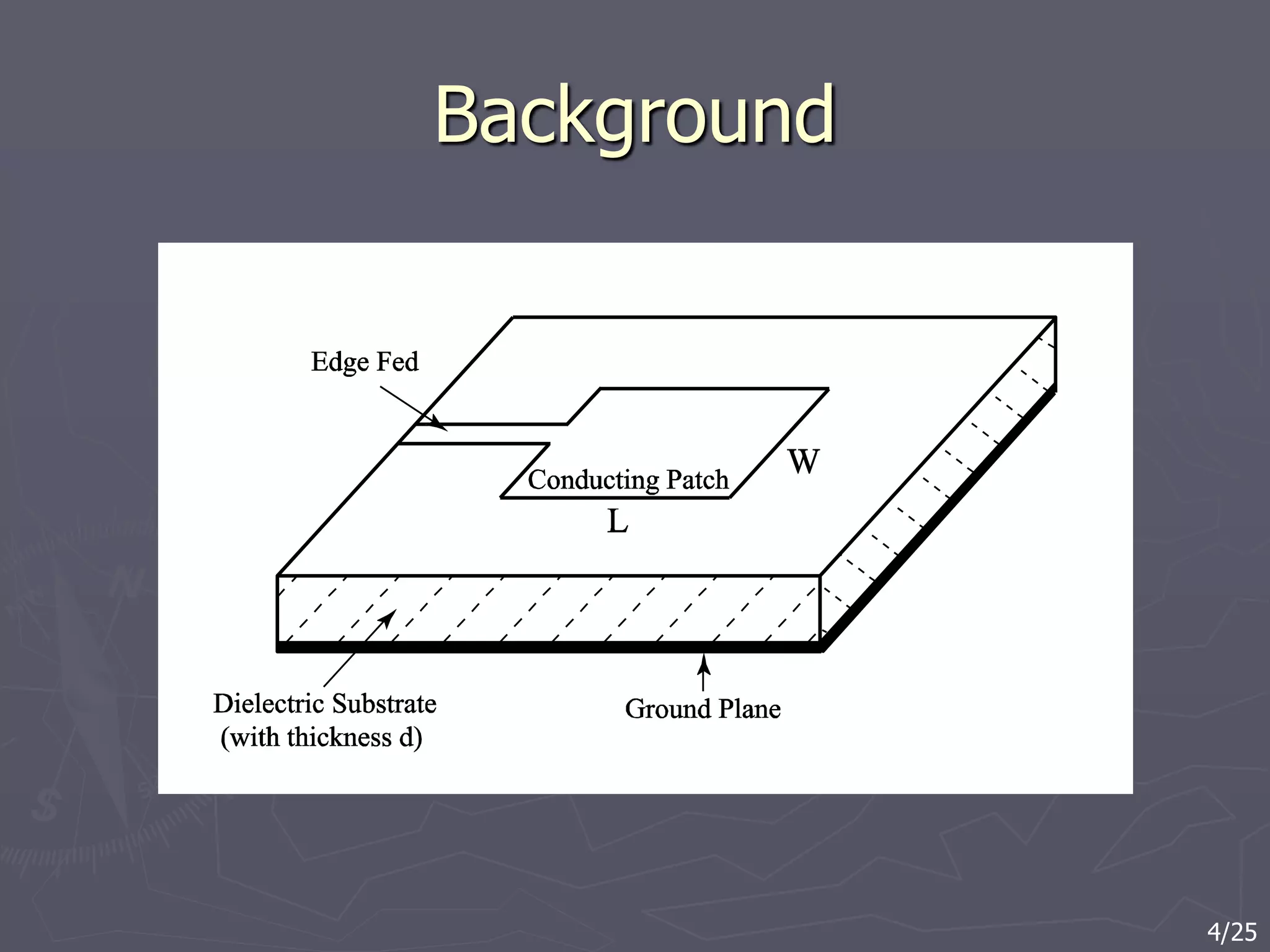
4/25
Background
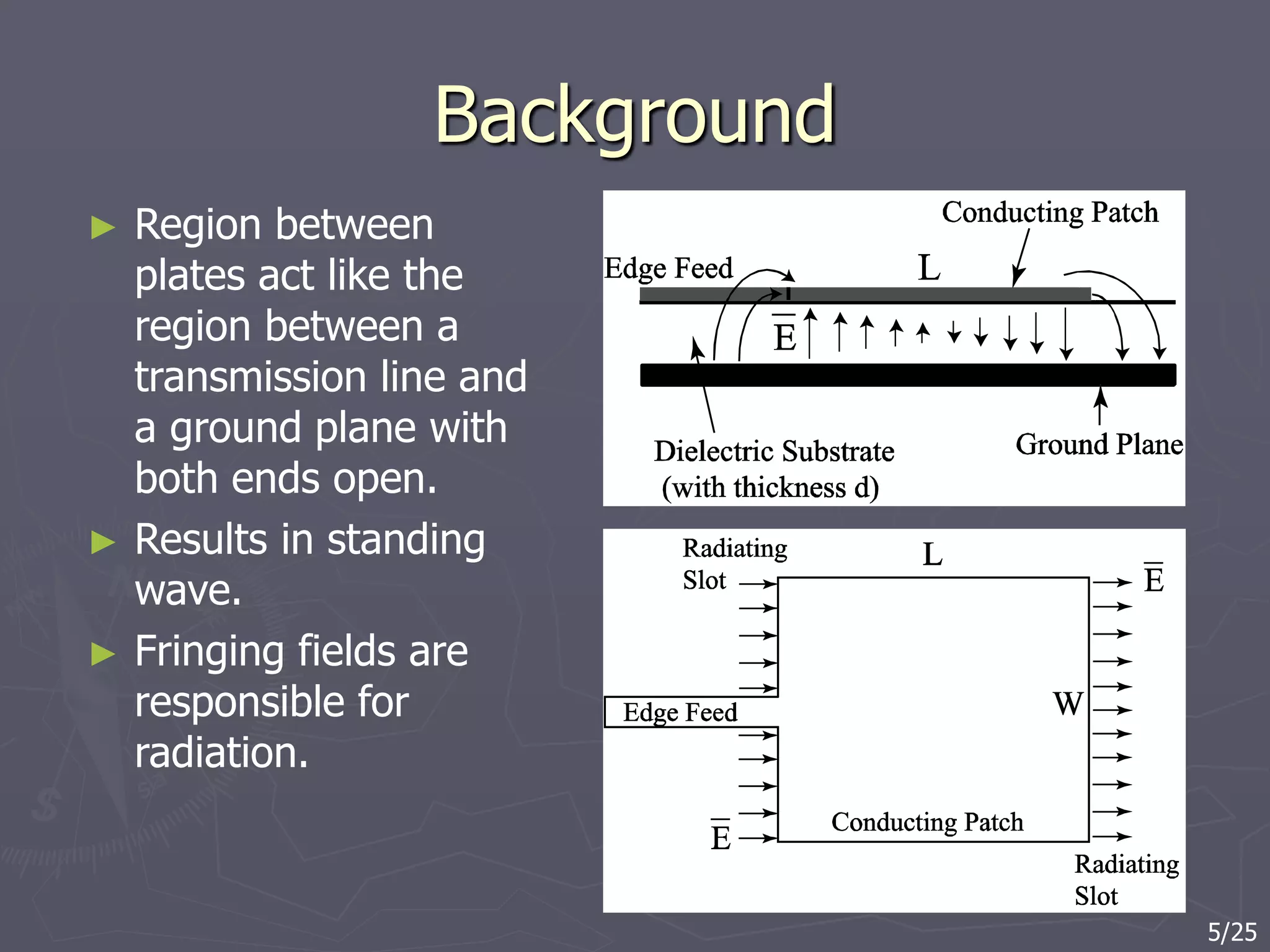
► Region between
plates act like the
region between a
transmission line and
a ground plane with
both ends open.
► Results in standing
wave.
► Fringing fields are
responsible for
radiation.
5/25
Background
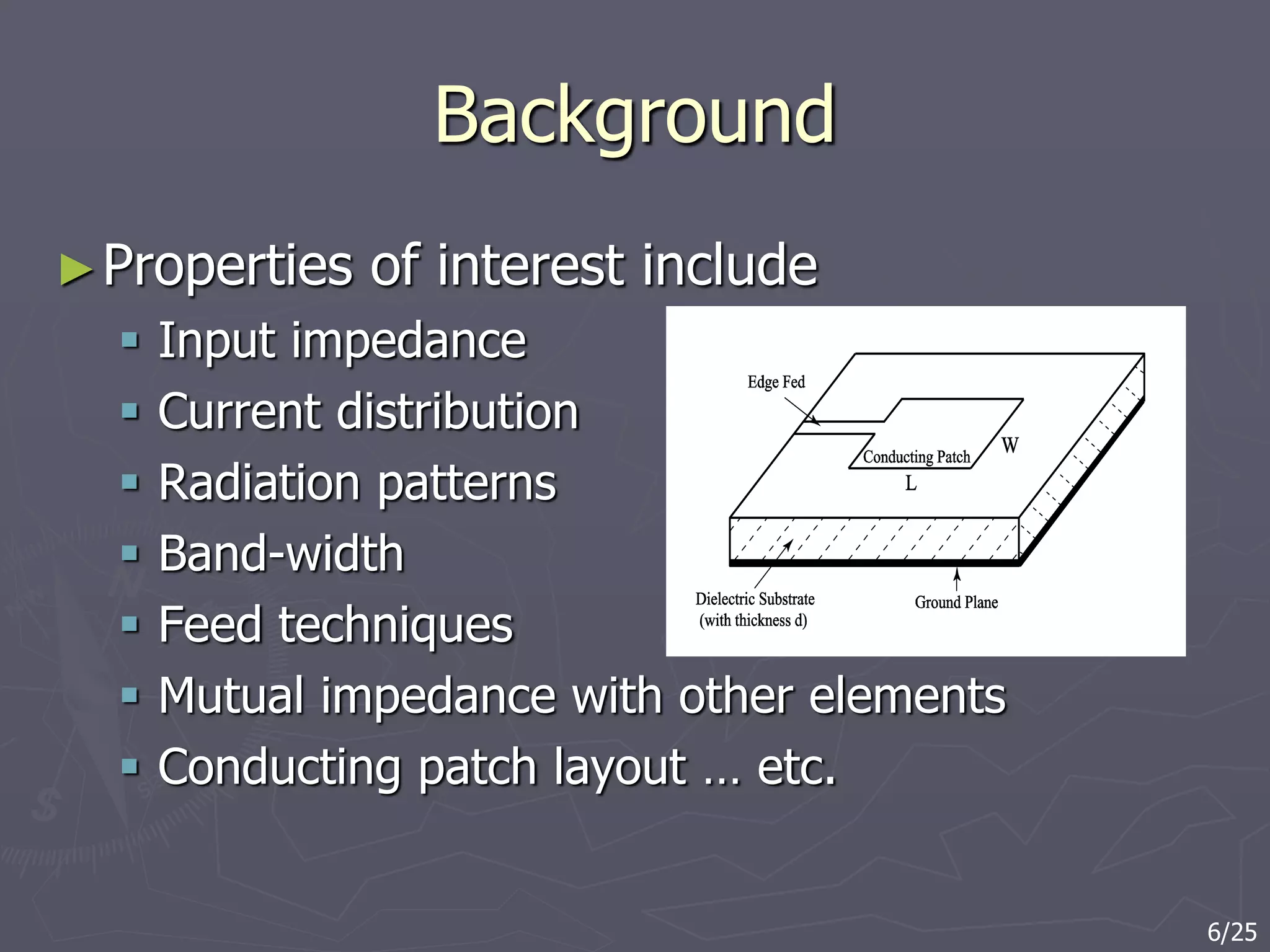
►Properties of interest include
 Input impedance
 Current distribution
 Radiation patterns
 Band-width
 Feed techniques
 Mutual impedance with other elements
 Conducting patch layout … etc.
6/25
Previous work-isolated antennas
► In 1979 a significant step was
taken by Uzunoglu,
Alexopoulos and Fikioris [9]
 microstrip dipoles
 radiation propoerties
 Based on Green’s function for
a hertizian dipole over a
grounded isotropic substrate
► Working from that base, Rana
and Alexopoulos presented
work in 1981 on the current
distribution and input
impedance of printed dipoles
[10].
[9] N.K. Uzunoglu, N.G. Alexopoulos and J.G. Fikioris, “Radiation properties of microstrip dipoles,'‘
IEEE Transactions on Antennas and Propagation, Vol. 27, No. 6, November 1979, pp. 853-858.
[10] I.E. Rana and N.G. Alexopoulos, “Current distribution and input impedance of printed dipoles,”
IEEE Transactions on Antennas and Propagation, Vol. 29, No. 1, January 1981, pp. 99-105.
7/25
Previous work-isolated antennas
► The above work with Green's functions in the spectral form laid the
foundation for future work by Pozar [11] and others to analyze
properties of other various microstrip antennas.
► In parallel with the development by Alexopoulos and his colleagues, in
1980 and 1981, Itoh and Mentzel [12]-[13] developed a spectral
domain immittance approach.
► This lead to the work by Lee and Tripathi [15] and later Nelson, Rogers
and d’Assuncao [16] to study layered anisotropic structures.
[11] D.M. Pozar, “Input impedance and mutual coupling of rectangular microstrip antennas,”
IEEE Transactions on Antennas and Propagation, Vol. 30, No. 6, November 1982, pp. 1191-1196.
[12] T. Itoh, “Spectral domain immitance approach for dispersion characteristics of generalized printed
transmission lines,” IEEE Transactions on Antennas and Propagation, Vol. 28, No. 7, July 1980, pp. 733-736.
[13] T. Itoh and W. Menzel, “A full-wave analysis method for open microstrip structures,”
IEEE Transactions on Microwave Theory and Techniques, Vol. 29, No. 1, January 1981, pp. 63-68.
[15] H. Lee and V.K. Tripathi, “Spectral domain analysis of frequency dependent propagation characteristics
of planar structures on uniaxial medium,” IEEE Transactions on Microwave Theory and Techniques, Vol.
30, No. 8, August 1982, pp. 1188-1193.
[16] R.M. Nelson, D.A. Rogers and A.G. D'Assuncao, “Resonant frequency of a rectangular microstrip patch
on several uniaxial substrates,” IEEE Transactions on Antennas and Propagation, Vol. 38, No. 7,
July 1990, pp. 973-981. 8/25
Previous work-mutual coupling
► In 1981, Alexopoulos and Rana [22] study the mutual
impedance between printed dipoles (Green’s function in
spectral form)
► Then in 1982, Pozar
presents the mututal
impedance between
rectangular microstrip
antennas [11]
[22] N.G. Alexopoulos and I.E. Rana, “Mutual impedance computation between printed dipoles,”
IEEE Transactions on Antennas and Propagation, Vol. 29, No. 1, January 1981, pp. 106-112.
[11] D.M. Pozar, “Input impedance and mutual coupling of rectangular microstrip antennas,”
IEEE Transactions on Antennas and Propagation, Vol. 30, No. 6, November 1982, pp. 1191-1196.
9/25
Current work
► In 1998, Waterhouse, Targonski and Kokotoff [36]
discuss the design and performance of using shorting
posts on a microstrip patch antenna on an isotropic
substrate.
► In 2001, Verma and Nisimuddin [34] investigate the
input impedance of rectangular microstrip antennas
 Different from work by Oliveira and d’Assuncao [20]
[36] R.B. Waterhouse, S.D. Targonski and D.M. Kokotoff, “Design and performance of small printed
antennas,” IEEE Transactions on Antennas and Propagation, Vol. 46, No. 11, November 1998.
[20] J.R.S. Oliveira and A.G. D'Assuncao, “Input impedance of microstrip patch antennas on anisotropic
dielectric substrates,” Antennas and Propagation Society International Symposium, 1996. AP-S. Digest,
Vol. 2, July 21-26, 1996, p. 1066-1069.
[34] A.K. Verma and Nasimuddin, “Input impedance of rectangular microstrip patch antenna with
iso/anisotropic substrate-superstrate,'‘ IEEE Microwave and Wireless Components Letters, Vol. 11, No. 11,
November 2001, pp. 456-458.
10/25
Current work
► Also in 2001, Shackelford,
Lee, Chatterjee, Guo, Luk
and Chair [39] present a
small-sized wide-band U-
slot and L-probe fed
microstrip antenna with
shorting walls.
[34] A. Shackelford, K.F. Lee, D. Chatterjee, Y.X. Guo,
K.M. Luk and R. Chair, “Small-size wide-bandwidth
microstrip patch antennas,” IEEE Antennas and
Propagation Society International Symposium, 2001,
Vol. 1, July 8-13, 2001, pp. 86-89.
11/25
Current work
► In 2003 Yang and Samii [48] presented a low mutual coupling design
of an array of electromagnetic band gap structures.
 Used FDTD
 Single anisotropic substrate
► In 2005 Chair, Kishk and Lee [49] presented work on the mutual
coupling between a 2 element array of circular patch antennas.
 Used IE3D [44]
 Single isotropic substrate on an isotropic dielectric substrate.
► Then, in 2007, Buell, Mosallaei and Sarabandi [45] used metamaterial
to suppress the mutual coupling between elements in a densely packed
array.
 metamaterial as isolation walls between the elements.
[48] F. Yang and Y. Rahmatt-Samii “Microstrip antennas integrated with electromagnetic band-gap
(EBG) structures: a low mutual coupling design for array applications,'‘ IEEE Transactions on Antennas
and Propagation, Vol. 51, No. 10, October 2003, pp. 2936-2946.
[49] R. Chair, A.A. Kishk and K-F. Lee, “Comparative study on the mutual coupling between different
sized cylindrical dielectric resonators antennas and circular microstrip patch antennas,” IEEE Transactions
on Antennas and Propagation, Vol. 53, No. 3, March 2005, pp. 1011-1019.
[44] www.zeland.com.
[45] K. Buell, H. Mosallaei and K. Sarabandi, “Metamaterial insulator enabled superdirective array,”
IEEE Transactions on Antennas and Propagation, Vol. 55, No. 4, April 2007, 1074-1085. 12/25
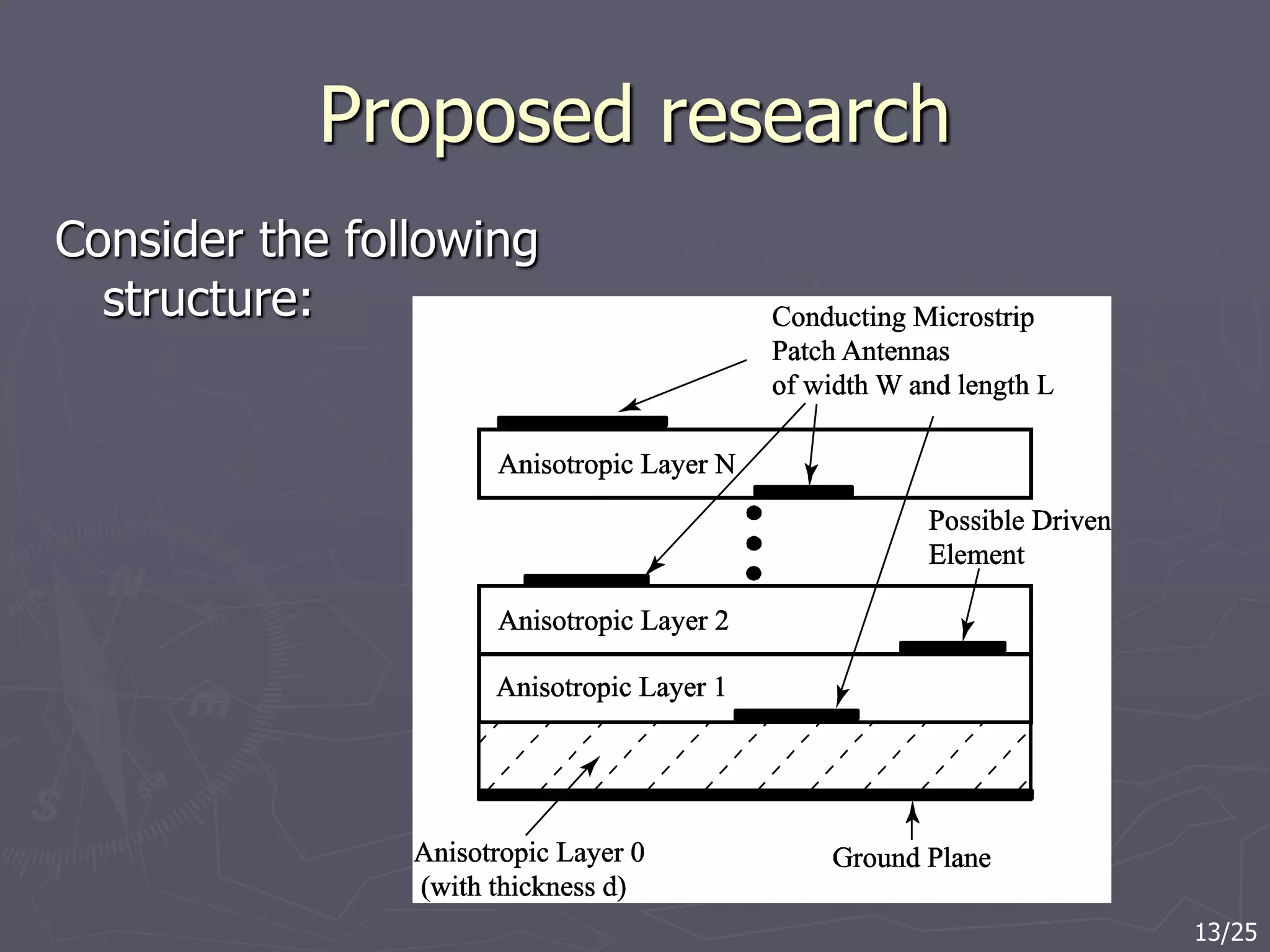
Proposed research
Consider the following
structure:
13/25
Proposed research
RESEARCH QUESTIONS:
► What is the input impedance of a driven element in the
layered anisotropic structure in the presence of other
conducting patches defined on arbitrary anisotropic layers
in the same structure?
and
► What is the mutual impedance between a driven element
in the layered anisotropic structure and other conducting
patches defined on arbitrary anisotropic layers in the same
structure?
14/25
Proposed research
The previous two questions are very
significant in many fields.
 Microstrip antenna arrays [3].
 Frequency Selective Structures (FSS) [53]
 Radio Frequency Identification (RFID) [56]
[3] David M. Pozar and Daniel H. Schaubert, “Microstrip Antennas: The analysis and Design of
Microstrip Antennas and Arrays”, IEEE Press, Piscataway, NJ, 1995.
[53] A.L.P.S. Campos an A.G. d'Assuncao, “Scattering paramters of a frequnecy selective surface
between anisotropic dielectric layers for incidnet co-polarized plane waves,” IEEE Antennas and
Propagation Society International Symposium, 2001, Vol. 4, July 8-13, 2001, p. 382-385.
[56] K. Finkenzeller, RFID Handbook:Fundamentals and Applications in Contactless Smart Cards
and Identification, John Wiley and Sons, West Sussex, England, 2003.
15/25
Technical Objectives
► Choose the appropriate types of microstrip
antennas that will allow the work to proceed to
answer the proposed questions.
► Choose and develop the numerical technique that
can be used to compute the input impedance and
mutual coupling between elements in the
anisotropic structure.
► Validate numerical results for the isotropic case
with commercially available software.
► Design and build a multiple layered structure to
measure and validate the numerical calculations of
input impedance and mutual coupling.
16/25
Work Plan
► Choose the appropriate types of microstrip
antennas that will allow the work to proceed to
answer the proposed questions.
 Printed dipoles by Alexopoulos and Rana [10]
 Rectangular microstrip antennas by Nelson [16], Pozar
[19], and Oliveira [20].
 UWB
[10] I.E. Rana and N.G. Alexopoulos, “Current distribution and input impedance of printed dipoles,”
IEEE Transactions on Antennas and Propagation, Vol. 29, No. 1, January 1981, pp. 99-105.
[16] R.M. Nelson, D.A. Rogers and A.G. D'Assuncao, “Resonant frequency of a rectangular microstrip patch
on several uniaxial substrates,” IEEE Transactions on Antennas and Propagation, Vol. 38, No. 7,
July 1990, pp. 973-981.
[19] D.M. Pozar, “Radiation and scattering from a microstrip patch on a uniaxial substrate,” IEEE
Transactions on Antennas and Propagation, Vol. 35, No. 6, June 1987, pp. 613-621.
[20] J.R.S. Oliveira and A.G. D'Assuncao, “Input impedance of microstrip patch antennas on anisotropic
dielectric substrates,” Antennas and Propagation Society International Symposium, 1996. AP-S. Digest,
Vol. 2, July 21-26, 1996, p. 1066-1069. 17/25
Work Plan
► Choose and develop the numerical technique that can be used to
compute the input impedance and mutual coupling between elements
in the anisotropic structure.
 Exact Green’s function [11, Pozar]
► Numerical integration and derivatives are extensive
► Developed to evaluate problems with anisotropic material
► Developed to evaluate problems with multiple anisotropic layers
 Equivalent magnetic source [30, Benalla]
► Field expression are much simpler
► Numerical integration and derivatives are extensive
► Needs to be extended to evaluate the problems proposed here
 Spectral domain immittance method [16, Nelson]
► Derivation is lengthy
► Needs to be developed to compute mutual impedance
► Numerical integration is nice
► No derivative approximations
► Developed to evaluate problems with multiple anisotropic materials
18/25
Work Plan
►Validate numerical results for the isotropic
case with commercially available software.
 Use Momentum in Advanced Design System
(ADS) [64].
 Reproduce printed dipole work by Rana and
Alexopoulos [22].
 Reproduce rectangular microstrip results by
Pozar [11].
[22] N.G. Alexopoulos and I.E. Rana, “Mutual impedance computation between printed dipoles,”
IEEE Transactions on Antennas and Propagation, Vol. 29, No. 1, January 1981, pp. 106-112.
[11] D.M. Pozar, “Input impedance and mutual coupling of rectangular microstrip antennas,”
IEEE Transactions on Antennas and Propagation, Vol. 30, No. 6, November 1982, pp. 1191-1196.
[64] www.agilent.com.
19/25
Work Plan
Many significant results will be obtained by
looking at the previous problems in
Momentum:
 The problems will validate the numerically
extensive code using the spectral domain
immittance method
 The new code can be used for multiple patch
geometries
 Momentum can be used as a good tool in this
type of research
20/25
Work Plan
► Design and build a multiple
layered structure to
measure and validate the
numerical calculations of
input impedance and
mutual coupling.
 Jadlecka, Poe and Carver
[24] – measurement
technique
 Validates code with
measurements
[24] R.P. Jedlicka, M.T. Poe and K.R. Carver,
“Measured mutual coupling between microstrip
antennas,” IEEE Transactions on Antennas
and Propagation, Vol. 29, No. 1, January 1981.
21/25
Initial work
►Derivation of the immittance functions for
the single layer isotropic case
►Polar and rectangular integration of the
immittance functions have been started and
compare well with Nelson’s Fortran results
22/25
Significance of anticipated results
► Mutual impedance will significantly effect input impedance
of driven elements
► Appropriate values of permittivity could possibly minimize
mutual impedance (Krowne [17] and Wang [62])
► Possible reduction of array surface area
 Values of permittivity
 Conducting surface on multiple layers
► UWB antennas
► 60GHz-90GHz band
► Dual frequency antennas
► RFID systems
[17] C.M. Krowne, “Green's function in the spectral domain for biaxial and uniaxial anisotropic planar
dielectric structures,” IEEE Transactions on Antennas and Propagation, Vol. 32, No. 12, December 1984.
[62] W.J. Wang, “Multilayered printed antennas with biaxial anisotropic dielectric substrates:
general analysis and case studies,” Ph.D. Dissertation, Polytechnic University, January 2002.
23/25
Conclusion
► A method for investigating the input impedance
and mutual coupling of multiple microstrip
antennas on multiple anisotropic layers is
presented.
► Based on the spectral domain immittance method
► Areas of interest include
 RFID
 Microstrip arrays – UWB, dual frequncy, … .etc
 EMC
24/25
Questions?
25/25

Phd proposal presentation

  • 1.
    Properties of MultipleMicrostrip Antennas in Several Layers of Anisotropic Material A Dissertation Proposal By Benjamin Braaten February 19, 2008
  • 2.
    Outline ►Background  The microstripantenna and mutual coupling  Previous work ►Proposed research  Research questions  Technical objectives and work plan  Initial work ►Significance of anticipated results ►Conclusion 2/25
  • 3.
    Background ► Since Deschamps's[1] formal presentation of a microstrip antenna in 1953 and detailed discussion by Alexopoulos [2] there has been an extensive amount of research devoted to the study of various printed antennas and arrays. ► It is well known that printed antennas are [3]  very light  occupy a small volume  are useful at higher frequencies (f>1GHz)  provide a wide range of patterns [1] G.A. Deschamps, “Microstrip Microwave Antennas,” 3rd USAF Symposium on Antennas, 1953. [2] N.G. Alexopoulus, “Integrated-circuit structures on anisotropic substrates,” IEEE Transactions on Microwave Theory and Techniques, Vol. 33, No. 10, October 1985, pp. 847-881. [3] David M. Pozar and Daniel H. Schaubert, “Microstrip Antennas: The analysis and Design of Microstrip Antennas and Arrays,” IEEE Press, Piscataway, NJ, 1995. 3/25
  • 4.
  • 5.
    Background ► Region between platesact like the region between a transmission line and a ground plane with both ends open. ► Results in standing wave. ► Fringing fields are responsible for radiation. 5/25
  • 6.
    Background ►Properties of interestinclude  Input impedance  Current distribution  Radiation patterns  Band-width  Feed techniques  Mutual impedance with other elements  Conducting patch layout … etc. 6/25
  • 7.
    Previous work-isolated antennas ►In 1979 a significant step was taken by Uzunoglu, Alexopoulos and Fikioris [9]  microstrip dipoles  radiation propoerties  Based on Green’s function for a hertizian dipole over a grounded isotropic substrate ► Working from that base, Rana and Alexopoulos presented work in 1981 on the current distribution and input impedance of printed dipoles [10]. [9] N.K. Uzunoglu, N.G. Alexopoulos and J.G. Fikioris, “Radiation properties of microstrip dipoles,'‘ IEEE Transactions on Antennas and Propagation, Vol. 27, No. 6, November 1979, pp. 853-858. [10] I.E. Rana and N.G. Alexopoulos, “Current distribution and input impedance of printed dipoles,” IEEE Transactions on Antennas and Propagation, Vol. 29, No. 1, January 1981, pp. 99-105. 7/25
  • 8.
    Previous work-isolated antennas ►The above work with Green's functions in the spectral form laid the foundation for future work by Pozar [11] and others to analyze properties of other various microstrip antennas. ► In parallel with the development by Alexopoulos and his colleagues, in 1980 and 1981, Itoh and Mentzel [12]-[13] developed a spectral domain immittance approach. ► This lead to the work by Lee and Tripathi [15] and later Nelson, Rogers and d’Assuncao [16] to study layered anisotropic structures. [11] D.M. Pozar, “Input impedance and mutual coupling of rectangular microstrip antennas,” IEEE Transactions on Antennas and Propagation, Vol. 30, No. 6, November 1982, pp. 1191-1196. [12] T. Itoh, “Spectral domain immitance approach for dispersion characteristics of generalized printed transmission lines,” IEEE Transactions on Antennas and Propagation, Vol. 28, No. 7, July 1980, pp. 733-736. [13] T. Itoh and W. Menzel, “A full-wave analysis method for open microstrip structures,” IEEE Transactions on Microwave Theory and Techniques, Vol. 29, No. 1, January 1981, pp. 63-68. [15] H. Lee and V.K. Tripathi, “Spectral domain analysis of frequency dependent propagation characteristics of planar structures on uniaxial medium,” IEEE Transactions on Microwave Theory and Techniques, Vol. 30, No. 8, August 1982, pp. 1188-1193. [16] R.M. Nelson, D.A. Rogers and A.G. D'Assuncao, “Resonant frequency of a rectangular microstrip patch on several uniaxial substrates,” IEEE Transactions on Antennas and Propagation, Vol. 38, No. 7, July 1990, pp. 973-981. 8/25
  • 9.
    Previous work-mutual coupling ►In 1981, Alexopoulos and Rana [22] study the mutual impedance between printed dipoles (Green’s function in spectral form) ► Then in 1982, Pozar presents the mututal impedance between rectangular microstrip antennas [11] [22] N.G. Alexopoulos and I.E. Rana, “Mutual impedance computation between printed dipoles,” IEEE Transactions on Antennas and Propagation, Vol. 29, No. 1, January 1981, pp. 106-112. [11] D.M. Pozar, “Input impedance and mutual coupling of rectangular microstrip antennas,” IEEE Transactions on Antennas and Propagation, Vol. 30, No. 6, November 1982, pp. 1191-1196. 9/25
  • 10.
    Current work ► In1998, Waterhouse, Targonski and Kokotoff [36] discuss the design and performance of using shorting posts on a microstrip patch antenna on an isotropic substrate. ► In 2001, Verma and Nisimuddin [34] investigate the input impedance of rectangular microstrip antennas  Different from work by Oliveira and d’Assuncao [20] [36] R.B. Waterhouse, S.D. Targonski and D.M. Kokotoff, “Design and performance of small printed antennas,” IEEE Transactions on Antennas and Propagation, Vol. 46, No. 11, November 1998. [20] J.R.S. Oliveira and A.G. D'Assuncao, “Input impedance of microstrip patch antennas on anisotropic dielectric substrates,” Antennas and Propagation Society International Symposium, 1996. AP-S. Digest, Vol. 2, July 21-26, 1996, p. 1066-1069. [34] A.K. Verma and Nasimuddin, “Input impedance of rectangular microstrip patch antenna with iso/anisotropic substrate-superstrate,'‘ IEEE Microwave and Wireless Components Letters, Vol. 11, No. 11, November 2001, pp. 456-458. 10/25
  • 11.
    Current work ► Alsoin 2001, Shackelford, Lee, Chatterjee, Guo, Luk and Chair [39] present a small-sized wide-band U- slot and L-probe fed microstrip antenna with shorting walls. [34] A. Shackelford, K.F. Lee, D. Chatterjee, Y.X. Guo, K.M. Luk and R. Chair, “Small-size wide-bandwidth microstrip patch antennas,” IEEE Antennas and Propagation Society International Symposium, 2001, Vol. 1, July 8-13, 2001, pp. 86-89. 11/25
  • 12.
    Current work ► In2003 Yang and Samii [48] presented a low mutual coupling design of an array of electromagnetic band gap structures.  Used FDTD  Single anisotropic substrate ► In 2005 Chair, Kishk and Lee [49] presented work on the mutual coupling between a 2 element array of circular patch antennas.  Used IE3D [44]  Single isotropic substrate on an isotropic dielectric substrate. ► Then, in 2007, Buell, Mosallaei and Sarabandi [45] used metamaterial to suppress the mutual coupling between elements in a densely packed array.  metamaterial as isolation walls between the elements. [48] F. Yang and Y. Rahmatt-Samii “Microstrip antennas integrated with electromagnetic band-gap (EBG) structures: a low mutual coupling design for array applications,'‘ IEEE Transactions on Antennas and Propagation, Vol. 51, No. 10, October 2003, pp. 2936-2946. [49] R. Chair, A.A. Kishk and K-F. Lee, “Comparative study on the mutual coupling between different sized cylindrical dielectric resonators antennas and circular microstrip patch antennas,” IEEE Transactions on Antennas and Propagation, Vol. 53, No. 3, March 2005, pp. 1011-1019. [44] www.zeland.com. [45] K. Buell, H. Mosallaei and K. Sarabandi, “Metamaterial insulator enabled superdirective array,” IEEE Transactions on Antennas and Propagation, Vol. 55, No. 4, April 2007, 1074-1085. 12/25
  • 13.
    Proposed research Consider thefollowing structure: 13/25
  • 14.
    Proposed research RESEARCH QUESTIONS: ►What is the input impedance of a driven element in the layered anisotropic structure in the presence of other conducting patches defined on arbitrary anisotropic layers in the same structure? and ► What is the mutual impedance between a driven element in the layered anisotropic structure and other conducting patches defined on arbitrary anisotropic layers in the same structure? 14/25
  • 15.
    Proposed research The previoustwo questions are very significant in many fields.  Microstrip antenna arrays [3].  Frequency Selective Structures (FSS) [53]  Radio Frequency Identification (RFID) [56] [3] David M. Pozar and Daniel H. Schaubert, “Microstrip Antennas: The analysis and Design of Microstrip Antennas and Arrays”, IEEE Press, Piscataway, NJ, 1995. [53] A.L.P.S. Campos an A.G. d'Assuncao, “Scattering paramters of a frequnecy selective surface between anisotropic dielectric layers for incidnet co-polarized plane waves,” IEEE Antennas and Propagation Society International Symposium, 2001, Vol. 4, July 8-13, 2001, p. 382-385. [56] K. Finkenzeller, RFID Handbook:Fundamentals and Applications in Contactless Smart Cards and Identification, John Wiley and Sons, West Sussex, England, 2003. 15/25
  • 16.
    Technical Objectives ► Choosethe appropriate types of microstrip antennas that will allow the work to proceed to answer the proposed questions. ► Choose and develop the numerical technique that can be used to compute the input impedance and mutual coupling between elements in the anisotropic structure. ► Validate numerical results for the isotropic case with commercially available software. ► Design and build a multiple layered structure to measure and validate the numerical calculations of input impedance and mutual coupling. 16/25
  • 17.
    Work Plan ► Choosethe appropriate types of microstrip antennas that will allow the work to proceed to answer the proposed questions.  Printed dipoles by Alexopoulos and Rana [10]  Rectangular microstrip antennas by Nelson [16], Pozar [19], and Oliveira [20].  UWB [10] I.E. Rana and N.G. Alexopoulos, “Current distribution and input impedance of printed dipoles,” IEEE Transactions on Antennas and Propagation, Vol. 29, No. 1, January 1981, pp. 99-105. [16] R.M. Nelson, D.A. Rogers and A.G. D'Assuncao, “Resonant frequency of a rectangular microstrip patch on several uniaxial substrates,” IEEE Transactions on Antennas and Propagation, Vol. 38, No. 7, July 1990, pp. 973-981. [19] D.M. Pozar, “Radiation and scattering from a microstrip patch on a uniaxial substrate,” IEEE Transactions on Antennas and Propagation, Vol. 35, No. 6, June 1987, pp. 613-621. [20] J.R.S. Oliveira and A.G. D'Assuncao, “Input impedance of microstrip patch antennas on anisotropic dielectric substrates,” Antennas and Propagation Society International Symposium, 1996. AP-S. Digest, Vol. 2, July 21-26, 1996, p. 1066-1069. 17/25
  • 18.
    Work Plan ► Chooseand develop the numerical technique that can be used to compute the input impedance and mutual coupling between elements in the anisotropic structure.  Exact Green’s function [11, Pozar] ► Numerical integration and derivatives are extensive ► Developed to evaluate problems with anisotropic material ► Developed to evaluate problems with multiple anisotropic layers  Equivalent magnetic source [30, Benalla] ► Field expression are much simpler ► Numerical integration and derivatives are extensive ► Needs to be extended to evaluate the problems proposed here  Spectral domain immittance method [16, Nelson] ► Derivation is lengthy ► Needs to be developed to compute mutual impedance ► Numerical integration is nice ► No derivative approximations ► Developed to evaluate problems with multiple anisotropic materials 18/25
  • 19.
    Work Plan ►Validate numericalresults for the isotropic case with commercially available software.  Use Momentum in Advanced Design System (ADS) [64].  Reproduce printed dipole work by Rana and Alexopoulos [22].  Reproduce rectangular microstrip results by Pozar [11]. [22] N.G. Alexopoulos and I.E. Rana, “Mutual impedance computation between printed dipoles,” IEEE Transactions on Antennas and Propagation, Vol. 29, No. 1, January 1981, pp. 106-112. [11] D.M. Pozar, “Input impedance and mutual coupling of rectangular microstrip antennas,” IEEE Transactions on Antennas and Propagation, Vol. 30, No. 6, November 1982, pp. 1191-1196. [64] www.agilent.com. 19/25
  • 20.
    Work Plan Many significantresults will be obtained by looking at the previous problems in Momentum:  The problems will validate the numerically extensive code using the spectral domain immittance method  The new code can be used for multiple patch geometries  Momentum can be used as a good tool in this type of research 20/25
  • 21.
    Work Plan ► Designand build a multiple layered structure to measure and validate the numerical calculations of input impedance and mutual coupling.  Jadlecka, Poe and Carver [24] – measurement technique  Validates code with measurements [24] R.P. Jedlicka, M.T. Poe and K.R. Carver, “Measured mutual coupling between microstrip antennas,” IEEE Transactions on Antennas and Propagation, Vol. 29, No. 1, January 1981. 21/25
  • 22.
    Initial work ►Derivation ofthe immittance functions for the single layer isotropic case ►Polar and rectangular integration of the immittance functions have been started and compare well with Nelson’s Fortran results 22/25
  • 23.
    Significance of anticipatedresults ► Mutual impedance will significantly effect input impedance of driven elements ► Appropriate values of permittivity could possibly minimize mutual impedance (Krowne [17] and Wang [62]) ► Possible reduction of array surface area  Values of permittivity  Conducting surface on multiple layers ► UWB antennas ► 60GHz-90GHz band ► Dual frequency antennas ► RFID systems [17] C.M. Krowne, “Green's function in the spectral domain for biaxial and uniaxial anisotropic planar dielectric structures,” IEEE Transactions on Antennas and Propagation, Vol. 32, No. 12, December 1984. [62] W.J. Wang, “Multilayered printed antennas with biaxial anisotropic dielectric substrates: general analysis and case studies,” Ph.D. Dissertation, Polytechnic University, January 2002. 23/25
  • 24.
    Conclusion ► A methodfor investigating the input impedance and mutual coupling of multiple microstrip antennas on multiple anisotropic layers is presented. ► Based on the spectral domain immittance method ► Areas of interest include  RFID  Microstrip arrays – UWB, dual frequncy, … .etc  EMC 24/25
  • 25.