PHASES OF NEURAL DEVELOPMENT IN LEARNING Phases of Neural Development
Revision a) Identify and explain 5 key areas of the brain thought to be involved in learning (5 marks)
Why is learning important............ It is crucial to  SURVIVAL
Donald Hebb (1946) Theorised that when two neurons are jointly activated they become more closely linked ‘ neurons that fire together wire together’ This creates neural pathways (neural circuits) which are an interconnected groups of neurons organised as a network that is active during the learning process
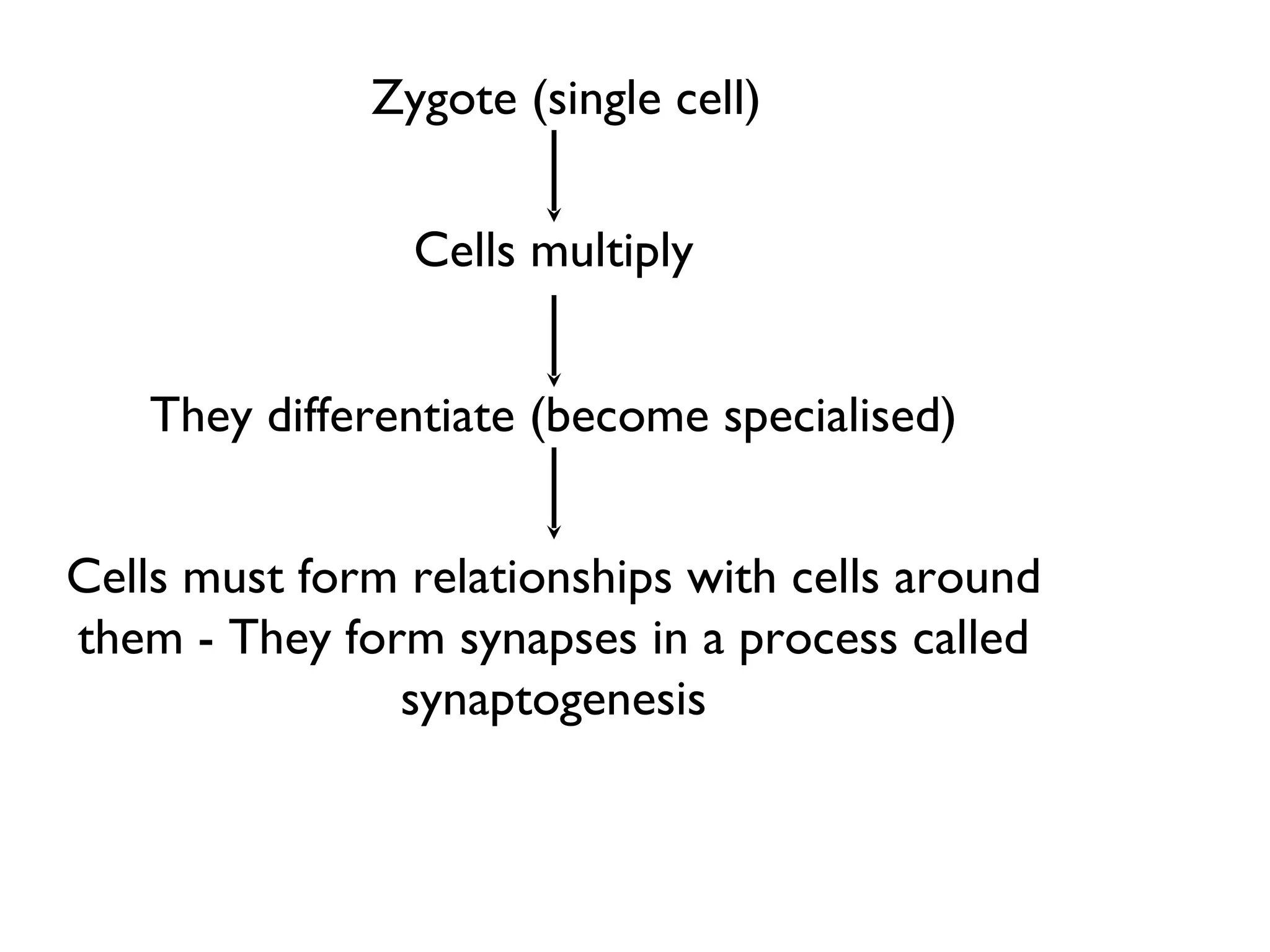
Zygote (single cell) Cells multiply They differentiate (become specialised) Cells must form relationships with cells around them - They form synapses in a process called synaptogenesis
Synaptogensis  Synaptogensis occurs throughout a healthy person’s lifetime   This happens rapidly from 2months before birth - 2years of age
Effects of Experience on Neural Development Genetics alone do not determine neural development Experience plays a part in neural development   Hebb proposed that use of neurons improved their function ‘Use it or loose it’
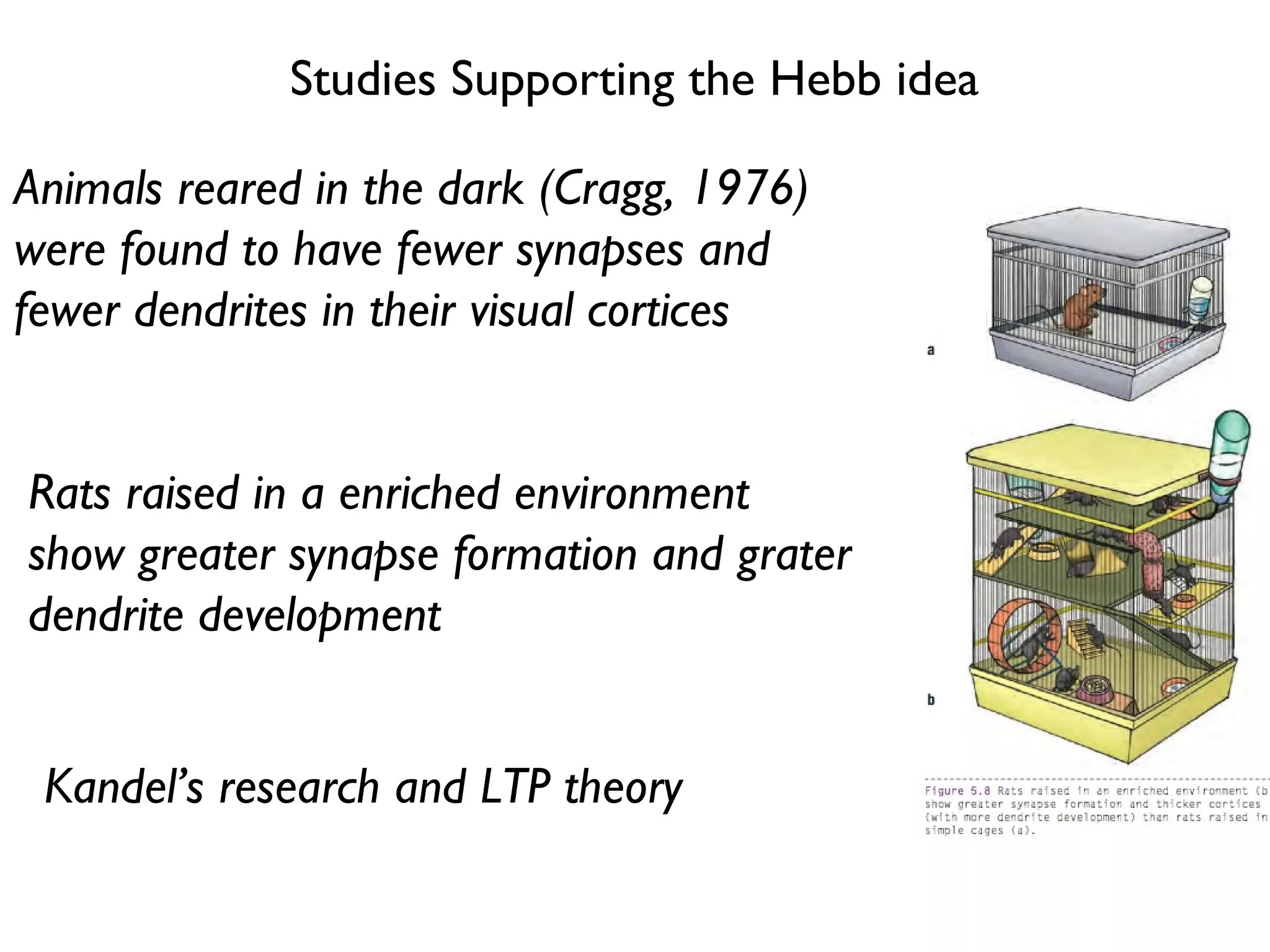
Studies Supporting the Hebb idea Animals reared in the dark (Cragg, 1976) were found to have fewer synapses and fewer dendrites in their visual cortices Rats raised in a enriched environment show greater synapse formation and grater dendrite development Kandel’s research and LTP theory
What is LTP again.......... The long-lasting strengthening of synaptic connections resulting in enhanced function of neurons along a neural pathway whenever activated LTP is a crucial mechanism of learning: Learning may not be possible without it
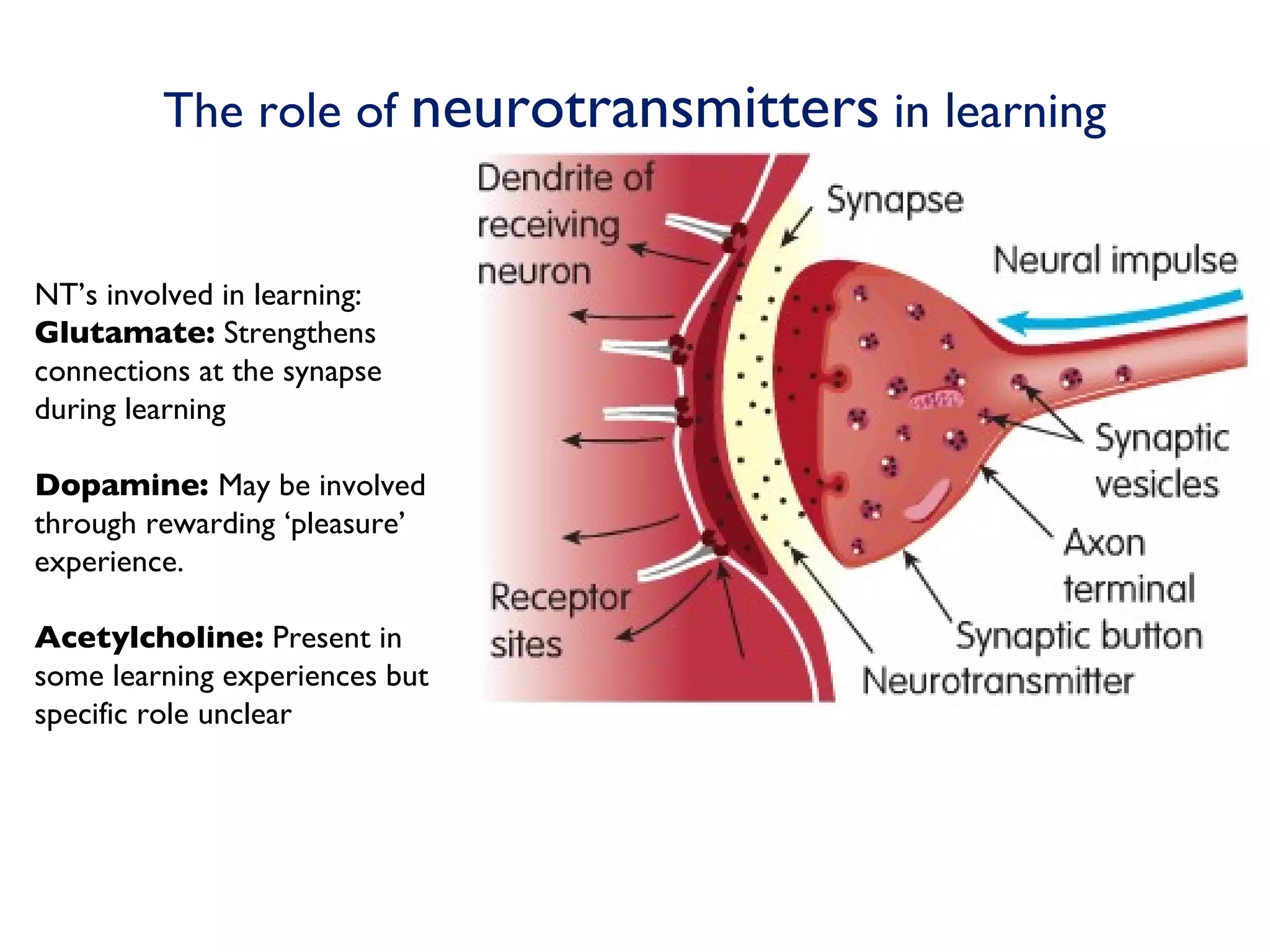
The role of  neurotransmitters  in learning NT’s involved in learning: Glutamate:  Strengthens  connections at the synapse during learning Dopamine:  May be involved through rewarding ‘pleasure’ experience. Acetylcholine:  Present in some learning experiences but specific role unclear

Phases of neural dvelopment

  • 1.
    PHASES OF NEURALDEVELOPMENT IN LEARNING Phases of Neural Development
  • 2.
    Revision a) Identifyand explain 5 key areas of the brain thought to be involved in learning (5 marks)
  • 3.
    Why is learningimportant............ It is crucial to SURVIVAL
  • 4.
    Donald Hebb (1946)Theorised that when two neurons are jointly activated they become more closely linked ‘ neurons that fire together wire together’ This creates neural pathways (neural circuits) which are an interconnected groups of neurons organised as a network that is active during the learning process
  • 5.
    Zygote (single cell)Cells multiply They differentiate (become specialised) Cells must form relationships with cells around them - They form synapses in a process called synaptogenesis
  • 6.
    Synaptogensis Synaptogensisoccurs throughout a healthy person’s lifetime This happens rapidly from 2months before birth - 2years of age
  • 7.
    Effects of Experienceon Neural Development Genetics alone do not determine neural development Experience plays a part in neural development Hebb proposed that use of neurons improved their function ‘Use it or loose it’
  • 8.
    Studies Supporting theHebb idea Animals reared in the dark (Cragg, 1976) were found to have fewer synapses and fewer dendrites in their visual cortices Rats raised in a enriched environment show greater synapse formation and grater dendrite development Kandel’s research and LTP theory
  • 9.
    What is LTPagain.......... The long-lasting strengthening of synaptic connections resulting in enhanced function of neurons along a neural pathway whenever activated LTP is a crucial mechanism of learning: Learning may not be possible without it
  • 10.
    The role of neurotransmitters in learning NT’s involved in learning: Glutamate: Strengthens connections at the synapse during learning Dopamine: May be involved through rewarding ‘pleasure’ experience. Acetylcholine: Present in some learning experiences but specific role unclear