Pharmacy Essentials for HIV Screening and
Management
This activity is supported by independent educational grants from
Gilead Sciences and ViiV Healthcare.
About These Slides
 Please feel free to use, update, and share some or all of these slides in
your noncommercial presentations to colleagues or patients
 When using our slides, please retain the source attribution:
 These slides may not be published, posted online, or used in
commercial presentations without permission. Please contact
permissions@clinicaloptions.com for details
Slide credit: clinicaloptions.com
Faculty
Jennifer Cocohoba, PharmD
Professor
Department of Clinical Pharmacy
University of California, San Francisco
San Francisco, California
Jennifer Cocohoba, PharmD, has no real or apparent conflicts of interest to
report.
Program Overview
 A Contemporary Picture of HIV in the United States
 Assessing Risk and Testing for HIV
 ARV Pharmacology
 Treatment of HIV
 Essential ART Drug–Drug Interactions
 Supporting Treatment Adherence
Slide credit: clinicaloptions.com
A Contemporary Picture of
HIV in the United States
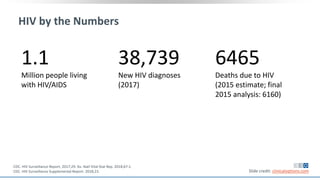
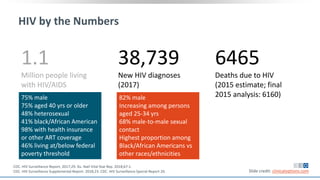
HIV by the Numbers
1.1
Million people living
with HIV/AIDS
38,739
New HIV diagnoses
(2017)
6465
Deaths due to HIV
(2015 estimate; final
2015 analysis: 6160)
Slide credit: clinicaloptions.com
CDC. HIV Surveillance Report, 2017;29. Xu. Natl Vital Stat Rep. 2018;67:1.
CDC. HIV Surveillance Supplemental Report. 2018;23.
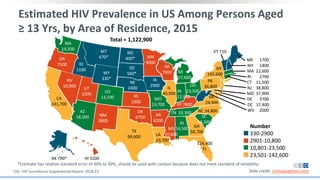
Estimated HIV Prevalence in US Among Persons Aged
≥ 13 Yrs, by Area of Residence, 2015
Slide credit: clinicaloptions.com
Total = 1,122,900
*Estimate has relative standard error of 30% to 50%, should be used with caution because does not meet standard of reliability.
CDC. HIV Surveillance Supplemental Report. 2018;23.
Number
330-2900
2901-10,800
10,801-23,500
23,501-142,600
WA
14,500
OR
7500
CA
141,700
NV
10,800
AZ
18,000
UT
3200
ID
1100
MT
670*
WY
330*
CO
13,100
NM
3800
TX
99,600
OK
6700
KS
3300
NE
2400
SD
560*
ND
400* MN
9000
IA
2900
MO
13,700
AR
6200
LA
23,700
IL
40,900
WI
7000 MI
17,600
IN
12,900
OH
23,500
MS
10,600
AL
14,500
GA
58,700
124,400
FL
SC
19,200
TN 19,300 NC 34,800
VA
24,900
PA
36,800
NY
142,600
ME 1700
NH 1400
MA 22,600
RI 2700
CT 11,500
NJ 38,800
MD 37,900
DE 3700
DC 17,400
WV 2000
VT 710
KY 7800
AK 790* HI 3200
HIV by the Numbers
1.1
Million people living
with HIV/AIDS
38,739
New HIV diagnoses
(2017)
6465
Deaths due to HIV
(2015 estimate; final
2015 analysis: 6160)
Slide credit: clinicaloptions.com
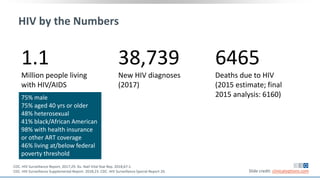
75% male
75% aged 40 yrs or older
48% heterosexual
41% black/African American
98% with health insurance
or other ART coverage
46% living at/below federal
poverty threshold
CDC. HIV Surveillance Report, 2017;29. Xu. Natl Vital Stat Rep. 2018;67:1.
CDC. HIV Surveillance Supplemental Report. 2018;23. CDC. HIV Surveillance Special Report 20.
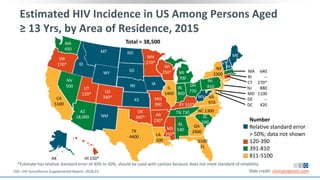
Estimated HIV Incidence in US Among Persons Aged
≥ 13 Yrs, by Area of Residence, 2015
Total = 38,500
Slide credit: clinicaloptions.com
*Estimate has relative standard error of 30% to 50%, should be used with caution because does not meet standard of reliability.
CDC. HIV Surveillance Supplemental Report. 2018;23.
Number
Relative standard error
> 50%; data not shown
120-390
391-810
811-5100
WA
450
OR
170*
CA
5100
NV
500
AZ
18,000
UT
120*
ID
MT
WY
CO
340*
NM
TX
4400
OK
260*
KS
NE
SD
ND
MN
270*
IA
MO
390
AR
230*
LA
100
IL
1400
WI
250* MI
700
IN
800
OH
770
MS
350*
AL
540
GA
2400
5100
FL
SC
590
TN 730 NC 1300
VA
970
PA
810
NY
3300
MA 640
RI --
CT 270*
NJ 880
MD 1100
DE --
DC 420
VT
KY 310*
AK HI 150*
WV
NH
ME
HIV by the Numbers
1.1
Million people living
with HIV/AIDS
38,739
New HIV diagnoses
(2017)
6465
Deaths due to HIV
(2015 estimate; final
2015 analysis: 6160)
Slide credit: clinicaloptions.com
CDC. HIV Surveillance Report, 2017;29. Xu. Natl Vital Stat Rep. 2018;67:1.
CDC. HIV Surveillance Supplemental Report. 2018;23. CDC. HIV Surveillance Special Report 20.
82% male
Increasing among persons
aged 25-34 yrs
68% male-to-male sexual
contact
Highest proportion among
Black/African Americans vs
other races/ethnicities
75% male
75% aged 40 yrs or older
48% heterosexual
41% black/African American
98% with health insurance
or other ART coverage
46% living at/below federal
poverty threshold
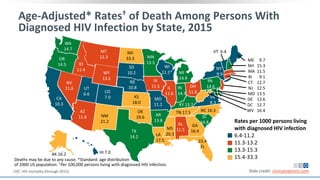
Age-Adjusted* Rates† of Death Among Persons With
Diagnosed HIV Infection by State, 2015
Slide credit: clinicaloptions.comCDC. HIV mortality (through 2015).
Rates per 1000 persons living
with diagnosed HIV infection
6.4-11.2
11.3-13.2
13.3-15.3
15.4-33.3
WA
14.7
OR
14.5
CA
10.3
NV
11.6
AZ
11.8
UT
6.6
ID
11.4
MT
12.3
WY
13.2
CO
7.0
NM
21.2
TX
14.2
OK
19.6
KS
18.0
NE
10.8
SD
10.2
ND
33.3 MN
13.5
IA
11.5
MO
11.2
AR
13.8
LA
17.5
IL
11.6
WI
11.1* MI
14.9
IN
14.3
OH
11.8
MS
20.3
AL
11.5
GA
16.4
15.4
FL
SC
14.8
TN 17.5 NC 16.3
VA
8.3
PA
14.6
NY
9.9
KY 13.7
AK 16.2 HI 7.0
ME 9.7
NH 15.3
MA 11.5
RI 9.1
CT 12.7
NJ 12.5
MD 13.5
DE 13.6
DC 12.7
WV 16.4
VT 6.4
Deaths may be due to any cause. *Standard: age distribution
of 2000 US population. †Per 100,000 persons living with diagnosed HIV infection.
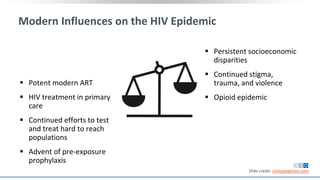
Modern Influences on the HIV Epidemic
 Potent modern ART
 HIV treatment in primary
care
 Continued efforts to test
and treat hard to reach
populations
 Advent of pre-exposure
prophylaxis
 Persistent socioeconomic
disparities
 Continued stigma,
trauma, and violence
 Opioid epidemic
Slide credit: clinicaloptions.com
HIV by the Numbers
1.1
Million people living
with HIV/AIDS
38,739
New HIV diagnoses
(2017)
6465
Deaths due to HIV
(2015 estimate; final
2015 analysis: 6160)
Slide credit: clinicaloptions.com
Median age: 52 yrs
Highest rate in black/African
Americans
Second highest rate among
Hispanics/Latinos
CDC. HIV Surveillance Report, 2017;29. Xu. Natl Vital Stat Rep. 2018;67:1. CDC. HIV Surveillance Supplemental Report.
2018;23. CDC. HIV Surveillance Special Report 20. CDC. HIV mortality (through 2015).
75% male
75% aged 40 yrs or older
48% heterosexual
41% black/African American
98% with health insurance
or other ART coverage
46% living at/below federal
poverty threshold
82% male
Increasing among persons
aged 25-34 yrs
68% male-to-male sexual
contact
Highest proportion among
Black/African Americans vs
other races/ethnicities
Assessing Risk and Testing for HIV
Patient Case
 25-yr-old male brings a home HIV test kit to the pharmacy counter to
purchase
 Had sex with new partner of unknown HIV status last night
 Worried about acquiring HIV
Slide credit: clinicaloptions.com
HIV Transmission and Risk
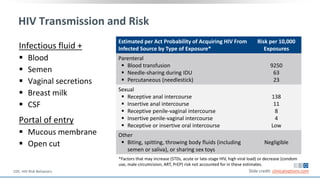
Infectious fluid +
 Blood
 Semen
 Vaginal secretions
 Breast milk
 CSF
Portal of entry
 Mucous membrane
 Open cut
Slide credit: clinicaloptions.comCDC. HIV Risk Behaviors.
Estimated per Act Probability of Acquiring HIV From
Infected Source by Type of Exposure*
Risk per 10,000
Exposures
Parenteral
 Blood transfusion
 Needle-sharing during IDU
 Percutaneous (needlestick)
9250
63
23
Sexual
 Receptive anal intercourse
 Insertive anal intercourse
 Receptive penile-vaginal intercourse
 Insertive penile-vaginal intercourse
 Receptive or insertive oral intercourse
138
11
8
4
Low
Other
 Biting, spitting, throwing body fluids (including
semen or saliva), or sharing sex toys
Negligible
*Factors that may increase (STDs, acute or late-stage HIV, high viral load) or decrease (condom
use, male circumcision, ART, PrEP) risk not accounted for in these estimates.
Get Comfortable Asking Questions
Health history
 Occupational and other blood exposures
 Sexual history (currently having sex, number of partners, gender of
partners, sexual practices)
Assessing other risk behaviors
 Legal drug use (types, how much, how often)
 Illicit drug use (types, how much, how often)
What is known about people they have sex with or use with (eg, HIV
status)?
Slide credit: clinicaloptions.com
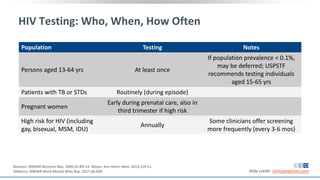
HIV Testing: Who, When, How Often
Population Testing Notes
Persons aged 13-64 yrs At least once
If population prevalence < 0.1%,
may be deferred; USPSTF
recommends testing individuals
aged 15-65 yrs
Patients with TB or STDs Routinely (during episode)
Pregnant women
Early during prenatal care, also in
third trimester if high risk
High risk for HIV (including
gay, bisexual, MSM, IDU)
Annually
Some clinicians offer screening
more frequently (every 3-6 mos)
Slide credit: clinicaloptions.com
Branson. MMWR Recomm Rep. 2006;55:RR-14. Moyer. Ann Intern Med. 2013;159:51.
DiNenno. MMWR Morb Mortal Wkly Rep. 2017;66:830.
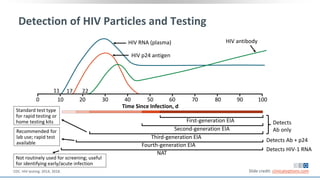
Detection of HIV Particles and Testing
Slide credit: clinicaloptions.comCDC. HIV testing. 2014, 2018.
Detects
Ab only
Detects Ab + p24
Standard test type
for rapid testing or
home testing kits
Recommended for
lab use; rapid test
available
Not routinely used for screening; useful
for identifying early/acute infection
0 10 20 30 40 50 60 70 80 90 100
Time Since Infection, d
11 17 22
HIV RNA (plasma)
HIV p24 antigen
HIV antibody
First-generation EIA
Second-generation EIA
Third-generation EIA
Fourth-generation EIA
NAT
Detects HIV-1 RNA
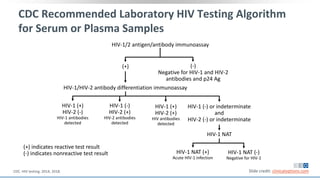
CDC Recommended Laboratory HIV Testing Algorithm
for Serum or Plasma Samples
Slide credit: clinicaloptions.comCDC. HIV testing. 2014, 2018.
HIV-1/2 antigen/antibody immunoassay
(-)
Negative for HIV-1 and HIV-2
antibodies and p24 Ag
(+)
HIV-1/HIV-2 antibody differentiation immunoassay
HIV-1 (+)
HIV-2 (-)
HIV-1 antibodies
detected
HIV-1 (-)
HIV-2 (+)
HIV-2 antibodies
detected
HIV-1 (+)
HIV-2 (+)
HIV antibodies
detected
HIV-1 (-) or indeterminate
and
HIV-2 (-) or indeterminate
HIV-1 NAT (+)
Acute HIV-1 infection
HIV-1 NAT (-)
Negative for HIV-1
(+) indicates reactive test result
(-) indicates nonreactive test result
HIV-1 NAT
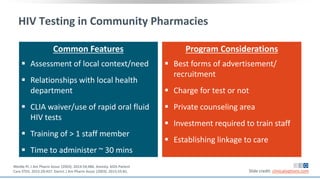
HIV Testing in Community Pharmacies
Slide credit: clinicaloptions.com
Weidle PJ. J Am Pharm Assoc (2003). 2014:54;486. Amesty. AIDS Patient
Care STDS. 2015:29;437. Darinl. J Am Pharm Assoc (2003). 2015;55:81.
Common Features
 Assessment of local context/need
 Relationships with local health
department
 CLIA waiver/use of rapid oral fluid
HIV tests
 Training of > 1 staff member
 Time to administer ~ 30 mins
Program Considerations
 Best forms of advertisement/
recruitment
 Charge for test or not
 Private counseling area
 Investment required to train staff
 Establishing linkage to care
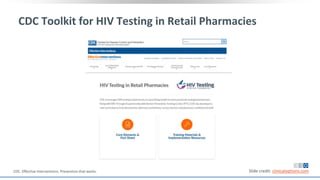
CDC Toolkit for HIV Testing in Retail Pharmacies
Slide credit: clinicaloptions.comCDC. Effective Interventions. Prevention that works.
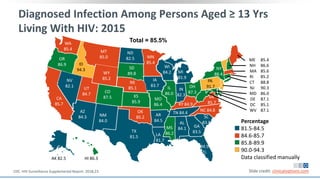
Diagnosed Infection Among Persons Aged ≥ 13 Yrs
Living With HIV: 2015
Total = 85.5%
Slide credit: clinicaloptions.comCDC. HIV Surveillance Supplemental Report. 2018;23.
Percentage
81.5-84.5
84.6-85.7
85.8-89.9
90.0-94.3
Data classified manually
WA
85.4
OR
86.9
CA
85.7
NV
82.1
AZ
84.3
UT
84.7
ID
94.3
MT
85.0
WY
85.2
CO
87.5
NM
84.0
TX
81.5
OK
85.2
KS
85.9
NE
85.1
SD
89.8
ND
82.5 MN
85.4
IA
83.7
MO
86.4
AR
84.5
LA
81.7
IL
86.0
WI
84.2 MI
81.9
IN
82.3
OH
87.3
MS
86.2
AL
84.1
GA
83.5
84.5
FL
SC
83.8
TN 84.4
NC 84.8
VA
85.7
PA
91.7
NY
88.4
ME 85.4
NH 86.6
MA 85.6
RI 85.2
CT 88.8
NJ 90.3
MD 86.0
DE 87.1
DC 85.1
WV 87.1
KY 84.9
AK 82.5 HI 86.3
Antiretroviral Pharmacology
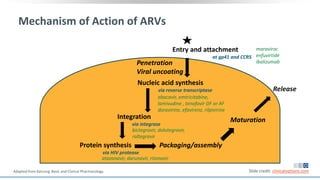
Mechanism of Action of ARVs
Maturation
Entry and attachment
at gp41 and CCR5
Penetration
Viral uncoating
Nucleic acid synthesis
via reverse transcriptase
Protein synthesis
via HIV protease
Packaging/assembly
Integration
via integrase
Release
maraviroc
enfuvirtide
ibalizumab
abacavir, emtricitabine,
lamivudine , tenofovir DF or AF
doravirine, efavirenz, rilpivirine
bictegravir, dolutegravir,
raltegravir
atazanavir, darunavir, ritonavir
Slide credit: clinicaloptions.comAdapted from Katzung. Basic and Clinical Pharmacology.
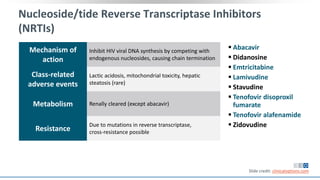
Nucleoside/tide Reverse Transcriptase Inhibitors
(NRTIs)
Mechanism of
action
Inhibit HIV viral DNA synthesis by competing with
endogenous nucleosides, causing chain termination
Class-related
adverse events
Lactic acidosis, mitochondrial toxicity, hepatic
steatosis (rare)
Metabolism Renally cleared (except abacavir)
Resistance
Due to mutations in reverse transcriptase,
cross-resistance possible
 Abacavir
 Didanosine
 Emtricitabine
 Lamivudine
 Stavudine
 Tenofovir disoproxil
fumarate
 Tenofovir alafenamide
 Zidovudine
Slide credit: clinicaloptions.com
Abacavir
300 mg orally twice daily or 600 mg orally once dailyDose
Headache, fatigue, malaise, nausea
Hypersensitivity reactionAdverse events
None majorDrug interactions
HLA-B*5701 testing required before initiation to predict
hypersensitivity reaction
Clinical
considerations
Slide credit: clinicaloptions.comAbacavir PI.
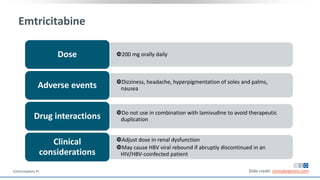
Emtricitabine
200 mg orally dailyDose
Dizziness, headache, hyperpigmentation of soles and palms,
nauseaAdverse events
Do not use in combination with lamivudine to avoid therapeutic
duplicationDrug interactions
Adjust dose in renal dysfunction
May cause HBV viral rebound if abruptly discontinued in an
HIV/HBV-coinfected patient
Clinical
considerations
Slide credit: clinicaloptions.comEmtricitabine PI.
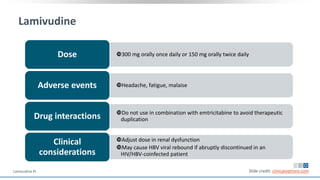
Lamivudine
300 mg orally once daily or 150 mg orally twice dailyDose
Headache, fatigue, malaiseAdverse events
Do not use in combination with emtricitabine to avoid therapeutic
duplicationDrug interactions
Adjust dose in renal dysfunction
May cause HBV viral rebound if abruptly discontinued in an
HIV/HBV-coinfected patient
Clinical
considerations
Slide credit: clinicaloptions.comLamivudine PI.
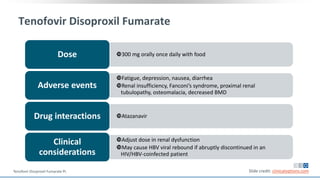
Tenofovir Disoproxil Fumarate
300 mg orally once daily with foodDose
Fatigue, depression, nausea, diarrhea
Renal insufficiency, Fanconi’s syndrome, proximal renal
tubulopathy, osteomalacia, decreased BMD
Adverse events
AtazanavirDrug interactions
Adjust dose in renal dysfunction
May cause HBV viral rebound if abruptly discontinued in an
HIV/HBV-coinfected patient
Clinical
considerations
Slide credit: clinicaloptions.comTenofovir Disoproxil Fumarate PI.
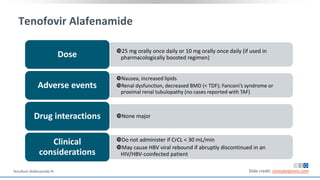
Tenofovir Alafenamide
25 mg orally once daily or 10 mg orally once daily (if used in
pharmacologically boosted regimen)Dose
Nausea, increased lipids
Renal dysfunction, decreased BMD (< TDF); Fanconi’s syndrome or
proximal renal tubulopathy (no cases reported with TAF)
Adverse events
None majorDrug interactions
Do not administer if CrCL < 30 mL/min
May cause HBV viral rebound if abruptly discontinued in an
HIV/HBV-coinfected patient
Clinical
considerations
Slide credit: clinicaloptions.comTenofovir Alafenamide PI.
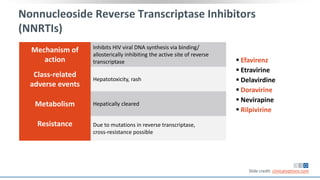
Nonnucleoside Reverse Transcriptase Inhibitors
(NNRTIs)
Mechanism of
action
Inhibits HIV viral DNA synthesis via binding/
allosterically inhibiting the active site of reverse
transcriptase
Class-related
adverse events
Hepatotoxicity, rash
Metabolism Hepatically cleared
Resistance Due to mutations in reverse transcriptase,
cross-resistance possible
 Efavirenz
 Etravirine
 Delavirdine
 Doravirine
 Nevirapine
 Rilpivirine
Slide credit: clinicaloptions.com
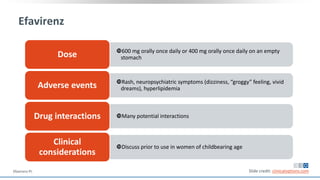
Efavirenz
600 mg orally once daily or 400 mg orally once daily on an empty
stomachDose
Rash, neuropsychiatric symptoms (dizziness, “groggy” feeling, vivid
dreams), hyperlipidemiaAdverse events
Many potential interactionsDrug interactions
Discuss prior to use in women of childbearing age
Clinical
considerations
Slide credit: clinicaloptions.comEfavirenz PI.
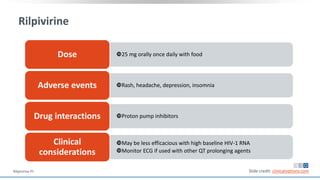
Rilpivirine
25 mg orally once daily with foodDose
Rash, headache, depression, insomniaAdverse events
Proton pump inhibitorsDrug interactions
May be less efficacious with high baseline HIV-1 RNA
Monitor ECG if used with other QT prolonging agents
Clinical
considerations
Slide credit: clinicaloptions.comRilpivirine PI.
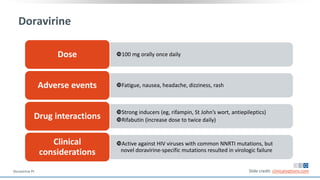
Doravirine
100 mg orally once dailyDose
Fatigue, nausea, headache, dizziness, rashAdverse events
Strong inducers (eg, rifampin, St John’s wort, antiepileptics)
Rifabutin (increase dose to twice daily)Drug interactions
Active against HIV viruses with common NNRTI mutations, but
novel doravirine-specific mutations resulted in virologic failure
Clinical
considerations
Slide credit: clinicaloptions.comDoravirine PI.
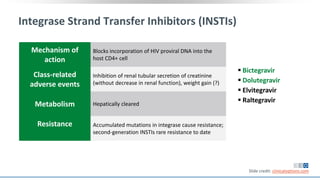
Integrase Strand Transfer Inhibitors (INSTIs)
Mechanism of
action
Blocks incorporation of HIV proviral DNA into the
host CD4+ cell
Class-related
adverse events
Inhibition of renal tubular secretion of creatinine
(without decrease in renal function), weight gain (?)
Metabolism Hepatically cleared
Resistance Accumulated mutations in integrase cause resistance;
second-generation INSTIs rare resistance to date
 Bictegravir
 Dolutegravir
 Elvitegravir
 Raltegravir
Slide credit: clinicaloptions.com
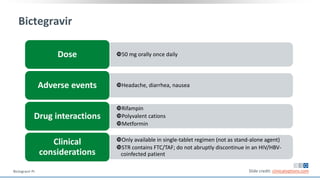
Bictegravir
50 mg orally once dailyDose
Headache, diarrhea, nauseaAdverse events
Rifampin
Polyvalent cations
Metformin
Drug interactions
Only available in single-tablet regimen (not as stand-alone agent)
STR contains FTC/TAF; do not abruptly discontinue in an HIV/HBV-
coinfected patient
Clinical
considerations
Slide credit: clinicaloptions.comBictegravir PI.
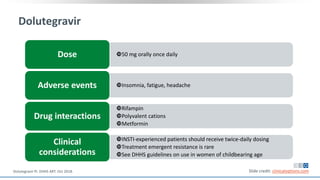
Dolutegravir
50 mg orally once dailyDose
Insomnia, fatigue, headacheAdverse events
Rifampin
Polyvalent cations
Metformin
Drug interactions
INSTI-experienced patients should receive twice-daily dosing
Treatment emergent resistance is rare
See DHHS guidelines on use in women of childbearing age
Clinical
considerations
Slide credit: clinicaloptions.comDolutegravir PI. DHHS ART. Oct 2018.
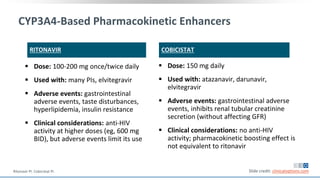
RITONAVIR
 Dose: 100-200 mg once/twice daily
 Used with: many PIs, elvitegravir
 Adverse events: gastrointestinal
adverse events, taste disturbances,
hyperlipidemia, insulin resistance
 Clinical considerations: anti-HIV
activity at higher doses (eg, 600 mg
BID), but adverse events limit its use
COBICISTAT
 Dose: 150 mg daily
 Used with: atazanavir, darunavir,
elvitegravir
 Adverse events: gastrointestinal adverse
events, inhibits renal tubular creatinine
secretion (without affecting GFR)
 Clinical considerations: no anti-HIV
activity; pharmacokinetic boosting effect is
not equivalent to ritonavir
Slide credit: clinicaloptions.com
CYP3A4-Based Pharmacokinetic Enhancers
Ritonavir PI. Cobicistat PI.
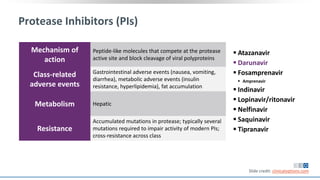
Protease Inhibitors (PIs)
Mechanism of
action
Peptide-like molecules that compete at the protease
active site and block cleavage of viral polyproteins
Class-related
adverse events
Gastrointestinal adverse events (nausea, vomiting,
diarrhea), metabolic adverse events (insulin
resistance, hyperlipidemia), fat accumulation
Metabolism Hepatic
Resistance
Accumulated mutations in protease; typically several
mutations required to impair activity of modern PIs;
cross-resistance across class
 Atazanavir
 Darunavir
 Fosamprenavir
 Amprenavir
 Indinavir
 Lopinavir/ritonavir
 Nelfinavir
 Saquinavir
 Tipranavir
Slide credit: clinicaloptions.com
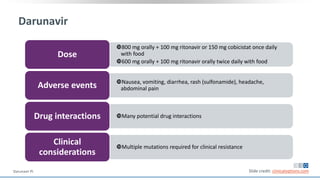
Darunavir
800 mg orally + 100 mg ritonavir or 150 mg cobicistat once daily
with food
600 mg orally + 100 mg ritonavir orally twice daily with food
Dose
Nausea, vomiting, diarrhea, rash (sulfonamide), headache,
abdominal painAdverse events
Many potential drug interactionsDrug interactions
Multiple mutations required for clinical resistance
Clinical
considerations
Slide credit: clinicaloptions.comDarunavir PI.
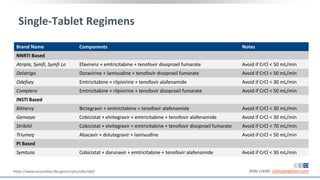
Single-Tablet Regimens
Brand Name Components Notes
NNRTI Based
Atripla, Symfi, Symfi Lo Efavirenz + emtricitabine + tenofovir disoproxil fumarate Avoid if CrCl < 50 mL/min
Delstrigo Doravirine + lamivudine + tenofovir disoproxil fumarate Avoid if CrCl < 50 mL/min
Odefsey Emtricitabine + rilpivirine + tenofovir alafenamide Avoid if CrCl < 30 mL/min
Complera Emtricitabine + rilpivirine + tenofovir disoproxil fumarate Avoid if CrCl < 50 mL/min
INSTI Based
Biktarvy Bictegravir + emtricitabine + tenofovir alafenamide Avoid if CrCl < 30 mL/min
Genvoya Cobicistat + elvitegravir + emtricitabine + tenofovir alafenamide Avoid if CrCl < 30 mL/min
Stribild Cobicistat + elvitegravir + emtricitabine + tenofovir disoproxil fumarate Avoid if CrCl < 70 mL/min
Triumeq Abacavir + dolutegravir + lamivudine Avoid if CrCl < 50 mL/min
PI Based
Symtuza Cobicistat + darunavir + emtricitabine + tenofovir alafenamide Avoid if CrCl < 30 mL/min
Slide credit: clinicaloptions.comhttps://www.accessdata.fda.gov/scripts/cder/daf/
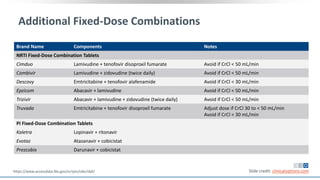
Additional Fixed-Dose Combinations
Brand Name Components Notes
NRTI Fixed-Dose Combination Tablets
Cimduo Lamivudine + tenofovir disoproxil fumarate Avoid if CrCl < 50 mL/min
Combivir Lamivudine + zidovudine (twice daily) Avoid if CrCl < 50 mL/min
Descovy Emtricitabine + tenofovir alafenamide Avoid if CrCl < 30 mL/min
Epzicom Abacavir + lamivudine Avoid if CrCl < 50 mL/min
Trizivir Abacavir + lamivudine + zidovudine (twice daily) Avoid if CrCl < 50 mL/min
Truvada Emtricitabine + tenofovir disoproxil fumarate Adjust dose if CrCl 30 to < 50 mL/min
Avoid if CrCl < 30 mL/min
PI Fixed-Dose Combination Tablets
Kaletra Lopinavir + ritonavir
Evotaz Atazanavir + cobicistat
Prezcobix Darunavir + cobicistat
Slide credit: clinicaloptions.comhttps://www.accessdata.fda.gov/scripts/cder/daf/
Treatment of HIV
Patient Case: New HIV diagnosis
 A 29-yr-old man reluctantly presents to the pharmacy to pick up a new
prescription for PCP prophylaxis and tells you that his doctor wants him
to start ART; “I just don’t see why I have to start right away,” he says. “I
feel just fine”
Slide credit: clinicaloptions.com
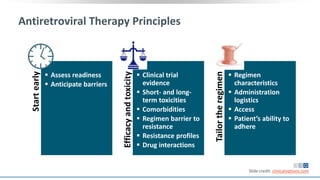
Antiretroviral Therapy Principles
Startearly
 Assess readiness
 Anticipate barriers
Efficacyandtoxicity
 Clinical trial
evidence
 Short- and long-
term toxicities
 Comorbidities
 Regimen barrier to
resistance
 Resistance profiles
 Drug interactions
Tailortheregimen
 Regimen
characteristics
 Administration
logistics
 Access
 Patient’s ability to
adhere
Slide credit: clinicaloptions.com
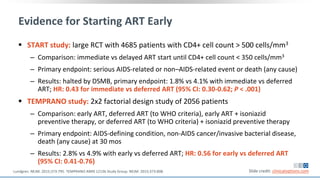
Evidence for Starting ART Early
 START study: large RCT with 4685 patients with CD4+ cell count > 500 cells/mm3
‒ Comparison: immediate vs delayed ART start until CD4+ cell count < 350 cells/mm3
‒ Primary endpoint: serious AIDS-related or non–AIDS-related event or death (any cause)
‒ Results: halted by DSMB, primary endpoint: 1.8% vs 4.1% with immediate vs deferred
ART; HR: 0.43 for immediate vs deferred ART (95% CI: 0.30-0.62; P < .001)
 TEMPRANO study: 2x2 factorial design study of 2056 patients
‒ Comparison: early ART, deferred ART (to WHO criteria), early ART + isoniazid
preventive therapy, or deferred ART (to WHO criteria) + isoniazid preventive therapy
‒ Primary endpoint: AIDS-defining condition, non-AIDS cancer/invasive bacterial disease,
death (any cause) at 30 mos
‒ Results: 2.8% vs 4.9% with early vs deferred ART; HR: 0.56 for early vs deferred ART
(95% CI: 0.41-0.76)
Slide credit: clinicaloptions.comLundgren. NEJM. 2015;373:795. TEMPRANO ANRS 12136 Study Group. NEJM. 2015;373:808.
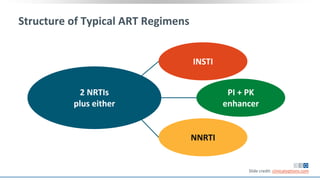
Structure of Typical ART Regimens
2 NRTIs
plus either
NNRTI
PI + PK
enhancer
INSTI
Slide credit: clinicaloptions.com
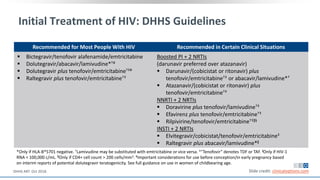
Initial Treatment of HIV: DHHS Guidelines
Recommended for Most People With HIV Recommended in Certain Clinical Situations
 Bictegravir/tenofovir alafenamide/emtricitabine
 Dolutegravir/abacavir/lamivudine*†#
 Dolutegravir plus tenofovir/emtricitabine†‡#
 Raltegravir plus tenofovir/emtricitabine†‡
Boosted PI + 2 NRTIs
(darunavir preferred over atazanavir)
 Darunavir/(cobicistat or ritonavir) plus
tenofovir/emtricitabine†‡ or abacavir/lamivudine*†
 Atazanavir/(cobicistat or ritonavir) plus
tenofovir/emtricitabine†‡
NNRTI + 2 NRTIs
 Doravirine plus tenofovir/lamivudine†‡
 Efavirenz plus tenofovir/emtricitabine†‡
 Rilpivirine/tenofovir/emtricitabine†‡ǁ§
INSTI + 2 NRTIs
 Elvitegravir/cobicistat/tenofovir/emtricitabine‡
 Raltegravir plus abacavir/lamivudine*ǁ
*Only if HLA-B*5701 negative. †Lamivudine may be substituted with emtricitabine or vice versa. ‡“Tenofovir” denotes TDF or TAF. ǁOnly if HIV-1
RNA < 100,000 c/mL. §Only if CD4+ cell count > 200 cells/mm3. #Important considerations for use before conception/in early pregnancy based
on interim reports of potential dolutegravir teratogenicity. See full guidance on use in women of childbearing age.
Slide credit: clinicaloptions.comDHHS ART. Oct 2018.
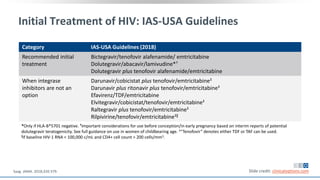
Initial Treatment of HIV: IAS-USA Guidelines
Category IAS-USA Guidelines (2018)
Recommended initial
treatment
Bictegravir/tenofovir alafenamide/ emtricitabine
Dolutegravir/abacavir/lamivudine*†
Dolutegravir plus tenofovir alafenamide/emtricitabine
When integrase
inhibitors are not an
option
Darunavir/cobicistat plus tenofovir/emtricitabine‡
Darunavir plus ritonavir plus tenofovir/emtricitabine‡
Efavirenz/TDF/emtricitabine
Elvitegravir/cobicistat/tenofovir/emtricitabine‡
Raltegravir plus tenofovir/emtricitabine‡
Rilpivirine/tenofovir/emtricitabine‡ǁ
*Only if HLA-B*5701 negative. †Important considerations for use before conception/in early pregnancy based on interim reports of potential
dolutegravir teratogenicity. See full guidance on use in women of childbearing age. ‡“Tenofovir” denotes either TDF or TAF can be used.
ǁIf baseline HIV-1 RNA < 100,000 c/mL and CD4+ cell count > 200 cells/mm3.
Slide credit: clinicaloptions.comSaag. JAMA. 2018;320:379.
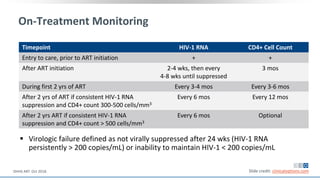
On-Treatment Monitoring
 Virologic failure defined as not virally suppressed after 24 wks (HIV-1 RNA
persistently > 200 copies/mL) or inability to maintain HIV-1 < 200 copies/mL
Slide credit: clinicaloptions.comDHHS ART. Oct 2018.
Timepoint HIV-1 RNA CD4+ Cell Count
Entry to care, prior to ART initiation + +
After ART initiation 2-4 wks, then every
4-8 wks until suppressed
3 mos
During first 2 yrs of ART Every 3-4 mos Every 3-6 mos
After 2 yrs of ART if consistent HIV-1 RNA
suppression and CD4+ count 300-500 cells/mm3
Every 6 mos Every 12 mos
After 2 yrs ART if consistent HIV-1 RNA
suppression and CD4+ count > 500 cells/mm3
Every 6 mos Optional
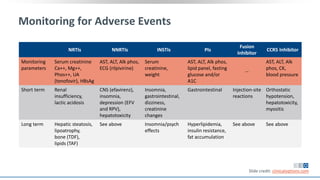
Monitoring for Adverse Events
NRTIs NNRTIs INSTIs PIs
Fusion
Inhibitor
CCR5 Inhibitor
Monitoring
parameters
Serum creatinine
Ca++, Mg++,
Phos++, UA
(tenofovir), HBsAg
AST, ALT, Alk phos,
ECG (rilpivirine)
Serum
creatinine,
weight
AST, ALT, Alk phos,
lipid panel, fasting
glucose and/or
A1C
--
AST, ALT, Alk
phos, CK,
blood pressure
Short term Renal
insufficiency,
lactic acidosis
CNS (efavirenz),
insomnia,
depression (EFV
and RPV),
hepatotoxicity
Insomnia,
gastrointestinal,
dizziness,
creatinine
changes
Gastrointestinal Injection-site
reactions
Orthostatic
hypotension,
hepatotoxicity,
myositis
Long term Hepatic steatosis,
lipoatrophy,
bone (TDF),
lipids (TAF)
See above Insomnia/psych
effects
Hyperlipidemia,
insulin resistance,
fat accumulation
See above See above
Slide credit: clinicaloptions.com
Essential ART Drug–Drug Interactions
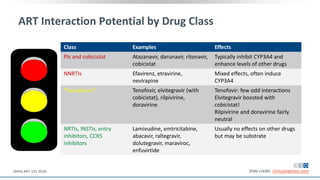
ART Interaction Potential by Drug Class
Class Examples Effects
PIs and cobicistat Atazanavir, darunavir, ritonavir,
cobicistat
Typically inhibit CYP3A4 and
enhance levels of other drugs
NNRTIs Efavirenz, etravirine,
nevirapine
Mixed effects, often induce
CYP3A4
*Exceptions* Tenofovir, elvitegravir (with
cobicistat), rilpivirine,
doravirine
Tenofovir: few odd interactions
Elvitegravir boosted with
cobicistat!
Rilpivirine and doravirine fairly
neutral
NRTIs, INSTIs, entry
inhibitors, CCR5
inhibitors
Lamivudine, emtricitabine,
abacavir, raltegravir,
dolutegravir, maraviroc,
enfuvirtide
Usually no effects on other drugs
but may be substrate
Slide credit: clinicaloptions.comDHHS ART. Oct 2018.
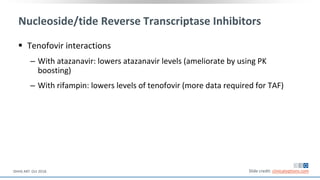
Nucleoside/tide Reverse Transcriptase Inhibitors
 Tenofovir interactions
‒ With atazanavir: lowers atazanavir levels (ameliorate by using PK
boosting)
‒ With rifampin: lowers levels of tenofovir (more data required for TAF)
Slide credit: clinicaloptions.comDHHS ART. Oct 2018.
Integrase Inhibitors
 With metformin
‒ Increases levels of metformin (OAT); limit metformin to 1000 mg/day with
dolutegravir
 With polyvalent cations (Ca++, Al/Mg++, Fe++)
‒ Decreased exposure/efficacy of INSTI. Recommendations may include avoiding
coadministration, taking together with food, or giving INSTI 2 hrs before or 6 hrs
after other medication
 With strong inducers (rifampin, rifapentine, carbamazepine, etc)
‒ Decreased exposure/efficacy of INSTI; refer to individual INSTI prescribing
information for management
Slide credit: clinicaloptions.comDHHS ART. Oct 2018.
Common Drug Classes Interacting With PIs,
PK Enhancers, NNRTIs
 Antacid agents: particularly lowers atazanavir levels, rilpivirine levels
 Statins: monitor for toxicity (PIs) or efficacy (with some NNRTIs)
 Hepatitis C drugs: some contraindicated with certain ART due to
interactions
 Azole antifungals: complex interactions, often bidirectional
 Rifampin, rifabutin, rifapentine: lower levels of ART
 Anticonvulsants: lower levels of ART (interactions may be bidirectional)
Slide credit: clinicaloptions.comDHHS ART. Oct 2018.
Supporting Treatment Adherence
Why Don’t People Take ART?
 Never started: healthcare provider said they didn’t need to, worried
about ART harming them or making them sick, don’t believe they need
ART
 Not currently taking ART: worried about ART harming them or making
them sick, money issues, don’t believe they need ART
 60%: proportion of people who reported taking 100% of their ART over
the last mo
Slide credit: clinicaloptions.comCDC. HIV Surveillance Special Report 20. May 2018.
Assessing Adherence
 Self-report
‒ “In the last 30 days, how good a job did you do at taking your HIV medications in the
way you were supposed to?” (excellent, very good, fair, poor, very poor)
‒ 3 (or 7) day recall
‒ Corroboration by family members/friends/partners
‒ Self-collection of dosing information via smartphone apps
 Pharmacy refill history: medication possession ratio or proportion of days covered
 Pill counts (unannounced vs scheduled)
 Patient familiarity with pills/routine
 Biologic markers: CD4, HIV-1 RNA, therapeutic drug monitoring (blood, hair, urine)
Slide credit: clinicaloptions.comAmico. J Int Assoc Provid AIDS Care. 2013;12:79.
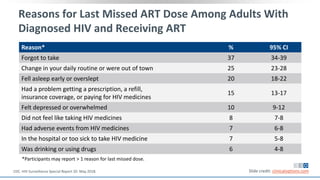
*Participants may report > 1 reason for last missed dose.
Reason* % 95% CI
Forgot to take 37 34-39
Change in your daily routine or were out of town 25 23-28
Fell asleep early or overslept 20 18-22
Had a problem getting a prescription, a refill,
insurance coverage, or paying for HIV medicines
15 13-17
Felt depressed or overwhelmed 10 9-12
Did not feel like taking HIV medicines 8 7-8
Had adverse events from HIV medicines 7 6-8
In the hospital or too sick to take HIV medicine 7 5-8
Was drinking or using drugs 6 4-8
Reasons for Last Missed ART Dose Among Adults With
Diagnosed HIV and Receiving ART
Slide credit: clinicaloptions.comCDC. HIV Surveillance Special Report 20. May 2018.
Pharmacists Supporting Adherence
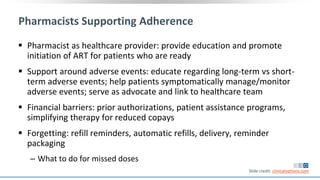
 Pharmacist as healthcare provider: provide education and promote
initiation of ART for patients who are ready
 Support around adverse events: educate regarding long-term vs short-
term adverse events; help patients symptomatically manage/monitor
adverse events; serve as advocate and link to healthcare team
 Financial barriers: prior authorizations, patient assistance programs,
simplifying therapy for reduced copays
 Forgetting: refill reminders, automatic refills, delivery, reminder
packaging
‒ What to do for missed doses
Slide credit: clinicaloptions.com
Potentially Modifiable Adherence Barriers
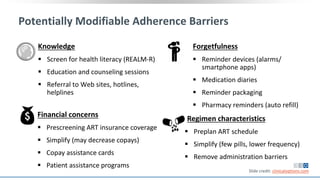
Knowledge
 Screen for health literacy (REALM-R)
 Education and counseling sessions
 Referral to Web sites, hotlines,
helplines
Forgetfulness
 Reminder devices (alarms/
smartphone apps)
 Medication diaries
 Reminder packaging
 Pharmacy reminders (auto refill)
Financial concerns
 Prescreening ART insurance coverage
 Simplify (may decrease copays)
 Copay assistance cards
 Patient assistance programs
Regimen characteristics
 Preplan ART schedule
 Simplify (few pills, lower frequency)
 Remove administration barriers
Slide credit: clinicaloptions.com
Supporting Adherence: A Process
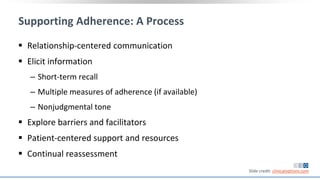
 Relationship-centered communication
 Elicit information
‒ Short-term recall
‒ Multiple measures of adherence (if available)
‒ Nonjudgmental tone
 Explore barriers and facilitators
 Patient-centered support and resources
 Continual reassessment
Slide credit: clinicaloptions.com
clinicaloptions.com/hiv
Go Online for More CCO
Education on HIV Prevention and Management!
Case-based interactive multimedia modules on key pharmacy strategies for PrEP, HIV, and HCV service
provision
Downloadable slidesets to use, update, and share in your noncommercial presentations to colleagues
or patients
the key studies

Pharmacy Essentials for HIV Screening and Management.2019

  • 1.
    Pharmacy Essentials forHIV Screening and Management This activity is supported by independent educational grants from Gilead Sciences and ViiV Healthcare.
  • 2.
    About These Slides Please feel free to use, update, and share some or all of these slides in your noncommercial presentations to colleagues or patients  When using our slides, please retain the source attribution:  These slides may not be published, posted online, or used in commercial presentations without permission. Please contact permissions@clinicaloptions.com for details Slide credit: clinicaloptions.com
  • 3.
    Faculty Jennifer Cocohoba, PharmD Professor Departmentof Clinical Pharmacy University of California, San Francisco San Francisco, California Jennifer Cocohoba, PharmD, has no real or apparent conflicts of interest to report.
  • 4.
    Program Overview  AContemporary Picture of HIV in the United States  Assessing Risk and Testing for HIV  ARV Pharmacology  Treatment of HIV  Essential ART Drug–Drug Interactions  Supporting Treatment Adherence Slide credit: clinicaloptions.com
  • 5.
    A Contemporary Pictureof HIV in the United States
  • 6.
    HIV by theNumbers 1.1 Million people living with HIV/AIDS 38,739 New HIV diagnoses (2017) 6465 Deaths due to HIV (2015 estimate; final 2015 analysis: 6160) Slide credit: clinicaloptions.com CDC. HIV Surveillance Report, 2017;29. Xu. Natl Vital Stat Rep. 2018;67:1. CDC. HIV Surveillance Supplemental Report. 2018;23.
  • 7.
    Estimated HIV Prevalencein US Among Persons Aged ≥ 13 Yrs, by Area of Residence, 2015 Slide credit: clinicaloptions.com Total = 1,122,900 *Estimate has relative standard error of 30% to 50%, should be used with caution because does not meet standard of reliability. CDC. HIV Surveillance Supplemental Report. 2018;23. Number 330-2900 2901-10,800 10,801-23,500 23,501-142,600 WA 14,500 OR 7500 CA 141,700 NV 10,800 AZ 18,000 UT 3200 ID 1100 MT 670* WY 330* CO 13,100 NM 3800 TX 99,600 OK 6700 KS 3300 NE 2400 SD 560* ND 400* MN 9000 IA 2900 MO 13,700 AR 6200 LA 23,700 IL 40,900 WI 7000 MI 17,600 IN 12,900 OH 23,500 MS 10,600 AL 14,500 GA 58,700 124,400 FL SC 19,200 TN 19,300 NC 34,800 VA 24,900 PA 36,800 NY 142,600 ME 1700 NH 1400 MA 22,600 RI 2700 CT 11,500 NJ 38,800 MD 37,900 DE 3700 DC 17,400 WV 2000 VT 710 KY 7800 AK 790* HI 3200
  • 8.
    HIV by theNumbers 1.1 Million people living with HIV/AIDS 38,739 New HIV diagnoses (2017) 6465 Deaths due to HIV (2015 estimate; final 2015 analysis: 6160) Slide credit: clinicaloptions.com 75% male 75% aged 40 yrs or older 48% heterosexual 41% black/African American 98% with health insurance or other ART coverage 46% living at/below federal poverty threshold CDC. HIV Surveillance Report, 2017;29. Xu. Natl Vital Stat Rep. 2018;67:1. CDC. HIV Surveillance Supplemental Report. 2018;23. CDC. HIV Surveillance Special Report 20.
  • 9.
    Estimated HIV Incidencein US Among Persons Aged ≥ 13 Yrs, by Area of Residence, 2015 Total = 38,500 Slide credit: clinicaloptions.com *Estimate has relative standard error of 30% to 50%, should be used with caution because does not meet standard of reliability. CDC. HIV Surveillance Supplemental Report. 2018;23. Number Relative standard error > 50%; data not shown 120-390 391-810 811-5100 WA 450 OR 170* CA 5100 NV 500 AZ 18,000 UT 120* ID MT WY CO 340* NM TX 4400 OK 260* KS NE SD ND MN 270* IA MO 390 AR 230* LA 100 IL 1400 WI 250* MI 700 IN 800 OH 770 MS 350* AL 540 GA 2400 5100 FL SC 590 TN 730 NC 1300 VA 970 PA 810 NY 3300 MA 640 RI -- CT 270* NJ 880 MD 1100 DE -- DC 420 VT KY 310* AK HI 150* WV NH ME
  • 10.
    HIV by theNumbers 1.1 Million people living with HIV/AIDS 38,739 New HIV diagnoses (2017) 6465 Deaths due to HIV (2015 estimate; final 2015 analysis: 6160) Slide credit: clinicaloptions.com CDC. HIV Surveillance Report, 2017;29. Xu. Natl Vital Stat Rep. 2018;67:1. CDC. HIV Surveillance Supplemental Report. 2018;23. CDC. HIV Surveillance Special Report 20. 82% male Increasing among persons aged 25-34 yrs 68% male-to-male sexual contact Highest proportion among Black/African Americans vs other races/ethnicities 75% male 75% aged 40 yrs or older 48% heterosexual 41% black/African American 98% with health insurance or other ART coverage 46% living at/below federal poverty threshold
  • 11.
    Age-Adjusted* Rates† ofDeath Among Persons With Diagnosed HIV Infection by State, 2015 Slide credit: clinicaloptions.comCDC. HIV mortality (through 2015). Rates per 1000 persons living with diagnosed HIV infection 6.4-11.2 11.3-13.2 13.3-15.3 15.4-33.3 WA 14.7 OR 14.5 CA 10.3 NV 11.6 AZ 11.8 UT 6.6 ID 11.4 MT 12.3 WY 13.2 CO 7.0 NM 21.2 TX 14.2 OK 19.6 KS 18.0 NE 10.8 SD 10.2 ND 33.3 MN 13.5 IA 11.5 MO 11.2 AR 13.8 LA 17.5 IL 11.6 WI 11.1* MI 14.9 IN 14.3 OH 11.8 MS 20.3 AL 11.5 GA 16.4 15.4 FL SC 14.8 TN 17.5 NC 16.3 VA 8.3 PA 14.6 NY 9.9 KY 13.7 AK 16.2 HI 7.0 ME 9.7 NH 15.3 MA 11.5 RI 9.1 CT 12.7 NJ 12.5 MD 13.5 DE 13.6 DC 12.7 WV 16.4 VT 6.4 Deaths may be due to any cause. *Standard: age distribution of 2000 US population. †Per 100,000 persons living with diagnosed HIV infection.
  • 12.
    Modern Influences onthe HIV Epidemic  Potent modern ART  HIV treatment in primary care  Continued efforts to test and treat hard to reach populations  Advent of pre-exposure prophylaxis  Persistent socioeconomic disparities  Continued stigma, trauma, and violence  Opioid epidemic Slide credit: clinicaloptions.com
  • 13.
    HIV by theNumbers 1.1 Million people living with HIV/AIDS 38,739 New HIV diagnoses (2017) 6465 Deaths due to HIV (2015 estimate; final 2015 analysis: 6160) Slide credit: clinicaloptions.com Median age: 52 yrs Highest rate in black/African Americans Second highest rate among Hispanics/Latinos CDC. HIV Surveillance Report, 2017;29. Xu. Natl Vital Stat Rep. 2018;67:1. CDC. HIV Surveillance Supplemental Report. 2018;23. CDC. HIV Surveillance Special Report 20. CDC. HIV mortality (through 2015). 75% male 75% aged 40 yrs or older 48% heterosexual 41% black/African American 98% with health insurance or other ART coverage 46% living at/below federal poverty threshold 82% male Increasing among persons aged 25-34 yrs 68% male-to-male sexual contact Highest proportion among Black/African Americans vs other races/ethnicities
  • 14.
    Assessing Risk andTesting for HIV
  • 15.
    Patient Case  25-yr-oldmale brings a home HIV test kit to the pharmacy counter to purchase  Had sex with new partner of unknown HIV status last night  Worried about acquiring HIV Slide credit: clinicaloptions.com
  • 16.
    HIV Transmission andRisk Infectious fluid +  Blood  Semen  Vaginal secretions  Breast milk  CSF Portal of entry  Mucous membrane  Open cut Slide credit: clinicaloptions.comCDC. HIV Risk Behaviors. Estimated per Act Probability of Acquiring HIV From Infected Source by Type of Exposure* Risk per 10,000 Exposures Parenteral  Blood transfusion  Needle-sharing during IDU  Percutaneous (needlestick) 9250 63 23 Sexual  Receptive anal intercourse  Insertive anal intercourse  Receptive penile-vaginal intercourse  Insertive penile-vaginal intercourse  Receptive or insertive oral intercourse 138 11 8 4 Low Other  Biting, spitting, throwing body fluids (including semen or saliva), or sharing sex toys Negligible *Factors that may increase (STDs, acute or late-stage HIV, high viral load) or decrease (condom use, male circumcision, ART, PrEP) risk not accounted for in these estimates.
  • 17.
    Get Comfortable AskingQuestions Health history  Occupational and other blood exposures  Sexual history (currently having sex, number of partners, gender of partners, sexual practices) Assessing other risk behaviors  Legal drug use (types, how much, how often)  Illicit drug use (types, how much, how often) What is known about people they have sex with or use with (eg, HIV status)? Slide credit: clinicaloptions.com
  • 18.
    HIV Testing: Who,When, How Often Population Testing Notes Persons aged 13-64 yrs At least once If population prevalence < 0.1%, may be deferred; USPSTF recommends testing individuals aged 15-65 yrs Patients with TB or STDs Routinely (during episode) Pregnant women Early during prenatal care, also in third trimester if high risk High risk for HIV (including gay, bisexual, MSM, IDU) Annually Some clinicians offer screening more frequently (every 3-6 mos) Slide credit: clinicaloptions.com Branson. MMWR Recomm Rep. 2006;55:RR-14. Moyer. Ann Intern Med. 2013;159:51. DiNenno. MMWR Morb Mortal Wkly Rep. 2017;66:830.
  • 19.
    Detection of HIVParticles and Testing Slide credit: clinicaloptions.comCDC. HIV testing. 2014, 2018. Detects Ab only Detects Ab + p24 Standard test type for rapid testing or home testing kits Recommended for lab use; rapid test available Not routinely used for screening; useful for identifying early/acute infection 0 10 20 30 40 50 60 70 80 90 100 Time Since Infection, d 11 17 22 HIV RNA (plasma) HIV p24 antigen HIV antibody First-generation EIA Second-generation EIA Third-generation EIA Fourth-generation EIA NAT Detects HIV-1 RNA
  • 20.
    CDC Recommended LaboratoryHIV Testing Algorithm for Serum or Plasma Samples Slide credit: clinicaloptions.comCDC. HIV testing. 2014, 2018. HIV-1/2 antigen/antibody immunoassay (-) Negative for HIV-1 and HIV-2 antibodies and p24 Ag (+) HIV-1/HIV-2 antibody differentiation immunoassay HIV-1 (+) HIV-2 (-) HIV-1 antibodies detected HIV-1 (-) HIV-2 (+) HIV-2 antibodies detected HIV-1 (+) HIV-2 (+) HIV antibodies detected HIV-1 (-) or indeterminate and HIV-2 (-) or indeterminate HIV-1 NAT (+) Acute HIV-1 infection HIV-1 NAT (-) Negative for HIV-1 (+) indicates reactive test result (-) indicates nonreactive test result HIV-1 NAT
  • 21.
    HIV Testing inCommunity Pharmacies Slide credit: clinicaloptions.com Weidle PJ. J Am Pharm Assoc (2003). 2014:54;486. Amesty. AIDS Patient Care STDS. 2015:29;437. Darinl. J Am Pharm Assoc (2003). 2015;55:81. Common Features  Assessment of local context/need  Relationships with local health department  CLIA waiver/use of rapid oral fluid HIV tests  Training of > 1 staff member  Time to administer ~ 30 mins Program Considerations  Best forms of advertisement/ recruitment  Charge for test or not  Private counseling area  Investment required to train staff  Establishing linkage to care
  • 22.
    CDC Toolkit forHIV Testing in Retail Pharmacies Slide credit: clinicaloptions.comCDC. Effective Interventions. Prevention that works.
  • 23.
    Diagnosed Infection AmongPersons Aged ≥ 13 Yrs Living With HIV: 2015 Total = 85.5% Slide credit: clinicaloptions.comCDC. HIV Surveillance Supplemental Report. 2018;23. Percentage 81.5-84.5 84.6-85.7 85.8-89.9 90.0-94.3 Data classified manually WA 85.4 OR 86.9 CA 85.7 NV 82.1 AZ 84.3 UT 84.7 ID 94.3 MT 85.0 WY 85.2 CO 87.5 NM 84.0 TX 81.5 OK 85.2 KS 85.9 NE 85.1 SD 89.8 ND 82.5 MN 85.4 IA 83.7 MO 86.4 AR 84.5 LA 81.7 IL 86.0 WI 84.2 MI 81.9 IN 82.3 OH 87.3 MS 86.2 AL 84.1 GA 83.5 84.5 FL SC 83.8 TN 84.4 NC 84.8 VA 85.7 PA 91.7 NY 88.4 ME 85.4 NH 86.6 MA 85.6 RI 85.2 CT 88.8 NJ 90.3 MD 86.0 DE 87.1 DC 85.1 WV 87.1 KY 84.9 AK 82.5 HI 86.3
  • 24.
  • 25.
    Mechanism of Actionof ARVs Maturation Entry and attachment at gp41 and CCR5 Penetration Viral uncoating Nucleic acid synthesis via reverse transcriptase Protein synthesis via HIV protease Packaging/assembly Integration via integrase Release maraviroc enfuvirtide ibalizumab abacavir, emtricitabine, lamivudine , tenofovir DF or AF doravirine, efavirenz, rilpivirine bictegravir, dolutegravir, raltegravir atazanavir, darunavir, ritonavir Slide credit: clinicaloptions.comAdapted from Katzung. Basic and Clinical Pharmacology.
  • 26.
    Nucleoside/tide Reverse TranscriptaseInhibitors (NRTIs) Mechanism of action Inhibit HIV viral DNA synthesis by competing with endogenous nucleosides, causing chain termination Class-related adverse events Lactic acidosis, mitochondrial toxicity, hepatic steatosis (rare) Metabolism Renally cleared (except abacavir) Resistance Due to mutations in reverse transcriptase, cross-resistance possible  Abacavir  Didanosine  Emtricitabine  Lamivudine  Stavudine  Tenofovir disoproxil fumarate  Tenofovir alafenamide  Zidovudine Slide credit: clinicaloptions.com
  • 27.
    Abacavir 300 mg orallytwice daily or 600 mg orally once dailyDose Headache, fatigue, malaise, nausea Hypersensitivity reactionAdverse events None majorDrug interactions HLA-B*5701 testing required before initiation to predict hypersensitivity reaction Clinical considerations Slide credit: clinicaloptions.comAbacavir PI.
  • 28.
    Emtricitabine 200 mg orallydailyDose Dizziness, headache, hyperpigmentation of soles and palms, nauseaAdverse events Do not use in combination with lamivudine to avoid therapeutic duplicationDrug interactions Adjust dose in renal dysfunction May cause HBV viral rebound if abruptly discontinued in an HIV/HBV-coinfected patient Clinical considerations Slide credit: clinicaloptions.comEmtricitabine PI.
  • 29.
    Lamivudine 300 mg orallyonce daily or 150 mg orally twice dailyDose Headache, fatigue, malaiseAdverse events Do not use in combination with emtricitabine to avoid therapeutic duplicationDrug interactions Adjust dose in renal dysfunction May cause HBV viral rebound if abruptly discontinued in an HIV/HBV-coinfected patient Clinical considerations Slide credit: clinicaloptions.comLamivudine PI.
  • 30.
    Tenofovir Disoproxil Fumarate 300mg orally once daily with foodDose Fatigue, depression, nausea, diarrhea Renal insufficiency, Fanconi’s syndrome, proximal renal tubulopathy, osteomalacia, decreased BMD Adverse events AtazanavirDrug interactions Adjust dose in renal dysfunction May cause HBV viral rebound if abruptly discontinued in an HIV/HBV-coinfected patient Clinical considerations Slide credit: clinicaloptions.comTenofovir Disoproxil Fumarate PI.
  • 31.
    Tenofovir Alafenamide 25 mgorally once daily or 10 mg orally once daily (if used in pharmacologically boosted regimen)Dose Nausea, increased lipids Renal dysfunction, decreased BMD (< TDF); Fanconi’s syndrome or proximal renal tubulopathy (no cases reported with TAF) Adverse events None majorDrug interactions Do not administer if CrCL < 30 mL/min May cause HBV viral rebound if abruptly discontinued in an HIV/HBV-coinfected patient Clinical considerations Slide credit: clinicaloptions.comTenofovir Alafenamide PI.
  • 32.
    Nonnucleoside Reverse TranscriptaseInhibitors (NNRTIs) Mechanism of action Inhibits HIV viral DNA synthesis via binding/ allosterically inhibiting the active site of reverse transcriptase Class-related adverse events Hepatotoxicity, rash Metabolism Hepatically cleared Resistance Due to mutations in reverse transcriptase, cross-resistance possible  Efavirenz  Etravirine  Delavirdine  Doravirine  Nevirapine  Rilpivirine Slide credit: clinicaloptions.com
  • 33.
    Efavirenz 600 mg orallyonce daily or 400 mg orally once daily on an empty stomachDose Rash, neuropsychiatric symptoms (dizziness, “groggy” feeling, vivid dreams), hyperlipidemiaAdverse events Many potential interactionsDrug interactions Discuss prior to use in women of childbearing age Clinical considerations Slide credit: clinicaloptions.comEfavirenz PI.
  • 34.
    Rilpivirine 25 mg orallyonce daily with foodDose Rash, headache, depression, insomniaAdverse events Proton pump inhibitorsDrug interactions May be less efficacious with high baseline HIV-1 RNA Monitor ECG if used with other QT prolonging agents Clinical considerations Slide credit: clinicaloptions.comRilpivirine PI.
  • 35.
    Doravirine 100 mg orallyonce dailyDose Fatigue, nausea, headache, dizziness, rashAdverse events Strong inducers (eg, rifampin, St John’s wort, antiepileptics) Rifabutin (increase dose to twice daily)Drug interactions Active against HIV viruses with common NNRTI mutations, but novel doravirine-specific mutations resulted in virologic failure Clinical considerations Slide credit: clinicaloptions.comDoravirine PI.
  • 36.
    Integrase Strand TransferInhibitors (INSTIs) Mechanism of action Blocks incorporation of HIV proviral DNA into the host CD4+ cell Class-related adverse events Inhibition of renal tubular secretion of creatinine (without decrease in renal function), weight gain (?) Metabolism Hepatically cleared Resistance Accumulated mutations in integrase cause resistance; second-generation INSTIs rare resistance to date  Bictegravir  Dolutegravir  Elvitegravir  Raltegravir Slide credit: clinicaloptions.com
  • 37.
    Bictegravir 50 mg orallyonce dailyDose Headache, diarrhea, nauseaAdverse events Rifampin Polyvalent cations Metformin Drug interactions Only available in single-tablet regimen (not as stand-alone agent) STR contains FTC/TAF; do not abruptly discontinue in an HIV/HBV- coinfected patient Clinical considerations Slide credit: clinicaloptions.comBictegravir PI.
  • 38.
    Dolutegravir 50 mg orallyonce dailyDose Insomnia, fatigue, headacheAdverse events Rifampin Polyvalent cations Metformin Drug interactions INSTI-experienced patients should receive twice-daily dosing Treatment emergent resistance is rare See DHHS guidelines on use in women of childbearing age Clinical considerations Slide credit: clinicaloptions.comDolutegravir PI. DHHS ART. Oct 2018.
  • 39.
    RITONAVIR  Dose: 100-200mg once/twice daily  Used with: many PIs, elvitegravir  Adverse events: gastrointestinal adverse events, taste disturbances, hyperlipidemia, insulin resistance  Clinical considerations: anti-HIV activity at higher doses (eg, 600 mg BID), but adverse events limit its use COBICISTAT  Dose: 150 mg daily  Used with: atazanavir, darunavir, elvitegravir  Adverse events: gastrointestinal adverse events, inhibits renal tubular creatinine secretion (without affecting GFR)  Clinical considerations: no anti-HIV activity; pharmacokinetic boosting effect is not equivalent to ritonavir Slide credit: clinicaloptions.com CYP3A4-Based Pharmacokinetic Enhancers Ritonavir PI. Cobicistat PI.
  • 40.
    Protease Inhibitors (PIs) Mechanismof action Peptide-like molecules that compete at the protease active site and block cleavage of viral polyproteins Class-related adverse events Gastrointestinal adverse events (nausea, vomiting, diarrhea), metabolic adverse events (insulin resistance, hyperlipidemia), fat accumulation Metabolism Hepatic Resistance Accumulated mutations in protease; typically several mutations required to impair activity of modern PIs; cross-resistance across class  Atazanavir  Darunavir  Fosamprenavir  Amprenavir  Indinavir  Lopinavir/ritonavir  Nelfinavir  Saquinavir  Tipranavir Slide credit: clinicaloptions.com
  • 41.
    Darunavir 800 mg orally+ 100 mg ritonavir or 150 mg cobicistat once daily with food 600 mg orally + 100 mg ritonavir orally twice daily with food Dose Nausea, vomiting, diarrhea, rash (sulfonamide), headache, abdominal painAdverse events Many potential drug interactionsDrug interactions Multiple mutations required for clinical resistance Clinical considerations Slide credit: clinicaloptions.comDarunavir PI.
  • 42.
    Single-Tablet Regimens Brand NameComponents Notes NNRTI Based Atripla, Symfi, Symfi Lo Efavirenz + emtricitabine + tenofovir disoproxil fumarate Avoid if CrCl < 50 mL/min Delstrigo Doravirine + lamivudine + tenofovir disoproxil fumarate Avoid if CrCl < 50 mL/min Odefsey Emtricitabine + rilpivirine + tenofovir alafenamide Avoid if CrCl < 30 mL/min Complera Emtricitabine + rilpivirine + tenofovir disoproxil fumarate Avoid if CrCl < 50 mL/min INSTI Based Biktarvy Bictegravir + emtricitabine + tenofovir alafenamide Avoid if CrCl < 30 mL/min Genvoya Cobicistat + elvitegravir + emtricitabine + tenofovir alafenamide Avoid if CrCl < 30 mL/min Stribild Cobicistat + elvitegravir + emtricitabine + tenofovir disoproxil fumarate Avoid if CrCl < 70 mL/min Triumeq Abacavir + dolutegravir + lamivudine Avoid if CrCl < 50 mL/min PI Based Symtuza Cobicistat + darunavir + emtricitabine + tenofovir alafenamide Avoid if CrCl < 30 mL/min Slide credit: clinicaloptions.comhttps://www.accessdata.fda.gov/scripts/cder/daf/
  • 43.
    Additional Fixed-Dose Combinations BrandName Components Notes NRTI Fixed-Dose Combination Tablets Cimduo Lamivudine + tenofovir disoproxil fumarate Avoid if CrCl < 50 mL/min Combivir Lamivudine + zidovudine (twice daily) Avoid if CrCl < 50 mL/min Descovy Emtricitabine + tenofovir alafenamide Avoid if CrCl < 30 mL/min Epzicom Abacavir + lamivudine Avoid if CrCl < 50 mL/min Trizivir Abacavir + lamivudine + zidovudine (twice daily) Avoid if CrCl < 50 mL/min Truvada Emtricitabine + tenofovir disoproxil fumarate Adjust dose if CrCl 30 to < 50 mL/min Avoid if CrCl < 30 mL/min PI Fixed-Dose Combination Tablets Kaletra Lopinavir + ritonavir Evotaz Atazanavir + cobicistat Prezcobix Darunavir + cobicistat Slide credit: clinicaloptions.comhttps://www.accessdata.fda.gov/scripts/cder/daf/
  • 44.
  • 45.
    Patient Case: NewHIV diagnosis  A 29-yr-old man reluctantly presents to the pharmacy to pick up a new prescription for PCP prophylaxis and tells you that his doctor wants him to start ART; “I just don’t see why I have to start right away,” he says. “I feel just fine” Slide credit: clinicaloptions.com
  • 46.
    Antiretroviral Therapy Principles Startearly Assess readiness  Anticipate barriers Efficacyandtoxicity  Clinical trial evidence  Short- and long- term toxicities  Comorbidities  Regimen barrier to resistance  Resistance profiles  Drug interactions Tailortheregimen  Regimen characteristics  Administration logistics  Access  Patient’s ability to adhere Slide credit: clinicaloptions.com
  • 47.
    Evidence for StartingART Early  START study: large RCT with 4685 patients with CD4+ cell count > 500 cells/mm3 ‒ Comparison: immediate vs delayed ART start until CD4+ cell count < 350 cells/mm3 ‒ Primary endpoint: serious AIDS-related or non–AIDS-related event or death (any cause) ‒ Results: halted by DSMB, primary endpoint: 1.8% vs 4.1% with immediate vs deferred ART; HR: 0.43 for immediate vs deferred ART (95% CI: 0.30-0.62; P < .001)  TEMPRANO study: 2x2 factorial design study of 2056 patients ‒ Comparison: early ART, deferred ART (to WHO criteria), early ART + isoniazid preventive therapy, or deferred ART (to WHO criteria) + isoniazid preventive therapy ‒ Primary endpoint: AIDS-defining condition, non-AIDS cancer/invasive bacterial disease, death (any cause) at 30 mos ‒ Results: 2.8% vs 4.9% with early vs deferred ART; HR: 0.56 for early vs deferred ART (95% CI: 0.41-0.76) Slide credit: clinicaloptions.comLundgren. NEJM. 2015;373:795. TEMPRANO ANRS 12136 Study Group. NEJM. 2015;373:808.
  • 48.
    Structure of TypicalART Regimens 2 NRTIs plus either NNRTI PI + PK enhancer INSTI Slide credit: clinicaloptions.com
  • 49.
    Initial Treatment ofHIV: DHHS Guidelines Recommended for Most People With HIV Recommended in Certain Clinical Situations  Bictegravir/tenofovir alafenamide/emtricitabine  Dolutegravir/abacavir/lamivudine*†#  Dolutegravir plus tenofovir/emtricitabine†‡#  Raltegravir plus tenofovir/emtricitabine†‡ Boosted PI + 2 NRTIs (darunavir preferred over atazanavir)  Darunavir/(cobicistat or ritonavir) plus tenofovir/emtricitabine†‡ or abacavir/lamivudine*†  Atazanavir/(cobicistat or ritonavir) plus tenofovir/emtricitabine†‡ NNRTI + 2 NRTIs  Doravirine plus tenofovir/lamivudine†‡  Efavirenz plus tenofovir/emtricitabine†‡  Rilpivirine/tenofovir/emtricitabine†‡ǁ§ INSTI + 2 NRTIs  Elvitegravir/cobicistat/tenofovir/emtricitabine‡  Raltegravir plus abacavir/lamivudine*ǁ *Only if HLA-B*5701 negative. †Lamivudine may be substituted with emtricitabine or vice versa. ‡“Tenofovir” denotes TDF or TAF. ǁOnly if HIV-1 RNA < 100,000 c/mL. §Only if CD4+ cell count > 200 cells/mm3. #Important considerations for use before conception/in early pregnancy based on interim reports of potential dolutegravir teratogenicity. See full guidance on use in women of childbearing age. Slide credit: clinicaloptions.comDHHS ART. Oct 2018.
  • 50.
    Initial Treatment ofHIV: IAS-USA Guidelines Category IAS-USA Guidelines (2018) Recommended initial treatment Bictegravir/tenofovir alafenamide/ emtricitabine Dolutegravir/abacavir/lamivudine*† Dolutegravir plus tenofovir alafenamide/emtricitabine When integrase inhibitors are not an option Darunavir/cobicistat plus tenofovir/emtricitabine‡ Darunavir plus ritonavir plus tenofovir/emtricitabine‡ Efavirenz/TDF/emtricitabine Elvitegravir/cobicistat/tenofovir/emtricitabine‡ Raltegravir plus tenofovir/emtricitabine‡ Rilpivirine/tenofovir/emtricitabine‡ǁ *Only if HLA-B*5701 negative. †Important considerations for use before conception/in early pregnancy based on interim reports of potential dolutegravir teratogenicity. See full guidance on use in women of childbearing age. ‡“Tenofovir” denotes either TDF or TAF can be used. ǁIf baseline HIV-1 RNA < 100,000 c/mL and CD4+ cell count > 200 cells/mm3. Slide credit: clinicaloptions.comSaag. JAMA. 2018;320:379.
  • 51.
    On-Treatment Monitoring  Virologicfailure defined as not virally suppressed after 24 wks (HIV-1 RNA persistently > 200 copies/mL) or inability to maintain HIV-1 < 200 copies/mL Slide credit: clinicaloptions.comDHHS ART. Oct 2018. Timepoint HIV-1 RNA CD4+ Cell Count Entry to care, prior to ART initiation + + After ART initiation 2-4 wks, then every 4-8 wks until suppressed 3 mos During first 2 yrs of ART Every 3-4 mos Every 3-6 mos After 2 yrs of ART if consistent HIV-1 RNA suppression and CD4+ count 300-500 cells/mm3 Every 6 mos Every 12 mos After 2 yrs ART if consistent HIV-1 RNA suppression and CD4+ count > 500 cells/mm3 Every 6 mos Optional
  • 52.
    Monitoring for AdverseEvents NRTIs NNRTIs INSTIs PIs Fusion Inhibitor CCR5 Inhibitor Monitoring parameters Serum creatinine Ca++, Mg++, Phos++, UA (tenofovir), HBsAg AST, ALT, Alk phos, ECG (rilpivirine) Serum creatinine, weight AST, ALT, Alk phos, lipid panel, fasting glucose and/or A1C -- AST, ALT, Alk phos, CK, blood pressure Short term Renal insufficiency, lactic acidosis CNS (efavirenz), insomnia, depression (EFV and RPV), hepatotoxicity Insomnia, gastrointestinal, dizziness, creatinine changes Gastrointestinal Injection-site reactions Orthostatic hypotension, hepatotoxicity, myositis Long term Hepatic steatosis, lipoatrophy, bone (TDF), lipids (TAF) See above Insomnia/psych effects Hyperlipidemia, insulin resistance, fat accumulation See above See above Slide credit: clinicaloptions.com
  • 53.
  • 54.
    ART Interaction Potentialby Drug Class Class Examples Effects PIs and cobicistat Atazanavir, darunavir, ritonavir, cobicistat Typically inhibit CYP3A4 and enhance levels of other drugs NNRTIs Efavirenz, etravirine, nevirapine Mixed effects, often induce CYP3A4 *Exceptions* Tenofovir, elvitegravir (with cobicistat), rilpivirine, doravirine Tenofovir: few odd interactions Elvitegravir boosted with cobicistat! Rilpivirine and doravirine fairly neutral NRTIs, INSTIs, entry inhibitors, CCR5 inhibitors Lamivudine, emtricitabine, abacavir, raltegravir, dolutegravir, maraviroc, enfuvirtide Usually no effects on other drugs but may be substrate Slide credit: clinicaloptions.comDHHS ART. Oct 2018.
  • 55.
    Nucleoside/tide Reverse TranscriptaseInhibitors  Tenofovir interactions ‒ With atazanavir: lowers atazanavir levels (ameliorate by using PK boosting) ‒ With rifampin: lowers levels of tenofovir (more data required for TAF) Slide credit: clinicaloptions.comDHHS ART. Oct 2018.
  • 56.
    Integrase Inhibitors  Withmetformin ‒ Increases levels of metformin (OAT); limit metformin to 1000 mg/day with dolutegravir  With polyvalent cations (Ca++, Al/Mg++, Fe++) ‒ Decreased exposure/efficacy of INSTI. Recommendations may include avoiding coadministration, taking together with food, or giving INSTI 2 hrs before or 6 hrs after other medication  With strong inducers (rifampin, rifapentine, carbamazepine, etc) ‒ Decreased exposure/efficacy of INSTI; refer to individual INSTI prescribing information for management Slide credit: clinicaloptions.comDHHS ART. Oct 2018.
  • 57.
    Common Drug ClassesInteracting With PIs, PK Enhancers, NNRTIs  Antacid agents: particularly lowers atazanavir levels, rilpivirine levels  Statins: monitor for toxicity (PIs) or efficacy (with some NNRTIs)  Hepatitis C drugs: some contraindicated with certain ART due to interactions  Azole antifungals: complex interactions, often bidirectional  Rifampin, rifabutin, rifapentine: lower levels of ART  Anticonvulsants: lower levels of ART (interactions may be bidirectional) Slide credit: clinicaloptions.comDHHS ART. Oct 2018.
  • 58.
  • 59.
    Why Don’t PeopleTake ART?  Never started: healthcare provider said they didn’t need to, worried about ART harming them or making them sick, don’t believe they need ART  Not currently taking ART: worried about ART harming them or making them sick, money issues, don’t believe they need ART  60%: proportion of people who reported taking 100% of their ART over the last mo Slide credit: clinicaloptions.comCDC. HIV Surveillance Special Report 20. May 2018.
  • 60.
    Assessing Adherence  Self-report ‒“In the last 30 days, how good a job did you do at taking your HIV medications in the way you were supposed to?” (excellent, very good, fair, poor, very poor) ‒ 3 (or 7) day recall ‒ Corroboration by family members/friends/partners ‒ Self-collection of dosing information via smartphone apps  Pharmacy refill history: medication possession ratio or proportion of days covered  Pill counts (unannounced vs scheduled)  Patient familiarity with pills/routine  Biologic markers: CD4, HIV-1 RNA, therapeutic drug monitoring (blood, hair, urine) Slide credit: clinicaloptions.comAmico. J Int Assoc Provid AIDS Care. 2013;12:79.
  • 61.
    *Participants may report> 1 reason for last missed dose. Reason* % 95% CI Forgot to take 37 34-39 Change in your daily routine or were out of town 25 23-28 Fell asleep early or overslept 20 18-22 Had a problem getting a prescription, a refill, insurance coverage, or paying for HIV medicines 15 13-17 Felt depressed or overwhelmed 10 9-12 Did not feel like taking HIV medicines 8 7-8 Had adverse events from HIV medicines 7 6-8 In the hospital or too sick to take HIV medicine 7 5-8 Was drinking or using drugs 6 4-8 Reasons for Last Missed ART Dose Among Adults With Diagnosed HIV and Receiving ART Slide credit: clinicaloptions.comCDC. HIV Surveillance Special Report 20. May 2018.
  • 62.
    Pharmacists Supporting Adherence Pharmacist as healthcare provider: provide education and promote initiation of ART for patients who are ready  Support around adverse events: educate regarding long-term vs short- term adverse events; help patients symptomatically manage/monitor adverse events; serve as advocate and link to healthcare team  Financial barriers: prior authorizations, patient assistance programs, simplifying therapy for reduced copays  Forgetting: refill reminders, automatic refills, delivery, reminder packaging ‒ What to do for missed doses Slide credit: clinicaloptions.com
  • 63.
    Potentially Modifiable AdherenceBarriers Knowledge  Screen for health literacy (REALM-R)  Education and counseling sessions  Referral to Web sites, hotlines, helplines Forgetfulness  Reminder devices (alarms/ smartphone apps)  Medication diaries  Reminder packaging  Pharmacy reminders (auto refill) Financial concerns  Prescreening ART insurance coverage  Simplify (may decrease copays)  Copay assistance cards  Patient assistance programs Regimen characteristics  Preplan ART schedule  Simplify (few pills, lower frequency)  Remove administration barriers Slide credit: clinicaloptions.com
  • 64.
    Supporting Adherence: AProcess  Relationship-centered communication  Elicit information ‒ Short-term recall ‒ Multiple measures of adherence (if available) ‒ Nonjudgmental tone  Explore barriers and facilitators  Patient-centered support and resources  Continual reassessment Slide credit: clinicaloptions.com
  • 65.
    clinicaloptions.com/hiv Go Online forMore CCO Education on HIV Prevention and Management! Case-based interactive multimedia modules on key pharmacy strategies for PrEP, HIV, and HCV service provision Downloadable slidesets to use, update, and share in your noncommercial presentations to colleagues or patients the key studies