Ph2A Win 2020 Numerical Analysis Lab
Max Yuen
Mar 2020
(use g = 9.8m/s2 for all problems.)
Background
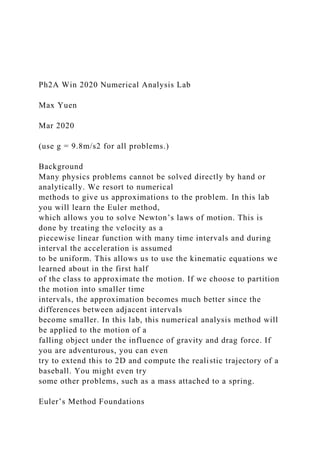
Many physics problems cannot be solved directly by hand or
analytically. We resort to numerical
methods to give us approximations to the problem. In this lab
you will learn the Euler method,
which allows you to solve Newton’s laws of motion. This is
done by treating the velocity as a
piecewise linear function with many time intervals and during
interval the acceleration is assumed
to be uniform. This allows us to use the kinematic equations we
learned about in the first half
of the class to approximate the motion. If we choose to partition
the motion into smaller time
intervals, the approximation becomes much better since the
differences between adjacent intervals
become smaller. In this lab, this numerical analysis method will
be applied to the motion of a
falling object under the influence of gravity and drag force. If
you are adventurous, you can even
try to extend this to 2D and compute the realistic trajectory of a
baseball. You might even try
some other problems, such as a mass attached to a spring.
Euler’s Method Foundations
This method is well suited for problems where the acceleration
is a function of the velocity, as in
the case of a falling object under the influence of gravity and
drag:
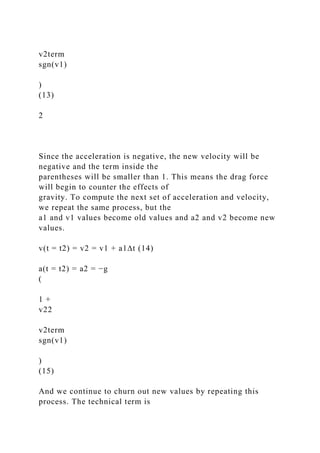
a = f(v) (1)
Falling object with drag force
The model for drag fits the prescription for using Euler’s
method since the net force on a falling
object with drag is given by:
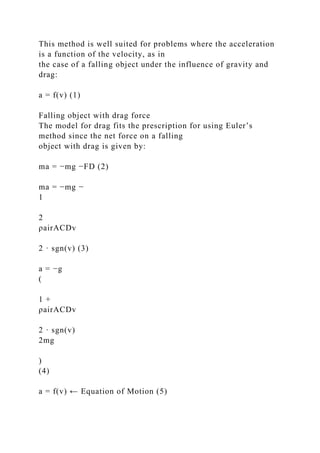
ma = −mg −FD (2)
ma = −mg −
1
2
ρairACDv
2 · sgn(v) (3)
a = −g
(
1 +
ρairACDv
2 · sgn(v)
2mg
)
(4)
a = f(v) ← Equation of Motion (5)
where m is the mass of the falling object, a is the acceleration
of the object (which is positive when
pointed up), ρair is the density of air (about 1.29 ·10−3kg/m3),
A is the cross-sectional area, CD is
the drag coefficient, v is the object’s velocity, and sgn(v) is the
signum function which returns the
sign of the argument. The second signum function is there to
guarantee that the direction of the
drag force is always in the opposite direction of the velocity
function. Note that we see that the
acceleration is an explicit function of v, which sort of makes
this a chicken or egg problem. This is
because we need a to get v, but to get a we need v, so which one
do we compute first? Hold that
thought. We’ll talk more on how to program this in EXCEL or
Google Sheets later.
1
Figure 1: FBD for an object falling under the pull of gravity and
resistance by drag force
Terminal Velocity
In lecture, we talked about how after waiting for some time, if
the object started at rest the
speed will increase and the drag force will also become larger
and eventually balance out with the
gravitational force. When this happens, we have reached
terminal velocity vterm = −v. This can
be solved by setting a = 0:
0 = −mg −
1
2
ρairACDv
2 · sgn(v) (6)
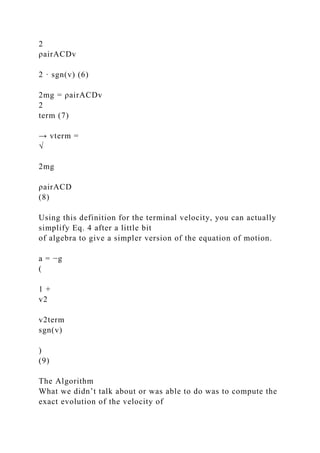
2mg = ρairACDv
2
term (7)
→ vterm =
√
2mg
ρairACD
(8)
Using this definition for the terminal velocity, you can actually
simplify Eq. 4 after a little bit
of algebra to give a simpler version of the equation of motion.
a = −g
(
1 +
v2
v2term
sgn(v)
)
(9)
The Algorithm
What we didn’t talk about or was able to do was to compute the
exact evolution of the velocity of
the system from t = 0 to see how velocity went form 0 to
−vterm. We can achieve this numerically
without knowing how to solve a differential equation if we
divide the problem into many smaller
time intervals ∆t, say starting from ti = 0 to tf = N∆t, where N
is the number of time intervals
from the start to the end time. When you increase the number of
intervals N or reduce the interval
∆t the approximation becomes better. (It should, or you will
have an unstable solution.) Thus,
we have N + 1 values of time tn = n∆t for N intervals from t0 to
tN.
The Euler’s method will solve the equation of motion problem
in each time interval by com-
puting new velocities and new positions using the information
from the previous interval. Let’s
define our initial values for a0 and v0 at t0 = 0:
a(t = 0) = a0 = −g (10)
v(t = 0) = v0 = 0 at rest initially (11)
We compute the new values at the next time step t1 from the old
values by direction applica-
tion of kinematics equations. The new velocity v1 is computed
from the old velocity v0 and old
acceleration a0. The new acceleration a1 is computed from the
new velocity v1.
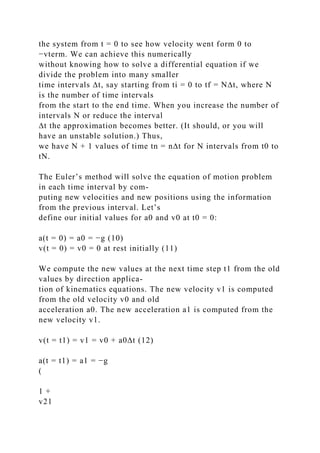
v(t = t1) = v1 = v0 + a0∆t (12)
a(t = t1) = a1 = −g
(
1 +
v21
v2term
sgn(v1)
)
(13)
2
Since the acceleration is negative, the new velocity will be
negative and the term inside the
parentheses will be smaller than 1. This means the drag force
will begin to counter the effects of
gravity. To compute the next set of acceleration and velocity,
we repeat the same process, but the
a1 and v1 values become old values and a2 and v2 become new
values.
v(t = t2) = v2 = v1 + a1∆t (14)
a(t = t2) = a2 = −g
(
1 +
v22
v2term
sgn(v1)
)
(15)
And we continue to churn out new values by repeating this
process. The technical term is
recursion and the recursive relation is given by:
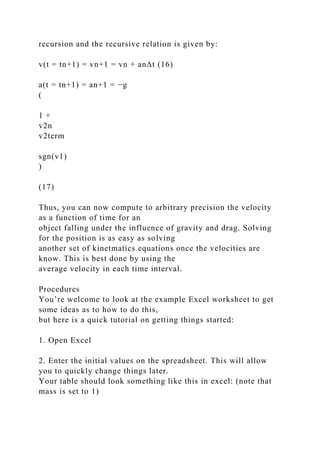
v(t = tn+1) = vn+1 = vn + an∆t (16)
a(t = tn+1) = an+1 = −g
(
1 +
v2n
v2term
sgn(v1)
)
(17)
Thus, you can now compute to arbitrary precision the velocity
as a function of time for an
object falling under the influence of gravity and drag. Solving
for the position is as easy as solving
another set of kinetmatics equations once the velocities are
know. This is best done by using the
average velocity in each time interval.
Procedures
You’re welcome to look at the example Excel worksheet to get
some ideas as to how to do this,
but here is a quick tutorial on getting things started:
1. Open Excel
2. Enter the initial values on the spreadsheet. This will allow
you to quickly change things later.
Your table should look something like this in excel: (note that
mass is set to 1)
parameter value units
g 9.8 m/s2
vterm 0.7 m/s
v0 0 m/s
dt 0.01 s
t0 0 s
Table 1: Initial values for modeling drag
3. Next, find an empty section in your spreadsheet and enter the
column headings and the first
row of initial values:
time(s) velocity(m/s) accel(m/s2)
0 0 -9.8
Table 2: Excel Worksheet Example
4. Next, enter for appropriate formulas in the next set of cells,
using the appropriate algorithm.
See EXCEL file for hints on the equations to enter.
5. In the box for time, we simply add the value stored at t0 to
the previous, so 0 + 0.1 = 0.1.
6. In the box for velocity, we update this using the old velocity
and the old acceleration using
the formula v1 = v0 + a0∆t . Thus, we get 0 + (−9.8) ∗ 0.01 =
−0.098.
3
time(s) velocity(m/s) accel(m/s2)
0 0 -9.8
0.01 -0.098 -9.60792
Table 3: Excel Worksheet Example
7. In the box for accel, we calculate the acceleration using Eq.
17. Thus, we get −9.8 · (1 +
(0.0982/0.72)(−1)) = −9.60792...
8. This is for one iteration.
9. Repeat Steps 4 to 7 for as many as you need to get to
terminal velocity.
10. Make a graph showing the velocity as a function of time.
Can you see when the velocity
becomes 90% of the terminal velocity?
11. Make another graph showing the acceleration as a function
of time. Can you see when the
net force become zero?
12. Try changing the ∆t to 0.1 or 0.001. What do you find?
Explain what you found.
13. Try changing the vterm to 2.1 m/s. How does this affect
your graphs?
14. Try a different starting velocity, say vi = −2.
15. Now, remember your results to the coffee filter drag force
lab. Does it make sense?
4
THE ENVIRONMENTAL ANALYSIS
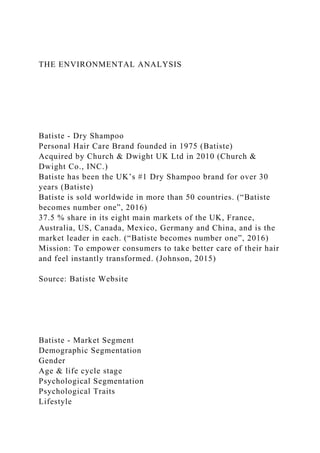
Batiste - Dry Shampoo
Personal Hair Care Brand founded in 1975 (Batiste)
Acquired by Church & Dwight UK Ltd in 2010 (Church &
Dwight Co., INC.)
Batiste has been the UK’s #1 Dry Shampoo brand for over 30
years (Batiste)
Batiste is sold worldwide in more than 50 countries. (“Batiste
becomes number one”, 2016)
37.5 % share in its eight main markets of the UK, France,
Australia, US, Canada, Mexico, Germany and China, and is the
market leader in each. (“Batiste becomes number one”, 2016)
Mission: To empower consumers to take better care of their hair
and feel instantly transformed. (Johnson, 2015)
Source: Batiste Website
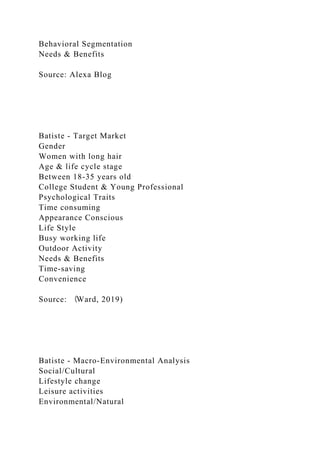
Batiste - Market Segment
Demographic Segmentation
Gender
Age & life cycle stage
Psychological Segmentation
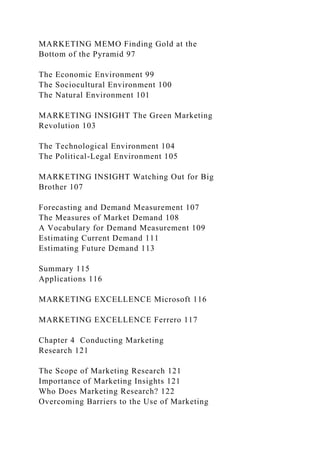
Psychological Traits
Lifestyle
Behavioral Segmentation
Needs & Benefits
Source: Alexa Blog
Batiste - Target Market
Gender
Women with long hair
Age & life cycle stage
Between 18-35 years old
College Student & Young Professional
Psychological Traits
Time consuming
Appearance Conscious
Life Style
Busy working life
Outdoor Activity
Needs & Benefits
Time-saving
Convenience
Source: (Ward, 2019)
Batiste - Macro-Environmental Analysis
Social/Cultural
Lifestyle change
Leisure activities
Environmental/Natural
Environmental Friendly Product
Opportunities
Saving Energy and Water (Baden, 2020)
Recyclable Aerosol Can (Batistie)
All the ingredients have been tested to ensure maximum safety.
(Batistie)
Threats
Aerosol propellants could damage the ozone layer - Global
Warming Concern (Reisch, n.d.)
Introduce aerosol-free product line
Source:PESTEL Analysis
References
Agwu, M. E., & Onwuegbuzie, H. N. (2018). Effects of
international marketing environments on entrepreneurship
development. Journal of Innovation and Entrepreneurship, 7(1),
1-14. doi:http://dx.doi.org/10.1186/s13731-018-0093-4
Alexa Blog. Retrieved from https://blog.alexa.com/types-of-
market-segmentation/
Baden, D. (2020, March 3). Change the way you wash your hair
to help save the environment. Retrieved from
http://theconversation.com/change-the-way-you-wash-your-hair-
to-help-save-the-environment-111113
Batiste. Retrieved from http://www.batistehair.co.uk/about
Batiste becomes number one dry shampoo brand globally.
(2016, August 22). Retrieved from
https://www.cosmeticsbusiness.com/news/article_page/Batiste_
becomes_number_one_dry_shampoo_brand_globally/120420
Church & Dwight Co., INC. Retrieved from
https://churchdwight.com/company/history.aspx
Johnson, T. C. (2015, August 19). Retrieved from
https://thedieline.com/blog/2015/8/13/batiste
PESTEL Analysis. Retrieved from
https://pestleanalysis.com/pestel-framework/
Reisch, M. S. (n.d.). Global Warming Concerns Put Pressure On
Aerosol Propellants. Retrieved from
https://cen.acs.org/articles/93/i42/Global-Warming-Concerns-
Put-Pressure.html
Ward, S. (2019, June 25). Use Target Marketing and Market
Segmentation to Improve Your Bottom Line. Retrieved from
https://www.thebalancesmb.com/target-marketing-2948355
15e
MARKETING
M A N A G E M E N T
Kotler
Keller
GLOBAL
EDITION
Go to Strategy Books: https://sharifstrategy.org/strategy-books
https://sharifstrategy.org/strategy-books
15
PHILIP KOTLER
Northwestern University
KEVIN LANE KELLER
Dartmouth College
Boston Columbus Indianapolis New York San Francisco
Amsterdam Cape Town
Dubai London Madrid Milan Munich Paris Montréal Toronto
Delhi Mexico City São Paulo Sydney Hong Kong Seoul
Singapore Taipei Tokyo
Marketing
Management
Global Edition
Go to Strategy Books: https://sharifstrategy.org/strategy-books
https://sharifstrategy.org/strategy-books
Donna Battista
Stephanie Wall
Mark Gaffney
Elisa Adams
Steven Jackson
Suchismita Ukil
Ashley Santora
Jennifer Collins
Daniel Petrino
Maggie Moylan
Jeanette Koskinas
Anne Fahlgren
Lenny Ann Raper
Erin Gardner
Judy Leale
Becca Groves
M. Vikram Kumar
Trudy Kimber
Carol Melville
Blair Brown
Janet Slowik
Lumina Datamatics Ltd.
Paul Gentile
Paul Deluca
Brian Surette
Diane Lombardo
Robin Lazrus
Alana Coles
Monique Lawrence
Regina DaSilva
Integra
Software Services Pvt Ltd.
Pearson Education Limited
Edinburgh Gate
Harlow
Essex CM20 2JE
England
and Associated Companies throughout the world
Visit us on the World Wide Web at:
www.pearsonglobaleditions.com
© Pearson Education Limited 2016
The rights of Philip Kotler and Kevin Lane Keller to be
identified as the authors of this work have been asserted by
them in accordance
with the Copyright, Designs and Patents Act 1988.
p K
All rights reserved. No part of this publication may be
reproduced, stored in a retrieval system, or transmitted in any
form or by any
means, electronic, mechanical, photocopying, recording or
otherwise, without either the prior written permission of the
publisher or a
license permitting restricted copying in the United Kingdom
issued by the Copyright Licensing Agency Ltd, Saffron House,
6–10 Kirby
Street, London EC1N 8TS.
All trademarks used herein are the property of their respective
owners. The use of any trademark in this text does not vest in
the author
or publisher any trademark ownership rights in such trademarks,
nor does the use of such trademarks imply any affiliation with
or
endorsement of this book by such owners.
ISBN 10: 1-292-09262-9
ISBN 13: 978-1-292-09262-1
British Library Cataloguing-in-Publication Data
A catalogue record for this book is available from the British
Library
10 9 8 7 6 5 4 3 2 1
14 13 12 11
Typeset in Minion Pro 9.5/11.5 by Integra Software Services
Pvt Ltd.
Printed and bound by Courier/Kendallville in the United States
of America
ISBN 13: 978-1-292-092 -71 3
Go to Strategy Books: https://sharifstrategy.org/strategy-books
https://sharifstrategy.org/strategy-books
This book is dedicated to my wife and best friend, Nancy, with
love.
—PK
This book is dedicated to my wife, Punam, and my two
daughters,
Carolyn and Allison, with much love and thanks.
—KLK
Go to Strategy Books: https://sharifstrategy.org/strategy-books
https://sharifstrategy.org/strategy-books
4
Philip Kotler is one of the world’s leading authorities on
marketing. He is the S. C. Johnson & Son Distinguished
Professor
of International Marketing at the Kellogg School of
Management,
Northwestern University. He received his master’s degree at the
University of Chicago and his Ph.D. at MIT, both in economics.
He did
postdoctoral work in mathematics at Harvard University and in
behav-
ioral science at the University of Chicago.
Dr. Kotler is the coauthor of Principles of Marketing and
Marketing:
An Introduction. His Strategic Marketing for Nonprofit
Organizations,
now in its seventh edition, is the best seller in that specialized
area.
Dr. Kotler’s other books include Marketing Models; The New
Competition; Marketing Professional
Services; Strategic Marketing for Educational Institutions;
Marketing for Health Care Organizations;
Marketing Congregations; High Visibility; Social Marketing;
Marketing Places; The Marketing of
Nations; Marketing for Hospitality and Tourism; Standing
Room Only—Strategies for Marketing the
Performing Arts; Museum Strategy and Marketing; Marketing
Moves; Kotler on Marketing; Lateral
Marketing; Winning at Innovation; Ten Deadly Marketing Sins;
Chaotics; Marketing Your Way to
Growth; Winning Global Markets; and Corporate Social
Responsibility.
In addition, he has published more than 150 articles in leading
journals, including the Harvard
Business Review, Sloan Management Review, Business
Horizons, California Management Review,
the Journal of Marketing, the Journal of Marketing Research,
Management Science, the Journal of
Business Strategy, and Futurist. He is the only three-time
winner of the coveted Alpha Kappa Psi
award for the best annual article published in the Journal of
Marketing.
Professor Kotler was the first recipient of the American
Marketing Association’s (AMA) Distinguished
Marketing Educator Award (1985). The European Association
of Marketing Consultants and Sales
Trainers awarded him their Prize for Marketing Excellence. He
was chosen as the Leader in Marketing
Thought by the Academic Members of the AMA in a 1975
survey. He also received the 1978 Paul
Converse Award of the AMA, honoring his original contribution
to marketing. In 1995, the Sales and
Marketing Executives International (SMEI) named him
Marketer of the Year. In 2002, Professor Kotler
received the Distinguished Educator Award from the Academy
of Marketing Science. In 2013, he
received the William L. Wilkie “Marketing for a Better World”
Award and subsequently received the
Sheth Foundation Medal for Exceptional Contribution to
Marketing Scholarship and Practice. In 2014,
he was inducted in the Marketing Hall of Fame.
He has received honorary doctoral degrees from Stockholm
University, the University of Zurich,
Athens University of Economics and Business, DePaul
University, the Cracow School of Business
and Economics, Groupe H.E.C. in Paris, the Budapest School of
Economic Science and Public
Administration, the University of Economics and Business
Administration in Vienna, and Plekhanov
Russian Academy of Economics. Professor Kotler has been a
consultant to many major U.S. and
foreign companies, including IBM, General Electric, AT&T,
Honeywell, Bank of America, Merck, SAS
Airlines, Michelin, and others in the areas of marketing strategy
and planning, marketing organization,
and international marketing.
He has been Chairman of the College of Marketing of the
Institute of Management Sciences, a Director
of the American Marketing Association, a Trustee of the
Marketing Science Institute, a Director of the MAC
Group, a member of the Yankelovich Advisory Board, and a
member of the Copernicus Advisory Board.
He was a member of the Board of Governors of the School of
the Art Institute of Chicago and a member of
the Advisory Board of the Drucker Foundation. He has traveled
extensively throughout Europe, Asia, and
South America, advising and lecturing to many companies about
global marketing opportunities.
About the Authors
P
hi
lip
K
ot
le
r
Go to Strategy Books: https://sharifstrategy.org/strategy-books
https://sharifstrategy.org/strategy-books
5
Kevin Lane Keller is the E. B. Osborn Professor of
Marketing at the Tuck School of Business at Dartmouth
College.
Professor Keller has degrees from Cornell, Carnegie-Mellon,
and
Duke universities. At Dartmouth, he teaches MBA courses on
mar-
keting management and strategic brand management and
lectures
in executive programs on those topics.
Previously, Professor Keller was on the faculty at Stanford
University, where he also served as the head of the marketing
group.
Additionally, he has been on the faculty at the University of
California
at Berkeley and the University of North Carolina at Chapel Hill,
has been a visiting professor at Duke University and the
Australian
Graduate School of Management, and has two years of industry
experience as Marketing Consultant
for Bank of America.
Professor Keller’s general area of expertise lies in marketing
strategy and planning and branding. His
specific research interest is in how understanding theories and
concepts related to consumer behavior
can improve marketing strategies. His research has been
published in three of the major marketing
journals: the Journal of Marketing, the Journal of Marketing
Research, and the Journal of Consumer
Research. He also has served on the Editorial Review Boards of
those journals. With more than 90 pub-
lished papers, his research has been widely cited and has
received numerous awards.
Actively involved with industry, he has worked on a host of
different types of marketing projects.
He has served as a long-term consultant and advisor to
marketers for some of the world’s most
successful brands, including Accenture, American Express,
Disney, Ford, Intel, Levi Strauss, Procter
& Gamble, and Samsung. Additional brand consulting activities
have been with other top companies
such as Allstate, Beiersdorf (Nivea), BlueCross BlueShield,
Campbell, Colgate, Eli Lilly, ExxonMobil,
General Mills, GfK, Goodyear, Hasbro, Intuit, Johnson &
Johnson, Kodak, L.L.Bean, Mayo Clinic, MTV,
Nordstrom, Ocean Spray, Red Hat, SAB Miller, Shell Oil,
Starbucks, Unilever, and Young & Rubicam.
He has also served as an academic trustee for the Marketing
Science Institute and served as their
Executive Director from July 1, 2013, to July 1, 2015.
A popular and highly sought-after speaker, he has made
speeches and conducted marketing semi-
nars to top executives in a variety of forums. Some of his senior
management and marketing training
clients have included include such diverse business
organizations as Cisco, Coca-Cola, Deutsche
Telekom, ExxonMobil, GE, Google, IBM, Macy’s, Microsoft,
Nestle, Novartis, Pepsico, SC Johnson and
Wyeth. He has lectured all over the world, from Seoul to
Johannesburg, from Sydney to Stockholm,
and from Sao Paulo to Mumbai. He has served as keynote
speaker at conferences with hundreds to
thousands of participants.
Professor Keller is currently conducting a variety of studies that
address strategies to build, mea-
sure, and manage brand equity. His textbook on those subjects,
Strategic Brand Management, in its
fourth edition, has been adopted at top business schools and
leading firms around the world and has
been heralded as the “bible of branding.”
An avid sports, music, and film enthusiast, in his so-called
spare time, he has helped to manage and
market, as well as serve as executive producer for, one of
Australia’s great rock-and-roll treasures, The
Church, as well as American power-pop legends Tommy Keene
and Dwight Twilley. He also serves on
the Board of Directors for The Doug Flutie, Jr. Foundation for
Autism, the Lebanon Opera House, and
the Montshire Museum of Science. Professor Keller lives in
Etna, NH, with his wife, Punam (also a Tuck
marketing professor), and his two daughters, Carolyn and
Allison.
K
ev
in
L
an
e
K
el
le
r
Go to Strategy Books: https://sharifstrategy.org/strategy-books
https://sharifstrategy.org/strategy-books
6
Brief Contents
Preface 17
PART 1 Understanding Marketing Management 24
Chapter 1 Defining Marketing for the New Realities 25
Chapter 2 Developing Marketing Strategies and Plans 57
PART 2 Capturing Marketing Insights 88
Chapter 3 Collecting Information and Forecasting Demand 89
Chapter 4 Conducting Marketing Research 121
PART 3 Connecting with Customers 148
Chapter 5 Creating Long-Term Loyalty Relationships 149
Chapter 6 Analyzing Consumer Markets 179
Chapter 7 Analyzing Business Markets 211
Chapter 8 Tapping into Global Markets 239
PART 4 Building Strong Brands 266
Chapter 9 Identifying Market Segments and Targets 267
Chapter 10 Crafting the Brand Positioning 297
Chapter 11 Creating Brand Equity 321
Chapter 12 Addressing Competition and Driving Growth 357
PART 5 Creating Value 388
Chapter 13 Setting Product Strategy 389
Chapter 14 Designing and Managing Services 421
Chapter 15 Introducing New Market Offerings 451
Chapter 16 Developing Pricing Strategies and Programs 483
PART 6 Delivering Value 514
Chapter 17 Designing and Managing Integrated Marketing
Channels 515
Chapter 18 Managing Retailing, Wholesaling, and Logistics 549
PART 7 Communicating Value 578
Chapter 19 Designing and Managing Integrated Marketing
Communications 579
Chapter 20 Managing Mass Communications: Advertising,
Sales Promotions, Events
and Experiences, and Public Relations 607
Chapter 21 Managing Digital Communications: Online, Social
Media, and Mobile 637
Chapter 22 Managing Personal Communications: Direct and
Database Marketing and
Personal Selling 657
PART 8 Conducting Marketing Responsibly for Long-Term
Success 678
Chapter 23 Managing a Holistic Marketing Organization for the
Long Run 679
Appendix: Sonic Marketing Plan and Exercises A1
Endnotes E1
Glossary G1
Name Index I1
Company, Brand, and Organization Index I5
Subject Index I18
Go to Strategy Books: https://sharifstrategy.org/strategy-books
https://sharifstrategy.org/strategy-books
7
Contents
Preface 17
PART 1 Understanding Marketing
Management 24
Chapter 1 Defining Marketing for the New
Realities 25
The Value of Marketing 25
Marketing Decision Making 25
Winning Marketing 26
The Scope of Marketing 27
What Is Marketing? 27
What Is Marketed? 27
Who Markets? 29
Core Marketing Concepts 31
Needs, Wants, and Demands 31
Target Markets, Positioning, and
Segmentation 31
Offerings and Brands 32
Marketing Channels 32
Paid, Owned, and Earned Media 32
Impressions and Engagement 32
Value and Satisfaction 33
Supply Chain 33
Competition 34
Marketing Environment 34
The New Marketing Realities 35
Technology 35
Globalization 36
Social Responsibility 36
MARKETING INSIGHT Getting to
Marketing 3.0 37
A Dramatically Changed Marketplace 38
New Consumer Capabilities 38
New Company Capabilities 39
Changing Channels 41
Heightened Competition 41
Marketing in Practice 41
Marketing Balance 41
MARKETING MEMO Reinventing Marketing
at Coca-Cola 42
Marketing Accountability 42
Marketing in the Organization 42
Company Orientation toward the
Marketplace 42
The Production Concept 42
The Product Concept 43
The Selling Concept 43
The Marketing Concept 43
The Holistic Marketing Concept 43
Updating the Four Ps 47
MARKETING INSIGHT Understanding the
4 As of Marketing 48
Marketing Management Tasks 49
Developing Marketing Strategies and
Plans 49
Capturing Marketing Insights 50
Connecting with Customers 50
Building Strong Brands 50
MARKETING MEMO Marketers’ Frequently
Asked Questions 50
Creating Value 51
Delivering Value 51
Communicating Value 51
Conducting Marketing Responsibly for
Long-Term Success 51
Summary 51
Applications 52
MARKETING EXCELLENCE Nike 52
MARKETING EXCELLENCE Google 54
Chapter 2 Developing Marketing Strategies
and Plans 57
Marketing and Customer Value 57
The Value Delivery Process 57
The Value Chain 58
Core Competencies 58
The Central Role of Strategic Planning 59
Corporate and Division Strategic Planning 60
MARKETING MEMO What Does It Take
to Be a Successful CMO? 61
Defining the Corporate Mission 61
Establishing Strategic Business Units 64
Assigning Resources to Each SBU 64
Assessing Growth Opportunities 64
Organization and Organizational Culture 68
Marketing Innovation 69
MARKETING INSIGHT Creating Innovative
Marketing 69
Business Unit Strategic Planning 70
The Business Mission 71
SWOT Analysis 71
Go to Strategy Books: https://sharifstrategy.org/strategy-books
https://sharifstrategy.org/strategy-books
8
MARKETING MEMO Checklist for Evaluating
Strengths/Weaknesses Analysis 73
Goal Formulation 74
Strategic Formulation 74
Program Formulation and
Implementation 75
MARKETING INSIGHT Businesses Charting
a New Direction 76
Feedback and Control 77
The Nature and Contents of a Marketing
Plan 77
MARKETING MEMO Marketing Plan
Criteria 77
The Role of Research 78
The Role of Relationships 78
From Marketing Plan to Marketing
Action 79
Summary 79
Applications 80
MARKETING EXCELLENCE Electrolux 80
MARKETING EXCELLENCE Emirates 81
Sample Marketing Plan: Pegasus Sports
International 83
PART 2 Capturing Marketing
Insights 88
Chapter 3 Collecting Information and
Forecasting Demand 89
Components of a Modern Marketing
Information System 89
Internal Records 91
The Order-to-Payment Cycle 91
Sales Information Systems 91
Databases, Data Warehousing, and Data
Mining 91
MARKETING INSIGHT Digging Into Big
Data 92
Marketing Intelligence 92
The Marketing Intelligence System 92
Collecting Marketing Intelligence on the
Internet 94
Communicating and Acting on Marketing
Intelligence 94
Analyzing the Macroenvironment 94
Needs and Trends 95
Identifying the Major Forces 95
The Demographic Environment 96
MARKETING MEMO Finding Gold at the
Bottom of the Pyramid 97
The Economic Environment 99
The Sociocultural Environment 100
The Natural Environment 101
MARKETING INSIGHT The Green Marketing
Revolution 103
The Technological Environment 104
The Political-Legal Environment 105
MARKETING INSIGHT Watching Out for Big
Brother 107
Forecasting and Demand Measurement 107
The Measures of Market Demand 108
A Vocabulary for Demand Measurement 109
Estimating Current Demand 111
Estimating Future Demand 113
Summary 115
Applications 116
MARKETING EXCELLENCE Microsoft 116
MARKETING EXCELLENCE Ferrero 117
Chapter 4 Conducting Marketing
Research 121
The Scope of Marketing Research 121
Importance of Marketing Insights 121
Who Does Marketing Research? 122
Overcoming Barriers to the Use of Marketing
Research 123
The Marketing Research Process 124
Step 1: Define the Problem, the Decision
Alternatives, and the Research
Objectives 124
Step 2: Develop the Research Plan 125
MARKETING MEMO Conducting Informative
Focus Groups 127
MARKETING MEMO Marketing
Questionnaire Dos And Don’ts 130
MARKETING INSIGHT Getting into the
Heads of Consumers 131
MARKETING INSIGHT Understanding Brain
Science 133
Step 3: Collect the Information 135
Step 4: Analyze the Information 135
Step 5: Present the Findings 135
MARKETING INSIGHT Bringing Marketing
Research to Life with Personas 136
Go to Strategy Books: https://sharifstrategy.org/strategy-books
https://sharifstrategy.org/strategy-books
9
Step 6: Make the Decision 136
Measuring Marketing Productivity 137
Marketing Metrics 137
MARKETING MEMO Measuring Social
Media ROI 139
Marketing-Mix Modeling 140
Marketing Dashboards 140
MARKETING MEMO Designing Effective
Marketing Dashboards 141
Summary 143
Applications 143
MARKETING EXCELLENCE IDEO 144
MARKETING EXCELLENCE Intuit 146
PART 3 Connecting with
Customers 148
Chapter 5 Creating Long-Term Loyalty
Relationships 149
Building Customer Value, Satisfaction, and
Loyalty 149
Customer-Perceived Value 150
Total Customer Satisfaction 153
Monitoring Satisfaction 155
Product and Service Quality 156
MARKETING INSIGHT Net Promoter and
Customer Satisfaction 157
Maximizing Customer Lifetime Value 158
Customer Profitability 159
Measuring Customer Lifetime
Value 160
Attracting and Retaining Customers 160
MARKETING MEMO Calculating Customer
Lifetime Value 161
Building Loyalty 164
Brand Communities 165
Win-Backs 168
Cultivating Customer Relationships 168
Customer Relationship Management 168
MARKETING INSIGHT The Behavioral
Targeting Controversy 169
Summary 174
Applications 174
MARKETING EXCELLENCE Audi 175
MARKETING EXCELLENCE
Harley-Davidson 176
Chapter 6 Analyzing Consumer Markets 179
What Influences Consumer Behavior? 179
Cultural Factors 179
Social Factors 181
Personal Factors 183
MARKETING MEMO The Average U.S.
Consumer Quiz 184
Key Psychological Processes 187
Motivation 187
Perception 189
MARKETING MEMO The Power of Sensory
Marketing 189
Learning 191
Emotions 192
Memory 193
The Buying Decision Process: The Five-Stage
Model 194
Problem Recognition 195
Information Search 196
Evaluation of Alternatives 197
Purchase Decision 198
Postpurchase Behavior 200
Moderating Effects on Consumer Decision
Making 202
Behavioral Decision Theory and Behavioral
Economics 202
Decision Heuristics 203
Framing 204
Summary 205
Applications 205
MARKETING EXCELLENCE Disney 206
MARKETING EXCELLENCE IKEA 207
Chapter 7 Analyzing Business Markets 211
What is Organizational Buying? 211
The Business Market versus the Consumer
Market 211
Buying Situations 214
Participants in the Business Buying
Process 215
The Buying Center 216
Buying Center Influences 216
Targeting Firms and Buying Centers 217
MARKETING INSIGHT Big Sales to Small
Businesses 218
The Purchasing/Procurement Process 219
Stages in the Buying Process 220
Problem Recognition 220
Go to Strategy Books: https://sharifstrategy.org/strategy-books
https://sharifstrategy.org/strategy-books
10
General Need Description and Product
Specification 221
Supplier Search 221
Proposal Solicitation 223
Supplier Selection 223
MARKETING MEMO Developing Compelling
Customer Value Propositions 224
Order-Routine Specification 226
Performance Review 226
Developing Effective Business-to-Business
Marketing Programs 226
Communication and Branding Activities 226
Systems Buying and Selling 228
MARKETING MEMO Spreading the Word
with Customer Reference Programs 229
Role of Services 229
Managing Business-to-Business Customer
Relationships 230
The Benefits of Vertical Coordination 230
MARKETING INSIGHT Establishing
Corporate Trust, Credibility, and
Reputation 231
Risks and Opportunism in Business
Relationships 231
Institutional and Government Markets 233
Summary 234
Applications 235
MARKETING EXCELLENCE Accenture 235
MARKETING EXCELLENCE GE 236
Chapter 8 Tapping into Global Markets 239
Competing on a Global Basis 239
Deciding Whether to Go Abroad 241
Deciding Which Markets to Enter 242
How Many Markets to Enter 242
Evaluating Potential Markets 243
Succeeding in Developing
Markets 243
Deciding How to Enter the Market 248
Indirect and Direct Export 249
Licensing 249
Joint Ventures 250
Direct Investment 250
Acquisition 250
Deciding on the Marketing Program 251
Global Similarities and Differences 252
Marketing Adaptation 253
Global Product Strategies 254
Global Communication Strategies 257
Global Pricing Strategies 257
Global Distribution Strategies 259
Country-of-Origin Effects 260
Building Country Images 260
Consumer Perceptions of Country of
Origin 261
Summary 262
Applications 263
MARKETING EXCELLENCE Twitter 263
MARKETING EXCELLENCE L’Oréal 264
PART 4 Building Strong
Brands 266
Chapter 9 Identifying Market Segments and
Targets 267
Bases for Segmenting Consumer
Markets 268
Geographic Segmentation 268
Demographic Segmentation 271
Psychographic Segmentation 280
Behavioral Segmentation 281
How Should Business Markets Be
Segmented? 283
Market Targeting 284
Effective Segmentation Criteria 285
Evaluating and Selecting the Market
Segments 286
MARKETING INSIGHT Chasing the Long
Tail 289
MARKETING MEMO Protecting Kids
Online 291
Summary 291
Applications 292
MARKETING EXCELLENCE HSBC 292
MARKETING EXCELLENCE BMW 294
Chapter 10 Crafting the Brand Positioning 297
Developing a Brand Positioning 297
Understanding Positioning and Value
Propositions 297
Choosing a Competitive Frame of
Reference 298
Identifying Potential Points-of-Difference
and Points-of-Parity 300
Go to Strategy Books: https://sharifstrategy.org/strategy-books
https://sharifstrategy.org/strategy-books
11
Choosing Specific POPs and PODs 304
Brand Mantras 307
Establishing a Brand Positioning 309
MARKETING MEMO Constructing a Brand
Positioning Bull’s-eye 309
Alternative Approaches to Positioning 313
Brand Narratives and Storytelling 313
Cultural Branding 314
Positioning and Branding for A Small
Business 314
Summary 317
Applications 317
MARKETING EXCELLENCE
Nespresso 318
MARKETING EXCELLENCE
Philips 319
Chapter 11 Creating Brand Equity 321
How Does Branding Work? 321
The Role of Brands 322
The Scope of Branding 323
Defining Brand Equity 324
Brand Equity Models 326
MARKETING INSIGHT Brand Bubble
Trouble 328
Building Brand Equity 331
MARKETING MEMO The Marketing Magic of
Characters 332
Designing Holistic Marketing Activities 332
Leveraging Secondary Associations 334
Internal Branding 336
Measuring Brand Equity 337
MARKETING INSIGHT The Brand Value
Chain 337
MARKETING INSIGHT What Is a Brand
Worth? 339
Managing Brand Equity 340
Brand Reinforcement 340
Brand Revitalization 341
Devising a Branding Strategy 343
Branding Decisions 344
Brand Portfolios 345
Brand Extensions 347
Customer Equity 350
MARKETING MEMO Twenty-First-Century
Branding 351
Summary 352
Applications 352
MARKETING EXCELLENCE McDonald’s 353
MARKETING EXCELLENCE
Procter & Gamble 354
Chapter 12 Addressing Competition and
Driving Growth 357
Growth 357
Growth Strategies 357
Growing the Core 358
Competitive Strategies for Market
Leaders 359
Expanding Total Market Demand 360
Protecting Market Share 361
Increasing Market Share 363
Other Competitive Strategies 364
Market-Challenger Strategies 364
Market-Follower Strategies 366
MARKETING INSIGHT The Costs and
Benefits of Fast Fashion 367
Market-Nicher Strategies 368
MARKETING MEMO Niche Specialist
Roles 370
Product Life-Cycle Marketing Strategies 370
Product Life Cycles 370
Style, Fashion, and Fad Life Cycles 371
Marketing Strategies: Introduction Stage and
the Pioneer Advantage 373
MARKETING INSIGHT Understanding
Double Jeopardy 374
Marketing Strategies: Growth Stage 375
Marketing Strategies: Maturity Stage 376
Marketing Strategies: Decline Stage 377
MARKETING MEMO Managing a Marketing
Crisis 378
Evidence for the Product Life-Cycle
Concept 380
Critique of the Product Life-Cycle
Concept 381
Market Evolution 381
Marketing in a Slow-Growth Economy 381
Explore the Upside of Increasing
Investment 381
Get Closer to Customers 382
Review Budget Allocations 382
Put Forth the Most Compelling Value
Proposition 382
Fine-Tune Brand and Product Offerings 383
Go to Strategy Books: https://sharifstrategy.org/strategy-books
https://sharifstrategy.org/strategy-books
12
Summary 384
Applications 384
MARKETING EXCELLENCE
Samsung 385
MARKETING EXCELLENCE SABIC 386
PART 5 Creating Value 388
Chapter 13 Setting Product Strategy 389
Product Characteristics and
Classifications 389
Product Levels: The Customer-Value
Hierarchy 389
Product Classifications 391
Differentiation 392
Product Differentiation 393
Services Differentiation 394
Design 396
Design Leaders 396
Power of Design 397
Approaches to Design 397
Luxury Products 398
Characterizing Luxury Brands 398
Growing Luxury Brands 398
Marketing Luxury Brands 399
Environmental Issues 400
MARKETING MEMO A Sip or A Gulp:
Environmental Concerns in the Water
Industry 401
Product and Brand Relationships 401
The Product Hierarchy 402
Product Systems and Mixes 402
Product Line Analysis 403
Product Line Length 404
MARKETING INSIGHT When Less Is
More 405
Product Mix Pricing 408
Co-Branding and Ingredient
Branding 409
MARKETING MEMO Product-Bundle Pricing
Considerations 410
Packaging, Labeling, Warranties, and
Guarantees 412
Packaging 412
Labeling 414
Warranties and Guarantees 415
Summary 415
Applications 416
MARKETING EXCELLENCE
Nivea 416
MARKETING EXCELLENCE
Toyota 418
Chapter 14 Designing and Managing
Services 421
The Nature of Services 421
Service Industries Are Everywhere 421
Categories of Service Mix 422
Distinctive Characteristics of Services 424
The New Services Realities 428
A Shifting Customer Relationship 428
MARKETING MEMO Lights! Cameras!
Customer Service Disasters! 430
Achieving Excellence In Services
Marketing 431
Marketing Excellence 431
Technology and Service
Delivery 432
Best Practices of Top Service
Companies 433
Differentiating Services 435
MARKETING INSIGHT Improving Company
Call Centers 436
Managing Service Quality 439
Managing Customer Expectations 440
MARKETING MEMO Recommendations for
Improving Service Quality 441
Incorporating Self-Service Technologies
(SSTS) 443
Managing Product-Support Services 444
Identifying and Satisfying Customer
Needs 444
Postsale Service Strategy 445
Summary 445
Applications 446
MARKETING EXCELLENCE
Club Med 446
MARKETING EXCELLENCE
Parkway Group Hotels 448
Chapter 15 Introducing New Market
Offerings 451
New-Product Options 451
Make or Buy 451
Types of New Products 452
Go to Strategy Books: https://sharifstrategy.org/strategy-books
https://sharifstrategy.org/strategy-books
13
Challenges in New-Product
Development 453
The Innovation Imperative 454
New-Product Success 454
New-Product Failure 455
Organizational Arrangements 456
Budgeting for New-Product Development 456
Organizing New-Product Development 457
Managing the Development Process: Ideas 460
Generating Ideas 460
MARKETING MEMO Ten Ways to Find Great
New-Product Ideas 460
MARKETING INSIGHT P&G’S Connect +
Develop Approach to Innovation 461
MARKETING MEMO Seven Ways to Draw
New Ideas from Your Customers 462
MARKETING MEMO How to Run a
Successful Brainstorming Session 464
Using Idea Screening 465
Managing the Development Process: Concept
to Strategy 467
Concept Development and Testing 467
Marketing Strategy Development 470
Business Analysis 470
Managing the Development Process:
Development to Commercialization 472
Product Development 472
Market Testing 473
Commercialization 475
The Consumer-Adoption Process 476
Stages in the Adoption Process 476
Factors Influencing the Adoption
Process 476
Summary 478
Applications 479
MARKETING EXCELLENCE Apple 479
MARKETING EXCELLENCE
Salesforce.com 481
Chapter 16 Developing Pricing Strategies
and Programs 483
Understanding Pricing 483
Pricing in a Digital World 484
A Changing Pricing Environment 484
MARKETING INSIGHT Giving It All Away 485
How Companies Price 486
Consumer Psychology and Pricing 487
Setting the Price 489
Step 1: Selecting the Pricing Objective 489
MARKETING INSIGHT Trading Up, Down,
and Over 490
Step 2: Determining Demand 492
Step 3: Estimating Costs 494
MARKETING MEMO How to Cut Costs 496
Step 4: Analyzing Competitors’ Costs, Prices,
and Offers 496
Step 5: Selecting a Pricing Method 497
Step 6: Selecting the Final Price 502
MARKETING INSIGHT Stealth Price
Increases 503
Adapting the Price 504
Geographical Pricing (Cash, Countertrade,
Barter) 504
Price Discounts and Allowances 504
Promotional Pricing 505
Differentiated Pricing 506
Initiating and Responding to Price
Changes 507
Initiating Price Cuts 507
Initiating Price Increases 508
Anticipating Competitive Responses 508
Responding to Competitors’ Price
Changes 509
Summary 510
Applications 510
MARKETING EXCELLENCE eBay 511
MARKETING EXCELLENCE
Air Arabia 512
PART 6 Delivering Value 514
Chapter 17 Designing and Managing Integrated
Marketing Channels 515
Marketing Channels and Value
Networks 516
The Importance of Channels 516
Multichannel Marketing 516
Integrating Multichannel Marketing
Systems 517
Value Networks 519
The Digital Channels Revolution 520
The Role of Marketing Channels 521
Channel Functions and Flows 522
Channel Levels 523
Service Sector Channels 524
Go to Strategy Books: https://sharifstrategy.org/strategy-books
https://sharifstrategy.org/strategy-books
14
Channel-Design Decisions 525
Analyzing Customer Needs and Wants 525
MARKETING INSIGHT Understanding the
Showrooming Phenomena 525
Establishing Objectives and Constraints 526
Identifying Major Channel Alternatives 527
Evaluating Major Channel
Alternatives 529
Channel-Management Decisions 530
Selecting Channel Members 530
Training and Motivating Channel
Members 530
Evaluating Channel Members 531
Modifying Channel Design and
Arrangements 532
Channel Modification Decisions 532
Global Channel Considerations 532
Channel Integration and Systems 534
Vertical Marketing Systems 534
Horizontal Marketing Systems 536
E-Commerce Marketing Practices 536
Pure-Click Companies 536
Brick-and-Click Companies 537
M-Commerce Marketing Practices 538
Changes in Customer and Company
Behavior 539
M-Commerce Marketing Practices 539
Privacy 540
Conflict, Cooperation, and Competition 540
Types of Conflict and Competition 541
Causes of Channel Conflict 541
Managing Channel Conflict 541
Dilution and Cannibalization 543
Legal and Ethical Issues in Channel
Relations 543
Summary 543
Applications 544
MARKETING EXCELLENCE
Amazon.com 544
MARKETING EXCELLENCE Tesco 546
Chapter 18 Managing Retailing,Wholesaling,
and Logistics 549
Retailing 549
Types of Retailers 550
MARKETING MEMO Innovative Retail
Organizations 551
The Modern Retail Marketing
Environment 554
MARKETING INSIGHT The Growth of
Shopper Marketing 556
Marketing Decisions 557
MARKETING MEMO Helping Stores to Sell 562
Private Labels 563
Role of Private Labels 564
Private-Label Success Factors 564
MARKETING INSIGHT Manufacturer’s
Response to the Private-Label
Threat 565
Wholesaling 565
Trends in Wholesaling 567
Market Logistics 567
Integrated Logistics Systems 568
Market-Logistics Objectives 569
Market-Logistics Decisions 570
Summary 573
Applications 574
MARKETING EXCELLENCE Zara 574
MARKETING EXCELLENCE Best Buy 576
PART 7 Communicating Value 578
Chapter 19 Designing and Managing
Integrated Marketing
Communications 579
The Role of Marketing Communications 580
The Changing Marketing Communications
Environment 580
MARKETING INSIGHT Don’t Touch That
Remote 580
Marketing Communications Mix 581
How Do Marketing Communications
Work? 583
The Communications Process Models 584
Developing Effective Communications 586
Identify the Target Audience 586
Set the Communications Objectives 587
Design the Communications 587
Select the Communications
Channels 590
MARKETING MEMO Celebrity
Endorsements as a Message
Strategy 591
MARKETING INSIGHT Playing Tricks to
Build a Brand 593
Go to Strategy Books: https://sharifstrategy.org/strategy-books
https://sharifstrategy.org/strategy-books
15
Establish the Total Marketing
Communications Budget 594
Selecting the Marketing Communications
Mix 595
Characteristics of the Marketing
Communications Mix 596
Factors in Setting the Marketing
Communications Mix 597
Measuring Communication Results 599
Managing the Integrated Marketing
Communications Process 599
Coordinating Media 601
Implementing IMC 601
MARKETING MEMO How Integrated Is Your
IMC Program? 601
Summary 602
Applications 603
MARKETING EXCELLENCE Red Bull 603
MARKETING EXCELLENCE L’Oreal 604
Chapter 20 Managing Mass Communications:
Advertising, Sales Promotions,
Events and Experiences, and Public
Relations 607
Developing and Managing an Advertising
Program 608
Setting the Advertising Objectives 609
Deciding on the Advertising Budget 609
Developing the Advertising
Campaign 610
MARKETING MEMO Print Ad Evaluation
Criteria 612
MARKETING INSIGHT Off-Air Ad Battles 614
Choosing Media 615
MARKETING INSIGHT Playing Games with
Brands 618
MARKETING MEMO Winning The Super
Bowl of Advertising 619
Evaluating Advertising Effectiveness 621
Sales Promotion 622
Advertising Versus Promotion 622
Major Decisions 623
Events and Experiences 626
Events Objectives 626
Major Sponsorship Decisions 627
MARKETING MEMO Measuring
High- Performance Sponsorship
Programs 628
Creating Experiences 628
Public Relations 629
Marketing Public Relations 629
Major Decisions in Marketing PR 630
Summary 631
Applications 632
MARKETING EXCELLENCE
Evian 632
MARKETING EXCELLENCE Gillette 634
Chapter 21 Managing Digital Communications:
Online, Social Media, and
Mobile 637
Online Marketing 637
Advantages and Disadvantages of Online
Marketing Communications 638
Online Marketing Communication
Options 639
MARKETING MEMO How to Maximize the
Marketing Value of E-mails 642
Social Media 642
Social Media Platforms 643
Using Social Media 644
Word of Mouth 645
Forms of Word of Mouth 646
Creating Word-of-Mouth Buzz 646
MARKETING MEMO How to Start a Buzz
Fire 648
MARKETING INSIGHT Tracking Online
Buzz 649
Measuring the Effects of Word of
Mouth 650
Mobile Marketing 650
The Scope of Mobile Marketing 650
Developing Effective Mobile Marketing
Programs 651
Mobile Marketing across Markets 651
Summary 652
Applications 653
MARKETING EXCELLENCE
Facebook 653
MARKETING EXCELLENCE Unilever
(Axe and Dove) 654
Go to Strategy Books: https://sharifstrategy.org/strategy-books
https://sharifstrategy.org/strategy-books
16
Chapter 22 Managing Personal Communications:
Direct and Database Marketing and
Personal Selling 657
Direct Marketing 657
The Benefits of Direct Marketing 658
Direct Mail 659
Catalog Marketing 660
Telemarketing 660
Other Media for Direct-Response
Marketing 661
Public and Ethical Issues in Direct
Marketing 661
Customer Databases and Database
Marketing 662
Customer Databases 662
Data Warehouses and Data Mining 662
The Downside of Database Marketing 664
Designing the Sales Force 664
Sales Force Objectives and Strategy 666
Sales Force Structure 667
MARKETING INSIGHT Major Account
Management 668
Sales Force Size 668
Sales Force Compensation 668
Managing the Sales Force 669
Recruiting and Selecting
Representatives 669
Training and Supervising Sales
Representatives 669
Sales Rep Productivity 670
Motivating Sales Representatives 670
Evaluating Sales Representatives 671
Principles of Personal Selling 673
The Six Steps 673
Relationship Marketing 674
Summary 675
Applications 675
MARKETING EXCELLENCE Progressive 676
MARKETING EXCELLENCE Victoria’s
Secret 677
PART 8 Conducting Marketing
Responsibly for Long-term
Success 678
Chapter 23 Managing a Holistic Marketing
Organization for the Long Run 679
Trends in Marketing Practices 679
Internal Marketing 680
MARKETING MEMO Characteristics of
Company Departments That Are Truly
Customer Driven 681
Organizing the Marketing Department 682
Relationships with Other Departments 684
Building a Creative Marketing
Organization 684
MARKETING INSIGHT The Marketing CEO 685
Socially Responsible Marketing 685
Corporate Social Responsibility 686
MARKETING INSIGHT The Rise of
Organic 689
Socially Responsible Business
Models 690
Cause-Related Marketing 690
MARKETING MEMO Making a Difference:
Top 10 Tips for Cause Branding 693
Social Marketing 694
Marketing Implementation and Control 697
Marketing Implementation 697
Marketing Control 697
The Future of Marketing 702
MARKETING MEMO Major Marketing
Weaknesses 703
Summary 705
Applications 705
MARKETING EXCELLENCE
Starbucks 706
MARKETING EXCELLENCE Virgin
Group 707
Appendix Tools for Marketing Control 709
Appendix: Sonic Marketing Plan
and Exercises A1
Endnotes E1
Glossary G1
Name Index I1
Company, Brand, and
Organization Index I5
Subject Index I18
Go to Strategy Books: https://sharifstrategy.org/strategy-books
https://sharifstrategy.org/strategy-books
17
Preface
What’s New in the 15th Edition
The 15th edition of is a landmark entry in the long successful
history of the market
leader. With the 15th edition, great care was taken to provide an
introductory guide to marketing management
that truly reflects the modern realities of marketing. In doing
so, classic concepts, guidelines, and examples were
retained while new ones were added as appropriate. Three broad
forces—globalization, technology, and social
responsibility—were identified as critical to the success of
modern marketing programs. These three topics are
evident all through the text.
As has been the case for a number of editions now, the
overriding goal of the revision for the 15th edition
of was to create as comprehensive, current, and engaging a
MBA marketing textbook
as possible. Where appropriate, new material was added, old
material was updated, and no longer relevant or
necessary material was deleted.
Even though marketing is changing in many significant ways
these days, many core elements remain, and
we feel strongly that a balanced approach of classic and
contemporary approaches and perspectives is the way
to go. 15th edition, allows those instructors who have used the
14th edition to build
on what they have learned and done while at the same time
offering a text that is unsurpassed in breadth,
depth, and relevance for students experiencing for the first
time.
The successful across-chapter reorganization into eight parts
that began with the 12th edition of
has largely been preserved, although several adjustments have
been made to improve student
understanding, as described below. Many of the favorably
received within-chapter features that have been
introduced through the years, such as topical chapter openers,
in-text boxes highlighting noteworthy compa-
nies or issues, and the Marketing Insight and Marketing Memo
boxes that provide in-depth conceptual and
practical commentary, have been retained.
Significant changes to the 15th edition include:
Brand-new opening vignettes for each chapter set the stage for
the chapter material to follow. By covering
topical brands or companies, the vignettes are great classroom
discussion starters.
Almost half of the in-text boxes are new. These boxes provide
vivid illustrations of chapter concepts using
actual companies and situations. The boxes cover a variety of
products, services, and markets, and many
have accompanying illustrations in the form of ads or product
shots.
Each end-of-chapter section now includes two expanded
Marketing Excellence mini-cases highlighting
innovative, insightful marketing accomplishments by leading
organizations. Each case includes questions
that promote classroom discussion and student analysis.
The global chapter (8, previously Chapter 21) has been moved
into Part 3 on Connecting with Customers
and the new products chapter (15, previously Chapter 20) has
been moved into Part 5 on Creating Value.
The positioning and brand chapters (10 and 11) have been
switched to allow for the conventional STP
sequencing. These moves permit richer coverage of the topics
and better align with many instructors’
teaching strategy.
A new chapter (21) titled Managing Digital Communications:
Online, Social Media, and Mobile has been
added to better highlight that important topic. Significant
attention is paid throughout the text to what a
new section in Chapter 1 calls “the digital revolution.”
The concluding chapter (23) has been retitled “Managing a
Holistic Marketing Organization for the Long
Run” and addresses corporate social responsibility, business
ethics, and sustainability, among other topics.
Chapter 12 (previously Chapter 11) has been retitled
“Addressing Competition and Driving Growth” to
acknowledge the importance of growth to an organization.
What Is Marketing Management All About?
is the leading marketing text because its content and
organization consistently reflect
changes in marketing theory and practice. The very first edition
of published in 1967,
introduced the concept that companies must be customer and
market driven. But there was little mention of
Go to Strategy Books: https://sharifstrategy.org/strategy-books
https://sharifstrategy.org/strategy-books
18
what have now become fundamental topics such as
segmentation, targeting, and positioning. Concepts such
as brand equity, customer value analysis, database marketing, e-
commerce, value networks, hybrid channels,
supply chain management, and integrated marketing
communications were not even part of the marketing
vocabulary then. continues to reflect the changes in the
marketing discipline over the
past almost 50 years.
Firms now sell goods and services through a variety of direct
and indirect channels. Mass advertis-
ing is not nearly as effective as it was, so marketers are
exploring new forms of communication, such as
experiential, entertainment, and viral marketing. Customers are
telling companies what types of product
or services they want and when, where, and how they want to
buy them. They are increasingly reporting to
other consumers what they think of specific companies and
products—using e-mail, blogs, podcasts, and
other digital media to do so. Company messages are becoming a
smaller fraction of the total “conversation”
about products and services.
In response, companies have shifted gears from managing
product portfolios to managing
portfolios, compiling databases on individual customers so they
can understand them better and construct
individualized offerings and messages. They are doing less
product and service standardization and more
niching and customization. They are replacing monologues with
customer dialogues. They are improving
their methods of measuring customer profitability and customer
lifetime value. They are intent on measur-
ing the return on their marketing investment and its impact on
shareholder value. They are also concerned
with the ethical and social implications of their marketing
decisions.
As companies change, so does their marketing organization.
Marketing is no longer a company depart-
ment charged with a limited number of tasks—it is a company-
wide undertaking. It drives the company’s
vision, mission, and strategic planning. Marketing includes
decisions like whom the company wants as
its customers, which of their needs to satisfy, what products and
services to offer, what prices to set, what
communications to send and receive, what channels of
distribution to use, and what partnerships to develop.
Marketing succeeds only when all departments work together to
achieve goals: when engineering designs
the right products; finance furnishes the required funds;
purchasing buys high-quality materials; produc-
tion makes high-quality products on time; and accounting
measures the profitability of different customers,
products, and areas.
To address all these different shifts, good marketers are
practicing holistic marketing.
is the development, design, and implementation of marketing
programs, processes, and activities that recog-
nize the breadth and interdependencies of today’s marketing
environment. Four key dimensions of holistic
marketing are:
—ensuring everyone in the organization embraces appropriate
marketing principles,
especially senior management.
—ensuring that multiple means of creating, delivering, and
communicating value
are employed and combined in the best way.
—having rich, multifaceted relationships with customers,
channel members, and
other marketing partners.
—understanding returns to the business from marketing
activities and programs,
as well as addressing broader concerns and their legal, ethical,
social, and environmental effects.
These four dimensions are woven throughout the book and at
times spelled out explicitly. The text is
organized to specifically address the following eight tasks that
constitute modern marketing management
in the 21st century:
Developing marketing strategies and plans
Capturing marketing insights
Connecting with customers
Building strong brands
Creating value
Delivering value
Communicating value
Conducting marketing responsibly for long-term success
Go to Strategy Books: https://sharifstrategy.org/strategy-books
https://sharifstrategy.org/strategy-books
19
What Makes Marketing Management
the Marketing Leader?
Marketing is of interest to everyone, whether they are marketing
goods, services, properties, persons, places,
events, information, ideas, or organizations. As it has
maintained its respected position among students,
educators, and businesspeople, has kept up to date and
contemporary. Students (and
instructors) feel that the book is talking directly to them in
terms of both content and delivery.
owes its marketplace success to its ability to maximize three
dimensions that
characterize the best marketing texts—depth, breadth, and
relevance—as measured by the following criteria:
Does the book have solid academic grounding? Does it contain
important theoretical concepts,
models, and frameworks? Does it provide conceptual guidance
to solve practical problems?
Does the book cover all the right topics? Does it provide the
proper amount of emphasis on
those topics?
Does the book engage the reader? Is it interesting to read?
Does it have lots of compelling
examples?
The 15th edition builds on the fundamental strengths of past
editions that collectively distinguish it from
all other marketing management texts:
The book focuses on the major decisions that marketing
managers and top
management face in their efforts to harmonize the
organization’s objectives, capabilities, and resources
with marketplace needs and opportunities.
presents conceptual tools and frameworks for analyz-
ing recurring problems in marketing management. Cases and
examples illustrate effective marketing
principles, strategies, and practices.
The book draws on the rich findings of various scientific
disciplines—
economics, behavioral science, management theory, and
mathematics—for fundamental concepts and
tools directly applicable to marketing challenges.
The book applies strategic thinking to the complete spectrum of
marketing:
products, services, persons, places, information, ideas, and
causes; consumer and business markets; profit
and nonprofit organizations; domestic and foreign companies;
small and large firms; manufacturing and
intermediary businesses; and low- and high-tech industries.
covers all the topics an informed
marketing manager needs to understand to execute strategic,
tactical, and administrative marketing.
Instructor Resources
At the Instructor Resource Center,
www.pearsonglobaleditions.com/kotler, instructors can easily
register to gain
access to a variety of instructor resources available with this
text in downloadable format. If assistance is needed,
our dedicated technical support team is ready to help with the
media supplements that accompany this text. Visit
http://247.pearsoned.com for answers to frequently asked
questions and toll-free user support phone numbers.
The following supplements are available with this text:
Go to Strategy Books: https://sharifstrategy.org/strategy-books
https://sharifstrategy.org/strategy-books
20
Acknowledgments
The 15th edition bears the imprint of many people. My
colleagues and associates at the Kellogg School of Management
at Northwestern University continue to have an important
impact on my thinking: Nidhi Agrawal, Eric T. Anderson, James
C. Anderson, Robert C. Blattberg, Miguel C.
Brendl, Bobby J. Calder, Gregory S. Carpenter, Alex Chernev,
Anne T. Coughlan, David Gal, Kent Grayson,
Karsten Hansen, Dipak C. Jain, Lakshman Krishnamurti, Angela
Lee, Vincent Nijs, Yi Qian, Mohanbir S.
Sawhney, Louis W. Stern, Brian Sternthal, Alice M. Tybout,
and Andris A. Zoltners. I also want to thank the S.
C. Johnson Family for the generous support of my chair at the
Kellogg School. Completing the Northwestern
team are my former Deans, Donald P. Jacobs and Dipak Jain
and my current Dean, Sally Blount, for provid-
ing generous support for my research and writing.
Several former faculty members of the marketing department
had a great influence on my think-
ing: Steuart Henderson Britt, Richard M. Clewett, Ralph
Westfall, Harper W. Boyd, Sidney J. Levy, John
Sherry, and John Hauser. I also want to acknowledge Gary
Armstrong for our work on
I am indebted to the following coauthors of international
editions of and
who have taught me a great deal as we worked together to
adapt marketing manage-
ment thinking to the problems of different nations:
Swee-Hoon Ang and Siew-Meng Leong, National University of
Singapore
Chin-Tiong Tan, Singapore Management University
Friedhelm W. Bliemel, Universitat Kaiserslautern (Germany)
Linden Brown; Stewart Adam, Deakin University; Suzan
Burton: Macquarie Graduate School of
Management, and Sara Denize, University of Western Sydney
(Australia)
Bernard Dubois, Groupe HEC School of Management (France)
and Delphine Manceau, ESCP-EAP
European School of Management
John Saunders, Loughborough University and Veronica Wong,
Warwick University (United Kingdom)
Jacob Hornick, Tel Aviv University (Israel)
Walter Giorgio Scott, Universita Cattolica del Sacro Cuore
(Italy)
Peggy Cunningham, Queen’s University (Canada)
I also want to acknowledge how much I have learned from
working with coauthors on more special-
ized marketing subjects: Alan Andreasen, Christer Asplund,
Paul N. Bloom, John Bowen, Roberta C.
Clarke, Karen Fox, David Gertner, Michael Hamlin, Thomas
Hayes, Donald Haider, Hooi Den Hua, Dipak
Jain, Somkid Jatusripitak, Hermawan Kartajaya, Milton Kotler,
Neil Kotler, Nancy Lee, Sandra Liu, Suvit
Maesincee, James Maken, Waldemar Pfoertsch, Gustave Rath,
Irving Rein, Eduardo Roberto, Joanne Scheff,
Norman Shawchuck, Joel Shalowitz, Ben Shields, Francois
Simon, Robert Stevens, Martin Stoller, Fernando
Trias de Bes, Bruce Wrenn, and David Young.
My overriding debt continues to be to my lovely wife, Nancy,
who provided me with the time, support,
and inspiration needed to prepare this edition. It is truly our
book.
I continually benefit from the wisdom of my marketing
colleagues at Tuck—
Punam Keller, Scott Neslin, Kusum Ailawadi, Praveen Kopalle,
Peter Golder, Ellie Kyung, Yaniv Dover,
Eesha Sharma, Fred Webster, Gert Assmus, and John Farley—as
well as the leadership of Dean Paul Danos.
I also gratefully acknowledge the invaluable research and
teaching contributions from my faculty colleagues
and collaborators through the years. I owe a considerable debt
of gratitude to Duke University’s Jim Bettman
and Rick Staelin for helping to get my academic career started
and serving as positive role models to this
day. I am also appreciative of all that I have learned from
working with many industry executives who have
generously shared their insights and experiences. With this 15th
edition, I received some extremely help-
ful research assistance from a talented group of Dartmouth
undergraduate RAs—Caroline Buck, James
Carlson, Ryan Galloway, Jack Heise, Jeff Keller, Jill Lyon,
Richard Newsome-White, Rahul Raina, and
Cameron Woodworth, —who were as accurate, thorough,
dependable, and cheerful as you could possibly
imagine. Alison Pearson provided superb administrative
support. Finally, I give special thanks to Punam,
my wife, and Carolyn and Allison, my daughters, who make it
all happen and make it all worthwhile.
Go to Strategy Books: https://sharifstrategy.org/strategy-books
https://sharifstrategy.org/strategy-books
21
We are indebted to the following colleagues at other
universities who reviewed this new edition:
Jennifer Barr, Richard Stockton College
Lawrence Kenneth Duke, Drexel University LeBow College of
Business
Barbara S. Faries, Mission College, Santa Clara, CA
William E. Fillner, Hiram College
Frank J. Franzak,Virginia Commonwealth University
Robert Galka, De Paul University
Albert N. Greco, Fordham University
John A. Hobbs, University of Oklahoma
Brian Larson,Widener University
Anthony Racka, Oakland Community College, Auburn
Hills, MI
Jamie Ressler, Palm Beach Atlantic University
James E. Shapiro, University of New Haven
George David Shows, Louisiana Tech University
We would also like to thank colleagues who have
reviewed previous editions of :
Homero Aguirre, TAMIU
Alan Au, University of Hong Kong
Hiram Barksdale, University of Georgia
Boris Becker, Oregon State University
Sandy Becker, Rutgers University
Parimal Bhagat, Indiana University of Pennsylvania
Sunil Bhatla, Case Western Reserve University
Michael Bruce, Anderson University
Frederic Brunel, Boston University
John Burnett, University of Denver
Lisa Cain, University of California at Berkeley and Mills
College
Surjit Chhabra, DePaul University
Yun Chu, Frostburg State University
Dennis Clayson, University of Northern Iowa
Bob Cline, University of Iowa
Brent Cunningham, Jacksonville State University
Hugh Daubek, Purdue University
John Deighton, University of Chicago
Kathleen Dominick, Rider University
Tad Duffy, Golden Gate University
Mohan Dutta, Purdue University
Barbara Dyer, University of North Carolina at Greensboro
Jackkie Eastman,Valdosta State University
Steve Edison, University of Arkansas–Little Rock
Alton Erdem, University of Houston at Clear Lake
Elizabeth Evans, Concordia University
Barb Finer, Suffolk University
Chic Fojtik, Pepperdine University
Renee Foster, Delta State University
Ralph Gaedeke, California State University, Sacramento
Robert Galka, De Paul University
Betsy Gelb, University of Houston at Clear Lake
Dennis Gensch, University of Wisconsin, Milwaukee
David Georgoff, Florida Atlantic University
Rashi Glazer, University of California, Berkeley
Bill Gray, Keller Graduate School of Management
Barbara Gross, California State University at Northridge
Lewis Hershey, Fayetteville State University
Thomas Hewett, Kaplan University
Mary Higby, University of Detroit–Mercy
Arun Jain, State University of New York, Buffalo
Michelle Kunz, Morehead State University
Eric Langer, Johns Hopkins University
Even Lanseng, Norwegian School of Management
Ron Lennon, Barry University
Michael Lodato, California Lutheran University
Henry Loehr, Pfeiffer University–Charlotte
Bart Macchiette, Plymouth University
Susan Mann, Bluefield State College
Charles Martin,Wichita State University
H. Lee Matthews, Ohio State University
Go to Strategy Books: https://sharifstrategy.org/strategy-books
https://sharifstrategy.org/strategy-books
22
Paul McDevitt, University of Illinois at Springfield
Mary Ann McGrath, Loyola University, Chicago
John McKeever, University of Houston
Kenneth P. Mead, Central Connecticut State University
Henry Metzner, University of Missouri, Rolla
Robert Mika, Monmouth University
Mark Mitchell, Coastal Carolina University
Francis Mulhern, Northwestern University
Pat Murphy, University of Notre Dame
Jim Murrow, Drury College
Zhou Nan, University of Hong Kong
Nicholas Nugent, Boston College
Nnamdi Osakwe, Bryant & Stratton College
Donald Outland, University of Texas, Austin
Albert Page, University of Illinois, Chicago
Young-Hoon Park, Cornell University
Koen Pauwels, Dartmouth College
Lisa Klein Pearo, Cornell University
Keith Penney, Webster University
Patricia Perry, University of Alabama
Mike Powell, North Georgia College and State University
Hank Pruden, Golden Gate University
Christopher Puto, Arizona State University
Abe Qstin, Lakeland University
Lopo Rego, University of Iowa
Richard Rexeisen, University of St. Thomas
William Rice, California State University–Fresno
Scott D. Roberts, Northern Arizona University
Bill Robinson, Purdue University
Robert Roe, University of Wyoming
Jan Napoleon Saykiewicz, Duquesne University
Larry Schramm, Oakland University
Alex Sharland, Hofstra University
Dean Siewers, Rochester Institute of Technology
Anusorn Singhapakdi, Old Dominion University
Jim Skertich, Upper Iowa University
Allen Smith, Florida Atlantic University
Joe Spencer, Anderson University
Mark Spriggs, University of St. Thomas
Nancy Stephens, Arizona State University
Michael Swenso, Brigham Young University, Marriott
School
Thomas Tellefsen, The College of Staten Island–CUNY
Daniel Turner, University of Washington
Sean Valentine, University of Wyoming
Ann Veeck, West Michigan University
R.Venkatesh, University of Pittsburgh
Edward Volchok, Stevens Institute of Management
D. J. Wasmer, St. Mary-of-the-Woods College
Zac Williams, Mississippi State University
Greg Wood, Canisius College
Kevin Zeng Zhou, University of Hong Kong
A warm welcome and many thanks to the following
people who contributed to the global case studies developed
for the 14th edition:
Mairead Brady, Trinity College
John R. Brooks, Jr., Houston Baptist University
Sylvain Charlebois, University of Regina
Geoffrey da Silva, Temasek Business School
Malcolm Goodman, Durham University
Torben Hansen, Copenhagen Business School
Abraham Koshy, Sanjeev Tripathi, and Abhishek, Indian
Institute of Management Ahmedabad
Peter Ling, Edith Cowan University
Marianne Marando, Seneca College
Lu Taihong, Sun Yat-Sen University
Go to Strategy Books: https://sharifstrategy.org/strategy-books
https://sharifstrategy.org/strategy-books
The talented staff at Pearson deserves praise for their role in
shaping the 15th edition. We want to thank
our editor, Mark Gaffney, for his contribution to this revision,
as well as our program manager, Jennifer
M. Collins. We also want to thank our project manager, Becca
Groves, for making sure everything was
moving along and falling into place in such a personable way,
both with regard to the book and supple-
ments. We benefited greatly from the superb editorial help of
Elisa Adams, who lent her considerable talents
as a development editor to this edition. We also thank our
marketing managers, Anne Fahlgren and Lenny
Ann Raper. Certainly, we are grateful for the editorial support
provided by Daniel Petrino. Lastly, we’d like
to thank the following MyLab contributors: Susan C. Schanne,
School of Management, Eastern Michigan
University, and Barbara S. Faries, MBA, Mission College, Santa
Clara.
Philip Kotler
S. C. Johnson Distinguished Professor of International
Marketing,
Kellogg School of Management,
Northwestern University,
Evanston, Illinois
Kevin Lane Keller
E. B. Osborn Professor of Marketing,
Tuck School of Business,
Dartmouth College,
Hanover, New Hampshire
23
Pearson would like to thank and acknowledge the following
people for their work on the Global Edition:
Andrea Rumler, Berlin School of Economics and Law,
Germany
Abderrahman Hassi, Al Akhawayn University, Morocco
Afifa Bouguerra, University of Toulouse, France
Bouchra Hamelin, Al Akhawayn University, Morocco
Abdelhamid Bennani Bouchiba, Al Akhawayn University,
Morocco
Muneeza Shoaib, Middlesex University Dubai, UAE
Naila Aaijaz, International Professors Project
Frances Ekwulungo, University of Westminster, UK
Michael Gründ, Zurich University of Applied Sciences in
Business Administration, Switzerland
Mohamed Dahlan Ibrahim, Universiti Malaysia Kelantan,
Malaysia
Jawahitha Sarabdeen, University of Wollongong in Dubai,
UAE
Go to Strategy Books: https://sharifstrategy.org/strategy-books
https://sharifstrategy.org/strategy-books
GUIDE TO THE MARKETING MIX ANALYSIS
(CLA 1 Part 2 of 2)
Kotler defines marketing mix as:
A set of tools that the firm uses to pursue its marketing
objectives in the target market.
These tools are classified into four broad groups, called the
‘four P’s’ of marketing, or the marketing mix. Each P has a
number of variables to it. The marketing mix includes: product,
place or distribution and supply chain, price and promotion.
How will each one be effective and how will they work together
in your marketing plan? By selecting and defining how and
which marketing P components are used, marketers create a
marketing mix that positions and differentiates their product in
the marketplace.
Prepare a 3 to 4 page marketing strategy and competitive
analysis by examining the variables of the 4 P’s used in your
product or service. Identify which variable of each P was used
and explain how it was used. For example, one of the variables
under product may be quality. If the retail price of the
product/service is less than most comparable products, you can
safely assume that the marketer decided to go with a lower
quality product.
Another example under the product variable is brand name.
Look at the name of your product. Does it use a brand name
similar to other products make by the company or a totally new
name? For example, when Gatorade launched their new bottled
water, they called it Propel, and not Gatorade Water.
These are the types of questions to address in this analysis:
How is the product ‘positioned’ (or perceived by the consumer
as compared to the competition) in the marketplace? What
perception of the product is the manufacturer trying to put into
the consumer’s mind? How is it differentiated from similar
products produced by the competition?
# # #
GUIDE TO COMPETITIVE ANALYSIS
(Use with CLA 1 Part 1 of 2)
While most of the marketing process is concerned with meeting
the needs of customers, it is extremely important to identify and
understand your competitors. The development of your
marketing mix strategy will be heavily influenced by what
strategy your competitors are using. You will learn there are
two types of competitors, direct and indirect. Direct competitors
offer consumers a product that is almost identical to yours.
Indirect competitors offer a different product that meets the
same consumer needs as your product, only in a different way.
For example if you make Frito Lay potato chips, you are a
direct competitor might be Pringles potato chips, while your
indirect competitor might be Orville Redenbacher popcorn.
Both appeal to the consumer need for a snack food that Frito-
Lay does - Pringles with an almost identical product,
Redenbacher with a different product.
The competitive analysis of your chosen product consists of two
parts:
I. Industry analysis
II. Competitor analysis
I. Industry analysis
a. The industry concept: an industry is a group of firms that
offer a product or products that are substitutes for each other.
i. Identify the major companies (select 1 or 2) in your product’s
industry.
ii. Discuss the nature and strengths of competitive threats by
firms that are defined as competitors (select 1 or 2).
II. Competitive analysis
Identify your products major direct competitors. This group will
be referred to for other parts of this assignment. For each direct
competitor, identify its:
a. Strategies: determine the nature of competitive strategies in
your industry.
b. Objectives: are your products direct competitors looking to
maximize sales or profits? Are they trying to gain market share
or a new target market? What are they trying to accomplish?
c. Strengths and weaknesses: classify each identified competitor
according to strength and weaknesses and justify your answer.
You should not exceed 2 competitive companies.
i. Do some research to estimate the size of the current market
for your product and the market share for your company and
market share for each of your identified competitors.
# # #

Ph2A Win 2020 Numerical Analysis LabMax YuenMar 2020.docx

  • 1.
    Ph2A Win 2020Numerical Analysis Lab Max Yuen Mar 2020 (use g = 9.8m/s2 for all problems.) Background Many physics problems cannot be solved directly by hand or analytically. We resort to numerical methods to give us approximations to the problem. In this lab you will learn the Euler method, which allows you to solve Newton’s laws of motion. This is done by treating the velocity as a piecewise linear function with many time intervals and during interval the acceleration is assumed to be uniform. This allows us to use the kinematic equations we learned about in the first half of the class to approximate the motion. If we choose to partition the motion into smaller time intervals, the approximation becomes much better since the differences between adjacent intervals become smaller. In this lab, this numerical analysis method will be applied to the motion of a falling object under the influence of gravity and drag force. If you are adventurous, you can even try to extend this to 2D and compute the realistic trajectory of a baseball. You might even try some other problems, such as a mass attached to a spring. Euler’s Method Foundations
  • 2.
    This method iswell suited for problems where the acceleration is a function of the velocity, as in the case of a falling object under the influence of gravity and drag: a = f(v) (1) Falling object with drag force The model for drag fits the prescription for using Euler’s method since the net force on a falling object with drag is given by: ma = −mg −FD (2) ma = −mg − 1 2 ρairACDv 2 · sgn(v) (3) a = −g ( 1 + ρairACDv 2 · sgn(v) 2mg ) (4) a = f(v) ← Equation of Motion (5)
  • 3.
    where m isthe mass of the falling object, a is the acceleration of the object (which is positive when pointed up), ρair is the density of air (about 1.29 ·10−3kg/m3), A is the cross-sectional area, CD is the drag coefficient, v is the object’s velocity, and sgn(v) is the signum function which returns the sign of the argument. The second signum function is there to guarantee that the direction of the drag force is always in the opposite direction of the velocity function. Note that we see that the acceleration is an explicit function of v, which sort of makes this a chicken or egg problem. This is because we need a to get v, but to get a we need v, so which one do we compute first? Hold that thought. We’ll talk more on how to program this in EXCEL or Google Sheets later. 1 Figure 1: FBD for an object falling under the pull of gravity and resistance by drag force Terminal Velocity In lecture, we talked about how after waiting for some time, if the object started at rest the speed will increase and the drag force will also become larger and eventually balance out with the gravitational force. When this happens, we have reached terminal velocity vterm = −v. This can be solved by setting a = 0: 0 = −mg − 1
  • 4.
    2 ρairACDv 2 · sgn(v)(6) 2mg = ρairACDv 2 term (7) → vterm = √ 2mg ρairACD (8) Using this definition for the terminal velocity, you can actually simplify Eq. 4 after a little bit of algebra to give a simpler version of the equation of motion. a = −g ( 1 + v2 v2term sgn(v) ) (9) The Algorithm What we didn’t talk about or was able to do was to compute the exact evolution of the velocity of
  • 5.
    the system fromt = 0 to see how velocity went form 0 to −vterm. We can achieve this numerically without knowing how to solve a differential equation if we divide the problem into many smaller time intervals ∆t, say starting from ti = 0 to tf = N∆t, where N is the number of time intervals from the start to the end time. When you increase the number of intervals N or reduce the interval ∆t the approximation becomes better. (It should, or you will have an unstable solution.) Thus, we have N + 1 values of time tn = n∆t for N intervals from t0 to tN. The Euler’s method will solve the equation of motion problem in each time interval by com- puting new velocities and new positions using the information from the previous interval. Let’s define our initial values for a0 and v0 at t0 = 0: a(t = 0) = a0 = −g (10) v(t = 0) = v0 = 0 at rest initially (11) We compute the new values at the next time step t1 from the old values by direction applica- tion of kinematics equations. The new velocity v1 is computed from the old velocity v0 and old acceleration a0. The new acceleration a1 is computed from the new velocity v1. v(t = t1) = v1 = v0 + a0∆t (12) a(t = t1) = a1 = −g ( 1 + v21
  • 6.
    v2term sgn(v1) ) (13) 2 Since the accelerationis negative, the new velocity will be negative and the term inside the parentheses will be smaller than 1. This means the drag force will begin to counter the effects of gravity. To compute the next set of acceleration and velocity, we repeat the same process, but the a1 and v1 values become old values and a2 and v2 become new values. v(t = t2) = v2 = v1 + a1∆t (14) a(t = t2) = a2 = −g ( 1 + v22 v2term sgn(v1) ) (15) And we continue to churn out new values by repeating this process. The technical term is
  • 7.
    recursion and therecursive relation is given by: v(t = tn+1) = vn+1 = vn + an∆t (16) a(t = tn+1) = an+1 = −g ( 1 + v2n v2term sgn(v1) ) (17) Thus, you can now compute to arbitrary precision the velocity as a function of time for an object falling under the influence of gravity and drag. Solving for the position is as easy as solving another set of kinetmatics equations once the velocities are know. This is best done by using the average velocity in each time interval. Procedures You’re welcome to look at the example Excel worksheet to get some ideas as to how to do this, but here is a quick tutorial on getting things started: 1. Open Excel 2. Enter the initial values on the spreadsheet. This will allow you to quickly change things later. Your table should look something like this in excel: (note that mass is set to 1)
  • 8.
    parameter value units g9.8 m/s2 vterm 0.7 m/s v0 0 m/s dt 0.01 s t0 0 s Table 1: Initial values for modeling drag 3. Next, find an empty section in your spreadsheet and enter the column headings and the first row of initial values: time(s) velocity(m/s) accel(m/s2) 0 0 -9.8 Table 2: Excel Worksheet Example 4. Next, enter for appropriate formulas in the next set of cells, using the appropriate algorithm. See EXCEL file for hints on the equations to enter. 5. In the box for time, we simply add the value stored at t0 to the previous, so 0 + 0.1 = 0.1. 6. In the box for velocity, we update this using the old velocity and the old acceleration using the formula v1 = v0 + a0∆t . Thus, we get 0 + (−9.8) ∗ 0.01 = −0.098. 3 time(s) velocity(m/s) accel(m/s2)
  • 9.
    0 0 -9.8 0.01-0.098 -9.60792 Table 3: Excel Worksheet Example 7. In the box for accel, we calculate the acceleration using Eq. 17. Thus, we get −9.8 · (1 + (0.0982/0.72)(−1)) = −9.60792... 8. This is for one iteration. 9. Repeat Steps 4 to 7 for as many as you need to get to terminal velocity. 10. Make a graph showing the velocity as a function of time. Can you see when the velocity becomes 90% of the terminal velocity? 11. Make another graph showing the acceleration as a function of time. Can you see when the net force become zero? 12. Try changing the ∆t to 0.1 or 0.001. What do you find? Explain what you found. 13. Try changing the vterm to 2.1 m/s. How does this affect your graphs? 14. Try a different starting velocity, say vi = −2. 15. Now, remember your results to the coffee filter drag force lab. Does it make sense? 4
  • 10.
    THE ENVIRONMENTAL ANALYSIS Batiste- Dry Shampoo Personal Hair Care Brand founded in 1975 (Batiste) Acquired by Church & Dwight UK Ltd in 2010 (Church & Dwight Co., INC.) Batiste has been the UK’s #1 Dry Shampoo brand for over 30 years (Batiste) Batiste is sold worldwide in more than 50 countries. (“Batiste becomes number one”, 2016) 37.5 % share in its eight main markets of the UK, France, Australia, US, Canada, Mexico, Germany and China, and is the market leader in each. (“Batiste becomes number one”, 2016) Mission: To empower consumers to take better care of their hair and feel instantly transformed. (Johnson, 2015) Source: Batiste Website Batiste - Market Segment Demographic Segmentation Gender Age & life cycle stage Psychological Segmentation Psychological Traits Lifestyle
  • 11.
    Behavioral Segmentation Needs &Benefits Source: Alexa Blog Batiste - Target Market Gender Women with long hair Age & life cycle stage Between 18-35 years old College Student & Young Professional Psychological Traits Time consuming Appearance Conscious Life Style Busy working life Outdoor Activity Needs & Benefits Time-saving Convenience Source: (Ward, 2019) Batiste - Macro-Environmental Analysis Social/Cultural Lifestyle change Leisure activities Environmental/Natural
  • 12.
    Environmental Friendly Product Opportunities SavingEnergy and Water (Baden, 2020) Recyclable Aerosol Can (Batistie) All the ingredients have been tested to ensure maximum safety. (Batistie) Threats Aerosol propellants could damage the ozone layer - Global Warming Concern (Reisch, n.d.) Introduce aerosol-free product line Source:PESTEL Analysis References Agwu, M. E., & Onwuegbuzie, H. N. (2018). Effects of international marketing environments on entrepreneurship development. Journal of Innovation and Entrepreneurship, 7(1), 1-14. doi:http://dx.doi.org/10.1186/s13731-018-0093-4 Alexa Blog. Retrieved from https://blog.alexa.com/types-of- market-segmentation/ Baden, D. (2020, March 3). Change the way you wash your hair to help save the environment. Retrieved from http://theconversation.com/change-the-way-you-wash-your-hair- to-help-save-the-environment-111113 Batiste. Retrieved from http://www.batistehair.co.uk/about Batiste becomes number one dry shampoo brand globally. (2016, August 22). Retrieved from https://www.cosmeticsbusiness.com/news/article_page/Batiste_ becomes_number_one_dry_shampoo_brand_globally/120420 Church & Dwight Co., INC. Retrieved from https://churchdwight.com/company/history.aspx
  • 13.
    Johnson, T. C.(2015, August 19). Retrieved from https://thedieline.com/blog/2015/8/13/batiste PESTEL Analysis. Retrieved from https://pestleanalysis.com/pestel-framework/ Reisch, M. S. (n.d.). Global Warming Concerns Put Pressure On Aerosol Propellants. Retrieved from https://cen.acs.org/articles/93/i42/Global-Warming-Concerns- Put-Pressure.html Ward, S. (2019, June 25). Use Target Marketing and Market Segmentation to Improve Your Bottom Line. Retrieved from https://www.thebalancesmb.com/target-marketing-2948355 15e MARKETING M A N A G E M E N T Kotler Keller GLOBAL EDITION Go to Strategy Books: https://sharifstrategy.org/strategy-books https://sharifstrategy.org/strategy-books 15
  • 14.
    PHILIP KOTLER Northwestern University KEVINLANE KELLER Dartmouth College Boston Columbus Indianapolis New York San Francisco Amsterdam Cape Town Dubai London Madrid Milan Munich Paris Montréal Toronto Delhi Mexico City São Paulo Sydney Hong Kong Seoul Singapore Taipei Tokyo Marketing Management Global Edition Go to Strategy Books: https://sharifstrategy.org/strategy-books https://sharifstrategy.org/strategy-books Donna Battista Stephanie Wall Mark Gaffney Elisa Adams Steven Jackson Suchismita Ukil Ashley Santora
  • 15.
    Jennifer Collins Daniel Petrino MaggieMoylan Jeanette Koskinas Anne Fahlgren Lenny Ann Raper Erin Gardner Judy Leale Becca Groves M. Vikram Kumar Trudy Kimber Carol Melville Blair Brown Janet Slowik Lumina Datamatics Ltd. Paul Gentile Paul Deluca Brian Surette Diane Lombardo Robin Lazrus Alana Coles Monique Lawrence
  • 16.
    Regina DaSilva Integra Software ServicesPvt Ltd. Pearson Education Limited Edinburgh Gate Harlow Essex CM20 2JE England and Associated Companies throughout the world Visit us on the World Wide Web at: www.pearsonglobaleditions.com © Pearson Education Limited 2016 The rights of Philip Kotler and Kevin Lane Keller to be identified as the authors of this work have been asserted by them in accordance with the Copyright, Designs and Patents Act 1988. p K All rights reserved. No part of this publication may be reproduced, stored in a retrieval system, or transmitted in any form or by any means, electronic, mechanical, photocopying, recording or otherwise, without either the prior written permission of the publisher or a license permitting restricted copying in the United Kingdom issued by the Copyright Licensing Agency Ltd, Saffron House, 6–10 Kirby Street, London EC1N 8TS.
  • 17.
    All trademarks usedherein are the property of their respective owners. The use of any trademark in this text does not vest in the author or publisher any trademark ownership rights in such trademarks, nor does the use of such trademarks imply any affiliation with or endorsement of this book by such owners. ISBN 10: 1-292-09262-9 ISBN 13: 978-1-292-09262-1 British Library Cataloguing-in-Publication Data A catalogue record for this book is available from the British Library 10 9 8 7 6 5 4 3 2 1 14 13 12 11 Typeset in Minion Pro 9.5/11.5 by Integra Software Services Pvt Ltd. Printed and bound by Courier/Kendallville in the United States of America ISBN 13: 978-1-292-092 -71 3 Go to Strategy Books: https://sharifstrategy.org/strategy-books https://sharifstrategy.org/strategy-books This book is dedicated to my wife and best friend, Nancy, with love. —PK
  • 18.
    This book isdedicated to my wife, Punam, and my two daughters, Carolyn and Allison, with much love and thanks. —KLK Go to Strategy Books: https://sharifstrategy.org/strategy-books https://sharifstrategy.org/strategy-books 4 Philip Kotler is one of the world’s leading authorities on marketing. He is the S. C. Johnson & Son Distinguished Professor of International Marketing at the Kellogg School of Management, Northwestern University. He received his master’s degree at the University of Chicago and his Ph.D. at MIT, both in economics. He did postdoctoral work in mathematics at Harvard University and in behav- ioral science at the University of Chicago. Dr. Kotler is the coauthor of Principles of Marketing and Marketing: An Introduction. His Strategic Marketing for Nonprofit Organizations, now in its seventh edition, is the best seller in that specialized area. Dr. Kotler’s other books include Marketing Models; The New Competition; Marketing Professional Services; Strategic Marketing for Educational Institutions;
  • 19.
    Marketing for HealthCare Organizations; Marketing Congregations; High Visibility; Social Marketing; Marketing Places; The Marketing of Nations; Marketing for Hospitality and Tourism; Standing Room Only—Strategies for Marketing the Performing Arts; Museum Strategy and Marketing; Marketing Moves; Kotler on Marketing; Lateral Marketing; Winning at Innovation; Ten Deadly Marketing Sins; Chaotics; Marketing Your Way to Growth; Winning Global Markets; and Corporate Social Responsibility. In addition, he has published more than 150 articles in leading journals, including the Harvard Business Review, Sloan Management Review, Business Horizons, California Management Review, the Journal of Marketing, the Journal of Marketing Research, Management Science, the Journal of Business Strategy, and Futurist. He is the only three-time winner of the coveted Alpha Kappa Psi award for the best annual article published in the Journal of Marketing. Professor Kotler was the first recipient of the American Marketing Association’s (AMA) Distinguished Marketing Educator Award (1985). The European Association of Marketing Consultants and Sales Trainers awarded him their Prize for Marketing Excellence. He was chosen as the Leader in Marketing Thought by the Academic Members of the AMA in a 1975 survey. He also received the 1978 Paul Converse Award of the AMA, honoring his original contribution to marketing. In 1995, the Sales and Marketing Executives International (SMEI) named him Marketer of the Year. In 2002, Professor Kotler received the Distinguished Educator Award from the Academy
  • 20.
    of Marketing Science.In 2013, he received the William L. Wilkie “Marketing for a Better World” Award and subsequently received the Sheth Foundation Medal for Exceptional Contribution to Marketing Scholarship and Practice. In 2014, he was inducted in the Marketing Hall of Fame. He has received honorary doctoral degrees from Stockholm University, the University of Zurich, Athens University of Economics and Business, DePaul University, the Cracow School of Business and Economics, Groupe H.E.C. in Paris, the Budapest School of Economic Science and Public Administration, the University of Economics and Business Administration in Vienna, and Plekhanov Russian Academy of Economics. Professor Kotler has been a consultant to many major U.S. and foreign companies, including IBM, General Electric, AT&T, Honeywell, Bank of America, Merck, SAS Airlines, Michelin, and others in the areas of marketing strategy and planning, marketing organization, and international marketing. He has been Chairman of the College of Marketing of the Institute of Management Sciences, a Director of the American Marketing Association, a Trustee of the Marketing Science Institute, a Director of the MAC Group, a member of the Yankelovich Advisory Board, and a member of the Copernicus Advisory Board. He was a member of the Board of Governors of the School of the Art Institute of Chicago and a member of the Advisory Board of the Drucker Foundation. He has traveled extensively throughout Europe, Asia, and South America, advising and lecturing to many companies about global marketing opportunities.
  • 21.
    About the Authors P hi lip K ot le r Goto Strategy Books: https://sharifstrategy.org/strategy-books https://sharifstrategy.org/strategy-books 5 Kevin Lane Keller is the E. B. Osborn Professor of Marketing at the Tuck School of Business at Dartmouth College. Professor Keller has degrees from Cornell, Carnegie-Mellon, and Duke universities. At Dartmouth, he teaches MBA courses on mar- keting management and strategic brand management and lectures in executive programs on those topics. Previously, Professor Keller was on the faculty at Stanford University, where he also served as the head of the marketing group. Additionally, he has been on the faculty at the University of California at Berkeley and the University of North Carolina at Chapel Hill,
  • 22.
    has been avisiting professor at Duke University and the Australian Graduate School of Management, and has two years of industry experience as Marketing Consultant for Bank of America. Professor Keller’s general area of expertise lies in marketing strategy and planning and branding. His specific research interest is in how understanding theories and concepts related to consumer behavior can improve marketing strategies. His research has been published in three of the major marketing journals: the Journal of Marketing, the Journal of Marketing Research, and the Journal of Consumer Research. He also has served on the Editorial Review Boards of those journals. With more than 90 pub- lished papers, his research has been widely cited and has received numerous awards. Actively involved with industry, he has worked on a host of different types of marketing projects. He has served as a long-term consultant and advisor to marketers for some of the world’s most successful brands, including Accenture, American Express, Disney, Ford, Intel, Levi Strauss, Procter & Gamble, and Samsung. Additional brand consulting activities have been with other top companies such as Allstate, Beiersdorf (Nivea), BlueCross BlueShield, Campbell, Colgate, Eli Lilly, ExxonMobil, General Mills, GfK, Goodyear, Hasbro, Intuit, Johnson & Johnson, Kodak, L.L.Bean, Mayo Clinic, MTV, Nordstrom, Ocean Spray, Red Hat, SAB Miller, Shell Oil, Starbucks, Unilever, and Young & Rubicam. He has also served as an academic trustee for the Marketing Science Institute and served as their
  • 23.
    Executive Director fromJuly 1, 2013, to July 1, 2015. A popular and highly sought-after speaker, he has made speeches and conducted marketing semi- nars to top executives in a variety of forums. Some of his senior management and marketing training clients have included include such diverse business organizations as Cisco, Coca-Cola, Deutsche Telekom, ExxonMobil, GE, Google, IBM, Macy’s, Microsoft, Nestle, Novartis, Pepsico, SC Johnson and Wyeth. He has lectured all over the world, from Seoul to Johannesburg, from Sydney to Stockholm, and from Sao Paulo to Mumbai. He has served as keynote speaker at conferences with hundreds to thousands of participants. Professor Keller is currently conducting a variety of studies that address strategies to build, mea- sure, and manage brand equity. His textbook on those subjects, Strategic Brand Management, in its fourth edition, has been adopted at top business schools and leading firms around the world and has been heralded as the “bible of branding.” An avid sports, music, and film enthusiast, in his so-called spare time, he has helped to manage and market, as well as serve as executive producer for, one of Australia’s great rock-and-roll treasures, The Church, as well as American power-pop legends Tommy Keene and Dwight Twilley. He also serves on the Board of Directors for The Doug Flutie, Jr. Foundation for Autism, the Lebanon Opera House, and the Montshire Museum of Science. Professor Keller lives in Etna, NH, with his wife, Punam (also a Tuck marketing professor), and his two daughters, Carolyn and Allison.
  • 24.
    K ev in L an e K el le r Go to StrategyBooks: https://sharifstrategy.org/strategy-books https://sharifstrategy.org/strategy-books 6 Brief Contents Preface 17 PART 1 Understanding Marketing Management 24 Chapter 1 Defining Marketing for the New Realities 25 Chapter 2 Developing Marketing Strategies and Plans 57 PART 2 Capturing Marketing Insights 88 Chapter 3 Collecting Information and Forecasting Demand 89 Chapter 4 Conducting Marketing Research 121 PART 3 Connecting with Customers 148 Chapter 5 Creating Long-Term Loyalty Relationships 149
  • 25.
    Chapter 6 AnalyzingConsumer Markets 179 Chapter 7 Analyzing Business Markets 211 Chapter 8 Tapping into Global Markets 239 PART 4 Building Strong Brands 266 Chapter 9 Identifying Market Segments and Targets 267 Chapter 10 Crafting the Brand Positioning 297 Chapter 11 Creating Brand Equity 321 Chapter 12 Addressing Competition and Driving Growth 357 PART 5 Creating Value 388 Chapter 13 Setting Product Strategy 389 Chapter 14 Designing and Managing Services 421 Chapter 15 Introducing New Market Offerings 451 Chapter 16 Developing Pricing Strategies and Programs 483 PART 6 Delivering Value 514 Chapter 17 Designing and Managing Integrated Marketing Channels 515 Chapter 18 Managing Retailing, Wholesaling, and Logistics 549 PART 7 Communicating Value 578 Chapter 19 Designing and Managing Integrated Marketing Communications 579 Chapter 20 Managing Mass Communications: Advertising, Sales Promotions, Events and Experiences, and Public Relations 607 Chapter 21 Managing Digital Communications: Online, Social Media, and Mobile 637 Chapter 22 Managing Personal Communications: Direct and Database Marketing and Personal Selling 657 PART 8 Conducting Marketing Responsibly for Long-Term
  • 26.
    Success 678 Chapter 23Managing a Holistic Marketing Organization for the Long Run 679 Appendix: Sonic Marketing Plan and Exercises A1 Endnotes E1 Glossary G1 Name Index I1 Company, Brand, and Organization Index I5 Subject Index I18 Go to Strategy Books: https://sharifstrategy.org/strategy-books https://sharifstrategy.org/strategy-books 7 Contents Preface 17 PART 1 Understanding Marketing Management 24 Chapter 1 Defining Marketing for the New Realities 25 The Value of Marketing 25 Marketing Decision Making 25 Winning Marketing 26 The Scope of Marketing 27 What Is Marketing? 27 What Is Marketed? 27 Who Markets? 29
  • 27.
    Core Marketing Concepts31 Needs, Wants, and Demands 31 Target Markets, Positioning, and Segmentation 31 Offerings and Brands 32 Marketing Channels 32 Paid, Owned, and Earned Media 32 Impressions and Engagement 32 Value and Satisfaction 33 Supply Chain 33 Competition 34 Marketing Environment 34 The New Marketing Realities 35 Technology 35 Globalization 36 Social Responsibility 36 MARKETING INSIGHT Getting to Marketing 3.0 37 A Dramatically Changed Marketplace 38 New Consumer Capabilities 38 New Company Capabilities 39 Changing Channels 41 Heightened Competition 41 Marketing in Practice 41 Marketing Balance 41 MARKETING MEMO Reinventing Marketing at Coca-Cola 42 Marketing Accountability 42
  • 28.
    Marketing in theOrganization 42 Company Orientation toward the Marketplace 42 The Production Concept 42 The Product Concept 43 The Selling Concept 43 The Marketing Concept 43 The Holistic Marketing Concept 43 Updating the Four Ps 47 MARKETING INSIGHT Understanding the 4 As of Marketing 48 Marketing Management Tasks 49 Developing Marketing Strategies and Plans 49 Capturing Marketing Insights 50 Connecting with Customers 50 Building Strong Brands 50 MARKETING MEMO Marketers’ Frequently Asked Questions 50 Creating Value 51 Delivering Value 51 Communicating Value 51 Conducting Marketing Responsibly for Long-Term Success 51 Summary 51 Applications 52
  • 29.
    MARKETING EXCELLENCE Nike52 MARKETING EXCELLENCE Google 54 Chapter 2 Developing Marketing Strategies and Plans 57 Marketing and Customer Value 57 The Value Delivery Process 57 The Value Chain 58 Core Competencies 58 The Central Role of Strategic Planning 59 Corporate and Division Strategic Planning 60 MARKETING MEMO What Does It Take to Be a Successful CMO? 61 Defining the Corporate Mission 61 Establishing Strategic Business Units 64 Assigning Resources to Each SBU 64 Assessing Growth Opportunities 64 Organization and Organizational Culture 68 Marketing Innovation 69 MARKETING INSIGHT Creating Innovative Marketing 69 Business Unit Strategic Planning 70 The Business Mission 71 SWOT Analysis 71 Go to Strategy Books: https://sharifstrategy.org/strategy-books https://sharifstrategy.org/strategy-books
  • 30.
    8 MARKETING MEMO Checklistfor Evaluating Strengths/Weaknesses Analysis 73 Goal Formulation 74 Strategic Formulation 74 Program Formulation and Implementation 75 MARKETING INSIGHT Businesses Charting a New Direction 76 Feedback and Control 77 The Nature and Contents of a Marketing Plan 77 MARKETING MEMO Marketing Plan Criteria 77 The Role of Research 78 The Role of Relationships 78 From Marketing Plan to Marketing Action 79 Summary 79 Applications 80 MARKETING EXCELLENCE Electrolux 80 MARKETING EXCELLENCE Emirates 81 Sample Marketing Plan: Pegasus Sports
  • 31.
    International 83 PART 2Capturing Marketing Insights 88 Chapter 3 Collecting Information and Forecasting Demand 89 Components of a Modern Marketing Information System 89 Internal Records 91 The Order-to-Payment Cycle 91 Sales Information Systems 91 Databases, Data Warehousing, and Data Mining 91 MARKETING INSIGHT Digging Into Big Data 92 Marketing Intelligence 92 The Marketing Intelligence System 92 Collecting Marketing Intelligence on the Internet 94 Communicating and Acting on Marketing Intelligence 94 Analyzing the Macroenvironment 94 Needs and Trends 95 Identifying the Major Forces 95 The Demographic Environment 96
  • 32.
    MARKETING MEMO FindingGold at the Bottom of the Pyramid 97 The Economic Environment 99 The Sociocultural Environment 100 The Natural Environment 101 MARKETING INSIGHT The Green Marketing Revolution 103 The Technological Environment 104 The Political-Legal Environment 105 MARKETING INSIGHT Watching Out for Big Brother 107 Forecasting and Demand Measurement 107 The Measures of Market Demand 108 A Vocabulary for Demand Measurement 109 Estimating Current Demand 111 Estimating Future Demand 113 Summary 115 Applications 116 MARKETING EXCELLENCE Microsoft 116 MARKETING EXCELLENCE Ferrero 117 Chapter 4 Conducting Marketing Research 121 The Scope of Marketing Research 121 Importance of Marketing Insights 121 Who Does Marketing Research? 122 Overcoming Barriers to the Use of Marketing
  • 33.
    Research 123 The MarketingResearch Process 124 Step 1: Define the Problem, the Decision Alternatives, and the Research Objectives 124 Step 2: Develop the Research Plan 125 MARKETING MEMO Conducting Informative Focus Groups 127 MARKETING MEMO Marketing Questionnaire Dos And Don’ts 130 MARKETING INSIGHT Getting into the Heads of Consumers 131 MARKETING INSIGHT Understanding Brain Science 133 Step 3: Collect the Information 135 Step 4: Analyze the Information 135 Step 5: Present the Findings 135 MARKETING INSIGHT Bringing Marketing Research to Life with Personas 136 Go to Strategy Books: https://sharifstrategy.org/strategy-books https://sharifstrategy.org/strategy-books 9
  • 34.
    Step 6: Makethe Decision 136 Measuring Marketing Productivity 137 Marketing Metrics 137 MARKETING MEMO Measuring Social Media ROI 139 Marketing-Mix Modeling 140 Marketing Dashboards 140 MARKETING MEMO Designing Effective Marketing Dashboards 141 Summary 143 Applications 143 MARKETING EXCELLENCE IDEO 144 MARKETING EXCELLENCE Intuit 146 PART 3 Connecting with Customers 148 Chapter 5 Creating Long-Term Loyalty Relationships 149 Building Customer Value, Satisfaction, and Loyalty 149 Customer-Perceived Value 150 Total Customer Satisfaction 153 Monitoring Satisfaction 155 Product and Service Quality 156 MARKETING INSIGHT Net Promoter and
  • 35.
    Customer Satisfaction 157 MaximizingCustomer Lifetime Value 158 Customer Profitability 159 Measuring Customer Lifetime Value 160 Attracting and Retaining Customers 160 MARKETING MEMO Calculating Customer Lifetime Value 161 Building Loyalty 164 Brand Communities 165 Win-Backs 168 Cultivating Customer Relationships 168 Customer Relationship Management 168 MARKETING INSIGHT The Behavioral Targeting Controversy 169 Summary 174 Applications 174 MARKETING EXCELLENCE Audi 175 MARKETING EXCELLENCE Harley-Davidson 176 Chapter 6 Analyzing Consumer Markets 179 What Influences Consumer Behavior? 179 Cultural Factors 179 Social Factors 181 Personal Factors 183
  • 36.
    MARKETING MEMO TheAverage U.S. Consumer Quiz 184 Key Psychological Processes 187 Motivation 187 Perception 189 MARKETING MEMO The Power of Sensory Marketing 189 Learning 191 Emotions 192 Memory 193 The Buying Decision Process: The Five-Stage Model 194 Problem Recognition 195 Information Search 196 Evaluation of Alternatives 197 Purchase Decision 198 Postpurchase Behavior 200 Moderating Effects on Consumer Decision Making 202 Behavioral Decision Theory and Behavioral Economics 202 Decision Heuristics 203 Framing 204 Summary 205 Applications 205 MARKETING EXCELLENCE Disney 206
  • 37.
    MARKETING EXCELLENCE IKEA207 Chapter 7 Analyzing Business Markets 211 What is Organizational Buying? 211 The Business Market versus the Consumer Market 211 Buying Situations 214 Participants in the Business Buying Process 215 The Buying Center 216 Buying Center Influences 216 Targeting Firms and Buying Centers 217 MARKETING INSIGHT Big Sales to Small Businesses 218 The Purchasing/Procurement Process 219 Stages in the Buying Process 220 Problem Recognition 220 Go to Strategy Books: https://sharifstrategy.org/strategy-books https://sharifstrategy.org/strategy-books 10 General Need Description and Product Specification 221
  • 38.
    Supplier Search 221 ProposalSolicitation 223 Supplier Selection 223 MARKETING MEMO Developing Compelling Customer Value Propositions 224 Order-Routine Specification 226 Performance Review 226 Developing Effective Business-to-Business Marketing Programs 226 Communication and Branding Activities 226 Systems Buying and Selling 228 MARKETING MEMO Spreading the Word with Customer Reference Programs 229 Role of Services 229 Managing Business-to-Business Customer Relationships 230 The Benefits of Vertical Coordination 230 MARKETING INSIGHT Establishing Corporate Trust, Credibility, and Reputation 231 Risks and Opportunism in Business Relationships 231 Institutional and Government Markets 233 Summary 234 Applications 235
  • 39.
    MARKETING EXCELLENCE Accenture235 MARKETING EXCELLENCE GE 236 Chapter 8 Tapping into Global Markets 239 Competing on a Global Basis 239 Deciding Whether to Go Abroad 241 Deciding Which Markets to Enter 242 How Many Markets to Enter 242 Evaluating Potential Markets 243 Succeeding in Developing Markets 243 Deciding How to Enter the Market 248 Indirect and Direct Export 249 Licensing 249 Joint Ventures 250 Direct Investment 250 Acquisition 250 Deciding on the Marketing Program 251 Global Similarities and Differences 252 Marketing Adaptation 253 Global Product Strategies 254 Global Communication Strategies 257 Global Pricing Strategies 257 Global Distribution Strategies 259 Country-of-Origin Effects 260 Building Country Images 260 Consumer Perceptions of Country of
  • 40.
    Origin 261 Summary 262 Applications263 MARKETING EXCELLENCE Twitter 263 MARKETING EXCELLENCE L’Oréal 264 PART 4 Building Strong Brands 266 Chapter 9 Identifying Market Segments and Targets 267 Bases for Segmenting Consumer Markets 268 Geographic Segmentation 268 Demographic Segmentation 271 Psychographic Segmentation 280 Behavioral Segmentation 281 How Should Business Markets Be Segmented? 283 Market Targeting 284 Effective Segmentation Criteria 285 Evaluating and Selecting the Market Segments 286 MARKETING INSIGHT Chasing the Long Tail 289 MARKETING MEMO Protecting Kids Online 291
  • 41.
    Summary 291 Applications 292 MARKETINGEXCELLENCE HSBC 292 MARKETING EXCELLENCE BMW 294 Chapter 10 Crafting the Brand Positioning 297 Developing a Brand Positioning 297 Understanding Positioning and Value Propositions 297 Choosing a Competitive Frame of Reference 298 Identifying Potential Points-of-Difference and Points-of-Parity 300 Go to Strategy Books: https://sharifstrategy.org/strategy-books https://sharifstrategy.org/strategy-books 11 Choosing Specific POPs and PODs 304 Brand Mantras 307 Establishing a Brand Positioning 309 MARKETING MEMO Constructing a Brand Positioning Bull’s-eye 309
  • 42.
    Alternative Approaches toPositioning 313 Brand Narratives and Storytelling 313 Cultural Branding 314 Positioning and Branding for A Small Business 314 Summary 317 Applications 317 MARKETING EXCELLENCE Nespresso 318 MARKETING EXCELLENCE Philips 319 Chapter 11 Creating Brand Equity 321 How Does Branding Work? 321 The Role of Brands 322 The Scope of Branding 323 Defining Brand Equity 324 Brand Equity Models 326 MARKETING INSIGHT Brand Bubble Trouble 328 Building Brand Equity 331 MARKETING MEMO The Marketing Magic of Characters 332 Designing Holistic Marketing Activities 332 Leveraging Secondary Associations 334 Internal Branding 336
  • 43.
    Measuring Brand Equity337 MARKETING INSIGHT The Brand Value Chain 337 MARKETING INSIGHT What Is a Brand Worth? 339 Managing Brand Equity 340 Brand Reinforcement 340 Brand Revitalization 341 Devising a Branding Strategy 343 Branding Decisions 344 Brand Portfolios 345 Brand Extensions 347 Customer Equity 350 MARKETING MEMO Twenty-First-Century Branding 351 Summary 352 Applications 352 MARKETING EXCELLENCE McDonald’s 353 MARKETING EXCELLENCE Procter & Gamble 354 Chapter 12 Addressing Competition and Driving Growth 357 Growth 357 Growth Strategies 357
  • 44.
    Growing the Core358 Competitive Strategies for Market Leaders 359 Expanding Total Market Demand 360 Protecting Market Share 361 Increasing Market Share 363 Other Competitive Strategies 364 Market-Challenger Strategies 364 Market-Follower Strategies 366 MARKETING INSIGHT The Costs and Benefits of Fast Fashion 367 Market-Nicher Strategies 368 MARKETING MEMO Niche Specialist Roles 370 Product Life-Cycle Marketing Strategies 370 Product Life Cycles 370 Style, Fashion, and Fad Life Cycles 371 Marketing Strategies: Introduction Stage and the Pioneer Advantage 373 MARKETING INSIGHT Understanding Double Jeopardy 374 Marketing Strategies: Growth Stage 375 Marketing Strategies: Maturity Stage 376 Marketing Strategies: Decline Stage 377 MARKETING MEMO Managing a Marketing
  • 45.
    Crisis 378 Evidence forthe Product Life-Cycle Concept 380 Critique of the Product Life-Cycle Concept 381 Market Evolution 381 Marketing in a Slow-Growth Economy 381 Explore the Upside of Increasing Investment 381 Get Closer to Customers 382 Review Budget Allocations 382 Put Forth the Most Compelling Value Proposition 382 Fine-Tune Brand and Product Offerings 383 Go to Strategy Books: https://sharifstrategy.org/strategy-books https://sharifstrategy.org/strategy-books 12 Summary 384 Applications 384 MARKETING EXCELLENCE Samsung 385 MARKETING EXCELLENCE SABIC 386
  • 46.
    PART 5 CreatingValue 388 Chapter 13 Setting Product Strategy 389 Product Characteristics and Classifications 389 Product Levels: The Customer-Value Hierarchy 389 Product Classifications 391 Differentiation 392 Product Differentiation 393 Services Differentiation 394 Design 396 Design Leaders 396 Power of Design 397 Approaches to Design 397 Luxury Products 398 Characterizing Luxury Brands 398 Growing Luxury Brands 398 Marketing Luxury Brands 399 Environmental Issues 400 MARKETING MEMO A Sip or A Gulp: Environmental Concerns in the Water Industry 401 Product and Brand Relationships 401 The Product Hierarchy 402 Product Systems and Mixes 402 Product Line Analysis 403
  • 47.
    Product Line Length404 MARKETING INSIGHT When Less Is More 405 Product Mix Pricing 408 Co-Branding and Ingredient Branding 409 MARKETING MEMO Product-Bundle Pricing Considerations 410 Packaging, Labeling, Warranties, and Guarantees 412 Packaging 412 Labeling 414 Warranties and Guarantees 415 Summary 415 Applications 416 MARKETING EXCELLENCE Nivea 416 MARKETING EXCELLENCE Toyota 418 Chapter 14 Designing and Managing Services 421 The Nature of Services 421 Service Industries Are Everywhere 421 Categories of Service Mix 422 Distinctive Characteristics of Services 424
  • 48.
    The New ServicesRealities 428 A Shifting Customer Relationship 428 MARKETING MEMO Lights! Cameras! Customer Service Disasters! 430 Achieving Excellence In Services Marketing 431 Marketing Excellence 431 Technology and Service Delivery 432 Best Practices of Top Service Companies 433 Differentiating Services 435 MARKETING INSIGHT Improving Company Call Centers 436 Managing Service Quality 439 Managing Customer Expectations 440 MARKETING MEMO Recommendations for Improving Service Quality 441 Incorporating Self-Service Technologies (SSTS) 443 Managing Product-Support Services 444 Identifying and Satisfying Customer Needs 444 Postsale Service Strategy 445
  • 49.
    Summary 445 Applications 446 MARKETINGEXCELLENCE Club Med 446 MARKETING EXCELLENCE Parkway Group Hotels 448 Chapter 15 Introducing New Market Offerings 451 New-Product Options 451 Make or Buy 451 Types of New Products 452 Go to Strategy Books: https://sharifstrategy.org/strategy-books https://sharifstrategy.org/strategy-books 13 Challenges in New-Product Development 453 The Innovation Imperative 454 New-Product Success 454 New-Product Failure 455 Organizational Arrangements 456 Budgeting for New-Product Development 456 Organizing New-Product Development 457 Managing the Development Process: Ideas 460
  • 50.
    Generating Ideas 460 MARKETINGMEMO Ten Ways to Find Great New-Product Ideas 460 MARKETING INSIGHT P&G’S Connect + Develop Approach to Innovation 461 MARKETING MEMO Seven Ways to Draw New Ideas from Your Customers 462 MARKETING MEMO How to Run a Successful Brainstorming Session 464 Using Idea Screening 465 Managing the Development Process: Concept to Strategy 467 Concept Development and Testing 467 Marketing Strategy Development 470 Business Analysis 470 Managing the Development Process: Development to Commercialization 472 Product Development 472 Market Testing 473 Commercialization 475 The Consumer-Adoption Process 476 Stages in the Adoption Process 476 Factors Influencing the Adoption Process 476 Summary 478 Applications 479
  • 51.
    MARKETING EXCELLENCE Apple479 MARKETING EXCELLENCE Salesforce.com 481 Chapter 16 Developing Pricing Strategies and Programs 483 Understanding Pricing 483 Pricing in a Digital World 484 A Changing Pricing Environment 484 MARKETING INSIGHT Giving It All Away 485 How Companies Price 486 Consumer Psychology and Pricing 487 Setting the Price 489 Step 1: Selecting the Pricing Objective 489 MARKETING INSIGHT Trading Up, Down, and Over 490 Step 2: Determining Demand 492 Step 3: Estimating Costs 494 MARKETING MEMO How to Cut Costs 496 Step 4: Analyzing Competitors’ Costs, Prices, and Offers 496 Step 5: Selecting a Pricing Method 497 Step 6: Selecting the Final Price 502 MARKETING INSIGHT Stealth Price
  • 52.
    Increases 503 Adapting thePrice 504 Geographical Pricing (Cash, Countertrade, Barter) 504 Price Discounts and Allowances 504 Promotional Pricing 505 Differentiated Pricing 506 Initiating and Responding to Price Changes 507 Initiating Price Cuts 507 Initiating Price Increases 508 Anticipating Competitive Responses 508 Responding to Competitors’ Price Changes 509 Summary 510 Applications 510 MARKETING EXCELLENCE eBay 511 MARKETING EXCELLENCE Air Arabia 512 PART 6 Delivering Value 514 Chapter 17 Designing and Managing Integrated Marketing Channels 515 Marketing Channels and Value Networks 516 The Importance of Channels 516
  • 53.
    Multichannel Marketing 516 IntegratingMultichannel Marketing Systems 517 Value Networks 519 The Digital Channels Revolution 520 The Role of Marketing Channels 521 Channel Functions and Flows 522 Channel Levels 523 Service Sector Channels 524 Go to Strategy Books: https://sharifstrategy.org/strategy-books https://sharifstrategy.org/strategy-books 14 Channel-Design Decisions 525 Analyzing Customer Needs and Wants 525 MARKETING INSIGHT Understanding the Showrooming Phenomena 525 Establishing Objectives and Constraints 526 Identifying Major Channel Alternatives 527 Evaluating Major Channel Alternatives 529 Channel-Management Decisions 530 Selecting Channel Members 530 Training and Motivating Channel Members 530
  • 54.
    Evaluating Channel Members531 Modifying Channel Design and Arrangements 532 Channel Modification Decisions 532 Global Channel Considerations 532 Channel Integration and Systems 534 Vertical Marketing Systems 534 Horizontal Marketing Systems 536 E-Commerce Marketing Practices 536 Pure-Click Companies 536 Brick-and-Click Companies 537 M-Commerce Marketing Practices 538 Changes in Customer and Company Behavior 539 M-Commerce Marketing Practices 539 Privacy 540 Conflict, Cooperation, and Competition 540 Types of Conflict and Competition 541 Causes of Channel Conflict 541 Managing Channel Conflict 541 Dilution and Cannibalization 543 Legal and Ethical Issues in Channel Relations 543 Summary 543 Applications 544 MARKETING EXCELLENCE Amazon.com 544
  • 55.
    MARKETING EXCELLENCE Tesco546 Chapter 18 Managing Retailing,Wholesaling, and Logistics 549 Retailing 549 Types of Retailers 550 MARKETING MEMO Innovative Retail Organizations 551 The Modern Retail Marketing Environment 554 MARKETING INSIGHT The Growth of Shopper Marketing 556 Marketing Decisions 557 MARKETING MEMO Helping Stores to Sell 562 Private Labels 563 Role of Private Labels 564 Private-Label Success Factors 564 MARKETING INSIGHT Manufacturer’s Response to the Private-Label Threat 565 Wholesaling 565 Trends in Wholesaling 567 Market Logistics 567 Integrated Logistics Systems 568 Market-Logistics Objectives 569 Market-Logistics Decisions 570
  • 56.
    Summary 573 Applications 574 MARKETINGEXCELLENCE Zara 574 MARKETING EXCELLENCE Best Buy 576 PART 7 Communicating Value 578 Chapter 19 Designing and Managing Integrated Marketing Communications 579 The Role of Marketing Communications 580 The Changing Marketing Communications Environment 580 MARKETING INSIGHT Don’t Touch That Remote 580 Marketing Communications Mix 581 How Do Marketing Communications Work? 583 The Communications Process Models 584 Developing Effective Communications 586 Identify the Target Audience 586 Set the Communications Objectives 587 Design the Communications 587 Select the Communications Channels 590
  • 57.
    MARKETING MEMO Celebrity Endorsementsas a Message Strategy 591 MARKETING INSIGHT Playing Tricks to Build a Brand 593 Go to Strategy Books: https://sharifstrategy.org/strategy-books https://sharifstrategy.org/strategy-books 15 Establish the Total Marketing Communications Budget 594 Selecting the Marketing Communications Mix 595 Characteristics of the Marketing Communications Mix 596 Factors in Setting the Marketing Communications Mix 597 Measuring Communication Results 599 Managing the Integrated Marketing Communications Process 599 Coordinating Media 601 Implementing IMC 601 MARKETING MEMO How Integrated Is Your IMC Program? 601
  • 58.
    Summary 602 Applications 603 MARKETINGEXCELLENCE Red Bull 603 MARKETING EXCELLENCE L’Oreal 604 Chapter 20 Managing Mass Communications: Advertising, Sales Promotions, Events and Experiences, and Public Relations 607 Developing and Managing an Advertising Program 608 Setting the Advertising Objectives 609 Deciding on the Advertising Budget 609 Developing the Advertising Campaign 610 MARKETING MEMO Print Ad Evaluation Criteria 612 MARKETING INSIGHT Off-Air Ad Battles 614 Choosing Media 615 MARKETING INSIGHT Playing Games with Brands 618 MARKETING MEMO Winning The Super Bowl of Advertising 619 Evaluating Advertising Effectiveness 621 Sales Promotion 622
  • 59.
    Advertising Versus Promotion622 Major Decisions 623 Events and Experiences 626 Events Objectives 626 Major Sponsorship Decisions 627 MARKETING MEMO Measuring High- Performance Sponsorship Programs 628 Creating Experiences 628 Public Relations 629 Marketing Public Relations 629 Major Decisions in Marketing PR 630 Summary 631 Applications 632 MARKETING EXCELLENCE Evian 632 MARKETING EXCELLENCE Gillette 634 Chapter 21 Managing Digital Communications: Online, Social Media, and Mobile 637 Online Marketing 637 Advantages and Disadvantages of Online Marketing Communications 638 Online Marketing Communication
  • 60.
    Options 639 MARKETING MEMOHow to Maximize the Marketing Value of E-mails 642 Social Media 642 Social Media Platforms 643 Using Social Media 644 Word of Mouth 645 Forms of Word of Mouth 646 Creating Word-of-Mouth Buzz 646 MARKETING MEMO How to Start a Buzz Fire 648 MARKETING INSIGHT Tracking Online Buzz 649 Measuring the Effects of Word of Mouth 650 Mobile Marketing 650 The Scope of Mobile Marketing 650 Developing Effective Mobile Marketing Programs 651 Mobile Marketing across Markets 651 Summary 652 Applications 653 MARKETING EXCELLENCE Facebook 653 MARKETING EXCELLENCE Unilever
  • 61.
    (Axe and Dove)654 Go to Strategy Books: https://sharifstrategy.org/strategy-books https://sharifstrategy.org/strategy-books 16 Chapter 22 Managing Personal Communications: Direct and Database Marketing and Personal Selling 657 Direct Marketing 657 The Benefits of Direct Marketing 658 Direct Mail 659 Catalog Marketing 660 Telemarketing 660 Other Media for Direct-Response Marketing 661 Public and Ethical Issues in Direct Marketing 661 Customer Databases and Database Marketing 662 Customer Databases 662 Data Warehouses and Data Mining 662 The Downside of Database Marketing 664 Designing the Sales Force 664 Sales Force Objectives and Strategy 666 Sales Force Structure 667 MARKETING INSIGHT Major Account
  • 62.
    Management 668 Sales ForceSize 668 Sales Force Compensation 668 Managing the Sales Force 669 Recruiting and Selecting Representatives 669 Training and Supervising Sales Representatives 669 Sales Rep Productivity 670 Motivating Sales Representatives 670 Evaluating Sales Representatives 671 Principles of Personal Selling 673 The Six Steps 673 Relationship Marketing 674 Summary 675 Applications 675 MARKETING EXCELLENCE Progressive 676 MARKETING EXCELLENCE Victoria’s Secret 677 PART 8 Conducting Marketing Responsibly for Long-term Success 678 Chapter 23 Managing a Holistic Marketing Organization for the Long Run 679 Trends in Marketing Practices 679
  • 63.
    Internal Marketing 680 MARKETINGMEMO Characteristics of Company Departments That Are Truly Customer Driven 681 Organizing the Marketing Department 682 Relationships with Other Departments 684 Building a Creative Marketing Organization 684 MARKETING INSIGHT The Marketing CEO 685 Socially Responsible Marketing 685 Corporate Social Responsibility 686 MARKETING INSIGHT The Rise of Organic 689 Socially Responsible Business Models 690 Cause-Related Marketing 690 MARKETING MEMO Making a Difference: Top 10 Tips for Cause Branding 693 Social Marketing 694 Marketing Implementation and Control 697 Marketing Implementation 697 Marketing Control 697 The Future of Marketing 702
  • 64.
    MARKETING MEMO MajorMarketing Weaknesses 703 Summary 705 Applications 705 MARKETING EXCELLENCE Starbucks 706 MARKETING EXCELLENCE Virgin Group 707 Appendix Tools for Marketing Control 709 Appendix: Sonic Marketing Plan and Exercises A1 Endnotes E1 Glossary G1 Name Index I1 Company, Brand, and Organization Index I5 Subject Index I18 Go to Strategy Books: https://sharifstrategy.org/strategy-books https://sharifstrategy.org/strategy-books 17 Preface What’s New in the 15th Edition The 15th edition of is a landmark entry in the long successful history of the market leader. With the 15th edition, great care was taken to provide an introductory guide to marketing management
  • 65.
    that truly reflectsthe modern realities of marketing. In doing so, classic concepts, guidelines, and examples were retained while new ones were added as appropriate. Three broad forces—globalization, technology, and social responsibility—were identified as critical to the success of modern marketing programs. These three topics are evident all through the text. As has been the case for a number of editions now, the overriding goal of the revision for the 15th edition of was to create as comprehensive, current, and engaging a MBA marketing textbook as possible. Where appropriate, new material was added, old material was updated, and no longer relevant or necessary material was deleted. Even though marketing is changing in many significant ways these days, many core elements remain, and we feel strongly that a balanced approach of classic and contemporary approaches and perspectives is the way to go. 15th edition, allows those instructors who have used the 14th edition to build on what they have learned and done while at the same time offering a text that is unsurpassed in breadth, depth, and relevance for students experiencing for the first time. The successful across-chapter reorganization into eight parts that began with the 12th edition of has largely been preserved, although several adjustments have been made to improve student understanding, as described below. Many of the favorably received within-chapter features that have been introduced through the years, such as topical chapter openers, in-text boxes highlighting noteworthy compa-
  • 66.
    nies or issues,and the Marketing Insight and Marketing Memo boxes that provide in-depth conceptual and practical commentary, have been retained. Significant changes to the 15th edition include: Brand-new opening vignettes for each chapter set the stage for the chapter material to follow. By covering topical brands or companies, the vignettes are great classroom discussion starters. Almost half of the in-text boxes are new. These boxes provide vivid illustrations of chapter concepts using actual companies and situations. The boxes cover a variety of products, services, and markets, and many have accompanying illustrations in the form of ads or product shots. Each end-of-chapter section now includes two expanded Marketing Excellence mini-cases highlighting innovative, insightful marketing accomplishments by leading organizations. Each case includes questions that promote classroom discussion and student analysis. The global chapter (8, previously Chapter 21) has been moved into Part 3 on Connecting with Customers and the new products chapter (15, previously Chapter 20) has been moved into Part 5 on Creating Value. The positioning and brand chapters (10 and 11) have been switched to allow for the conventional STP sequencing. These moves permit richer coverage of the topics and better align with many instructors’ teaching strategy. A new chapter (21) titled Managing Digital Communications: Online, Social Media, and Mobile has been added to better highlight that important topic. Significant attention is paid throughout the text to what a new section in Chapter 1 calls “the digital revolution.” The concluding chapter (23) has been retitled “Managing a
  • 67.
    Holistic Marketing Organizationfor the Long Run” and addresses corporate social responsibility, business ethics, and sustainability, among other topics. Chapter 12 (previously Chapter 11) has been retitled “Addressing Competition and Driving Growth” to acknowledge the importance of growth to an organization. What Is Marketing Management All About? is the leading marketing text because its content and organization consistently reflect changes in marketing theory and practice. The very first edition of published in 1967, introduced the concept that companies must be customer and market driven. But there was little mention of Go to Strategy Books: https://sharifstrategy.org/strategy-books https://sharifstrategy.org/strategy-books 18 what have now become fundamental topics such as segmentation, targeting, and positioning. Concepts such as brand equity, customer value analysis, database marketing, e- commerce, value networks, hybrid channels, supply chain management, and integrated marketing communications were not even part of the marketing vocabulary then. continues to reflect the changes in the marketing discipline over the past almost 50 years. Firms now sell goods and services through a variety of direct and indirect channels. Mass advertis- ing is not nearly as effective as it was, so marketers are
  • 68.
    exploring new formsof communication, such as experiential, entertainment, and viral marketing. Customers are telling companies what types of product or services they want and when, where, and how they want to buy them. They are increasingly reporting to other consumers what they think of specific companies and products—using e-mail, blogs, podcasts, and other digital media to do so. Company messages are becoming a smaller fraction of the total “conversation” about products and services. In response, companies have shifted gears from managing product portfolios to managing portfolios, compiling databases on individual customers so they can understand them better and construct individualized offerings and messages. They are doing less product and service standardization and more niching and customization. They are replacing monologues with customer dialogues. They are improving their methods of measuring customer profitability and customer lifetime value. They are intent on measur- ing the return on their marketing investment and its impact on shareholder value. They are also concerned with the ethical and social implications of their marketing decisions. As companies change, so does their marketing organization. Marketing is no longer a company depart- ment charged with a limited number of tasks—it is a company- wide undertaking. It drives the company’s vision, mission, and strategic planning. Marketing includes decisions like whom the company wants as its customers, which of their needs to satisfy, what products and services to offer, what prices to set, what communications to send and receive, what channels of distribution to use, and what partnerships to develop.
  • 69.
    Marketing succeeds onlywhen all departments work together to achieve goals: when engineering designs the right products; finance furnishes the required funds; purchasing buys high-quality materials; produc- tion makes high-quality products on time; and accounting measures the profitability of different customers, products, and areas. To address all these different shifts, good marketers are practicing holistic marketing. is the development, design, and implementation of marketing programs, processes, and activities that recog- nize the breadth and interdependencies of today’s marketing environment. Four key dimensions of holistic marketing are: —ensuring everyone in the organization embraces appropriate marketing principles, especially senior management. —ensuring that multiple means of creating, delivering, and communicating value are employed and combined in the best way. —having rich, multifaceted relationships with customers, channel members, and other marketing partners. —understanding returns to the business from marketing activities and programs, as well as addressing broader concerns and their legal, ethical, social, and environmental effects. These four dimensions are woven throughout the book and at times spelled out explicitly. The text is organized to specifically address the following eight tasks that
  • 70.
    constitute modern marketingmanagement in the 21st century: Developing marketing strategies and plans Capturing marketing insights Connecting with customers Building strong brands Creating value Delivering value Communicating value Conducting marketing responsibly for long-term success Go to Strategy Books: https://sharifstrategy.org/strategy-books https://sharifstrategy.org/strategy-books 19 What Makes Marketing Management the Marketing Leader? Marketing is of interest to everyone, whether they are marketing goods, services, properties, persons, places, events, information, ideas, or organizations. As it has maintained its respected position among students, educators, and businesspeople, has kept up to date and contemporary. Students (and instructors) feel that the book is talking directly to them in terms of both content and delivery. owes its marketplace success to its ability to maximize three dimensions that characterize the best marketing texts—depth, breadth, and relevance—as measured by the following criteria:
  • 71.
    Does the bookhave solid academic grounding? Does it contain important theoretical concepts, models, and frameworks? Does it provide conceptual guidance to solve practical problems? Does the book cover all the right topics? Does it provide the proper amount of emphasis on those topics? Does the book engage the reader? Is it interesting to read? Does it have lots of compelling examples? The 15th edition builds on the fundamental strengths of past editions that collectively distinguish it from all other marketing management texts: The book focuses on the major decisions that marketing managers and top management face in their efforts to harmonize the organization’s objectives, capabilities, and resources with marketplace needs and opportunities. presents conceptual tools and frameworks for analyz- ing recurring problems in marketing management. Cases and examples illustrate effective marketing principles, strategies, and practices. The book draws on the rich findings of various scientific disciplines— economics, behavioral science, management theory, and mathematics—for fundamental concepts and tools directly applicable to marketing challenges. The book applies strategic thinking to the complete spectrum of marketing:
  • 72.
    products, services, persons,places, information, ideas, and causes; consumer and business markets; profit and nonprofit organizations; domestic and foreign companies; small and large firms; manufacturing and intermediary businesses; and low- and high-tech industries. covers all the topics an informed marketing manager needs to understand to execute strategic, tactical, and administrative marketing. Instructor Resources At the Instructor Resource Center, www.pearsonglobaleditions.com/kotler, instructors can easily register to gain access to a variety of instructor resources available with this text in downloadable format. If assistance is needed, our dedicated technical support team is ready to help with the media supplements that accompany this text. Visit http://247.pearsoned.com for answers to frequently asked questions and toll-free user support phone numbers. The following supplements are available with this text: Go to Strategy Books: https://sharifstrategy.org/strategy-books https://sharifstrategy.org/strategy-books 20 Acknowledgments The 15th edition bears the imprint of many people. My colleagues and associates at the Kellogg School of Management at Northwestern University continue to have an important impact on my thinking: Nidhi Agrawal, Eric T. Anderson, James C. Anderson, Robert C. Blattberg, Miguel C.
  • 73.
    Brendl, Bobby J.Calder, Gregory S. Carpenter, Alex Chernev, Anne T. Coughlan, David Gal, Kent Grayson, Karsten Hansen, Dipak C. Jain, Lakshman Krishnamurti, Angela Lee, Vincent Nijs, Yi Qian, Mohanbir S. Sawhney, Louis W. Stern, Brian Sternthal, Alice M. Tybout, and Andris A. Zoltners. I also want to thank the S. C. Johnson Family for the generous support of my chair at the Kellogg School. Completing the Northwestern team are my former Deans, Donald P. Jacobs and Dipak Jain and my current Dean, Sally Blount, for provid- ing generous support for my research and writing. Several former faculty members of the marketing department had a great influence on my think- ing: Steuart Henderson Britt, Richard M. Clewett, Ralph Westfall, Harper W. Boyd, Sidney J. Levy, John Sherry, and John Hauser. I also want to acknowledge Gary Armstrong for our work on I am indebted to the following coauthors of international editions of and who have taught me a great deal as we worked together to adapt marketing manage- ment thinking to the problems of different nations: Swee-Hoon Ang and Siew-Meng Leong, National University of Singapore Chin-Tiong Tan, Singapore Management University Friedhelm W. Bliemel, Universitat Kaiserslautern (Germany) Linden Brown; Stewart Adam, Deakin University; Suzan Burton: Macquarie Graduate School of Management, and Sara Denize, University of Western Sydney (Australia) Bernard Dubois, Groupe HEC School of Management (France) and Delphine Manceau, ESCP-EAP
  • 74.
    European School ofManagement John Saunders, Loughborough University and Veronica Wong, Warwick University (United Kingdom) Jacob Hornick, Tel Aviv University (Israel) Walter Giorgio Scott, Universita Cattolica del Sacro Cuore (Italy) Peggy Cunningham, Queen’s University (Canada) I also want to acknowledge how much I have learned from working with coauthors on more special- ized marketing subjects: Alan Andreasen, Christer Asplund, Paul N. Bloom, John Bowen, Roberta C. Clarke, Karen Fox, David Gertner, Michael Hamlin, Thomas Hayes, Donald Haider, Hooi Den Hua, Dipak Jain, Somkid Jatusripitak, Hermawan Kartajaya, Milton Kotler, Neil Kotler, Nancy Lee, Sandra Liu, Suvit Maesincee, James Maken, Waldemar Pfoertsch, Gustave Rath, Irving Rein, Eduardo Roberto, Joanne Scheff, Norman Shawchuck, Joel Shalowitz, Ben Shields, Francois Simon, Robert Stevens, Martin Stoller, Fernando Trias de Bes, Bruce Wrenn, and David Young. My overriding debt continues to be to my lovely wife, Nancy, who provided me with the time, support, and inspiration needed to prepare this edition. It is truly our book. I continually benefit from the wisdom of my marketing colleagues at Tuck— Punam Keller, Scott Neslin, Kusum Ailawadi, Praveen Kopalle, Peter Golder, Ellie Kyung, Yaniv Dover, Eesha Sharma, Fred Webster, Gert Assmus, and John Farley—as well as the leadership of Dean Paul Danos. I also gratefully acknowledge the invaluable research and teaching contributions from my faculty colleagues and collaborators through the years. I owe a considerable debt
  • 75.
    of gratitude toDuke University’s Jim Bettman and Rick Staelin for helping to get my academic career started and serving as positive role models to this day. I am also appreciative of all that I have learned from working with many industry executives who have generously shared their insights and experiences. With this 15th edition, I received some extremely help- ful research assistance from a talented group of Dartmouth undergraduate RAs—Caroline Buck, James Carlson, Ryan Galloway, Jack Heise, Jeff Keller, Jill Lyon, Richard Newsome-White, Rahul Raina, and Cameron Woodworth, —who were as accurate, thorough, dependable, and cheerful as you could possibly imagine. Alison Pearson provided superb administrative support. Finally, I give special thanks to Punam, my wife, and Carolyn and Allison, my daughters, who make it all happen and make it all worthwhile. Go to Strategy Books: https://sharifstrategy.org/strategy-books https://sharifstrategy.org/strategy-books 21 We are indebted to the following colleagues at other universities who reviewed this new edition: Jennifer Barr, Richard Stockton College Lawrence Kenneth Duke, Drexel University LeBow College of Business Barbara S. Faries, Mission College, Santa Clara, CA William E. Fillner, Hiram College Frank J. Franzak,Virginia Commonwealth University Robert Galka, De Paul University Albert N. Greco, Fordham University
  • 76.
    John A. Hobbs,University of Oklahoma Brian Larson,Widener University Anthony Racka, Oakland Community College, Auburn Hills, MI Jamie Ressler, Palm Beach Atlantic University James E. Shapiro, University of New Haven George David Shows, Louisiana Tech University We would also like to thank colleagues who have reviewed previous editions of : Homero Aguirre, TAMIU Alan Au, University of Hong Kong Hiram Barksdale, University of Georgia Boris Becker, Oregon State University Sandy Becker, Rutgers University Parimal Bhagat, Indiana University of Pennsylvania Sunil Bhatla, Case Western Reserve University Michael Bruce, Anderson University Frederic Brunel, Boston University John Burnett, University of Denver Lisa Cain, University of California at Berkeley and Mills College Surjit Chhabra, DePaul University Yun Chu, Frostburg State University Dennis Clayson, University of Northern Iowa Bob Cline, University of Iowa Brent Cunningham, Jacksonville State University Hugh Daubek, Purdue University John Deighton, University of Chicago Kathleen Dominick, Rider University Tad Duffy, Golden Gate University Mohan Dutta, Purdue University Barbara Dyer, University of North Carolina at Greensboro Jackkie Eastman,Valdosta State University
  • 77.
    Steve Edison, Universityof Arkansas–Little Rock Alton Erdem, University of Houston at Clear Lake Elizabeth Evans, Concordia University Barb Finer, Suffolk University Chic Fojtik, Pepperdine University Renee Foster, Delta State University Ralph Gaedeke, California State University, Sacramento Robert Galka, De Paul University Betsy Gelb, University of Houston at Clear Lake Dennis Gensch, University of Wisconsin, Milwaukee David Georgoff, Florida Atlantic University Rashi Glazer, University of California, Berkeley Bill Gray, Keller Graduate School of Management Barbara Gross, California State University at Northridge Lewis Hershey, Fayetteville State University Thomas Hewett, Kaplan University Mary Higby, University of Detroit–Mercy Arun Jain, State University of New York, Buffalo Michelle Kunz, Morehead State University Eric Langer, Johns Hopkins University Even Lanseng, Norwegian School of Management Ron Lennon, Barry University Michael Lodato, California Lutheran University Henry Loehr, Pfeiffer University–Charlotte Bart Macchiette, Plymouth University Susan Mann, Bluefield State College Charles Martin,Wichita State University H. Lee Matthews, Ohio State University Go to Strategy Books: https://sharifstrategy.org/strategy-books https://sharifstrategy.org/strategy-books 22
  • 78.
    Paul McDevitt, Universityof Illinois at Springfield Mary Ann McGrath, Loyola University, Chicago John McKeever, University of Houston Kenneth P. Mead, Central Connecticut State University Henry Metzner, University of Missouri, Rolla Robert Mika, Monmouth University Mark Mitchell, Coastal Carolina University Francis Mulhern, Northwestern University Pat Murphy, University of Notre Dame Jim Murrow, Drury College Zhou Nan, University of Hong Kong Nicholas Nugent, Boston College Nnamdi Osakwe, Bryant & Stratton College Donald Outland, University of Texas, Austin Albert Page, University of Illinois, Chicago Young-Hoon Park, Cornell University Koen Pauwels, Dartmouth College Lisa Klein Pearo, Cornell University Keith Penney, Webster University Patricia Perry, University of Alabama Mike Powell, North Georgia College and State University Hank Pruden, Golden Gate University Christopher Puto, Arizona State University Abe Qstin, Lakeland University Lopo Rego, University of Iowa Richard Rexeisen, University of St. Thomas William Rice, California State University–Fresno Scott D. Roberts, Northern Arizona University Bill Robinson, Purdue University Robert Roe, University of Wyoming Jan Napoleon Saykiewicz, Duquesne University Larry Schramm, Oakland University Alex Sharland, Hofstra University Dean Siewers, Rochester Institute of Technology
  • 79.
    Anusorn Singhapakdi, OldDominion University Jim Skertich, Upper Iowa University Allen Smith, Florida Atlantic University Joe Spencer, Anderson University Mark Spriggs, University of St. Thomas Nancy Stephens, Arizona State University Michael Swenso, Brigham Young University, Marriott School Thomas Tellefsen, The College of Staten Island–CUNY Daniel Turner, University of Washington Sean Valentine, University of Wyoming Ann Veeck, West Michigan University R.Venkatesh, University of Pittsburgh Edward Volchok, Stevens Institute of Management D. J. Wasmer, St. Mary-of-the-Woods College Zac Williams, Mississippi State University Greg Wood, Canisius College Kevin Zeng Zhou, University of Hong Kong A warm welcome and many thanks to the following people who contributed to the global case studies developed for the 14th edition: Mairead Brady, Trinity College John R. Brooks, Jr., Houston Baptist University Sylvain Charlebois, University of Regina Geoffrey da Silva, Temasek Business School Malcolm Goodman, Durham University Torben Hansen, Copenhagen Business School Abraham Koshy, Sanjeev Tripathi, and Abhishek, Indian Institute of Management Ahmedabad Peter Ling, Edith Cowan University Marianne Marando, Seneca College
  • 80.
    Lu Taihong, SunYat-Sen University Go to Strategy Books: https://sharifstrategy.org/strategy-books https://sharifstrategy.org/strategy-books The talented staff at Pearson deserves praise for their role in shaping the 15th edition. We want to thank our editor, Mark Gaffney, for his contribution to this revision, as well as our program manager, Jennifer M. Collins. We also want to thank our project manager, Becca Groves, for making sure everything was moving along and falling into place in such a personable way, both with regard to the book and supple- ments. We benefited greatly from the superb editorial help of Elisa Adams, who lent her considerable talents as a development editor to this edition. We also thank our marketing managers, Anne Fahlgren and Lenny Ann Raper. Certainly, we are grateful for the editorial support provided by Daniel Petrino. Lastly, we’d like to thank the following MyLab contributors: Susan C. Schanne, School of Management, Eastern Michigan University, and Barbara S. Faries, MBA, Mission College, Santa Clara. Philip Kotler S. C. Johnson Distinguished Professor of International Marketing, Kellogg School of Management, Northwestern University, Evanston, Illinois Kevin Lane Keller
  • 81.
    E. B. OsbornProfessor of Marketing, Tuck School of Business, Dartmouth College, Hanover, New Hampshire 23 Pearson would like to thank and acknowledge the following people for their work on the Global Edition: Andrea Rumler, Berlin School of Economics and Law, Germany Abderrahman Hassi, Al Akhawayn University, Morocco Afifa Bouguerra, University of Toulouse, France Bouchra Hamelin, Al Akhawayn University, Morocco Abdelhamid Bennani Bouchiba, Al Akhawayn University, Morocco Muneeza Shoaib, Middlesex University Dubai, UAE Naila Aaijaz, International Professors Project Frances Ekwulungo, University of Westminster, UK Michael Gründ, Zurich University of Applied Sciences in Business Administration, Switzerland Mohamed Dahlan Ibrahim, Universiti Malaysia Kelantan, Malaysia Jawahitha Sarabdeen, University of Wollongong in Dubai, UAE Go to Strategy Books: https://sharifstrategy.org/strategy-books
  • 82.
    https://sharifstrategy.org/strategy-books GUIDE TO THEMARKETING MIX ANALYSIS (CLA 1 Part 2 of 2) Kotler defines marketing mix as: A set of tools that the firm uses to pursue its marketing objectives in the target market. These tools are classified into four broad groups, called the ‘four P’s’ of marketing, or the marketing mix. Each P has a number of variables to it. The marketing mix includes: product, place or distribution and supply chain, price and promotion. How will each one be effective and how will they work together in your marketing plan? By selecting and defining how and which marketing P components are used, marketers create a marketing mix that positions and differentiates their product in the marketplace. Prepare a 3 to 4 page marketing strategy and competitive analysis by examining the variables of the 4 P’s used in your product or service. Identify which variable of each P was used and explain how it was used. For example, one of the variables under product may be quality. If the retail price of the product/service is less than most comparable products, you can safely assume that the marketer decided to go with a lower quality product. Another example under the product variable is brand name. Look at the name of your product. Does it use a brand name similar to other products make by the company or a totally new name? For example, when Gatorade launched their new bottled water, they called it Propel, and not Gatorade Water.
  • 83.
    These are thetypes of questions to address in this analysis: How is the product ‘positioned’ (or perceived by the consumer as compared to the competition) in the marketplace? What perception of the product is the manufacturer trying to put into the consumer’s mind? How is it differentiated from similar products produced by the competition? # # # GUIDE TO COMPETITIVE ANALYSIS (Use with CLA 1 Part 1 of 2) While most of the marketing process is concerned with meeting the needs of customers, it is extremely important to identify and understand your competitors. The development of your marketing mix strategy will be heavily influenced by what strategy your competitors are using. You will learn there are two types of competitors, direct and indirect. Direct competitors offer consumers a product that is almost identical to yours. Indirect competitors offer a different product that meets the same consumer needs as your product, only in a different way. For example if you make Frito Lay potato chips, you are a direct competitor might be Pringles potato chips, while your indirect competitor might be Orville Redenbacher popcorn. Both appeal to the consumer need for a snack food that Frito- Lay does - Pringles with an almost identical product, Redenbacher with a different product. The competitive analysis of your chosen product consists of two parts: I. Industry analysis II. Competitor analysis I. Industry analysis a. The industry concept: an industry is a group of firms that offer a product or products that are substitutes for each other. i. Identify the major companies (select 1 or 2) in your product’s industry. ii. Discuss the nature and strengths of competitive threats by
  • 84.
    firms that aredefined as competitors (select 1 or 2). II. Competitive analysis Identify your products major direct competitors. This group will be referred to for other parts of this assignment. For each direct competitor, identify its: a. Strategies: determine the nature of competitive strategies in your industry. b. Objectives: are your products direct competitors looking to maximize sales or profits? Are they trying to gain market share or a new target market? What are they trying to accomplish? c. Strengths and weaknesses: classify each identified competitor according to strength and weaknesses and justify your answer. You should not exceed 2 competitive companies. i. Do some research to estimate the size of the current market for your product and the market share for your company and market share for each of your identified competitors. # # #