pg_shardman:
PostgreSQL sharding
via postgres_fdw,
pg_pathman and
logical replication.
Arseny Sher, Stas Kelvich
Postgres Professional
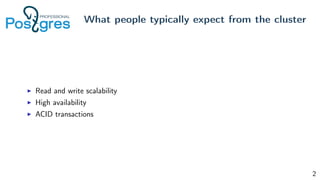
Read and write scalability
High availability
ACID transactions
What people typically expect from the cluster
2
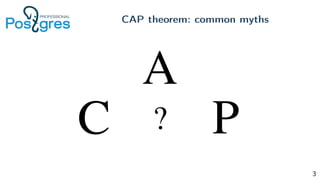
CAP theorem: common myths
3
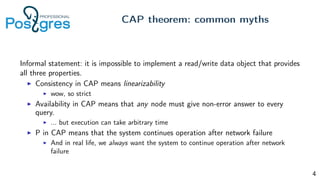
Informal statement: it is impossible to implement a read/write data object that provides
all three properties.
Consistency in CAP means linearizability
wow, so strict
Availability in CAP means that any node must give non-error answer to every
query.
... but execution can take arbitrary time
P in CAP means that the system continues operation after network failure
And in real life, we always want the system to continue operation after network
failure
CAP theorem: common myths
4
This combination of availability and consistency over the wide area is generally
considered impossible due to the CAP Theorem. We show how Spanner achieves this
combination and why it is consistent with CAP.
Eric Brewer. Spanner, TrueTime & The CAP Theorem. February 14, 2017
CAP theorem: conclusions
5
We aim for
Write (and read) horizontal scalability
Mainly OLTP workload with occasional analytical queries
Decent transactions
pg_shardman is PG 10 extension, PostgreSQL license, available at GitHub
Some features require patched Postgres
pg_shardman
6
pg_shardman is a compilation of several technologies.
Scalability: hash-sharding via partitioning and fdw
HA: logical replication
ACID: 2PC + distributed snapshot manager
pg_shardman foundations
7
Let’s go up from partitioning.
Because it’s like sharding, but inside one node.
Partitioning benefits
Sequential access to single (or a few) partitions instead of random access to huge
table
Effective cache usage when most frequently used data located in several partitions
...
Sharding
8
9.6 and below:
Range and list partitioning, complex manual management
Not efficient
New declarative partitioning in 10:
+ Range and list partitioning with handy DDL
- No insertions to foreign partitions, no triggers on parent tables
- Updates moving tuples between partitions are not supported
pg_pathman extension:
Hash and range partitioning
Planning and execution optimizations
FDW support
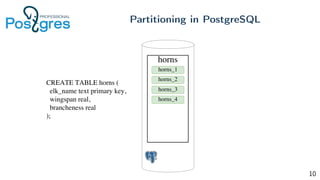
Partitioning in PostgreSQL
9
Partitioning in PostgreSQL
10
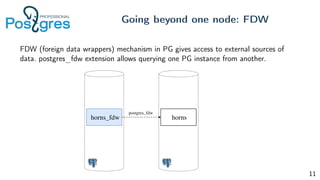
FDW (foreign data wrappers) mechanism in PG gives access to external sources of
data. postgres_fdw extension allows querying one PG instance from another.
Going beyond one node: FDW
11
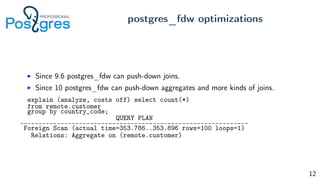
Since 9.6 postgres_fdw can push-down joins.
Since 10 postgres_fdw can push-down aggregates and more kinds of joins.
explain (analyze, costs off) select count(*)
from remote.customer
group by country_code;
QUERY PLAN
--------------------------------------------------------------
Foreign Scan (actual time=353.786..353.896 rows=100 loops=1)
Relations: Aggregate on (remote.customer)
postgres_fdw optimizations
12
Currently parallel foreign scans are not supported :(
... and limitations
13
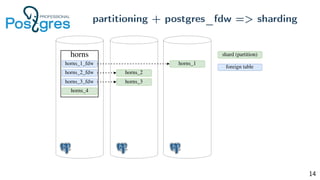
partitioning + postgres_fdw => sharding
14
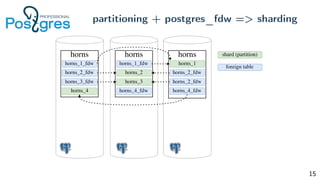
partitioning + postgres_fdw => sharding
15
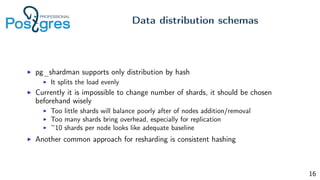
pg_shardman supports only distribution by hash
It splits the load evenly
Currently it is impossible to change number of shards, it should be chosen
beforehand wisely
Too little shards will balance poorly after of nodes addition/removal
Too many shards bring overhead, especially for replication
~10 shards per node looks like adequate baseline
Another common approach for resharding is consistent hashing
Data distribution schemas
16
Possible schemas of replication
per-node, using streaming (physical) replication of PostgreSQL
High availability
17
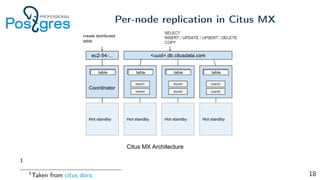
1
1
Taken from citus docs
Per-node replication in Citus MX
18
per-node, using streaming (physical) replication of PostgreSQL
Requires 2x nodes, or 2х PG instances per node.
Possible schemas of replication
19
per-node, using streaming (physical) replication of PostgreSQL
Requires 2x nodes, or 2х PG instances per node.
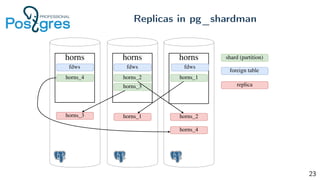
per-shard, using logical replication
Possible schemas of replication
20
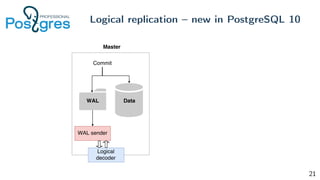
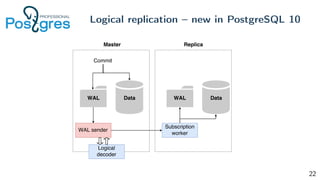
Logical replication – new in PostgreSQL 10
21
Logical replication – new in PostgreSQL 10
22
Replicas in pg_shardman
23
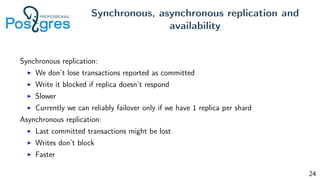
Synchronous replication:
We don’t lose transactions reported as committed
Write it blocked if replica doesn’t respond
Slower
Currently we can reliably failover only if we have 1 replica per shard
Asynchronous replication:
Last committed transactions might be lost
Writes don’t block
Faster
Synchronous, asynchronous replication and
availability
24
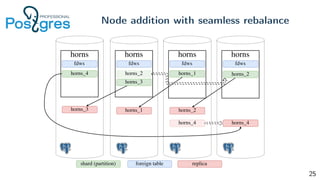
Node addition with seamless rebalance
25
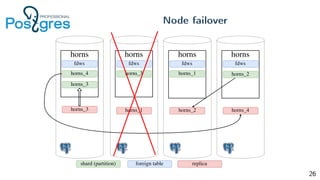
Node failover
26
We designate one special node ’sharlord’.
It holds tables with metadata.
Metadata can be synchronously replicated somewhere to change shardlord in case
of failure.
Currently shardlord can’t hold usual data itself.
How to manage this zoo
27
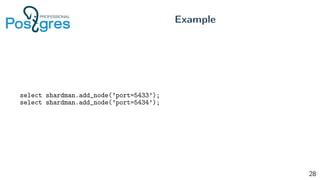
select shardman.add_node(’port=5433’);
select shardman.add_node(’port=5434’);
Example
28
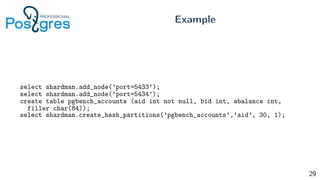
select shardman.add_node(’port=5433’);
select shardman.add_node(’port=5434’);
create table pgbench_accounts (aid int not null, bid int, abalance int,
filler char(84));
select shardman.create_hash_partitions(’pgbench_accounts’,’aid’, 30, 1);
Example
29
[local]:5432 ars@ars:5434=# table shardman.partitions;
part_name | node_id | relation
---------------------+---------+------------------
pgbench_accounts_0 | 1 | pgbench_accounts
pgbench_accounts_1 | 2 | pgbench_accounts
pgbench_accounts_2 | 3 | pgbench_accounts
...
Example
30
[local]:5432 ars@ars:5434=# table shardman.replicas;
part_name | node_id | relation
---------------------+---------+------------------
pgbench_accounts_0 | 2 | pgbench_accounts
pgbench_accounts_1 | 3 | pgbench_accounts
pgbench_accounts_2 | 1 | pgbench_accounts
...
Example
31
Distributed transactions:
Distributed atomicity
Distributed isolation
Profit! (distributed)
Transactions in shardman
32
All reliable distributed systems are alike each unreliable is unreliable in its own way.
Kyle Kingsbury and Leo Tolstoy.
Transactions in shardman
33
Distributed transactions:
Atomicity: 2PC
Isolation: Clock-SI
Transactions in shardman
34
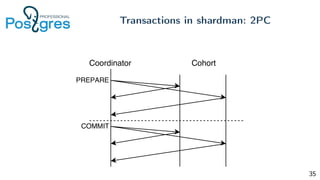
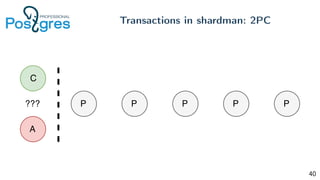
Transactions in shardman: 2PC
35
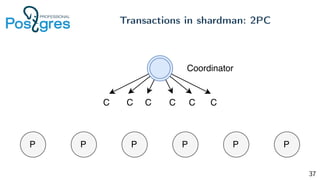
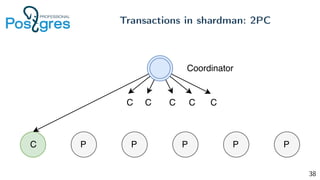
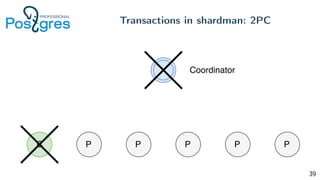
Two-phase commit is the anti-availability protocol.
P. Helland. ACM Queue, Vol. 14, Issue 2, March-April 2016.
Transactions in shardman: 2PC
36
Transactions in shardman: 2PC
37
Transactions in shardman: 2PC
38
Transactions in shardman: 2PC
39
Transactions in shardman: 2PC
40
So what we can do about it?
Make 2PC fail-recovery tolerant: X3PC, Paxos Commit
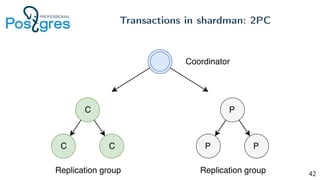
Back-up partitions!
Transactions in shardman: 2PC
41
Transactions in shardman: 2PC
42
Spanner mitigates this by having each member be a Paxos group, thus ensuring each
2PC “member” is highly available even if some of its Paxos participants are down.
Eric Brewer.
Transactions in shardman: 2PC
43
Profit? Not yet!
Transactions in shardman: isolation
44
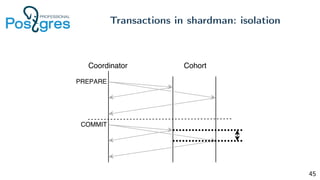
Transactions in shardman: isolation
45
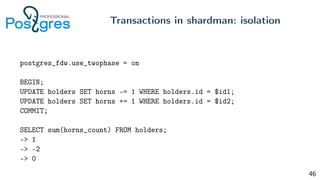
postgres_fdw.use_twophase = on
BEGIN;
UPDATE holders SET horns -= 1 WHERE holders.id = $id1;
UPDATE holders SET horns += 1 WHERE holders.id = $id2;
COMMIT;
SELECT sum(horns_count) FROM holders;
-> 1
-> -2
-> 0
Transactions in shardman: isolation
46
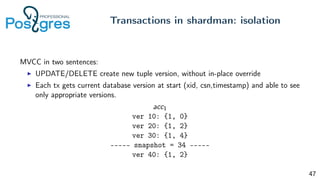
MVCC in two sentences:
UPDATE/DELETE create new tuple version, without in-place override
Each tx gets current database version at start (xid, csn,timestamp) and able to see
only appropriate versions.
acc1
ver 10: {1, 0}
ver 20: {1, 2}
ver 30: {1, 4}
––––– snapshot = 34 –––––
ver 40: {1, 2}
Transactions in shardman: isolation
47
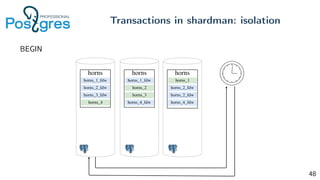
BEGIN
Transactions in shardman: isolation
48
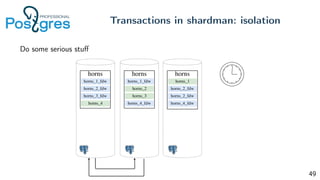
Do some serious stuff
Transactions in shardman: isolation
49
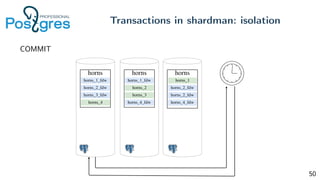
COMMIT
Transactions in shardman: isolation
50
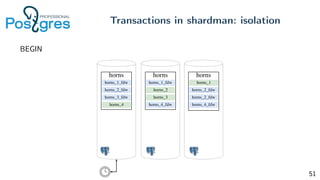
BEGIN
Transactions in shardman: isolation
51
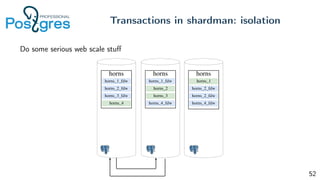
Do some serious web scale stuff
Transactions in shardman: isolation
52
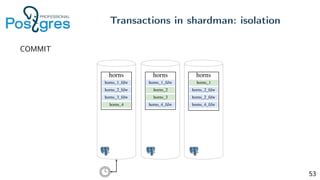
COMMIT
Transactions in shardman: isolation
53
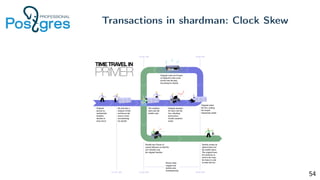
Transactions in shardman: Clock Skew
54
Clock-SI slightly changes visibility rules:
version = timestamp
Visibility’: Waits if tuple came from future. (Do not allow time-travel paradoxes!)
Visibility”: Waits if tuple already prepared(P) but not yet commited(C).
Commit’: Receives local versions from partitions on Prepare and Commits with
maximal version.
Transactions in shardman: isolation
55
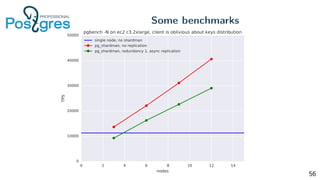
0 2 4 6 8 10 12 14
nodes
0
10000
20000
30000
40000
50000
TPS
pgbench -N on ec2 c3.2xlarge, client is oblivious about keys distribution
single node, no shardman
pg_shardman, no replication
pg_shardman, redundancy 1, async replication
Some benchmarks
56
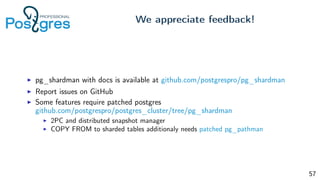
pg_shardman with docs is available at github.com/postgrespro/pg_shardman
Report issues on GitHub
Some features require patched postgres
github.com/postgrespro/postgres_cluster/tree/pg_shardman
2PC and distributed snapshot manager
COPY FROM to sharded tables additionaly needs patched pg_pathman
We appreciate feedback!
57

pg / shardman: шардинг в PostgreSQL на основе postgres / fdw, pg / pathman и логической репликации / Арсений Шер, Стас Кельвич (Postgres Professional)

  • 1.
    pg_shardman: PostgreSQL sharding via postgres_fdw, pg_pathmanand logical replication. Arseny Sher, Stas Kelvich Postgres Professional
  • 2.
    Read and writescalability High availability ACID transactions What people typically expect from the cluster 2
  • 3.
  • 4.
    Informal statement: itis impossible to implement a read/write data object that provides all three properties. Consistency in CAP means linearizability wow, so strict Availability in CAP means that any node must give non-error answer to every query. ... but execution can take arbitrary time P in CAP means that the system continues operation after network failure And in real life, we always want the system to continue operation after network failure CAP theorem: common myths 4
  • 5.
    This combination ofavailability and consistency over the wide area is generally considered impossible due to the CAP Theorem. We show how Spanner achieves this combination and why it is consistent with CAP. Eric Brewer. Spanner, TrueTime & The CAP Theorem. February 14, 2017 CAP theorem: conclusions 5
  • 6.
    We aim for Write(and read) horizontal scalability Mainly OLTP workload with occasional analytical queries Decent transactions pg_shardman is PG 10 extension, PostgreSQL license, available at GitHub Some features require patched Postgres pg_shardman 6
  • 7.
    pg_shardman is acompilation of several technologies. Scalability: hash-sharding via partitioning and fdw HA: logical replication ACID: 2PC + distributed snapshot manager pg_shardman foundations 7
  • 8.
    Let’s go upfrom partitioning. Because it’s like sharding, but inside one node. Partitioning benefits Sequential access to single (or a few) partitions instead of random access to huge table Effective cache usage when most frequently used data located in several partitions ... Sharding 8
  • 9.
    9.6 and below: Rangeand list partitioning, complex manual management Not efficient New declarative partitioning in 10: + Range and list partitioning with handy DDL - No insertions to foreign partitions, no triggers on parent tables - Updates moving tuples between partitions are not supported pg_pathman extension: Hash and range partitioning Planning and execution optimizations FDW support Partitioning in PostgreSQL 9
  • 10.
  • 11.
    FDW (foreign datawrappers) mechanism in PG gives access to external sources of data. postgres_fdw extension allows querying one PG instance from another. Going beyond one node: FDW 11
  • 12.
    Since 9.6 postgres_fdwcan push-down joins. Since 10 postgres_fdw can push-down aggregates and more kinds of joins. explain (analyze, costs off) select count(*) from remote.customer group by country_code; QUERY PLAN -------------------------------------------------------------- Foreign Scan (actual time=353.786..353.896 rows=100 loops=1) Relations: Aggregate on (remote.customer) postgres_fdw optimizations 12
  • 13.
    Currently parallel foreignscans are not supported :( ... and limitations 13
  • 14.
  • 15.
  • 16.
    pg_shardman supports onlydistribution by hash It splits the load evenly Currently it is impossible to change number of shards, it should be chosen beforehand wisely Too little shards will balance poorly after of nodes addition/removal Too many shards bring overhead, especially for replication ~10 shards per node looks like adequate baseline Another common approach for resharding is consistent hashing Data distribution schemas 16
  • 17.
    Possible schemas ofreplication per-node, using streaming (physical) replication of PostgreSQL High availability 17
  • 18.
    1 1 Taken from citusdocs Per-node replication in Citus MX 18
  • 19.
    per-node, using streaming(physical) replication of PostgreSQL Requires 2x nodes, or 2х PG instances per node. Possible schemas of replication 19
  • 20.
    per-node, using streaming(physical) replication of PostgreSQL Requires 2x nodes, or 2х PG instances per node. per-shard, using logical replication Possible schemas of replication 20
  • 21.
    Logical replication –new in PostgreSQL 10 21
  • 22.
    Logical replication –new in PostgreSQL 10 22
  • 23.
  • 24.
    Synchronous replication: We don’tlose transactions reported as committed Write it blocked if replica doesn’t respond Slower Currently we can reliably failover only if we have 1 replica per shard Asynchronous replication: Last committed transactions might be lost Writes don’t block Faster Synchronous, asynchronous replication and availability 24
  • 25.
    Node addition withseamless rebalance 25
  • 26.
  • 27.
    We designate onespecial node ’sharlord’. It holds tables with metadata. Metadata can be synchronously replicated somewhere to change shardlord in case of failure. Currently shardlord can’t hold usual data itself. How to manage this zoo 27
  • 28.
  • 29.
    select shardman.add_node(’port=5433’); select shardman.add_node(’port=5434’); createtable pgbench_accounts (aid int not null, bid int, abalance int, filler char(84)); select shardman.create_hash_partitions(’pgbench_accounts’,’aid’, 30, 1); Example 29
  • 30.
    [local]:5432 ars@ars:5434=# tableshardman.partitions; part_name | node_id | relation ---------------------+---------+------------------ pgbench_accounts_0 | 1 | pgbench_accounts pgbench_accounts_1 | 2 | pgbench_accounts pgbench_accounts_2 | 3 | pgbench_accounts ... Example 30
  • 31.
    [local]:5432 ars@ars:5434=# tableshardman.replicas; part_name | node_id | relation ---------------------+---------+------------------ pgbench_accounts_0 | 2 | pgbench_accounts pgbench_accounts_1 | 3 | pgbench_accounts pgbench_accounts_2 | 1 | pgbench_accounts ... Example 31
  • 32.
    Distributed transactions: Distributed atomicity Distributedisolation Profit! (distributed) Transactions in shardman 32
  • 33.
    All reliable distributedsystems are alike each unreliable is unreliable in its own way. Kyle Kingsbury and Leo Tolstoy. Transactions in shardman 33
  • 34.
    Distributed transactions: Atomicity: 2PC Isolation:Clock-SI Transactions in shardman 34
  • 35.
  • 36.
    Two-phase commit isthe anti-availability protocol. P. Helland. ACM Queue, Vol. 14, Issue 2, March-April 2016. Transactions in shardman: 2PC 36
  • 37.
  • 38.
  • 39.
  • 40.
  • 41.
    So what wecan do about it? Make 2PC fail-recovery tolerant: X3PC, Paxos Commit Back-up partitions! Transactions in shardman: 2PC 41
  • 42.
  • 43.
    Spanner mitigates thisby having each member be a Paxos group, thus ensuring each 2PC “member” is highly available even if some of its Paxos participants are down. Eric Brewer. Transactions in shardman: 2PC 43
  • 44.
    Profit? Not yet! Transactionsin shardman: isolation 44
  • 45.
  • 46.
    postgres_fdw.use_twophase = on BEGIN; UPDATEholders SET horns -= 1 WHERE holders.id = $id1; UPDATE holders SET horns += 1 WHERE holders.id = $id2; COMMIT; SELECT sum(horns_count) FROM holders; -> 1 -> -2 -> 0 Transactions in shardman: isolation 46
  • 47.
    MVCC in twosentences: UPDATE/DELETE create new tuple version, without in-place override Each tx gets current database version at start (xid, csn,timestamp) and able to see only appropriate versions. acc1 ver 10: {1, 0} ver 20: {1, 2} ver 30: {1, 4} ––––– snapshot = 34 ––––– ver 40: {1, 2} Transactions in shardman: isolation 47
  • 48.
  • 49.
    Do some seriousstuff Transactions in shardman: isolation 49
  • 50.
  • 51.
  • 52.
    Do some seriousweb scale stuff Transactions in shardman: isolation 52
  • 53.
  • 54.
  • 55.
    Clock-SI slightly changesvisibility rules: version = timestamp Visibility’: Waits if tuple came from future. (Do not allow time-travel paradoxes!) Visibility”: Waits if tuple already prepared(P) but not yet commited(C). Commit’: Receives local versions from partitions on Prepare and Commits with maximal version. Transactions in shardman: isolation 55
  • 56.
    0 2 46 8 10 12 14 nodes 0 10000 20000 30000 40000 50000 TPS pgbench -N on ec2 c3.2xlarge, client is oblivious about keys distribution single node, no shardman pg_shardman, no replication pg_shardman, redundancy 1, async replication Some benchmarks 56
  • 57.
    pg_shardman with docsis available at github.com/postgrespro/pg_shardman Report issues on GitHub Some features require patched postgres github.com/postgrespro/postgres_cluster/tree/pg_shardman 2PC and distributed snapshot manager COPY FROM to sharded tables additionaly needs patched pg_pathman We appreciate feedback! 57