PET (Preliminary English Test) Speaking Guide
The standard format of the test is: 2 candidates and 2 examiners (one will talk to you and will ask you questions and the other one will just watch and take down notes)
PART 1 Student-examiner interaction PART 2 Simulated situation PART 3 Photograph description PART 4 General conversation The speaking test consists of 4 parts:
PART 1 Student-examiner interaction The examiner will ask you: -Your name -Where you come from Provide short answers in this part of the test. The examiner will ask you to spell your surname. Now, practise spelling your surname.
PART 1 Student-examiner interaction After you are asked two or three questions (What’s your name?Where you come from? etc) you will be asked a question that requires a longer answer: *Why you like something *A detail about a hobby
PART 1 Student-examiner interaction Think of how  important these items are to you: Music Sport Cinema and TV Reading Travelling and visiting other places
PART 1 Student-examiner interaction Also think of what you would say in connection with: Family Friends Teachers Study and plans You will be asked questions about the present circumstances, past experiences and future plans
PART 1 Student-examiner interaction Remember: The interaction in this part is between  examiner and candidate  do not interrupt when your partner is speaking.
PART 2 Simulated situation In this part of the test talk to your partner, not to the examiner. The examiner will explain to both candidates what they have to discuss to come to an agreement.
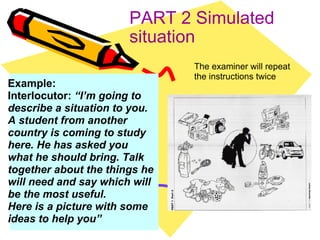
PART 2 Simulated situation The examiner will repeat the instructions twice Example: Interlocutor:  “I’m going to describe a situation to you. A student from another country is coming to study here. He has asked you what he should bring. Talk together about the things he will need and say which will be the most useful. Here is a picture with some ideas to help you”
PART 2 Simulated situation Talking about needs: This is good because… He’ll probably need… because… He’ll definitely need… because… I don’t think … is so important because… For me, the most important thing is … because You are expected to make suggestions, discuss alternatives, make recommendations, negotiate agreement.
PART 2 Simulated situation Think about how you can get your partner involved. What about this one? Do you think he should..? I don’t think this one is very good, do you? Getting started Think about how you can start the task:
PART 2 Simulated situation Agreeing and disagreeing (That’s) true. I agree. You’re right. I think so too. That’s a good idea./That’s interesting. Really? I’m not sure about that. I don’t think I agree because… I don’t think so because… Yes, but… Ending the discussion What have we decided? What do you think we should choose? Shall we choose one? Let’s choose/ go for… OK, we’ve decided. So, we think he/ they should…
PART 3 Photograph description   A colour photograph is given to each student in turn and they have to talk about it for up to one minute.
PART 3 Photograph description   Example: Interlocutor:  “Now I’d like each of you to talk on your own about something. I’m going to give each of you a photograph of families spending time together. Candidate A, here is your photograph. Please show it to Candidate B, but I’d like you to talk about it. Candidate B, you just listen, I’ll give you your photograph in a moment. Candidate A, please tell us what you can see in your photograph.”
PART 3 Photograph description
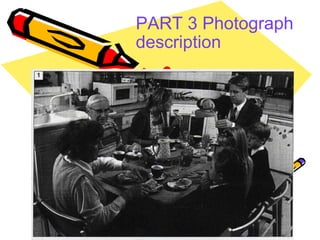
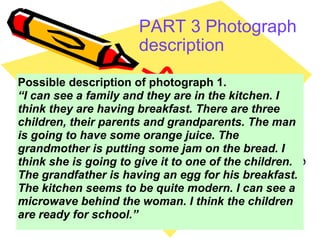
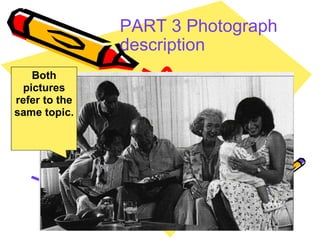
PART 3 Photograph description   Possible description of photograph 1.  “ I can see a family and they are in the kitchen. I think they are having breakfast. There are three children, their parents and grandparents. The man is going to have some orange juice. The grandmother is putting some jam on the bread. I think she is going to give it to one of the children. The grandfather is having an egg for his breakfast. The kitchen seems to be quite modern. I can see a microwave behind the woman. I think the children are ready for school.”
PART 3 Photograph description   Both pictures refer to the same topic.
PART 3 Photograph description   A good description will include something about: The people The place The action The background Making deductions/Speculating She looks+adjective She seems to be +adjective They/ He / It could be on holiday. She might be in Germany or somewhere like that. It’s probably winter/ springtime. Maybe/Perhaps they are friends. They could be friends…
PART 3 Photograph description   When describing a picture, mention: * whom or what you can see (there is/there are, I can see) the place - the season *what is happening (they are running, shopping, biking, buying things) *the mood (look happy, sad, excited) *what has just happened (they have just started doing it) * what is going to happen next (they are going to go home)
PART 3 Photograph description   * opinion words (I think, I guess, I believe, it seems to me that, I don’t think, it must be, it could be, one possibility is that…, to my mind, as far as I am concerned, I tend to think that, my personal view is that…) * whereabouts (at the top, at the bottom, in the left-hand corner, in the background, in the front) there is, there are/it must be winter, it must be spring/they look happy, sad, excited/they are running, shopping, biking, buying things, etc
PART 4 General conversation   Candidates talk together about their opinions, likes, dislikes, preferences, experiences, habits, etc. Part 4 will be connected to the topic presented in part 3.
PART 4 General conversation   Example: Interlocutor: (says to both candidates) “ Your photographs showed families spending time together. Now, I’d like you to talk together about the things you like to do with your families, and the things you prefer to do with your friends.”
PART 4 General conversation   Remember: *Give reasons for your statements *Make the conversation interesting *Try hard to keep the conversation going: what about you? Do you…? *Make sure you really talk to your partner.

PET speaking guide

  • 1.
    PET (Preliminary EnglishTest) Speaking Guide
  • 2.
    The standard formatof the test is: 2 candidates and 2 examiners (one will talk to you and will ask you questions and the other one will just watch and take down notes)
  • 3.
    PART 1 Student-examinerinteraction PART 2 Simulated situation PART 3 Photograph description PART 4 General conversation The speaking test consists of 4 parts:
  • 4.
    PART 1 Student-examinerinteraction The examiner will ask you: -Your name -Where you come from Provide short answers in this part of the test. The examiner will ask you to spell your surname. Now, practise spelling your surname.
  • 5.
    PART 1 Student-examinerinteraction After you are asked two or three questions (What’s your name?Where you come from? etc) you will be asked a question that requires a longer answer: *Why you like something *A detail about a hobby
  • 6.
    PART 1 Student-examinerinteraction Think of how important these items are to you: Music Sport Cinema and TV Reading Travelling and visiting other places
  • 7.
    PART 1 Student-examinerinteraction Also think of what you would say in connection with: Family Friends Teachers Study and plans You will be asked questions about the present circumstances, past experiences and future plans
  • 8.
    PART 1 Student-examinerinteraction Remember: The interaction in this part is between examiner and candidate do not interrupt when your partner is speaking.
  • 9.
    PART 2 Simulatedsituation In this part of the test talk to your partner, not to the examiner. The examiner will explain to both candidates what they have to discuss to come to an agreement.
  • 10.
    PART 2 Simulatedsituation The examiner will repeat the instructions twice Example: Interlocutor: “I’m going to describe a situation to you. A student from another country is coming to study here. He has asked you what he should bring. Talk together about the things he will need and say which will be the most useful. Here is a picture with some ideas to help you”
  • 11.
    PART 2 Simulatedsituation Talking about needs: This is good because… He’ll probably need… because… He’ll definitely need… because… I don’t think … is so important because… For me, the most important thing is … because You are expected to make suggestions, discuss alternatives, make recommendations, negotiate agreement.
  • 12.
    PART 2 Simulatedsituation Think about how you can get your partner involved. What about this one? Do you think he should..? I don’t think this one is very good, do you? Getting started Think about how you can start the task:
  • 13.
    PART 2 Simulatedsituation Agreeing and disagreeing (That’s) true. I agree. You’re right. I think so too. That’s a good idea./That’s interesting. Really? I’m not sure about that. I don’t think I agree because… I don’t think so because… Yes, but… Ending the discussion What have we decided? What do you think we should choose? Shall we choose one? Let’s choose/ go for… OK, we’ve decided. So, we think he/ they should…
  • 14.
    PART 3 Photographdescription A colour photograph is given to each student in turn and they have to talk about it for up to one minute.
  • 15.
    PART 3 Photographdescription Example: Interlocutor: “Now I’d like each of you to talk on your own about something. I’m going to give each of you a photograph of families spending time together. Candidate A, here is your photograph. Please show it to Candidate B, but I’d like you to talk about it. Candidate B, you just listen, I’ll give you your photograph in a moment. Candidate A, please tell us what you can see in your photograph.”
  • 16.
    PART 3 Photographdescription
  • 17.
    PART 3 Photographdescription Possible description of photograph 1. “ I can see a family and they are in the kitchen. I think they are having breakfast. There are three children, their parents and grandparents. The man is going to have some orange juice. The grandmother is putting some jam on the bread. I think she is going to give it to one of the children. The grandfather is having an egg for his breakfast. The kitchen seems to be quite modern. I can see a microwave behind the woman. I think the children are ready for school.”
  • 18.
    PART 3 Photographdescription Both pictures refer to the same topic.
  • 19.
    PART 3 Photographdescription A good description will include something about: The people The place The action The background Making deductions/Speculating She looks+adjective She seems to be +adjective They/ He / It could be on holiday. She might be in Germany or somewhere like that. It’s probably winter/ springtime. Maybe/Perhaps they are friends. They could be friends…
  • 20.
    PART 3 Photographdescription When describing a picture, mention: * whom or what you can see (there is/there are, I can see) the place - the season *what is happening (they are running, shopping, biking, buying things) *the mood (look happy, sad, excited) *what has just happened (they have just started doing it) * what is going to happen next (they are going to go home)
  • 21.
    PART 3 Photographdescription * opinion words (I think, I guess, I believe, it seems to me that, I don’t think, it must be, it could be, one possibility is that…, to my mind, as far as I am concerned, I tend to think that, my personal view is that…) * whereabouts (at the top, at the bottom, in the left-hand corner, in the background, in the front) there is, there are/it must be winter, it must be spring/they look happy, sad, excited/they are running, shopping, biking, buying things, etc
  • 22.
    PART 4 Generalconversation Candidates talk together about their opinions, likes, dislikes, preferences, experiences, habits, etc. Part 4 will be connected to the topic presented in part 3.
  • 23.
    PART 4 Generalconversation Example: Interlocutor: (says to both candidates) “ Your photographs showed families spending time together. Now, I’d like you to talk together about the things you like to do with your families, and the things you prefer to do with your friends.”
  • 24.
    PART 4 Generalconversation Remember: *Give reasons for your statements *Make the conversation interesting *Try hard to keep the conversation going: what about you? Do you…? *Make sure you really talk to your partner.