Pests of mustard
By
Dr. U. Pirithiraj, P.hD.
Assistant Professor (Entomology)
JSACAT
Affiliated to Tamil Nadu Agricultural University
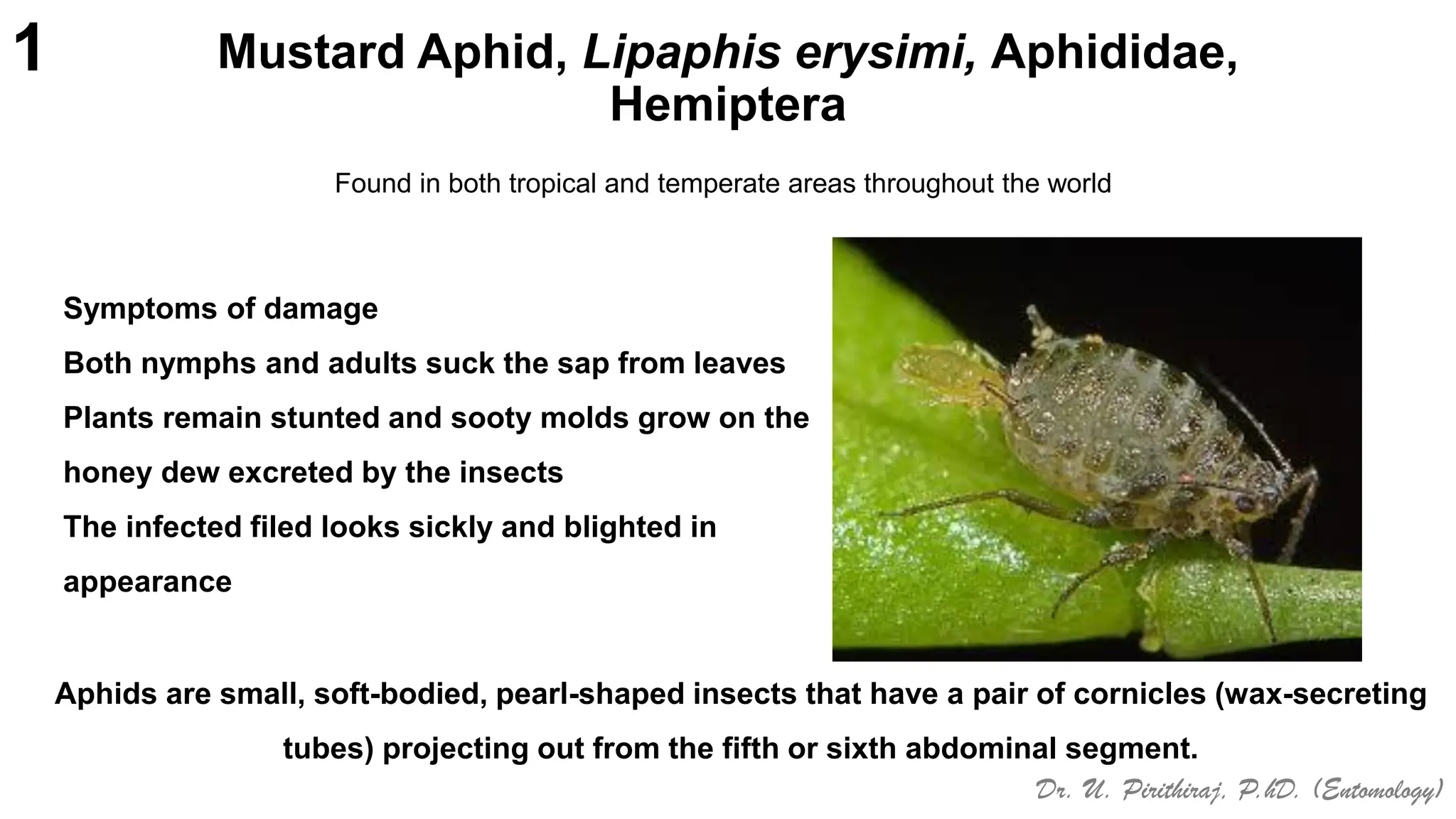
Mustard Aphid, Lipaphis erysimi, Aphididae,
Hemiptera
1
Dr. U. Pirithiraj, P.hD. (Entomology)
Symptoms of damage
Both nymphs and adults suck the sap from leaves
Plants remain stunted and sooty molds grow on the
honey dew excreted by the insects
The infected filed looks sickly and blighted in
appearance
Aphids are small, soft-bodied, pearl-shaped insects that have a pair of cornicles (wax-secreting
tubes) projecting out from the fifth or sixth abdominal segment.
Found in both tropical and temperate areas throughout the world
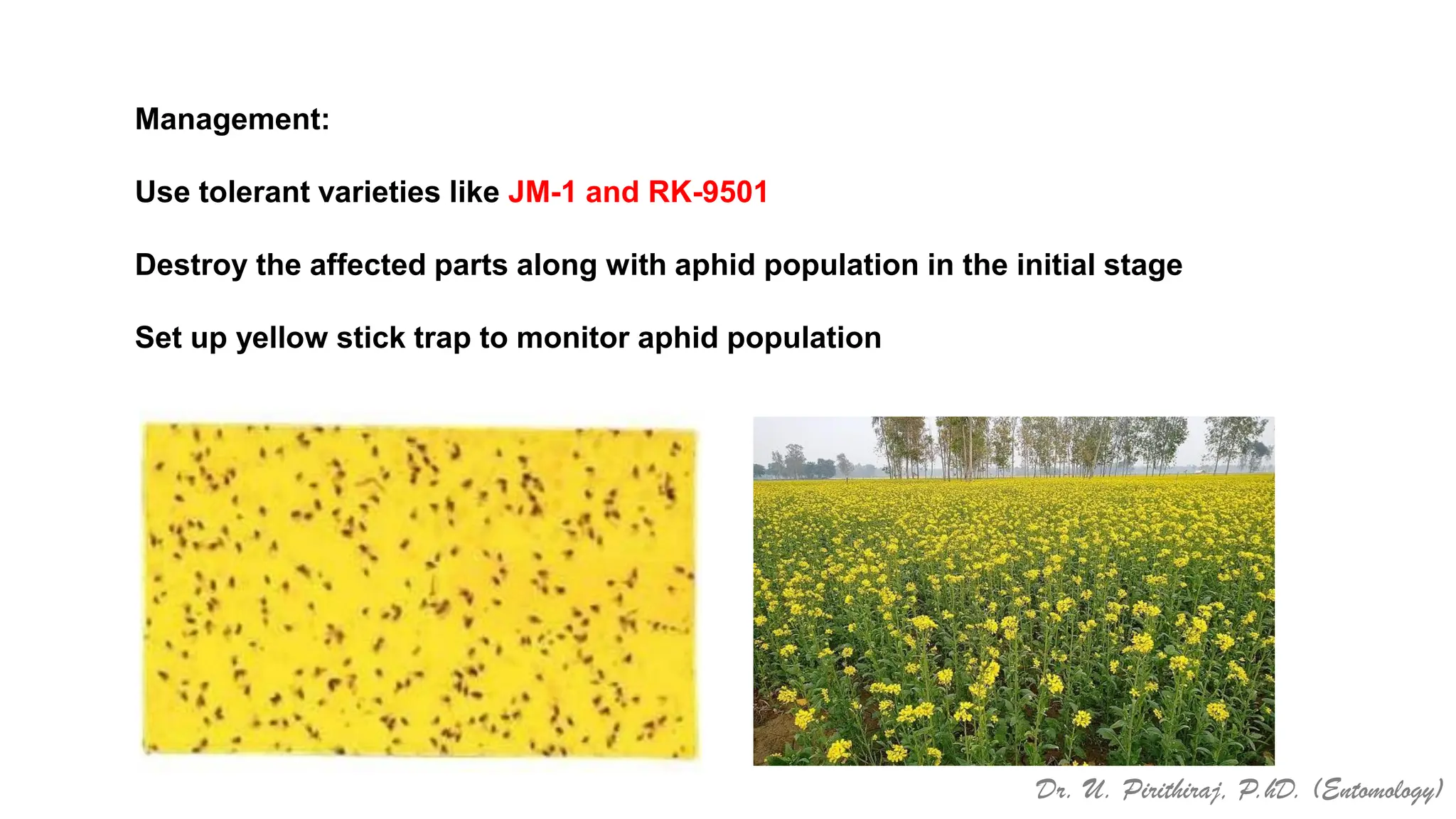
Management:
Use tolerant varieties like JM-1 and RK-9501
Destroy the affected parts along with aphid population in the initial stage
Set up yellow stick trap to monitor aphid population
Dr. U. Pirithiraj, P.hD. (Entomology)
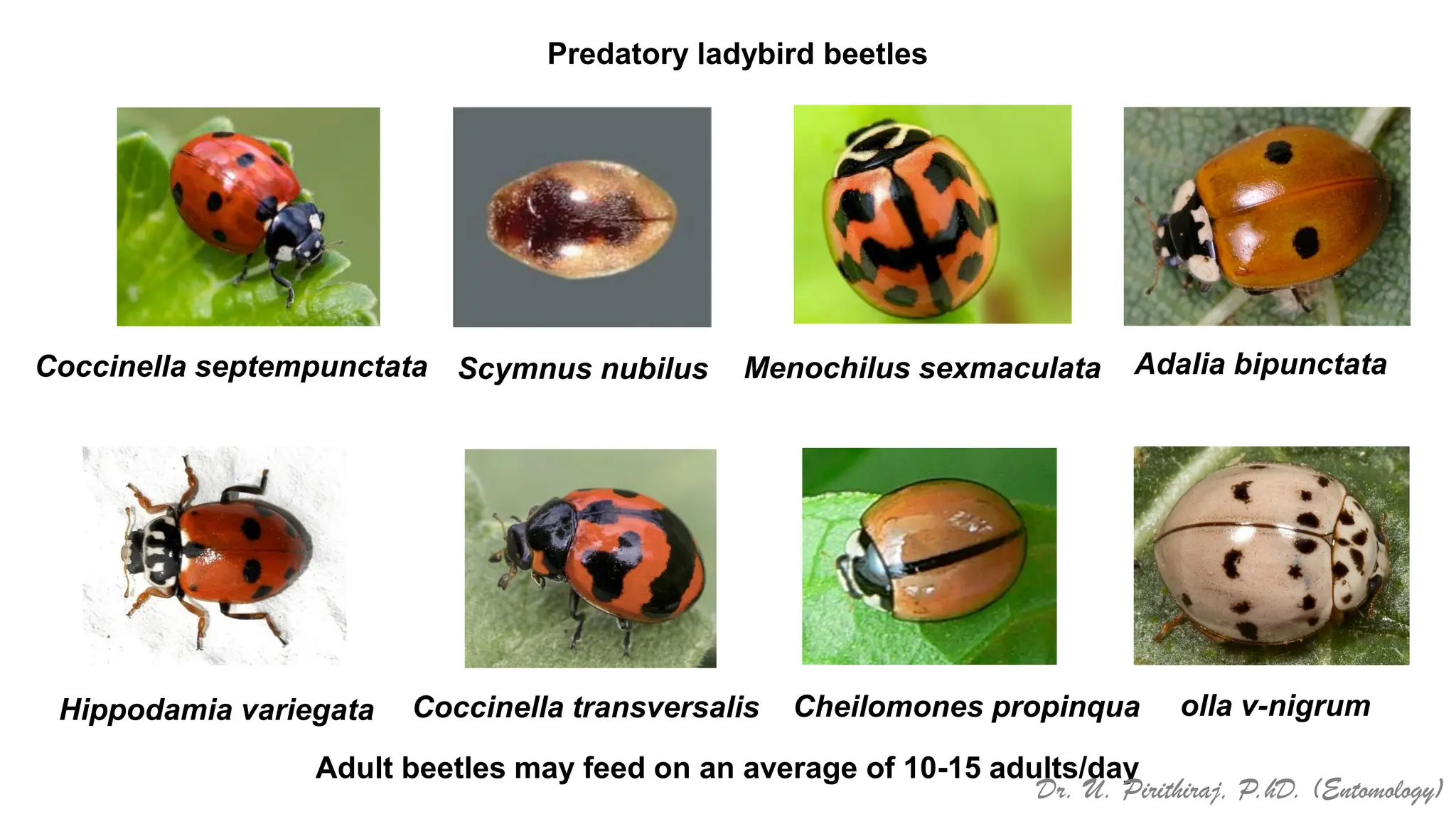
Coccinella septempunctata Menochilus sexmaculata
Hippodamia variegata Cheilomones propinqua
Adult beetles may feed on an average of 10-15 adults/day
Scymnus nubilus
Coccinella transversalis
Adalia bipunctata
olla v-nigrum
Predatory ladybird beetles
Dr. U. Pirithiraj, P.hD. (Entomology)
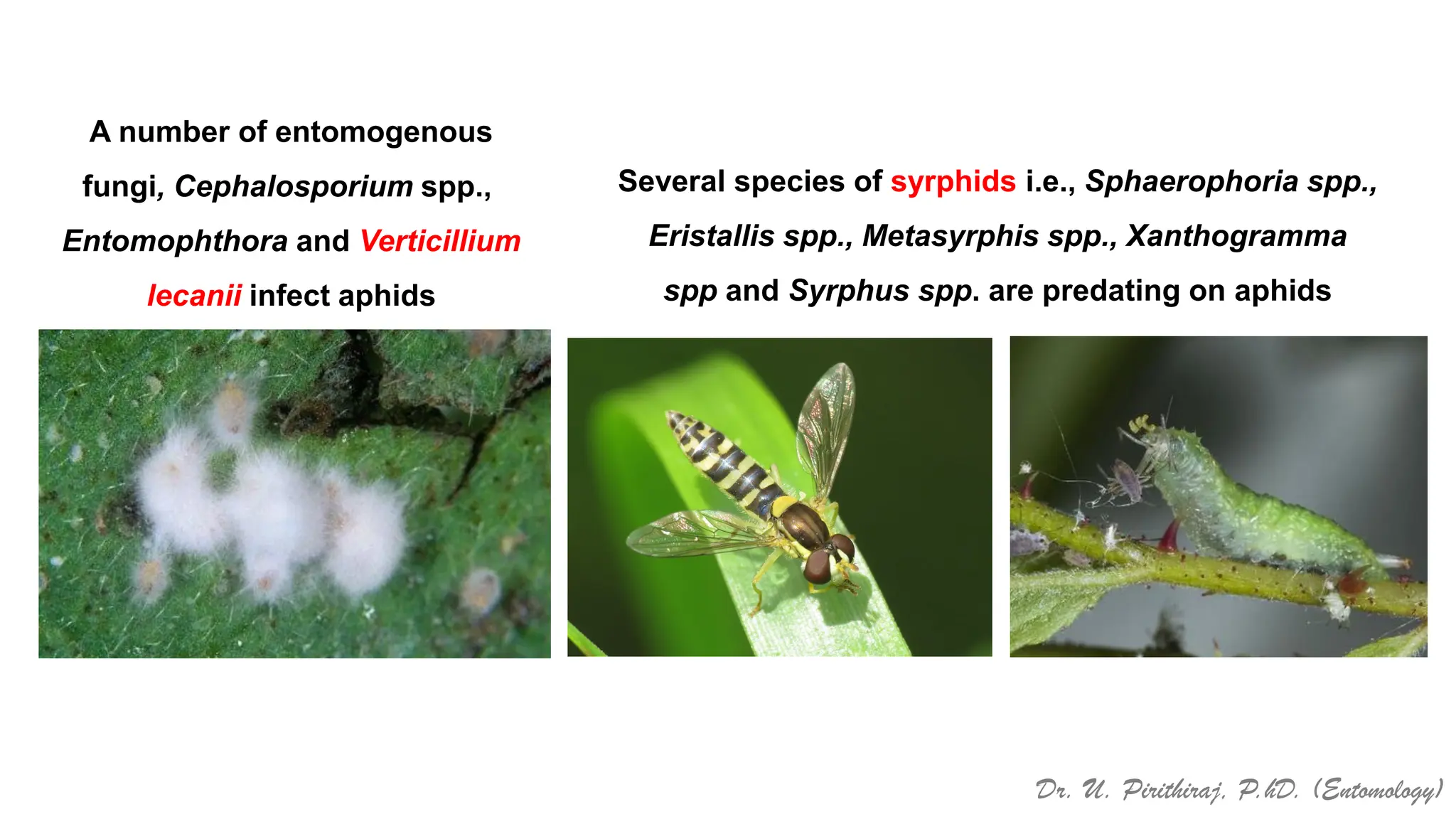
A number of entomogenous
fungi, Cephalosporium spp.,
Entomophthora and Verticillium
lecanii infect aphids
Several species of syrphids i.e., Sphaerophoria spp.,
Eristallis spp., Metasyrphis spp., Xanthogramma
spp and Syrphus spp. are predating on aphids
Dr. U. Pirithiraj, P.hD. (Entomology)
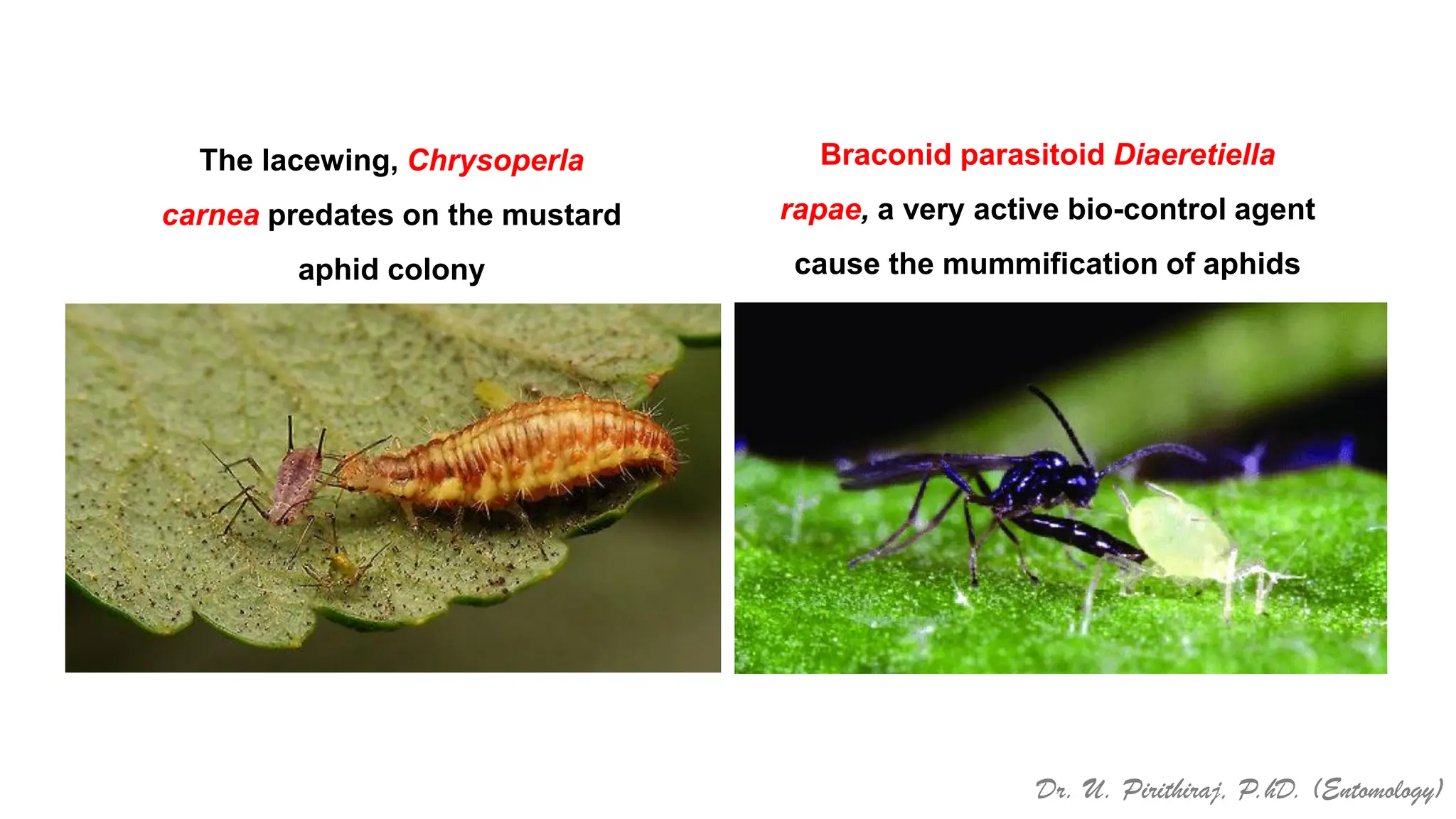
Braconid parasitoid Diaeretiella
rapae, a very active bio-control agent
cause the mummification of aphids
The lacewing, Chrysoperla
carnea predates on the mustard
aphid colony
Dr. U. Pirithiraj, P.hD. (Entomology)
Predatory bird Motacilla cospica is actively feeding over aphids in February-March
Dr. U. Pirithiraj, P.hD. (Entomology)
Whitefly, Bemisia tabaci, Aleyrodidae, Hemiptera
2
Dr. U. Pirithiraj, P.hD. (Entomology)
Nature of damage
Nymphs and adults remain in cluster and desap.
Symptom of attack
White chlorotic spots appear on leaves.
Nymphs and adults secrete honeydew, which lead to
sooty mould formation.
Origin in Uganda, to the northern, central, eastern and coastal regions of Tanzania
Diamondback moth, Plutella xylostella, Plutellidae,
Lepidoptera
3
Dr. U. Pirithiraj, P.hD. (Entomology)
Throughout the Americas and in Europe, Southeast Asia, Australia, and New Zealand
Symptoms of damage
Whitish patches due to scrapping of
epidermal leaf tissues by young larvae
The leaves give a withered appearance but in
later stages larvae bore holes in the leaves.
Leaves may be eaten up completely.
It also bores into pods and feeds developing
seed
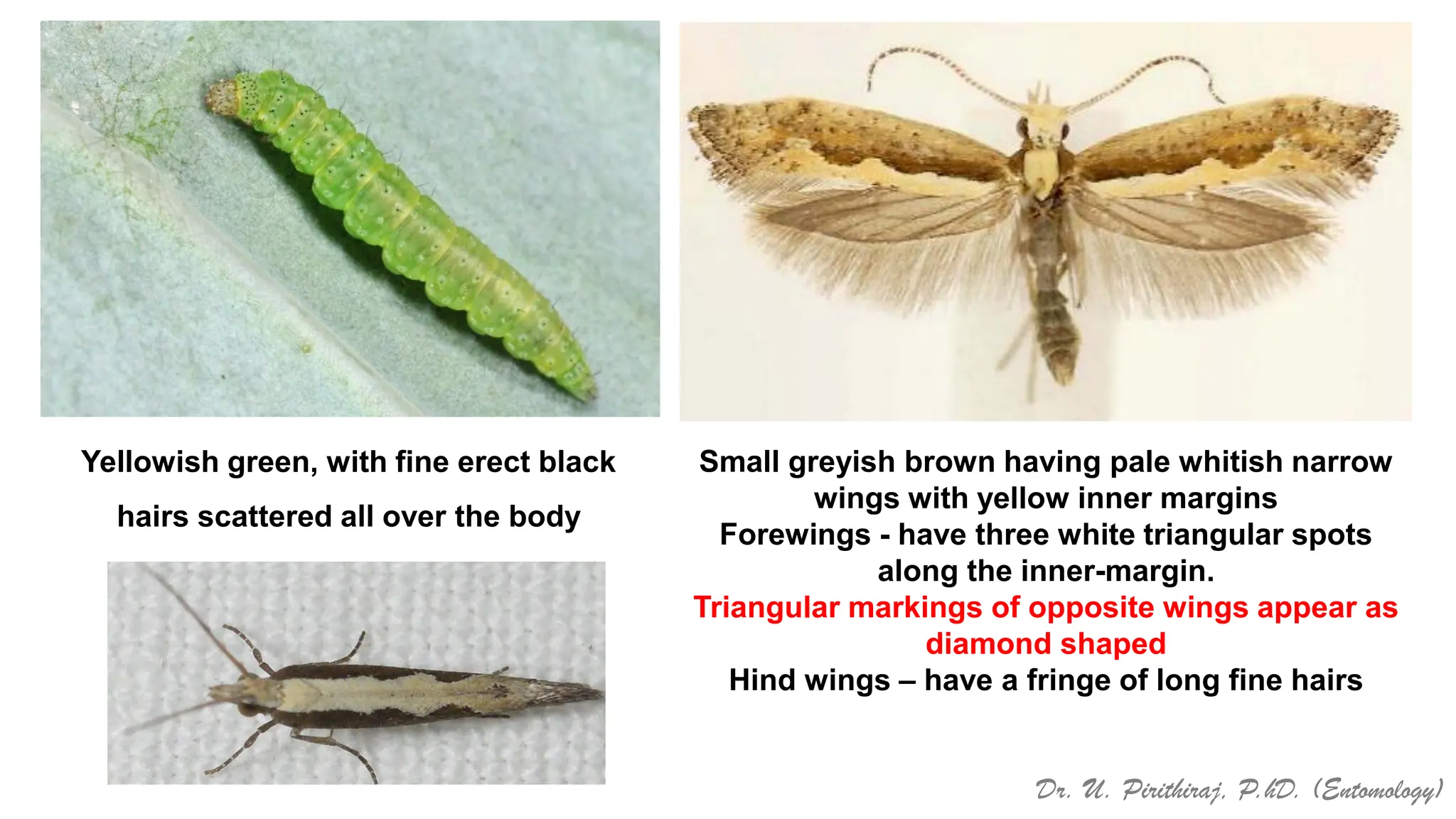
Yellowish green, with fine erect black
hairs scattered all over the body
Small greyish brown having pale whitish narrow
wings with yellow inner margins
Forewings - have three white triangular spots
along the inner-margin.
Triangular markings of opposite wings appear as
diamond shaped
Hind wings – have a fringe of long fine hairs
Dr. U. Pirithiraj, P.hD. (Entomology)
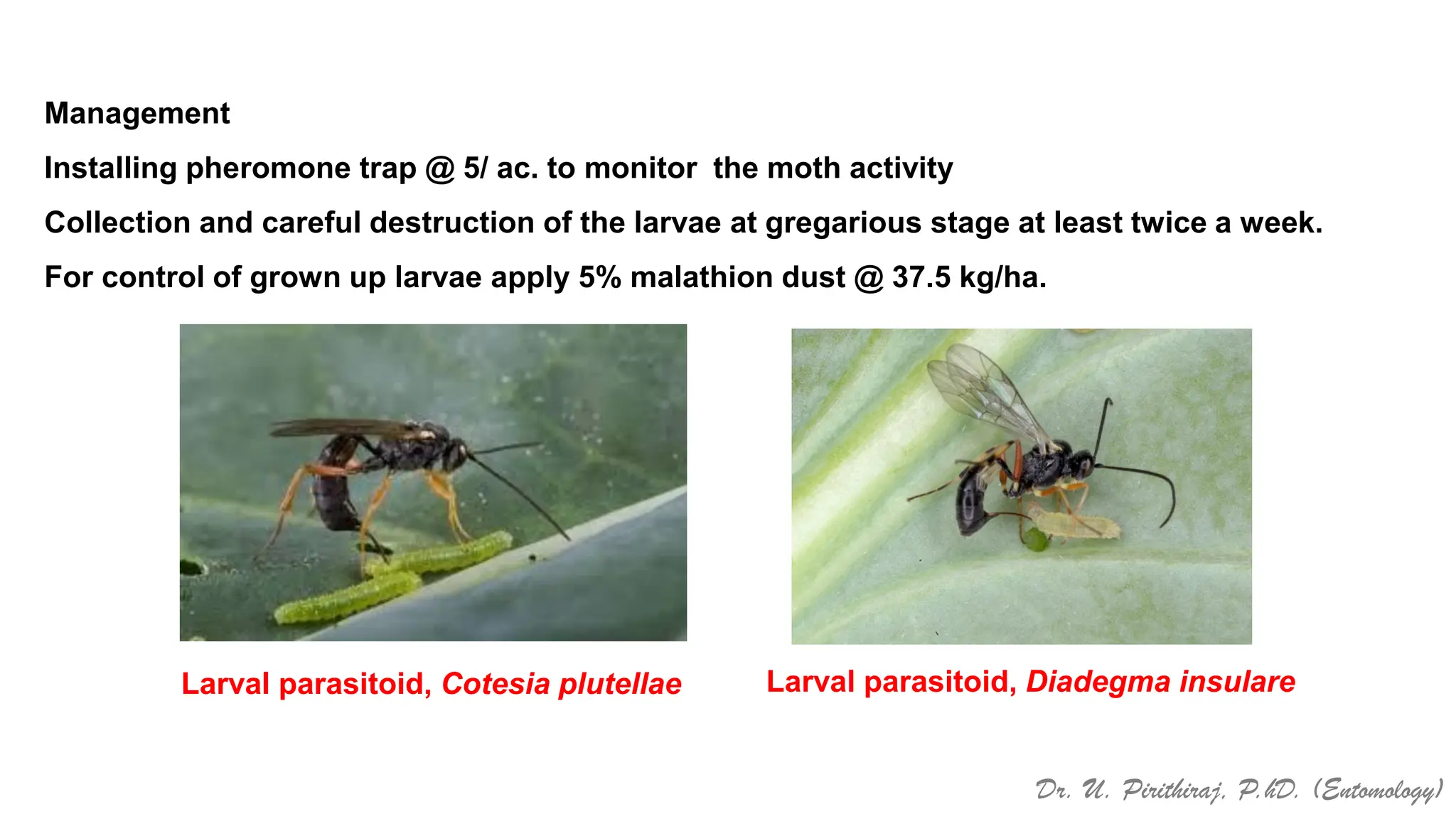
Management
Installing pheromone trap @ 5/ ac. to monitor the moth activity
Collection and careful destruction of the larvae at gregarious stage at least twice a week.
For control of grown up larvae apply 5% malathion dust @ 37.5 kg/ha.
Larval parasitoid, Cotesia plutellae Larval parasitoid, Diadegma insulare
Dr. U. Pirithiraj, P.hD. (Entomology)
Cabbage head borer, Hellula undalis, crambidae,
Lepidoptera
4
Dr. U. Pirithiraj, P.hD. (Entomology)
Throughout the middle east, asia and the pacific
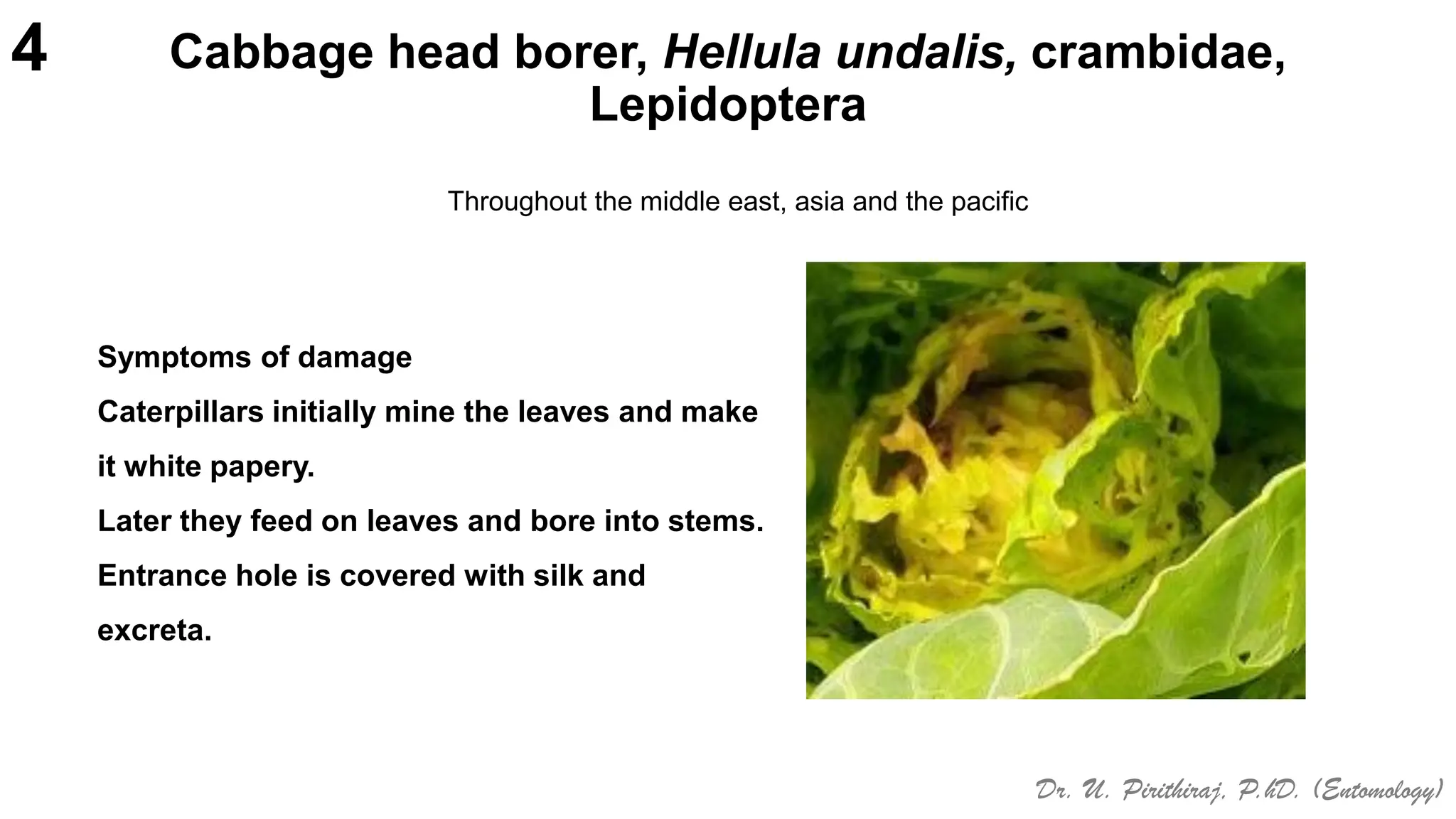
Symptoms of damage
Caterpillars initially mine the leaves and make
it white papery.
Later they feed on leaves and bore into stems.
Entrance hole is covered with silk and
excreta.
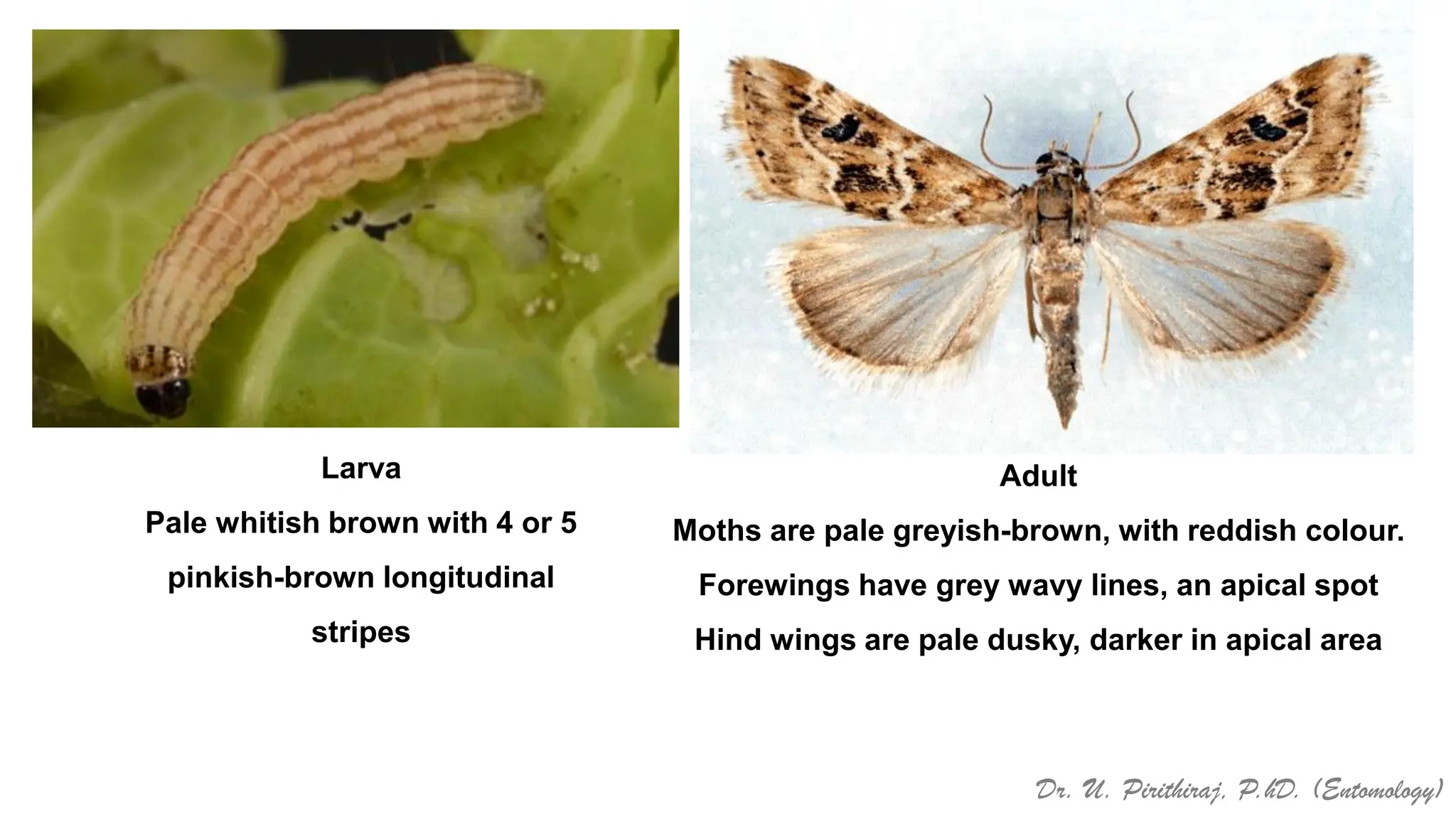
Larva
Pale whitish brown with 4 or 5
pinkish-brown longitudinal
stripes
Adult
Moths are pale greyish-brown, with reddish colour.
Forewings have grey wavy lines, an apical spot
Hind wings are pale dusky, darker in apical area
Dr. U. Pirithiraj, P.hD. (Entomology)
Leaf webber, Crocidolomia binotalis, crambidae,
Lepidoptera
5
Dr. U. Pirithiraj, P.hD. (Entomology)
Tropical and subtropical areas of Africa, Asia and Australia
Symptoms of damage
Newly hatched larvae feed initially on the
chlorophyll of young leaves and later on older
leaves, buds and pods, make webbings and live
within.
Severely attacked plants are defoliated.
Seeds in the pods are eaten away.
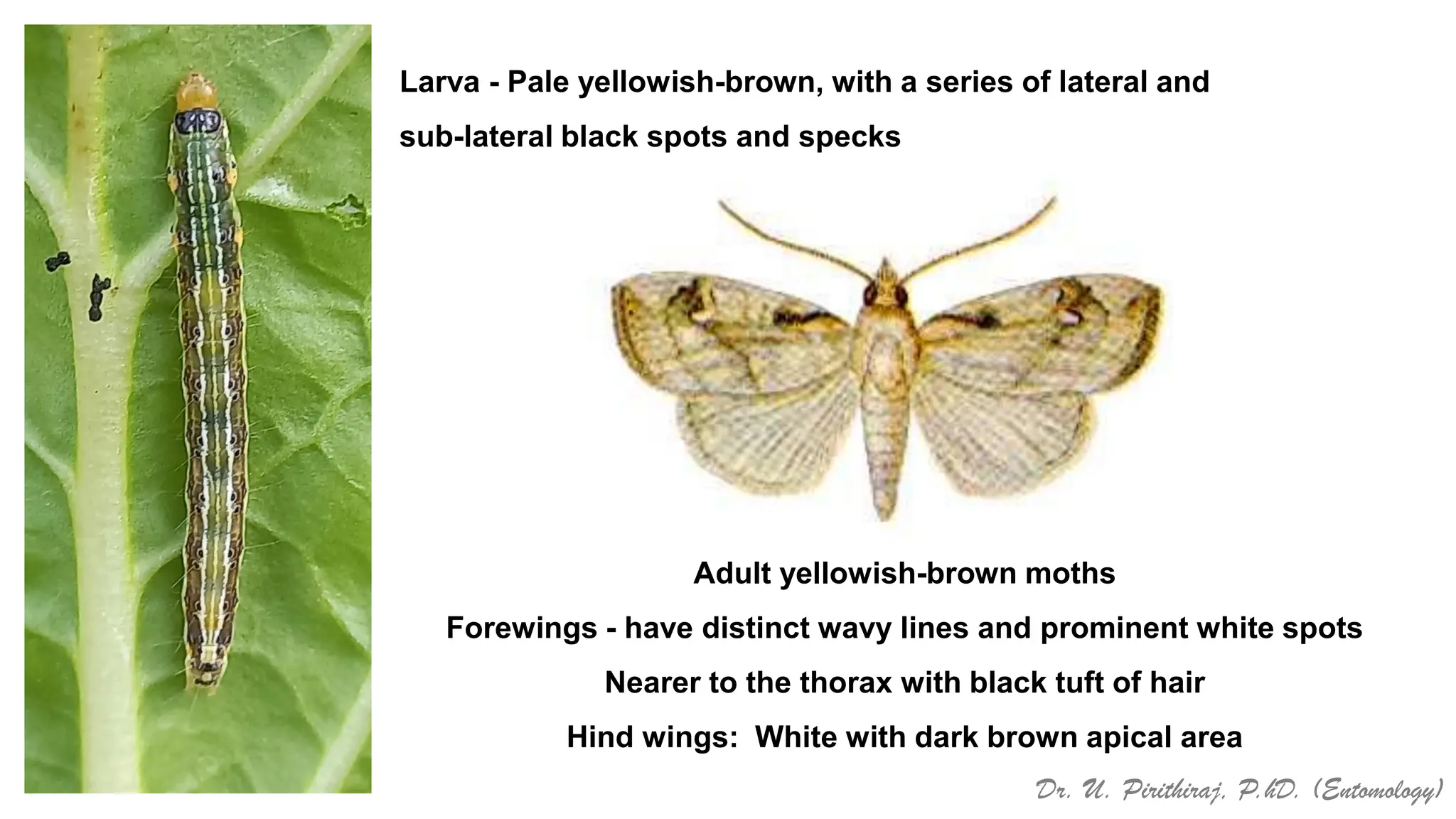
Adult yellowish-brown moths
Forewings - have distinct wavy lines and prominent white spots
Nearer to the thorax with black tuft of hair
Hind wings: White with dark brown apical area
Larva - Pale yellowish-brown, with a series of lateral and
sub-lateral black spots and specks
Dr. U. Pirithiraj, P.hD. (Entomology)
Mustard saw fly, Athalia lugens proxima,
Tenthredinidae, Lepidoptera
6
Dr. U. Pirithiraj, P.hD. (Entomology)
Tropical and subtropical areas of Africa, Asia and Australia
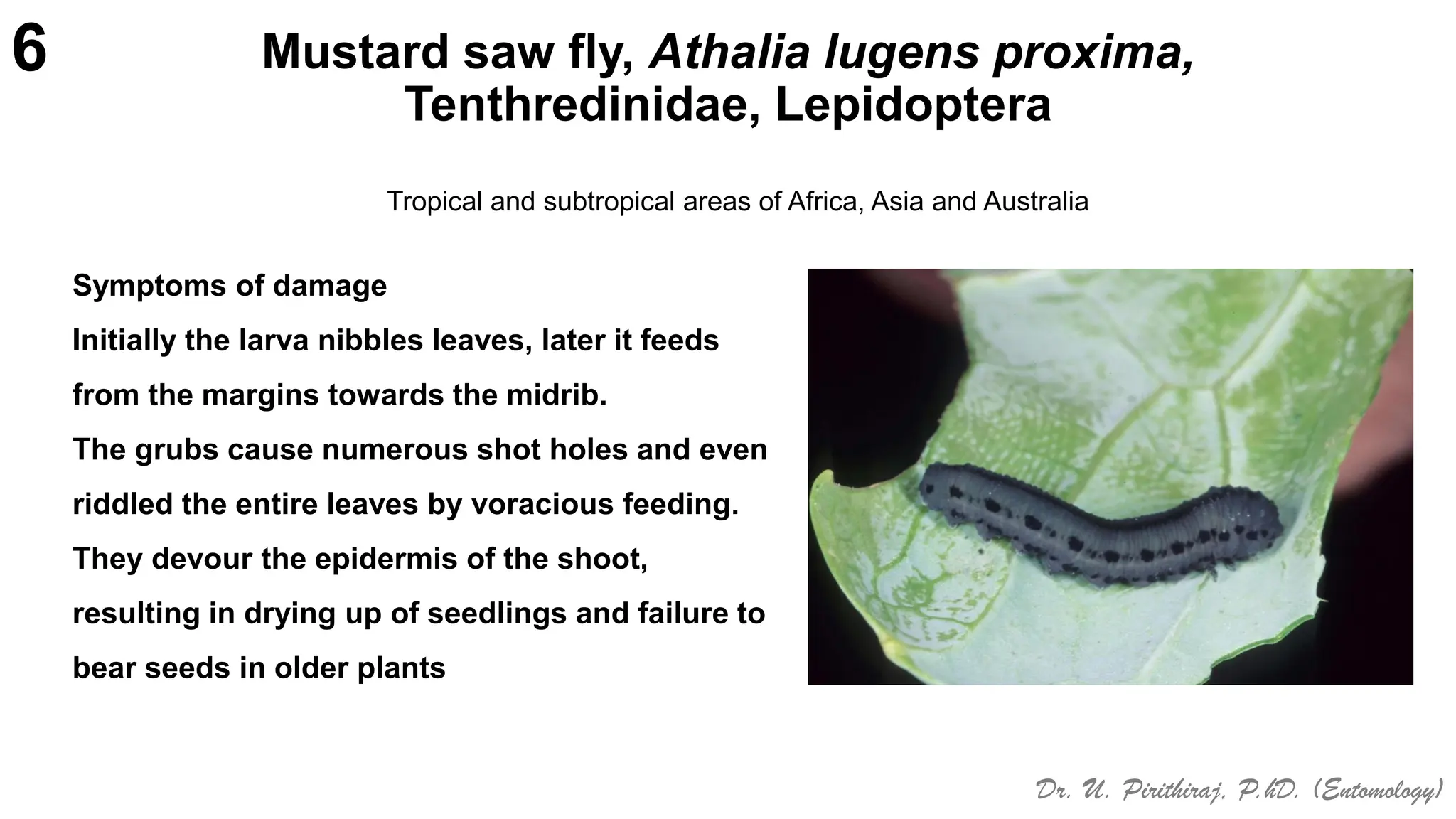
Symptoms of damage
Initially the larva nibbles leaves, later it feeds
from the margins towards the midrib.
The grubs cause numerous shot holes and even
riddled the entire leaves by voracious feeding.
They devour the epidermis of the shoot,
resulting in drying up of seedlings and failure to
bear seeds in older plants
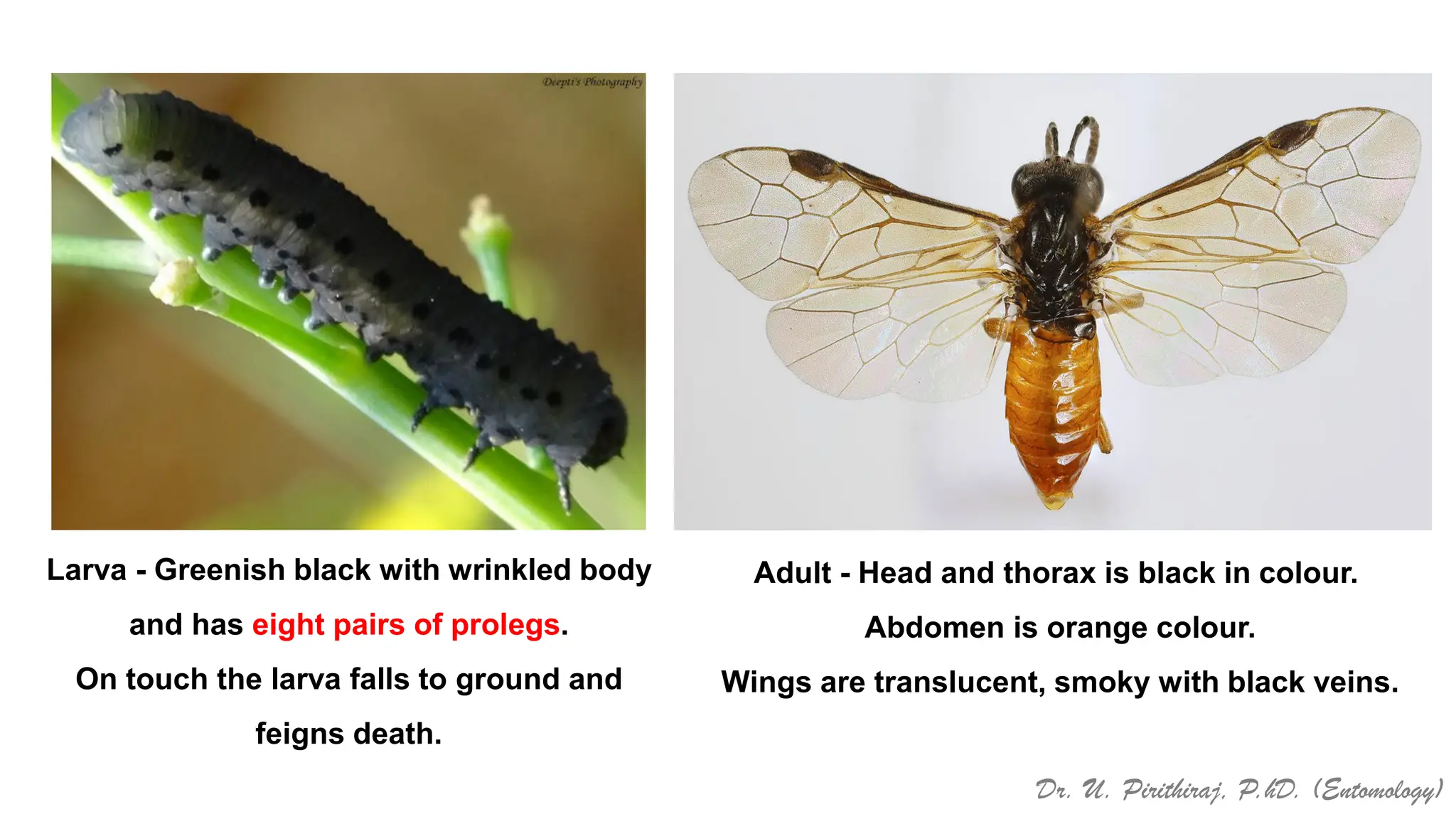
Larva - Greenish black with wrinkled body
and has eight pairs of prolegs.
On touch the larva falls to ground and
feigns death.
Adult - Head and thorax is black in colour.
Abdomen is orange colour.
Wings are translucent, smoky with black veins.
Dr. U. Pirithiraj, P.hD. (Entomology)
Management
Maintain clean cultivation.
Apply irrigation in seedling stage is very crucial for sawfly management because most of the
larvae die due to drowning effect. Severe cold reduces pest load.
Collection and destruction of grubs of saw fly in morning and evening
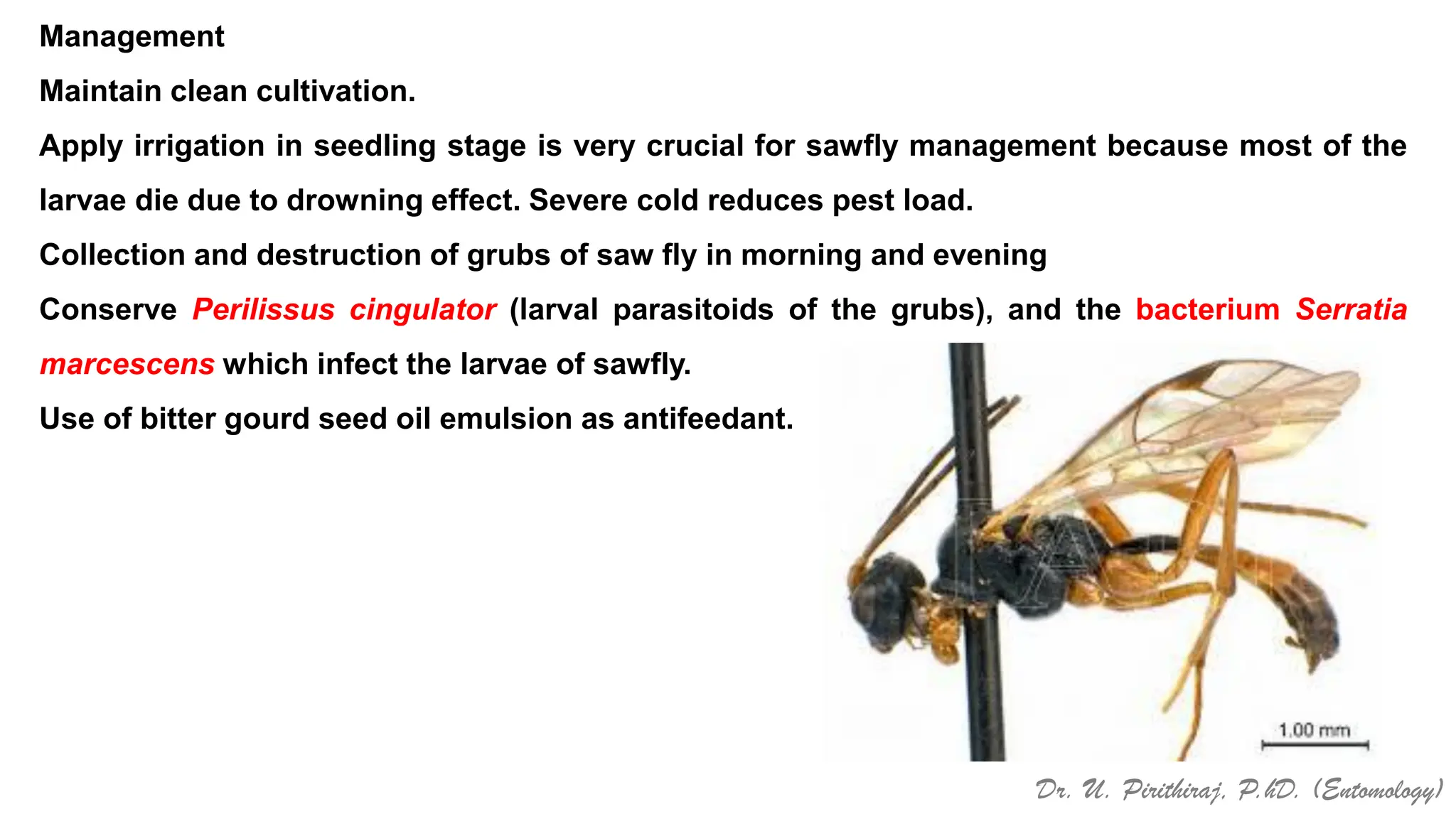
Conserve Perilissus cingulator (larval parasitoids of the grubs), and the bacterium Serratia
marcescens which infect the larvae of sawfly.
Use of bitter gourd seed oil emulsion as antifeedant.
Dr. U. Pirithiraj, P.hD. (Entomology)

Pests of mustard_Identification_Management_Dr.UPR.pdf

  • 1.
    Pests of mustard By Dr.U. Pirithiraj, P.hD. Assistant Professor (Entomology) JSACAT Affiliated to Tamil Nadu Agricultural University
  • 2.
    Mustard Aphid, Lipaphiserysimi, Aphididae, Hemiptera 1 Dr. U. Pirithiraj, P.hD. (Entomology) Symptoms of damage Both nymphs and adults suck the sap from leaves Plants remain stunted and sooty molds grow on the honey dew excreted by the insects The infected filed looks sickly and blighted in appearance Aphids are small, soft-bodied, pearl-shaped insects that have a pair of cornicles (wax-secreting tubes) projecting out from the fifth or sixth abdominal segment. Found in both tropical and temperate areas throughout the world
  • 3.
    Management: Use tolerant varietieslike JM-1 and RK-9501 Destroy the affected parts along with aphid population in the initial stage Set up yellow stick trap to monitor aphid population Dr. U. Pirithiraj, P.hD. (Entomology)
  • 4.
    Coccinella septempunctata Menochilussexmaculata Hippodamia variegata Cheilomones propinqua Adult beetles may feed on an average of 10-15 adults/day Scymnus nubilus Coccinella transversalis Adalia bipunctata olla v-nigrum Predatory ladybird beetles Dr. U. Pirithiraj, P.hD. (Entomology)
  • 5.
    A number ofentomogenous fungi, Cephalosporium spp., Entomophthora and Verticillium lecanii infect aphids Several species of syrphids i.e., Sphaerophoria spp., Eristallis spp., Metasyrphis spp., Xanthogramma spp and Syrphus spp. are predating on aphids Dr. U. Pirithiraj, P.hD. (Entomology)
  • 6.
    Braconid parasitoid Diaeretiella rapae,a very active bio-control agent cause the mummification of aphids The lacewing, Chrysoperla carnea predates on the mustard aphid colony Dr. U. Pirithiraj, P.hD. (Entomology)
  • 7.
    Predatory bird Motacillacospica is actively feeding over aphids in February-March Dr. U. Pirithiraj, P.hD. (Entomology)
  • 8.
    Whitefly, Bemisia tabaci,Aleyrodidae, Hemiptera 2 Dr. U. Pirithiraj, P.hD. (Entomology) Nature of damage Nymphs and adults remain in cluster and desap. Symptom of attack White chlorotic spots appear on leaves. Nymphs and adults secrete honeydew, which lead to sooty mould formation. Origin in Uganda, to the northern, central, eastern and coastal regions of Tanzania
  • 9.
    Diamondback moth, Plutellaxylostella, Plutellidae, Lepidoptera 3 Dr. U. Pirithiraj, P.hD. (Entomology) Throughout the Americas and in Europe, Southeast Asia, Australia, and New Zealand Symptoms of damage Whitish patches due to scrapping of epidermal leaf tissues by young larvae The leaves give a withered appearance but in later stages larvae bore holes in the leaves. Leaves may be eaten up completely. It also bores into pods and feeds developing seed
  • 10.
    Yellowish green, withfine erect black hairs scattered all over the body Small greyish brown having pale whitish narrow wings with yellow inner margins Forewings - have three white triangular spots along the inner-margin. Triangular markings of opposite wings appear as diamond shaped Hind wings – have a fringe of long fine hairs Dr. U. Pirithiraj, P.hD. (Entomology)
  • 11.
    Management Installing pheromone trap@ 5/ ac. to monitor the moth activity Collection and careful destruction of the larvae at gregarious stage at least twice a week. For control of grown up larvae apply 5% malathion dust @ 37.5 kg/ha. Larval parasitoid, Cotesia plutellae Larval parasitoid, Diadegma insulare Dr. U. Pirithiraj, P.hD. (Entomology)
  • 12.
    Cabbage head borer,Hellula undalis, crambidae, Lepidoptera 4 Dr. U. Pirithiraj, P.hD. (Entomology) Throughout the middle east, asia and the pacific Symptoms of damage Caterpillars initially mine the leaves and make it white papery. Later they feed on leaves and bore into stems. Entrance hole is covered with silk and excreta.
  • 13.
    Larva Pale whitish brownwith 4 or 5 pinkish-brown longitudinal stripes Adult Moths are pale greyish-brown, with reddish colour. Forewings have grey wavy lines, an apical spot Hind wings are pale dusky, darker in apical area Dr. U. Pirithiraj, P.hD. (Entomology)
  • 14.
    Leaf webber, Crocidolomiabinotalis, crambidae, Lepidoptera 5 Dr. U. Pirithiraj, P.hD. (Entomology) Tropical and subtropical areas of Africa, Asia and Australia Symptoms of damage Newly hatched larvae feed initially on the chlorophyll of young leaves and later on older leaves, buds and pods, make webbings and live within. Severely attacked plants are defoliated. Seeds in the pods are eaten away.
  • 15.
    Adult yellowish-brown moths Forewings- have distinct wavy lines and prominent white spots Nearer to the thorax with black tuft of hair Hind wings: White with dark brown apical area Larva - Pale yellowish-brown, with a series of lateral and sub-lateral black spots and specks Dr. U. Pirithiraj, P.hD. (Entomology)
  • 16.
    Mustard saw fly,Athalia lugens proxima, Tenthredinidae, Lepidoptera 6 Dr. U. Pirithiraj, P.hD. (Entomology) Tropical and subtropical areas of Africa, Asia and Australia Symptoms of damage Initially the larva nibbles leaves, later it feeds from the margins towards the midrib. The grubs cause numerous shot holes and even riddled the entire leaves by voracious feeding. They devour the epidermis of the shoot, resulting in drying up of seedlings and failure to bear seeds in older plants
  • 17.
    Larva - Greenishblack with wrinkled body and has eight pairs of prolegs. On touch the larva falls to ground and feigns death. Adult - Head and thorax is black in colour. Abdomen is orange colour. Wings are translucent, smoky with black veins. Dr. U. Pirithiraj, P.hD. (Entomology)
  • 18.
    Management Maintain clean cultivation. Applyirrigation in seedling stage is very crucial for sawfly management because most of the larvae die due to drowning effect. Severe cold reduces pest load. Collection and destruction of grubs of saw fly in morning and evening Conserve Perilissus cingulator (larval parasitoids of the grubs), and the bacterium Serratia marcescens which infect the larvae of sawfly. Use of bitter gourd seed oil emulsion as antifeedant. Dr. U. Pirithiraj, P.hD. (Entomology)