Introduction to Private Equity
Gustavo Velez
Appendix
• Introduction to PE
• Debt Financing
• Company Screening
• Leveraged Buyout
Disclaimer: This guide aims to provide a
high level overview of what is private
equity. PPT should merely serve as a
guide.
Introduction to PE
What is PE?
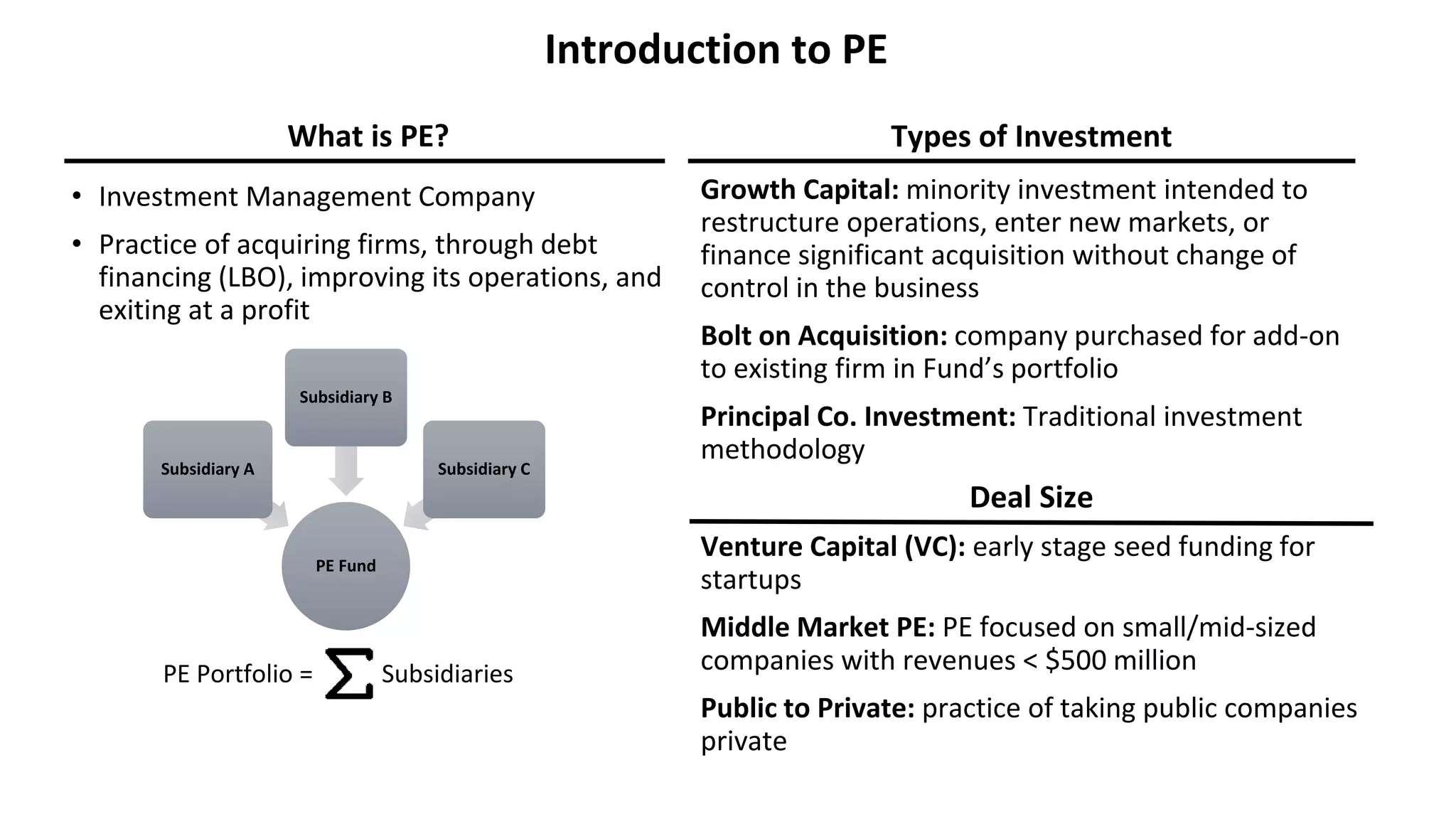
• Investment Management Company
• Practice of acquiring firms, through debt
financing (LBO), improving its operations, and
exiting at a profit
Venture Capital (VC): early stage seed funding for
startups
Middle Market PE: PE focused on small/mid-sized
companies with revenues < $500 million
Public to Private: practice of taking public companies
private
Deal Size
Types of Investment
Growth Capital: minority investment intended to
restructure operations, enter new markets, or
finance significant acquisition without change of
control in the business
Bolt on Acquisition: company purchased for add-on
to existing firm in Fund’s portfolio
Principal Co. Investment: Traditional investment
methodology
PE Fund
Subsidiary A
Subsidiary B
Subsidiary C
PE Portfolio = Subsidiaries
Introduction to PE
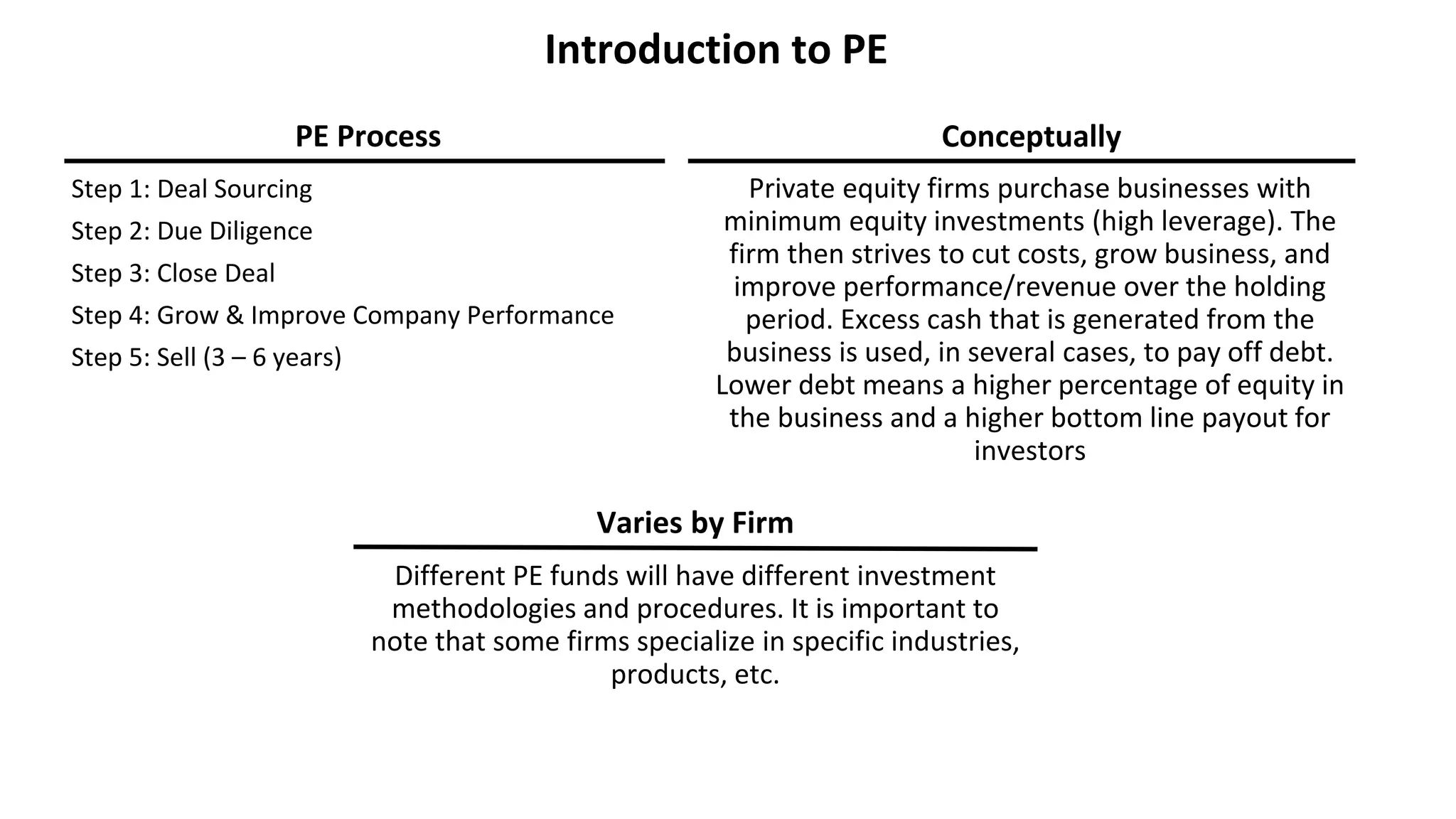
PE Process
Step 1: Deal Sourcing
Step 2: Due Diligence
Step 3: Close Deal
Step 4: Grow & Improve Company Performance
Step 5: Sell (3 – 6 years)
Different PE funds will have different investment
methodologies and procedures. It is important to
note that some firms specialize in specific industries,
products, etc.
Varies by Firm
Conceptually
Private equity firms purchase businesses with
minimum equity investments (high leverage). The
firm then strives to cut costs, grow business, and
improve performance/revenue over the holding
period. Excess cash that is generated from the
business is used, in several cases, to pay off debt.
Lower debt means a higher percentage of equity in
the business and a higher bottom line payout for
investors
Company Screening
Criteria
Stable and recurring Cash Flows
Low Cyclicality / Seasonality
Growing Industry
Sustainable Competitive Advantage
Low Capital Expenditures (CAPEX)
Strong Management Team
Private Equity firms look for companies that have high and stable cash flows, which can hold a high
debt load. Ability to cover your interest expense is essential to staying in business and avoiding
bankruptcy issues. Size of businesses, industry preference, and other business characteristics vary by
PE fund. *While traditional PE firms invest in companies with these criteria, there are funds that
deviate from this investment strategy.
Leveraged Buyouts
What is An LBO
Acquisition of Company primarily through debt
financing
Leveraging an Asset can provide higher returns
through minimal equity investments
Common Terminology
Exit Multiples
Equity IRR
Leverage Ratio
Interest Coverage Ratio
EV/EBITDA
Net Debt/EBITDA
LTM EBITDA
The Purchase
House: $100k
Down Payment (Equity):
$35
Mortgage (Debt): $65
Over a period of 5 years:
$20 of debt are repaid
Demand for Houses along with
improvements drive the price of
the House up 30%
The Sale
House: $130k
Equity: $85
Mortgage (Debt): $45
LBO – (Like taking Mortgage)
Debt Financing
Term Loans or Revolvers
Senior Claim to Business
Collateral – Asset Based
Requires Interest + Principal Payments
Lowest Interest Payment (lowest risk)
Referred to as 1st Lien / 2nd Lien
Biggest chunk of financing
BBB Credit Rating or Lower
Below senior debt / Usually Unsecured
No Collateral – Cash Based
High Interest Rates – No Principal Payment
Covenant Requirements
Both Debt and Equity Like Qualities
Convertible Option
Attached Warrants
Preferred Stock with Warrants
Unsecured with very few covenants
Mezzanine
Finance
High Yield Bonds
Bank Debt
(Revolver/Term
Loans)
Institutional
Investors &
Banks
Institutional
Investors
Hedge Funds &
Mezz Funds
End
GVA | Finance Academy

Introduction to Private Equity

  • 1.
    Introduction to PrivateEquity Gustavo Velez
  • 2.
    Appendix • Introduction toPE • Debt Financing • Company Screening • Leveraged Buyout Disclaimer: This guide aims to provide a high level overview of what is private equity. PPT should merely serve as a guide.
  • 3.
    Introduction to PE Whatis PE? • Investment Management Company • Practice of acquiring firms, through debt financing (LBO), improving its operations, and exiting at a profit Venture Capital (VC): early stage seed funding for startups Middle Market PE: PE focused on small/mid-sized companies with revenues < $500 million Public to Private: practice of taking public companies private Deal Size Types of Investment Growth Capital: minority investment intended to restructure operations, enter new markets, or finance significant acquisition without change of control in the business Bolt on Acquisition: company purchased for add-on to existing firm in Fund’s portfolio Principal Co. Investment: Traditional investment methodology PE Fund Subsidiary A Subsidiary B Subsidiary C PE Portfolio = Subsidiaries
  • 4.
    Introduction to PE PEProcess Step 1: Deal Sourcing Step 2: Due Diligence Step 3: Close Deal Step 4: Grow & Improve Company Performance Step 5: Sell (3 – 6 years) Different PE funds will have different investment methodologies and procedures. It is important to note that some firms specialize in specific industries, products, etc. Varies by Firm Conceptually Private equity firms purchase businesses with minimum equity investments (high leverage). The firm then strives to cut costs, grow business, and improve performance/revenue over the holding period. Excess cash that is generated from the business is used, in several cases, to pay off debt. Lower debt means a higher percentage of equity in the business and a higher bottom line payout for investors
  • 5.
    Company Screening Criteria Stable andrecurring Cash Flows Low Cyclicality / Seasonality Growing Industry Sustainable Competitive Advantage Low Capital Expenditures (CAPEX) Strong Management Team Private Equity firms look for companies that have high and stable cash flows, which can hold a high debt load. Ability to cover your interest expense is essential to staying in business and avoiding bankruptcy issues. Size of businesses, industry preference, and other business characteristics vary by PE fund. *While traditional PE firms invest in companies with these criteria, there are funds that deviate from this investment strategy.
  • 6.
    Leveraged Buyouts What isAn LBO Acquisition of Company primarily through debt financing Leveraging an Asset can provide higher returns through minimal equity investments Common Terminology Exit Multiples Equity IRR Leverage Ratio Interest Coverage Ratio EV/EBITDA Net Debt/EBITDA LTM EBITDA The Purchase House: $100k Down Payment (Equity): $35 Mortgage (Debt): $65 Over a period of 5 years: $20 of debt are repaid Demand for Houses along with improvements drive the price of the House up 30% The Sale House: $130k Equity: $85 Mortgage (Debt): $45 LBO – (Like taking Mortgage)
  • 7.
    Debt Financing Term Loansor Revolvers Senior Claim to Business Collateral – Asset Based Requires Interest + Principal Payments Lowest Interest Payment (lowest risk) Referred to as 1st Lien / 2nd Lien Biggest chunk of financing BBB Credit Rating or Lower Below senior debt / Usually Unsecured No Collateral – Cash Based High Interest Rates – No Principal Payment Covenant Requirements Both Debt and Equity Like Qualities Convertible Option Attached Warrants Preferred Stock with Warrants Unsecured with very few covenants Mezzanine Finance High Yield Bonds Bank Debt (Revolver/Term Loans) Institutional Investors & Banks Institutional Investors Hedge Funds & Mezz Funds
  • 8.