Topic: Informal Risk Capital
and Venture Capital
Class : M. Com part 2nd
Institute : Govt. College of Commerce,
Qasimpur Colony Multan
Course: Entrepreneurship
Instructor: Ghulam Haider
Financing the Business
12-3
Criteria for evaluating appropriateness of
financing alternatives:
Amount and timing of funds required.
Projected company sales and growth.
Three types of funding:
Early stage financing.
Development financing.
Acquisition financing.
Risk capital markets provide debt and
equity to financing situations.
Types of risk capital markets:
Informal risk capital market.
Venture-capital market.
Public-equity market.
All three can be a source of funds for stage-
one financing.
However, public-equity market is available only
for high-potential ventures.
Financing the Business (cont.)
12-4
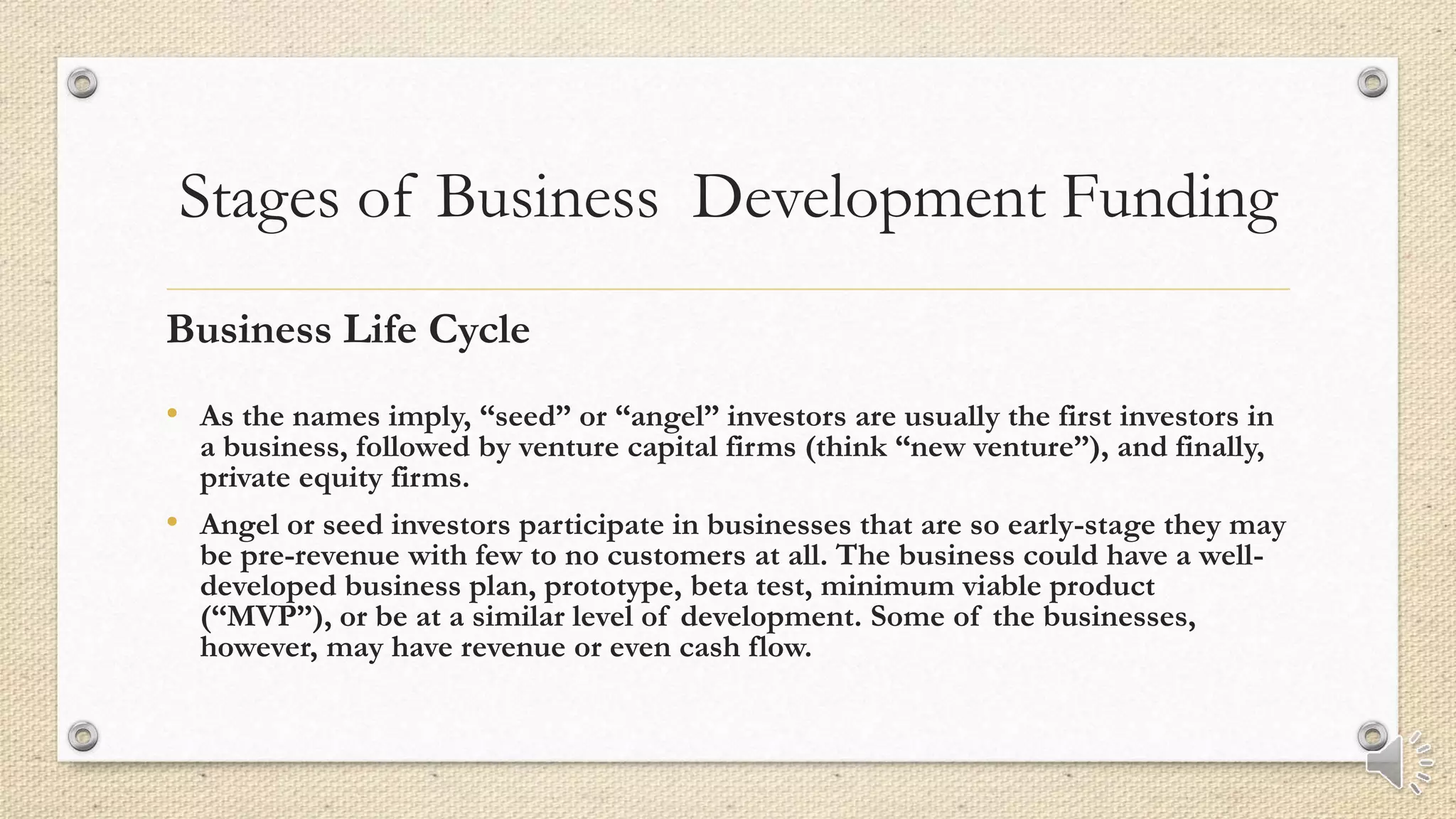
Stages of Business Development Funding
Business Life Cycle
• As the names imply, “seed” or “angel” investors are usually the first investors in
a business, followed by venture capital firms (think “new venture”), and finally,
private equity firms.
• Angel or seed investors participate in businesses that are so early-stage they may
be pre-revenue with few to no customers at all. The business could have a well-
developed business plan, prototype, beta test, minimum viable product
(“MVP”), or be at a similar level of development. Some of the businesses,
however, may have revenue or even cash flow.
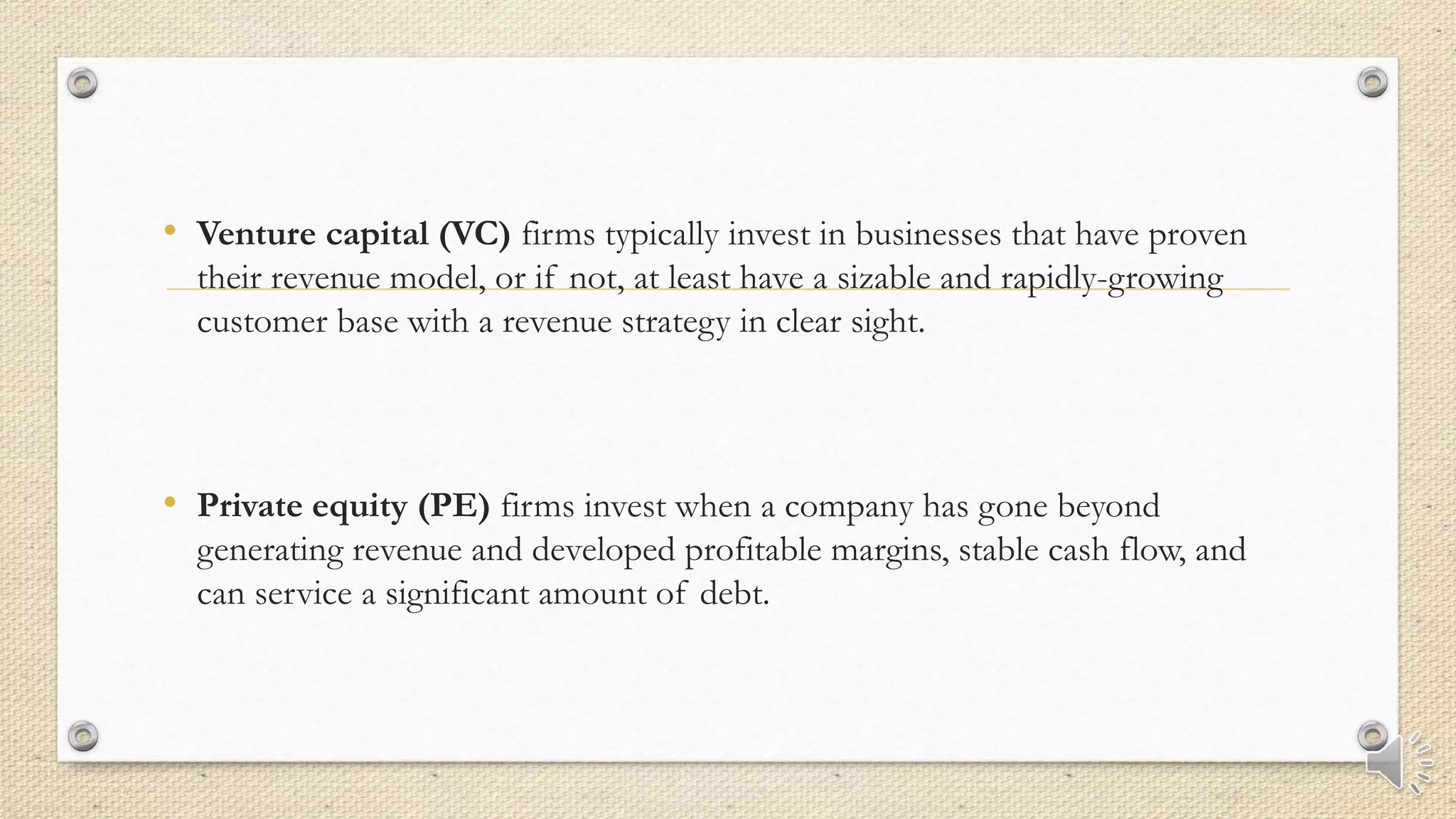
• Venture capital (VC) firms typically invest in businesses that have proven
their revenue model, or if not, at least have a sizable and rapidly-growing
customer base with a revenue strategy in clear sight.
• Private equity (PE) firms invest when a company has gone beyond
generating revenue and developed profitable margins, stable cash flow, and
can service a significant amount of debt.
Size of Investment
Seed and angel investors have no minimum size,
but typically it’s at least $10,000 to $100,000 and can
be as high as a few million in some cases. Some Investors,
for example, invests $120,000 for a 7% ownership stake in
companies accepted into its accelerator program.
Size of Investment (contd.)
• Venture capital firms can invest a wide range of values depending
on the industry, company, and various other factors. As a rule of
thumb, you can assume venture capital deals are, on average,
anywhere between $1 million and $20 million.
• Private equity firms, being later-stage investors, typically do more
massive deals and the range can be enormous depending on the
types of business. There are boutique, mid-market private equity
firms that will do $5 million deals, while large global firms. The
range is so vast it’s almost meaningless to put an average on it.
Type of Investment
• Angel/seed investor can only invest equity, as the businesses they are
targeting are such an early stage that they’re not suitable for debt. In
extremely early stage deals, they may use an instrument called a SAFE, which
stands for Simple Agreement for Future Equity. This is an alternative to a
convertible note. In exchange for money, the company gives the investor the
right to buy shares in a future equity round (with specific price parameters).
Most deals, however, are done as straight up cash for shares.
Type of Investment (Contd.)
• VC firms invest common equity, preferred shares, and convertible debt
securities in companies. Their focus is on equity upside, so even if they
invest in a convertible debt security, their goal is to own equity eventually.
Preferred shares can have all sorts of special rights and privileges to protect
investors by limiting their downside (first out) and protecting them from
future dilution of equity interest (rights/warrants/ratchets).
• PE firms typically invest equity, but also borrow a significant amount of
money to enhance their levered rate of return (internal rate of return IRR).
They may undertake a transaction known as a leveraged buyout LBO where
they maximize the amount of debt they can use in the deal.
Level of Risk
• This part is relatively straightforward. The earlier the stage the business is in,
the higher the risk (as a generalization — there are exceptions, of course).
Investment Screening
• Angels and seed investors focus more on qualitative factors such as who the
founders are, high-level reasons why the business should be a big success,
and ideas about product-market fit.
• VCs are also very focused on who the founders are, but usually by this stage,
more detailed metrics are available to consider, such as revenue run rate,
average revenue per user, customer lifetime value, margins, etc.
• PE firms look at key financial metrics, including EBIT, cash flow, free cash
flow, and, ultimately, what IRR they believe they can achieve.

Chapter 12 entrepreneurship lesson 1

  • 2.
    Topic: Informal RiskCapital and Venture Capital Class : M. Com part 2nd Institute : Govt. College of Commerce, Qasimpur Colony Multan Course: Entrepreneurship Instructor: Ghulam Haider
  • 3.
    Financing the Business 12-3 Criteriafor evaluating appropriateness of financing alternatives: Amount and timing of funds required. Projected company sales and growth. Three types of funding: Early stage financing. Development financing. Acquisition financing.
  • 4.
    Risk capital marketsprovide debt and equity to financing situations. Types of risk capital markets: Informal risk capital market. Venture-capital market. Public-equity market. All three can be a source of funds for stage- one financing. However, public-equity market is available only for high-potential ventures. Financing the Business (cont.) 12-4
  • 5.
    Stages of BusinessDevelopment Funding Business Life Cycle • As the names imply, “seed” or “angel” investors are usually the first investors in a business, followed by venture capital firms (think “new venture”), and finally, private equity firms. • Angel or seed investors participate in businesses that are so early-stage they may be pre-revenue with few to no customers at all. The business could have a well- developed business plan, prototype, beta test, minimum viable product (“MVP”), or be at a similar level of development. Some of the businesses, however, may have revenue or even cash flow.
  • 6.
    • Venture capital(VC) firms typically invest in businesses that have proven their revenue model, or if not, at least have a sizable and rapidly-growing customer base with a revenue strategy in clear sight. • Private equity (PE) firms invest when a company has gone beyond generating revenue and developed profitable margins, stable cash flow, and can service a significant amount of debt.
  • 7.
    Size of Investment Seedand angel investors have no minimum size, but typically it’s at least $10,000 to $100,000 and can be as high as a few million in some cases. Some Investors, for example, invests $120,000 for a 7% ownership stake in companies accepted into its accelerator program.
  • 8.
    Size of Investment(contd.) • Venture capital firms can invest a wide range of values depending on the industry, company, and various other factors. As a rule of thumb, you can assume venture capital deals are, on average, anywhere between $1 million and $20 million. • Private equity firms, being later-stage investors, typically do more massive deals and the range can be enormous depending on the types of business. There are boutique, mid-market private equity firms that will do $5 million deals, while large global firms. The range is so vast it’s almost meaningless to put an average on it.
  • 9.
    Type of Investment •Angel/seed investor can only invest equity, as the businesses they are targeting are such an early stage that they’re not suitable for debt. In extremely early stage deals, they may use an instrument called a SAFE, which stands for Simple Agreement for Future Equity. This is an alternative to a convertible note. In exchange for money, the company gives the investor the right to buy shares in a future equity round (with specific price parameters). Most deals, however, are done as straight up cash for shares.
  • 10.
    Type of Investment(Contd.) • VC firms invest common equity, preferred shares, and convertible debt securities in companies. Their focus is on equity upside, so even if they invest in a convertible debt security, their goal is to own equity eventually. Preferred shares can have all sorts of special rights and privileges to protect investors by limiting their downside (first out) and protecting them from future dilution of equity interest (rights/warrants/ratchets). • PE firms typically invest equity, but also borrow a significant amount of money to enhance their levered rate of return (internal rate of return IRR). They may undertake a transaction known as a leveraged buyout LBO where they maximize the amount of debt they can use in the deal.
  • 11.
    Level of Risk •This part is relatively straightforward. The earlier the stage the business is in, the higher the risk (as a generalization — there are exceptions, of course).
  • 12.
    Investment Screening • Angelsand seed investors focus more on qualitative factors such as who the founders are, high-level reasons why the business should be a big success, and ideas about product-market fit. • VCs are also very focused on who the founders are, but usually by this stage, more detailed metrics are available to consider, such as revenue run rate, average revenue per user, customer lifetime value, margins, etc. • PE firms look at key financial metrics, including EBIT, cash flow, free cash flow, and, ultimately, what IRR they believe they can achieve.