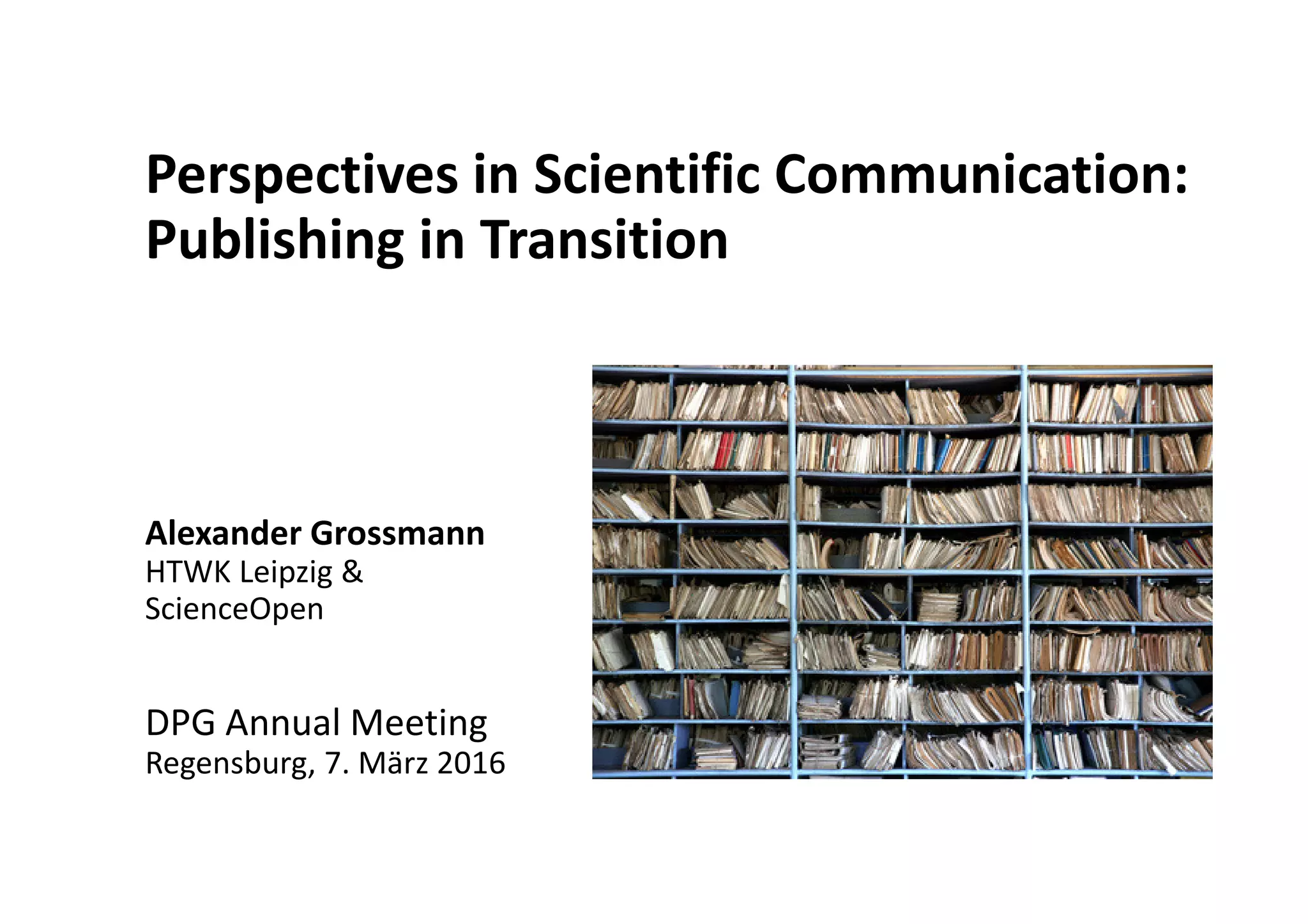
Perspectives in Scientific Communication:
Publishing in Transition
Alexander Grossmann
HTWK Leipzig &
ScienceOpen
DPG Annual Meeting
Regensburg, 7. März 2016
2
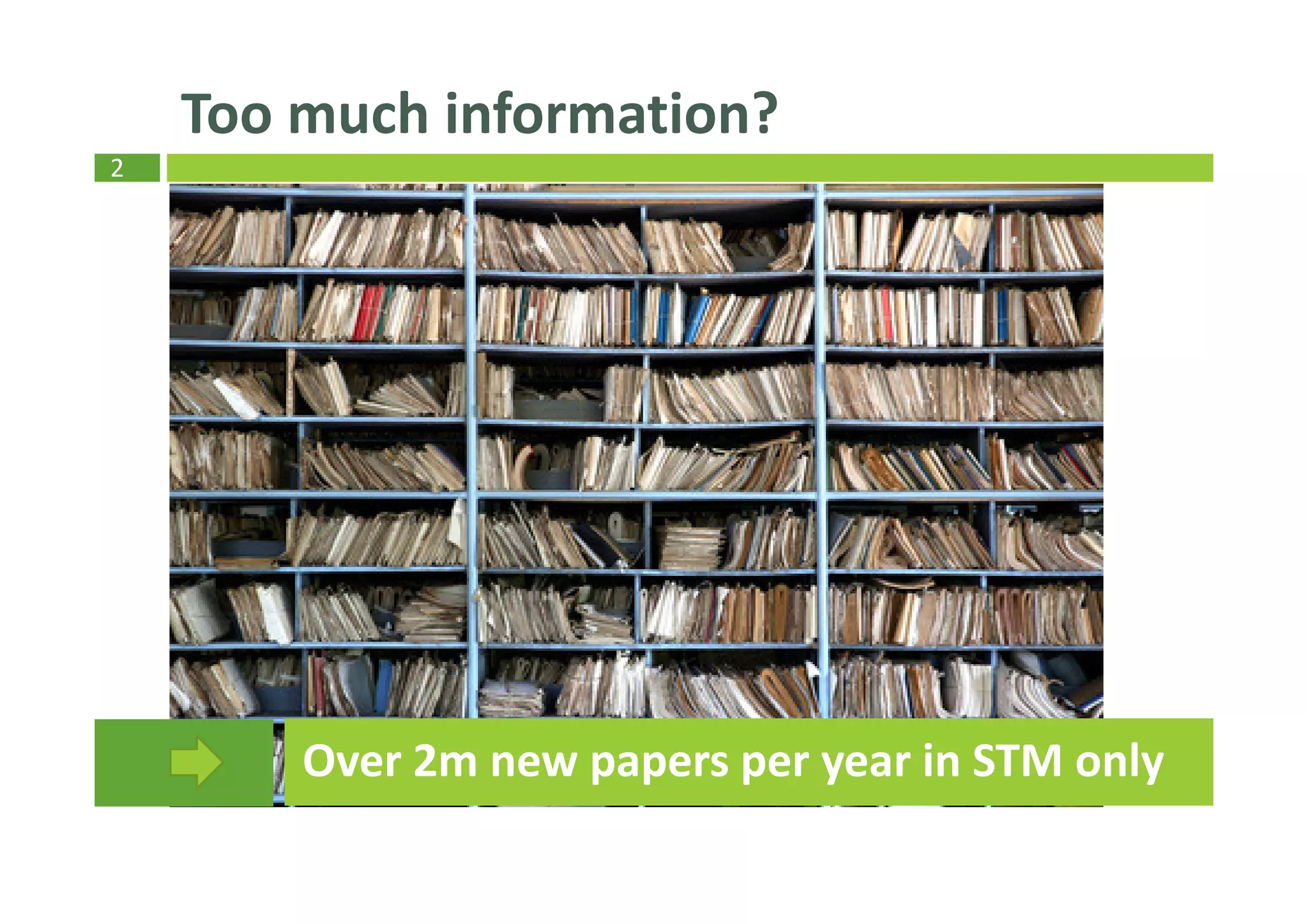
Too much information?
Over 2m new papers per year in STM only
3
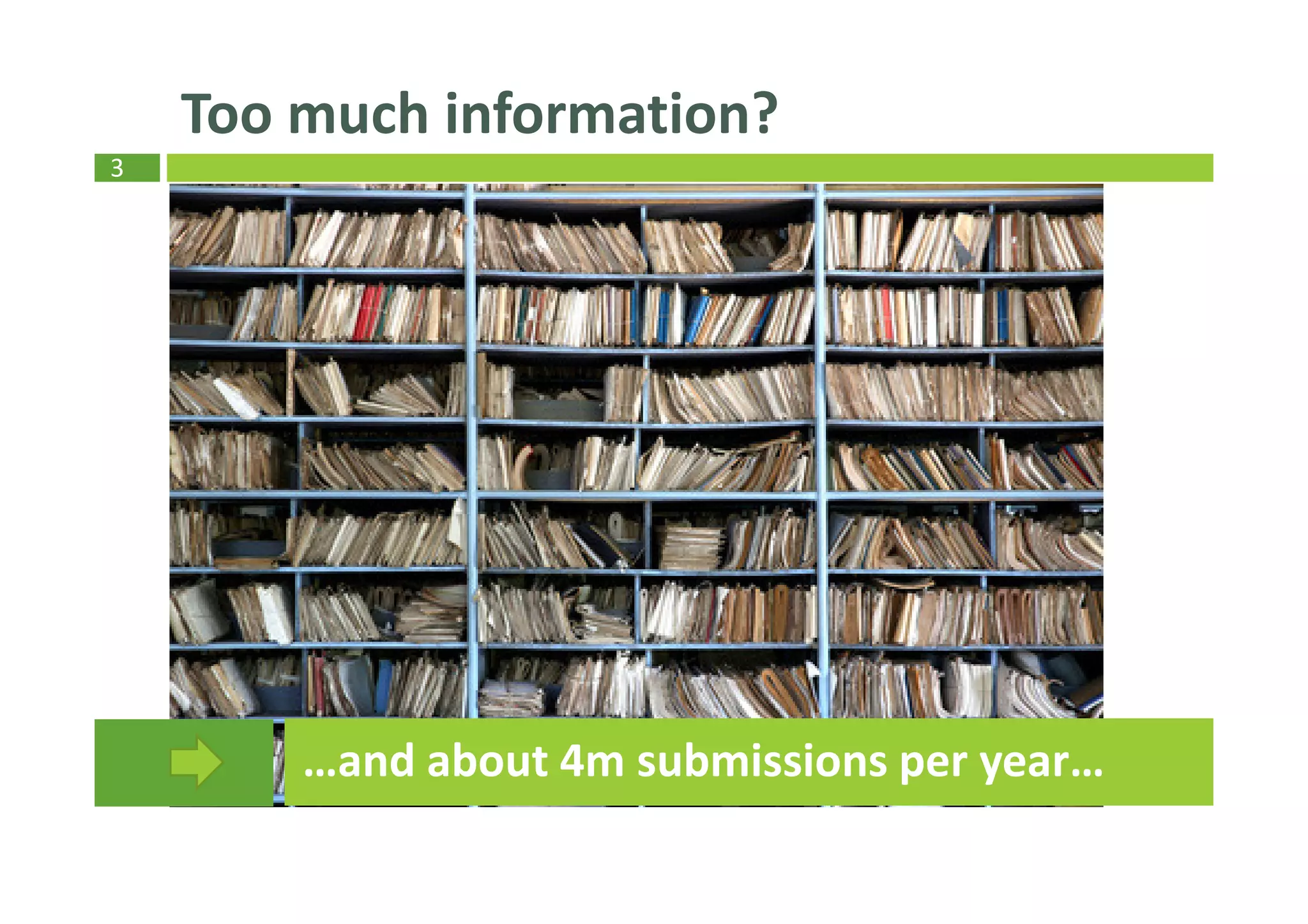
Too much information?
…and about 4m submissions per year…
4
Scientific Publishing: Present Status
Problems:
too much information
slow publication process & high rejection rates
anonymous & non-transparent reviewing process
no credits for reviewers
expensive subscription pricing
IF-driven „glamorous journals“ (R. Schekman)
…
5
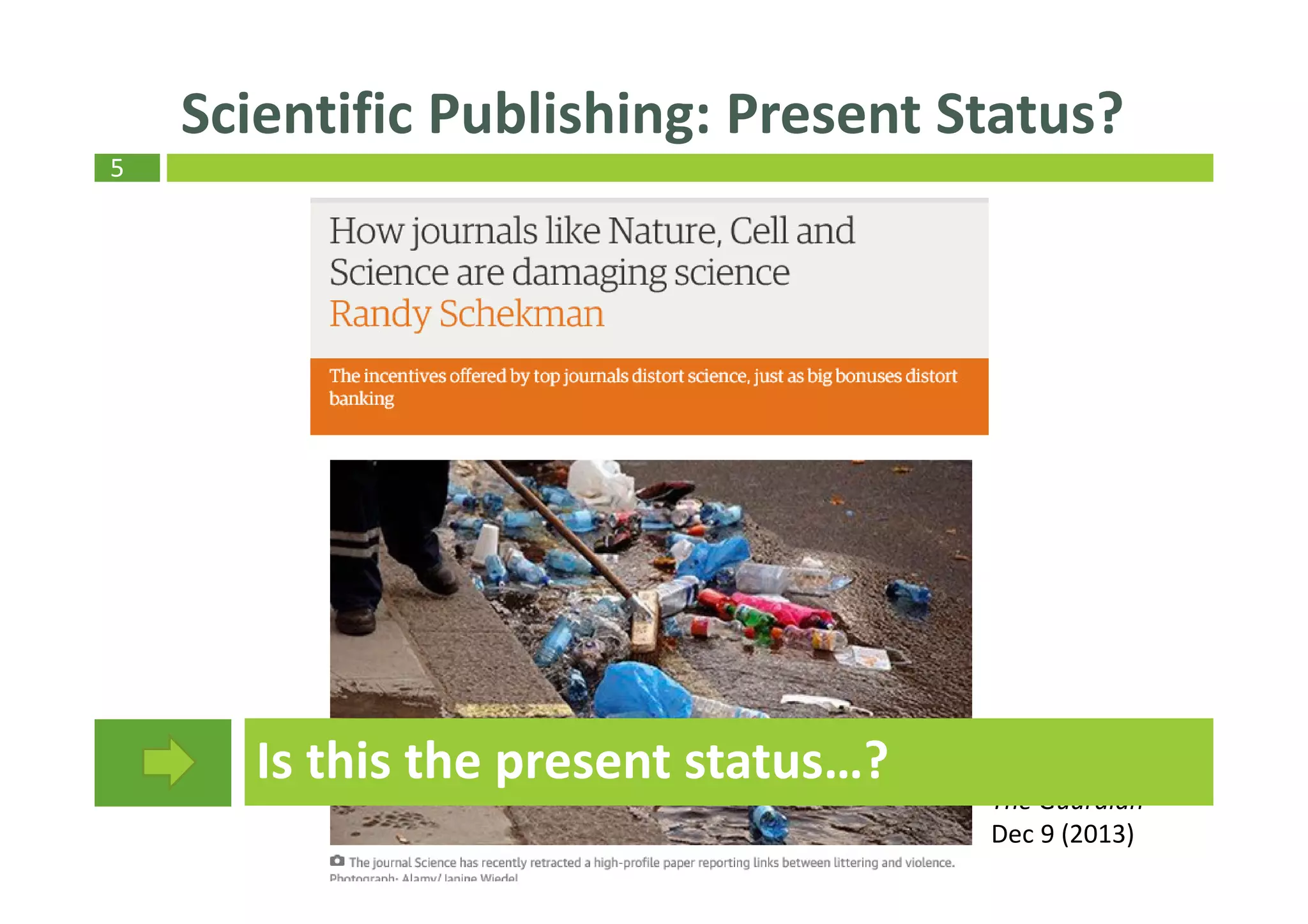
Scientific Publishing: Present Status?
R. Schekman:
The Guardian
Dec 9 (2013)
Is this the present status…?
6
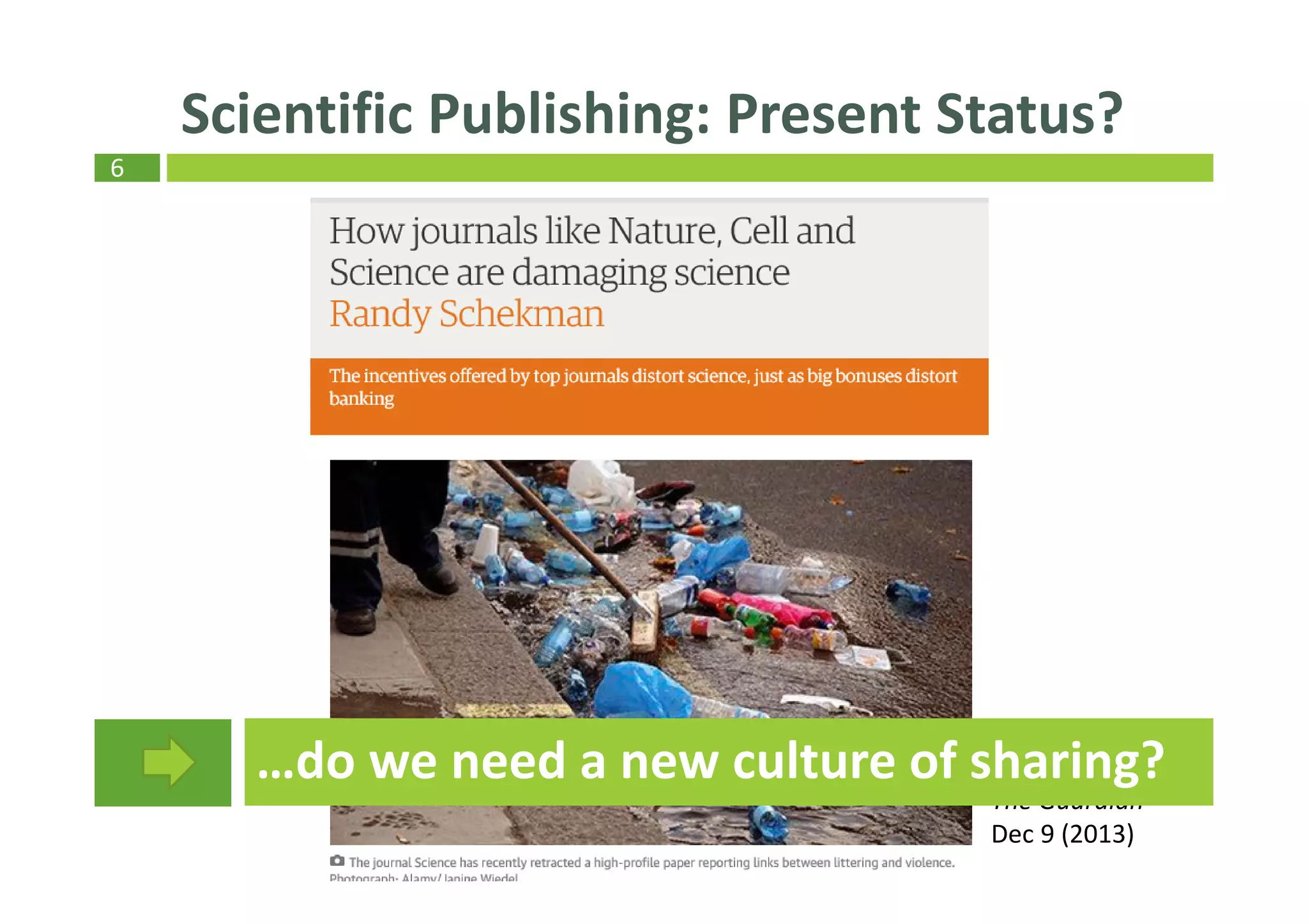
Scientific Publishing: Present Status?
R. Schekman:
The Guardian
Dec 9 (2013)
…do we need a new culture of sharing?
7
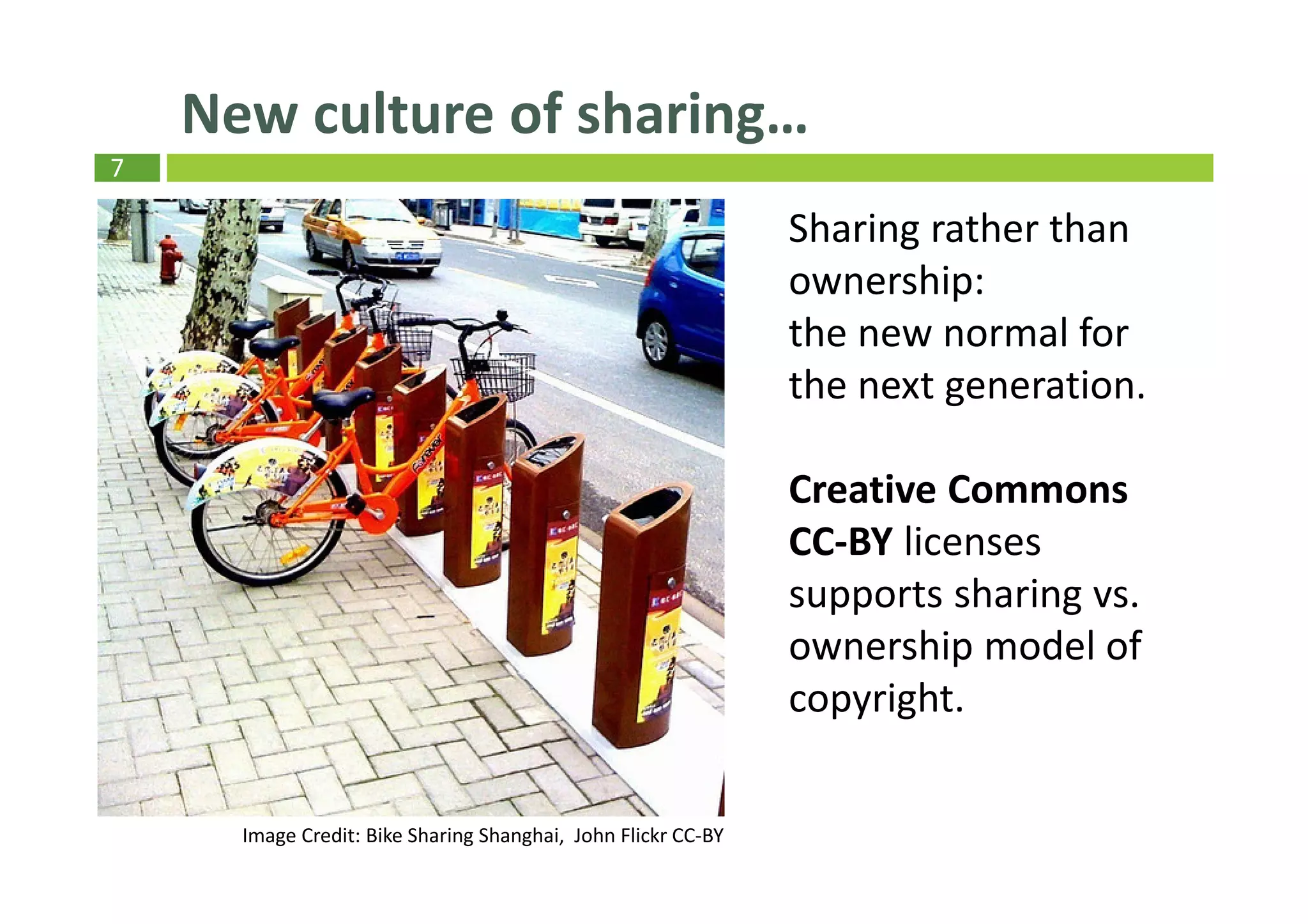
New culture of sharing…
Sharing rather than
ownership:
the new normal for
the next generation.
Creative Commons
CC-BY licenses
supports sharing vs.
ownership model of
copyright.
Image Credit: Bike Sharing Shanghai, John Flickr CC-BY
8
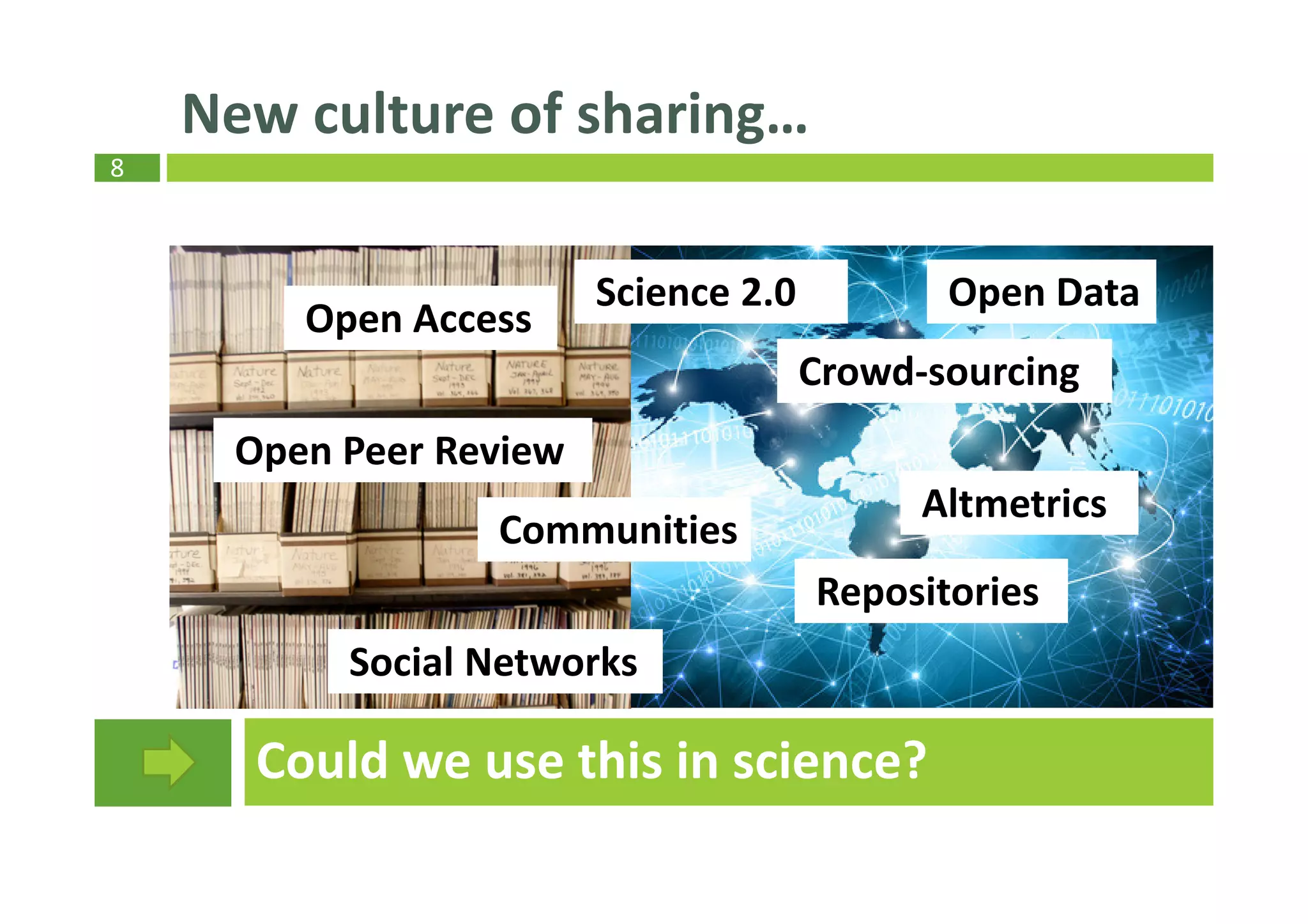
New culture of sharing…
Social Networks
Communities
Crowd-sourcing
Open Data
Open Access
Repositories
Altmetrics
Open Peer Review
Science 2.0
Could we use this in science?
Perspectives in Scientific Publishing DPG Regensburg 2016
CC0 Pixabay
Alexander Grossmann
10
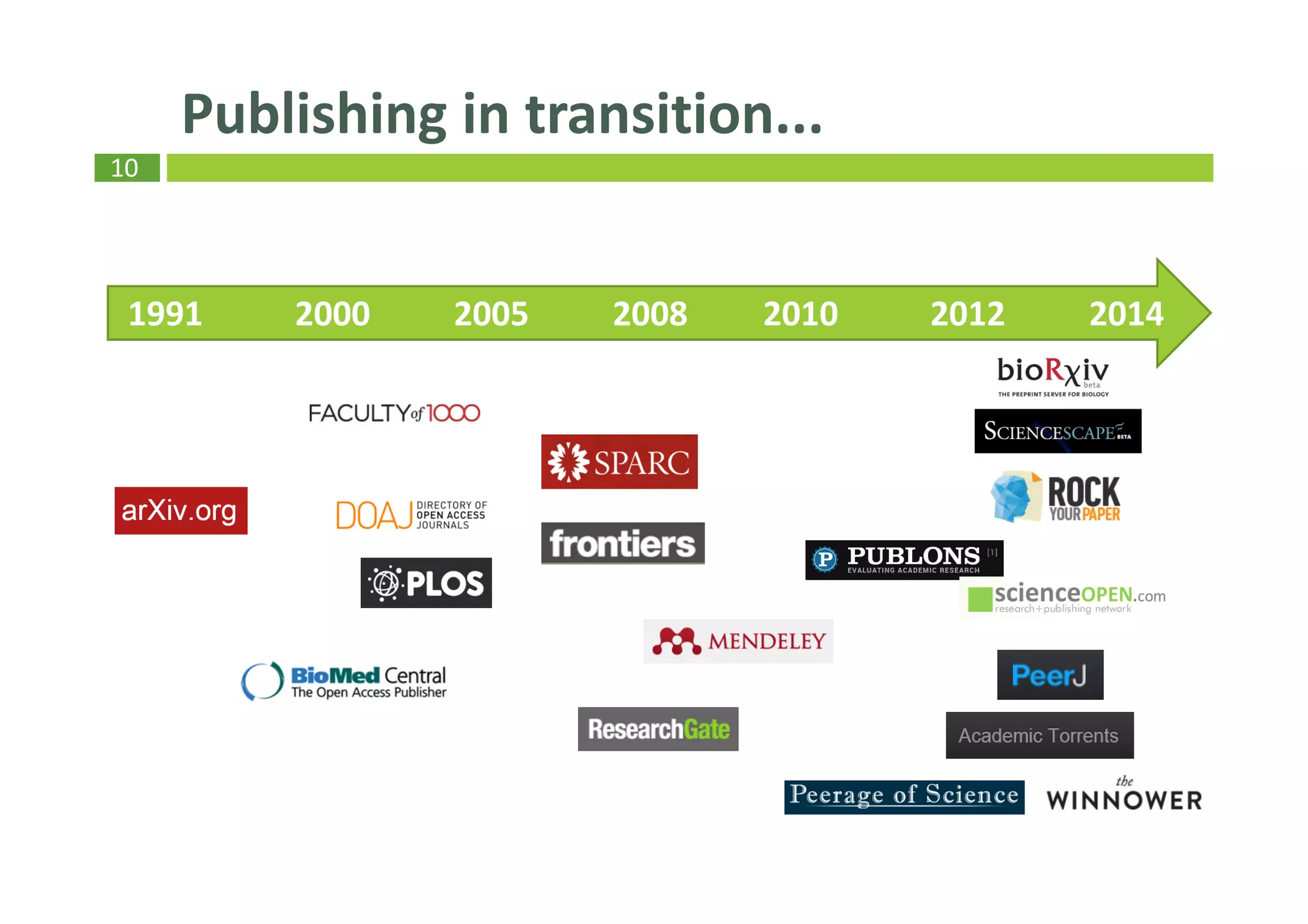
Publishing in transition...
1991 2000 2005 2008 2010 2012 2014
11
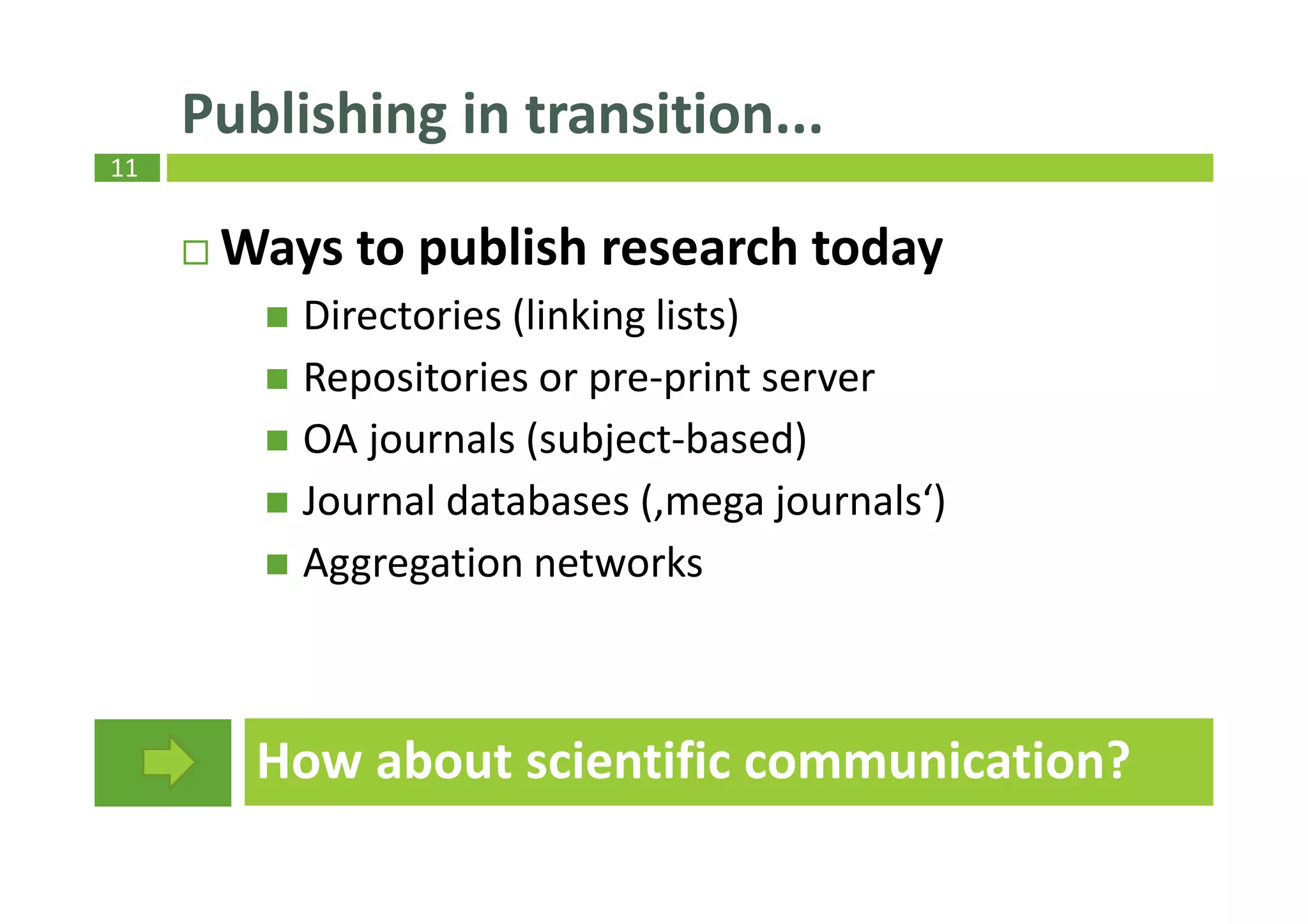
Publishing in transition...
Ways to publish research today
Directories (linking lists)
Repositories or pre-print server
OA journals (subject-based)
Journal databases (‚mega journals‘)
Aggregation networks
How about scientific communication?
12
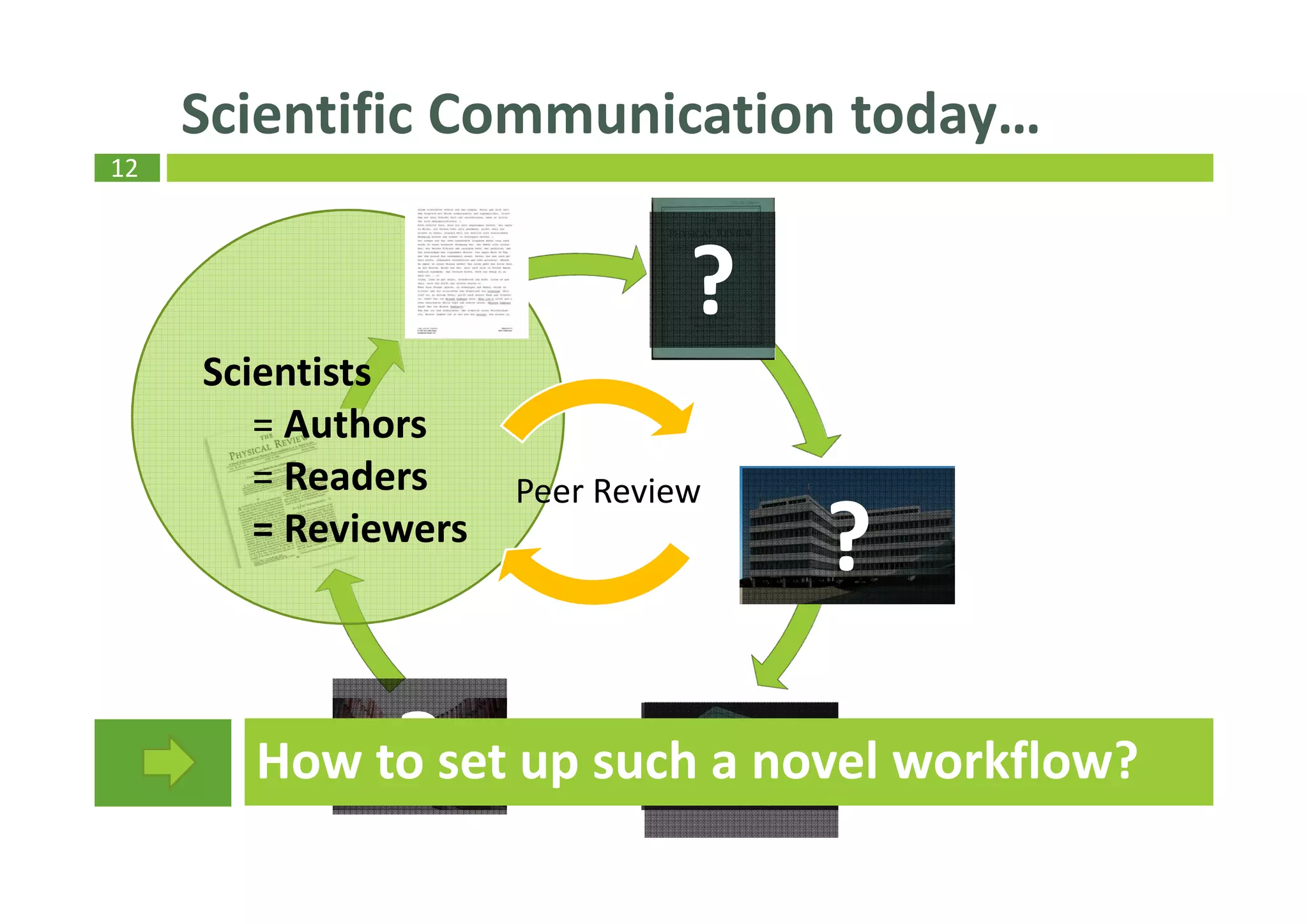
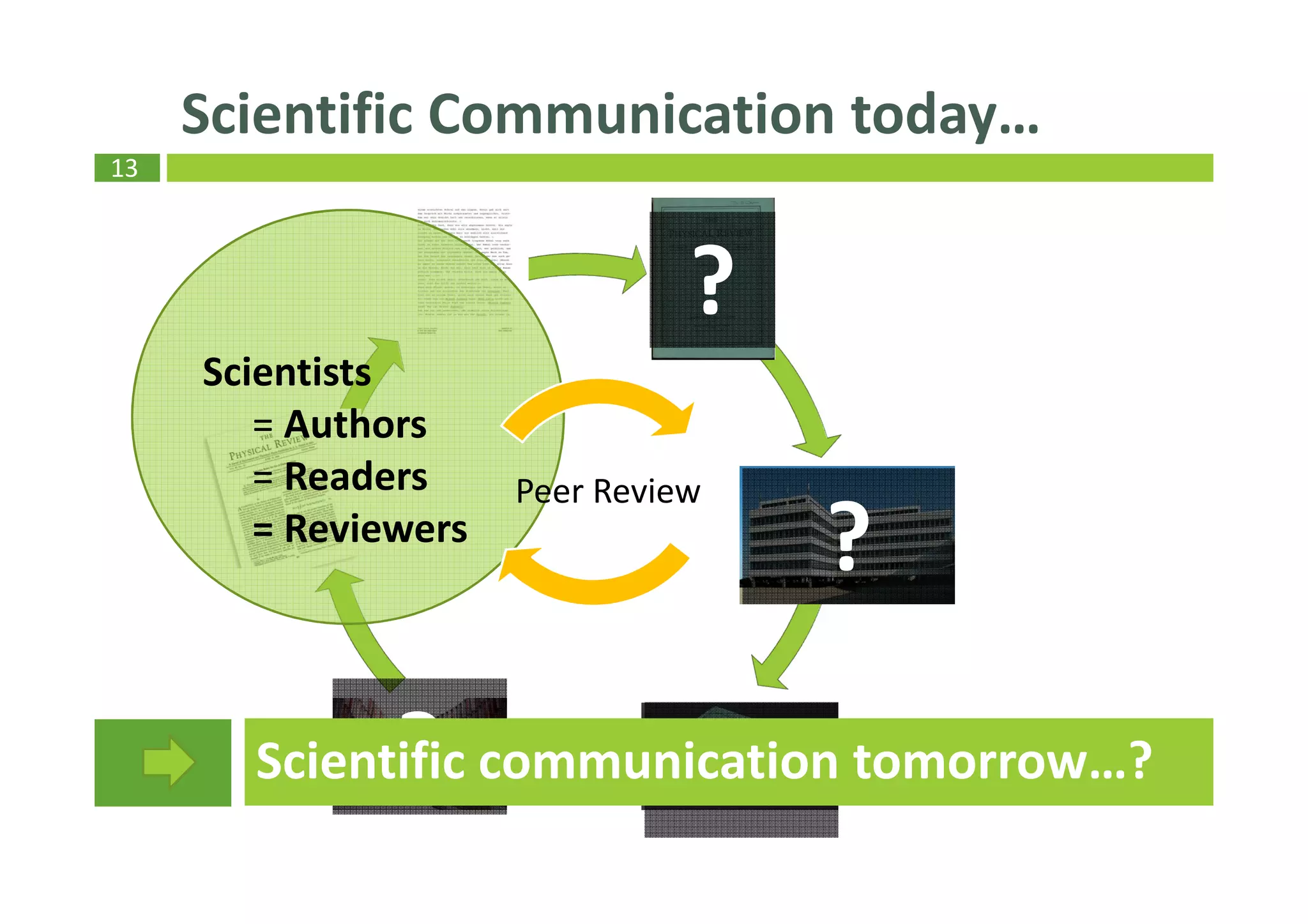
Scientific Communication today…
Peer Review
Scientists
= Authors
= Readers
= Reviewers
?
?
?
?
How to set up such a novel workflow?
13
Scientific Communication today…
Peer Review
Scientists
= Authors
= Readers
= Reviewers
?
?
?
?
Scientific communication tomorrow…?
14
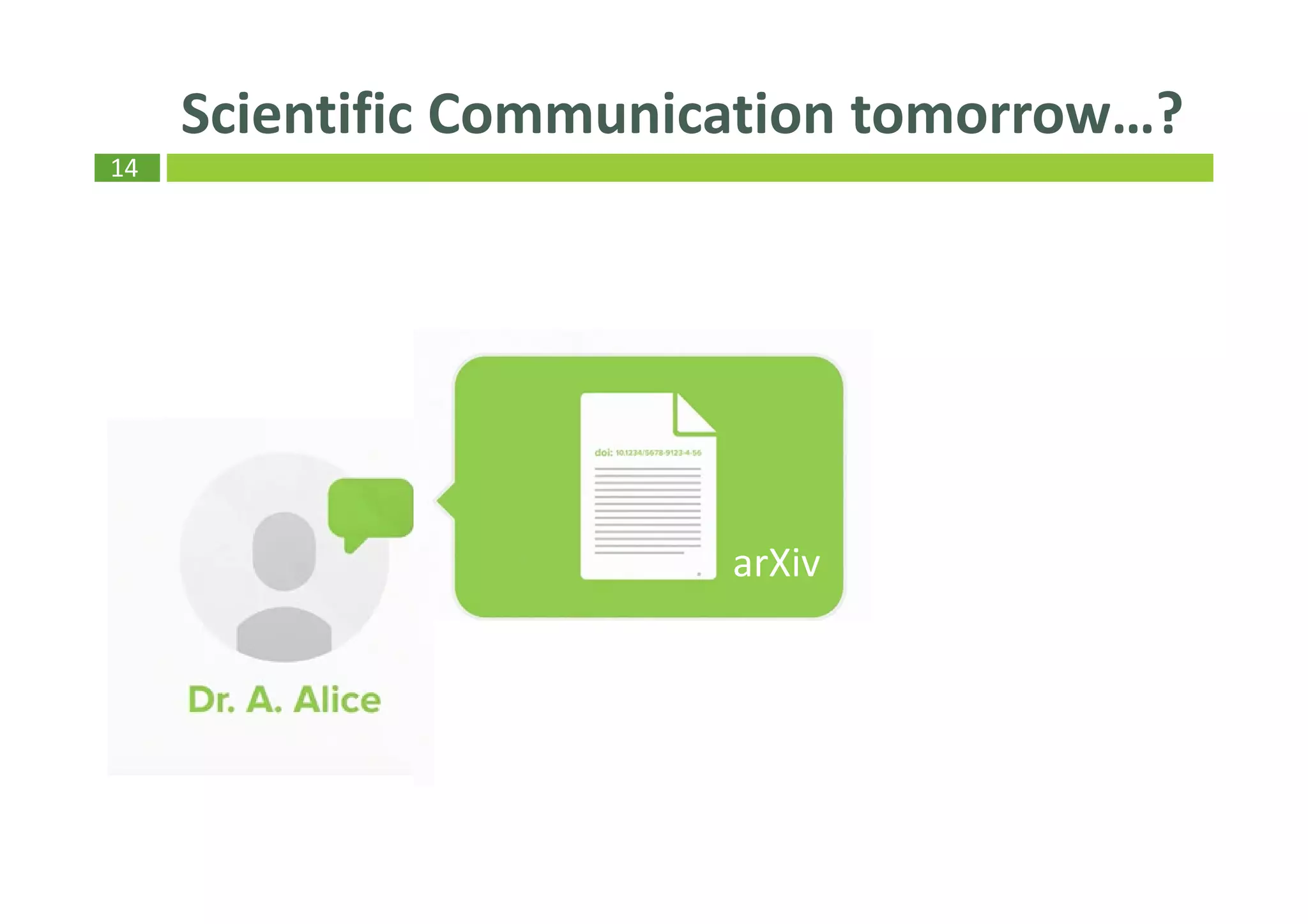
Scientific Communication tomorrow…?
arXiv
15
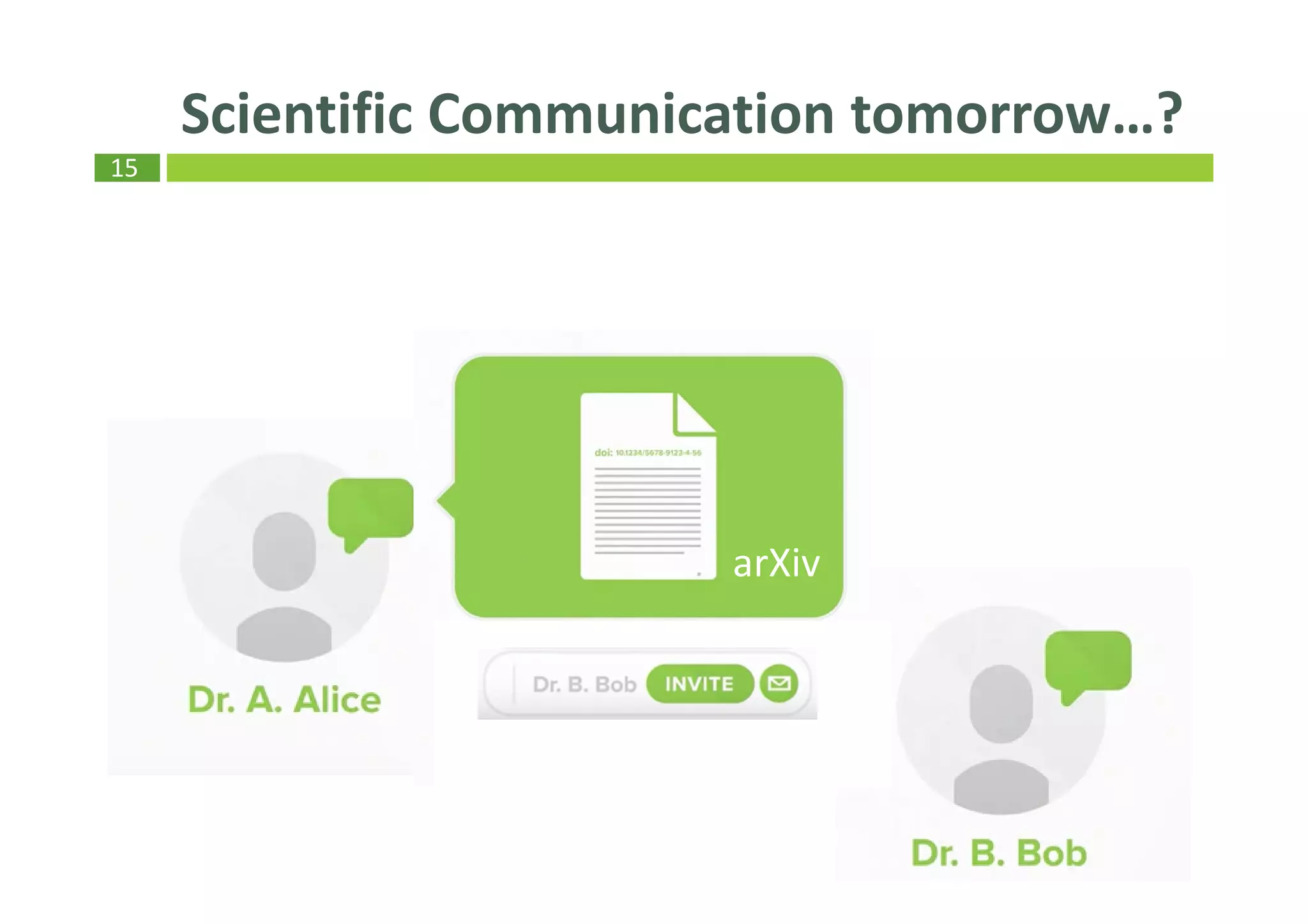
Scientific Communication tomorrow…?
arXiv
16
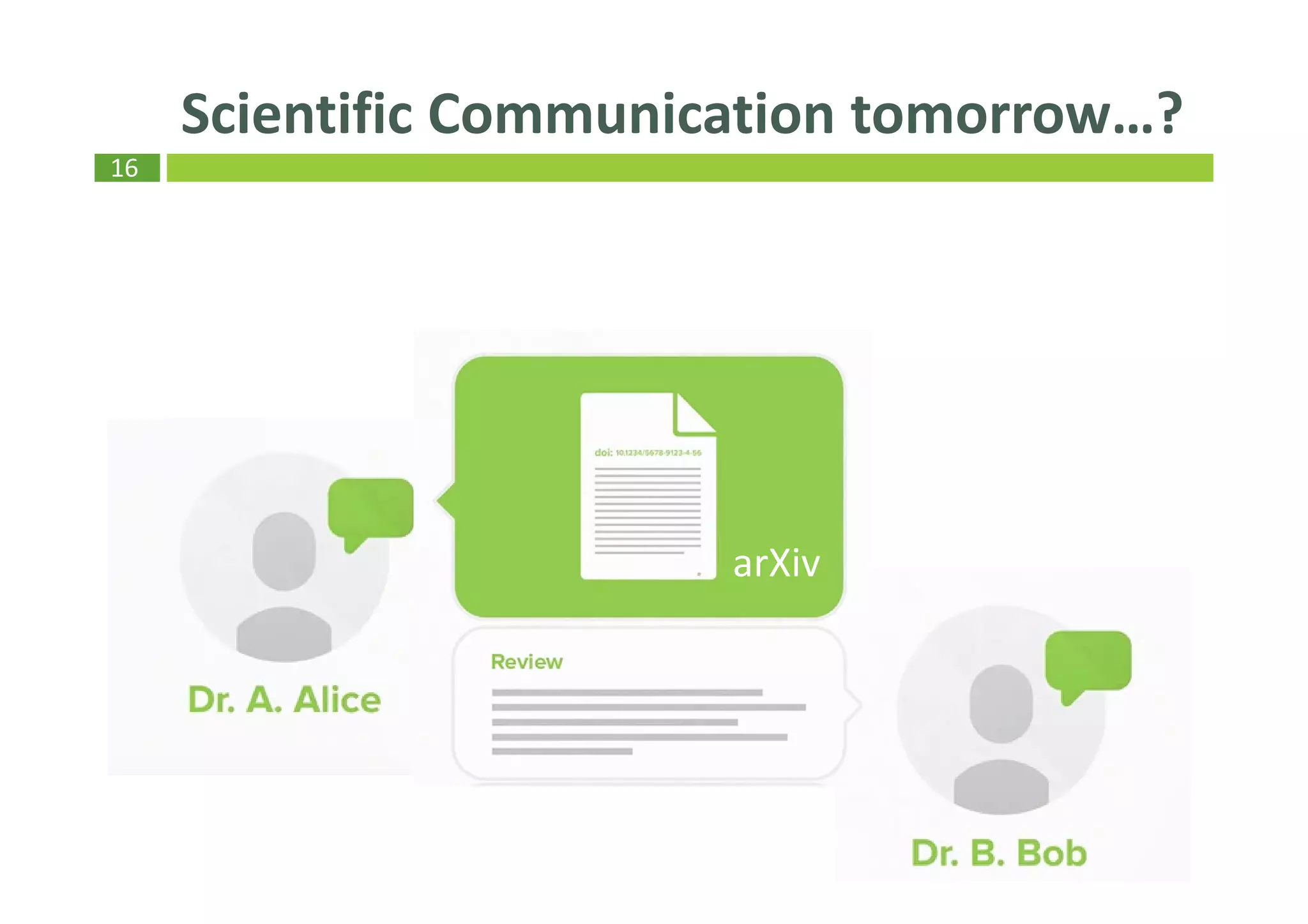
Scientific Communication tomorrow…?
arXiv
17
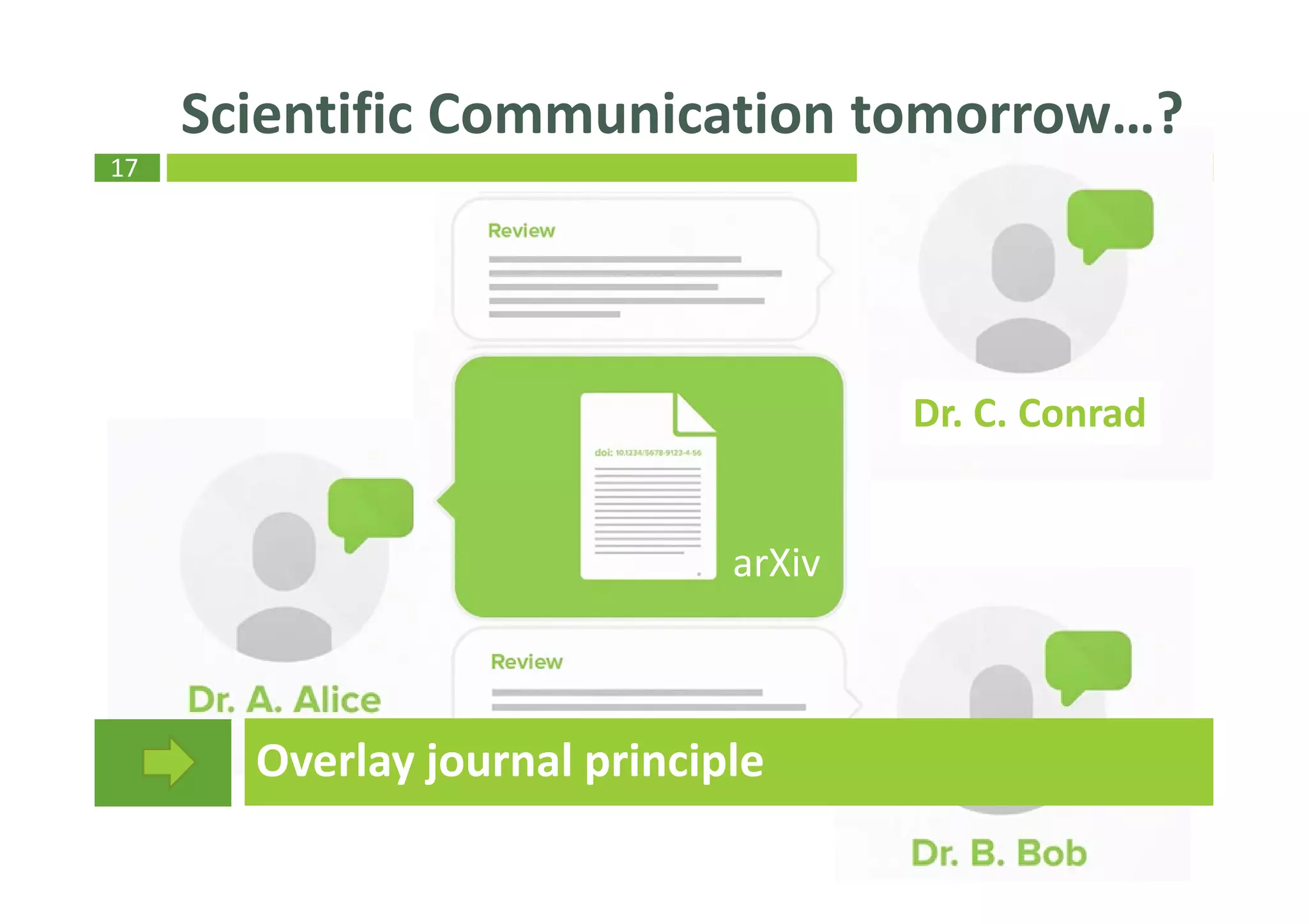
Scientific Communication tomorrow…?
arXiv
Dr. C. Conrad
Overlay journal principle
18
Concept in principal discussed by
Timothy Gowers
University of Cambridge, UK
Fields Medal 1998
Elsevier Boycott 2012 (Cost of Knowledge project)
Massively collaborative Math project Nature 461 879 (2009)
Ideas: https://gowers.wordpress.com/2011/10/31/how-might-we-get-to-a-new-
model-of-mathematical-publishing/.
Launched Discrete Analysis 2016
as an arXiv-based overlay journal
https://gowers.wordpress.com/2015/09/10/discrete-analysis-an-arxiv-overlay-journal
Overlay Journal Principle
Quality assessment: peer review
19
Concept in principal discussed by
Timothy Gowers
University of Cambridge, UK
Fields Medal 1998
Elsevier Boycott 2012 (Cost of Knowledge project)
Massively collaborative Math project Nature 461 879 (2009)
Ideas: https://gowers.wordpress.com/2011/10/31/how-might-we-get-to-a-new-
model-of-mathematical-publishing/.
Launched Discrete Analysis 2016
as an arXiv-based overlay journal
https://gowers.wordpress.com/2015/09/10/discrete-analysis-an-arxiv-overlay-journal
Overlay Journal Principle
Public post-publication peer review
20
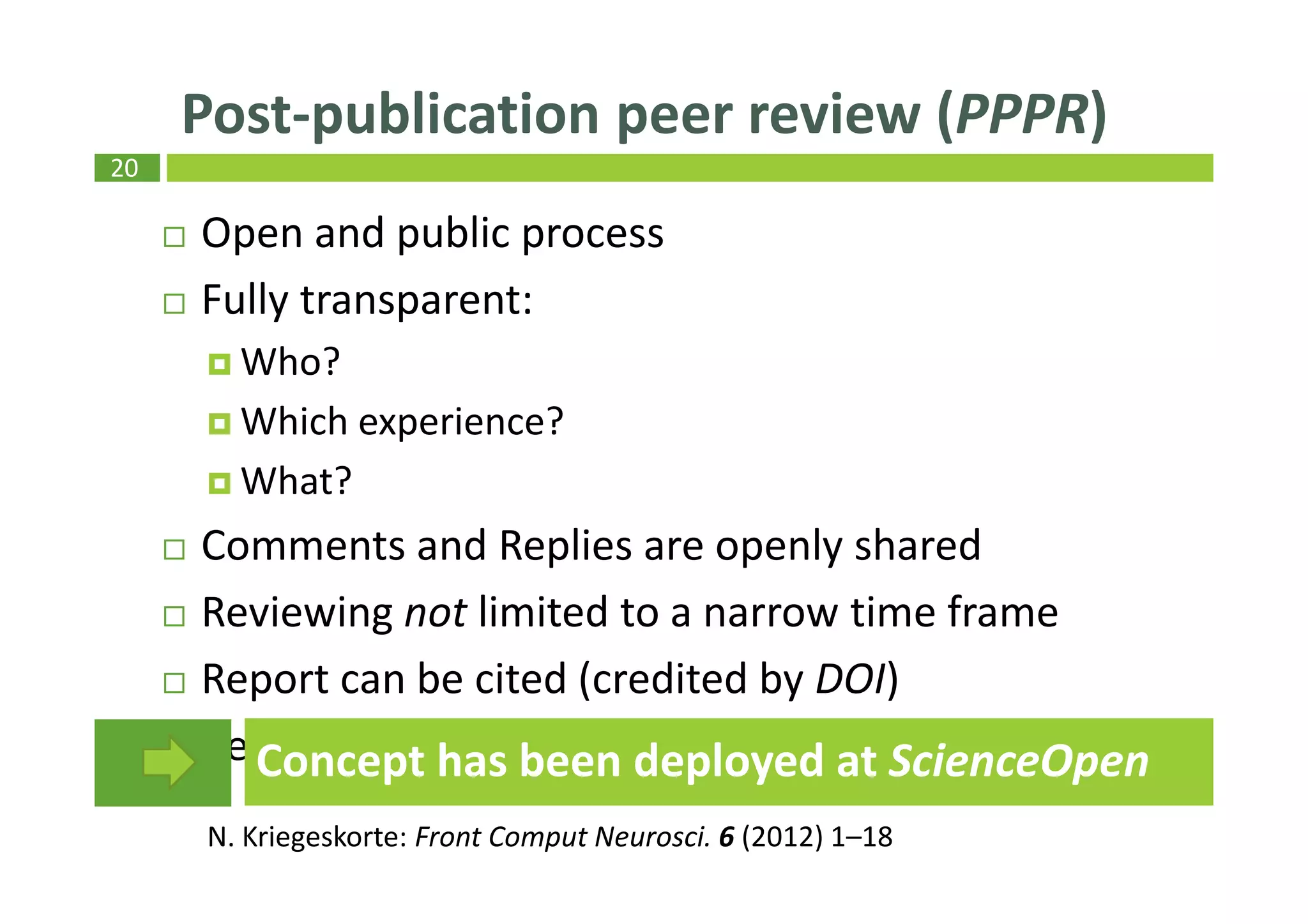
Open and public process
Fully transparent:
Who?
Which experience?
What?
Comments and Replies are openly shared
Reviewing not limited to a narrow time frame
Report can be cited (credited by DOI)
Reviewer is acknowledged
Post-publication peer review (PPPR)
N. Kriegeskorte: Front Comput Neurosci. 6 (2012) 1–18
Concept has been deployed at ScienceOpen
21
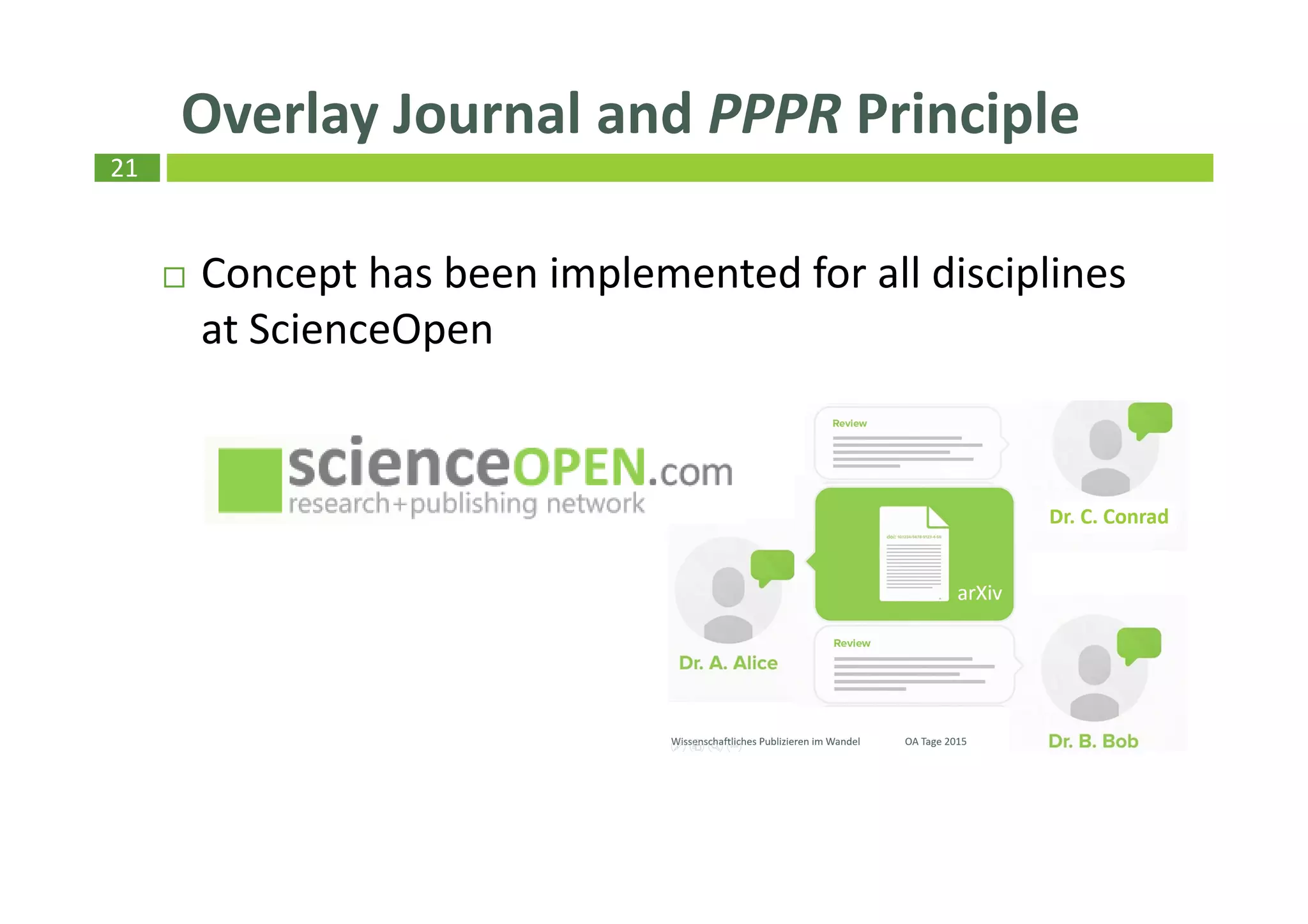
Concept has been implemented for all disciplines
at ScienceOpen
Overlay Journal and PPPR Principle
22
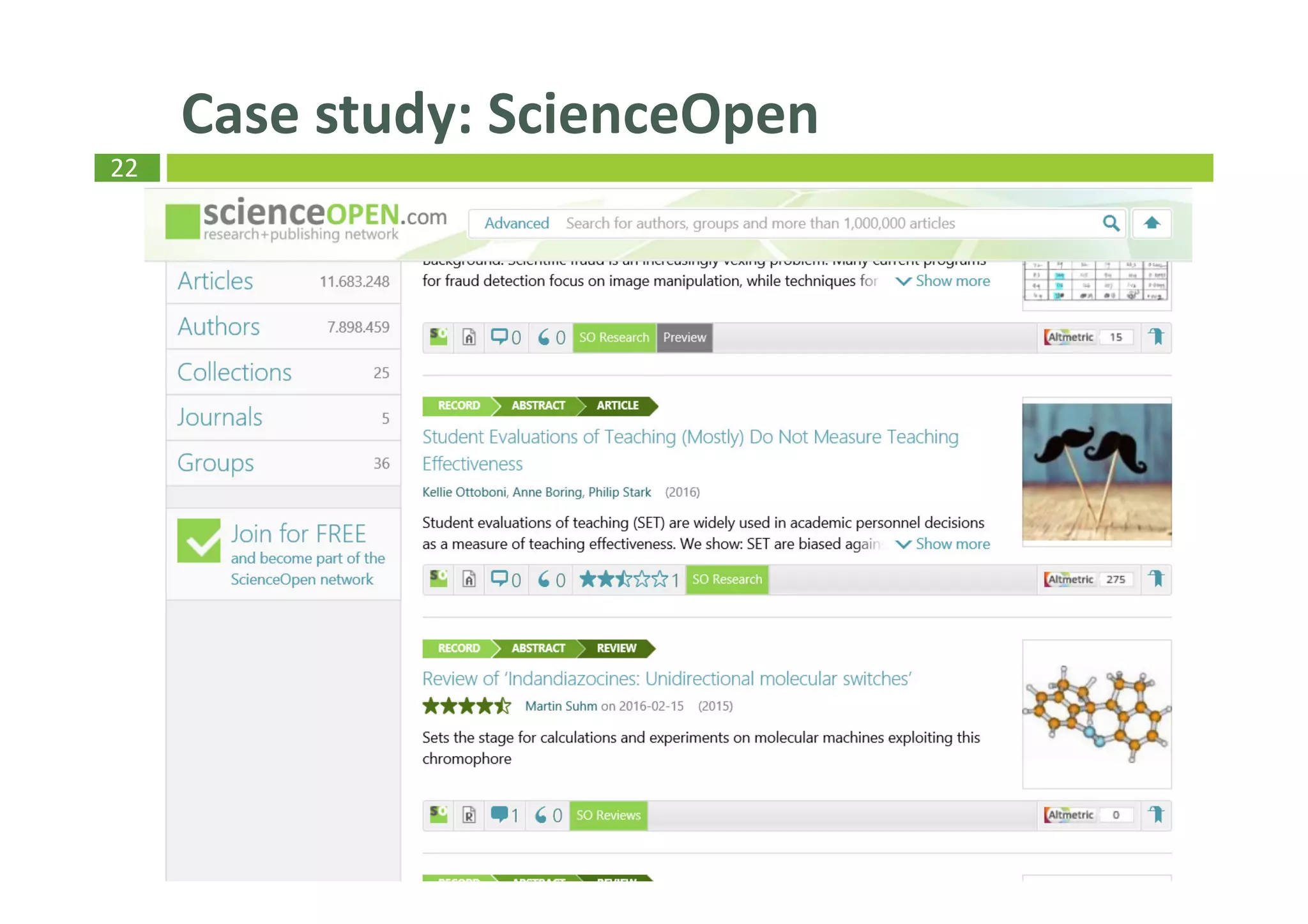
Case study: ScienceOpen
23
ScienceOpen is a next generation
Open Access indexing platform
Aggregating arXiv and journal content
Over 11 million article records yet
2m open access articles with full text
All articles are open for
public post-publication peer reviewing (PPPR)
Further information provided per article:
# social mentions (Altmetric)
# open access citations (Open Citation Index)
related articles (Discovery section)
Case study: ScienceOpen
24
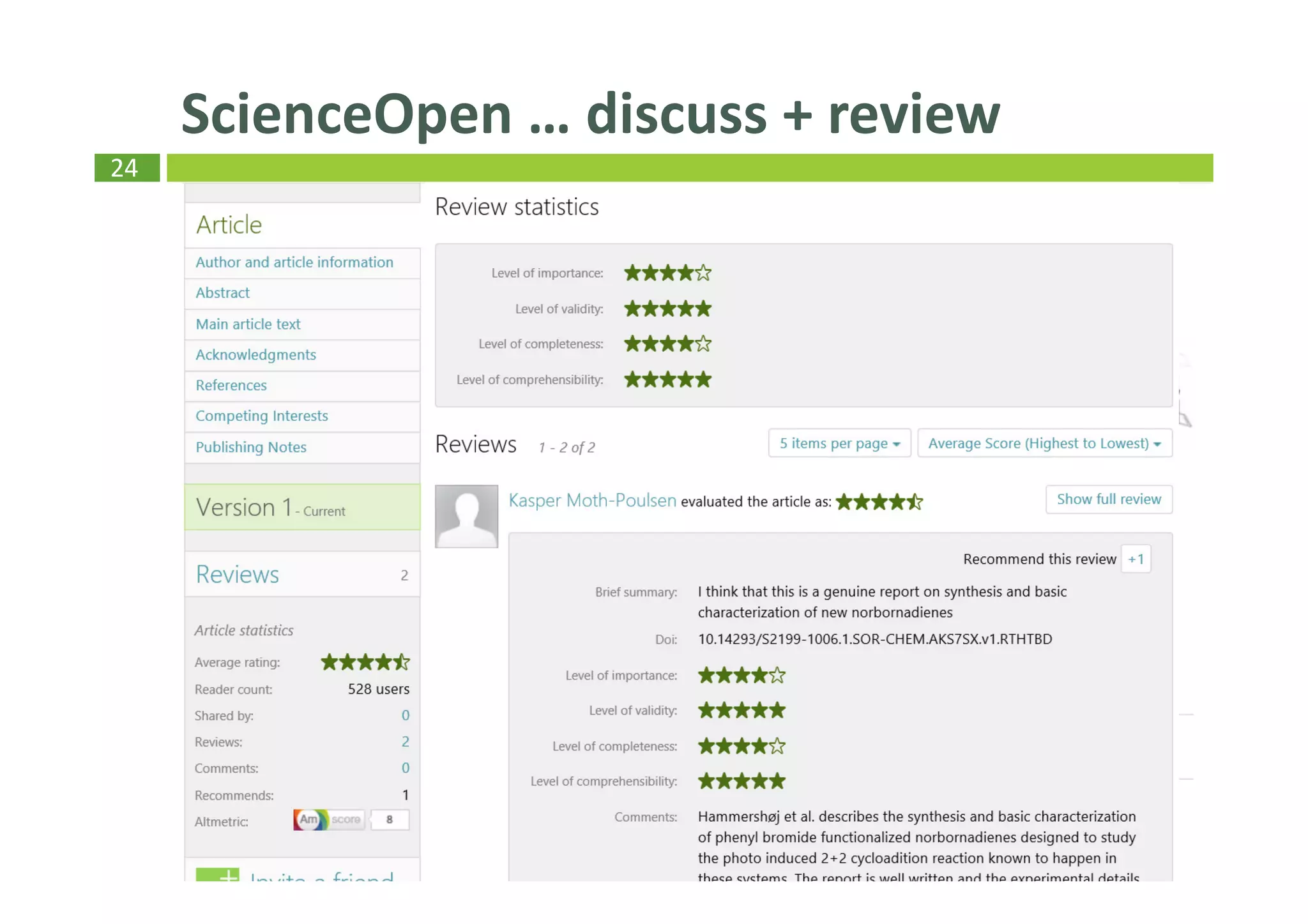
ScienceOpen … discuss + review
25
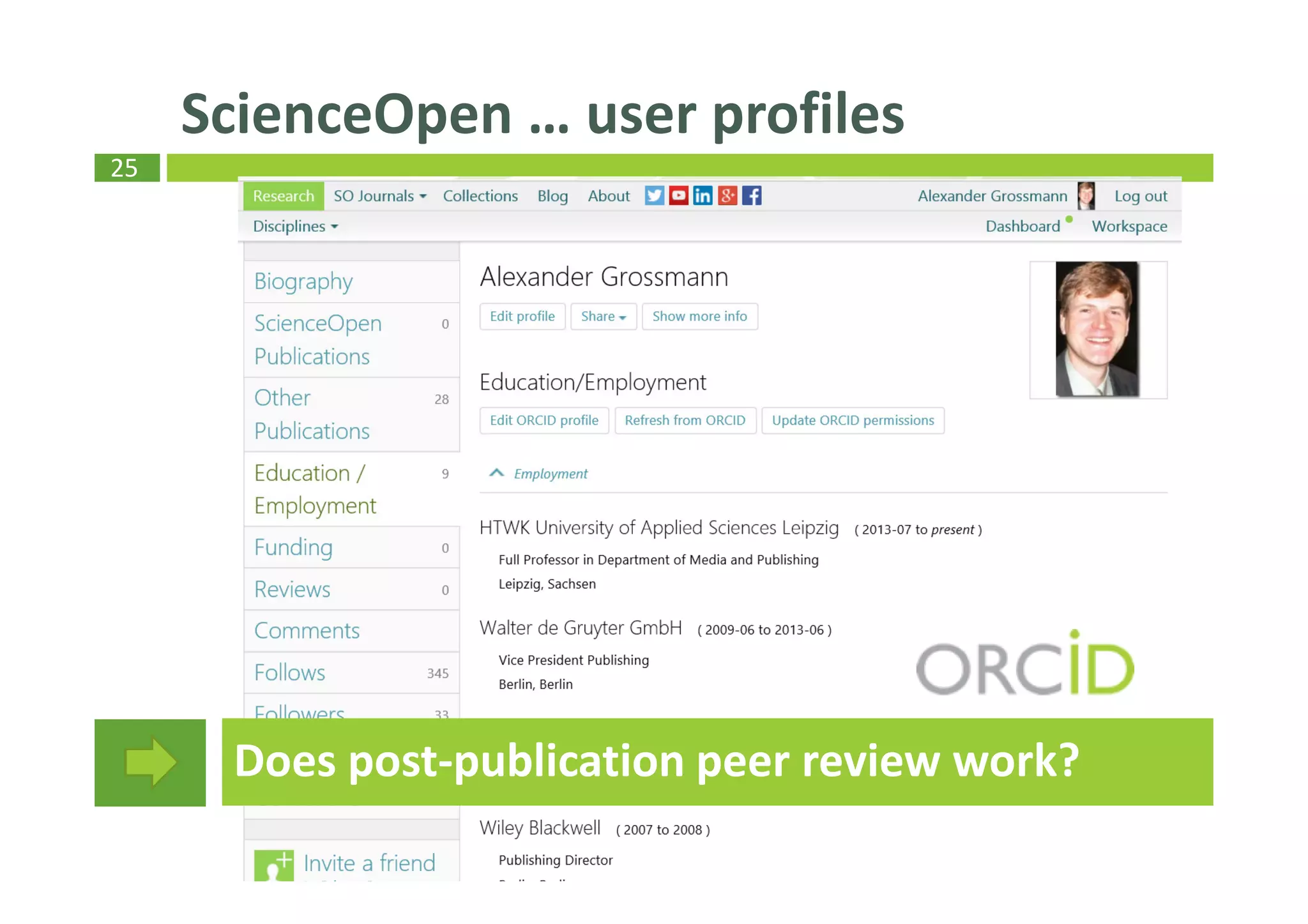
ScienceOpen … user profiles
Does post-publication peer review work?
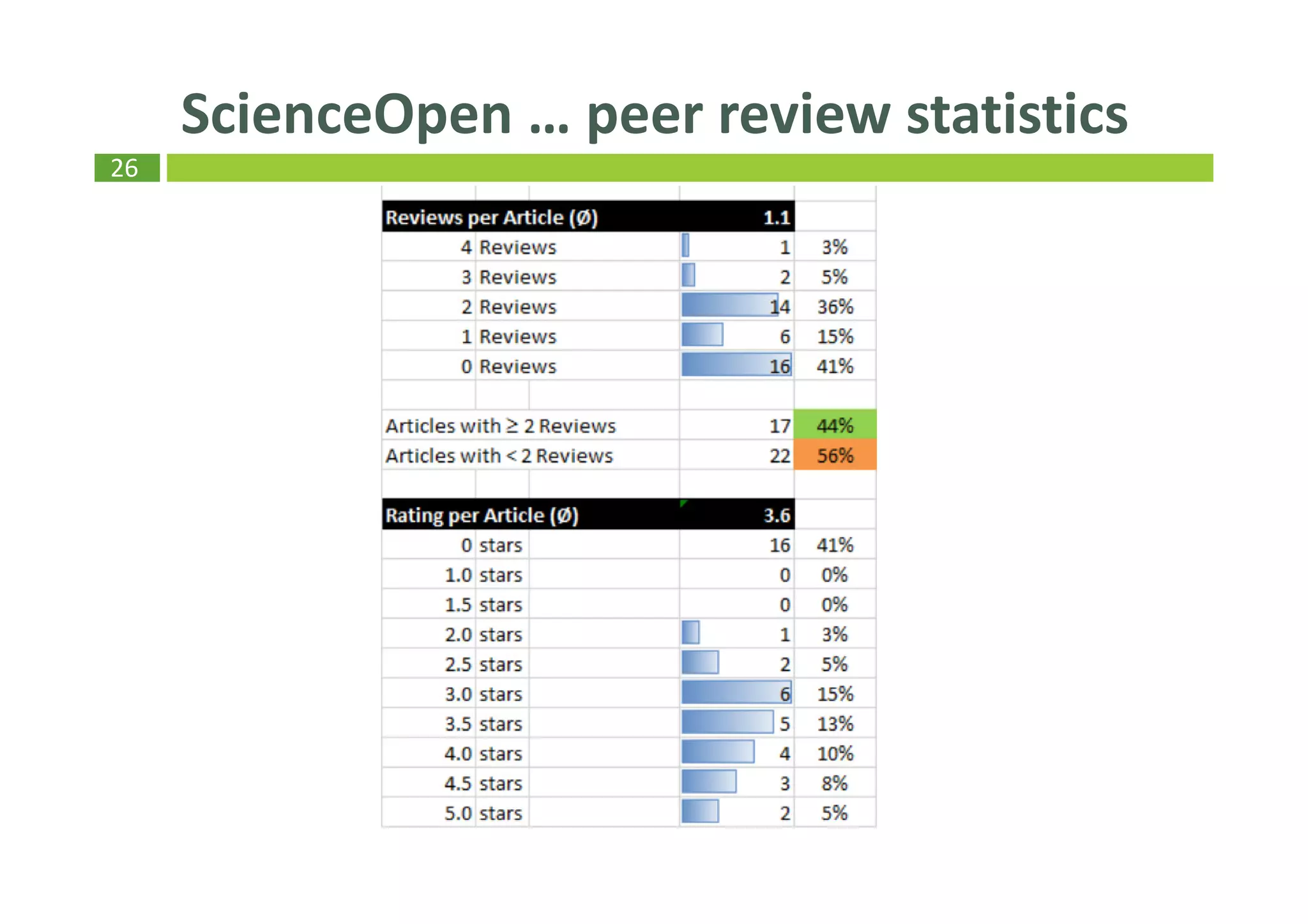
26
ScienceOpen … peer review statistics
27
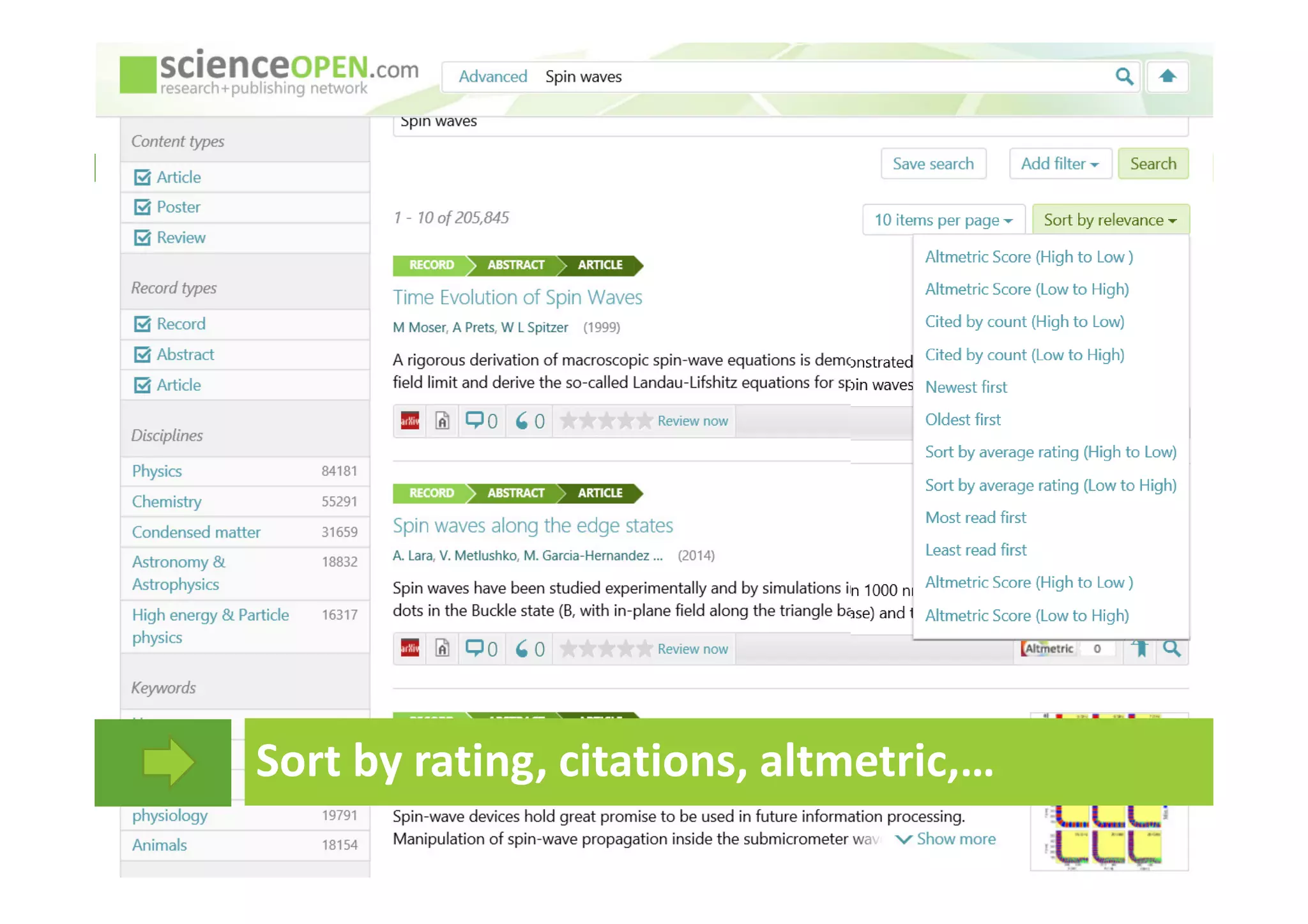
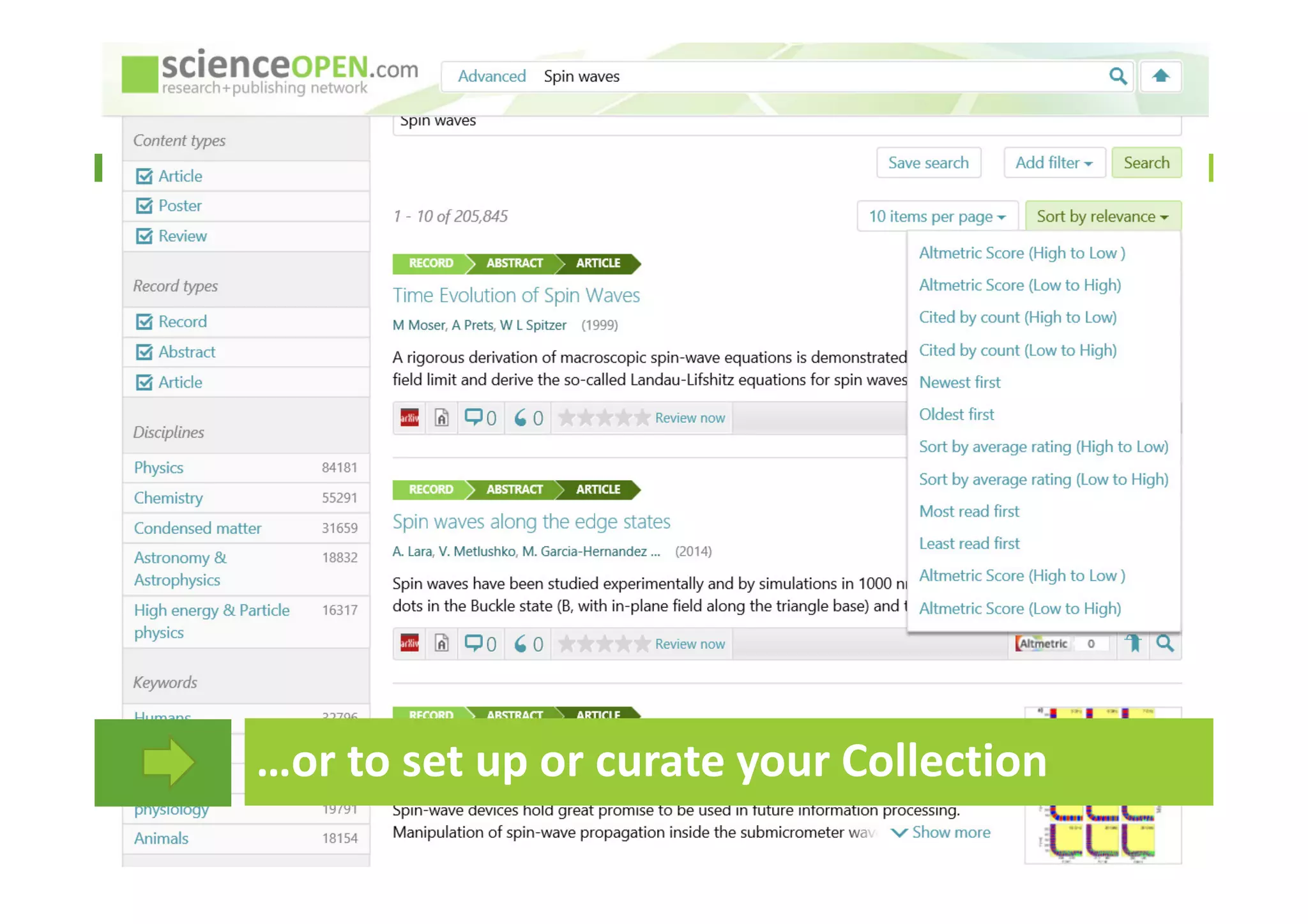
Sort by rating, citations, altmetric,…
28
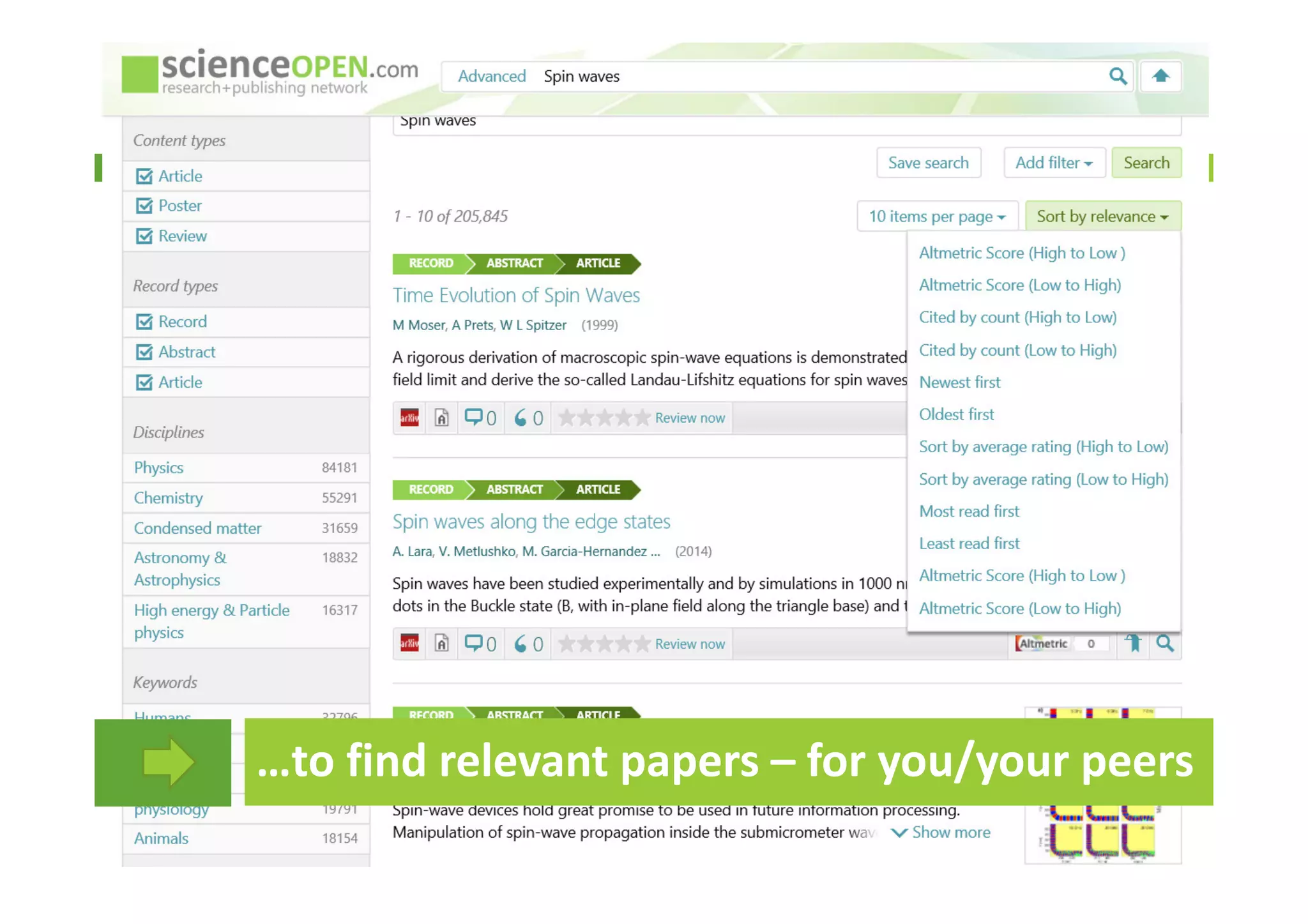
ScienceOpen … peer review statistics
…to find relevant papers – for you/your peers
29
ScienceOpen … peer review statistics
…or to set up or curate your Collection
30
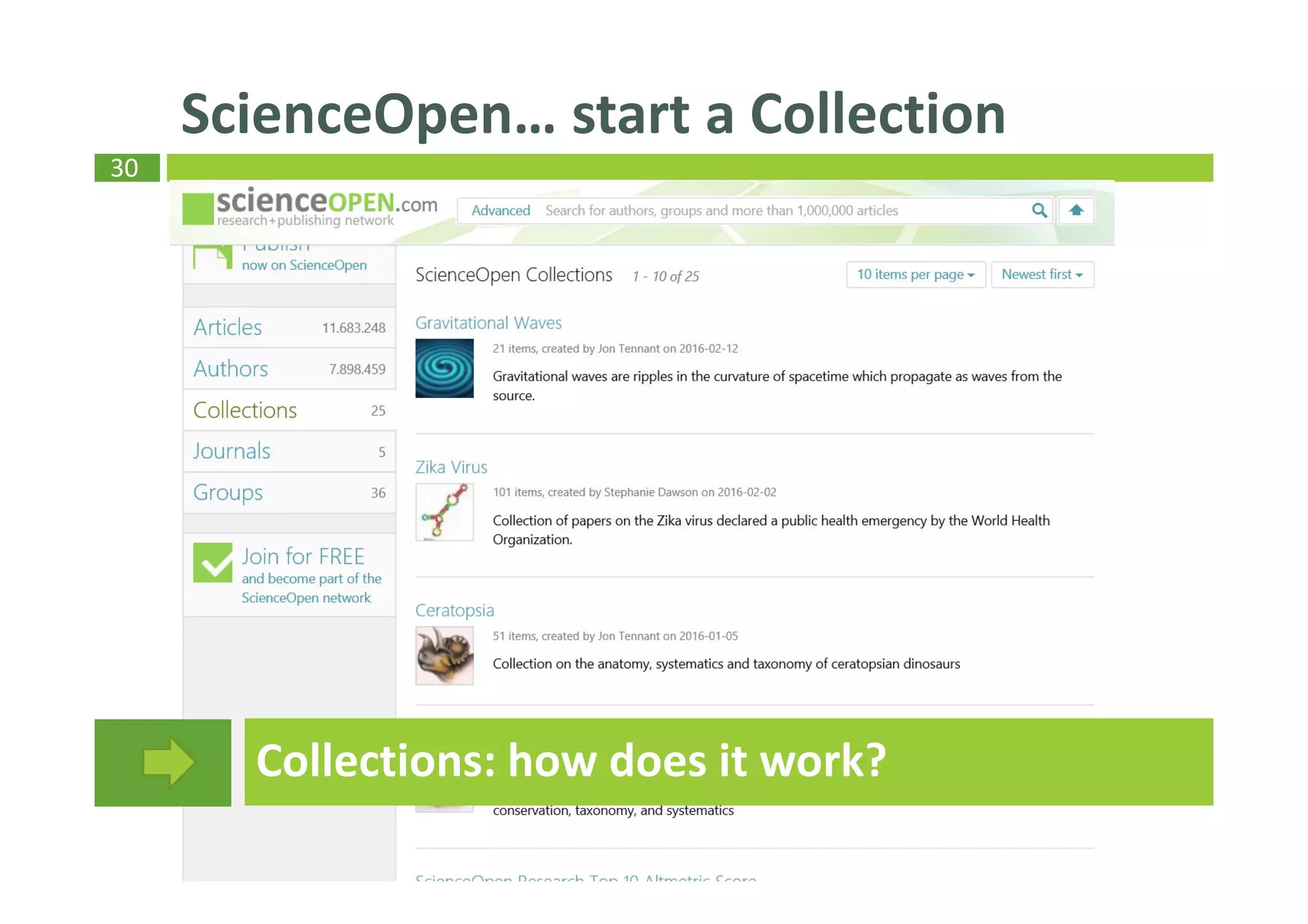
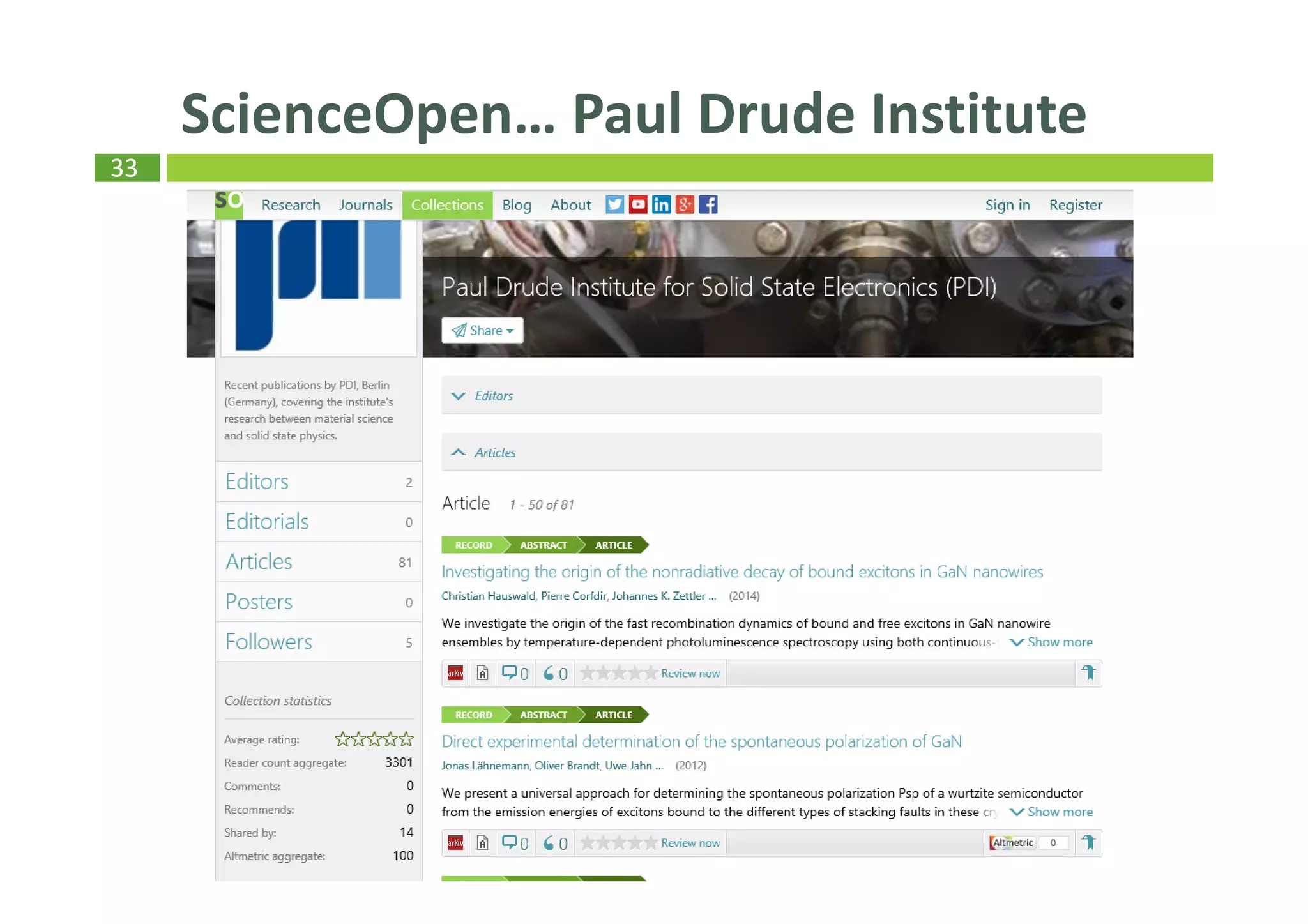
ScienceOpen… start a Collection
Collections: how does it work?
31
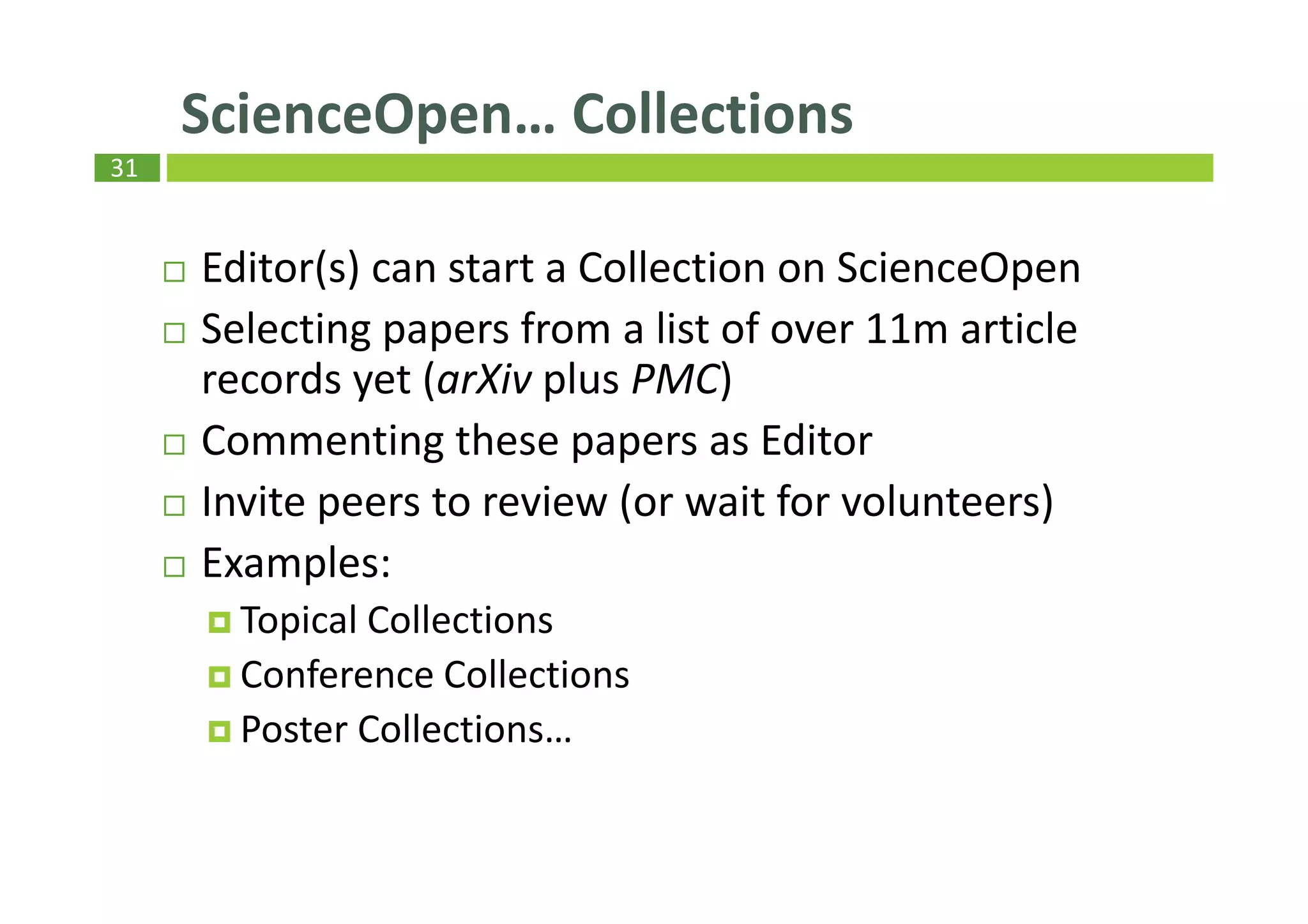
Editor(s) can start a Collection on ScienceOpen
Selecting papers from a list of over 11m article
records yet (arXiv plus PMC)
Commenting these papers as Editor
Invite peers to review (or wait for volunteers)
Examples:
Topical Collections
Conference Collections
Poster Collections…
ScienceOpen… Collections
32
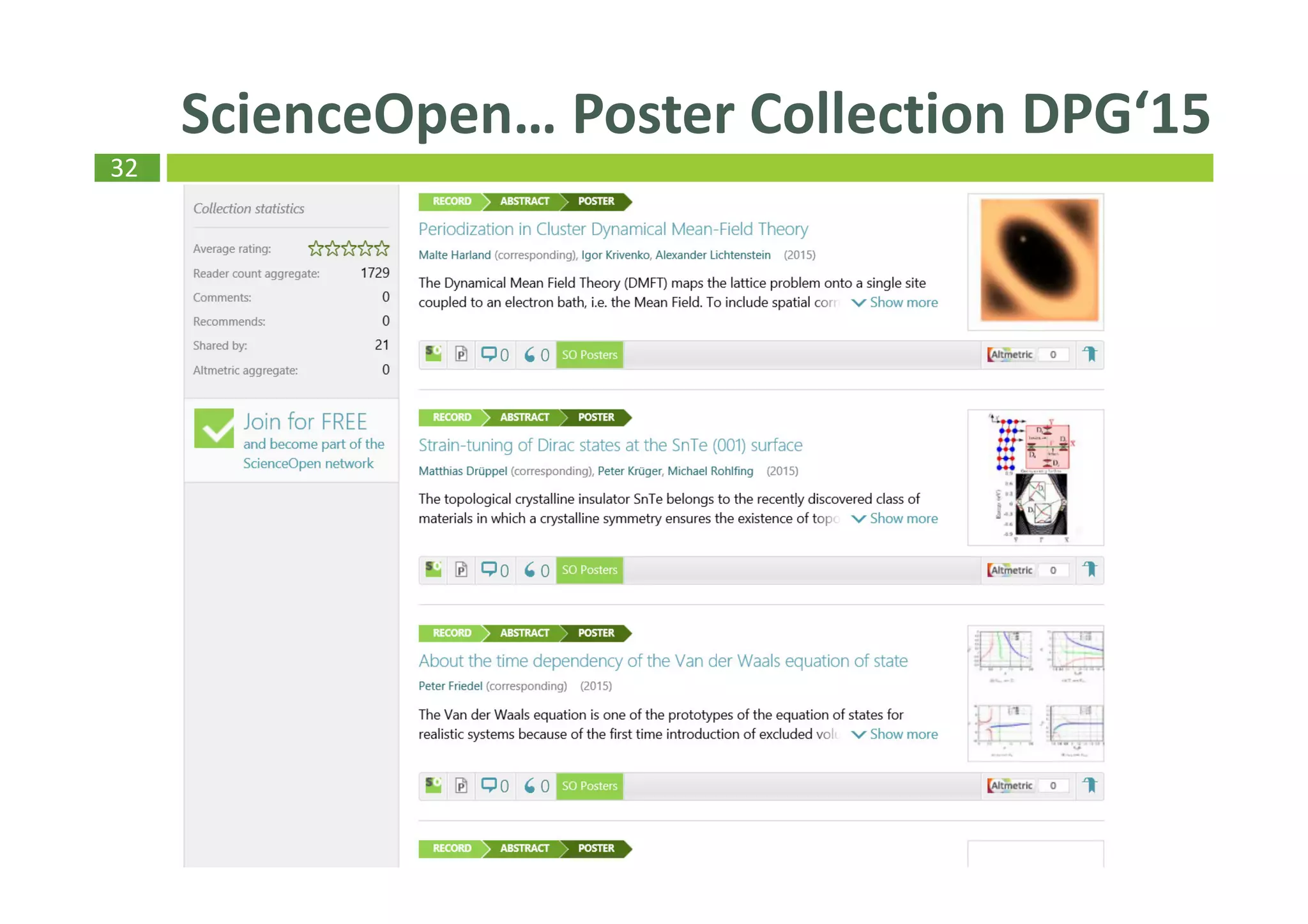
ScienceOpen… Poster Collection DPG‘15
33
ScienceOpen… Paul Drude Institute
34
Collections
CC-BY SA 3.0 Wikimedia by Acdx
35
A new way to filter content
Independent of journal or publisher
Filtering to narrow complexity of current research
outcome in different aspects: topic, institution,…
Not pre-selective but consists of those papers which are
relevant to your peers
Flexible: not limited by (publication) date
and resource (journal) but a ‚living‘ list
Incorporate existing resources as (OA) journals, pre-print
servers or repositories (non-redundancy)
Engages transparent and open quality assessment:
public post-publication peer review process (PPPR)
To replace classical journals…?
Collections: Advantages
36
A new way to filter content
Independent of journal or publisher
Filtering to narrow complexity of current research
outcome in different aspects: topic, institution,…
Not pre-selective but consists of those papers which are
relevant to your peers
Flexible: not limited by (publication) date
and resource (journal) but a ‚living‘ list
Incorporate existing resources as (OA) journals, pre-print
servers or repositories (non-redundancy)
Engages transparent and open quality assessment:
public post-publication peer review process (PPPR)
To replace classical journals…?
Collections: Advantages
Principle of future scientific communication?
37
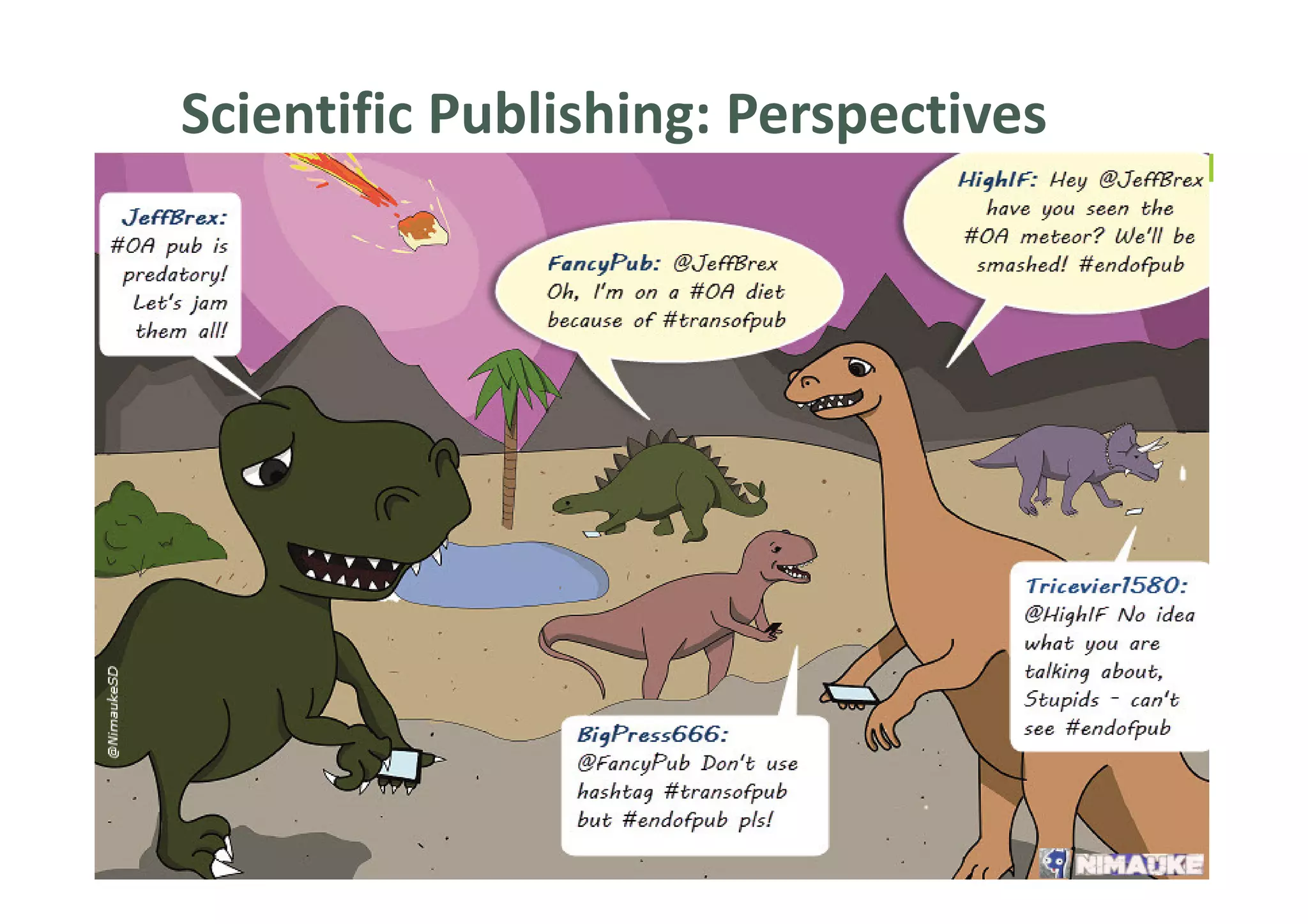
Scientific Publishing: Perspectives
38
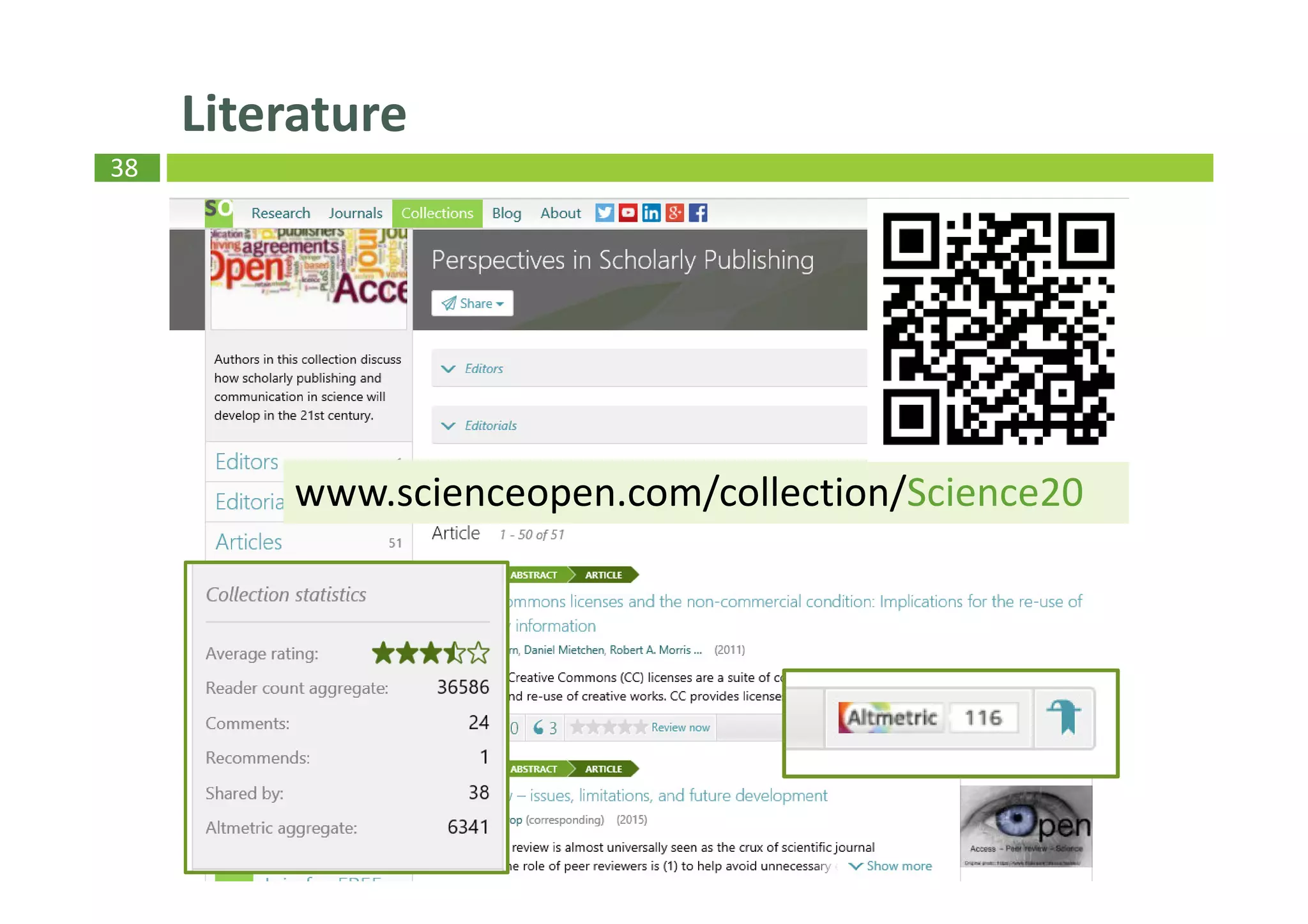
Literature
www.scienceopen.com/collection/Science20
39
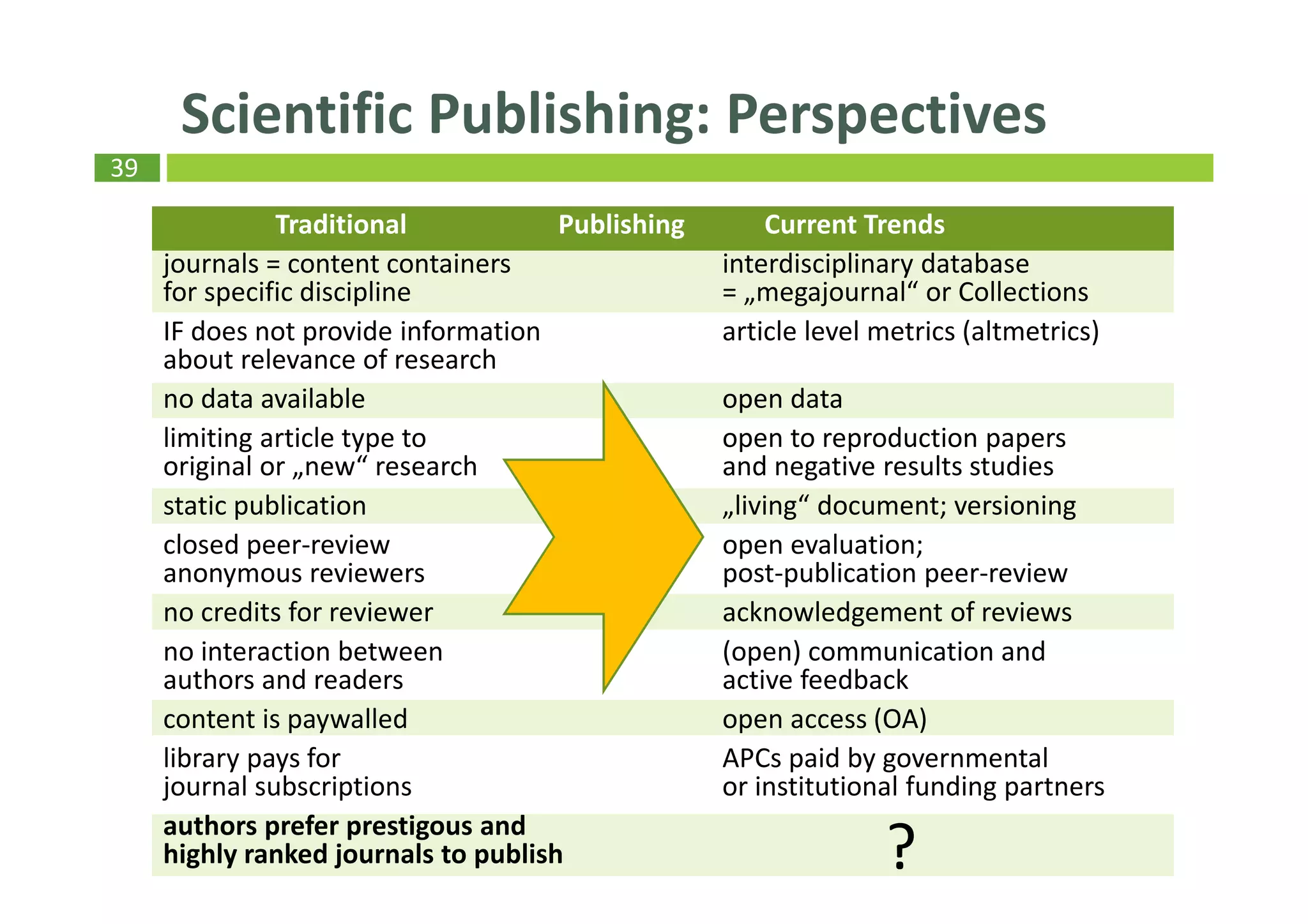
Scientific Publishing: Perspectives
Traditional Publishing Current Trends
journals = content containers interdisciplinary database
for specific discipline = „megajournal“ or Collections
IF does not provide information article level metrics (altmetrics)
about relevance of research
no data available open data
limiting article type to open to reproduction papers
original or „new“ research and negative results studies
static publication „living“ document; versioning
closed peer-review open evaluation;
anonymous reviewers post-publication peer-review
no credits for reviewer acknowledgement of reviews
no interaction between (open) communication and
authors and readers active feedback
content is paywalled open access (OA)
library pays for APCs paid by governmental
journal subscriptions or institutional funding partners
authors prefer prestigous and
highly ranked journals to publish ?
40
Thank you!
Alexander Grossmann
Prof. Dr. rer. nat.
HTWK Leipzig
University of Applied Sciences
@SciPubLab
Alexander.Grossmann@htwk-leipzig.de

Perspectives in Scientific Communication: Publishing in Transition

  • 1.
    Perspectives in ScientificCommunication: Publishing in Transition Alexander Grossmann HTWK Leipzig & ScienceOpen DPG Annual Meeting Regensburg, 7. März 2016
  • 2.
    2 Too much information? Over2m new papers per year in STM only
  • 3.
    3 Too much information? …andabout 4m submissions per year…
  • 4.
    4 Scientific Publishing: PresentStatus Problems: too much information slow publication process & high rejection rates anonymous & non-transparent reviewing process no credits for reviewers expensive subscription pricing IF-driven „glamorous journals“ (R. Schekman) …
  • 5.
    5 Scientific Publishing: PresentStatus? R. Schekman: The Guardian Dec 9 (2013) Is this the present status…?
  • 6.
    6 Scientific Publishing: PresentStatus? R. Schekman: The Guardian Dec 9 (2013) …do we need a new culture of sharing?
  • 7.
    7 New culture ofsharing… Sharing rather than ownership: the new normal for the next generation. Creative Commons CC-BY licenses supports sharing vs. ownership model of copyright. Image Credit: Bike Sharing Shanghai, John Flickr CC-BY
  • 8.
    8 New culture ofsharing… Social Networks Communities Crowd-sourcing Open Data Open Access Repositories Altmetrics Open Peer Review Science 2.0 Could we use this in science?
  • 9.
    Perspectives in ScientificPublishing DPG Regensburg 2016 CC0 Pixabay Alexander Grossmann
  • 10.
    10 Publishing in transition... 19912000 2005 2008 2010 2012 2014
  • 11.
    11 Publishing in transition... Waysto publish research today Directories (linking lists) Repositories or pre-print server OA journals (subject-based) Journal databases (‚mega journals‘) Aggregation networks How about scientific communication?
  • 12.
    12 Scientific Communication today… PeerReview Scientists = Authors = Readers = Reviewers ? ? ? ? How to set up such a novel workflow?
  • 13.
    13 Scientific Communication today… PeerReview Scientists = Authors = Readers = Reviewers ? ? ? ? Scientific communication tomorrow…?
  • 14.
  • 15.
  • 16.
  • 17.
    17 Scientific Communication tomorrow…? arXiv Dr.C. Conrad Overlay journal principle
  • 18.
    18 Concept in principaldiscussed by Timothy Gowers University of Cambridge, UK Fields Medal 1998 Elsevier Boycott 2012 (Cost of Knowledge project) Massively collaborative Math project Nature 461 879 (2009) Ideas: https://gowers.wordpress.com/2011/10/31/how-might-we-get-to-a-new- model-of-mathematical-publishing/. Launched Discrete Analysis 2016 as an arXiv-based overlay journal https://gowers.wordpress.com/2015/09/10/discrete-analysis-an-arxiv-overlay-journal Overlay Journal Principle Quality assessment: peer review
  • 19.
    19 Concept in principaldiscussed by Timothy Gowers University of Cambridge, UK Fields Medal 1998 Elsevier Boycott 2012 (Cost of Knowledge project) Massively collaborative Math project Nature 461 879 (2009) Ideas: https://gowers.wordpress.com/2011/10/31/how-might-we-get-to-a-new- model-of-mathematical-publishing/. Launched Discrete Analysis 2016 as an arXiv-based overlay journal https://gowers.wordpress.com/2015/09/10/discrete-analysis-an-arxiv-overlay-journal Overlay Journal Principle Public post-publication peer review
  • 20.
    20 Open and publicprocess Fully transparent: Who? Which experience? What? Comments and Replies are openly shared Reviewing not limited to a narrow time frame Report can be cited (credited by DOI) Reviewer is acknowledged Post-publication peer review (PPPR) N. Kriegeskorte: Front Comput Neurosci. 6 (2012) 1–18 Concept has been deployed at ScienceOpen
  • 21.
    21 Concept has beenimplemented for all disciplines at ScienceOpen Overlay Journal and PPPR Principle
  • 22.
  • 23.
    23 ScienceOpen is anext generation Open Access indexing platform Aggregating arXiv and journal content Over 11 million article records yet 2m open access articles with full text All articles are open for public post-publication peer reviewing (PPPR) Further information provided per article: # social mentions (Altmetric) # open access citations (Open Citation Index) related articles (Discovery section) Case study: ScienceOpen
  • 24.
  • 25.
    25 ScienceOpen … userprofiles Does post-publication peer review work?
  • 26.
    26 ScienceOpen … peerreview statistics
  • 27.
    27 Sort by rating,citations, altmetric,…
  • 28.
    28 ScienceOpen … peerreview statistics …to find relevant papers – for you/your peers
  • 29.
    29 ScienceOpen … peerreview statistics …or to set up or curate your Collection
  • 30.
    30 ScienceOpen… start aCollection Collections: how does it work?
  • 31.
    31 Editor(s) can starta Collection on ScienceOpen Selecting papers from a list of over 11m article records yet (arXiv plus PMC) Commenting these papers as Editor Invite peers to review (or wait for volunteers) Examples: Topical Collections Conference Collections Poster Collections… ScienceOpen… Collections
  • 32.
  • 33.
  • 34.
    34 Collections CC-BY SA 3.0Wikimedia by Acdx
  • 35.
    35 A new wayto filter content Independent of journal or publisher Filtering to narrow complexity of current research outcome in different aspects: topic, institution,… Not pre-selective but consists of those papers which are relevant to your peers Flexible: not limited by (publication) date and resource (journal) but a ‚living‘ list Incorporate existing resources as (OA) journals, pre-print servers or repositories (non-redundancy) Engages transparent and open quality assessment: public post-publication peer review process (PPPR) To replace classical journals…? Collections: Advantages
  • 36.
    36 A new wayto filter content Independent of journal or publisher Filtering to narrow complexity of current research outcome in different aspects: topic, institution,… Not pre-selective but consists of those papers which are relevant to your peers Flexible: not limited by (publication) date and resource (journal) but a ‚living‘ list Incorporate existing resources as (OA) journals, pre-print servers or repositories (non-redundancy) Engages transparent and open quality assessment: public post-publication peer review process (PPPR) To replace classical journals…? Collections: Advantages Principle of future scientific communication?
  • 37.
  • 38.
  • 39.
    39 Scientific Publishing: Perspectives TraditionalPublishing Current Trends journals = content containers interdisciplinary database for specific discipline = „megajournal“ or Collections IF does not provide information article level metrics (altmetrics) about relevance of research no data available open data limiting article type to open to reproduction papers original or „new“ research and negative results studies static publication „living“ document; versioning closed peer-review open evaluation; anonymous reviewers post-publication peer-review no credits for reviewer acknowledgement of reviews no interaction between (open) communication and authors and readers active feedback content is paywalled open access (OA) library pays for APCs paid by governmental journal subscriptions or institutional funding partners authors prefer prestigous and highly ranked journals to publish ?
  • 40.
    40 Thank you! Alexander Grossmann Prof.Dr. rer. nat. HTWK Leipzig University of Applied Sciences @SciPubLab Alexander.Grossmann@htwk-leipzig.de