
The Big Picture: Open Access content
aggregators as drivers of impact
ReCon Conference
Edinburgh, 19 June 2015
Image Courtesy SRTM Team
NASA/JPL/NIMA
2
Information overload
Yearly ca. 1.8 million articles published in
around 28,000 scholarly journals.
And more on the way…
 Digitalization – new outlets
 Economic logic of Open Access
 Publication of negative results, all
clinical trials, data sets, micro-
publications
 China, India, Brazil and others entering
the research community
Image credit: Tom Magliery_CC-BY NC SA Flickr
3
Discovery
How do researchers find
relevant articles?
 Search engines (Google)
 Indexing services (pubMed, Scopus,
Web of Science, SciELO)
 Networking (Social media,
conferences)
 Topical bundling (journals, collections)
Image credit: Ina Müller-Schmoß_CC-BY-NC-SA_Flickr
4
Ranking knowledge
 Orientation
 Context
 Inspiration
 Time-saving
But also..
 Reputation
 Career
Image Credit: Kai Morgener, Flickr, CC-BY-NC-SA
5
Journal-based tools: Impact Factor
“Impact Factor—
Negotiated,
Irreproducible, and
Unsound”
Brembs, Button, Munafò
Front. Hum. Neurosci., 24 June 2013
http://dx.doi.org/10.3389/fnhum.2013.00291
6
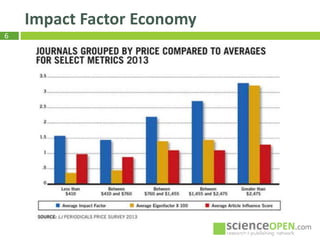
Impact Factor Economy
7
Article-based tools
Image credit: Olivier Delaye Fotolia
 Usage statistics
 Social media mentions
 Mentions in news media, blogs,
podcasts
 Citations in scientific literature
 Open Peer Review reports
 Comments
 Inclusion in citation management
tools (Mendeley, CiteuLike)
8
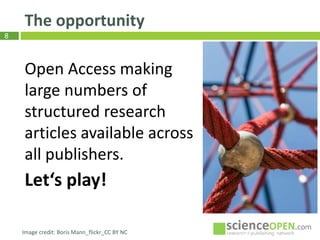
The opportunity
Image credit: Boris Mann_flickr_CC BY NC
Open Access making
large numbers of
structured research
articles available across
all publishers.
Let‘s play!
9
Case Study: ScienceOpen
10
What is ScienceOpen?
 ScienceOpen is a next generation Open Access
communication platform.
 1.5 million aggregated Open Access articles open to Post-
Pub Peer Review and Collection building.
 Suite of social-networking and collaboration tools.
 ScienceOpen as publisher offers immediate publication
after editorial check with a transparent, network-based
peer-review afterward.
11
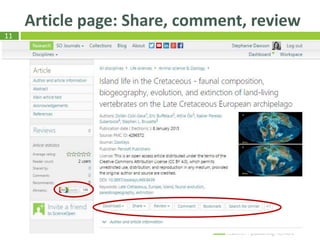
Article page: Share, comment, review
12
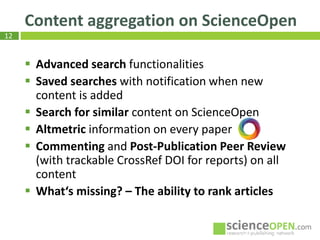
Content aggregation on ScienceOpen
Th
 Advanced search functionalities
 Saved searches with notification when new
content is added
 Search for similar content on ScienceOpen
 Altmetric information on every paper
 Commenting and Post-Publication Peer Review
(with trackable CrossRef DOI for reports) on all
content
 What‘s missing? – The ability to rank articles
13
Coming soon…
Th
Image credit: Spottiswoode & Stevens_2011 Proceedings of the Royal
Society B
 Citation information within the
ScienceOpen platform
 Reference “stubs“ for content not on
the platform (ca. 10 million to start)
 Author profiles
 Content ranking
 Recommendation function from a
range of parameters
14
Future of scholarly communication
What aspects of scholarly journals are
most important to users?
 Topic-specific bundling
 Editorial selection
 Quality assurance
 Trust and reliability
ScienceOpen Collections provide
these functions beyond individual
publishers or journals.
15
ScienceOpen Collections
16
Researcher-driven collections
17
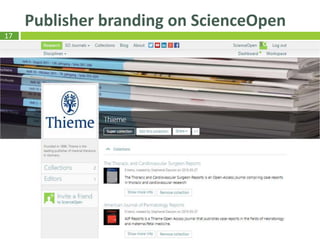
Publisher branding on ScienceOpen
18
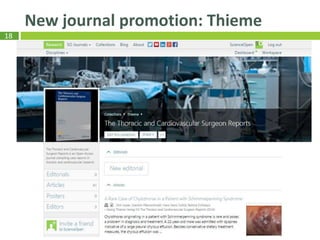
New journal promotion: Thieme
19
Best of OA promotion: IUCr
20
In summary…
 Beyond the Impact Factor:
we need new ways to rate
and rank content across
publishers
 New tools for content
owners (publishers,
societies, authors) to
promote their work
 Aggregators leading the
way
Image credit: Kay Gaensler, Flickr, CC-BY-NC-SA
21
Thank you!
Stephanie Dawson, PhD
ScienceOpen GmbH
Pappelallee 78/79
10437 Berlin, Germany
Skype: dawson_scienceopen
Twitter: @SDawsonBerlin
Mobile: +49-176-72614581
Tel: +49-30-6098490-277
Stephanie.Dawson@ScienceOpen.com
22
Looking forward to your visit!
youtube.com/user/ScienceOpen
facebook.com/pages/scienceopencom/151202981751490
twitter.com/Science_Open

ScienceOpen "The Big Picture: Open Access content aggregators as drivers of impact" ReCon2015 Edinburgh

  • 1.
    The Big Picture:Open Access content aggregators as drivers of impact ReCon Conference Edinburgh, 19 June 2015 Image Courtesy SRTM Team NASA/JPL/NIMA
  • 2.
    2 Information overload Yearly ca.1.8 million articles published in around 28,000 scholarly journals. And more on the way…  Digitalization – new outlets  Economic logic of Open Access  Publication of negative results, all clinical trials, data sets, micro- publications  China, India, Brazil and others entering the research community Image credit: Tom Magliery_CC-BY NC SA Flickr
  • 3.
    3 Discovery How do researchersfind relevant articles?  Search engines (Google)  Indexing services (pubMed, Scopus, Web of Science, SciELO)  Networking (Social media, conferences)  Topical bundling (journals, collections) Image credit: Ina Müller-Schmoß_CC-BY-NC-SA_Flickr
  • 4.
    4 Ranking knowledge  Orientation Context  Inspiration  Time-saving But also..  Reputation  Career Image Credit: Kai Morgener, Flickr, CC-BY-NC-SA
  • 5.
    5 Journal-based tools: ImpactFactor “Impact Factor— Negotiated, Irreproducible, and Unsound” Brembs, Button, Munafò Front. Hum. Neurosci., 24 June 2013 http://dx.doi.org/10.3389/fnhum.2013.00291
  • 6.
  • 7.
    7 Article-based tools Image credit:Olivier Delaye Fotolia  Usage statistics  Social media mentions  Mentions in news media, blogs, podcasts  Citations in scientific literature  Open Peer Review reports  Comments  Inclusion in citation management tools (Mendeley, CiteuLike)
  • 8.
    8 The opportunity Image credit:Boris Mann_flickr_CC BY NC Open Access making large numbers of structured research articles available across all publishers. Let‘s play!
  • 9.
  • 10.
    10 What is ScienceOpen? ScienceOpen is a next generation Open Access communication platform.  1.5 million aggregated Open Access articles open to Post- Pub Peer Review and Collection building.  Suite of social-networking and collaboration tools.  ScienceOpen as publisher offers immediate publication after editorial check with a transparent, network-based peer-review afterward.
  • 11.
    11 Article page: Share,comment, review
  • 12.
    12 Content aggregation onScienceOpen Th  Advanced search functionalities  Saved searches with notification when new content is added  Search for similar content on ScienceOpen  Altmetric information on every paper  Commenting and Post-Publication Peer Review (with trackable CrossRef DOI for reports) on all content  What‘s missing? – The ability to rank articles
  • 13.
    13 Coming soon… Th Image credit:Spottiswoode & Stevens_2011 Proceedings of the Royal Society B  Citation information within the ScienceOpen platform  Reference “stubs“ for content not on the platform (ca. 10 million to start)  Author profiles  Content ranking  Recommendation function from a range of parameters
  • 14.
    14 Future of scholarlycommunication What aspects of scholarly journals are most important to users?  Topic-specific bundling  Editorial selection  Quality assurance  Trust and reliability ScienceOpen Collections provide these functions beyond individual publishers or journals.
  • 15.
  • 16.
  • 17.
  • 18.
  • 19.
    19 Best of OApromotion: IUCr
  • 20.
    20 In summary…  Beyondthe Impact Factor: we need new ways to rate and rank content across publishers  New tools for content owners (publishers, societies, authors) to promote their work  Aggregators leading the way Image credit: Kay Gaensler, Flickr, CC-BY-NC-SA
  • 21.
    21 Thank you! Stephanie Dawson,PhD ScienceOpen GmbH Pappelallee 78/79 10437 Berlin, Germany Skype: dawson_scienceopen Twitter: @SDawsonBerlin Mobile: +49-176-72614581 Tel: +49-30-6098490-277 Stephanie.Dawson@ScienceOpen.com
  • 22.
    22 Looking forward toyour visit! youtube.com/user/ScienceOpen facebook.com/pages/scienceopencom/151202981751490 twitter.com/Science_Open