forward 2012
   (BACK IN BLACK)


        Sheridan Hadley,
       Genevieve Hurtado,
         Jordan Elmore,
     Carter Johnston,
         Andrew Schultz,
           Mely Meyer,
          Kristina Kroon
PRIMARY: THE 
    SOCIOLOGICAL MODEL

WHAT IS THE SOCIOLOGICAL MODEL?
Basically, the sociological model of voting takes a look at how people vote based off of what is influencing them
to vote. In order to see what is influencing someone you need to take a loot at social class, religious background,
ethnicity, race, family loyalties, gender (gender affiliation) and on the job relationships. This is what makes up a
person’s political socialization.


WHAT DOES IT HAVE TO DO WITH THE ELECTION?
First of all the sociological model of voting really is taking place in every election, because most often people are
going to vote based off of their political socialization and not just follow their respective party like sheep. In this
election, many people are listening to the candidates and the questions they are asking are “How will this affect
me?” and “What will each candidate to for me?” Because of this, I would certainly say the sociological model is
taking the role as the primary model of voting in this election.
SECONDARY: THE 
                ECONOMIC MODEL
                                      The economic model focuses on:
 The theory of people voting for their own self-interest. People tend to Vote on economic past, present, and
                                                    future.
           Macroeconomics focus on the country as a whole and the decisions of the government
                   Microeconomics focus on individuals, and the decisions of businesses

                  Are we better than we were in 2008?
                      Yes, why? More growth in our economy and unemployment rate

          * GDP (gross domestic product) in 2008 was at 1.4% and currently it is at 2% in growth
                        * Inflation in 2007 was at 4.3% and is currently at 1.7%
  * Gas prices are $0.25 cents higher than last year and last month gas prices have gone down $0.11 cents.
* Voters are taking all this information into account and vote according to how the president has handled this
                                                   issues.
THE RESULTS
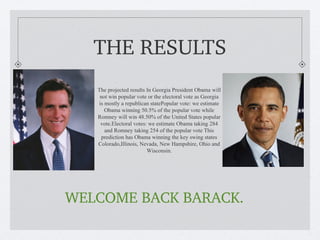
   The projected results In Georgia President Obama will
    not win popular vote or the electoral vote as Georgia
   is mostly a republican statePopular vote: we estimate
      Obama winning 50.5% of the popular vote while
   Romney will win 48.50% of the United States popular
    vote.Electoral votes: we estimate Obama taking 284
      and Romney taking 254 of the popular vote This
     prediction has Obama winning the key swing states
   Colorado,Illinois, Nevada, New Hampshire, Ohio and
                         Wisconsin.


WELCOME BACK BARACK.
50%


      SO, WHAT’S GOING ON IN 
       HOME SWEET HOME?
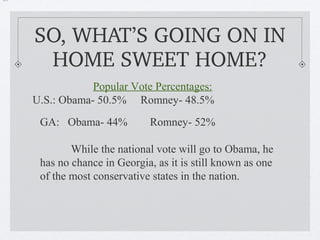
                  Popular Vote Percentages:
      U.S.: Obama- 50.5% Romney- 48.5%
       GA: Obama- 44%          Romney- 52%

              While the national vote will go to Obama, he
       has no chance in Georgia, as it is still known as one
       of the most conservative states in the nation.
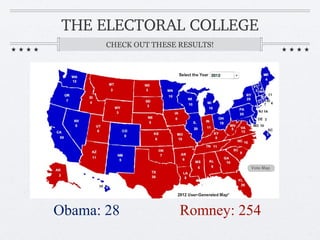
THE ELECTORAL COLLEGE
       CHECK OUT THESE RESULTS!


Obama: 28              Romney: 254
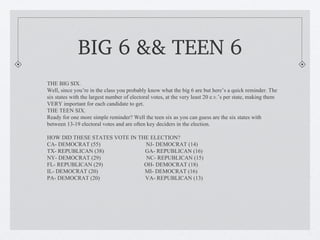
BIG 6 && TEEN 6
THE BIG SIX.
Well, since you’re in the class you probably know what the big 6 are but here’s a quick reminder. The
six states with the largest number of electoral votes, at the very least 20 e.v.’s per state, making them
VERY important for each candidate to get.
THE TEEN SIX.
Ready for one more simple reminder? Well the teen six as you can guess are the six states with
between 13-19 electoral votes and are often key deciders in the election.

HOW DID THESE STATES VOTE IN THE ELECTION?
CA- DEMOCRAT (55)              NJ- DEMOCRAT (14)
TX- REPUBLICAN (38)            GA- REPUBLICAN (16)
NY- DEMOCRAT (29)               NC- REPUBLICAN (15)
FL- REPUBLICAN (29)            OH- DEMOCRAT (18)
IL- DEMOCRAT (20)              MI- DEMOCRAT (16)
PA- DEMOCRAT (20)              VA- REPUBLICAN (13)
WHY
Why
HOUSE SEATS
SENATE SEATS
   There are two Senate seats per state as set by the constitution of the U.S.Each
                           senator serves 6 year terms.
2012 Elections* The states that currently have party holding seats show the
          democrats with the majority of Senate seats by 53 Dem/47 Rep
    * With states Scheduled for Senate elections in 2012 it is projected that the
Democrats will still have the majority with 44 Dem/ 43 Rep. With 12 undecided and
   leaning mostly democratic states. Its safe to say that in the 2012 elections the
              Democrats will have a majority of the seats in the Senate.
               This gives the Senate overwhelming "Veto Proof" status.
With states Scheduled for Senate elections in 2012 it is projected that the Democrats
 will still have the majority with 44 Dem/ 43 Rep. With 12 undecided and leaning
 mostly democratic states. Its safe to say that in the 2012 elections the Democrats
                    will have a majority of the seats in the Senate.
               This gives the Senate overwhelming "Veto Proof" status.
With states Scheduled for Senate elections in 2012 it is projected that the Democrats
 will still have the majority with 44 Dem/ 43 Rep. With 12 undecided and leaning
 mostly democratic states. Its safe to say that in the 2012 elections the Democrats
REFERENCES
                              "Battleground Congress." www.270towin.com. 2012. Web. 31 Oct 2012.

Cambell, James. "Sabato's Crystal Ball."Larry J. A. Can president Obama survive his economic record? Center for politics, 9 Aug. 2012.
                                                           web. 30 Oct. 2012

     "The Electoral Map: Building a Path to Victory." The New York Times. New York Times, 4 Nov. 2012. Web. 04 Nov. 2012

 Krauss, Clifford. "Another Debate Postscript: Voters and Gasoline Prices." Green Blog. Ny times, 17 Oct. 2012. Web. 04 Nov. 2012

 Sabatos, Larry J., and Kyle Kondik. "Sabato's Crystal Ball." Larry J. Â PRESIDENT TOO CLOSE TO CALL; DEMOCRATS HOLD
             SENATE EDGE PRIOR TO FINAL WEEKEND. University of Virginia, 01 Nov. 2012. Web. 04 Nov. 2012.

Seeye, Katherine Q. "Female swing Voters, a coveted demographic. "The new york Times. The New york times, 25 Oct. 2012. 30 Oct.
                                                             2012

 Silver, Nate." On the Maddeningly inexact relationship unemployment and re-election." Fivethirtyeight. New york timesRoberto. "If
                                   Obama Wins." www.sodahead.com. 2012. Web. 31 Oct 2012.

                       "US Inflation Rate Forecast." ForecastChart.com. ForecastChar, n.d. Web. 04 Nov. 2012

       "United States GDP Growth Rate." United States GDP Growth Rate. Trading economics, Fall 2012. Web. 04 Nov. 2012

Persp2012 forward

  • 1.
    forward 2012 (BACK IN BLACK) Sheridan Hadley, Genevieve Hurtado, Jordan Elmore, Carter Johnston, Andrew Schultz, Mely Meyer, Kristina Kroon
  • 2.
    PRIMARY: THE  SOCIOLOGICAL MODEL WHAT IS THE SOCIOLOGICAL MODEL? Basically, the sociological model of voting takes a look at how people vote based off of what is influencing them to vote. In order to see what is influencing someone you need to take a loot at social class, religious background, ethnicity, race, family loyalties, gender (gender affiliation) and on the job relationships. This is what makes up a person’s political socialization. WHAT DOES IT HAVE TO DO WITH THE ELECTION? First of all the sociological model of voting really is taking place in every election, because most often people are going to vote based off of their political socialization and not just follow their respective party like sheep. In this election, many people are listening to the candidates and the questions they are asking are “How will this affect me?” and “What will each candidate to for me?” Because of this, I would certainly say the sociological model is taking the role as the primary model of voting in this election.
  • 3.
    SECONDARY: THE  ECONOMIC MODEL The economic model focuses on: The theory of people voting for their own self-interest. People tend to Vote on economic past, present, and future. Macroeconomics focus on the country as a whole and the decisions of the government Microeconomics focus on individuals, and the decisions of businesses Are we better than we were in 2008? Yes, why? More growth in our economy and unemployment rate * GDP (gross domestic product) in 2008 was at 1.4% and currently it is at 2% in growth * Inflation in 2007 was at 4.3% and is currently at 1.7% * Gas prices are $0.25 cents higher than last year and last month gas prices have gone down $0.11 cents. * Voters are taking all this information into account and vote according to how the president has handled this issues.
  • 4.
    THE RESULTS The projected results In Georgia President Obama will not win popular vote or the electoral vote as Georgia is mostly a republican statePopular vote: we estimate Obama winning 50.5% of the popular vote while Romney will win 48.50% of the United States popular vote.Electoral votes: we estimate Obama taking 284 and Romney taking 254 of the popular vote This prediction has Obama winning the key swing states Colorado,Illinois, Nevada, New Hampshire, Ohio and Wisconsin. WELCOME BACK BARACK.
  • 5.
    50% SO, WHAT’S GOING ON IN  HOME SWEET HOME? Popular Vote Percentages: U.S.: Obama- 50.5% Romney- 48.5% GA: Obama- 44% Romney- 52% While the national vote will go to Obama, he has no chance in Georgia, as it is still known as one of the most conservative states in the nation.
  • 6.
    THE ELECTORAL COLLEGE CHECK OUT THESE RESULTS! Obama: 28 Romney: 254
  • 7.
    BIG 6 && TEEN 6 THE BIG SIX. Well,since you’re in the class you probably know what the big 6 are but here’s a quick reminder. The six states with the largest number of electoral votes, at the very least 20 e.v.’s per state, making them VERY important for each candidate to get. THE TEEN SIX. Ready for one more simple reminder? Well the teen six as you can guess are the six states with between 13-19 electoral votes and are often key deciders in the election. HOW DID THESE STATES VOTE IN THE ELECTION? CA- DEMOCRAT (55) NJ- DEMOCRAT (14) TX- REPUBLICAN (38) GA- REPUBLICAN (16) NY- DEMOCRAT (29) NC- REPUBLICAN (15) FL- REPUBLICAN (29) OH- DEMOCRAT (18) IL- DEMOCRAT (20) MI- DEMOCRAT (16) PA- DEMOCRAT (20) VA- REPUBLICAN (13)
  • 8.
  • 9.
  • 10.
  • 11.
    SENATE SEATS There are two Senate seats per state as set by the constitution of the U.S.Each senator serves 6 year terms. 2012 Elections* The states that currently have party holding seats show the democrats with the majority of Senate seats by 53 Dem/47 Rep * With states Scheduled for Senate elections in 2012 it is projected that the Democrats will still have the majority with 44 Dem/ 43 Rep. With 12 undecided and leaning mostly democratic states. Its safe to say that in the 2012 elections the Democrats will have a majority of the seats in the Senate. This gives the Senate overwhelming "Veto Proof" status. With states Scheduled for Senate elections in 2012 it is projected that the Democrats will still have the majority with 44 Dem/ 43 Rep. With 12 undecided and leaning mostly democratic states. Its safe to say that in the 2012 elections the Democrats will have a majority of the seats in the Senate. This gives the Senate overwhelming "Veto Proof" status. With states Scheduled for Senate elections in 2012 it is projected that the Democrats will still have the majority with 44 Dem/ 43 Rep. With 12 undecided and leaning mostly democratic states. Its safe to say that in the 2012 elections the Democrats
  • 12.
    REFERENCES "Battleground Congress." www.270towin.com. 2012. Web. 31 Oct 2012. Cambell, James. "Sabato's Crystal Ball."Larry J. A. Can president Obama survive his economic record? Center for politics, 9 Aug. 2012. web. 30 Oct. 2012 "The Electoral Map: Building a Path to Victory." The New York Times. New York Times, 4 Nov. 2012. Web. 04 Nov. 2012 Krauss, Clifford. "Another Debate Postscript: Voters and Gasoline Prices." Green Blog. Ny times, 17 Oct. 2012. Web. 04 Nov. 2012 Sabatos, Larry J., and Kyle Kondik. "Sabato's Crystal Ball." Larry J. Â PRESIDENT TOO CLOSE TO CALL; DEMOCRATS HOLD SENATE EDGE PRIOR TO FINAL WEEKEND. University of Virginia, 01 Nov. 2012. Web. 04 Nov. 2012. Seeye, Katherine Q. "Female swing Voters, a coveted demographic. "The new york Times. The New york times, 25 Oct. 2012. 30 Oct. 2012 Silver, Nate." On the Maddeningly inexact relationship unemployment and re-election." Fivethirtyeight. New york timesRoberto. "If Obama Wins." www.sodahead.com. 2012. Web. 31 Oct 2012. "US Inflation Rate Forecast." ForecastChart.com. ForecastChar, n.d. Web. 04 Nov. 2012 "United States GDP Growth Rate." United States GDP Growth Rate. Trading economics, Fall 2012. Web. 04 Nov. 2012