PERSONALITY
&
CHARACTER
&
PERSONALITY
TYPING
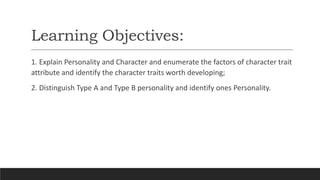
Learning Objectives:
1. Explain Personality and Character and enumerate the factors of character trait
attribute and identify the character traits worth developing;
2. Distinguish Type A and Type B personality and identify ones Personality.
Go to mentimeter and type the voting
code
8485 5645
or
https://www.menti.com/7r4ueo52g5
What is Character?
Introduction
 Character, individuality and personality refer to the sum of the
characteristics possessed by a person.
 Character refers especially to moral qualities, ethical standards, principles and the like.
 Individuality refers to the distinctive qualities that makes recognizable as a
person differentiated from others.
Personality refers particularly to the combination of outer and inner
characteristics that determine the impression that a person makes up on other.
DIFFERENCE BETWEEN PERSONALITY AND CHARACTER
(Dr. Alex Lickerman, Psychology Today)
Basis of Comparison Personality Character
Meaning Personality refers to the
range of distinctive
personal
qualities and traits of an
individual
A character refers to a set of morals
and beliefs that defines how we treat
or behave with others and ourselves
Represents Who we seem to be? Who we actually are?
Traits Personal and Physical Mental and Moral
What is it? It is the identity It is a learned behavior
Expression Outer appearance and
behavior of a person
Traits of a person that are
abstract
Change May change over time Remains same
Validation
of
Society
Not Required Required
Personality is easy to read, and we are all experts at it. We judge people as funny,
extroverted, energetic, optimistic, confident- as well as overly serious, lazy,
negative and shy- if not upon first meeting them, then shortly thereafter.
Character, on the other hand, takes far longer to puzzle out. It includes
traits that reveal themselves only in specific- and often uncommon-
circumstances, traits like honesty, virtue, and kindliness.
Personality traits are what define individuals. Not two people can have the
same matrix of character traits. Understanding how they differ from one person to
the next will give you an idea of how multiple personality shades make us who we
are.
FACTORS OF CHARACTER TRAIT
ATTRIBUTE
1. Openness
These individuals are open to creativity, new ideas, and thoughts. They appreciate
art, are rational thinkers, intelligent, a little complex by nature and are mindful of
their own feelings.
2. Extraversion
Individuals under this trait are aggressive, chatty, outgoing and look for the
company of simulating people. They have lots of positive energy in them and like
to gain the attention of people. They believe in action.
3. Neuroticism.
This trait includes individuals harboring negative emotions in them. Individuals
may be prone to anxiety, depression, or may get easily stressed. They are quick –
tempered and may overreact in response to certain situations.
4. Conscientious
These individuals are well- organized and systematic with regard to their work,
and aim high in all that they want to accomplish. Self- discipline comes naturally to
them; they are passionate about their work and are highly efficient.
5. Agreeableness
Rather than being suspicious or curious, these individuals sympathize with other.
They are kind. Warm hearted, understanding, cooperative, and friendly. The give
their best in any relation. They are open to compromising, helpful to others and are
optimists.
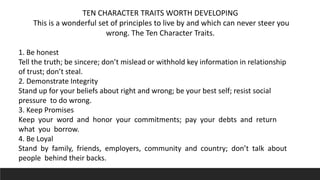
TEN CHARACTER TRAITS WORTH DEVELOPING
This is a wonderful set of principles to live by and which can never steer you
wrong. The Ten Character Traits.
1. Be honest
Tell the truth; be sincere; don’t mislead or withhold key information in relationship
of trust; don’t steal.
2. Demonstrate Integrity
Stand up for your beliefs about right and wrong; be your best self; resist social
pressure to do wrong.
3. Keep Promises
Keep your word and honor your commitments; pay your debts and return
what you borrow.
4. Be Loyal
Stand by family, friends, employers, community and country; don’t talk about
people behind their backs.
5. Be responsible
Think before you, act; consider consequences; be accountable and “take your
medicine.” 6. Pursue Excellence
Do your best with what you have; don’t quit easily.
7. Be kind and caring
Show you care through generosity and compassion; don’t’ be selfish or
mean.
8. Treat all people with respect
Be courteous and polite; judge all people on their merits; be tolerant, appreciative
and accepting of individual differences.
9. Be Fair
Treat all people fairly; be open- minded; listen to others and try to understand
what they are saying and feeling.
10. Be a good Citizen
Obey the law and respect authority; vote volunteer your efforts; protect the
environ
CHARACTER QUALITIES
1. Adaptability 9. Duty
2. Alertness 10. Enthusiasm
3. Attentiveness 11. Excellence
4. Authenticity 12. Fairness
5. Cooperation 13. Initiative
6. Courage 14. Innovation
7. Creativity 15. Integrity
8. Courtesy 16. Joy
Type A and Type B Personalities
Type- A personality
- is a personality trait that involves working competitively under pressure. Type B
personality is a personality trait that involves working calmly without pressure.
Type B personality
- chooses and prefers a low pressure life and is a more relaxed, easy-going,
sociable person (Dunham, 1984).
Self-esteem is a personality trait that is concerned with the extent to which
one has a feeling of self-worth. It is an individual’s general feeling of self-worth
(Nelson and Quick, 1997). You are a human being and you have a relatively stable
perception about you.
A person with a high self-esteem exhibits the following characteristics:
1) Has a positive feeling about self.
2) Understands that there are self-strengths and self- weaknesses.
3) Believes to have a higher number of strengths than a number of
weaknesses.
4) Believes that strengths are more important than
weaknesses.
5) Believes that he or she is an important person.
6) Seeks responsibility.
7) Inspires others to have confidence in him or her.
Self-efficacy is defined by Bandura (1977, as in Nelson and Quick, 1997)
as an individual’s beliefs and expectations about his or her ability to accomplish a
specific task effectively. It is the degree to which you believe that you can
perform a certain task successfully.
A person with a high self-efficacy exhibits the following characteristics:
1) Has a belief that he or she possesses the knowledge and skills needed to get the things
done successfully.
2) Has the capability to exert the needed effort to accomplish the task. 3) Can
overcome any obstacles which may arise in achieving successful performance.
4) Has no doubt about reaching success on the task.
5) Has self-esteem.
As a matter of fact some employees have more self-efficacy than others in
organizations.
1) Past mastery experience
2) Observation (vicarious experience)
3) Persuasion
4) Assessment
5) Availability of help
Self-monitoring is a personality trait that has a great potential to affect
behavior of a person at work. It is defined as the process of observing and
controlling how we are perceived by others (DuBrin, 1997). It is the extent to
which an individual adjusts his or her behavior according to signals or hints
from other people or situations.
THE BIG FIVE DIMENSIONS
Big Dimension Definition Associated Traits
(Sub-Dimensions)
CONSCIENTIOUSNESS The extent to which
an individual is very
careful and thorough to
do his or her work
properly.
Being responsible, hardworking,
achievement oriented,
persevering, and painstaking.
EXTRAVERSION The degree to which
an individual is open,
talkative, expressive,
gregarious and lively,
not quiet and reserved.
Being social (living in groups and
relating well with others),
assertiveness, talkativeness, and
gregariousness (enjoying being
with other people).
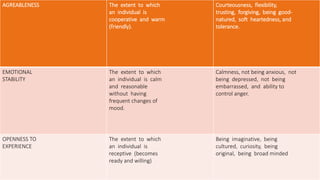
AGREABLENESS The extent to which
an individual is
cooperative and warm
(friendly).
Courteousness, flexibility,
trusting, forgiving, being good-
natured, soft heartedness, and
tolerance.
EMOTIONAL
STABILITY
The extent to which
an individual is calm
and reasonable
without having
frequent changes of
mood.
Calmness, not being anxious, not
being depressed, not being
embarrassed, and ability to
control anger.
OPENNESS TO
EXPERIENCE
The extent to which
an individual is
receptive (becomes
ready and willing)
Being imaginative, being
cultured, curiosity, being
original, being broad minded
What are the implications of the big five
personality dimensions for organizations?
1) Several of the big five dimensions are related to work performance and this is
true across many different occupational groups (e.g., professionals, police
personnel, managers, salespersons, skilled laborer's) and several kinds of
performance measures including ratings of individuals’ performance by managers
or others, performance during training programs, and personnel records.
2) In general, conscientiousness shows the strongest association with task
performance.
3) The more emotionally stable individuals are, the better their task
performance.
4) Agreeableness is positively related to the interpersonal aspect of work (e.g.,
getting along well with others).
5) Extraversion is positively related to performance of jobs which require
individuals to interact with many other people during the course of the day
(e.g., managers, police officers, salesperson).
6) The higher the average scores of team members on conscientiousness,
agreeableness, extraversion, and emotional stability, the higher was their teams’
performance as rated by managers.
7) As a whole, the big five dimensions of personality are indeed a key determinant
of job performance.
Questions?
PERSONALITY.pptx

PERSONALITY.pptx

  • 1.
  • 2.
    Learning Objectives: 1. ExplainPersonality and Character and enumerate the factors of character trait attribute and identify the character traits worth developing; 2. Distinguish Type A and Type B personality and identify ones Personality.
  • 3.
    Go to mentimeterand type the voting code 8485 5645 or https://www.menti.com/7r4ueo52g5
  • 4.
  • 5.
    Introduction  Character, individualityand personality refer to the sum of the characteristics possessed by a person.  Character refers especially to moral qualities, ethical standards, principles and the like.  Individuality refers to the distinctive qualities that makes recognizable as a person differentiated from others. Personality refers particularly to the combination of outer and inner characteristics that determine the impression that a person makes up on other.
  • 6.
    DIFFERENCE BETWEEN PERSONALITYAND CHARACTER (Dr. Alex Lickerman, Psychology Today) Basis of Comparison Personality Character Meaning Personality refers to the range of distinctive personal qualities and traits of an individual A character refers to a set of morals and beliefs that defines how we treat or behave with others and ourselves Represents Who we seem to be? Who we actually are? Traits Personal and Physical Mental and Moral What is it? It is the identity It is a learned behavior Expression Outer appearance and behavior of a person Traits of a person that are abstract Change May change over time Remains same Validation of Society Not Required Required
  • 7.
    Personality is easyto read, and we are all experts at it. We judge people as funny, extroverted, energetic, optimistic, confident- as well as overly serious, lazy, negative and shy- if not upon first meeting them, then shortly thereafter. Character, on the other hand, takes far longer to puzzle out. It includes traits that reveal themselves only in specific- and often uncommon- circumstances, traits like honesty, virtue, and kindliness. Personality traits are what define individuals. Not two people can have the same matrix of character traits. Understanding how they differ from one person to the next will give you an idea of how multiple personality shades make us who we are.
  • 8.
    FACTORS OF CHARACTERTRAIT ATTRIBUTE 1. Openness These individuals are open to creativity, new ideas, and thoughts. They appreciate art, are rational thinkers, intelligent, a little complex by nature and are mindful of their own feelings. 2. Extraversion Individuals under this trait are aggressive, chatty, outgoing and look for the company of simulating people. They have lots of positive energy in them and like to gain the attention of people. They believe in action.
  • 9.
    3. Neuroticism. This traitincludes individuals harboring negative emotions in them. Individuals may be prone to anxiety, depression, or may get easily stressed. They are quick – tempered and may overreact in response to certain situations. 4. Conscientious These individuals are well- organized and systematic with regard to their work, and aim high in all that they want to accomplish. Self- discipline comes naturally to them; they are passionate about their work and are highly efficient. 5. Agreeableness Rather than being suspicious or curious, these individuals sympathize with other. They are kind. Warm hearted, understanding, cooperative, and friendly. The give their best in any relation. They are open to compromising, helpful to others and are optimists.
  • 10.
    TEN CHARACTER TRAITSWORTH DEVELOPING This is a wonderful set of principles to live by and which can never steer you wrong. The Ten Character Traits. 1. Be honest Tell the truth; be sincere; don’t mislead or withhold key information in relationship of trust; don’t steal. 2. Demonstrate Integrity Stand up for your beliefs about right and wrong; be your best self; resist social pressure to do wrong. 3. Keep Promises Keep your word and honor your commitments; pay your debts and return what you borrow. 4. Be Loyal Stand by family, friends, employers, community and country; don’t talk about people behind their backs.
  • 11.
    5. Be responsible Thinkbefore you, act; consider consequences; be accountable and “take your medicine.” 6. Pursue Excellence Do your best with what you have; don’t quit easily. 7. Be kind and caring Show you care through generosity and compassion; don’t’ be selfish or mean. 8. Treat all people with respect Be courteous and polite; judge all people on their merits; be tolerant, appreciative and accepting of individual differences. 9. Be Fair Treat all people fairly; be open- minded; listen to others and try to understand what they are saying and feeling. 10. Be a good Citizen Obey the law and respect authority; vote volunteer your efforts; protect the environ
  • 12.
    CHARACTER QUALITIES 1. Adaptability9. Duty 2. Alertness 10. Enthusiasm 3. Attentiveness 11. Excellence 4. Authenticity 12. Fairness 5. Cooperation 13. Initiative 6. Courage 14. Innovation 7. Creativity 15. Integrity 8. Courtesy 16. Joy
  • 13.
    Type A andType B Personalities Type- A personality - is a personality trait that involves working competitively under pressure. Type B personality is a personality trait that involves working calmly without pressure. Type B personality - chooses and prefers a low pressure life and is a more relaxed, easy-going, sociable person (Dunham, 1984). Self-esteem is a personality trait that is concerned with the extent to which one has a feeling of self-worth. It is an individual’s general feeling of self-worth (Nelson and Quick, 1997). You are a human being and you have a relatively stable perception about you. A person with a high self-esteem exhibits the following characteristics: 1) Has a positive feeling about self. 2) Understands that there are self-strengths and self- weaknesses. 3) Believes to have a higher number of strengths than a number of weaknesses.
  • 14.
    4) Believes thatstrengths are more important than weaknesses. 5) Believes that he or she is an important person. 6) Seeks responsibility. 7) Inspires others to have confidence in him or her. Self-efficacy is defined by Bandura (1977, as in Nelson and Quick, 1997) as an individual’s beliefs and expectations about his or her ability to accomplish a specific task effectively. It is the degree to which you believe that you can perform a certain task successfully. A person with a high self-efficacy exhibits the following characteristics: 1) Has a belief that he or she possesses the knowledge and skills needed to get the things done successfully. 2) Has the capability to exert the needed effort to accomplish the task. 3) Can overcome any obstacles which may arise in achieving successful performance. 4) Has no doubt about reaching success on the task. 5) Has self-esteem.
  • 15.
    As a matterof fact some employees have more self-efficacy than others in organizations. 1) Past mastery experience 2) Observation (vicarious experience) 3) Persuasion 4) Assessment 5) Availability of help Self-monitoring is a personality trait that has a great potential to affect behavior of a person at work. It is defined as the process of observing and controlling how we are perceived by others (DuBrin, 1997). It is the extent to which an individual adjusts his or her behavior according to signals or hints from other people or situations.
  • 16.
    THE BIG FIVEDIMENSIONS Big Dimension Definition Associated Traits (Sub-Dimensions) CONSCIENTIOUSNESS The extent to which an individual is very careful and thorough to do his or her work properly. Being responsible, hardworking, achievement oriented, persevering, and painstaking. EXTRAVERSION The degree to which an individual is open, talkative, expressive, gregarious and lively, not quiet and reserved. Being social (living in groups and relating well with others), assertiveness, talkativeness, and gregariousness (enjoying being with other people).
  • 17.
    AGREABLENESS The extentto which an individual is cooperative and warm (friendly). Courteousness, flexibility, trusting, forgiving, being good- natured, soft heartedness, and tolerance. EMOTIONAL STABILITY The extent to which an individual is calm and reasonable without having frequent changes of mood. Calmness, not being anxious, not being depressed, not being embarrassed, and ability to control anger. OPENNESS TO EXPERIENCE The extent to which an individual is receptive (becomes ready and willing) Being imaginative, being cultured, curiosity, being original, being broad minded
  • 18.
    What are theimplications of the big five personality dimensions for organizations? 1) Several of the big five dimensions are related to work performance and this is true across many different occupational groups (e.g., professionals, police personnel, managers, salespersons, skilled laborer's) and several kinds of performance measures including ratings of individuals’ performance by managers or others, performance during training programs, and personnel records. 2) In general, conscientiousness shows the strongest association with task performance. 3) The more emotionally stable individuals are, the better their task performance.
  • 19.
    4) Agreeableness ispositively related to the interpersonal aspect of work (e.g., getting along well with others). 5) Extraversion is positively related to performance of jobs which require individuals to interact with many other people during the course of the day (e.g., managers, police officers, salesperson). 6) The higher the average scores of team members on conscientiousness, agreeableness, extraversion, and emotional stability, the higher was their teams’ performance as rated by managers. 7) As a whole, the big five dimensions of personality are indeed a key determinant of job performance.
  • 20.