16 PERSONALITY
FACTORS
Submitted to : Dr. Bushra Bibi
Submitted by: 18220811-012
18220811-029
18220811-039
18220811-048
18220811-060
18220811-062
16 PERSONALITY FACTORS
What is Personality?
•Personality refers to factors inside people that
explain their behavior.
•The sum total of typical ways of acting,
thinking and feeling that makes a person
unique.
METHODS OF MEASURING PERSONALITY
• Paper and Pencil Tests : questionnaires, inventories
• Situational exercises
• Field or natural observations
• Projective measures
16 PF QUESTIONAIRE: AN INTRODUCTION
• The 16PF Questionnaire is a self-report assessment
instrument that measures the sixteen normal adult
personality dimensions that make up our personality.
• Represents Dr . Raymond Cattell‘s endeavor to identify the
primary components of personality by factor analyzing all
English language adjectives describing human behavior.
AUTHORS:
• Raymond B. Cattell, A. Karen S. Cattell, and Heather E. P. Cattell
PUBLICATIONS:
• 1993 (5th Edition)
PUBLISHERS:
• Institute for Personality & Ability Testing, Inc. (IPAT)
REQUIREMENTS FOR PURCHASE:
• Level 2
• IPAT requires a Master‘s degree in psychology,
counseling, social works, or a related field, plus
relevant graduate-level course work in Tests and
Measurement.
Requirements For Purchase:
• LEVEL A: available if the person administering the test had
undergraduate courses in testing or psychometrics, or sufficient
training and experience in test administration.
• LEVEL B: available only if the test administer has completed an
advanced level course in testing in a university, or its equivalent in
training under the direction of a qualified superior or consultant.
• LEVEL C: available only for use, by, or under the supervision of
qualified psychologists, i.e. Members of APA or the PAP or other
persons with at least a Master‘s Degree in psychology and at least
one year experience under professional supervision.
HISTORY AND OVERVIEW
• 1949 – The institute for Personality and Ability Testing
(IPAT) is founded by Raymond Cattell and his wife, A.
Karen Cattell, who served as director and chairperson of
IPAT until 1992.
• The 16PF Questionnaire, the 1st edition is released.
• It was a revolutionary concept: measuring the whole of
human personality using structure discovered through
factor analysis.
Applications:
• Selection
• Management development
• Outplacement consulting
• Team building and development
• Career counseling
• Individual and couple‘s counseling, and
• Research and clinical settings.
Age Range:
• Age Range: 16 years old and older
Forms:
• 1 Form; 185 Items
Administration Time (Unlimited):
• Average test completion is 35-50 minute
ADMINISTRATION
• Designed to be administered to adults individually or in
group setting.
• Self-administrable, the test administer is advised to take
time to established a comfortable rapport with examinees.
• The test is untimed but the examinee should be encouraged
to work on a steady pace.
• "Remember, don‘t spend too much time thinking over any
one question. Give the first, natural answer as it comes to
you“.
Administration:
• The administrator may either read aloud the instructions or
request examinees to read the instruction silently,
responding to their question as necessary..
• The instructor advised examinees not to make any marks in
the test booklet.
• Before starting the test, examinees are asked to complete
the grids for name and gender on the left-hand side of the
answer sheet.
Administration:
• . During the testing, the administrator should check that
examinees are marking responses appropriately.
• Response circles must be darkened completely with a No. 2
or softer lead pencil.
• At the conclusion of the testing, the administrator should
review each answer sheet to ensure that the name, gender
grids have been completed and that all (185 items)
responses are scorable
HAND SCORING
Material needed for hand scoring the 16PF:
• Four set of Scoring keys
• Norm table
• Individual Record Form (IRF)
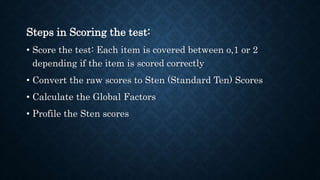
Steps in Scoring the test:
• Score the test: Each item is covered between o,1 or 2
depending if the item is scored correctly
• Convert the raw scores to Sten (Standard Ten) Scores
• Calculate the Global Factors
• Profile the Sten scores
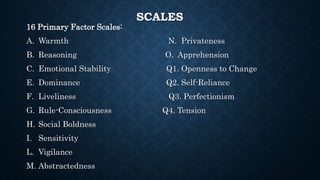
SCALES
16 Primary Factor Scales:
A. Warmth N. Privateness
B. Reasoning O. Apprehension
C. Emotional Stability Q1. Openness to Change
E. Dominance Q2. Self-Reliance
F. Liveliness Q3. Perfectionism
G. Rule-Consciousness Q4. Tension
H. Social Boldness
I. Sensitivity
L. Vigilance
M. Abstractedness
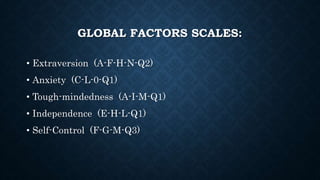
GLOBAL FACTORS SCALES:
• Extraversion (A-F-H-N-Q2)
• Anxiety (C-L-0-Q1)
• Tough-mindedness (A-I-M-Q1)
• Independence (E-H-L-Q1)
• Self-Control (F-G-M-Q3)
16 PERSONALITY FACTORS
16 PRIMARY FACTORS
WARMTH A
• LOW A: Reserved impersonal, distant, formal.
They tend to be reserved and cautious about involvement and attachment. They
tend to like solitude, often focusing attention on intellectual, mechanical, or
artistic pursuits, where they can quite effective. Low scores can be uncomfortable
in situations that call for emotional closeness or extensive interaction.
• LOW B: Warm, caring, soft-hearted, and generous.
They tend to have an intrinsic interest in people and they often seek situations
that call for closeness with other people. Their friends describe them as
sympathetic and comforting. Extreme scores may be seen as gullible, and may be
uncomfortable in situations where close relationships are inaccessible.
REASONING (B)
• LOW B: They are less able to solve verbal and numerical problems of an
academic nature. This can indicate lower intellectual ability, but it also related to
educational level. Low scores can also result from a range of problems effecting
concentration and motivation.
• HIGH B: They are more able to solve verbal and numerical problems of an
academic nature. This is often indicative of intellectual, but it also related to
educational level. This index should not replace full length measure of cognitive
ability.
EMOTIONAL STABILITY (C)
• LOW C: Reactive, easily upset, temperamental.
They tend to feel a lack of control over life‘s challenges and to react to life rather
than making adaptive or proactive choices. For some test takers, reactivity can
reflect current life stressors; for others, it may characterize their way of life.
• HIGH C: Calm, stable, mature, unruffled.
They tend to take life in stride and to cope with day-to-day life and its challenges
in a calm. Balanced, adaptive way. They tolerate frustration well, can delay
gratification, and don‘t let emotions obscure reality. Extremes scores may tend to
avoid “negative“ feelings or use strong defenses like deniel.
DOMINANCE (E)
• LOW E: Differential, modest, submissive
They tend to accommodate other‘s wishes, and are cooperative and agreeable.
They are likely to avoid conflict by acquiescing to the wishes of others, and they
are willing to set aside their own wishes and feeling. Extreme defense can
disappoint those who wish for a more forceful or participating response from
them.
• HIGH E: Assertive, forceful, competitive.
They tend to be vocal in expressing their opinion and wishes. While dominance
can create a commanding, take charge social presence, at times it can be sen as
overbearing, stubborn or argumentative. For example, Dominant people who are
also warm (A) may be more thoughtful than reserved people.
LIVELINESS (F)
• LOW F: Serious, quiet, reflective, cautious.
Though they may not be the life of the party or the most entertaining person in a
group, their quiet attentiveness can make them reliable and mature. At the
extreme, they can inhibit their spontaneity, sometime to the point of appearing
constricted.
• HIGH F: Carefree, enthusiastic, spontaneous, energetic.
They are high spirited and stimulating and drawn to lively social situations.
Extreme scores may reflect an impulsive or unreliable quality. They may find it
hard to rein in their enthusiasm in situations that call for restraint decorum.
RULE CONSCIOUSNESS (G)
• Low G: expedient, non-conforming.
They may not worry about conventions, obligation, or following rules and
regulations. This may be because they lack internalized standards or simply
because they follow unconventional values.
• High G: rule-conscious, dutiful, scrupulous.
They tend to be proper and conscientious and conform to conventional cultural
standards. At the extreme they can be perceived as inflexible, moralistic, self-
righteous.
SOCIAL BOLDNESS (H)
• LOW H: Shy, socially timid, threat-sensitive, easily embarrassed.
They find speaking in front of groups to be difficult and may feel intimidated
when facing stressful situation of an interpersonal nature. However they may be
sensitive listeners who are more aware of rick in situations.
• HIGH H: Socially bold, outgoing gregarious, adventuresome.
They tend to be boldly initiate social contacts be fearless in the face of new or
intimidated social setting to be risk taker adventure. Extreme scorers ,may be
thick skinned or attention seeking.
SENSITIVITY (I)
• LOW I: Tough, realistic, logical, unsentimental.
They focus more on how things work than on aesthetics or refined sensibilities,
and may be so concerned with utility and objectivity that they exclude emotions
from consideration. Because they don‘t tend to allow vulnerability, extreme low
scorers may have trouble in situations that demand awareness of feelings.
• HIGH I: Emotionally sensitive, intuitive, cultured, sentimental.
High scorers are attuned to sensitive feelings, and thus are empathetic,
sympathetic and tender-minded. They tend to be artistic and refined in their
interests and tastes. Extreme scorers may be so focused on subjective aspects of
situations that they overlook more functional aspects.
VIGILANCE (L)
• LOW L: Trusting, unsuspecting, Forgiving, Accepting:
They tend to be easy-going and expect fair treatment and good intentions from
others, and to have trusting relationships. However, extremely low scorers may
be taken advantage of because they do not gave enough thought to others
motivations.
• High L: Vigilant, suspicious, distrustful, wary:
They tend to be attentive to others motives and intentions and sensitive to
being misunderstood or taken advantage of. They may be unable to relax their
vigilance, and at the extreme their mistrust may have an aspect of animosity.
ABSTRACTEDNESS (M)
• LOW M: Grounded, practical, concrete.
They tend to focus on practical observable realities of their environment and
may be better at working on a specific solution than at imagining possible
solutions. Extreme scorers may be so concrete in their focus, unimaginative, or
literal that they “miss the forest for the trees“
• HIGH M: Abstracted, imaginative, idea-oriented, contemplative.
They are more oriented to abstract ideas than to external facts and
practicalities that being focused on thinking, imagination and fantasy, high
scorers generate many ideas and theories and are often creative. Extreme
scorers can be so absorbed in thoughts that they can be absentminded and
impractical.
PRIVATENESS (N)
• LOW N: Forthright, self-revealing, transparent.
They tend to be open, artless and transparent. They are willing to talk about
themselves readily, even about fairly personal matters. They tend to “put all
their cards on the table“, and to be genuine and unguarded. At the extreme, they
may be forthright in situations where it might be more astute to be circumspect
or tactful
• HIGH N: Private, discreet, non-disclosing.
They tend to be guarded, and reluctant to disclose personal information, and
“Play their hand close to their chest“. They may be tactful, diplomatic and
calculating regarding others motive. At the extreme, they maintain their privacy
at the expense of developing few close relationships.
APPREHENSION (O)
• LOW O: Self-assured, unworried, complacent.
They tend to be self-confident and untroubled by self-doubt. While this may make
them more resilient in stressful situations, at the extreme, the person's confidence
may be unshaken, even in situations that call for self-evaluation and self-
improvement. The extreme low score may reflect and avoidance of anything
negative about the self.
• HIGH O: Apprehensive, self-doubting, guilt-prone.
They tend to worry about things and to feel anxious and insecure. These feelings
may be in response to current life events or they may be characteristic While
worrying can help the person anticipate dangers, be sensitive to others reactions,
and anticipate consequences of actions, it can also be painful and make a poor
social impressions on other.
OPENNESS TO CHANGE (Q1)
• LOW Q1: Traditional, attached to familiar, resistant to change.
They tend to stick to traditional ways of doing things. They prefer what's
predictable and routine, and so they don't tend to challenge the status quo. At the
Extreme, they may not initiate or be open to change, when the situation calls for
it.
HIGH Q1: Open to change, experimenting, freethinking.
They tend to be open-minded and innovative, and seek ways to improve the status
quo. They enjoy experimenting, and tend to think critically or question authority.
Extreme score may find it hard to "leave well enough alone“.
SELF-RELIANCE (Q2)
• LOW Q2: Group-oriented, affiliative.
They tend to prefer being around other people, and enjoy social groups and
working in teams. At the extreme, they may not be effective in situations where
they need to function independently or where others are giving poor direction or
advice.
• HIGH Q2: Self-reliant, solitary, individualistic.
They enjoy spending time alone and prefer to rely on their own thinking and
judgment. While self-reliant people are autonomous in their thoughts and
actions, extreme scorers may be uncomfortable working collaboratively or
neglect interpersonal consequences of their actions.
PERFECTIONISM (Q3)
• LOW Q3: Tolerates disorder, unexacting, casual, lax.
They tend to be comfortable leaving things to chance, tending to be spontaneous
rather than planful, organized, and structured. Extreme scorers may seem
flexible and spontaneous, but they may also seem unorganized, unprepared, or
undisciplined.
• HIGH Q3: Perfectionistic, self-disciplined, goal-oriented.
They tend to be organized, plan ahead, persevere, and work conscientiously.
They are most effective in organized and structured situations, and may find it
hard to deal with unpredictability. At the extreme, they may be seen as
inflexible or preoccupied with tasks.
TENSION (Q4)
• LOW Q4: Relaxed, placid, tranquil, patient.
They are laid back, easy-going, and composed. They are not easily upset or aroused, and
frustrations rarely bother them. At the extreme, their low level of arousal can make
them unmotivated. That is, because they are comfortable, they may be disinclined to
change or push themselves.
• HIGH Q4: Tense, driven, high energy, impatient.
They tend to have a lot of drive, to be high strung, and to be fidgety when made to wait.
A certain amount of tension is necessary to focus effectively and can motivate action.
However, extremely high tension can lead to impatience and irritability. The source of
tension should be explored when scores are extremely high.
GLOBAL FACTORS
• Extraversion(EX)
• Anxiety(AX)
• Thought-mindedness(TM)
• Independence(IN)
• Self-control(SC)
EXTRAVERSION (EX)
• Low Scorer: Tend to value time spent alone or in solitary pursuits, being generally
less inclined to seek out interaction with others. The introvert can have one or more
of these qualities: personal aloofness and a tendency to make few close connections;
caution, restraint and a tendency to take life seriously; an inclination to be shy or
fearful about reaching out to others; discomfort about revealing personal
information; and a preference for working alone and functioning autonomously.
• High scorer: High scorer tend to be people oriented, to seek interaction
with others, and to value time spent with others, in social pursuits.
The extravert can have one or more of these qualities; warmth and a
wish to feel close connections with people; a lively, stimulating social
energy; comfort in the company of others; bold gregariousness; a
tendency to be fortright and self-disclosing.
ANXIETY (AX)
• Low scorer: tend to be unperturbed by most events and less easily upset than most people.
They can be; emotionally stable, facing life challenges with calm and stability; trusting of
others; unworried and self assured; and relaxed and placid. Extremely low scorer may minimize
the ways that life or personal limitations can pose stress or challenges, or may be so comfortable
that they are not motivated to change.
• High scorer: tend to be more easily upset by events; they are more perturbed, both by internal
thoughts and feelings as well as by external events. This may be characteristics or may be due
to current life stress. Anxiety people can experience one or more of the following; feeling
overwhelmed and unable to cope with day-to-day living; being suspicious or doubting of others;
worrying and self-doubting; and feeling tense, driven, or frustrated.
THOUGHT-MINDEDNESS(TM)
• Low scorers: tend to be open to feelings, imagination, people and new ideas.
Their approach may focus on: emotional and aesthetic sensibilities; ideas and
thoughts, especially imaginative ones; caring connections with people; or
experimenting and trying new approaches. They may overlook the need to be
practical, objective, or realistic in dealing with the world.
• High scorers: tend to prefer logical, realistic solutions. They may focus on;
objectivity( as opposed to sentimentality), practical, concrete things rather
than abstract ideas or theories; keeping things on an impersonal level; and
valuing methods that are traditional and proven. Extreme thought-mindedness
may result in resolute entrenchment and avoidance of new or imaginative
approaches.
INDEPENDENCE(IN)
• Low scorers: tend to be agreeable and accommodating to others people and external
influences rather than being self-determining. They may be uncomfoertable in situations
that call for independence or assertiveness. Low scorer have varying degrees of defence,
cooperation, shyness, trust, and adherence to the status quo. Their ability to
accommodate others wishes often comes at their own expenses, and may frustrate others
who desire more active participation from them.
• High scorer: tend to take charge of situations and to influence others rather than be
influenced. Their active stance on life can include one or more of these elements:
dominance and an unwillingness to acquiesce ; social boldness and fearlessness;
skepticism of others, especially about being controlled; and willingness to question and
improve on the status quo. High scorer can be seen as disagreeable or controlled.
SELF-CONTROL (SC)
• Low scorer: are unrestricted and tend to have fewer resources for controlling their
behavior. They may find it hard to place limits on their own urges or to focus their
attention. They may be: spontaneous, carefree, or impulsive; non-conforming, or
inattentive to rules and regulations; so caught up in internal thoughts that they don’t
focus on practicalities; or so undisciplined and casual that they do not plan, organize,
or perseveres. While perceived as flexible, playful and casual, low scorer can also be
seen as unreliable, expedient, or careless.
• High scorer: are conscientious and have substantial resources for controlling their
behavior and meeting their responsibilities. These resources may include one or more
of these qualities; being cautious, restrained, and taking matters seriously; placing
importance on following rules and meeting expectations; being practical. Focused,
and realistic; being self disciplined, goal oriented, and organized.
THANK YOU..

Personality Factor.pptx

  • 1.
  • 2.
    Submitted to :Dr. Bushra Bibi Submitted by: 18220811-012 18220811-029 18220811-039 18220811-048 18220811-060 18220811-062
  • 3.
    16 PERSONALITY FACTORS Whatis Personality? •Personality refers to factors inside people that explain their behavior. •The sum total of typical ways of acting, thinking and feeling that makes a person unique.
  • 4.
    METHODS OF MEASURINGPERSONALITY • Paper and Pencil Tests : questionnaires, inventories • Situational exercises • Field or natural observations • Projective measures
  • 5.
    16 PF QUESTIONAIRE:AN INTRODUCTION • The 16PF Questionnaire is a self-report assessment instrument that measures the sixteen normal adult personality dimensions that make up our personality. • Represents Dr . Raymond Cattell‘s endeavor to identify the primary components of personality by factor analyzing all English language adjectives describing human behavior.
  • 6.
    AUTHORS: • Raymond B.Cattell, A. Karen S. Cattell, and Heather E. P. Cattell PUBLICATIONS: • 1993 (5th Edition) PUBLISHERS: • Institute for Personality & Ability Testing, Inc. (IPAT)
  • 7.
    REQUIREMENTS FOR PURCHASE: •Level 2 • IPAT requires a Master‘s degree in psychology, counseling, social works, or a related field, plus relevant graduate-level course work in Tests and Measurement.
  • 8.
    Requirements For Purchase: •LEVEL A: available if the person administering the test had undergraduate courses in testing or psychometrics, or sufficient training and experience in test administration. • LEVEL B: available only if the test administer has completed an advanced level course in testing in a university, or its equivalent in training under the direction of a qualified superior or consultant. • LEVEL C: available only for use, by, or under the supervision of qualified psychologists, i.e. Members of APA or the PAP or other persons with at least a Master‘s Degree in psychology and at least one year experience under professional supervision.
  • 9.
    HISTORY AND OVERVIEW •1949 – The institute for Personality and Ability Testing (IPAT) is founded by Raymond Cattell and his wife, A. Karen Cattell, who served as director and chairperson of IPAT until 1992. • The 16PF Questionnaire, the 1st edition is released. • It was a revolutionary concept: measuring the whole of human personality using structure discovered through factor analysis.
  • 10.
    Applications: • Selection • Managementdevelopment • Outplacement consulting • Team building and development • Career counseling • Individual and couple‘s counseling, and • Research and clinical settings.
  • 11.
    Age Range: • AgeRange: 16 years old and older Forms: • 1 Form; 185 Items Administration Time (Unlimited): • Average test completion is 35-50 minute
  • 12.
    ADMINISTRATION • Designed tobe administered to adults individually or in group setting. • Self-administrable, the test administer is advised to take time to established a comfortable rapport with examinees. • The test is untimed but the examinee should be encouraged to work on a steady pace. • "Remember, don‘t spend too much time thinking over any one question. Give the first, natural answer as it comes to you“.
  • 13.
    Administration: • The administratormay either read aloud the instructions or request examinees to read the instruction silently, responding to their question as necessary.. • The instructor advised examinees not to make any marks in the test booklet. • Before starting the test, examinees are asked to complete the grids for name and gender on the left-hand side of the answer sheet.
  • 14.
    Administration: • . Duringthe testing, the administrator should check that examinees are marking responses appropriately. • Response circles must be darkened completely with a No. 2 or softer lead pencil. • At the conclusion of the testing, the administrator should review each answer sheet to ensure that the name, gender grids have been completed and that all (185 items) responses are scorable
  • 15.
    HAND SCORING Material neededfor hand scoring the 16PF: • Four set of Scoring keys • Norm table • Individual Record Form (IRF)
  • 16.
    Steps in Scoringthe test: • Score the test: Each item is covered between o,1 or 2 depending if the item is scored correctly • Convert the raw scores to Sten (Standard Ten) Scores • Calculate the Global Factors • Profile the Sten scores
  • 17.
    SCALES 16 Primary FactorScales: A. Warmth N. Privateness B. Reasoning O. Apprehension C. Emotional Stability Q1. Openness to Change E. Dominance Q2. Self-Reliance F. Liveliness Q3. Perfectionism G. Rule-Consciousness Q4. Tension H. Social Boldness I. Sensitivity L. Vigilance M. Abstractedness
  • 18.
    GLOBAL FACTORS SCALES: •Extraversion (A-F-H-N-Q2) • Anxiety (C-L-0-Q1) • Tough-mindedness (A-I-M-Q1) • Independence (E-H-L-Q1) • Self-Control (F-G-M-Q3)
  • 19.
  • 20.
    16 PRIMARY FACTORS WARMTHA • LOW A: Reserved impersonal, distant, formal. They tend to be reserved and cautious about involvement and attachment. They tend to like solitude, often focusing attention on intellectual, mechanical, or artistic pursuits, where they can quite effective. Low scores can be uncomfortable in situations that call for emotional closeness or extensive interaction. • LOW B: Warm, caring, soft-hearted, and generous. They tend to have an intrinsic interest in people and they often seek situations that call for closeness with other people. Their friends describe them as sympathetic and comforting. Extreme scores may be seen as gullible, and may be uncomfortable in situations where close relationships are inaccessible.
  • 21.
    REASONING (B) • LOWB: They are less able to solve verbal and numerical problems of an academic nature. This can indicate lower intellectual ability, but it also related to educational level. Low scores can also result from a range of problems effecting concentration and motivation. • HIGH B: They are more able to solve verbal and numerical problems of an academic nature. This is often indicative of intellectual, but it also related to educational level. This index should not replace full length measure of cognitive ability.
  • 22.
    EMOTIONAL STABILITY (C) •LOW C: Reactive, easily upset, temperamental. They tend to feel a lack of control over life‘s challenges and to react to life rather than making adaptive or proactive choices. For some test takers, reactivity can reflect current life stressors; for others, it may characterize their way of life. • HIGH C: Calm, stable, mature, unruffled. They tend to take life in stride and to cope with day-to-day life and its challenges in a calm. Balanced, adaptive way. They tolerate frustration well, can delay gratification, and don‘t let emotions obscure reality. Extremes scores may tend to avoid “negative“ feelings or use strong defenses like deniel.
  • 23.
    DOMINANCE (E) • LOWE: Differential, modest, submissive They tend to accommodate other‘s wishes, and are cooperative and agreeable. They are likely to avoid conflict by acquiescing to the wishes of others, and they are willing to set aside their own wishes and feeling. Extreme defense can disappoint those who wish for a more forceful or participating response from them. • HIGH E: Assertive, forceful, competitive. They tend to be vocal in expressing their opinion and wishes. While dominance can create a commanding, take charge social presence, at times it can be sen as overbearing, stubborn or argumentative. For example, Dominant people who are also warm (A) may be more thoughtful than reserved people.
  • 24.
    LIVELINESS (F) • LOWF: Serious, quiet, reflective, cautious. Though they may not be the life of the party or the most entertaining person in a group, their quiet attentiveness can make them reliable and mature. At the extreme, they can inhibit their spontaneity, sometime to the point of appearing constricted. • HIGH F: Carefree, enthusiastic, spontaneous, energetic. They are high spirited and stimulating and drawn to lively social situations. Extreme scores may reflect an impulsive or unreliable quality. They may find it hard to rein in their enthusiasm in situations that call for restraint decorum.
  • 25.
    RULE CONSCIOUSNESS (G) •Low G: expedient, non-conforming. They may not worry about conventions, obligation, or following rules and regulations. This may be because they lack internalized standards or simply because they follow unconventional values. • High G: rule-conscious, dutiful, scrupulous. They tend to be proper and conscientious and conform to conventional cultural standards. At the extreme they can be perceived as inflexible, moralistic, self- righteous.
  • 26.
    SOCIAL BOLDNESS (H) •LOW H: Shy, socially timid, threat-sensitive, easily embarrassed. They find speaking in front of groups to be difficult and may feel intimidated when facing stressful situation of an interpersonal nature. However they may be sensitive listeners who are more aware of rick in situations. • HIGH H: Socially bold, outgoing gregarious, adventuresome. They tend to be boldly initiate social contacts be fearless in the face of new or intimidated social setting to be risk taker adventure. Extreme scorers ,may be thick skinned or attention seeking.
  • 27.
    SENSITIVITY (I) • LOWI: Tough, realistic, logical, unsentimental. They focus more on how things work than on aesthetics or refined sensibilities, and may be so concerned with utility and objectivity that they exclude emotions from consideration. Because they don‘t tend to allow vulnerability, extreme low scorers may have trouble in situations that demand awareness of feelings. • HIGH I: Emotionally sensitive, intuitive, cultured, sentimental. High scorers are attuned to sensitive feelings, and thus are empathetic, sympathetic and tender-minded. They tend to be artistic and refined in their interests and tastes. Extreme scorers may be so focused on subjective aspects of situations that they overlook more functional aspects.
  • 28.
    VIGILANCE (L) • LOWL: Trusting, unsuspecting, Forgiving, Accepting: They tend to be easy-going and expect fair treatment and good intentions from others, and to have trusting relationships. However, extremely low scorers may be taken advantage of because they do not gave enough thought to others motivations. • High L: Vigilant, suspicious, distrustful, wary: They tend to be attentive to others motives and intentions and sensitive to being misunderstood or taken advantage of. They may be unable to relax their vigilance, and at the extreme their mistrust may have an aspect of animosity.
  • 29.
    ABSTRACTEDNESS (M) • LOWM: Grounded, practical, concrete. They tend to focus on practical observable realities of their environment and may be better at working on a specific solution than at imagining possible solutions. Extreme scorers may be so concrete in their focus, unimaginative, or literal that they “miss the forest for the trees“ • HIGH M: Abstracted, imaginative, idea-oriented, contemplative. They are more oriented to abstract ideas than to external facts and practicalities that being focused on thinking, imagination and fantasy, high scorers generate many ideas and theories and are often creative. Extreme scorers can be so absorbed in thoughts that they can be absentminded and impractical.
  • 30.
    PRIVATENESS (N) • LOWN: Forthright, self-revealing, transparent. They tend to be open, artless and transparent. They are willing to talk about themselves readily, even about fairly personal matters. They tend to “put all their cards on the table“, and to be genuine and unguarded. At the extreme, they may be forthright in situations where it might be more astute to be circumspect or tactful • HIGH N: Private, discreet, non-disclosing. They tend to be guarded, and reluctant to disclose personal information, and “Play their hand close to their chest“. They may be tactful, diplomatic and calculating regarding others motive. At the extreme, they maintain their privacy at the expense of developing few close relationships.
  • 31.
    APPREHENSION (O) • LOWO: Self-assured, unworried, complacent. They tend to be self-confident and untroubled by self-doubt. While this may make them more resilient in stressful situations, at the extreme, the person's confidence may be unshaken, even in situations that call for self-evaluation and self- improvement. The extreme low score may reflect and avoidance of anything negative about the self. • HIGH O: Apprehensive, self-doubting, guilt-prone. They tend to worry about things and to feel anxious and insecure. These feelings may be in response to current life events or they may be characteristic While worrying can help the person anticipate dangers, be sensitive to others reactions, and anticipate consequences of actions, it can also be painful and make a poor social impressions on other.
  • 32.
    OPENNESS TO CHANGE(Q1) • LOW Q1: Traditional, attached to familiar, resistant to change. They tend to stick to traditional ways of doing things. They prefer what's predictable and routine, and so they don't tend to challenge the status quo. At the Extreme, they may not initiate or be open to change, when the situation calls for it. HIGH Q1: Open to change, experimenting, freethinking. They tend to be open-minded and innovative, and seek ways to improve the status quo. They enjoy experimenting, and tend to think critically or question authority. Extreme score may find it hard to "leave well enough alone“.
  • 33.
    SELF-RELIANCE (Q2) • LOWQ2: Group-oriented, affiliative. They tend to prefer being around other people, and enjoy social groups and working in teams. At the extreme, they may not be effective in situations where they need to function independently or where others are giving poor direction or advice. • HIGH Q2: Self-reliant, solitary, individualistic. They enjoy spending time alone and prefer to rely on their own thinking and judgment. While self-reliant people are autonomous in their thoughts and actions, extreme scorers may be uncomfortable working collaboratively or neglect interpersonal consequences of their actions.
  • 34.
    PERFECTIONISM (Q3) • LOWQ3: Tolerates disorder, unexacting, casual, lax. They tend to be comfortable leaving things to chance, tending to be spontaneous rather than planful, organized, and structured. Extreme scorers may seem flexible and spontaneous, but they may also seem unorganized, unprepared, or undisciplined. • HIGH Q3: Perfectionistic, self-disciplined, goal-oriented. They tend to be organized, plan ahead, persevere, and work conscientiously. They are most effective in organized and structured situations, and may find it hard to deal with unpredictability. At the extreme, they may be seen as inflexible or preoccupied with tasks.
  • 35.
    TENSION (Q4) • LOWQ4: Relaxed, placid, tranquil, patient. They are laid back, easy-going, and composed. They are not easily upset or aroused, and frustrations rarely bother them. At the extreme, their low level of arousal can make them unmotivated. That is, because they are comfortable, they may be disinclined to change or push themselves. • HIGH Q4: Tense, driven, high energy, impatient. They tend to have a lot of drive, to be high strung, and to be fidgety when made to wait. A certain amount of tension is necessary to focus effectively and can motivate action. However, extremely high tension can lead to impatience and irritability. The source of tension should be explored when scores are extremely high.
  • 36.
    GLOBAL FACTORS • Extraversion(EX) •Anxiety(AX) • Thought-mindedness(TM) • Independence(IN) • Self-control(SC)
  • 37.
    EXTRAVERSION (EX) • LowScorer: Tend to value time spent alone or in solitary pursuits, being generally less inclined to seek out interaction with others. The introvert can have one or more of these qualities: personal aloofness and a tendency to make few close connections; caution, restraint and a tendency to take life seriously; an inclination to be shy or fearful about reaching out to others; discomfort about revealing personal information; and a preference for working alone and functioning autonomously. • High scorer: High scorer tend to be people oriented, to seek interaction with others, and to value time spent with others, in social pursuits. The extravert can have one or more of these qualities; warmth and a wish to feel close connections with people; a lively, stimulating social energy; comfort in the company of others; bold gregariousness; a tendency to be fortright and self-disclosing.
  • 38.
    ANXIETY (AX) • Lowscorer: tend to be unperturbed by most events and less easily upset than most people. They can be; emotionally stable, facing life challenges with calm and stability; trusting of others; unworried and self assured; and relaxed and placid. Extremely low scorer may minimize the ways that life or personal limitations can pose stress or challenges, or may be so comfortable that they are not motivated to change. • High scorer: tend to be more easily upset by events; they are more perturbed, both by internal thoughts and feelings as well as by external events. This may be characteristics or may be due to current life stress. Anxiety people can experience one or more of the following; feeling overwhelmed and unable to cope with day-to-day living; being suspicious or doubting of others; worrying and self-doubting; and feeling tense, driven, or frustrated.
  • 39.
    THOUGHT-MINDEDNESS(TM) • Low scorers:tend to be open to feelings, imagination, people and new ideas. Their approach may focus on: emotional and aesthetic sensibilities; ideas and thoughts, especially imaginative ones; caring connections with people; or experimenting and trying new approaches. They may overlook the need to be practical, objective, or realistic in dealing with the world. • High scorers: tend to prefer logical, realistic solutions. They may focus on; objectivity( as opposed to sentimentality), practical, concrete things rather than abstract ideas or theories; keeping things on an impersonal level; and valuing methods that are traditional and proven. Extreme thought-mindedness may result in resolute entrenchment and avoidance of new or imaginative approaches.
  • 40.
    INDEPENDENCE(IN) • Low scorers:tend to be agreeable and accommodating to others people and external influences rather than being self-determining. They may be uncomfoertable in situations that call for independence or assertiveness. Low scorer have varying degrees of defence, cooperation, shyness, trust, and adherence to the status quo. Their ability to accommodate others wishes often comes at their own expenses, and may frustrate others who desire more active participation from them. • High scorer: tend to take charge of situations and to influence others rather than be influenced. Their active stance on life can include one or more of these elements: dominance and an unwillingness to acquiesce ; social boldness and fearlessness; skepticism of others, especially about being controlled; and willingness to question and improve on the status quo. High scorer can be seen as disagreeable or controlled.
  • 41.
    SELF-CONTROL (SC) • Lowscorer: are unrestricted and tend to have fewer resources for controlling their behavior. They may find it hard to place limits on their own urges or to focus their attention. They may be: spontaneous, carefree, or impulsive; non-conforming, or inattentive to rules and regulations; so caught up in internal thoughts that they don’t focus on practicalities; or so undisciplined and casual that they do not plan, organize, or perseveres. While perceived as flexible, playful and casual, low scorer can also be seen as unreliable, expedient, or careless. • High scorer: are conscientious and have substantial resources for controlling their behavior and meeting their responsibilities. These resources may include one or more of these qualities; being cautious, restrained, and taking matters seriously; placing importance on following rules and meeting expectations; being practical. Focused, and realistic; being self disciplined, goal oriented, and organized.
  • 42.